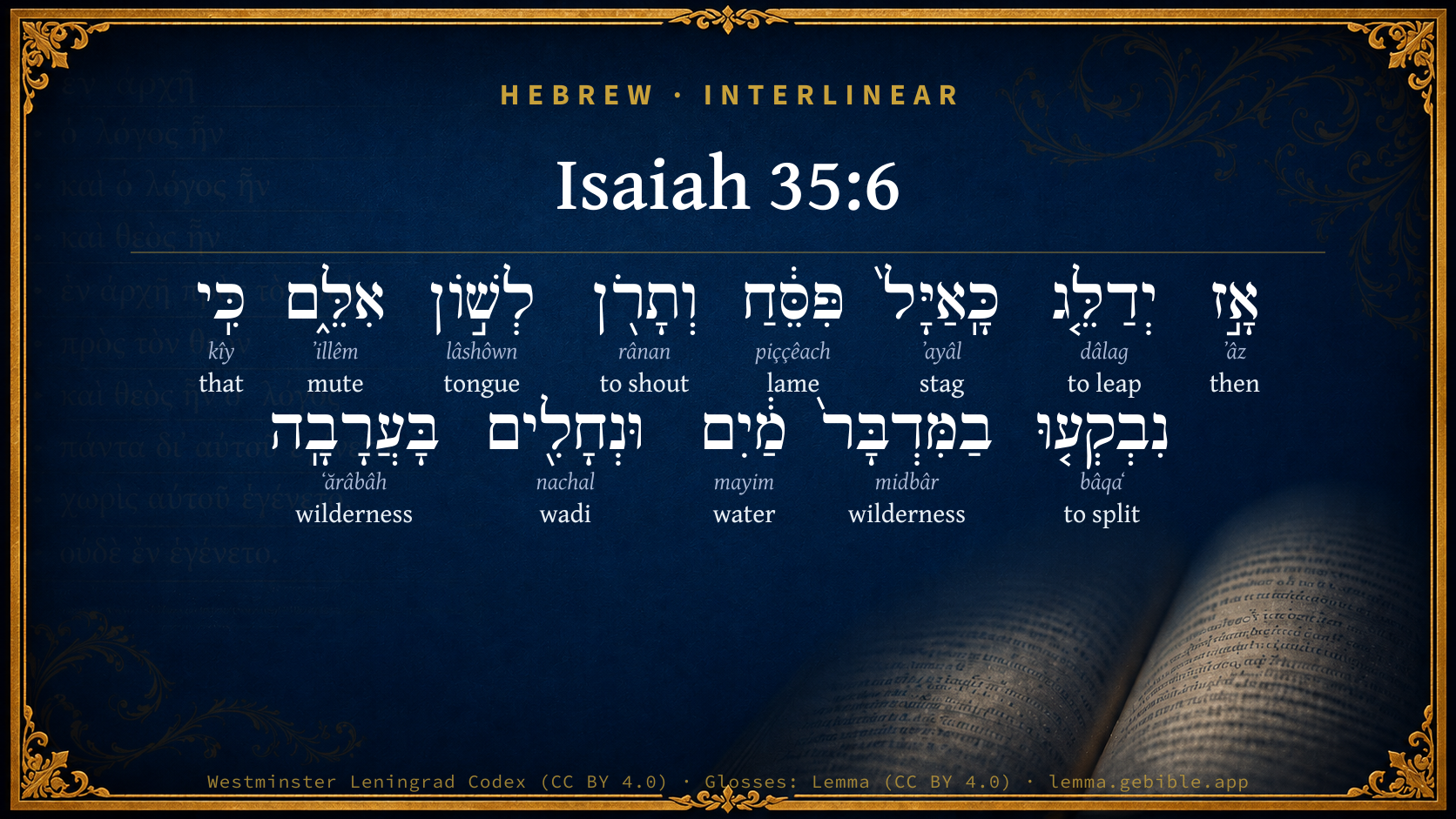
Isaiah 35:6

Hebrew (Westminster Leningrad Codex) Isaiah 35:6 appears in the Hebrew Old Testament. The text above is from the Westminster Leningrad Codex. Each word links to its Strong’s number, a concise gloss, and parsing drawn from the Open Scriptures Hebrew Bible morphology. Click any word for its full Brown-Driver-Briggs (BDB) entry.
Download image
Cite this verse

Isaiah 35:6 (World English Bible). Public Domain. Lemma interlinear Bible study tool, https://lemma.gebible.app/v/isaiah/35/6.

Show BibTeX & RIS
BibTeX
RIS
English Translation
Then shall the lame man leap as a hart, and the tongue of the mute shall sing; for in the wilderness shall waters break out, and streams in the desert.
World English Bible · Public Domain
Download a study sheet

One document with this verse’s original text, its word-by-word gloss line, the meaning frame, cross-references with their text, attributed commentary, and full source and license credits — printable, and it pastes into notes with its structure intact.

This verse Autodidact and up

Study sheet (.html) Plain text (.txt)

A passage Seminary Student

Up to 50 verses in one chapter. A passage sheet keeps up to 6 commentary sources and 12 cross-references per verse, in the order this page ranks them, and says so on the sheet whenever that leaves anything out. Ask for a single verse and you get the Autodidact verse sheet above.

Everything on this page stays free to read, with no account — the sheet is a download of what is already on screen, not access to it.

Want to remove ads? Support Godless Engineer
Compare translations 3

The same verse in 3 English versions, stacked beneath the original-language interlinear above. Click any original word for its lexicon entry.

Each is an independent rendering of the whole verse — the interlinear is not word-aligned to these translations.

Highlighted words mark where these versions differ — a whole-verse word diff, not a word-by-word alignment.

  • World English Bible Public Domain
    Then shall the lame man leap as a hart, and the tongue of the mute shall sing; for in the wilderness shall waters break out, and streams in the desert.
  • King James Version Public Domain
    Then shall the lame man leap as an hart, and the tongue of the dumb sing: for in the wilderness shall waters break out, and streams in the desert.
  • unfoldingWord Literal Text CC BY-SA 4.0
    Then the lame will leap like a deer, and the tongue of the mute will sing joyfully. For waters will break out in the wilderness, and streams, in the Arabah.

unfoldingWord Literal Text — © unfoldingWord, licensed CC BY-SA 4.0. Word-aligned USFM3 via Door43 (git.door43.org/unfoldingWord/en_ult).

Versions to compare (up to 4)

3 of 4 selected

Show all 18 translations

Every available English version of this verse, each an independent rendering of the whole verse.

  • World English Bible Public Domain
    Then shall the lame man leap as a hart, and the tongue of the mute shall sing; for in the wilderness shall waters break out, and streams in the desert.
  • Berean Standard Bible Public Domain
    Then the lame will leap like a deer and the mute tongue will shout for joy. For waters will gush forth in the wilderness, and streams in the desert.
  • Majority Standard Bible Public Domain
    Then the lame will leap like a deer and the mute tongue will shout for joy. For waters will gush forth in the wilderness, and streams in the desert.
  • King James Version Public Domain
    Then shall the lame man leap as an hart, and the tongue of the dumb sing: for in the wilderness shall waters break out, and streams in the desert.
  • American Standard Version (1901) Public Domain
    Then shall the lame man leap as a hart, and the tongue of the dumb shall sing; for in the wilderness shall waters break out, and streams in the desert.
  • Revised Version (1885) Public Domain
    Then shall the lame man leap as an hart, and the tongue of the dumb shall sing: for in the wilderness shall waters break out, and streams in the desert.
  • Geneva Bible (1599) Public Domain
    Then shall ye lame man leape as an hart, and the dumme mans tongue shall sing: for in the wildernes shall waters breake out, and riuers in ye desert.
  • Douay-Rheims (1899) Public Domain
    Then shall the lame man leap as a hart, and the tongue of the dumb shall be free: for waters are broken out in the desert, and streams in the wilderness.
  • Young's Literal Translation Public Domain
    Then leap as a hart doth the lame, And sing doth the tongue of the dumb, For broken up in a wilderness have been waters, And streams in a desert.
  • Literal Standard Version CC BY-SA 4.0
    Then the lame leap as a deer, || And the tongue of the mute sings, || For waters have been broken up in a wilderness, || And streams in a desert.
  • Unlocked Literal Bible CC BY-SA 4.0
    Then the lame man will leap like a deer, and the mute tongue will sing, for water breaks out in the Arabah, and streams in the wilderness.
  • unfoldingWord Literal Text CC BY-SA 4.0
    Then the lame will leap like a deer, and the tongue of the mute will sing joyfully. For waters will break out in the wilderness, and streams, in the Arabah.
  • Darby Bible Public Domain
    then shall the lame [man] leap as a hart, and the tongue of the dumb sing: for in the wilderness shall waters break out, and torrents in the desert.
  • World Messianic Bible Public Domain
    Then the lame man will leap like a deer, and the tongue of the mute will sing; for waters will break out in the wilderness, and streams in the desert.
  • Webster's Bible Public Domain
    Then shall the lame man leap as a hart, and the tongue of the dumb shall sing: for in the wilderness shall waters break out, and streams in the desert.
  • Free Bible Version CC BY-SA 4.0
    The lame will jump like a deer, and the dumb will sing for joy. Springs will gush in the wilderness; streams will flow in the desert.
  • Bible in Basic English Public Domain
    Then will the feeble-footed be jumping like a roe, and the voice which was stopped will be loud in song: for in the waste land streams will be bursting out, and waters in the dry places.
  • JPS Tanakh (1917) Public Domain
    Then shall the lame man leap as a hart, and the tongue of the dumb shall sing; for in the wilderness shall waters break out, and streams in the desert.

Literal Standard Version (2020), Covenant Press — licensed CC BY-SA 4.0. Text via the HelloAO Bible API (eBible.org). Unlocked Literal Bible (unfoldingWord) — licensed CC BY-SA 4.0. Text via the HelloAO Bible API (eBible.org). unfoldingWord Literal Text — © unfoldingWord, licensed CC BY-SA 4.0. Word-aligned USFM3 via Door43 (git.door43.org/unfoldingWord/en_ult). Free Bible Version, Dr. Jonathan Gallagher — licensed CC BY-SA 4.0. Text via the HelloAO Bible API (eBible.org).

Word by word

More ways to search: Search by grammar → Find every occurrence → Compare this word →

Practice this passage: Drill this verse → Learn its vocabulary →

יְדַלֵּ֤ג
dâlag
H1801
“to leap”
Verb, Piel, Imperfect, 3rd Person, Masculine, Singular
Part of Speech
Verb
Stem
Piel
Form
Imperfect
Person
3rd Person
Gender
Masculine
Number
Singular
Full BDB Definition

Origin: a primitive root

TWOT: 430

to leap - (Qal) to leap - (Piel) to leap, leap over
  1. אָ֣ז ʼâz H227 “then” Adverb
  2. כָּֽאַיָּל֙ ʼayâl H354 “like/as the · stag” Preposition, Determined + Noun, Common, Both, Singular, Absolute
  3. פִּסֵּ֔חַ piççêach H6455 “lame” Adjective, Adjective, Masculine, Singular, Absolute
  4. וְתָרֹ֖ן rânan H7442 “and · to shout” Conjunction + Verb, Qal, Imperfect, 3rd Person, Feminine, Singular
  5. לְשׁ֣וֹן lâshôwn H3956 “tongue of” Noun, Common, Both, Singular, Construct
  6. אִלֵּ֑ם ʼillêm H483 “mute” Adjective, Adjective, Masculine, Singular, Absolute
  7. כִּֽי kîy H3588 “that” Conjunction
  8. נִבְקְע֤וּ bâqaʻ H1234 “to split” Verb, Niphal, Perfect, 3rd Person, Common, Plural
  9. בַמִּדְבָּר֙ midbâr H4057 “in/at the · wilderness” Preposition, Determined + Noun, Common, Masculine, Singular, Absolute
  10. מַ֔יִם mayim H4325 “water(s)” Noun, Common, Masculine, Plural, Absolute
  11. וּנְחָלִ֖ים nachal H5158 “and · wadis” Conjunction + Noun, Common, Masculine, Plural, Absolute
  12. בָּעֲרָבָֽה ʻărâbâh H6160 “in/at the · wilderness” Preposition, Determined + Noun, Common, Feminine, Singular, Absolute

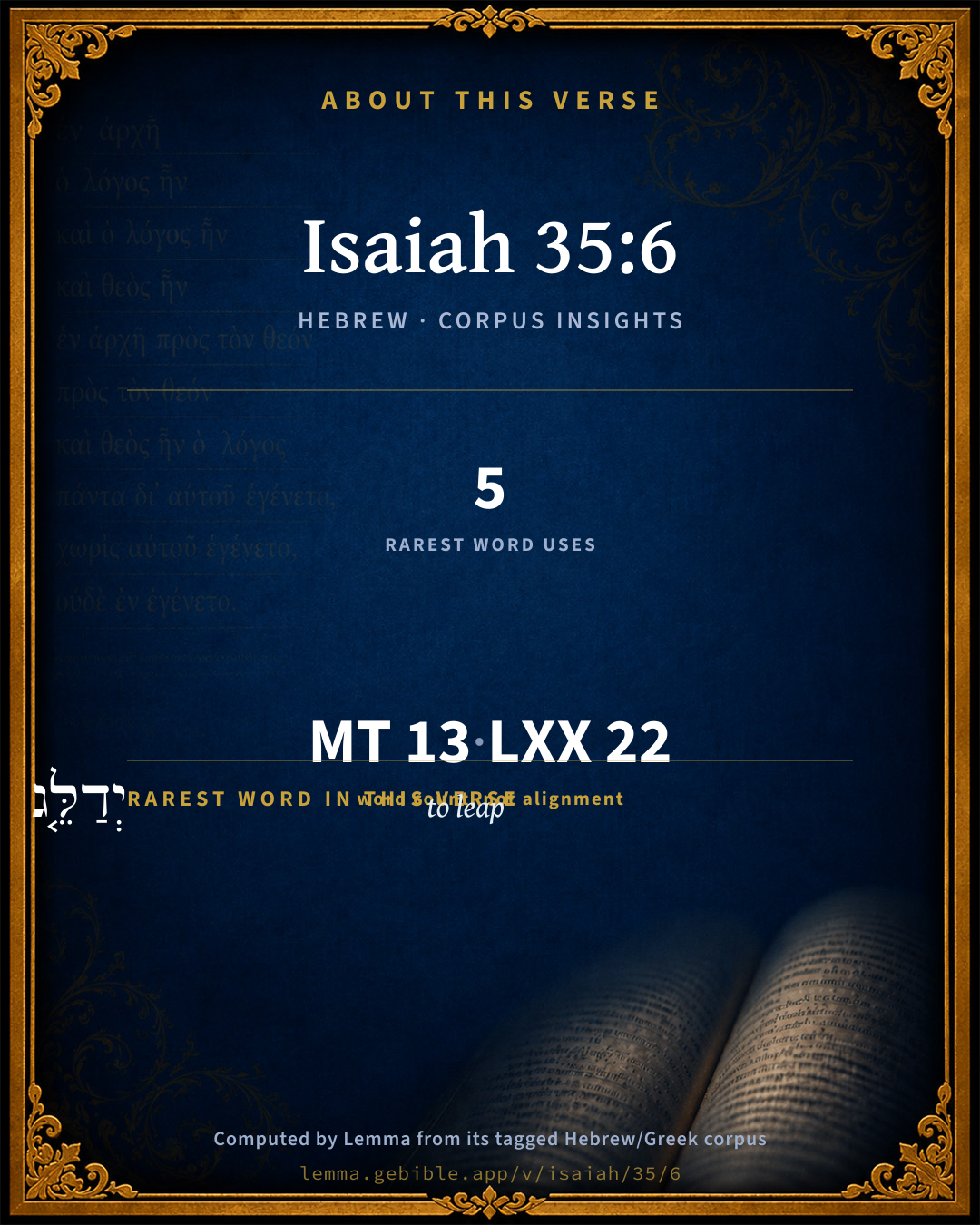
About this verse

These counts appear in no published source. They are computed here, from the morphology-tagged text and Lemma’s own curated glosses. What Lemma adds →

13
words
13
distinct lemmas
Prophets
section

Notable vocabulary

The rarest word here is יְדַלֵּ֤ג to leap H1801 — appearing just 5 times in the whole Hebrew Bible.

Shared distinctive vocabulary

יְדַלֵּ֤ג to leap H1801 occurs in 5 verses of the Hebrew Bible. Also found in:

Grammatical profile

  • 3 verbs
  • 6 nouns
  • 2 adjectives
  • 1 conjunction
  • 1 adverb

Verb forms

  • יְדַלֵּ֤ג Piel · Imperfect
  • וְתָרֹ֖ן Qal · Imperfect
  • נִבְקְע֤וּ Niphal · Perfect

Hebrew & Septuagint length

In English translation the verse runs 30 words from the Hebrew and 35 from the Septuagint (LXX English) — closely comparable.

A rough comparison of the two English renderings, which tokenize alike — not a word-level alignment.

Word counts can differ between the Hebrew and the Greek without any difference in meaning — e.g. the Hebrew direct-object marker אֵת has no separate Greek word, and Greek often adds the article ὁ.

In the original languages it is 13 Hebrew tokens and 22 Greek tokens — but the two are counted differently (Hebrew bundles its prefixes and suffixes into one token; the Greek is in lemma form), so that isn’t a like-for-like length.

Cross-references

32

Topical passages linked to Isaiah 35:6 in the Treasury of Scripture Knowledge — connected by theme and wording, ordered by reader-vote popularity; previews shown in the World English Bible.

  • John 5:8–9 Jesus said to him, "Arise, take up your mat, and walk."
  • Luke 11:14 He was casting out a demon, and it was mute. It happened, when the demon had gone out, the mute man spoke; and the multitudes marveled.
  • John 7:37–39 Now on the last and greatest day of the feast, Jesus stood and cried out, "If anyone is thirsty, let him come to me and drink!
  • Isaiah 32:4 The heart of the rash shall understand knowledge, and the tongue of the stammerers shall be ready to speak plainly.
  • Psalms 51:15 Lord, open my lips. My mouth shall declare your praise.
  • Matthew 9:32–33 As they went out, behold, a mute man who was demon possessed was brought to him.
  • Matthew 12:22 Then one possessed by a demon, blind and mute, was brought to him and he healed him, so that the blind and mute man both spoke and saw.
  • Luke 1:64 His mouth was opened immediately, and his tongue freed, and he spoke, blessing God.
  • Exodus 17:6 Behold, I will stand before you there on the rock in Horeb. You shall strike the rock, and water will come out of it, that the people may drink." Moses did so in the sight of the elders of Israel.
  • Numbers 20:11 Moses lifted up his hand, and struck the rock with his rod twice: and water came forth abundantly, and the congregation drank, and their cattle.
  • Nehemiah 9:15 and gave them bread from the sky for their hunger, and brought forth water for them out of the rock for their thirst, and commanded those who they should go in to possess the land which you had sworn to give them.
  • Psalms 46:4 There is a river, the streams of which make the city of God glad, The holy place of the tents of the Most High.
  • Psalms 78:15–16 He split rocks in the wilderness, And gave them drink abundantly as out of the depths.
  • Isaiah 35:1 The wilderness and the dry land shall be glad; and the desert shall rejoice, and blossom as the rose.
  • Isaiah 41:17–18 The poor and needy seek water, and there is none, and their tongue fails for thirst; I, Yahweh, will answer them, I, the God of Israel, will not forsake them.
  • Isaiah 43:19–20 Behold, I will do a new thing; now shall it spring forth; shall you not know it? I will even make a way in the wilderness, and rivers in the desert.
  • Isaiah 48:21 They didn't thirst when he led them through the deserts; he caused the waters to flow out of the rock for them; he split the rock also, and the waters gushed out.
  • Isaiah 49:10–11 They shall not hunger nor thirst; neither shall the heat nor sun strike them: for he who has mercy on them will lead them, even by springs of water will he guide them.
  • Ezekiel 47:1–11 He brought me back to the door of the house; and, behold, waters issued out from under the threshold of the house eastward; (for the forefront of the house was toward the east;) and the waters came down from under, from the right side of the house, on the south of the altar.
  • Zechariah 14:8 It will happen in that day, that living waters will go out from Jerusalem; half of them toward the eastern sea, and half of them toward the western sea; in summer and in winter will it be.
  • Matthew 11:5 the blind receive their sight, the lame walk, the lepers are cleansed, the deaf hear, the dead are raised up, and the poor have good news preached to them.
  • Matthew 15:30–31 Great multitudes came to him, having with them the lame, blind, mute, maimed, and many others, and they put them down at his feet. He healed them,
  • Matthew 21:14 The blind and the lame came to him in the temple, and he healed them.
  • Mark 7:32–37 They brought to him one who was deaf and had an impediment in his speech. They begged him to lay his hand on him.
  • Mark 9:17–25 One of the multitude answered, "Teacher, I brought to you my son, who has a mute spirit;
  • Acts 3:2 A certain man who was lame from his mother's womb was being carried, whom they laid daily at the door of the temple which is called Beautiful, to ask gifts for the needy of those who entered into the temple.
  • Acts 3:6–8 But Peter said, "Silver and gold have I none, but what I have, that I give you. In the name of Jesus Christ of Nazareth, get up and walk!"
  • Acts 8:7 For unclean spirits came out of many of those who had them. They came out, crying with a loud voice. Many who had been paralyzed and lame were healed.
  • Acts 14:8–10 At Lystra a certain man sat, impotent in his feet, a cripple from his mother's womb, who never had walked.
  • Colossians 3:16 Let the word of Christ dwell in you richly; in all wisdom teaching and admonishing one another with psalms, hymns, and spiritual songs, singing with grace in your heart to the Lord.
  • Revelation 22:1 He showed me a river of water of life, clear as crystal, proceeding out of the throne of God and of the Lamb,
  • Revelation 22:17 The Spirit and the bride say, "Come!" He who hears, let him say, "Come!" He who is thirsty, let him come. He who desires, let him take the water of life freely.

Cross-references courtesy of OpenBible.info (CC BY 4.0).

Hebrew and Greek witnesses Masoretic Hebrew ↔ Greek Septuagint

The same verse in the two great witnesses to the Old Testament, shown verse-for-verse.

These are two independent witnesses, not word-aligned to each other, and the Septuagint is shown in lemma (dictionary) form.

Hebrew Isaiah 35:6 Masoretic · Westminster Leningrad Codex

אָ֣ז יְדַלֵּ֤ג כָּֽאַיָּל֙ פִּסֵּ֔חַ וְתָרֹ֖ן לְשׁ֣וֹן אִלֵּ֑ם כִּֽי נִבְקְע֤וּ בַמִּדְבָּר֙ מַ֔יִם וּנְחָלִ֖ים בָּעֲרָבָֽה

Then shall the lame man leap as a hart, and the tongue of the mute shall sing; for in the wilderness shall waters break out, and streams in the desert.

World English Bible · Public Domain

Greek LXX Isaiah 35:6 Septuagint · lemma form

τότε ἅλλομαι ὡς ἔλαφος ὁ χωλός καί τρανός εἰμί γλῶσσα μογίλαλος ὅτι ῥήγνυμι ἐν ὁ ἔρημος ὕδωρ καί φάραγξ ἐν γῆ διψάω

Then shall the lame man leap as an hart, and the tongue of the stammerers shall speak plainly; for water has burst forth in the desert, and a channel of water in a thirsty land.

LXX2012 (modern English Septuagint) · Public Domain

Hebrew: Westminster Leningrad Codex (CC BY 4.0). Greek: Septuagint (public domain); English from LXX2012 (modern English Septuagint) (Public Domain). How the Septuagint differs from the Hebrew →

Targum (Aramaic paraphrase)

1

The Targum is the ancient Jewish Aramaic paraphrase of the Hebrew Scriptures — an interpretive translation, not the Hebrew text itself. Onkelos (literal) and Pseudo-Jonathan (expansive) render the Torah, and Jonathan the Prophets. Coverage is partial: where no permissively-licensed English translation exists for a verse, only the Aramaic is shown. This is verse-level text, not a word-by-word alignment to the Hebrew.

  1. Targum Jonathan Prophets (Joshua–Malachi)
    בְּכֵן בְּמֶחְזְהוֹן גַלְוָתָא דְיִשְׂרָאֵל דְמִתְכַּנְשִׁין וְסַלְקָן לְאַרְעֲהוֹן הָא כְּאַיָלִין קַלִילִין וְלָא לְאִתְעַכָּבָא וִישַׁבַּח לִישָׁנְהוֹן דַהֲוָה בְּלִים אֲרֵי בְּכֵן אִתְבְּזָעוּ בְמַדְבְּרָא מַיָא וְנַחֲלַיָא בְּמֵישְׁרָא:

    Then when they shall see the captives of Israel gathered to go up to their own land as the swift harts, and not tarry, they shall sing with their tongue, which has been tied, because then the waters shall gush forth in the wilderness, and rivers in the plain.

    Targum Jonathan — Aramaic: “Mikraot Gedolot” (public domain). English: “Sefaria Community Translation” (CC0 1.0 (public-domain dedication)); “London "Chaldee Paraphrase," 1871” (public domain). Text via Sefaria.

Commentary

Notes on Isaiah 35:6 from classic Christian and Jewish commentators (each source and its license shown beneath its notes). The classic Christian expositions comment on the surrounding passage and are grouped to its opening verse, so a note may address several verses; the Jewish commentaries on the Tanakh (Rashi and others) are per-verse, so they appear only where the commentator wrote on this verse.

Lemma curates 59 commentaries, every one of them public domain or Creative Commons licensed, each selected and text-cleaned for this edition rather than reprinted as found. About our sources →

Trapp's Complete Commentary

John Trapp

Isa 35:6 Then shall the lame [man] leap as an hart, and the tongue of the dumb sing: for in the wilderness shall waters break out, and streams in the desert.

Ver. 6. Then shall the lame man leap as an hart.] As that impotent man did, {Act 3:8} and those Loripedes {Heb 12:13}

And the tongue of the dumb sing.] As good old Zacharias did, {Luk 1:64} not so much for his speech restored, or his son received, as for his Saviour now at hand; and as did those that sang, "He hath done all things well; he maketh both the deaf to hear, and the dumb to speak," {Mar 7:37} yea, to utter the great things of God, and to speak good of his name. Lo here, saith Luther, miracles to confirm the gospel to be of God, against those that deride his ministers, saying, They cannot make so much as a lame horse sound: for all they in whose hearts it taketh effect, of blind are made to see, of deaf to hear, of lame to go, and of dumb to speak.

For in the wilderness shall waters break out.] This, and that which followeth in the next verse, Junius maketh to be the matter of their song - viz., the grace of God abundantly communicated to his Church. See Joh 7:38-39. The Jews dream that when their Messiah cometh, the Red Sea shall again be divided and the rock cloven, much water gushing out, &c. Thus they work themselves into the fool’s paradise of a sublime dotage, by misunderstanding this text.

John Trapp, A Commentary or Exposition upon All the Books of the Old and New Testament (1647–1656) — public domain. Text from a community e-Sword module.

The Biblical Illustrator

Joseph S. Exell

Isa_35:6

Then shall the lame man leap as an hart

A threefold promise

1.

Banished crutch.

2. Accentuation of speechless tongue.

3. Irrigated Sahara. (T. De Wilt Talmage, D. D.)

And the tongue of the dumb sing

Dumb singers

I. NOTE THE PERSONS WHOM GOD HAS CHOSEN TO SING HIS SONGS FOR EVER. The tongue of the dumb shall sing. Their singing does not come naturally from themselves; they were not born songsters. No, they were dumb. How this ought to give you encouragement in seeking to do good to others! If you have neighbours who are profaners of the Sabbath, haters of God, unwilling to come to the house of God, despising Christ; if you find them as far gone as you can find them, recollect He maketh the dumb sing, and therefore He can make them live.

II. Now I am to enter into some rather more lucid DESCRIPTION OF THESE DUMB PEOPLE. Who are they? Sometimes I get a good thought out of Crudens Concordance. As I opened it at this passage, I found Master Cruden describing different kinds of dumb people. He says there are four or five different sorts, but I shall name only four of them.

1. Those who cannot speak--that is the usual acceptation of the word dumb--the others are, of course, only figurative applications of the term. Now, spiritually, the man who is still in his trespasses and sins is dumb. He is dead, and there is none so dumb as a dead man. Shall the dead arise and praise Thee? Shall Thy loving-kindness be declared in the grave, or Thy faithfulness in destruction? As no man can call Jesus Lord, except by the Holy Ghost, these people cannot do so truly. But, all hail sovereign grace! They are dumb by nature, but He will not leave them so; they cannot now sing His praises, but they shall do it; they will not now confess their sins, but He will bring them on their knees yet, and make them pour out their hearts before Him.

2. But there is a sort of dumb people that will not speak. They are mentioned by Isaiah. He said of preachers in his day, they were dumb dogs that would not bark.

3. I will now introduce you to a third sort of dumb people. They are dumb because they dare not speak; and they are good people. Here is one of them: I was dumb with silence; I opened not my mouth, because Thou didst it. And it is so blessed to be dumb in that fashion. The Lords servant will often have to be dumb under trials and troubles. You are, it may be, in the deepest trouble now, and obliged to be silent; well, you shall sing yet for all that. If you cannot cheer the darkness with songs in the night, yet He shall compass you about with songs of deliverance. We are not always to be silent with affliction. The saints have known joy, unspeakably great, in the midst of trial intolerably hot. Their murmuring has been silenced, and their thanks-giving has become vocal. An old Puritan said, Gods people are like birds; they sing best in cages.

4. We have one more kind of dumb people--those who have nothing to say. I will give you an instance; Solomon says in the Proverbs--Open thy mouth for the dumb; and he means those who in the court of judgment have nothing to plead for themselves, and have to stand dumb before the bar. Like that man of old, who, when the king came in to see the guests, had not on a wedding garment; and when the king said, Friend, how earnest thou in hither? he stood speechless; speechless, not because he could not speak, but because he had nothing to say. Have not you and I been dumb, and are we not now, when we attempt to stand on law terms with God, when we forget that Jesus Christ and His blood and righteousness are our full acquittal? We can now sing this anthem: Who shall lay anything to the charge of Gods elect? Not God, for He hath justified. Who is he that condemneth? Not Christ, He hath died, yea rather, hath risen again, who is even at the right hand of God, and maketh intercession for us.

III. THE OCCASIONS WHEN THE TONGUE OF THESE DUMB PEOPLE SINGS THE BEST. I think it sings always, little or much. If it is once set at liberty, it will never leave off staging. (C. H. Spurgeon.)

In the wilderness shall waters break out

The figure of the wilderness

The lovely poetry of this passage is almost thrown away upon us who have had no actual experience of the wilderness. Our imagination has been largely helped by the vivid and pathetic descriptions from travellers who have been through it; but the most powerful imagination cannot enable us to feel its awful reality. The interminable expanse, the distressing sameness, the horizon for leagues on leagues unbroken by a solitary tree or shrub. The burning sand blinding our eyes and scorching our feet. The very pathway, confused and often obliterated by the blast of the burning wind, is strewn with the bleached bones of the poor creatures who have fallen victims to the heat and drought. Not a bird flying over our heads, nor a harmless animal to be seen browsing a scanty pasture. The night is made terrible and the gloom is deepened by the roarings of the lion and the howlings of the jackal and the hyaena. Not a scrap of food of fruit or root to be obtained, and, worst of all, not a drop of water to quench the fiery thirst. Our parched lips can scarcely close. And this dreadful place is so interminable that it takes days and weeks to traverse; only here and there at long intervals does the exhausted and almost demented traveller come upon the green oasis and the priceless well of water. In the Old Testament the horrors of the desert are often used to figure the miserable aspect of life, and the privations of the human soul. My soul is athirst for Thee, in a barren and dry land where no water is. As the hart panteth after the water brooks, so longeth my soul after Thee, O God. My soul is athirst for God, yea even for the living God; when shall I come to appear before the presence of God? I will pour water upon him that is thirsty and floods upon the dry ground. And here Isaiah, wishing to show the glory and beauty of a true vision of God, compares the change out of the darkness and misery or soul to the transformation of the wilderness into a garden. (C. Voysey, M. A.)

The wilderness of existence

The heart of man is the real wilderness, where dearth and drought and quenchless thirst torment and destroy him until he get the vision of the glory of God, which is His love. When man sees that, the waters break forth m the wilderness of his soul, and streams in the desert. His heart shall blossom as the rose and blossom abundantly; and not only flowers but fruit shall he bear for the healing of the nations. When man learns how God loves us all, then shall he find joy and gladness; and sorrow and sighing shall flee away. That is the essence of the poem. But it teaches yet a great deal more. When mans heart is turned from a wilderness into a garden by the knowledge of Gods love, he is not only happy in himself, but he is a fountain and stream of happiness to others. Then the eye of the blind are opened and the ears of the deaf unstopped. Then doth the lame man leap as an hart and the tongue of the dumb can sing. His love for others is kindled and set aglow by the sight of the love of God. So we get three distinct ideas out of the poetry before us. The knowledge of the love of God as the source of all blessedness--first, to bring joy and gladness into individual souls, and then to make them fruitful in bringing joy and gladness into the hearts of their fellow-men. (C. Voysey, M. A.)

God alone the satisfaction of humanity

If we would only believe it, we should see that in proportion as we regard our surroundings as a desert, we are giving proof that we belong to a higher order of existence than those who can be satisfied with the common pleasures, the bread and water of merely animal life. If we belong to that higher order, if our true realm is not of this world, we shall not be able to satisfy ourselves with all that this world can possibly furnish. Our thirst will only be inflamed and not quenched by every effort to allay it with earthly gratification. And I do not think it unreasonable to ask you to take the next step--which is more like a leap than a step--and to admit that God never intended us to be perfectly happy here on earth, in and through only the satisfaction of our earthly desires. He has so made us that the world and human life, lovely and delicious as these are, shall yet be to us a very wilderness full of weariness and hunger and thirst, until we have found our true satisfaction in Him and His love. (C. Voysey, M. A.)

The joys of the godly

The whole secret of our happiness lies in this knowledge of the love of God.

1. It adds enormously to every lawful pleasure and indulgence. We take our joys in company with God. In our recreation, in our games, in our mirth and laughter, we revel all the more freely and heartily because we never forget that He is there, never forget that it is from Him that have come our varied powers of enjoyment and the numberless resources which minister to it. We set God always before us, and therefore in all the so-called blessings and comforts of life we are free from sin in the using. We will not enjoy any pleasure for which we cannot give Him thanks. And it is amazing what a large extra number of pleasures we is in consequence.

2. A still greater wealth is poured upon us by the sight of the love of God. It turns all our pains and sorrows into joy. It gives us perfect contentment with our lot. We know it could not have come against His will. We know it has come, then, to do us good. If we will only be patient and bear it like a man, we shall soon see the blessing which God had wrapped up in it; when our God comes to us in the wilderness of our woe, the water breaks forth and we are satisfied and refreshed. He is our living fountain of peace and hope and joy unspeakable; His love touches the strong rock of our hearts rebellion, and lo! the streams of gladness flow forth and we are like a well-watered garden. Then our poor blind eyes are opened to see only good, where we thought there was only evil. Then our deaf ears are unstopped, and we listen joyfully and thankfully to His soothing and cheering whisper of peace. Then our palsied limbs leap up at His call and we do the duty that lies nearest to us; we begin to make the best of our altered conditions and tread cheerfully the path of thorns in which His hand is leading us. And the tongue of the dumb shall sing. Our stubborn lips fast closed in anger and resentment, our tongue cleaving to the roof of our mouth in distress and despair, shall now move in harmony with the gladness awakened by the sight of His love. We shall glorify Him in the fires of tribulation; we shall sing of His great salvation. (C. Voysey, M. A.)

The desire to bless others

And yet more and more comes out of that inexhaustible fountain of goodness and joy. The sight of the love of God not only transfigures the life of each individual, but makes us do our best to convert the wilderness around us into a garden. Atheists have confessed to me how barren of any practical good atheism is, how absolutely deficient in any inspiring motive for kindly endeavour to help others. But we know, by our own experience, that the sight of Gods love which has turned our own wilderness into a garden, has likewise stirred us up into an enthusiasm of brotherly love and has borne fruit in practical endeavours to bring streams into the desert of lives not our own. (C. Voysey, M. A.)

Streams in the desert

The streams are spiritual, and refer to the diffusion of the Gospel and the manifold blessings of salvation over the world.

I. A FEW OF THE BLESSINGS WHICH THESE STREAMS IMPART. They are a source of--

1. Spiritual fertility. No other streams are possessed of the same fertilising power. Modern writers show a tendency to ascribe to the influence of civilisation and knowledge all our social, moral, and religious blessings. But how do they reconcile their theories with the comparatively barren effects of Egyptian science and civilisation, Greek philosophy and art, and Roman law and discipline? Be the influence of these latter what they might, they wrought no radical change on mans moral and spiritual character.

2. Spiritual beauty. Wherever streams flow in such lands as Judaea, there luxuriance waves, but in an endless variety of appearance. Not less diversified is the influence of Divine grace on the character. Religion does not obliterate nature, but works in harmony with it, preserving all its innocent idiosyncrasies, so that as in the natural world are to be seen the cedar, the palm; the fir, and the rose, so in the Church, along the streams of Divine grace, are to be seen a John and a Peter, a Martha and a Mary.

3. Spiritual joy. Every one has experienced the refreshing influence of water. This is an image of the deep satisfaction and joy which true religion is fitted to impart. No other streams convey the same joy.

II. SOME OF THE DISTINGUISHING EXCELLENCES BY WHICH THE STREAMS ARE CHARACTERISED.

1. They are full and abundant.

2. They are free to all. Men have tried to fence round these streams, and to reduce them to the limits of their own selfish hearts and narrow creed; but Gods thoughts are not as our thoughts, nor His ways as ours. While this is cheering, it is also a solemnising, thought, laying the responsibility of our own ruin on ourselves.

3. They are near and accessible. If a visit to such rivers as the Ganges or the Nile were requisite to our salvation, how many would be unable to comply with the condition. But these streams flow wherever the Gospel comes.

4. They are ever spreading in their influence. What is the garden of the Lord compared with the desert of this world? It is seen blooming in little oases here and there. But these streams are destined to spread and multiply, and to cover the whole earth with spiritual verdure and beauty.

Conclusion--

1. These streams are at present accessible, but may not be so long. Come to them now.

2. Remember that Jesus is the only channel through which they can reach us. (W. Johnston.)

The Biblical Illustrator, edited by Joseph S. Exell (c. 1880s–1900s) — public domain. Text from a community e-Sword module.

MacLaren's Expositions of Holy Scripture

Alexander MacLaren

Isaiah

MIRACLES OF HEALING

MIRAGE OR LAKE

Isa 35:6 - Isa 35:7.

What a picture is painted in these verses! The dreary wilderness stretches before us, monotonous, treeless, in some parts bearing a scanty vegetation which flourishes in early spring and dies before fierce summer heats, but for the most part utterly desolate, the sand blinding the eyes, the ground cracked and gaping as if athirst for the rain that will not fall; over it the tantalising mirage dancing in mockery, and amid the hot sand the yelp of the jackals. What does this dead land want? One thing alone-water. Could that be poured upon it, all would be changed; nothing else will do any good. And it comes. Suddenly it bursts from the sand, and streams bring life along the desert. It gathers into placid lakes, with their whispering reeds and nodding rushes, and the thick cool grass round their margins. The foul beasts that wandered through dry places seeking rest are drowned out. So full of blessed change will be the coming of the Lord, of which all this context speaks. Mark that this burst of waters is when ‘the Lord shall come,’ and that it is the reason for the restoration of lost powers in men, and especially for a chorus of praise from dumb lips. This, then, is the central blessing. It is not merely a joyful transformation, but it is the reason for a yet more joyful transformation {Isa 44:3}. Recall Christ’s words to the Samaritan woman and in the Temple on the great day of the Feast.

Then this is pre-eminently a description of the work of Christ.

I. Christ brings the Supernatural Communication of a New Life.

We may fairly regard this metaphor as setting forth the very deepest characteristic of the gospel. Consider man’s need, as typified in the image of the desert. Mark that the supply for that need must come from without; that coming from without, it must be lodged in the heart of the race; that the supernatural communication of a new life and power is the very essence of the work of Christ; that such a communication is the only thing adequate to produce these wondrous effects.

II. This new life slakes men’s thirst.

The pangs and tortures of the waterless wilderness. The thirst of human souls; they long, whether they know it or not, for-

Truth for Understanding.

Love for Heart.

Basis and Guidance for Will and Effort.

Cleansing for Conscience.

Adequate objects for their powers.

They need that all these should be in One.

The gnawing pain of our thirst is not a myth; it is the secret of man’s restlessness. We are ever on the march, not only because change is the law of the world, nor only because effort and progress are the law for civilised men, but because, like caravans in the desert, we have to search for water.

In Christ it is slaked; all is found there.

III. The Communication of this New Life turns Illusions into Realities.

‘The mirage shall become a pool.’ Life without Christ is but a long illusion. ‘Sin makes a mock of fools.’ How seldom are hopes fulfilled, and how still less frequently are they, when fulfilled, as good as we painted them! The prismatic splendours of the rain bow, which gleam before us and which we toil to catch, are but grey rain-drops when caught. Joys attract and, attained, have incompleteness and a tang of bitterness. The fish is never so heavy when landed on the sward as it felt when struggling on our hook. ‘All is vanity’-yes, if creatures and things temporal are pursued as our good. But nothing is vanity, if we have the life in us which Jesus comes to give. His Gospel gives solid, unmingled joys, sure promises which are greater when fulfilled than when longed for, certain hopes whose most brilliant colours are duller than those of the realities. The half has not been told of the ‘things which God hath prepared for them that love Him.’

Sure Promises.

A certain Hope.

IV. This New Life gives Fruitfulness. It stimulates all our nature. A godless life is in a very tragic sense barren, and a wilderness. There is in it nothing really worth doing, nor anything that will last. Christ gives Power, Motive, Pattern, and makes a life of holy activity possible. The works done by men apart from Him are, if measured by the whole relations and capacities of the doers, unfruitful works, however they may seem laden with ruddy clusters. It is only lives into which that river of God which is full of water flows that bring forth fruit, and whose fruit remains. The desert irrigated becomes a garden of the Lord.

Note, too, how this river drowns out wild beasts. The true way of conquering evil is to turn the river into it. Cultivate, and weeds die. The expulsive power of a new affection is the most potent instrument for perfecting character.

What is the use of water if we do not drink? We may perish with thirst even on the river’s bank. ‘If any man thirst, let him come to Me and drink.’

Alexander MacLaren, Expositions of Holy Scripture (1904–1910) — public domain. Text from a community e-Sword module.

Tyndale Open Study Notes

Tyndale Open Resources

35:6 The lame . . . those who cannot speak: All disabilities will be removed (see Matt 11:5; 12:22; Mark 7:37; Acts 3:7-8).

Tyndale Open Study Notes — © Tyndale Open Resources, licensed CC BY-SA 4.0. Text via the HelloAO Bible API.

Geneva Bible (1599)

Geneva Bible translators

They that were barren and destitute of the graces of God, shall have them given by Christ.

Geneva Bible (1599) marginal notes — public domain. Text via Bolls.life.

Jamieson, Fausset & Brown

Robert Jamieson, A. R. Fausset & David Brown

leap--literally, "fulfilled" (Act 3:8; Act 14:10).

sing--joyful thanksgiving.

in . . . wilderness . . . waters-- (Isa 41:18).

Jamieson, Fausset & Brown — Commentary Critical and Explanatory on the Whole Bible (1871) — public domain (CC PDM 1.0). Text via the HelloAO Bible API.

John Gill's Exposition

Then shall the lame man leap as an hart..... As the lame man did healed by Peter, Act 3:1 there were many instances of such persons cured by Christ when here on earth, Mat 15:30 and in a spiritual sense this was verified in many who were impotent to that which is good; had neither will nor power to go to Christ for life and salvation, nor to walk by faith in him, nor to walk in his ways; who yet, by the mighty power of the Spirit and grace of God, became able and willing to go to him, and venture their souls on him; walked on in him as they had received him; and not only walked in his ways, but ran in the ways of his commandments, and leaped for joy for what they saw and heard of him, and received from him; and innumerable will be the instances of such mighty grace at the spiritual coming and reign of Christ:

and the tongue of the dumb shall sing; this had its accomplishment, in a literal sense, at the first coming of Christ, Mat 9:32, Mat 12:22 and, in a spiritual sense, in many who before had nothing to say to God in prayer, nor in praise; nothing to say of Christ, or for him; or of the blessed Spirit, and his divine operations; but now, by divine grace, are made to speak unto God, both in a petitionary way, and in a way of thankfulness; and of Christ, and of the blessed Spirit; and of the great things each have done for them; and even to sing for joy, because of the wondrous blessings of grace they were made partakers of; and many more such there will be in the latter day, when the Spirit is poured down from on high. Kimchi interprets all this of the Israelites, who were in captivity as blind, deaf, lame, and dumb. So the Targum of this and the preceding verse Isa 35:5,

"then shall the eyes of the house of Israel be opened, who were as blind men as to the law; and the ears of them that are as deaf men, to attend to the words of the prophets shall hear; then when they shall see the captives of Israel gathered to go up to their own land as the swift harts, and not tarry,'' &c.;

but it may be better applied to their present state, and to their case when they shall be turned to the Lord in the latter day:

for in the wilderness shall waters break out, and streams in the desert; not literally, but mystically; and may be understood both of the doctrines of the Gospel breaking out in the ministry of them, in such places as were like unto the wilderness and desert, quite barren, and destitute of the knowledge, grace, and fear of God; see Joe 3:18 and of the abundance of grace, and the efficacy of it, making the word effectual to the conversion and fruitfulness of multitudes of souls, bringing along with it a vast variety of spiritual blessings; see Joh 7:37 to both which, the one as the means, and the other as the cause, all the above wonderful things are owing.

John Gill's Exposition of the Whole Bible (1746–1763) — public domain (CC PDM 1.0). Text via the HelloAO Bible API.

Albert Barnes' Notes on the Bible

Then shall the lame man leap - This was literally fulfilled after the coming of the Messiah Act 14:10; Act 3:8. It is an emblem of the general joy which the coming of the Messiah would impart, and is an instance of the blessings which it would convey.

As an hart - The word used here denotes the stag, or male deer. In Arabic it denotes the wild, or mountain-goat. The word sometimes refers to any species of deer or antelope, and this is referred to here from its quick and sprightly nature.

And the tongue of the dumb sing - Shall be able to sing, and to praise God. On the restoration of the dumb to the benefits of language, see Mat 9:32-33; Mat 12:22; Mat 15:30-31; Mar 9:17; Luk 11:14.

For in the wilderness shall waters break out - The joy shall be as great, and the blessings as numerous and refreshing, as if running fountains should suddenly break out in the desert, and the thirsty and weary traveler should be thus unexpectedly and fully supplied. The world, in regard to its real comforts without the gospel, may be not unaptly compared to g vast waste of pathless sands and arid plains. Nothing will more strongly express the blessings of the gospel than the idea of cool, refreshing, abundant fountains and streams bursting forth in such pathless wastes. This is an image which would be very expressive to those who were accustomed to cross such deserts, and it is one which is frequently employed by the sacred writers, and especially by Isaiah (see Isa 43:19-20; Isa 48:21; Isa 49:10-11; Isa 55:1; Isa 58:11). ‘Lameness and dumbness are the uniform effects of long walking in a desert; the sand and gravel produce the former, fatigue the latter. In such cases some of us have walked hours together without uttering a sentence; and all walked as if crippled, from the sand and gravel getting into the shoes; but the sight of water, especially if unexpected, unloosed every tongue, and gave agility to every limb; men, oxen, goats, sheep, and dogs, ran with speed and expressions of joy to the refreshing element.’ (Campbell’s Travels in Africa.) The Chaldee Paraphrast understands this as referring entirely to the return from the captivity at Babylon. ‘Then shall they see the exiles of Israel assembled, ascend to their own land as the swift stags, so that they shall not be hindered.’

Albert Barnes' Notes on the Bible (1834–1885) — public domain. Text from a community e-Sword/MySword module.

Haydock's Catholic Bible Commentary

Free. Our Saviour healed both soul and body, (Calmet) shewing by his works (John x.; Worthington) that he had fulfilled this prediction, Luke vii. 22., and Matthew xi. 5. --- Waters. Baptism has sanctified the most wicked.

George Leo Haydock (1774–1849), Haydock's Catholic Family Bible and Commentary, 1859 edition — public domain. Excludes Psalms (Douay-Rheims chapter numbering differs from Protestant) and Deuterocanonical books (Catholic canon only).

Matthew Poole's English Annotations

Then shall the lame man leap for joy, or go nimbly and readily. And this clause also, and that which follows, are to he understood both spiritually and literally, as in the former verse.

In the wilderness small waters break out, and streams in the desert; the most dry and barren places shall be made moist and fruitful; which is principally meant of the plentiful effusion of God’s grace upon such persons and nations as had been wholly destitute of it.

Matthew Poole's English Annotations on the Holy Bible (1683–1685) — public domain. Text from a community e-Sword/MySword module.

The Pulpit Commentary

For in the wilderness shall waters break out. The wilderness of humanity shall be renovated by a large effluence of God"s grace. (comp. Isa_30:25 Isa_32:2 Isa_41:18 Isa_43:19 Joh_7:37, Joh_7:38)

The Pulpit Commentary (1880–1919), ed. H.D.M. Spence-Jones & Joseph S. Exell — public domain. Text from a community e-Sword module.

J. A. Alexander on Isaiah

Joseph Addison Alexander

“And the mirage shall become a pool (or the sand lake a water lake, the seeming lake a real one), and the thirsty land springs of water, (even) in the haunt of wolves, their lair, a court (or field) for reed and rush.” The idea of complete and joyful change is still expressed by the transformation of a desert and the consequent removal of its inconveniences, among which the Prophet here particularly mentions the tantalizing illusions to which travelers in the wilderness are subject. The first noun denotes the illusive appearance caused by unequal refraction in the lower strata of the atmosphere, and often witnessed both at sea and land, called in English looming, in Italian fata morgana, and in French mirage. In the deserts of Arabia and Africa, the appearance presented is precisely that of an extensive sheet of water, tending not only to mislead the traveler but to aggravate his thirst by disappointment. The phenomenon is well described by Quintus Curtius in his Life of Alexander the Great. It is also referred to in the Koran. ‘More deceitful than the mirage is an Arabian proverb.’ Its introduction here adds a beautiful stroke to the description, not only by its local propriety, but by its strict agreement with the context.

Joseph Addison Alexander, The Prophecies of Isaiah (1846–1847; New York: Scribner, 1870–1878) — public domain. Text from a community e-Sword module.

Rashi

Rabbi Shlomo Yitzchaki (Rashi)

Then the lame shall skip like a hart, etc. Israel, who are now lame and weak. We find that he calls the weak with an expression of ‘lame,’ as the matter is stated (above 33:23): “The lame take the prey.”

shall sing in My salvation.

the tongue of the mute The tongue of Israel, who are among the nations as mutes, for they hear their scorn and do not respond.

for water has broken out in the desert For My salvation shall cheer them up, and they shall blossom like a desert wasteland, which thirsts for water, and springs break out into it; i.e., for salvation shall sprout for the crushed ones.

Rashi on the Tanakh — English translations: “The Judaica Press complete Tanach with Rashi, translated by A. J. Rosenberg” (CC BY 4.0); “Pentateuch with Rashi's commentary by M. Rosenbaum and A.M. Silbermann, 1929-1934” (public domain); “The Metsudah Tanach series, Lakewood, N.J” (CC BY 4.0); and “The Book of Joshua, Metsudah Publications, 1997” (CC BY 4.0). Text via Sefaria.

Ibn Ezra

Rabbi Abraham ibn Ezra

Then shall the lame man leap, in his return to Jerusalem.

And the tongue of the dumb shall sing. A figurative expression for they will find water everywhere; it is the reverse of the tongue of the suckling cleaveth to the roof of his mouth for thirst (Lam. 4:4)

Ibn Ezra on the Tanakh — English translations: “Sefaria Community Translation” (CC0 1.0 (public-domain dedication)); “Yalkut, Sifsei Chachomim Chumash, Metsudah Publications, 2009” (CC BY 4.0); and “Commentary of Ibn Ezra on Isaiah - trans. by M. Friedlander, 1873” (public domain). Text via Sefaria.

Lesson kit

Teaching starters — assembled from the data on this page, not authored interpretation. Every prompt links to the verse data it draws on. Edit before teaching.

Isaiah, in the Prophets, opens this verse with 13 words (13 distinct Hebrew lemmas). Its most distinctive word is dâlag (“to leap”). A historical commentator’s framing appears above. Read the whole chapter for the surrounding context.

Discussion questions

  1. The word dâlag carries the sense “to leap.” How does it shape the verse?
  2. How does 2 Samuel 22:30, which shares the word «to leap», read alongside this verse?
  3. These translations render this verse differently. What is at stake in choosing one wording over another?
  4. «יְדַלֵּ֤ג» is a Piel Imperfect verb. How does that grammatical form shape the action described?
  5. Compare how Trapp's Complete Commentary and The Biblical Illustrator read this verse. Where do they agree or differ?

Things to notice

Reading settings

Reading text

Shown beneath each verse's original-language words.

Old Testament
Old Testament edition

Read the OT as the Masoretic Hebrew (MT) or the Greek Septuagint (LXX).

English shown for the Greek Septuagint (in the Hebrew ↔ Greek comparison).

Comparing translations? Open the Compare panel on any verse page to stack up to four side by side.