
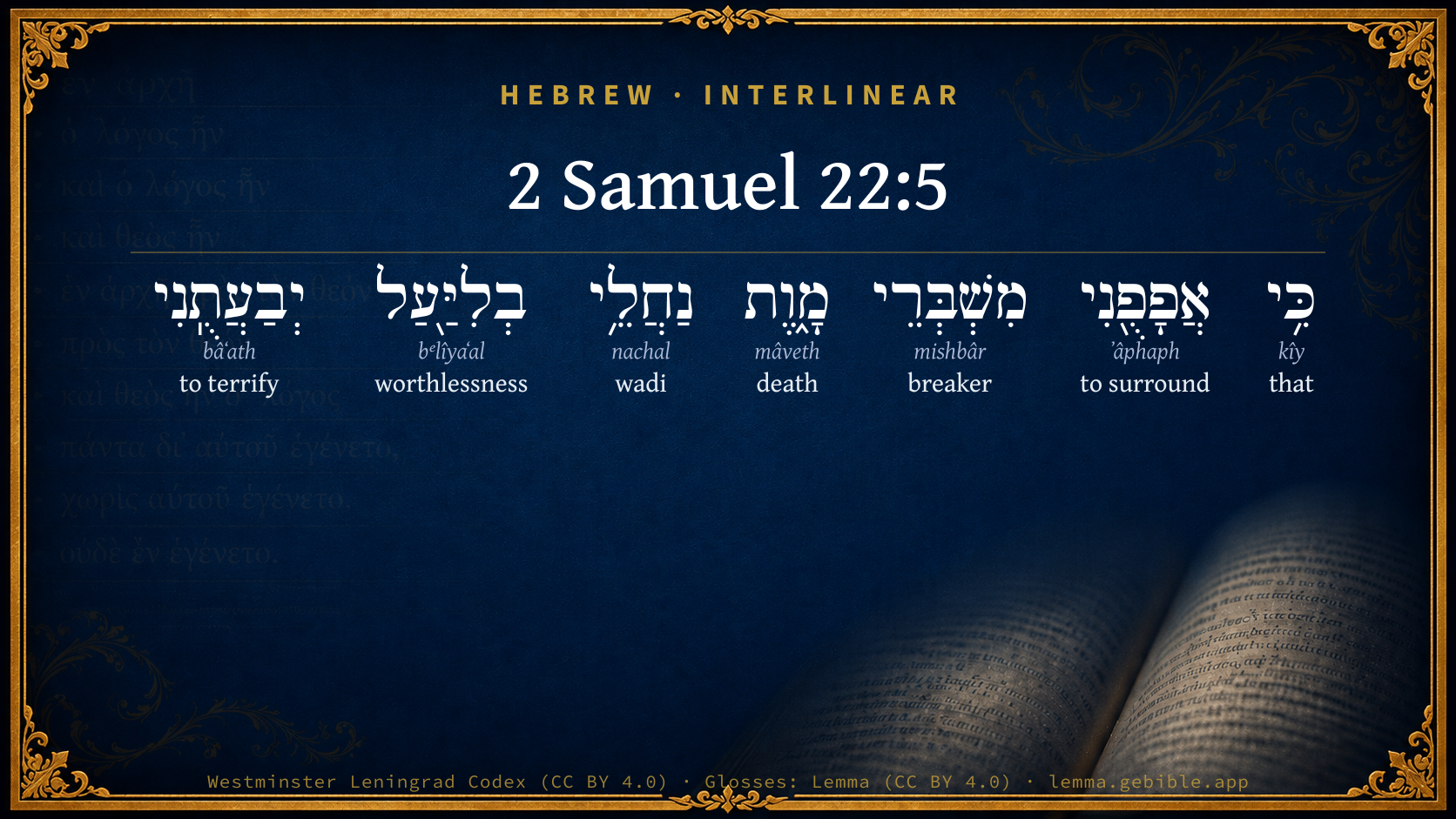
2 Samuel 22:5

Hebrew (Westminster Leningrad Codex) 2 Samuel 22:5 appears in the Hebrew Old Testament. The text above is from the Westminster Leningrad Codex. Each word links to its Strong’s number, a concise gloss, and parsing drawn from the Open Scriptures Hebrew Bible morphology. Click any word for its full Brown-Driver-Briggs (BDB) entry.
Download image
Cite this verse

2 Samuel 22:5 (World English Bible). Public Domain. Lemma interlinear Bible study tool, https://lemma.gebible.app/v/2-samuel/22/5.

Show BibTeX & RIS
BibTeX
RIS
English Translation
For the waves of death compassed me; The floods of ungodliness made me afraid:
World English Bible · Public Domain
Highlights
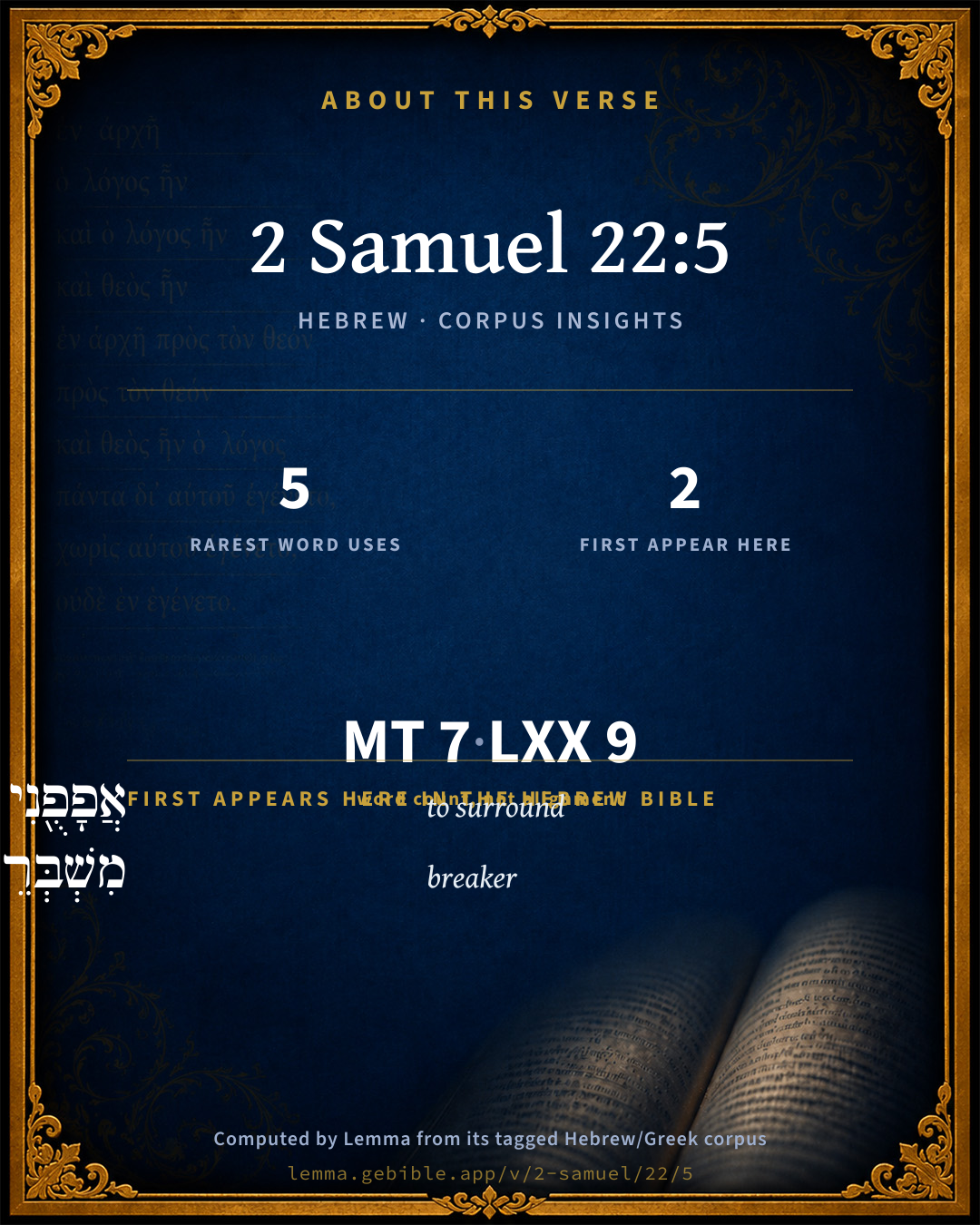
  • 2 first appearances in the Hebrew Bible
Full analysis ↓
Download a study sheet

One document with this verse’s original text, its word-by-word gloss line, the meaning frame, cross-references with their text, attributed commentary, and full source and license credits — printable, and it pastes into notes with its structure intact.

This verse Autodidact and up

Study sheet (.html) Plain text (.txt)

A passage Seminary Student

Up to 50 verses in one chapter. A passage sheet keeps up to 6 commentary sources and 12 cross-references per verse, in the order this page ranks them, and says so on the sheet whenever that leaves anything out. Ask for a single verse and you get the Autodidact verse sheet above.

Everything on this page stays free to read, with no account — the sheet is a download of what is already on screen, not access to it.

Want to remove ads? Support Godless Engineer
Compare translations 3

The same verse in 3 English versions, stacked beneath the original-language interlinear above. Click any original word for its lexicon entry.

Each is an independent rendering of the whole verse — the interlinear is not word-aligned to these translations.

Highlighted words mark where these versions differ — a whole-verse word diff, not a word-by-word alignment.

  • World English Bible Public Domain
    For the waves of death compassed me; The floods of ungodliness made me afraid:
  • King James Version Public Domain
    When the waves of death compassed me, the floods of ungodly men made me afraid;
  • unfoldingWord Literal Text CC BY-SA 4.0
    For the waves of death surrounded me, the torrents of wickedness terrified me.

unfoldingWord Literal Text — © unfoldingWord, licensed CC BY-SA 4.0. Word-aligned USFM3 via Door43 (git.door43.org/unfoldingWord/en_ult).

Versions to compare (up to 4)

3 of 4 selected

Show all 18 translations

Every available English version of this verse, each an independent rendering of the whole verse.

  • World English Bible Public Domain
    For the waves of death compassed me; The floods of ungodliness made me afraid:
  • Berean Standard Bible Public Domain
    For the waves of death engulfed me; the torrents of chaos overwhelmed me.
  • Majority Standard Bible Public Domain
    For the waves of death engulfed me; the torrents of chaos overwhelmed me.
  • King James Version Public Domain
    When the waves of death compassed me, the floods of ungodly men made me afraid;
  • American Standard Version (1901) Public Domain
    For the waves of death compassed me; The floods of ungodliness made me afraid:
  • Revised Version (1885) Public Domain
    For the waves of death compassed me, the floods of ungodliness made me afraid.
  • Geneva Bible (1599) Public Domain
    For the pangs of death haue compassed me: the floods of vngodlinesse haue made mee afrayd.
  • Douay-Rheims (1899) Public Domain
    For the pangs of death have sur rounded me: the floods of Belial have made me afraid.
  • Young's Literal Translation Public Domain
    When the breakers of death compassed me, The streams of the worthless terrify me,
  • Literal Standard Version CC BY-SA 4.0
    When the breakers of death surrounded me, || The streams of the worthless terrify me,
  • Unlocked Literal Bible CC BY-SA 4.0
    For the waves of death surrounded me, the rushing waters of destruction overwhelmed me.
  • unfoldingWord Literal Text CC BY-SA 4.0
    For the waves of death surrounded me, the torrents of wickedness terrified me.
  • Darby Bible Public Domain
    For the waves of death encompassed me, Torrents of Belial made me afraid.
  • World Messianic Bible Public Domain
    For the waves of death surrounded me. The floods of ungodliness made me afraid.
  • Webster's Bible Public Domain
    When the waves of death compassed me, the floods of ungodly-men made me afraid;
  • Free Bible Version CC BY-SA 4.0
    The waves of death swept over me; surging waters of destruction flooded over me;
  • Bible in Basic English Public Domain
    For the waves of death came round me, and the seas of evil put me in fear;
  • JPS Tanakh (1917) Public Domain
    For the waves of Death compassed me. The floods of Belial assailed me.

Literal Standard Version (2020), Covenant Press — licensed CC BY-SA 4.0. Text via the HelloAO Bible API (eBible.org). Unlocked Literal Bible (unfoldingWord) — licensed CC BY-SA 4.0. Text via the HelloAO Bible API (eBible.org). unfoldingWord Literal Text — © unfoldingWord, licensed CC BY-SA 4.0. Word-aligned USFM3 via Door43 (git.door43.org/unfoldingWord/en_ult). Free Bible Version, Dr. Jonathan Gallagher — licensed CC BY-SA 4.0. Text via the HelloAO Bible API (eBible.org).

Word by word

More ways to search: Search by grammar → Find every occurrence → Compare this word →

Practice this passage: Drill this verse → Learn its vocabulary →

About this verse

These counts appear in no published source. They are computed here, from the morphology-tagged text and Lemma’s own curated glosses. What Lemma adds →

7
words
7
distinct lemmas
Historical
section

Notable vocabulary

The rarest word here is אֲפָפֻ֖נִי to surround H661 — appearing just 5 times in the whole Hebrew Bible.

First appearance in Scripture

These words make their first canonical appearance in the Hebrew Bible here:

  • אֲפָפֻ֖נִי to surround H661
  • מִשְׁבְּרֵי breaker H4867

Shared distinctive vocabulary

אֲפָפֻ֖נִי to surround H661 occurs in 5 verses of the Hebrew Bible. Also found in:

Grammatical profile

  • 2 verbs
  • 4 nouns
  • 1 conjunction

Verb forms

  • אֲפָפֻ֖נִי Qal · Perfect
  • יְבַעֲתֻֽנִי Piel · Imperfect

Hebrew & Septuagint length

In English translation the verse runs 14 words from the Hebrew and 13 from the Septuagint (LXX English) — closely comparable.

A rough comparison of the two English renderings, which tokenize alike — not a word-level alignment.

Word counts can differ between the Hebrew and the Greek without any difference in meaning — e.g. the Hebrew direct-object marker אֵת has no separate Greek word, and Greek often adds the article ὁ.

In the original languages it is 7 Hebrew tokens and 9 Greek tokens — but the two are counted differently (Hebrew bundles its prefixes and suffixes into one token; the Greek is in lemma form), so that isn’t a like-for-like length.

Cross-references

10

Topical passages linked to 2 Samuel 22:5 in the Treasury of Scripture Knowledge — connected by theme and wording, ordered by reader-vote popularity; previews shown in the World English Bible.

  • Psalms 69:14–15 Deliver me out of the mire, and don't let me sink. Let me be delivered from those who hate me, and out of the deep waters.
  • Jonah 2:3 For you threw me into the depths, In the heart of the seas. The flood was all around me. All your waves and your billows passed over me.
  • Psalms 18:4 The cords of death surrounded me. The floods of ungodliness made me afraid.
  • Psalms 93:3–4 The floods have lifted up, Yahweh, The floods have lifted up their voice. The floods lift up their waves.
  • Isaiah 59:19 So shall they fear the name of Yahweh from the west, and his glory from the rising of the sun; for he will come as a rushing stream, which the breath of Yahweh drives.
  • Jeremiah 46:7–8 Who is this who rises up like the Nile, whose waters toss themselves like the rivers?
  • 1 Thessalonians 5:3 For when they are saying, "Peace and safety," then sudden destruction will come on them, like birth pains on a pregnant woman; and they will in no way escape.
  • Revelation 12:15–16 The serpent spewed water out of his mouth after the woman like a river, that he might cause her to be carried away by the stream.
  • Revelation 17:1 One of the seven angels who had the seven bowls came and spoke with me, saying, "Come here. I will show you the judgment of the great prostitute who sits on many waters,
  • Revelation 17:15 He said to me, "The waters which you saw, where the prostitute sits, are peoples, multitudes, nations, and languages.

Cross-references courtesy of OpenBible.info (CC BY 4.0).

Hebrew and Greek witnesses Masoretic Hebrew ↔ Greek Septuagint

The same verse in the two great witnesses to the Old Testament, shown verse-for-verse.

These are two independent witnesses, not word-aligned to each other, and the Septuagint is shown in lemma (dictionary) form.

Hebrew 2 Samuel 22:5 Masoretic · Westminster Leningrad Codex

כִּ֥י אֲפָפֻ֖נִי מִשְׁבְּרֵי מָ֑וֶת נַחֲלֵ֥י בְלִיַּ֖עַל יְבַעֲתֻֽנִי

For the waves of death compassed me; The floods of ungodliness made me afraid:

World English Bible · Public Domain

Greek LXX 2 Samuel 22:5 Septuagint · lemma form

ὅτι περιἔχω ἐγώ συντριμμός θάνατος χειμάροος ἀνομία θαμβέω ἐγώ

For the troubles of death compassed me, the floods of iniquity amazed me:

LXX2012 (modern English Septuagint) · Public Domain

Hebrew: Westminster Leningrad Codex (CC BY 4.0). Greek: Septuagint (public domain); English from LXX2012 (modern English Septuagint) (Public Domain). How the Septuagint differs from the Hebrew →

Targum (Aramaic paraphrase)

1

The Targum is the ancient Jewish Aramaic paraphrase of the Hebrew Scriptures — an interpretive translation, not the Hebrew text itself. Onkelos (literal) and Pseudo-Jonathan (expansive) render the Torah, and Jonathan the Prophets. Coverage is partial: where no permissively-licensed English translation exists for a verse, only the Aramaic is shown. This is verse-level text, not a word-by-word alignment to the Hebrew.

  1. Targum Jonathan Prophets (Joshua–Malachi)
    אֲרֵי אַקֵיפַתְנִי עָקָא כְּאִתָּא דְיַתְבָא עַל מַתְבְּרָא וְחֵילָא לֵית לָהּ לְמֵילַד וְהִיא מְסַכְּנָא לִמְמָת סִיעַת חַיָבִין בַּעֲתַת יָתִי:

    (no public-domain English translation for this verse)

    Targum Jonathan — Aramaic: “Mikraot Gedolot” (public domain). English: “Sefaria Community Translation” (CC0 1.0 (public-domain dedication)); “London "Chaldee Paraphrase," 1871” (public domain). Text via Sefaria.

Commentary

Notes on 2 Samuel 22:5 from classic Christian and Jewish commentators (each source and its license shown beneath its notes). The classic Christian expositions comment on the surrounding passage and are grouped to its opening verse, so a note may address several verses; the Jewish commentaries on the Tanakh (Rashi and others) are per-verse, so they appear only where the commentator wrote on this verse.

Lemma curates 59 commentaries, every one of them public domain or Creative Commons licensed, each selected and text-cleaned for this edition rather than reprinted as found. About our sources →

Keil & Delitzsch

C. F. Keil & F. Delitzsch

5 For breakers of death had compassed me,

Streams of wickedness terrified me.

6 Cords of hell had girt me about,

Snares of death overtook me.

7 In my distress I called Jehovah,

And to my God I called;

And He heard my voice out of His temple,

And my crying came into His ears.

David had often been in danger of death, most frequently at the time when he was pursued by Saul, but also in Absalom's conspiracy, and even in several wars (cf. Sa2 21:16). All these dangers, out of which the Lord delivered him, and not merely those which originated with Saul, are included in Sa2 22:5, Sa2 22:6. The figure "breakers or waves of death" is analogous to that of the "streams of Belial." His distress is represented in both of them under the image of violent floods of water. In the psalm we find מות חבלי, "snares of death," as in Psa 116:3, death being regarded as a hunger with a net and snare (cf. Psa 91:3): this does not answer to well to the parallel נחלי, and therefore is not so good, since שׁאול חבלי follows immediately. בליּעל (Belial), uselessness in a moral sense, or worthlessness. The meaning "mischief," or injury in a physical sense, which many expositors give to the word in this passage on account of the parallel "death," cannot be grammatically sustained. Belial was afterwards adopted as a name for the devil (Co2 6:15). Streams of wickedness are calamities that proceed from wickedness, or originate with worthless men. קדּם, to come to meet with a hostile intention, i.e., to fall upon (vid., Job 30:27). היכל, the temple out of which Jehovah heard him, was the heavenly abode of God, as in Psa 11:4; for, according to Sa2 22:8., God came down from heaven to help him.

Keil & Delitzsch — Biblical Commentary on the Old Testament (1861–1891) — public domain (CC PDM 1.0). Text via the HelloAO Bible API. (Old Testament only.)

Geneva Bible (1599)

Geneva Bible translators

As David (who was the figure of Christ) was by God’s power delivered from all dangers: so Christ and his Church shall overcome most grievous dangers, tyranny and death.

Geneva Bible (1599) marginal notes — public domain. Text via Bolls.life.

Adam Clarke's Commentary

Verse 5. When the waves of death compassed me] Though in a primary sense many of these things belong to David, yet generally and fully they belong to the Messiah alone.

Adam Clarke's Commentary on the Bible (1810–1826) — public domain. Text from a community e-Sword/MySword module.

Ellicott's Commentary for English Readers

(5) The waves of death.—In Psalms 18, “the sorrows of death,” in the Authorised Version, but literally, the bands of death. The word is entirely different, and the variation can hardly have been accidental. The form here accords better with the parallelism of the next clause.

A Bible Commentary for English Readers, edited by Charles John Ellicott (1878–1897) — public domain. Text from a community e-Sword module.

The Cambridge Bible for Schools and Colleges

gen. ed. J. J. S. Perowne

5. waves] Psa_18:4 reads cords as in 2Sa_22:6; E. V sorrows.

ungodly men] Heb. Belial. See note on 1Sa_1:16. The parallelism points to the meaning destruction, physical mischief, instead of the ordinary meaning wickedness, moral mischief.

5–7. The Psalmist’s perils. His cry for help

5, 6. For breakers of death had compassed me,

torrents of destruction were affrighting me,

cords of Sheol had surrounded me,

snares of death had encountered me.

The perils to which he had been exposed are described as waves and floods which threatened to engulf him: Sheol and death are represented as laying wait for his life like hunters with nets and snares.

The Cambridge Bible for Schools and Colleges (gen. ed. J. J. S. Perowne; Cambridge University Press, 1878–1918) — public domain. Text from a community e-Sword module.

John Gill's Exposition

Then the earth shook and trembled; the foundations of heaven moved and shook, because he was wroth. See Gill on Psa 18:7.

.

2 Samuel 22:9

sa2 22:9

sa2 22:9

sa2 22:9There went up a smoke out of his nostrils, and fire out of his mouth devoured: coals were kindled by it. See Gill on Psa 18:8.

John Gill's Exposition of the Whole Bible (1746–1763) — public domain (CC PDM 1.0). Text via the HelloAO Bible API.

Whedon's Commentary on the Bible

Daniel D. Whedon

5. Breakers of death — Death stared him in the face, like an angry sea whose billows rolled around and broke close upon him.

Torrents of wickedness — He compares his wicked foes to those mountain torrents that, after a rain, rush like an avalanche down through the rocky gorges, and sweep away every thing before them.

Daniel D. Whedon (gen. ed.), Commentary on the Old and New Testaments (1874–1909) — public domain. Text from a community e-Sword module.

The Pulpit Commentary

Vers. 5-7.

For the breakers of death surrounded me; Torrents of wickedness Hebrew, "of Belial" terrified me; Cords of Sheol surrounded me; Snares of death came suddenly upon me. In my distress I cried unto Jehovah, And to my God I cried. And he heard my voice out of his palace, And my cry was in his ears.

Instead of breakers waves dashing violently on rocks (Psa_18:4) has "cords of death;" translated "sorrow" in the Authorized Version. But "cords of death" mean the fatal snares of the hunter, and are not in keeping with "torrents of wickedness." "Belial," literally, "worthlessness," is by many supposed, from the context to mean herd "destruction," that is, physical instead of moral wickedness. So in Nah_1:11 "a counsellor of Belial" means a ruinous, destructive counsellor. Sheol is the world of the departed, and is equivalent to "death." Cried is the same verb twice used. In Psa_18:6 it is altered, in the former part of the verse unto "I called a change probably suggested by the more fastidious taste of a later age. For temple we should translate palace, or heavenly temple. It is not the temple in Jerusalem, which was not yet built, but God"s heavenly dwelling, that is meant. Instead of the terse ellipse, "And my cry in his ears," the full but heavy phrase, "My cry before him came into his ears," is substituted in Psa_18:6.

Vers. 5-19.

God"s answer to the cry of distress.

The facts are:

1. David represents death, the grave, and ungodly men, under variousfigures, as causing him deep distress.

2. He states that, on crying unto God out of the greatness of his distress,his voice entered even into his ears.

3. He thus indicates, in strong figurative language, the tokens of God"sattention to his cry.

(1) Some manifest signs of his displeasure against his foes (vers. 8, 9).

(2) A speedy and yet mysterious condescension to the need of his servant (vers. 10, 11).

(3) The blending of concealed purpose with distinct manifestations of the reality of his interposition (vers. 12-14).

(4) The pressure of his agencies on David"s enemies (ver. 15).

(5) The thorough rending of all barriers by his mighty power so as to effect deliverance for his servant (vers. 16-19). David represents his condition as one of isolated anguish he is cut off from God and man, standing in a position of peril and suffering, from which there is no chance of escape. Doubtless there were several occasions in his checkered life when this was true; but he describes them in the terms more strictly appropriate to the time when, being pursued by Saul and his emissaries, he took refuge in mountains. Like one standing on a slight elevation when the floods are gathering around, he sees only, on every side, death as waves eager to sweep him away. The ungodly men with Saul rush on as a torrent from which there is no escape. The sorrows arising from the thought of all his youthful and patriotic aspirations being soon buried in a premature grave, and a once promising life being cut off as a worthless thing, gather irresistibly around his soul. Whichever way he turns, to the cliffs or the plain, to the ravine or the cave, he sees that death is there spreading out snares to catch him. Neither God nor man is nigh to rescue. Life"s great and holy purposes are being crushed and blighted forever. No one cares for his soul. It was then, when destruction was inevitable, that, as a last desperate resort, he poured out his anguish before God and cried for help. The help came, and the fact and form of the interposition are the theme of his song. Here we notice

I PROVIDENCE PERMITS MEN TO COME INTO GREAT EXTREMITIES. David"s life was especially providential. He was from his youth the child of Providence, and yet, for no other traceable reason than his patriotism and his goodness, he was persecuted by Saul, a jealous, suspicious king, even to the degree that life was despaired of. All the forces of society and of nature seemed to go against him, and meanwhile the God of his youth and early manhood was silent and apparently far away. Our only interpretation of the facts is that God allows his servants sometimes to be brought very low. He does not give them the immunity from pain and peril which their relative goodness and fidelity would seem to warrant. Yet this is not the result of mere arbitrariness or neglect. It is part of an educational purpose, and inseparable from a government of men free in their deeds of wrong. The latent qualities of the righteous and their powers for future use can often be best developed by means of adverse events which throw them more absolutely on God than under smooth and easy conditions they ever could be. We need not be surprised if we fall into manifold trials. (1Pe_4:12)

II THE EXTREMITIES OF LIFE DEVELOP THE FULL STRENGTH OF PRAYER. David had been accustomed, like all pious men, to pray, but now he cried unto God. There was a reserve store of prayer in him which now became developed. He realized as never before his need of God, his helplessness, apart from pure Divine interposition and aid, to accomplish the purpose for which he had been selected by Samuel. There was more faith in him than he had been aware of, and now it was brought into exercise. This was the first gain in the educational process. In the spiritual life, as in the physical and mental, our capacities become atrophied if not well used, and circumstances that draw them forth in unusual degree enrich us with a permanent legacy of increased power. There is a natural tendency to inertia, which the stress of our environment urges us to overcome. How great is the power placed in our hands by the privilege of prayer, who can tell? There are indications of its greatness in particular instances recorded in the Bible and known in modern life. It availeth much. It is the human agency by which the exercise of the Almighty Power has conditioned its own exercise. How seldom do we cry unto God as though we really wanted him and his aid!

III THE INTERPOSITION OF GOD ON BEHALF OF HIS PEOPLE IS A REALITY IN LIFE. David contrasts in thought his position and that of his enemies. He was apparently left alone by God and man; they were prosperous, numerous, strong, and eager as rolling waves. Death was before and behind him, so that he could not move; they were free to act, and no one to put them in peril. But a change came; the cry of distress had entered into the very ear of God, and, as though there were a sudden change in the Divine relationship to human forces, rescue came. To David the interposition was as real as the previous peril and agony. It was not mere faint heartedness in Saul, not accidental diversion of his thoughts, not a simple refusal of his men to go further in pursuit of the victim of his malice; it was God who had somehow so acted on men and things as to bring about deliverance. The strong figures used by David in vers. 8-12 express the conviction that God had come to his help, not simply by the action of normal laws, but by the invisible contact of the eternal energy with those laws, wondrously subordinating them to a special design. The true believer still sees God in his great deliverances. The answer to prayer is a great reality. God can and does get at his suffering children. Men see not the invisible hand, but those who cry to God recognize it. The profoundest matters of life are objects of faith, and in faith, as in intention, there is a transcendent knowledge passing all demonstration and all communication.

IV A REVIEW OF DIVINE INTERPOSITIONS BRINGS OUT TO THE EYE OF FAITH THEIR STRONG CHARACTERISTICS. David here reflects on the deliverances wrought for him in answer to earnest prayer, and their characteristics appear to him to be best represented by the bold and vigorous language in vers. 8-16. Among these we may notice:

1. A twofold revelation to himself, as the God of power actually stooping to his help, and holding in his hand the most terrible and most subtle forces of nature; and to his enemies, as the great God causing his voice so to be heard in the course of things as to reveal his wrath and impress men with a sense of his greatness and majesty.

2. An assurance blended with uncertainty. The coming down and the Divine brightness brought assurance unmistakable; but the darkness and mystery of his movements indicated that his methods of working out a saving purpose were beyond human penetration.

3. Use of appropriate agencies for frustrating wicked purposes. The Divine "arrows" were so directed by unerring wisdom as to scatter those who hitherto were bent on pursuit.

4. Thoroughness in clearing away all natural obstacles to the perfecting of the deliverance. So thorough was the reserve to be that the swollen torrents and deep places were to be entirely made bare of water in order to render escape complete. We may look at our deliverances as from enemies human or fiendish, and we shall find that God does make himself known as our Friend, and causes our foes to feel his displeasure. We know that he helps, but we know not all his ways. He brings influences to bear on our foes, so that they are weakened, and what he does he does perfectly, clearing away whatever may hinder our safety. The same general truths will hold good if we look at our many deliverances from spiritual peril. He sets himself against evil, and comes to our sorrowing soul. He lets us know enough for our cheer, but does not throw full light on all his methods. He brings the mighty influences of his Word and Spirit to destroy the power of sin, and by the tremendous work of Christ clears away every obstacle to our full salvation.

GENERAL LESSONS.

1. When we come into great troubles let us take comfort that in this matterwe are sharing in an experience which, in the case of some of the best of men, has developed a more earnest spirit of prayer.

2. The records of God"s dealings with his saints shows that there is nodistress too deep for him to reach and remedy.

3. There is no place on earth but that the voice of prayer is free to enterinto God"s holy temple and even to his ear.

4. Although for a season during the prosperity of those who persecute thepious it may seem as though they were exempt from displeasure, yet God is angry with them, and will in some significant way cause them to know it.

5. However desperate our case, we may rest assured that God is inpossession of all the means of gaining access to our need, and of scattering whatever evils threaten us with ruin.

6. There are no powers, however deep seated and established, but that, ifwe trust in God, he will clear them out of the way, so that we may find a position of safety, and consequent elevation to honour and blessedness.

The Pulpit Commentary (1880–1919), ed. H.D.M. Spence-Jones & Joseph S. Exell — public domain. Text from a community e-Sword module.

unfoldingWord translationNotes

Door43 World Missions Community

General Information:

David's song to Yahweh continues. He uses parallelism to emphasize what he is saying. (See: Parallelism)

For the waves of death surrounded me, the rushing waters of destruction overwhelmed me

David compares the wicked men who wanted to kill him to flood waters that are about to drown him. These sentences have similar meanings and are used for emphasis. (See: Metaphor and Parallelism)

the rushing waters of destruction

This is a picture of fast-flowing flood waters that destroy everything in their path.

The cords of Sheol surrounded me; the snares of death trapped me

David speaks about death and Sheol as if they are people who are trying to trap him as a hunter traps an animal. These phrases have similar meanings and are used for emphasis. (See: Personification and Parallelism)

translationWords

die

water

Hades

unfoldingWord translationNotes — © Distant Shores Media and the Door43 World Missions Community, licensed CC BY-SA 4.0. Source: git.door43.org/Door43/en_tn.

Rashi

Rabbi Shlomo Yitzchaki (Rashi)

Surrounded me. Surrounded me.

Death's destruction. As [Yonoson] translates, "Like a woman sitting on the birthing chair," that is the name of the stone seat where women give birth.

The deluge. Soldiers pouring forth like a stream.

Rashi on the Tanakh — English translations: “The Judaica Press complete Tanach with Rashi, translated by A. J. Rosenberg” (CC BY 4.0); “Pentateuch with Rashi's commentary by M. Rosenbaum and A.M. Silbermann, 1929-1934” (public domain); “The Metsudah Tanach series, Lakewood, N.J” (CC BY 4.0); and “The Book of Joshua, Metsudah Publications, 1997” (CC BY 4.0). Text via Sefaria.

Lesson kit

Teaching starters — assembled from the data on this page, not authored interpretation. Every prompt links to the verse data it draws on. Edit before teaching.

2 Samuel, in the Historical, opens this verse with 7 words (7 distinct Hebrew lemmas). Its most distinctive word is ʼâphaph (“to surround”). A historical commentator’s framing appears above. Read the whole chapter for the surrounding context.

Discussion questions

  1. The word ʼâphaph carries the sense “to surround.” How does it shape the verse?
  2. 2 words here appear for the first time in Scripture. What is being introduced at this debut?
  3. Psalms 18:4 shares the word «to surround» with this verse. How do the two illuminate each other?
  4. These translations render this verse differently. What is at stake in choosing one wording over another?
  5. The verb «אֲפָפֻ֖נִי» is Qal Perfect. How does its form color the action?
  6. Reading how Keil & Delitzsch and Geneva Bible (1599) read this verse, where do the two commentators agree and where do they part?

Things to notice

Reading settings

Reading text

Shown beneath each verse's original-language words.

Old Testament
Old Testament edition

Read the OT as the Masoretic Hebrew (MT) or the Greek Septuagint (LXX).

English shown for the Greek Septuagint (in the Hebrew ↔ Greek comparison).

Comparing translations? Open the Compare panel on any verse page to stack up to four side by side.