
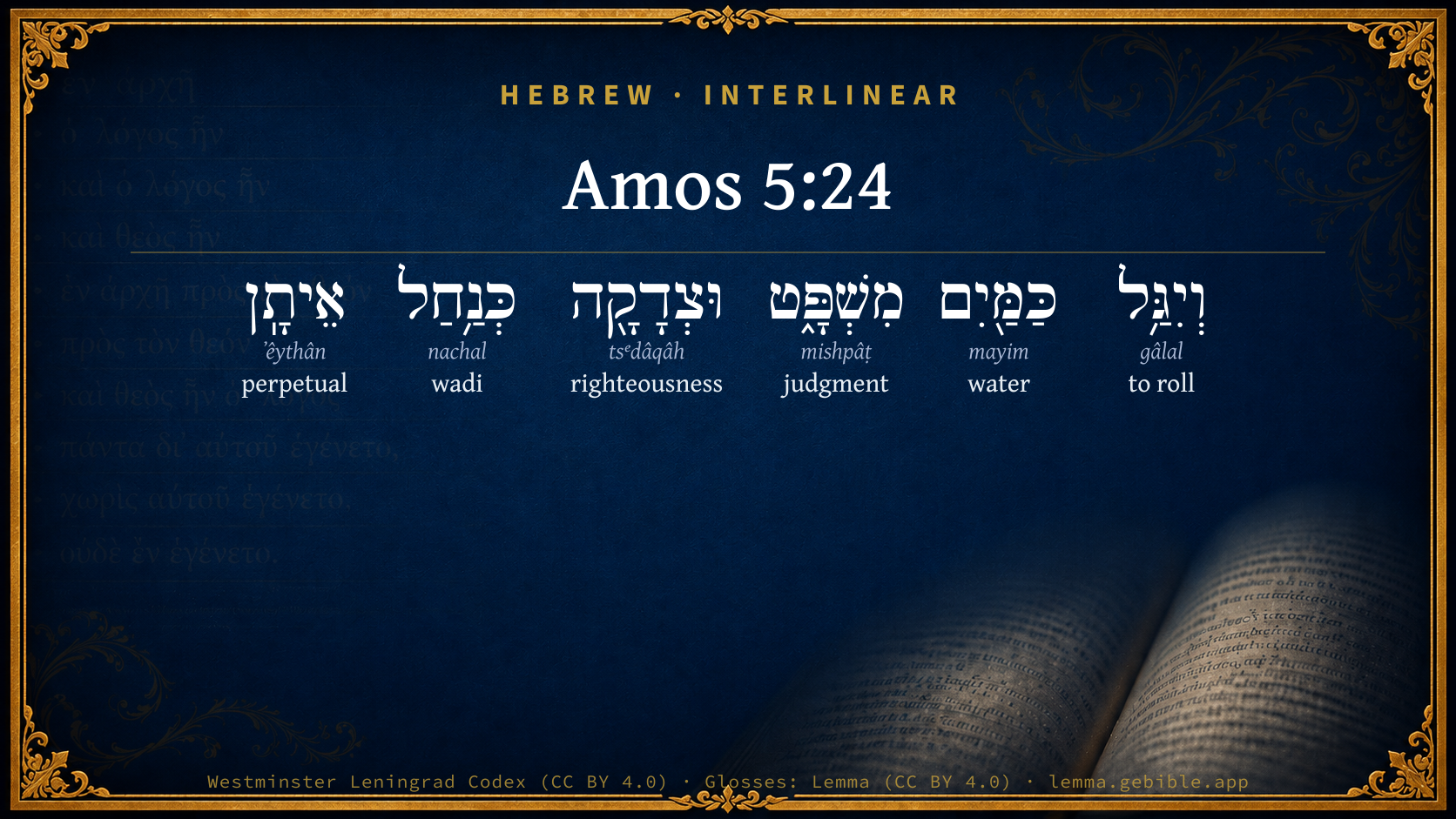
Amos 5:24

Hebrew (Westminster Leningrad Codex) Amos 5:24 appears in the Hebrew Old Testament. The text above is from the Westminster Leningrad Codex. Each word links to its Strong’s number, a concise gloss, and parsing drawn from the Open Scriptures Hebrew Bible morphology. Click any word for its full Brown-Driver-Briggs (BDB) entry.
Download image
Cite this verse

Amos 5:24 (World English Bible). Public Domain. Lemma interlinear Bible study tool, https://lemma.gebible.app/v/amos/5/24.

Show BibTeX & RIS
BibTeX
RIS
English Translation
But let justice roll on like rivers, And righteousness like a mighty stream.
World English Bible · Public Domain
Download a study sheet

One document with this verse’s original text, its word-by-word gloss line, the meaning frame, cross-references with their text, attributed commentary, and full source and license credits — printable, and it pastes into notes with its structure intact.

This verse Autodidact and up

Study sheet (.html) Plain text (.txt)

A passage Seminary Student

Up to 50 verses in one chapter. A passage sheet keeps up to 6 commentary sources and 12 cross-references per verse, in the order this page ranks them, and says so on the sheet whenever that leaves anything out. Ask for a single verse and you get the Autodidact verse sheet above.

Everything on this page stays free to read, with no account — the sheet is a download of what is already on screen, not access to it.

Want to remove ads? Support Godless Engineer
Compare translations 3

The same verse in 3 English versions, stacked beneath the original-language interlinear above. Click any original word for its lexicon entry.

Each is an independent rendering of the whole verse — the interlinear is not word-aligned to these translations.

Highlighted words mark where these versions differ — a whole-verse word diff, not a word-by-word alignment.

  • World English Bible Public Domain
    But let justice roll on like rivers, And righteousness like a mighty stream.
  • King James Version Public Domain
    But let judgment run down as waters, and righteousness as a mighty stream.
  • unfoldingWord Literal Text CC BY-SA 4.0
    Instead, let justice flow like water, and righteousness like a constantly flowing stream.

unfoldingWord Literal Text — © unfoldingWord, licensed CC BY-SA 4.0. Word-aligned USFM3 via Door43 (git.door43.org/unfoldingWord/en_ult).

Versions to compare (up to 4)

3 of 4 selected

Show all 18 translations

Every available English version of this verse, each an independent rendering of the whole verse.

  • World English Bible Public Domain
    But let justice roll on like rivers, And righteousness like a mighty stream.
  • Berean Standard Bible Public Domain
    But let justice roll on like a river, and righteousness like an ever-flowing stream.
  • Majority Standard Bible Public Domain
    But let justice roll on like a river, and righteousness like an ever-flowing stream.
  • King James Version Public Domain
    But let judgment run down as waters, and righteousness as a mighty stream.
  • American Standard Version (1901) Public Domain
    But let justice roll down as waters, and righteousness as a mighty stream.
  • Revised Version (1885) Public Domain
    But let judgment roll down as waters, and righteousness as a mighty stream.
  • Geneva Bible (1599) Public Domain
    And let iudgement runne downe as waters, and righteousnesse as a mightie riuer.
  • Douay-Rheims (1899) Public Domain
    But judgment shall be revealed as water, and justice as a mighty torrent.
  • Young's Literal Translation Public Domain
    And roll on as waters doth judgment, And righteousness as a perennial stream.
  • Literal Standard Version CC BY-SA 4.0
    And judgment rolls on as waters, || And righteousness as a perennial stream.
  • Unlocked Literal Bible CC BY-SA 4.0
    Instead, let justice flow like water, and righteousness like a constantly flowing stream.
  • unfoldingWord Literal Text CC BY-SA 4.0
    Instead, let justice flow like water, and righteousness like a constantly flowing stream.
  • Darby Bible Public Domain
    but let judgment roll down as waters, and righteousness as an ever-flowing stream.
  • World Messianic Bible Public Domain
    But let justice roll on like rivers, and righteousness like a mighty stream.
  • Webster's Bible Public Domain
    But let judgment run down as waters, and righteousness as a mighty stream.
  • Free Bible Version CC BY-SA 4.0
    Rather let justice flow like a river, and doing right like an ever-flowing stream.
  • Bible in Basic English Public Domain
    But let the right go rolling on like waters, and righteousness like an ever-flowing stream.
  • JPS Tanakh (1917) Public Domain
    But let justice well up as waters, and righteousness as a mighty stream.

Literal Standard Version (2020), Covenant Press — licensed CC BY-SA 4.0. Text via the HelloAO Bible API (eBible.org). Unlocked Literal Bible (unfoldingWord) — licensed CC BY-SA 4.0. Text via the HelloAO Bible API (eBible.org). unfoldingWord Literal Text — © unfoldingWord, licensed CC BY-SA 4.0. Word-aligned USFM3 via Door43 (git.door43.org/unfoldingWord/en_ult). Free Bible Version, Dr. Jonathan Gallagher — licensed CC BY-SA 4.0. Text via the HelloAO Bible API (eBible.org).

Word by word

More ways to search: Search by grammar → Find every occurrence → Compare this word →

Practice this passage: Drill this verse → Learn its vocabulary →

About this verse

These counts appear in no published source. They are computed here, from the morphology-tagged text and Lemma’s own curated glosses. What Lemma adds →

6
words
6
distinct lemmas
Prophets
section

Notable vocabulary

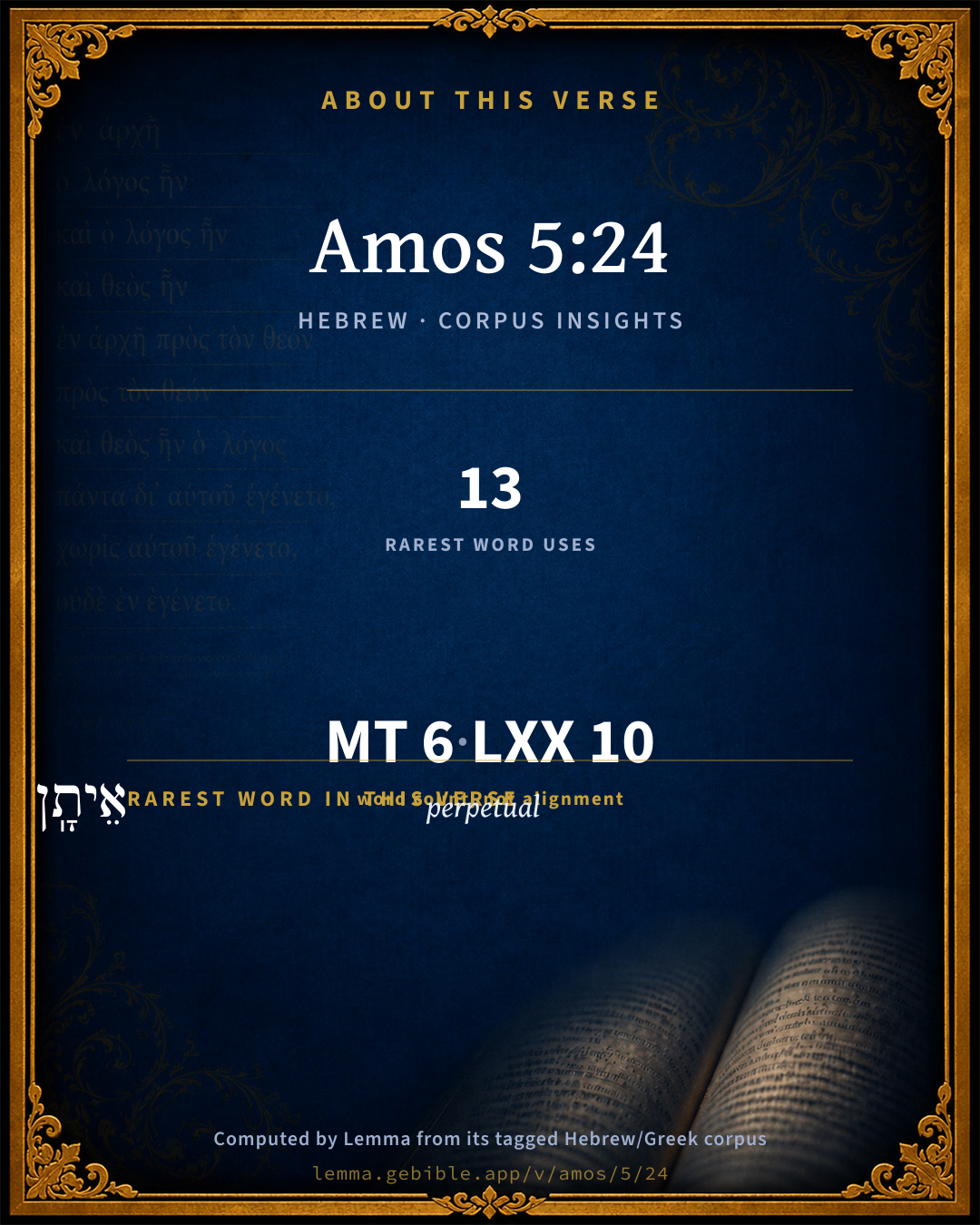
The rarest word here is אֵיתָֽן perpetual H386 — appearing just 13 times in the whole Hebrew Bible.

Shared distinctive vocabulary

אֵיתָֽן perpetual H386 occurs in 13 verses of the Hebrew Bible. Also found in:

Grammatical profile

  • 1 verb
  • 4 nouns
  • 1 adjective

Verb forms

  • וְיִגַּ֥ל Niphal · Imperfect

Hebrew & Septuagint length

In English translation the verse runs 13 words from the Hebrew and 13 from the Septuagint (LXX English) — the same length.

A rough comparison of the two English renderings, which tokenize alike — not a word-level alignment.

Word counts can differ between the Hebrew and the Greek without any difference in meaning — e.g. the Hebrew direct-object marker אֵת has no separate Greek word, and Greek often adds the article ὁ.

In the original languages it is 6 Hebrew tokens and 10 Greek tokens — but the two are counted differently (Hebrew bundles its prefixes and suffixes into one token; the Greek is in lemma form), so that isn’t a like-for-like length.

Cross-references

8

Topical passages linked to Amos 5:24 in the Treasury of Scripture Knowledge — connected by theme and wording, ordered by reader-vote popularity; previews shown in the World English Bible.

  • Micah 6:8 He has shown you, O man, what is good. What does Yahweh require of you, but to act justly, To love mercy, and to walk humbly with your God?
  • Jeremiah 22:3 Thus says Yahweh: Execute you justice and righteousness, and deliver him who is robbed out of the hand of the oppressor: and do no wrong, do no violence, to the foreigner, the fatherless, nor the widow; neither shed innocent blood in this place.
  • Proverbs 21:3 To do righteousness and justice Is more acceptable to Yahweh than sacrifice.
  • Hosea 6:6 For I desire mercy, and not sacrifice; And the knowledge of God more than burnt offerings.
  • Mark 12:32–34 The scribe said to him, "Truly, teacher, you have said well that he is one, and there is none other but he,
  • Amos 5:14–15 Seek good, and not evil, That you may live; And so Yahweh, the God of hosts, will be with you, As you say.
  • Job 29:12–17 Because I delivered the poor who cried, And the fatherless also, who had none to help him.
  • Amos 5:7 You who turn justice to wormwood, And cast down righteousness to the earth:

Cross-references courtesy of OpenBible.info (CC BY 4.0).

Hebrew and Greek witnesses Masoretic Hebrew ↔ Greek Septuagint

The same verse in the two great witnesses to the Old Testament, shown verse-for-verse.

These are two independent witnesses, not word-aligned to each other, and the Septuagint is shown in lemma (dictionary) form.

Hebrew Amos 5:24 Masoretic · Westminster Leningrad Codex

וְיִגַּ֥ל כַּמַּ֖יִם מִשְׁפָּ֑ט וּצְדָקָ֖ה כְּנַ֥חַל אֵיתָֽן

But let justice roll on like rivers, And righteousness like a mighty stream.

World English Bible · Public Domain

Greek LXX Amos 5:24 Septuagint · lemma form

καί κυλίω ὡς ὕδωρ κρίμα καί δικαιοσύνη ὡς χειμάρρους ἄβατος

But let judgment roll down as water, and righteousness as an impassable torrent.

LXX2012 (modern English Septuagint) · Public Domain

On this verse, The Pulpit Commentary discusses the Septuagint’s reading. Read the note in Commentary ↓

Hebrew: Westminster Leningrad Codex (CC BY 4.0). Greek: Septuagint (public domain); English from LXX2012 (modern English Septuagint) (Public Domain). How the Septuagint differs from the Hebrew →

Targum (Aramaic paraphrase)

1

The Targum is the ancient Jewish Aramaic paraphrase of the Hebrew Scriptures — an interpretive translation, not the Hebrew text itself. Onkelos (literal) and Pseudo-Jonathan (expansive) render the Torah, and Jonathan the Prophets. Coverage is partial: where no permissively-licensed English translation exists for a verse, only the Aramaic is shown. This is verse-level text, not a word-by-word alignment to the Hebrew.

  1. Targum Jonathan Prophets (Joshua–Malachi)
    וְיִתְגְלֵי כְמַיָא דִינָא וּזְכוּתָא כְּנַחַל מַגְבַּר:

    (no public-domain English translation for this verse)

    Targum Jonathan — Aramaic: “Mikraot Gedolot” (public domain). English: “Sefaria Community Translation” (CC0 1.0 (public-domain dedication)); “London "Chaldee Paraphrase," 1871” (public domain). Text via Sefaria.

Commentary

Notes on Amos 5:24 from classic Christian and Jewish commentators (each source and its license shown beneath its notes). The classic Christian expositions comment on the surrounding passage and are grouped to its opening verse, so a note may address several verses; the Jewish commentaries on the Tanakh (Rashi and others) are per-verse, so they appear only where the commentator wrote on this verse.

Lemma curates 59 commentaries, every one of them public domain or Creative Commons licensed, each selected and text-cleaned for this edition rather than reprinted as found. About our sources →

Trapp's Complete Commentary

John Trapp

Amo 5:24 But let judgment run down as waters, and righteousness as a mighty stream.

Ver. 24. But let judgment run down] Heb. roll down freely, plentifully, and plainly, ut devolutus monte praecipiti torrens, as the great billows of the sea, or as waves rolling over rocks, so let judgment and equity be constantly and vigorously administered and executed.

And righteousness as a mighty stream] That comes with a force, and bears down all before it. Fiat iustitia, runt orbis, Let justice be done whatever come of it. The sun might as soon be turned out of his course as Fabricius out of the track of truth and justice, saith the historian. How much better might this have been said of Job, Moses, Phineas, Nehemiah, &c., famous in their generations for brandishing the sword of justice against the friends of Baal, Balaam, and Bacchus, for turning the wheel over all such roaring monsters, such lewd and lawless Belialists, as, hardened with impunity, dare oppose with crest and breast whosoever or whatsoever standeth in the way of their wicked lusts and practices. Oh this was better than burnt offerings without this; this was that actual, magisterial, and majestic kind of devotion, that pleased God far better than an "ox that hath horns and hoofs."

John Trapp, A Commentary or Exposition upon All the Books of the Old and New Testament (1647–1656) — public domain. Text from a community e-Sword module.

The Preacher's Complete Homiletical Commentary

Joseph S. Exell (gen. ed.)

CRITICAL NOTES.]

Amo_5:24. Run] judgments like a flood over the land [Keil]. Others take it as an exhortation to practise justice and truth.

HOMILETICS

JUDGMENTS LIKE A FLOOD.—Amo_5:24

The verse is to be explained according to Isa_10:22, and threatens the flooding of the land with judgment, and the punitive righteousness of God [Keil]. In this sense the judgments of God are like a flood.

I. In the method of coming. Terrors and troubles are often compared to waters in Scripture.

1. They come suddenly. All at once they burst upon men in sin and carnal security. When they say peace then sudden destruction cometh upon them.

2. They come supernaturally. God, and not any second cause, sends them. “God hath broken in upon mine enemies … like the breaking forth of waters.”

3. They come violently. They carry away all opposition, and roll direct to their place.

4. They come abundantly. One after another in dreadful succession upon individuals and nations, until the purpose of God is accomplished.

II. In the mischief they create. Floods and mighty streams are fearful in themselves, but when sent by Almighty power to chastise who can resist them?

1. They create consternation. Men are terrified and seek every possible way of escape. The late floods in England and France illustrate this. Divine judgments are intended to rouse men from slumber and lead them to God. “For when thy judgments are in the earth, the inhabitants of the world will learn righteousness.”

2. They cause universal devastation. They sweep the city and the country, and spread destruction on every hand. The mansions of the rich and the dwellings of the poor are overcome with the rolling stream. So God’s fierce anger goes over men as mighty waters, to drown their possessions and take their comforts. “Deep calleth unto deep at the noise of thy waterspouts; all thy waves and thy billows are gone over me.”

“Wide o’er misfortune’s surging tide

Billows succeeding billows spread;

Should one, its fury spent, subside,

Another lifts its boisterous head.”

The Preacher's Complete Homiletical Commentary (gen. ed. Joseph S. Exell; Funk & Wagnalls, c. 1892) — public domain (pre-1929). A full-Bible homiletical/sermon-outline anthology covering 65 of 66 books (2 John is absent from the source module). Text from a community e-Sword module.

Tyndale Open Study Notes

Tyndale Open Resources

5:24 This is the second of the great thematic verses in Amos (see 4:12). • endless river: The streams or gullies (wadis) in Israel’s dry areas contained water only temporarily during rainy seasons. However, God wanted continual, not just seasonal, justice.

Tyndale Open Study Notes — © Tyndale Open Resources, licensed CC BY-SA 4.0. Text via the HelloAO Bible API.

Geneva Bible (1599)

Geneva Bible translators

Do your duty to God, and to your neighbor, and so ye shall feel his grace plentifully, if you show your abundant affections according to God’s word.

Geneva Bible (1599) marginal notes — public domain. Text via Bolls.life.

Jamieson, Fausset & Brown

Robert Jamieson, A. R. Fausset & David Brown

judgment--justice.

run down--literally, "roll," that is, flow abundantly (Isa 48:18). Without the desire to fulfil righteousness in the offerer, the sacrifice is hateful to God (Sa1 15:22; Psa 66:18; Hos 6:6; Mic 6:8).

Jamieson, Fausset & Brown — Commentary Critical and Explanatory on the Whole Bible (1871) — public domain (CC PDM 1.0). Text via the HelloAO Bible API.

Adam Clarke's Commentary

Verse 24. Let judgment run down] Let the execution of justice be everywhere like the showers that fall upon the land to render it fertile; and let righteousness in heart and life be like a mighty river, or the Jordan, that shall wind its course through the whole nation, and carry every abomination into the Dead Sea. Let justice and righteousness prevail everywhere, and sweep their contraries out of the land.

Adam Clarke's Commentary on the Bible (1810–1826) — public domain. Text from a community e-Sword/MySword module.

John Calvin's Commentaries

Interpreters variously expound this verse. To some it seems an exhortation, as though the Prophet said, “Ye thrust on me victims of beasts and various ceremonies; but I regard not these things; for the interior purity of heart alone pleases me: take away then all these things, which are of no moment with me, and bring what I especially require and demands even a pure and sincere heart.”

Some also think that newness of life is here described by its fruits or its evidences: for the Prophet mentions not purity, speaks not of faith and repentance, but by the fruits sets forth that renovation, which God always chiefly regards, and for the sake of which he had required sacrifices under the law. The meaning then is, that hypocrites are here recalled to true worship, because they vainly and absurdly tormented themselves with their own fictions: and by requiring from them righteousness and judgment, he required a holy and pure life, or, in a word, uprightness.

Others think that the Prophet turns aside here to celebrate the grace of Christ, which was to be made known in the gospel: and the verb יגל, igel, is rendered by many “shall be revealed;” but others more correctly derive it from the root גל, igel, to roll. Let justice then as it were, roll. But I will return to the second exposition. Most think that there is here a prediction of that righteousness which God was to make known by the coming of Christ; and some retain also the proper meaning of the verb גל, gal, to roll. They then say that the gospel is here compared to an impetuous river and a violent stream, because the Lord would rush on and penetrate through all hindrances, how many soever Satan might attempt to throw in his way. But this meaning seems not to harmonize with the Prophet’s words and is in my judgment, too refined.

Some again regard the verse as a threatening, and think that God here reproves the Israelites, as though he had said, that since they were trifling with and mocking him, he would at length show what was true righteousness and what was true judgment: for hypocrites think that they come not short of a perfect state, when they are veiled by their ceremonies, inasmuch as they flee to these lurking holes, when they would cover all their flagitous deeds. Hence they think not that they are guilty, for they hide their sins under their ceremonies as under Ajax’s shield. Seeing then that they thus trifle with God, some interpreters think that God here sharply reproves them and says, that they were greatly deceived, for he would himself at length make known what was true righteousness. Righteousness then shall run down or be rolled; and by this verb he expresses impetuosity; but he sets it forth afterwards more clearly by איתן, aitan, “Judgment shall be a violent stream.” But hypocrites amuse themselves as children do with their puppets. Inasmuch then as they do nothing seriously, and yet desire to pacify God as with baubles, the Prophet here shakes off such delusions, as though he said, “Do you think that God is like a child? Why do you set up these trifles? Do you think that righteousness is a fictitious thing, or that judgment is a vain figment? The Lord will certainly show to you how precious righteousness is. It shall therefore run down as violent waters, as an impetuous stream. “Judgment,” he says “shall rush upon you and overwhelm you.” This is the third meaning.

But the verse may be again explained in a different way, as though God obviated an objection; for hypocrites, we know, always raise a clamor, and make no end of contending; “What! Have we then lost all our labor, while endeavoring to worship God? Is all this to go for nothing? And further, we have not only offered sacrifices, but sought also to testify that the glory of God is to us an object of concern. Since then we have had a care for religion, why should God now reject us?” The Prophet here shortly answers, — that if only they brought forth true righteousness, their course would be free; as though he said, “God will not put a check to your righteousness and rectitude:” and this must be referred to the fruit or remuneration; as though the Prophet said, “Only worship God in sincerity, and he will not disappoint you; for a reward will be laid up for you; your righteousness shall run down as a river.” As it is said in another place, ‘Your righteousness shall shine as the dawn,’ so it is also in this, ‘Your righteousness shall run down as violent waters.’ There was therefore no reason for hypocrites to expostulate and say that wrong was done them by God, or that their performances were lightly esteemed, since God openly testified, that he would provide for righteousness, that it might have a free course, like an impetuous river: and this seems to be the genuine meaning of the Prophet. While I do not wholly reject the other expositions, I do not yet follow them; but show what I mostly approve.

Then the Prophet, after having bidden them to throw aside all their fictitious and spurious forms of worship, does not now simply exhort the Israelites, as some think, to exhibit righteousness and rectitude, but expresses this in the form of a promise, “Run down shall your righteousness as impetuous waters, provided it be true, and not an empty name. Whenever God shall see in you sincere rectitude, there will certainly be prepared an ample reward for you.” It follows —

John Calvin's Commentaries (1540-1563) — public domain. Text from the Calvin Translation Society English edition (1840s-50s) via the Christian Classics Ethereal Library (ccel.org). Calvin's coverage is partial (roughly two-thirds of the Bible); uncommented books and verses are honest gaps, never fabricated. The 19th-century editor's footnotes and remarks are omitted so the notes are faithfully Calvin's own voice.

Ellicott's Commentary for English Readers

(24) Mighty stream.—Or rather perennial stream.

A Bible Commentary for English Readers, edited by Charles John Ellicott (1878–1897) — public domain. Text from a community e-Sword module.

The Cambridge Bible for Schools and Colleges

gen. ed. J. J. S. Perowne

24. Justice, between man and man, is what Jehovah demands: no ceremonial, however punctiliously observed, is a substitute in Jehovah’s eyes for moral duties. The argument is exactly that of Isaiah 1, where Jehovah rejects similarly the entire body of ritual observances, celebrated at the Temple of Jerusalem, on account of the moral shortcomings of the worshippers; and where the exhortation is similarly to observe the elementary duties of civic morality—“Put away the evil of your doings from before my eyes: seek judgement, set right the oppressor, judge the fatherless, plead for the widow” (Isa_1:10-17).

run down] roll on; R.V. roll down: let justice, which has hitherto been too often thwarted and obstructed in its course, roll on, as waters, in one perpetual flow; and righteousness as an overflowing stream. Stream is in the Heb. naḥal, a word for which there is no proper English equivalent, but which corresponds really to the Arabic wâdy, so often found in descriptions of travel in Palestine. The naḥal, or wâdy, is a torrent running down through a narrow valley, which in the rainy season forms usually a copious stream, while in summer it may be reduced to a mere brook or thread of water, or may even be entirely dry. Righteousness, Jehovah claims, should roll on like a perennial (or ever-flowing) wâdy, like a wâdy which is never so dried up, but flows continuously. The word rendered ever-flowing (êthân) is the term applied specially to characterize such a perennial wâdy. It is one of the words (like hibhlîg, Amo_5:9), of which the true meaning was lost by the Jews, and was recovered only when Arabic began to be compared systematically with Hebrew, some two centuries ago. The renderings strong, mighty, strength, are in reality guesses made from the context by the mediæval Jewish commentators, whom the translators of the Authorised Version often followed as their guide. Examples of the word: Exo_14:27 (see R.V. marg.), Psa_74:15; and in a metaphorical sense, Jer_5:15 (of a nation whose numbers are never diminished), Jer_49:19 and Num_24:21 (of an abiding, never-failing habitation).

Others understand judgement and righteousness here of God’s punitive justice (cf. Isa_1:27; Isa_5:16; Isa_28:17; and for the figure, Isa_10:22 “a consumption, overflowing with righteousness”); but the former interpretation, which is the usual one, is more agreeable with the context.

The Cambridge Bible for Schools and Colleges (gen. ed. J. J. S. Perowne; Cambridge University Press, 1878–1918) — public domain. Text from a community e-Sword module.

John Gill's Exposition

But let judgments run down as waters,.... Or "roll" (o); in abundance, with great rapidity, bearing down all before them, which nothing can resist; signifying the plenty of justice done in the land, the full and free exercise of it, without any stoppage or intermission:

and righteousness as a mighty stream; the same thing expressed in different words; though some think that not the execution of judgment and justice by men is here exhorted to, but the vindictive justice of God is threatened; which like a mighty torrent of water should come down, overwhelm, bear away, and destroy all before it, even all the transgressors in Israel.

(o) "volvatur", Munster, Mercerus, Liveleus, Drusius; "volvat se", Montanus, Vatablus; "revolvet se", Piscator; "provolvatur", Cocceius.

John Gill's Exposition of the Whole Bible (1746–1763) — public domain (CC PDM 1.0). Text via the HelloAO Bible API.

Albert Barnes' Notes on the Bible

But - (And) let judgment run down (Literally, “roll” English margin) “like water.” The duties of either table include both; since there is no true love for man without the love of God, nor any real love or duty to God without the love of man. People will exchange their sins for other sins. They will not break them off unless they be converted to God. But the first outward step in conversion, is to break off sin. He bids them then “let judgment,” which had hitherto ever been perverted in its course, “roll on like” a mighty tide of “waters,” sweeping before it all hindrances, obstructed by no power, turned aside by no bribery, but pouring on in one perpetual flow, reaching all, refreshing all, and “righteousness like a mighty (or ceaseless) stream.” The word “ethan” may signify “strong or perennial.” Whence the seventh month, just before the early rain, was called “the month Ethanim 1Ki 8:2, that is, the month of the “perennial streams,” when they alone flowed. In the meaning “perennial,” it would stand tacitly contrasted with “streams which fail or lie.” True righteousness is not fitful, like an intermitting stream, vehement at one time, then disappearing, but continuous, unfailing.

Albert Barnes' Notes on the Bible (1834–1885) — public domain. Text from a community e-Sword/MySword module.

Haydock's Catholic Bible Commentary

Mighty. Hebrew, "Ethan." Let your virtue appear, or the greatest miseries will shortly overwhelm you. (Calmet)

George Leo Haydock (1774–1849), Haydock's Catholic Family Bible and Commentary, 1859 edition — public domain. Excludes Psalms (Douay-Rheims chapter numbering differs from Protestant) and Deuterocanonical books (Catholic canon only).

Matthew Poole's English Annotations

But, Heb. And

judgment: some interpret this of penal judgment, by God threatened against these hypocrites; but it is better understood of justice to be administered by rulers, whose office it was to determine between party and party.

Run down as waters; freely, constantly, speedily, and for common benefit of all, as waters run.

Righteousness; equity, relieving justice, the want of which hath been notorious among you.

As a mighty stream, which bears down all that opposeth it: be hindered by none from doing every one right; do this, and you may yet be accepted.

Matthew Poole's English Annotations on the Holy Bible (1683–1685) — public domain. Text from a community e-Sword/MySword module.

The Pulpit Commentary

But let judgment run down as waters; let judgment roll on; Septuagint, kaisetai wJv udwr krima, "and judgment shall roll along as water." Et revelabitur quasi aqua judicium (Vulgate). This verse has been explained in different ways. Hitzig, Keil, with many ancient commentators, find in it a threat of chastisement, "the flooding of the land with judgment and the punitive righteousness of God." Pusey, Professor Gandell, and others consider it to be a call to amendment. "He bids them let judgment, which had hitherto been perverted in its course, roll on like a mighty tide of waters, sweeping before it all hindrances," filling the whole land with righteousness. Schegg makes it to be a promise of the coming of the day of the Lord, that is, the revelation of Messiah. But such a promise in this position is very forced and unnatural. The second interpretation seems most suitable. In the midst of the denunciation of men"s formal worship, the prophet announces their duty in the present crisis, attention to which could alone win God"s favour. Judgment and righteousness, long neglected and forgotten, should permeate the land like refreshing streams of water a simile of special signification to an inhabitant of an Eastern country, where the neighbourhood of a perennial stream was as delightful as it was unusual. Mighty (ethan); abatov, "impassable" (Septuagint); fortis (Vulgate). The word may mean "strong," or "perennial." "Whence the seventh month, just before the early rain, was called the month Ethanim, i.e. the month of the perennial streams, when they alone flowed" (Pusey).

Real calamity waiting upon unreal service.

meaning of this verse is not, "Let justice and righteousness take the place of your sacrifices." The verse threatens the flooding of the land with judgment and the punitive righteousness of God" (Keil). Adopting this interpretation, we observe

I THAT WHICH IS REJECTED "IS NIGH UNTO CURSING." Hollow service has been sitting for its portrait, and the picture is striking. Now we have the Divine appraisement revealed in the action to be taken forthwith. Instead of approval there is condemnation. Instead of reward there is punishment. Instead of profit resulting there is loss on every issue.

1. It deserves this. Want of conformity to law is a sufficient ground of condemnation. Positive transgression of law is ground more decided still Wilful mockery of the Lawgiver is most deeply criminal of all. All these elements pertained to Israel"s sham observances, and, together, they constitute an indictment on which the criminal"s conviction is inevitable.

2. It requires it. God"s moral government must show itself strong and just, and in order to this, sin, and all sin, must be visited with his avenging stroke. Especially must this be done in the sphere of "things whereby God maketh himself known." The thing whose function it is to make him known must do so in the glorious character he bears.

II THE JUDGMENTS THAT ENGULF ARE RIGHTEOUSNESS. This could be argued, and is here affirmed.

1. They express righteousness. They are deserved. They are all deserved. They are deserved in the proportions in which they come. If they did not come, the moral balance of things would be disturbed. If they came in less decided form, this balance would be only half adjusted. They are "righteous judgments" in the fullest and highest sense.

2. They accomplish righteousness. They are sent in the interests of it. They fall on the unrighteous. They are designed and fitted to lead to their reformation. (Isa_26:9) Sometimes the righteous suffer from themalso. In that case their tendency is on the one hand to promote the righteousness of the sufferer, and on the other to emphasize the evil of unrighteousness in any section of a community, and so prevent, it. As a matter of fact, Divine judgments have often wrought righteousness both in individuals (2Ch_33:11-16) and communities. (Isa_43:21) Even in eternity they bulk largely, in the thought of the redeemed, among the helpful experiences of earth. (Rev_7:14)

III WHEN JUDGMENT IN RIGHTEOUSNESS COMES, IT COMES LIKE A FLOOD. There are two ideas here. The first is:

1. Let judgment roll on like water. In this:

(1) It will be deep, (Psa_36:6) swallowing up all its victims.

(2) It will be sudden, taking the evil doers by surprise. (Luk_17:20-31)

(3) It will be irresistible, sweeping before it every opposing object. (Psa_90:5)

(4) It will be destroying, leaving no living thing in its track.

(5) It will be ultimately fertilizing, leaving behind it the rich ooze of an abiding lesson.

2. And righteousness like on inexhaustible stream. Judgment is the act of which righteousness is the principle. God"s righteousness, whether in himself or in his judgments, is like an inexhaustible stream.

(1) It is perennial. The righteousness of God"s judgments is a constant quantity. It never intermits. Each is righteous and all are righteousness.

(3) It is pure. Righteousness in God is necessarily so. There is no foreign ingredient, no cloud of mixture in it whatever. It is righteous through and through. "There is," there can be, "no unrighteousness in him.

(3) It is cleansing. It purifies all it touches; the person it is laved on, the city it passes through.

(4) It is irrigating. It waters the fields of human life. It makes the graces, like the grass, to grow in the desert, and withering things revive. The righteousness of God, like water streams, is rich in every element of blessing for timer and is a benefactor for eternity as well.

The river of righteousness.

Whilst the holy King and Judge rejects the mere service of the lip and of the hand, when unaccompanied by genuine piety, he desires above all things the prevalence of those practical principles of rectitude which are the secret, hidden power of an upright and acceptable life. In a very bold and beautiful metaphor the Divine wish and pleasure are declared. Let the hypocritical festivals, the unmeaning sacrifices, the hollow songs, be swept away, and let the river of righteousness roll through the land, and God shall be pleased, and his people shall be blessed.

I ITS DIVINE SOURCE. The fountain of rectitude is not to be found in the arrangements of human society, in the laws of human device, in the expediency which aims at human pleasures. We are to look up to the hills, to the heavens, for its source. It wells from the eternal constitution of the moral universe, from the very nature, from the glorious government, of the Eternal.

II ITS VAST VOLUME. There is no community of men, there is no social relationship, in which righteousness may not be exemplified. Even the heathen philosophers could say great things of justice.

Nor morning star, nor evening star, so fair!

Ardent religionists sometimes lose sight of this principle and its necessity, thinking justice too sublunary and commonplace to be deserving of their attention. Such a practice is not sanctioned by Scripture, which from beginning to end lays stress upon the faithful and honourable discharge of human duty, as between man and man, in all the varied relationships of life.

III ITS MIGHTY CURRENT. There is a power in righteousness which only the morally blind can overlook, which commands the homage of the observant and the thoughtful. For whilst it is not the kind of power that the worldly cannot but see, and the vulgar cannot but admire, it is nevertheless power enduring, effective, undoubted power. The state is strong in which justice is administered, in which a high standard of uprightness is maintained in social and public life; whilst injustice, insincerity, oppression, corruption, and deceit are detrimental to the true interests of any community.

IV ITS PERENNIAL FLOW. A river differs from a cistern, a reservoir, in this that it does not run dry, that it is not exhausted, that it flows on from age to age. And the righteousness that the eternal King desires to see prevail in human society is an ever-flowing stream. Not like the mountain torrent, which is dried up in summer heat; but like the vast river, which is fed from the everlasting hills, and is replenished by many a tributary stream, is the course of Divine righteousness upon earth. Not in one nation, in one age, in one dispensation only, but in every time and place does this river of righteousness flow for the welfare of mankind.

V ITS BENEFICENT RESULTS. From insincere religious observances no good can come; but from justice, from a proper discharge of duty, from right principles, we may look forevery good. God is pleased that his attribute becomes his creature"s law. And righteousness exalts nations and establishes thrones. T.

The Pulpit Commentary (1880–1919), ed. H.D.M. Spence-Jones & Joseph S. Exell — public domain. Text from a community e-Sword module.

John Wesley's Explanatory Notes

Let judgment - Let justice be administered constantly. Righteousness - Equity. Stream - Bearing down all that opposes it.

John Wesley, Explanatory Notes Upon the Whole Bible (1754–1765) — public domain. Text via the GEBible commentary corpus.

Rashi

Rabbi Shlomo Yitzchaki (Rashi)

And justice shall be revealed like water Heb. וְיִגַּל. And you shall do this, and I will accept you. The justice that you have hidden and concealed shall be revealed and stream among you like water. [after Jonathan]

and righteousness—shall be revealed like a mighty stream. [after Jonathan]

Rashi on the Tanakh — English translations: “The Judaica Press complete Tanach with Rashi, translated by A. J. Rosenberg” (CC BY 4.0); “Pentateuch with Rashi's commentary by M. Rosenbaum and A.M. Silbermann, 1929-1934” (public domain); “The Metsudah Tanach series, Lakewood, N.J” (CC BY 4.0); and “The Book of Joshua, Metsudah Publications, 1997” (CC BY 4.0). Text via Sefaria.

Lesson kit

Teaching starters — assembled from the data on this page, not authored interpretation. Every prompt links to the verse data it draws on. Edit before teaching.

Amos, in the Prophets, opens this verse with 6 words (6 distinct Hebrew lemmas). Its most distinctive word is ʼêythân (“perpetual”). A historical commentator’s framing appears above. Read the whole chapter for the surrounding context.

Discussion questions

  1. How does “perpetual” (ʼêythân) shape what this verse is saying?
  2. How does Genesis 49:24, which shares the word «perpetual», read alongside this verse?
  3. The translations on this page render this verse differently — a whole-verse word diff, not a word-by-word alignment. What might account for the different wordings?
  4. «וְיִגַּ֥ל» is a Niphal Imperfect verb. How does that grammatical form shape the action described?
  5. Compare how Trapp's Complete Commentary and The Preacher's Complete Homiletical Commentary read this verse. Where do they agree or differ?

Things to notice

Reading settings

Reading text

Shown beneath each verse's original-language words.

Old Testament
Old Testament edition

Read the OT as the Masoretic Hebrew (MT) or the Greek Septuagint (LXX).

English shown for the Greek Septuagint (in the Hebrew ↔ Greek comparison).

Comparing translations? Open the Compare panel on any verse page to stack up to four side by side.