
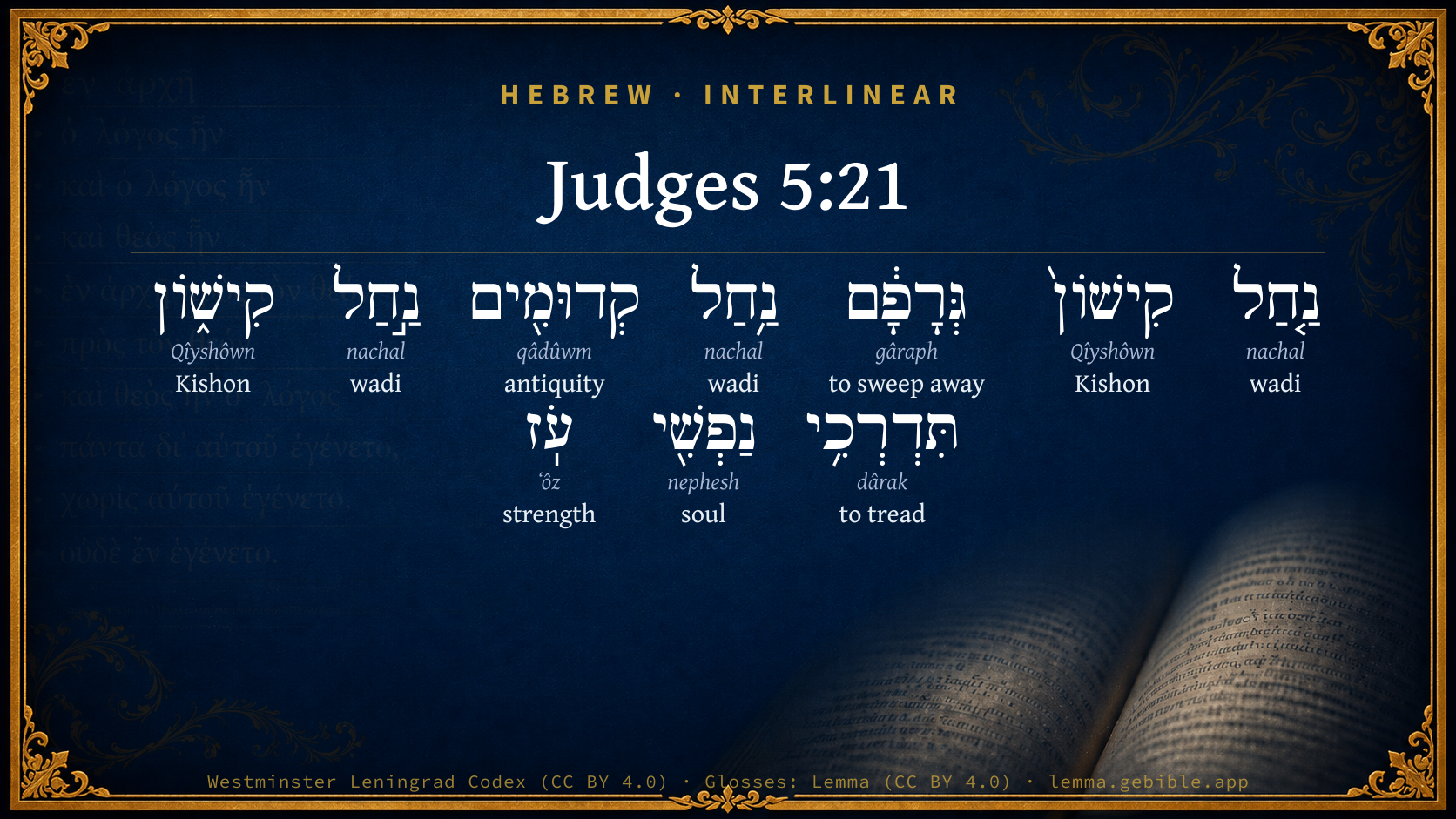
Judges 5:21

Hebrew (Westminster Leningrad Codex) Judges 5:21 appears in the Hebrew Old Testament. The text above is from the Westminster Leningrad Codex. Each word links to its Strong’s number, a concise gloss, and parsing drawn from the Open Scriptures Hebrew Bible morphology. Click any word for its full Brown-Driver-Briggs (BDB) entry.
Download image
Cite this verse

Judges 5:21 (World English Bible). Public Domain. Lemma interlinear Bible study tool, https://lemma.gebible.app/v/judges/5/21.

Show BibTeX & RIS
BibTeX
RIS
English Translation
The river Kishon swept them away, That ancient river, the river Kishon. My soul, march on with strength.
World English Bible · Public Domain
Highlights
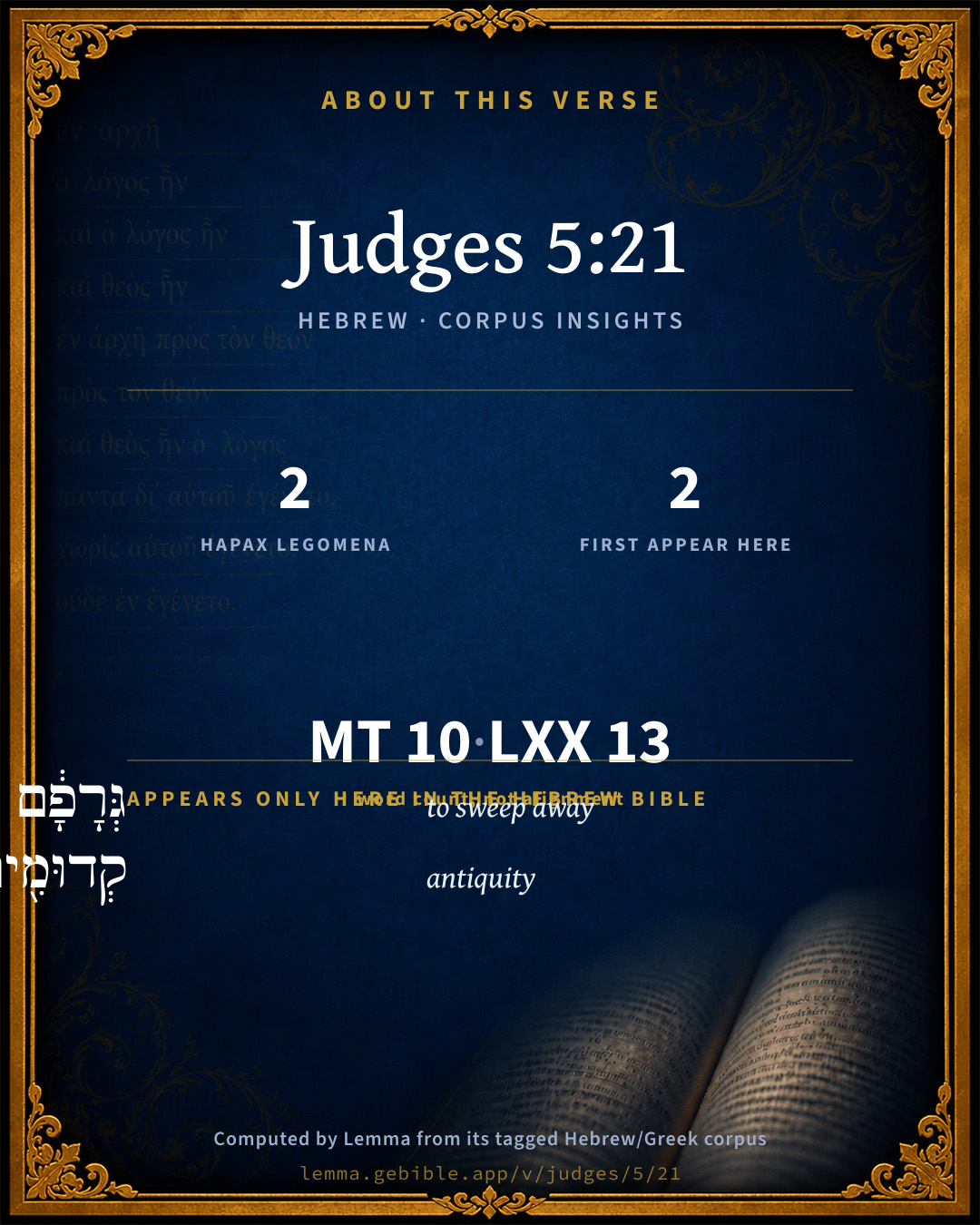
  • 2 hapax legomena — only here in the Hebrew Bible
  • 2 first appearances in the Hebrew Bible
Full analysis ↓
Download a study sheet

One document with this verse’s original text, its word-by-word gloss line, the meaning frame, cross-references with their text, attributed commentary, and full source and license credits — printable, and it pastes into notes with its structure intact.

This verse Autodidact and up

Study sheet (.html) Plain text (.txt)

A passage Seminary Student

Up to 50 verses in one chapter. A passage sheet keeps up to 6 commentary sources and 12 cross-references per verse, in the order this page ranks them, and says so on the sheet whenever that leaves anything out. Ask for a single verse and you get the Autodidact verse sheet above.

Everything on this page stays free to read, with no account — the sheet is a download of what is already on screen, not access to it.

Want to remove ads? Support Godless Engineer
Compare translations 3

The same verse in 3 English versions, stacked beneath the original-language interlinear above. Click any original word for its lexicon entry.

Each is an independent rendering of the whole verse — the interlinear is not word-aligned to these translations.

Highlighted words mark where these versions differ — a whole-verse word diff, not a word-by-word alignment.

  • World English Bible Public Domain
    The river Kishon swept them away, That ancient river, the river Kishon. My soul, march on with strength.
  • King James Version Public Domain
    The river of Kishon swept them away, that ancient river, the river Kishon. O my soul, thou hast trodden down strength.
  • unfoldingWord Literal Text CC BY-SA 4.0
    The wadi of Kishon swept them away, the wadi of antiquity, the wadi of Kishon. March on, my soul, strength!

unfoldingWord Literal Text — © unfoldingWord, licensed CC BY-SA 4.0. Word-aligned USFM3 via Door43 (git.door43.org/unfoldingWord/en_ult).

Versions to compare (up to 4)

3 of 4 selected

Show all 18 translations

Every available English version of this verse, each an independent rendering of the whole verse.

  • World English Bible Public Domain
    The river Kishon swept them away, That ancient river, the river Kishon. My soul, march on with strength.
  • Berean Standard Bible Public Domain
    The River Kishon swept them away, the ancient river, the River Kishon. March on, O my soul, in strength!
  • Majority Standard Bible Public Domain
    The River Kishon swept them away, the ancient river, the River Kishon. March on, O my soul, in strength!
  • King James Version Public Domain
    The river of Kishon swept them away, that ancient river, the river Kishon. O my soul, thou hast trodden down strength.
  • American Standard Version (1901) Public Domain
    The river Kishon swept them away, That ancient river, the river Kishon. O my soul, march on with strength.
  • Revised Version (1885) Public Domain
    The river Kishon swept them away, that ancient river, the river Kishon. O my soul, march on with strength.
  • Geneva Bible (1599) Public Domain
    The Riuer Kishon swepe them away, that ancient riuer the riuer Kishon. O my soule, thou hast marched valiantly.
  • Douay-Rheims (1899) Public Domain
    The torrent of Cison dragged their carcasses, the torrent of Cadumim, the torrent of Cisoii: tread thou, my soul, upon the strong ones.
  • Young's Literal Translation Public Domain
    The brook Kishon swept them away, The brook most ancient -- the brook Kishon. Thou dost tread down strength, O my soul!
  • Literal Standard Version CC BY-SA 4.0
    The Brook of Kishon swept them away, || The most ancient brook—the Brook of Kishon. You tread down strength, O my soul!
  • Unlocked Literal Bible CC BY-SA 4.0
    The Kishon River swept them away, that old river, the Kishon River. March on my soul, be strong!
  • unfoldingWord Literal Text CC BY-SA 4.0
    The wadi of Kishon swept them away, the wadi of antiquity, the wadi of Kishon. March on, my soul, strength!
  • Darby Bible Public Domain
    The torrent Kishon swept them away, the onrushing torrent, the torrent Kishon. March on, my soul, with might!
  • World Messianic Bible Public Domain
    The river Kishon swept them away, that ancient river, the river Kishon. My soul, march on with strength.
  • Webster's Bible Public Domain
    The river of Kishon swept them away, that ancient river, the river Kishon. O my soul, thou hast trodden down strength.
  • Free Bible Version CC BY-SA 4.0
    The Kishon River swept them away—the old river turned into a raging torrent! I bravely march on!
  • Bible in Basic English Public Domain
    The river Kishon took them violently away, stopping their flight, the river Kishon. Give praise, O my soul, to the strength of the Lord!
  • JPS Tanakh (1917) Public Domain
    The brook Kishon swept them away, that ancient brook, the brook Kishon. O my soul, tread them down with strength.

Literal Standard Version (2020), Covenant Press — licensed CC BY-SA 4.0. Text via the HelloAO Bible API (eBible.org). Unlocked Literal Bible (unfoldingWord) — licensed CC BY-SA 4.0. Text via the HelloAO Bible API (eBible.org). unfoldingWord Literal Text — © unfoldingWord, licensed CC BY-SA 4.0. Word-aligned USFM3 via Door43 (git.door43.org/unfoldingWord/en_ult). Free Bible Version, Dr. Jonathan Gallagher — licensed CC BY-SA 4.0. Text via the HelloAO Bible API (eBible.org).

Word by word

More ways to search: Search by grammar → Find every occurrence → Compare this word →

Practice this passage: Drill this verse → Learn its vocabulary →

גְּרָפָ֔ם
gâraph
H1640
“to sweep away · them”
Verb, Qal, Perfect, 3rd Person, Masculine, Singular + Suffix, Personal, 3rd Person, Masculine, Plural
Part of Speech
Verb
Stem
Qal
Form
Perfect
Person
3rd Person
Gender
Masculine
Number
Singular
Full BDB Definition

Origin: a primitive root

TWOT: 385

(Qal) to sweep away, sweep
  1. נַ֤חַל nachal H5158 “wadi of” Noun, Common, Masculine, Singular, Construct
  2. קִישׁוֹן֙ Qîyshôwn H7028 “Kishon” Noun, Proper
  3. נַ֥חַל nachal H5158 “wadi of” Noun, Common, Masculine, Singular, Construct
  4. קְדוּמִ֖ים qâdûwm H6917 “ancient times” Noun, Common, Masculine, Plural, Absolute
  5. נַ֣חַל nachal H5158 “wadi of” Noun, Common, Masculine, Singular, Construct
  6. קִישׁ֑וֹן Qîyshôwn H7028 “Kishon” Noun, Proper
  7. תִּדְרְכִ֥י dârak H1869 “to tread” Verb, Qal, Imperfect, 2nd Person, Feminine, Singular
  8. נַפְשִׁ֖י nephesh H5315 “soul · my” Noun, Common, Both, Singular, Construct + Suffix, Personal, 1st Person, Common, Singular
  9. עֹֽז ʻôz H5797 “strength” Noun, Common, Masculine, Singular, Absolute

About this verse

These counts appear in no published source. They are computed here, from the morphology-tagged text and Lemma’s own curated glosses. What Lemma adds →

10
words
7
distinct lemmas
Historical
section

Notable vocabulary

2 hapax legomena — words that appear only here in the entire Hebrew Bible:

  • גְּרָפָ֔ם to sweep away H1640
  • קְדוּמִ֖ים antiquity H6917

First appearance in Scripture

These words make their first canonical appearance in the Hebrew Bible here:

  • גְּרָפָ֔ם to sweep away H1640
  • קְדוּמִ֖ים antiquity H6917

Shared distinctive vocabulary

קִישׁוֹן֙ Kishon H7028 occurs in 5 verses of the Hebrew Bible. Also found in:

Grammatical profile

  • 2 verbs
  • 8 nouns

Verb forms

  • גְּרָפָ֔ם Qal · Perfect
  • תִּדְרְכִ֥י Qal · Imperfect

Repetition

Words recur within this verse — often emphatic in Hebrew:

  • נַ֤חַל wadi H5158 ×3
  • קִישׁוֹן֙ Kishon H7028 ×2

Hebrew & Septuagint length

In English translation the verse runs 18 words from the Hebrew and 20 from the Septuagint (LXX English) — closely comparable.

A rough comparison of the two English renderings, which tokenize alike — not a word-level alignment.

Word counts can differ between the Hebrew and the Greek without any difference in meaning — e.g. the Hebrew direct-object marker אֵת has no separate Greek word, and Greek often adds the article ὁ.

In the original languages it is 10 Hebrew tokens and 13 Greek tokens — but the two are counted differently (Hebrew bundles its prefixes and suffixes into one token; the Greek is in lemma form), so that isn’t a like-for-like length.

Cross-references

8

Topical passages linked to Judges 5:21 in the Treasury of Scripture Knowledge — connected by theme and wording, ordered by reader-vote popularity; previews shown in the World English Bible.

  • Judges 4:7 I will draw to you, to the river Kishon, Sisera, the captain of Jabin's army, with his chariots and his multitude; and I will deliver him into your hand.
  • Psalms 44:5 Through you, will we push down our adversaries. Through your name, will we tread them under who rise up against us.
  • Micah 7:10 Then my enemy will see it, And shame will cover her who said to me, Where is Yahweh your God? Then my enemy will see me and will cover her shame. Now she will be trodden down like the mire of the streets.
  • Genesis 49:18 I have waited for your salvation, Yahweh.
  • Judges 4:13 Sisera gathered together all his chariots, even nine hundred chariots of iron, and all the people who were with him, from Harosheth of the Gentiles, to the river Kishon.
  • 1 Kings 18:40 and Elijah said to them, Take the prophets of Baal; don't let one of them escape. They took them; and Elijah brought them down to the brook Kishon, and killed them there.
  • Psalms 83:9–10 Do to them as you did to Midian, As to Sisera, as to Jabin, at the river Kishon;
  • Isaiah 25:10 For in this mountain will the hand of Yahweh rest; and Moab shall be trodden down in his place, even as straw is trodden down in the water of the dung-hill.

Cross-references courtesy of OpenBible.info (CC BY 4.0).

Hebrew and Greek witnesses Masoretic Hebrew ↔ Greek Septuagint

The same verse in the two great witnesses to the Old Testament, shown verse-for-verse.

These are two independent witnesses, not word-aligned to each other, and the Septuagint is shown in lemma (dictionary) form.

Hebrew Judges 5:21 Masoretic · Westminster Leningrad Codex

נַ֤חַל קִישׁוֹן֙ גְּרָפָ֔ם נַ֥חַל קְדוּמִ֖ים נַ֣חַל קִישׁ֑וֹן תִּדְרְכִ֥י נַפְשִׁ֖י עֹֽז

The river Kishon swept them away, That ancient river, the river Kishon. My soul, march on with strength.

World English Bible · Public Domain

Greek LXX Judges 5:21 Septuagint · lemma form

χειμάρρους κισων ἐκσύρω αὐτός χειμάρρους ἀρχαῖος χειμάρρους κισων καταἀπατάω αὐτός ψυχή ἐγώ δυνατός

The brook of Kison swept them away, the ancient brook, the brook Kison: my mighty soul will trample him down.

LXX2012 (modern English Septuagint) · Public Domain

On this verse, Ellicott's Commentary for English Readers discusses the Septuagint’s reading. Read the note in Commentary ↓

Hebrew: Westminster Leningrad Codex (CC BY 4.0). Greek: Septuagint (public domain); English from LXX2012 (modern English Septuagint) (Public Domain). How the Septuagint differs from the Hebrew →

Targum (Aramaic paraphrase)

1

The Targum is the ancient Jewish Aramaic paraphrase of the Hebrew Scriptures — an interpretive translation, not the Hebrew text itself. Onkelos (literal) and Pseudo-Jonathan (expansive) render the Torah, and Jonathan the Prophets. Coverage is partial: where no permissively-licensed English translation exists for a verse, only the Aramaic is shown. This is verse-level text, not a word-by-word alignment to the Hebrew.

  1. Targum Jonathan Prophets (Joshua–Malachi)
    נַחֲלָא דְקִישׁוֹן תַּבְּרִינוּן נַחֲלָא דְאִתְעֲבִידוּ בֵיהּ נִסִין וּגְבוּרָן מִלְקַדְמֵין לְיִשְׂרָאֵל הוּא נַחֲלָא דְקִישׁוֹן תַּמָן דוּשִׁישַׁת נַפְשִׁי קְטִילֵי גִבָּרֵיהוֹן בִּתְקוֹף:

    (no public-domain English translation for this verse)

    Targum Jonathan — Aramaic: “Mikraot Gedolot” (public domain). English: “Sefaria Community Translation” (CC0 1.0 (public-domain dedication)); “London "Chaldee Paraphrase," 1871” (public domain). Text via Sefaria.

Commentary

Notes on Judges 5:21 from classic Christian and Jewish commentators (each source and its license shown beneath its notes). The classic Christian expositions comment on the surrounding passage and are grouped to its opening verse, so a note may address several verses; the Jewish commentaries on the Tanakh (Rashi and others) are per-verse, so they appear only where the commentator wrote on this verse.

Lemma curates 59 commentaries, every one of them public domain or Creative Commons licensed, each selected and text-cleaned for this edition rather than reprinted as found. About our sources →

John Gill's Exposition

The river of Kishon swept them away,.... To which Sisera's army was drawn, and where it was discomfited; and very probably many of them, in their confusion, endeavoured to make their escape by fording or swimming over the river, by which they were swept away and drowned, the waters of it at this time swelling in a miraculous manner, as Ben Gersom thinks; or were increased by the large showers of rain that fell, as some note from Josephus, though I find it not in him; however it is not improbable it might be the case; for our countryman Mr. Maundrell (l) thus observed when he was at it;"in the condition we saw it, its waters were low and inconsiderable; but passing along the side of the plain, we discovered the track of many lesser torrents falling down into it from the mountains, which must needs make it swell exceedingly upon sudden rains, as doubtless it actually did at the destruction of Sisera's host, Jdg 5:21"

that ancient river, the river Kishon; called ancient, either because it was from the beginning of the creation, and not cut by the art of men, as some rivers are; or because it was spoken of by poets and historians in ancient times; or because of famous exploits done here of old; so the Targum,"the river where signs and mighty works were done for Israel of old.''Some take the word Kedumim to be another name of the river, so called from its windings and turnings, and, as it were, meeting itself. So some travellers tell us (m) the river Kedumim, the same with Kishon, is so called, because it meets itself, being by its meanders formed like a sling or noose, as Kishon signifies; it rises at Mount Tabor, and discharges itself into the Mediterranean sea, at the foot of Mount Carmel; so Hillerus (n) says, Kishon signifies bending in manner of a snare, or net, or meander, and takes it to be the same with the Pagida of Pliny (o), which in the Greek tongue signifies the same:

O my soul, thou hast trodden down strength; a strong and mighty army, through her prayers and supplication, advice and direction; or thou hast trodden with strength, that is, the river Kishon, as some Jewish interpreters understand it, who suppose that another miracle was wrought; that as the waters of the river swelled when the Canaanites attempted to escape over it, so it sunk and became fordable for Deborah and the Israelites; a miracle, as they suppose, somewhat similar to that at the Red sea.

(l) Journey from Aleppo, &c. p. 57. (m) Egmont and Heyman's Travels, par. 2. p. 2. (n) Onomastic. Sacr. p. 186, 405, 865. (o) Nat. Hist. l. 5. c. 19.

John Gill's Exposition of the Whole Bible (1746–1763) — public domain (CC PDM 1.0). Text via the HelloAO Bible API.

Trapp's Complete Commentary

John Trapp

Jdg 5:21 The river of Kishon swept them away, that ancient river, the river Kishon. O my soul, thou hast trodden down strength.

Ver. 21. The river of Kishon swept them away.] For fear they ran into this river and there perished; which yet I, a weak woman, have manfully passed over on foot, without such danger: so Vatablus senseth the text, which he thus readeth, O my soul, thou hast trodden (that river) valiantly.

John Trapp, A Commentary or Exposition upon All the Books of the Old and New Testament (1647–1656) — public domain. Text from a community e-Sword module.

Joseph Benson's Commentary

Jdg 5:21. The river of Kishon — Which, though not great in itself, was now much swelled by the foregoing storm and rain, and therefore drowned those who, being pursued by the hand of God and by the Israelites, were forced into it, and thought to pass over it, as they did before. Ancient river — So called, either, first, in opposition to those rivers which are of a later date, being made by the hand and art of man; or, secondly, because it was a river anciently famous for remarkable exploits, for which it was celebrated by the ancient poets or writers, though not here mentioned. O my soul, thou hast trodden down strength — Thou, O Deborah, though but a weak woman, hast, by God’s assistance, subdued a potent enemy; a beautiful apostrophe this of the prophetess; turning her speech to herself, as it were, to congratulate herself on the success of the commission which she had received from God to stir up Barak, and on the great efficacy of her prayers to God; for it cannot be doubted but that she implored help from Heaven, while Barak fought with Sisera.

Joseph Benson's Commentary on the Old and New Testaments (1811–1818) — public domain. Text from a community e-Sword module.

Geneva Bible (1599)

Geneva Bible translators

As a besom doeth the filth of the house.

Geneva Bible (1599) marginal notes — public domain. Text via Bolls.life.

Jamieson, Fausset & Brown

Robert Jamieson, A. R. Fausset & David Brown

the river of Kishon swept them away--The enemy was defeated near "the waters of Megiddo"--the sources and side streams of the Kishon: they that fled had to cross the deep and marshy bed of the torrent, but the Lord had sent a heavy rain--the waters suddenly rose--the warriors fell into the quicksands, and sinking deep into them, were drowned or washed into the sea [VAN DE VELDE].

Jamieson, Fausset & Brown — Commentary Critical and Explanatory on the Whole Bible (1871) — public domain (CC PDM 1.0). Text via the HelloAO Bible API.

Adam Clarke's Commentary

Verse 21. The river of Kishon swept them away] This gives plausibility to the above conjecture, that there was a storm at this time which produced an inundation in the river Kishon, which the routed Canaanites attempting to ford were swept away.

Adam Clarke's Commentary on the Bible (1810–1826) — public domain. Text from a community e-Sword/MySword module.

Ellicott's Commentary for English Readers

(21) The river of Kishon.—Jdg_4:7; Psa_83:9. Either from this massacre, or that of the Baal priests of Elijah, the Kishon is now called the Nahr Mukatta, or “river of slaughter” (1Ki_18:40).

That ancient river.—The Vulgate renders this, “the torrent Kedumim,” and the LXX. (Cod. Vat.), “the river of the ancients” (comp. Deu_33:15). The Chaldee paraphrases it, “the torrent on whose banks illustrious deeds have been done from the ancient times of Israel.” As the Plain of Jezreel has been in all ages the battle-field of Israel, the Kishon must always have played an important part in these struggles, as when the Turks were drowned in its swollen waves on April 16th, 1799. We know, however, of no ancient fame of Kishon before these events; and some render it. “the torrent of meeting armies,” or “of slaughters” (Ewald), deriving Kedumim from an Arabic root; or “the torrent of succours,” connecting the word with Kiddeem (see Psa_79:8, &c., Heb.). Aquila renders it by “the torrent of siroccos” (Kausônôn); and Symmachus, “the torrent of goats” (wild waves, egers, and bores).

O my soul, thou hast trodden down strength.—These sudden exclamations, which break the flow of the poem, add greatly to its fire and impetuosity. The verb may be an imperative, and the Vulgate renders it, “Trample down, O my soul, the mighty.” The word “trample” recalls the image of treading the vintage.

A Bible Commentary for English Readers, edited by Charles John Ellicott (1878–1897) — public domain. Text from a community e-Sword module.

The Cambridge Bible for Schools and Colleges

gen. ed. J. J. S. Perowne

21. swept them away] The battle must have taken place in the winter or spring, for in summer the Kishon runs low. The fate of Sisera’s host finds a parallel in the battle of Mt Tabor between the army of Napoleon and the Turks, Apr. 16, 1799, when many of the latter were drowned when attempting to escape across a part of the plain inundated by the Kishon.

That ancient river] lit. torrent of antiquity, so LXX. B, Targ. (‘where the wonders and mighty deeds of old were wrought for Israel’). Another translation, based on Arabic usage, is torrent of onsets; or, developing the meaning of the root ‘be before, in front,’ we might render onrushing torrent, alluding to the swollen waters. The exact sense must remain obscure.

O my soul, march on with strength] A questionable rendering, for the verb is not an imperative. The text as it stands is probably an attempt to make some sense of an ancient corruption. The line may have formed part of the previous one: ‘the torrent of Kishon trode them down mightily’—but to reconstruct the original form of the sentence is hopeless.

The Cambridge Bible for Schools and Colleges (gen. ed. J. J. S. Perowne; Cambridge University Press, 1878–1918) — public domain. Text from a community e-Sword module.

Albert Barnes' Notes on the Bible

The word translated ancient occurs only here. The phrase probably means that Kishon was celebrated from ancient times on account of the battles fought on its banks.

Albert Barnes' Notes on the Bible (1834–1885) — public domain. Text from a community e-Sword/MySword module.

Haydock's Catholic Bible Commentary

Dragged. Protestants, "swept them away, that ancient river, the river Kishon." --- Cadumim, which the Protestants translate ancient, (Haydock) means also eastern. The former epithet seems very insignificant. Some assert, that the Cison divided its streams about Mount Thabor, and one part ran towards the east into the lake of Genesareth, which is here designated, while the other empties itself above Carmel into the great sea. But there is no proof of this assertion in the Scripture, nor in Josephus. We read (Judith vii. 3,) of a place, which the Syriac properly calls Cadmon, and the Vulgate Chelmon, in this neighbourhood. Instead of Kedumin, Symmachus and Theodotion read Kodssim, which the former translates, "the holy vale." Many of the army (Calmet) of the kings, and perhaps of Sisara also, (Haydock) endeavouring to make their escape, were drowned in the Cison. (Calmet)

Ver 22. Broken (ceciderunt) "fell off," the hoofs being fractured by the hard road, while the riders galloped full speed. (Haydock) --- Some translate the Hebrew, "the hoofs of the horses made a sound like that of a hammer beating an anvil, on account of the hurry of the strong ones who push them forward." Quadrupedante putrem sonitu quatit ungula campum, as Virgil attempts to imitate the sound in verse. Others, "the hoof....was broken by the precipitation (Calmet) (Protestants, prancings, the prancings of the mighty ones; Haydock) of those who fled." Formerly, Xenophon observes, the horses were not usually shod with iron. The feet of Bucephalus were consequently much worn. Yet some took the precaution to defend the feet of their horses with brass, (Homer) or iron, in the shape of crescents. (Eustathius) --- Nero shod his mules with silver; (Suetonius) and Popea, his wife, had shoes of gold for her more delicate beasts. Soleas ex auro quoque induere solebat. (Pliny, [Natural History?] xxxiii. 11.) --- Yet many excellent horses in Arabia and Tartary are never shod. (Tavern. T. i. B. ii. 5.)

George Leo Haydock (1774–1849), Haydock's Catholic Family Bible and Commentary, 1859 edition — public domain. Excludes Psalms (Douay-Rheims chapter numbering differs from Protestant) and Deuterocanonical books (Catholic canon only).

Matthew Poole's English Annotations

The river of Kishon, though not great in itself, and therefore fordable, was now much swelled and increased by the foregoing storm and rain, as Josephus affirms; and therefore drowned those who being pursued by the hand of God, and by the Israelites, were forced into it, and thought to pass over it, as they did before.

That ancient river; so called, either, first, In opposition to those rivers which are of a later date, being made by the hand and art of man. Or, secondly, Because it was a river anciently famous for some remarkable exploits, for which it was celebrated by the ancient poets or writers, though not here mentioned.

Thou hast trodden down strength, i.e. thou, O Deborah, though but a weak woman, hast, by God’s assistance and blessing upon thy counsels and prayers, subdued a potent enemy. Such apostrophes and abrupt speeches are frequent in poetical scriptures.

Matthew Poole's English Annotations on the Holy Bible (1683–1685) — public domain. Text from a community e-Sword/MySword module.

Whedon's Commentary on the Bible

Daniel D. Whedon

21. The river Kishon snatched them away — This celebrated stream has two principal sources, one at the base of Mount Tabor, and the other in the large fountain of Jerrin, (En-gannim,) about fifteen miles south of Tabor.

Its general course is northwesterly, sweeping along the northern base of Mount Carmel, and emptying into the Mediterranean. It drains the great valley of Esdraelon. In the southern part of the plain, at Megiddo and Taanach, the Kishon is not a permanent stream, but flows only during the rainy season; but after a violent rain storm the dry bed suddenly changes to a sweeping torrent, and snatches away everything it meets. So in the present case, the rushing waters carried away the bewildered soldiers of Sisera.

Trample down, O my soul — A burst of enthusiastic exultation over such a sudden destruction of the strong enemy.

Daniel D. Whedon (gen. ed.), Commentary on the Old and New Testaments (1874–1909) — public domain. Text from a community e-Sword module.

The Pulpit Commentary

Ancient. The word so rendered is only found here. The brook of ancient days, or things, probably means the brook celebrated from of old by the warlike deeds done on its banks.

The Pulpit Commentary (1880–1919), ed. H.D.M. Spence-Jones & Joseph S. Exell — public domain. Text from a community e-Sword module.

John Wesley's Explanatory Notes

River of Kishon - Which, though not great in itself, was now much swelled by the foregoing storm and rain, and therefore drowned those who being pursued by the hand of God, and by the Israelites, were forced into it, and thought to pass over it, as they did before. Ancient river - So called, either, first, in opposition to those rivers which are of a later date, being made by the hand and art of man. Or, secondly, because it was a river anciently famous for remarkable exploits, for which it was celebrated by the ancient poets or writers, though not here mentioned. Trodden down - Thou, O Deborah, though but a weak woman, hast by God's assistance subdued a potent enemy. Such abrupt speeches are frequent in poetical scriptures.

John Wesley, Explanatory Notes Upon the Whole Bible (1754–1765) — public domain. Text via the GEBible commentary corpus.

Keil & Delitzsch

C. F. Keil & F. Delitzsch

The kings of Canaan could do nothing against these powers. They were smitten; the brook Kishon washed them (i.e., their corpses) away. The meaning "to wash away" is well established by the dialects and the context, though the verb itself only occurs here. As the battle was fought between Taanach and Megiddo, i.e., to the south of the brook Kishon, and the smitten foe fled towards the north, many of them met with their death in the waves of the brook, which was flowing over its banks at the time. The brook is called קדוּמים נחל, i.e., the brook of the old world or the olden time (according to the lxx Cod. Vat. χειμάῤῥους ἀρχαίων), as the stream that had been flowing from time immemorial, and not, as the Chaldee interprets it, the stream that had been celebrated from olden time on account of the mighty acts that had been performed there. The meaning suggested by Ewald and others, "brook of attacks, or slaughters," is not well sustained, although קדּם is sometimes used to denote a hostile encounter. The last clause interrupts the description of the slaughter and the victory. Borne away by the might of the acts to be commemorated, Deborah stimulates her soul, i.e., herself, to a vigorous continuation of her song. תּדרכי is jussive, and עז an accusative governed by the verb, in strength, vigorously; for she had still to celebrate the glorious results of the victory. This is done in the third part of the song (Jdg 5:22-31), the first strophe of which (Jdg 5:22-24) describes in brief drastic traits the flight of the foe, and the treatment of the fugitives by the people of the land.

Keil & Delitzsch — Biblical Commentary on the Old Testament (1861–1891) — public domain (CC PDM 1.0). Text via the HelloAO Bible API. (Old Testament only.)

unfoldingWord translationNotes

Door43 World Missions Community

The Kishon River swept them away

Because of the heavy rain the river flooded quickly causing the chariots to be stuck in the mud and drowning many soldiers. AT: "The Kishon River flooded and swept away Sisera's soldiers" (See: Assumed Knowledge and Implicit Information)

Kishon

See how you translated this in Judges 4:6.

March on my soul, be strong

Here "soul" refers to the whole person. The word "my" refers to Deborah. AT: "I tell myself to march on and to be strong" (See: Synecdoche)

Then came the sound of horses' hooves—galloping, the galloping of his mighty ones

This describes the sound of many horses running away from the battle. AT: "Then I heard the sound of horses running away. Sisera's mighty horses were running away" (See: Assumed Knowledge and Implicit Information)

galloping

running quickly

translationWords

sweep

soul

horse

hoof

might

unfoldingWord translationNotes — © Distant Shores Media and the Door43 World Missions Community, licensed CC BY-SA 4.0. Source: git.door43.org/Door43/en_tn.

Rashi

Rabbi Shlomo Yitzchaki (Rashi)

Swept them away. It brushed them from the world like a broom which brushes ashes from an oven.

The stream of antiquity. It guaranteed the obligation to the sea concerning this, from the days of Egypt, as stated in Pesachim.

My soul trampled underfoot the power of the mighty Canaanite warriors.

Rashi on the Tanakh — English translations: “The Judaica Press complete Tanach with Rashi, translated by A. J. Rosenberg” (CC BY 4.0); “Pentateuch with Rashi's commentary by M. Rosenbaum and A.M. Silbermann, 1929-1934” (public domain); “The Metsudah Tanach series, Lakewood, N.J” (CC BY 4.0); and “The Book of Joshua, Metsudah Publications, 1997” (CC BY 4.0). Text via Sefaria.

Lesson kit

Teaching starters — assembled from the data on this page, not authored interpretation. Every prompt links to the verse data it draws on. Edit before teaching.

Judges, in the Historical, opens this verse with 10 words (7 distinct Hebrew lemmas). Its most distinctive word is gâraph (“to sweep away”). A historical commentator’s framing appears above. Read the whole chapter for the surrounding context.

Discussion questions

  1. What does “to sweep away” (gâraph) contribute to the verse as a whole?
  2. This verse holds 2 words here found nowhere else in the Hebrew Bible. What might the rare words draw attention to?
  3. 2 words here appear for the first time in Scripture. What is being introduced at this debut?
  4. Judges 4:7 shares the word «Kishon» with this verse. How do the two illuminate each other?
  5. “wadi” occurs 3× in this one verse. What is the effect of the repetition?
  6. These translations render this verse differently. What is at stake in choosing one wording over another?
  7. The verb «גְּרָפָ֔ם» is Qal Perfect. How does its form color the action?
  8. Reading how John Gill's Exposition and Trapp's Complete Commentary read this verse, where do the two commentators agree and where do they part?

Things to notice

  • 2 words in this verse appear nowhere else in the Hebrew Bible.
  • 2 words make their first canonical appearance in Scripture here.
  • This verse counts 10 Hebrew ↔ 13 Greek words.
  • These translations choose different wording for 8 words in this verse.
  • “wadi” occurs 3× in this single verse.

Reading settings

Reading text

Shown beneath each verse's original-language words.

Old Testament
Old Testament edition

Read the OT as the Masoretic Hebrew (MT) or the Greek Septuagint (LXX).

English shown for the Greek Septuagint (in the Hebrew ↔ Greek comparison).

Comparing translations? Open the Compare panel on any verse page to stack up to four side by side.