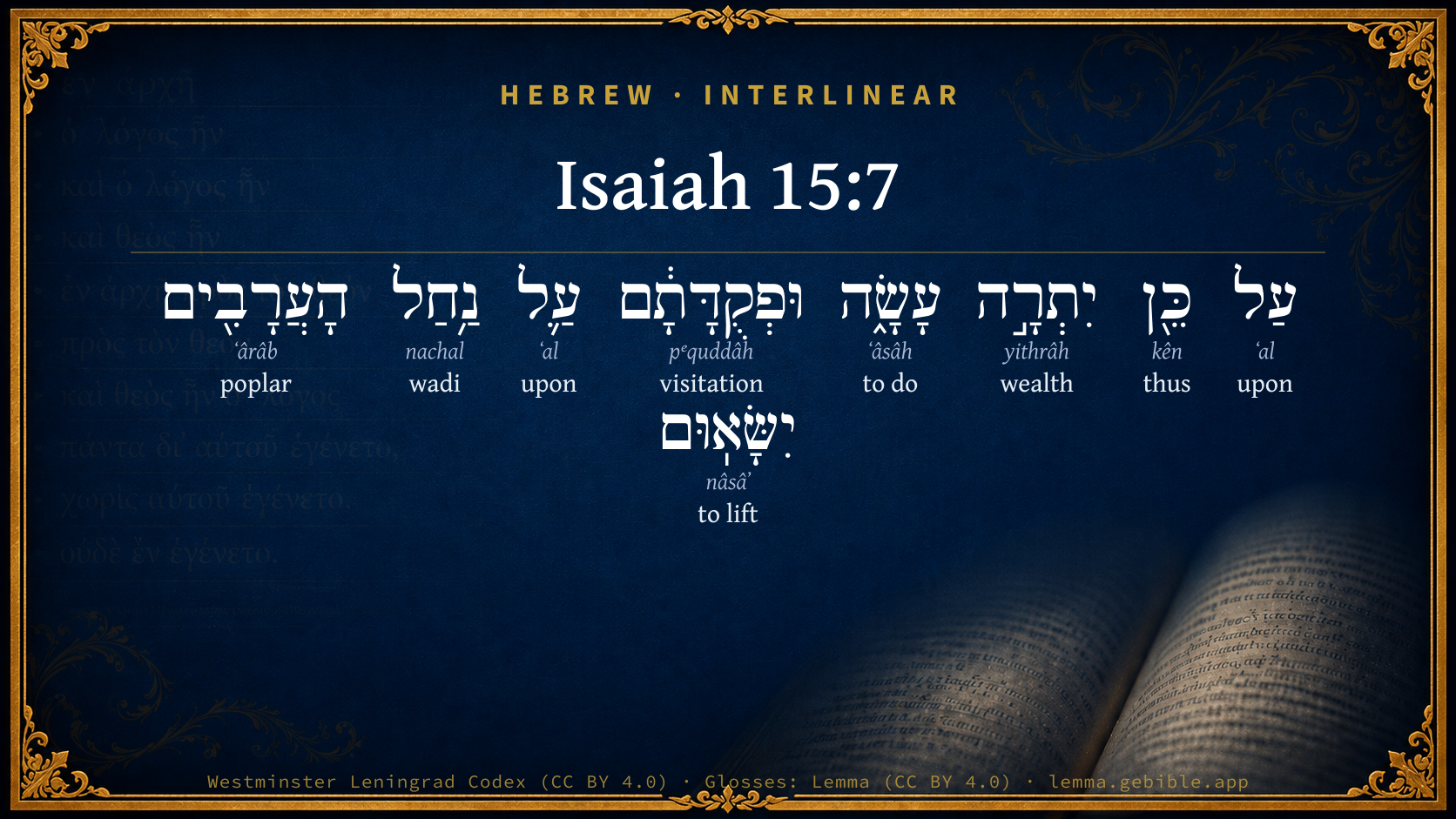
Isaiah 15:7

Hebrew (Westminster Leningrad Codex) Isaiah 15:7 appears in the Hebrew Old Testament. The text above is from the Westminster Leningrad Codex. Each word links to its Strong’s number, a concise gloss, and parsing drawn from the Open Scriptures Hebrew Bible morphology. Click any word for its full Brown-Driver-Briggs (BDB) entry.
Download image
Cite this verse

Isaiah 15:7 (World English Bible). Public Domain. Lemma interlinear Bible study tool, https://lemma.gebible.app/v/isaiah/15/7.

Show BibTeX & RIS
BibTeX
RIS
English Translation
Therefore the abundance they have gotten, and that which they have laid up, shall they carry away over the brook of the willows.
World English Bible · Public Domain
Highlights
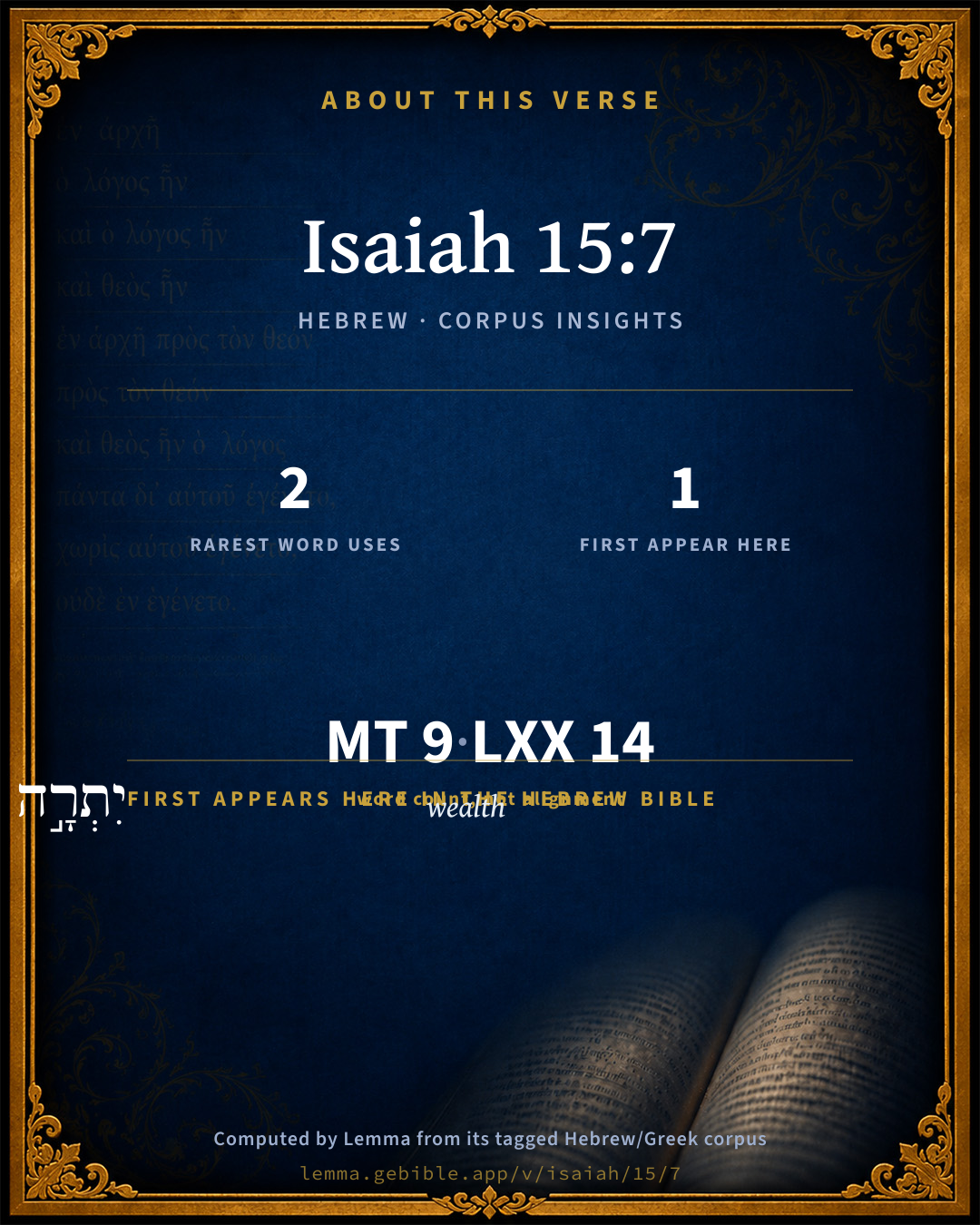
  • 1 first appearance in the Hebrew Bible
Full analysis ↓
Download a study sheet

One document with this verse’s original text, its word-by-word gloss line, the meaning frame, cross-references with their text, attributed commentary, and full source and license credits — printable, and it pastes into notes with its structure intact.

This verse Autodidact and up

Study sheet (.html) Plain text (.txt)

A passage Seminary Student

Up to 50 verses in one chapter. A passage sheet keeps up to 6 commentary sources and 12 cross-references per verse, in the order this page ranks them, and says so on the sheet whenever that leaves anything out. Ask for a single verse and you get the Autodidact verse sheet above.

Everything on this page stays free to read, with no account — the sheet is a download of what is already on screen, not access to it.

Want to remove ads? Support Godless Engineer
Compare translations 3

The same verse in 3 English versions, stacked beneath the original-language interlinear above. Click any original word for its lexicon entry.

Each is an independent rendering of the whole verse — the interlinear is not word-aligned to these translations.

Highlighted words mark where these versions differ — a whole-verse word diff, not a word-by-word alignment.

  • World English Bible Public Domain
    Therefore the abundance they have gotten, and that which they have laid up, shall they carry away over the brook of the willows.
  • King James Version Public Domain
    Therefore the abundance they have gotten, and that which they have laid up, shall they carry away to the brook of the willows.
  • unfoldingWord Literal Text CC BY-SA 4.0
    Therefore, the abundance one has made and their store, they carry them over the Wadi of the Willows.

unfoldingWord Literal Text — © unfoldingWord, licensed CC BY-SA 4.0. Word-aligned USFM3 via Door43 (git.door43.org/unfoldingWord/en_ult).

Versions to compare (up to 4)

3 of 4 selected

Show all 18 translations

Every available English version of this verse, each an independent rendering of the whole verse.

  • World English Bible Public Domain
    Therefore the abundance they have gotten, and that which they have laid up, shall they carry away over the brook of the willows.
  • Berean Standard Bible Public Domain
    So they carry their wealth and belongings over the Brook of the Willows.
  • Majority Standard Bible Public Domain
    So they carry their wealth and belongings over the Brook of the Willows.
  • King James Version Public Domain
    Therefore the abundance they have gotten, and that which they have laid up, shall they carry away to the brook of the willows.
  • American Standard Version (1901) Public Domain
    Therefore the abundance they have gotten, and that which they have laid up, shall they carry away over the brook of the willows.
  • Revised Version (1885) Public Domain
    Therefore the abundance they have gotten, and that which they have laid up, shall they carry away to the brook of the willows.
  • Geneva Bible (1599) Public Domain
    Therefore what euery man hath left, and their substance shall they beare to the brooke of the willowes.
  • Douay-Rheims (1899) Public Domain
    According to the greatness of their work, is their visitation also: they shall lead them to the torrent of the willows.
  • Young's Literal Translation Public Domain
    Therefore the abundance he made, and their store, Unto the brook of the willows they carry.
  • Literal Standard Version CC BY-SA 4.0
    Therefore the abundance he made, and their store, || They carry to the Brook of the Willows.
  • Unlocked Literal Bible CC BY-SA 4.0
    The abundance they have grown and stored they carry away over the brook of the poplars.
  • unfoldingWord Literal Text CC BY-SA 4.0
    Therefore, the abundance one has made and their store, they carry them over the Wadi of the Willows.
  • Darby Bible Public Domain
    Therefore the abundance they have gotten, and that which they have laid up, do they carry away to the torrent of the willows.
  • World Messianic Bible Public Domain
    Therefore they will carry away the abundance they have gotten, and that which they have stored up, over the brook of the willows.
  • Webster's Bible Public Domain
    Therefore the abundance they have gained, and that which they have laid up, shall they carry away to the brook of the willows.
  • Free Bible Version CC BY-SA 4.0
    Everything they had gained, all their possessions, they have to carry across Willow River.
  • Bible in Basic English Public Domain
    For this cause they will take away their wealth, and the stores they have got together, over the stream of the water-plants.
  • JPS Tanakh (1917) Public Domain
    Therefore the abundance they have gotten, and that which they have laid up, shall they carry away to the brook of the willows.

Literal Standard Version (2020), Covenant Press — licensed CC BY-SA 4.0. Text via the HelloAO Bible API (eBible.org). Unlocked Literal Bible (unfoldingWord) — licensed CC BY-SA 4.0. Text via the HelloAO Bible API (eBible.org). unfoldingWord Literal Text — © unfoldingWord, licensed CC BY-SA 4.0. Word-aligned USFM3 via Door43 (git.door43.org/unfoldingWord/en_ult). Free Bible Version, Dr. Jonathan Gallagher — licensed CC BY-SA 4.0. Text via the HelloAO Bible API (eBible.org).

Word by word

More ways to search: Search by grammar → Find every occurrence → Compare this word →

Practice this passage: Drill this verse → Learn its vocabulary →

About this verse

These counts appear in no published source. They are computed here, from the morphology-tagged text and Lemma’s own curated glosses. What Lemma adds →

9
words
8
distinct lemmas
Prophets
section

Notable vocabulary

The rarest word here is יִתְרָ֣ה wealth H3502 — appearing just 2 times in the whole Hebrew Bible.

First appearance in Scripture

This word makes its first canonical appearance in the Hebrew Bible here:

  • יִתְרָ֣ה wealth H3502

Shared distinctive vocabulary

יִתְרָ֣ה wealth H3502 occurs in 2 verses of the Hebrew Bible. Also found in:

Grammatical profile

  • 2 verbs
  • 4 nouns
  • 2 prepositions
  • 1 particle

Verb forms

  • עָשָׂ֑ה Qal · Perfect
  • יִשָּׂאֽוּם Qal · Imperfect

Repetition

A word recurs within this verse — often emphatic in Hebrew:

Hebrew & Septuagint length

In English translation the verse runs 23 words from the Hebrew and 20 from the Septuagint (LXX English) — closely comparable.

A rough comparison of the two English renderings, which tokenize alike — not a word-level alignment.

Word counts can differ between the Hebrew and the Greek without any difference in meaning — e.g. the Hebrew direct-object marker אֵת has no separate Greek word, and Greek often adds the article ὁ.

In the original languages it is 9 Hebrew tokens and 14 Greek tokens — but the two are counted differently (Hebrew bundles its prefixes and suffixes into one token; the Greek is in lemma form), so that isn’t a like-for-like length.

Cross-references

7

Topical passages linked to Isaiah 15:7 in the Treasury of Scripture Knowledge — connected by theme and wording, ordered by reader-vote popularity; previews shown in the World English Bible.

  • Jeremiah 48:36 Therefore my heart sounds for Moab like pipes, and my heart sounds like pipes for the men of Kir Heres: therefore the abundance that he has gotten is perished.
  • Psalms 137:1–2 By the rivers of Babylon, there we sat down. Yes, we wept, when we remembered Zion.
  • Isaiah 5:29 Their roaring will be like a lioness. They will roar like young lions. Yes, they shall roar, And seize their prey and carry it off, And there will be no one to deliver.
  • Isaiah 10:6 I will send him against a profane nation, and against the people of my wrath will I give him a charge, to take the spoil, and to take the prey, and to tread them down like the mire of the streets.
  • Isaiah 10:14 and my hand has found as a nest the riches of the peoples; and as one gathers eggs that are forsaken, have I gathered all the earth: and there was none that moved the wing, or that opened the mouth, or chirped.
  • Isaiah 30:6 The burden of the animals of the South. Through the land of trouble and anguish, from whence come the lioness and the lion, the viper and fiery flying serpent, they carry their riches on the shoulders of young donkeys, and their treasures on the humps of camels, to a people that shall not profit [them].
  • Nahum 2:12–13 The lion tore in pieces enough for his cubs, and strangled for his lionesses, and filled his caves with the kill, and his dens with prey.

Cross-references courtesy of OpenBible.info (CC BY 4.0).

Hebrew and Greek witnesses Masoretic Hebrew ↔ Greek Septuagint

The same verse in the two great witnesses to the Old Testament, shown verse-for-verse.

These are two independent witnesses, not word-aligned to each other, and the Septuagint is shown in lemma (dictionary) form.

Hebrew Isaiah 15:7 Masoretic · Westminster Leningrad Codex

עַל כֵּ֖ן יִתְרָ֣ה עָשָׂ֑ה וּפְקֻדָּתָ֔ם עַ֛ל נַ֥חַל הָעֲרָבִ֖ים יִשָּׂאֽוּם

Therefore the abundance they have gotten, and that which they have laid up, shall they carry away over the brook of the willows.

World English Bible · Public Domain

Greek LXX Isaiah 15:7 Septuagint · lemma form

μή καί οὕτως μέλλω σώζω ἐπιἄγω γάρ ἐπί ὁ φάραγξ ἄραψ καί λαμβάνω αὐτός

Shall Moab even thus be delivered? for I will bring the Arabians upon the valley, and they shall take it.

LXX2012 (modern English Septuagint) · Public Domain

On this verse, Keil & Delitzsch discusses the Septuagint’s reading. Read the note in Commentary ↓

Hebrew: Westminster Leningrad Codex (CC BY 4.0). Greek: Septuagint (public domain); English from LXX2012 (modern English Septuagint) (Public Domain). How the Septuagint differs from the Hebrew →

Targum (Aramaic paraphrase)

1

The Targum is the ancient Jewish Aramaic paraphrase of the Hebrew Scriptures — an interpretive translation, not the Hebrew text itself. Onkelos (literal) and Pseudo-Jonathan (expansive) render the Torah, and Jonathan the Prophets. Coverage is partial: where no permissively-licensed English translation exists for a verse, only the Aramaic is shown. This is verse-level text, not a word-by-word alignment to the Hebrew.

  1. Targum Jonathan Prophets (Joshua–Malachi)
    עַל כֵּן שְׁאָר נִכְסֵיהוֹן יִתְבַּזְזוּן וּתְחוּמְהוּן דְעַל יַמָא מַעַרְבָא יִתְנְסֵיב מִנְהוֹן:

    Therefore the remnant of their riches, shall be plundered; and their border, which is by the western sea, shall be taken from them.

    Targum Jonathan — Aramaic: “Mikraot Gedolot” (public domain). English: “Sefaria Community Translation” (CC0 1.0 (public-domain dedication)); “London "Chaldee Paraphrase," 1871” (public domain). Text via Sefaria.

Commentary

Notes on Isaiah 15:7 from classic Christian and Jewish commentators (each source and its license shown beneath its notes). The classic Christian expositions comment on the surrounding passage and are grouped to its opening verse, so a note may address several verses; the Jewish commentaries on the Tanakh (Rashi and others) are per-verse, so they appear only where the commentator wrote on this verse.

Lemma curates 59 commentaries, every one of them public domain or Creative Commons licensed, each selected and text-cleaned for this edition rather than reprinted as found. About our sources →

Trapp's Complete Commentary

John Trapp

Isa 15:7 Therefore the abundance they have gotten, and that which they have laid up, shall they carry away to the brook of the willows.

Ver. 7. Therefore the abundance they have gotten.] Here the prophet seemeth to tax the covetousness of the Moabites, qui coacervandis thesauris operam dederint, who made it their work to hoard and heap up riches.

And that which they have laid up.] Heb., Their visitation; that is, their treasures, which they often looked upon.

Shall they carry away to the brook of the willows.] The Moabites shall cast it into the water, as hoping there to find it again when the enemy was gone. Or, Shall they (the Assyrians) carry away to the valley of the Arabians, who were their confederates, and for such good offices spared (as Herodotus saith, lib. iii.), that they might keep and convey home for them the spoils they had taken from other nations. {a}

{a} Piscat.

John Trapp, A Commentary or Exposition upon All the Books of the Old and New Testament (1647–1656) — public domain. Text from a community e-Sword module.

Keil & Delitzsch

C. F. Keil & F. Delitzsch

As Moabitis has thus become a great scene of conflagration, the Moabites cross the border and fly to Idumaea. The reason for this is given in sentences which the prophet again links on to one another with the particle ci (for). "Therefore what has been spared, what has been gained, and their provision, they carry it over the willow-brook. For the scream has gone the round in the territory of Moab; the wailing of Joab resounds to Eglayim, and his wailing to Beeer-Elim. For the waters of Dimon are full of blood: for I suspend over Dimon a new calamity, over the escaped of Moab a lion, and over the remnant of the land." Yithrâh is what is superfluous or exceeds the present need, and pekuddâh (lit. a laying up, depositio) that which has been carefully stored; whilst ‛âsâh, as the derivative passage, Jer 48:36, clearly shows (although the accusative in the whole of Isa 15:7 is founded upon a different view: see Rashi), is an attributive clause (what has been made, worked out, or gained). All these things they carry across nachal hâ‛arâbim, i.e., not the desert-stream, as Hitzig, Maurer, Ewald, and Knobel suppose, since the plural of ‛arâbâh is ‛arâboth, but either the Arab stream (lxx, Saad.), or the willow-stream, torrens salicum (Vulg.). The latter is more suitable to the connection; and among the rivers which flow to the south of the Arnon from the mountains of the Moabitish highlands down to the Dead Sea, there is one which is called Wadi Sufsaf, i.e., willow-brook (Tzaphtzphh is the name of a brook in Hebrew also), viz., the northern arm of the Seil el-Kerek. This is what we suppose to be intended here, and not the Wadi el-Ahsa, although the latter (probably the biblical Zered

(Note: Hence the Targ. II renders nachal zered "the brook of the willows." See Buxtorf, Lex. chald. s.v. Zerad.))

is the boundary river on the extreme south, and separates Moab from Edom (Kerek from Gebal: see Ritter, Erdk. xv 1223-4). Wading through the willow-brook, they carry their possessions across, and hurry off to the land of Edom, for their own land has become the prey of the foe throughout its whole extent, and within its boundaries the cry of wailing passes from Eglayim, on the south-west of Ar, and therefore not far from the southern extremity of the Dead Sea (Eze 47:10), as far as Beer-elim, in the north-east of the land towards the desert (Num 21:16-18; עד must be supplied: Ewald, 351, a), that is to say, if we draw a diagonal through the land, from one end to the other. Even the waters of Dibon, which are called Dimon here to produce a greater resemblance in sound to dâm, blood, and by which we are probably to understand the Arnon, as this was only a short distance off (just as in Jdg 5:19 the "waters of Megiddo" are the Kishon), are full of blood,

(Note: דם מלאוּ, with munach (which also represents the metheg) at the first syllable of the verb (compare Isa 15:4, לּו ירעה, with mercha), according to Vened. 1521, and other good editions. This is also grammatically correct.)

so that the enemy must have penetrated into the very heart of the land in his course of devastation and slaughter. But what drives them across the willow-brook is not this alone; it is as if they forebode that what has hitherto occurred is not the worst or the last. Jehovah suspends (shith, as in Hos 6:11) over Dibon, whose waters are already reddened with blood, nōsâphōth, something to be added, i.e., a still further judgment, namely a lion. The measure of Moab's misfortunes is not yet full: after the northern enemy, a lion will come upon those that have escaped by flight or have been spared at home (on the expression itself, compare Isa 10:20; Isa 37:32, and other passages). This lion is no other than the basilisk of the prophecy against Philistia, but with this difference, that the basilisk represents one particular Davidic king, whilst the lion is Judah generally, whose emblem was the lion from the time of Jacob's blessing, in Gen 49:9.

Keil & Delitzsch — Biblical Commentary on the Old Testament (1861–1891) — public domain (CC PDM 1.0). Text via the HelloAO Bible API. (Old Testament only.)

Tyndale Open Study Notes

Tyndale Open Resources

15:7-8 The precise locations of the Ravine of Willows and of Eglaim and Beer-elim are uncertain.

Tyndale Open Study Notes — © Tyndale Open Resources, licensed CC BY-SA 4.0. Text via the HelloAO Bible API.

Geneva Bible (1599)

Geneva Bible translators

To hide themselves, and their goods there.

Geneva Bible (1599) marginal notes — public domain. Text via Bolls.life.

Jamieson, Fausset & Brown

Robert Jamieson, A. R. Fausset & David Brown

Therefore--because of the devastation of the land.

abundance--literally, "that which is over and above" the necessaries of life.

brook of . . . willows--The fugitives flee from Nimrim, where the waters have failed, to places better watered. Margin has "valley of Arabians"; that is, to the valley on the boundary between them and Arabia-Petræa; now Wady-el Arabah. "Arabia" means a "desert."

Jamieson, Fausset & Brown — Commentary Critical and Explanatory on the Whole Bible (1871) — public domain (CC PDM 1.0). Text via the HelloAO Bible API.

Adam Clarke's Commentary

Verse 7. "Shall perish"] אבדו abadu or אבדה abadeh. This word seems to have been lost out of the text: it is supplied by the parallel place, Jer 48:36. The Syriac expresses it by עבר aber, praeteriit, "he hath passed;" and the Chaldee by יתבזזון yithbazezun, diripientur.

To the brook of the willows - "To the valley of willows"] That is, to Babylon. Hieron. and Jarchi in loc., both referring to Ps 137:2. So likewise Prideaux, Le Clerc, &c.

Adam Clarke's Commentary on the Bible (1810–1826) — public domain. Text from a community e-Sword/MySword module.

Ellicott's Commentary for English Readers

(7) Therefore the abundance . . .—The picture of the flight is completed. The fugitives carry with them all that they can collect together of their household goods, and bear them in their flight.

To the brook of the willows.—This, which has been variously translated as (1) “the torrent of the poplars,” or (2) “the Arabians,” or (3) “of the wilderness,” was probably the Wady el Achsar, where a stream falls into the Dead Sea, between the territory of Moab and Edom, the brook Zered of Num_21:12, Deu_2:13. It is obviously named here as being the point where the fugitives pass the boundary of their own lands. With less probability it has been taken as a poetical equivalent for the Euphrates (Psa_137:2).

A Bible Commentary for English Readers, edited by Charles John Ellicott (1878–1897) — public domain. Text from a community e-Sword module.

The Cambridge Bible for Schools and Colleges

gen. ed. J. J. S. Perowne

7. (Jer_48:36.) The fugitives have now reached the border of their own land, and prepare to cross into Edom. The boundary between the two countries was formed by the Wadi el-Ahsa (“valley of water-pits,” the scene of the miracle in 2Ki_3:16 ff. See Robertson Smith, Old Test. in Jewish Ch. p. 147). In all probability this Wadi is identical with the brook of the willows here mentioned. There is, however, some doubt about the correct translation of the name, arising from its similarity to the “brook of the wilderness” in Amo_6:14 (here pl. ‘ǎrâbîm, there sing. ‘ǎrâbâh. Cf. 2Ki_14:25 “sea of the ‘ǎrâbâh”). Some regard the word here as an irregular pl. of that used by Amos, and render “brook of the wastes.” But the two brooks are not necessarily identical, and even if they are, the translation “willows” (or rather, “poplars”) is perhaps to be preferred. Cf. ch. Isa_44:4; Psa_137:2, &c., for the name of the tree.

the abundance] is lit. “surplus.” that which they have laid up is in Heb. a single word, meaning something entrusted for safe keeping. Instead of carry away to read carry over.

The Cambridge Bible for Schools and Colleges (gen. ed. J. J. S. Perowne; Cambridge University Press, 1878–1918) — public domain. Text from a community e-Sword module.

John Gill's Exposition

Therefore the abundance they have gotten, and that which they have laid up,.... The great substance which the Moabites had got, and hoarded up:

shall they carry away to the brook of the willows; either the Moabites should carry their substance to some brook, it may be near Nimrim, where many willows grew, and cast it into the brook, or lay it by the brook side, in some private place, or under and among the willows, to preserve it from the enemy; or else the meaning is, that their enemies should take what they had with a great deal of labour got, and with a great deal of care had laid up, and carry it to the brook of the willows, some place without the city, and there divide it; or to the valley of the Arabians (q), as some render it, some part of Arabia lying between Moab and Babylon, whither they might carry it, in order to the conveyance of it into their own country at a proper time: it may be observed, that the country of Moab came after this into the hands of the Arabians; and, according to Jerom, the valley of Arabia lay in the way from Moab to Assyria; but it may be rendered "the valley of the willows", and design the land of Babylon, or Babylon itself, which was built in a plain, or on a flat by the river Euphrates, out of which many canals and rivulets were cut and derived, near to which willows in great abundance grew; as they usually do in marshy and watery places; hence the Jews in Babylon are said to hang their harps upon the willows which were by its rivers; so Jarchi thinks the land of Babylon is meant, and compares it with Psa 137:1 which sense is approved of by Bochart and Vitringa. The Septuagint version is,

"I will bring upon the valley the Arabians, and they shall take it;''

and the Targum is,

"their border, which is by the western sea, shall be taken from them.''

(q) "in vallem Arabum", Junius & Tremellius, Piscator, Cocceius.

John Gill's Exposition of the Whole Bible (1746–1763) — public domain (CC PDM 1.0). Text via the HelloAO Bible API.

Albert Barnes' Notes on the Bible

Therefore, the abundance they have gotten - Their wealth they shall remove from a place that is utterly burned up with drought, where the waters and the grass fail, to another place where they may find water.

To the brook of willows - Margin, ‘The valley of the Arabians.’ The Septuagint renders it, ‘I will lead them to the valley of the Arabians, and they shall take it.’ So Saadias. It might, perhaps, be called the valley of the Arabians, because it was the boundary line between them and Arabia on the south. Lowth renders it, ‘To Babylon.’ The probability is, that the prophet refers to some valley or brook that was called the brook of the willows, from the fact that many willows grew upon its bank. Perhaps it was the small stream which flows into the southern extremity of the Dead Sea, and which forms the boundary of Arabia Petrea of the province of Jebal. They withdrew toward the south, where toward Petra or Sela they had their property in herds Isa 16:1, for probably the invader came from the north, and drove them in this direction. Lowth, and most commentators, suppose that ‘they’ in this verse refers to the enemies of Moab, and that it means that they would carry away the property of Moab to some distant place. But the more probable meaning is, that when the waters of the Nimrim should fail, they would remove to a place better watered; that is, they would leave their former abode, and wander away. It is an image of the desolation that was coming upon the land.

Albert Barnes' Notes on the Bible (1834–1885) — public domain. Text from a community e-Sword/MySword module.

Haydock's Catholic Bible Commentary

Willows. That is, as some say, the waters of Babylon; others render it a valley of the Arabians, (Challoner) or "of crows," to which their bodies will be exposed, chap. lvii. 6.

George Leo Haydock (1774–1849), Haydock's Catholic Family Bible and Commentary, 1859 edition — public domain. Excludes Psalms (Douay-Rheims chapter numbering differs from Protestant) and Deuterocanonical books (Catholic canon only).

Matthew Poole's English Annotations

Shall they, to wit, their enemies, which is plainly implied,

carry away to the brook of the willows; unto some brook or river having great numbers of willows growing by it, by which they might convey them to some eminent and strong city built upon the same river. Possibly he means some such river which ran into Euphrates, and so gave them opportunity of carrying their spoils by water unto Babylon. Though the words may be rendered, into the valley of the Arabians; whither the spoils might be first carried, in order to their transportation into Assyria or Chaldea; for part of Arabia lay between Moab and those countries. But the former translation seems better, because these very words are so rendered, Lev 23:40.

Matthew Poole's English Annotations on the Holy Bible (1683–1685) — public domain. Text from a community e-Sword/MySword module.

Whedon's Commentary on the Bible

Daniel D. Whedon

7. Brook of the willows — Probably a wady in the vicinity of Nimrim, where are remains of a former town site; not a place in Edom, as held by some. To this place they take with them in their flight all gathered stores. (Land of Moab, pp. 72, 82.)

Daniel D. Whedon (gen. ed.), Commentary on the Old and New Testaments (1874–1909) — public domain. Text from a community e-Sword module.

The Pulpit Commentary

The abundance, etc.; i.e. "the property which they have been able to save and carry off with them." This, finding no place of refuge in their own territory, they convey to their southern border, where "the brook of the willows" separates their country from Edom, with the intention, no doubt, of transporting it across the brook.

The insecurity of worldly possessions.

The picture is a striking one. In the national fright, the people are seen picking up what they can of their treasures, and escaping for life to the border districts; learning the lesson that "riches take to themselves wings, and flee away." The word "abundance," in the text, should be replaced by the word "remainder;" and the most probable meaning of the verse is that the Moabites shall carry what they can save of their possessions into the land of Edom. The picture suggests two topics.

I THE INSECURITY OF THE MAN WHO IS RICH IN WHAT HE HAS. Illustrate from riches

(1) in land;

(2) in money;

(3) in houses;

(4) in goods.

How dependent he is on a thousand things for the retention and use of all! The lesson of Job is that no form of earthly possession can possibly be secure. Land is unlet; money cannot be profitably exchanged; houses get out of repair, and eat up rentals; and goods deteriorate in the warehouses. When ordinary forces leave our property alone, the heavens can send fire; the earth can heave and quake; and by mysterious influences we can be made to learn our lesson, that "this is not our rest.

II THE SECURITY OF THE MAN WHO IS RICH IN WHAT HE IS. No human and no supernatural forces, here or hereafter, can deprive a man of his possessions in what he is. Character, piety, are beyond reach of moth, or worm, or rust, or storm, or earthquake, or death. It is said of knowledge that a man "only possesses what he understands." It might be said of a man"s wealth that he "only has what he is." When calamities come, the man of character never has to gather his treasures hurriedly together and make off for the border-land. Wherever he is, he has his riches with him. Stripped of all his so-called wealth, he is not deprived of one grain. He holds it all, and his riches none can take away. The Lord Jesus men called poor. He was the only truly and perfectly rich man that ever lived; and such as he was we would desire to be. R.T.

The Pulpit Commentary (1880–1919), ed. H.D.M. Spence-Jones & Joseph S. Exell — public domain. Text from a community e-Sword module.

John Wesley's Explanatory Notes

They - Their enemies. Brook - Possibly he means some such river which ran into Euphrates, and so gave them opportunity of carrying their spoils by water unto Babylon.

John Wesley, Explanatory Notes Upon the Whole Bible (1754–1765) — public domain. Text via the GEBible commentary corpus.

J. A. Alexander on Isaiah

Joseph Addison Alexander

“Therefore (because the country can no longer be inhabited) the remainder of what (each) one has made (i.e., acquired), and their hoard (or store), over the brook of the willows they carry them away.” Not one of the ancient versions has given a coherent or intelligible rendering of this obscure sentence. It is now commonly agreed that the brook mentioned is the Wady el Ahsa of Burckhardt (the Wady el Ahsy of Robinson and Smith), running into the Dead Sea near its southern extremity, and forming the boundary between Kerek and Gebal, corresponding to the ancient Moab and Edom. On the whole, the most probable meaning of the verse is that the Moabites shall carry what they can save of their possessions into the ancient land of Edom.

Joseph Addison Alexander, The Prophecies of Isaiah (1846–1847; New York: Scribner, 1870–1878) — public domain. Text from a community e-Sword module.

Rashi

Rabbi Shlomo Yitzchaki (Rashi)

Because of the many things they did Because they did many things, this retribution shall come upon them, for they were unappreciative, for in many places Abraham stood up for Lot: when he left Haran, and when he went to Egypt, and in his merit he was sent out of the overturning of Sodom, and he fought for him with Amraphel and his allies. For this, they should have repaid his descendants with favors. Yet they taunted them when Sennacherib exiled the Reubenites and the Gadites, and the Israelites were weeping and lamenting, and they would say to them, ‘Why are you lamenting? Aren’t you going to your father’s house? Didn’t your father Abraham come from the other side of the river?’ And this is what is stated (Zephaniah 2:8): “I heard the insults of Moab and the jeers of the children of Ammon.” Moreover, they aided Sennacherib for three years when he besieged Samaria. This is what is stated (infra 16:14): “In three years, like the years of a hireling, the glory of Moab shall be debased.”

and their appointed territory Heb. וּפְקֻדָּתָם. Jonathan renders: and their boundaries that are on the western sea, shall be taken. This is an expression of appointment. Comp. (Num. 4:16) “And the appointment of Eleazar the son of Aaron the priest.” The land over which they were appointed, shall be taken from them.

by the western sea, they shall take them The enemies shall take them, namely the boundaries. Alternatively, it may be interpreted as: and their visitation; i.e., their visitation that I will bring upon them will be, that to the valley of the willows they shall carry them off. The enemies shall exile them to the land of Babylon, which is the valley of the willows, as it is said (Ps. 137:2): “On willows in its midst we hung our harps.”

Rashi on the Tanakh — English translations: “The Judaica Press complete Tanach with Rashi, translated by A. J. Rosenberg” (CC BY 4.0); “Pentateuch with Rashi's commentary by M. Rosenbaum and A.M. Silbermann, 1929-1934” (public domain); “The Metsudah Tanach series, Lakewood, N.J” (CC BY 4.0); and “The Book of Joshua, Metsudah Publications, 1997” (CC BY 4.0). Text via Sefaria.

Ibn Ezra

Rabbi Abraham ibn Ezra

יתרה Abundance. A noun.

עשה He hath gotten. Comp. Deut. 8:17.

ופקדתם And that which they have laid up. Comp. פקדון that which hath been delivered him to keep (Lev. 5:23).—They will carry their treasures to the willows of the brook, to hide them there, or better they will carry away their treasures by boats on a certain river in their land, which flows between willows; that is, they will carry their property to another place, where it may be kept for them.

Ibn Ezra on the Tanakh — English translations: “Sefaria Community Translation” (CC0 1.0 (public-domain dedication)); “Yalkut, Sifsei Chachomim Chumash, Metsudah Publications, 2009” (CC BY 4.0); and “Commentary of Ibn Ezra on Isaiah - trans. by M. Friedlander, 1873” (public domain). Text via Sefaria.

Lesson kit

Teaching starters — assembled from the data on this page, not authored interpretation. Every prompt links to the verse data it draws on. Edit before teaching.

Isaiah, in the Prophets, opens this verse with 9 words (8 distinct Hebrew lemmas). Its most distinctive word is yithrâh (“wealth”). A historical commentator’s framing appears above. Read the whole chapter for the surrounding context.

Discussion questions

  1. How does “wealth” (yithrâh) shape what this verse is saying?
  2. The word “wealth” first appears here in Scripture. What is being introduced at this debut?
  3. Jeremiah 48:36 shares the word «wealth» with this verse. How do the two illuminate each other?
  4. “upon” occurs 2× in this one verse. What is the effect of the repetition?
  5. These translations render this verse differently. What is at stake in choosing one wording over another?
  6. The verb «עָשָׂ֑ה» is Qal Perfect. How does its form color the action?
  7. Reading how Trapp's Complete Commentary and Keil & Delitzsch read this verse, where do the two commentators agree and where do they part?

Things to notice

Reading settings

Reading text

Shown beneath each verse's original-language words.

Old Testament
Old Testament edition

Read the OT as the Masoretic Hebrew (MT) or the Greek Septuagint (LXX).

English shown for the Greek Septuagint (in the Hebrew ↔ Greek comparison).

Comparing translations? Open the Compare panel on any verse page to stack up to four side by side.