
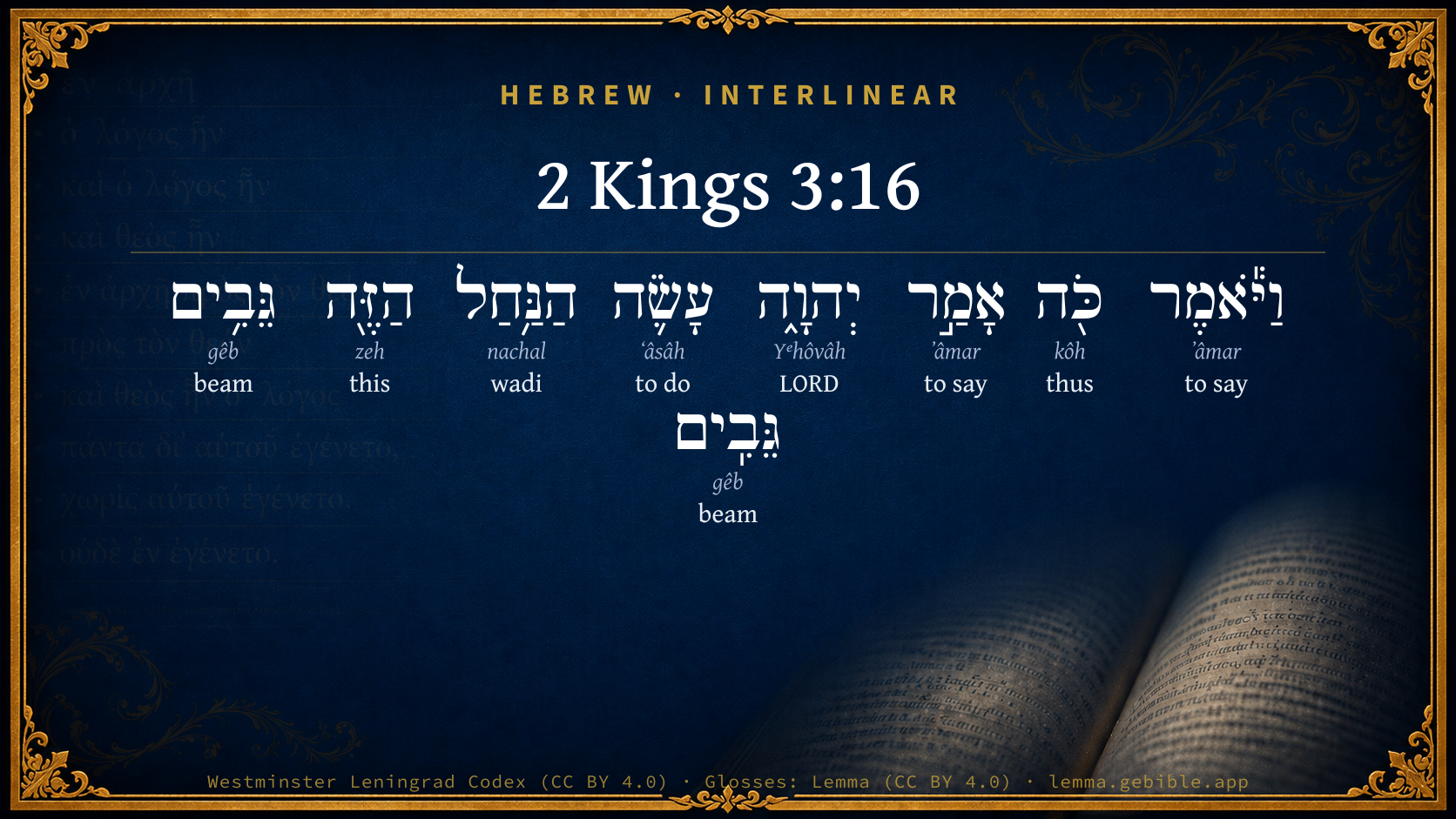
2 Kings 3:16

Hebrew (Westminster Leningrad Codex) 2 Kings 3:16 appears in the Hebrew Old Testament. The text above is from the Westminster Leningrad Codex. Each word links to its Strong’s number, a concise gloss, and parsing drawn from the Open Scriptures Hebrew Bible morphology. Click any word for its full Brown-Driver-Briggs (BDB) entry.
Download image
Cite this verse

2 Kings 3:16 (World English Bible). Public Domain. Lemma interlinear Bible study tool, https://lemma.gebible.app/v/2-kings/3/16.

Show BibTeX & RIS
BibTeX
RIS
English Translation
He said, Thus says Yahweh, Make this valley full of trenches.
World English Bible · Public Domain
Download a study sheet

One document with this verse’s original text, its word-by-word gloss line, the meaning frame, cross-references with their text, attributed commentary, and full source and license credits — printable, and it pastes into notes with its structure intact.

This verse Autodidact and up

Study sheet (.html) Plain text (.txt)

A passage Seminary Student

Up to 50 verses in one chapter. A passage sheet keeps up to 6 commentary sources and 12 cross-references per verse, in the order this page ranks them, and says so on the sheet whenever that leaves anything out. Ask for a single verse and you get the Autodidact verse sheet above.

Everything on this page stays free to read, with no account — the sheet is a download of what is already on screen, not access to it.

Want to remove ads? Support Godless Engineer
Compare translations 3

The same verse in 3 English versions, stacked beneath the original-language interlinear above. Click any original word for its lexicon entry.

Each is an independent rendering of the whole verse — the interlinear is not word-aligned to these translations.

Highlighted words mark where these versions differ — a whole-verse word diff, not a word-by-word alignment.

  • World English Bible Public Domain
    He said, Thus says Yahweh, Make this valley full of trenches.
  • King James Version Public Domain
    And he said, Thus saith the LORD, Make this valley full of ditches.
  • unfoldingWord Literal Text CC BY-SA 4.0
    And he said, “Thus says Yahweh: ‘Make this valley ditches, ditches.’

unfoldingWord Literal Text — © unfoldingWord, licensed CC BY-SA 4.0. Word-aligned USFM3 via Door43 (git.door43.org/unfoldingWord/en_ult).

Versions to compare (up to 4)

3 of 4 selected

Show all 18 translations

Every available English version of this verse, each an independent rendering of the whole verse.

  • World English Bible Public Domain
    He said, Thus says Yahweh, Make this valley full of trenches.
  • Berean Standard Bible Public Domain
    and he said, “This is what the LORD says: ‘Dig this valley full of ditches.’
  • Majority Standard Bible Public Domain
    and he said, “This is what the LORD says: ‘Dig this valley full of ditches.’
  • King James Version Public Domain
    And he said, Thus saith the LORD, Make this valley full of ditches.
  • American Standard Version (1901) Public Domain
    And he said, Thus saith Jehovah, Make this valley full of trenches.
  • Revised Version (1885) Public Domain
    And he said, Thus saith the LORD, Make this valley full of trenches.
  • Geneva Bible (1599) Public Domain
    And he saide, Thus saith the Lord, Make this valley full of ditches.
  • Douay-Rheims (1899) Public Domain
    Thus saith the Lord: Make the channel of this torrent full of ditches.
  • Young's Literal Translation Public Domain
    and he saith, `Thus said Jehovah, Make this valley ditches -- ditches;
  • Literal Standard Version CC BY-SA 4.0
    and he says, “Thus said YHWH: Make this valley ditches—ditches;
  • Unlocked Literal Bible CC BY-SA 4.0
    He said, “Yahweh says this, 'Make this dry river valley full of trenches.'
  • unfoldingWord Literal Text CC BY-SA 4.0
    And he said, “Thus says Yahweh: ‘Make this valley ditches, ditches.’
  • Darby Bible Public Domain
    And he said, Thus saith Jehovah: Make this valley full of ditches.
  • World Messianic Bible Public Domain
    He said, “The LORD says, ‘Make this valley full of trenches.’
  • Webster's Bible Public Domain
    And he said, Thus saith the LORD, Make this valley full of ditches.
  • Free Bible Version CC BY-SA 4.0
    and he announced, “This is what the Lord says: This valley will be filled with pools of water. For the Lord says:
  • Bible in Basic English Public Domain
    And he said, The Lord says, I will make this valley full of water-holes.
  • JPS Tanakh (1917) Public Domain
    And he said: 'Thus saith the LORD: Make this valley full of trenches.

Literal Standard Version (2020), Covenant Press — licensed CC BY-SA 4.0. Text via the HelloAO Bible API (eBible.org). Unlocked Literal Bible (unfoldingWord) — licensed CC BY-SA 4.0. Text via the HelloAO Bible API (eBible.org). unfoldingWord Literal Text — © unfoldingWord, licensed CC BY-SA 4.0. Word-aligned USFM3 via Door43 (git.door43.org/unfoldingWord/en_ult). Free Bible Version, Dr. Jonathan Gallagher — licensed CC BY-SA 4.0. Text via the HelloAO Bible API (eBible.org).

Word by word

More ways to search: Search by grammar → Find every occurrence → Compare this word →

Practice this passage: Drill this verse → Learn its vocabulary →

About this verse

These counts appear in no published source. They are computed here, from the morphology-tagged text and Lemma’s own curated glosses. What Lemma adds →

9
words
7
distinct lemmas
Historical
section

Notable vocabulary

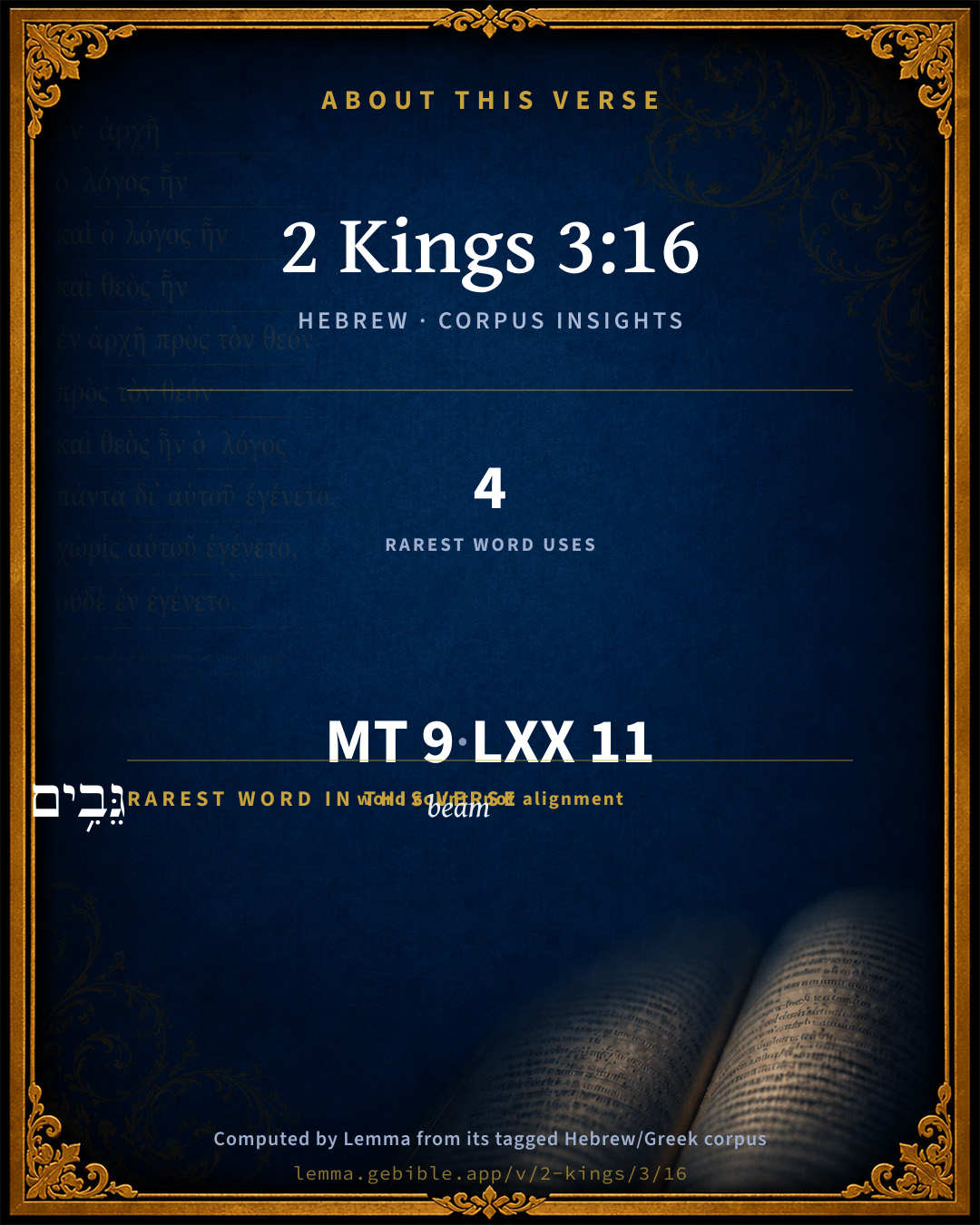
The rarest word here is גֵּבִ֥ים beam H1356 — appearing just 4 times in the whole Hebrew Bible.

Shared distinctive vocabulary

גֵּבִ֥ים beam H1356 occurs in 3 verses of the Hebrew Bible. Also found in:

Grammatical profile

  • 3 verbs
  • 4 nouns
  • 1 pronoun
  • 1 adverb

Verb forms

  • וַיֹּ֕אמֶר Qal · Sequential Imperfect
  • אָמַ֣ר Qal · Perfect
  • עָשֹׂ֛ה Qal · Infinitive Absolute

Repetition

Words recur within this verse — often emphatic in Hebrew:

  • וַיֹּ֕אמֶר to say H559 ×2
  • גֵּבִ֥ים beam H1356 ×2

Hebrew & Septuagint length

In English translation the verse runs 11 words from the Hebrew and 13 from the Septuagint (LXX English) — closely comparable.

A rough comparison of the two English renderings, which tokenize alike — not a word-level alignment.

Word counts can differ between the Hebrew and the Greek without any difference in meaning — e.g. the Hebrew direct-object marker אֵת has no separate Greek word, and Greek often adds the article ὁ.

In the original languages it is 9 Hebrew tokens and 11 Greek tokens — but the two are counted differently (Hebrew bundles its prefixes and suffixes into one token; the Greek is in lemma form), so that isn’t a like-for-like length.

Hebrew and Greek witnesses Masoretic Hebrew ↔ Greek Septuagint

The same verse in the two great witnesses to the Old Testament, shown verse-for-verse.

These are two independent witnesses, not word-aligned to each other, and the Septuagint is shown in lemma (dictionary) form.

Hebrew 2 Kings 3:16 Masoretic · Westminster Leningrad Codex

וַיֹּ֕אמֶר כֹּ֖ה אָמַ֣ר יְהוָ֑ה עָשֹׂ֛ה הַנַּ֥חַל הַזֶּ֖ה גֵּבִ֥ים גֵּבִֽים

He said, Thus says Yahweh, Make this valley full of trenches.

World English Bible · Public Domain

Greek LXX 2 Kings 3:16 Septuagint · lemma form

καί εἶπον ὅδε λέγω κύριος ποιέω ὁ χειμάρρους οὗτος βόθυνος βόθυνος

And he said, Thus says the Lord, Make this valley full of trenches.

LXX2012 (modern English Septuagint) · Public Domain

On this verse, Adam Clarke's Commentary discusses the Septuagint’s reading. Read the note in Commentary ↓

Hebrew: Westminster Leningrad Codex (CC BY 4.0). Greek: Septuagint (public domain); English from LXX2012 (modern English Septuagint) (Public Domain). How the Septuagint differs from the Hebrew →

Targum (Aramaic paraphrase)

1

The Targum is the ancient Jewish Aramaic paraphrase of the Hebrew Scriptures — an interpretive translation, not the Hebrew text itself. Onkelos (literal) and Pseudo-Jonathan (expansive) render the Torah, and Jonathan the Prophets. Coverage is partial: where no permissively-licensed English translation exists for a verse, only the Aramaic is shown. This is verse-level text, not a word-by-word alignment to the Hebrew.

  1. Targum Jonathan Prophets (Joshua–Malachi)
    וַאֲמַר כִּדְנַן אֲמַר יְיָ יִתְעֲבֵיד נַחֲלָא הָדֵין פַּצִידִין פַּצִידִין:

    (no public-domain English translation for this verse)

    Targum Jonathan — Aramaic: “Mikraot Gedolot” (public domain). English: “Sefaria Community Translation” (CC0 1.0 (public-domain dedication)); “London "Chaldee Paraphrase," 1871” (public domain). Text via Sefaria.

Commentary

Notes on 2 Kings 3:16 from classic Christian and Jewish commentators (each source and its license shown beneath its notes). The classic Christian expositions comment on the surrounding passage and are grouped to its opening verse, so a note may address several verses; the Jewish commentaries on the Tanakh (Rashi and others) are per-verse, so they appear only where the commentator wrote on this verse.

Lemma curates 59 commentaries, every one of them public domain or Creative Commons licensed, each selected and text-cleaned for this edition rather than reprinted as found. About our sources →

Trapp's Complete Commentary

John Trapp

2Ki 3:16 And he said, Thus saith the LORD, Make this valley full of ditches.

Ver. 16. Make this valley full of ditches,] Heb., Ditches, ditches, sc., to receive the water which shall fall by a miracle. Thus God for the most part, saith Mr Diodate here, first prepareth the vessels which are to receive his grace, which is never limited nor hindered but only by man’s incapacity.

John Trapp, A Commentary or Exposition upon All the Books of the Old and New Testament (1647–1656) — public domain. Text from a community e-Sword module.

The Biblical Illustrator

Joseph S. Exell

2Ki_3:16

Make this valley full of ditches.

Preparation for revival

In this story there were no less than three powerful kings, surrounded by numerous hosts of valiant men, marching forth, as they supposed, to easy victory., but when the water failed they themselves had failed in their enterprise. Moab may well be feared when there is no water for Israel, and for Judah, and for Edom. But oh, beloved, this is only a picture of the Church which has not constant supplies of Gods refreshing grace, and of the Christian community from which the favour and the Spirit of the living God have been withdrawn. There may be riches and learning, there may be numbers and influence, there may be talent and organisation, but if there be not the Spirit of all grace, and the helpful influences that come from Him, these other things may prove but hindrances instead of helps. I notice in the story that though the kings were powerless, they were not prayerless. There is hope for any heart that has not forgotten the way to the mercy-seat, and for any child that still believes in, and practises the holy art of prayer.

I. It is mans part to make the trenches. He set all the people of Israel, and Judah, and Edom to dig the ditches, that presently His power might be seen in filling them.

1. It is Gods wont to use ordinary instruments. Sometimes, indeed, He goes out of His own beaten track, He is not necessarily confined to any one course; still, He is a God of order, and does everything accordingly. Nor have I forgotten that when Jesus was amongst men, He acted on the same principle exactly. He took the loaves and fishes of the lad, and multiplied them into a sufficient meal for the multitude.

2. Moreover, preparation for the coming blessing is essential. Suppose in this instance God had sent the water, but there had been no previous preparation for conserving it, it would have been virtually wasted. If there had been no trenches dug, the water would have speedily disappeared; there would have been a momentary refreshing, but nothing more. God will not have His gifts wasted. He outpours His blessings that they may secure the best possible results. This trench-making is not an inapt illustration of Christian effort. I know there are some hearts that will not receive Gods blessing until there has been a good deal of digging in them first. There is nowhere to store it, no place to contain it. Their prejudices must be dug away, their doubts and fears must be uprooted. Digging is hard and difficult work, especially for those who are not used to it. I have found digging to be hard back-breaking work, but it is not so hard as is the labour of trying to get mens hearts right before God. There is something delightfully individual about this digging, inasmuch as every one can have a hand in it. You may not all be able to lead the hosts, but you can all have your spade and mattock with which to dig a ditch in your own immediate neighbourhood. It is humble work this; it is not like storming a citadel, or rushing on the foe, but it is just as necessary. Pick and shovel can be consecrated as surely as sword and spear. Do not be ashamed of delving for Christ, and of digging for Jesus.

II. It is Gods part to fill the trenches with water. Do not omit your duty; but do not attempt His. There are some who go to this extreme. They want to get up a revival. Revivals that are worth having are not got up, they are brought down; they are the work of the Spirit of God.

1. Mark how mysteriously the water came. There was no sound of wind which generally precedes the rainstorm. There was no falling of the rain overnight. From whence did the water come? Was there some rock in the desert, struck as by the hand of God, that gushed its waters forth, as Horebs did long years ago? When and where He pleases He does His sovereign will. I notice that the water came by the way of Edom--a most unlikely source. Let it come by way of Edom if it will, so long as it comes from God.

2. The Lord sent this blessing in spite of the sinners that were in the camp. They often hinder Gods work, but sometimes He seems to set them aside, as if to say, My time to work is come, and even Jehoram and the abominations of Baal shall not prevent, and for Jehoshaphats sake, I will save this people, and do them good.

3. How copious was the supply, when it did come. It filled the whole of the valley; the deepest trenches were filled to the brim, and the longest had enough to fill them from end to end. Oh, that some such favour might come to us, till heart and home are filled with blessing, and the whole Church rejoices in the love of God, shed abroad in our hearts, and in the saving power of His grace, effecting wonders far and wide.

4. And this, mind you, was only the beginning of good things. God called it a little thing to fill the valley with water. He will deliver the Moabites also into your hands, the prophet said. There are surprises in store for those who trust in God, and do their part.

5. Remember also, when this blessing came! It was in the early morning when the meat offering was offered. God wrought many of His marvellous acts when either the morning or the evening sacrifice was being offered. Twas then that Elijah called upon his God, who answered him by fire. Twas then that Ezra rose up from his heaviness. It was then that Daniel was touched by the hand of Gabriel. Nor can I forget that when Jesus Christ was sacrificed, our offering for sin, the rocks rent, the veil of the temple was rent in twain from the top to the bottom, and many that slept arose out of their graves. Ah! there is a lesson for us here. The blessing comes at the time of sacrificing. (T. Spurgeon.)

Make this valley full of ditches

Many useful lessons might be gathered from this narrative if we had but time. Upon the very surface we are led to observe the weakness of man when at his utmost strength. Three kings, with three armies well-skilled in war, were gathered to subdue Moab, and lo, the whole of the leaguered hosts were brought to a dead-lock and a standstill by the simple circumstance that there was a want of water. How easily can God nonplus and checkmate all the wisdom and the strength of mankind! We may also learn here how easily men in times of difficulty which they have brought upon themselves, will lay their distress upon providence rather than honestly see it to be the result of their own foolish actions. Hear the King of Israel cast the blame upon Jehovah: For the Lord has called these three kings together, to deliver them into the hand of Moab. Providence is a most convenient horse to bear the saddles of our folly.

I. Our present position. The armies of these kings were in a position of abject dependence; they were dying of thirst; they could not supply their need; they must have from God the help required, or they must perish. This is just the position of every Christian church. So dependent is the Christian Church upon the Holy Ghost, that there never was an acceptable sigh heaved by a penitent apart from him; never did holy song mount to heaven except he gave it wings; never was there true prayer or faithful ministry except through the power and might of the Holy Ghost. Sinners are never saved apart from the Spirit of God.

II. Our duty as the prophet tells it to us. The prophet did not tell the kings that they were to procure the water--that, as we have already said, was out of their power--but he did say, Make this valley full of ditches, that when the water came there might be reservoirs to contain it. If we expect to obtain the Holy Spirits blessing, we must prepare for his reception. Before the Nile begins to rise, you see the Egyptians on either side of the banks making ready first the deep channel, and then the large reservoir, and afterwards the small canals, and then the minor pools, for unless these are ready the rising of the Nile will be of little value for the irrigation of the crops in future months; but when the Nile rises, then the water is received and made use of to fertilise the fields; and so, when the treasury of the Spirit is open by His powerful operations, each one of us should have his trench ready to receive the blessed flood which is not always at its height. Have you never noticed the traders by the rivers side? If they expect a barge of coals, or a vessel laden with other freight, the wharf is cleared to receive it. Have you not noticed the farmer just before the harvest-time--how the barn is emptied, or the rick yard is made ready for the stacks? Men will, when they expect a thing, prepare for the reception of it; and, if they expect more than usual, they say, I will pull down my barns and build greater, that I may have where to bestow my goods. The text says to us, Prepare for the Spirit of God. Do not pray for it, and then fold your arms and say, Well, perhaps He will work; we ought to act as though we were certain He would work mightily--we must prepare in faith.

1. Prepare for a blessing: prepare largely. Make this valley full of ditches, not make one, trench, but as many as possible. For God, when He worketh, worketh like a God. Expect great things from a great God. Make this valley full of ditches. Have a holy covetousness of the Divine blessing. Never be satisfied with what God is doing in the conversion of souls; be grateful, but hunger after more.

2. Moreover, prepare at once--trot dig trenches in a months time, but make this valley full of ditches now.

3. Furthermore, prepare actively. Ditchmaking is laborious work; God is not to be served by childs-play, or sham work with no toil in it. When a valley is to be trenched throughout its whole length, all the host must give themselves to the effort, and none must skulk from the toil. I believe with all my heart in the Spirit of God; but I do not believe in human idleness. Celestial power uses human effort. The Spirit of God usually works most where we work most. Make this valley full of ditches, a little more plainly and pointedly. If we are to have a blessing from God, we are every one of us to have a trench ready to receive it. Well, how shall I have mine ready? one says. My answer is, have large desires for a blessing: that is one trench you can all dig. Next, add to these desires, faithful, vehement, and importunate prayers. Furthermore, if desires and prayers are good, yet activity is even more so. Every Christian who wanteth to have a blessing for himself or for others, must set to work by active exertion, for this is the word, Make this valley full of ditches. One thing more, and I leave this point. With all the work that the Church does in making the valley full of ditches, we must take care that we do it in a spirit of holy confidence and faith. These ditches were to be dug, not because the water might come, but because they were sure it would come.

III. Divine operations. Observe how sovereign the operations of God are. When Elijah wanted rain, there was a cloud seen, and he heard a sound as of abundance of rain, and by and by the water descended in floods; but when God would send the water to Elisha, he heard no sound of rain, nor did a drop descend. I know not how it was that the trenches were filled. Whether adown some deep ravine, the ancient bed of a dried-up torrent, God made the mighty flood to return, as He did along the bed of Kishon of old, I do not know, but by the way of Edom the waters came obedient to the Divine command. God is not tied to this or that mode of form.

1. As the blessing comes sovereignly, so it comes sufficiently: there was enough for all the men, for all the cattle, and all the beasts. They might drink as they would, but there was quite enough for all.

2. Observe, that this flood came very soon, for the Lord is a punctual paymaster. Moreover, it came certainly; there was no mistaking it, no doubting it; and so shall Gods blessing wait upon the earnest prayers and faithful endeavours of Christian people--a blessing such as the greatest sceptic shall not be able to deny, such as shall make the eyes of timidity to water, while he says to himself, Who hath begotten me these?

IV. The Lord bade His servant tell them that not only should there be water, but he said, This is but a light thing in the sight of God. He will deliver the Moabites also into your hand. Greater things are behind, and are to be expected. (C. H. Spurgeon.)

The Biblical Illustrator, edited by Joseph S. Exell (c. 1880s–1900s) — public domain. Text from a community e-Sword module.

Joseph Benson's Commentary

2Ki 3:16-17. Make this valley full of ditches — Which may receive the water and retain it, for the use of men and beasts. They that expect God’s blessings, must prepare room for them. Ye shall not see wind — Any of those winds which commonly bring rain. Seeing is here put for perceiving or feeling; the words belonging to one sense, being frequently applied to another. Neither shall ye see rain — Elijah, by prayer, obtained water from the sea and clouds: but Elisha fetches it nobody knows whence. God is not confined to second causes. Ordinarily it is by a plentiful rain that he refreshes his inheritance: but here it is done without any such means. Yet that valley shall be filled with water — That valley only, it seems, and no other place, however near or adjoining, which greatly increased the miracle.

Joseph Benson's Commentary on the Old and New Testaments (1811–1818) — public domain. Text from a community e-Sword module.

Jamieson, Fausset & Brown

Robert Jamieson, A. R. Fausset & David Brown

Make this valley full of ditches--capable of holding water.

Jamieson, Fausset & Brown — Commentary Critical and Explanatory on the Whole Bible (1871) — public domain (CC PDM 1.0). Text via the HelloAO Bible API.

Adam Clarke's Commentary

Verse 16. Make this valley full of ditches.] The word נחל nachal may be translated brook, as it is by the Vulgate and Septuagint. There probably was a river here, but it was now dry; and the prophet desires that they would enlarge the channel, and cut out various canals from it, and reservoirs, where water might be collected for the refreshment of the army and of the cattle; and these were to be made so wide that the reflection of the sun's rays from this water might be the means of confounding and destroying the Moabites.

Adam Clarke's Commentary on the Bible (1810–1826) — public domain. Text from a community e-Sword/MySword module.

Ellicott's Commentary for English Readers

(16) Make.—Right (infinitive, equivalent to an energetic imperative).

Valley.—Nahal, wady, torrent-bed, gully. According to Thenius, “the brook Zered” of Deu_2:13 is meant; the present Wady el-Ahsy, (or el-Hasa) which forms the natural southern boundary of Moab, and from which several gorges lead up into the Moabite highlands. (See Isa_15:7.)

Full of ditches.—Literally, pits, pits. (Comp. Gen_14:10 : “Wells, wells of bitumen.”) The pits were to gather the water, which otherwise would soon have run away in the bed of the torrent (Jer_14:3-4). The style of the oracle is stamped with the liveliness and originality of historic truth.

A Bible Commentary for English Readers, edited by Charles John Ellicott (1878–1897) — public domain. Text from a community e-Sword module.

The Cambridge Bible for Schools and Colleges

gen. ed. J. J. S. Perowne

16. Make this valley full of ditches] R.V. trenches. The valley was a torrent bed which in the time of rain would become suddenly flooded with the water from the steep sides, and from the watershed above. This would soon run away, and the excavations mentioned here seem to have been meant to dam up the water, and prevent its rapid escape, that so the army might be supplied for a good while if necessary.

The Cambridge Bible for Schools and Colleges (gen. ed. J. J. S. Perowne; Cambridge University Press, 1878–1918) — public domain. Text from a community e-Sword module.

John Gill's Exposition

And ye shall smite every fenced city and every choice city,.... That is, the inhabitants of them with the sword, and demolish them also, Kg2 3:25, and shall fell every good tree; which seems contrary to the law in Deu 20:19, but that may respect trees belonging to a city when besieged only, or only to Canaanitish cities; or the law was now dispensed with, and that for this time only, to make the punishment of Moab the greater, for their rebellion and other sins:

and stop all wells of water; which must be very distressing to those that survived the calamity of the sword:

and mar every good piece of land with stones; as that it could not be ploughed and sowed, nor anything spring up and grow upon it.

John Gill's Exposition of the Whole Bible (1746–1763) — public domain (CC PDM 1.0). Text via the HelloAO Bible API.

Albert Barnes' Notes on the Bible

Ditches - Or “pits” Jer 14:3. They were to dig pits in the broad valley or wady, wherein the water might remain, instead of flowing off down the torrent course.

Albert Barnes' Notes on the Bible (1834–1885) — public domain. Text from a community e-Sword/MySword module.

Haydock's Catholic Bible Commentary

Ditches. It was then quite dry; the water which should come in the night, would both refresh the army, and bring on the ruin of the Moabites.

George Leo Haydock (1774–1849), Haydock's Catholic Family Bible and Commentary, 1859 edition — public domain. Excludes Psalms (Douay-Rheims chapter numbering differs from Protestant) and Deuterocanonical books (Catholic canon only).

Matthew Poole's English Annotations

Which may receive the water, and hold it for the use of men and beasts.

Matthew Poole's English Annotations on the Holy Bible (1683–1685) — public domain. Text from a community e-Sword/MySword module.

Whedon's Commentary on the Bible

Daniel D. Whedon

16. Make this valley full of ditches — More literally, Make this valley pits, pits. The valley was one of the broad water courses at the southern end of the Dead Sea, and was at that time dry. These pits were to catch and hold the water which was about to come from the distant hills of Edom.

Daniel D. Whedon (gen. ed.), Commentary on the Old and New Testaments (1874–1909) — public domain. Text from a community e-Sword module.

The Pulpit Commentary

And he said, Thus saith the Lord, Make this valley full of ditches; rather, full of pits (boqubouv, LXX). The object was to detain the water which would otherwise have all run off down the torrent-course in a very little time.

Vers. 16-25.

The valley full of ditches.

Two troubles had come upon Israel at this time. The kings of Israel, Judah, and Edom were gone forth to battle against the King of Moab. Strife is an evil between nations or individuals. It takes years for a nation to recover from the devastating effects of war. Terrible is the destruction of life and property which war causes. To the horrors and perils of war in this case was added a fresh difficulty. Their armies, passing through the desert, had no water to drink. Under the burning heat, they suffered fearfully from thirst. We know how greatly our own troops suffered from lack of water in Egypt and the Soudan. Dr. Livingstone, in his travels, has given us an idea of what it is to be without water in the desert. When he saw his children almost perishing of thirst before his eyes, he had a new idea of the value of water. It was no wonder, then, that, with the soldiers weak and languishing from thirst, with no water either for them or for their horses and cattle, they began to despair and regard defeat as certain. But the Prophet Elisha was sent for, as we have seen, and, on being consulted by the kings of Israel and Judah, he said, "Make this valley full of ditches. For thus saith the Lord, Ye shall not see wind, neither shall ye see rain; yet that valley shall be filled with water, that ye may drink, both ye, and your cattle, and your beasts. And this is but a light thing in the sight of the Lord: he will deliver the Moabites also into your hand." We have here

I A STRANGE COMMAND. "Make this valley full of ditches.

1. It was a strange command that ditches should be dug in a desert place. But so it is also in the spiritual kingdom. God often chooses the most unlikely places and the most unlikely persons for the operations of his grace. Is it not a fact that, in thinking of the spread of the gospel, and in engaging in Christian work, we are too much guided by human calculations? We judge too much by outward appearances. We forget that God"s ways are not as our ways, nor his thoughts as our thoughts. People have sometimes refused to give to certain missions because they did not think there was any use in sending the gospel to the particular people for whom the mission was intended. Is God"s arm shortened that it cannot save? It is time for us as Christian Churches and as Christian people to work wherever God gives us the opportunity, even though it should be in the most unlikely and unpromising sphere. God calls us, wherever we are, to dig up wells in the valley.

2. Further, it was a strange command, because there was no appearance of rain at the time, and there was no river at hand from which the wells could be supplied. Why dig wells when you don"t know where the water is to come from? We live in a utilitarian age. Men like to have a reason for everything. They like to be assured of a return for their labor. Consequently, even professedly Christian men are disposed to question the utility of many of God"s commands. Why rest on the sabbath more than on any other day? Why attach any peculiar sanctity to the sabbath? Why not worship God at home, or walk in the fields, instead of going to church? We might show the benefit to the nation of religious observances and of religious teaching. We might show the benefit to the individual of assembling with others for devotional exercises instead of merely worshipping God in private or even in the home. But it is enough here to notice that God has commanded these duties. That ought to be enough to convince any intelligent being, any religious being. God gives no command for which there is not a good reason. I may not see the reason. I may not see the benefit that will result from it. But I am convinced by reason, by conscience, by history, by human experience, that whatever the command may be, a real benefit follows the obedience of it, and real unhappiness and suffering the disobedience of it.

3. One other thought this strange command of God suggests God wants us to be fellow-workers with him. God could have sent the water and provided a place of storage for it without the assistance of the Israelites here. But he does not choose to do so. He says, "Make the valley full of ditches." When modern missions to the heathen first began to be spoken of about a century ago, those who advocated them were met on every side, and in many a church, from pulpit and from pew, from prelate and from presbyter, with the objection that God could save the heathen without their instrumentality. It is obvious that those who reasoned thus about God"s method of converting the world had read their Bible to very little purpose. We find human agency, as a rule, accompanying Divine grace. Christ"s own command is clear, "Go ye therefore, and teach all nations... and, lo! I am with you always." How do we stand in regard to the commands of God? Is there any command that we are deliberately and constantly disobeying? It ought to be the daily prayer of every Christian, "Make me to go in the path of thy commandments; for therein do I delight.

II SUBMISSIVE FAITH. It is clear from the narrative that the men of Judah did as God had commanded them, and made the valley full of ditches. These Hebrew soldiers gave a good example of submissive practical faith.

1. They might have reasonedBetter to be going forth against our enemies than to be wasting our time digging these trenches. So men reason when they hurry forth to their work in the morning without waiting to give God thanks for the rest of the night, and to ask his blessing upon the work of the day. Is it any wonder that the life is so dry, and that things so often seem to go wrong, when we do not take time to dig up wells for God"s blessing? Is it any wonder that the Churches are so unfruitful, that conversions are so infrequent, that revivals are so rare, that there is not more spiritual power in the preaching of the Word, that the influence exercised upon the world around us is so slight, when, with all the attention to congregational machinery and church order, there is so little attention to congregational prayer? It is a fine sight to look at the great engines of a steamer when in motion, and admire the beautiful mechanism of cylinder and crank and piston. But all that elaborate and powerful machinery would be utterly useless unless the steam was there to set it in motion. Let us have our church machinery and organization as perfect as may be, but let us remember that the secret of power is behind and beyond it all. "Not by might, nor by power, but by my Spirit, saith the Lord." The Hebrew soldiers did not think the time lost which they spent in preparing the way for God"s blessing.

2. They might have reasoned Better to move further on where we shall have water than to spend our labor in this desert place. So Christians are sometimes disposed to reason. Ministers grow weary of seeing no fruit of their labors. Sunday-school teachers grow weary of their class. But if all the workers in God"s vineyard had reasoned in that way, and abandoned any sphere of labor because it seemed unfruitful or because they were weary of waiting, the gospel would have made very little progress in the world.

3. They might have reasonedIf were to be saved, we shall be saved. It is not likely that digging up trenches in the valley will deliver us out of the hands of the Moabites. So the sinner reasons when he is urged to believe on the Lord Jesus Christ. Satan, for his soul"s destruction, prompts him with objections to the plan of salvation. But objections to the plan of salvation can no more alter it than any suggestions which a man of science might make could alter the course of nature. The way of salvation is clear. "Believe on the Lord Jesus Christ, and thou shelf be saved." Is it not better for us, as these soldiers did, to take God"s plan, to believe that whatever he commands is for our good, to accept his loving offers of salvation purchased for us by the precious blood of his beloved Son, and to yield ourselves to him as willing servants, doing the will of God from the heart?

III STREAMS OF REFRESHING AND SAFETY. "And it came to pass in the morning, when the meat offering was offered, that, behold, there came water by the way of Edom, and the country was filled with water." Not more eagerly do the weary watchers watch for morning than those languid soldiers watched for the coming of the water. It was a welcome sight. So it is with the blessings of the gospel. "Blessed are they that hunger and thirst after righteousness: for they shall be filled,

As dew upon the tender herb, Diffusing fragrance round, As showers that usher in the spring And cheer the thirsty ground,

So shall his presence bless our souls, And shed a joyful light, That hallowed morn shall chase away The sorrows of the night.

And then also the streams that filled the trenches proved to be streams of safety. When the Moabites arose in the morning, and looked over to the place where the Israelites were encamped, they only saw the glare of the sun upon the water as red as blood. They had probably no idea that water could be there. And so they said, "This is blood; the kings are surely slain, and they have smitten one another." They thought they had nothing to do but plunder the deserted camp of the Israelites, and the result was that the Israelites gained an easy victory, and were delivered out of the hand of their enemies. It is the same with the blessings of the gospel. The gospel which satisfies also saves the soul. And it satisfies because it saves. Herein all human religion and philosophies fail. They may point out a high ideal, but they give us little help to attain it. They may point out the evil of sin, but they cannot strengthen us to overcome it or deliver us from its power. And all they can offer us is only for the present life. But the gospel not only puts before us the high ideal, but enables us through Divine grace to attain to it. It not only shows us the guilt of sin, but it points us to the cleansing blood. It not only shows us the evil of sin, but gives us the victory over it through Christ Jesus our Lord. It not only gives us blessings for the present life, but secures to all who believe on the Lord Jesus Christ the life of heaven, life with God, life that shall never end. Make the valley full of ditches. Open your heart to receive this satisfying, saving gospel Children of God, if you want God"s blessing to flow in upon you in reviving, refreshing streams, prepare the way for it. Dig up wells in the desert. Value your Sundays, your opportunities for private prayer, the house of God, the prayer-meeting. You need them all to refresh your souls and to revive your spiritual life amid the parching, chilling influences of the world. And then in your short life do what you can to make channels through which blessings may flow to others. In this aspect, what a privilege it becomes to help missions, to built! churches and schools, and to take part in every effort for the benefit and enlightenment of others! You may never see the streams of blessing flow, but at any rate you will have dug the channels for them. Such labor is not in vain in the Lord. C.H.I.

The Pulpit Commentary (1880–1919), ed. H.D.M. Spence-Jones & Joseph S. Exell — public domain. Text from a community e-Sword module.

Rashi

Rabbi Shlomo Yitzchaki (Rashi)

Many pools. Ditches full of water.

Rashi on the Tanakh — English translations: “The Judaica Press complete Tanach with Rashi, translated by A. J. Rosenberg” (CC BY 4.0); “Pentateuch with Rashi's commentary by M. Rosenbaum and A.M. Silbermann, 1929-1934” (public domain); “The Metsudah Tanach series, Lakewood, N.J” (CC BY 4.0); and “The Book of Joshua, Metsudah Publications, 1997” (CC BY 4.0). Text via Sefaria.

Lesson kit

Teaching starters — assembled from the data on this page, not authored interpretation. Every prompt links to the verse data it draws on. Edit before teaching.

2 Kings, in the Historical, opens this verse with 9 words (7 distinct Hebrew lemmas). Its most distinctive word is gêb (“beam”). A historical commentator’s framing appears above. Read the whole chapter for the surrounding context.

Discussion questions

  1. The word gêb carries the sense “beam.” How does it shape the verse?
  2. 1 Kings 6:9 shares the word «beam» with this verse. How do the two illuminate each other?
  3. “to say” occurs 2× in this one verse. What is the effect of the repetition?
  4. These translations render this verse differently; the difference is in the English rendering, not the original. What questions does that raise?
  5. The verb «וַיֹּ֕אמֶר» is Qal Sequential Imperfect. How does its form color the action?
  6. Reading how Trapp's Complete Commentary and The Biblical Illustrator read this verse, where do the two commentators agree and where do they part?

Things to notice

Reading settings

Reading text

Shown beneath each verse's original-language words.

Old Testament
Old Testament edition

Read the OT as the Masoretic Hebrew (MT) or the Greek Septuagint (LXX).

English shown for the Greek Septuagint (in the Hebrew ↔ Greek comparison).

Comparing translations? Open the Compare panel on any verse page to stack up to four side by side.