1 Samuel 30:10

Hebrew (Westminster Leningrad Codex) 1 Samuel 30:10 appears in the Hebrew Old Testament. The text above is from the Westminster Leningrad Codex. Each word links to its Strong’s number, a concise gloss, and parsing drawn from the Open Scriptures Hebrew Bible morphology. Click any word for its full Brown-Driver-Briggs (BDB) entry.
Download image
Cite this verse

1 Samuel 30:10 (World English Bible). Public Domain. Lemma interlinear Bible study tool, https://lemma.gebible.app/v/1-samuel/30/10.

Show BibTeX & RIS
BibTeX
RIS
English Translation
But David pursued, he and four hundred men; for two hundred stayed behind, who were so faint that they couldn't go over the brook Besor.
World English Bible · Public Domain
Highlights
  • 1 first appearance in the Hebrew Bible
Full analysis ↓
Download a study sheet

One document with this verse’s original text, its word-by-word gloss line, the meaning frame, cross-references with their text, attributed commentary, and full source and license credits — printable, and it pastes into notes with its structure intact.

This verse Autodidact and up

Study sheet (.html) Plain text (.txt)

A passage Seminary Student

Up to 50 verses in one chapter. A passage sheet keeps up to 6 commentary sources and 12 cross-references per verse, in the order this page ranks them, and says so on the sheet whenever that leaves anything out. Ask for a single verse and you get the Autodidact verse sheet above.

Everything on this page stays free to read, with no account — the sheet is a download of what is already on screen, not access to it.

Want to remove ads? Support Godless Engineer
Compare translations 3

The same verse in 3 English versions, stacked beneath the original-language interlinear above. Click any original word for its lexicon entry.

Each is an independent rendering of the whole verse — the interlinear is not word-aligned to these translations.

Highlighted words mark where these versions differ — a whole-verse word diff, not a word-by-word alignment.

  • World English Bible Public Domain
    But David pursued, he and four hundred men; for two hundred stayed behind, who were so faint that they couldn't go over the brook Besor.
  • King James Version Public Domain
    But David pursued, he and four hundred men: for two hundred abode behind, which were so faint that they could not go over the brook Besor.
  • unfoldingWord Literal Text CC BY-SA 4.0
    So David pursued, he and 400 men, but 200 men stayed who were too exhausted to pass over the wadi of Besor.

unfoldingWord Literal Text — © unfoldingWord, licensed CC BY-SA 4.0. Word-aligned USFM3 via Door43 (git.door43.org/unfoldingWord/en_ult).

Versions to compare (up to 4)

3 of 4 selected

Show all 18 translations

Every available English version of this verse, each an independent rendering of the whole verse.

  • World English Bible Public Domain
    But David pursued, he and four hundred men; for two hundred stayed behind, who were so faint that they couldn't go over the brook Besor.
  • Berean Standard Bible Public Domain
    because two hundred men were too exhausted to cross the brook. But David and four hundred men continued in pursuit.
  • Majority Standard Bible Public Domain
    because two hundred men were too exhausted to cross the brook. But David and four hundred men continued in pursuit.
  • King James Version Public Domain
    But David pursued, he and four hundred men: for two hundred abode behind, which were so faint that they could not go over the brook Besor.
  • American Standard Version (1901) Public Domain
    But David pursued, he and four hundred men; for two hundred stayed behind, who were so faint that they could not go over the brook Besor.
  • Revised Version (1885) Public Domain
    But David pursued, he and four hundred men: for two hundred stayed behind, which were so faint that they could not go over the brook Besor:
  • Geneva Bible (1599) Public Domain
    But Dauid and foure hundreth men followed (for two hundreth abode behinde, being too wearie to goe ouer the riuer Besor)
  • Douay-Rheims (1899) Public Domain
    But David pursued, he and four hundred men: for two hundred stayed, who being weary could not go over the torrent Besor.
  • Young's Literal Translation Public Domain
    and David pursueth, he and four hundred men, (and two hundred men stand still who have been too faint to pass over the brook of Besor),
  • Literal Standard Version CC BY-SA 4.0
    and David pursues, he and four hundred men (and two hundred men stand still who have been too faint to pass over the Brook of Besor),
  • Unlocked Literal Bible CC BY-SA 4.0
    But David kept pursuing, he and four hundred men; for two hundred had stayed behind, who were so weak that they could not go over the brook Besor.
  • unfoldingWord Literal Text CC BY-SA 4.0
    So David pursued, he and 400 men, but 200 men stayed who were too exhausted to pass over the wadi of Besor.
  • Darby Bible Public Domain
    And David pursued, he and four hundred men; for two hundred stayed behind, who were too exhausted to go over the torrent Besor.
  • World Messianic Bible Public Domain
    But David pursued, he and four hundred men; for two hundred stayed behind, who were so faint that they couldn’t go over the brook Besor.
  • Webster's Bible Public Domain
    But David pursued, he and four hundred men: for two hundred abode behind, who were so faint that they could not go over the brook Besor.
  • Free Bible Version CC BY-SA 4.0
    Two hundred of them remained behind there because they were too tired to cross the valley while David continued on with four hundred men.
  • Bible in Basic English Public Domain
    And David, with four hundred men, went on: but two hundred of them were overcome with weariness, and not able to go across the stream.
  • JPS Tanakh (1917) Public Domain
    But David pursued, he and four hundred men; for two hundred stayed behind, who were so faint that they could not go over the brook Besor.

Literal Standard Version (2020), Covenant Press — licensed CC BY-SA 4.0. Text via the HelloAO Bible API (eBible.org). Unlocked Literal Bible (unfoldingWord) — licensed CC BY-SA 4.0. Text via the HelloAO Bible API (eBible.org). unfoldingWord Literal Text — © unfoldingWord, licensed CC BY-SA 4.0. Word-aligned USFM3 via Door43 (git.door43.org/unfoldingWord/en_ult). Free Bible Version, Dr. Jonathan Gallagher — licensed CC BY-SA 4.0. Text via the HelloAO Bible API (eBible.org).

Word by word

More ways to search: Search by grammar → Find every occurrence → Compare this word →

Practice this passage: Drill this verse → Learn its vocabulary →

פִּגְּר֔וּ
pâgar
H6296
“to faint”
Verb, Piel, Perfect, 3rd Person, Common, Plural
Part of Speech
Verb
Stem
Piel
Form
Perfect
Person
3rd Person
Gender
Common
Number
Plural
Full BDB Definition

Origin: a primitive root

TWOT: 1732

(Piel) to be exhausted, be faint
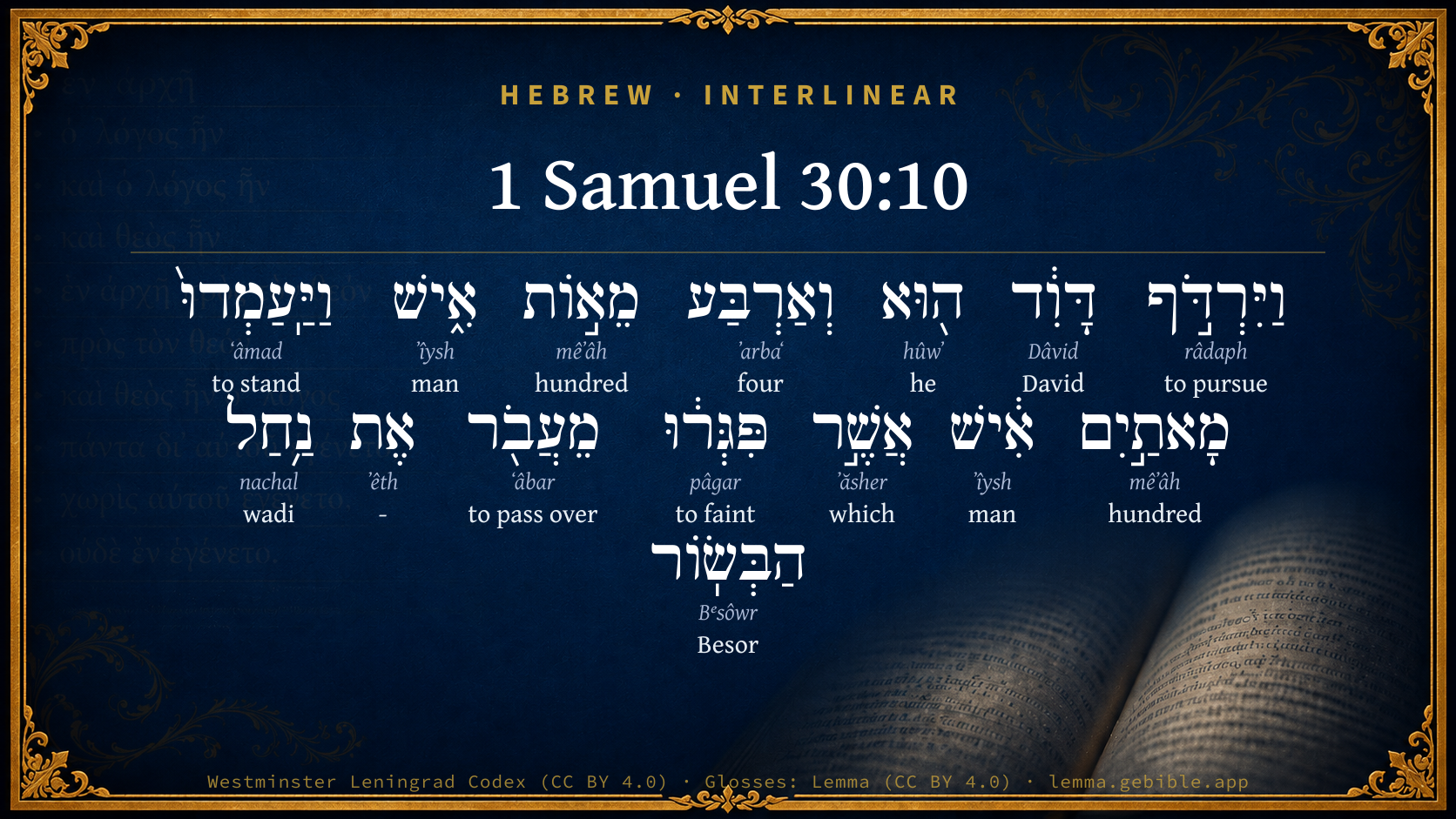
  1. וַיִּרְדֹּ֣ף râdaph H7291 “and · to pursue” Conjunction + Verb, Qal, Sequential Imperfect, 3rd Person, Masculine, Singular
  2. דָּוִ֔ד Dâvid H1732 “David” Noun, Proper
  3. ה֖וּא hûwʼ H1931 “he” Pronoun, Personal, 3rd Person, Masculine, Singular
  4. וְאַרְבַּע ʼarbaʻ H702 “and · four” Conjunction + Adjective, Cardinal number, Feminine, Singular, Absolute
  5. מֵא֣וֹת mêʼâh H3967 “hundred” Adjective, Cardinal number, Both, Plural, Absolute
  6. אִ֑ישׁ ʼîysh H376 “man” Noun, Common, Masculine, Singular, Absolute
  7. וַיַּֽעַמְדוּ֙ ʻâmad H5975 “and · to stand” Conjunction + Verb, Qal, Sequential Imperfect, 3rd Person, Masculine, Plural
  8. מָאתַ֣יִם mêʼâh H3967 “hundred” Adjective, Cardinal number, Both, Dual, Absolute
  9. אִ֔ישׁ ʼîysh H376 “man” Noun, Common, Masculine, Singular, Absolute
  10. אֲשֶׁ֣ר ʼăsher H834 “which” Particle, Relative
  11. מֵעֲבֹ֖ר ʻâbar H5674 “from · to pass over” Preposition + Verb, Qal, Infinitive Construct
  12. אֶת ʼêth H853 “-” Particle, Direct Object
  13. נַ֥חַל nachal H5158 “wadi of” Noun, Common, Masculine, Singular, Construct
  14. הַבְּשֽׂוֹר Bᵉsôwr H1308 “the · Besor” Particle, Definite Article + Noun, Proper

About this verse

These counts appear in no published source. They are computed here, from the morphology-tagged text and Lemma’s own curated glosses. What Lemma adds →

15
words
13
distinct lemmas
Historical
section

Notable vocabulary

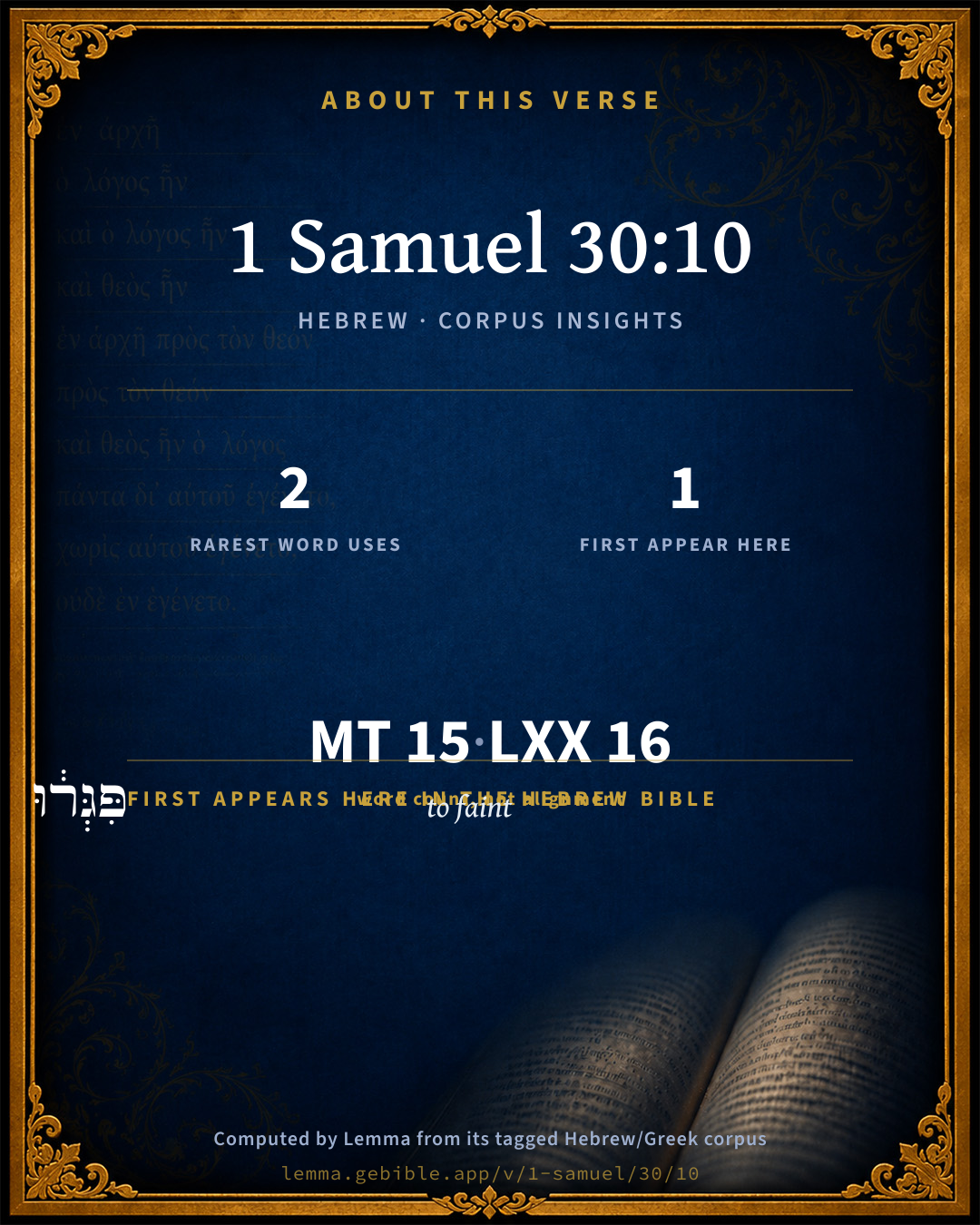
The rarest word here is פִּגְּר֔וּ to faint H6296 — appearing just 2 times in the whole Hebrew Bible.

First appearance in Scripture

This word makes its first canonical appearance in the Hebrew Bible here:

  • פִּגְּר֔וּ to faint H6296

Shared distinctive vocabulary

פִּגְּר֔וּ to faint H6296 occurs in 2 verses of the Hebrew Bible. Also found in:

Grammatical profile

  • 4 verbs
  • 5 nouns
  • 3 adjectives
  • 1 pronoun
  • 2 particles

Verb forms

  • וַיִּרְדֹּ֣ף Qal · Sequential Imperfect
  • וַיַּֽעַמְדוּ֙ Qal · Sequential Imperfect
  • פִּגְּר֔וּ Piel · Perfect
  • מֵעֲבֹ֖ר Qal · Infinitive Construct

Repetition

Words recur within this verse — often emphatic in Hebrew:

  • מֵא֣וֹת hundred H3967 ×2
  • אִ֑ישׁ man H376 ×2

Hebrew & Septuagint length

In English translation the verse runs 25 words from the Hebrew and 25 from the Septuagint (LXX English) — the same length.

A rough comparison of the two English renderings, which tokenize alike — not a word-level alignment.

Word counts can differ between the Hebrew and the Greek without any difference in meaning — e.g. the Hebrew direct-object marker אֵת has no separate Greek word, and Greek often adds the article ὁ.

In the original languages it is 15 Hebrew tokens and 16 Greek tokens — but the two are counted differently (Hebrew bundles its prefixes and suffixes into one token; the Greek is in lemma form), so that isn’t a like-for-like length.

Cross-references

5

Topical passages linked to 1 Samuel 30:10 in the Treasury of Scripture Knowledge — connected by theme and wording, ordered by reader-vote popularity; previews shown in the World English Bible.

  • 1 Samuel 30:9 So David went, he and the six hundred men who were with him, and came to the brook Besor, where those who were left behind stayed.
  • 1 Samuel 30:21 David came to the two hundred men, who were so faint that they could not follow David, whom also they had made to abide at the brook Besor; and they went forth to meet David, and to meet the people who were with him: and when David came near to the people, he greeted them.
  • Judges 8:4–5 Gideon came to the Jordan, [and] passed over, he, and the three hundred men who were with him, faint, yet pursuing.
  • 1 Samuel 14:20 Saul and all the people who were with him were gathered together, and came to the battle: and, behold, every man's sword was against his fellow, [and there was] a very great confusion.
  • 1 Samuel 14:31 They struck of the Philistines that day from Michmash to Aijalon. The people were very faint;

Cross-references courtesy of OpenBible.info (CC BY 4.0).

Hebrew and Greek witnesses Masoretic Hebrew ↔ Greek Septuagint

The same verse in the two great witnesses to the Old Testament, shown verse-for-verse.

These are two independent witnesses, not word-aligned to each other, and the Septuagint is shown in lemma (dictionary) form.

Hebrew 1 Samuel 30:10 Masoretic · Westminster Leningrad Codex

וַיִּרְדֹּ֣ף דָּוִ֔ד ה֖וּא וְאַרְבַּע מֵא֣וֹת אִ֑ישׁ וַיַּֽעַמְדוּ֙ מָאתַ֣יִם אִ֔ישׁ אֲשֶׁ֣ר פִּגְּר֔וּ מֵעֲבֹ֖ר אֶת נַ֥חַל הַבְּשֽׂוֹר

But David pursued, he and four hundred men; for two hundred stayed behind, who were so faint that they couldn't go over the brook Besor.

World English Bible · Public Domain

Greek LXX 1 Samuel 30:10 Septuagint · lemma form

καί καταδιώκω ἐν τετρακόσιοι ἀνήρ ὑποἵστημι δέ διακόσιοι ἀνήρ ὅστις καταἵζω πέραν ὁ χειμάρρους ὁ βοσορ

And he pursued them with four hundred men; and there remained behind two hundred men, who tarried on the other side of the brook Bosor.

LXX2012 (modern English Septuagint) · Public Domain

On this verse, Haydock's Catholic Bible Commentary discusses the Septuagint’s reading. Read the note in Commentary ↓

Hebrew: Westminster Leningrad Codex (CC BY 4.0). Greek: Septuagint (public domain); English from LXX2012 (modern English Septuagint) (Public Domain). How the Septuagint differs from the Hebrew →

Targum (Aramaic paraphrase)

1

The Targum is the ancient Jewish Aramaic paraphrase of the Hebrew Scriptures — an interpretive translation, not the Hebrew text itself. Onkelos (literal) and Pseudo-Jonathan (expansive) render the Torah, and Jonathan the Prophets. Coverage is partial: where no permissively-licensed English translation exists for a verse, only the Aramaic is shown. This is verse-level text, not a word-by-word alignment to the Hebrew.

  1. Targum Jonathan Prophets (Joshua–Malachi)
    וּרְדַף דָוִד הוּא וְאַרְבַּע מְאָה גַבְרָא וְאִשְׁתָּאֲרוּן מָאתָן גַבְרָא דְאִתְמְנָעוּ מִלְמֶעֱבַר יַת נַחַל דִבְשׂוֹר:

    (no public-domain English translation for this verse)

    Targum Jonathan — Aramaic: “Mikraot Gedolot” (public domain). English: “Sefaria Community Translation” (CC0 1.0 (public-domain dedication)); “London "Chaldee Paraphrase," 1871” (public domain). Text via Sefaria.

Commentary

Notes on 1 Samuel 30:10 from classic Christian and Jewish commentators (each source and its license shown beneath its notes). The classic Christian expositions comment on the surrounding passage and are grouped to its opening verse, so a note may address several verses; the Jewish commentaries on the Tanakh (Rashi and others) are per-verse, so they appear only where the commentator wrote on this verse.

Lemma curates 59 commentaries, every one of them public domain or Creative Commons licensed, each selected and text-cleaned for this edition rather than reprinted as found. About our sources →

The Cambridge Bible for Schools and Colleges

gen. ed. J. J. S. Perowne

10. abode behind] Stayed, as in 1Sa_30:9. The condensed expression of the last clause of 1Sa_30:9 is explained by 1Sa_30:10.

were so faint] A verb found only here and in 1Sa_30:21, connected with a substantive meaning a corpse; as we should say, they were dead-beat.

The Cambridge Bible for Schools and Colleges (gen. ed. J. J. S. Perowne; Cambridge University Press, 1878–1918) — public domain. Text from a community e-Sword module.

Trapp's Complete Commentary

John Trapp

1Sa 30:10 But David pursued, he and four hundred men: for two hundred abode behind, which were so faint that they could not go over the brook Besor.

Ver. 10. He and four hundred men.] For those six hundred were too many for God to work by, as Jdg 7:4. He delighteth to help his people "with a little help." {Dan 11:34}

For two hundred abode behind.] Being either so weary, or so lazy, for the word will bear both, saith Vatablus, {a} that they marched no farther. Piscator noteth, that of the Hebrew word here used cometh pheger, for a dead carcass: to show that these two hundred were so weak and weary, that they were well nigh dead.

{a} פגרו significat et lassum esse et pigrum esse.

John Trapp, A Commentary or Exposition upon All the Books of the Old and New Testament (1647–1656) — public domain. Text from a community e-Sword module.

Tyndale Open Study Notes

Tyndale Open Resources

30:10 too exhausted: David’s men had traveled for three days (30:1) and were now in hot pursuit of the Amalekites without having rested. David did not upbraid them or drive them on mercilessly. See 30:23-25.

Tyndale Open Study Notes — © Tyndale Open Resources, licensed CC BY-SA 4.0. Text via the HelloAO Bible API.

John Gill's Exposition

But David pursued, he and four hundred men,.... Not discouraged with being obliged to leave a third part of his little army behind; though it was doubtless a trial of his faith, with these to pursue an enemy, whose numbers he knew not, which must greatly exceed his; for after the rout and slaughter of them, as many escaped on camels as David had with him, Sa1 30:17,

for two hundred abode behind, which were so faint; through their grief and sorrow for the loss of their wives and children, and through their march from the camp of the Philistines to Ziklag, and from thence hither, that they looked like a corpse, as the word signifies; Procopius Gazaeus has it only seventy men:

so that they could not go over the brook Besor: being so weak and feeble; for this was not owing to fear of their enemies, and faint heartedness on that account, then it would rather have been said, "they would not go over"; the Targum renders the word "faint" by "restrained" or prohibited, as if they were forbid by David to go over, but were ordered to tarry here by the stuff, while the rest pursued; and, according to the Syriac and Arabic versions, they were placed there, that none might go over the brook; and it seems, by Sa1 30:22, that they had a good will to go over, but were made to abide there; or as all Gideon's army, but three hundred, were sent back, and not suffered to go with him, being too many, Jdg 7:2.

John Gill's Exposition of the Whole Bible (1746–1763) — public domain (CC PDM 1.0). Text via the HelloAO Bible API.

Haydock's Catholic Bible Commentary

CHAPTER XXX.

Weary. Hebrew pigru, denotes those who are "lazy and dead." Septuagint, "some sat down on the other side of the torrent." Syriac and Arabic insinuate, to defend the passage. But why then do the rest complain? (Calmet) --- They acted irrationally, as David shewed afterwards. Some of the 600 might well be more exhausted than others, and these were selected to guard the baggage, ver. 24. This was only the third day since they left Aphec, ver. 1. (Haydock)

George Leo Haydock (1774–1849), Haydock's Catholic Family Bible and Commentary, 1859 edition — public domain. Excludes Psalms (Douay-Rheims chapter numbering differs from Protestant) and Deuterocanonical books (Catholic canon only).

Matthew Poole's English Annotations

Four hundred men; a small number for such an attempt; but David was strong in faith, giving God the glory of his power and faithfulness.

Matthew Poole's English Annotations on the Holy Bible (1683–1685) — public domain. Text from a community e-Sword/MySword module.

John Wesley's Explanatory Notes

Four hundred - A small number for such an attempt: but David was strong in faith, giving God the glory of his power and faithfulness.

John Wesley, Explanatory Notes Upon the Whole Bible (1754–1765) — public domain. Text via the GEBible commentary corpus.

Rashi

Rabbi Shlomo Yitzchaki (Rashi)

Who were too exhausted. Who refrained; and I say that this is Aramaic, the translation of וְנֶהֶרְסוּ [=and they will be destroyed].

Rashi on the Tanakh — English translations: “The Judaica Press complete Tanach with Rashi, translated by A. J. Rosenberg” (CC BY 4.0); “Pentateuch with Rashi's commentary by M. Rosenbaum and A.M. Silbermann, 1929-1934” (public domain); “The Metsudah Tanach series, Lakewood, N.J” (CC BY 4.0); and “The Book of Joshua, Metsudah Publications, 1997” (CC BY 4.0). Text via Sefaria.

Lesson kit

Teaching starters — assembled from the data on this page, not authored interpretation. Every prompt links to the verse data it draws on. Edit before teaching.

1 Samuel, in the Historical, opens this verse with 15 words (13 distinct Hebrew lemmas). Its most distinctive word is pâgar (“to faint”). A historical commentator’s framing appears above. Read the whole chapter for the surrounding context.

Discussion questions

  1. The word pâgar carries the sense “to faint.” How does it shape the verse?
  2. The word “to faint” first appears here in Scripture. What is being introduced at this debut?
  3. 1 Samuel 30:21 shares the word «to faint» with this verse. How do the two illuminate each other?
  4. “hundred” occurs 2× in this one verse. What is the effect of the repetition?
  5. The translations on this page render this verse differently — a whole-verse word diff, not a word-by-word alignment. What might account for the different wordings?
  6. The verb «וַיִּרְדֹּ֣ף» is Qal Sequential Imperfect. How does its form color the action?
  7. Reading how The Cambridge Bible for Schools and Colleges and Trapp's Complete Commentary read this verse, where do the two commentators agree and where do they part?

Things to notice

Reading settings

Reading text

Shown beneath each verse's original-language words.

Old Testament
Old Testament edition

Read the OT as the Masoretic Hebrew (MT) or the Greek Septuagint (LXX).

English shown for the Greek Septuagint (in the Hebrew ↔ Greek comparison).

Comparing translations? Open the Compare panel on any verse page to stack up to four side by side.