
Psalms 74:15

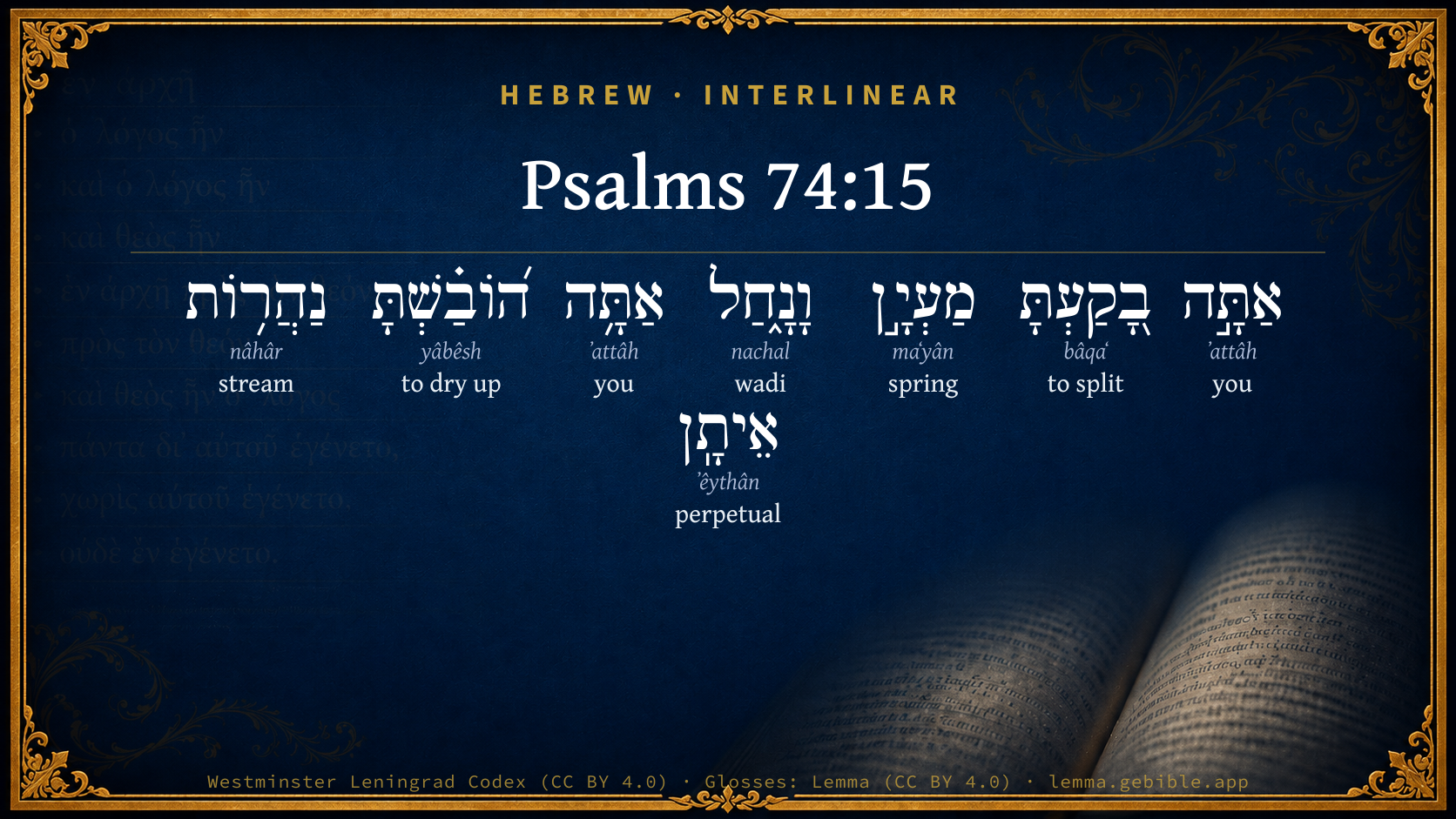
Hebrew (Westminster Leningrad Codex) Psalms 74:15 appears in the Hebrew Old Testament. The text above is from the Westminster Leningrad Codex. Each word links to its Strong’s number, a concise gloss, and parsing drawn from the Open Scriptures Hebrew Bible morphology. Click any word for its full Brown-Driver-Briggs (BDB) entry.
Download image
Cite this verse

Psalms 74:15 (World English Bible). Public Domain. Lemma interlinear Bible study tool, https://lemma.gebible.app/v/psalms/74/15.

Show BibTeX & RIS
BibTeX
RIS
English Translation
You opened up spring and stream. You dried up mighty rivers.
World English Bible · Public Domain
Download a study sheet

One document with this verse’s original text, its word-by-word gloss line, the meaning frame, cross-references with their text, attributed commentary, and full source and license credits — printable, and it pastes into notes with its structure intact.

This verse Autodidact and up

Study sheet (.html) Plain text (.txt)

A passage Seminary Student

Up to 50 verses in one chapter. A passage sheet keeps up to 6 commentary sources and 12 cross-references per verse, in the order this page ranks them, and says so on the sheet whenever that leaves anything out. Ask for a single verse and you get the Autodidact verse sheet above.

Everything on this page stays free to read, with no account — the sheet is a download of what is already on screen, not access to it.

Want to remove ads? Support Godless Engineer
Compare translations 3

The same verse in 3 English versions, stacked beneath the original-language interlinear above. Click any original word for its lexicon entry.

Each is an independent rendering of the whole verse — the interlinear is not word-aligned to these translations.

Highlighted words mark where these versions differ — a whole-verse word diff, not a word-by-word alignment.

  • World English Bible Public Domain
    You opened up spring and stream. You dried up mighty rivers.
  • King James Version Public Domain
    Thou didst cleave the fountain and the flood: thou driedst up mighty rivers.
  • unfoldingWord Literal Text CC BY-SA 4.0
    You, you split open spring and wadi; you, you dry up perpetual rivers.

unfoldingWord Literal Text — © unfoldingWord, licensed CC BY-SA 4.0. Word-aligned USFM3 via Door43 (git.door43.org/unfoldingWord/en_ult).

Versions to compare (up to 4)

3 of 4 selected

Show all 18 translations

Every available English version of this verse, each an independent rendering of the whole verse.

  • World English Bible Public Domain
    You opened up spring and stream. You dried up mighty rivers.
  • Berean Standard Bible Public Domain
    You broke open the fountain and the flood; You dried up the ever-flowing rivers.
  • Majority Standard Bible Public Domain
    You broke open the fountain and the flood; You dried up the ever-flowing rivers.
  • King James Version Public Domain
    Thou didst cleave the fountain and the flood: thou driedst up mighty rivers.
  • American Standard Version (1901) Public Domain
    Thou didst cleave fountain and flood: Thou driedst up mighty rivers.
  • Revised Version (1885) Public Domain
    Thou didst cleave fountain and flood: thou driedst up mighty rivers.
  • Geneva Bible (1599) Public Domain
    Thou brakest vp the fountaine and riuer: thou dryedst vp mightie riuers.
  • Douay-Rheims (1899) Public Domain
    Thou hast broken up the fountains and the torrents: thou hast dried up the Ethan rivers.
  • Young's Literal Translation Public Domain
    Thou hast cleaved a fountain and a stream, Thou hast dried up perennial flowings.
  • Literal Standard Version CC BY-SA 4.0
    You have cleaved a fountain and a stream, || You have dried up perennial flowings.
  • Unlocked Literal Bible CC BY-SA 4.0
    You broke open springs and streams; you dried up flowing rivers.
  • unfoldingWord Literal Text CC BY-SA 4.0
    You, you split open spring and wadi; you, you dry up perpetual rivers.
  • Darby Bible Public Domain
    *Thou* didst cleave fountain and torrent, *thou* driedst up ever-flowing rivers.
  • World Messianic Bible Public Domain
    You opened up spring and stream. You dried up mighty rivers.
  • Webster's Bible Public Domain
    Thou didst cleave the fountain and the flood: thou didst dry up mighty rivers.
  • Free Bible Version CC BY-SA 4.0
    You were the one who made springs and rivers flow with water. You made permanent rivers dry up.
  • Bible in Basic English Public Domain
    You made valleys for fountains and springs; you made the ever-flowing rivers dry.
  • JPS Tanakh (1917) Public Domain
    Thou didst cleave fountain and brook; Thou driedst up ever-flowing rivers.

Literal Standard Version (2020), Covenant Press — licensed CC BY-SA 4.0. Text via the HelloAO Bible API (eBible.org). Unlocked Literal Bible (unfoldingWord) — licensed CC BY-SA 4.0. Text via the HelloAO Bible API (eBible.org). unfoldingWord Literal Text — © unfoldingWord, licensed CC BY-SA 4.0. Word-aligned USFM3 via Door43 (git.door43.org/unfoldingWord/en_ult). Free Bible Version, Dr. Jonathan Gallagher — licensed CC BY-SA 4.0. Text via the HelloAO Bible API (eBible.org).

Word by word

More ways to search: Search by grammar → Find every occurrence → Compare this word →

Practice this passage: Drill this verse → Learn its vocabulary →

About this verse

These counts appear in no published source. They are computed here, from the morphology-tagged text and Lemma’s own curated glosses. What Lemma adds →

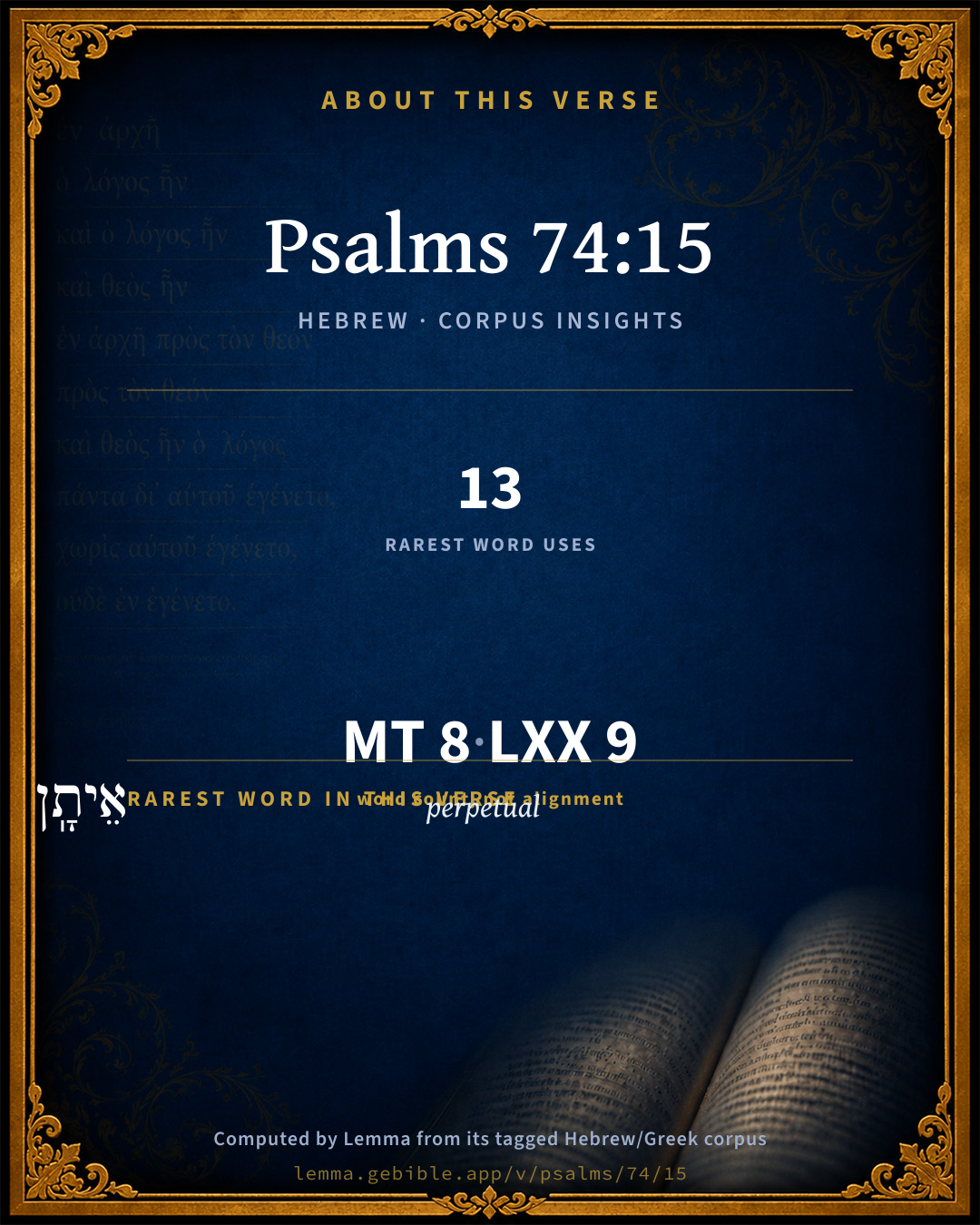
8
words
7
distinct lemmas
Wisdom
section

Notable vocabulary

The rarest word here is אֵיתָֽן perpetual H386 — appearing just 13 times in the whole Hebrew Bible.

Shared distinctive vocabulary

אֵיתָֽן perpetual H386 occurs in 13 verses of the Hebrew Bible. Also found in:

Grammatical profile

  • 2 verbs
  • 3 nouns
  • 1 adjective
  • 2 pronouns

Verb forms

  • בָ֭קַעְתָּ Qal · Perfect
  • ה֝וֹבַ֗שְׁתָּ Hiphil · Perfect

Repetition

A word recurs within this verse — often emphatic in Hebrew:

  • אַתָּ֣ה you H859 ×2

Hebrew & Septuagint length

In English translation the verse runs 11 words from the Hebrew and 11 from the Septuagint (LXX English) — the same length.

A rough comparison of the two English renderings, which tokenize alike — not a word-level alignment.

Word counts can differ between the Hebrew and the Greek without any difference in meaning — e.g. the Hebrew direct-object marker אֵת has no separate Greek word, and Greek often adds the article ὁ.

In the original languages it is 8 Hebrew tokens and 9 Greek tokens — but the two are counted differently (Hebrew bundles its prefixes and suffixes into one token; the Greek is in lemma form), so that isn’t a like-for-like length.

Cross-references

14

Topical passages linked to Psalms 74:15 in the Treasury of Scripture Knowledge — connected by theme and wording, ordered by reader-vote popularity; previews shown in the World English Bible.

  • Numbers 20:11 Moses lifted up his hand, and struck the rock with his rod twice: and water came forth abundantly, and the congregation drank, and their cattle.
  • Exodus 17:5–6 Yahweh said to Moses, "Walk on before the people, and take the elders of Israel with you, and take the rod in your hand with which you struck the Nile, and go.
  • Psalms 105:41 He opened the rock, and waters gushed out. They ran as a river in the dry places.
  • Isaiah 48:21 They didn't thirst when he led them through the deserts; he caused the waters to flow out of the rock for them; he split the rock also, and the waters gushed out.
  • Joshua 2:10 For we have heard how Yahweh dried up the water of the Red Sea before you, when you came out of Egypt; and what you did to the two kings of the Amorites, who were beyond the Jordan, to Sihon and to Og, whom you utterly destroyed.
  • Joshua 3:13–17 It shall come to pass, when the soles of the feet of the priests who bear the ark of Yahweh, the Lord of all the earth, shall rest in the waters of the Jordan, that the waters of the Jordan shall be cut off, even the waters that come down from above; and they shall stand in one heap.
  • Exodus 14:21–22 Moses stretched out his hand over the sea, and Yahweh caused the sea to go back by a strong east wind all the night, and made the sea dry land, and the waters were divided.
  • 2 Kings 2:8 Elijah took his mantle, and wrapped it together, and struck the waters, and they were divided here and there, so that they two went over on dry ground.
  • Psalms 78:15 He split rocks in the wilderness, And gave them drink abundantly as out of the depths.
  • Isaiah 11:16 There shall be a highway for the remnant of his people, who shall remain, from Assyria; like as there was for Israel in the day that he came up out of the land of Egypt.
  • Isaiah 44:27 who says to the deep, Be dry, and I will dry up your rivers;
  • Habakkuk 3:9 You uncovered your bow. You called for your sworn arrows. Selah. You split the earth with rivers.
  • Revelation 16:12 The sixth poured out his bowl on the great river, the Euphrates. Its water was dried up, that the way might be made ready for the kings that come from the sunrise.
  • 2 Kings 2:14 He took the mantle of Elijah that fell from him, and struck the waters, and said, Where is Yahweh, the God of Elijah? and when he also had struck the waters, they were divided here and there; and Elisha went over.

Cross-references courtesy of OpenBible.info (CC BY 4.0).

Hebrew and Greek witnesses Masoretic Hebrew ↔ Greek Septuagint

The same verse in the two great witnesses to the Old Testament, shown verse-for-verse.

You’re reading Greek Psalm 73 (Hebrew Psalm 74). The Septuagint counts the superscription, so verse numbers can differ from the Hebrew — chapter-level alignment, not verse-by-verse. Numbering follows Rahlfs.

These are two independent witnesses, not word-aligned to each other, and the Septuagint is shown in lemma (dictionary) form.

Hebrew Psalms 74:15 Masoretic · Westminster Leningrad Codex

אַתָּ֣ה בָ֭קַעְתָּ מַעְיָ֣ן וָנָ֑חַל אַתָּ֥ה ה֝וֹבַ֗שְׁתָּ נַהֲר֥וֹת אֵיתָֽן

You opened up spring and stream. You dried up mighty rivers.

World English Bible · Public Domain

Greek LXX Greek Psalm 73:15 Septuagint · lemma form

σύ διαῥήγνυμι πηγή καί χειμάρρους σύ ξηραίνω ποταμός ηθαμ

You did cleave fountains and torrents; you dried up mighty rivers.

LXX2012 (modern English Septuagint) · Public Domain

Hebrew: Westminster Leningrad Codex (CC BY 4.0). Greek: Septuagint (public domain); English from LXX2012 (modern English Septuagint) (Public Domain). How the Septuagint differs from the Hebrew →

Commentary

Notes on Psalms 74:15 from classic Christian and Jewish commentators (each source and its license shown beneath its notes). The classic Christian expositions comment on the surrounding passage and are grouped to its opening verse, so a note may address several verses; the Jewish commentaries on the Tanakh (Rashi and others) are per-verse, so they appear only where the commentator wrote on this verse.

Lemma curates 59 commentaries, every one of them public domain or Creative Commons licensed, each selected and text-cleaned for this edition rather than reprinted as found. About our sources →

Trapp's Complete Commentary

John Trapp

Psa 74:15 Thou didst cleave the fountain and the flood: thou driedst up mighty rivers.

Ver. 15. Thou didst cleave the fountain and the flood] i.e. Fontium et torrentium scatebras et latebras, thou didst set the rock abroach once and again, Exo 17:6 Num 20:11, rescissis ipsius naturae legibus.

Thou driedst up mighty rivers] Jordan (wherein some say met two great rivers, Jor and Dan), whereunto the Chaldee here addeth Arnon and Jabbok, whereof see Num 21:14 Deu 2:37.

John Trapp, A Commentary or Exposition upon All the Books of the Old and New Testament (1647–1656) — public domain. Text from a community e-Sword module.

Joseph Benson's Commentary

Psa 74:15. Thou didst cleave the fountain and the flood — That is, thou didst, by cleaving the rock, make a fountain in it, and a flood or stream to flow from it, for the refreshment of thy people in those dry deserts. Thou driedst up mighty rivers — Hebrew, נהרות איתןrivers of strength. The Seventy, however, render it, ποταμους ηθαμ, taking the latter word, eethan, for a proper name. Undoubtedly Jordan is meant: so that “two other remarkable exertions of the divine power, in favour of the Israelites, are here referred to. Water was brought out of the rock to satisfy their thirst in the time of drought; and the river Jordan was dried up to open the passage for them into Canaan.”

Joseph Benson's Commentary on the Old and New Testaments (1811–1818) — public domain. Text from a community e-Sword module.

J. A. Alexander on Psalms

Joseph Addison Alexander

Psa 74:15. (It is) thou (that) didst cleave fount and flood, (that) didst dry up rivers ever flowing. Fountain and flood is a kind of proverbial expression for smaller and greater bodies of water. The primary historical allusion here is to the passage of the Jordan. The original construction of the last phrase is streams of perpetuity, perennial or unfailing streams, as distillguished from the winter torrents of the Holy Land, which disappear in summer. The common version, rivers of strength or mighty rivers, is not sustained by etymology or usage.

Joseph Addison Alexander, The Psalms Translated and Explained (1850) — public domain. Text from a community e-Sword module.

Tyndale Open Study Notes

Tyndale Open Resources

74:15 springs and streams to gush forth: God provided water in the desert for his people (see 68:8-9; Exod 17:6); he dried up the Red Sea (Exod 14:21) and the Jordan River (Josh 3:17).

Tyndale Open Study Notes — © Tyndale Open Resources, licensed CC BY-SA 4.0. Text via the HelloAO Bible API.

Adam Clarke's Commentary

Verse 15. Thou didst cleave the fountain] Thou didst cleave the rock in the wilderness, of which all the congregation drank.

Thou driedst up mighty rivers.] Does not this refer to the cutting off the waters of the Jordan, so that the people passed over dryshod?

Adam Clarke's Commentary on the Bible (1810–1826) — public domain. Text from a community e-Sword/MySword module.

Ellicott's Commentary for English Readers

(15) Thou didst cleave . . .—Another pregnant expression for “thou didst cleave the rock, and a fountain came forth.”

Flood.—Better, brook. Heb., nâchal.

Mighty rivers.—See margin. But, perhaps, rather. rivers of constant flow, that did not dry up in summer like the “brooks.” The same word is used of the sea (Exo_14:27), to express the return to the regular flow of the tide.

The verb “driest up” is that used (Jos_2:10) of the Red Sea, and Jos_4:23; Jos_5:1 of the Jordan.

A Bible Commentary for English Readers, edited by Charles John Ellicott (1878–1897) — public domain. Text from a community e-Sword module.

The Cambridge Bible for Schools and Colleges

gen. ed. J. J. S. Perowne

15. Thou didst cleave fountain and torrent:

Thou didst dry up perennial rivers.

God’s omnipotence was shewn alike in cleaving the rock so that water flowed out (Exo_17:6; Num_20:8; Psa_78:15; Isa_48:21), and in drying up the perennial stream of the Jordan (Joshua 3; Jos_4:23).

The Cambridge Bible for Schools and Colleges (gen. ed. J. J. S. Perowne; Cambridge University Press, 1878–1918) — public domain. Text from a community e-Sword module.

John Gill's Exposition

The day is thine, and the night also is thine,.... He made the one and the other, and divided the one from the other; and can make them longer or shorter, clear or cloudy, as he pleases: and the day of prosperity and night of adversity are at his disposal; all the times of his people and of his church are in his hands; sometimes it is a night of darkness, deadness, sleepiness, and security, as it now is; ere long there will be no more night, but bright day; the light of the moon will be as the light of the sun, and the light of the sun will be seven fold as the light of seven days; and this is to be expected from him whose is the day and the night also, Rev 21:25. Jarchi interprets the day, of the redemption of Israel; and the night, of distresses and afflictions:

thou hast prepared the light and the sun; first the light, and then the sun; for the light was before the sun; or the luminary, even the sun. Aben Ezra interprets the "light" of the moon, and so the Targum; and Kimchi, both of the moon and of the stars; Jarchi takes the light figuratively to be meant of the light of the law; but it is much better to understand it of the light of the Gospel, which God has prepared, and will send forth more largely in the latter day, whereby the whole earth shall be lightened; and when Christ the "sun" of righteousness will arise with healing in his wings, and who gives both the light of grace and glory to his people.

John Gill's Exposition of the Whole Bible (1746–1763) — public domain (CC PDM 1.0). Text via the HelloAO Bible API.

Albert Barnes' Notes on the Bible

Thou didst cleave the fountain and the flood - That is, the source of the streams and the streams themselves. The main allusion is probably to the Jordan, and the idea is, that God had, as it were, divided all the waters, or prevented any obstruction to his people from the river in any respect; as if the waters in the very springs and fountains, and the waters in the channel of the river flowing from those springs and fountains, had been so restrained and divided that there was a safe passage through them. Jos 3:14-17.

Thou driedst up mighty rivers - Margin, “rivers of strength.” The Hebrew - איתן 'êythân - (compare Deu 21:4; Amo 5:24; 1Ki 8:2) - means rather perennial, constant, ever-flowing. The allusion is to rivers or streams that flow constantly, or that do not dry up. It was this which made the miracle so apparent. It could not be pretended that they had gone over the bed of a stream which was accustomed to be dry at certain seasons of the year. They passed over rivers that never dried up; and, therefore, it could have been only by miracle. The main allusion is undoubtedly to the passage of the Jordan.

Albert Barnes' Notes on the Bible (1834–1885) — public domain. Text from a community e-Sword/MySword module.

Matthew Poole's English Annotations

Thou didst cleave the fountain and the flood, i.e. thou didst by cleaving the rock make a fountain in it, and a flood or stream to flow from it, for the refreshment of thy people in those dry deserts. The phrase is like that Isa 47:2, grind meal, i.e. by grinding the corn make meal.

Mighty rivers; either,

1. Jordan, which was then more mighty than ordinarily, as having overflowed all his banks, and therefore may be called rivers, because it was now equivalent to two or three such rivers; or it is only an ensilage of the plural number for the singular, whereof I have given many instances formerly. Or rather,

2. Both Jordan and the Red Sea; for the sea itself, yea, a greater sea than that, is called a river, Jon 2:3; for the Hebrew word is the same which is here used, though there it be rendered floods. And the same title is expressly given to the sea by Homer and other ancient writers. To these the ancient Chaldee interpreter addeth the rivers of Amen and Jabbok, in or about which some extraordinary work was wrought, yea, something which was like God’s work at the Red Sea, as may seem by the conjunction of these together, Num 21:14.

Matthew Poole's English Annotations on the Holy Bible (1683–1685) — public domain. Text from a community e-Sword/MySword module.

The Treasury of David

Charles H. Spurgeon

Ver. 15. Thou didst cleave the fountain and the flood. Jordan was divided by Jehovah's power; the Lord is able to repeat his miracles, what he did with a sea, he can do with a river; lesser difficulties shall be removed as well as greater ones. Perhaps the fountain refers to the smitten rock, which from its cleft poured forth a perpetual stream; so the Lord opens to us springs of water in the wilderness.

Thou driedst up mighty rivers, rivers which were permanent, and not like the transient torrents of the land, were dried up for awhile; the Jordan itself, being such, was laid dry for a season. Observe the repetition of the pronoun "thou; "the song is all for God, and the prayer is all directed to him. The argument is that he who wrought such wonders would be pleased to do the like now that an emergency had arisen.

Ver. 15. Flood. God in dividing Jordan did not only divide the water that ordinarily belonged to the river, or the water which came from its fountains, but also the extraordinary additional waters by the great rains a little before harvest. So God cleaved both the fountain, i.e., the fountain water, and the flood. Jonathan Edwards.

Ver. 15. The wonderful nature of gracious supplies, illustrated by the smitten rock.

Psalms 74:16*

Charles H. Spurgeon's The Treasury of David (1869–1885) — public domain. Psalms only. Text from a community e-Sword/MySword module.

Whedon's Commentary on the Bible

Daniel D. Whedon

15. Driedst up mighty rivers—This was done when he dried up the rivers of the desert after having miraculously created them. See note on Psa_78:15, and when he “dried up the waters of Jordan.” Jos_4:23

Daniel D. Whedon (gen. ed.), Commentary on the Old and New Testaments (1874–1909) — public domain. Text from a community e-Sword module.

The Pulpit Commentary

Thou didst cleave the fountain and the flood; rather, and the torrent. (comp. Exo_17:6 Num_20:11) Thou driedst up mighty rivers; i.e. the Jordan. (Jos_3:13, et seqq.)

The Pulpit Commentary (1880–1919), ed. H.D.M. Spence-Jones & Joseph S. Exell — public domain. Text from a community e-Sword module.

John Wesley's Explanatory Notes

The flood - Thou didst by cleaving the rock, make a fountain and a stream to flow from it, for the refreshment of thy people in those dry deserts. Driedst - Jordan and the Red Sea; for the sea itself; yea, a greater sea than that, is called a river, Jonah ii, 3, where the Hebrew word is the same which is here used. And the same title is expressly given to the sea, by Homer, and other ancient writers.

John Wesley, Explanatory Notes Upon the Whole Bible (1754–1765) — public domain. Text via the GEBible commentary corpus.

Rashi

Rabbi Shlomo Yitzchaki (Rashi)

You split for Israel fountains from the rock.

You dried up the Jordan, which is a mighty river.

Rashi on the Tanakh — English translations: “The Judaica Press complete Tanach with Rashi, translated by A. J. Rosenberg” (CC BY 4.0); “Pentateuch with Rashi's commentary by M. Rosenbaum and A.M. Silbermann, 1929-1934” (public domain); “The Metsudah Tanach series, Lakewood, N.J” (CC BY 4.0); and “The Book of Joshua, Metsudah Publications, 1997” (CC BY 4.0). Text via Sefaria.

Lesson kit

Teaching starters — assembled from the data on this page, not authored interpretation. Every prompt links to the verse data it draws on. Edit before teaching.

Psalms, in the Wisdom, opens this verse with 8 words (7 distinct Hebrew lemmas). Its most distinctive word is ʼêythân (“perpetual”). A historical commentator’s framing appears above. Read the whole chapter for the surrounding context.

Discussion questions

  1. The word ʼêythân carries the sense “perpetual.” How does it shape the verse?
  2. How does Genesis 49:24, which shares the word «perpetual», read alongside this verse?
  3. What does the repetition of “you” (2× in this one verse) do in this verse?
  4. These translations render this verse differently. What is at stake in choosing one wording over another?
  5. «בָ֭קַעְתָּ» is a Qal Perfect verb. How does that grammatical form shape the action described?
  6. Compare how Trapp's Complete Commentary and Joseph Benson's Commentary read this verse. Where do they agree or differ?

Things to notice

Reading settings

Reading text

Shown beneath each verse's original-language words.

Old Testament
Old Testament edition

Read the OT as the Masoretic Hebrew (MT) or the Greek Septuagint (LXX).

English shown for the Greek Septuagint (in the Hebrew ↔ Greek comparison).

Comparing translations? Open the Compare panel on any verse page to stack up to four side by side.