Isaiah 57:5

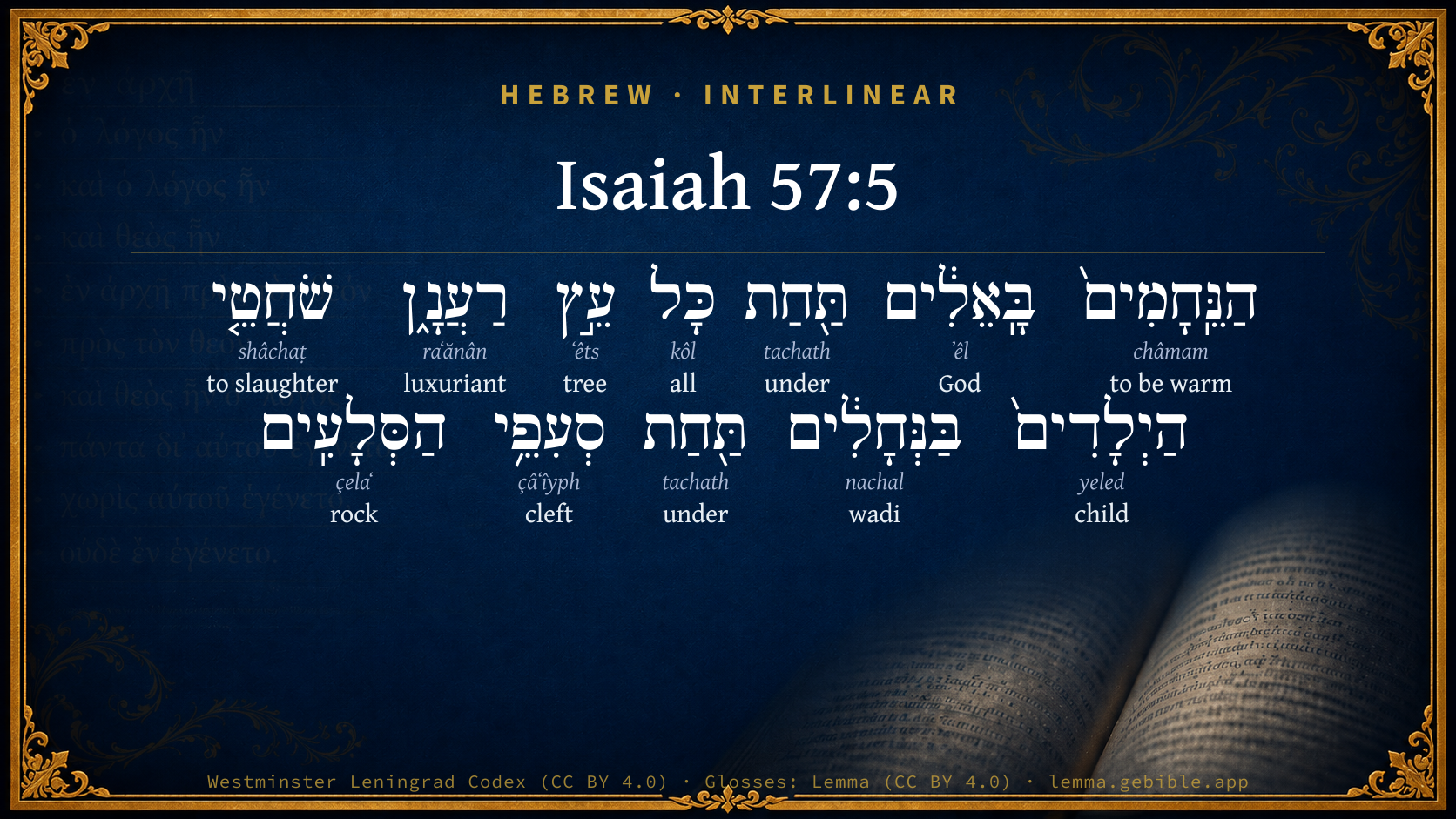
Hebrew (Westminster Leningrad Codex) Isaiah 57:5 appears in the Hebrew Old Testament. The text above is from the Westminster Leningrad Codex. Each word links to its Strong’s number, a concise gloss, and parsing drawn from the Open Scriptures Hebrew Bible morphology. Click any word for its full Brown-Driver-Briggs (BDB) entry.
Download image
Cite this verse

Isaiah 57:5 (World English Bible). Public Domain. Lemma interlinear Bible study tool, https://lemma.gebible.app/v/isaiah/57/5.

Show BibTeX & RIS
BibTeX
RIS
English Translation
you who inflame yourselves among the oaks, under every green tree; who kill the children in the valleys, under the clefts of the rocks?
World English Bible · Public Domain
Download a study sheet

One document with this verse’s original text, its word-by-word gloss line, the meaning frame, cross-references with their text, attributed commentary, and full source and license credits — printable, and it pastes into notes with its structure intact.

This verse Autodidact and up

Study sheet (.html) Plain text (.txt)

A passage Seminary Student

Up to 50 verses in one chapter. A passage sheet keeps up to 6 commentary sources and 12 cross-references per verse, in the order this page ranks them, and says so on the sheet whenever that leaves anything out. Ask for a single verse and you get the Autodidact verse sheet above.

Everything on this page stays free to read, with no account — the sheet is a download of what is already on screen, not access to it.

Want to remove ads? Support Godless Engineer
Compare translations 3

The same verse in 3 English versions, stacked beneath the original-language interlinear above. Click any original word for its lexicon entry.

Each is an independent rendering of the whole verse — the interlinear is not word-aligned to these translations.

Highlighted words mark where these versions differ — a whole-verse word diff, not a word-by-word alignment.

  • World English Bible Public Domain
    you who inflame yourselves among the oaks, under every green tree; who kill the children in the valleys, under the clefts of the rocks?
  • King James Version Public Domain
    Enflaming yourselves with idols under every green tree, slaying the children in the valleys under the clifts of the rocks?
  • unfoldingWord Literal Text CC BY-SA 4.0
    ones inflaming yourselves among the oaks, under every green tree, slaughterers of children in wadis, under clefts of rocks?

unfoldingWord Literal Text — © unfoldingWord, licensed CC BY-SA 4.0. Word-aligned USFM3 via Door43 (git.door43.org/unfoldingWord/en_ult).

Versions to compare (up to 4)

3 of 4 selected

Show all 18 translations

Every available English version of this verse, each an independent rendering of the whole verse.

  • World English Bible Public Domain
    you who inflame yourselves among the oaks, under every green tree; who kill the children in the valleys, under the clefts of the rocks?
  • Berean Standard Bible Public Domain
    who burn with lust among the oaks, under every luxuriant tree, who slaughter your children in the valleys, under the clefts of the rocks?
  • Majority Standard Bible Public Domain
    who burn with lust among the oaks, under every luxuriant tree, who slaughter your children in the valleys, under the clefts of the rocks?
  • King James Version Public Domain
    Enflaming yourselves with idols under every green tree, slaying the children in the valleys under the clifts of the rocks?
  • American Standard Version (1901) Public Domain
    ye that inflame yourselves among the oaks, under every green tree; that slay the children in the valleys, under the clefts of the rocks?
  • Revised Version (1885) Public Domain
    ye that inflame yourselves among the oaks, under every green tree; that slay the children in the valleys, under the clefts of the rocks?
  • Geneva Bible (1599) Public Domain
    Inflamed with idoles vnder euery greene tree? and sacrificing the children in the valleys vnder the tops of the rocks?
  • Douay-Rheims (1899) Public Domain
    Who seek your comfort in idols under every green tree, sacrificing children in the torrents, under the high rocks?
  • Young's Literal Translation Public Domain
    Who are inflamed among oaks, under every green tree, Slaughtering the children in valleys, Under clefts of the rocks.
  • Literal Standard Version CC BY-SA 4.0
    Who are inflamed among oaks, under every green tree, || Slaughtering the children in valleys, || Under clefts of the rocks.
  • Unlocked Literal Bible CC BY-SA 4.0
    You heat yourselves up sleeping together under the oaks, under every green tree, you who kill your children in the dry riverbeds, under the rocky overhangs.
  • unfoldingWord Literal Text CC BY-SA 4.0
    ones inflaming yourselves among the oaks, under every green tree, slaughterers of children in wadis, under clefts of rocks?
  • Darby Bible Public Domain
    inflaming yourselves with idols under every green tree, slaying the children in the valleys under the clefts of the rocks?
  • World Messianic Bible Public Domain
    you who inflame yourselves among the oaks, under every green tree; who kill the children in the valleys, under the clefts of the rocks?
  • Webster's Bible Public Domain
    Inflaming yourselves with idols under every green tree, slaying the children in the valleys under the cliffs of the rocks?
  • Free Bible Version CC BY-SA 4.0
    You're the ones having pagan orgies under the oak trees, under every green tree. You sacrifice your children in the valleys and among the rocky peaks.
  • Bible in Basic English Public Domain
    You who are burning with evil desire among the oaks, under every green tree; putting children to death in the valleys, under the cracks of the rocks?
  • JPS Tanakh (1917) Public Domain
    Ye that inflame yourselves among the terebinths, under every leafy tree; that slay the children in the valleys, under the clefts of the rocks?

Literal Standard Version (2020), Covenant Press — licensed CC BY-SA 4.0. Text via the HelloAO Bible API (eBible.org). Unlocked Literal Bible (unfoldingWord) — licensed CC BY-SA 4.0. Text via the HelloAO Bible API (eBible.org). unfoldingWord Literal Text — © unfoldingWord, licensed CC BY-SA 4.0. Word-aligned USFM3 via Door43 (git.door43.org/unfoldingWord/en_ult). Free Bible Version, Dr. Jonathan Gallagher — licensed CC BY-SA 4.0. Text via the HelloAO Bible API (eBible.org).

Word by word

More ways to search: Search by grammar → Find every occurrence → Compare this word →

Practice this passage: Drill this verse → Learn its vocabulary →

סְעִפֵ֥י
çâʻîyph
H5585
“clefts of”
Noun, Common, Masculine, Plural, Construct
Part of Speech
Noun
Type
Common
Gender
Masculine
Number
Plural
State
Construct
Full BDB Definition

Origin: from H5586

TWOT: 1527a

cleft, branch - cleft (of a crag) - branches, boughs
  1. הַנֵּֽחָמִים֙ châmam H2552 “the · being warm” Particle, Definite Article + Verb, Niphal, Participle Active, Masculine, Plural, Absolute
  2. בָּֽאֵלִ֔ים ʼêl H410 “in/at the · gods” Preposition, Determined + Noun, Common, Masculine, Plural, Absolute
  3. תַּ֖חַת tachath H8478 “under” Preposition
  4. כָּל kôl H3605 “all of” Noun, Common, Masculine, Singular, Construct
  5. עֵ֣ץ ʻêts H6086 “tree” Noun, Common, Masculine, Singular, Absolute
  6. רַעֲנָ֑ן raʻănân H7488 “luxuriant” Adjective, Adjective, Masculine, Singular, Absolute
  7. שֹׁחֲטֵ֤י shâchaṭ H7819 “slaughtering” Verb, Qal, Participle Active, Masculine, Plural, Construct
  8. הַיְלָדִים֙ yeled H3206 “the · children” Particle, Definite Article + Noun, Common, Masculine, Plural, Absolute
  9. בַּנְּחָלִ֔ים nachal H5158 “in/at the · wadis” Preposition, Determined + Noun, Common, Masculine, Plural, Absolute
  10. תַּ֖חַת tachath H8478 “under” Preposition
  11. הַסְּלָעִֽים çelaʻ H5553 “the · rocks” Particle, Definite Article + Noun, Common, Masculine, Plural, Absolute

About this verse

These counts appear in no published source. They are computed here, from the morphology-tagged text and Lemma’s own curated glosses. What Lemma adds →

12
words
11
distinct lemmas
Prophets
section

Notable vocabulary

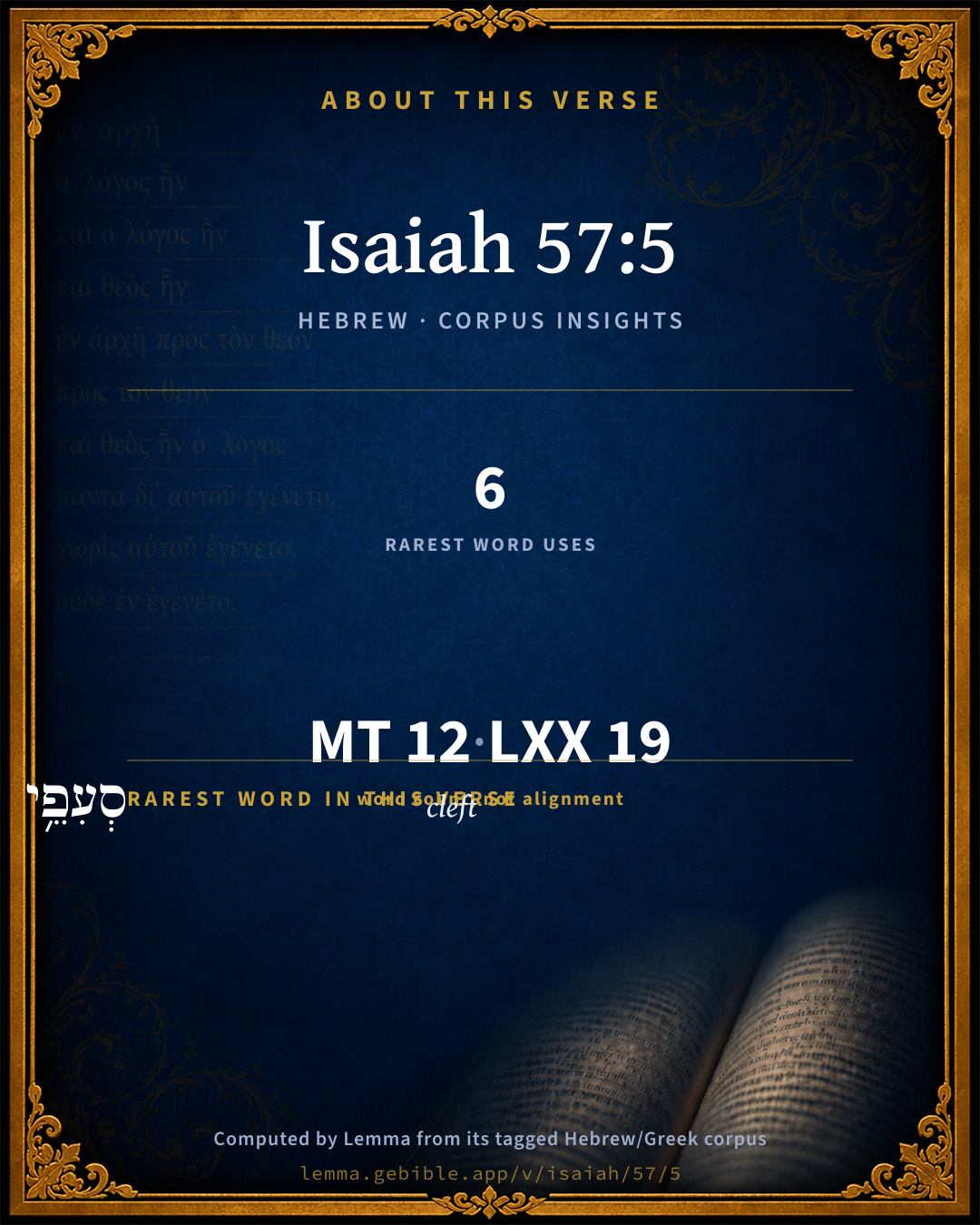
The rarest word here is סְעִפֵ֥י cleft H5585 — appearing just 6 times in the whole Hebrew Bible.

Shared distinctive vocabulary

סְעִפֵ֥י cleft H5585 occurs in 6 verses of the Hebrew Bible. Also found in:

Grammatical profile

  • 2 verbs
  • 7 nouns
  • 1 adjective
  • 2 prepositions

Verb forms

  • הַנֵּֽחָמִים֙ Niphal · Participle Active
  • שֹׁחֲטֵ֤י Qal · Participle Active

Repetition

A word recurs within this verse — often emphatic in Hebrew:

  • תַּ֖חַת under H8478 ×2

Hebrew & Septuagint length

In English translation the verse runs 24 words from the Hebrew and 17 from the Septuagint (LXX English) — the Septuagint runs noticeably shorter here. See the side-by-side →

A rough comparison of the two English renderings, which tokenize alike — not a word-level alignment.

Word counts can differ between the Hebrew and the Greek without any difference in meaning — e.g. the Hebrew direct-object marker אֵת has no separate Greek word, and Greek often adds the article ὁ.

In the original languages it is 12 Hebrew tokens and 19 Greek tokens — but the two are counted differently (Hebrew bundles its prefixes and suffixes into one token; the Greek is in lemma form), so that isn’t a like-for-like length.

Cross-references

30

Topical passages linked to Isaiah 57:5 in the Treasury of Scripture Knowledge — connected by theme and wording, ordered by reader-vote popularity; previews shown in the World English Bible.

  • 2 Kings 16:3–4 But he walked in the way of the kings of Israel, yes, and made his son to pass through the fire, according to the abominations of the nations, whom Yahweh cast out from before the children of Israel.
  • Isaiah 1:29 For they shall be ashamed of the oaks which you have desired, And you shall be confounded for the gardens that you have chosen.
  • Ezekiel 16:20 Moreover you have taken your sons and your daughters, whom you have borne to me, and these have you sacrificed to them to be devoured. Were your prostitution a small matter,
  • Leviticus 18:21 "'You shall not give any of your children to sacrifice to Molech; neither shall you profane the name of your God: I am Yahweh.
  • 2 Kings 23:10 He defiled Topheth, which is in the valley of the children of Hinnom, that no man might make his son or his daughter to pass through the fire to Molech.
  • Jeremiah 2:20 For of old time I have broken your yoke, and burst your bonds; and you said, I will not serve; for on every high hill and under every green tree you did bow yourself, playing the prostitute.
  • Jeremiah 3:13 Only acknowledge your iniquity, that you have transgressed against Yahweh your God, and have scattered your ways to the strangers under every green tree, and you have not obeyed my voice, says Yahweh.
  • Jeremiah 7:31 They have built the high places of Topheth, which is in the valley of the son of Hinnom, to burn their sons and their daughters in the fire; which I didn't command, neither came it into my mind.
  • Exodus 32:6 They rose up early on the next day, and offered burnt offerings, and brought peace-offerings; and the people sat down to eat and to drink, and rose up to play.
  • Leviticus 20:2–5 "Moreover, you shall tell the children of Israel, 'Anyone of the children of Israel, or of the strangers who live as foreigners in Israel, who gives any of his seed to Molech; he shall surely be put to death. The people of the land shall stone him with stones.
  • Numbers 25:1–2 Israel abode in Shittim; and the people began to play the prostitute with the daughters of Moab:
  • Numbers 25:6 Behold, one of the children of Israel came and brought to his brothers a Midianite woman in the sight of Moses, and in the sight of all the congregation of the children of Israel, while they were weeping at the door of the tent of meeting.
  • Deuteronomy 12:2 You shall surely destroy all the places in which the nations that you shall dispossess served their gods, on the high mountains, and on the hills, and under every green tree:
  • 1 Kings 14:23 For they also built them high places, and pillars, and Asherim, on every high hill, and under every green tree;
  • 2 Kings 17:10 and they set them up pillars and Asherim on every high hill, and under every green tree;
  • 2 Chronicles 28:3 Moreover he burnt incense in the valley of the son of Hinnom, and burnt his children in the fire, according to the abominations of the nations whom Yahweh cast out before the children of Israel.
  • Psalms 106:37–38 Yes, they sacrificed their sons and their daughters to demons.
  • Jeremiah 17:2 while their children remember their altars and their Asherim by the green trees on the high hills.
  • Jeremiah 32:35 They built the high places of Baal, which are in the valley of the son of Hinnom, to cause their sons and their daughters to pass through [the fire] to Molech; which I didn't command them, neither did it come into my mind, that they should do this abomination, to cause Judah to sin.
  • Jeremiah 50:38 A drought is on her waters, and they shall be dried up; for it is a land of engraved images, and they are mad over idols.
  • Jeremiah 51:7 Babylon has been a golden cup in Yahweh's hand, who made all the earth drunken: the nations have drunk of her wine; therefore the nations are mad.
  • Ezekiel 6:13 You shall know that I am Yahweh, when their slain men shall be among their idols round about their altars, on every high hill, on all the tops of the mountains, and under every green tree, and under every thick oak, the places where they offered sweet savor to all their idols.
  • Ezekiel 20:26 and I polluted them in their own gifts, in that they caused to pass through [the fire] all that opens the womb, that I might make them desolate, to the end that they might know that I am Yahweh.
  • Ezekiel 20:31 and when you offer your gifts, when you make your sons to pass through the fire, do you pollute yourselves with all your idols to this day? and shall I be inquired of by you, house of Israel? As I live, says the Lord Yahweh, I will not be inquired of by you;
  • Hosea 4:11–13 Prostitution, wine, and new wine take away understanding.
  • Hosea 7:4–7 They are all adulterers. They are burning like an oven that the baker stops stirring, From the kneading of the dough, until it is leavened.
  • Amos 2:7–8 They trample on the dust of the earth on the head of the poor, And deny justice to the oppressed; And a man and his father use the same maiden, to profane my holy name;
  • Revelation 17:1–5 One of the seven angels who had the seven bowls came and spoke with me, saying, "Come here. I will show you the judgment of the great prostitute who sits on many waters,
  • Revelation 18:3 For all the nations have drunk of the wine of the wrath of her sexual immorality, the kings of the earth committed sexual immorality with her, and the merchants of the earth grew rich from the abundance of her luxury."
  • Jeremiah 3:6 Moreover Yahweh said to me in the days of Josiah the king, Have you seen that which backsliding Israel has done? she is gone up on every high mountain and under every green tree, and there has played the prostitute.

Cross-references courtesy of OpenBible.info (CC BY 4.0).

Hebrew and Greek witnesses Masoretic Hebrew ↔ Greek Septuagint

The same verse in the two great witnesses to the Old Testament, shown verse-for-verse.

Here the Septuagint runs noticeably shorter than the Hebrew — LXX2012 (modern English Septuagint) 17 words vs World English Bible 24. A rough length comparison of the two English translations, not a word-level alignment — read both below.

These are two independent witnesses, not word-aligned to each other, and the Septuagint is shown in lemma (dictionary) form.

Hebrew Isaiah 57:5 Masoretic · Westminster Leningrad Codex

הַנֵּֽחָמִים֙ בָּֽאֵלִ֔ים תַּ֖חַת כָּל עֵ֣ץ רַעֲנָ֑ן שֹׁחֲטֵ֤י הַיְלָדִים֙ בַּנְּחָלִ֔ים תַּ֖חַת סְעִפֵ֥י הַסְּלָעִֽים

you who inflame yourselves among the oaks, under every green tree; who kill the children in the valleys, under the clefts of the rocks?

World English Bible · Public Domain

Greek LXX Isaiah 57:5 Septuagint · lemma form

ὁ παρακαλέω ἐπί ὁ εἴδωλον ὑπό δένδρον δασύς σφάζω ὁ τέκνον αὐτός ἐν ὁ φάραγξ ἀνά μέσος ὁ πέτρος

who call upon idols under the leafy trees, slaying your children in the valleys among the rocks?

LXX2012 (modern English Septuagint) · Public Domain

On this verse, Albert Barnes' Notes on the Bible discusses the Septuagint’s reading. Read the note in Commentary ↓

Hebrew: Westminster Leningrad Codex (CC BY 4.0). Greek: Septuagint (public domain); English from LXX2012 (modern English Septuagint) (Public Domain). How the Septuagint differs from the Hebrew →

Targum (Aramaic paraphrase)

1

The Targum is the ancient Jewish Aramaic paraphrase of the Hebrew Scriptures — an interpretive translation, not the Hebrew text itself. Onkelos (literal) and Pseudo-Jonathan (expansive) render the Torah, and Jonathan the Prophets. Coverage is partial: where no permissively-licensed English translation exists for a verse, only the Aramaic is shown. This is verse-level text, not a word-by-word alignment to the Hebrew.

  1. Targum Jonathan Prophets (Joshua–Malachi)
    דְפַלְחִין לְטַעֲוָתָא תְּחוֹת כָּל אִילַן עַבּוּף נִכְסֵי יִנְקַיָא בְּנַחֲלַיָא תְּחוֹת שְׁקִיפֵי כֵיפַיָא:

    Who worship idols beneath every green tree, who sacrifice the children in the valleys under the clifts of the rocks.

    Targum Jonathan — Aramaic: “Mikraot Gedolot” (public domain). English: “Sefaria Community Translation” (CC0 1.0 (public-domain dedication)); “London "Chaldee Paraphrase," 1871” (public domain). Text via Sefaria.

Commentary

Notes on Isaiah 57:5 from classic Christian and Jewish commentators (each source and its license shown beneath its notes). The classic Christian expositions comment on the surrounding passage and are grouped to its opening verse, so a note may address several verses; the Jewish commentaries on the Tanakh (Rashi and others) are per-verse, so they appear only where the commentator wrote on this verse.

Lemma curates 59 commentaries, every one of them public domain or Creative Commons licensed, each selected and text-cleaned for this edition rather than reprinted as found. About our sources →

Trapp's Complete Commentary

John Trapp

Isa 57:5 Enflaming yourselves with idols under every green tree, slaying the children in the valleys under the clifts of the rocks?

Ver. 5. Inflaming yourselves with idols.] That it might appear that there was good cause of so much sharpness, and that he did them no wrong. He painteth them out in their colours to the life: Incalescitis, id est, concumbitis; while ye commit folly and filthiness with your idols, ye are all "adulterers, as an oven heated by the baker; your baker sleepeth all the night, in the morning it burneth as a flaming fire." {Hos 7:4; Hos 7:6} And as the love of harlots is oft hotter than that of husband and wife, so superstition many times outdoeth true religion.

Slaying the children.] A barbarous practice, taught them by that old man slayer. Careless parents do little less, whom, therefore, Bernard calleth peremptores potius quam parentes, rather parricides than parents.

John Trapp, A Commentary or Exposition upon All the Books of the Old and New Testament (1647–1656) — public domain. Text from a community e-Sword module.

Joseph Benson's Commentary

Isa 57:5-6. Inflaming yourselves with idols — Hebrew, הנחמים, being inflamed, or growing hot, after idols, as Dr. Waterland renders it. Lusting after them, and mad upon them, as the phrase is, Jer 50:38. Fervent, both in making and in worshipping them, as was observed Isa 44:12. Under every green tree — Wherever you see an idol erected, which was commonly done in groves, or under great and shady trees, which defended the worshippers from the heat of the sun, and were supposed to strike them with a kind of sacred awe and reverence. Slaying the children — In the way of sacrifice to your idols, after the manner of the barbarous heathen; in the valleys — Or, beside the brooks which run in the valleys; which was most commodious for such bloody work. He seems to allude to the valley of Hinnom, in which these cruelties were practised, Jer 7:31. Under the clefts of the rocks — Which they choose for shade, or those dark vaults in rocks, which were convenient for idolatrous uses. Among the smooth stones, &c, is thy portion — Thou hast chosen for thy portion those idols, which were either made of those smooth stones, or were worshipped by the sides of brooks or rivers, where such smooth stones commonly lie. They are thy lot — Thou hast forsaken me, and chosen idols. Thou hast offered a meat-offering — For the devil is God’s ape, and idolaters use the same rites and offerings in the worship of idols, which God prescribed in his own worship. Should I receive comfort in these — Should I be pleased with such a people, and with such actions? “The Jews were extremely addicted to the practice of many superstitious and idolatrous rites, which the prophet here inveighs against. Of the worship of huge stones consecrated, there are many testimonies of the ancients. They were called Βαιτυλοι and Βαιτυλια, probably from the stone which Jacob erected at Beth-el, pouring oil upon the top of it. The practice was very common in different ages and places.” — Bishop Lowth, who mentions divers instances of this foolish superstition.

Joseph Benson's Commentary on the Old and New Testaments (1811–1818) — public domain. Text from a community e-Sword module.

Tyndale Open Study Notes

Tyndale Open Resources

57:5 beneath the oaks and under every green tree: Tree groves were commonly used as places of pagan worship (see 1:29-30). • sacrifice your children: The horrible practice of child sacrifice was occasionally practiced in Israel (see Ps 106:37-38).

Tyndale Open Study Notes — © Tyndale Open Resources, licensed CC BY-SA 4.0. Text via the HelloAO Bible API.

Geneva Bible (1599)

Geneva Bible translators

Read Lev. 18:21; 2 Kings 23:10.

Geneva Bible (1599) marginal notes — public domain. Text via Bolls.life.

Jamieson, Fausset & Brown

Robert Jamieson, A. R. Fausset & David Brown

Enflaming yourselves--burning with lust towards idols [GESENIUS]; or else (compare Margin), in the terebinth groves, which the Hebrew and the parallelism favor (see on Isa 1:29) [MAURER].

under . . . tree-- (Kg2 17:10). The tree, as in the Assyrian sculptures, was probably made an idolatrous symbol of the heavenly hosts.

slaying . . . children--as a sacrifice to Molech, &c. (Kg2 17:31; Ch2 28:3; Ch2 33:6).

in . . . valleys--the valley of the son of Hinnom. Fire was put within a hollow brazen statue, and the child was put in his heated arms; kettle drums (Hebrew, toph) were beaten to drown the child's cries; whence the valley was called Tophet (Ch2 33:6; Jer 7:3).

under . . . clifts--the gloom of caverns suiting their dark superstitions.

Jamieson, Fausset & Brown — Commentary Critical and Explanatory on the Whole Bible (1871) — public domain (CC PDM 1.0). Text via the HelloAO Bible API.

Ellicott's Commentary for English Readers

(5) Enflaming yourselves.—The best illustration of the phrase is found in the real or supposed derivation of “fanatic” as meaning one who is circa fana calefactus. No word could better describe the orgiastic excitement of heathen rites. For “with idols read among the terebinths, which were prominent, with other trees, in the groves dedicated to idol-worship (Hos_4:13; Eze_6:13).

Under every green tree is almost a stereotyped formula in this connection (Deu_12:2; 1Ki_14:23; Jer_2:20), the tree itself becoming a direct object of the cultus.

Slaying the children in the valleys . . .—This had been done by Ahaz (2Ch_28:3). It was perfectly natural that it should be done by Manasseh. There is not the slightest trace of the revival of the practice among the exiles in Babylon or after their return. The scenery described—the torrent-stream, the clefts of the rock—belongs distinctively to Palestine.

A Bible Commentary for English Readers, edited by Charles John Ellicott (1878–1897) — public domain. Text from a community e-Sword module.

John Gill's Exposition

Inflaming yourselves with idols under every green tree,.... Or, "inflamed with or among oaks" (h); with images made of oaken wood, such as the Papists worship, Rev 9:20 expressing a burning zeal for their idols, and being as hot upon them, as impure persons burn in lust one towards another: or "with mighty ones" (i); the kings and potentates of the earth, with whom the whore of Rome commits her fornication, even in every flourishing kingdom and state in Europe, compared to a green tree; alluding to the custom of the Heathens, who used to set up their idols under green trees and groves, and there worship them, which were pleasing to the flesh; and I wish, says Musculus on the text, there were no instances of this kind in the Papacy.

Slaying the children in the valleys, under the clifts of the rocks? this may refer to the cruelty of these idolatrous worshippers; for, as they burn with zeal to their idols, so with rage against those that oppose their idolatrous practices, not sparing men, women, and children; and such butcheries have been committed in many places, and especially in the "valleys" of Piedmont; nor could the cragged rocks secure them from their falling a sacrifice unto them. Or it may intend the ruining and destroying the souls of such, who, before they fell into their hands, were innocent as children, by their superstitious worship and idolatry, committed in low and dark places, under cragged rocks, and in caves and dens; such as the above mentioned commentator speaks of, a very dark one, under a prominent rock, in which the ignorant and unhappy people, some time ago, worshipped and invoked a certain blessed saint, he knew not who, which could scarce be looked into without horror; and such was the cave in which they worshipped the angel Michael.

(h) "inflammati inter quercus", Gataker; "incalescentes, vel incalescitis inter quercus, vel ulmos", Vatablus. (i) "In potentibus", Cocceius.

John Gill's Exposition of the Whole Bible (1746–1763) — public domain (CC PDM 1.0). Text via the HelloAO Bible API.

Albert Barnes' Notes on the Bible

Inflaming yourselves - Burning, that is, with lust. The whole language here is derived from adulterous intercourse. The sense is, that they were greatly addicted to idolatry, and that they used every means to increase and extend the practice of it. The Vulgate, however, renders this, ‘Who console yourselves.’ The Septuagint renders it, ‘Invoking (παρακαλοῦντες parakalountes) idols.’ But the proper meaning of the Hebrew word חמם châmam is, “to become warm; to be inflamed, or to burn as with lust.”

With idols - Margin, ‘Among the oaks.’ Hebrew, באלים bā'ēlı̂ym. Vulgate, In diis - ‘With the gods.’ Septuagint, Εἴδωλα Eidōla - ‘Idols.’ So the Chaldee and Syriac. The Hebrew may denote ‘with gods,’ that is, with idol-gods; or it may denote, as in the margin, ‘among the oaks,’ or the terebinth groves, from איל 'ēyl, plural אילים 'ēylı̂ym, or אלים 'ēlym (the terebinth). See the word explained in the note at Isa 1:29. Kimchi and Jarchi here render it by ‘the terebinth tree.’ Lowth renders it, ‘Burning with the lust of idols;’ and probably this is the correct interpretation, for, if it had meant oaks or the terebinth tree, the phrase would have been “under” (תחת tachath) instead of “in” or “with” (ב b).

Under every green tree - (See the notes at Isa 1:29; compare Deu 22:2; 2Ki 17:10; 2Ch 28:4).

Slaying the children - That is, sacrificing them to the idol-gods. This was commonly done by burning them, as when they were offered to Moloch, though it is not improbable that they were sometimes sacrificed in other ways. It was a common custom among the worshippers of Moloch. Thus it is said of Ahaz 2Ch 28:3, that he ‘burnt incense in the valley of the son of Hinnom, and burnt his children in the fire.’ The same thing is said of Manasseh, to whose time the prophet most probably refers. ‘And he caused his children to pass through the fire in the valley of the son of Hinnom’ (2Ch 33:6; compare Jer 7:31). The same thing was practiced in the countries of the Babylonian empire 2Ki 17:31, and from Deu 12:31, it is evident that it was commonly practiced by pagan nations. The Phenicians, according to Eusebius (Praep. Evan. iv. 16), and the Carthagenians, according to Diodorus Siculus (xx. 14), practiced it.

In the valleys - The place where these abominations were practiced by the Jews was the valley of the son of Hinnom (see the references above); that is, the valley of Jehoshaphat, lying to the south and the southeast of Jerusalem. A large hollow, brass statue was erected, and the fire was enkindled within it, and the child was placed in his heated arms, and thus put to death. The cries of the child were drowned by the music of the תף tôph, or kettle-drums (see the notes at Isa 5:12, where this instrument is fully described), and hence, the name of the valley was Tophet.

Under the clefts of the rocks - Dark and shady groves, and deep and sombre caverns were the places where the abominable rites of the pagan superstitions were practiced (compare the notes at Isa 11:1).

Albert Barnes' Notes on the Bible (1834–1885) — public domain. Text from a community e-Sword/MySword module.

Haydock's Catholic Bible Commentary

Comfort. Hebrew, "heat," abandoning yourselves to shameful excesses. --- Torrents, to avoid being seen. Such sacrifices would have been incredible, if the Scriptures, and all history did not prove their existence, Deuteronomy xii. 31., and Wisdom xii. 3., and 4 Kings xxiii. 10.

George Leo Haydock (1774–1849), Haydock's Catholic Family Bible and Commentary, 1859 edition — public domain. Excludes Psalms (Douay-Rheims chapter numbering differs from Protestant) and Deuterocanonical books (Catholic canon only).

Matthew Poole's English Annotations

Inflaming yourselves with idols, Heb. Being inflamed, &c.; lusting after them, and mad upon them, as the phrase is, Jer 50:38; fervent both in making and in worshipping of them, as was observed, Isa 44:12, &c. It is a metaphor borrowed from whoredom, to which idolatry is oft compared.

Under every green tree; wheresoever you see an idol erected, which was commonly done in groves, or under great and shady trees, which both defended the worshippers from the heat of the sun, and were supposed to strike them with a kind of sacred horror and reverence. See Poole "Deu 12:2"; See Poole "2Ki 16:4"; See Poole "2Ki 17:10".

Slaying the children, in way of sacrifice to their idols, after the manner of the barbarous heathens; of which see on Lev 18:21; Deu 12:31; 2Ki 21:6; 23:10.

In the valleys; or, beside the brooks, which run in the valleys; which was most commodious for such bloody work. He seems to allude to the valley of Hinnom, in which these cruelties were practised, Jer 7:31, through which also the brook Kidron is supposed to have run.

Under the clifts of the rocks; which they chose either for shade, or for those dark vaults and hollow places which were either by nature or art made in rocks, and which were convenient for and frequently appointed to idolatrous uses.

Matthew Poole's English Annotations on the Holy Bible (1683–1685) — public domain. Text from a community e-Sword/MySword module.

Whedon's Commentary on the Bible

Daniel D. Whedon

5, 6. More closely scrutinizing their case, the prophet puts it as it is.

Inflaming yourselves — As near as can be ascertained from lexicon, grammar, and ancient usages in Palestine connected with idolatries, these words imply burning with libidinous desires; adulterous practices characterized the exercises of the worship of idols.

Under every green tree — Groves of terebinths, a species of live oak, were planted in localities set apart for idol worship and lust, usually on big hills, often the highest in northern and middle Palestine, where Baal worship was the most common. Then another form of this sin was the worship of Moloch, in the Hinnom vale southeast of Jerusalem. Children were here sacrificed, either by thrusting them into the furnace, or by slaughtering and then burning them. These extreme evils became most prevalent, probably, in Manasseh’s reign, though from earliest time in that land they may have been more or less practised.

Smooth stones — Either rendered smooth by rushing waters in the brooks, or by oil poured upon them when reared into altars.

Did any exilian prophet write thus minutely of the scenery of hills, mountains, valleys, etc., peculiar chiefly to Palestine, and not at all to the level Chaldean plains? Difficulties of explanation arise mostly from neological interpreters trying to keep good this theory of an unknown prophet, and not Isaiah, as the writer.

Daniel D. Whedon (gen. ed.), Commentary on the Old and New Testaments (1874–1909) — public domain. Text from a community e-Sword module.

The Pulpit Commentary

Inflaming yourselves with idols under every green tree. (Isa_1:29 Isa_65:3 Isa_66:17; and see also 2Ki_16:4 2Ki_17:10 Jer_2:20 Jer_3:6, etc.) The reference is, as Mr. Cheyne says, to the "orgiastic cults" in the sacred groves of Palestinian heathenism." The nature of these cults is well stated by Professor Dollinger ("Jew and Gentile," vol. 1. p. 430): "At the spring festival, called by some the "brandfeast," by others that of torches, which was attended by streams of visitors from every country, huge trees were burnt, with the offerings suspended on them. Even children were sacrificed; they were put into a leathern bag, and thrown the whole height of the temple to the bottom, with the shocking expression that they were calves, and not children. In the fore-court stood two gigantic phalli. To the exciting din of drums, flutes, and inspired songs, the Galli cut themselves on the arms; and the effect of this act, and of the music accompanying it, was so strong upon mere spectators, that all their bodily and mental powers were thrown into a tumult of excitement; and they too, seized by the desire to lacerate themselves, deprived themselves of their manhood by means of potsherds lying ready for the purpose." Slaying the children in the valleys under the clefts of the rocks. The sacrifice of their children to Moloch was largely practised by the Jews in the later period of the kingdom of Judah. It seems to have been originally introduced by the superstitious Ahaz, the father of Hezekiah, who "made his son to pass through the fire, according to the abominations of the heathen". (2Ki_16:3 2Ch_28:3) Suspended during the reign of Hezekiah, it was renewed under Manasseh, who followed the example of his grandfather in himself sacrificing one of his sons. (2Ki_21:6) Under the last three kings it prevailed to a very wide extent, and the prophets Jeremiah and Ezekiel are loud in their denunciations of it. (Jer_7:31, 32 19:2-6 32:35 Eze_16:20 Eze_20:26 Eze_23:37, etc.) Arguments have been brought forward to prove that the child was merely passed before a fire, or between two fires, and not burnt; but the evidence to the contrary is overwhelming (see the article on "Moloch" in Dr. W. Smith"s "Dictionary of the Bible," vol. 2, pp. 403, 404). The rite belonged especially to the worship of Chemosh and Moloch by the Moabites and Ammonites, (2Ki_3:27 Mic_6:7) from whom it was adopted by the Israelites (2Ki_17:7) and Jews. The sacrifice was supposed to be expiatory. (Mic_6:7) In the later times of the Jewish kingdom the place of sacrifice was the valley of Hinnom, west and north of Jerusalem, which is overhung by rugged rocks.

The Pulpit Commentary (1880–1919), ed. H.D.M. Spence-Jones & Joseph S. Exell — public domain. Text from a community e-Sword module.

John Wesley's Explanatory Notes

Enflaming - Lusting after them, and mad upon them. Slaying - In way of sacrifice to their idols. Valleys - He seems to allude to the valley of Hinnom in which these cruelties were practiced. Clifts - Which they chuse either for shade, or for those dark vaults, in rocks, which were convenient for idolatrous uses.

John Wesley, Explanatory Notes Upon the Whole Bible (1754–1765) — public domain. Text via the GEBible commentary corpus.

Keil & Delitzsch

C. F. Keil & F. Delitzsch

The participles which follow in the next v. are in apposition to אתּ, and confirm the predicates already applied to them. They soon give place, however, to independent sentences. "Ye that inflame yourselves by the terebinths, under every green tree, ye slayers of children in the valleys under the clefts of the rocks. By the smooth ones of the brook was thy portion; they, they were thy lot: thou also pouredst out libations to them, thou laidst meat-offerings upon them. Shall I be contented with this?" The people of the captivity are addressed, and the idolatry handed down to them from their ancestors depicted. The prophet looks back from the standpoint of the captivity, and takes his colours from the time in which he himself lived, possibly from the commencement of Manasseh's reign, when the heathenism that had for a long time been suppressed burst forth again in all its force, and the measure of iniquity became full. The part. niphal הנּחמים is formed like נחן in Jer 22:23, if the latter signifies miserandum esse. The primary form is נחם, which is doubled like נגּר from גּרר in Job 20:28, and from which נחם is formed by the resolution of the latent reduplication. Stier derives it from; but even if formed from this, נחם would still have to be explained from נחם, after the form נצּת. 'Elı̄m signifies either gods or terebinths. But although it might certainly mean idols, according to Exo 15:11; Dan 11:36 (lxx, Targ., and Jerome), it is never used directly in this sense, and Isaiah always uses the word as the name of a tree (Isa 1:29; Isa 61:3). The terebinths are introduced here, exactly as in Isa 1:29, as an object of idolatrous lust: "who inflame themselves with the terebinths;" ב denotes the object with which the lust is excited and inf Lamed. The terebinth ('ēlâh) held the chief place in tree-worship (hence אלנם, lit., oak-trees, together with אלם, is the name of one of the Phoenician gods),

(Note: See Levy, Phnizische Studien, i. 19.)

possibly as being the tree sacred to Astarte; just as the Samura Acacia among the heathen Arabs was the tree sacred to the goddess 'Uzza.

(Note: Krehl, Religioin der vorisl. Araber, p. 74ff.)

The following expression, "under every green tree," is simply a permutative of the words "with the terebinths" in the sense of "with the terebinths, yea, under every green tree" (a standing expression from Deu 12:2 downwards) - one tree being regarded as the abode and favourite of this deity, and another of that, and all alluring you to your carnal worship.

From the tree-worship with its orgies, which was so widely spread in antiquity generally, the prophet passes to the leading Canaanitish abomination, viz., human sacrifices, which had been adopted by the Israelites (along with שׁחטי we find the false reading שׂחטי, which is interpreted as signifying self-abuse). Judging from the locality named, "under the clefts of the rocks," the reference is not to the slaying of children sacrificed to Moloch in the valley of Hinnom, but to those offered to Baal upon his bâmōth or high places (Jer 19:5; Eze 16:20-21; Hos 13:2; Psa 106:37-38). As we learn from the chronique scandaleuse many things connected with the religious history of Israel, which cannot be found in its historical books, there is nothing to surprise us in the stone-worship condemned in Isa 57:6. The dagesh of חלּקי is in any case dagesh dirimens. The singular is wither חלק after the form חכמי (cf., עצבי, Isa 58:3), or חלק after the form ילדי. But חלק, smoothness, never occurs; and the explanation, "in the smoothnesses, i.e., the smooth places of the valley, is thy portion," has this also against it, that it does not do justice to the connection בּ חלק, in which the preposition is not used in a local sense, and that it leaves the emphatic הם הם quite unexplained. The latter does not point to places, but to objects of worship for which they had exchanged Jehovah, of whom the true Israelite could say ה חלקי, Psa 119:57, etc., or בה לי חלק, Jos 22:25, and גּורלי תּומיך אתּה (Thou art He that maintaineth my lot), Psa 16:5. The prophet had such expressions as these in his mind, and possibly also the primary meaning of גורל = κλῆρος, which may be gathered from the rare Arabic word 'garal, gravel, stones worn smooth by rolling, when he said, "In the smooth ones of the valley is thy portion; they, they are thy lot." In the Arabic also, achlaq (equilvaent to châlâq, smooth, which forms here a play upon the word with חלק, châlâq) is a favourite word for stones and rocks. חלּקי־נחל, however, according to Sa1 17:40 (where the intensive form חלּוּק, like שׁכּוּל, is used), are stones which the stream in the valley has washed smooth with time, and rounded into a pleasing shape. The mode of the worship, the pouring out of libations,

(Note: Compare the remarks made in the Comm. on the Pentateuch, at Gen 29:20, on the heathen worship of anointed stones, and the Baetulian worship.)

and the laying of meat-offerings upon them, confirm this view. In Carthage such stones were called abbadires (= אדיר, אבן); and among the ancient Arabs, the asnâm or idols consisted for the most part of rude blocks of stone of this description. Herodotus (3:8) speaks of seven stones which the Arabs anointed, calling upon the god Orotal. Suidas (s.v. Θεῦς ἄρης) states that the idol of Ares in Petra was a black square stone; and the black stone of the Ka'aba was, according to a very inconvenient tradition for the Mohammedans, an idol of Saturn (zuhal).

(Note: See Krehl, p. 72. In the East Indies also we find stone-worship not only among the Vindya tribes (Lassen, A.K. i. 376), but also among the Vaishnavas, who worship Vishnu in the form of a stone, viz., the sâlagrâm, a kind of stone from the river Gandak (see Wilson's Sanscrit Lexicon s.h.v. and Vishnu-Purn, p. 163). The fact of the great antiquity of stone and tree worship has been used in the most ridiculous manner by Dozy in his work on the Israelites at Mecca (1864). He draws the following conclusion from Deu 32:18 : "Thus the Israelites sprang from a divine block of stone; and this is, in reality, the true old version of the origin of the nation." From Isa 51:1-2, he infers that Abraham and Sara were not historical persons at all, but that the former was a block of stone, and the latter a hollow; and that the two together were a block of stone in a hollow, to which divine worship was paid. "This fact," he says, "viz. that Abraham and Sarah in the second Isaiah are not historical persons, but a block of stone and a hollow, is one of great worth, as enabling us to determine the time at which the stories of Abraham in Genesis were written, and to form a correct idea of the spirit of those stories.")

Stone-worship of this kind had been practised by the Israelites before the captivity, and their heathenish practices had been transmitted to the exiles in Babylon. The meaning of the question, Shall I comfort myself concerning such things? - i.e., Shall I be contented with them (אנּחם niphal, not hithpael)? - is, that it was impossible that descendants who so resembled their fathers should remain unpunished.

Keil & Delitzsch — Biblical Commentary on the Old Testament (1861–1891) — public domain (CC PDM 1.0). Text via the HelloAO Bible API. (Old Testament only.)

J. A. Alexander on Isaiah

Joseph Addison Alexander

“Inflamed (or inflaming yourselves) among the oaks (or terebinths), under every green tree, slaughtering the children in the valleys, under the clefts of the rocks.” Their idolatrous practices are now described in detail. The first word of this verse properly denotes libidinous excitement, and is here used with reference to the previous representation of idolatry as spiritual whoredom or adultery. There seems to be an allusion to the valleys round Jerusalem, in one of which, the valley of the son of Hinnom, we know that Moloch was adored with human victims. The clefts of the rocks, or cliffs projecting in consequence of excavations, is a circumstance perfectly in keeping with the topography of that spot. The minute description of idolatry given in this passage is exceedingly perplexing to those writers who fix the date of composition at the period of the exile. A perfect solution of the difficulty is afforded by our own hypothesis, that the Prophet, from the whole field of vision spread before him, singles out the most revolting traits and images by which he could present in its true aspect the guilt and madness of apostasy from God.

Joseph Addison Alexander, The Prophecies of Isaiah (1846–1847; New York: Scribner, 1870–1878) — public domain. Text from a community e-Sword module.

unfoldingWord translationNotes

Door43 World Missions Community

General Information:

Yahweh continues speaking to the unfaithful people of Israel.

You heat yourselves ... under the rocky overhangs

All of these actions are associated with worshiping idols. The oaks were sacred trees to the Canaanites. People thought such activity would increase fertility for people and the land. (See: Assumed Knowledge and Implicit Information)

translationWords

had relations with

oak

children

unfoldingWord translationNotes — © Distant Shores Media and the Door43 World Missions Community, licensed CC BY-SA 4.0. Source: git.door43.org/Door43/en_tn.

Rashi

Rabbi Shlomo Yitzchaki (Rashi)

You who inflame yourselves among the terebinths Who stimulate themselves with semen under the אֵלִים, they are the terebinth and the oak.

who slaughter the children for a sacrifice to the idols.

clefts Heb. סְעִפֵי, the clefts of the rocks. Comp. (Jud. 15:11) “to the cleft (סְעִיף) of the rock.”

Rashi on the Tanakh — English translations: “The Judaica Press complete Tanach with Rashi, translated by A. J. Rosenberg” (CC BY 4.0); “Pentateuch with Rashi's commentary by M. Rosenbaum and A.M. Silbermann, 1929-1934” (public domain); “The Metsudah Tanach series, Lakewood, N.J” (CC BY 4.0); and “The Book of Joshua, Metsudah Publications, 1997” (CC BY 4.0). Text via Sefaria.

Ibn Ezra

Rabbi Abraham ibn Ezra

הנחמים באלים The best of the various explanations of this phrase is that it refers to idolatry; הנחמים Who are conceived, similar in form to הנצבים that stood (Gen. 45:1), is the Niphal of יחם to conceive; comp. בכלּ יַחֵם whensoever (the stronger cattle) did conceive (Gen. 30:41). This expression is the description of children of transgression (ver. 4); comp., And in sin did my mother conceive me (Ps. 51:7).

שחטי הילדים Slaying the children in honour of the idols; comp. ואשחט and I pressed (Gen. 40:11). They act like a harlot that kills her children.

בחלקי Among the smooth stones. Comp. חלוקי אבנים smooth stones (1 Sam. 17:40). Among the smooth stones of the stream is thy portion. They seek for smooth stones to shape them into idols.

Ibn Ezra on the Tanakh — English translations: “Sefaria Community Translation” (CC0 1.0 (public-domain dedication)); “Yalkut, Sifsei Chachomim Chumash, Metsudah Publications, 2009” (CC BY 4.0); and “Commentary of Ibn Ezra on Isaiah - trans. by M. Friedlander, 1873” (public domain). Text via Sefaria.

Lesson kit

Teaching starters — assembled from the data on this page, not authored interpretation. Every prompt links to the verse data it draws on. Edit before teaching.

Isaiah, in the Prophets, opens this verse with 12 words (11 distinct Hebrew lemmas). Its most distinctive word is çâʻîyph (“cleft”). The Greek Septuagint runs shorter here. A historical commentator’s framing appears above. Read the whole chapter for the surrounding context.

Discussion questions

  1. What does “cleft” (çâʻîyph) contribute to the verse as a whole?
  2. Judges 15:8 shares the word «cleft» with this verse. How do the two illuminate each other?
  3. “under” occurs 2× in this one verse. What is the effect of the repetition?
  4. Compared with the Hebrew, the Septuagint runs shorter here. What questions does that raise?
  5. The translations on this page render this verse differently — a whole-verse word diff, not a word-by-word alignment. What might account for the different wordings?
  6. The verb «הַנֵּֽחָמִים֙» is Niphal Participle Active. How does its form color the action?
  7. Reading how Trapp's Complete Commentary and Joseph Benson's Commentary read this verse, where do the two commentators agree and where do they part?

Things to notice

Reading settings

Reading text

Shown beneath each verse's original-language words.

Old Testament
Old Testament edition

Read the OT as the Masoretic Hebrew (MT) or the Greek Septuagint (LXX).

English shown for the Greek Septuagint (in the Hebrew ↔ Greek comparison).

Comparing translations? Open the Compare panel on any verse page to stack up to four side by side.