
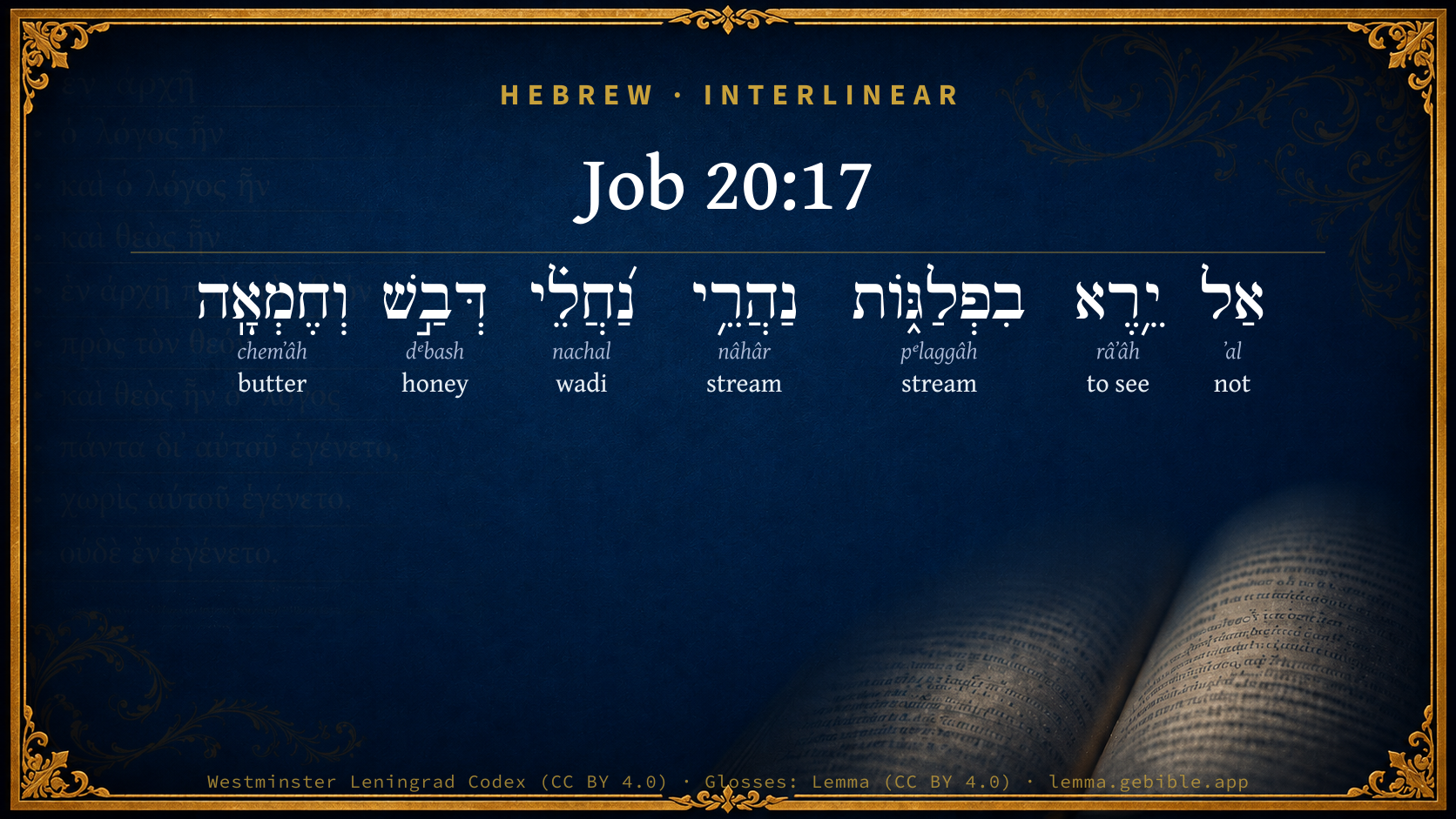
Job 20:17

Hebrew (Westminster Leningrad Codex) Job 20:17 appears in the Hebrew Old Testament. The text above is from the Westminster Leningrad Codex. Each word links to its Strong’s number, a concise gloss, and parsing drawn from the Open Scriptures Hebrew Bible morphology. Click any word for its full Brown-Driver-Briggs (BDB) entry.
Download image
Cite this verse

Job 20:17 (World English Bible). Public Domain. Lemma interlinear Bible study tool, https://lemma.gebible.app/v/job/20/17.

Show BibTeX & RIS
BibTeX
RIS
English Translation
He shall not look at the rivers, The flowing streams of honey and butter.
World English Bible · Public Domain
Highlights
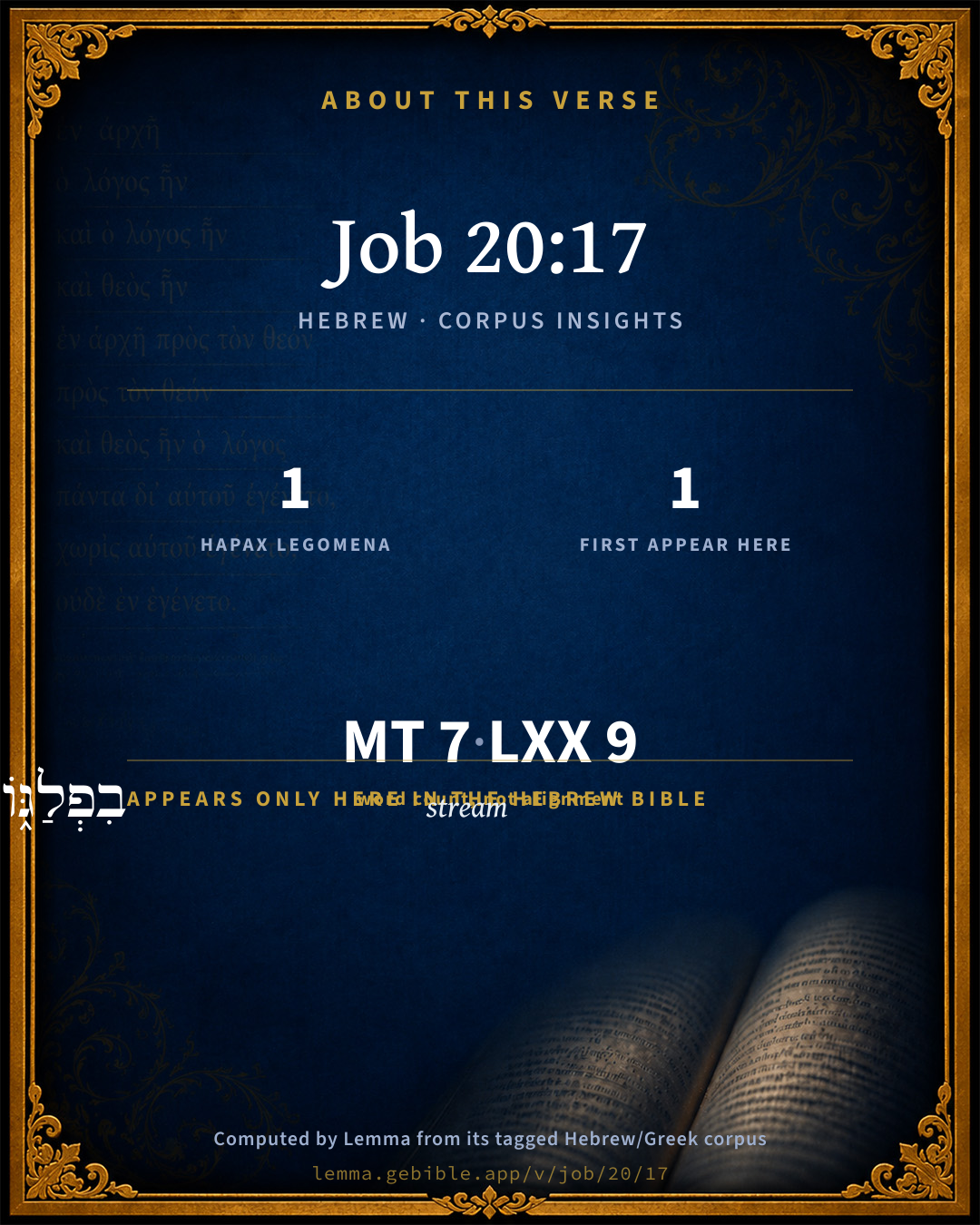
  • 1 hapax legomenon — only here in the Hebrew Bible
  • 1 first appearance in the Hebrew Bible
Full analysis ↓
Download a study sheet

One document with this verse’s original text, its word-by-word gloss line, the meaning frame, cross-references with their text, attributed commentary, and full source and license credits — printable, and it pastes into notes with its structure intact.

This verse Autodidact and up

Study sheet (.html) Plain text (.txt)

A passage Seminary Student

Up to 50 verses in one chapter. A passage sheet keeps up to 6 commentary sources and 12 cross-references per verse, in the order this page ranks them, and says so on the sheet whenever that leaves anything out. Ask for a single verse and you get the Autodidact verse sheet above.

Everything on this page stays free to read, with no account — the sheet is a download of what is already on screen, not access to it.

Want to remove ads? Support Godless Engineer
Compare translations 3

The same verse in 3 English versions, stacked beneath the original-language interlinear above. Click any original word for its lexicon entry.

Each is an independent rendering of the whole verse — the interlinear is not word-aligned to these translations.

Highlighted words mark where these versions differ — a whole-verse word diff, not a word-by-word alignment.

  • World English Bible Public Domain
    He shall not look at the rivers, The flowing streams of honey and butter.
  • King James Version Public Domain
    He shall not see the rivers, the floods, the brooks of honey and butter.
  • unfoldingWord Literal Text CC BY-SA 4.0
    He will not enjoy the streams, the rivers of torrents of honey and butter.

unfoldingWord Literal Text — © unfoldingWord, licensed CC BY-SA 4.0. Word-aligned USFM3 via Door43 (git.door43.org/unfoldingWord/en_ult).

Versions to compare (up to 4)

3 of 4 selected

Show all 18 translations

Every available English version of this verse, each an independent rendering of the whole verse.

  • World English Bible Public Domain
    He shall not look at the rivers, The flowing streams of honey and butter.
  • Berean Standard Bible Public Domain
    He will not enjoy the streams, the rivers flowing with honey and cream.
  • Majority Standard Bible Public Domain
    He will not enjoy the streams, the rivers flowing with honey and cream.
  • King James Version Public Domain
    He shall not see the rivers, the floods, the brooks of honey and butter.
  • American Standard Version (1901) Public Domain
    He shall not look upon the rivers, The flowing streams of honey and butter.
  • Revised Version (1885) Public Domain
    He shall not look upon the rivers, the flowing streams of honey and butter.
  • Geneva Bible (1599) Public Domain
    He shall not see the riuers, nor the floods and streames of honie and butter.
  • Douay-Rheims (1899) Public Domain
    (Let him not see the streams of the river, the brooks of honey and of butter.)
  • Young's Literal Translation Public Domain
    He looketh not on rivulets, Flowing of brooks of honey and butter.
  • Literal Standard Version CC BY-SA 4.0
    He does not look on streams, || Flowing of brooks of honey and butter.
  • Unlocked Literal Bible CC BY-SA 4.0
    He will not enjoy the streams, the torrents of honey and butter.
  • unfoldingWord Literal Text CC BY-SA 4.0
    He will not enjoy the streams, the rivers of torrents of honey and butter.
  • Darby Bible Public Domain
    He shall not see streams, rivers, brooks of honey and butter.
  • World Messianic Bible Public Domain
    He will not look at the rivers, the flowing streams of honey and butter.
  • Webster's Bible Public Domain
    He shall not see the river, the floods, the brooks of honey and buttermilk.
  • Free Bible Version CC BY-SA 4.0
    They will not live to enjoy the streams, the rivers of milk and honey.
  • Bible in Basic English Public Domain
    Let him not see the rivers of oil, the streams of honey and milk.
  • JPS Tanakh (1917) Public Domain
    He shall not look upon the rivers, the flowing streams of honey and curd.

Literal Standard Version (2020), Covenant Press — licensed CC BY-SA 4.0. Text via the HelloAO Bible API (eBible.org). Unlocked Literal Bible (unfoldingWord) — licensed CC BY-SA 4.0. Text via the HelloAO Bible API (eBible.org). unfoldingWord Literal Text — © unfoldingWord, licensed CC BY-SA 4.0. Word-aligned USFM3 via Door43 (git.door43.org/unfoldingWord/en_ult). Free Bible Version, Dr. Jonathan Gallagher — licensed CC BY-SA 4.0. Text via the HelloAO Bible API (eBible.org).

Word by word

More ways to search: Search by grammar → Find every occurrence → Compare this word →

Practice this passage: Drill this verse → Learn its vocabulary →

About this verse

These counts appear in no published source. They are computed here, from the morphology-tagged text and Lemma’s own curated glosses. What Lemma adds →

7
words
7
distinct lemmas
Wisdom
section

Notable vocabulary

1 hapax legomenon — a word that appears only here in the entire Hebrew Bible:

  • בִפְלַגּ֑וֹת stream H6390

First appearance in Scripture

This word makes its first canonical appearance in the Hebrew Bible here:

  • בִפְלַגּ֑וֹת stream H6390

Shared distinctive vocabulary

וְחֶמְאָֽה butter H2529 occurs in 9 verses of the Hebrew Bible. Also found in:

Grammatical profile

  • 1 verb
  • 5 nouns
  • 1 particle

Verb forms

  • יֵ֥רֶא Qal · Jussive

Hebrew & Septuagint length

In English translation the verse runs 14 words from the Hebrew and 16 from the Septuagint (LXX English) — closely comparable.

A rough comparison of the two English renderings, which tokenize alike — not a word-level alignment.

Word counts can differ between the Hebrew and the Greek without any difference in meaning — e.g. the Hebrew direct-object marker אֵת has no separate Greek word, and Greek often adds the article ὁ.

In the original languages it is 7 Hebrew tokens and 9 Greek tokens — but the two are counted differently (Hebrew bundles its prefixes and suffixes into one token; the Greek is in lemma form), so that isn’t a like-for-like length.

Cross-references

13

Topical passages linked to Job 20:17 in the Treasury of Scripture Knowledge — connected by theme and wording, ordered by reader-vote popularity; previews shown in the World English Bible.

  • Deuteronomy 32:13–14 He made him ride on the high places of the earth, He ate the increase of the field; He made him to suck honey out of the rock, Oil out of the flinty rock;
  • Job 29:6 When my steps were washed with butter, And the rock poured out streams of oil for me!
  • Luke 16:24 He cried and said, 'Father Abraham, have mercy on me, and send Lazarus, that he may dip the tip of his finger in water, and cool my tongue! For I am in anguish in this flame.'
  • Numbers 14:23 surely they shall not see the land which I swore to their fathers, neither shall any of those who despised me see it:
  • 2 Samuel 17:29 and honey, and butter, and sheep, and cheese of the herd, for David, and for the people who were with him, to eat: for they said, The people are hungry, and weary, and thirsty, in the wilderness.
  • 2 Kings 7:2 Then the captain on whose hand the king leaned answered the man of God, and said, Behold, if Yahweh should make windows in heaven, might this thing be? He said, Behold, you shall see it with your eyes, but shall not eat of it.
  • Psalms 36:8–9 They shall be abundantly satisfied with the abundance of your house. You will make them drink of the river of your pleasures.
  • Psalms 81:16 But he would have also fed them with the finest of the wheat. I will satisfy you with honey out of the rock."
  • Isaiah 7:15 He shall eat butter and honey when he knows to refuse the evil, and choose the good.
  • Isaiah 7:22 and it shall happen, that because of the abundance of milk which they shall give he shall eat butter: for everyone will eat butter and honey that is left in the midst of the land.
  • Isaiah 41:17 The poor and needy seek water, and there is none, and their tongue fails for thirst; I, Yahweh, will answer them, I, the God of Israel, will not forsake them.
  • Jeremiah 17:6–8 For he shall be like the heath in the desert, and shall not see when good comes, but shall inhabit the parched places in the wilderness, a salt land and not inhabited.
  • Revelation 22:1 He showed me a river of water of life, clear as crystal, proceeding out of the throne of God and of the Lamb,

Cross-references courtesy of OpenBible.info (CC BY 4.0).

Hebrew and Greek witnesses Masoretic Hebrew ↔ Greek Septuagint

The same verse in the two great witnesses to the Old Testament, shown verse-for-verse.

These are two independent witnesses, not word-aligned to each other, and the Septuagint is shown in lemma (dictionary) form.

Hebrew Job 20:17 Masoretic · Westminster Leningrad Codex

אַל יֵ֥רֶא בִפְלַגּ֑וֹת נַהֲרֵ֥י נַ֝חֲלֵ֗י דְּבַ֣שׁ וְחֶמְאָֽה

He shall not look at the rivers, The flowing streams of honey and butter.

World English Bible · Public Domain

Greek LXX Job 20:17 Septuagint · lemma form

μή ὁράω ἄμελξις νομάς μηδέ νομή μέλι καί βούτυρον

Let him not see the milk of the pastures, nor the supplies of honey and butter.

LXX2012 (modern English Septuagint) · Public Domain

Hebrew: Westminster Leningrad Codex (CC BY 4.0). Greek: Septuagint (public domain); English from LXX2012 (modern English Septuagint) (Public Domain). How the Septuagint differs from the Hebrew →

Commentary

Notes on Job 20:17 from classic Christian and Jewish commentators (each source and its license shown beneath its notes). The classic Christian expositions comment on the surrounding passage and are grouped to its opening verse, so a note may address several verses; the Jewish commentaries on the Tanakh (Rashi and others) are per-verse, so they appear only where the commentator wrote on this verse.

Lemma curates 59 commentaries, every one of them public domain or Creative Commons licensed, each selected and text-cleaned for this edition rather than reprinted as found. About our sources →

Trapp's Complete Commentary

John Trapp

Job 20:17 He shall not see the rivers, the floods, the brooks of honey and butter.

Ver. 17. He shall not see the rivers, the floods] That is, that plenty and abundance of all good things that cometh in to the righteous, Velut confertim, certatim, et affatim, a confluence of all manner of comforts and contentments (Mercer). These the oppressor shall have none of; for being insatiable and vexed with the furies of an evil conscience, they enjoy not anything, though they abound with all things, being worse than tantalized; and if after his fall he seek to recruit himself, he shall never be able to effect it. He shall not see the rivers, &c. The Seventy, and others after them, render it by an elegant apostrophe, Ne, specter rivos, Let him never look after the rivers, &c., for it will never be. He may please himself in hope and expectation of a better condition, but God will surely cross him. For his hoped for riches he shall have poverty, for pleasure pain, for health sickness, for nourishment poison, for dignity disgrace, for the favour of God his wrath and hatred, for life destruction. A further account of the wicked man’s non-enjoyment of what he hath wrongfully wrested from others Zophar giveth us in the next verse.

John Trapp, A Commentary or Exposition upon All the Books of the Old and New Testament (1647–1656) — public domain. Text from a community e-Sword module.

Joseph Benson's Commentary

Job 20:17. He shall not see the rivers, the floods, &c. — “He shall not see them with any pleasure. The most delightful things of this world, and the greatest affluence and plenty of them, shall afford him no enjoyment.” — Dodd. Or, rather, he speaks metaphorically, and means, he shall not enjoy that abundant satisfaction and comfort, which he promised himself from his great riches, or which good men, through God’s blessing, commonly enjoy.

Joseph Benson's Commentary on the Old and New Testaments (1811–1818) — public domain. Text from a community e-Sword module.

Whedon's Commentary on the Bible

Daniel D. Whedon

Third strophe — The wicked had counted upon perennial resources of bliss — “rivers of honey and butter” — only to find himself stripped of all his ill-gotten good, and himself the defenceless prey of the victims of his own insatiable greed, Job_20:17-22.

17. Not see the rivers — See note Job_29:6. ראה with ב implies joy in beholding. To the Oriental a river has ever been an emblem of felicity. In the paradise of Mohammed “are rivers of incorruptible water, and rivers of milk, the taste whereof changeth not; and rivers of wine, pleasant unto those who drink; and rivers of clarified honey.” — KORAN, Sura 47. The butter was either cream, or simply curdled milk in a semi-liquid state.

Daniel D. Whedon (gen. ed.), Commentary on the Old and New Testaments (1874–1909) — public domain. Text from a community e-Sword module.

Tyndale Open Study Notes

Tyndale Open Resources

20:17 The streams of olive oil and rivers of milk and honey signify superabundant blessing (Exod 5:19; Deut 27:3; Joel 3:18).

Tyndale Open Study Notes — © Tyndale Open Resources, licensed CC BY-SA 4.0. Text via the HelloAO Bible API.

Geneva Bible (1599)

Geneva Bible translators

Though God give to all other abundance of his blessings, yet he shall have no part thereof.

Geneva Bible (1599) marginal notes — public domain. Text via Bolls.life.

Jamieson, Fausset & Brown

Robert Jamieson, A. R. Fausset & David Brown

floods--literally, "stream of floods," plentiful streams flowing with milk, &c. (Job 29:6; Exo 3:17). Honey and butter are more fluid in the East than with us and are poured out from jars. These "rivers" or water brooks are in the sultry East emblems of prosperity.

Jamieson, Fausset & Brown — Commentary Critical and Explanatory on the Whole Bible (1871) — public domain (CC PDM 1.0). Text via the HelloAO Bible API.

Adam Clarke's Commentary

Verse 17. He shall not see the rivers] Mr. Good has the following judicious note on this passage: "Honey and butter are the common results of a rich, well-watered pasturage, offering a perpetual banquet of grass to kine, and of nectar to bees; and thus loading the possessor with the most luscious luxuries of pastoral life, peculiarly so before the discovery of the means of obtaining sugar. The expression appears to have been proverbial; and is certainly used here to denote a very high degree of temporal prosperity." See also Job 29:6. To the Hebrews such expressions were quite familiar. See Ex 3:8; Ex 13:5; Ex 33:3; 2Kg 18:32; De 31:20, and elsewhere.

The Greek and Roman writers abound in such images.

Milk and honey were such delicacies with the ancients, that Pindar compares his song to them for its smoothness and sweetness: -

Χαιρε

Φιλος. Εγω τοδε τοι

Πεμπω μεμιγμενον μελι λευκῳ

Συν γαλακτι· κιρναμενα δ' εερς' αμφεπει πομ' αοιδιμον, Αιολισιν εν πνοαισιν αυλων.

PIND. Nem. iii., ver. 133.

"Hail, friend! to thee I tune my song;

For thee its mingled sweets prepare;

Mellifluous accents pour along;

Verse, pure as milk, to thee I bear;

On all thy actions falls the dew of praise;

Pierian draughts thy thirst of fame assuage,

And breathing flutes thy songs of triumph raise."

J. B. C.

Qui te, Pollio, amat, veniat, quo te quoque gaudet;

Mella fluant illi, ferat et rubus asper amomum.

VIRG. Ecl. iii., ver. 88.

"Who Pollio loves, and who his muse admires;

Let Pollio's fortune crown his full desires

Let myrrh, instead of thorn, his fences fill;

And showers of honey from his oaks distil!"

DRYDEN.

OVID, describing the golden age, employs the same image: -

Flumina jam lactis, jam flumina nectaris ibant;

Flavaque de viridi stillabant ilice mella.

Metam. lib. i., ver. 3.

"Floods were with milk, and floods with nectar, fill'd;

And honey from the sweating oak distill'd."

DRYDEN.

HORACE employs a similar image in nearly the same words: -

Mella cava manant ex ilice, montibus altis;

Levis crepante lympha desilit pede.

Epod. xvi., ver. 46.

"From hollow oaks, where honey'd streams distil,

And bounds with noisy foot the pebbled rill."

FRANCIS.

Job employs the same metaphor, Job 29:6: -

When I washed my steps with butter,

And the rock poured out to me rivers of oil.

Isaiah, also, Isa 7:22, uses the same when describing the produce of a heifer and two ewes: -

From the plenty of milk that they shall produce,

He shall eat butter: butter and honey shall he eat,

Whosoever is left in the midst of the land.

And Joel, Joe 3:18: -

And it shall come to pass in that day,

The mountains shall drop down new wine,

And the hills shall flow with milk;

And all the rivers of Judah shall flow with waters.

These expressions denote fertility and abundance; and are often employed to point out the excellence of the promised land, which is frequently denominated a land flowing with milk and honey: and even the superior blessings of the Gospel are thus characterized, Isa 51:1.

Adam Clarke's Commentary on the Bible (1810–1826) — public domain. Text from a community e-Sword/MySword module.

Ellicott's Commentary for English Readers

(17) The brooks of honey and butter.—He uses language which might lead one to suppose he was familiar with the promise of Canaan, except that, as the phrase is not precisely identical it may perhaps rather show a community of proverbial language, and that the land flowing with milk and honey may have been an expression in use, and not one original with the Pentateuch.

A Bible Commentary for English Readers, edited by Charles John Ellicott (1878–1897) — public domain. Text from a community e-Sword module.

The Cambridge Bible for Schools and Colleges

gen. ed. J. J. S. Perowne

17. the floods, the brooks of honey] The marg. the streaming brooks is unnecessary. The words “honey and butter” apply both to “floods” (streams) and brooks. The figure is common for fulness of blessings. Cf. Exo_3:8, “A land flowing with milk and honey.”

17–22. That long time of enjoyment which he promised himself shall never come; according to his insatiable lust and greed shall be his utter destitution at last.

The Cambridge Bible for Schools and Colleges (gen. ed. J. J. S. Perowne; Cambridge University Press, 1878–1918) — public domain. Text from a community e-Sword module.

John Gill's Exposition

He shall not see the rivers,.... Of water, or meet with any to assuage his thirst, which poison excites, and so makes a man wish for water, and desire large quantities; but this shall not be granted the wicked man; this might be illustrated in the case of the rich man in hell, who desired a drop of cold water to cool his tongue, but could not have it, Luk 16:24; though rather plenty of good things is here intended, see Isa 48:18; as also the following expressions:

the floods, the brooks of honey and butter; or "cream"; which are hyperbolical expressions, denoting the great profusion and abundance of temporal blessings, which either the covetous rich man was ambitious of obtaining, and hoped to enjoy, seeking and promising great things to himself, which yet he should never attain unto; or else the sense is, though he had enjoyed such plenty, and been in such great prosperity as to have honey and butter, or all temporal good things, flowing about him like rivers, and floods, and brooks; yet he should "see them no more", so Broughton reads the words; and perhaps Zophar may have respect to the abundance Job once possessed, but should no more, and which is by himself expressed by such like metaphors, Job 29:6; yea, even spiritual and eternal good things may be designed, and the plenty of them, as they often are in Scripture, by wine, and milk, and honey; such as the means of grace, the word and ordinances, the blessings of grace dispensed and communicated through them; spiritual peace and joy, called the rivers of pleasure; the love of God, and the streams of it, which make glad his people; yea, eternal glory and happiness, signified by new wine in the kingdom of God, and by a river of water of life, and a tree of life by it, see Isa 55:1; which are what carnal men and hypocrites shall never see or enjoy; and whereas Zophar took Job to be such a man, he may have a principal view to him, and object this to the beatific vision of God, and the enjoyment of eternal happiness he promised himself, Job 19:26. Bar Tzemach observes, that these words are to be read by a transposition thus, "he shall not see rivers of water, floods of honey, and brooks of butter".

John Gill's Exposition of the Whole Bible (1746–1763) — public domain (CC PDM 1.0). Text via the HelloAO Bible API.

Albert Barnes' Notes on the Bible

He shall not see the rivers - That is, he shall not be permitted to enjoy plenty and prosperity. Rivers or rills of honey and butter are emblems of prosperity; compare Exo 3:17; Job 29:6. A land flowing with milk, honey, and butter, is, in the Scripture, the highest image of prosperity and happiness. The word rendered “rivers” (פלגה pelaggâh), means rather “rivulets small streams - or brooks,” such as were made by “dividing” a large stream (from פלג pâlag, to “cleave, divide”), and would properly be applied to canals made by separating a large stream, or dividing it into numerous watercourses for the purpose of irrigating lands. The word rendered “floods,” and in the margin, “streaming brooks” (נחלי נהרי nâhârēy nachalēy), means “the rivers of the valley,” or such as flow through a valley when it is swelled by the melting of snow, or by torrents of rain.

A flood, a rapid, swollen, full stream, would express the idea. These were ideas of beauty and fertility among the Orientals; and where butter and honey were represented as flowing in this manner in a land, it was the highest conception of plenty. The word rendered “honey” (דבשׁ debash) may, and commonly does, mean “honey;” but it also means the juice of the grape, boiled down to about the consistency of molasses, and used as an article of food. The Arabs make much use of this kind of food now, and in Syria, nearly two-thirds of the grapes are employed in preparing this article of food. It is called by the Arabs “Dibs,” which is the same as the Hebrew word used here. May not the word mean this in some of the places where it is rendered “honey” in the Scriptures? The word rendered “butter” (חמאה chem'âh) probably means, usually, “curdled milk.” See the notes at Isa 7:15. It is not certain that the word is ever used in the Old Testament to denote “butter.” The article which is used still by the Arabs is chiefly curdled milk, and probably this is referred to here. It will illustrate this passage to remark, that the inhabitants of Arabia, and of those who live in similar countries, have no idea of “butter,” as it exists among us, in a solid state. What they call “butter,” is in a fluid state, and is hence compared with flowing streams. An abundance of these articles was regarded as a high proof of prosperity, as they constitute a considerable part of the diet of Orientals. The same image, to denote plenty, is often used by the sacred writers, and by Classical poets; see Isa 7:22 :

And it shall come to pass in that day

That a man shall keep alive a young cow and two sheep,

And it shall be that from the plenty of milk which they shall give,

He shall eat butter

For butter and honey shall every one eat,

Who is left alone in the midst of the land.

See also in Joe 3:18 :

And it shall come to pass in that day,

The mountains shall drop down new wine,

And the hills shall flow with milk,

And all the rivers of Judah shall flow with water.

Thus, also Ovid, Metam. iii.

Flumina jam lactis, jam flumina nectaris ibant.

Compare Horace Epod. xvi. 41.

Mella cava manant ex ilice; montibus altis

Levis crepante lympha desilit pede.

From oaks pure honey flows, from lofty hills

Bound in light dance the murmuring rills.

Boscawen.

See also Euripides, Bacch. 142; and Theoc. Idyll. 5,124. Compare Rosenmuller’s Alte u. neue Morgenland on Exo 3:8, No. 194.

Albert Barnes' Notes on the Bible (1834–1885) — public domain. Text from a community e-Sword/MySword module.

Haydock's Catholic Bible Commentary

Butter. The impious may have a short-lived pleasure, but it will not give perfect satisfaction. The poets use similar expressions. (Calmet) Mella fluant illi, ferat et rubus asper amomum. (Virgil)

Flumina jam lactis, jam flumina nectaris ibant. (Met. i.)

George Leo Haydock (1774–1849), Haydock's Catholic Family Bible and Commentary, 1859 edition — public domain. Excludes Psalms (Douay-Rheims chapter numbering differs from Protestant) and Deuterocanonical books (Catholic canon only).

Matthew Poole's English Annotations

Not see, i.e. not enjoy, as that word is oft used as Psa 106:5; Ecc 2:1.

The brooks of honey and butter; that abundant satisfaction and comfort, (oft signified by these or suchlike metaphors; as Psa 36:8; 46:4; Isa 7:15,22; 41:18) either which he promised to himself from that great estate which he had got by deceit and oppression, or which good men through God’s blessing may and commonly do enjoy.

Matthew Poole's English Annotations on the Holy Bible (1683–1685) — public domain. Text from a community e-Sword/MySword module.

The Pulpit Commentary

He shall not see the rivers, the floods, the brooks. The wicked man shall suffer, not only positive pains, but what casuists call the peens damni, or "penalty of loss deprivation, in other words, of blessings which he would naturally have enjoyed but for his wickedness. Zophar here threatens him with the Joss of those paradisaical delights which the Orientals associated with water in all its forms, whether as twglP, or "rills derived from larger streams," or as yrhk, "rivers," or as yljk, "brooks" or "torrents," now strong and impetuous, now reduced to a mere thread These are said poetically to flow with honey and butter, not, of course, in any literal sense, such as Ovid may have meant, when, in describing the golden age, he said"Flumina jam lactis, jam fiumina nectaris ibant; ("Metaph.," 1:111.) but as fertilizing the land through which they ran, and so causing it to abound with bees anti cattle, whence would be derived butter and honey. Compare the terms in which Canaan was described to the Israelites. (Exo_3:8, 17 13:5 Deu_26:9, Deu_26:15, etc.)

The Pulpit Commentary (1880–1919), ed. H.D.M. Spence-Jones & Joseph S. Exell — public domain. Text from a community e-Sword module.

John Wesley's Explanatory Notes

See - Not enjoy that abundant satisfaction and comfort, which good men through God's blessings enjoy.

John Wesley, Explanatory Notes Upon the Whole Bible (1754–1765) — public domain. Text via the GEBible commentary corpus.

Keil & Delitzsch

C. F. Keil & F. Delitzsch

17 He shall not delight himself in streams,

Like to rivers and brooks of honey and cream.

18 Giving back that for which he laboured, he shall not swallow it;

He shall not rejoice according to the riches he hath gotten.

19 Because he cast down, let the destitute lie helpless;

He shall not, in case he hath seized a house, finish building it.

20 Because he knew no rest in his craving,

He shall not be able to rescue himself with what he most loveth.

As poets sing of the aurea aetas of the paradise-like primeval age: Flumina jam lactis, jam flumina nectaris ibant,

(Note: Ovid, Metam. i. 112, comp. Virgil, Ecl. iv. 30:

Et durae quercus sudabant roscida mella;

and Horace, Epod. xvi. 47

Mella cava manant ex ilice, montibus altis

Levis crepante lympha desilit pede.)

and as the land of promise is called in the words of Jehovah in the Thora, "a land flowing with milk and honey," the puffed-up prosperity to which the evil-doer has attained by injustice is likened to streams (פּלגּות, prop. dividings, and indeed perhaps of a country = districts, Jdg 5:15., or as here, of a fountain = streams) of rivers, of brooks (two gen. appositionis which are co-ordinate, of which Hupfeld thinks one must be crossed out; they, however, are not unpoetical, since, just as in Psa 78:9, the flow of words is suspended, Ew. 289, c) of honey and cream (comp. cream and oil, Job 29:6), if נהרי נחלי is not perhaps (which is more in accordance with the accentuation) intended as an explanatory permutative of בפלגות: he shall not feast himself upon streams, streamings of rivers of honey and cream (Dachselt); and by אל־ירא (seq. Beth, to fasten one's gaze upon anything = feast one's self upon it), the prospect of enjoying this prosperity, and indeed, since the moral judgment and feeling are concerned in the affirmation of the fact (אל, as Job 5:22; Psa 41:3; Pro 3:3, Pro 3:25), the privilege of this prospect, is denied. This thought, that the enjoyment aimed at and anticipated shall not follow the attainment of this height of prosperity, is reiterated in a twofold form in Job 20:18.

Job 20:18 is not to be translated: He gives back that which he has gained without swallowing it down, which must have been ישׁיב; the syntactic relation is a different one: the Waw of ולא is not expressive of detail; the detailing is implied in the partic., which is made prominent as an antecedent, as if it were: because, or since, he gives out again that which he has acquired (ינע only here instead of יגיע, Job 10:3 and freq.), he has no pleasure in it, he shall or may not altogether swallow it down (Targ. incorrectly ולא־יגמר, after the Arabic blg, to penetrate, attain an object). The formation of the clause corresponds entirely with Job 20:18. All attempts at interpretation which connect כּחיל תּמוּרתו with משׁיב, Job 20:18, are to be objected to: (he gives it back again) as property of his restitution, i.e., property that is to be restored (Schlottm.), or the property of another (Hahn). Apart from the unsuitableness of the expression to the meaning found in it, it is contrary to the relative independence of the separate lines of the verse, which our poet almost always preserves, and is also opposed by the interposing of ולא יבלע. The explanation chosen by Schult., Oet., Umbr., Hirz., Renan, and others, after the Targ., is utterly impossible: as his possession, so his exchange (which is intended to mean: restitution, giving up); this, instead of כּחיל, must have been not merely כּחיל, but כּחילו. The designed relation of the members of the sentence is, without doubt, that כחיל תמורתו is a nearer defining of ולא יעלס, after the manner of an antecedent clause, and from which, that it may be emphatically introduced, it begins by means of Waw apod. (to which Schult. not unsuitably compares Jer 6:19; Kg1 15:13). The following explanation is very suitable: according to the power, i.e., entire fulness of his exchange, but not in the sense of "to the full amount of its value" (Carey, as Rosenm.), connected with משׁיב, but connected with what follows: "how great soever his exchange (gain), still he does not rejoice" (Ew.). But it is not probable that חיל here signifies power = a great quantity, where property and possessions are spoken of. The most natural rendering appears to me to be this: according to the relation of the property of his exchange (תמורה from מור, Syr. directly emere, cogn. מהר, מחר, and perhaps also מכר, here of exchange, barter, or even acquisition, as Job 15:31; comp. Job 28:17, of the means of exchange), i.e., of the property exchanged, bartered, gained by barter by him, he is not to enjoy, i.e., the rejoicing which might have been expected in connection with the greatness of the wealth he has amassed, departs from him.

Jerome is not the only expositor who (as though the Hebrew tenses were subject to no rule, and might mean everything) translates Job 20:19, domum rapuit et non aedificvit eam (equivalent to quam non aedificaverat). Even Hupfeld translates thus, by taking ולא יבנהו as imperfect = והוּא לא בנהוּ; but he, of course, fails to furnish a grammatical proof for the possibility of inferring a plusquamperfectum sense. It might sooner be explained: instead of building it (Lit. Centralblatt, 1853, Nr. 24). But according to the syntax, Job 20:19 must be an antecedent clause: because he crushed, left (therefore: crushed by himself) the destitute alone;

(Note: The Targ. translates: because he brought to ruin the business of the poor (עזב after עזּבון in Ezekiel); and Parchon: because he brought to ruin the courts of the poor (after the Mishna-word מעזיבה, a paved floor); but עזב, according to the Masora on Isa 58:2 (comp. Kimchi, Michlol, p. 35), is to be read עזב as a verb.)

and Job 20:19 the conclusion: he has pillaged a house, and will not build it, i.e., in case he has plundered a house, he will not build it up. For בּית גּזל, according to the accents, which are here correct, is not to be translated: domus, quam rapuit, but hypothetically: si (ἐὰν) domum rapuit, to which ybnhw wl' is connected by Waw apod. (comp. Job 7:21); and בּנה signifies here, as frequently, not: to build, but: to build round, build additions to, continue building (comp. Ch2 11:5-6; Psa 89:3, Psa 89:5). In Job 20:20 similar periodizing occurs: because he knew not שׁלו (neutral = שׁלוה, Pro 17:1; Ew. 293, c), contentment, rest, and sufficiency (comp. Isa 59:8, לא ידע שׁלום) in his belly, i.e., his craving, which swallows up everything: he will not be able to deliver himself (מלּט like פּלּט, Job 23:7, as intensive of Kal: to escape, or also = מלּט נפשׁו, which Amo 2:15 seems to favour) with (בּ as Job 19:20) his dearest treasure (thus e.g., Ewald), or: he will not be able to rescue his dearest object, prop. not to effect a rescue with his dearest object, the obj., as Job 16:4, Job 16:10; Job 31:12, conceived of as the instrument (vid., e.g., Schlottm.). The former explanation is more natural and simple. חמוּד, that which is exceedingly desired (Psa 39:12), of health and pleasantness; Isa 44:9, of idols, as the cherished objects of their worshippers), is the dearest and most precious thing to which the sinner clung with all his soul, not, as Bttch. thinks, the soul itself.

(Note: Hupfeld interprets: non fruitur securus ventre suo h. e. cibo quo venter potitus erat et deliciis quas non salvas retinebit (or also Job 20:20 as a clause by itself: cum deliciis suis non evadet), but without any proof that ידע בּ can signify frui, and בטן metonymically food, whereas the assertion that שׁלו cannot be equivalent to שׁלו, and cannot be used of rest with reference to the desire, is unfounded. In Hebrew the neuter adj. can be used as a substantive, just as in Greek, e.g., τὸ ἀσφαλές, security, τὸ εὐτυχές, success (comp. e.g., the combination בתמים ואמת), and שלח signifies release and ease (Arab. followed by ‛n), without distinction of what disturbs, be it danger, or pain, or any kind of emotion whatever.)

Keil & Delitzsch — Biblical Commentary on the Old Testament (1861–1891) — public domain (CC PDM 1.0). Text via the HelloAO Bible API. (Old Testament only.)

unfoldingWord translationNotes

Door43 World Missions Community

General Information:

Zophar continues speaking to Job.

the streams, the torrents of honey and butter

"Streams" and "torrents" are metaphors that represent abundance. "Honey" and "butter" are metonyms that represent the good things that God gives people. AT: "the abundance of good things that God gives his people" (See: Metaphor and Metonymy)

the fruit of his labor

Normally "the fruit of his labor" simply refers to the results of his labor. In this case it refers to the things the wicked man had stolen. AT: "the things he had worked to get" or "the things he had stolen" (See: Metaphor and Assumed Knowledge and Implicit Information)

will not be able to eat it

Here "to eat" the fruit of his labor represents enjoying the things he had stolen. AT: "will not be able to enjoy them" (See: Metaphor)

translationWords

honey

labor

oppress

unfoldingWord translationNotes — © Distant Shores Media and the Door43 World Missions Community, licensed CC BY-SA 4.0. Source: git.door43.org/Door43/en_tn.

Rashi

Rabbi Shlomo Yitzchaki (Rashi)

the rivulets, the flowing rivers of the Garden of Eden, which are as sweet as honey and cream.

Rashi on the Tanakh — English translations: “The Judaica Press complete Tanach with Rashi, translated by A. J. Rosenberg” (CC BY 4.0); “Pentateuch with Rashi's commentary by M. Rosenbaum and A.M. Silbermann, 1929-1934” (public domain); “The Metsudah Tanach series, Lakewood, N.J” (CC BY 4.0); and “The Book of Joshua, Metsudah Publications, 1997” (CC BY 4.0). Text via Sefaria.

Lesson kit

Teaching starters — assembled from the data on this page, not authored interpretation. Every prompt links to the verse data it draws on. Edit before teaching.

Job, in the Wisdom, opens this verse with 7 words (7 distinct Hebrew lemmas). Its most distinctive word is pᵉlaggâh (“stream”). A historical commentator’s framing appears above. Read the whole chapter for the surrounding context.

Discussion questions

  1. What does “stream” (pᵉlaggâh) contribute to the verse as a whole?
  2. 1 word here appears nowhere else in the Hebrew Bible. Why might the author reach for such rare wording?
  3. This is the first place “stream” appears in Scripture (first appears here). What does its debut here establish?
  4. How does Genesis 18:8, which shares the word «butter», read alongside this verse?
  5. These translations render this verse differently. What is at stake in choosing one wording over another?
  6. «יֵ֥רֶא» is a Qal Jussive verb. How does that grammatical form shape the action described?
  7. Compare how Trapp's Complete Commentary and Joseph Benson's Commentary read this verse. Where do they agree or differ?

Things to notice

Reading settings

Reading text

Shown beneath each verse's original-language words.

Old Testament
Old Testament edition

Read the OT as the Masoretic Hebrew (MT) or the Greek Septuagint (LXX).

English shown for the Greek Septuagint (in the Hebrew ↔ Greek comparison).

Comparing translations? Open the Compare panel on any verse page to stack up to four side by side.