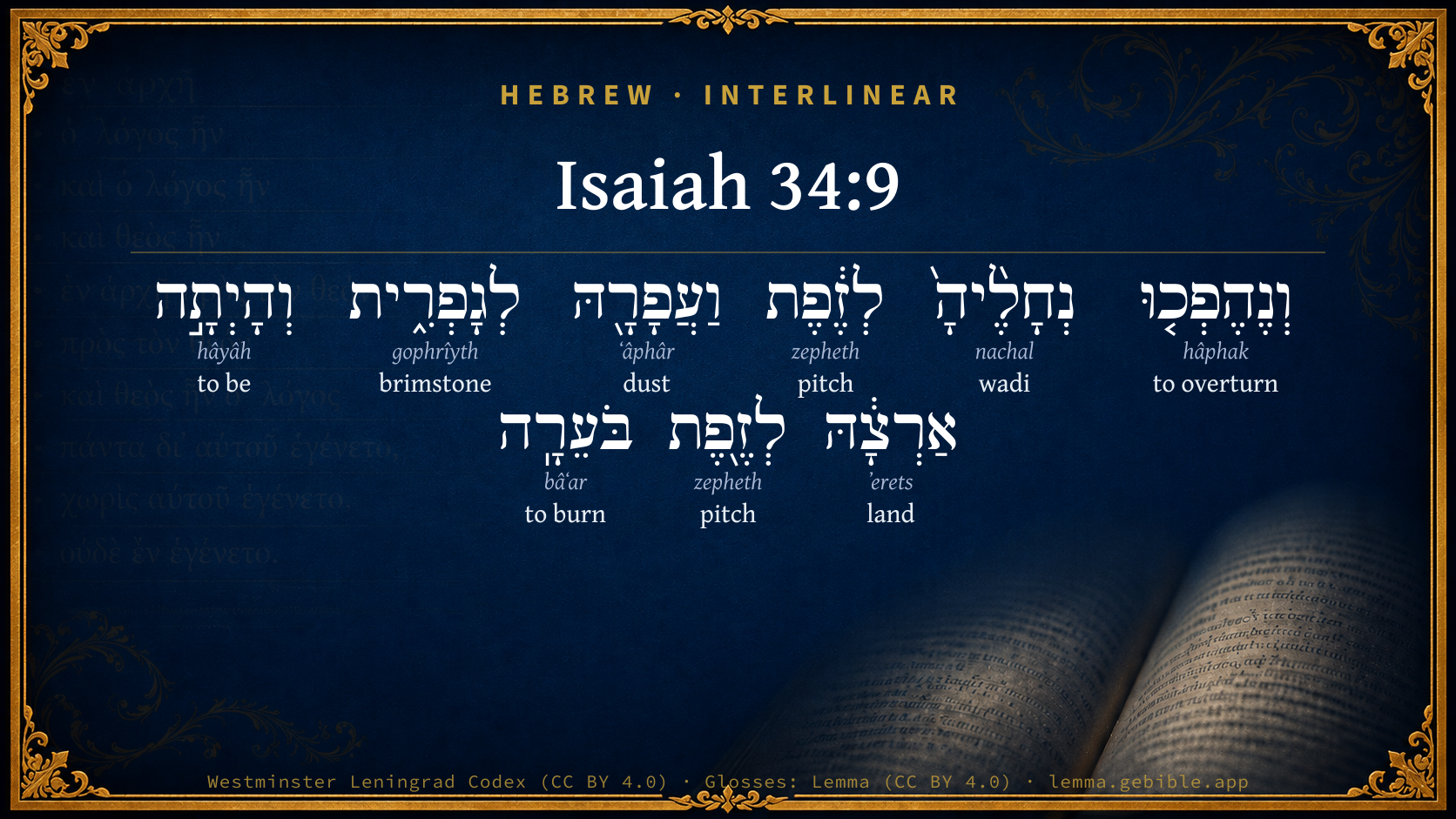
Isaiah 34:9

Hebrew (Westminster Leningrad Codex) Isaiah 34:9 appears in the Hebrew Old Testament. The text above is from the Westminster Leningrad Codex. Each word links to its Strong’s number, a concise gloss, and parsing drawn from the Open Scriptures Hebrew Bible morphology. Click any word for its full Brown-Driver-Briggs (BDB) entry.
Download image
Cite this verse

Isaiah 34:9 (World English Bible). Public Domain. Lemma interlinear Bible study tool, https://lemma.gebible.app/v/isaiah/34/9.

Show BibTeX & RIS
BibTeX
RIS
English Translation
The streams of [Edom] shall be turned into pitch, and the dust of it into sulfur, and the land of it shall become burning pitch.
World English Bible · Public Domain
Download a study sheet

One document with this verse’s original text, its word-by-word gloss line, the meaning frame, cross-references with their text, attributed commentary, and full source and license credits — printable, and it pastes into notes with its structure intact.

This verse Autodidact and up

Study sheet (.html) Plain text (.txt)

A passage Seminary Student

Up to 50 verses in one chapter. A passage sheet keeps up to 6 commentary sources and 12 cross-references per verse, in the order this page ranks them, and says so on the sheet whenever that leaves anything out. Ask for a single verse and you get the Autodidact verse sheet above.

Everything on this page stays free to read, with no account — the sheet is a download of what is already on screen, not access to it.

Want to remove ads? Support Godless Engineer
Compare translations 3

The same verse in 3 English versions, stacked beneath the original-language interlinear above. Click any original word for its lexicon entry.

Each is an independent rendering of the whole verse — the interlinear is not word-aligned to these translations.

Highlighted words mark where these versions differ — a whole-verse word diff, not a word-by-word alignment.

  • World English Bible Public Domain
    The streams of [Edom] shall be turned into pitch, and the dust of it into sulfur, and the land of it shall become burning pitch.
  • King James Version Public Domain
    And the streams thereof shall be turned into pitch, and the dust thereof into brimstone, and the land thereof shall become burning pitch.
  • unfoldingWord Literal Text CC BY-SA 4.0
    And its streams will be turned into pitch, and its dust, into sulfur, and its land will become burning pitch.

unfoldingWord Literal Text — © unfoldingWord, licensed CC BY-SA 4.0. Word-aligned USFM3 via Door43 (git.door43.org/unfoldingWord/en_ult).

Versions to compare (up to 4)

3 of 4 selected

Show all 18 translations

Every available English version of this verse, each an independent rendering of the whole verse.

  • World English Bible Public Domain
    The streams of [Edom] shall be turned into pitch, and the dust of it into sulfur, and the land of it shall become burning pitch.
  • Berean Standard Bible Public Domain
    Edom’s streams will be turned to tar, and her soil to sulfur; her land will become a blazing pitch.
  • Majority Standard Bible Public Domain
    Edom’s streams will be turned to tar, and her soil to sulfur; her land will become a blazing pitch.
  • King James Version Public Domain
    And the streams thereof shall be turned into pitch, and the dust thereof into brimstone, and the land thereof shall become burning pitch.
  • American Standard Version (1901) Public Domain
    And the streams of `Edom' shall be turned into pitch, and the dust thereof into brimstone, and the land thereof shall become burning pitch.
  • Revised Version (1885) Public Domain
    And the streams thereof shall be turned into pitch, and the dust thereof into brimstone, and the land thereof shall become burning pitch.
  • Geneva Bible (1599) Public Domain
    And the riuers thereof shall be turned into pitche, and the dust thereof into brimstone, and the land thereof shalbe burning pitch.
  • Douay-Rheims (1899) Public Domain
    And the streams thereof shall be turned into pitch, and the ground thereof into brimstone: and the land thereof shall become burning pitch.
  • Young's Literal Translation Public Domain
    And turned have been her streams to pitch, And her dust to brimstone, And her land hath become burning pitch.
  • Literal Standard Version CC BY-SA 4.0
    And her streams have been turned to pitch, || And her dust to brimstone, || And her land has become burning pitch.
  • Unlocked Literal Bible CC BY-SA 4.0
    The streams of Edom will be turned into pitch, her dust into sulfur, and her land will become burning pitch.
  • unfoldingWord Literal Text CC BY-SA 4.0
    And its streams will be turned into pitch, and its dust, into sulfur, and its land will become burning pitch.
  • Darby Bible Public Domain
    And the torrents thereof shall be turned into pitch, and its dust into brimstone; yea, the land thereof shall become burning pitch:
  • World Messianic Bible Public Domain
    Its streams will be turned into pitch, its dust into sulfur, and its land will become burning pitch.
  • Webster's Bible Public Domain
    And its streams shall be turned into pitch, and its dust into brimstone, and its land shall become burning pitch.
  • Free Bible Version CC BY-SA 4.0
    Edom's streams will be turned into tar, its soil into sulfur, and her land will become burning tar!
  • Bible in Basic English Public Domain
    And its streams will be turned into boiling oil, and its dust into burning stone, and all the land will be on fire.
  • JPS Tanakh (1917) Public Domain
    And the streams thereof shall be turned into pitch, and the dust thereof into brimstone, and the land thereof shall become burning pitch.

Literal Standard Version (2020), Covenant Press — licensed CC BY-SA 4.0. Text via the HelloAO Bible API (eBible.org). Unlocked Literal Bible (unfoldingWord) — licensed CC BY-SA 4.0. Text via the HelloAO Bible API (eBible.org). unfoldingWord Literal Text — © unfoldingWord, licensed CC BY-SA 4.0. Word-aligned USFM3 via Door43 (git.door43.org/unfoldingWord/en_ult). Free Bible Version, Dr. Jonathan Gallagher — licensed CC BY-SA 4.0. Text via the HelloAO Bible API (eBible.org).

Word by word

More ways to search: Search by grammar → Find every occurrence → Compare this word →

Practice this passage: Drill this verse → Learn its vocabulary →

לְזֶ֔פֶת
zepheth
H2203
“to/for · pitch”
Preposition + Noun, Common, Feminine, Singular, Absolute
Part of Speech
Preposition + Noun
Type
Common
Gender
Feminine
Number
Singular
State
Absolute
Full BDB Definition

Origin: from an unused root (meaning to liquify)

TWOT: 572

pitch, tar, asphalt
  1. וְנֶהֶפְכ֤וּ hâphak H2015 “and · to overturn” Conjunction + Verb, Niphal, Sequential Perfect, 3rd Person, Common, Plural
  2. נְחָלֶ֨יהָ֙ nachal H5158 “wadis · her” Noun, Common, Masculine, Plural, Construct + Suffix, Personal, 3rd Person, Feminine, Singular
  3. וַעֲפָרָ֖הּ ʻâphâr H6083 “and · dust · her” Conjunction + Noun, Common, Masculine, Singular, Construct + Suffix, Personal, 3rd Person, Feminine, Singular
  4. לְגָפְרִ֑ית gophrîyth H1614 “to/for · brimstone” Preposition + Noun, Common, Feminine, Singular, Absolute
  5. וְהָיְתָ֣ה hâyâh H1961 “and · to be” Conjunction + Verb, Qal, Sequential Perfect, 3rd Person, Feminine, Singular
  6. אַרְצָ֔הּ ʼerets H776 “land · her” Noun, Common, Both, Singular, Construct + Suffix, Personal, 3rd Person, Feminine, Singular
  7. לְזֶ֖פֶת zepheth H2203 “to/for · pitch” Preposition + Noun, Common, Feminine, Singular, Absolute
  8. בֹּעֵרָֽה bâʻar H1197 “burning” Verb, Qal, Participle Active, Feminine, Singular, Absolute

About this verse

These counts appear in no published source. They are computed here, from the morphology-tagged text and Lemma’s own curated glosses. What Lemma adds →

9
words
8
distinct lemmas
Prophets
section

Notable vocabulary

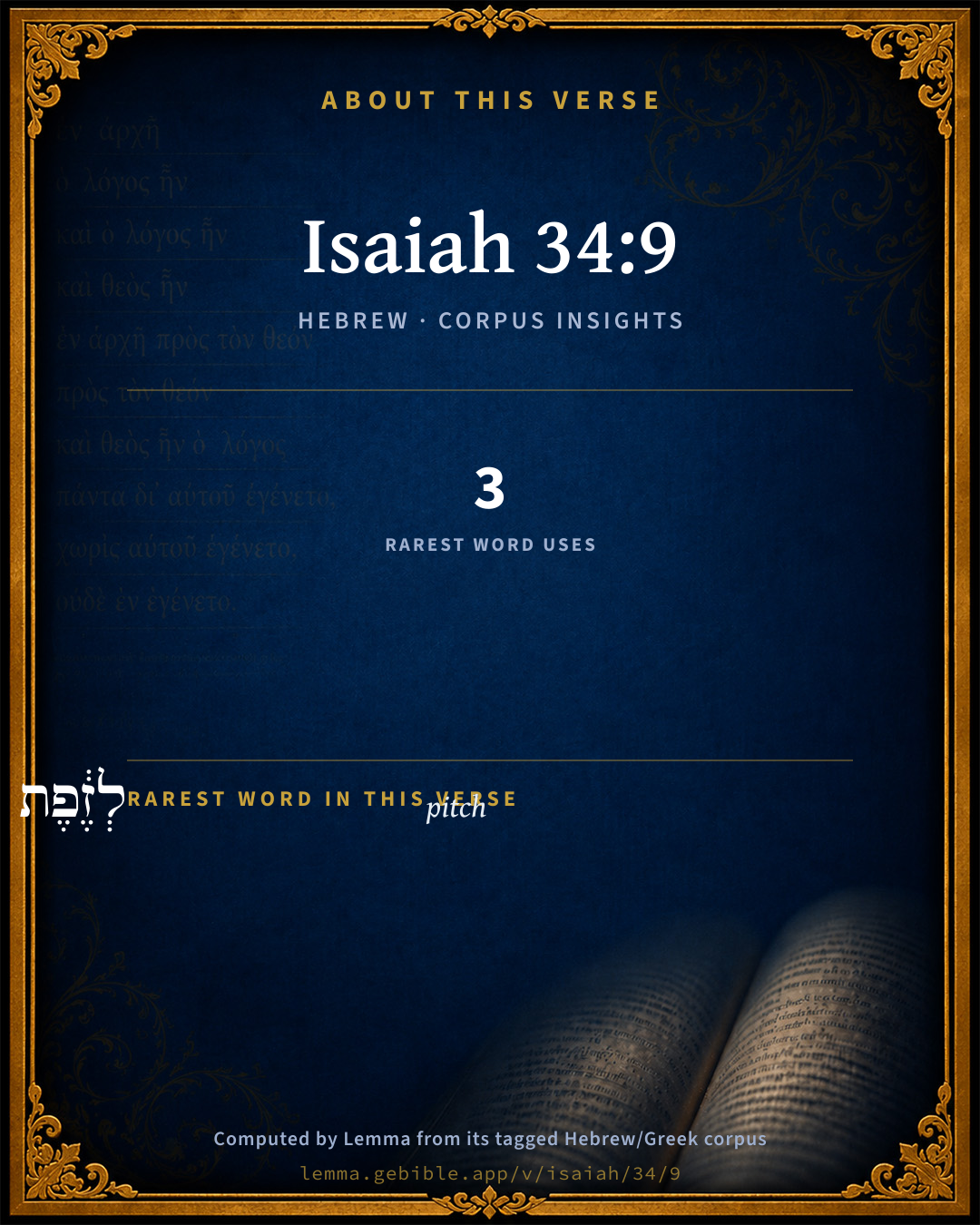
The rarest word here is לְזֶ֔פֶת pitch H2203 — appearing just 3 times in the whole Hebrew Bible.

Shared distinctive vocabulary

לְזֶ֔פֶת pitch H2203 occurs in 2 verses of the Hebrew Bible. Also found in:

Grammatical profile

  • 3 verbs
  • 6 nouns

Verb forms

  • וְנֶהֶפְכ֤וּ Niphal · Sequential Perfect
  • וְהָיְתָ֣ה Qal · Sequential Perfect
  • בֹּעֵרָֽה Qal · Participle Active

Repetition

A word recurs within this verse — often emphatic in Hebrew:

  • לְזֶ֔פֶת pitch H2203 ×2

Hebrew & Septuagint length

In English translation the verse runs 25 words from the Hebrew and 24 from the Septuagint (LXX English) — closely comparable.

A rough comparison of the two English renderings, which tokenize alike — not a word-level alignment.

Word counts can differ between the Hebrew and the Greek without any difference in meaning — e.g. the Hebrew direct-object marker אֵת has no separate Greek word, and Greek often adds the article ὁ.

Cross-references

8

Topical passages linked to Isaiah 34:9 in the Treasury of Scripture Knowledge — connected by theme and wording, ordered by reader-vote popularity; previews shown in the World English Bible.

  • Deuteronomy 29:23 [and that] the whole land of it is sulfur, and salt, [and] a burning, [that] it is not sown, nor bears, nor any grass grows therein, like the overthrow of Sodom and Gomorrah, Admah and Zeboiim, which Yahweh overthrew in his anger, and in his wrath:
  • Psalms 11:6 On the wicked he will rain blazing coals; Fire, sulfur, and scorching wind shall be the portion of their cup.
  • Genesis 19:28 He looked toward Sodom and Gomorrah, and toward all the land of the plain, and looked, and saw that the smoke of the land went up as the smoke of a furnace.
  • Job 18:15 There shall dwell in his tent that which is none of his. Sulfur shall be scattered on his habitation.
  • Luke 17:29 but in the day that Lot went out from Sodom, it rained fire and sulfur from the sky, and destroyed them all.
  • Jude 1:7 Even as Sodom and Gomorrah, and the cities around them, having, in the same way as these, given themselves over to sexual immorality and gone after strange flesh, are set forth as an example, suffering the punishment of eternal fire.
  • Revelation 19:20 The beast was taken, and with him the false prophet who worked the signs in his sight, with which he deceived those who had received the mark of the beast and those who worshiped his image. These two were thrown alive into the lake of fire that burns with sulfur.
  • Revelation 21:8 But for the cowardly, unbelieving, sinners, abominable, murderers, sexually immoral, sorcerers, idolaters, and all liars, their part is in the lake that burns with fire and sulfur, which is the second death."

Cross-references courtesy of OpenBible.info (CC BY 4.0).

Hebrew and Greek witnesses Masoretic Hebrew ↔ Greek Septuagint

The same verse in the two great witnesses to the Old Testament, shown verse-for-verse.

These are two independent witnesses, not word-aligned to each other, and the Septuagint is shown in lemma (dictionary) form.

Hebrew Isaiah 34:9 Masoretic · Westminster Leningrad Codex

וְנֶהֶפְכ֤וּ נְחָלֶ֨יהָ֙ לְזֶ֔פֶת וַעֲפָרָ֖הּ לְגָפְרִ֑ית וְהָיְתָ֣ה אַרְצָ֔הּ לְזֶ֖פֶת בֹּעֵרָֽה

The streams of [Edom] shall be turned into pitch, and the dust of it into sulfur, and the land of it shall become burning pitch.

World English Bible · Public Domain

Greek LXX Isaiah 34:9 Septuagint · lemma form

καί στρέφω αὐτός ὁ φάραγξ εἰς πίσσα καί ὁ γῆ αὐτός εἰς θεῖος καί εἰμί αὐτός ὁ γῆ καίω ὡς πίσσα

And her valleys shall be turned into pitch, and her land into sulphur; and her land shall be as pitch burning night and day;

LXX2012 (modern English Septuagint) · Public Domain

On this verse, The Cambridge Bible for Schools and Colleges discusses the Septuagint’s reading. Read the note in Commentary ↓

Hebrew: Westminster Leningrad Codex (CC BY 4.0). Greek: Septuagint (public domain); English from LXX2012 (modern English Septuagint) (Public Domain). How the Septuagint differs from the Hebrew →

Targum (Aramaic paraphrase)

1

The Targum is the ancient Jewish Aramaic paraphrase of the Hebrew Scriptures — an interpretive translation, not the Hebrew text itself. Onkelos (literal) and Pseudo-Jonathan (expansive) render the Torah, and Jonathan the Prophets. Coverage is partial: where no permissively-licensed English translation exists for a verse, only the Aramaic is shown. This is verse-level text, not a word-by-word alignment to the Hebrew.

  1. Targum Jonathan Prophets (Joshua–Malachi)
    וְיִתְהַפְּכוּן נַחֲלָהָא לְזֵפָא וְעַפְרָא לְגוּפְרֵיתָא וּתְהֵי אַרְעָהּ לְזֵפָא בוֹעֵרָא:

    And the rivers of Samaria shall be turned into pitch, and her dust into brimstone, and the land shall become burning pitch.

    Targum Jonathan — Aramaic: “Mikraot Gedolot” (public domain). English: “Sefaria Community Translation” (CC0 1.0 (public-domain dedication)); “London "Chaldee Paraphrase," 1871” (public domain). Text via Sefaria.

Commentary

Notes on Isaiah 34:9 from classic Christian and Jewish commentators (each source and its license shown beneath its notes). The classic Christian expositions comment on the surrounding passage and are grouped to its opening verse, so a note may address several verses; the Jewish commentaries on the Tanakh (Rashi and others) are per-verse, so they appear only where the commentator wrote on this verse.

Lemma curates 59 commentaries, every one of them public domain or Creative Commons licensed, each selected and text-cleaned for this edition rather than reprinted as found. About our sources →

Matthew Henry's Commentary

This prophecy looks very black, but surely it looks so further than upon Edom and Bozrah. 1. It describes the melancholy changes that are often made by the divine Providence, in countries, cities, palaces, and families. Places that have flourished and been much frequented strangely go to decay. We know not where to find the places where many great towns, celebrated in history, once stood. Fruitful countries, in process of time, are turned into barrenness, and pompous populous cities into ruinous heaps. Old decayed castles look frightful, and their ruins are almost as much dreaded as ever their garrisons were. 2. It describes the destroying judgments which are the effects of God's wrath and the just punishment of those that are enemies to his people, which God will inflict when the year of the redeemed has come, and the year of recompences for the controversy of Zion. Those that aim to ruin the church can never do that, but will infallibly ruin themselves. 3. It describes the final desolation of this wicked world, which is reserved unto fire at the day of judgment, Pe2 3:7. The earth itself, when it, and all the works that are therein, shall be burnt up, will (for aught I know) be turned into a hell to all those that set their affections on earthly things. However, this prophecy shows us what will be the lot of the generation of God's curse.

I. The country shall become like the lake of Sodom, Isa 34:9, Isa 34:10. The streams thereof, that both watered the land and pleased and refreshed the inhabitants, shall now be turned into pitch, shall be congealed, shall look black, and shall move slowly, or not at all. Their floods to lazy streams of pitch shall turn; so Sir R. Blackmore. The dust thereof shall be turned into brimstone; so combustible has sin made their land that it shall take fire at the first spark of God's wrath struck upon it; and, when it has taken fire, it shall become burning pitch; the fire shall be universal, not a house, or town, on fire, but a whole country; and it shall not be in the power of any to suppress or extinguish it. It shall burn continually, burn perpetually, and shall not be quenched night nor day. The torment of those in hell, or that have a hell within them in their own consciences, is without interruption; the smoke of this fire goes up for ever. As long as there are provoking sinners on earth, from one generation to another, an increase of sinful men, to augment the fierce anger of the Lord (Num 32:14), there will be a righteous God in heaven to punish them for it. And as long as a people keep up a succession of sinners God will have a succession of plagues for them; nor will any that fall under the wrath of God be ever able to recover themselves. It will be found, how light soever men make of it, that it is a fearful thing to fall into the hands of the living God. If the land be doomed to destruction, none shall pass through it, but travellers will choose rather to go a great way about than come within the smell of it.

II. The cities shall become like old decayed houses, which, being deserted by the owners, look very frightful, being commonly possessed by beasts of prey or birds of ill omen. See how dismally the palaces of the enemy look; the description is peculiarly elegant and fine. 1. God shall mark them for ruin and destruction. He shall stretch out upon Bozrah the line of confusion with the stones or plummets of emptiness, Isa 34:11. This intimates the equity of the sentence passed upon it; it is given according to the rules of justice and the exact agreeableness of the execution with the sentence; the destruction is not wrought at random, but by line and level. The confusion and emptiness that shall overspread the face of the whole country shall be like that of the whole earth when it was Tohu and Bohu (the very words here used) - without form and void. Gen 1:2. Sin will soon turn a paradise into a chaos, and sully the beauty of the whole creation. When there is confusion there will soon be emptiness; but both are appointed by the governor of the world, and in exact proportions. 2. Their great men shall be all cut off, and none of them shall dare to appear (Isa 34:12): They shall call the nobles of the kingdom to take care of the arduous affairs which lie before them, but none shall be there to take this ruin under their hand, and all her princes, having the sad tidings brought them, shall be nothing, shall be at their wits' end, and not be able to stand them in stead, to shelter them from destruction.

III. Even the houses of state, and those of strength, shall become as wildernesses (Isa 34:13); not only grass shall grow, but thorns shall come up, in her palaces, nettles and brambles in the fortresses thereof, and there shall be none to cut them up or tread them down. We sometimes see ruined buildings thus overgrown with rubbish. It intimates that the place shall not only be uninhabited and unfrequented where a full court used to be kept, but that it shall be under the curse of God; for thorns and thistles were the production of the curse, Gen 3:18.

IV. They shall become the residence and rendezvous of fearful frightful beasts and birds, which usually frequent such melancholy places, because there they may be undisturbed, and, when they are frightened thither, they help to frighten men thence. This circumstance of the desolation, being apt to strike a horror upon the mind, is much enlarged upon here, Isa 34:11. The cormorant shall possess it, or the pelican, which affects to be solitary (Psa 102:6); and the bittern, which makes a hideous noise, the owl, a melancholy bird, the raven, a bird of prey, invited by the dead carcases, shall dwell there (with all the ill-boding monsters of the air, Sir R. B.), all the unclean birds, which were not for the service of man, Isa 34:13. It shall be a habitation for dragons, which are poisonous and hurtful.

And in their lofty rooms of state,

Where cringing sycophants did wait,

Dragons shall hiss and hungry wolves shall howl;

In courts before by mighty lords possess'd

The serpent shall erect his speckled crest,

Or fold his circling spires to rest.

- Sir R. Blackmore

That which was a court for princes shall now be a court for owls or ostriches, Isa 34:14. The wild beasts of the desert, the dry and sandy country, shall meet, as it were by appointment, with the wild beasts of the island, the wet marshy country, and shall regale themselves with such a perfect desolation as they shall find there.

Leopards, and all the rav'ning brotherhoods

That range the plains, or lurk in woods,

Each other shall invite to come,

And make this wilder place their home.

Fierce beasts of every frightful shape and size

Shall settle here their bloody colonies.

- Sir R. Blackmore

The satyr shall cry to his fellow to go with him to this desert place, or, being there, they shall please themselves that they have found such an agreeable habitation. There shall the screech-owl rest, a night-bird and an ominous one. The great owl shall there make her nest (Isa 34:15) and lay and hatch; the breed of them shall be kept up to provide heirs for this desolate place. The vultures which feast on carcases, shall be gathered there, every one with his mate. Now observe, 1. How the places which men have deserted, and keep at a distance from, are proper receptacles for other animals, which the providence of God takes care of, and will not neglect. 2. Whom those resemble that are morose, unsociable, and unconversable, and affect a melancholy retirement; they are like these solitary creatures that take delight in desolations. 3. What a dismal change sin makes; it turns a fruitful land into barrenness, a frequented city into a wilderness.

V. Here is an assurance given of the full accomplishment of this prediction, even to the most minute circumstance of it (Isa 34:16, Isa 34:17): "Seek you out of the book of the Lord and read. When this destruction comes compare the event with the prediction, and you will find it to answer exactly." Note, The book of the prophets is the book of the Lord, and we ought to consult it and converse with it as of divine origin and authority. We must not only read it, but see out of it, search into it, turn first to one text and then to another and compare them together. Abundance of useful knowledge might thus be extracted, by a diligent search, out of the scriptures, which cannot be got by a superficial reading of them. When you have read the prediction out of the book of the Lord then observe, 1. That according to what you have read so you see; not one of these shall fail, either beast or fowl: and, it being foretold that they shall possess it from generation to generation, in order to that, that the species may be propagated, none shall want her mate; these marks of desolation shall be fruitful, and multiply, and replenish the land. 2. That God's mouth having commanded this direful muster his Spirit shall gather them, as the creatures by instinct were gathered to Adam to be named and to Noah to be housed. What God's word has appointed his Spirit will effect and bring about, for no word of God shall fall to the ground. The word of God's promise shall in like manner be accomplished by the operations of the Spirit. 3. That there is an exact order and proportion observed in the accomplishment of this threatening: He has cast the lot for these birds and beasts, so that each one shall know his place as readily as if it were marked by line. See the like, Joe 2:7, Joe 2:8, They shall not break their ranks, neither shall one thrust another. The soothsayers among the heathen foretold events by the flight of birds, as if the fate of men depended on them. But here we find that the flight of birds is under the direction of the God of Israel: he has cast the lot for them. 4. That the desolation shall be perpetual: They shall possess it for ever. God's Jerusalem may be laid in ruins; but Jerusalem of old recovered itself out of its ruins, till it gave place to the gospel Jerusalem, which may be brought low, but shall be rebuilt, and shall continue till it give place to the heavenly Jerusalem. But the enemies of the church shall be for ever desolate, shall be punished with an everlasting destruction.

Matthew Henry's Commentary on the Whole Bible (1708–1710) — public domain (CC PDM 1.0). Text via the HelloAO Bible API.

The Cambridge Bible for Schools and Colleges

gen. ed. J. J. S. Perowne

9, 10. The description is no doubt suggested by the volcanic phenomena which accompanied the destruction of the neighbouring cities of the Plain (Genesis 19; Jer_49:18). The division of clauses in the LXX. is much preferable to that in the Hebrew Text. Render accordingly: … and its land shall become pitch, burning night and day; it shall not be quenched for ever; its smoke shall go up from generation to generation; it shall lie waste to all eternity, none passing through it (so Cheyne). The last two clauses prepare for the transition to the other picture of ruin, which is elaborated in the verses that follow.

9–17. The fate of the land of Edom is next represented under two incompatible images,—first that of a perpetual conflagration (Isa_34:9-10), and second that of a dreary solitude, peopled only by “doleful creatures” (Isa_34:11 ff.).

The Cambridge Bible for Schools and Colleges (gen. ed. J. J. S. Perowne; Cambridge University Press, 1878–1918) — public domain. Text from a community e-Sword module.

Trapp's Complete Commentary

John Trapp

Isa 34:9 And the streams thereof shall be turned into pitch, and the dust thereof into brimstone, and the land thereof shall become burning pitch.

Ver. 9. And the streams thereof shall be turned into pitch.] Like the lake of Sodom, which is near to Idumea, and whereof Josephus {a} writes, that an ox, having all his legs bound, will not sink into it, the water is so thick and pitchy. Strabo, though a stranger to this prophecy, attesteth the accomplishment of it. Lyra saith that in some part of Idumea there is still ascending a smoke of fire and brimstone, as out of Mount Etna in Sicily. {b} And Hyperius thinketh that the Edomites are here further threatened with hell torments. It should seem so by the next words.

{a} Alludit ad vicinam et situ et scelare et clade Sodomam - Lib. v. De Bell. Jud.

{b} Geog., lib. xvi.

John Trapp, A Commentary or Exposition upon All the Books of the Old and New Testament (1647–1656) — public domain. Text from a community e-Sword module.

Joseph Benson's Commentary

Isa 34:9-15. And the streams thereof — The rivers, which seem most secure from the judgment here threatened; shall be turned into pitch, &c. — The country shall be dealt with as Sodom and Gomorrah were, even utterly destroyed, as it were, by fire, or burning pitch and brimstone, thrown down upon it from heaven. From generation to generation it shall lie waste — It shall be irrecoverably ruined, and shall remain a spectacle of God’s vengeance to all succeeding ages. The cormorant, &c., shall possess it — The inhabitants shall be wholly cut off, and it shall be entirely possessed by those creatures which delight in deserts and waste places: see Isa 13:21-22; and Isa 14:23. He shall stretch out upon it the line of confusion, &c. — He shall use the line, and the stone, or plummet, joined to it, not to build it up, but to mark it out for destruction and desolation. Thus the prophet goes on to “paint, in the most chosen figures, an image of the land and city desolated by war, wasted by fire, and devoted to eternal desolation, by the divine judgment; which should not only be deprived of its inhabitants, and left to impure beasts and birds, but also, by the desolations brought upon it, should be rendered uninhabitable, and present the appearance of the infernal flames, like another Sodom and Gomorrah, sending forth continually black smoke and horrid smells. The desolation of Babylon is set forth in similar terms, Isa 13:19, &c. Though Rome pagan and the Roman powers have already suffered great desolation from the Goths and others, yet Vitringa is of opinion that this prophecy has not yet had its full completion, but will hereafter have it in the destruction of Papal Rome. The state of Italy, and the sulphurous soil in the vicinity of Rome, render the probability of this devastation greater.” — Dodd.

Joseph Benson's Commentary on the Old and New Testaments (1811–1818) — public domain. Text from a community e-Sword module.

Tyndale Open Study Notes

Tyndale Open Resources

34:9 Edom’s judgment was similar to the judgment of Sodom and Gomorrah (Gen 19:24; see also Jer 49:17-18).

Tyndale Open Study Notes — © Tyndale Open Resources, licensed CC BY-SA 4.0. Text via the HelloAO Bible API.

Geneva Bible (1599)

Geneva Bible translators

He alludeth to the destruction of Sodom and Gomorrah, Gen. 19:24.

Geneva Bible (1599) marginal notes — public domain. Text via Bolls.life.

Jamieson, Fausset & Brown

Robert Jamieson, A. R. Fausset & David Brown

Images from the overthrow of Sodom and Gomorrah (Gen 19:24-28; so Deu 29:23; Jer 49:17-18).

Jamieson, Fausset & Brown — Commentary Critical and Explanatory on the Whole Bible (1871) — public domain (CC PDM 1.0). Text via the HelloAO Bible API.

Ellicott's Commentary for English Readers

(9, 10) The streams thereof shall be turned into pitch . . .—The imagery of the punishment which is to fall on Edom is suggested partly by the scenery of the Dead Sea, partly by the volcanic character of Edom itself, with its extinct craters and streams of lava. (Comp. Jer_49:18.) The prophet sees the destruction, as continuing not merely in its results, but in its process, the smoke of the burning craters rising up perpetually, and making the land uninhabitable.

A Bible Commentary for English Readers, edited by Charles John Ellicott (1878–1897) — public domain. Text from a community e-Sword module.

John Gill's Exposition

And the streams thereof shall be turned into pitch,.... The Septuagint render it, "the valleys"; the word signifying both rivers and valleys, most render it rivers or streams. The Targum is express,

"the rivers of Rome shall be turned into pitch;''

by which may be meant the maritime places belonging to the Romish jurisdiction, the same on which the third vial will be poured, by which the rivers and fountains of waters will become blood; and which refers to this very time, when blood shall be given to the whore of Rome to drink, Rev 16:4. The allusion, in this and some following clauses, is to the destruction of Sodom and Gomorrah; see Jer 49:17,

and the dust thereof into brimstone; and so easily take fire:

and the land thereof shall become burning pitch: plainly pointing to the destruction of Rome by fire, Rev 17:16.

John Gill's Exposition of the Whole Bible (1746–1763) — public domain (CC PDM 1.0). Text via the HelloAO Bible API.

Albert Barnes' Notes on the Bible

And the streams thereof - The idea here is, that there would be as great and awful a destruction as if the streams everywhere should become pitch or resin, which would be set on fire, and which would fill the land with flame. This image is very striking, as we may see by supposing the rivers and streams in any land to flow not with water, but with heated pitch, turpentine, or tar, and that this was all suddenly kindled into a flame. It cannot be supposed that this is to be taken literally. The image is evidently taken from the destruction of Sodom and Gamorrah (Gen 19:25-28), an image which is more fully used in reference to the same subject in Jer 49:17-18 : ‘And Edom shall be a desolation;... as in the overthrow of Sodom and Gomorrah, and the neighbor cities thereof, saith the Lord, no man shall abide there, neither shall a son of man dwell in it.’

And the dust thereof into brimstone - The ruin shall be as entire as if all the soil were turned into brimstone, which should be ignited and left burning.

Albert Barnes' Notes on the Bible (1834–1885) — public domain. Text from a community e-Sword/MySword module.

Haydock's Catholic Bible Commentary

Pitch. The soil was sulphureous, and became neglected, (ver. 10.) like the territory of Sodom. The people are now no more, and only a few miserable Arabs pitch their tents there.

George Leo Haydock (1774–1849), Haydock's Catholic Family Bible and Commentary, 1859 edition — public domain. Excludes Psalms (Douay-Rheims chapter numbering differs from Protestant) and Deuterocanonical books (Catholic canon only).

Matthew Poole's English Annotations

The streams, which seem most secure from this danger, and much more the land. Idumea shall be dealt with as Sodom and Gomorrah were, even utterly destroyed, as it were, by fire, or burning pitch and brimstone thrown down upon it from heaven.

Matthew Poole's English Annotations on the Holy Bible (1683–1685) — public domain. Text from a community e-Sword/MySword module.

The Pulpit Commentary

And the streams thereof; i.e. "the streams of the land of Edom." Though Edom has no perennial rivers, it has numerous torrent-courses to carry off the winter rains. (see 2Ki_3:20-22) These should run with pitch, instead of water. The general idea is that Edom should be visited with a destruction like that of Sodom and Gomorrah. (Gen_19:24; comp. Jer_49:18) But the prophet scarcely intends his words to be taken literally; he is making Edom a type or representation of God"s enemies, and the gist of his teaching is that a dreadful vengeance, an utter destruction, will come upon all who set themselves up against the Most High. In the next verse he declares that the vengeance will be eternal. (comp. Isa_66:24)

The Pulpit Commentary (1880–1919), ed. H.D.M. Spence-Jones & Joseph S. Exell — public domain. Text from a community e-Sword module.

John Wesley's Explanatory Notes

The land - Idumea shall be dealt with, as Sodom and Gomorrah were.

John Wesley, Explanatory Notes Upon the Whole Bible (1754–1765) — public domain. Text via the GEBible commentary corpus.

J. A. Alexander on Isaiah

Joseph Addison Alexander

“And her streams (those of Idumea or the land of Edom) shall be turned to pitch, and her dust to brimstone, and her land shall become burning pitch.” This verse announces nothing new, but repeats the same prediction under other figures, borrowed from the overthrow of Sodom and Gomorrah, which throughout the Bible are set forth for an example, suffering the vengeance of eternal fire (Jud 1:7). To the fire and brimstone there mentioned, pitch or bitumen is added, as some suppose, because the soil of Idumea, lying adjacent to the Dead Sea, is bituminous and abounds in veins or springs of naphtha. The first clause expresses in the strongest terms the idea of utter and permanent destruction, as complete and terrible as if the streams were turned to pitch.

Joseph Addison Alexander, The Prophecies of Isaiah (1846–1847; New York: Scribner, 1870–1878) — public domain. Text from a community e-Sword module.

Rashi

Rabbi Shlomo Yitzchaki (Rashi)

And its streams shall turn (I.e., the streams) of the heathens. ([Mss. yield:] of Edom.)

Rashi on the Tanakh — English translations: “The Judaica Press complete Tanach with Rashi, translated by A. J. Rosenberg” (CC BY 4.0); “Pentateuch with Rashi's commentary by M. Rosenbaum and A.M. Silbermann, 1929-1934” (public domain); “The Metsudah Tanach series, Lakewood, N.J” (CC BY 4.0); and “The Book of Joshua, Metsudah Publications, 1997” (CC BY 4.0). Text via Sefaria.

Ibn Ezra

Rabbi Abraham ibn Ezra

And the streams thereof, etc. This really happened or will happen in a miraculous way, as some believe; others are of opinion that this verse is to be taken figuratively: None will remain there to drink the water, as if it were changed to pitch.

בוערה Burning. This word shows that the ת of זפת is the feminine termination.

Ibn Ezra on the Tanakh — English translations: “Sefaria Community Translation” (CC0 1.0 (public-domain dedication)); “Yalkut, Sifsei Chachomim Chumash, Metsudah Publications, 2009” (CC BY 4.0); and “Commentary of Ibn Ezra on Isaiah - trans. by M. Friedlander, 1873” (public domain). Text via Sefaria.

Lesson kit

Teaching starters — assembled from the data on this page, not authored interpretation. Every prompt links to the verse data it draws on. Edit before teaching.

Isaiah, in the Prophets, opens this verse with 9 words (8 distinct Hebrew lemmas). Its most distinctive word is zepheth (“pitch”). A historical commentator’s framing appears above. Read the whole chapter for the surrounding context.

Discussion questions

  1. How does “pitch” (zepheth) shape what this verse is saying?
  2. How does Exodus 2:3, which shares the word «pitch», read alongside this verse?
  3. What does the repetition of “pitch” (2× in this one verse) do in this verse?
  4. These translations render this verse differently; the difference is in the English rendering, not the original. What questions does that raise?
  5. «וְנֶהֶפְכ֤וּ» is a Niphal Sequential Perfect verb. How does that grammatical form shape the action described?
  6. Compare how Matthew Henry's Commentary and The Cambridge Bible for Schools and Colleges read this verse. Where do they agree or differ?

Things to notice

  • These translations choose different wording for 6 words in this verse.
  • “pitch” occurs 2× in this single verse.
  • 8 distinct Hebrew lemmas span 9 words in this verse.

Reading settings

Reading text

Shown beneath each verse's original-language words.

Old Testament
Old Testament edition

Read the OT as the Masoretic Hebrew (MT) or the Greek Septuagint (LXX).

English shown for the Greek Septuagint (in the Hebrew ↔ Greek comparison).

Comparing translations? Open the Compare panel on any verse page to stack up to four side by side.