
Jeremiah 47:2

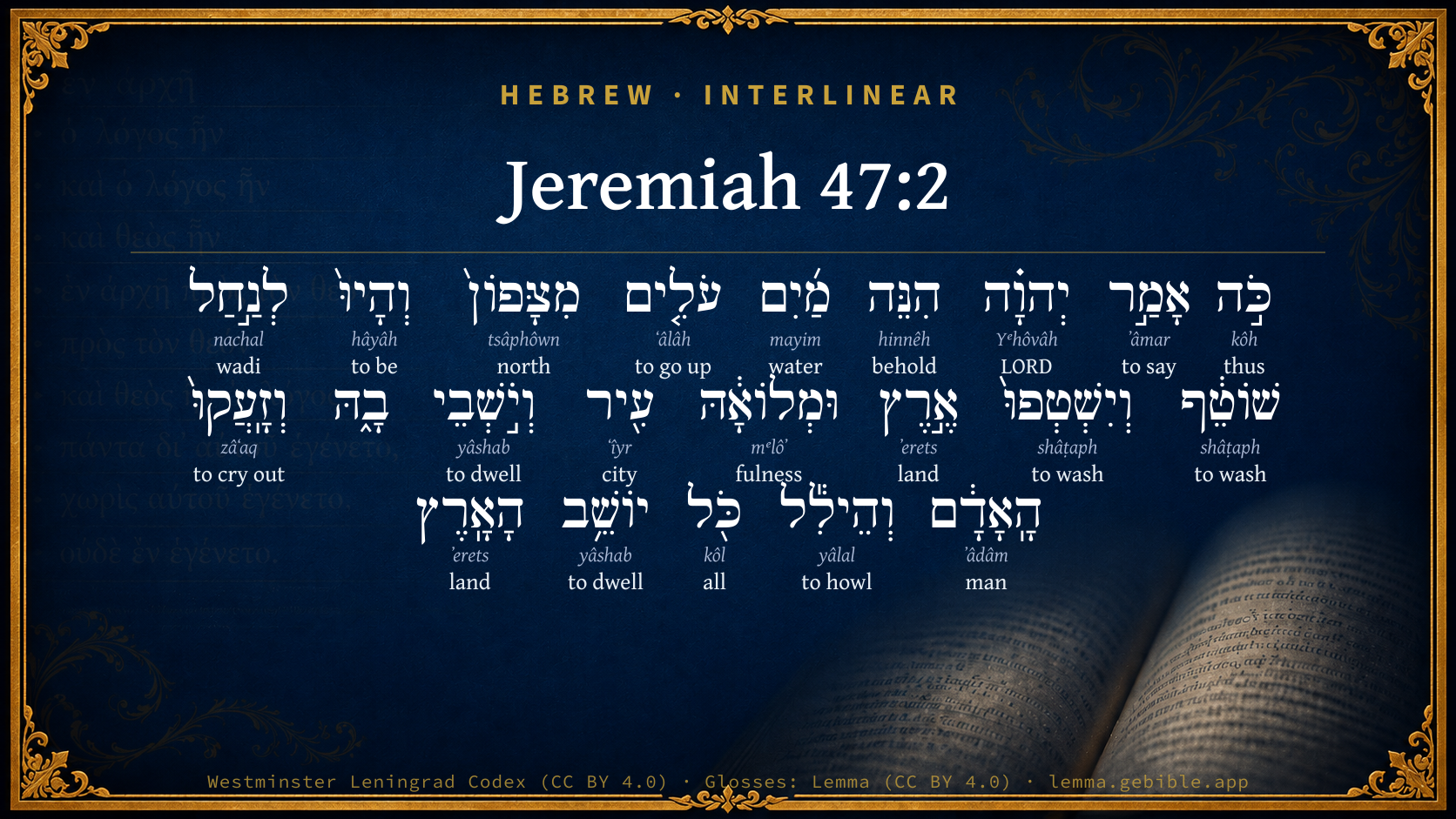
Hebrew (Westminster Leningrad Codex) Jeremiah 47:2 appears in the Hebrew Old Testament. The text above is from the Westminster Leningrad Codex. Each word links to its Strong’s number, a concise gloss, and parsing drawn from the Open Scriptures Hebrew Bible morphology. Click any word for its full Brown-Driver-Briggs (BDB) entry.
Download image
Cite this verse

Jeremiah 47:2 (World English Bible). Public Domain. Lemma interlinear Bible study tool, https://lemma.gebible.app/v/jeremiah/47/2.

Show BibTeX & RIS
BibTeX
RIS
English Translation
Thus says Yahweh: Behold, waters rise up out of the north, and shall become an overflowing stream, and shall overflow the land and all that is therein, the city and those who dwell therein; and the men shall cry, and all the inhabitants of the land shall wail.
World English Bible · Public Domain
Download a study sheet

One document with this verse’s original text, its word-by-word gloss line, the meaning frame, cross-references with their text, attributed commentary, and full source and license credits — printable, and it pastes into notes with its structure intact.

This verse Autodidact and up

Study sheet (.html) Plain text (.txt)

A passage Seminary Student

Up to 50 verses in one chapter. A passage sheet keeps up to 6 commentary sources and 12 cross-references per verse, in the order this page ranks them, and says so on the sheet whenever that leaves anything out. Ask for a single verse and you get the Autodidact verse sheet above.

Everything on this page stays free to read, with no account — the sheet is a download of what is already on screen, not access to it.

Want to remove ads? Support Godless Engineer
Compare translations 3

The same verse in 3 English versions, stacked beneath the original-language interlinear above. Click any original word for its lexicon entry.

Each is an independent rendering of the whole verse — the interlinear is not word-aligned to these translations.

Highlighted words mark where these versions differ — a whole-verse word diff, not a word-by-word alignment.

  • World English Bible Public Domain
    Thus says Yahweh: Behold, waters rise up out of the north, and shall become an overflowing stream, and shall overflow the land and all that is therein, the city and those who dwell therein; and the men shall cry, and all the inhabitants of the land shall wail.
  • King James Version Public Domain
    Thus saith the LORD; Behold, waters rise up out of the north, and shall be an overflowing flood, and shall overflow the land, and all that is therein; the city, and them that dwell therein: then the men shall cry, and all the inhabitants of the land shall howl.
  • unfoldingWord Literal Text CC BY-SA 4.0
    “Yahweh says this: See, floods of water are rising in the north. They will be like an overflowing river! Then they will overflow the land and everything in it, its cities and its inhabitants! So everyone will shout for help, and all the inhabitants of the land will lament.

unfoldingWord Literal Text — © unfoldingWord, licensed CC BY-SA 4.0. Word-aligned USFM3 via Door43 (git.door43.org/unfoldingWord/en_ult).

Versions to compare (up to 4)

3 of 4 selected

Show all 18 translations

Every available English version of this verse, each an independent rendering of the whole verse.

  • World English Bible Public Domain
    Thus says Yahweh: Behold, waters rise up out of the north, and shall become an overflowing stream, and shall overflow the land and all that is therein, the city and those who dwell therein; and the men shall cry, and all the inhabitants of the land shall wail.
  • Berean Standard Bible Public Domain
    This is what the LORD says: “See how the waters are rising from the north and becoming an overflowing torrent. They will overflow the land and its fullness, the cities and their inhabitants. The people will cry out, and all who dwell in the land will wail
  • Majority Standard Bible Public Domain
    This is what the LORD says: “See how the waters are rising from the north and becoming an overflowing torrent. They will overflow the land and its fullness, the cities and their inhabitants. The people will cry out, and all who dwell in the land will wail
  • King James Version Public Domain
    Thus saith the LORD; Behold, waters rise up out of the north, and shall be an overflowing flood, and shall overflow the land, and all that is therein; the city, and them that dwell therein: then the men shall cry, and all the inhabitants of the land shall howl.
  • American Standard Version (1901) Public Domain
    Thus saith Jehovah: Behold, waters rise up out of the north, and shall become an overflowing stream, and shall overflow the land and all that is therein, the city and them that dwell therein; and the men shall cry, and all the inhabitants of the land shall wail.
  • Revised Version (1885) Public Domain
    Thus saith the LORD: Behold, waters rise up out of the north, and shall become an overflowing stream, and shall overflow the land and all that is therein, the city and them that dwell therein: and the men shall cry, and all the inhabitants of the land shall howl.
  • Geneva Bible (1599) Public Domain
    Thus saith the Lord, Beholde, waters rise vp out of the North, and shalbe as a swelling flood, and shall ouerflowe the land, and all that is therein, and the cities with them that dwell therein: then the men shall crie, and all the inhabitants of the land shall howle,
  • Douay-Rheims (1899) Public Domain
    Thus saith the Lord: Behold there come up waters out of the north, and they shall be as an overflowing torrent, and they shall cover the land, and all that is therein, the city and the inhabitants thereof: then the men shall cry, and all the inhabitants of the land shall howl,
  • Young's Literal Translation Public Domain
    `Thus said Jehovah: Lo, waters are coming up from the north, And have been for an overflowing stream, And they overflow the land and its fulness, The city, and the inhabitants in it, And men have cried out, And howled hath every inhabitant of the land.
  • Literal Standard Version CC BY-SA 4.0
    “Thus said YHWH: Behold, waters are going up from the north, || And have been for an overflowing stream, || And they overflow the land and its fullness, || The city, and those dwelling in it, || And men have cried out, || And every inhabitant of the land has howled.
  • Unlocked Literal Bible CC BY-SA 4.0
    “Yahweh says this: See, floods of water are rising in the north. They will be like an overflowing river! Then they will overflow the land and everything in it, its cities and its inhabitants! So everyone will shout for help, and all the inhabitants of the land will lament.
  • unfoldingWord Literal Text CC BY-SA 4.0
    “Yahweh says this: See, floods of water are rising in the north. They will be like an overflowing river! Then they will overflow the land and everything in it, its cities and its inhabitants! So everyone will shout for help, and all the inhabitants of the land will lament.
  • Darby Bible Public Domain
    Thus saith Jehovah: Behold, waters rise up out of the north, and shall become an overflowing flood, and shall overflow the land, and all that is therein; the city, and them that dwell therein: and the men shall cry, and all the inhabitants of the land shall howl,
  • World Messianic Bible Public Domain
    The LORD says: “Behold, waters rise up out of the north, and will become an overflowing stream, and will overflow the land and all that is therein, the city and those who dwell therein. The men will cry, and all the inhabitants of the land will wail.
  • Webster's Bible Public Domain
    Thus saith the LORD; Behold, waters rise out of the north, and shall be an overflowing flood, and shall overflow the land, and all that is in it; the city, and them that dwell therein: then the men shall cry, and all the inhabitants of the land shall howl.
  • Free Bible Version CC BY-SA 4.0
    This is what the Lord says: Look at the waters rising from the north! They will become an overflowing river that sweeps across the country and everything in it, flooding the towns and everyone's homes. The people will cry out for help; everyone who lives in the country will weep,
  • Bible in Basic English Public Domain
    This is what the Lord has said: See, waters are coming up out of the north, and will become an overflowing stream, overflowing the land and everything in it, the town and those who are living in it; and men will give a cry, and all the people of the land will be crying out in pain.
  • JPS Tanakh (1917) Public Domain
    Thus saith the LORD: Behold, waters rise up out of the north, and shall become an overflowing stream, and they shall overflow the land and all that is therein, the city and them that dwell therein; and the men shall cry, and all the inhabitants of the land shall wail.

Literal Standard Version (2020), Covenant Press — licensed CC BY-SA 4.0. Text via the HelloAO Bible API (eBible.org). Unlocked Literal Bible (unfoldingWord) — licensed CC BY-SA 4.0. Text via the HelloAO Bible API (eBible.org). unfoldingWord Literal Text — © unfoldingWord, licensed CC BY-SA 4.0. Word-aligned USFM3 via Door43 (git.door43.org/unfoldingWord/en_ult). Free Bible Version, Dr. Jonathan Gallagher — licensed CC BY-SA 4.0. Text via the HelloAO Bible API (eBible.org).

Word by word

More ways to search: Search by grammar → Find every occurrence → Compare this word →

Practice this passage: Drill this verse → Learn its vocabulary →

שׁוֹטֵ֔ף
shâṭaph
H7857
“washing”
Verb, Qal, Participle Active, Masculine, Singular, Absolute
Part of Speech
Verb
Stem
Qal
Form
Participle Active
Gender
Masculine
Number
Singular
State
Absolute
Full BDB Definition

Origin: a primitive root

TWOT: 2373

to wash, rinse, overflow, engulf, rinse or wash off - (Qal) - to overflow - to flow, run - to rinse or wash off - (Niphal) to be swept away, be rinsed out - (Pual) to be rinsed, be scoured and rinsed
  1. כֹּ֣ה kôh H3541 “thus” Adverb
  2. אָמַ֣ר ʼâmar H559 “to say” Verb, Qal, Perfect, 3rd Person, Masculine, Singular
  3. יְהוָ֗ה Yᵉhôvâh H3068 “LORD” Noun, Proper
  4. הִנֵּה hinnêh H2009 “behold” Particle, Demonstrative
  5. מַ֜יִם mayim H4325 “water(s)” Noun, Common, Masculine, Plural, Absolute
  6. עֹלִ֤ים ʻâlâh H5927 “going up” Verb, Qal, Participle Active, Masculine, Plural, Absolute
  7. מִצָּפוֹן֙ tsâphôwn H6828 “from · north” Preposition + Noun, Common, Feminine, Singular, Absolute
  8. וְהָיוּ֙ hâyâh H1961 “and · to be” Conjunction + Verb, Qal, Sequential Perfect, 3rd Person, Common, Plural
  9. לְנַ֣חַל nachal H5158 “to/for · wadi” Preposition + Noun, Common, Masculine, Singular, Absolute
  10. וְיִשְׁטְפוּ֙ shâṭaph H7857 “and · to wash” Conjunction + Verb, Qal, Imperfect, 3rd Person, Masculine, Plural
  11. אֶ֣רֶץ ʼerets H776 “land” Noun, Common, Both, Singular, Absolute
  12. וּמְלוֹאָ֔הּ mᵉlôʼ H4393 “and · fulness · her” Conjunction + Noun, Common, Masculine, Singular, Construct + Suffix, Personal, 3rd Person, Feminine, Singular
  13. עִ֖יר ʻîyr H5892 “city” Noun, Common, Feminine, Singular, Absolute
  14. וְיֹ֣שְׁבֵי yâshab H3427 “and · dwelling” Conjunction + Verb, Qal, Participle Active, Masculine, Plural, Construct
  15. וְזָֽעֲקוּ֙ zâʻaq H2199 “and · to cry out” Conjunction + Verb, Qal, Sequential Perfect, 3rd Person, Common, Plural
  16. הָֽאָדָ֔ם ʼâdâm H120 “the · man” Particle, Definite Article + Noun, Common, Masculine, Singular, Absolute
  17. וְהֵילִ֕ל yâlal H3213 “and · to howl” Conjunction + Verb, Hiphil, Sequential Perfect, 3rd Person, Masculine, Singular
  18. כֹּ֖ל kôl H3605 “all of” Noun, Common, Masculine, Singular, Construct
  19. יוֹשֵׁ֥ב yâshab H3427 “dwelling” Verb, Qal, Participle Active, Masculine, Singular, Construct
  20. הָאָֽרֶץ ʼerets H776 “the · land” Particle, Definite Article + Noun, Common, Both, Singular, Absolute

About this verse

These counts appear in no published source. They are computed here, from the morphology-tagged text and Lemma’s own curated glosses. What Lemma adds →

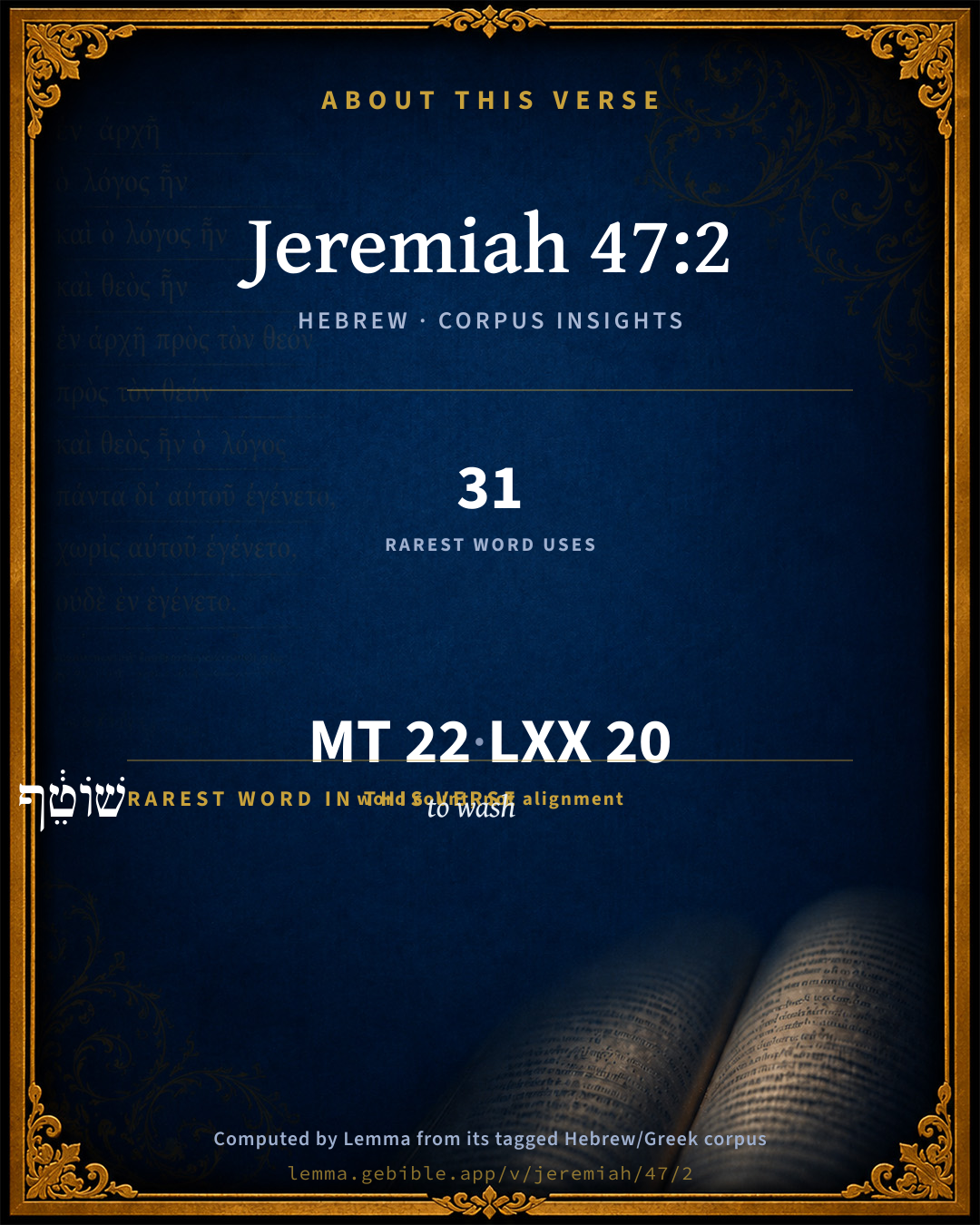
22
words
18
distinct lemmas
Prophets
section

Shared distinctive vocabulary

שׁוֹטֵ֔ף to wash H7857 occurs in 30 verses of the Hebrew Bible. Also found in:

Grammatical profile

  • 9 verbs
  • 10 nouns
  • 1 preposition
  • 1 adverb
  • 1 particle

Verb forms

  • אָמַ֣ר Qal · Perfect
  • עֹלִ֤ים Qal · Participle Active
  • וְהָיוּ֙ Qal · Sequential Perfect
  • שׁוֹטֵ֔ף Qal · Participle Active
  • וְיִשְׁטְפוּ֙ Qal · Imperfect
  • וְיֹ֣שְׁבֵי Qal · Participle Active
  • וְזָֽעֲקוּ֙ Qal · Sequential Perfect
  • וְהֵילִ֕ל Hiphil · Sequential Perfect
  • יוֹשֵׁ֥ב Qal · Participle Active

Repetition

Words recur within this verse — often emphatic in Hebrew:

  • שׁוֹטֵ֔ף to wash H7857 ×2
  • אֶ֣רֶץ land H776 ×2
  • וְיֹ֣שְׁבֵי to dwell H3427 ×2

Hebrew & Septuagint length

In the original languages it is 22 Hebrew tokens and 20 Greek tokens — but the two are counted differently (Hebrew bundles its prefixes and suffixes into one token; the Greek is in lemma form), so that isn’t a like-for-like length.

Cross-references

29

Topical passages linked to Jeremiah 47:2 in the Treasury of Scripture Knowledge — connected by theme and wording, ordered by reader-vote popularity; previews shown in the World English Bible.

  • Isaiah 8:7–8 now therefore, behold, the Lord brings up on them the waters of the River, strong and many, [even] the king of Assyria and all his glory: and it shall come up over all its channels, and go over all its banks;
  • Isaiah 15:2–5 They are gone up to Bayith, and to Dibon, to the high places, to weep: Moab wails over Nebo, and over Medeba; on all their heads is baldness, every beard is cut off.
  • Jeremiah 1:14 Then Yahweh said to me, Out of the north evil shall break forth on all the inhabitants of the land.
  • Jeremiah 8:16 The snorting of his horses is heard from Dan: at the sound of the neighing of his strong ones the whole land trembles; for they are come, and have devoured the land and all that is in it; the city and those who dwell therein.
  • Jeremiah 46:20 Egypt is a very beautiful heifer; [but] destruction out of the north is come, it is come.
  • Psalms 24:1 The earth is Yahweh's, with its fullness; The world, and those who dwell therein.
  • Psalms 50:12 If I were hungry, I would not tell you, For the world is mine, and all that is in it.
  • Psalms 96:11 Let the heavens be glad, and let the earth rejoice. Let the sea roar, and it's fullness!
  • Psalms 98:7 Let the sea roar with its fullness; The world, and those who dwell therein.
  • Isaiah 14:31 Howl, gate; cry, city; you are melted away, Philistia, all of you; for there comes a smoke out of the north, and there is no straggler in his ranks.
  • Isaiah 15:8 For the cry is gone round about the borders of Moab; the wailing of it to Eglaim, and the wailing of it to Beer-elim.
  • Isaiah 22:1 The burden of the valley of vision. What ails you now, that you are wholly gone up to the housetops?
  • Isaiah 22:4–5 Therefore said I, Look away from me, I will weep bitterly; don't labor to comfort me for the destruction of the daughter of my people.
  • Isaiah 28:17 I will make justice the line, and righteousness the plummet; and the hail shall sweep away the refuge of lies, and the waters shall overflow the hiding-place.
  • Isaiah 59:19 So shall they fear the name of Yahweh from the west, and his glory from the rising of the sun; for he will come as a rushing stream, which the breath of Yahweh drives.
  • Jeremiah 46:6–8 Don't let the swift flee away, nor the mighty man escape; in the north by the river Euphrates have they stumbled and fallen.
  • Jeremiah 46:13 The word that Yahweh spoke to Jeremiah the prophet, how that Nebuchadrezzar king of Babylon should come and strike the land of Egypt.
  • Jeremiah 48:3–5 The sound of a cry from Horonaim, desolation and great destruction!
  • Jeremiah 48:39 How is it broken down! [how] do they wail! how has Moab turned the back with shame! so shall Moab become a derision and a terror to all who are round about him.
  • Daniel 11:22 The overwhelming forces shall be overwhelmed from before him, and shall be broken; yes, also the prince of the covenant.
  • Amos 9:5–6 For the Lord, Yahweh of Hosts, is he who touches the land and it melts, and all who dwell in it will mourn; and it will rise up wholly like the River, and will sink again, like the River of Egypt.
  • Nahum 1:8 But with an overflowing flood, he will make a full end of her place, and will pursue his enemies into darkness.
  • Zephaniah 1:10–11 In that day, says Yahweh, there will be the noise of a cry from the fish gate, a wailing from the second quarter, and a great crashing from the hills.
  • 1 Corinthians 10:26 for "the earth is the Lord's, and its fullness."
  • 1 Corinthians 10:28 But if anyone says to you, "This was offered to idols," don't eat it for the sake of the one who told you, and for the sake of conscience. For "the earth is the Lord's, and all its fullness."
  • James 5:1 Come now, you rich, weep and howl for your miseries that are coming on you.
  • Revelation 12:15–16 The serpent spewed water out of his mouth after the woman like a river, that he might cause her to be carried away by the stream.
  • Revelation 17:1 One of the seven angels who had the seven bowls came and spoke with me, saying, "Come here. I will show you the judgment of the great prostitute who sits on many waters,
  • Revelation 17:15 He said to me, "The waters which you saw, where the prostitute sits, are peoples, multitudes, nations, and languages.

Cross-references courtesy of OpenBible.info (CC BY 4.0).

Hebrew and Greek witnesses Masoretic Hebrew ↔ Greek Septuagint

The same verse in the two great witnesses to the Old Testament, shown verse-for-verse.

These are two independent witnesses, not word-aligned to each other, and the Septuagint is shown in lemma (dictionary) form.

Hebrew Jeremiah 47:2 Masoretic · Westminster Leningrad Codex

כֹּ֣ה אָמַ֣ר יְהוָ֗ה הִנֵּה מַ֜יִם עֹלִ֤ים מִצָּפוֹן֙ וְהָיוּ֙ לְנַ֣חַל שׁוֹטֵ֔ף וְיִשְׁטְפוּ֙ אֶ֣רֶץ וּמְלוֹאָ֔הּ עִ֖יר וְיֹ֣שְׁבֵי בָ֑הּ וְזָֽעֲקוּ֙ הָֽאָדָ֔ם וְהֵילִ֕ל כֹּ֖ל יוֹשֵׁ֥ב הָאָֽרֶץ

Thus says Yahweh: Behold, waters rise up out of the north, and shall become an overflowing stream, and shall overflow the land and all that is therein, the city and those who dwell therein; and the men shall cry, and all the inhabitants of the land shall wail.

World English Bible · Public Domain

Greek LXX Structure differs

In the Septuagint, Jeremiah is about an eighth shorter than the Hebrew and arranges its material differently — the Oracles Against the Nations (Hebrew chapters 46–51) appear in the middle of the Greek book, after 25:13. Because the chapter and verse boundaries do not line up, a verse-for-verse comparison with the Hebrew is not shown.

A verse-for-verse comparison isn’t shown here because the chapters and verses don’t line up. Switch to the LXX edition with the MT / LXX toggle above to read the Greek directly.

On this verse, Joseph Benson's Commentary discusses the Septuagint’s reading. Read the note in Commentary ↓

Hebrew: Westminster Leningrad Codex (CC BY 4.0). Greek: Septuagint (public domain); English from a public-domain English Septuagint. How the Septuagint differs from the Hebrew →

Targum (Aramaic paraphrase)

1

The Targum is the ancient Jewish Aramaic paraphrase of the Hebrew Scriptures — an interpretive translation, not the Hebrew text itself. Onkelos (literal) and Pseudo-Jonathan (expansive) render the Torah, and Jonathan the Prophets. Coverage is partial: where no permissively-licensed English translation exists for a verse, only the Aramaic is shown. This is verse-level text, not a word-by-word alignment to the Hebrew.

  1. Targum Jonathan Prophets (Joshua–Malachi)
    כִּדְנַן אֲמַר יְיָ הָא עַמְמַיָא אָתָן מִצִפּוּנָא וִיהוֹן כְּנַחַל מְגַבֵּר וְיִבְזוּן אַרְעָא וּמְלָאָהּ קִרְוַיָא וּדְיַתְבִין בְּהוֹן וִיצַוְחוּן בְּנֵי אֱנָשָׁא וִילֵילוּן כָּל יַתְבֵי אַרְעָא:

    (no public-domain English translation for this verse)

    Targum Jonathan — Aramaic: “Mikraot Gedolot” (public domain). English: “Sefaria Community Translation” (CC0 1.0 (public-domain dedication)); “London "Chaldee Paraphrase," 1871” (public domain). Text via Sefaria.

Commentary

Notes on Jeremiah 47:2 from classic Christian and Jewish commentators (each source and its license shown beneath its notes). The classic Christian expositions comment on the surrounding passage and are grouped to its opening verse, so a note may address several verses; the Jewish commentaries on the Tanakh (Rashi and others) are per-verse, so they appear only where the commentator wrote on this verse.

Lemma curates 59 commentaries, every one of them public domain or Creative Commons licensed, each selected and text-cleaned for this edition rather than reprinted as found. About our sources →

Trapp's Complete Commentary

John Trapp

Jer 47:2 Thus saith the LORD; Behold, waters rise up out of the north, and shall be an overflowing flood, and shall overflow the land, and all that is therein; the city, and them that dwell therein: then the men shall cry, and all the inhabitants of the land shall howl.

Ver. 2. Behold, waters rise up out of the north.] The Chaldean, as a mighty torrent, shall overflow the whole country, and bury all as it were in one universal grave of waters, as once at the deluge. So Isa 8:7. This seemeth to have been done somewhat before Egypt was destroyed, when Moab, Ammon, and Syria, and therein Palestine, drank of the same cup.

John Trapp, A Commentary or Exposition upon All the Books of the Old and New Testament (1647–1656) — public domain. Text from a community e-Sword module.

Joseph Benson's Commentary

Jer 47:2-3. Behold, waters rise out of the north — Waters sometimes signify multitudes of people and nations, Rev 17:15; sometimes great and threatening calamities, Psa 69:1, these waters mean both. By the north, in this prophecy, the country of the Chaldeans is intended, from whence it is here foretold an army should come and overflow the land like a deluge, spreading devastation and destruction everywhere. At the noise of the stamping, &c. — The word שׁעשׂת, here rendered stamping, occurs nowhere else in the Hebrew Scriptures. The LXX. render it, ορμης, impetus, force, rushing along: the Syriac and Chaldee, by words that respectively denote a progressive motion. “But Grotius,” says Blaney, “seems to have expressed it most happily, who has rendered מקול שׁעשׂת, a quadrupedante sono: having in view, no doubt, that line of Virgil, Æn. 8:596.

Quadrupedante putrem sonitu quatit ungula campum.

We may therefore render it, At the galloping sound, or, at the sound of the galloping,” of the hoofs of his strong horses — Hebrew, אביריז, of his mighty ones; namely, horses. At the rushing of his chariots, the rumbling of his wheels — Blaney unites these two particulars in one, and reads, “At the rattling of the multitude of his wheels as he drove along.” The fathers shall not look back to their children — To provide for their safety, or so much as to see what becomes of them; for feebleness of hands — Their bodily vigour being dissolved, or relaxed, through the impression made by fear on their minds, which shall be such as to incapacitate them from exerting their strength to any efficacious purpose.

Joseph Benson's Commentary on the Old and New Testaments (1811–1818) — public domain. Text from a community e-Sword module.

Tyndale Open Study Notes

Tyndale Open Resources

47:2 A flood: This metaphor depicts the movement of the Babylonian armies into the coastal area, beginning in 609 BC and peaking in 605 BC (cp. 1:11-14).

Tyndale Open Study Notes — © Tyndale Open Resources, licensed CC BY-SA 4.0. Text via the HelloAO Bible API.

Geneva Bible (1599)

Geneva Bible translators

He meaneth the army of the Chaldeans, Isa. 8:7, 8.

Geneva Bible (1599) marginal notes — public domain. Text via Bolls.life.

Jamieson, Fausset & Brown

Robert Jamieson, A. R. Fausset & David Brown

waters-- (Isa 8:7). The Chaldeans from the north are compared to the overwhelming waters of their own Euphrates. The smiting of Gaza was to be only the prelude of a greater disaster to the Philistines. Nebuzara-dan was left by Nebuchadnezzar, after he had taken Jerusalem, to subdue the rest of the adjoining cities and country.

Jamieson, Fausset & Brown — Commentary Critical and Explanatory on the Whole Bible (1871) — public domain (CC PDM 1.0). Text via the HelloAO Bible API.

Adam Clarke's Commentary

Verse 2. Waters rise up out of the north] Waters is a common prophetic image for a multitude of people. The north here, as in other places of this prophecy, means Chaldea.

Adam Clarke's Commentary on the Bible (1810–1826) — public domain. Text from a community e-Sword/MySword module.

John Calvin's Commentaries

The Prophet, no doubt, wished to remind the Jews that it would only be a prelude when Gaza was plundered, and that a far more grievous punishment was impending over that ungodly nation, which had done so many wrongs to God’s people. For if Gaza had suffered only that loss, the Jews might have complained of their lot, as those ungodly men who had acted so wickedly and in so many ways provoked God’s vengeance, had lightly suffered. They might then have objected and said, “What can this mean? God has indeed lightly smitten Gaza; but we would thus willingly redeem our lives: as those who wish to avoid shipwreck cast forth their goods into the sea, and whatever precious thing they may have; so we, if life only be given us, are prepared to part with all our property.” The Jews then might have thus deplored their lot. Hence the Prophet says, that something more grievous awaited that city.

“When ye see Gaza plundered,” he says, “think not that this is the last judgment of God; for, behold, waters shall rise from the north, that is, the Chaldeans shall complete the work of executing God’s vengeance; the Egyptians shall only plunder the wealth of the city, which will be endurable; but at length the Chaldeans will come to exercise boundless cruelty, and they shall be like a flood, and shall overwhelm Gaza, so as utterly to destroy it.” We now, then, see what the Prophet meant: there is implied a comparison between the plunder effected by the Egyptians and the final ruin brought on it by the Chaldeans.

The rising or ascending of waters is evidently a metaphorical expression. He adds that they would be an overflowing torrent, that is, the waters would be like an inundating river; and they will inundate the land. He speaks of the land of the Philistines, where this city was. They will inundate, he says, the land and its fullness Fullness is taken in Hebrew for opulence or wealth; trees, corn, and animals are called the fullness of the land; for when the land brings forth no corn and no fruits, when it breeds no animals, it is deemed naked and empty. As then God clothes the land with such ornaments, the land is said to be full, when it abounds in those productions with which God enriches it. he afterwards speaks of men, the city, he says; he speaks not now of the city Gaza, but of the whole country; then the singular number is to be taken here for the plural. At length he says, Cry shall men, and howl shall all the inhabitants of the land The number as to the verbs is here changed, but there is no ambiguity in the meaning. And by these words the Prophet intimates, that a most grievous punishment would be inflicted on the Philistines, so that they would not only cry for sorrow, but even howl. It follows, —

John Calvin's Commentaries (1540-1563) — public domain. Text from the Calvin Translation Society English edition (1840s-50s) via the Christian Classics Ethereal Library (ccel.org). Calvin's coverage is partial (roughly two-thirds of the Bible); uncommented books and verses are honest gaps, never fabricated. The 19th-century editor's footnotes and remarks are omitted so the notes are faithfully Calvin's own voice.

Ellicott's Commentary for English Readers

(2) Behold, waters rise up out of the north.—The reference to the north indicates that the invasion which the prophet contemplates is that of Nebuchadnezzar, not of Pharaoh-necho. For the metaphor of the overflowing river see Jer_46:7; Isa_8:7. For “the land and all that is therein” read, as in the margin, “the land and the fulness thereof.”

A Bible Commentary for English Readers, edited by Charles John Ellicott (1878–1897) — public domain. Text from a community e-Sword module.

The Cambridge Bible for Schools and Colleges

gen. ed. J. J. S. Perowne

2–7. The Prophecy regarding Philistia

2. waters rise up] In Jer_46:8 the same figure was used for an army. Cp. Isa_8:7 (on which Co. thinks this v. to be based), where the Assyrian army is likened to the floods of the Euphrates.

an overflowing stream] a river suddenly swelling up through the effect of the winter rains; a frequent occurrence in Palestine.

and the men … shall howl] Co. rejects this part of the v. both as over-passing the proper limits of the metre, and suggesting a universal judgement, which would be, according to him, a later conception.

The Cambridge Bible for Schools and Colleges (gen. ed. J. J. S. Perowne; Cambridge University Press, 1878–1918) — public domain. Text from a community e-Sword module.

John Gill's Exposition

Thus saith the Lord, behold, waters rise up out of the north,.... Meaning an army of men, which should come in great numbers, and with great force and rapidity, like an overflowing flood. So the Targum,

"behold, people shall come from the north;''

that is, from Chaldea, which lay north of Palestine:

and shall be an overflowing flood, and shall overflow the land, and all that is therein; or, "the fulness of it" (u); the land of the Philistines, and carry off the men and cattle, and all the riches thereof;

the city, and them that dwell therein; not any particular or single city, as Gaza; but the several cities of Palestine, and the inhabitants of them:

then the men shall cry, and all the inhabitants of the land shall howl; not being able to do anything else; not to defend themselves, their families, and property; and seeing nothing but ruin and destruction before their eyes.

(u) "et plenitudinem ejus", Schmidt, &c.

John Gill's Exposition of the Whole Bible (1746–1763) — public domain (CC PDM 1.0). Text via the HelloAO Bible API.

Albert Barnes' Notes on the Bible

Waters rise up - A metaphor for the assembling of an army (compare the marginal references).

Out of the north - The Chaldaean army must cross the Euphrates at Carchemish.

An overflowing flood - Or, “torrent.” To understand the metaphors of the Bible we must keep the natural phenomena of the country in mind. In Palestine rivers are torrents, dashing furiously along in the rainy seasons, and dry, or nearly so, in the summer.

All that is therein - The marginal rendering contrasts the wealth of Egypt, which forms its fullness, and the inhabitants.

Albert Barnes' Notes on the Bible (1834–1885) — public domain. Text from a community e-Sword/MySword module.

Matthew Poole's English Annotations

Calamities and afflictions are often in Scripture set out under the notion of waters; and as the miseries of Egypt were set out by the overflowings of their great river Nilus, so the calamities of the Philistines are expressed by the overflowings of the great river Euphrates; these miseries coming upon them by the Chaldeans, which were a northern people, their waters are said to

rise up out of the north. It is said to be an

overflowing flood that should

overflow the land, because it was to be a sweeping judgment, which like a flood should carry all before it, which should produce amongst the inhabitants of Gaza a great howling and lamentation.

Matthew Poole's English Annotations on the Holy Bible (1683–1685) — public domain. Text from a community e-Sword/MySword module.

Whedon's Commentary on the Bible

Daniel D. Whedon

2. Waters rise up — The comparison of a hostile army to an inundating flood spreading devastation over the land is repeatedly used. See Jer_46:7-8; Isa_8:7, etc. This flood is said to come out of the north, because all those Eastern peoples enter Palestine, Philistia, and Egypt from the north.

All that is therein — The margin is better, all the fulness thereof, meaning not the people, but the fruits of the earth and the wealth of its inhabitants.

Daniel D. Whedon (gen. ed.), Commentary on the Old and New Testaments (1874–1909) — public domain. Text from a community e-Sword module.

The Pulpit Commentary

Vers. 2-4. Hostile bands advance from the north; horror seizes the Philistines.

Waters rise up. The prophets think in figures, and no figure is so familiar to them (alas for the unstable condition of those times!) as that of an overflowing torrent for an invading army. (see on Jer_46:8, and add to the parallel passages Isa_28:18 Eze_26:19 Dan_11:10) Out of the north. To suppose that this refers to Pharaohnecho returning from Carchemish seems forced and unnatural. If Necho conquered Gaza at the period supposed, it would be on his way to Carchemish, and not on his return. Besides," the north" is the standing symbol for the home of the dreaded Assyrian and Babylonian foes. (see on Jer_1:14) Isaiah had uttered a very similar prediction when the Assyrian hosts were sweeping through Palestine. (Isa_14:31) An overflowing flood; rather, torrent. The same phrase occurs in Isa_30:28, where the "breath" of the angry God is described with this figurative expression. It is in autumn time that the torrents of Palestine become dangerous, and water courses, dry or almost dry in summer, (comp. Jer_15:18) become filled with a furiously rushing stream.

The Pulpit Commentary (1880–1919), ed. H.D.M. Spence-Jones & Joseph S. Exell — public domain. Text from a community e-Sword module.

Keil & Delitzsch

C. F. Keil & F. Delitzsch

"Thus saith Jahveh: Behold, waters shall rise up out of the north, and shall become an inundating stream, and they shall inundate the land and its fulness, cities and those who dwell in them; and men shall cry, and all the inhabitants of the land shall howl. Jer 47:3. Because of the sound of the trampling of the hoofs of his strong horses, because of the din of his chariots, the noise of his wheels, fathers to not look back to their children from weakness of hands; Jer 47:4. Because of the day that cometh to destroy all the Philistines, to cut off from Tyre and Zidon every one remaining as a helper; for Jahveh destroyeth the Philistines, the remnant of the coast of Caphtor. Jer 47:5. Baldness is come upon Gaza; Ashkelon is destroyed, the rest of their plain. How long wilt thou cut thyself? Jer 47:6. O sword of Jahveh, how long wilt thou not rest? Draw thyself back into thy sheath; rest, and be still. Jer 47:7. How canst thou be quiet, when Jahveh hath commanded thee? Against Ashkelon and against the sea-coast, there hath He appointed it."

The address opens with a figure. The hostile army that is to devastate Philistia is represented as a stream of water, breaking forth from the north, and swelling to an overflowing winter-torrent, that inundates the country ad cities with their inhabitants. The figure is often used: cf. Jer 46:7-8, where the Egyptian host is compared to the waves of the Nile; and Isa 8:7, where the Assyrian army is likened to the floods of the Euphrates. The simile is applied here in another way. The figure is taken from a strong spring of water, coming forth in streams out of the ground, in the north, and swelling to an overflowing winter-torrent, that pours out its floods over Philistia, laying it waste. "From the north" is used here as in Jer 46:20, and points back to Jer 1:13-14. "An inundating stream" is here employed as in Isa 30:20; "earth and its fulness, a city and those who dwell in it," as in Isa 8:16. In Jer 47:3 follows the application of the figure. It is a martial host that overflows the land, and with its mighty noise puts the inhabitants in such terror that they think only of a hasty flight; even fathers do not turn back to save their children. שׁעטהἅπ. λεγ., Syriac se‛aṭ, incedere, gradi, hence probably the stamping of hoofs. אבּירים, strong horses, as in Jer 8:16. לרכבּו, instead of the construct state, has perhaps been chosen only for the sake of introducing a variation; cf. Ewald, 290, a. הפנה, to turn the back, as in Jer 46:5. "Slackness of hands," i.e., utter loss of courage through terror; cf. Jer 6:24 (the form רפיון only occurs here). In Jer 47:4 the deeper source of fear is mentioned; "because of the day," i.e., because the day has come to destroy all the Philistines, namely, the day of the judgment determined by the Lord; cf. Jer 46:10. "In order to destroy every remnant helping Tyre and Zidon." שׂריד עזר are the Philistines, who could afford help to the Phoenicians in the struggle against the Chaldean power. This implies that the Phoenicians also shall perish without any one to help them. This indirect mention of the Phoenicians appears striking, but it is to be explained partly on the ground that Jeremiah has uttered special prophecies only against the chief enemies of Judah, and partly also perhaps from the historical relations, i.e., from the fact that the Philistines might have afforded help to the Phoenicians in the struggles against the great powers of the world. Hitzig unnecessarily seeks to take לצר וּלצידון as the object, and to expunge כּל־שׂריד עזר as a gloss. The objections which he raises against the construction are groundless, as is shown by such passages as Jer 44:7; Isa 14:22; Kg1 14:10, etc. "The remaining helper" is the expression used, because the other nations that could help the Egyptians, viz., the Syrians and Phoenicians, had already succumbed to the Chaldean power. The destruction will be so great as this, because it is Jahveh who destroys the Philistines, the remnant of the coast of Caphtor. According to Amo 9:7; Deu 2:23, the Philistines came from Caphtor; hence שׁארית אי can only mean "what still remains of the people of Philistia who come from the coat of Caphtor," like "the remnant of the Philistines" in Amo 1:8. Opinions are divided as to Caphtor. The prevailing view is that of Lakemacher, that Caphtor is the name of the island of Crete; but for this there are no tenable grounds: see on Zep 2:5; and Delitzsch on Genesis, S. 248, Aufl. 4. Dietrich (in Merx' Archiv. i. S. 313ff.) and Ebers (Aegypten u. die Bcher Moses, i. S. 130ff.) agree in thinking that Caphtor is the shore of the Delta, but they explain the name differently. Dietrich derives it from the Egyptian Kah-pet-Hôr (district of Hor), which he takes to be the environs of the city of Buto, and the lake called after it (the modern Burlos), not far from the Sebennytic mouth of the Nile; Ebers, following the tablet of Canopus, in which the Egyptian name Kfa (Kaf) is given as that of Phoenicia, derives the name from Kaf-t-ur, i.e., the great Kefa, as the ancient seat of the Phoenicians on the shore of the Delta must have been called. But both explanations are still very doubtful, though there is no question about the migration of the Philistines from Egypt into Canaan.

Keil & Delitzsch — Biblical Commentary on the Old Testament (1861–1891) — public domain (CC PDM 1.0). Text via the HelloAO Bible API. (Old Testament only.)

Lesson kit

Teaching starters — assembled from the data on this page, not authored interpretation. Every prompt links to the verse data it draws on. Edit before teaching.

Jeremiah, in the Prophets, opens this verse with 22 words (18 distinct Hebrew lemmas). Its most distinctive word is shâṭaph (“to wash”). A historical commentator’s framing appears above. Read the whole chapter for the surrounding context.

Discussion questions

  1. What does “to wash” (shâṭaph) contribute to the verse as a whole?
  2. Leviticus 6:28 shares the word «to wash» with this verse. How do the two illuminate each other?
  3. “to wash” occurs 2× in this one verse. What is the effect of the repetition?
  4. The translations on this page render this verse differently — a whole-verse word diff, not a word-by-word alignment. What might account for the different wordings?
  5. The verb «אָמַ֣ר» is Qal Perfect. How does its form color the action?
  6. Reading how Trapp's Complete Commentary and Joseph Benson's Commentary read this verse, where do the two commentators agree and where do they part?

Things to notice

Reading settings

Reading text

Shown beneath each verse's original-language words.

Old Testament
Old Testament edition

Read the OT as the Masoretic Hebrew (MT) or the Greek Septuagint (LXX).

English shown for the Greek Septuagint (in the Hebrew ↔ Greek comparison).

Comparing translations? Open the Compare panel on any verse page to stack up to four side by side.