Deuteronomy 8:7

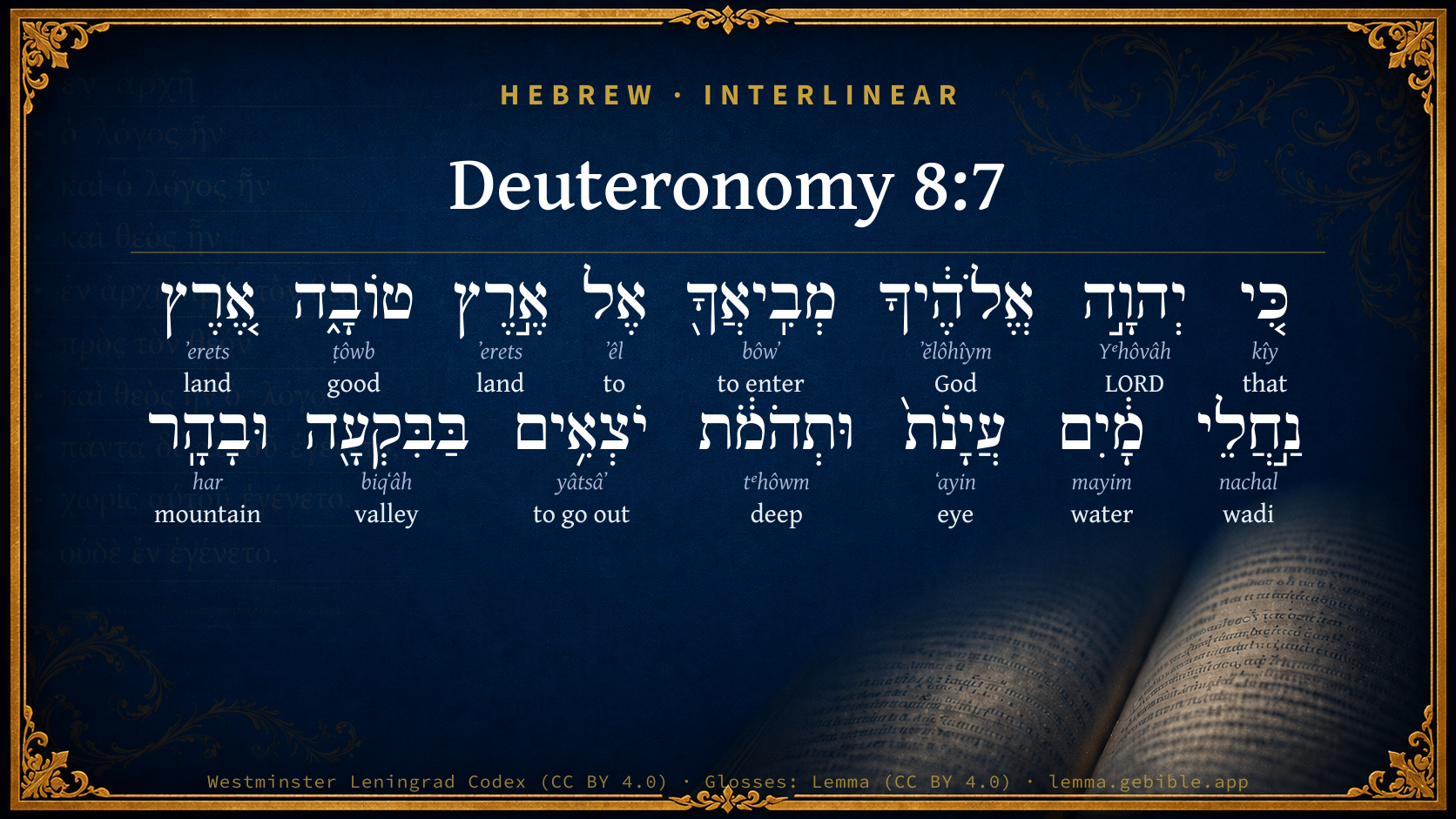
Hebrew (Westminster Leningrad Codex) Deuteronomy 8:7 appears in the Hebrew Old Testament. The text above is from the Westminster Leningrad Codex. Each word links to its Strong’s number, a concise gloss, and parsing drawn from the Open Scriptures Hebrew Bible morphology. Click any word for its full Brown-Driver-Briggs (BDB) entry.
Download image
Cite this verse

Deuteronomy 8:7 (World English Bible). Public Domain. Lemma interlinear Bible study tool, https://lemma.gebible.app/v/deuteronomy/8/7.

Show BibTeX & RIS
BibTeX
RIS
English Translation
For Yahweh your God brings you into a good land, a land of brooks of water, of springs and springs, flowing forth in valleys and hills;
World English Bible · Public Domain
Download a study sheet

One document with this verse’s original text, its word-by-word gloss line, the meaning frame, cross-references with their text, attributed commentary, and full source and license credits — printable, and it pastes into notes with its structure intact.

This verse Autodidact and up

Study sheet (.html) Plain text (.txt)

A passage Seminary Student

Up to 50 verses in one chapter. A passage sheet keeps up to 6 commentary sources and 12 cross-references per verse, in the order this page ranks them, and says so on the sheet whenever that leaves anything out. Ask for a single verse and you get the Autodidact verse sheet above.

Everything on this page stays free to read, with no account — the sheet is a download of what is already on screen, not access to it.

Want to remove ads? Support Godless Engineer
Compare translations 3

The same verse in 3 English versions, stacked beneath the original-language interlinear above. Click any original word for its lexicon entry.

Each is an independent rendering of the whole verse — the interlinear is not word-aligned to these translations.

Highlighted words mark where these versions differ — a whole-verse word diff, not a word-by-word alignment.

  • World English Bible Public Domain
    For Yahweh your God brings you into a good land, a land of brooks of water, of springs and springs, flowing forth in valleys and hills;
  • King James Version Public Domain
    For the LORD thy God bringeth thee into a good land, a land of brooks of water, of fountains and depths that spring out of valleys and hills;
  • unfoldingWord Literal Text CC BY-SA 4.0
    For Yahweh your God is bringing you into a good land, a land of brooks of water, fountains, and springs coming out in valleys and in hills;

unfoldingWord Literal Text — © unfoldingWord, licensed CC BY-SA 4.0. Word-aligned USFM3 via Door43 (git.door43.org/unfoldingWord/en_ult).

Versions to compare (up to 4)

3 of 4 selected

Show all 18 translations

Every available English version of this verse, each an independent rendering of the whole verse.

  • World English Bible Public Domain
    For Yahweh your God brings you into a good land, a land of brooks of water, of springs and springs, flowing forth in valleys and hills;
  • Berean Standard Bible Public Domain
    For the LORD your God is bringing you into a good land, a land of brooks and fountains and springs that flow through the valleys and hills;
  • Majority Standard Bible Public Domain
    For the LORD your God is bringing you into a good land, a land of brooks and fountains and springs that flow through the valleys and hills;
  • King James Version Public Domain
    For the LORD thy God bringeth thee into a good land, a land of brooks of water, of fountains and depths that spring out of valleys and hills;
  • American Standard Version (1901) Public Domain
    For Jehovah thy God bringeth thee into a good land, a land of brooks of water, of fountains and springs, flowing forth in valleys and hills;
  • Revised Version (1885) Public Domain
    For the LORD thy God bringeth thee into a good land, a land of brooks of water, of fountains and depths, springing forth in valleys and hills;
  • Geneva Bible (1599) Public Domain
    For the Lord thy God bringeth thee into a good land, a land in the which are riuers of water and fountaines, and depthes that spring out of valleis and mountaines:
  • Douay-Rheims (1899) Public Domain
    For the Lord thy God will bring thee into a good land, of brooks and of waters, and of fountains: in the plains of which and the hills deep rivers break out:
  • Young's Literal Translation Public Domain
    `For Jehovah thy God is bringing thee in unto a good land, a land of brooks of waters, of fountains, and of depths coming out in valley and in mountain:
  • Literal Standard Version CC BY-SA 4.0
    For your God YHWH is bringing you into a good land, a land of brooks of waters, of fountains, and of depths coming out in valley and in mountain;
  • Unlocked Literal Bible CC BY-SA 4.0
    For Yahweh your God is bringing you into a good land, a land of brooks of water, of fountains and springs, flowing out into valleys and among hills;
  • unfoldingWord Literal Text CC BY-SA 4.0
    For Yahweh your God is bringing you into a good land, a land of brooks of water, fountains, and springs coming out in valleys and in hills;
  • Darby Bible Public Domain
    For Jehovah thy God bringeth thee into a good land, a land of water-brooks, of springs, and of deep waters, that gush forth in the valleys and hills;
  • World Messianic Bible Public Domain
    For the LORD your God brings you into a good land, a land of brooks of water, of springs, and underground water flowing into valleys and hills;
  • Webster's Bible Public Domain
    For the LORD thy God bringeth thee into a good land, a land of brooks of water, of fountains, and depths that spring out of valleys and hills;
  • Free Bible Version CC BY-SA 4.0
    For the Lord your God is taking you to a good country. It's a land of streams and pools and springs that flow through the valleys and down the hills;
  • Bible in Basic English Public Domain
    For the Lord your God is guiding you into a good land, a land of water-springs, of fountains, and deep streams flowing out from the valleys and the hills;
  • JPS Tanakh (1917) Public Domain
    For the LORD thy God bringeth thee into a good land, a land of brooks of water, of fountains and depths, springing forth in valleys and hills;

Literal Standard Version (2020), Covenant Press — licensed CC BY-SA 4.0. Text via the HelloAO Bible API (eBible.org). Unlocked Literal Bible (unfoldingWord) — licensed CC BY-SA 4.0. Text via the HelloAO Bible API (eBible.org). unfoldingWord Literal Text — © unfoldingWord, licensed CC BY-SA 4.0. Word-aligned USFM3 via Door43 (git.door43.org/unfoldingWord/en_ult). Free Bible Version, Dr. Jonathan Gallagher — licensed CC BY-SA 4.0. Text via the HelloAO Bible API (eBible.org).

Word by word

More ways to search: Search by grammar → Find every occurrence → Compare this word →

Practice this passage: Drill this verse → Learn its vocabulary →

בַּבִּקְעָ֖ה
biqʻâh
H1237
“in/at the · valley”
Preposition, Determined + Noun, Common, Feminine, Singular, Absolute
Part of Speech
Preposition + Noun
Type
Common
Gender
Feminine
Number
Singular
State
Absolute
Full BDB Definition

Origin: from H1234

TWOT: 271b

valley - plain, level valley
  1. כִּ֚י kîy H3588 “that” Conjunction
  2. יְהוָ֣ה Yᵉhôvâh H3068 “LORD” Noun, Proper
  3. אֱלֹהֶ֔יךָ ʼĕlôhîym H430 “God(s) · your” Noun, Common, Masculine, Plural, Construct + Suffix, Personal, 2nd Person, Masculine, Singular
  4. מְבִֽיאֲךָ֖ bôwʼ H935 “entering · you” Verb, Hiphil, Participle Active, Masculine, Singular, Construct + Suffix, Personal, 2nd Person, Masculine, Singular
  5. אֶל ʼêl H413 “to” Preposition
  6. אֶ֣רֶץ ʼerets H776 “land” Noun, Common, Both, Singular, Absolute
  7. טוֹבָ֑ה ṭôwb H2896 “good” Adjective, Adjective, Feminine, Singular, Absolute
  8. אֶ֚רֶץ ʼerets H776 “land of” Noun, Common, Both, Singular, Construct
  9. נַ֣חֲלֵי nachal H5158 “wadis of” Noun, Common, Masculine, Plural, Construct
  10. מָ֔יִם mayim H4325 “water(s)” Noun, Common, Masculine, Plural, Absolute
  11. עֲיָנֹת֙ ʻayin H5869 “eyes” Noun, Common, Both, Plural, Absolute
  12. וּתְהֹמֹ֔ת tᵉhôwm H8415 “and · depths” Conjunction + Noun, Common, Both, Plural, Absolute
  13. יֹצְאִ֥ים yâtsâʼ H3318 “going out” Verb, Qal, Participle Active, Masculine, Plural, Absolute
  14. וּבָהָֽר har H2022 “and · in/at the · mountain” Conjunction + Preposition, Determined + Noun, Common, Masculine, Singular, Absolute

About this verse

These counts appear in no published source. They are computed here, from the morphology-tagged text and Lemma’s own curated glosses. What Lemma adds →

15
words
14
distinct lemmas
Pentateuch
section

Notable vocabulary

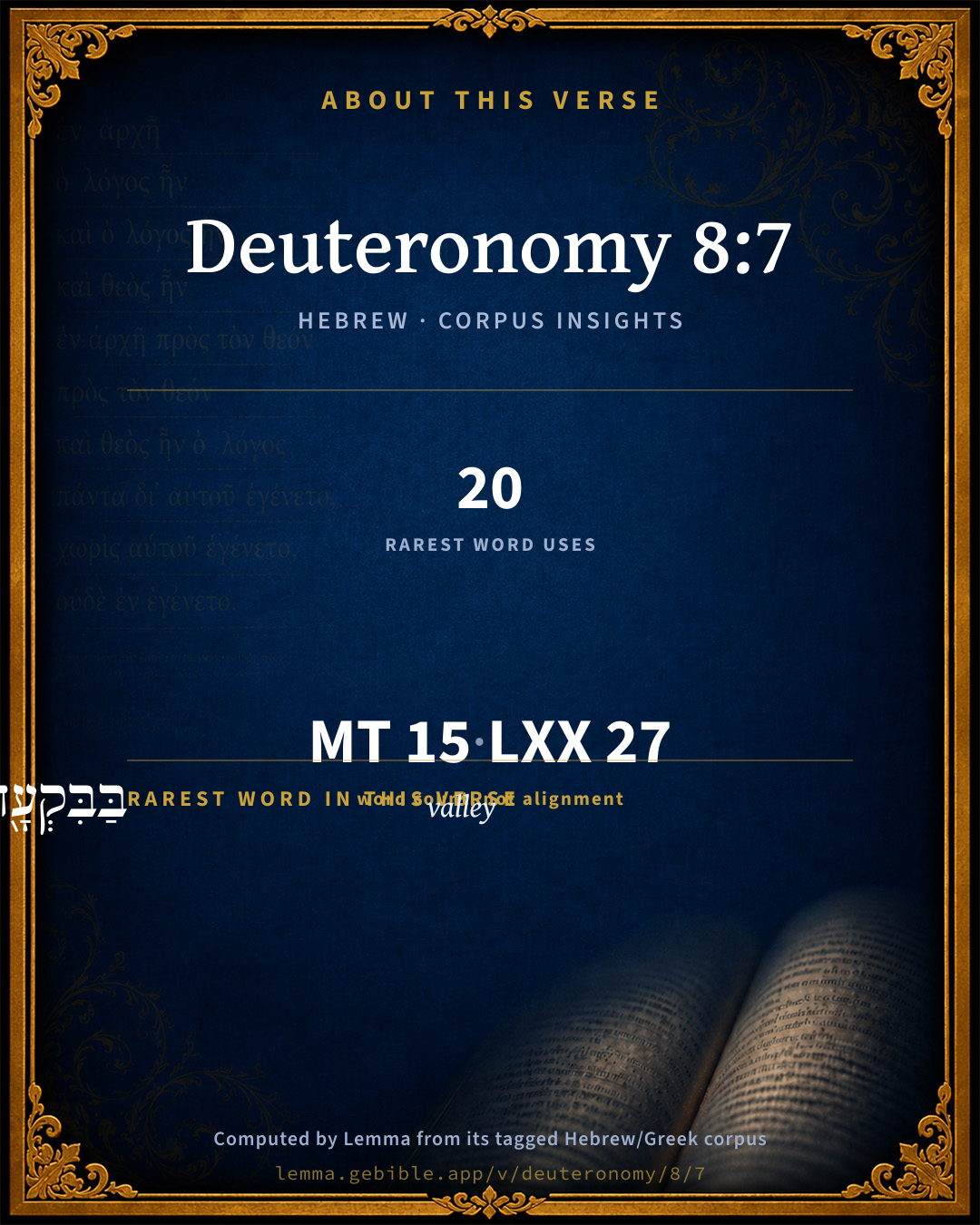
The rarest word here is בַּבִּקְעָ֖ה valley H1237 — appearing just 20 times in the whole Hebrew Bible.

Shared distinctive vocabulary

בַּבִּקְעָ֖ה valley H1237 occurs in 20 verses of the Hebrew Bible. Also found in:

Grammatical profile

  • 2 verbs
  • 10 nouns
  • 1 adjective
  • 1 preposition
  • 1 conjunction

Verb forms

  • מְבִֽיאֲךָ֖ Hiphil · Participle Active
  • יֹצְאִ֥ים Qal · Participle Active

Repetition

A word recurs within this verse — often emphatic in Hebrew:

  • אֶ֣רֶץ land H776 ×2

Hebrew & Septuagint length

In English translation the verse runs 26 words from the Hebrew and 33 from the Septuagint (LXX English) — closely comparable.

A rough comparison of the two English renderings, which tokenize alike — not a word-level alignment.

Word counts can differ between the Hebrew and the Greek without any difference in meaning — e.g. the Hebrew direct-object marker אֵת has no separate Greek word, and Greek often adds the article ὁ.

In the original languages it is 15 Hebrew tokens and 27 Greek tokens — but the two are counted differently (Hebrew bundles its prefixes and suffixes into one token; the Greek is in lemma form), so that isn’t a like-for-like length.

Cross-references

6

Topical passages linked to Deuteronomy 8:7 in the Treasury of Scripture Knowledge — connected by theme and wording, ordered by reader-vote popularity; previews shown in the World English Bible.

  • Deuteronomy 11:9–12 and that you may prolong your days in the land, which Yahweh swore to your fathers to give to them and to their seed, a land flowing with milk and honey.
  • Exodus 3:8 I have come down to deliver them out of the hand of the Egyptians, and to bring them up out of that land to a good and large land, to a land flowing with milk and honey; to the place of the Canaanite, the Hittite, the Amorite, the Perizzite, the Hivite, and the Jebusite.
  • Ezekiel 20:6 in that day I swore to them, to bring them forth out of the land of Egypt into a land that I had searched out for them, flowing with milk and honey, which is the glory of all lands.
  • Deuteronomy 6:10–11 It shall be, when Yahweh your God shall bring you into the land which he swore to your fathers, to Abraham, to Isaac, and to Jacob, to give you, great and goodly cities, which you didn't build,
  • Psalms 65:9–13 You visit the earth, and water it. You greatly enrich it. The river of God is full of water. You provide them grain, for so you have ordained it.
  • Nehemiah 9:24–25 So the children went in and possessed the land, and you subdued before them the inhabitants of the land, the Canaanites, and gave them into their hands, with their kings, and the peoples of the land, that they might do with them as they would.

Cross-references courtesy of OpenBible.info (CC BY 4.0).

Hebrew and Greek witnesses Masoretic Hebrew ↔ Greek Septuagint

The same verse in the two great witnesses to the Old Testament, shown verse-for-verse.

These are two independent witnesses, not word-aligned to each other, and the Septuagint is shown in lemma (dictionary) form.

Hebrew Deuteronomy 8:7 Masoretic · Westminster Leningrad Codex

כִּ֚י יְהוָ֣ה אֱלֹהֶ֔יךָ מְבִֽיאֲךָ֖ אֶל אֶ֣רֶץ טוֹבָ֑ה אֶ֚רֶץ נַ֣חֲלֵי מָ֔יִם עֲיָנֹת֙ וּתְהֹמֹ֔ת יֹצְאִ֥ים בַּבִּקְעָ֖ה וּבָהָֽר

For Yahweh your God brings you into a good land, a land of brooks of water, of springs and springs, flowing forth in valleys and hills;

World English Bible · Public Domain

Greek LXX Deuteronomy 8:7 Septuagint · lemma form

ὁ γάρ κύριος ὁ θεός σύ εἰςἄγω σύ εἰς γῆ ἀγαθός καί πολύς οὗ χειμάρρους ὕδωρ καί πηγή ἄβυσσος ἐκπορεύομαι διά ὁ πεδίον καί διά ὁ ὄρος

For the Lord your God will bring you into a good and extensive land, where there are torrents of waters, and fountains of deep places issuing through the plains and through the mountains:

LXX2012 (modern English Septuagint) · Public Domain

On this verse, The Cambridge Bible for Schools and Colleges discusses the Septuagint’s reading. Read the note in Commentary ↓

Hebrew: Westminster Leningrad Codex (CC BY 4.0). Greek: Septuagint (public domain); English from LXX2012 (modern English Septuagint) (Public Domain). How the Septuagint differs from the Hebrew →

Targum (Aramaic paraphrase)

2

The Targum is the ancient Jewish Aramaic paraphrase of the Hebrew Scriptures — an interpretive translation, not the Hebrew text itself. Onkelos (literal) and Pseudo-Jonathan (expansive) render the Torah, and Jonathan the Prophets. Coverage is partial: where no permissively-licensed English translation exists for a verse, only the Aramaic is shown. This is verse-level text, not a word-by-word alignment to the Hebrew.

  1. Targum Onkelos Torah (Genesis–Deuteronomy)
    אֲרֵי יְיָ אֱלָהָךְ מַעֲלָךְ לְאַרְעָא טַבְתָא אַרְעָא נָגְדָא נַחֲלִין דְמַיִין מַבּוּעֵי עֵינַוָן וּתְהוֹמִין נָפְקִין בְּבִקְעָן וּבְטוּרִין

    (no public-domain English translation for this verse)

    Targum Onkelos — Aramaic: “Onkelos Genesis” (public domain); “Onkelos Exodus” (public domain); “Onkelos Leviticus” (public domain); “Onkelos Numbers” (public domain); “Onkelos Deuteronomy” (public domain). English: “Sefaria Community Translation” (CC0 1.0 (public-domain dedication)); “J.W. Etheridge. The Targums of Onkelos and Jonathan Ben Uzziel on the Pentateuch. London: Longmans, Green, 1862” (public domain). Text via Sefaria.

  2. Targum Pseudo-Jonathan Torah (Genesis–Deuteronomy)
    אֲרוּם יְיָ אֱלָהָכוֹן מֵעַל יַתְכוֹן לְאַרְעָא מְשַׁבְּחָא בְּפֵירָהָא אַרְעָא דְנַגְדָא נַחֲלִין דְּמַיָין צְלִילִין מַבּוּעֵי עֵינַוָון חַלְיַין וּתְהוֹמִין דְּלָא מְיַיבְּשִׁין נַפְקִין בְּבִקְעָן וּבְטַוְורִין

    For the Lord your God bringeth you into a land whose fruits are celebrated, a land whose streams flow in clear waters, from sweet fountain springs, and depths that dry not up, issuing forth among the vales and mountains;

    Targum Pseudo-Jonathan — Aramaic: “Targum Jonathan on Genesis” (public domain); “Targum Jonathan on Exodus” (public domain); “Targum Jonathan on Leviticus” (public domain); “Targum Jonathan on Numbers” (public domain); “Targum Jonathan on Deuteronomy” (public domain). English: “The Targum of Jonathan ben Uzziel, trans. J. W. Etheridge, London, 1862” (public domain). Text via Sefaria.

Commentary

Notes on Deuteronomy 8:7 from classic Christian and Jewish commentators (each source and its license shown beneath its notes). The classic Christian expositions comment on the surrounding passage and are grouped to its opening verse, so a note may address several verses; the Jewish commentaries on the Tanakh (Rashi and others) are per-verse, so they appear only where the commentator wrote on this verse.

Lemma curates 59 commentaries, every one of them public domain or Creative Commons licensed, each selected and text-cleaned for this edition rather than reprinted as found. About our sources →

Trapp's Complete Commentary

John Trapp

Deu 8:7 For the LORD thy God bringeth thee into a good land, a land of brooks of water, of fountains and depths that spring out of valleys and hills;

Ver. 7. That spring out of valleys.] Quantum miraculi sit in admiranda illa fontium perennitate, nemo, credo, Philosophorum satis explicare hactenus potuit. The perennity of springs is a just wonder, and not far from a miracle.

John Trapp, A Commentary or Exposition upon All the Books of the Old and New Testament (1647–1656) — public domain. Text from a community e-Sword module.

The Biblical Illustrator

Joseph S. Exell

Deu_8:7-9

The Lord thy God bringeth thee into a good land.

The land of promise

We will first take the central picture which is presented to us, and we shall then notice the neighbouring thoughts held up to us. The Lord bringeth thee into a good land. These words were uttered, as you know, to a number of people who had never seen anything but the wilderness. They had not an actual knowledge, but they had only heard by description, by their fathers memory lingering upon what they had once enjoyed, and talking of them to their children. And their children had grown up in the desert and wondered what those nations could be of which they had heard their fathers speak. These words would seem to be a description which was intended to convey a contrast between Egypt and the land of promise. The feeling that lingered still upon their minds as to what Egypt was would render the contrast stronger still in their own minds. The land whither thou goest in to possess it is not as the land of Egypt from whence ye came out, where thou sowedst thy seed and wateredst it with thy foot. But the land whither ye go to possess it is a land of hills and valleys, and is watered by the rain from heaven. Some think this is a figure of speech intended to represent human labour, that the country had to be watered by labour, physical exertion; others seem to think it may be literal, and intended to apply to the way either in which by mechanism or by the use of the foot the water was raised to an elevation; or as, perhaps, very likely, afterwards it was spread abroad over the land in little streams; a man could just walk from place to place and with his foot let it out into different streams. In the land of promise, instead of there being any process of human labour, or any contrivances of the kind--The land to which ye go, said the prophet, shall be watered by the rain from heaven. It shall come down upon it like a gift from God. For in Egypt there was no rain--and in the wilderness nothing but sand, nothing but desert. There is also the suggestion, you know, of green hills. Egypt was very flat, but this was a land of hills and valleys, of valleys and hills. A land of wheat, and barley, and vines, and fig trees--the staff of life, all that is necessary for support. And what is given for enjoyment--luxury? A land of oil olive, and honey. A land wherein thou shalt eat bread without scarceness. They had been living on manna, and their souls loathed this light bread. They were to have bread without scarcity--Thou shalt not lack anything in it. A land whose stones are iron, and out of whose hills thou mayest dig brass. This was a fine picture set before these people--setting forth the love of God to them, His Divine purposes, His Fatherly protection, and exciting them to devotion to His will. The surrounding words also suggest a grand idea. The idea is that of obedience, at all times and under all circumstances. In the desert, in the city, whatever be your circumstances or your needs, Gods law is to be recognised. He is lord over all. God hath made the earth, and placed man upon it, and hath given him everything richly to enjoy. And so he presents a picture of discipline with the enjoyment of abundance. There is the suggestion of preparatory discipline, in order that a man may be fitted for the right appreciation and right use of these sources of physical enjoyment. God gives you all things richly to enjoy, and you may enjoy them; but there can be nothing in the present world and in the present condition of our nature--there can be nothing without peril and moral danger. There is danger in the desert surrounded by sterility and want; and there is danger in abundance, surrounded with wheat and barley and vines and olives, and all these luxuries. God had led them through scenes of preparatory discipline; He had given them a taste of sorrow; He had disciplined their souls by labour and by want; He had tested them that it might be seen what was in their hearts. There was moral danger and peril. The great truth which the whole discipline was intended to impress upon their souls was this, that man does not live by bread alone. Of far more importance is the attainment of the higher and diviner life than to attend merely to the physical life. It is better to die through absolute starvation and want than to supply those wants by anything which would be a violation of the Divine law. And there is set forth the warning--warning them of the danger and the peril which they had to encounter--Beware that thou forget not the Lord thy God, in not keeping His commandments and His statutes, which I command thee this day, under the circumstances in which thou art placed, surrounded by abundance, Lest when thou hast eaten and art full, etc. How prone is man to forget God, and then to sink into worldliness! Oh, what a fall is there! The Great Being excluded from his thoughts, and the poor inflated heart filled with its own image, and the man thinking about himself. Forgetting God, who had done everything in him and for him, then looking upon Gods gifts and their very magnitude and number, hiding God, concealing the Giver, and man tempted to say, My own power and my skill have gotten me all this. In a certain sense you exercise skill, but God gave you the power. It is through Him everything is done. Thus our religion in all things takes us from ourselves and throws us back upon God. Then comes the last thought of all, which is the prophetic denunciation, It shall be if thou do at all forget the Lord thy God, and walk after other gods, and serve them and worship them, I testify against you this day that ye shall surely perish. God loved your fathers, and loves you, and He selected you for a great mission, has told you what to do in the world, He sets before you the course you are to pursue; but if the heart be not with Him, if you forget Him and disobey Him, ye shall likewise perish, in spite of Gods love to your fathers and His love to you and your children--ye shall utterly perish; He will find others to do the work, that will not stand still. I merely throw out these few thoughts to guide you. There are principles embodied here of a general and universal application to individuals and nations. In the reading of the Bible you have the law of Divine government set forth. You not only hear God saying to an individual or to a nation, At a particular time so and so shall be, but in consequence of having the whole, history of the other nations spread out before you, you can see the actual workings out of the law in history, and character, and fortunes of the individual or nation. Now, if you read the Bible so, then I take it there are great moral principles in this chapter, which it would be very easy to dwell upon in relation to individuals and nations; it is Gods way in the education of most of us. Men sometimes have a great deal to bear in their youth. We have seen men go through very severe self-denial, hard work and little enjoyment, harsh words and disappointment. Oh, the youthful heart, and the heart of early manhood--how very often does God school it, and set it a tremendously hard lesson! It is to discipline it. And how very often do we see this very process succeeding, producing submission, peace, industry, integrity--these are the virtues which spring out of discipline and suffering, and they have their reward. Then there comes the fruit of the reward: in the middle life of the man you may see, in consequence of the preparatory discipline, the fruit of it springing up--the man surrounded with riches and affluence and possessions, and you see him in the land, which is not like the land of Egypt, the land of his youth, where he had to labour and suffer; no, he has his wheat and his barley and vines and olive oil and pomegranates, and all things about him like the good land. Then comes the rest. Then we shall see what is in the man. Ay, and how very often do we see that man forget the rock out of which he was hewn, and the pit from which he was digged--the discipline and the ways through which God led him, ay, and the lesson, the very lesson which he learned. When he was little in his own eyes, and had little of the appliances of luxury about him, he had his mind filled with what was Divine. And now he has fallen upon the lap of earth, and it is very pleasant to the flesh to lie down and enjoy; the wings of his spirit are clipped, and he has fallen down into the mire; the man becomes sensual and worldly, his heavenly aspirations have departed, he has forgotten God, and is filled with worldliness. Sometimes God comes down upon such a man and blasts him. He was like a bay tree, and in a moment he is not. We look, and behold he cannot be found. Or he may live on and on, but he shall not be what he was; he is doing nothing for God or man; all his Divine aspirations are dead, and he dies, and his name is forgotten. Nobody has anything to remember of him, but perhaps the few to whom his property comes, which comes with a curse rather than a blessing. But in the other case, where the individual remembers the discipline, the lesson, and the hard history through which he passed when he was rising up and struggling nobly with circumstances, and then when his position changes the mans inward and better life keeps up, and all things are kept in their proper subordination, and used for God. When men hear of his prosperity they bless and thank God; his righteousness endureth forever, and his name is held in everlasting remembrance; he has the blessings in relation to this world and that which is to come, and he dies amid the benedictions of his children and the blessings of society. These principles have to do with you. Are there young men here who sometimes think their lot is hard, and perhaps it is; their lot may be very hard; they may be placed in circumstances and pressed by duties that may be hard to bear; but still, it may be and it is God, it is God teaching you, it is God disciplining yon, and if you will accept this teaching Chat is the great secret--accept it, take it lovingly, and then half the difficulty is gone. If affliction or toil through Gods providence should come upon you, accept it cheerfully, and then only half the burden falls upon you. It is only half what it was as soon as you lovingly accept it and say, I take it, and will make the best of it; I will by Thy strength, bear it like a man. And so now, if there are many young men here who have to endure a great many hardships, look up to your Father and bear it bravely; seek for Gods strength, and depend upon it that this very hardness and the discipline through which you are passing now is a sort of wilderness, a desert which will lead you to the good land. Only, take care to remember the lesson that you are learning now; in whatever circumstances you may hereafter be placed do not forget God. (T. Binney.)

The Biblical Illustrator, edited by Joseph S. Exell (c. 1880s–1900s) — public domain. Text from a community e-Sword module.

Joseph Benson's Commentary

Deu 8:7-9. Depths — Deep wells, or springs, or lakes, which were numerous and large. Whose stones are iron — Where iron mines are as plentiful as quarries of stone are in other places. Thou mayest dig brass — That is, copper, of which brass is made.

Joseph Benson's Commentary on the Old and New Testaments (1811–1818) — public domain. Text from a community e-Sword module.

Geneva Bible (1599)

Geneva Bible translators

Or, meres.

Geneva Bible (1599) marginal notes — public domain. Text via Bolls.life.

Jamieson, Fausset & Brown

Robert Jamieson, A. R. Fausset & David Brown

For the Lord thy God bringeth thee into a good land--All accounts, ancient and modern, concur in bearing testimony to the natural beauty and fertility of Palestine, and its great capabilities if properly cultivated.

a land of brooks of water, of fountains and depths that spring out of valleys and hills--These characteristic features are mentioned first, as they would be most striking; and all travellers describe how delightful and cheerful it is, after passing through the barren and thirsty desert, to be among running brooks and swelling hills and verdant valleys. It is observable that water is mentioned as the chief source of its ancient fertility.

Jamieson, Fausset & Brown — Commentary Critical and Explanatory on the Whole Bible (1871) — public domain (CC PDM 1.0). Text via the HelloAO Bible API.

Ellicott's Commentary for English Readers

(7) For the Lord thy God bringeth thee into a good land.—The description in this and the following verses is most attractive; but it is a long time since any one has seen Palestine in that condition. Its desolation, no less than its beauty, is a proof of the truth of the Divine word.

Of fountains and depths that spring out.—Rather, that go forth in the valley and on the hill. The watercourse down the mountain-side, and the deep lake or still pool below, are both described here.

A Bible Commentary for English Readers, edited by Charles John Ellicott (1878–1897) — public domain. Text from a community e-Sword module.

The Cambridge Bible for Schools and Colleges

gen. ed. J. J. S. Perowne

7. bringeth thee] is about to bring thee: see above on Deu_6:10.

a good land] Deu_1:35 : Sam. and LXX add here and a large (Exo_3:8).

brooks of water … fountains … depths] The principal and characteristic waters of Palestine (for the hydrography of the land see especially Robinson, Phys. Geog. of the Holy Land, ch. ii, Trelawney Saunders, Introd. to Survey of W. Pal.; also the present writer’s HGHL, 77 f., 657 f., and Jerusalem, Bk i. chs. 3–5). Brook: naḥal (Deu_2:13) is the Ar. wady, applied both to a valley with only a winter-torrent (e.g. Kidron) and one with a perennial stream (e.g. Arnon and Jabboḳ), the more exact name for which is naḥal ’çthan (HGHL, 657). Fountains: ‘ayanoth, springs of living water as distinct from cisterns (id. 77 f.). Depths: tehômôth, pl. of tehom, the mythical name not only of the open ocean round the earth, but of its supposed continuance under the earth (Deu_4:18, Deu_5:8), from which the fountains, salt and fresh alike, seemed to be derived (Amo_8:4); the depths here are therefore either the lakes of Palestine, perennial (Phiala or Birket er-Ram, Huleh, Gennesaret and the Dead Sea) and seasonal (e.g. Merj el-Ghuruk, HGHL, 327 n.), a possible meaning for tehômôth in Psa_135:6; or the larger outbursts of water from underground, the births of full rivers (as at Tell el Ḳady) so characteristic of Palestine. This second meaning is the more probable here both because of the following springing forth, and the parallelism between depths and fountains (the larger word for fountains) in Pro_8:24. See below on Deu_33:13.

springing forth in valleys and hills] Lit. in the valley and on the mountain. The phenomenon is due to the limestone formation of the land, the larger outbursts occurring mainly at the foot of a hill or great mound, where the harder dolomitic limestone impenetrable by water comes to the surface, forcing the water out. Where the softer cretaceous strata lie deep the water sinks through them and fountains are either scanty or altogether wanting. Valley, biḳ‘ah, HGHL, 654 f.

The Cambridge Bible for Schools and Colleges (gen. ed. J. J. S. Perowne; Cambridge University Press, 1878–1918) — public domain. Text from a community e-Sword module.

John Gill's Exposition

A land of wheat and barley,.... There were two harvests in it, one a barley harvest, which began at the passover, and the other a wheat harvest, which began at Pentecost: instances of the great plenty of these might be observed in the vast quantities consumed in the times of Solomon, in his household, and in the yearly distribution he made to Hiram, Kg1 4:22, yea, there was such plenty of wheat in this land, that it not only supplied the inhabitants of it, but even furnished other countries with it; with this the merchants of Israel and Judah traded at the market of Tyre, Eze 27:17. According to the Jewish writers, the best fine wheat flour was at Mechumas and Mezonichah, and the next to them was Chephraim, or Ephraim, in the valley (h):

and vines; with which this land abounded everywhere; the places most noted were Lebanon, Eshcol, Engedi, Ashkelon, Gaza, and Sarepta; according to the above writers (i), Cerotim and Hatolim were the first for wine, and the second to them were Beth Rimah and Beth Laban in the mountain, and Caphat Sigmah in the valley; the wine of Sharon is also highly commended by them (k).

and fig trees and pomegranates: according to Josephus (l), the country of Gennesaret furnished with the best grapes and figs for ten months without intermission, and the rest of fruits throughout the whole year. Figs and pomegranates, the spies brought with them when they returned from searching the land, as well as grapes, are a specimen of the fruits of it, Num 13:23.

a land of oil olive; the mount of Olives was famous for olive trees, and had its name from thence; the whole land abounded with them, and though oil was so much in common use with the Jews, they supplied their neighbours with it: see Kg1 5:11. It was usual also, as we are told, for the ten tribes to send oil into Egypt (m); according to the Jewish doctors, Tekoah was the first place for oil, and the second, Ragab, beyond Jordan (n); very probably the same with Argob, Deu 3:4.

and honey; besides the great quantities of honey produced by bees in this country, there was much of another sort that dropped from trees, called wild honey, the food of John the Baptist in the wilderness, Mat 3:4. Pliny (o) speaks of a sort of honey which he calls "eloeomeli", or oil honey, which is said to flow from the olive trees in Syria; but this honey here is generally thought by the Jewish writers to be an honey which was made of the fruit of palm trees, frequent in this country, and especially about Jericho; of which Josephus (p) says, that the palm trees about Jericho, the fatter of them (i.e. of the fruit of them) being pressed, emit a large quantity of honey, scarce exceeded by any; and Maimonides (q) says, that the honey spoken of in the law, particularly in this place, is honey of palm trees, so Ben Melech; and it was not unusual for people of other nations to make honey of the fruit of them. Herodotus (r) reports, that the Babylonians made honey out of palm trees; so the Arabs call honey of palm trees "dibs, dibis, dipso" (s), the same with the word here used; agreeably to which both the Targums of Jonathan and Jerusalem paraphrase the words,"out of whose palm trees honey is made.''

(h) Misn. Menachot, c. 8. sect. 1. (i) lbid. sect. 6. (k) T. Bab. Sabbat, fol. 77. 1. (l) De Bello Jud. l. 3. c. 9. sect. 8. (m) Echa Rabbati, fol. 59. 3. (n) Misn. Menachot, c. 8. sect. 3. (o) Nat. Hist. l. 23. c. 4. Tikkune Zohar, correct. 16. fol. 27. 1. (p) De Bello Jud. l. 4. c. 8. sect. 3. (q) In Misn. Menachot, c. 5. sect. 1. so Bartenora in Misn. Biccurim, c. 1. sect. 3. (r) Clio, sive, l. 1. c. 193. (s) See Shaw's Travels, p. 143.

John Gill's Exposition of the Whole Bible (1746–1763) — public domain (CC PDM 1.0). Text via the HelloAO Bible API.

Albert Barnes' Notes on the Bible

See Exo 3:8 note, and the contrast expressed in Deu 11:10-11, between Palestine and Egypt.

The physical characteristics and advantages of a country like Palestine must have been quite strange to Israel at the time Moses was speaking: compare Deu 3:25 note. To have praised the fertility and excellence of the promised land at an earlier period would have increased the murmurings and impatience of the people at being detained in the wilderness: whereas now it encouraged them to encounter with more cheerfulness the opposition that they would meet from the inhabitants of Canaan.

Deu 8:8

Vines - The abundance of wine in Syria and Palestine is dwelt upon in the Egyptian records of the campaigns of Thotmosis III. Only a little wine is produced in Egypt itself. The production of wine has in later times gradually ceased in Palestine (circa 1880’s).

Deu 8:9

For brass read copper (Gen 4:22 note); and compare the description of mining operations in Job 28:1-11. Mining does not seem to have been extensively carried on by the Jews, though it certainly was by the Canaanite peoples displaced by them. Traces of iron and copper works have been discovered by modern travelers in Lebanon and many parts of the country; e. g., the district of Argob (see Deu 3:4 notes) contains iron-stone in abundance.

Albert Barnes' Notes on the Bible (1834–1885) — public domain. Text from a community e-Sword/MySword module.

Haydock's Catholic Bible Commentary

Out. The Jordan was the only river of consequence; but there were many torrents, &c., which rendered the country very different from that where they had been travelling for 40 years. (Haydock) --- Hebrew, "of fountains, of abysses, which spring in vales and on mountains," having their origin in the sea. (Chaldean; Ecclesiastes i. 7.) "Judea is famous for its waters," says Solinus, (35,) "and the Jordan, a most enchanting river, runs through regions of equal beauty." (Calmet)

George Leo Haydock (1774–1849), Haydock's Catholic Family Bible and Commentary, 1859 edition — public domain. Excludes Psalms (Douay-Rheims chapter numbering differs from Protestant) and Deuterocanonical books (Catholic canon only).

Matthew Poole's English Annotations

Depths, i.e. deep wells, or springs, or lakes, which were divers and large.

Matthew Poole's English Annotations on the Holy Bible (1683–1685) — public domain. Text from a community e-Sword/MySword module.

Whedon's Commentary on the Bible

Daniel D. Whedon

7, 8. A good land — In these verses Moses contrasts the sterility of the almost waterless desert with the fertility of the land they are soon to possess. They are to have a land of brooks and fountains. At Banias, the Caesarea Philippi of the New Testament, are rivulets so deep and so abundant in supply of water that they form one of the chief sources of the Jordan. This river, extending from the northern boundary to the Dead Sea, with the lakes through which it flows — Merom and Gennesaret — forms one of the most marked features of the land. “Beautiful springs, characteristic of the whole valley of the Jordan, are unusually numerous and copious along the western shore of the lake,” (Gennesaret.) — STANLEY, Sinai and Palestine, p. 374.

Vines — Palestine was noted for the products of the vineyard. Comparatively little wine is now made, as the Mohammedans are forbidden to use it. But the vine is still extensively cultivated in the southern part of Palestine. The traveler sees many fruitful vineyards in the neighbourhood of Hebron.

9. Out of whose hills thou mayest dig brass — Instead of brass the translation should read copper. In Lebanon on the north, and in the mountains of Edom on the southeast, there were mines of copper. On the east of the Jordan are ancient worked-out iron mines. Comp. Delitzsch on Job, vol. ii, p. 91. The Jews apparently did not engage in mining to any extent.

Daniel D. Whedon (gen. ed.), Commentary on the Old and New Testaments (1874–1909) — public domain. Text from a community e-Sword module.

The Pulpit Commentary

Vers. 7-20. The land on which they were about to enter is described as a good laud, fertile and well watered, and yielding abundant produce to its cultivators; and they are cautioned against forgetting, in their enjoyment of the gift, the bounty of the Giver, or congratulating themselves on having achieved the conquest of such a land, instead of gratefully acknowledging the grace which had sustained them during their protracted wandering in the wilderness, and by which alone they had been enabled to take possession of that favored land.

Vers. 7, 8Brooks of water, running streams, mountain torrents, and watercourses in the narrow valleys or wadys; fountains, perennial springs; depths, "the fathomless pools from which such streams as the Abana (now Barada), near Damascus, spring up full-grown rivers, almost as broad at their sources as at their mouths" (Condor, "Handbook to the Bible," p. 214), or this may include also the inland seas or lakes, such as the sea of Galileo and Lake Haleh. Palestine is in the present day, on the whole, well supplied with water, though the distribution is very unequal, many parts being almost wholly destitute of supply, except from what may be collected from rain in tanks or cisterns; and there is no reason to suppose it was different in the ancient times. As compared, however, with the desert to which the Israelites had been so long accustomed, and even with Egypt from which they had escaped, the country on which they were about to enter was well watered.

Vers. 7-10. The duty of thankfulness for the bounty of God in nature.

The people of Israel were being led by the Lord their God to a land beautiful, luxuriant, fruitful. (For an account of the productions of Palestine, of the fertility of its soil, and of the treasures hidden in its hills, see works by Kitto, Stanley, Wilson, Thomson, and others; as well as Bible dictionaries and Cyclopedias, under the several headings.) Evidently, at the time Moses uttered the words before us, the people had not reached that land; though they were expecting shortly to do so. In view thereof, Moses bids them (ver. 10) bless the Lord their God for the good land he had given them. Hence our subject: "the duty of recognizing the hand of God in the bounties of nature, and of thankfulness for the use of them.

I THERE IS A MARVELLOUS ADAPTATION IN EXTERNAL NATURE TO THE CONSTITUTION AND WARTS OF MAN. (Each of the varied terms used in vers. 7-9 will afford vast scope for the expansion of this thought. And the wider the range of knowledge, the greater delight will such expansion afford to one who longs to make others see the variety of the Divine goodness.) What a vast and prolonged preparation must there have been to fit this world for the use of those who should hereafter dwell upon it! And then, when all is ready, man, the crown of God"s earthly creation, comes last upon the scene, with "all things put under his feet.

II ALL THE WEALTH OF EARTH IS A GIFT TO MAN. "The good land which he hath given thee" (ver. 10). It is but reasonable that we look at the profusion of riches upon and within the earth as a "gift." "What have we that we have not received?" Where were we when "the foundations of the earth" were laid? Yet some would have us adopt a "religion of humanity," as if humanity were to be praised for the physical basis of its own existence! A Power not in man nor of man hath given us all.

III THE GIFT COMETH FROM A PERSONAL BEING. "The Lord thy God for the good land which he hath given thee." The Power from which nature"s wealth cometh, is not a blind non-intelligent force. For man"s own intelligence has to be accounted for; and even if impersonal forces could have wrought out matter, it is axiomatically certain that impersonality could not produce personality. So far natural religion can go. But our text takes us further.

IV NATURE"S WEALTH COMETH FROM THE LORD OUR GOD. "Our God." He is not an "Unknown." We may not set up an altar, jAgnwstw Qew. We know him as a redeeming God, as One who delights to exercise loving-kindness, righteousness, and judgment in the earth. And since God is revealed to us in Christ, we learn thereby that the long preparations of earth have been going on with a view of setting up on it the new creations of redeeming grace. This is "the hidden wisdom, which God ordained before the world, unto our glory." Oh, the boundless meaning of the expression, "The Lamb slain from the foundation of the world!

V ALL THIS SHOULD CALL FORTH SPECIAL THANKFULNESS FROM OUR HEARTS AND LIPS. "Thou shalt bless," etc. We may go very far beyond the merely personal consideration which Moses suggests here. We know more clearly, therefore we should praise more intelligently, devoutly, and warmly. Israel might include some, we should take in all, the following considerations, to stimulate to intense thankfulness.

1. We were nothing, had nothing, and yet we have all given to us richly to enjoy.

2. We are sinful, and have forfeited thereby even our natural claim. Yet all is continued to us, in unwearying kindness and unabated faithfulness.

3. We have not only the actual possessions of earth"s wealth, but are put in possession of the mind and purpose of the Great Framer of all, that ours may be the praise of understanding hearts.

4. We read that God wills to have on this globe a ransomed people, ours, therefore, may well be the jubilant praise of redeemed men.

5. We are not here merely to enjoy this world and then to know no other, but to enjoy this world as a stepping-stone to another. Hence ours should be the triumphant shout of men with a glorious destiny ahead, and of those who use this world so as to help them to a better. Finally:

6. The present form of earth is destined to fall away. God will "make all things new". (Psa_102:26; Heb_1:12; 2Pe_3:13) We for whom this world was made, will then be rejoicing in God, and will be enraptured to see what ever-advancing forms of beauty "he hath prepared for them that love him" Thus ours should be the praise of men on whom even the too oft-repeated dirge, "passing away," leaves no trace of gloom or of regret. If we are the redeemed of the Lord, our life may be a song of thanksgiving, and our death a shout of victory!

Vers. 7-20. Wealth perilous to piety.

God"s policy in the government of men is to win by prodigal kindness. A churlish parsimony has never been found with him; the very opposite. An open eye discovers widespread munificence a royal banquet. The present is only a sample of the future. The full inheritance is always the object of hope. The children of a king have large expectations. This passage contains

I A NOTABLE INSTANCE OF DIVINE MUNIFICENCE.

1. The heritage of Israel was a good land." Both climate and soil were suited to every variety of natural production. The fruits of the North, and the fruits of the Tropics, might alike find a home there. Untold ages had passed, during which God had been slowly preparing that land for Israel, and storing it with elements of fertility, and wealth of minerals.

2. Others had been employed to bring the virgin soil under culture. The harder and more unprofitable toil bad been accomplished. The house of Israel was already well furnished, as when a bridegroom brings home his bride.

3. There was every variety of provision. This betokened thoughtful foresight and tender affection. No needed good had been overlooked. The beneficent Creator had furnished, not only the necessaries of life, but every luxury. Whatever could please the palate, or gratify a taste, or invigorate the health, was there. These were pictures of heavenly good; for as yet the people could not appreciate the imperishable treasures of the spirit-land.

4. This inheritance was unpurchased and unreserved. It made them, body and soul, debtors to God. Had they preferred to purchase it with money, they had naught of their own; they could not create the medium of barter. They had not obtained it by the merit of obedience. They were the recipients of distinguished favor pensioners on the Divine bounty. If it be said that they obtained the land by right of conquest, it must be counter-said that the Lord had given them victory. The battle was the Lord"s. Herein God designed to conquer their proud spirits by the generosity of his love.

5. This inheritance was not the final end. God had ulterior purposes of good yet beyond, towards the realization of which this was a stepping-stone. His next design was to "establish his covenant with them." At present, they were reaping the fruit of their fathers" faith. This was a reward for Abraham"s piety. If they should prove faithful, they too should be promoted to higher things. Canaan was not a home, but a school-house.

II THE PASSAGE CONTAINS VALUABLE COUNSEL. The counsels of clear-eyed, venerable wisdom are more precious than pearls.

1. The counsel prescribes grateful recollection. Having received such measureless kindness, it would be the rankest villany to forget the Giver. Over the sunken rock of ingratitude a triple beacon stands: "Beware!" Give this murderous reef ample sea-room. Here many a gallant ship has gone to pieces.

2. The counsel directs suitable requital. "Thou shalt bless the Lord thy God!" But can man confer any blessing on his Maker? Can we add to God"s wealth or enjoyment? In a sense we can. Dispositions are accepted as deeds. If we are not willing to give to God all we have, our hearts are base. We can bring him the wealth of our love. We can bring him the music of our praise. We can bring him the devotion of our lives. Does his voice whisper to us from heaven, "It is well that it is in thine heart?" Does he smell the sweet savor of our sacrifice?

3. The counsel includes practical obedience. Obedience, if genuine, will be complete. It will embrace every known command. If we observe some commandments, and consciously neglect others, this is not obedience; we are merely doing our own will. Whether we perceive the reason of the command or not, we shall honor it as oar Lord"s will as our Lord himself. No matter what compliance costs, we will give it. Ours not to reason why. True obedience is hearty, complete, perpetual.

III THIS PASSAGE INDICATES IMMINENT PERILS.

1. Wealth often leads to fleshly indulgence. With abundance in our possession, it is easier to indulge the appetites than to deny them. Yet the higher life can only be developed at the expense of the lower. "Flesh and blood cannot inherit the kingdom.

2. Wealth breeds self-sufficient pride. It serves to weaken our sense of dependence upon God. When from our visible stores every felt need can be supplied, we are prone to forget the unseen Giver. Most men may well thank God that the temptations of wealth dwell not under their roofs. "How hardly shall they that have riches enter into the kingdom of God!" In the hot-bed of riches, the flower of sweet humility does not thrive.

3. Wealth loses sight of its own origin. It has a short memory for obligations. The millionaire soon forgets the days of poverty and struggle forgets the Friend who succored him in his extremity kicks away theladder by which he rose. Riches naturally encumber and stifle the flame of religious feeling.

1. Riches beget in us false confidence. Like Nebuchadnezzar, we say, "Is not this great Babylon, that I have built?" We find a delicious pleasure in hearing our own skill and sagacity praised. The tide of natural feeling sets strongly towards self-trust.

2. Riches tend towards idolatry. In the days of poverty we did not object to be accounted singular; but in the time of wealth we aspire to do as others do. It is arduous to have to think for one"s self, to rely upon one"s own judgments, to pursue a course which men will ridicule. If others bow clown to their own net, or rear a popular idol, we too must bow down and worship it. Wealth has given us prominence, set us on high, and we must not risk our new reputation. It is easier to drift with the stream than to stem it.

3. Justice, with her balances and sword, is always nigh. No man can defraud God. If the Amorites were thrust out from the land because they had become flagrant idolaters, so also shall the Israelites if they become votaries of idols. As the Hebrews conquered the Canaanites, so did the Assyrians vanquish the Hebrews. One law shall prevail for all. If we have not been overwhelmed in one disaster, we may be overtaken suddenly by another minister of justice. Sin shall bear its own proper fruit. Every nation and every individual shall "go to his own place." From the summit of earthly magnificence to the lowest pit of misery, there is often a single step. "I saw," says Bunyan, "that there was a way to hell, even from the gate of the celestial city." "Be not highminded, but fear." Riches make a slippery descent to ruin. D.

Vers. 7-10. The good land.

I A LAND OF GREAT NATURAL ADVANTAGES a wealthy possession. Wood, water, metals, a fertile soil, good pasturage, honey in the clefts of the rocks, etc.. (Deu_11:11, 12 33:13-16, 19, 25) Dr. Dykes remarks on it as uniting, as no other does, the two indispensable conditions of central position and yet of isolation, and points out that few regions offer so few temptations to corrupt the simplicity of their inhabitants, or better facilities for the defense of their liberties. ("Abraham," De 3) A yet richer inheritance awaits the Christian, who is brought through the fire and water of tribulation to "a wealthy place" (Psa_66:12; 2Co_4:17, 2Co_4:18; Heb_11:16; 1Pe_1:4)

II A LAND OF GREAT OUTWARD PLEASANTNESS a beautiful possession. The speaker dwells in captivating detail on the features of its beauty its hills and valleys, gushing with springs and cleft with innumerable water-courses; picturesque in its scenery, richly cultivated, diversified in its natural productions; blending with its agricultural and pastoral beauties the graces of the vine-clad slope, of the olive garden, of orchards of luscious fruits. A type of the fairer land beyond the Canaan of the skies.

III A LAND OF EXHAUSTLESS PLENTY a satisfying possession. "Eat bread without scarceness," etc. (ver. 9). God was not ashamed to be called their God, having provided for them so rich a possession. Yet how poor were its satisfactions as compared with those which await believers! (Rev_21:4)

The land was given them in fulfillment of promise; for the possession of it God had been preparing them in the wilderness; and the sharpness of the desert experience made the rest and delights of it sweeter when they came. "Trials make the promise sweet;" etc. J.O.

Vers. 7-20. God forgotten amid second causes.

The support of the wilderness was manifestly miraculous. They could not doubt their dependence there upon God. They might murmur even amid daily miracle, but they could not doubt it. It would be different in Canaan, and it is in view of this Moses warns them. There they would get sustenance in ordinary ways; and they might say that their own power, and not God"s blessing, made them wealthy.

I THERE IS A VERY GREAT TENDENCY TO FORGET GOD AMID THE ORDER OF NATURE. It is supposed God has nothing to do, because we get our supplies through steady "second causes." But God claims recognition when he blesses us through ordinary channels as well as when he blesses us through extraordinary. The natural order is either due to God or arranged itself. We have not credulity sufficient for the latter hypothesis, and must accept the former.

II WHEN GOD ASKS US TO BE FELLOW-WORKERS WITH HIM, IT IS NOT TO BE ENGROSSED WITH OUR WORK AND TO IGNORE HIS. In the wilderness God fed them out of his own hand, so to speak. But in Canaan he directed them to work for their daily bread. They were raised from being "spoon-fed" to be "fellow-workers." The temptation in Canaan gas to think that their own hand and power had produced the wealth. It is the same still. From being fellow-workers with God, men, by mere forget fullness, pass into the delusion of being sole workers. Life is workable, they think, without God. Atheism is the principle underlying such a life.

III THIS UNHOLY INDEPENDENCE OF SPIRIT IS THE SURE PRELUDE OF NATIONAL DECAY. It is not national "self-reliance" which serves a state, but national reliance upon God in the use of the means he has appointed. Nations that think they can get on alone are left at length to do so, and God-deserted they perish. The Canaanites were illustrating this in their own case. They should be a warning to Israel. Living without God in the world, depending on themselves, they were about to be removed violently from their ancestral scats. It was so afterwards with Israel. They were as a nation effaced from the land where they had been placed in probation. The captivity of the ton tribes was terrible, and so was that of Judah and Benjamin. It is this which nations must still guard against. God will not be ignored. If nations attempt it, they only efface themselves. Dying dynasties and scattered nations proclaim the existence and retribution of God.

IV HOW NEEDFUL, THEN, TO RECOGNIZE GOD"S HAND IN ALL THINGS! The procession of nature all that is beautiful in second causes, has come from him. The "First Cause" may surely be allowed to work through "second causes" without forfeiting his right to recognition and thanksgiving. Our times are largely atheistic, because our little knowledge of second causes affords such fussy occupation to us, that we have not taste or time to see the First Cause behind all and using all for his glory. R.M.E.

The Pulpit Commentary (1880–1919), ed. H.D.M. Spence-Jones & Joseph S. Exell — public domain. Text from a community e-Sword module.

John Wesley's Explanatory Notes

Depths - Deep wells or springs, or lakes, which were numerous and large.

John Wesley, Explanatory Notes Upon the Whole Bible (1754–1765) — public domain. Text via the GEBible commentary corpus.

Keil & Delitzsch

C. F. Keil & F. Delitzsch

The Israelites were to continue mindful of this paternal discipline on the part of their God, when the Lord should bring them into the good land of Canaan. This land Moses describes in Deu 8:8, Deu 8:9, in contrast with the dry unfruitful desert, as a well-watered and very fruitful land, which yielded abundance of support to its inhabitants; a land of water-brooks, fountains, and floods (תּהומות, see Gen 1:2), which had their source (took their rise) in valleys and on mountains; a land of wheat and barley, of the vine, fig, and pomegranate, and full of oil and honey (see at Exo 3:8); lastly, a land "in which thou shalt not eat (support thyself) in scarcity, and shalt not be in want of anything; a land whose stones are iron, and out of whose mountains thou hewest brass." The stones are iron, i.e., ferruginous. This statement is confirmed by modern travellers, although the Israelites did not carry on mining, and do not appear to have obtained either iron or brass from their own land. The iron and brass of which David collected such quantities for the building of the temple (Ch1 22:3, Ch1 22:14), he procured from Betach and Berotai (Sa2 8:8), or Tibchat and Kun (Ch1 18:8), towns of Hadadezer, that is to say, from Syria. According to Eze 27:19, however, the Danites brought iron-work to the market of Tyre. Not only do the springs near Tiberias contain iron (v. Schubert, R. iii. p. 239), whilst the soil at Hasbeya and the springs in the neighbourhood are also strongly impregnated with iron (Burckhardt, Syrien, p. 83), but in the southern mountains as well there are probably strata of iron between Jerusalem and Jericho (Russegger, R. iii. p. 250). But Lebanon especially abounds in iron-stone; iron mines and smelting furnaces being found there in many places (Volney, Travels; Burckhardt, p. 73; Seetzen, i. pp. 145, 187ff., 237ff.). The basalt also, which occurs in great masses in northern Canaan by the side of the limestone, from the plain of Jezreel onwards (Robinson, iii. p. 313), and is very predominant in Bashan, is a ferruginous stone. Traces of extinct copper-works are also found upon Lebanon (Volney, Travels; Ritter's Erdkunde, xvii. p. 1063).

Keil & Delitzsch — Biblical Commentary on the Old Testament (1861–1891) — public domain (CC PDM 1.0). Text via the HelloAO Bible API. (Old Testament only.)

unfoldingWord translationNotes

Door43 World Missions Community

General Information:

Moses continues to speak to the Israelites as if they are one person. (See: Forms of You)

a land of

"a land with" or "a land that has"

translationWords

fountain

wheat

barley

vine

fig

pomegranate

olive

honey

unfoldingWord translationNotes — © Distant Shores Media and the Door43 World Missions Community, licensed CC BY-SA 4.0. Source: git.door43.org/Door43/en_tn.

Ramban (Nachmanides)

Rabbi Moshe ben Nachman (Ramban / Nachmanides)

A LAND OF BROOKS OF WATER. The meaning thereof is that it is like a watered garden, and it is not necessary to irrigate it by foot as the land of Egypt, as it will yet be stated, for it drinketh water as the rain of heaven cometh down., Verse 11. Now he explained [here] that fountains and depths, come out in deep valleys and mountains, and from there the brooks flow in the Land, the purport of the verse being “fountains and the fountains of the depths, ” like: when the ‘fountains of the deep’ showed their might; the fountains of the great deep. The reason [for referring to both sources: fountains, and fountains of the deep] is that there are some fountains that flow from the very moisture of the mountains which has been absorbed by them from the rains, or from the clouds that ascend upon them, these being called “fountains” [or “springs”] as it is said, unto all the springs of water, the flint [He turned] into a fountain of waters. There are other kinds of fountains which come forth from the interior of the depth, these being called “deep waters” that is to say, the fountains of the depths. The verse is thus stating that both [kinds of fountains] come out in deep valleys and mountains.

Ramban (Nachmanides) on the Tanakh — English translation: “Commentary on the Torah by Ramban (Nachmanides). Translated and annotated by Charles B. Chavel. New York, Shilo Pub. House, 1971-1976” (CC BY 4.0). Text via Sefaria.

Lesson kit

Teaching starters — assembled from the data on this page, not authored interpretation. Every prompt links to the verse data it draws on. Edit before teaching.

Deuteronomy, in the Pentateuch, opens this verse with 15 words (14 distinct Hebrew lemmas). Its most distinctive word is biqʻâh (“valley”). A historical commentator’s framing appears above. Read the whole chapter for the surrounding context.

Discussion questions

  1. How does “valley” (biqʻâh) shape what this verse is saying?
  2. Genesis 11:2 shares the word «valley» with this verse. How do the two illuminate each other?
  3. “land” occurs 2× in this one verse. What is the effect of the repetition?
  4. The translations on this page render this verse differently — a whole-verse word diff, not a word-by-word alignment. What might account for the different wordings?
  5. The verb «מְבִֽיאֲךָ֖» is Hiphil Participle Active. How does its form color the action?
  6. Reading how Trapp's Complete Commentary and The Biblical Illustrator read this verse, where do the two commentators agree and where do they part?

Things to notice

Reading settings

Reading text

Shown beneath each verse's original-language words.

Old Testament
Old Testament edition

Read the OT as the Masoretic Hebrew (MT) or the Greek Septuagint (LXX).

English shown for the Greek Septuagint (in the Hebrew ↔ Greek comparison).

Comparing translations? Open the Compare panel on any verse page to stack up to four side by side.