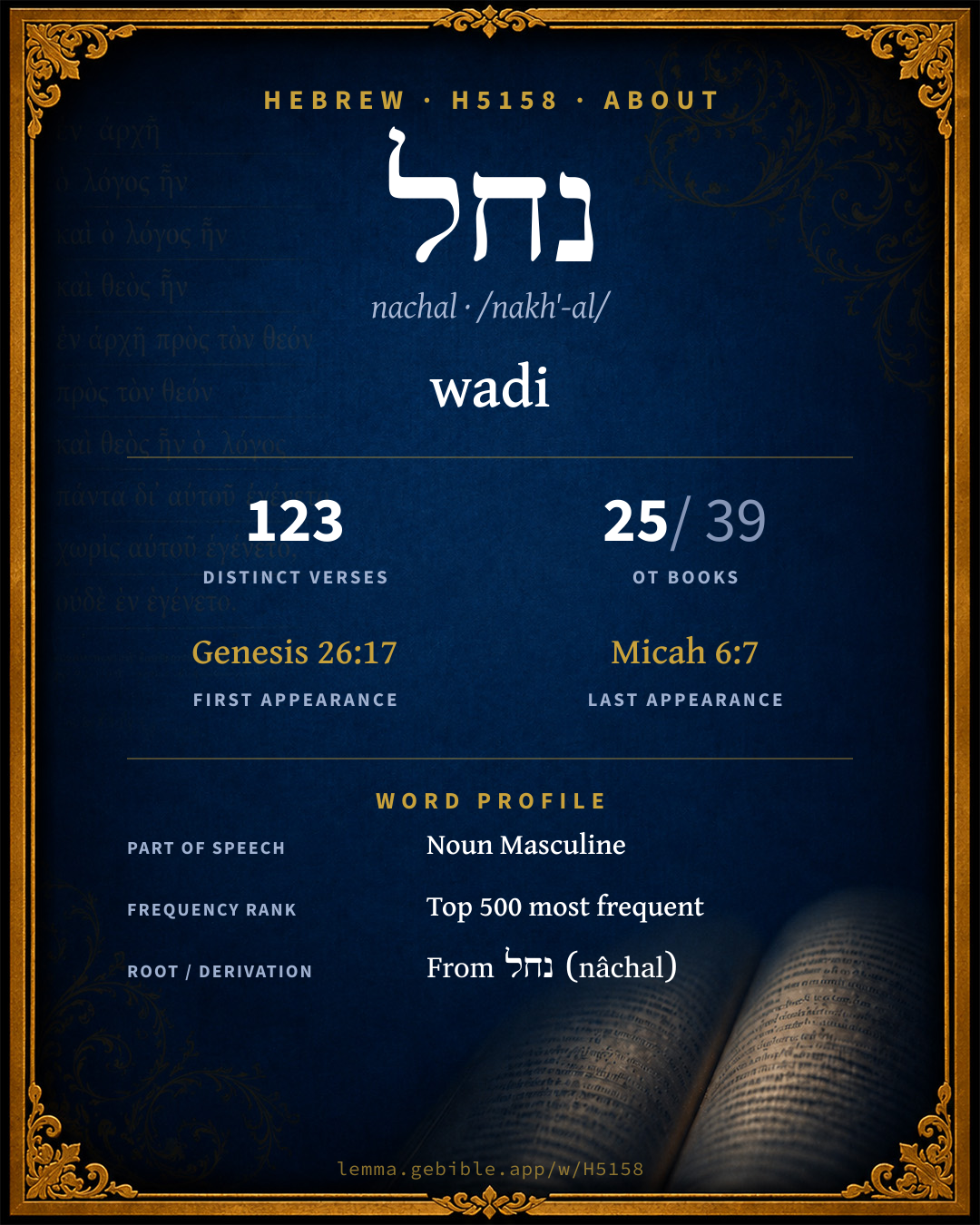
נַ֫חַל
wadi
also: torrent, valley, torrent-valley fuller range ↓
Full lexicon entry — Brown-Driver-Briggs (BDB)
From Brown-Driver-Briggs (BDB)
Where this word appears
See every Absolute-state word in the Hebrew Bible →
Grammar key — what these labels mean
Part of speech
- Noun
- A naming word — a person, place, thing, or idea.
Noun type
- Common
- A common noun — a general class of person, place, or thing (“king,” “city,” “water”), not a specific name.
- Proper
- A name of a specific person, place, or people (e.g. Abraham, Zion, Israel).
State
- Construct
- A noun bound to a following noun in a possessive / “of” relationship (the construct chain).
- Absolute
- The independent form of a noun, not bound to a following word.
Gender
- Masculine
- Grammatically masculine.
Number
- Singular
- One.
- Plural
- More than one (in Hebrew, generally three or more).
- Dual
- Exactly two — for natural pairs and some measures of time.
Every verse where H5158 appears in the Book of Amos — 2 distinct verses. Click any verse to open its interlinear word-by-word view. Verse text shown in the World English Bible for context — . Each verse’s Hebrew form is shown with its reference; the English is not keyword-highlighted, since the data carries no word-level English alignment. Use “Compare translations” on any verse to read it across multiple English versions. This concordance covers the Hebrew Bible; Septuagint (Greek Old Testament) occurrences are not indexed here.
Amos
- Amos 5:24 כְּ/נַ֥חַל prep + n c ms But let justice roll on like rivers, And righteousness like a mighty stream.
- Amos 6:14 נַ֥חַל n c ms cs For, behold, I will raise up against you a nation, house of Israel," Says Yahweh, the God of hosts; "And they will afflict you from the entrance of Hamath to the brook of the Arabah."
About this entry
At a glance — auto-summarized from this page’s data, not written by a person. Every figure links to its source below. This summary describes the numbers; it doesn’t interpret them.
נחל (nachal) is a Hebrew noun most often rendered “wadi.” Translators differ — “river” in the King James Version, then “valley” (Berean Standard Bible) and “wadi of” (unfoldingWord Literal Text), as the renderings breakdown shows. It turns up in 123 verses across 25 books, a common footprint. It first appears in Genesis 26:17. It also covers “torrent”, “valley”, and “torrent-valley”, alongside “wadi” — see its full sense range. The sections below give every sense, occurrence, and version rendering.
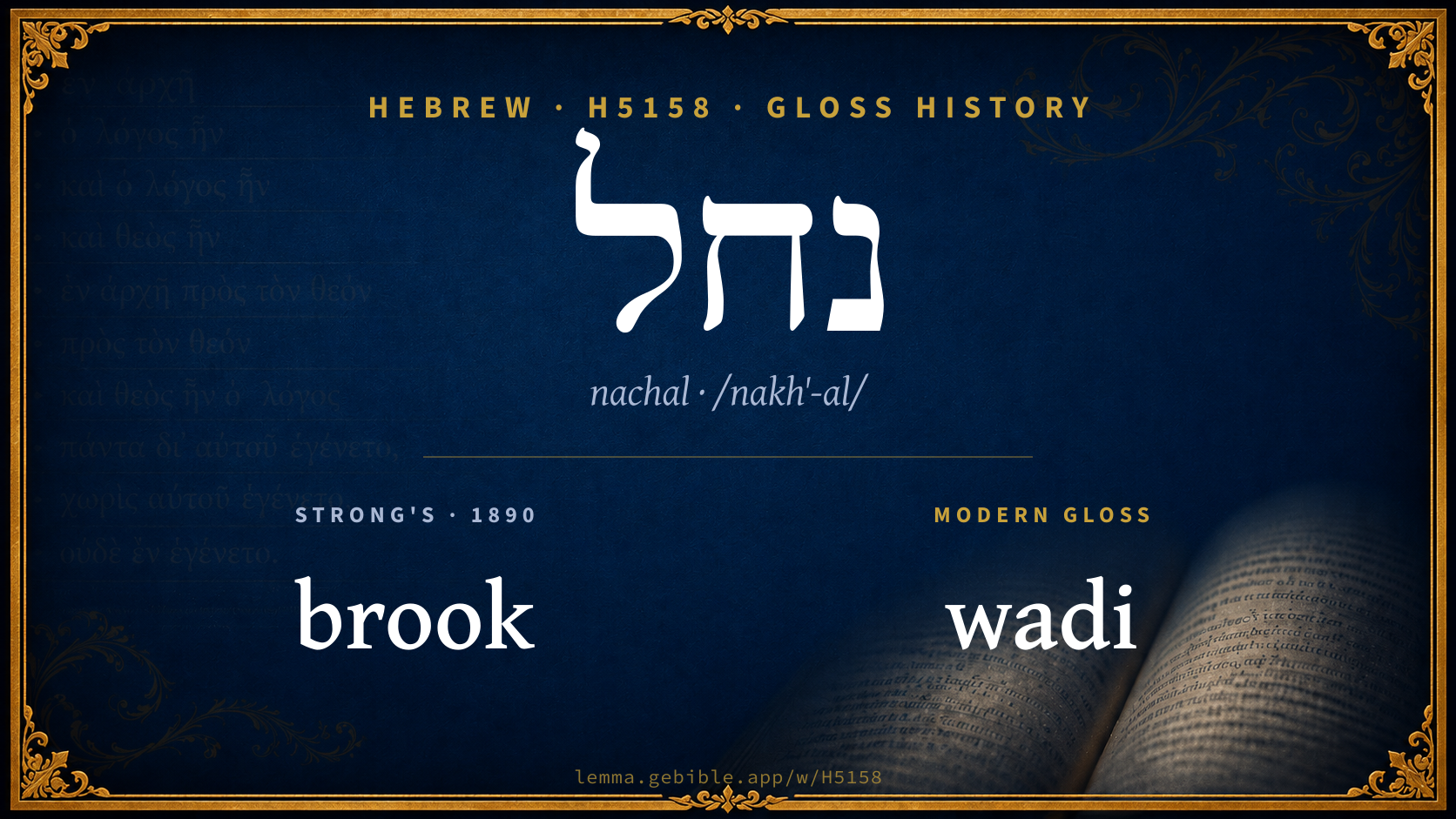
Gloss history
Strong's 1890 vs modern scholarship
About this word
Strong's H5158 catalogs a Hebrew word from the Hebrew Old Testament.
These counts are not copied from any lexicon or concordance. They are computed here, from the morphology-tagged Hebrew Old Testament. What Lemma adds →
- 123
- distinct verses
- The word appears in 123 distinct verses.
- 25 / 39
- OT books
- The word appears in 25 of 39 Old Testament books.
- #318
- by frequency
- Top 500 most frequent Hebrew words (rank 318 of 8,640 Hebrew words by occurrence).
View all 123 occurrences in the concordance →
Most concentrated in
- Deuteronomy 15 verses 12%
- Isaiah 11 verses 9%
- Joshua 10 verses 8%
By section of the Old Testament
By traditional corpus
Conventional, traditional groupings — biblical authorship is debated, so this is a traditional corpus grouping, not an authorship claim. Each share is this word’s portion of its verses in that division of the Hebrew canon. Each figure is a share of the word’s 123 distinct verses.
- Prophets (Nevi'im) 65 verses · 53%
- Torah (Pentateuch) 29 verses · 24%
- Writings (Ketuvim) 29 verses · 24%
How translations render this word
Counts come from each version’s own published word-to-Strong’s tagging or interlinear alignment — an approximate guide to how each version renders this word, not a word-level alignment the data otherwise carries. Because each total is that version’s own tagged count, the per-version totals vary from one another and need not match the appearance or distinct-verse counts above. These counts may also differ from a printed concordance because Lemma counts each distinctly tagged rendering and does not collapse phrase taggings into a single head-word total. This is a fixed set of word-tagged versions (KJV, ASV, BSB, ULT) and does not change with the reading translation you choose elsewhere. Each version’s license is shown beside its name below (and on Sources).
BDB lists this Strong’s number as 3 distinct words (homographs). Each count above pools all of them and is not split by sense — see the Senses section below. A low-frequency rendering may belong to a different one of those words, not the primary meaning.
- King James Version†: River 41×, Brook 35×, Valley 18×
- American Standard Version†: Brook 40×, Valley 32×, River 12×
- Berean Standard Bible†: Valley 49×, Brook 26×, River 16×
- unfoldingWord Literal Text†: Wadi of 31×, Wadi 28×, Valley 10×
King James Version Public Domain
Renders H5158 across 141† tagged occurrences — most commonly:
Plus 12 renderings that appear only once — usually multi-word phrases or single function words the recovered tagging swept in, not distinct renderings.
American Standard Version Public Domain
Renders H5158 across 138† tagged occurrences — most commonly:
Plus 23 renderings that appear only once — usually multi-word phrases or single function words the recovered tagging swept in, not distinct renderings.
Berean Standard Bible Public Domain
Renders H5158 across 138† tagged occurrences — most commonly:
Plus other, less common renderings. Plus 13 renderings that appear only once — usually multi-word phrases or single function words the recovered tagging swept in, not distinct renderings. Not rendered by a distinct English word in 3 further occurrences.
unfoldingWord Literal Text CC BY-SA 4.0
Renders H5158 across 145† tagged occurrences — most commonly:
Plus other, less common renderings. Plus 23 renderings that appear only once — usually multi-word phrases or single function words the recovered tagging swept in, not distinct renderings.
13 senses and sub-senses in the full BDB
What do BDB’s symbols mean?
BDB uses these scholarly abbreviations:
| Symbol | Meaning |
|---|---|
| 𝔊 | the Septuagint (the ancient Greek translation, LXX) |
| 𝔙 | the Vulgate (the Latin translation) |
| 𝔖 | the Syriac version (the Peshitta) |
| 𝔗 | the Targum (the Aramaic translation) |
| ψ | the Psalms |
| √ | root (the underlying root or stem) |
| ‖ | parallel passage (a synonymous or contrasted parallel) |
| † | the dagger: every passage where the word occurs is cited |
The 13 senses and sub-senses the full Brown-Driver-Briggs lexicon distinguishes for this word, in lexicon order (not ranked by frequency), with BDB’s own verbatim wording and sub-sense lettering. Shown in Hebrew script with BDB’s own scholarly abbreviations. The condensed entry is in the Lexicon Entry tab. See also the Forms in the corpus table below.
נחל I possession, property, inheritance (orig. gift
- 1. property:
- a. in Canaan given by י׳ to Israel, †נחלת ישׂראל Ju 20:6; †נ׳ יעקב Is 58:14, especially †אֲשֶׁר נֹתֵן לְךָ נַחֲלָה Dt 4:21; 15:4; 19:10; 20:16; 21:23; 24:4; 25:19; 26:1 (all D); הנחלה אשׁר הנחלתי את עמי Je 12:14. e.g. Judges 20:6
- b. distrib. among tribes: נתן נ׳ לְ Nu 16:14; 36:2 Jos 14:3 (restore לְ), 17:4, 14; 19:49 (all P); נתן לנ׳ לְ Dt 29:7 Jos 11:23; 14:13 (all D2); נָֽחֲלוּ נחלה Jos 17:6 (J); תֵּחָלֵק בנ׳ Nu 26:53, 56 (P); נפל בנחלה Nu 34:2 (P), Ju 18:1 Ez 47:22; הפיל בנ׳ Jos 13:6; 23:4 (D2), Ez 45:1; 47:22, also v 29 (Co reads ב for מ). e.g. Numbers 16:14
- c. nations as possession of the people, ψ 111:6; of the king 2:8. e.g. Psalms 111:6
- d. Levites have no property in the land Nu 18:23, 24 Dt 10:9; 12:12; their possession is י׳ Nu 18:20 (P); י׳ הוּא נחלתו Dt 10:9; 18:2 Jos 13:14, 33 (all D); the tithes Nu 18:21, 24, 26 (P). e.g. Numbers 18:23
- e. †י׳ takes Isr. as his property, 1 S 10:1 1 K 8:53 2 K 21:14 Is 19:25 Mi 7:18 ψ 33:12; 68:10; 106:5; עם נחלה Dt 4:20 (D2); עַמְּךָ וְנַחֲלָֽתְךָ Dt 9:26, 29 (D), 1 K 8:51; ‖ עַם Is 47:6 Jo 2:17; 4:2 Mi 7:14 ψ 28:9; 78:62, 71; 94:5, 14; 106:40; נחלת י׳ 1 S 26:19 2 S 20:19; 21:3; נ׳ אלהים 2 S 14:16; יעקב חבל נ׳ Dt 32:9; שׁבט נ׳ Je 10:16 = 51:19, ψ 74:2; שׁבטי נ׳ Is 63:17; also, the holy mt. Ex 15:17 (song), temple Je 12:7 ψ 79:1, land Je 2:7; 12:8, 9; 16:18; 50:11. e.g. 1 Samuel 10:1
- 2. portion, share:
- a. assigned by God, Is 54:17 ψ 37:18; 127:3; elsewhere ‖ חֵלָק Jb 20:29; 27:13; 31:2. e.g. Isaiah 54:17
- b. by choice, ‖ חֵלֶק, לא נ׳ לנו בבן ישׁי 2 S 20:1 we have no share in the son of Jesse = 1 K 12:16 = 2 Ch 10:16. e.g. 2 Samuel 20:1
- 3. inheritance (45 times) חֵלָק וְנַחֲלָה בְּבֵית אָבִינוּ Gn 31:14 (E) portion or inheritance in the house of our father; העביר נ׳ לְ Nu 27:7, 8 (P) cause the inheritance to pass unto; נתן נ׳ לְ Nu 27:9, 10, 11 (P), Jb 42:15; †נחלת אבוה Nu 36:3, 8 1 K 21:3, 4 Pr 19:14; נ׳ לבניו תהיה Ez 46:16. e.g. Genesis 31:14
נחל II
- 1. torrent, of rushing water in narrow channel Ju 5:21(×3); 4:7, 13 ψ 83:10 (all of קִישֹׁן, q.v.); mountain torrent Dt 9:21 (cf. Ex 32:20); so Am 5:24 (sim. of righteousness); הַנּ׳ הַשּׁוֹטֵף 2 Ch 32:4 (‖ מַעְיָנוֹת); נֶהְפְּכוּ נ׳ לְזֶפֶת Is 34:9; sim. of tears La 2:18; hyperb. נ׳־שָׁ֑מֶן Mi 6:7 torrents of oil, cf. of honey and curd Jb 20:17 (‖ פְּלַגּוֹת, נְהָרִים); fig. נ׳ בְלִיַּעַל 2 S 22:5 torrents of worthlessness (‖ מִשְׁבְּרֵי מָ֫וֶת, = ψ 18:5; נ׳ שׁוֹטֵף sim. of glory of nations Is 66:12, fig. of invaders Je 47:2 (‖ מַיִס), or foes ψ 124:4 (נַ֫חְלָה, v. supr.); 1 K 17:4, 6 (for drinking), drying up in summer v 7 (יָבֵשׁ; all of Elijah’s stream כְּרִית, q.v.); for drinking also ψ 110:7, and (fig.) נ׳ עֲדָנֶיךָ 36:9; Jb 6:15(×2) (אֲפִיק נְחָלִים; in sim.); of water bursting from rock ψ 78:20 (שָׁטַף, ‖ מַיִם), cf. 74:15 (+ מַעְיָן); fig. of מְקוֹר חָכְמָה Pr 18:4 (נ׳ נֹבֵעַ; ‖ מַיִם עֲמֻקִים); more gen. = stream, brook, river (chiefly late) Is 11:15 (divisions of river, נָהָר), in desert 35:6 (‖ מַיִם), Je 31:9 (נַחֲלֵי מַיִם), Ez 47:5(×2), 9b (all del. Co), v 6, 7, 9a (read הַנַּחַל, v. supr.) v 12; containing fish, etc. Lv 11:9, 10 (‖ מַיִם, יַמִּים), Ec 1:7(×2); fig. of רוּחַ י׳ Is 30:28 (נ׳ שׁוֹטֵף), 30:33 (נ׳ גָּפְרִית). e.g. Judges 5:21
- 2. Torrent-valley, wady, as stream-bed 1 S 17:40 Ne 2:15 Is 57:6; with torrent flowing through it, נ׳ אֵיתָן Dt 21:4(×2), 6, אֶרֶץ נַחֲלֵי מַיִם Dt 8:7 (‖ עֲיָנֹת וּתְהֹמֹת יֹצְאִים בַּבִּקְעָה), cf. 10:7, 1 K 18:5 (‖ מַעְיְנֵי הַמַּיִם), ψ 104:10; abode of Elijah 1 K 17:3, 5 (cf. v 4, 6, 7 supr.); עֹרְבֵי נ׳ Pr 30:17 (cf. 1 K 17:4, 6); נ׳ הַבַּתּוֹת Is 7:19 as home of bees; fertile, נ׳ אֶשְׁכֹּל Nu 13:23, 24 (E); אִבֵּי הַנּ׳ Ct 6:11; עַרְבֵי־נ׳ poplars of the wady Lv 23:40 (H), Jb 40:22; נ׳ עֲרָבִים Is 15:7; needing water Gn 26:17 (נ׳ גְּרָר), v 19 (J), cf. 2 K 3:16, 17; place for refuse, ruins, etc. 2 S 17:13; poet. aslso as wild, remote ravine Jb 30:6, cf. בְּצוּר הַנְּחָלִים 22:24; place of child-sacrifice Is 57:5; burial-place Jb 21:33 (רִגְבֵי נ׳).—Nu 24:6 v. ii. נַ֫חַל. Particular wadys designate localities נ׳ קִישׁוֹן 1 K 18:40. אַרִנוֹן Nu 21:14 (E), Dt 2:24, 36(×2); 3:8, 12, 16(×2); 4:48 Jos 12:1, 2(×2), 13:9(×2) (all D), v 16(×2) (P), 2 K 10:33; אֶשְׁכֹּל Nu 32:9 (J), Dt 1:24; בְּשׂוֹר 1 S 30:9, 10, 21; גָּד 2 S 24:5; זֶרֶד Nu 21:12 (E), Dt 2:13(×2), 14; יַבֹּק Gn 32:24 (J), Dt 2:37; 3:16 Jos 12:2 (all D); קִדְרוֹן 2 S 15:23 1 K 2:37; 15:13 2 K 23:6(×2), 12 2 Ch 15:16; 29:16; 30:14 Je 31:40; קָנָה Jos 16:8; 17:9(×3) (all P); שׂוֹרֵק Ju 16:4; נ׳ הַשִּׁטִּים Jo 4:18; נ׳ מִצְרַיִם is SW. limit of Pal. (Assyrian naḫal [mat] Muṣri, DlPar 310 SchrCOT Nu 34:5) Nu 34:5 (P), Jos 15:4 (D), v 47 (P), 1 K 8:65 2 K 24:7 2 Ch 7:8 Is 27:12, + (om. מצרים) Ez 47:19; 48:28 (v. supr.); so read also poss. Am 6:14 (v. עֲרָבָה: usually identified with Wâdy el-Arîsh; on Wkl’s different view, v. reff. sub מִצְרַיִם ad fin.); on identif. of נ׳ Jos 15:7; 19:11 (both P), 2 S 23:30 = 1 Ch 11:32, 2 Ch 20:16; 33:14, v. Comm.; אֶשֶׁד הַנְּחָלִים Nu 21:15, v. אֶשֶׁד. e.g. 1 Samuel 17:40
- 3. Miner’s shaft, פָּרַץ נ׳ Jb 28:4. e.g. Job 28:4
נחל III [m.] perhaps palm-tree (Arabic نَخْلٌ, n. unit. نَخْلَةٌ
Senses from the full Brown-Driver-Briggs lexicon (Brown, Driver, Briggs; Oxford 1906 — public domain), digitized via Sefaria, supplemented by the OpenScriptures HebrewLexicon (CC BY 4.0). Full attribution on Sources.
Word origin
I. n.f. possession, property, inheritance (orig. gift; NH = BH);—נ׳ Nu 18:23 +; נַחֲלָת ψ 16:6 (Ges§ 80 g), read נַחֲלָתִי Ew SS We Köii 1, 425; cstr. נַחֲלַת Jos 13:23; sf. נַחֲלָתִי Ru 4:6; נַחֲלַתְכֶם ψ 105:11; pl. נְחָלוֹת Is 49:8, נְחָלֹת Jos 19:51;—
I. n.m. 2 K 3:16 torrent, torrent-valley, wady (Ecclus 40:13, 16; NH id.; stream (rare); 𝔗 נַחְלָא, Syriac ܢܰܚܠܴܐ = BH; Assyrian naḫlu = BH; LagBN 140 Anm. thinks Νεῖλος may be from Νεέλ = נַחַל pronounced נִחִל; on נ׳ in Sab. n.pr.loc., v. HalRev. Sémit. iv. (1896), 80, 1. 14);—abs. נ׳ Gn 32:24 +, נַ֫חְלָה ψ 124;4; cstr. נַהַל Gn 26:17 +; c. ה loc. Nu 34:5; so read also Ez 47:19; 48:28 (where MT נַחֲלָ֫ה; v. Thes); du. נַחֲלַיִם Ez 47:9, but read הַנַּחַל 𝔊 𝔗 𝔖 𝔙 Co Berthol; pl. נְחָלִים Nu 21:4 +; נַחֲלֵי Dt 8:7 +; sf. נְחָלֶיהָ Is 34:9;—
II. n.[m.] perhaps palm-tree (Arabic نَخْلٌ, n. unit. نَخْلَةٌ; v. PerlesJQ, July, 1899, 688);— only pl. abs., כִּנְחָלִים נִטָּ֑יוּ Nu 24:6 like palm-trees, which are stretched out, spread out (as to foliage). So Perlesl.c., who compares כערבי נחל Ecclus 50:12, 𝔊 ὡς στελέχη φοινίκων.
— Brown-Driver-Briggs (Oxford 1906, public domain), digitized via Sefaria, supplemented by the OpenScriptures HebrewLexicon (CC BY 4.0). See Sources.
Derived from נחל (nâchal) (H5157) — to inherit.
Jastrow Dictionary
A second Hebrew/Aramaic lexicon for comparison, covering Aramaic and post-biblical (Talmudic, Targumic, Midrashic) usage that the biblical-Hebrew BDB does not. Matched by lemma rather than by Strong’s number, so a lemma may carry more than one Jastrow headword (shown separately below), and the entries cover usage well beyond the Bible.
נַחַל
- wady, river-bed, ravine, stream. Sabb. 56ᵇ (ref. to I Sam. XV, 5) על עסקי נ׳ (he was discussing) the subject of naḥal (Deut. XXI, 4), i.e. the regard due to human lives. Cant. R. to I, 2 עד שנעשה כנ׳ נובע until he (through his erudition) becomes like a bubbling stream; a. e.—Pl. נְחָלִים, נְחָלִין. Ib. מה מים … ונעשין נ׳ נ׳ as waters come down in drops and grow to be torrents; Midr. Till. to Ps. I. Ber. 1Ber. 16ᵃ (ref. to Num. XXIV, 6) מה נ׳ … אף אהלים וכ׳ as the waters of streams raise man from uncleanness to cleanness, so do the tents (of learning) &c.; a. fr. e.g. 1 Samuel 15:5
נַחַל ²
- Targ. Gen. XXVI, 19. Targ. Num. XIII, 24. Targ. Ps. LXXIV, 15; a. fr.—[Targ. Is. XXXVIII, 12 נְחַל, v. נְוַול III.]—Pl. נַחֲלִין, נַחֲלַיָּא, נַחֲלֵי. Targ. Deut. VIII, 7. Targ. Koh. I, 7. Targ. Prov. VIII, 26 (h. text חוצות); a. e.
נָחַל
- , q. v.) to inherit. B. Bath. VIII, 1 יש נוֹחֲלִין ומַנְחִילִין there are such relations as inherit from and eventually transmit to one another (e. g. father and son); ויש נוחלין ולא מנחילין and some inherit, but (when they die) do not transmit their estate to those whose natural heirs they would have been (e. g. son and mother). Kidd. I, 10 ונוֹחֵל את הארץ and shall inherit the land (of life everlasting). Sifré Num. 133 יודע … שהבנות נוֹחֲלוֹת Moses knew that daughters (in the absence of sons) are legal heirs. Midr. Till. to Ps. V, beg. (ref. to Num. XXI, 19) משנָחֲלוּ ע"ז בא עליהם וכ׳ when they adopted idolatry, the angel of death came upon them. Ib. נחלו להק"בה לאלוה והוא נ׳ וכ׳ they adopted the Lord as God, and he adopted them as a people; ib. ממתנה נָחַלְתִּי לאל through the gift (of the well in the desert) I adopted God; מתוך שנתן לי הקב"ה הבאר נחלתי אותו (ed. Bub.) because the Lord gave me the well as a gift, I adopted him; Erub. 54ᵃ וכיון שניתנה לו במתנה נְחָלוֹ אל and since it (the Law) is given him as a gift, the Lord claims him as his own; a. fr. e.g. Numbers 21:19
- to transmit by legal succession; to give in possession. B. Bath. l. c., v. supra. Tosef. B. Mets. XI, 32, a. fr. שעל מנת כן ה׳ וכ׳ for Joshua gave possession of the land with such provisions (restricting the rights of ownership). Ukts. III, 12 עתיד הקב"ה להַנְחִיל וכ׳ (Snh. 100ᵃ ליתן) the Lord will in the hereafter give every righteous man possession of &c. B. Bath. 114ᵇ אין הבן יורש את אמו בקבר להנחיל וכ׳ a son in the grave does not succeed his mother so as to transmit his estate to his paternal brothers; a. fr.
A Dictionary of the Targumim, the Talmud Babli and Yerushalmi, and the Midrashic Literature (Marcus Jastrow; London, Luzac, 1903) — Public Domain. Digitized via Sefaria. Digitized via Sefaria. Full attribution on Sources.
Forms in the corpus
The 75 distinct written forms H5158 takes in the Hebrew Bible, most frequent first — each parse links to that state’s occurrences in the concordance. Hebrew forms include their vowel points and cantillation, so a single lemma takes many written forms.
The 60 most common forms are shown; 15 rarer forms follow in the full concordance.
Same root — word family
Other BDB entries built from the same root as H5158, grouped by Strong’s listed origin. These share a root / origin per the lexicon — not necessarily a shared meaning. Each links to that word’s own entry.
Derives from
Shares the same root
Proper names from this root
People and places named from this root — a name, not an additional meaning of the word.
Compare all same-root words → 1 of the same-root words is a proper name (a person or place). They share a root, not necessarily a meaning.
Septuagint verse parallels
This word appears in 118 verses that also exist in the Greek Old Testament (Septuagint), out of the 123 Hebrew verses it occurs in. You can read those verses in Greek by switching the Old Testament edition to the Septuagint.
Read these verses in the Septuagint
- Genesis 26:17
- Leviticus 11:9
- Numbers 13:23
- Deuteronomy 1:24
- Joshua 12:1
- Judges 4:7
- 1 Samuel 15:5
- 2 Samuel 15:23
- 1 Kings 2:37
- 2 Kings 3:16
- 1 Chronicles 11:32
- 2 Chronicles 7:8
This is a verse-level parallel only — the same verses exist in both the Hebrew and Greek Old Testaments. No word-level Hebrew↔Greek correspondence is claimed: the data carries no such alignment, so no Greek word is shown as this Hebrew word’s translation. Coverage is not total — the Septuagint omits the deuterocanon and renumbers the Psalms, so some Hebrew verses have no direct Greek parallel.