
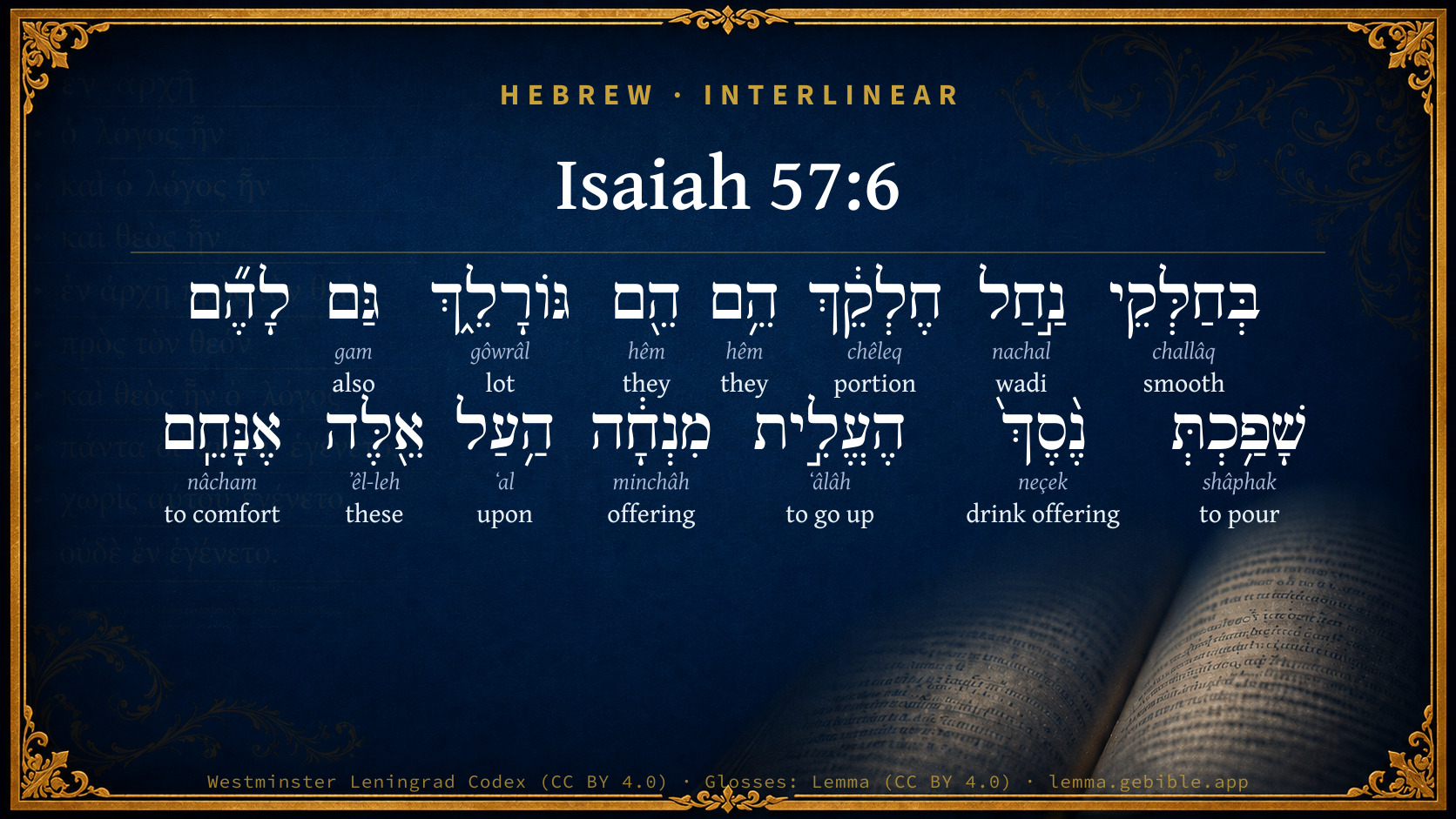
Isaiah 57:6

Hebrew (Westminster Leningrad Codex) Isaiah 57:6 appears in the Hebrew Old Testament. The text above is from the Westminster Leningrad Codex. Each word links to its Strong’s number, a concise gloss, and parsing drawn from the Open Scriptures Hebrew Bible morphology. Click any word for its full Brown-Driver-Briggs (BDB) entry.
Download image
Cite this verse

Isaiah 57:6 (World English Bible). Public Domain. Lemma interlinear Bible study tool, https://lemma.gebible.app/v/isaiah/57/6.

Show BibTeX & RIS
BibTeX
RIS
English Translation
Among the smooth [stones] of the valley is your portion; they, they are your lot; even to them have you poured a drink-offering, you have offered an offering. Shall I be appeased for these things?
World English Bible · Public Domain
Highlights
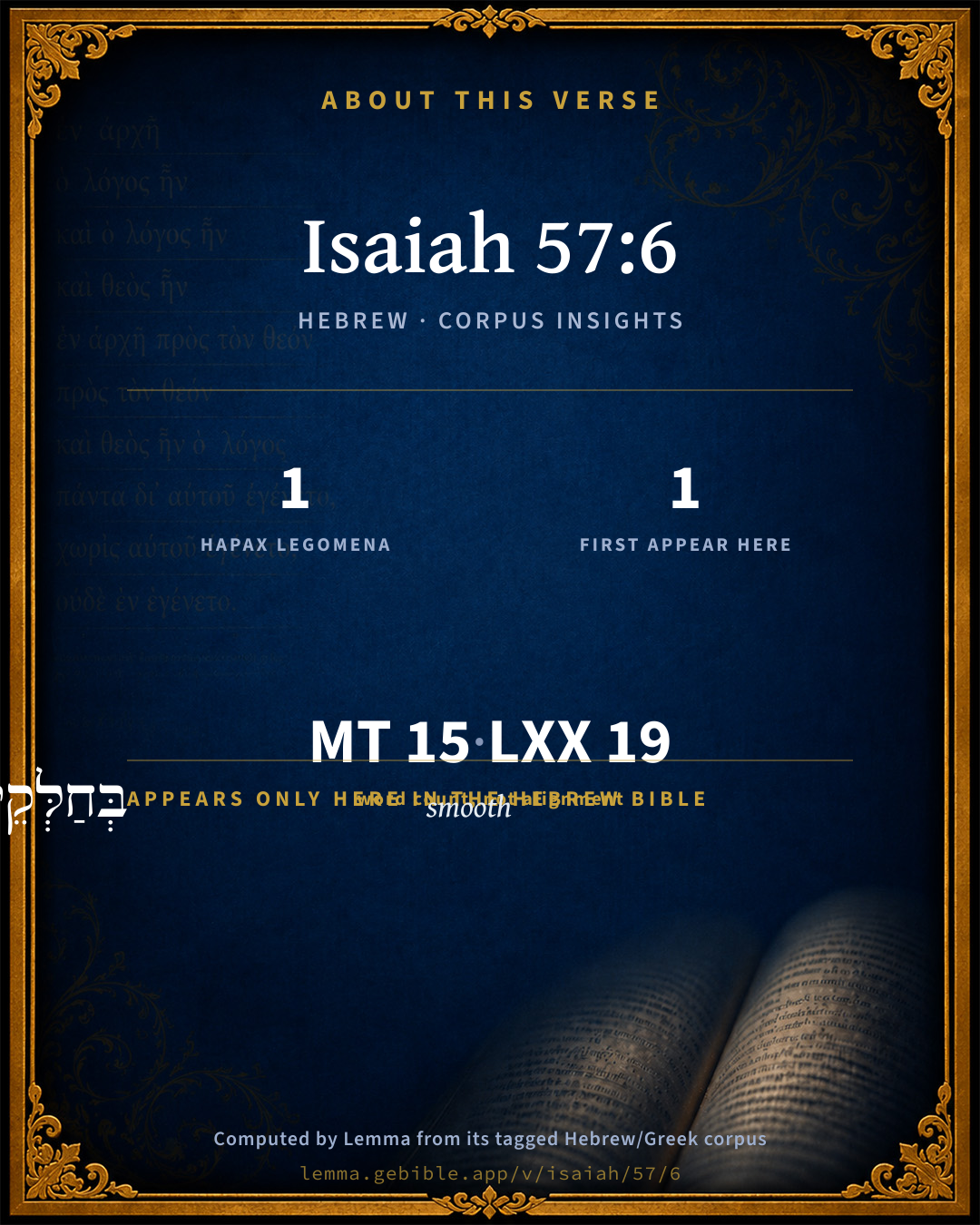
  • 1 hapax legomenon — only here in the Hebrew Bible
  • 1 first appearance in the Hebrew Bible
Full analysis ↓
Download a study sheet

One document with this verse’s original text, its word-by-word gloss line, the meaning frame, cross-references with their text, attributed commentary, and full source and license credits — printable, and it pastes into notes with its structure intact.

This verse Autodidact and up

Study sheet (.html) Plain text (.txt)

A passage Seminary Student

Up to 50 verses in one chapter. A passage sheet keeps up to 6 commentary sources and 12 cross-references per verse, in the order this page ranks them, and says so on the sheet whenever that leaves anything out. Ask for a single verse and you get the Autodidact verse sheet above.

Everything on this page stays free to read, with no account — the sheet is a download of what is already on screen, not access to it.

Want to remove ads? Support Godless Engineer
Compare translations 3

The same verse in 3 English versions, stacked beneath the original-language interlinear above. Click any original word for its lexicon entry.

Each is an independent rendering of the whole verse — the interlinear is not word-aligned to these translations.

Highlighted words mark where these versions differ — a whole-verse word diff, not a word-by-word alignment.

  • World English Bible Public Domain
    Among the smooth [stones] of the valley is your portion; they, they are your lot; even to them have you poured a drink-offering, you have offered an offering. Shall I be appeased for these things?
  • King James Version Public Domain
    Among the smooth stones of the stream is thy portion; they, they are thy lot: even to them hast thou poured a drink offering, thou hast offered a meat offering. Should I receive comfort in these?
  • unfoldingWord Literal Text CC BY-SA 4.0
    Among the smooth of the wadi your portion; they, they your lot. Even to them you pour out a drink offering, you raise up a grain offering. Shall I relent over these?

unfoldingWord Literal Text — © unfoldingWord, licensed CC BY-SA 4.0. Word-aligned USFM3 via Door43 (git.door43.org/unfoldingWord/en_ult).

Versions to compare (up to 4)

3 of 4 selected

Show all 18 translations

Every available English version of this verse, each an independent rendering of the whole verse.

  • World English Bible Public Domain
    Among the smooth [stones] of the valley is your portion; they, they are your lot; even to them have you poured a drink-offering, you have offered an offering. Shall I be appeased for these things?
  • Berean Standard Bible Public Domain
    Your portion is among the smooth stones of the valley; indeed, they are your lot. Even to them you have poured out a drink offering and offered a grain offering. Should I relent because of these?
  • Majority Standard Bible Public Domain
    Your portion is among the smooth stones of the valley; indeed, they are your lot. Even to them you have poured out a drink offering and offered a grain offering. Should I relent because of these?
  • King James Version Public Domain
    Among the smooth stones of the stream is thy portion; they, they are thy lot: even to them hast thou poured a drink offering, thou hast offered a meat offering. Should I receive comfort in these?
  • American Standard Version (1901) Public Domain
    Among the smooth `stones' of the valley is thy portion; they, they are thy lot; even to them hast thou poured a drink-offering, thou hast offered an oblation. Shall I be appeased for these things?
  • Revised Version (1885) Public Domain
    Among the smooth stones of the valley is thy portion; they, they are thy lot: even to them hast thou poured a drink offering, thou hast offered an oblation. Shall I be appeased for these things?
  • Geneva Bible (1599) Public Domain
    Thy portion is in the smooth stones of the riuer: they, they are thy lot: euen to them hast thou powred a drinke offering: thou hast offered a sacrifice. Should I delite in these?
  • Douay-Rheims (1899) Public Domain
    In the parts of the torrent is thy portion, this is thy lot: and thou hast poured out libations to them, thou hast offered sacrifice. Shall I not be angry at these things?
  • Young's Literal Translation Public Domain
    Among the smooth things of a brook `is' thy portion, They -- they `are' thy lot, Also to them thou hast poured out an oblation, Thou hast caused a present to ascend, For these things am I comforted?
  • Literal Standard Version CC BY-SA 4.0
    Your portion [is] among the smooth things of a brook, || They [are] your lot, || You have also poured out an oblation to them, || You have caused a present to ascend, || Am I comforted in these things?
  • Unlocked Literal Bible CC BY-SA 4.0
    Among the smooth things of the river valley are the things that have been assigned to you. They are the object of your devotion. You pour out your drink offering to them and raise up a grain offering. In these things should I take pleasure?
  • unfoldingWord Literal Text CC BY-SA 4.0
    Among the smooth of the wadi your portion; they, they your lot. Even to them you pour out a drink offering, you raise up a grain offering. Shall I relent over these?
  • Darby Bible Public Domain
    Among the smooth [stones] of the torrent is thy portion; they, they are thy lot: even to them hast thou poured out a drink-offering, thou hast offered an oblation. Shall I be comforted myself as to these things?
  • World Messianic Bible Public Domain
    Among the smooth stones of the valley is your portion. They, they are your lot. You have even poured a drink offering to them. You have offered an offering. Shall I be appeased for these things?
  • Webster's Bible Public Domain
    Among the smooth stones of the stream is thy portion; they, they are thy lot: even to them hast thou poured a drink-offering, thou hast offered a meat-offering. Should I receive comfort in these?
  • Free Bible Version CC BY-SA 4.0
    You have chosen to worship the smooth stones from the streams of the valleys—that's the choice you've made! You have poured out drink offerings to these idols—you have presented them with grain offerings. Should that make me happy?
  • Bible in Basic English Public Domain
    Among the smooth stones of the valley is your heritage; they, even they, are your part: even to them have you made a drink offering and a meal offering. Is it possible for such things to be overlooked by me?
  • JPS Tanakh (1917) Public Domain
    Among the smooth stones of the valley is thy portion; they, they are thy lot; even to them hast thou poured a drink-offering, thou hast offered a meal-offering. Should I pacify Myself for these things?

Literal Standard Version (2020), Covenant Press — licensed CC BY-SA 4.0. Text via the HelloAO Bible API (eBible.org). Unlocked Literal Bible (unfoldingWord) — licensed CC BY-SA 4.0. Text via the HelloAO Bible API (eBible.org). unfoldingWord Literal Text — © unfoldingWord, licensed CC BY-SA 4.0. Word-aligned USFM3 via Door43 (git.door43.org/unfoldingWord/en_ult). Free Bible Version, Dr. Jonathan Gallagher — licensed CC BY-SA 4.0. Text via the HelloAO Bible API (eBible.org).

Word by word

More ways to search: Search by grammar → Find every occurrence → Compare this word →

Practice this passage: Drill this verse → Learn its vocabulary →

בְּחַלְּקֵי
challâq
H2511
“in/at · smooth of”
Preposition + Adjective, Adjective, Masculine, Plural, Construct
Part of Speech
Preposition + Adjective
Type
Adjective
Gender
Masculine
Number
Plural
State
Construct
Full BDB Definition

Origin: from H2505

TWOT: 670d

smooth
  1. נַ֣חַל nachal H5158 “wadi” Noun, Common, Masculine, Singular, Absolute
  2. חֶלְקֵ֔ךְ chêleq H2506 “portion · your” Noun, Common, Masculine, Singular, Construct + Suffix, Personal, 2nd Person, Feminine, Singular
  3. הֵ֥ם hêm H1992 “they” Pronoun, Personal, 3rd Person, Masculine, Plural
  4. הֵ֖ם hêm H1992 “they” Pronoun, Personal, 3rd Person, Masculine, Plural
  5. גּוֹרָלֵ֑ךְ gôwrâl H1486 “lot · your” Noun, Common, Masculine, Singular, Construct + Suffix, Personal, 2nd Person, Feminine, Singular
  6. גַּם gam H1571 “also” Particle, Accusative
  7. שָׁפַ֥כְתְּ shâphak H8210 “to pour” Verb, Qal, Perfect, 2nd Person, Feminine, Singular
  8. נֶ֨סֶךְ֙ neçek H5262 “drink offering” Noun, Common, Masculine, Singular, Absolute
  9. הֶעֱלִ֣ית ʻâlâh H5927 “to go up” Verb, Hiphil, Perfect, 2nd Person, Feminine, Singular
  10. מִנְחָ֔ה minchâh H4503 “offering” Noun, Common, Feminine, Singular, Absolute
  11. הַ֥עַל ʻal H5921 “upon” Particle, Interrogative + Preposition
  12. אֵ֖לֶּה ʼêl-leh H428 “these” Pronoun, Demonstrative, Common, Plural
  13. אֶנָּחֵֽם nâcham H5162 “to comfort” Verb, Niphal, Imperfect, 1st Person, Common, Singular

About this verse

These counts appear in no published source. They are computed here, from the morphology-tagged text and Lemma’s own curated glosses. What Lemma adds →

15
words
13
distinct lemmas
Prophets
section

Notable vocabulary

1 hapax legomenon — a word that appears only here in the entire Hebrew Bible:

  • בְּחַלְּקֵי smooth H2511

First appearance in Scripture

This word makes its first canonical appearance in the Hebrew Bible here:

  • בְּחַלְּקֵי smooth H2511

Grammatical profile

  • 3 verbs
  • 5 nouns
  • 1 adjective
  • 3 pronouns
  • 2 prepositions
  • 1 particle

Verb forms

  • שָׁפַ֥כְתְּ Qal · Perfect
  • הֶעֱלִ֣ית Hiphil · Perfect
  • אֶנָּחֵֽם Niphal · Imperfect

Repetition

A word recurs within this verse — often emphatic in Hebrew:

  • הֵ֥ם they H1992 ×2

Hebrew & Septuagint length

In English translation the verse runs 35 words from the Hebrew and 32 from the Septuagint (LXX English) — closely comparable.

A rough comparison of the two English renderings, which tokenize alike — not a word-level alignment.

Word counts can differ between the Hebrew and the Greek without any difference in meaning — e.g. the Hebrew direct-object marker אֵת has no separate Greek word, and Greek often adds the article ὁ.

In the original languages it is 15 Hebrew tokens and 19 Greek tokens — but the two are counted differently (Hebrew bundles its prefixes and suffixes into one token; the Greek is in lemma form), so that isn’t a like-for-like length.

Cross-references

13

Topical passages linked to Isaiah 57:6 in the Treasury of Scripture Knowledge — connected by theme and wording, ordered by reader-vote popularity; previews shown in the World English Bible.

  • Jeremiah 3:9 It happened through the lightness of her prostitution, that the land was polluted, and she committed adultery with stones and with stocks.
  • Jeremiah 7:18 The children gather wood, and the fathers kindle the fire, and the women knead the dough, to make cakes to the queen of the sky, and to pour out drink-offerings to other gods, that they may provoke me to anger.
  • Habakkuk 2:19 Woe to him who says to the wood, 'Awake!' or to the mute stone, 'Arise!' Shall this teach? Behold, it is overlaid with gold and silver, and there is no breath at all in the midst of it.
  • Deuteronomy 32:37–38 He will say, Where are their gods, The rock in which they took refuge;
  • Isaiah 65:11 But you who forsake Yahweh, who forget my holy mountain, who prepare a table for Fortune, and who fill up mixed wine to Destiny;
  • Isaiah 66:3 He who kills an ox is as he who kills a man; he who sacrifices a lamb, as he who breaks a dog's neck; he who offers an offering, [as he who offers] pig's blood; he who burns frankincense, as he who blesses an idol. Yes, they have chosen their own ways, and their soul delights in their abominations:
  • Jeremiah 5:9 Shall I not visit for these things? says Yahweh; and shall not my soul be avenged on such a nation as this?
  • Jeremiah 5:29 Shall I not visit for these things? says Yahweh; shall not my soul be avenged on such a nation as this?
  • Jeremiah 9:9 Shall I not visit them for these things? says Yahweh; shall not my soul be avenged on such a nation as this?
  • Jeremiah 19:13 and the houses of Jerusalem, and the houses of the kings of Judah, which are defiled, shall be as the place of Topheth, even all the houses on whose roofs they have burned incense to all the host of the sky, and have poured out drink-offerings to other gods.
  • Jeremiah 32:29 and the Chaldeans, who fight against this city, shall come and set this city on fire, and burn it, with the houses, on whose roofs they have offered incense to Baal, and poured out drink-offerings to other gods, to provoke me to anger.
  • Jeremiah 44:17–25 But we will certainly perform every word that is gone forth out of our mouth, to burn incense to the queen of the sky, and to pour out drink-offerings to her, as we have done, we and our fathers, our kings and our princes, in the cities of Judah, and in the streets of Jerusalem; for then had we plenty of food, and were well, and saw no evil.
  • Ezekiel 20:39 As for you, house of Israel, thus says the Lord Yahweh: Go you, serve everyone his idols, and hereafter also, if you will not listen to me; but my holy name shall you no more profane with your gifts, and with your idols.

Cross-references courtesy of OpenBible.info (CC BY 4.0).

Hebrew and Greek witnesses Masoretic Hebrew ↔ Greek Septuagint

The same verse in the two great witnesses to the Old Testament, shown verse-for-verse.

These are two independent witnesses, not word-aligned to each other, and the Septuagint is shown in lemma (dictionary) form.

Hebrew Isaiah 57:6 Masoretic · Westminster Leningrad Codex

בְּחַלְּקֵי נַ֣חַל חֶלְקֵ֔ךְ הֵ֥ם הֵ֖ם גּוֹרָלֵ֑ךְ גַּם לָהֶ֞ם שָׁפַ֥כְתְּ נֶ֨סֶךְ֙ הֶעֱלִ֣ית מִנְחָ֔ה הַ֥עַל אֵ֖לֶּה אֶנָּחֵֽם

Among the smooth [stones] of the valley is your portion; they, they are your lot; even to them have you poured a drink-offering, you have offered an offering. Shall I be appeased for these things?

World English Bible · Public Domain

Greek LXX Isaiah 57:6 Septuagint · lemma form

ἐκεῖνος σύ ὁ μερίς οὗτος σύ ὁ κλῆρος καΐἐκεῖνος ἐκχέω σπονδή καΐἐκεῖνος ἀναφέρω θυσία ἐπί οὗτος οὖν οὐ ὀργίζω

That is your portion, this is your lot: and to them have you poured forth drink-offerings, and to these have you offered meat-offerings. Shall I not therefore be angry for these things?

LXX2012 (modern English Septuagint) · Public Domain

On this verse, John Gill's Exposition discusses the Septuagint’s reading. Read the note in Commentary ↓

Hebrew: Westminster Leningrad Codex (CC BY 4.0). Greek: Septuagint (public domain); English from LXX2012 (modern English Septuagint) (Public Domain). How the Septuagint differs from the Hebrew →

Targum (Aramaic paraphrase)

1

The Targum is the ancient Jewish Aramaic paraphrase of the Hebrew Scriptures — an interpretive translation, not the Hebrew text itself. Onkelos (literal) and Pseudo-Jonathan (expansive) render the Torah, and Jonathan the Prophets. Coverage is partial: where no permissively-licensed English translation exists for a verse, only the Aramaic is shown. This is verse-level text, not a word-by-word alignment to the Hebrew.

  1. Targum Jonathan Prophets (Joshua–Malachi)
    בִּשְׁעִיעוּת כֵּיף נַחֲלָא חוּלָקִיךְ אַף תַּמָן אִינוּן עַדְבָךְ אַף לְהוֹן נְסֵיכְתְּ נַסְכִין אֲסֵיקְתְּ קוּרְבָּנִין הַעַל אִלֵין יְתוּב מֵימְרִי:

    Among the smooth stones of the valley is thy portion; yea, there they shall be thy lot, even to them thou hast poured out drink-offerings, thou hast offered sacrifices; ah! on account of these things my WORD shall retribute.

    Targum Jonathan — Aramaic: “Mikraot Gedolot” (public domain). English: “Sefaria Community Translation” (CC0 1.0 (public-domain dedication)); “London "Chaldee Paraphrase," 1871” (public domain). Text via Sefaria.

Commentary

Notes on Isaiah 57:6 from classic Christian and Jewish commentators (each source and its license shown beneath its notes). The classic Christian expositions comment on the surrounding passage and are grouped to its opening verse, so a note may address several verses; the Jewish commentaries on the Tanakh (Rashi and others) are per-verse, so they appear only where the commentator wrote on this verse.

Lemma curates 59 commentaries, every one of them public domain or Creative Commons licensed, each selected and text-cleaned for this edition rather than reprinted as found. About our sources →

Trapp's Complete Commentary

John Trapp

Isa 57:6 Among the smooth [stones] of the stream [is] thy portion; they, they [are] thy lot: even to them hast thou poured a drink offering, thou hast offered a meat offering. Should I receive comfort in these?

Ver. 6. Among the smooth stones of the stream is thy portion.] Pars et sors tua. A poor portion it is, but such as thou art well apaid of, viz., thine altars and thine idol service, and settest up in my place. How exceeding devout in their way are some misled and muzzled Papists, those of the weaker sex especially, in the service of their god, Mauzzim, in the honour of their too admired relics, which they esteem no less than the people of the isle Ceylon, in the East Indies, did their consecrated ape’s tooth, which being got from them, they offered an incredible mass of treasure to recover it.

Should I receive comfort in these?] Or, Should I not ease myself of these? {as Jer 5:9}

John Trapp, A Commentary or Exposition upon All the Books of the Old and New Testament (1647–1656) — public domain. Text from a community e-Sword module.

The Biblical Illustrator

Joseph S. Exell

Isa_57:6

Among the smooth stones of the stream is thy portion

Smooth stones

The term portion suggests that the smooth stones were fetishes.

(A. B. Davidson, D. D.)

False sods the idolaters portion

In stony valleys they set up their gods, which they called their portion, and took for their lot, as Gods people take Him for their lot and portion. (M. Henry.)

The Biblical Illustrator, edited by Joseph S. Exell (c. 1880s–1900s) — public domain. Text from a community e-Sword module.

The Preacher's Complete Homiletical Commentary

Joseph S. Exell (gen. ed.)

Isa_57:6. I. Human substitutes for true and spiritual worship. II. Their offensiveness to God.—Dr. Lyth.

The Preacher's Complete Homiletical Commentary (gen. ed. Joseph S. Exell; Funk & Wagnalls, c. 1892) — public domain (pre-1929). A full-Bible homiletical/sermon-outline anthology covering 65 of 66 books (2 John is absent from the source module). Text from a community e-Sword module.

Tyndale Open Study Notes

Tyndale Open Resources

57:6 Liquid offerings and grain offerings were believed to satisfy the basic needs of the gods and thus to earn their favor.

Tyndale Open Study Notes — © Tyndale Open Resources, licensed CC BY-SA 4.0. Text via the HelloAO Bible API.

Geneva Bible (1599)

Geneva Bible translators

Meaning, every place was polluted with their idolatry: or every fair stone that they found, they made an idol of it.

In the sacrifices which you offering before these idols, thought you did serve God.

Geneva Bible (1599) marginal notes — public domain. Text via Bolls.life.

Jamieson, Fausset & Brown

Robert Jamieson, A. R. Fausset & David Brown

The smooth stones, shaped as idols, are the gods chosen by thee as thy portion (Psa 16:5).

meat offering--not a bloody sacrifice, but one of meal and flour mingled with oil. "Meat" in Old English meant food, not flesh, as it means now (Lev 14:10).

Should I receive comfort--rather, "Shall I bear these things with patience?" [HORSLEY].

Jamieson, Fausset & Brown — Commentary Critical and Explanatory on the Whole Bible (1871) — public domain (CC PDM 1.0). Text via the HelloAO Bible API.

Adam Clarke's Commentary

Verse 6. Among the smooth stones of the stream - "Among the smooth stones of the valley"] The Jews were extremely addicted to the practice of many superstitious and idolatrous rites, which the prophet here inveighs against with great vehemence. Of the worship of rude stones consecrated, there are many testimonials of the ancients. They were called βαιτυλοι and βαιτυλια probably from the stone which Jacob erected at Beth-el, pouring oil upon the top of it. This practice was very common in different ages and places. Arnobius, lib. i., gives an account of his own practice in this respect before he became a Christian: Si quando conspexeram lubricatum lapidem, et ex olivi unguine sordidatum; tanquam inesset vis praesens, adulabar, affabar, et beneficia poscebam nihil sentiente de trunco. - "When I have met with a smooth stone, smeared with oil, supposing a spiritual power to be connected with it, I worshipped it, paid my addresses to it, and requested blessings," c. Clemens Alex., Strom. lib. vii., speaks of a worshipper of every smooth stone in a proverbial way, to denote one given up to superstition. And accordingly Theophrastus has marked this as one strong feature in the character of the superstitious man: Και των λιπαρων λιθων των εν ταις τριοδοις παριων, εκ της ληκυθου ελαιου καταχειν, και επι γονατα πεσων και προσκυνησας απαλλαττεσθαι. "Passing by the anointed stones in the streets, he takes out his phial of oil, and pours it on them and having fallen on his knees, and made his adorations, he departs." Kimchi says: "When they found a beautiful polished stone in a brook or river, they paid Divine adoration to it." This idolatry is still prevalent among the Hindoos. The stone which is the object of their adoration is called salgram. They are found about eighty miles from the source of the river Sown, in the viceroyalty of Bahar, on the coast of Bengal. Ayeen Akbery vol. ii. p. 29.

Adam Clarke's Commentary on the Bible (1810–1826) — public domain. Text from a community e-Sword/MySword module.

Ellicott's Commentary for English Readers

(6) Among the smooth stones . . .—The worship of stones was almost as widely diffused as that of trees and serpents. In Gen_28:18 we have, at least, an analogous practice, which might easily become identical. Among the Phœnicians such stones were known as Bœtulia (probably a Grecised form of Bethel), and were connected with the worship of the reproductive powers of nature. As the true portion of Israel was emphatically Jehovah (Jer_10:16; Psa_16:5) there is an indignant irony in the word thus used. The idolaters had chosen a fetish instead of the Eternal One. In thy portion, we have the feminine singular, designating Israel as the faithless wife.

Should I receive comfort in these?—i.e., better, Should I be quiet in spite of all this? (Comp. Jer_5:7.)

A Bible Commentary for English Readers, edited by Charles John Ellicott (1878–1897) — public domain. Text from a community e-Sword module.

The Cambridge Bible for Schools and Colleges

gen. ed. J. J. S. Perowne

6. As commonly explained, the verse refers to the worship of stone fetishes; but this is very doubtful. It is obvious, indeed, that by the smooth (ones) of the wadi some objects of worship are denoted, but is it necessary to suppose that they were smooth stones? The expression “smooth ones” (ḥalqê) is chosen for the sake of a play of words between it and “portion” (ḥçleq). If we take it literally it is of course natural to think of stones worn smooth by the winter torrents (cf. 1Sa_17:40), although even then there is force in Duhm’s observation that such featureless objects were least of all likely to be chosen as fetishes. (See Tylor, Primitive Culture3, Vol. ii. p. 144 f.) But the word occurs in the metaphorical sense of “slippery,” flattering, deceitful (Eze_12:24; cf. Pro_7:5; Pro_7:21; Pro_29:5; Psa_5:9, &c.); and such a term might readily be applied to false gods of any kind (cf. e.g. “lies” in Amo_2:4). We may therefore render (following Duhm), “In the deceivers of the wadi is thy portion”; although the special connexion of the deities with the wadi remains obscure.

thy portion] As Jehovah is said to be the portion of His people (Deu_4:19; Jer_10:16; Psa_16:5; Psa_142:6) so these deceitful beings are the portion of those who do homage to them in the manner described in the second half of the verse.

thou hast offered a meat-offering] or, more generally, an oblation, as R.V. (see on ch. Isa_1:13).

should I receive comfort in these?] Better, as R.V., shall I be appeased for these things? i.e. “leave them unpunished.” Cf. Jer_5:9.

Note that from this verse onwards the female personification is employed, indicating that a definite community is addressed.

The Cambridge Bible for Schools and Colleges (gen. ed. J. J. S. Perowne; Cambridge University Press, 1878–1918) — public domain. Text from a community e-Sword module.

John Gill's Exposition

Among the smooth stones of the stream is thy portion,.... Or thy god; but the portion of Jacob is not like them, stocks and stones, Jer 10:16. Whenever they could pick up smooth stones, and such as were fit for their purpose, whether in the stream of a brook, or in a valley, as the word also signifies, they polished and formed them into an image, and made gods of them; and these were their portion and inheritance, and which they left to their children. There is an elegant play on words (k) in the Hebrew tongue, between the word for "smooth stones", and that for a "portion (l)", which cannot be expressed in our language: or, "in the smooth or slippery places of the valley shall be thy portions"; see Psa 35:6.

They, they are thy lot; even those stones. Jarchi's note is, to stone thee with, the punishment of idolaters with the Jews; suggesting that those idols would be their ruin; as they will be the ruin of the idolatrous members of the church of Rome, who repent not of worshipping their idols of stone among others, Rev 9:20,

even to them hast thou poured a drink offering, thou hast offered a meat offering; or a "bread offering", as well as a libation of wine, respecting the sacrifice of the mass, which consists of bread and wine, which is offered up in honour of their idols, angels and saints; hence "Michael mass" and "Martin mass", &c.

Should I receive comfort in these? be pleased with such idolatrous sacrifices? no. The Septuagint, Vulgate Latin, and Arabic versions render it, "should I not be angry for these?" I will; I have just reason for it. Or it may be rendered, "shall I repent of these (m)?" of the evil I have threatened to bring, and am about to bring upon these idolaters? I will not.

(k) . (l) "In laevitatibus vallis erit portio tua", Gataker, Vitringa. (m) "a me super his poenitebit?" Musculus; "poenitebit me", some in Vatablus.

John Gill's Exposition of the Whole Bible (1746–1763) — public domain (CC PDM 1.0). Text via the HelloAO Bible API.

Albert Barnes' Notes on the Bible

Among the smooth stones of the streams - In the original here, there is a paronomasia, which cannot be fully retained in our English version. There has been also considerable diversity of opinion in regard to the sense of the passage, from the ambiguity of the words in the original. Jerome (the Vulgate) renders it, In partibus torrentis pars tua - ‘Thy portion is in the parts of the torrent.’ The Septuagint translates it ‘This is thy portion; this is thy lot. The word rendered in our version, ‘smooth stones’ (חלק chēleq), means properly smoothness, hence, barrenness or bare place; and supposes that the idea is, their lot was in the bare places of the valley, that is, in the open (not wooded) places where they worshipped idols - an interpretation not very consistent with the fact that groves were commonly selected as the place where they worshipped idols. It seems to me, therefore, that the idea of smoothness here, whether of the valley or of the stones, is not the idea intended. Indeed, in no place, it is believed, does the word mean ‘smooth stones;’ and it is difficult to conceive what was the exact idea which our translators intended to convey, or why they supposed that such worship was celebrated among the smooth or much-worn stones of the running stream. The true idea can probably be obtained by reverting to the primitive sense of the word as derived from the verb. The verb חלק châlaq means:

1. To smooth.

2. To divide, to distribute, to appropriate - as the dividing of spoil, etc.

Hence, the noun also means dividing, or portion, as that which is divided - whether an inheritance, or whether the dividings of spoil after battle. Retaining this idea, the literal sense, as I conceive, would be this in which also something of the paronomasia will be retained: ‘Among the dividings of the valley is thy dividing,’ that is, thy portion In the places where the valley divides, is thy lot. Thy lot is there instead of the place which God appointed. There you worship; there you pour out your libations to the false gods; and there you must partake of the protection and favor which the gods whom you worship can give. You have chosen that as your inheritance, and by the results of that you must abide.

Of the stream - The word rendered here ‘stream’ (נחל nachal), means either a stream, or a rivulet of water Num 34:5; Josh. 15:4-47; or it means a valley with a brook or torrent; a low place with water. Here it means evidently the latter - as it cannot be supposed they would worship in a stream, though they undoubtedly worshipped in a vale or low place where there was occasionally a rivulet of water. This entire description is strikingly applicable to the valley of Jehoshaphat - a low vale, broken by chasms and by projecting and overhanging rocks, and along the center of which flowed a small brook, much swelled occasionally by the waters that fell from the adjacent hills. At some seasons of the year, however, the valley was entirely dry. The idea here is, that they had chosen their portion in the dividings of that valley instead of the adjacent hills on which the worship of God was celebrated. That valley became afterward the emblem of punishment: and may it not be implied in this passage that they were to inherit whatever would descend on that valley; that is, that they were to participate in the punishment which would be the just expression of the divine displeasure?

Even to them hast thou poured out - That is, to these idols erected in the valleys.

A drink-offering - A libation, or drink-offering was usually poured out in the worship of pagan gods Jer 7:18. It was common also in the worship of the true God (see Gen 35:14). Among the Hebrews it consisted of wine and oil Exo 29:40; Num 15:5-7; Lev 23:13.

Thou hast offered a meat-offering - On the word used here (מנחה minchāh) see the notes at Isa 1:13; Isa 43:23. The word ‘meat’ formerly denoted in the English language food in general, and was not confined as it is now to animal food. Hence, the word ‘meat-offering’ is so often used in the Scriptures when a sacrifice is intended which was not a bloody sacrifice. The mincha was in fact an offering of meal, fine flour, etc., mingled with oil Lev 14:10; Num 7:13, and was distinguished expressly from the bloody sacrifice. The word ‘meal-offering’ would much more appropriately express the sense of the original than ‘meat-offering.’ This was a common offering made to idols as well as to the true God, and was designed as an expression of thankfulness.

Should I receive comfort in these? - It is implied that God could not behold them but with displeasure, and that for them he would punish them. The Vulgate and the Septuagint express it well as: ‘On account of these things shall I not be enraged?’

Albert Barnes' Notes on the Bible (1834–1885) — public domain. Text from a community e-Sword/MySword module.

Haydock's Catholic Bible Commentary

Them. The stones of the torrent, which were often the objects of adoration, Leviticus xxvi. 1., and Genesis xxviii. 18. The god, Helagabalus, was a rough boundary stone.

George Leo Haydock (1774–1849), Haydock's Catholic Family Bible and Commentary, 1859 edition — public domain. Excludes Psalms (Douay-Rheims chapter numbering differs from Protestant) and Deuterocanonical books (Catholic canon only).

Matthew Poole's English Annotations

Among the smooth stones of the stream is thy portion; thou hast chosen for thy portion those idols which were either made of those smooth stones which were cast up by rivers, or which were worshipped upon altars made of such stones, or which were worshipped by the sides of brooks or rivers, where such smooth stones commonly lie.

They are thy lot; thou hast forsaken me, and chosen idols for the great object of thy worship and trust.

To them hast thou poured a drink-offering, thou hast offered a meat-offering; for the devil is God’s ape, and idolaters used the same rites and offerings in the worship of idols which God had prescribed in his own, Num 15:4, &c.

Should I receive comfort in these? should I be pleased with such a people and such actions? must I not needs be highly provoked, and show my displeasure by an exemplary punishment of such wicked and foolish actions? This is a usual figure, called meiosis, or litotes, when less is said, and more is understood.

Matthew Poole's English Annotations on the Holy Bible (1683–1685) — public domain. Text from a community e-Sword/MySword module.

The Pulpit Commentary

Among the smooth stones of the stream is thy portion. Smooth stones, rounded by water-action, were among the objects worshipped by many Semitic peoples. Such stones were called baituloi or baitulia Bethels, or "houses of God and received libations of oil and wine from their worshippers. (see Gen_28:18; and comp. Herod., 3:8; Arnob., "Adv. Gentes," 1:39; Lucian, "Pseudomant.," p. 30; Apul., p. 349; etc.) Stones of this kind, the prophet says, had now become "the portion" of Israel, instead of Jehovah. (Psa_119:57; comp. Psa_16:5) To such objects they offered their "meat offerings" and "drink offerings." Should I receive comfort in these? Can I, Jehovah, be comforted, when my people indulge in such practices?

The worship of stones.

"In the smooth stones of the valley is thy portion... even to them hast thou poured out drink offerings." A good deal of information is at command on this subject, Illustrative matter will be found in Kitto"s "Daily Bible Illustrations," vol. "Isaiah," p. 209. Matthew Arnold sums up the matter in the following note: "The worship of stones is a very early form of idolatry, and originated, probably, in the veneration paid to meteoric stones stones which, as the people said, "fell down from heaven." But the worship extended to other stones also. Traces of this worship occur in Genesis, in Jacob"s consecration of the stones in his passage by Bethel. (Gen_28:18) The Greeks, too, had this stone-worship. "In the earlier times," says the Greek traveller Pausanias, "all the Greeks worshipped, in place of images of the gods, undressed stones." We find the name Baetylia given to these stones, and it has even been conjectured that this name comes from Bethel." Smooth stones (named salagrams), chiefly from the river Gandaki, are treated as sacred objects by the Vaishnavas all over North India. Dr. Turner writes, "I have several" smooth stones of the stream" from the New Hebrides, which were used as idols, and have heard of precisely similar stones being used in other parts of the Pacific." At Inniskea, off the coast of Mayo, a stone, carefully kept wrapped up in flannel, used to be brought out at certain periods to be adored; and when a storm arises, this god is supplicated to send a wreck on their coast! It is narrated that there is a stone set up to the south of St. Columba"s Church, in the island of Eriska, about eight feet high and two feet broad. It is called by the natives the bowing-stone; for when the inhabitants had the first sight of the church, they set up this stone, and then bowed, and said the Lord"s Prayer. Three points may be illustrated.

I GOD IS OFFENDED WHEN THINGS ARE PUT IN PLACE OF HIM. This is the coarser form of idolatry. Material things are superstitiously invested with powers, and become actual idols.

II GOD IS OFFENDED WHEN THINGS ARE USED TO REPRESENT HIM. This is the refined form of idolatry which some thinking and educated persons approve. The thing stone or figure becomes for them a material representation of the invisible God. This is offensive because of the limitations it puts on men"s conceptions of the Divine Being.

III GOD IS OFFENDED WHEN THINGS ARE MADE THE MEDIUM FOR GETTING TO HIM. This is one phase of modern idolatry. It is an offence because the essence of the last, the Christian, revelation is that each individual soul can have direct and immediate access to God. There is no place for idol-mediators. R.T.

The Pulpit Commentary (1880–1919), ed. H.D.M. Spence-Jones & Joseph S. Exell — public domain. Text from a community e-Sword module.

John Wesley's Explanatory Notes

Portion - Thou hast chosen for thy portion those idols, which were worshipped by the sides of brooks or rivers where such smooth stones commonly lie. They - Thou hast forsaken me and chosen idols. Offered - For the devil is God's ape, and idolaters used the same rites and offerings in the worship of idols which God had prescribed in his own. Comfort - Should I be pleased with such a people and such actions?

John Wesley, Explanatory Notes Upon the Whole Bible (1754–1765) — public domain. Text via the GEBible commentary corpus.

J. A. Alexander on Isaiah

Joseph Addison Alexander

“Among the smooth (stones) of the valley (or the brook) is thy portion; they, they, are thy lot; also to them hast thou poured out a, drink-offering, thou hast brought up a meal-offering. Shall I for these things be consoled (i.e., satisfied without revenge)?” ‘Thy portion,’ (i.e., the objects of thy choice and thy affection (Jer 10:16)). The word ‘stones’ is correctly supplied in the English version. (See 1Sa 17:40). Others supply ‘places’, and suppose the phrase to mean open cleared spots in the midst of wooded valleys, places cleared for the performance of religious rites. In favor of this meaning, is the not infrequent use of the Hebrew word to signify ‘not hairy’, and in figurative application to the earth, not wooded, free from trees. ‘Smooth stones’ may mean either polished or anointed stones, such as were set up by the patriarchs as memorials (Gen 28:18; Gen 35:14), and by the heathen as objects of worship. Thus Arnobius says, that before his conversion to Christianity he never saw an oiled stone without addressing it and praying to it. This explanation of the first clause agrees best with what follows and with the emphatic repetition, ‘they, they, are thy portion’, which is more natural in reference to the objects than to the mere place of worship.

Joseph Addison Alexander, The Prophecies of Isaiah (1846–1847; New York: Scribner, 1870–1878) — public domain. Text from a community e-Sword module.

unfoldingWord translationNotes

Door43 World Missions Community

General Information:

Yahweh continues speaking to the unfaithful people of Israel.

that have been assigned to you

This can be stated in active form. The exact meaning in Hebrew is unclear. AT: "that is your lot" or "that is your inheritance" (See: Active or Passive)

In these things should I take pleasure?

Yahweh uses a question to scold the people. AT: "Certainly, these things do not please me." (See: Rhetorical Question)

translationWords

drink offering

raise

grain offering

unfoldingWord translationNotes — © Distant Shores Media and the Door43 World Missions Community, licensed CC BY-SA 4.0. Source: git.door43.org/Door43/en_tn.

Rashi

Rabbi Shlomo Yitzchaki (Rashi)

Of the smooth [stones] of the valley [Lit. of the smooth ones of the valley, i.e.,] among the smooth stones that are in the valley.

your portion With them they will stone you.

they, they are your lot to be saddened with them. Why? For to them too you have poured out libations.

in the face of these shall I relent from doing harm to you?

Rashi on the Tanakh — English translations: “The Judaica Press complete Tanach with Rashi, translated by A. J. Rosenberg” (CC BY 4.0); “Pentateuch with Rashi's commentary by M. Rosenbaum and A.M. Silbermann, 1929-1934” (public domain); “The Metsudah Tanach series, Lakewood, N.J” (CC BY 4.0); and “The Book of Joshua, Metsudah Publications, 1997” (CC BY 4.0). Text via Sefaria.

Ibn Ezra

Rabbi Abraham ibn Ezra

אנחם Shall I regret, the evil with which I intend to afflict thee. Some consider אנחם to be Hithpael and explain it: Could I receive comfort? But it is not necessary to depart from the usual meaning of אֶנׇּחֵם.

Ibn Ezra on the Tanakh — English translations: “Sefaria Community Translation” (CC0 1.0 (public-domain dedication)); “Yalkut, Sifsei Chachomim Chumash, Metsudah Publications, 2009” (CC BY 4.0); and “Commentary of Ibn Ezra on Isaiah - trans. by M. Friedlander, 1873” (public domain). Text via Sefaria.

Lesson kit

Teaching starters — assembled from the data on this page, not authored interpretation. Every prompt links to the verse data it draws on. Edit before teaching.

Isaiah, in the Prophets, opens this verse with 15 words (13 distinct Hebrew lemmas). Its most distinctive word is challâq (“smooth”). A historical commentator’s framing appears above. Read the whole chapter for the surrounding context.

Discussion questions

  1. How does “smooth” (challâq) shape what this verse is saying?
  2. 1 word here appears nowhere else in the Hebrew Bible. Why might the author reach for such rare wording?
  3. This is the first place “smooth” appears in Scripture (first appears here). What does its debut here establish?
  4. How does Jeremiah 3:9, which shares this passage’s theme, read alongside this verse?
  5. What does the repetition of “they” (2× in this one verse) do in this verse?
  6. The translations on this page render this verse differently — a whole-verse word diff, not a word-by-word alignment. What might account for the different wordings?
  7. «שָׁפַ֥כְתְּ» is a Qal Perfect verb. How does that grammatical form shape the action described?
  8. Compare how Trapp's Complete Commentary and The Biblical Illustrator read this verse. Where do they agree or differ?

Things to notice

  • 1 word in this verse appears nowhere else in the Hebrew Bible.
  • 1 word makes its first canonical appearance in Scripture here.
  • This verse counts 15 Hebrew ↔ 19 Greek words.
  • These translations choose different wording for 24 words in this verse.
  • “they” occurs 2× in this single verse.

Reading settings

Reading text

Shown beneath each verse's original-language words.

Old Testament
Old Testament edition

Read the OT as the Masoretic Hebrew (MT) or the Greek Septuagint (LXX).

English shown for the Greek Septuagint (in the Hebrew ↔ Greek comparison).

Comparing translations? Open the Compare panel on any verse page to stack up to four side by side.