
Proverbs 18:4

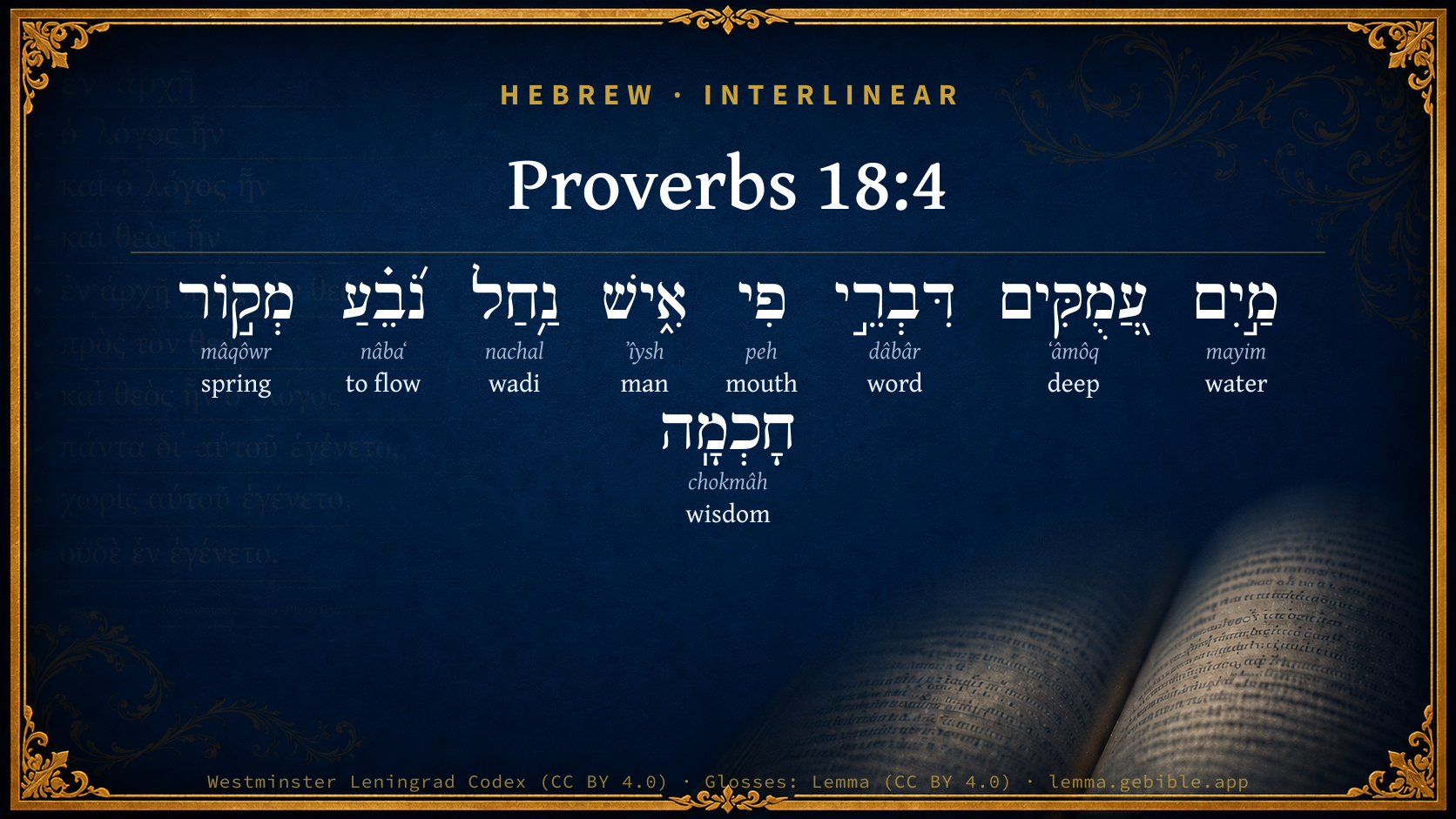
Hebrew (Westminster Leningrad Codex) Proverbs 18:4 appears in the Hebrew Old Testament. The text above is from the Westminster Leningrad Codex. Each word links to its Strong’s number, a concise gloss, and parsing drawn from the Open Scriptures Hebrew Bible morphology. Click any word for its full Brown-Driver-Briggs (BDB) entry.
Download image
Cite this verse

Proverbs 18:4 (World English Bible). Public Domain. Lemma interlinear Bible study tool, https://lemma.gebible.app/v/proverbs/18/4.

Show BibTeX & RIS
BibTeX
RIS
English Translation
The words of a man's mouth are like deep waters. The fountain of wisdom is like a flowing brook.
World English Bible · Public Domain
Download a study sheet

One document with this verse’s original text, its word-by-word gloss line, the meaning frame, cross-references with their text, attributed commentary, and full source and license credits — printable, and it pastes into notes with its structure intact.

This verse Autodidact and up

Study sheet (.html) Plain text (.txt)

A passage Seminary Student

Up to 50 verses in one chapter. A passage sheet keeps up to 6 commentary sources and 12 cross-references per verse, in the order this page ranks them, and says so on the sheet whenever that leaves anything out. Ask for a single verse and you get the Autodidact verse sheet above.

Everything on this page stays free to read, with no account — the sheet is a download of what is already on screen, not access to it.

Want to remove ads? Support Godless Engineer
Compare translations 3

The same verse in 3 English versions, stacked beneath the original-language interlinear above. Click any original word for its lexicon entry.

Each is an independent rendering of the whole verse — the interlinear is not word-aligned to these translations.

Highlighted words mark where these versions differ — a whole-verse word diff, not a word-by-word alignment.

  • World English Bible Public Domain
    The words of a man's mouth are like deep waters. The fountain of wisdom is like a flowing brook.
  • King James Version Public Domain
    The words of a man's mouth are as deep waters, and the wellspring of wisdom as a flowing brook.
  • unfoldingWord Literal Text CC BY-SA 4.0
    The words of the mouth of a man deep waters; a fountain of wisdom a gushing stream.

unfoldingWord Literal Text — © unfoldingWord, licensed CC BY-SA 4.0. Word-aligned USFM3 via Door43 (git.door43.org/unfoldingWord/en_ult).

Versions to compare (up to 4)

3 of 4 selected

Show all 18 translations

Every available English version of this verse, each an independent rendering of the whole verse.

  • World English Bible Public Domain
    The words of a man's mouth are like deep waters. The fountain of wisdom is like a flowing brook.
  • Berean Standard Bible Public Domain
    The words of a man’s mouth are deep waters; the fountain of wisdom is a bubbling brook.
  • Majority Standard Bible Public Domain
    The words of a man’s mouth are deep waters; the fountain of wisdom is a bubbling brook.
  • King James Version Public Domain
    The words of a man's mouth are as deep waters, and the wellspring of wisdom as a flowing brook.
  • American Standard Version (1901) Public Domain
    The words of a man's mouth are `as' deep waters; The wellspring of wisdom is `as' a flowing brook.
  • Revised Version (1885) Public Domain
    The words of a man’s mouth are as deep waters; the wellspring of wisdom is as a flowing brook.
  • Geneva Bible (1599) Public Domain
    The words of a mans mouth are like deepe waters, and the welspring of wisdome is like a flowing riuer.
  • Douay-Rheims (1899) Public Domain
    Words from the mouth of a men are as deep water: and the fountain of wisdom as an overflowing stream.
  • Young's Literal Translation Public Domain
    Deep waters `are' the words of a man's mouth, The fountain of wisdom `is' a flowing brook.
  • Literal Standard Version CC BY-SA 4.0
    The words of a man’s mouth [are] deep waters, || The fountain of wisdom [is] a flowing brook.
  • Unlocked Literal Bible CC BY-SA 4.0
    The words of a man's mouth are deep waters; the fountain of wisdom is a flowing stream.
  • unfoldingWord Literal Text CC BY-SA 4.0
    The words of the mouth of a man deep waters; a fountain of wisdom a gushing stream.
  • Darby Bible Public Domain
    The words of a man's mouth are deep waters, [and] the fountain of wisdom is a gushing brook.
  • World Messianic Bible Public Domain
    The words of a man’s mouth are like deep waters. The fountain of wisdom is like a flowing brook.
  • Webster's Bible Public Domain
    The words of a man's mouth are as deep waters, and the well-spring of wisdom as a flowing brook.
  • Free Bible Version CC BY-SA 4.0
    People's words can be profound like deep waters, a gushing stream that is the source of wisdom.
  • Bible in Basic English Public Domain
    The words of a man's mouth are like deep waters: the fountain of wisdom is like a flowing stream.
  • JPS Tanakh (1917) Public Domain
    The words of a man's mouth are as deep waters; a flowing brook, a fountain of wisdom.

Literal Standard Version (2020), Covenant Press — licensed CC BY-SA 4.0. Text via the HelloAO Bible API (eBible.org). Unlocked Literal Bible (unfoldingWord) — licensed CC BY-SA 4.0. Text via the HelloAO Bible API (eBible.org). unfoldingWord Literal Text — © unfoldingWord, licensed CC BY-SA 4.0. Word-aligned USFM3 via Door43 (git.door43.org/unfoldingWord/en_ult). Free Bible Version, Dr. Jonathan Gallagher — licensed CC BY-SA 4.0. Text via the HelloAO Bible API (eBible.org).

Word by word

More ways to search: Search by grammar → Find every occurrence → Compare this word →

Practice this passage: Drill this verse → Learn its vocabulary →

About this verse

These counts appear in no published source. They are computed here, from the morphology-tagged text and Lemma’s own curated glosses. What Lemma adds →

9
words
9
distinct lemmas
Wisdom
section

Notable vocabulary

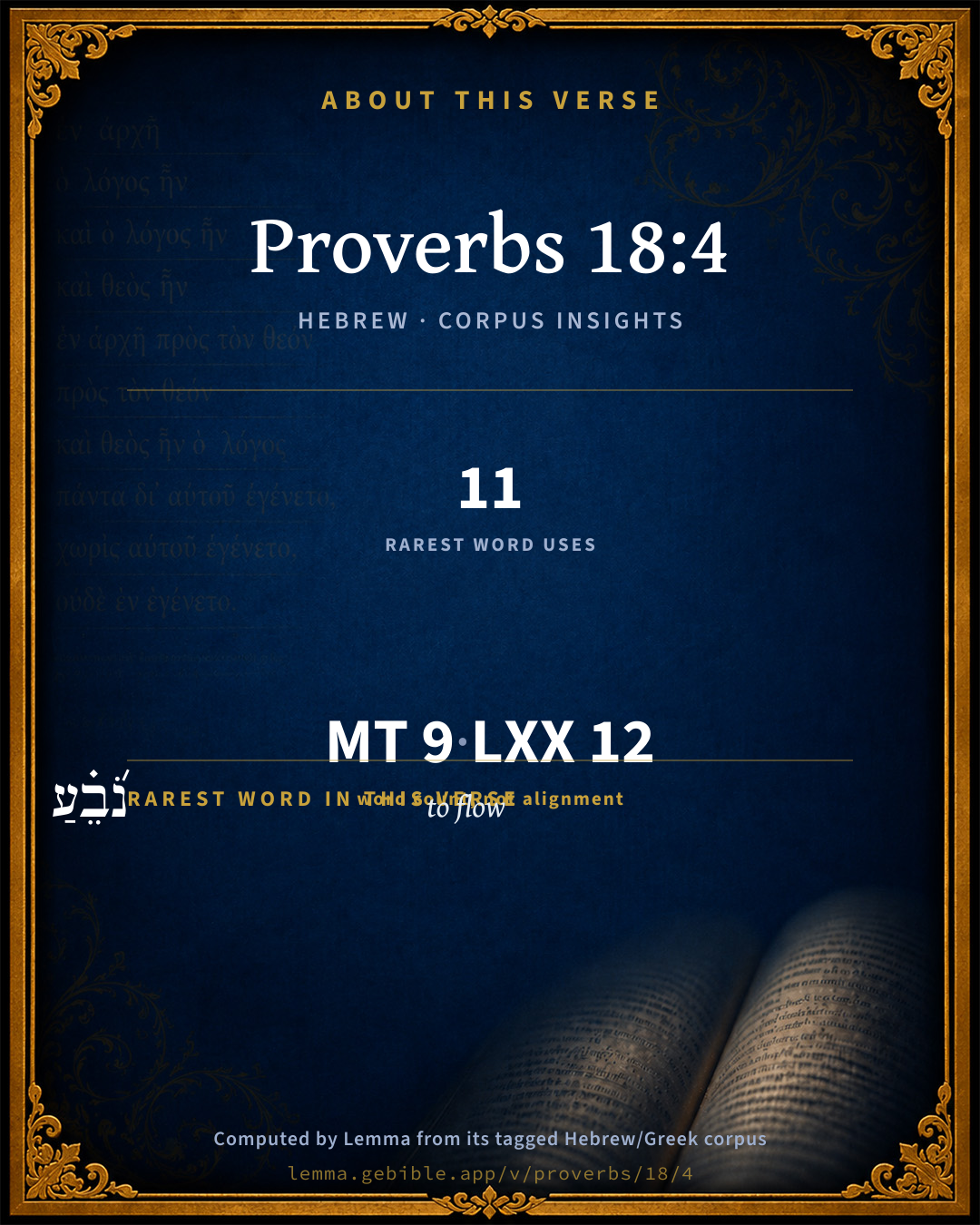
The rarest word here is נֹ֝בֵ֗עַ to flow H5042 — appearing just 11 times in the whole Hebrew Bible.

Shared distinctive vocabulary

נֹ֝בֵ֗עַ to flow H5042 occurs in 11 verses of the Hebrew Bible. Also found in:

Grammatical profile

  • 1 verb
  • 7 nouns
  • 1 adjective

Verb forms

  • נֹ֝בֵ֗עַ Qal · Participle Active

Hebrew & Septuagint length

In English translation the verse runs 19 words from the Hebrew and 21 from the Septuagint (LXX English) — closely comparable.

A rough comparison of the two English renderings, which tokenize alike — not a word-level alignment.

Word counts can differ between the Hebrew and the Greek without any difference in meaning — e.g. the Hebrew direct-object marker אֵת has no separate Greek word, and Greek often adds the article ὁ.

In the original languages it is 9 Hebrew tokens and 12 Greek tokens — but the two are counted differently (Hebrew bundles its prefixes and suffixes into one token; the Greek is in lemma form), so that isn’t a like-for-like length.

Cross-references

10

Topical passages linked to Proverbs 18:4 in the Treasury of Scripture Knowledge — connected by theme and wording, ordered by reader-vote popularity; previews shown in the World English Bible.

  • Proverbs 20:5 Counsel in the heart of man is like deep water; But a man of understanding will draw it out.
  • Proverbs 10:11 The mouth of the righteous is a spring of life, But violence covers the mouth of the wicked.
  • Colossians 4:6 Let your speech always be with grace, seasoned with salt, that you may know how you ought to answer each one.
  • Proverbs 13:14 The teaching of the wise is a spring of life, To turn from the snares of death.
  • John 4:14 but whoever drinks of the water that I will give him will never thirst again; but the water that I will give him will become in him a well of water springing up to eternal life."
  • John 7:38–39 He who believes in me, as the Scripture has said, from within him will flow rivers of living water."
  • Colossians 3:16 Let the word of Christ dwell in you richly; in all wisdom teaching and admonishing one another with psalms, hymns, and spiritual songs, singing with grace in your heart to the Lord.
  • Psalms 78:2 I will open my mouth in a parable. I will utter dark sayings of old,
  • Matthew 12:34 You offspring of vipers, how can you, being evil, speak good things? For out of the abundance of the heart, the mouth speaks.
  • Proverbs 16:22 Understanding is a fountain of life to one who has it, But the punishment of fools is their folly.

Cross-references courtesy of OpenBible.info (CC BY 4.0).

Hebrew and Greek witnesses Masoretic Hebrew ↔ Greek Septuagint

The same verse in the two great witnesses to the Old Testament, shown verse-for-verse.

These are two independent witnesses, not word-aligned to each other, and the Septuagint is shown in lemma (dictionary) form.

Hebrew Proverbs 18:4 Masoretic · Westminster Leningrad Codex

מַ֣יִם עֲ֭מֻקִּים דִּבְרֵ֣י פִי אִ֑ישׁ נַ֥חַל נֹ֝בֵ֗עַ מְק֣וֹר חָכְמָֽה

The words of a man's mouth are like deep waters. The fountain of wisdom is like a flowing brook.

World English Bible · Public Domain

Greek LXX Proverbs 18:4 Septuagint · lemma form

ὕδωρ βαθύς λόγος ἐν καρδία ἀνήρ ποταμός δέ ἀναπηδύω καί πηγή ζωή

A word in the heart of a man is a deep water, and a river and fountain of life spring forth.

LXX2012 (modern English Septuagint) · Public Domain

On this verse, Adam Clarke's Commentary discusses the Septuagint’s reading. Read the note in Commentary ↓

Hebrew: Westminster Leningrad Codex (CC BY 4.0). Greek: Septuagint (public domain); English from LXX2012 (modern English Septuagint) (Public Domain). How the Septuagint differs from the Hebrew →

Commentary

Notes on Proverbs 18:4 from classic Christian and Jewish commentators (each source and its license shown beneath its notes). The classic Christian expositions comment on the surrounding passage and are grouped to its opening verse, so a note may address several verses; the Jewish commentaries on the Tanakh (Rashi and others) are per-verse, so they appear only where the commentator wrote on this verse.

Lemma curates 59 commentaries, every one of them public domain or Creative Commons licensed, each selected and text-cleaned for this edition rather than reprinted as found. About our sources →

Trapp's Complete Commentary

John Trapp

Pro 18:4 The words of a man’s mouth [are as] deep waters, [and] the wellspring of wisdom [as] a flowing brook.

Ver. 4. The words of a man’s mouth are as deep waters.] Fitly are the words of the wise resembled to waters, saith one, inasmuch as they both wash the minds of the hearers, that the foulness of sin remain not therein, and water them in such sort that they faint not, nor wither by a drought and burning desire of heavenly doctrine. Now these words of the wise are of two sorts - some are as deep waters, and cannot easily be fathomed, as Samson’s riddles and Solomon’s apothegms, so very much admired by the Queen of Sheba, 2Ch 9:1-9; some again are plain, and flow so easily, as a flowing brook, that the simplest may understand them. The same may be affirmed of the holy Scriptures -- those "words of the wise and their dark sayings." {Pro 1:6} The Scriptures, saith one, are both text and gloss; one place opens another; one place hath that plainly, that another delivers darkly. The Rabbis have one saying, That there is a mountain of sense hangs upon every apex of the word of God; and another they have, Nulla est obiectio in lege quae non habet solutionem in latere - i.e., There is not any doubt in the law but may be resolved by some other text. Parallel scriptures cast a mutual light one upon another; and is there not a thin veil laid over the word, which is more rarefied by reading, and at last wholly worn away? A friend, says Chrysostom, that is acquainted with his friend, will get out the meaning of a letter or phrase which another could not that is a stranger; so it is in the Scripture.

John Trapp, A Commentary or Exposition upon All the Books of the Old and New Testament (1647–1656) — public domain. Text from a community e-Sword module.

The Biblical Illustrator

Joseph S. Exell

Pro_18:4

The words of a mans mouth are as deep waters.

The importance of language

Language is one of the principal tests and standards of civilisation. The study of language is one of the most naturally interesting and naturally elevating studies with which the human mind can occupy itself.

I. It is of great intellectual importance. Only through the instrumentality of language can the thoughts of the mind be revealed and displayed. Nothing bewrays more obviously the rustiness and disorganisation of the intellect than inaccuracy and dulness of language.

II. The moral importance of language is still greater. As a rule the relations between intellect and conscience are harmonious. When the intellect is illuminated it brightens the conscience; when the conscience is quickened it animates the intellect. Language is often a standard of morals. Exactitude of utterance is seldom compatible with great frequency of utterance. Modern writing and modern speech are impotent because they are slipshod. Language is also a great moral force in the world by reason of its variety. A world of one language would not be a very interesting world.

III. The great religious importance of language. The utmost solemnity is attached in the Bible to the use of language. What man can think that words are light and little things when he remembers that it is through the instrumentality of words inspired that God has made known His greatest revelations to mankind? (Canon Diggle.)

The words of inspired wisdom

There are some who regard the two clauses of this verse as antithetic. The former indicating hidden depths of evil in the wicked man. The words of his mouth are as deep waters. That is, he is so full of guile and deceit that you cannot reach his meaning. The latter indicating the transparent communications of the wise and the good. The wellspring of wisdom as a flowing brook. The communications of the one are guileful--the words conceal rather than reveal. The words of the other are honest and lucid. There are others who regard the two clauses as a parallelism. The character of the former clause is to be taken from the latter. The words of a mans mouth--that is, according to the second clause, of a wise mans mouth--are as deep waters, and the wellspring of wisdom as a flowing brook. We shall use the words thus as a parallelism to illustrate the words of inspired wisdom which are wise in the highest sense.

I. They are full. They are as deep waters. The world abounds with shallow words, mere empty sounds. The words in the general conversation of society and in the popular literature of the day are empty, shells without a kernel, mere husks without grain. But the words of inspired men are full, brimful, full of light and full of power.

1. The greatest thinkers have failed to exhaust their meaning.

2. Every modern thinker discovers new significance. Every paragraph has a continent of thought.

There lie vast treasures unexplored,

And wonders yet untold.

II. They are flowing. A flowing brook. The words of eternal truth are always in motion. They pulsate in thousands of souls every hour, and onward is their tendency.

1. They flow from the eternal wellspring of truth.

2. They flow through human channels. Divine wisdom speaks through man as well as through other organs. Holy men spake as they were moved, etc. The highest teacher was a man, Christ, the Logos. The words of His mouth were indeed as deep waters. Since Heaven has thus made man the organ of wisdom, it behoves man--

(1) Devoutly to realise the honour God has conferred upon his nature;

(2) Earnestly to aspire to the high honour of being a messenger of the Eternal. Man should not only be the student, but the revealer of God.

III. They are fertilising. They are here compared to waters and to a flowing brook. What water is to all physical life the words of heavenly wisdom are to souls. They quicken and satisfy.

1. It is a perennial brook. It has streamed down these centuries, imparting life and beauty in its course.

2. It is an accumulating brook. As brooks in nature swell into rivers by the confluence of contributory streams, so the brook of Divine truth widens and deepens by every contribution of holy thought. And never was it so broad and deep as now. (Homilist.)

The Biblical Illustrator, edited by Joseph S. Exell (c. 1880s–1900s) — public domain. Text from a community e-Sword module.

Joseph Benson's Commentary

Pro 18:4. The words of a man’s mouth — Of a wise man’s; are as deep waters — Full of deep wisdom; and the well-spring of wisdom as a flowing brook — That wisdom which is in his heart is continually pouring forth wise and good counsels.

Joseph Benson's Commentary on the Old and New Testaments (1811–1818) — public domain. Text from a community e-Sword module.

The Preacher's Complete Homiletical Commentary

Joseph S. Exell (gen. ed.)

CRITICAL NOTES.—

Pro_18:4. The last clause of this verse may be divided into two smaller ones and placed in apposition, thus: “a bubbling brook,”—a fountain of wisdom. Fausset remarks that the Hebrew word used for man is ish, a good man, not adam, the general term for man.

MAIN HOMILETICS OF Pro_18:4

A GOOD MAN’S MOUTH

We must understand Solomon here to refer to a good man—to a man whose words are in harmony with the mind of God. Of such a man it may be said that his words are as deep waters and as a living spring.

I. Because his soul is in communication with an exhaustless source of spiritual life and wisdom. Rivers and wells that are fed from the mountain recesses which are filled with eternal snows never dry up—they are fed from a source that is never exhausted. So long as the lasting hills remain, and the present natural laws govern the world they must give forth every day abundant streams. A communication has been established between the soul of a good man and the living God—he holds constant communion with a source of spiritual life which can never fail, and consequently he can never be at a loss for subjects upon which to discourse—his mind is always filled with new thoughts of God, and new hopes of heaven upon which to meditate himself and which he can communicate to others.

II. Because that which flows from his lips is beneficial and refreshing to others. The waters in a shallow and stagnant pond give little or no refreshment to the thirsty traveller; they may even be the means of imparting disease to those who drink of them, or who live near them. But the water from a well, or from a deep and flowing stream, is generally pure and wholesome to the taste, and refreshing to the land through which it flows. And so it is with the speech of a godly man. Very mighty are the influence of words for good or for ill. Our first parents lost Eden by listening to the words of the tempter, and the speech of the wicked always diffuses an unwholesome moral atmosphere around it, if it does not eject a deadly poison into the soul. But the conversation and teaching of the godly are always a means of moral health to others; by their words they witness for the truth of God, and are the means of “opening men’s eyes, and turning them from darkness to light, from the power of Satan unto God” (Act_26:13). And, like their Divine Master, they “know how to speak a word in season to him that is weary” (Isa_50:4), and thus that which flows from their lips is as refreshing and healthful to weary and struggling men and women on the highway of life as the living, cooling watercourse is to the dusty and thirsty traveller.

III. Because the flow is natural and spontaneous. Water may be sent through a tract of country by artificial means; fields may be watered and reservoirs filled by calling in science to supply natural deficiencies. But there is, after all, no comparison between this kind of forced irrigation and that which is the result of natural causes. If there is water beneath the surface of the earth it must force its way and find an outlet; it needs no hand of man to come to its aid; it penetrates the soil and forms a fertilising stream in obedience to natural law. And so the speech of a good man has nothing forced or artificial about it. It is the overflow of heartfelt experience. Like the apostles of old, he “cannot but speak the things which he has seen and heard” (Act_4:20). The “good things” of his lips are the natural outcome of the “good treasure of his heart,” “for out of the abundance of the heart the mouth speaketh” (Mat_12:24-25).

OUTLINES AND SUGGESTIVE COMMENTS

Talleyrand defined speech to be the art of concealing one’s opinions. Speech, even without any attempt at concealment, must be endlessly deep and wide as uttering all our being. Who can translate all its outgoings? If this be so with man, who shall judge of God and censure His obscurer revelations? Solomon is satisfied with one great difference,—that while man’s speech is “deep,” God’s speech is both “deep” and “living.” One has a vital source, the other is dead and stagnant. Grant that both are obscure. One is the darkness of a pool, the other the breadth and gush of an overflowing water. We ought to submit to mystery in God, for the tide of His utterance is to flow on for ever.—Miller.

One “greater than Solomon” “astonished the people” by the clearness, no less than by the depth of the waters (Mat_7:28-29). No blessing is more valuable than a “rich indwelling of the word,” ready to be brought out on all suitable occasions of instruction. If the wise man sometimes “spares his words,” it is not for want of matter, but for greater edification. The stream is ready to flow, and sometimes can scarcely be restrained. The cold-hearted, speculative professor has his flow—sometimes a torrent of words, yet without a drop of profitable matter; chilling, even when doctrinally correct; without life, unction, or love. Lord! deliver us from this barren “talk of the lips” (chap. Pro_14:23). May our waters be deep, flowing from thine own inner sanctuary, refreshing and fertilising the Church of God!—Bridges.

In the two clauses of the verse, on the principle of parallelism, there appears to be an inversion of the same sentiment; for, properly speaking, the words uttered are not the “deep waters,” but the stream that issues from them; and, on the other hand, “the wellspring of wisdom” is not “the flowing brook,” but the deep and copious fountain or reservoir from which it issues. Another passage may serve to confirm this view. “Counsel in the heart of man is like deep water; but a man of understanding will draw it out.” Here, the counsel is the deep water, not the words. But the words are the stream which the deep waters send forth. The words bring out and contain the counsel.—Wardlaw.

It must be remembered that “deep waters” are associated in the Old Testament with the thought of darkness and mystery (Pro_20:5; Psa_69:2; Ecc_7:24), and we get a more profound thought if we see in the proverb a comparison between all teaching from without and that of the light within. The words of a man’s mouth are dark as the “deep waters of a pool, or tank; but the well-spring of wisdom is as a flowing brook, bright and clear.” So taken the verse presents a contrast like that of Jer_2:13.—Plumptre.

When this word vir is used for man in sacred Scriptures it signifieth one who is strong and mighty, and for his strength great and excellent, and then by a man here we may understand him who is mighty and great in knowledge; the words of such a man are as deep waters, to the bottom whereof the shallow capacity of every one is not able to reach. But yet where the spring of those waters is a well-spring of wisdom, though sometimes it send forth deep waters, yet it doth not always; for that were to overwhelm the hearers. But at other times it is as a flowing brook, more shallow for capacity, but more forcible also in the stream of it, and either by persuasive exhortation carrying on the hearers to a pursuit of virtue and godliness, or else by a dissuasive reproof carrying them away from the practice of wickedness, and in both washing away the stains of their sinful lives. Wherefore St. Gregory saith, so must every preacher deal with his hearers as God dealeth with him; he must not preach to the simple as much as he knoweth because himself doth not know of heavenly mysteries as much as they are.—Jermin.

The subject of Pro_18:5 has been treated in the Homiletics on chap. 17, Pro_17:15 and Pro_17:26.

The Preacher's Complete Homiletical Commentary (gen. ed. Joseph S. Exell; Funk & Wagnalls, c. 1892) — public domain (pre-1929). A full-Bible homiletical/sermon-outline anthology covering 65 of 66 books (2 John is absent from the source module). Text from a community e-Sword module.

Tyndale Open Study Notes

Tyndale Open Resources

18:4 Words flow from one’s character as water bubbles up from the earth (see also 10:20; 12:23; 16:23; cp. Jas 3:10-12).

Tyndale Open Study Notes — © Tyndale Open Resources, licensed CC BY-SA 4.0. Text via the HelloAO Bible API.

Geneva Bible (1599)

Geneva Bible translators

Which can never be drawn empty, but bring ever profit.

Geneva Bible (1599) marginal notes — public domain. Text via Bolls.life.

Matthew Henry's Commentary

The similitudes here seem to be elegantly transposed. 1. The well-spring of wisdom is as deep waters. An intelligent knowing man has in him a good treasure of useful things, which furnishes him with something to say upon all occasions that is pertinent and profitable. This is as deep waters, which make no noise, but never run dry. 2. The words of such a man's mouth are as a flowing brook. What he sees cause to speak flows naturally from him and with a great deal of ease, and freedom, and natural fluency; it is clean and fresh, it is cleansing and refreshing; from his deep waters there flows what there is occasion for, to water those about him, as the brooks do the low grounds.

Matthew Henry's Commentary on the Whole Bible (1708–1710) — public domain (CC PDM 1.0). Text via the HelloAO Bible API.

Jamieson, Fausset & Brown

Robert Jamieson, A. R. Fausset & David Brown

Wise speech is like an exhaustless stream of benefit.

Jamieson, Fausset & Brown — Commentary Critical and Explanatory on the Whole Bible (1871) — public domain (CC PDM 1.0). Text via the HelloAO Bible API.

Adam Clarke's Commentary

Verse 4. The words of a man's mouth] That is, the wise sayings of a wise man are like deep waters; howsoever much you pump or draw off, you do not appear to lessen them.

The well-spring of wisdom] Where there is a sound understanding, and a deep, well-informed mind, its wisdom and its counsels are an incessant stream, מקור חכמה mekor chochmah, "the vein of wisdom," ever throwing out its healthy streams: but מקור חיים mekor chaiyim, "the vein of LIVES," is the reading of eight of Kennicott's and De Rossi's MSS., and is countenanced by the Septuagint, πηγη ζωης, "the fountain of life." And so the Arabic, [Arabic]. This is the more likely to be the true reading, because the figure of the heart propelling the blood through the great aorta, to send it to all parts of the animal system, is a favourite with Solomon, as it was with his father, David. See Clarke on Ps 36:9; "Pr 10:11", &c.

Adam Clarke's Commentary on the Bible (1810–1826) — public domain. Text from a community e-Sword/MySword module.

Ellicott's Commentary for English Readers

(4) The words of a man’s mouth are as deep waters . . .—i.e., the words of a “man,” properly so called, are as deep waters which cannot be easily fathomed; they are a copious stream, which flows from a never failing source; they are a fountain of wisdom which is never exhausted.

A Bible Commentary for English Readers, edited by Charles John Ellicott (1878–1897) — public domain. Text from a community e-Sword module.

The Cambridge Bible for Schools and Colleges

gen. ed. J. J. S. Perowne

4. a man’s mouth] The second clause of the verse limits and interprets the first. It is of a wise man’s mouth that the proverb speaks. His words are “as deep waters,” because they are no mere shallow talk, but are full of depth and meaning, “The well-spring of wisdom,” which is their source, does not soon run dry, but is “as a flowing brook,” in its full, clear, steady course. Such were Solomon’s own words to the queen of Sheba, 1Ki_10:1; 1Ki_10:3.

Somewhat similarly the LXX. make the first clause refer to the still unuttered word in the heart, and the second to its leaping forth thence like the stream from the spring:

“Deep water is a word in the heart of a man,

But it leaps forth as a river and a fountain of life.”

The Cambridge Bible for Schools and Colleges (gen. ed. J. J. S. Perowne; Cambridge University Press, 1878–1918) — public domain. Text from a community e-Sword module.

John Gill's Exposition

The words of a man's mouth are as deep waters,.... The words of a great and mighty man; of an excellent and valuable man, as Jarchi; or of a wise man, as Aben Ezra. The doctrines which such a man has imbibed, and his heart is full of and his mouth utters, are like to "waters", pure, purifying, and refreshing; to "deep waters", which make no noise, and cannot be easily fathomed: such are the deep mysteries of grace, the wisdom of God in a mystery, spoken among them that are perfect; of which a good man makes no boast, but humbly declares; out of the abundance of his heart, his mouth speaks;

and the wellspring of wisdom as a flowing brook; there is a spring of spiritual wisdom and knowledge in him; a well of living water, springing up unto everlasting life; and from thence it flows freely and constantly; communicating itself liberally unto others, and ministering grace to the hearers, for their edification.

John Gill's Exposition of the Whole Bible (1746–1763) — public domain (CC PDM 1.0). Text via the HelloAO Bible API.

Albert Barnes' Notes on the Bible

The parallelism of the two clauses is probably one of contrast. If so, the proverb is a comparison between all teaching from without and that of the light within. “The words of a man’s mouth” are dark as the “deep waters” of a pool, or tank (“deep waters” being associated in the Old Testament with the thought of darkness and mystery; compare Pro 20:5; Psa 69:2; Ecc 7:24); but “the wellspring of wisdom is as a flowing brook,” bright and clear. The verse presents a contrast like that of Jer 2:13.

Albert Barnes' Notes on the Bible (1834–1885) — public domain. Text from a community e-Sword/MySword module.

Haydock's Catholic Bible Commentary

Man, who is just and wise. His advice deserves attention, chap. xx. 5.

George Leo Haydock (1774–1849), Haydock's Catholic Family Bible and Commentary, 1859 edition — public domain. Excludes Psalms (Douay-Rheims chapter numbering differs from Protestant) and Deuterocanonical books (Catholic canon only).

Matthew Poole's English Annotations

A man’s, i.e. a wise man’s, as the next clause explains this; who is worthy of the name and hath the understanding of a man in him. This Hebrew word ofttimes notes an eminent or excellent person, and therefore is opposed to Adam, which designs any ordinary man.

As deep waters; full of deep wisdom.

The well-spring of wisdom as a flowing brook; that wisdom which is in his heart is continually pouring forth wise and good counsels.

Matthew Poole's English Annotations on the Holy Bible (1683–1685) — public domain. Text from a community e-Sword/MySword module.

Whedon's Commentary on the Bible

Daniel D. Whedon

4. A flowing brook — A gushing stream. The clause may be rendered: “The words of a man’s mouth are a gushing stream, a fountain of wisdom.” Though it is not expressed, the proverb implies (see second clause) that the words are those of a wise man, from whose mind, as from an inexhaustible fountain, flow continually excellent lessons of instruction. Comp. Pro_10:11; Pro_20:5; Ecc_7:24.

Daniel D. Whedon (gen. ed.), Commentary on the Old and New Testaments (1874–1909) — public domain. Text from a community e-Sword module.

The Pulpit Commentary

The words of a man"s mouth are as deep waters. "Man" (ish) here means the ideal man in all his wisdom and integrity, just as in Pro_18:22 the ideal wife is intended under the general term "wife." Such a man"s words are as deep waters which cannot be fathomed or exhausted. The metaphor is common (see Pro_20:5 Ecc_7:24; Ecc 21:13). For "mouth," the Septuagint reads "heart:" "Deep water is a word in a man"s heart." The second hemistich explains the first: The well spring of wisdom as a flowing (gushing) brook. A man"s words are now called a well spring of wisdom, gushing forth from its source, the wise and understanding heart, pure, fresh, and inexhaustible. Septuagint, "And it leapeth forth (anaphduei ) a river and a fountain of life." Or we may, with Delitzsch, take the whole as one idea, and consider that a man"s words are deep waters, a bubbling brook, and a fountain of wisdom.

The utterances of wisdom.

Taking the sense of this passage to be continuous and not antithetical, and understanding it to refer to the utterances of the wisdom which is from above, we notice their constant characteristics, viz.

I THEIR DEPTH. The words which come from the mouth of wisdom are "as deep waters." How shallow is much, if not most, that is spoken in our hearing! It strikes no deeper than "the hour"s event," than the mere gilding of our life; it only extends to the circumstances or to the conventionalities of life; it deals with tastes and customs, with regulation and proprieties; it goes no further than pecuniary or social expectations; it lies upon the surface and does not touch "the deep heart and reality of things." But the wisdom of the wise strikes deep; it goes down into the character; it touches first principles; it has to do with the sources and springs of human action; it concerns itself with the intrinsically true, the really beautiful, the solidly and permanently good.

II THEIR SPONTANEITY. The utterances of men who are not truly wise are lacking in this. They can only repeat what they have learned; they have to consult their "authorities" in order to know what they should say; they have to labour and strive in order to express themselves. Not so the truly wise. Their words come from them as water from a well spring; their speech is the simple, natural, unconstrained outflow of their soul; they speak from the heart, not from the book. Their spirit is full of Divine wisdom; they "have understanding"; (Pro_17:24) they have knowledge, insight, love of the truth; they "cannot but speak" the truth they have learned of God, the things they have heard and seen. And the spontaneity of their utterance is one real element in their eloquence and their influence.

III THEIR COMMUNICATIVENESS. They are "as a flowing brook." As water that is not pent up like a reservoir, but flows on through the thirsty land, communicating moisture, and thus ministering to life and growth, so the words of the wise are continually flowing; they spread from heart to heart, from land to land, from age to age. And as they flow they minister to the life and the growth of men; they communicate those living truths which enlighten the mind, which soften and change the heart, which transform and ennoble the life. Their career is never closed, for from soul to soul, from lip to lip, from life to life, wisdom passes on in its blessed, unbroken course.

1. Be ever learning of God. He himself, in the book which he has "written for our learning," is the Divine Source of such wisdom as this. Only as we receive from him who is "the Wisdom of God" shall we be partakers and possessors of this heavenly wisdom. And therefore:

2. Come into the closest communion and connection with Jesus Christ himself.

3. Open your mind to all sources of truth whatsoever. C.

The Pulpit Commentary (1880–1919), ed. H.D.M. Spence-Jones & Joseph S. Exell — public domain. Text from a community e-Sword module.

John Wesley's Explanatory Notes

A man's - A wise man's. As a brook - That wisdom which is in his heart is continually pouring forth wise and good counsels.

John Wesley, Explanatory Notes Upon the Whole Bible (1754–1765) — public domain. Text via the GEBible commentary corpus.

Keil & Delitzsch

C. F. Keil & F. Delitzsch

4 Deep waters are the words from a man's mouth,

A bubbling brook, a fountain of wisdom.

Earlier, we added to hominis the supplement sc. sapientis, but then an unnecessary word would be used, and that which is necessary omitted. Rather it might be said that אישׁ is meant in an ideal sense; but thus meant, אישׁ, like גּבר, denotes the valiant man, but not man as he ought to be, or the man of honour; and besides, a man may be a man of honour without there being said of him what this proverb expresses. Ewald comes nearer the case when he translates, "deep waters are the heart-words of many." Heart-words - what an unbiblical expression! The lxx, which translates λόγος ἐν καρδίᾳ, has not read דברי לב, but דבר בלב (as Pro 20:5, עצה בלב־). But that "of many" is certainly not a right translation, yet right in so far as אישׁ (as at Pro 12:14) is thought of as made prominent: the proverb expresses, in accordance with the form of narrative proverbs which present an example, what occurs in actual life, and is observed. Three different things are said of the words from a man's mouth: they are deep waters, for their meaning does not lie on the surface, but can be perceived only by penetrating into the secret motives and aims of him who speaks; they are a bubbling brook, which freshly and powerfully gushes forth to him who feels this flow of words, for in this brook there never fails an always new gush of living water; it is a fountain or well of wisdom, from which wisdom flows forth, and whence wisdom is to be drawn. Hitzig supposes that the distich is antithetic; מים עמקּים, or rather מי מעמקּים, "waters of the deep," are cistern waters; on the contrary, "a welling brook is a fountain of wisdom." But עמק means deep, not deepened, and deep water is the contrast of shallow water; a cistern also may be deep (cf. Pro 22:14), but deep water is such as is deep, whether it be in the ocean or in a ditch. 4b also does not suggest a cistern, for thereby it would be indicated that the description, דברי פי־אישׁ, is not here continued; the "fountain of wisdom" does not form a proper parallel or an antithesis to this subject, since this much rather would require the placing in contrast of deep and shallow, of exhausted (drained out) and perennial. And: the fountain is a brook, the well a stream - who would thus express himself! We have thus neither an antithetic nor a synonymous (lxx after the phrase ἀναπηδῶν, Jerome, Venet., Luth.), but an integral distich before us; and this leads us to consider what depths of thought, what riches of contents, what power of spiritual and moral advancement, may lie in the words of a man.

Keil & Delitzsch — Biblical Commentary on the Old Testament (1861–1891) — public domain (CC PDM 1.0). Text via the HelloAO Bible API. (Old Testament only.)

Bridges on Proverbs

Charles Bridges

’This sentence expresses the depth, the abundance, the clearness, and the force of the counsels of the wise man.’†1 The last clause gives this restriction to wisdom. When "a man has intermeddled with all wisdom," his words are in themselves deep waters, and in their communication fruitful as a flowing brook. His wisdom is a well-spring, ’which sends up full brooks, that are ready to overflow their banks. So plentiful is he in good discourse and wholesome counsel!’†2 So deep were the waters from the wise man’s spring, that his words nearly overwhelmed the capacity of his royal hearer. (1Ki 10:4-8 .) One "greater than Solomon" "astonished the people" by the clearness, no less than by the depth of the waters. (Mat 7:28-29 .) No blessing is more valuable than a "rich indwelling of the word," ready to be brought out on all suitable occasions of instruction.†3 If the wise man sometimes "spares his words,"†4 it is not for want of matter, but for greater edification. The stream is ready to flow, and sometimes can scarcely be restrained.†5 The cold-hearted, speculative professor has his flow — sometimes a torrent of words, yet without a drop of profitable matter; chilling, even when doctrinally correct; without life, unction, or love. Lord! deliver us from this barren "talk of the lips." (Pro 14:23 .) May our waters be deep, flowing from thine own inner sanctuary, refreshing, and fertilizing the Church of God!

This well-spring is specially invigorating, when, as in Chrysostom, it gives an heavenly glow to outward eloquence. Consecrated mind and talent are the gifts of God. Oh! let them be improved in simplicity, not for the creature’s honour, but for the glory of the Great Giver.

Footnotes:

†1 Calmet.

†2 Bishop Hall. Compare Pro 10:11 ; Pro 16:22 ; Pro 20:5 .

†3 Col 3:16; Col 4:6 .

†4 Pro 17:27.

†5 Job 32:19. Jer 20:9 . Act 17:16 .

Charles Bridges, An Exposition of the Book of Proverbs (1846) — public domain. Text from a community e-Sword module.

Kretzmann's Popular Commentary

Paul E. Kretzmann

v. 4. The words of a man’s mouth are as deep waters, hard to fathom and exhaust, if he really has something to say, and the well-spring of wisdom as a flowing brook, literally, "a bubbling brook," a fountain of wisdom, rich in content and life-giving in quality.

Paul E. Kretzmann, Popular Commentary of the Bible (1921–1924) — public domain. Text from a community e-Sword module.

Rashi

Rabbi Shlomo Yitzchaki (Rashi)

the wellspring of wisdom is like a flowing stream and like deep water.

The words of a man’s mouth Heb. איש. Every instance of איש in Scripture is an expression of a mighty man, one who is great in might.

Rashi on the Tanakh — English translations: “The Judaica Press complete Tanach with Rashi, translated by A. J. Rosenberg” (CC BY 4.0); “Pentateuch with Rashi's commentary by M. Rosenbaum and A.M. Silbermann, 1929-1934” (public domain); “The Metsudah Tanach series, Lakewood, N.J” (CC BY 4.0); and “The Book of Joshua, Metsudah Publications, 1997” (CC BY 4.0). Text via Sefaria.

Lesson kit

Teaching starters — assembled from the data on this page, not authored interpretation. Every prompt links to the verse data it draws on. Edit before teaching.

Proverbs, in the Wisdom, opens this verse with 9 words (9 distinct Hebrew lemmas). Its most distinctive word is nâbaʻ (“to flow”). A historical commentator’s framing appears above. Read the whole chapter for the surrounding context.

Discussion questions

  1. The word nâbaʻ carries the sense “to flow.” How does it shape the verse?
  2. Psalms 19:2 shares the word «to flow» with this verse. How do the two illuminate each other?
  3. These translations render this verse differently; the difference is in the English rendering, not the original. What questions does that raise?
  4. The verb «נֹ֝בֵ֗עַ» is Qal Participle Active. How does its form color the action?
  5. Reading how Trapp's Complete Commentary and The Biblical Illustrator read this verse, where do the two commentators agree and where do they part?

Things to notice

Reading settings

Reading text

Shown beneath each verse's original-language words.

Old Testament
Old Testament edition

Read the OT as the Masoretic Hebrew (MT) or the Greek Septuagint (LXX).

English shown for the Greek Septuagint (in the Hebrew ↔ Greek comparison).

Comparing translations? Open the Compare panel on any verse page to stack up to four side by side.