
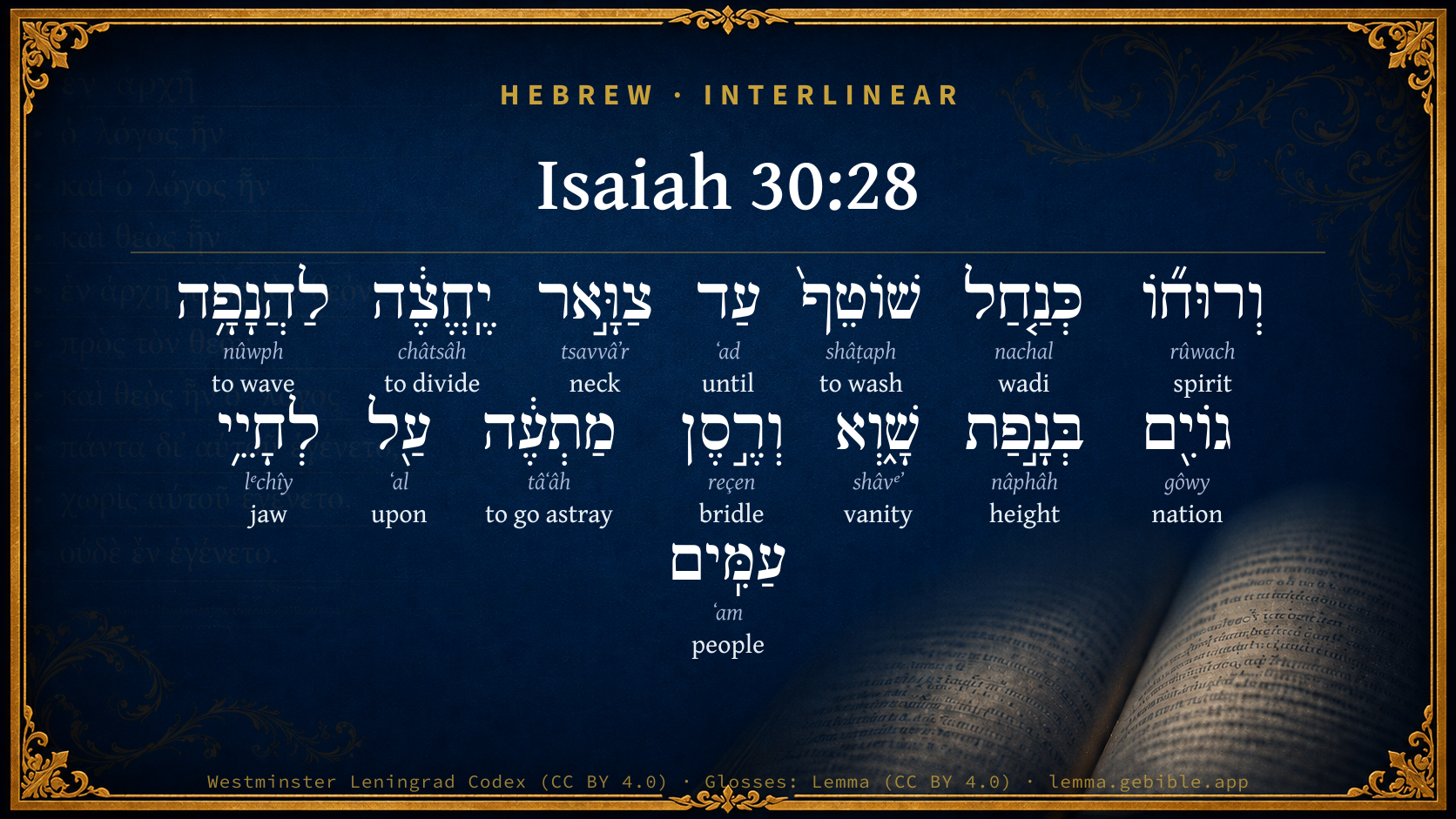
Isaiah 30:28

Hebrew (Westminster Leningrad Codex) Isaiah 30:28 appears in the Hebrew Old Testament. The text above is from the Westminster Leningrad Codex. Each word links to its Strong’s number, a concise gloss, and parsing drawn from the Open Scriptures Hebrew Bible morphology. Click any word for its full Brown-Driver-Briggs (BDB) entry.
Download image
Cite this verse

Isaiah 30:28 (World English Bible). Public Domain. Lemma interlinear Bible study tool, https://lemma.gebible.app/v/isaiah/30/28.

Show BibTeX & RIS
BibTeX
RIS
English Translation
and his breath is as an overflowing stream, that reaches even to the neck, to sift the nations with the sieve of destruction: and a bridle that causes to err [shall be] in the jaws of the peoples.
World English Bible · Public Domain
Download a study sheet

One document with this verse’s original text, its word-by-word gloss line, the meaning frame, cross-references with their text, attributed commentary, and full source and license credits — printable, and it pastes into notes with its structure intact.

This verse Autodidact and up

Study sheet (.html) Plain text (.txt)

A passage Seminary Student

Up to 50 verses in one chapter. A passage sheet keeps up to 6 commentary sources and 12 cross-references per verse, in the order this page ranks them, and says so on the sheet whenever that leaves anything out. Ask for a single verse and you get the Autodidact verse sheet above.

Everything on this page stays free to read, with no account — the sheet is a download of what is already on screen, not access to it.

Want to remove ads? Support Godless Engineer
Compare translations 3

The same verse in 3 English versions, stacked beneath the original-language interlinear above. Click any original word for its lexicon entry.

Each is an independent rendering of the whole verse — the interlinear is not word-aligned to these translations.

Highlighted words mark where these versions differ — a whole-verse word diff, not a word-by-word alignment.

  • World English Bible Public Domain
    and his breath is as an overflowing stream, that reaches even to the neck, to sift the nations with the sieve of destruction: and a bridle that causes to err [shall be] in the jaws of the peoples.
  • King James Version Public Domain
    And his breath, as an overflowing stream, shall reach to the midst of the neck, to sift the nations with the sieve of vanity: and there shall be a bridle in the jaws of the people, causing them to err.
  • unfoldingWord Literal Text CC BY-SA 4.0
    And his breath like an overflowing torrent; it reaches to the neck, to sift the nations in the sieve of destruction, and a bridle leading astray on the jaws of the peoples.

unfoldingWord Literal Text — © unfoldingWord, licensed CC BY-SA 4.0. Word-aligned USFM3 via Door43 (git.door43.org/unfoldingWord/en_ult).

Versions to compare (up to 4)

3 of 4 selected

Show all 18 translations

Every available English version of this verse, each an independent rendering of the whole verse.

  • World English Bible Public Domain
    and his breath is as an overflowing stream, that reaches even to the neck, to sift the nations with the sieve of destruction: and a bridle that causes to err [shall be] in the jaws of the peoples.
  • Berean Standard Bible Public Domain
    His breath is like a rushing torrent that rises to the neck. He comes to sift the nations in a sieve of destruction; He bridles the jaws of the peoples to lead them astray.
  • Majority Standard Bible Public Domain
    His breath is like a rushing torrent that rises to the neck. He comes to sift the nations in a sieve of destruction; He bridles the jaws of the peoples to lead them astray.
  • King James Version Public Domain
    And his breath, as an overflowing stream, shall reach to the midst of the neck, to sift the nations with the sieve of vanity: and there shall be a bridle in the jaws of the people, causing them to err.
  • American Standard Version (1901) Public Domain
    and his breath is as an overflowing stream, that reacheth even unto the neck, to sift the nations with the sieve of destruction: and a bridle that causeth to err `shall be' in the jaws of the peoples.
  • Revised Version (1885) Public Domain
    and his breath is as an overflowing stream, that reacheth even unto the neck, to sift the nations with the sieve of vanity: and a bridle that causeth to err shall be in the jaws of the peoples.
  • Geneva Bible (1599) Public Domain
    And his spirit is as a riuer that ouerfloweth vp to the necke: it deuideth asunder, to fanne the nations with the fanne of vanitie, and there shall be a bridle to cause them to erre in the chawes of the people.
  • Douay-Rheims (1899) Public Domain
    His breath as a torrent overflowing even to the midst of the neck, to destroy the nations unto nothing, and the bridle of error that was in the jaws of the people.
  • Young's Literal Translation Public Domain
    And His breath `is' as an overflowing stream, Unto the neck it divideth, To sift nations with a sieve of vanity, And a bridle causing to err, `Is' on the jaws of the peoples.
  • Literal Standard Version CC BY-SA 4.0
    And His breath [is] as an overflowing stream, || It divides to the neck, || To sift nations with a sieve of vanity, || And a bridle causing to err, || [Is] on the jaws of the peoples.
  • Unlocked Literal Bible CC BY-SA 4.0
    His breath is like an overflowing torrent that reaches up to the middle of the neck, to sift the nations with the sieve of destruction. His breath is a bridle in the jaws of the peoples to cause them to wander away.
  • unfoldingWord Literal Text CC BY-SA 4.0
    And his breath like an overflowing torrent; it reaches to the neck, to sift the nations in the sieve of destruction, and a bridle leading astray on the jaws of the peoples.
  • Darby Bible Public Domain
    and his breath as an overflowing torrent, which reacheth even to the neck, to sift the nations with the sieve of destruction, and [to put] a bridle into the jaws of the peoples, that causeth them to go astray.
  • World Messianic Bible Public Domain
    His breath is as an overflowing stream that reaches even to the neck, to sift the nations with the sieve of destruction. A bridle that leads to ruin will be in the jaws of the peoples.
  • Webster's Bible Public Domain
    And his breath, as an overflowing stream, shall reach to the midst of the neck, to sift the nations with the sieve of vanity: and there shall be a bridle in the jaws of the people, causing them to err.
  • Free Bible Version CC BY-SA 4.0
    His breath rushes out like a flood that comes up to the neck. He shakes the nations in a sieve that destroys them; he puts bridles in the mouths of the different peoples to lead them away.
  • Bible in Basic English Public Domain
    And his breath is as an overflowing stream, coming up even to the neck, shaking the nations for their destruction, like the shaking of grain in a basket: and he will put a cord in the mouths of the people, turning them out of their way.
  • JPS Tanakh (1917) Public Domain
    And His breath is as an overflowing stream, that divideth even unto the neck, to sift the nations with the sieve of destruction; and a bridle that causeth to err shall be in the jaws of the peoples.

Literal Standard Version (2020), Covenant Press — licensed CC BY-SA 4.0. Text via the HelloAO Bible API (eBible.org). Unlocked Literal Bible (unfoldingWord) — licensed CC BY-SA 4.0. Text via the HelloAO Bible API (eBible.org). unfoldingWord Literal Text — © unfoldingWord, licensed CC BY-SA 4.0. Word-aligned USFM3 via Door43 (git.door43.org/unfoldingWord/en_ult). Free Bible Version, Dr. Jonathan Gallagher — licensed CC BY-SA 4.0. Text via the HelloAO Bible API (eBible.org).

Word by word

More ways to search: Search by grammar → Find every occurrence → Compare this word →

Practice this passage: Drill this verse → Learn its vocabulary →

בְּנָ֣פַת
nâphâh
H5299
“in/at · height of”
Preposition + Noun, Common, Feminine, Singular, Construct
Part of Speech
Preposition + Noun
Type
Common
Gender
Feminine
Number
Singular
State
Construct
Full BDB Definition

Origin: from H5130 in the sense of lifting

TWOT: 1331b , 1330a

a lofty place, height - sieve, winnowing implement
  1. וְרוּח֞וֹ rûwach H7307 “and · spirit · his” Conjunction + Noun, Common, Both, Singular, Construct + Suffix, Personal, 3rd Person, Masculine, Singular
  2. כְּנַ֤חַל nachal H5158 “like/as · wadi” Preposition + Noun, Common, Masculine, Singular, Absolute
  3. שׁוֹטֵף֙ shâṭaph H7857 “washing” Verb, Qal, Participle Active, Masculine, Singular, Absolute
  4. עַד ʻad H5704 “until” Preposition
  5. צַוָּ֣אר tsavvâʼr H6677 “neck” Noun, Common, Masculine, Singular, Absolute
  6. יֶֽחֱצֶ֔ה châtsâh H2673 “to divide” Verb, Qal, Imperfect, 3rd Person, Masculine, Singular
  7. לַהֲנָפָ֥ה nûwph H5130 “to/for · sifting” Preposition + Noun, Common, Feminine, Singular, Absolute
  8. גוֹיִ֖ם gôwy H1471 “nations” Noun, Common, Masculine, Plural, Absolute
  9. שָׁ֑וְא shâvᵉʼ H7723 “vanity” Noun, Common, Masculine, Singular, Absolute
  10. וְרֶ֣סֶן reçen H7448 “and · bridle” Conjunction + Noun, Common, Masculine, Singular, Absolute
  11. מַתְעֶ֔ה tâʻâh H8582 “going astray” Verb, Hiphil, Participle Active, Masculine, Singular, Absolute
  12. עַ֖ל ʻal H5921 “upon” Preposition
  13. לְחָיֵ֥י lᵉchîy H3895 “jaws of” Noun, Common, Both, Plural, Construct
  14. עַמִּֽים ʻam H5971 “peoples” Noun, Common, Masculine, Plural, Absolute

About this verse

These counts appear in no published source. They are computed here, from the morphology-tagged text and Lemma’s own curated glosses. What Lemma adds →

15
words
15
distinct lemmas
Prophets
section

Notable vocabulary

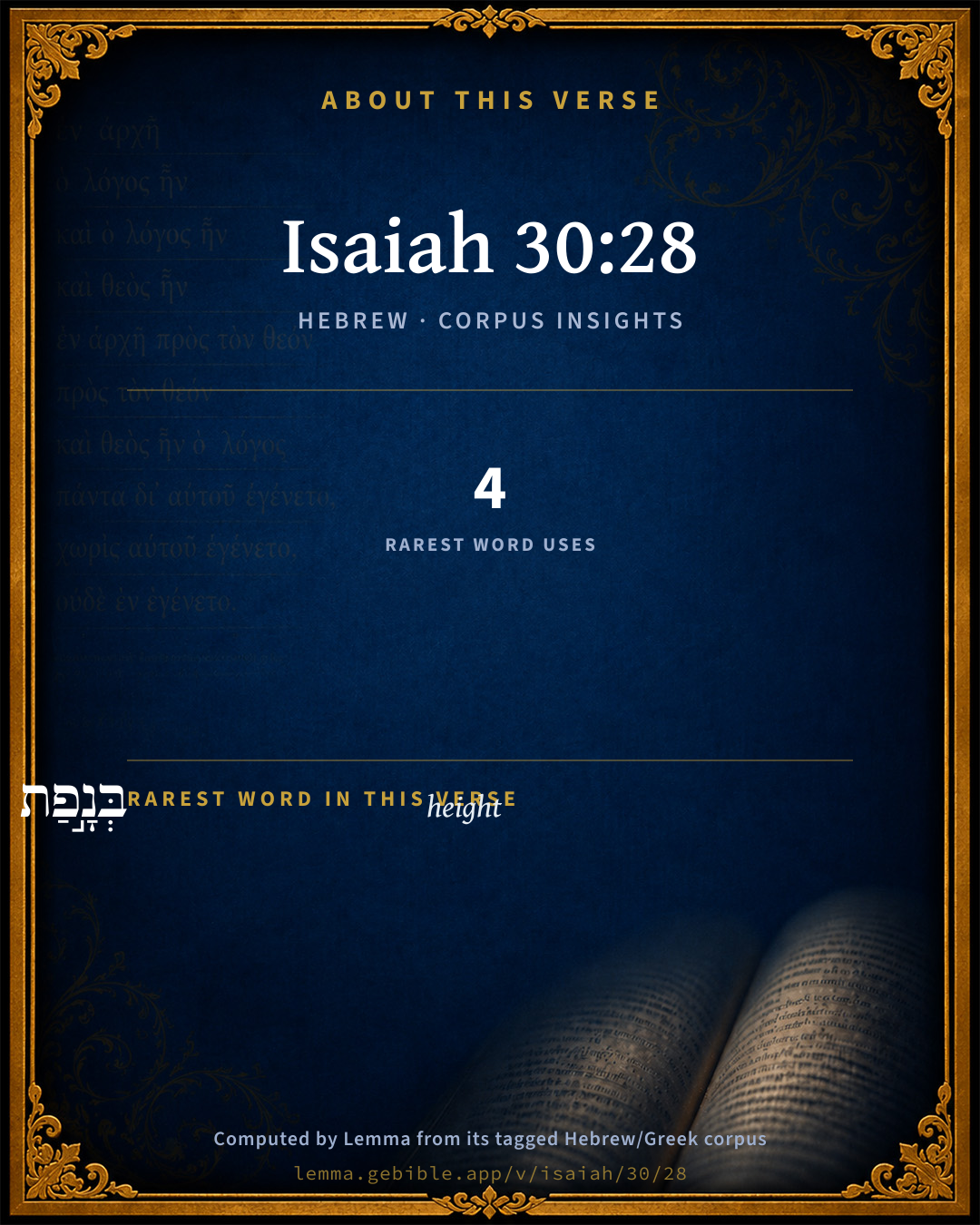
The rarest word here is בְּנָ֣פַת height H5299 — appearing just 4 times in the whole Hebrew Bible.

Shared distinctive vocabulary

בְּנָ֣פַת height H5299 occurs in 4 verses of the Hebrew Bible. Also found in:

Grammatical profile

  • 3 verbs
  • 10 nouns
  • 2 prepositions

Verb forms

  • שׁוֹטֵף֙ Qal · Participle Active
  • יֶֽחֱצֶ֔ה Qal · Imperfect
  • מַתְעֶ֔ה Hiphil · Participle Active

Hebrew & Septuagint length

In English translation the verse runs 38 words from the Hebrew and 35 from the Septuagint (LXX English) — closely comparable.

A rough comparison of the two English renderings, which tokenize alike — not a word-level alignment.

Word counts can differ between the Hebrew and the Greek without any difference in meaning — e.g. the Hebrew direct-object marker אֵת has no separate Greek word, and Greek often adds the article ὁ.

Cross-references

26

Topical passages linked to Isaiah 30:28 in the Treasury of Scripture Knowledge — connected by theme and wording, ordered by reader-vote popularity; previews shown in the World English Bible.

  • Isaiah 37:29 Because of your raging against me, and because your arrogance is come up into my ears, therefore will I put my hook in your nose, and my bridle in your lips, and I will turn you back by the way by which you came.
  • Isaiah 8:8 and it shall sweep onward into Judah; it shall overflow and pass through; it shall reach even to the neck; and the stretching out of its wings shall fill the breadth of your land, Immanuel.
  • Isaiah 11:4 but with righteousness shall he judge the poor, and decide with equity for the humble of the earth; and he shall strike the earth with the rod of his mouth; and with the breath of his lips shall he kill the wicked.
  • 2 Thessalonians 2:8 Then the lawless one will be revealed, whom the Lord will kill with the breath of his mouth, and bring to nothing by the brightness of his coming;
  • 2 Kings 19:28 Because of your raging against me, and because your arrogance is come up into my ears, therefore will I put my hook in your nose, and my bridle in your lips, and I will turn you back by the way by which you came.
  • Amos 9:9 "For, behold, I will command, and I will sift the house of Israel among all the nations, as grain is sifted in a sieve, yet not the least kernel will fall on the earth.
  • Luke 22:31 The Lord said, "Simon, Simon, behold, Satan asked to have you, that he might sift you as wheat,
  • Hebrews 4:12 For the word of God is living, and active, and sharper than any two-edged sword, and piercing even to the dividing of soul and spirit, of both joints and marrow, and is able to discern the thoughts and intentions of the heart.
  • Revelation 2:16 Repent therefore, or else I am coming to you quickly, and I will make war against them with the sword of my mouth.
  • 2 Samuel 17:14 Absalom and all the men of Israel said, The counsel of Hushai the Archite is better than the counsel of Ahithophel. For Yahweh had ordained to defeat the good counsel of Ahithophel, to the intent that Yahweh might bring evil on Absalom.
  • 1 Kings 22:20–22 Yahweh said, Who shall entice Ahab, that he may go up and fall at Ramoth-gilead? One said on this manner; and another said on that manner.
  • Job 39:17 Because God has deprived her of wisdom, Neither has he imparted to her understanding.
  • Psalms 18:15 Then the channels of waters appeared, The foundations of the world were laid bare at your rebuke, Yahweh, At the blast of the breath of your nostrils.
  • Psalms 32:9 Don't be like the horse, or like the mule, which have no understanding, Who are controlled by bit and bridle, or else they will not come near to you.
  • Proverbs 26:3 A whip for the horse, A bridle for the donkey, And a rod for the back of fools!
  • Isaiah 19:3 The spirit of Egypt shall fail in the midst of it; and I will destroy the counsel of it: and they shall seek to the idols, and to the charmers, and to those who have familiar spirits, and to the wizards.
  • Isaiah 19:12–14 Where then are your wise men? and let them tell you now; and let them know what Yahweh of Hosts has purposed concerning Egypt.
  • Isaiah 28:17–18 I will make justice the line, and righteousness the plummet; and the hail shall sweep away the refuge of lies, and the waters shall overflow the hiding-place.
  • Isaiah 29:6 She shall be visited of Yahweh of Hosts with thunder, and with earthquake, and great noise, with whirlwind and tempest, and the flame of a devouring fire.
  • Isaiah 33:10–12 Now will I arise, says Yahweh; now will I lift up myself; now will I be exalted.
  • Ezekiel 14:7–9 For everyone of the house of Israel, or of the strangers who sojourn in Israel, who separates himself from me, and takes his idols into his heart, and puts the stumbling block of his iniquity before his face, and comes to the prophet to inquire for himself of me; I Yahweh will answer him by myself:
  • Hosea 13:3 Therefore they will be like the morning cloud, And like the dew that passes away early, Like the chaff that is driven with the whirlwind out of the threshing floor, And like the smoke out of the chimney.
  • Habakkuk 3:12–15 You marched through the land in wrath. You threshed the nations in anger.
  • Matthew 3:12 His winnowing fork is in his hand, and he will thoroughly cleanse his threshing floor. He will gather his wheat into the barn, but the chaff he will burn up with unquenchable fire."
  • 2 Thessalonians 2:11 Because of this, God sends them a working of error, that they should believe a lie;
  • Revelation 1:16 He had seven stars in his right hand. Out of his mouth proceeded a sharp two-edged sword. His face was like the sun shining at its brightest.

Cross-references courtesy of OpenBible.info (CC BY 4.0).

Hebrew and Greek witnesses Masoretic Hebrew ↔ Greek Septuagint

The same verse in the two great witnesses to the Old Testament, shown verse-for-verse.

These are two independent witnesses, not word-aligned to each other, and the Septuagint is shown in lemma (dictionary) form.

Hebrew Isaiah 30:28 Masoretic · Westminster Leningrad Codex

וְרוּח֞וֹ כְּנַ֤חַל שׁוֹטֵף֙ עַד צַוָּ֣אר יֶֽחֱצֶ֔ה לַהֲנָפָ֥ה גוֹיִ֖ם בְּנָ֣פַת שָׁ֑וְא וְרֶ֣סֶן מַתְעֶ֔ה עַ֖ל לְחָיֵ֥י עַמִּֽים

and his breath is as an overflowing stream, that reaches even to the neck, to sift the nations with the sieve of destruction: and a bridle that causes to err [shall be] in the jaws of the peoples.

World English Bible · Public Domain

Greek LXX Isaiah 30:28 Septuagint · lemma form

καί ὁ πνεῦμα αὐτός ὡς ὕδωρ ἐν φάραγξ σύρω ἥκω ἕως ὁ τράχηλος καί διααἱρέω ὁ ἔθνος ταράσσω ἐπί πλανάω μάταιος καί διώκω αὐτός πλάνησις καί λαμβάνω αὐτός κατά πρόσωπον αὐτός

And his breath, as rushing water in a valley, shall reach as far as the neck, and be divided, to confound the nations for their vain error: error also shall pursue them, and overtake them.

LXX2012 (modern English Septuagint) · Public Domain

Hebrew: Westminster Leningrad Codex (CC BY 4.0). Greek: Septuagint (public domain); English from LXX2012 (modern English Septuagint) (Public Domain). How the Septuagint differs from the Hebrew →

Targum (Aramaic paraphrase)

1

The Targum is the ancient Jewish Aramaic paraphrase of the Hebrew Scriptures — an interpretive translation, not the Hebrew text itself. Onkelos (literal) and Pseudo-Jonathan (expansive) render the Torah, and Jonathan the Prophets. Coverage is partial: where no permissively-licensed English translation exists for a verse, only the Aramaic is shown. This is verse-level text, not a word-by-word alignment to the Hebrew.

  1. Targum Jonathan Prophets (Joshua–Malachi)
    וּמֵימְרֵהּ כְּנַחַל מַגְבַּר עַד צַוָאר תַּקִיפִין יִקְטֵיל לַאֲרָמָא עַמְמַיָא בְּרָמוּת רֵיקָנוּ וּזְמָם דְטָעוּ בְּלִיסַת עַמְמַיָא:

    And His word is as an overwhelming river reaching unto the neck: He shall slay the mighty; He will assuredly agitate the nations with the agitation of vanity: and there shall be a bridle of error in the jaws of the people.

    Targum Jonathan — Aramaic: “Mikraot Gedolot” (public domain). English: “Sefaria Community Translation” (CC0 1.0 (public-domain dedication)); “London "Chaldee Paraphrase," 1871” (public domain). Text via Sefaria.

Commentary

Notes on Isaiah 30:28 from classic Christian and Jewish commentators (each source and its license shown beneath its notes). The classic Christian expositions comment on the surrounding passage and are grouped to its opening verse, so a note may address several verses; the Jewish commentaries on the Tanakh (Rashi and others) are per-verse, so they appear only where the commentator wrote on this verse.

Lemma curates 59 commentaries, every one of them public domain or Creative Commons licensed, each selected and text-cleaned for this edition rather than reprinted as found. About our sources →

Trapp's Complete Commentary

John Trapp

Isa 30:28 And his breath, as an overflowing stream, shall reach to the midst of the neck, to sift the nations with the sieve of vanity: and [there shall be] a bridle in the jaws of the people, causing [them] to err.

Ver. 28. And his breath as an overflowing stream.] God can blow men to destruction, {Job 4:9} for they are but dust heaps; yea, his breath, as an irresistible torrent, beareth all before it. The prophet had compared God’s fierce wrath to a raging fire; now he further compareth it here, 1. To a flood; 2. To a fan; 3. To a bridle.

To sift the nations with a sieve of vanity,] i.e., Ad perdendas gentes in nihilum, as the Vulgate here hath it, To destroy the nations, and to bring them to nothing.

John Trapp, A Commentary or Exposition upon All the Books of the Old and New Testament (1647–1656) — public domain. Text from a community e-Sword module.

Tyndale Open Study Notes

Tyndale Open Resources

30:28 like a flood up to the neck: Assyria’s destruction would be as devastating as their invasion of Judah (see 8:8).

Tyndale Open Study Notes — © Tyndale Open Resources, licensed CC BY-SA 4.0. Text via the HelloAO Bible API.

Geneva Bible (1599)

Geneva Bible translators

To drive thee to nothing: and thus God consumeth the wicked by that means, whereby he cleanseth his.

Geneva Bible (1599) marginal notes — public domain. Text via Bolls.life.

Jamieson, Fausset & Brown

Robert Jamieson, A. R. Fausset & David Brown

(Isa 11:4; Th2 2:8).

reach . . . neck--the most extreme danger; yet as the head, or capital of Judah, was to be spared (Isa 8:8), so the head, or sovereign of Assyria, Sennacherib, should escape.

sieve of vanity--Rather, "the winnowing fan of destruction" [LOWTH] (Isa 41:16).

bridle in . . . jaws--as prisoners are represented in the Assyrian inscriptions (Isa 37:29).

causing . . . to err-- (Isa 63:17). "People," Hebrew, "peoples," namely, the various races composing the Assyrian armies (Isa 5:26).

Jamieson, Fausset & Brown — Commentary Critical and Explanatory on the Whole Bible (1871) — public domain (CC PDM 1.0). Text via the HelloAO Bible API.

Adam Clarke's Commentary

Verse 28. To sift the nations with a sieve of vanity - "To toss the nations with the van of perdition"] The word להנפה lahanaphah is in its form very irregular. Kimchi says it is for להניף lehaniph. Houbigant supposes it to be a mistake, and shows the cause of it; the joining it to the ה he, which should begin the following word. The true reading is להניף הגוים lehaniph haggoyim, "to sift the nations."

The Vulgate seems to be the only one of the ancient interpreters who has explained rightly the sense; but he has dropped the image: ad perdendas gentes in nihilum, "to reduce the nations to nothing." Kimchi's explanation is to the following effect: " נפה naphah is a van with which they winnow corn; and its use is to cleanse the corn from the chaff and straw: but the van with which God will winnow the nations will be the van of emptiness or perdition; for nothing useful shall remain behind, but all shall come to nothing, and perish. In like manner, a bridle is designed to guide the horse in the right way; but the bridle which God will put in the jaws of the people shall not direct them aright, but shall make them err, and lead them into destruction." This latter image the prophet has applied to the same subject afterwards, Isa 37:29: -

"I will put my bridle in thy jaws,

And turn thee back by the way in which thou camest."

And as for the former it is to be observed, that the van of the ancients was a large instrument, somewhat like a shovel, with a long handle, with which they tossed the corn mixed with the chaff and chopped straw into the air, that the wind might separate them. See Hammond on Mt 3:12.

There shall be a bridle in the jaws] A metaphor taken from a headstrong, unruly horse: the bridle checks, restrains, and directs him. What the true God does in restraining sinners has been also attributed to the false gods of the heathen. Thus AEschylus, prom. Vinct. 691: -

αλλ' επηναγκαζε νιν

Διος χαλινος προς βιαν πρασσειν ταδε.

"But the bridle of Jupiter violently constrained him to do these things."

Adam Clarke's Commentary on the Bible (1810–1826) — public domain. Text from a community e-Sword/MySword module.

Ellicott's Commentary for English Readers

(28) His breath, as an overflowing stream.—Water supplies its symbolism, as well as fire. The wrath of the judge sweeps onward like an autumn torrent, threatening to engulf all that stand in its way.

To sift the nations with the sieve of vanity.—Better, the winnowing fan of nothingness. Sifting is, as elsewhere, the symbol of judgment (so Osiris appears in Egyptian monuments armed with a flail, as the judge of the dead; Cheyne), and the “fan” in this case is one which threatens to annihilate the guilty.

A bridle in the jaws of the people.—The words find a parallel in Isa_37:29. The enemies of Jehovah should find themselves under a constraining power, leading them on against their will to their own destruction. Quem Deus vult perdere, prius dementat.

A Bible Commentary for English Readers, edited by Charles John Ellicott (1878–1897) — public domain. Text from a community e-Sword module.

The Cambridge Bible for Schools and Colleges

gen. ed. J. J. S. Perowne

28. Render with R.V. and his breath is as an overflowing stream that reacheth (lit. “divideth”) even unto the neck, &c. (cf. ch. Isa_8:8).

to sift (lit. “swing”) [the] nations with the sieve of vanity (or “ruin”)] i.e. to sift them until they are annihilated.

and there shall be a bridle … err] Better: and (he shall be) a bridle that causeth to err, in the jaws of peoples; i.e. Jehovah by His providence, turns the Assyrians aside from their purpose, and frustrates their enterprise.

The Cambridge Bible for Schools and Colleges (gen. ed. J. J. S. Perowne; Cambridge University Press, 1878–1918) — public domain. Text from a community e-Sword module.

John Gill's Exposition

And his breath as an overflowing stream,.... Which comes with great swiftness and force, bearing all before it, breathing out nothing but the fire of divine wrath, before which there is no standing; nor could the Assyrian army stand before it, but suddenly, in a moment, was carried away with the force of it: thus our Lord will consume the man of sin with the spirit or breath of his mouth, and destroy him with the brightness of his coming, Th2 2:8, and this stream

shall reach to the midst of the neck; which shows the extreme danger the army would be in, as a man that is up to the neck in water, and can find no way of escaping; and very aptly represents their state and condition, the whole body of the army being encompassed and destroyed by this overflowing stream of divine wrath, only their head, their king Sennacherib was saved; and he in a little time was cut off, when he had got into his country; as the Assyrian army served the Jews, they are served themselves; see Isa 8:7,

to sift the nations with the sieve of vanity; that is, the breath, wind, or Spirit of the Lord, compared to an overflowing stream, should be of this use, and have this effect, to sift the people of several nations, of which the Assyrian army consisted, so as to dash them one against another, and utterly destroy them; for they were to be sifted, not with a good and profitable sieve, which retains the corn, and shakes out the chaff, or so as to have some taken out and spared; but with a sieve that lets all through, and so be brought to nothing, as the Vulgate Latin version; and thus will all the antichristian nations be agitated, and shaken, and destroyed, ere long:

and there shall be a bridle in the jaws of the people, causing them to err; from the way they intended to go, namely, up to Jerusalem, and take and sack it, and obliging them to betake themselves another way for their retreat and safety; see Isa 37:29.

John Gill's Exposition of the Whole Bible (1746–1763) — public domain (CC PDM 1.0). Text via the HelloAO Bible API.

Albert Barnes' Notes on the Bible

And his breath - The word רוח rûach properly means “wind,” air in motion; then a breathing, an exhalation, a breath; then the soul, spirit, etc. The idea here seems to be that of excited, and rapid, and agitated breathing, as when one is in anger (compare Jdg 8:3; Zec 6:8).

As an overflowing stream - This figure is common to express desolating judgments (see the notes at Isa 8:8; Isa 10:22; Isa 28:17; compare Psa 69:2, Psa 69:15).

Shall reach to the midst of the neck - Isaiah Isa 8:8, in describing the invasion of Sennacherib, and comparing it to an oveflowing torrent, says it would ‘reach even to the neck;’ that is, it would overflow the land, and even approach the head, the capital, but that that would be spared. By the use of a similar figure, and perhaps referring to that, he here says, that the judgment of God would overflow the army of the Assyrians, but that it would approach only to the neck, the head would still be spared; the commander and sovereign would not be destroyed. In accordance with this prediction, the angel in one night, as with an overflowing flood, cut off the army, and yet spared the sovereign, Sennacherib, who escaped with his life Isa 37:36-37. The word rendered ‘shall reach’ (רחצה yechĕtseh) properly means “shall divide,” or cut into two parts Gen 33:8; Num 31:37, Num 31:42; Jdg 9:43; and the idea here seems to be that a man who is in the water seems to be “divided” into two parts, one part above, and one in the water.

To sift the nations - Doubtless many nations were laid under requisition to furnish an army so large as that of Sennaherib, as the kingdom of Assyria was made up of a number of tributary people and provinces. The word rendered ‘to sift’ refers to the act of winnowing or fanning grain, in which the grain is “tossed” or thrown from the shovel into the air. As the chaff is driven away by the wind, so the nations in the army of Sennacherib would be scattered.

With the sieve of vanity - That is, of emptiness or perdition; he would so scatter them that nothing would be left.

A bridle in the jaws of the people - The idea is, that he had all these nations as much under his control as a man has a horse with a bridle in his mouth. The same idea the prophet has used in reference to the same subject in Isa 37:29 :

I will put my bridle in thy jaws,

And I will turn thee back by the way by which thou camest.

Causing them to err - That shall cause them to wander; that is, he would turn them from the path in which they had designed to go. They had purposed to go to Jerusalem, but he would lead them back to their own land, discomfited and disheartened (see Isa 37:29).

Albert Barnes' Notes on the Bible (1834–1885) — public domain. Text from a community e-Sword/MySword module.

Haydock's Catholic Bible Commentary

Error. The unjust government of Sennacherib, who endeavoured to engage all in idolatry.

George Leo Haydock (1774–1849), Haydock's Catholic Family Bible and Commentary, 1859 edition — public domain. Excludes Psalms (Douay-Rheims chapter numbering differs from Protestant) and Deuterocanonical books (Catholic canon only).

Matthew Poole's English Annotations

His breath; either,

1. The breath of his nostrils, as it is called, Job 4:9; or the blast of the breath of his nostrils, as Psa 18:15; in both which places it is mentioned as a sign and effect of God’s anger, and the cause of the destruction of those against whom it is directed. And the expression seems to be borrowed from hence, that men discover their anger by a strong and vehement breathing through their nostrils. Or,

2. The breath of his lips or mouth, to which the destruction of God’s enemies is elsewhere ascribed, as Job 15:30; Isa 11:4, which may be the same thing with his lips and tongue in the foregoing verse, or may design strong blast coming out of his mouth; for God is frequently said to destroy wicked men by blowing upon them, as Isa 40:7,24; Eze 21:31; 22:21. As an overflowing stream; coming from him as vehemently as a mighty torrent of waters.

Shall reach to the midst of the neck; shall bring him into a most dangerous condition, as a man who is in deep waters which reach to his neck is in danger of being drowned; and afterwards, as is related in the following verses, will utterly destroy him. And this was fulfilled in Sennacherib, who was highly endangered, when he lost so great a part of his army, and shortly after slain by his own sons. Although these words may be added as a description of the overflowing: stream now mentioned, and may be thus rendered, Which reacheth even to the midst of the neck; for the relative particle is frequently understood in Scripture.

To sift; to shake and scatter, as it were, with a sieve; or to try and vex, as this metaphor signifies, Amo 9:9; Luk 22:31. The nations; the Assyrian army, which was made up of the people of several nations. With the sieve of vanity; not with an ordinary sieve, which casteth away the chaff only, but keepeth the corn; but with a sieve which should shake them so long and so vehemently as to cast away all together, and to make a full end of them.

There shall be a bridle in the jaws of the people; God will restrain and overrule them by his secret and powerful providence. Causeth them to err; whereas other bridles guide the bridled creatures into the right way, this shall turn them out of the way, by giving them up to their own mistakes, and foolish counsels, and wicked courses, which shall bring them to sore and certain ruin.

Matthew Poole's English Annotations on the Holy Bible (1683–1685) — public domain. Text from a community e-Sword/MySword module.

The Pulpit Commentary

His breath, as an overflowing stream, shall reach to the midst of the neck. When the sacred writers are oppressed by the tremendous character of the revelations made to them, their metaphors are often labored and incongruous. Here, the mouth, in which there is a tongue of fire, sends forth a rush of breath, which is compared to an "overflowing stream, which reaches to the middle of the neck, "and sweeps those who try to cross it away (comp. Eze_47:5) To sift the nations with the sieve of vanity. More incongruity, to be excused by the writer"s theme being such as to transcend all language and all imagery. One of the Divine purposes, in all violent crashes and revolutions, is "to sift nationsto separate in each nation the good from the bad, the precious from the vile; and this is done with the sieve of vanity," i.e. the sieve which allows the good corn to pass through, separating from it, and keeping back, all that is vile and refuse. (comp. Amo_9:9) There shall be a bridle in the jaws of the people, causing them to err. Another entire change in the metaphor. The result of God"s interference shall be "to put a bridle in the jaws of the peoples," whereby the hand of the Almighty will guide them to their destruction.

The Pulpit Commentary (1880–1919), ed. H.D.M. Spence-Jones & Joseph S. Exell — public domain. Text from a community e-Sword module.

John Wesley's Explanatory Notes

His breath - God's anger. A stream - Coming from him as vehemently, as a mighty torrent of waters. To sift - To shake and scatter, as it were with a sieve. The nations - The Assyrian army, which was made up of several nations. With - Not with an ordinary sieve, which casteth away the chaff only, but with a sieve, which should shake them so long and so vehemently, as to cast away altogether. A bridle - God will over-rule them by his powerful providence. To err - Whereas other bridles guide into the right way, this shall turn them out of the way, by giving them up to their own foolish counsels, which shall bring them to certain ruin.

John Wesley, Explanatory Notes Upon the Whole Bible (1754–1765) — public domain. Text via the GEBible commentary corpus.

J. A. Alexander on Isaiah

Joseph Addison Alexander

“And His breath (or spirit), like an overflowing stream, shall divide as far as the neck, to sift the nations in the sieve of falsehood, and a misleading bridle on the jaws of the people.” There are here three metaphors employed to express the same general idea, those of a flood, a sieve, and a bridle. The whole verse is a threatening against Jehovah’s enemies. The verb translated ‘divide’ is here explained by the English Version in the sense of reaching to the midst; but most interpreters adopt the explanation that the water rising to the neck divides the body into two unequal parts. The metaphor itself, as in Isa 8:8, denotes extreme danger. The phrase ‘sieve of falsehood’, is ambiguous. It may either mean wickedness in general, (i.e., the instrument by which the wicked and especially the false are to be punished; or the sieve of ruin, pointing out the issue of the process, as the other version does the object upon which it acts). Gill’s paraphrase is, "they were to be sifted, not with a good and profitable sieve, which retains the corn and shakes out the chaff, or so as to have some taken out and spared, but with a sieve that lets all through, and so be brought to nothing.” The last clause may be understood in the sense of leading astray or in the wrong direction.

Joseph Addison Alexander, The Prophecies of Isaiah (1846–1847; New York: Scribner, 1870–1878) — public domain. Text from a community e-Sword module.

Rashi

Rabbi Shlomo Yitzchaki (Rashi)

is like a flooding stream which divides the one who crosses it, up to his neck, for he has no strength to stand against the current of the water.

to wave (לַהֲנָפָה) to wave, vaner in O.F.

with a vain waving Not to avail them, but they think it will avail.

and a bit (רֶסֶן) a bit, freynk in O.F., (a rein or curb).

Rashi on the Tanakh — English translations: “The Judaica Press complete Tanach with Rashi, translated by A. J. Rosenberg” (CC BY 4.0); “Pentateuch with Rashi's commentary by M. Rosenbaum and A.M. Silbermann, 1929-1934” (public domain); “The Metsudah Tanach series, Lakewood, N.J” (CC BY 4.0); and “The Book of Joshua, Metsudah Publications, 1997” (CC BY 4.0). Text via Sefaria.

Ibn Ezra

Rabbi Abraham ibn Ezra

And His breath. The breath that comes out of His mouth; a figurative expression for the work of the angel.

להנפה. Most of the commentaries say that להנפה is the same as להניף, to wave; but R. Moses Hakkohen is of opinion, that it means to bridle, and that by the breath of God, the false spirit, described by Micaiah (1 Kgs. 22:19—23) is to be understood; and this is the right explanation. And there shall be a bridle in the jaws of the people, causing them to err. The bridle is put in the mouth of the horse, to make it go the right way, but the spirit mentioned here, will be רסן מתעה a misleading bridle. The same idea is expressed by,בנפת שוא and this proves that להנפה has the meaning to bridle.

Ibn Ezra on the Tanakh — English translations: “Sefaria Community Translation” (CC0 1.0 (public-domain dedication)); “Yalkut, Sifsei Chachomim Chumash, Metsudah Publications, 2009” (CC BY 4.0); and “Commentary of Ibn Ezra on Isaiah - trans. by M. Friedlander, 1873” (public domain). Text via Sefaria.

Lesson kit

Teaching starters — assembled from the data on this page, not authored interpretation. Every prompt links to the verse data it draws on. Edit before teaching.

Isaiah, in the Prophets, opens this verse with 15 words (15 distinct Hebrew lemmas). Its most distinctive word is nâphâh (“height”). A historical commentator’s framing appears above. Read the whole chapter for the surrounding context.

Discussion questions

  1. The word nâphâh carries the sense “height.” How does it shape the verse?
  2. Joshua 11:2 shares the word «height» with this verse. How do the two illuminate each other?
  3. The translations on this page render this verse differently — a whole-verse word diff, not a word-by-word alignment. What might account for the different wordings?
  4. The verb «שׁוֹטֵף֙» is Qal Participle Active. How does its form color the action?
  5. Reading how Trapp's Complete Commentary and Tyndale Open Study Notes read this verse, where do the two commentators agree and where do they part?

Things to notice

Reading settings

Reading text

Shown beneath each verse's original-language words.

Old Testament
Old Testament edition

Read the OT as the Masoretic Hebrew (MT) or the Greek Septuagint (LXX).

English shown for the Greek Septuagint (in the Hebrew ↔ Greek comparison).

Comparing translations? Open the Compare panel on any verse page to stack up to four side by side.