
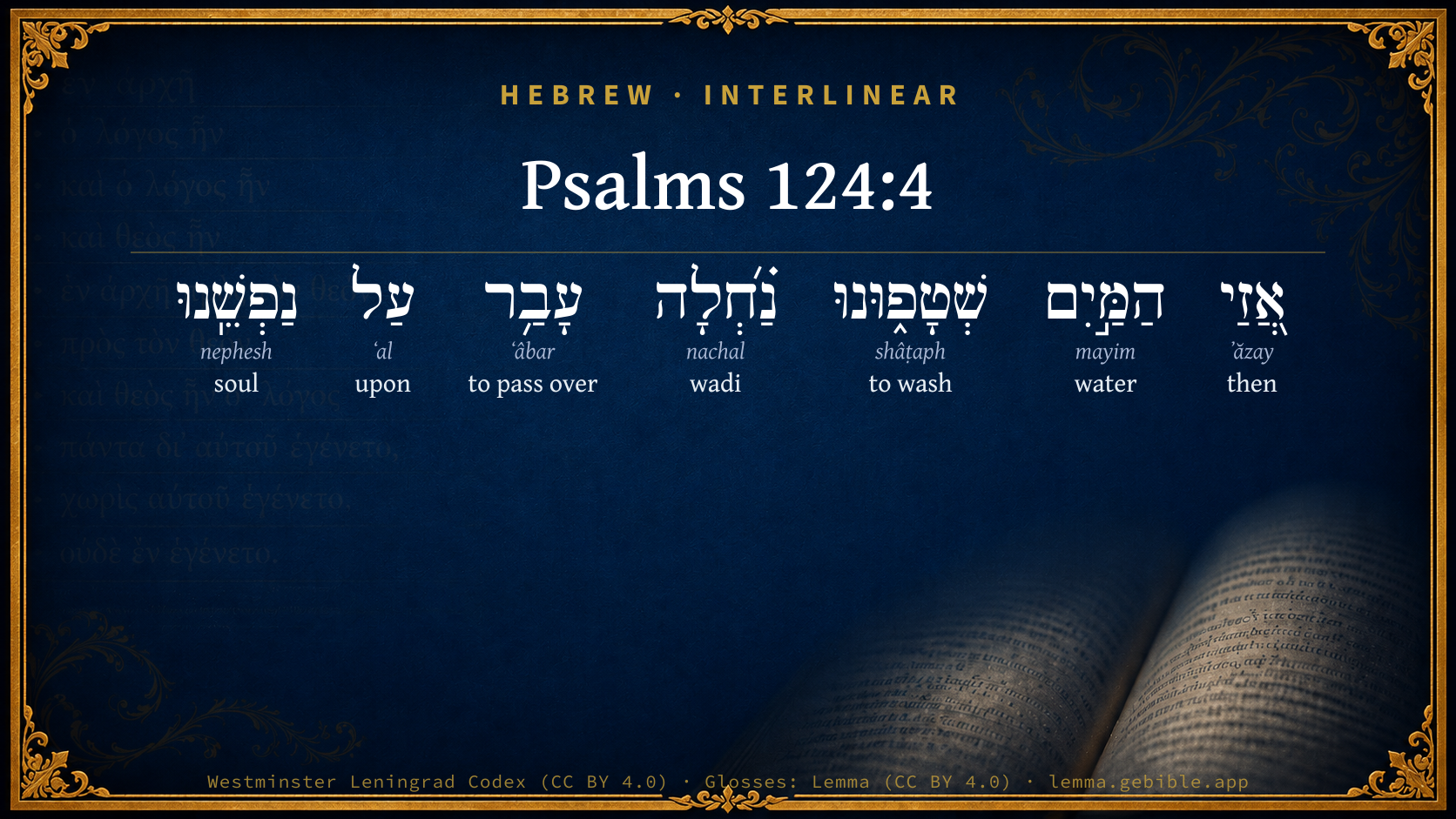
Psalms 124:4

Hebrew (Westminster Leningrad Codex) Psalms 124:4 appears in the Hebrew Old Testament. The text above is from the Westminster Leningrad Codex. Each word links to its Strong’s number, a concise gloss, and parsing drawn from the Open Scriptures Hebrew Bible morphology. Click any word for its full Brown-Driver-Briggs (BDB) entry.
Download image
Cite this verse

Psalms 124:4 (World English Bible). Public Domain. Lemma interlinear Bible study tool, https://lemma.gebible.app/v/psalms/124/4.

Show BibTeX & RIS
BibTeX
RIS
English Translation
Then the waters would have overwhelmed us, The stream would have gone over our soul;
World English Bible · Public Domain
Download a study sheet

One document with this verse’s original text, its word-by-word gloss line, the meaning frame, cross-references with their text, attributed commentary, and full source and license credits — printable, and it pastes into notes with its structure intact.

This verse Autodidact and up

Study sheet (.html) Plain text (.txt)

A passage Seminary Student

Up to 50 verses in one chapter. A passage sheet keeps up to 6 commentary sources and 12 cross-references per verse, in the order this page ranks them, and says so on the sheet whenever that leaves anything out. Ask for a single verse and you get the Autodidact verse sheet above.

Everything on this page stays free to read, with no account — the sheet is a download of what is already on screen, not access to it.

Want to remove ads? Support Godless Engineer
Compare translations 3

The same verse in 3 English versions, stacked beneath the original-language interlinear above. Click any original word for its lexicon entry.

Each is an independent rendering of the whole verse — the interlinear is not word-aligned to these translations.

Highlighted words mark where these versions differ — a whole-verse word diff, not a word-by-word alignment.

  • World English Bible Public Domain
    Then the waters would have overwhelmed us, The stream would have gone over our soul;
  • King James Version Public Domain
    Then the waters had overwhelmed us, the stream had gone over our soul:
  • unfoldingWord Literal Text CC BY-SA 4.0
    Then the waters would have overflowed us; the torrent would have passed over our soul.

unfoldingWord Literal Text — © unfoldingWord, licensed CC BY-SA 4.0. Word-aligned USFM3 via Door43 (git.door43.org/unfoldingWord/en_ult).

Versions to compare (up to 4)

3 of 4 selected

Show all 18 translations

Every available English version of this verse, each an independent rendering of the whole verse.

  • World English Bible Public Domain
    Then the waters would have overwhelmed us, The stream would have gone over our soul;
  • Berean Standard Bible Public Domain
    then the floods would have engulfed us, then the torrent would have overwhelmed us,
  • Majority Standard Bible Public Domain
    then the floods would have engulfed us, then the torrent would have overwhelmed us,
  • King James Version Public Domain
    Then the waters had overwhelmed us, the stream had gone over our soul:
  • American Standard Version (1901) Public Domain
    Then the waters had overwhelmed us, The stream had gone over our soul;
  • Revised Version (1885) Public Domain
    Then the waters had overwhelmed us, the stream had gone over our soul:
  • Geneva Bible (1599) Public Domain
    Then the waters had drowned vs, and the streame had gone ouer our soule:
  • Douay-Rheims (1899) Public Domain
    For our soul is greatly filled: we are a reproach to the rich, and contempt to the proud.
  • Young's Literal Translation Public Domain
    Then the waters had overflowed us, The stream passed over our soul,
  • Literal Standard Version CC BY-SA 4.0
    Then the waters had overflowed us, || The stream passed over our soul,
  • Unlocked Literal Bible CC BY-SA 4.0
    The water would have swept us away; the torrent would have overwhelmed us.
  • unfoldingWord Literal Text CC BY-SA 4.0
    Then the waters would have overflowed us; the torrent would have passed over our soul.
  • Darby Bible Public Domain
    Then the waters had overwhelmed us, a torrent had gone over our soul;
  • World Messianic Bible Public Domain
    then the waters would have overwhelmed us, the stream would have gone over our soul.
  • Webster's Bible Public Domain
    Then the waters had overwhelmed us, the stream had gone over our soul:
  • Free Bible Version CC BY-SA 4.0
    Like a flood they would have swept over us; like a rushing torrent they would have submerged us.
  • Bible in Basic English Public Domain
    We would have been covered by the waters; the streams would have gone over our soul;
  • JPS Tanakh (1917) Public Domain
    Then the waters had overwhelmed us, the stream had gone over our soul;

Literal Standard Version (2020), Covenant Press — licensed CC BY-SA 4.0. Text via the HelloAO Bible API (eBible.org). Unlocked Literal Bible (unfoldingWord) — licensed CC BY-SA 4.0. Text via the HelloAO Bible API (eBible.org). unfoldingWord Literal Text — © unfoldingWord, licensed CC BY-SA 4.0. Word-aligned USFM3 via Door43 (git.door43.org/unfoldingWord/en_ult). Free Bible Version, Dr. Jonathan Gallagher — licensed CC BY-SA 4.0. Text via the HelloAO Bible API (eBible.org).

Word by word

More ways to search: Search by grammar → Find every occurrence → Compare this word →

Practice this passage: Drill this verse → Learn its vocabulary →

About this verse

These counts appear in no published source. They are computed here, from the morphology-tagged text and Lemma’s own curated glosses. What Lemma adds →

7
words
7
distinct lemmas
Wisdom
section

Notable vocabulary

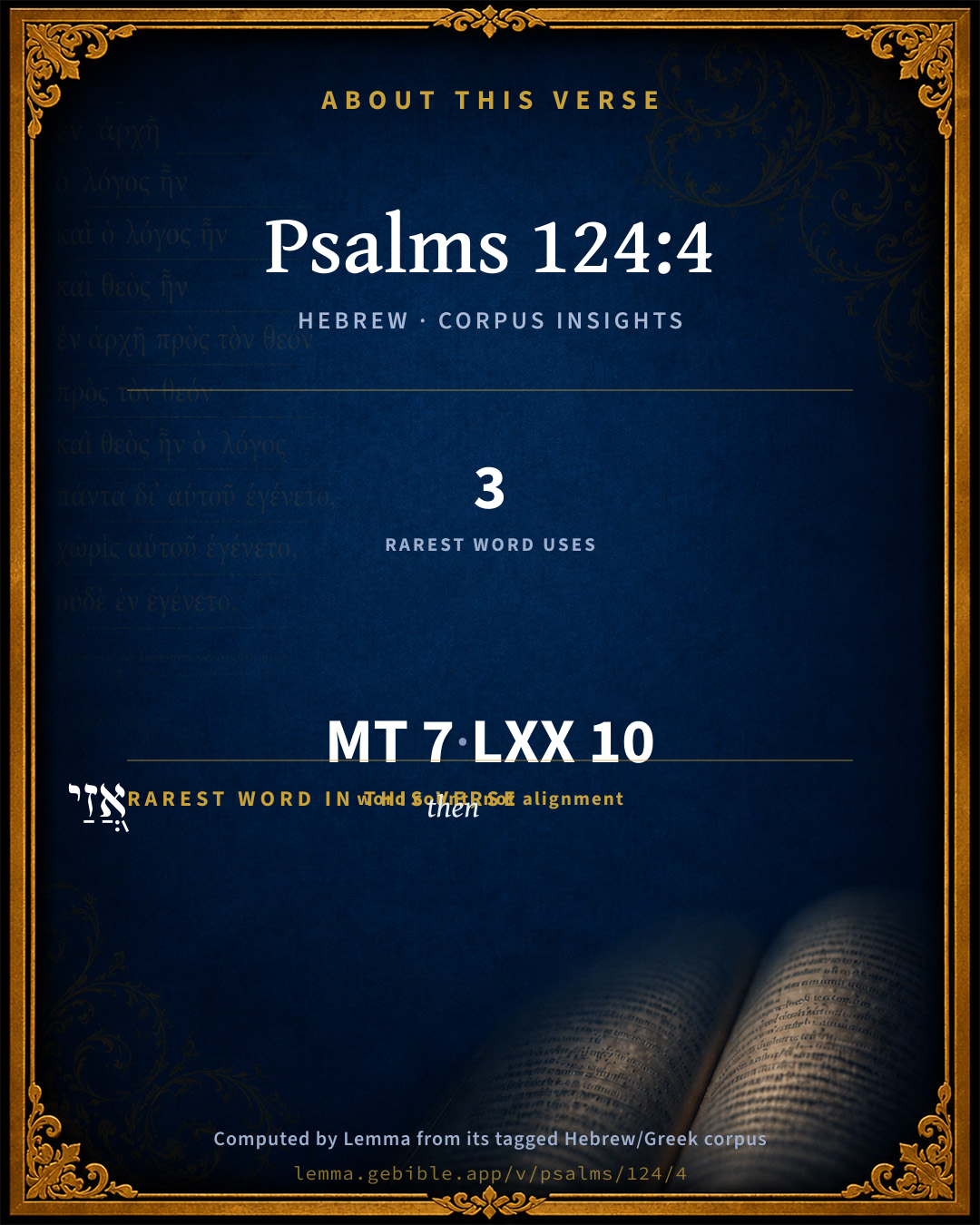
The rarest word here is אֲ֭זַי then H233 — appearing just 3 times in the whole Hebrew Bible.

Shared distinctive vocabulary

אֲ֭זַי then H233 occurs in 3 verses of the Hebrew Bible. Also found in:

Grammatical profile

  • 2 verbs
  • 3 nouns
  • 1 preposition
  • 1 adverb

Verb forms

  • שְׁטָפ֑וּנוּ Qal · Perfect
  • עָבַ֥ר Qal · Perfect

Hebrew & Septuagint length

In English translation the verse runs 15 words from the Hebrew and 15 from the Septuagint (LXX English) — the same length.

A rough comparison of the two English renderings, which tokenize alike — not a word-level alignment.

Word counts can differ between the Hebrew and the Greek without any difference in meaning — e.g. the Hebrew direct-object marker אֵת has no separate Greek word, and Greek often adds the article ὁ.

In the original languages it is 7 Hebrew tokens and 10 Greek tokens — but the two are counted differently (Hebrew bundles its prefixes and suffixes into one token; the Greek is in lemma form), so that isn’t a like-for-like length.

Cross-references

14

Topical passages linked to Psalms 124:4 in the Treasury of Scripture Knowledge — connected by theme and wording, ordered by reader-vote popularity; previews shown in the World English Bible.

  • Psalms 69:15 Don't let the flood waters overwhelm me, Neither let the deep swallow me up. Don't let the pit shut its mouth on me.
  • Revelation 17:15 He said to me, "The waters which you saw, where the prostitute sits, are peoples, multitudes, nations, and languages.
  • Revelation 12:15–16 The serpent spewed water out of his mouth after the woman like a river, that he might cause her to be carried away by the stream.
  • Psalms 32:6 For this, let everyone who is godly pray to you in a time when you may be found. Surely when the great waters overflow, they shall not reach to him.
  • Psalms 69:2 I sink in deep mire, where there is no foothold. I have come into deep waters, where the floods overflow me.
  • Isaiah 8:7–8 now therefore, behold, the Lord brings up on them the waters of the River, strong and many, [even] the king of Assyria and all his glory: and it shall come up over all its channels, and go over all its banks;
  • Isaiah 59:19 So shall they fear the name of Yahweh from the west, and his glory from the rising of the sun; for he will come as a rushing stream, which the breath of Yahweh drives.
  • Jeremiah 46:7–8 Who is this who rises up like the Nile, whose waters toss themselves like the rivers?
  • Job 22:11 Or darkness, so that you can not see, And floods of waters cover you.
  • Psalms 18:4 The cords of death surrounded me. The floods of ungodliness made me afraid.
  • Psalms 42:7 Deep calls to deep at the noise of your waterfalls. All your waves and your billows have swept over me.
  • Isaiah 28:2 Behold, the Lord has a mighty and strong one; as a tempest of hail, a destroying storm, as a tempest of mighty waters overflowing, will he cast down to the earth with the hand.
  • Daniel 9:26 After the sixty-two weeks the Anointed One shall be cut off, and shall have nothing: and the people of the prince who shall come shall destroy the city and the sanctuary; and the end of it shall be with a flood, and even to the end shall be war; desolations are determined.
  • Revelation 17:1 One of the seven angels who had the seven bowls came and spoke with me, saying, "Come here. I will show you the judgment of the great prostitute who sits on many waters,

Cross-references courtesy of OpenBible.info (CC BY 4.0).

Hebrew and Greek witnesses Masoretic Hebrew ↔ Greek Septuagint

The same verse in the two great witnesses to the Old Testament, shown verse-for-verse.

You’re reading Greek Psalm 123 (Hebrew Psalm 124). The Septuagint counts the superscription, so verse numbers can differ from the Hebrew — chapter-level alignment, not verse-by-verse. Numbering follows Rahlfs.

These are two independent witnesses, not word-aligned to each other, and the Septuagint is shown in lemma (dictionary) form.

Hebrew Psalms 124:4 Masoretic · Westminster Leningrad Codex

אֲ֭זַי הַמַּ֣יִם שְׁטָפ֑וּנוּ נַ֗֜חְלָה עָבַ֥ר עַל נַפְשֵֽׁנוּ

Then the waters would have overwhelmed us, The stream would have gone over our soul;

World English Bible · Public Domain

Greek LXX Greek Psalm 123:4 Septuagint · lemma form

ἄρα ὁ ὕδωρ καταποντίζω ἐγώ χειμάρρους διαἔρχομαι ὁ ψυχή ἐγώ

verily the water would have drowned us, our soul would have gone under the torrent.

LXX2012 (modern English Septuagint) · Public Domain

Hebrew: Westminster Leningrad Codex (CC BY 4.0). Greek: Septuagint (public domain); English from LXX2012 (modern English Septuagint) (Public Domain). How the Septuagint differs from the Hebrew →

Commentary

Notes on Psalms 124:4 from classic Christian and Jewish commentators (each source and its license shown beneath its notes). The classic Christian expositions comment on the surrounding passage and are grouped to its opening verse, so a note may address several verses; the Jewish commentaries on the Tanakh (Rashi and others) are per-verse, so they appear only where the commentator wrote on this verse.

Lemma curates 59 commentaries, every one of them public domain or Creative Commons licensed, each selected and text-cleaned for this edition rather than reprinted as found. About our sources →

Trapp's Complete Commentary

John Trapp

Psa 124:4 Then the waters had overwhelmed us, the stream had gone over our soul:

Ver. 4. Then the waters had overwhelmed us] As once the Red Sea did the Egyptians, or as the general deluge did the old world.

The stream had gone over our soul] Neither could we have withstood it by any art or industry.

John Trapp, A Commentary or Exposition upon All the Books of the Old and New Testament (1647–1656) — public domain. Text from a community e-Sword module.

J. A. Alexander on Psalms

Joseph Addison Alexander

4. (Psa 124:4) Then the waters would have overwhelmed us (and) a stream passed over our soul. The common version (had overwhelmed us) is entirely correct, and more poetical in form than that here given, but at the same time ambiguous, as the sentence, taken by itself, would seem to mean, that before the time signified by then, the waters had actually overwhelmed them, which was not the case. The figures are the same as in Psa 18:4; Psa 18:16; Psa 144:7.

Joseph Addison Alexander, The Psalms Translated and Explained (1850) — public domain. Text from a community e-Sword module.

Tyndale Open Study Notes

Tyndale Open Resources

124:4-5 the raging waters of their fury: The enemies could have overwhelmed the Israelites and wiped them out if the Lord had not been with his people (cp. 69:15; Jer 46:8).

Tyndale Open Study Notes — © Tyndale Open Resources, licensed CC BY-SA 4.0. Text via the HelloAO Bible API.

Geneva Bible (1599)

Geneva Bible translators

He useth most proper similitudes to express the great danger that the Church was in, and out of the which God miraculously delivered them.

Geneva Bible (1599) marginal notes — public domain. Text via Bolls.life.

John Calvin's Commentaries

4. The waters had then overwhelmed us. He embellishes by an elegant metaphor the preceding sentiment, comparing the dreadful impetuosity of the enemies of the Jews to an inundation, which swallows up whatever it meets with in its overflowing course. And he continues to preserve the character of a man affrighted. He names the waters, next the torrent, thirdly, the proud or impetuous waters. He says, over us, and over our soul, as if, by presenting the thing to the eye, he intended to strike terror into the people. And certainly this impassioned language ought to have all the effect of a graphic representation, that the faithful might the better feel from what a profound gulf they had been rescued by the hand of God. He only truly attributes his deliverance to God, who acknowledges himself to have been lost before he was delivered. The adverb them is here either demonstrative, as if the Psalmist had pointed to the thing with the finger, or it is taken for long ago. The former signification is, however, more suitable to the present passage.

John Calvin's Commentaries (1540-1563) — public domain. Text from the Calvin Translation Society English edition (1840s-50s) via the Christian Classics Ethereal Library (ccel.org). Calvin's coverage is partial (roughly two-thirds of the Bible); uncommented books and verses are honest gaps, never fabricated. The 19th-century editor's footnotes and remarks are omitted so the notes are faithfully Calvin's own voice.

Ellicott's Commentary for English Readers

(4) Waters.—The sudden transition in the imagery from the earthquake to the flood is characteristic of Hebrew poetry. (For the flood, see Psa_18:4; Psa_18:16; Psa_69:14; Psa_144:7.)

Stream.—The torrent swollen with the winter rain. (Comp. Isa_8:7-8.)

A Bible Commentary for English Readers, edited by Charles John Ellicott (1878–1897) — public domain. Text from a community e-Sword module.

The Cambridge Bible for Schools and Colleges

gen. ed. J. J. S. Perowne

4. For the figure cp. Psa_18:16; Psa_69:1-2; Psa_69:15; Isa_8:7-8; Lam_3:54.

the stream] The torrent, suddenly swollen by a storm. Cp. Jdg_5:21.

had gone over our soul] Overwhelmed us and put an end to our existence.

The Cambridge Bible for Schools and Colleges (gen. ed. J. J. S. Perowne; Cambridge University Press, 1878–1918) — public domain. Text from a community e-Sword module.

John Gill's Exposition

Then the waters had overwhelmed us,.... People, comparable to waters for their multitude, Strength, force, and impetuosity; which bear down all before them, and against which there is no standing; which, like the waters of the flood, overflow and destroy all they pass over. These are the floods of ungodly men, which are very destructive and terrible; see Rev 17:15; together with all those reproaches, afflictions, and persecutions, which come along with them; which the presence of God only can bear up his people under, and carry them through, Sol 8:7;

the stream had gone over our soul; and so deprived them of life; the whole force of the enemy; which, like a stream, flows in with great strength and rapidity, when a breach is made and spreads itself, Arama interprets it of the stream of the Egyptians, and restrains it to them, their armies and forces; but it rather designs others, and the enemies of God's people in general, which threaten their ruin, even their very souls and lives: it may be applied to the stream of corruptions, the flood of temptation and flow of persecutions, such as the flood the dragon cast out of his mouth after the woman; which, were it not for divine grace and assistance, would destroy the saints, who have no might against this great force, Ch2 20:12.

John Gill's Exposition of the Whole Bible (1746–1763) — public domain (CC PDM 1.0). Text via the HelloAO Bible API.

Albert Barnes' Notes on the Bible

Then the waters had overwhelmed us - Our destruction would have been as if the waves of the ocean had overwhelmed us.

The stream had gone over our soul - The torrent would have swept us away. Compare Psa 18:4, Psa 18:16.

Albert Barnes' Notes on the Bible (1834–1885) — public domain. Text from a community e-Sword/MySword module.

The Treasury of David

Charles H. Spurgeon

Ver. 4. Then the waters had overwhelmed us. Rising irresistibly, like the Nile, the flood of opposition would soon have rolled over our heads. Across the mighty waste of waters we should have cast an anxious eye, but looked in vain for escape. The motto of a royal house is, "Tossed about but not submerged": we should have needed an epitaph rather than an epigram, for we should have been driven by the torrent and sunken, never to rise again.

The stream had gone over our soul. The rushing torrent would have drowned our soul, our hope, our life. The figures seem to be the steadily rising flood, and the hurriedly rushing stream. Who can stand against two such mighty powers? Everything is destroyed by these unconquerable forces, either by being submerged or swept away. When the world's enmity obtains a vent it both rises and rushes, it rages and rolls along, and spares nothing. In the great water floods of persecution and affliction who can help but Jehovah? But for him where would we be at this very hour? We have experienced seasons in which the combined forces of earth and hell must have made an end of us had not omnipotent grace interfered for our rescue.

Ver. 4,5. A familiar, but exceedingly apt and most significant figure. Horrible is the sight of a raging conflagration; but far more destructive is a river overflowing its banks and rushing violently on: for it is not possible to restrain it by any strength or power. As, then, he says, a river is carried along with great impetuosity, and carries away and destroys whatever it meets with in its course; thus also is the rage of the enemies of the church, not to be withstood by human strength. Hence, we should learn to avail ourselves of the protection and help of God. For what else is the church but a little boat fastened to the bank, which is carried away by the force of the waters? or a shrub growing on the bank, which without effort the flood roots up? Such was the people of Israel in the days of David compared with the surrounding nations. Such in the present day is the church compared with her enemies. Such is each one of us compared with the power of the malignant spirit. We are as a little shrub, of recent growth and having no firm hold: but he is like the Elbe, overflowing, and with great force overthrowing all things far and wide. We are like a withered leaf, lightly holding to the tree; he is like the north wind, with great force rooting up and throwing down the trees. How, then, can we withstand or defend ourselves by out' own power? Martin Luther.

Ver. 4,5. First the "waters"; then "the stream" or torrent; then "the proud waters, "lifting up their heads on high. First the waters overwhelm us; then the torrent goes over our soul; and then the proud waters go over our soul. What power can resist the rapid floods of waters, when they overspread their boundaries, and rush over a country? Onward they sweep with resistless force, and men and cattle, and crops and houses, are destroyed. Let the impetuous waters break loose, and, in a few minutes, the scene of life, and industry, and happiness, is made a scene of desolation and woe. Perhaps there is an allusion here to the destruction of the Egyptians in the Red Sea. The floods fell upon them, the depths covered them: they sank into the bottom as a stone. Had God not stretched forth his hand to rescue the Israelites, their enemies would have overwhelmed them. Happy they who, in seasons of danger, have Jehovah for a hiding place. N. McMichael.

Psalms 124:5*

Charles H. Spurgeon's The Treasury of David (1869–1885) — public domain. Psalms only. Text from a community e-Sword/MySword module.

Whedon's Commentary on the Bible

Daniel D. Whedon

4. The waters… overwhelmed us—Probably an allusion to Exo_14:27-28.

The stream—The mountain torrent. These, in the rainy season, are terrible, and against them no art or power of man can prevail. A single thunder storm of rain will often suffice to create a flood which sweeps away habitations and families and animals. Such a seil, or flood, in the Wady Solaf, Mount Sinai, in 1867, swept away an Arab encampment, and forty persons, with many camels, sheep, and cattle, perished in the waters. Palmer and his company saw trunks of large palm trees which had been carried thirty miles down the valley by this flood. See Psa_18:13; Psa_18:15. The description of Isa_8:7-8, refers to the excessive overflow of the Nile or of the Euphrates, which, though more rare and gradual, is yet far more terrible. These perils from the great forces of nature are a fit emblem of the dangers, often as sudden as overwhelming, to which the militant Church is exposed.

Daniel D. Whedon (gen. ed.), Commentary on the Old and New Testaments (1874–1909) — public domain. Text from a community e-Sword module.

The Pulpit Commentary

Then the waters had overwhelmed us. A sudden and startling change of metaphor. In the quick transition of Oriental thought, the fire becomes a flood an irresistible torrent-stream, carrying all before it. (comp. Psa_18:4 Psa_144:7) The stream had gone over our soul; i.e. "had mounted up over our heads, and stifled our breath of life."

The Pulpit Commentary (1880–1919), ed. H.D.M. Spence-Jones & Joseph S. Exell — public domain. Text from a community e-Sword module.

unfoldingWord translationNotes

Door43 World Missions Community

General Information:

In these two verses the author compares the enemies of Israel to a flood of water.

The water would have swept us away ... would have drowned us

This continues the hypothetical statement from the previous verse. It describes a result that did not happen, because Yahweh was actually on their side. AT: "The water did not sweep us away ... did not drown us" (See: Hypothetical Situations)

The water ... the torrent ... the raging waters

These phrases mean the same thing. (See: Parallelism)

swept us away ... overwhelmed us ... drowned us

These phrases mean the same thing. (See: Parallelism)

The water would have swept us away

Here the enemies of the writer are spoken of as if they were a flood of water. AT: "Our enemies would have easily defeated us" (See: Metaphor)

the torrent would have overwhelmed us

Here the enemies of the writer are spoken of as if they were a flood of water that would have drowned the Israelites. AT: "our enemies would have overwhelmed us" (See: Metaphor)

the raging waters would have drowned us

Here the enemies of the writer are spoken of as if they were a raging river that would have drowned the Israelites. AT: "our enemies would have destroyed us" (See: Metaphor)

translationWords

water

unfoldingWord translationNotes — © Distant Shores Media and the Door43 World Missions Community, licensed CC BY-SA 4.0. Source: git.door43.org/Door43/en_tn.

Rashi

Rabbi Shlomo Yitzchaki (Rashi)

illness Heb. נחלה, expression of illness (חלי).

Rashi on the Tanakh — English translations: “The Judaica Press complete Tanach with Rashi, translated by A. J. Rosenberg” (CC BY 4.0); “Pentateuch with Rashi's commentary by M. Rosenbaum and A.M. Silbermann, 1929-1934” (public domain); “The Metsudah Tanach series, Lakewood, N.J” (CC BY 4.0); and “The Book of Joshua, Metsudah Publications, 1997” (CC BY 4.0). Text via Sefaria.

Lesson kit

Teaching starters — assembled from the data on this page, not authored interpretation. Every prompt links to the verse data it draws on. Edit before teaching.

Psalms, in the Wisdom, opens this verse with 7 words (7 distinct Hebrew lemmas). Its most distinctive word is ʼăzay (“then”). A historical commentator’s framing appears above. Read the whole chapter for the surrounding context.

Discussion questions

  1. How does “then” (ʼăzay) shape what this verse is saying?
  2. How does Psalms 124:3, which shares the word «then», read alongside this verse?
  3. These translations render this verse differently. What is at stake in choosing one wording over another?
  4. «שְׁטָפ֑וּנוּ» is a Qal Perfect verb. How does that grammatical form shape the action described?
  5. Compare how Trapp's Complete Commentary and J. A. Alexander on Psalms read this verse. Where do they agree or differ?

Things to notice

Reading settings

Reading text

Shown beneath each verse's original-language words.

Old Testament
Old Testament edition

Read the OT as the Masoretic Hebrew (MT) or the Greek Septuagint (LXX).

English shown for the Greek Septuagint (in the Hebrew ↔ Greek comparison).

Comparing translations? Open the Compare panel on any verse page to stack up to four side by side.