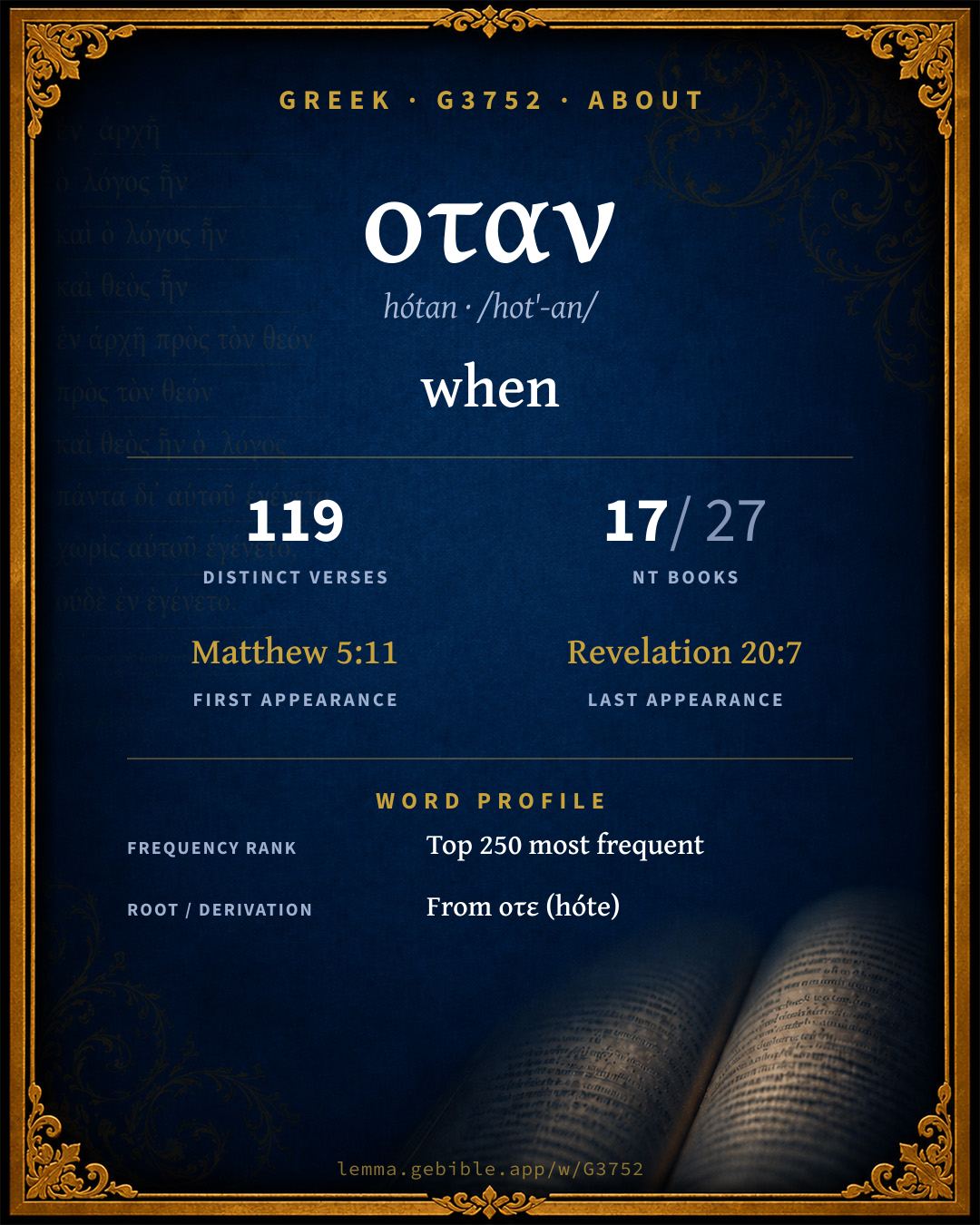
ὅταν
when
Full lexicon entry — Thayer's Greek Lexicon
From Thayer's Greek Lexicon
Where this word appears
Grammar key — what these labels mean
Part of speech
- Conjunction
- A joining word linking words or clauses.
Every verse where G3752 appears — 119 distinct verses across 17 books. Click any verse to open its interlinear word-by-word view. Verse text shown in the World English Bible for context — . Each verse’s Greek form is shown with its reference; the English is not keyword-highlighted, since the data carries no word-level English alignment. Use “Compare translations” on any verse to read it across multiple English versions. This concordance covers the Greek New Testament; Septuagint (Greek Old Testament) occurrences of this word are not indexed here.
Matthew 19 verses
- Matthew 5:11 ὅταν conj "Blessed are you when people reproach you, persecute you, and say all kinds of evil against you falsely, for my sake.
- Matthew 6:2 ὅταν conj Therefore when you do merciful deeds, don't sound a trumpet before yourself, as the hypocrites do in the synagogues and in the streets, that they may get glory from men. Most assuredly I tell you, they have received their reward.
- Matthew 6:5 ὅταν conj "When you pray, you shall not be as the hypocrites, for they love to stand and pray in the synagogues and in the corners of the streets, that they may be seen by men. Most assuredly, I tell you, they have received their reward.
- Matthew 6:6 ὅταν conj But you, when you pray, enter into your inner chamber, and having shut your door, pray to your Father who is in secret, and your Father who sees in secret will reward you openly.
- Matthew 6:16 Ὅταν conj "Moreover when you fast, don't be like the hypocrites, with sad faces. For they disfigure their faces, that they may be seen by men to be fasting. Most assuredly I tell you, they have received their reward.
- Matthew 9:15 ὅταν conj Jesus said to them, "Can the friends of the bridegroom mourn, as long as the bridegroom is with them? But the days will come when the bridegroom will be taken away from them, and then they will fast.
- Matthew 10:19 ὅταν conj But when they deliver you up, don't be anxious how or what you will say, for it will be given you in that hour what you will say.
- Matthew 10:23 ὅταν conj But when they persecute you in this city, flee into the next, for most assuredly I tell you, you will not have gone through the cities of Israel, until the Son of Man has come.
- Matthew 12:43 Ὅταν conj But the unclean spirit, when he is gone out of the man, passes through waterless places, seeking rest, and doesn't find it.
- Matthew 13:32 ὅταν conj which indeed is smaller than all seeds. But when it is grown, it is greater than the herbs, and becomes a tree, so that the birds of the air come and lodge in its branches."
- Matthew 15:2 ὅταν conj "Why do your disciples disobey the tradition of the elders? For they don't wash their hands when they eat bread."
- Matthew 19:28 ὅταν conj Jesus said to them, "Most assuredly I tell you that you who have followed me, in the regeneration when the Son of Man will sit on the throne of his glory, you also will sit on twelve thrones, judging the twelve tribes of Israel.
- Matthew 21:40 ὅταν conj When therefore the lord of the vineyard comes, what will he do to those farmers?"
- Matthew 23:15 ὅταν conj Woe to you, scribes and Pharisees, hypocrites! For you travel around by sea and land to make one proselyte; and when he becomes one, you make him twice as much of a son of Gehenna as yourselves.
- Matthew 24:15 Ὅταν conj "When, therefore, you see the abomination of desolation, which was spoken of through Daniel the prophet, standing in the holy place (let the reader understand),
- Matthew 24:32 ὅταν conj "Now from the fig tree learn this parable. When its branch has now become tender, and puts forth its leaves, you know that the summer is near.
- Matthew 24:33 ὅταν conj Even so you also, when you see all these things, know that it is near, even at the doors.
- Matthew 25:31 Ὅταν conj "But when the Son of Man comes in his glory, and all the holy angels with him, then he will sit on the throne of his glory.
- Matthew 26:29 ὅταν conj But I tell you that I will not drink of this fruit of the vine from now on, until that day when I drink it anew with you in my Father's Kingdom."
Mark 21 verses
- Mark 2:20 ὅταν conj But the days will come when the bridegroom will be taken away from them, and then will they fast in that day.
- Mark 3:11 ὅταν conj The unclean spirits, whenever they saw him, fell down before him, and cried, "You are the Son of God!"
- Mark 4:15 ὅταν conj These are the ones by the road, where the word is sown; and when they have heard, immediately Satan comes, and takes away the word which has been sown in them.
- Mark 4:16 ὅταν conj These in like manner are those who are sown on the rocky places, who, when they have heard the word, immediately receive it with joy.
- Mark 4:29 ὅταν conj But when the fruit is ripe, immediately he puts forth the sickle, because the harvest has come."
- Mark 4:31 ὅταν conj It's like a grain of mustard seed, which, when it is sown in the earth, though it is less than all the seeds that are on the earth,
- Mark 4:32 ὅταν conj yet when it is sown, grows up, and becomes greater than all the herbs, and puts out great branches, so that the birds of the sky can lodge under its shadow."
- Mark 8:38 ὅταν conj For whoever will be ashamed of me and of my words in this adulterous and sinful generation, the Son of Man also will be ashamed of him, when he comes in the glory of his Father with the holy angels."
- Mark 9:9 ὅταν conj As they were coming down from the mountain, he charged them that they should tell no one what things they had seen, until after the Son of Man had risen from the dead.
- Mark 11:19 ὅταν conj When evening came, he went out of the city.
- Mark 11:25 ὅταν conj Whenever you stand praying, forgive, if you have anything against anyone; so that your Father, who is in heaven, may also forgive you your transgressions.
- Mark 12:23 ὅταν conj In the resurrection, when they rise, whose wife will she be of them? For the seven had her as a wife."
- Mark 12:25 ὅταν conj For when they will rise from the dead, they neither marry, nor are given in marriage, but are like angels in heaven.
- Mark 13:4 ὅταν conj "Tell us, when will these things be? What is the sign that these things are all about to be fulfilled?"
- Mark 13:7 ὅταν conj "When you hear of wars and rumors of wars, don't be troubled. For those must happen, but the end is not yet.
- Mark 13:11 ὅταν conj When they lead you away and deliver you up, don't be anxious beforehand, or premeditate what you will say, but say whatever will be given you in that hour. For it is not you who speak, but the Holy Spirit.
- Mark 13:14 Ὅταν conj But when you see the abomination of desolation, spoken of by Daniel the prophet, standing where it ought not (let the reader understand), then let those who are in Judea flee to the mountains,
- Mark 13:28 ὅταν conj "Now from the fig tree, learn this parable. When the branch has now become tender, and puts forth its leaves, you know that the summer is near;
- Mark 13:29 ὅταν conj even so you also, when you see these things coming to pass, know that it is near, at the doors.
- Mark 14:7 ὅταν conj For you always have the poor with you, and whenever you want to, you can do them good; but you will not always have me.
- Mark 14:25 ὅταν conj Most assuredly I tell you, I will no more drink of the fruit of the vine, until that day when I drink it anew in the Kingdom of God."
Luke 27 verses
- Luke 5:35 ὅταν conj But the days will come when the bridegroom will be taken away from them. Then they will fast in those days."
- Luke 6:22 ὅταν ὅταν conj conj Blessed are you when men shall hate you, and when they shall exclude and mock you, and throw out your name as evil, for the Son of Man's sake.
- Luke 6:26 ὅταν conj Woe, when men speak well of you! For their fathers did the same thing to the false prophets.
- Luke 8:13 ὅταν conj Those on the rock are they who, when they hear, receive the word with joy; but these have no root, who believe for a while, then fall away in time of temptation.
- Luke 9:26 ὅταν conj For whoever will be ashamed of me and of my words, of him will the Son of Man be ashamed, when he comes in his glory, and the glory of the Father, and of the holy angels.
- Luke 11:2 ὅταν conj He said to them, "When you pray, say, 'Our Father in heaven, May your name be kept holy. May your Kingdom come. May your will be done on Earth, as it is in heaven.
- Luke 11:21 Ὅταν conj "When the strong man, fully armed, guards his own dwelling, his goods are safe.
- Luke 11:24 Ὅταν conj The unclean spirit, when he has gone out of the man, passes through dry places, seeking rest, and finding none, he says, 'I will turn back to my house from which I came out.'
- Luke 11:34 ὅταν conj The lamp of the body is the eye. Therefore when your eye is good, your whole body is also full of light; but when it is evil, your body also is full of darkness.
- Luke 11:36 ὅταν conj If therefore your whole body is full of light, having no part dark, it will be wholly full of light, as when the lamp with its bright shining gives you light."
- Luke 12:11 ὅταν conj When they bring you before the synagogues, the rulers, and the authorities, don't be anxious how or what you will answer, or what you will say;
- Luke 12:54 ὅταν conj He said to the multitudes also, "When you see a cloud rising from the west, immediately you say, 'A shower is coming,' and so it happens.
- Luke 12:55 ὅταν conj When a south wind blows, you say, 'There will be a scorching heat,' and it happens.
- Luke 13:28 ὅταν conj There will be weeping and gnashing of teeth, when you see Abraham, Isaac, Jacob, and all the prophets, in the Kingdom of God, and yourselves being thrown outside.
- Luke 14:8 ὅταν conj "When you are invited by anyone to a marriage feast, don't sit in the best seat, since perhaps someone more honorable than you might be invited by him,
- Luke 14:10 ὅταν ὅταν conj conj But when you are invited, go and sit in the lowest place, so that when he who invited you comes, he may tell you, 'Friend, move up higher.' Then you will be honored in the presence of all who sit at the table with you.
- Luke 14:12 ὅταν conj He also said to the one who had invited him, "When you make a dinner or a supper, don't call your friends, nor your brothers, nor your kinsmen, nor rich neighbors, or perhaps they might also return the favor, and pay you back.
- Luke 14:13 ὅταν conj But when you make a feast, ask the poor, the maimed, the lame, or the blind;
- Luke 16:4 ὅταν conj I know what I will do, so that when I am removed from management, they may receive me into their houses.'
- Luke 16:9 ὅταν conj I tell you, make for yourselves friends by means of unrighteous mammon, so that when you fail, they may receive you into the eternal tents.
- Luke 17:10 ὅταν conj Even so you also, when you have done all the things that are commanded you, say, 'We are unworthy servants. We have done our duty.'"
- Luke 21:7 ὅταν conj They asked him, "Teacher, so when will these things be? What is the sign that these things are about to happen?"
- Luke 21:9 ὅταν conj When you hear of wars and disturbances, don't be terrified, for these things must happen first, but the end won't come immediately."
- Luke 21:20 Ὅταν conj "But when you see Jerusalem surrounded by armies, then know that its desolation is at hand.
- Luke 21:30 ὅταν conj When they are already budding, you see it and know by your own selves that the summer is already near.
- Luke 21:31 ὅταν conj Even so you also, when you see these things happening, know that the Kingdom of God is near.
- Luke 23:42 ὅταν conj He said to Jesus, "Lord, remember me when you come into your Kingdom."
John 16 verses
- John 2:10 ὅταν conj and said to him, "Everyone serves the good wine first, and when the guests have drunk freely, then that which is worse. You have kept the good wine until now!"
- John 4:25 ὅταν conj The woman said to him, "I know that Messiah comes," (he who is called Christ). "When he has come, he will declare to us all things."
- John 5:7 ὅταν conj The sick man answered him, "Sir, I have no one to put me into the pool when the water is stirred up, but while I'm coming, another steps down before me."
- John 7:27 ὅταν conj However we know where this man comes from, but when the Christ comes, no one will know where he comes from."
- John 7:31 ὅταν conj But of the multitude, many believed in him. They said, "When the Christ comes, he won't do more signs than those which this man has done, will he?"
- John 8:28 ὅταν conj Jesus therefore said to them, "When you have lifted up the Son of Man, then you will know that I am he, and I do nothing of myself, but as my Father taught me, I say these things.
- John 8:44 ὅταν conj You are of your Father, the devil, and you want to do the desires of your father. He was a murderer from the beginning, and doesn't stand in the truth, because there is no truth in him. When he speaks a lie, he speaks on his own; for he is a liar, and the father of it.
- John 9:5 ὅταν conj While I am in the world, I am the light of the world."
- John 10:4 ὅταν conj Whenever he brings out his own sheep, he goes before them, and the sheep follow him, for they know his voice.
- John 13:19 ὅταν conj From now on, I tell you before it happens, that when it happens, you may believe that I AM.
- John 14:29 ὅταν conj Now I have told you before it happens so that, when it happens, you may believe.
- John 15:26 ὅταν conj "When the Counselor has come, whom I will send to you from the Father, the Spirit of truth, who proceeds from the Father, he will testify about me.
- John 16:4 ὅταν conj But I have told you these things, so that when the time comes, you may remember that I told you about them. I didn't tell you these things from the beginning, because I was with you.
- John 16:13 ὅταν conj However when he, the Spirit of truth, has come, he will guide you into all truth, for he will not speak from himself; but whatever he hears, he will speak. He will declare to you things that are coming.
- John 16:21 ὅταν ὅταν conj conj A woman, when she gives birth, has sorrow, because her time has come. But when she has delivered the child, she doesn't remember the anguish any more, for the joy that a human being is born into the world.
- John 21:18 ὅταν conj Most assuredly I tell you, when you were young, you dressed yourself, and walked where you wanted to. But when you are old, you will stretch out your hands, and another will dress you, and carry you where you don't want to go."
Acts 2 verses
- Acts 23:35 ὅταν conj "I will hear you fully when your accusers also arrive." He commanded that he be kept in Herod's palace.
- Acts 24:22 ὅταν conj But Felix, having more exact knowledge concerning the Way, deferred them, saying, "When Lysias, the commanding officer, comes down, I will decide your case."
Romans 2 verses
1 Corinthians 11 verses
- 1 Corinthians 3:4 ὅταν conj For when one says, "I follow Paul," and another, "I follow Apollos," aren't you fleshly?
- 1 Corinthians 13:10 ὅταν conj but when that which is complete has come, then that which is partial will be done away with.
- 1 Corinthians 14:26 ὅταν conj What is it then, brothers? When you come together, each one of you has a psalm, has a teaching, has a revelation, has another language, has an interpretation. Let all things be done to build each other up.
- 1 Corinthians 15:24 ὅταν ὅταν conj conj Then the end comes, when he will deliver up the Kingdom to God, even the Father; when he will have abolished all rule and all authority and power.
- 1 Corinthians 15:27 ὅταν conj For, "He put all things in subjection under his feet." But when he says, "All things are put in subjection," it is evident that he is excepted who subjected all things to him.
- 1 Corinthians 15:28 ὅταν conj When all things have been subjected to him, then the Son will also himself be subjected to him who subjected all things to him, that God may be all in all.
- 1 Corinthians 15:54 ὅταν conj But when this corruptible will have put on incorruption, and this mortal will have put on immortality, then what is written will happen: "Death is swallowed up in victory."
- 1 Corinthians 16:2 ὅταν conj On the first day of the week, let each one of you save, as he may prosper, that no collections be made when I come.
- 1 Corinthians 16:3 ὅταν conj When I arrive, I will send whoever you approve with letters to carry your gracious gift to Jerusalem.
- 1 Corinthians 16:5 ὅταν conj But I will come to you when I have passed through Macedonia, for I am passing through Macedonia.
- 1 Corinthians 16:12 ὅταν conj Now concerning Apollos, the brother, I strongly urged him to come to you with the brothers; and it was not at all his desire to come now; but he will come when he has an opportunity.
2 Corinthians 3 verses
- 2 Corinthians 10:6 ὅταν conj and being in readiness to avenge all disobedience, when your obedience will be made full.
- 2 Corinthians 12:10 ὅταν conj Therefore I take pleasure in weaknesses, in injuries, in necessities, in persecutions, in distresses, for Christ's sake. For when I am weak, then am I strong.
- 2 Corinthians 13:9 ὅταν conj For we rejoice when we are weak and you are strong. And this we also pray for, even your perfecting.
Colossians 2 verses
1 Thessalonians 1 verse
2 Thessalonians 1 verse
1 Timothy 1 verse
Titus 1 verse
Hebrews 1 verse
James 1 verse
1 John 1 verse
Revelation 9 verses
- Revelation 4:9 ὅταν conj When the living creatures give glory, honor, and thanks to him who sits on the throne, to him who lives forever and ever,
- Revelation 8:1 ὅταν conj When he opened the seventh seal, there was silence in heaven for about half an hour.
- Revelation 9:5 ὅταν conj They were given power not to kill them, but to torment them for five months. Their torment was like the torment of a scorpion, when it strikes a person.
- Revelation 10:7 ὅταν conj but in the days of the voice of the seventh angel, when he is about to sound, then the mystery of God is finished, as he declared to his servants, the prophets.
- Revelation 11:7 ὅταν conj When they have finished their testimony, the beast that comes up out of the abyss will make war with them, and overcome them, and kill them.
- Revelation 12:4 ὅταν conj His tail drew one third of the stars of the sky, and threw them to the earth. The dragon stood before the woman who was about to give birth, so that when she gave birth he might devour her child.
- Revelation 17:10 ὅταν conj They are seven kings. Five have fallen, the one is, the other has not yet come. When he comes, he must continue a little while.
- Revelation 18:9 ὅταν conj The kings of the earth, who committed sexual immorality and lived wantonly with her, will weep and wail over her, when they look at the smoke of her burning,
- Revelation 20:7 ὅταν conj And after the thousand years, Satan will be released from his prison,
About this entry
At a glance — auto-summarized from this page’s data, not written by a person. Every figure links to its source below. This summary describes the numbers; it doesn’t interpret them.
οταν — transliterated hótan — is a Greek word carrying the sense “when.” Its earliest occurrence is Matthew 5:11. Spanning 119 verses in 17 books, it ranks among the common words of the Greek New Testament. See the sense tree, 119-verse concordance, and the renderings breakdown below.
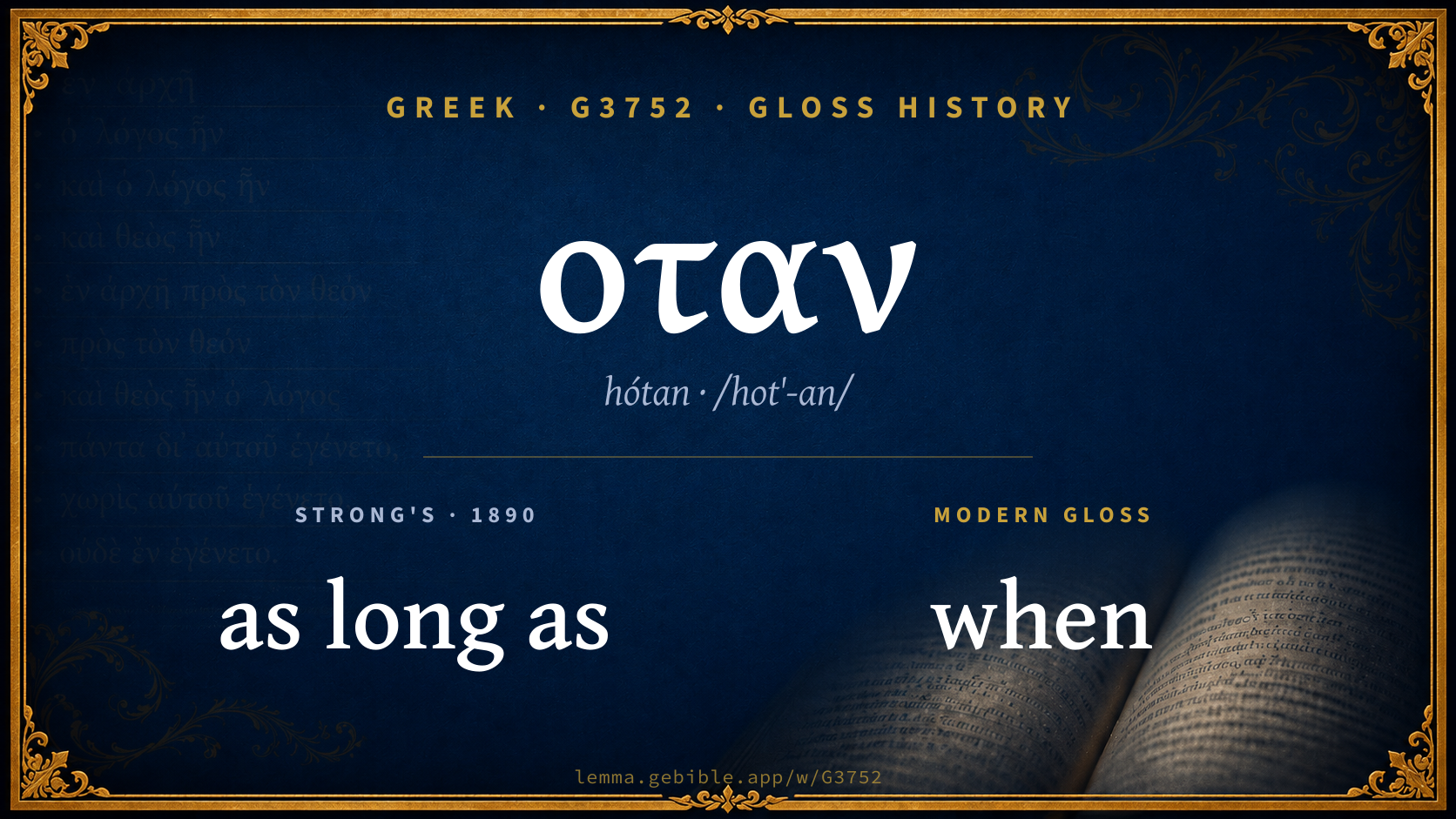
Gloss history
Strong's 1890 vs modern scholarship
About this word
Strong's G3752 catalogs a Greek word from the Greek New Testament.
These counts are not copied from any lexicon or concordance. They are computed here, from the morphology-tagged Greek New Testament. What Lemma adds →
- 119
- distinct verses
- The word appears in 119 distinct verses.
- 17 / 27
- NT books
- The word appears in 17 of 27 New Testament books.
- #135
- by frequency
- Top 250 most frequent Greek words (rank 135 of 5,347 Greek words by occurrence).
View all 119 occurrences in the concordance →
By section of the New Testament
By traditional corpus
Conventional, traditional groupings — biblical authorship is debated, so this is a traditional corpus grouping, not an authorship claim. Some books belong to more than one corpus (Luke is in both the Gospels and the Lukan corpus, and so on), so these shares overlap and need not total 100%. Each figure is a share of the word’s 119 distinct verses.
- Gospels 83 verses · 70%
- Lukan (Luke–Acts) 29 verses · 24%
- Johannine 26 verses · 22%
- Pauline corpus 22 verses · 18%
- Revelation 9 verses · 8%
- General (Catholic) Epistles 2 verses · 2%
- Hebrews 1 verse · 1%
How translations render this word
Counts come from each version’s own published word-to-Strong’s tagging or interlinear alignment — an approximate guide to how each version renders this word, not a word-level alignment the data otherwise carries. Because each total is that version’s own tagged count, the per-version totals vary from one another and need not match the appearance or distinct-verse counts above. These counts may also differ from a printed concordance because Lemma counts each distinctly tagged rendering and does not collapse phrase taggings into a single head-word total. This is a fixed set of word-tagged versions (KJV, ASV, BSB, ULT) and does not change with the reading translation you choose elsewhere. Each version’s license is shown beside its name below (and on Sources).
- King James Version: When 113×, Soon as 2×
- American Standard Version: When 113×, Whensoever 3×
- Berean Standard Bible: When 88×, After 6×, Soon as 6×
- unfoldingWord Literal Text: When 110×, Whenever 10×
King James Version Public Domain
Renders G3752 across 120 tagged occurrences — most commonly:
Plus 5 renderings that appear only once — usually multi-word phrases or single function words the recovered tagging swept in, not distinct renderings. Not rendered by a distinct English word in 2 further occurrences.
American Standard Version Public Domain
Renders G3752 across 119 tagged occurrences — most commonly:
Plus 3 renderings that appear only once — usually multi-word phrases or single function words the recovered tagging swept in, not distinct renderings.
Berean Standard Bible Public Domain
Renders G3752 across 108 tagged occurrences — most commonly:
Plus 4 renderings that appear only once — usually multi-word phrases or single function words the recovered tagging swept in, not distinct renderings. Not rendered by a distinct English word in 11 further occurrences.
unfoldingWord Literal Text CC BY-SA 4.0
Renders G3752 across 123 tagged occurrences — most commonly:
Plus 3 renderings that appear only once — usually multi-word phrases or single function words the recovered tagging swept in, not distinct renderings.
Senses in Thayer's
The 1 sense Thayer's distinguishes for this word, in lexicon order (not ranked by frequency or importance). The full entry — with sub-senses — is in the Lexicon Entry tab.
- when, whenever, as long as, as soon as
Word origin
Derived from οτε (hóte) (G3753) — when.
Forms in the corpus
The 2 distinct written forms G3752 takes in the Greek New Testament, most frequent first — each parse links to that case’s occurrences in the concordance.
| Form | Parsing | Example | Uses |
|---|---|---|---|
| ὅταν hótan | Conjunction | Matthew 5:11 | 114 |
| Ὅταν Hótan | Conjunction | Matthew 6:16 | 9 |
Septuagint usage
The same Greek word οταν appears 175 times in the Greek Old Testament (Septuagint), across 163 verses in 26 books.
- 175
- LXX occurrences
- Tagged occurrences of this Greek word in the Septuagint.
- 163
- verses
- Distinct Septuagint verses containing this word.
- 26 / 39
- OT books
- The word appears in 26 of the 39 Old Testament books.
Sample Septuagint occurrences
- Genesis 38:9 ὅταν
- Exodus 1:16 ὅταν
- Leviticus 12:6 ὅταν
- Numbers 4:5 ὅταν
- Deuteronomy 4:29 ὅταν
- Joshua 3:3 ὅταν
- Judges 21:22 ὅταν
- 1 Samuel 10:7 ὅταν
- 1 Kings 8:35 ὅταν
- 1 Chronicles 17:11 ὅταν
- Esther 2:12 ὅταν
- Job 6:4 ὅταν
Septuagint occurrences (same lexeme)
Every verse where the same Strong’s number (G3752) appears in the Greek Septuagint — showing the first 50 of 163. Verse text shown in the World English Bible for context; the Greek form is the matched word — the English is not keyword-highlighted.
- Genesis 38:9 ὅταν Onan knew that the seed wouldn't be his; and it happened, when he went in to his brother's wife, that he spilled it on the ground, lest he should give seed to his brother.
- Genesis 40:14 ὅταν But remember me when it will be well with you, and show kindness, please, to me, and make mention of me to Pharaoh, and bring me out of this house.
- Exodus 1:16 ὅταν and he said, "When you perform the duty of a midwife to the Hebrew women, and see them on the birth stool; if it is a son, then you shall kill him; but if it is a daughter, then she shall live."
- Exodus 3:21 ὅταν I will give this people favor in the sight of the Egyptians, and it will happen that when you go, you shall not go empty-handed.
- Exodus 11:1 ὅταν Yahweh said to Moses, "Yet one plague more will I bring on Pharaoh, and on Egypt; afterwards he will let you go. When he lets you go, he will surely thrust you out altogether.
- Exodus 12:13 ὅταν The blood shall be to you for a token on the houses where you are: and when I see the blood, I will pass over you, and there shall no plague be on you to destroy you, when I strike the land of Egypt.
- Exodus 16:3 ὅταν and the children of Israel said to them, "We wish that we had died by the hand of Yahweh in the land of Egypt, when we sat by the flesh-pots, when we ate our fill of bread, for you have brought us out into this wilderness, to kill this whole assembly with hunger."
- Exodus 17:11 ὅταν It happened, when Moses held up his hand, that Israel prevailed; and when he let down his hand, Amalek prevailed.
- Exodus 18:16 ὅταν When they have a matter, they come to me, and I judge between a man and his neighbor, and I make them know the statutes of God, and his laws."
- Exodus 19:13 ὅταν No hand shall touch him, but he shall surely be stoned or shot through; whether it is animal or man, he shall not live.' When the trumpet sounds long, they shall come up to the mountain."
- Exodus 23:18 ὅταν "You shall not offer the blood of my sacrifice with leavened bread, neither shall the fat of my feast remain all night until the morning.
- Exodus 28:30 ὅταν You shall put in the breastplate of judgment the Urim and the Thummim; and they shall be on Aaron's heart, when he goes in before Yahweh: and Aaron shall bear the judgment of the children of Israel on his heart before Yahweh continually.
- Exodus 28:43 ὅταν They shall be on Aaron, and on his sons, when they go in to the tent of meeting, or when they come near to the altar to minister in the holy place; that they don't bear iniquity, and die: it shall be a statute forever to him and to his descendants after him.
- Exodus 30:7 ὅταν Aaron shall burn incense of sweet spices on it every morning. When he tends the lamps, he shall burn it.
- Exodus 30:8 ὅταν When Aaron lights the lamps at evening, he shall burn it, a perpetual incense before Yahweh throughout your generations.
- Exodus 30:20 ὅταν When they go into the tent of meeting, they shall wash with water, that they not die; or when they come near to the altar to minister, to burn an offering made by fire to Yahweh.
- Exodus 30:21 ὅταν So they shall wash their hands and their feet, that they not die: and it shall be a statute forever to them, even to him and to his descendants throughout their generations."
- Exodus 34:24 ὅταν For I will drive out nations before you and enlarge your borders; neither shall any man desire your land when you go up to appear before Yahweh, your God, three times in the year.
- Exodus 38:27 ὅταν The one hundred talents of silver were for casting the sockets of the sanctuary, and the sockets of the veil; one hundred sockets for the one hundred talents, a talent for a socket.
- Leviticus 12:6 ὅταν "'When the days of her purification are completed, for a son, or for a daughter, she shall bring to the priest at the door of the Tent of Meeting, a year old lamb for a burnt offering, and a young pigeon, or a turtledove, for a sin offering:
- Leviticus 19:23 ὅταν "'When you come into the land, and have planted all kinds of trees for food, then you shall count their fruit as forbidden. Three years shall they be forbidden to you. It shall not be eaten.
- Leviticus 23:10 ὅταν "Speak to the children of Israel, and tell them, 'When you have come into the land which I give to you, and shall reap its the harvest, then you shall bring the sheaf of the first fruits of your harvest to the priest:
- Leviticus 23:22 ὅταν "'When you reap the harvest of your land, you shall not wholly reap into the corners of your field, neither shall you gather the gleanings of your harvest: you shall leave them for the poor, and for the foreigner. I am Yahweh your God.'"
- Leviticus 23:39 ὅταν "'So on the fifteenth day of the seventh month, when you have gathered in the fruits of the land, you shall keep the feast of Yahweh seven days: on the first day shall be a solemn rest, and on the eighth day shall be a solemn rest.
- Numbers 4:5 ὅταν When the camp moves forward, Aaron shall go in, and his sons, and they shall take down the veil of the screen, and cover the ark of the Testimony with it,
- Numbers 8:2 ὅταν "Speak to Aaron, and tell him, 'When you light the lamps, the seven lamps shall give light in front of the lampstand.'"
- Numbers 9:19 ὅταν When the cloud stayed on the tabernacle many days, then the children of Israel kept the charge of Yahweh, and didn't travel.
- Numbers 9:20 ὅταν Sometimes the cloud was a few days on the tabernacle; then according to the commandment of Yahweh they remained encamped, and according to the commandment of Yahweh they traveled.
- Numbers 9:21 ὅταν Sometimes the cloud was from evening until morning; and when the cloud was taken up in the morning, they traveled: or by day and by night, when the cloud was taken up, they traveled.
- Numbers 10:7 ὅταν But when the assembly is to be gathered together, you shall blow, but you shall not sound an alarm.
- Numbers 11:9 ὅταν When the dew fell on the camp in the night, the manna fell on it.
- Numbers 11:29 ὅταν Moses said to him, Are you jealous for my sake? would that all Yahweh's people were prophets, that Yahweh would put his Spirit on them!
- Numbers 15:2 ὅταν Speak to the children of Israel, and tell them, When you are come into the land of your habitations, which I give to you,
- Numbers 15:6 ὅταν Or for a ram, you shall prepare for a meal-offering two tenth parts [of an ephah] of fine flour mixed with the third part of a hin of oil:
- Numbers 15:19 ὅταν then it shall be that when you eat of the bread of the land, you shall offer up a heave-offering to Yahweh.
- Numbers 15:22 ὅταν When you shall err, and not observe all these commandments, which Yahweh has spoken to Moses,
- Numbers 18:30 ὅταν Therefore you shall tell them, When you heave the best of it from it, then it shall be reckoned to the Levites as the increase of the threshing floor, and as the increase of the wine-press.
- Numbers 21:9 ὅταν Moses made a serpent of brass, and set it on the standard: and it happened, that if a serpent had bitten any man, when he looked to the serpent of brass, he lived.
- Numbers 24:23 ὅταν He took up his parable, and said, Alas, who shall live when God does this?
- Numbers 28:26 ὅταν Also in the day of the first fruits, when you offer a new meal-offering to Yahweh in your [feast of] weeks, you shall have a holy convocation; you shall do no servile work;
- Numbers 32:23 ὅταν But if you will not do so, behold, you have sinned against Yahweh; and be sure your sin will find you out.
- Numbers 35:19 ὅταν The avenger of blood shall himself put the murderer to death: when he meets him, he shall put him to death.
- Deuteronomy 4:29 ὅταν But from there you shall seek Yahweh your God, and you shall find him, when you search after him with all your heart and with all your soul.
- Deuteronomy 6:10 ὅταν It shall be, when Yahweh your God shall bring you into the land which he swore to your fathers, to Abraham, to Isaac, and to Jacob, to give you, great and goodly cities, which you didn't build,
- Deuteronomy 6:20 ὅταν When your son asks you in time to come, saying, What mean the testimonies, and the statutes, and the ordinances, which Yahweh our God has commanded you?
- Deuteronomy 11:10 ὅταν For the land, where you go in to possess it, isn't as the land of Egypt, from whence you came out, where you sowed your seed, and watered it with your foot, as a garden of herbs;
- Deuteronomy 11:29 ὅταν It shall happen, when Yahweh your God shall bring you into the land where you go to possess it, that you shall set the blessing on Mount Gerizim, and the curse on Mount Ebal.
- Deuteronomy 15:13 ὅταν When you let him go free from you, you shall not let him go empty:
- Deuteronomy 17:18 ὅταν It shall be, when he sits on the throne of his kingdom, that he shall write him a copy of this law in a book, out of [that which is] before the priests the Levites:
- Deuteronomy 20:2 ὅταν It shall be, when you draw near to the battle, that the priest shall approach and speak to the people,
These are occurrences of the same Greek lexeme (G3752) in the Septuagint — not a translation of any one Hebrew word. The store carries no word-level Hebrew↔Greek alignment, so no Hebrew original is asserted here. Counts come from the recovered LXX Strong's tagging — high-frequency vocabulary is well covered, while rare or late forms may be untagged — so they reflect tagged occurrences and may slightly undercount.