Revelation 18:9

Greek (Tischendorf 8th ed.) Revelation 18:9 appears in the Greek New Testament. The text above is from the Tischendorf 8th edition. Each word links to its Strong’s number and a concise gloss. Click any word for its full Thayer’s Greek Lexicon entry.
Download image
Cite this verse

Revelation 18:9 (World English Bible). Public Domain. Lemma interlinear Bible study tool, https://lemma.gebible.app/v/revelation/18/9.

Show BibTeX & RIS
BibTeX
RIS
English Translation
The kings of the earth, who committed sexual immorality and lived wantonly with her, will weep and wail over her, when they look at the smoke of her burning,
World English Bible · Public Domain
Download a study sheet

One document with this verse’s original text, its word-by-word gloss line, the meaning frame, cross-references with their text, attributed commentary, and full source and license credits — printable, and it pastes into notes with its structure intact.

This verse Autodidact and up

Study sheet (.html) Plain text (.txt)

A passage Seminary Student

Up to 50 verses in one chapter. A passage sheet keeps up to 6 commentary sources and 12 cross-references per verse, in the order this page ranks them, and says so on the sheet whenever that leaves anything out. Ask for a single verse and you get the Autodidact verse sheet above.

Everything on this page stays free to read, with no account — the sheet is a download of what is already on screen, not access to it.

Want to remove ads? Support Godless Engineer
Compare translations 3

The same verse in 3 English versions, stacked beneath the original-language interlinear above. Click any original word for its lexicon entry.

Each is an independent rendering of the whole verse — the interlinear is not word-aligned to these translations.

Highlighted words mark where these versions differ — a whole-verse word diff, not a word-by-word alignment.

  • World English Bible Public Domain
    The kings of the earth, who committed sexual immorality and lived wantonly with her, will weep and wail over her, when they look at the smoke of her burning,
  • King James Version Public Domain
    And the kings of the earth, who have committed fornication and lived deliciously with her, shall bewail her, and lament for her, when they shall see the smoke of her burning,
  • unfoldingWord Literal Text CC BY-SA 4.0
    And the kings of the earth, the ones having committed sexual immorality and having lived in luxury with her, will weep and wail over her when they see the smoke of her burning,

unfoldingWord Literal Text — © unfoldingWord, licensed CC BY-SA 4.0. Word-aligned USFM3 via Door43 (git.door43.org/unfoldingWord/en_ult).

Versions to compare (up to 4)

3 of 4 selected

Show all 19 translations

Every available English version of this verse, each an independent rendering of the whole verse.

  • World English Bible Public Domain
    The kings of the earth, who committed sexual immorality and lived wantonly with her, will weep and wail over her, when they look at the smoke of her burning,
  • Berean Standard Bible Public Domain
    Then the kings of the earth who committed sexual immorality and lived in luxury with her will weep and wail at the sight of the smoke rising from the fire that consumes her.
  • Majority Standard Bible Public Domain
    Then the kings of the earth who committed sexual immorality and lived in luxury with her will weep and wail at the sight of the smoke rising from the fire that consumes her.
  • King James Version Public Domain
    And the kings of the earth, who have committed fornication and lived deliciously with her, shall bewail her, and lament for her, when they shall see the smoke of her burning,
  • American Standard Version (1901) Public Domain
    And the kings of the earth, who committed fornication and lived wantonly with her, shall weep and wail over her, when they look upon the smoke of her burning,
  • Revised Version (1885) Public Domain
    And the kings of the earth, who committed fornication and lived wantonly with her, shall weep and wail over her, when they look upon the smoke of her burning,
  • Geneva Bible (1599) Public Domain
    And the kings of the earth shall bewayle her, and lament for her, which haue committed fornication, and liued in pleasure with her, when they shall see that smoke of that her burning,
  • Douay-Rheims (1899) Public Domain
    And the kings of the earth, who have committed fornication, and lived in delicacies with her, shall weep, and bewail themselves over her, when they shall see the smoke of her burning:
  • Young's Literal Translation Public Domain
    and weep over her, and smite themselves for her, shall the kings of the earth, who with her did commit whoredom and did revel, when they may see the smoke of her burning,
  • Literal Standard Version CC BY-SA 4.0
    and the kings of the earth will weep over her and strike themselves for her, who committed whoredom and indulged with her, when they may see the smoke of her burning,
  • Unlocked Literal Bible CC BY-SA 4.0
    The kings of the earth who committed sexual immorality and went out of control with her will weep and wail over her when they see the smoke of her burning.
  • unfoldingWord Literal Text CC BY-SA 4.0
    And the kings of the earth, the ones having committed sexual immorality and having lived in luxury with her, will weep and wail over her when they see the smoke of her burning,
  • Darby Bible Public Domain
    And the kings of the earth, who have committed fornication, and lived luxuriously with her, shall weep and wail over her, when they see the smoke of her burning,
  • World Messianic Bible Public Domain
    The kings of the earth who committed sexual immorality and lived wantonly with her will weep and wail over her, when they look at the smoke of her burning,
  • Webster's Bible Public Domain
    And the kings of the earth, who have committed lewdness and lived deliciously with her, shall bewail her, and lament for her, when they shall see the smoke of her burning,
  • Free Bible Version CC BY-SA 4.0
    The kings of the earth who had committed adultery with her and indulged their lusts with her will cry and mourn over her when they see the smoke of the fire that destroys her.
  • Bible in Basic English Public Domain
    And the kings of the earth, who made themselves unclean with her, and in her company gave themselves up to evil, will be weeping and crying over her, when they see the smoke of her burning,
  • Text-Critical English NT CC BY 4.0
    The kings of the earth who have committed fornication with her and lived in luxury with her will weep and wail over her when they see the smoke of her burning.
  • Tyndale New Testament (1534) Public Domain
    And the kynges of the erth shalbe wepe her and wayle over her which have committed fornicacion with her and have lyved wantanly with her when they shall se the smoke of her burnynge

Literal Standard Version (2020), Covenant Press — licensed CC BY-SA 4.0. Text via the HelloAO Bible API (eBible.org). Unlocked Literal Bible (unfoldingWord) — licensed CC BY-SA 4.0. Text via the HelloAO Bible API (eBible.org). unfoldingWord Literal Text — © unfoldingWord, licensed CC BY-SA 4.0. Word-aligned USFM3 via Door43 (git.door43.org/unfoldingWord/en_ult). Free Bible Version, Dr. Jonathan Gallagher — licensed CC BY-SA 4.0. Text via the HelloAO Bible API (eBible.org).

Word by word

More ways to search: Search by grammar → Find every occurrence → Compare this word →

Practice this passage: Drill this verse → Learn its vocabulary →

στρηνιάσαντες
strēniáō
G4763
“to be wanton”
Verb, Aorist, Active, Participle, Nominative, Plural, Masculine
Part of Speech
Verb
Tense
Aorist
Voice
Active
Mood
Participle
Case
Nominative
Number
Plural
Gender
Masculine
Full Thayer's Definition

Origin: from a presumed derivative of G4764

TDNT: None

1. to be wanton, to live luxuriously
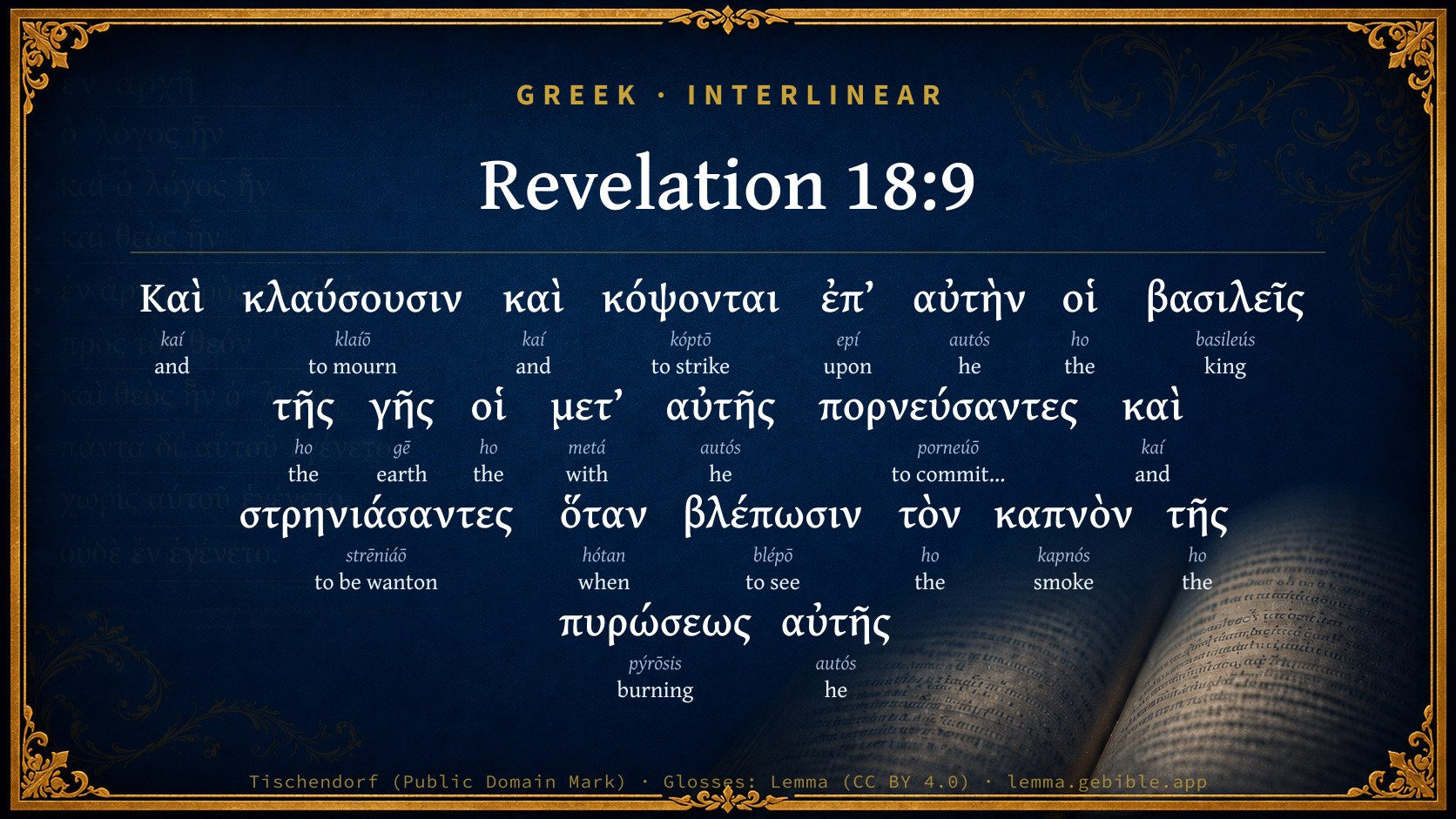
  1. Καὶ kaí G2532 “and” Conjunction
  2. κλαύσουσιν klaíō G2799 “to mourn” Verb, Future, Active, Indicative, 3rd person, Plural
  3. καὶ kaí G2532 “and” Conjunction
  4. κόψονται kóptō G2875 “to strike” Verb, Future, Middle deponent, Indicative, 3rd person, Plural
  5. ἐπ’ epí G1909 “upon” Preposition
  6. αὐτὴν autós G846 “he” Personal pronoun, Accusative, Singular, Feminine
  7. οἱ ho G3588 “the” Article, Nominative, Plural, Masculine
  8. βασιλεῖς basileús G935 “king” Noun, Nominative, Plural, Masculine
  9. τῆς ho G3588 “the” Article, Genitive, Singular, Feminine
  10. γῆς gē G1093 “earth” Noun, Genitive, Singular, Feminine
  11. οἱ ho G3588 “the” Article, Nominative, Plural, Masculine
  12. μετ’ metá G3326 “with” Preposition
  13. αὐτῆς autós G846 “he” Personal pronoun, Genitive, Singular, Feminine
  14. πορνεύσαντες porneúō G4203 “to commit immorality” Verb, Aorist, Active, Participle, Nominative, Plural, Masculine
  15. καὶ kaí G2532 “and” Conjunction
  16. ὅταν hótan G3752 “when” Conjunction
  17. βλέπωσιν blépō G991 “to see” Verb, Present, Active, Subjunctive, 3rd person, Plural
  18. τὸν ho G3588 “the” Article, Accusative, Singular, Masculine
  19. καπνὸν kapnós G2586 “smoke” Noun, Accusative, Singular, Masculine
  20. τῆς ho G3588 “the” Article, Genitive, Singular, Feminine
  21. πυρώσεως pýrōsis G4451 “burning” Noun, Genitive, Singular, Feminine
  22. αὐτῆς autós G846 “he” Personal pronoun, Genitive, Singular, Feminine

About this verse

These counts appear in no published source. They are computed here, from the morphology-tagged text and Lemma’s own curated glosses. What Lemma adds →

23
words
15
distinct lemmas
Revelation
section

Notable vocabulary

The rarest word here is στρηνιάσαντες to be wanton G4763 — appearing just 2 times in the whole Greek New Testament.

Shared distinctive vocabulary

στρηνιάσαντες to be wanton G4763 occurs in 2 verses of the Greek New Testament. Also found in:

Repetition

Words recur within this verse:

Cross-references

20

Topical passages linked to Revelation 18:9 in the Treasury of Scripture Knowledge — connected by theme and wording, ordered by reader-vote popularity; previews shown in the World English Bible.

  • Revelation 18:3 For all the nations have drunk of the wine of the wrath of her sexual immorality, the kings of the earth committed sexual immorality with her, and the merchants of the earth grew rich from the abundance of her luxury."
  • Revelation 19:3 A second said, "Hallelujah! Her smoke goes up forever and ever."
  • Revelation 17:2 with whom the kings of the earth committed sexual immorality, and those who dwell in the earth were made drunken with the wine of her sexual immorality."
  • Revelation 18:18 and cried out as they looked at the smoke of her burning, saying, 'What is like the great city?'
  • Ezekiel 26:16–17 Then all the princes of the sea shall come down from their thrones, and lay aside their robes, and strip off their embroidered garments: they shall clothe themselves with trembling; they shall sit on the ground, and shall tremble every moment, and be astonished at you.
  • Revelation 14:11 The smoke of their torment goes up forever and ever. They have no rest day and night, those who worship the beast and his image, and whoever receives the mark of his name.
  • Revelation 18:20 Rejoice over her, O heaven, you saints, apostles, and prophets; for God has judged your judgment on her."
  • Genesis 19:28 He looked toward Sodom and Gomorrah, and toward all the land of the plain, and looked, and saw that the smoke of the land went up as the smoke of a furnace.
  • Jeremiah 50:46 At the noise of the taking of Babylon the earth trembles, and the cry is heard among the nations.
  • Revelation 18:7 However much she glorified herself, and grew wanton, so much give her of torment and mourning. For she says in her heart, 'I sit a queen, and am no widow, and will in no way see mourning.'
  • Ezekiel 32:9–10 I will also vex the hearts of many peoples, when I shall bring your destruction among the nations, into the countries which you have not known.
  • Deuteronomy 29:23 [and that] the whole land of it is sulfur, and salt, [and] a burning, [that] it is not sown, nor bears, nor any grass grows therein, like the overthrow of Sodom and Gomorrah, Admah and Zeboiim, which Yahweh overthrew in his anger, and in his wrath:
  • Isaiah 13:19 Babylon, the glory of kingdoms, the beauty of the Chaldeans' pride, shall be as when God overthrew Sodom and Gomorrah.
  • Isaiah 34:9–10 The streams of [Edom] shall be turned into pitch, and the dust of it into sulfur, and the land of it shall become burning pitch.
  • Jeremiah 50:40 As when God overthrew Sodom and Gomorrah and the neighbor cities of it, says Yahweh, so shall no man dwell there, neither shall any son of man sojourn therein.
  • Zechariah 11:2–3 Wail, fir tree, for the cedar has fallen, Because the stately ones are destroyed. Wail, you oaks of Bashan, For the strong forest has come down.
  • Revelation 17:12–13 The ten horns that you saw are ten kings who have received no kingdom as yet, but they receive authority as kings, with the beast, for one hour.
  • Psalms 58:10 The righteous shall rejoice when he sees the vengeance. He shall wash his feet in the blood of the wicked;
  • Isaiah 30:33 For a Topheth is prepared of old; yes, for the king it is made ready; he has made it deep and large; the pile of it is fire and much wood; the breath of Yahweh, like a stream of sulfur, does kindle it.
  • Daniel 4:14 He cried aloud, and said thus, Hew down the tree, and cut off its branches, shake off its leaves, and scatter its fruit: let the animals get away from under it, and the fowls from its branches.

Cross-references courtesy of OpenBible.info (CC BY 4.0).

Commentary

Notes on Revelation 18:9 from classic Christian and Jewish commentators (each source and its license shown beneath its notes). The classic Christian expositions comment on the surrounding passage and are grouped to its opening verse, so a note may address several verses; the Jewish commentaries on the Tanakh (Rashi and others) are per-verse, so they appear only where the commentator wrote on this verse.

Lemma curates 59 commentaries, every one of them public domain or Creative Commons licensed, each selected and text-cleaned for this edition rather than reprinted as found. About our sources →

The Cambridge Bible for Schools and Colleges

gen. ed. J. J. S. Perowne

The Lamentation over them on Earth, Rev_18:9-19

9. the kings of the earth] Who bore a more or less immediately active part in her destruction, Rev_17:16 : see note there.

shall bewail her] Read simply, shall weep.

the smoke of her burning] Cf. Gen_19:28.

The Cambridge Bible for Schools and Colleges (gen. ed. J. J. S. Perowne; Cambridge University Press, 1878–1918) — public domain. Text from a community e-Sword module.

The Biblical Illustrator

Joseph S. Exell

Rev_18:9-24

The merchants of the earth shall bewail her, and lament for her.

The fall of the corrupt in human life

Wrong, including all that is morally evil ill human thought, feeling, and action is constantly falling. Though it has a very slow death, it will by the eternal law of moral disintegration be one day brought down.

I. The lamentation of the bad.

1. The ruling class. True kinghood is the majesty of intellect and goodness.

2. The mercantile class. When the grand altruistic truth of Christian socialism becomes realised by the masses--Let no man seek his own, but every man anothers wealth--then the every-man-for-himself principle will fall, and with its fall what will become of the enormous possessions which they have obtained merely by working for themselves?

II. The jubilation of the good.

1. Because the fall is just. Evil has no right to exist.

2. Because the fall is beneficent. It is the uprooting of those thorns and thistles and noxious weeds that have turned the paradise of our being into a howling wilderness.

3. Because the fall is complete. Destroyed once, it is destroyed for ever. (D. Thomas, D. D.)

The commercial Babylon

1. We should first of all learn that the hold of God on all that we have and are is absolute. We are but tenants-at-will. The proud and conceited talk as if the world were ours--My river is my own, and I have made it for myself--is an abomination to the Lord. God has never waived His rights in entrusting to us His loans. Let merchants, stockbrokers, bankers, bondholders, traders learn this lesson. At any moment God may bring all our possessions to nought; and He will do that at His own time, not waiting for ours.

2. It may well yield us matter for lamentation that the use of so much earthly capital is a perverted one. Many of Gods gifts are put in alliance with overreaching, corruption, and fraud. But when things of wealth and beauty become the instruments of apostacy it is sad indeed.

3. Let us learn to look at whatever is beautiful and costly and artistic as precious in the truest sense only as it is allied to or in harmony with righteousness. Beauty and wealth are only of genuine value when employed in accordance with Gods will and Word.

4. Let us take care that, so far as we are concerned, we have no share in this heart-apostacy of Babylon the great, even in the commercial world. The voice cries now, Come out of her, my people (Isa_48:20; Isa_52:11; Jer_1:8; Jer_51:6; Jer_51:45; 2Co_6:14-17). If we would not share her plagues we must not share her sins. There are those who are in Babylon the great, the slaves of godless gain or godless pleasure. There are those who belong to the new and eternal city, the New Jerusalem, who engrave on the bells of the horses, Holiness to the Lord, and whose daily toil is being sanctified for Him. It may cost something to renounce all fellowship with Babylon. But it is worth infinitely more than it costs. Yea, to be right is so transcendently great, that the question of cost should scarce be deemed worth a thought. Better die with Christ than reign with Caesar. (S. Conway, B. A.)

The Biblical Illustrator, edited by Joseph S. Exell (c. 1880s–1900s) — public domain. Text from a community e-Sword module.

Joseph Benson's Commentary

Rev 18:9-11. And the kings of the earth, &c. — Even the chief rulers and great powers of the world, who were formerly in league with her, and supported her in her corruptions, practised her idolatries, and lived deliciously with her — Shared in the pomp and luxury of her prosperous state; shall bewail her, &c. — Shall not be able to afford her any support or defence, or to do any more than fruitlessly condole with her, and lament her sad condition, when they shall behold all these calamities come suddenly upon her. Saying, Alas, alas! — Only expressing their astonishment at so great and wonderful a revolution, so little expected, so little thought of; that great city, that mighty city — Rome was anciently termed by its inhabitants, Valentia, that is, strong; and the word Rome itself, in Greek, signifies strength. This name was given to it by the Greek strangers. For in one hour is thy judgment come — How strange, how awful, that so great and mighty a city should be so suddenly, so utterly destroyed! And the merchants of the earth — Her men of business, and those skilled in the affairs of life, who gained so much by her preferments, and by employments under her; the men of riches and credit in the several nations which she had corrupted, and who were supported in their pride and luxury by her means, shall not be able to help in this hour of her distress, any more than the kings of the earth; they can only weep and mourn for her misery, and for their own loss in her destruction. Now all commerce with her shall be utterly cut off; and no man by her means shall obtain wealth, credit, or power, any more.

Joseph Benson's Commentary on the Old and New Testaments (1811–1818) — public domain. Text from a community e-Sword module.

Whedon's Commentary on the Bible

Daniel D. Whedon

c. Portraiture (mostly in prophetic form) of her mercantile and commercial desolations, Rev_18:9-20.

It would, of course, be physically impossible for kings in their foreign capitals, and merchants beyond sea, to behold, with bodily eye, the burning metropolis, and even be obliged to withdraw to a distance (Rev_18:10; Rev_18:15) for fear of being scorched. This close grouping, however, gives us a very vivid conception. Yet under this poetic parable of commercial desolation it is the overthrow of the Babylonic anti-christianity of all ages that is symbolized.

9. Kings bewail the cessation of the alliance of debauchery and luxury, merchants weep for the loss of the great market for their commodities.

Daniel D. Whedon (gen. ed.), Commentary on the Old and New Testaments (1874–1909) — public domain. Text from a community e-Sword module.

Tyndale Open Study Notes

Tyndale Open Resources

18:9-19 These three laments highlight the grief of those who profited most from the wicked city’s rich lifestyle (cp. Ezek 27).

18:9-10 The kings of the world lament as they mourn the loss of the luxury they had obtained from alliance with the wicked city.

Tyndale Open Study Notes — © Tyndale Open Resources, licensed CC BY-SA 4.0. Text via the HelloAO Bible API.

Meyer's Critical & Exegetical Commentary

Heinrich August Wilhelm Meyer

Rev_18:9 sq. The lament of the kings of the earth.[3955] Cf. Rev_14:11. The βασανισμός of the city, through which they are affected by the judgment, is its actual πυρῶσις.[3956] Accordingly the lamenting kings stand at a distance: they dread the conflagration in which the city perishes.[3957]

Οὐαί, οὐαί. With the διπλώσατε, Rev_18:6, the repetition of the cry of woe, which corresponds only to the extremity of the pain,[3958] has nothing to do.[3959]

ἡ πόλις ἡ μεγάλη, κ.τ.λ. The allusion to the greatness and power of the city[3960] makes still more forcible the impression of its destruction, which is expressly designated as the reason for the lamentation (ὅτι, κ.τ.λ.).

[3955] Cf. Rev_17:2.

[3956] Cf. Rev_1:15.

[3957] Cf. Rev_18:15.

[3958] Cf. Rev_18:16; Rev_18:19.

[3959] Against Hengstenb.

[3960] Cf. Rev_18:11 sqq., Rev_19:21 sq.

Rev_18:9-20. Now the kings and other inhabitants of the earth lament for the rash pride of the great city, whereby they also are painfully affected.[3954] Yet in Rev_18:11; Rev_18:17, a similar change in form of statement occurs, as in Rev_11:11 compared with Rev_11:7.

[3954] Cf. Ezekiel 27.

Meyer — Critical and Exegetical Commentary on the New Testament — English translation by Peter Christie, edited by Frederick Crombie (T&T Clark, 1880) — public domain. Text from a community e-Sword module.

Expositor's Greek Testament

ed. W. Robertson Nicoll

Rev 18:9-20 : the wailing on earth, by kings (Rev 18:9-10 ), merchants (at length, 11 16), and seafaring men (Rev 18:17-20 ), imitated from the finer and more elaborate passages in Ezekiel 26-28, where kings (Eze 26:15-18 ), traders (very briefly and indirectly, Eze 27:36 ), and mariners (Eze 27:29-36 ) are all introduced in the lament over Tyre’s downfall. Contrast the joy of the three classes in Rev 18:20 . A triple rhythm pervades (cf. Rev 18:2-3 ; Rev 18:6 ; Rev 18:8 ; Rev 18:14 ; Rev 18:16 ; Rev 18:19 ) but does not dominate this grim doom-song, somewhat after the well-known structure of the Semitic elegy. But the three laments are all characteristic. The kings are saddened by the swift overthrow of power (10), and the reverse of fortune; the merchants (Rev 18:11 ; Rev 18:16 ) by the loss of a profitable market, the mariners by the sudden blow inflicted on the shipping trade (Rev 18:19 ).

The Expositor's Greek Testament, edited by W. Robertson Nicoll (1897–1910) — public domain. Text from a community e-Sword module.

Geneva Bible (1599)

Geneva Bible translators

The circumstances following the fall of Babylon, or the consequences thereof (as I distinguished them, verse 4) are two. Namely the lamentation of the wicked unto verse 19: and the rejoicing of the godly, verse 20. This most sorrowful lamentation, according to the person of them that lament, hath three members, the first whereof is the mourning of the kings and mighty men of the earth, in two verses. The second is the lamentation of the merchants that traffic by land thence unto verse 16. The third is the wailing of those that merchandise by sea, verses 16, 17, 18. In every [one] of these the cause and manner of their mourning is described in order, according to the condition of those [that] mourn, with observation of that which best agreeth unto them.

Geneva Bible (1599) marginal notes — public domain. Text via Bolls.life.

Matthew Henry's Commentary

Here we have,

I. A doleful lamentation made by Babylon's friends for her fall; and here observe,

1. Who are the mourners, namely, those who had been bewitched by her fornication, those who had been sharers in her sensual pleasures, and those who had been gainers by her wealth and trade - the kings and the merchants of the earth: the kings of the earth, whom she had flattered into idolatry by allowing them to be arbitrary and tyrannical over their subjects, while they were obsequious to her; and the merchants, that is, those who trafficked with her for indulgences, pardons, dispensations, and preferments; these will mourn, because by this craft they got their wealth.

2. What was the manner of their mourning. (1.) They stood afar off, they durst not come nigh her. Even Babylon's friends will stand at a distance from her fall. Though they had been partakers with her in her sins, and in her sinful pleasures and profits, they were not willing to bear a share in her plagues. (2.) They made a grievous outcry: Alas! alas! that great city, Babylon, that mighty city! (3.) They wept, and cast dust upon their heads, Rev 18:19. The pleasures of sin are but for a season, and they will end in dismal sorrow. All those who rejoice in the success of the church's enemies will share with them in their downfall; and those who have most indulged themselves in pride and pleasure are the least able to bear calamities; their sorrows will be as excessive as their pleasure and jollity were before.

3. What was the cause of their mourning; not their sin, but their punishment. They did not lament their fall into idolatry, and luxury, and persecution, but their fall into ruin - the loss of their traffic and of their wealth and power. The spirit of antichrist is a worldly spirit, and their sorrow is a mere worldly sorrow; they did not lament for the anger of God, that had now fallen upon them, but for the loss of their outward comfort. We have a large schedule and inventory of the wealth and merchandise of this city, all which was suddenly lost (Rev 18:12, Rev 18:13), and lost irrecoverably (Rev 18:14): All things which were dainty and goodly have departed from thee, and thou shalt find them no more at all. The church of God may fall for a time, but she shall rise again; but the fall of Babylon will be an utter overthrow, like that of Sodom and Gomorrah. Godly sorrow is some support under affliction, but mere worldly sorrow adds to the calamity.

II. An account of the joy and triumph there was both in heaven and earth at the irrecoverable fall of Babylon: while her own people were bewailing her, the servants of God were called to rejoice over her, Rev 18:20. Here observe, 1. How universal this joy would be: heaven and earth, angels and saints, would join in it; that which is matter of rejoicing to the servants of God in this world is matter of rejoicing to the angels in heaven. 2. How just and reasonable; and that, (1.) Because the fall of Babylon was an act of God's vindictive justice. God was then avenging his people's cause. They had committed their cause to him to whom vengeance belongs, and now the year of recompence had come for the controversies of Zion; and, though they did not take pleasure in the miseries of any, yet they had reason to rejoice in the discoveries of the glorious justice of God. (2.) Because it was an irrecoverable ruin. This enemy should never molest them any more, and of this they were assured by a remarkable token (Rev 18:21): An angel from heaven took up a stone like a great millstone, and cast it into the sea, saying, "Thus shall Babylon be thrown down with violence, and be found no more at all; the place shall be no longer habitable by man, no work shall be done there, no comfort enjoyed, no light seen there, but utter darkness and desolation, as the reward of her great wickedness, first in deceiving the nations with her sorceries, and secondly in destroying and murdering those whom she could not deceive," Rev 18:24. Such abominable sins deserved so great a ruin.

Matthew Henry's Commentary on the Whole Bible (1708–1710) — public domain (CC PDM 1.0). Text via the HelloAO Bible API.

Jamieson, Fausset & Brown

Robert Jamieson, A. R. Fausset & David Brown

lived deliciously--Greek, "luxuriated." The faithless Church, instead of reproving, connived at the self-indulgent luxury of the great men of this world, and sanctioned it by her own practice. Contrast the world's rejoicing over the dead bodies of the two witnesses (Rev 11:10) who had tormented it by their faithfulness, with its lamentations over the harlot who had made the way to heaven smooth, and had been found a useful tool in keeping subjects in abject tyranny. Men's carnal mind relishes a religion like that of the apostate Church, which gives an opiate to conscience, while leaving the sinner license to indulge his lusts.

bewail her--A, B, C, Syriac, Coptic, and CYPRIAN omit "her."

Jamieson, Fausset & Brown — Commentary Critical and Explanatory on the Whole Bible (1871) — public domain (CC PDM 1.0). Text via the HelloAO Bible API.

Adam Clarke's Commentary

Verse 9. The kings of the earth] Those who copied her superstitions and adopted her idolatries.

Adam Clarke's Commentary on the Bible (1810–1826) — public domain. Text from a community e-Sword/MySword module.

Ellicott's Commentary for English Readers

(9) And the kings of the earth. . . .—Read, And there shall weep and mourn over her the kings of the earth, who with her committed fornication and luxuriated, when they see the smoke of her burning, standing afar off because of the fear of her torment, saying, Woe, woe, the great city, Babylon the strong city; because in one hour is come thy judgment. Kings, merchants (Rev_18:11-17), shippers (Rev_18:17-19) join in lamenting the overthrow of the great city; all stand afar off, as though fearing to be involved in her ruin; all cry, “Woe” (or, Alas!) at the beginning of their lament; and at the close the words, “in one hour,” telling the suddenness of the great city’s overthrow, recur (Rev_18:10; Rev_18:17; Rev_18:19) with the monotony of a passing bell heard at intervals amid the strains of sad music. The parallel passages in Eze_26:15-16; Eze_27:35, should be compared. The grief described is the result of fear mingled with selfishness; the mourners remember with a regret, only tempered with terror, the voluptuous life, the quick-growing profits, and the varied commercial advantages which they have lost in her overthrow.

THE LAMENT OF THE MERCHANTS (Rev_18:11-17).—The lament proper, that is, the actual words put in the mouths of the merchants, is contained in Rev_18:16-17. The immediately preceding verses describe the various kinds of merchandise which were dealt in.

A Bible Commentary for English Readers, edited by Charles John Ellicott (1878–1897) — public domain. Text from a community e-Sword module.

John Gill's Exposition

And the kings of the earth, who have committed fornication,.... Idolatry, Rev 17:2

and lived deliciously with her; Rev 18:3 joining with her in her sensual, as well as in her idolatrous practices:

shall bewail her, and lament for her: shall mourn inwardly, and by various gestures outwardly express their sorrow at her desolation; see Eze 27:30 these will not be the ten kings who will burn the whore with fire, and then repent of what they have done, and weep over her, as Titus did at the destruction of Jerusalem, as some Popish writers have fancied, for they will hate the whore, and eat her flesh; but earthly and idolatrous kings, who will be in the communion of the church of Rome:

when they shall see the smoke of her burning: as Abraham saw the smoke of Sodom and Gomorrah go up like the smoke of a furnace; by which they will perceive that her judgment is come, and her ruin begun.

John Gill's Exposition of the Whole Bible (1746–1763) — public domain (CC PDM 1.0). Text via the HelloAO Bible API.

Trapp's Complete Commentary

John Trapp

9 And the kings of the earth, who have committed fornication and lived deliciously with her, shall bewail her, and lament for her, when they shall see the smoke of her burning,

Ver. 9. Shall bewail her and lament] κοψουσι, As with the "voice of doves, tabering upon their breasts," Nah 2:7. The chief of these mourners shall be the Spaniard likely; who yet hath no such great cause, if he look well about him; for he is yearly excommunicated by the pope, for detaining him from the kingdom of Sicily, as Baronius witnesseth. (In Respon. Apol. ad Card. Colum.) It were to be wished that he would imitate his predecessor Charles V, who upon a displeasure conceived against Pope Clement VIII, abolished the pope’s authority throughout all Spain, Exemplo ab Hispanis ipsis posteritati relicto, posse Ecclesiasticam disciplinam citra nominis Pontificii authoritatem conservari, saith mine author, i.e. The Spaniards themselves setting forth to the world that the Church may be governed without the pope’s authority. (Scultet. Annul. Decad. ii. p. 2.) But this Charles did in a passion only, and not from a settled resolution. For after this, when Pope Clement and his cardinals were imprisoned by the duke of Bourbon’s men in St Angelo, Caesar in Spain forbade all interludes to be played; and pageants prepared for the joy of the birth of his son Prince Philip to be pulled down. In France, by the court of Parliament, the duke of Bourbon was condemned of treason, his name and memorial accursed, his arms pulled down, his lands and goods confiscated. Neither would King Henry of England answer the emperor’s letters, whereby he excused himself from having any hand in the action. (Speed, 1012.)

John Trapp, A Commentary or Exposition upon All the Books of the Old and New Testament (1647–1656) — public domain. Text from a community e-Sword module.

Albert Barnes' Notes on the Bible

And the kings of the earth - This verse commences the description of the lamentation over the fall of the mystical Babylon (see the Analysis of the chapter).

Who have committed fornication - That is, who have been seduced by her from the true God, and have been led into practical idolatry. See the notes on Rev 14:8. The kings of the earth seem to be represented as among the chief mourners, because they had derived important aid from the power which was now to be reduced to ruin. As a matter of fact, the kings of Europe have owed much of their influence and power to the support which has been derived from the papacy, and when that power shall fall, there will fall much that has contributed to sustain oppressive and arbitrary governments, and that has prevented the extension of popular liberty. In fact, Europe might have been long since free, if it had not been for the support which despotic governments have derived from the papacy.

And lived deliciously with her - In the same kind of luxury and dissoluteness of manners. See Rev 18:3, Rev 18:7. The courts of Europe, under the papacy, have had the same general character for dissoluteness and licentiousness as Rome itself. The same views of religion produce the same effects everywhere.

Shall bewail her, and lament for her - Because their ally is destroyed, and the source of their power is taken away. The fall of the papacy will be the signal for a general overturning of the thrones of Europe.

When they shall see the smoke of her burning - When they shall see her on fire, and her smoke ascending toward heaven. See the notes on Rev 14:11.

Albert Barnes' Notes on the Bible (1834–1885) — public domain. Text from a community e-Sword/MySword module.

Matthew Poole's English Annotations

Not all of them, for some of them shall help to burn her, Rev 17:16; but such as God had left to their hardness of heart, that they still live in her fellowship and communion: or, if others also, it must proceed from their humanity, not being able to see so splendid a city, as that of Rome, ruined, and so many ruined as will perish by her fall, without the moving of their bowels by some pity and commiseration.

Matthew Poole's English Annotations on the Holy Bible (1683–1685) — public domain. Text from a community e-Sword/MySword module.

The Pulpit Commentary

And the kings of the earth, who have committed fornication and lived deliciously with her, shall bewail her, and lament for her, when they shall see the smoke of her burning; and the kings of the earth, who committed fornication and revelled with her, shall weep and wait over her, when they see, etc. It is noteworthy that this sentence is in the future tense; that in ver. 11 in the present; that in vers. 17, 18 in the past. (On "committed fornication," see ver. 3 Rev_14:4, 8 16:14 17:2. On "lived deliciously," see vers. 3, 7) "Lament" is the same word used in Rev_1:7, "All kindreds of the earth shall wail because of him." Cf. the description of the fall of Tyre. (Eze_26:16) (On "smoke," see on Rev_9:2)

Vers. 9-24. Lamentations over the fall of Babylon.

In our previous study of "Babylon the great," we had occasion to remark that there were three forms under which a great Babylon might be recognized.

1. In that worldwide spirit of alienation from God which has corrupted every form of human life everywhere.

2. In any Church which, allying itself with the world power, fornicates therewith, and puts itself on the throne instead of God.

3. Most manifestly of all in the papal Church, where every form of spiritual harlotry is seen at its very worst. Mr. Porter remarks, "Zion is the place where God dwells with men; great Babylon, the place where the priest sits in the seat of God." We would rather say, "Zion is where God dwells with men; Babylon the great is where any x, any unclean spirit, commercial or religious, sets aside the will of God, and so comes between men and their Maker." This harlot is seated on seven mountains which are seven kings or kingdoms which are seven heads of the beast. The world"s might and energy are "beheld concentrated under this mystic number seven in the one symbol of the beast; and this, it is important to bear in mind, is not merely Rome, nor the Roman empire, but a general symbol of secular anti-Christian power." If we thus see spirit rather than form referred to under this varied symbolism, we shall perceive at once the reason why some parts of these chapters apply rather to a huge commercial power and other parts to a huge ecclesiastical one; and hence the difficulty which is so frankly and clearly stated by Dean Alford will no longer be felt. As the writer in the "Speaker"s Commentary" remarks, "The whole passage points not to any single city, at any one single period, but, to the world city throughout all time;" and, we would add, not only to a religious but to a commercial harlotry; to any and every attraction by which the spirit of man is seduced from allegiance to God.

I THE SAME SPIRIT OF ALIENATION FROM GOD, WHICH ASSUMES A RELIGIOUS FORM, ALSO PRESENTS ITSELF IN A COMMERCIAL ASPECT, ALL THE WORLD OVER. It is just as possible to put "business" between man and God as it is to put a priest between man and God. So far as we can read this Apocalyptic word, the commercial will survive the downfall of the papal Babylon. For (Rev_17:17) we are told that when the kings of the earth have ceases their amours with the papacy, they will "give their kingdom to the beast, until the words of God should be fulfilled;" as if there would be even a more determined manifestation of carnal world force after the death or, at any rate, during the decline of the papacy. Certainly it is that these are the two lines along which history is moving at this hour. The papacy as a whole is on the decline. The world is opening up more and more to commercial interchange; and it is just as clear that the commerce of the world, in the godlessness which so largely pervades it, is Babylon the great on the secular side, as that papal Rome is Babylon the great on its ecclesiastical side. And just as easily as we could draw out a ground plan in outline of a papal Babylon from the details in Re 17, so can we draw out a ground plan of the commercial Babylon from the details supplied in Revelation 18.

Ten features.

1. Seated on many waters.

2. A dominant power: "ruling over the kings of the earth.

3. Proud and boastful: "I sit as a queen.

4. Serenely secure: "I shall see no mourning.

5. Self-sufficient: "I am no widow.

6. Luxurious living in "wantonness.

7. Intoxicated, and intoxicating others, with her splendour.

8. Carrying on an international merchandise.

9. Engaged in shipping.

10. Exporting or importing in sevenfold variety:

a. precious metals;

b. costly attire;

c. materials for furniture;

d. spices;

e. food;

f. cattle, sheep, etc.;

g. bodies and souls of men.

Could there be a more precise description of the commercial world spirit, which is at work among all nations, and kindreds, and people, and tongues a spirit of which this England of ours in her world wide transactions is the chief manifestation at this moment? So that, as Dean Alford ominously remarks, some parts of the description rather suit London than Rome. Commercially, indeed, we have done with any avowed traffic in the bodies of men. But that in the sight of God many of the accepted maxims of some men of business involve a fearful trifling with consciences and souls, is not open to question. It is well known that almost every variety of export and import named here is ours. Our shipping interests are far larger than those of any other nation on the face of the earth. Our gross tonnage through the Suez Canal alone shows this. Our merchandise touches every shore. The splendour and renown of our name and fame intoxicates many and many a merchant. Luxury, self sufficiency, pride, godlessness, these are to a grievous extent our bane and our poison. And who would venture to dispute the fact that, from sheer love of greed and gold, thousands on thousands will play fast and loose with truth and principle, and the right and God, and will say, "Let us break their bands asunder, and cast away their cords from us"? And the fearful fact ought to be recognized and acknowledged, that even the hatred which some entertain of the priestly yoke arises from a refusal to wear any yoke at all. "Our tongues are our own; who is Lord over us?" So men speak. This evil is certainly so huge that it is nothing less than a "Babylon the great.

II THIS BABYLON IS DOOMED. The means and methods of Babylon"s fall have been indicated in the preceding homily (q.v. ). They are fourfold.

1. Divine overruling.

2. Human desertion.

3. Heavy judgments.

4. Retribution and desolation.

III THE FALL OF BABYLON WILL CALL FROM MANY A BITTER LAMENTATION. There are three sources from which the lament will come.

1. From kings, as they see the great city which was the glory of their empire reduced and brought low.

2. From merchants, whose sources of wealth are dried up, so that "no one buyeth their merchandise any more.

3. From men of the sea, who gained their living by trading from port to port, because there is no longer any principal mart with which to trade. And clearly this is such a lamentation as godless men would make. We read Rev_16:21 that when the destruction came men blasphemed God because of the hail. In strict accordance therewith is the spirit of the wail over Babylon"s fall It is not that God has not been glorified. It is not that her busy life has been used for purposes most utterly selfish and often vile, for the lamentation over the ruin is just as selfish as their commerce itself has been (ver. 11). Their cargoes no one buys any more! Surely, nothing could bespeak the degradation of man when in apostasy from God, more than such a lamentation as this. It all centres in self. They have made their commerce their god. Ah! earthly souls will be earthly still, even under the ruin of all they hold most dear. Here we see sketched before us men men made for God, to enjoy him, to love him, and to obey him clad in sackcloth; and why? Because they have not honoured their God? Ah, no! But because no one buys their cargo.! It is as if an orphan child should centre all his grief on a lost farthing, and think nothing of his disobedience to his lost parents. Nor can we fail to detect in this lament a note of bitterness against God. They see that the great Power they have been ignoring is working against them, and that they are bankrupt for eternity. Terrible beyond expression must it be for a man who has lived for earth, to find the world for which he lived departing forever. How bare and forlorn and desolate must he feel! The harpers, and singers, and pipers, and trumpeters are forever still; the sound of hammer and anvil is heard no more; the whirl of the mill has ceased; the sheen of the silver, the glitter of the gold, the light of the lamp, have vanished away; the voice of gladness, and of the bridegroom and the bride, are hushed; and the man is left alone. His gods are gone, and he is confronted with the God whom he neglected, to find alas! too late that his whole life has been a mistake. He has loved and served the creature more than the Creator, and now, instead of finding his joy in God when every earthly joy is gone, his only look out is a vista of bankruptcy and of irreparable woe. All his dignity has disappeared, and is reduced to a moan and groan that no one buys his cargo!

IV THIS PICTURE OF GODLESS AND HOPELESS LAMENTATION OUGHT NOT TO BE STUDIED IN VAIN.

1. We should first of all learn that the hold of God on all that we have and are is absolute. We are but tenants at will. The proud and conceited talk as if the world were ours river is my own, and I have made it for myself is an abomination to the Lord. God has never waived his rights in entrusting to us his loans. Let merchants, stockbrokers, bankers, bondholders, traders, learn this lesson. In our great city it is too often forgotten. At any moment God may bring all our possessions to nought; and he will do that at his own time, not waiting for ours.

2. It may well yield us matter for lamentation that the use of so much earthly capital is a perverted one. Many of God"s gifts are put in alliance with overreaching, corruption, and fraud. In themselves they are not to be despised. "Every creature of God is good," etc. But when things of wealth and beauty become the instruments of apostasy, it is sad indeed. And the more so when we add to all this the thought that Divine gifts misused do, in so being misused, deceive and ruin the souls of men, and in proportion to the joy which their right and proper use would have brought is the treasured up woe which their abuse will certainly ensure.

3. Let us learn to look at whatever is beautiful and costly and artistic as precious in the truest sense, only as it is allied to or in harmony with righteousness. Beauty and wealth are only of genuine value when employed in accordance with God"s will and Word.

4. Let us take care that, so far as we are concerned, we have no share in this heart apostasy of Babylon the great, even in the commercial world. The voice cries now, "Come out of her, my people". (cf. Isa_48:20 Jer_1:8 Jer_51:6, 45 52:11 2Co_6:14-17) If we would not share her plagues, we must not share her sins. "Come ye out from," etc. For in this London of ours Babylon the great and the New Jerusalem are side by side. There are those who are in Babylon the great, the slaves of godless gain or godless pleasure. There are those who belong to the new and eternal city, the New Jerusalem, who grave on the bells of the horses, "Holiness to the Lord," and whose daily toil is being sanctified for him. And oh! it is worth a struggle to be living even now in that city of God, into which no foe can enter and which no convulsion can for a moment disturb. It may cost something to renounce all fellowship with Babylon. But it is worth infinitely more than it costs. Yea, to be right is so transcendently great, that the question of cost should scarce be deemed worth a thought. Better die with Christ than reign with Caesar. Let us dare to be singular. By the gewgaws of this Babylonian harlotry many are attracted. So be it not with us. A nobler aim be ours, even to "seek the things which are above, where Christ sitteth on the right hand of God;" and when our communion with this earth is sundered, we shall find our home in the New Jerusalem. Hence we may "go forth of Babylon... with a voice of singing," and may "utter it even to the ends of the earth The Lord hath redeemed his servant Jacob.

Vers. 9-24. The fall of the corrupt in human life.

"And the kings of the earth, who have committed fornication and lived deliciously with her," etc. All along through my remarks on the Apocalyptic visions of this book I have not only discarded any attempt at a literal interpretation, but have affirmed that, as a rule, such interpretations of dreams or visions can seldom, if ever, from the nature of the case, be correct; and more especially so with the visions and dreams recorded in this book. The objects seen, the voices heard, the acts performed, are so incongruous with the course of nature and the concurrent experience of mankind, that the attempt at a literal exposition would seem to be the height of absurdity. Anyhow, though it has been tried a thousand times, and is still being tried, all the results are utterly unsatisfactory to the unprejudiced and unsophisticated intellect and conscience of mankind.

Common sense repudiates all such interpretations. Using, however, such visions and dreams as the great redeeming Teacher of mankind used the blooming lily, the fruitful vine, the toiling fishermen, the flowing river, the booming sea, and the beaming heavens viz. to suggest and illustrate the eternal realities of the supersensuous realm is to use them not only legitimately, but usefully in the highest degree. Still proceeding on this principle, we may perhaps get out of the strange scenes here recorded some things that may quicken our intellect, encourage our conscience, and inspire our hope. The subject here isThe fall of the corrupt in human life. The corrupt thing is here symbolized by Babylon. "Babylon is fallen." If Babylon here be understood to mean the old cry of whose infamous history we have all read, the language used is historically true, for it had fallen to ruins five hundred years before this, and had become "the habitation of devils, and every foul thing." If, as some say, it means pagan Rome, it is not true, for that is as strong and numerically influential if not more so now as it ever has been. Take Babylon as standing for wrong everywhere throughout society, and the expression is not true. Moral Babylon in the aggregate still lives and works on this planet. Albeit, regarding it as an event perpetually occurring, it is true enough. Wrong, including all that is morally evil in human thought, feeling, and action, is constantly failing. It has been falling from Adam to Christ, and from Christ to this hour. Such stupendous events were occurring in connection with it in the days of John, that he might well have dreamt that he heard some angel say, "Babylon is fallen." The false and the wrong everywhere are constantly falling, and must continue to do so. Do not, then, understand that the whole of corrupt society on this earth will in some distant day in the mighty aggregate be at once clearly swept from the face of the earth. There is no reason to believe this. The idea is contrary to the analogy of nature, where all things move gradually. Wrong has a very slow death. If we use the word "falling" for "is fallen," it will give us a universal truth viz, that moral Babylon, the corrupt in society, is falling. I stand upon the brow of some firm and lofty mountain, and I say, "This mountain is falling;" and I say truly, for there is not a moment in its existence when it is not crumbling into the atoms that made it up, for the great physical law of disintegration will never cease operating upon it, until it shall "become a plain." "The mountains falling cometh to nought," etc. Or I stand by the trunk of some huge tree, and I say, "This tree is falling." And I speak truth, for the great law of vegetable decay is working in it, and will one day bring it down into the dust. So with the wrong thing in human life. Though it stand as a huge mountain filling the horizon of humanity, it will, by the eternal law of moral disintegration, be one day brought down. Or though it stand as some huge tree whose branches spread over the race, and under whose shadows mighty populations live, the invincible and unalterable law of moral retribution will rot it clean away. The record here given of this highly symbolic vision suggests its influence upon two classes of mind. It excites

I THE LAMENTATION OF THE BAD Who are the men who feel distressed at the fall of the wrong thing the moral Babylon? We find at least two classes in these verses.

1. The ruling class. "And the kings of the earth, who have committed fornication and lived deliciously wantonly with her, shall bewail her, and lament for her weep and wail over her, when they shall see look upon the smoke of her burning" (ver. 9). Throughout the human race the world over, we find a class of men who are the chiefs, the masters, the kings, who control and determine the destinies of others.

2. The mercantile class. "And the merchants of the earth shall weep and mourn," etc. (vers. 11-17). The mercantile principle is an instinct Divine and beneficent. Its operations are not limited to shops, storerooms, markets, exchanges, or land; it extends to the ocean. "And every shipmaster, and all the company in ships, and sailors every one that saileth any whither, and mariners," etc. (ver. 17). The ships of commerce are found ploughing every sea and lying in every port. The principle is found working among savage hordes as well as amongst civilized men. But whilst the principle is right enough, and transcendently beneficent when rightly directed, it has, like all other instincts of our nature, been sadly perverted. It is perverted when it is directed not to the good of the commonwealth, but to the gratification and aggrandizement of self. Hence the enormous private fortunes on the one hand, and the starving destitution of millions on the other. Now, this morally wrong thing, this every man for himself, is a principle that has been so much criticized, not only by political and moral philosophers, but by the thinking men in all conditions of life, that it is getting weak, beginning to fall, and must ultimately be destroyed. When the grand altruistic truth of Christly socialism becomes realized by the masses, "Let no man seek his own, but every man another"s wealth," then this every-man-for-himself principle will fall, and with its fall what will become of the enormous possessions which they have obtained merely by working for themselves? No wonder they are distressed at the prospect. Every day this wrong thing is gradually falling, and the best men everywhere are becoming altruistic. "Go to now, ye rich men, weep and howl for your miseries that shall come upon you." How they struggle to arrest this wrong principle in its fall, to buttress it up; but it is the fiat of eternal justice that it should fall and rise no more.

II THE JUBILATION OF THE GOOD. "Rejoice over her, thou heaven, and ye holy apostles and prophets," etc. (ver. 20). Whilst those who have a vested interest in the maintenance of the wrong thing whose pomp, and wealth, and luxurious sensualities, and gilded pageantries would have never existed but for the Babylonian spirit that permeates social life howl in anguish at the fall of wrong, there are others transported with rapture as they see it giving way. Who are these? Unfallen angels, saints, and holy intelligences throughout the empire of God. "Thou heaven, and ye holy apostles ye saints and prophets." Heaven knows what is going on earth, and is thrilled with delight at the sight of even "one sinner that repenteth." The change of governments, the fluctuation of markets, the revolution of empires such things as these awaken the deepest concern of the ignorant and erring sons of men. But they wake no ripple on the deep translucent river of celestial minds. Whereas every fraction of wrong which they see falling into ruin from this huge Babylon gives them a new thrill of delight. Why should these peers in the spiritual universe thus exult at the fail of wrong?

1. Because the fall is just. Evil has no right to exist; it is an abnormal thing. The father of lies is a usurper in the universe. All the wrong systems, theoretical and practical, in every department of human life, political, commercial, ecclesiastic, he has built up on falsehood and deception; and their destruction is an act of eternal justice. God speed the right! This is the instinctive prayer of all consciences.

2. Because the fall is beneficent. The giving way of the wrong thing in society is as the breaking up of the dense cloud that darkens the whole heavens of man, the bringing down of fertilizing showers on the earth, and brightening the sky into sunny azure. It is the uprooting of those thorns and thistles and noxious weeds that have turned the paradise of our being into a howling wilderness. What benevolent nature could fail to exult in such an event as this? "Rejoice over her, thou heaven, and ye holy apostles and prophets.

3. Because the fall is complete. "And a mighty strong angel took up a stone like aas it were a great millstone, and cast it into the sea, saying, Thus with violence a mighty fall shall that great city Babylon Babylon the great city be thrown cast down, and shall be found no more at all," etc. (vers. 21-23). All this imposing symbolical description suggests the enormous curses associated with moral Babylonianism, and the strong reason for jubilation at its final fall. The fall of moral evil, even in part or whole, in the individual soul, in small or large communities, is not a temporary event. Destroyed once, it is destroyed forever. "It shall be thrown down, and shall be found no more at all." It is "cast into the sea." What does the mighty "millstone" suggest? What was the "little stone" in Daniel"s vision cut out of the rock without hands, and which became a great mountain? This, I trow the gospel, which is the "power of God, this is the only instrument that can hurl Babylon into the depths of the sea. D.T.

The Pulpit Commentary (1880–1919), ed. H.D.M. Spence-Jones & Joseph S. Exell — public domain. Text from a community e-Sword module.

Kretzmann's Popular Commentary

Paul E. Kretzmann

The description of the desolation:

v. 9. And the kings of the earth, who have committed fornication and lived deliciously with her, shall bewail her and lament for her when they shall see the smoke of her burning,

v. 10. standing afar off for the fear of her torment, saying, Alas, alas, that great city Babylon, that mighty city! For in one hour is thy judgment come.

v. 11. And the merchants of the earth shall weep and mourn over her; for no man buyeth their merchandise any more;

v. 12. the merchandise of gold, and silver, and precious stones, and of pearls, and fine linen, and purple, and silk, and scarlet, and all thyine wood, and all manner vessels of ivory, and all manner vessels of most precious wood, and of brass, and iron, and marble,

v. 13. and cinnamon, and odors, and ointments, and frankincense, and wine, and oil, and fine flour, and wheat, and beasts, and sheep, and horses, and chariots, and slaves, and souls of men.

v. 14. And the fruits that thy soul lusted after are departed from thee, and all things which were dainty and goodly are departed from thee, and thou shalt find them no more at all.

So the judgment of the Lord, which was spoken of in chap. 17:16-17, has already gone forth, as is here pictured with intense dramatic power: And there will cry and wail over her the kings of the earth that have committed fornication with her and lived a wanton life, when they see the smoke of her burning, standing at a distance for fear of her torment, saying, Woe and alas, the great city, Babylon the mighty city! For in one hour thy doom has come. So the same rulers and kings that have been the instruments of God in bringing about the punishment of Anti-Christ’s kingdom were also the companions of the great harlot in her sins. They themselves have kindled the fire of Rome’s destruction, but when they see the smoke of her burning, they are terrified and prefer to remain at a safe distance, since their conscience tells them of their guilt. Time and again the lament of the mighty of the earth has arisen in the last four hundred years when the power of Anti-Christ had received a severe setback. The great and mighty city that has bidden defiance to all enemies has been conquered, her real power being broken forever. The doom of one mightier than she has fallen upon her, and she will never regain her original prestige.

But the doom of the papal power strikes another class of men still worse: And the merchants of the earth weep and mourn over her, because their merchandise no one buys any more, the merchandise of gold and silver and precious stones and pearls; and fine linen and purple and silk and scarlet goods, and all kinds of citron wood and all manner of ivory vessels and all manner of vessels of most costly wood and of brass and of iron and of marble, and cinnamon and balsam and spices and myrrh and frankincense, and wine and oil and the finest flour and wheat, and cattle and sheep, and some horses and wagons and slaves, and the souls of men; and the fruit of thy soul’s desire has gone away from thee, and all the luxurious and splendid things have been lost from thee, and men shall find them no more. There is a deliberate irony in the long enumeration of things which have delighted the heart of the great Roman harlot, which she has made the object of her desires, which her merchants, her vassals, the men that trafficked in these things to their own enrichment, now bewail as lost forever. For the possession of many of these things is in itself not wrong; it has become a sin only in the case of the Church of Anti-Christ on account of the sinful uses to which these things have been put. The pomp, the lavish display of glory which Rome affects wherever she gains a foothold, requires such costly and luxurious things; whenever, therefore, this power is taken from her, it means a loss to the scheming members of the hierarchy and other sycophants that grow rich and live in luxury under the fostering care of their spiritual mother, the Church of Rome. But the climax is reached in the traffic in souls which is carried on in that Church, in taking away the simple doctrine of faith in Christ’s salvation and supplanting it with man-made doctrines, especially that of salvation by works, and in the delusion which places thousands of young men and women into monasteries and nunneries every year, all in the vain hope that they will thereby merit heaven and its glory.

Paul E. Kretzmann, Popular Commentary of the Bible (1921–1924) — public domain. Text from a community e-Sword module.

Burkitt's Expository Notes on the New Testament

William Burkitt

The Spirit of God having in the former part of the chapter set forth the certainty and severity of those judgments which should come upon mystical Babylon, he next declares what wailings and bitter lamentations her downfall would occasion to her votaries and admirers, to her friends and followers; more particularly he acquaints us with three sorts of persons that shall bewail Babylon’s destruction, kings, merchants, and seamen; the former we have here before us in these two verses: The kings of the earth, who have adhered to the whore, committed spiritual fornication with her, and delighted themselves in her carnal and pompous idol-worship, when they see the smoke of her burning, and understand the certainty of her destruction, they shall stand afar off, like persons astonished, and like persons afraid, amazed at the dreadfulness of the judgment, and afraid to come near, they be involved in it; and the words of their lamentation are here set down, Alas, alas! that great city Babylon; in one hour is her judgment come! As if they had said, "Notwithstanding all Babylon’s grandeur, which we so admired and magnified, and which she herself put so much trust and confidence in, to our astonishment we behold, in one hour, her judgment come upon her; a great and mighty city destroyed, a gay and splendid church, politically founded, powerfully strengthened, on a sudden broken in pieces, and brought to desolation: Alas, alas! that great city Babylon!

Learn hence, That when God begins to enter into judgment with his church’s enemies, the strongest arm of flesh cannot avail, but kings with their armies will flee and be discomfited, the stoutest hearts will be afraid and terrified, not daring to approach the presence of an angry God: the kings of the earth shall stand afar off for fear of her torment.

William Burkitt's Expository Notes on the New Testament (1700–1703) — public domain. Text from a community e-Sword module.

The People's New Testament

B. W. Johnson

9–14. The kings … shall bewail her. There will be mourners. Those who have sinned with her, or profited by her will bewail her fall.

B. W. Johnson's The People's New Testament with Notes (1889–1891) — public domain. Electronic text from the Christian Classics Ethereal Library (CCEL) ThML edition.

unfoldingWord translationNotes

Door43 World Missions Community

Connecting Statement:

John tells what people say about Babylon.

General Information:

In these verses the word "her" refers to the city of Babylon.

committed sexual immorality and went out of control with her

"sinned sexually and did whatever they wanted just as the people of Babylon did"

afraid of her torment

The abstract noun "torment" can be translated as a verb. AT: "afraid that they will be tormented as Babylon is" or "afraid that God will torment them as he torments Babylon" (See: Abstract Nouns)

Woe, woe

This is repeated for emphasis.

your punishment has come

Existing in the present is spoken of as having come. (See: Metaphor)

translationWords

king

sexual immorality

fear

torment

woe

Babylon

punish

unfoldingWord translationNotes — © Distant Shores Media and the Door43 World Missions Community, licensed CC BY-SA 4.0. Source: git.door43.org/Door43/en_tn.

Cambridge Greek Testament for Schools and Colleges

9–19. THE LAMENTATION OVER HER ON EARTH

9. κλαύσουσιν. So Lach[652] Treg[653] W. H[654] (text) and Weiss with B2CP; Text. Rec[655] and Tisch[656] (note) read κλαύσονται with אA.

[652] Lachmann’s larger edition.

[653] Tregelles.

[654] H. Westcott aud Hort.

[655] Rec. Textus Receptus as printed by Scrivener.

[656] Tischendorf: eighth edition; where the text aud notes differ the latter are cited.

9. οἱ βασιλεῖς τῆς γῆς. Primarily, no doubt, the few vassal kings that were left in Syria and its neighbourhood. See also on Rev 17:16.

τὸν καπνὸν τῆς πυρώσεως αὐτῆς. Cf. Gen 19:28.

Cambridge Greek Testament for Schools and Colleges (Cambridge University Press, 1896; 21 vols, various authors incl. Carr, Maclear, Plummer, Farrar, Lumby, Moule, M. R. James, Simcox) — public domain. Text from a community e-Sword module.

Alford’s Greek Testament

Henry Alford

9-20.] The mourning over her: and first, 9, 10, by the kings of the earth. And there shall weep and mourn over her (when the catalogue of mourners has yet to begin, the fact of mourning is thrown forward by the verbs being placed first: but below, ver. 11, when we come to the second member, the persons, as the new feature, are put forward before the verbs. ἐπʼ αὐτήν, as the direction and converging of their lamentation) the kings of the earth, who committed fornication and luxuriated (see above, ver. 7) with her, when they see the smoke of her burning, standing afar off on account of their fear of her torment (this feature in the prophecy is an objection to the literal understanding of its details. It can hardly be imagined that the kings should bodily stand and look as described, seeing that no combination of events contemplated in the prophecy has brought them together as yet), saying, Woe, woe, the great city, Babylon the strong city, because in one hour has come thy judgment.

Henry Alford, The Greek Testament (1849–1861) — public domain. Text from a community e-Sword module.

Lesson kit

Teaching starters — assembled from the data on this page, not authored interpretation. Every prompt links to the verse data it draws on. Edit before teaching.

Revelation, in the Revelation, opens this verse with 23 words (15 distinct Greek lemmas). Its most distinctive word is strēniáō (“to be wanton”). A historical commentator’s framing appears above. Read the whole chapter for the surrounding context.

Discussion questions

  1. What does “to be wanton” (strēniáō) contribute to the verse as a whole?
  2. How does Revelation 18:7, which shares the word «to be wanton», read alongside this verse?
  3. What does the repetition of “the” (5× in this one verse) do in this verse?
  4. These translations render this verse differently; the difference is in the English rendering, not the original. What questions does that raise?
  5. Compare how The Cambridge Bible for Schools and Colleges and The Biblical Illustrator read this verse. Where do they agree or differ?

Things to notice

Reading settings

Reading text

Shown beneath each verse's original-language words.

Old Testament
Old Testament edition

Read the OT as the Masoretic Hebrew (MT) or the Greek Septuagint (LXX).

English shown for the Greek Septuagint (in the Hebrew ↔ Greek comparison).

Comparing translations? Open the Compare panel on any verse page to stack up to four side by side.