2 Corinthians 10:6

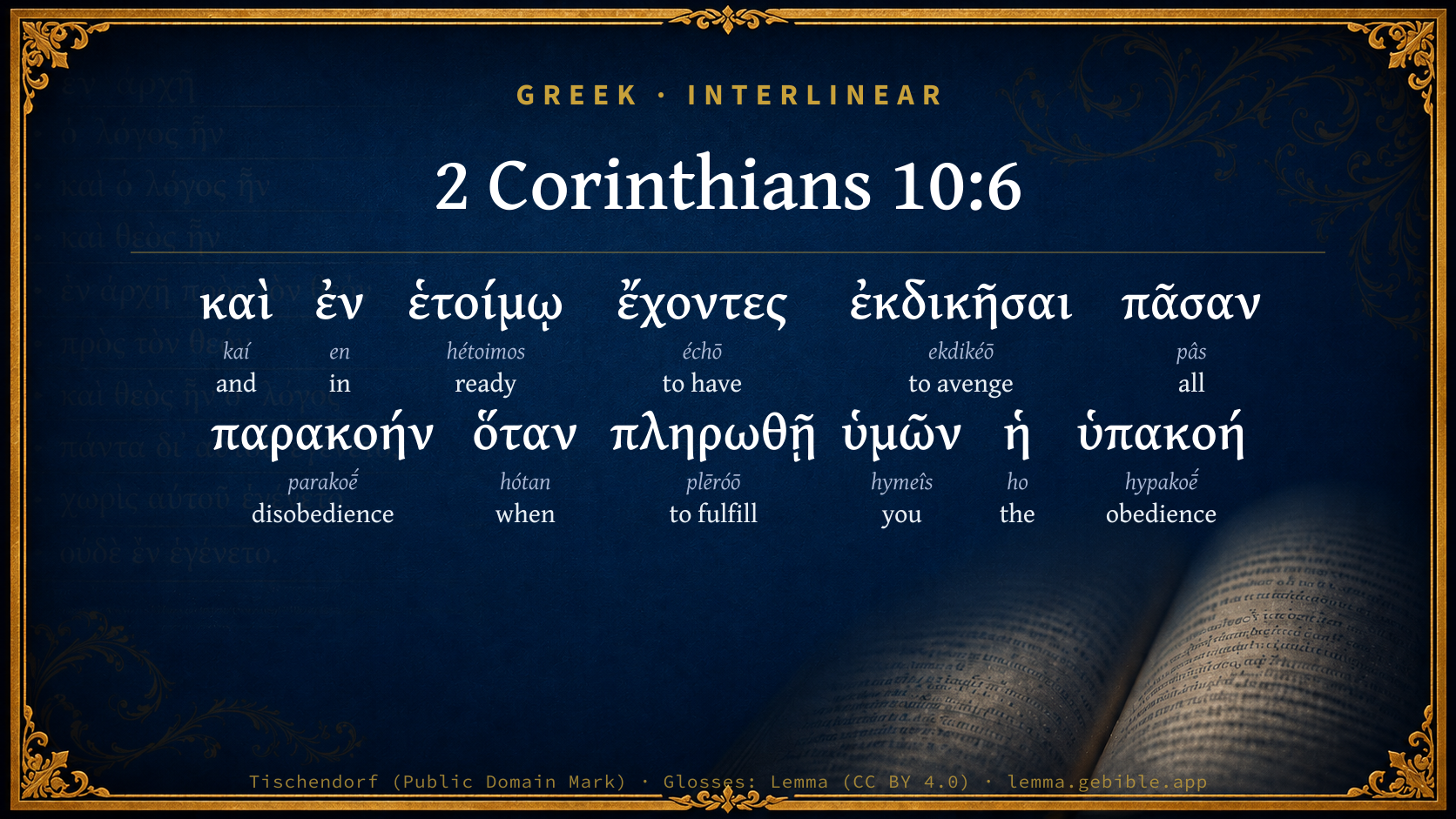
Greek (Tischendorf 8th ed.) 2 Corinthians 10:6 appears in the Greek New Testament. The text above is from the Tischendorf 8th edition. Each word links to its Strong’s number and a concise gloss. Click any word for its full Thayer’s Greek Lexicon entry.
Download image
Cite this verse

2 Corinthians 10:6 (World English Bible). Public Domain. Lemma interlinear Bible study tool, https://lemma.gebible.app/v/2-corinthians/10/6.

Show BibTeX & RIS
BibTeX
RIS
English Translation
and being in readiness to avenge all disobedience, when your obedience will be made full.
World English Bible · Public Domain
Download a study sheet

One document with this verse’s original text, its word-by-word gloss line, the meaning frame, cross-references with their text, attributed commentary, and full source and license credits — printable, and it pastes into notes with its structure intact.

This verse Autodidact and up

Study sheet (.html) Plain text (.txt)

A passage Seminary Student

Up to 50 verses in one chapter. A passage sheet keeps up to 6 commentary sources and 12 cross-references per verse, in the order this page ranks them, and says so on the sheet whenever that leaves anything out. Ask for a single verse and you get the Autodidact verse sheet above.

Everything on this page stays free to read, with no account — the sheet is a download of what is already on screen, not access to it.

Want to remove ads? Support Godless Engineer
Compare translations 3

The same verse in 3 English versions, stacked beneath the original-language interlinear above. Click any original word for its lexicon entry.

Each is an independent rendering of the whole verse — the interlinear is not word-aligned to these translations.

Highlighted words mark where these versions differ — a whole-verse word diff, not a word-by-word alignment.

  • World English Bible Public Domain
    and being in readiness to avenge all disobedience, when your obedience will be made full.
  • King James Version Public Domain
    And having in a readiness to revenge all disobedience, when your obedience is fulfilled.
  • unfoldingWord Literal Text CC BY-SA 4.0
    and being in readiness to avenge every act of disobedience, when your obedience would be complete.

unfoldingWord Literal Text — © unfoldingWord, licensed CC BY-SA 4.0. Word-aligned USFM3 via Door43 (git.door43.org/unfoldingWord/en_ult).

Versions to compare (up to 4)

3 of 4 selected

Show all 19 translations

Every available English version of this verse, each an independent rendering of the whole verse.

  • World English Bible Public Domain
    and being in readiness to avenge all disobedience, when your obedience will be made full.
  • Berean Standard Bible Public Domain
    And we will be ready to punish every act of disobedience, as soon as your obedience is complete.
  • Majority Standard Bible Public Domain
    And we will be ready to punish every act of disobedience, as soon as your obedience is complete.
  • King James Version Public Domain
    And having in a readiness to revenge all disobedience, when your obedience is fulfilled.
  • American Standard Version (1901) Public Domain
    and being in readiness to avenge all disobedience, when your obedience shall be made full.
  • Revised Version (1885) Public Domain
    and being in readiness to avenge all disobedience, when your obedience shall be fulfilled.
  • Geneva Bible (1599) Public Domain
    And hauing ready the vengeance against all disobedience, when your obedience is fulfilled.
  • Douay-Rheims (1899) Public Domain
    And having in readiness to revenge all disobedience, when your obedience shall be fulfilled.
  • Young's Literal Translation Public Domain
    and being in readiness to avenge every disobedience, whenever your obedience may be fulfilled.
  • Literal Standard Version CC BY-SA 4.0
    and being in readiness to avenge every disobedience whenever your obedience may be fulfilled.
  • Unlocked Literal Bible CC BY-SA 4.0
    And we are getting ready to punish every act of disobedience, as soon as your obedience is complete.
  • unfoldingWord Literal Text CC BY-SA 4.0
    and being in readiness to avenge every act of disobedience, when your obedience would be complete.
  • Darby Bible Public Domain
    and having in readiness to avenge all disobedience when your obedience shall have been fulfilled.
  • World Messianic Bible Public Domain
    and being in readiness to avenge all disobedience when your obedience is made full.
  • Webster's Bible Public Domain
    And having in a readiness to avenge all disobedience, when your obedience is fulfilled.
  • Free Bible Version CC BY-SA 4.0
    When you are completely obeying Christ then we're ready to punish any disobedience.
  • Bible in Basic English Public Domain
    Being ready to give punishment to whatever is against his authority, after you have made it clear that you are completely under his control.
  • Text-Critical English NT CC BY 4.0
    We are ready to punish any disobedience, once your obedience is complete.
  • Tyndale New Testament (1534) Public Domain
    and are redy to take vengeaunce on all disobedience when youre obedience is fulfilled.

Literal Standard Version (2020), Covenant Press — licensed CC BY-SA 4.0. Text via the HelloAO Bible API (eBible.org). Unlocked Literal Bible (unfoldingWord) — licensed CC BY-SA 4.0. Text via the HelloAO Bible API (eBible.org). unfoldingWord Literal Text — © unfoldingWord, licensed CC BY-SA 4.0. Word-aligned USFM3 via Door43 (git.door43.org/unfoldingWord/en_ult). Free Bible Version, Dr. Jonathan Gallagher — licensed CC BY-SA 4.0. Text via the HelloAO Bible API (eBible.org).

Word by word

More ways to search: Search by grammar → Find every occurrence → Compare this word →

Practice this passage: Drill this verse → Learn its vocabulary →

About this verse

These counts appear in no published source. They are computed here, from the morphology-tagged text and Lemma’s own curated glosses. What Lemma adds →

12
words
12
distinct lemmas
Pauline Epistles
section

Notable vocabulary

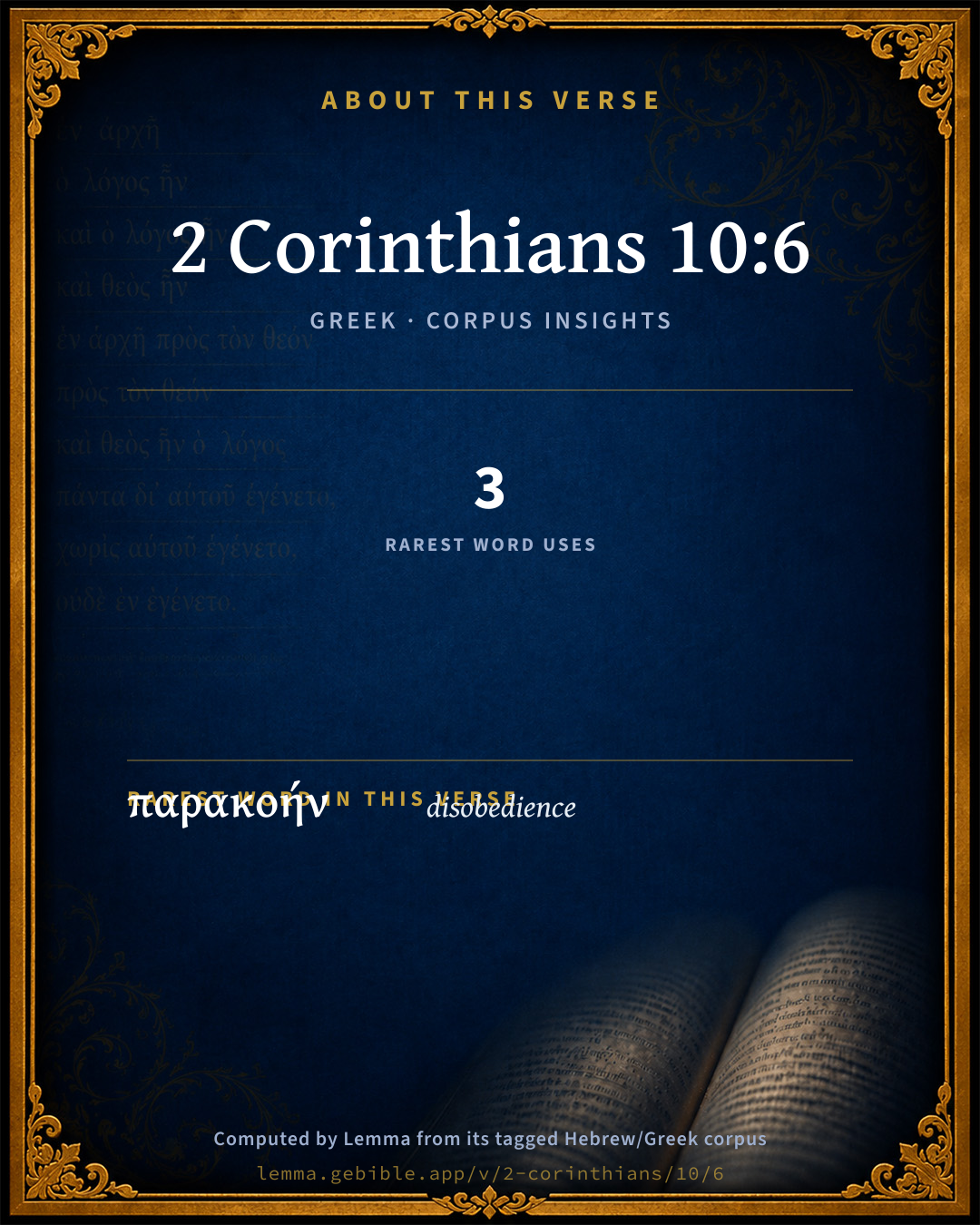
The rarest word here is παρακοήν disobedience G3876 — appearing just 3 times in the whole Greek New Testament.

Shared distinctive vocabulary

παρακοήν disobedience G3876 occurs in 3 verses of the Greek New Testament. Also found in:

Cross-references

11

Topical passages linked to 2 Corinthians 10:6 in the Treasury of Scripture Knowledge — connected by theme and wording, ordered by reader-vote popularity; previews shown in the World English Bible.

  • 2 Corinthians 2:9 For to this end I also wrote, that I might know the proof of you, whether you are obedient in all things.
  • Numbers 16:26–30 He spoke to the congregation, saying, Depart, I pray you, from the tents of these wicked men, and touch nothing of theirs, lest you be consumed in all their sins.
  • 2 Corinthians 7:15 His affection is more abundantly toward you, while he remembers all of your obedience, how with fear and trembling you received him.
  • 1 Corinthians 5:3–5 For I most assuredly, as being absent in body but present in spirit, have already, as though I were present, judged him who has done this thing.
  • 2 Corinthians 13:2 I have said beforehand, and I do say beforehand, as when I was present the second time, so now, being absent, I write to those who have sinned before now, and to all the rest, that, if I come again, I will not spare;
  • Acts 5:3–11 But Peter said, "Ananias, why has Satan filled your heart to lie to the Holy Spirit, and to keep back part of the price of the land?
  • Acts 13:10–11 and said, "Full of all deceit and all cunning, you son of the devil, you enemy of all righteousness, will you not cease to pervert the right ways of the Lord?
  • 2 Corinthians 13:10 For this cause I write these things while absent, that I may not deal sharply when present, according to the authority which the Lord gave me for building up, and not for tearing down.
  • 1 Timothy 1:20 of whom is Hymenaeus and Alexander; whom I delivered to Satan, that they might be taught not to blaspheme.
  • 3 John 1:10 Therefore, if I come, I will call attention to his deeds which he does, unjustly accusing us with wicked words. Not content with this, neither does he himself receive the brothers, and those who would, he forbids and throws out of the assembly.
  • 1 Corinthians 4:21 What do you want? Shall I come to you with a rod, or in love and a spirit of gentleness?

Cross-references courtesy of OpenBible.info (CC BY 4.0).

Commentary

Notes on 2 Corinthians 10:6 from classic Christian and Jewish commentators (each source and its license shown beneath its notes). The classic Christian expositions comment on the surrounding passage and are grouped to its opening verse, so a note may address several verses; the Jewish commentaries on the Tanakh (Rashi and others) are per-verse, so they appear only where the commentator wrote on this verse.

Lemma curates 59 commentaries, every one of them public domain or Creative Commons licensed, each selected and text-cleaned for this edition rather than reprinted as found. About our sources →

Bengel's Gnomon

Johann Albrecht Bengel

2Co 10:6. Ἐν ἑτοίμῳ ἔχοντες) viz., ἡμᾶς, he says, we are ready [having ourselves in readiness]. We have zeal already; and it will be brought forth into action at the proper time.—πᾶσαν, all) This has a more extensive meaning than ὑμῶν, your, presently after.—ὅταν, when) lest the weaker should be injured,[66] 2Co 10:8. This is the principal point of pastoral prudence. [Paul had already done something of this sort at Corinth, Act 18:7. On a similar principle, GOD exercises so great long-suffering as He does, in regard to an immense multitude of wicked men, till those things which can be gained thereby, have been drawn forth. See Exo 32:34.—V. g.]

[66] Were I prematurely before the time to revenge disobedience.—ED.

Bengel's Gnomon of the New Testament — English translation (T&T Clark, Edinburgh, 1860) — public domain. Text from a community e-Sword module.

Meyer's Critical & Exegetical Commentary

Heinrich August Wilhelm Meyer

2Co_10:6. The reverse side of the αἰχμαλωτίζοντες κ.τ.λ. just expressed. Although, namely, the αἰχμαλ. πᾶν νόημα εἰς τ. ὑπακ. τοῦ Χριστοῦ is the result of the apostolic warfare on the whole and in general, yet there remain exceptionspersons, who do not surrender themselves captive to Christs dominion; there remains παρακοή in contradistinction to the ὑπακοή of others. Hence it is a part also of the complete work of victory to punish every παρακοή. And this, says Paul, we are in readiness to execute, so soon as, etc. Bengel well says: Zelus jam adest; prometur, cum tempus erit. Paul does not speak of the action of war-captives at variance with the duty of obedience, to which they are taken bound (Hofmann). For this the threat, which would amount, in fact, to the avenging of every sin, would be too strong, and the following ὅταν κ.τ.λ. would not be suitable. The παρακουοντες must still be enemies who, after the victory, do not submit to the victo.

ἐν ἑτοίμῳ ἔχοντες] in promptu habentes, also in Polyb. ii. 34. 2, and Philo, Leg. ad. Caj. p. 1011, 1029. See, in general, Wetstei.

ὅταν πληρωθῇ ὑμῶν ἡ ὑπακοή] With this he turns to apply what was previously said of a general tenor (ἐκδικ. πᾶσαν παρακ.) specially to the circumstances of the Corinthians, so that the conduct of the Judaistic teachers, who had intruded into Corinth and directed their doings against Paul, appears especially to be included in πᾶσα παρακοή; and the Corinthian church, a part of which had been led astray by those persons, is represented as not yet completely obedient, but as in the course of developing this complete obedience. When this development shall be completed (which till then makes a claim on my patience, ne laedantur imbecilliores, Bengel), that ἐκδίκησις of every disobedience shalleven as respects the situation of things at Corinthensue.[301] Thus the apostle separates the interest of the church from that of the intruding seducers, and presents his relation to the church as one of forbearance and confidence, while his relation to his opponents is one of vengeance delaying its execution only for the sake of the church, which has not yet attained to full obediencea wise manipulation of the Divide et impera!

How he means to execute the ἐκδικεῖν (Rom_12:19), he does not say; he might do so by ordaining excommunication, by giving them over to Satan (1Co_5:5), or by other exercise of his miraculous apostolic powe.

ὑμῶν] is placed first with emphasis, to distinguish the church from those whose παρακοή was to be punished. Hofmann, without ground, denies this emphasis, because ὙΜῶΝ does not stand before ΠΛΗΡΩΘῆ. The emphasis certainly falls, in the first instance, on πληρ., and next not on ἡ ὑπακ., but on ὙΜῶΝ.

[301] Lachmann, by a full stop, separates ὅταν πληρ. ὑμ. ἡ ὑπακ. wholly from what goes before, and connects it with what follows, so that the meaning results: When your obedience shall have become complete, see to what lies before your eyes. A precept strangely conditioned! And why should we give up the common punctuation, which yields a delicate touch quite characteristic of Paul?

Meyer — Critical and Exegetical Commentary on the New Testament — English translation by Peter Christie, edited by Frederick Crombie (T&T Clark, 1880) — public domain. Text from a community e-Sword module.

Expositor's Greek Testament

ed. W. Robertson Nicoll

2Co 10:6 . καὶ ἐν ἑτοίμῳ ἔχοντες κ . τ . λ .: and being in readiness ( cf. ἑτοίμως ἔχω chap. 2Co 12:14 ) to avenge all disobedience ( cf. Mat 18:17 ), sc. , if there remain any still disobedient, when your obedience, i.e. , to me and to my Apostolic authority ( cf. 2Co 2:9 , 2Co 7:15 ), shall be fulfilled . The word ὑπακοή in 2Co 10:5 brings him back to this, the primary object of his letter. He does not wish to arrive in Corinth until the Church as a whole is firm in its loyalty to him.

The Expositor's Greek Testament, edited by W. Robertson Nicoll (1897–1910) — public domain. Text from a community e-Sword module.

Jamieson, Fausset & Brown

Robert Jamieson, A. R. Fausset & David Brown

Translate, "Having ourselves (that is, being) in readiness to exact punishment for all disobedience," &c. We have this in store for the disobedient: it will be brought into action in due time.

when your obedience, &c.--He charitably assumes that most of the Corinthian Church will act obediently; therefore he says "YOUR obedience." But perhaps some will act otherwise; in order, therefore, to give all an opportunity of joining the obedient, he will not prematurely exact punishment, but wait until the full number of those gathered out to Christ has been "completed," and the remainder have been proved incorrigible. He had acted already so at Corinth (Act 18:6-11; compare Exo 32:34; Mat 13:28-30).

Jamieson, Fausset & Brown — Commentary Critical and Explanatory on the Whole Bible (1871) — public domain (CC PDM 1.0). Text via the HelloAO Bible API.

Adam Clarke's Commentary

Verse 6. And having in a readiness to revenge all disobedience] I am ready, through this mighty armour of God, to punish those opposers of the doctrine of Christ, and the disobedience which has been produced by them.

When your obedience is fulfilled.] When you have in the fullest manner, discountenanced those men, and separated yourselves from their communion. The apostle was not in haste to pull up the tares, lest he should pull up the wheat also.

All the terms in these two verses are military. Allusion is made to a strongly fortifed city, where the enemy had made his last stand; entrenching himself about the walls; strengthening all his redoubts and ramparts; raising castles, towers, and various engines of defence and offence upon the walls; and neglecting nothing that might tend to render his strong hold impregnable. The army of God comes against the place and attacks it; the strong holds οχυροματα, all the fortified places, are carried. The imaginations, λογισμοι, engines, and whatever the imagination or skill of man could raise, are speedily taken and destroyed. Every high thing, παν υψωμα, all the castles and towers are sapped, thrown down and demolished; the walls are battered into breaches; and the besieging army, carrying every thing at the point of the sword, enter the city, storm and take the citadel. Every where defeated, the conquered submit, and are brought into captivity, αιχμαλωτιζοντες, are led away captives; and thus the whole government is destroyed.

It is easy to apply these things, as far as may be consistent with the apostle's design. The general sense I have given in the preceding notes.

Adam Clarke's Commentary on the Bible (1810–1826) — public domain. Text from a community e-Sword/MySword module.

John Calvin's Commentaries

6. And are in readiness to avenge. This he adds, lest insolent men should presumptuously lift themselves up in opposition to his ministry, as if they could do so with impunity. Hence he says, that power had been given him — not merely for constraining voluntary disciples to subjection to Christ, but also for inflicting vengeance upon the rebellious, and that his threats were not empty bugbears, but had the execution quite in readiness — to use the customary expression. Now this vengeance is founded on Christ’s word —

whatsoever ye shall bind on earth shall be bound also in heaven. (Matthew 18:18.)

For although God does not thunder forth immediately on the minister’s pronouncing the sentence, yet the decision is ratified, and will be accomplished in its own time. Let it, however, be always understood, that it is when the minister fights with spiritual armor. Some understand it as referring to bodily punishments, by means of which the Apostles inflicted vengeance upon contumacious and impious persons; as for example, Peter struck Ananias and Sapphira dead, and Paul struck Elymas the sorcerer blind. (Acts 5:1-10, and Acts 13:6-11.) But the other meaning suits better, for the Apostles did not make use of that power invariably or indiscriminately. Paul, however, speaks in general terms that he has vengeance ready at hand against all the disobedient.

When your obedience shall be fulfilled How prudently he guards against alienating any by excessive severity! For as he had threatened to inflict punishment upon the rebellious, that he may not seem to provoke them, he declares that another duty had been enjoined upon him with regard to them — simply that of making them obedient to Christ. And, unquestionably, this is the proper intention of the gospel, as he teaches both in the commencement and in the close of the Epistle to the Romans. (Romans 1:5, and Romans 16:26.) Hence all Christian teachers ought carefully to observe this order, that they should first endeavor with gentleness to bring their hearers to obedience, so as to invite them kindly before proceeding to inflict punishment upon rebellion. Hence, too, Christ has given the commandment as to loosing before that of binding.

John Calvin's Commentaries (1540-1563) — public domain. Text from the Calvin Translation Society English edition (1840s-50s) via the Christian Classics Ethereal Library (ccel.org). Calvin's coverage is partial (roughly two-thirds of the Bible); uncommented books and verses are honest gaps, never fabricated. The 19th-century editor's footnotes and remarks are omitted so the notes are faithfully Calvin's own voice.

Ellicott's Commentary for English Readers

(6) And having in a readiness to revenge all disobedience.—The idiom, having in a readiness, is perhaps, somewhat too archaic, and it might be better to render being ready, or holding ourselves ready. The words that follow imply the thought that those with which the verse opens were somewhat too unqualified. When he spoke of “avenging all disobedience,” he was not thinking of those to whom he writes, and whose repentance and obedience had filled him with so much joy (2Co_7:6-13), but only of the rebellious remnant. He would wait till all had obeyed who were willing to obey. He does not indicate what form of vengeance he thought of taking, but we may think of some such severe discipline as that indicated by “delivering to Satan,” in 1Co_5:5; 1Ti_5:20, with a view, if it were possible, to their ultimate restoration. (Comp. 2Co_13:3-10.)

A Bible Commentary for English Readers, edited by Charles John Ellicott (1878–1897) — public domain. Text from a community e-Sword module.

The Cambridge Bible for Schools and Colleges

gen. ed. J. J. S. Perowne

6. and having in a readiness] The expression is equivalent to our holding ourselves in readiness.

to revenge] Better, to avenge. Literally, to do justice, execute sentence upon.

when your obedience is fulfilled] St Paul was ready to wait until his exhortations and rebukes had had time to work. He would not ‘come to them in heaviness’ (ch. 2Co_2:1). He called ‘God to witness that if he did delay to come to Corinth it was to spare them’ (ch. 2Co_1:23). He wrote while absent that he might not have to use sharpness when present (ch. 2Co_13:10). But when all had been done that could be done, it was his intention to come and ‘not spare’ those who refused to listen to his voice (ch. 2Co_13:2).

The Cambridge Bible for Schools and Colleges (gen. ed. J. J. S. Perowne; Cambridge University Press, 1878–1918) — public domain. Text from a community e-Sword module.

John Gill's Exposition

And having in a readiness to revenge all disobedience,.... Not with the temporal sword, as the civil magistrate, but with the spiritual one; meaning either censures and excommunication, which a faithful minister of the Gospel, with the suffrage of the church, has at hand, and a power to make use of, for the reclaiming of disobedient persons; or rather that extraordinary power which was peculiar to the apostles, of inflicting punishments on delinquents, such as what was exercised by Peter upon Ananias and Sapphira, by the Apostle Paul on Elymas the sorcerer, the incestuous person, and Hymenaeus and Philetus, and which still continued with him; it was ready at hand, he could exercise it whenever he pleased, he only waited a proper time:

when your obedience is fulfilled: till they were thoroughly reformed from the several abuses, both in doctrine and practice, they had fallen into, and were brought into a better order and decorum, and appeared to have been in all things obedient to the directions he had given; being unwilling, as yet, to use the awful authority he had from Christ, lest any of the dear children of God, who were capable of being restored by gentler methods, should suffer with the refractory and incorrigible.

John Gill's Exposition of the Whole Bible (1746–1763) — public domain (CC PDM 1.0). Text via the HelloAO Bible API.

Trapp's Complete Commentary

John Trapp

6 And having in a readiness to revenge all disobedience, when your obedience is fulfilled.

Ver. 6. And having in a readiness] Vengeance is every whit as ready in God’s hand, as in the minister’s mouth. See Mat 16:19; Mat 18:18. Elisha hath his sword as well as Jehu and Hazael, 1Ki 19:17. God hews men by his prophets and slays them by the words of his mouth, Hos 6:5. By preaching, Christ many times smites the earth, Isa 11:4; his word lays hold on them, Zec 1:6, and that which they have counted wind, hath become fire to devour them, Jer 5:13-14.

John Trapp, A Commentary or Exposition upon All the Books of the Old and New Testament (1647–1656) — public domain. Text from a community e-Sword module.

Albert Barnes' Notes on the Bible

And having in a readiness ... - I am ready to punish all disobedience, notwithstanding all that is said to the contrary; see the notes on 2Co 10:1-2. Clothed as I am with this power; aiming to subdue all things to Christ, though the weapons of my warfare are not carnal, and though I am modest or timid 2Co 10:1 when I am with you, I am prepared to take any measures of severity required by my apostolic office, in order that I may inflict deserved punishment on those who have violated the laws of Christ. The design of this is, to meet the objection of his enemies, that he would not dare to execute his threatenings.

When your obedience is fulfilled - Doddridge renders this: “now your obedience is fulfilled, and the sounder part of your church restored to due order and submission.” The idea seems to be, that Paul was ready to inflict discipline when the church had showed a readiness to obey his laws, and to do its own duty - delicately intimating that the reason why it was not done was the lack of entire promptness in the church itself, and that it could not be done on any offender as long as the church itself was not prepared to sustain him. The church was to discountenance the enemies of the Redeemer; to show an entire readiness to sustain the apostle, and to unite with him in the effort to maintain the discipline of Christ’s house.

Albert Barnes' Notes on the Bible (1834–1885) — public domain. Text from a community e-Sword/MySword module.

Haydock's Catholic Bible Commentary

Having in readiness. God gave power, not only to persuade, and to convince the incredulous, but also to punish them, as we see in the examples of Simon Magus and Elymas. What then should hinder him from using the same against these false apostles? But he says, your obedience must first be fulfilled. God forbid that I should first use the sword, before I have tried the ways of sweetness and conciliation. But if any remain obstinate, then I will employ the arms that God has given me. (Grotius) --- This sweet and forcible example of the apostle is worthy the imitation of all superiors, temporal and ecclesiastical, how ever high their dignity or command. (Haydock)

George Leo Haydock (1774–1849), Haydock's Catholic Family Bible and Commentary, 1859 edition — public domain. Excludes Psalms (Douay-Rheims chapter numbering differs from Protestant) and Deuterocanonical books (Catholic canon only).

Matthew Poole's English Annotations

The apostle certainly means by this, excommunication; which was the rod which he had before mentioned, asking them if they would he should come unto them with a rod. This rod he here threateneth them with; telling them, that he had another weapon of his warfare, of a spiritual nature too, to be used against such as preferred themselves to be believers, but walked disorderly; only he at present spared them, because though a great part of them were obedient, yet there were some amongst them of whose obedience he could not yet glory; but yet he hoped well, and therefore should wait until, by the use of all fair means, (such as exhortations and arguments), he had reduced as many of them as he could unto obedience. But that being done, God had intrusted him with another weapon, with which he would, in the name and by the authority of God, revenge his glory upon the disobedience of others. Herein the apostle hath set a rule and a pattern to all churches, where are multitudes that walk disorderly; not to be too hasty in excommunicating them, but to proceed gradually; first using all fair means, and waiting with all patience, for the reducing them to their duty, who will by any gentle and fair means be reduced; and then revenging the honour and glory of God only upon such as will not be reclaimed.

Matthew Poole's English Annotations on the Holy Bible (1683–1685) — public domain. Text from a community e-Sword/MySword module.

Whedon's Commentary on the Bible

Daniel D. Whedon

6. Having—Parallel with casting, in 2Co_10:5, both agreeing with we, in 2Co_10:3. Our apostle is describing the actual war which we are waging; and while depicting it in the grand imagery of 2Co_10:4-5, he is not for a moment forgetting the smaller enemies now in his front; for, as before remarked, they are included as the less in the greater.

Revenge—A judicial term, punish.

All disobedience—Such as is excited by the Christine party in Corinth.

Your obedience is fulfilled—When the solid Church is fully unified, and brought to a perfect accord with its founder apostle, then will due penalty be received by the schismatics.

Daniel D. Whedon (gen. ed.), Commentary on the Old and New Testaments (1874–1909) — public domain. Text from a community e-Sword module.

The Pulpit Commentary

Being in a readiness; i.e. being quite prepared. My sternness of purpose is ready, but my hope is that it may not be called into action. To revenge; rather, to do justice upon. In any case, in this infliction of justice, whatever form it might take, he would only be an agent of God. (Rom_12:19) When your obedience is fulfilled. St. Paul is confident that he will overcome the mazes of those opposed to him, and win them to Christ"s obedience; but if there were any who should obstinately refuse to submit, they must be reduced to submission by action, not by words.

The Pulpit Commentary (1880–1919), ed. H.D.M. Spence-Jones & Joseph S. Exell — public domain. Text from a community e-Sword module.

John Wesley's Explanatory Notes

Being in readiness to avenge all disobedience - Not only by spiritual censure, but miraculous punishments. When your obedience is fulfilled - When the sound part of you has given proof of your obedience, so that I am in no danger of punishing the innocent with the guilty.

John Wesley, Explanatory Notes Upon the Whole Bible (1754–1765) — public domain. Text via the GEBible commentary corpus.

Burkitt's Expository Notes on the New Testament

William Burkitt

That is, having in a readiness that which will revenge all disobedience upon refractory and stubborn offenders (namely, the power of excommunication) and both authority and ability to inflict such corporal punishment as he judged fit, by delivering them unto Satan; which power he resolved to make use of, when the greater part of them were, by their obedience to his admonitions, reduced to good order again.

Where note, That the apostle defers the excommunicating and censuring the offenders amongst them, they being very many, till he had, by exhortaiton and argument, brought over as many as possibly he could unto obedience. There is no place for severe remedies, when the diseases have taken and infected the whole church: the offenders in the church, when very many, cannot be easily punished; for when great multitudes are concerned, they are like to draw great multitudes after them.

The apostle’s practice in this case here, is a good pattern for our imitation, not to be too forward, rash, and hasty in denouncing the censures of the church, but to proceed prudently and gradually: first using all fair means and gentle methods, and waiting with all patience for the reducing them to their duty who will be reduced, and then revenging the glory and honour of God only upon such as will by no means be reclaimed or reduced.

William Burkitt's Expository Notes on the New Testament (1700–1703) — public domain. Text from a community e-Sword module.

McGarvey & Pendleton's Commentaries

J. W. McGarvey

and being in readiness to avenge all disobedience, when your obedience shall be made full . [For though we are indeed human, we do not contend after a human or worldly fashion (for our weapons are not slander, detraction, misrepresentation, etc., which are the methods employed by the world in overcoming opponents, but we use divine powers in our conflicts ( 1Co_4:19-21 ; 1Co_5:5 ), powers which are mighty in the sight of God to tear down defenses), and which can cast down all false human reasonings, sophistries and vain deductions, and every like thing which men presumptuously rear in opposition to the word of God, and which can bring every rebellious thought into captivity, so that it shall obey Christ. With this power, therefore, I am ready to come to punish all the disobedient; but I pause that all who desire to repent may do so, and after the number of the obedient is made full I will punish the rebellious remnant that remain. In verse 4 Paul evidently alludes to the crow, a large military engine with a great claw to it, which was used to pull down the walls of castles, forts and other strongholds. Stanley thinks that Paul has in mind in this passage certain military operations which occurred in Cilicia, the province in which he was born. In the hills and mountains of that locality, certain bands of pirates and robbers entrenched themselves, and for awhile withstood the Roman arms. Cicero made some headway in suppressing them, and on his return was honored with a Roman triumph, but the final victory was achieved by Pompey the generation before Paul was born. Pompey made great use of the crow, for he pulled down one hundred and twenty fortresses. But the crow was then in as general use as the cannon is now, and a writer would hardly be thought to refer to Gettysburg if he happened to use cannonading as a figure of speech. However, Pompey's campaign is a useful bit of history, for it shows us how forceful the figure was which Paul employed.]

J. W. McGarvey (with Philip Y. Pendleton), Commentaries on the New Testament (The Fourfold Gospel, 1914; Acts; and the epistles) — public domain. Text from a community e-Sword/MySword module.

The People's New Testament

B. W. Johnson

6. To revenge all disobedience. These spiritual weapons are ready to punish all disobedience at Corinth, when time had been given for all who are disposed to be obedient to show it.

B. W. Johnson's The People's New Testament with Notes (1889–1891) — public domain. Electronic text from the Christian Classics Ethereal Library (CCEL) ThML edition.

Cambridge Greek Testament for Schools and Colleges

6. ἐν ἑτοίμῳ ἔχοντες ἐκδικῆσαι πᾶσαν παρακοήν, κ.τ.λ. Being in readiness to avenge all disobedience, whenever your obedience shall be fulfilled, i.e. shall have been completed. The Apostle will give time for all Christians at Corinth to allow themselves to be ‘led captive to the obedience of the Christ’; then disobedience of whatever kind will be punished. There is emphasis on ὑμῶν, implying that his readers are, or will soon be, obedient. For ἐν ἐτοίμῳ ἔχοντες, in promptu habentes (Vulg.), Wetstein gives parallels from Philo, Polybius, and Dionysius Hal. For ἐκδικῆσαι, ‘to do justice,’ comp. Luk 18:5; 1Ma 6:22: it is one of the legal words which are rather frequent in this letter; comp. 2Co 1:22, 2Co 2:6; 2Co 2:8, 2Co 7:11-12. The aor. after verbs of readiness or expectation is in accordance with N.T. usage; 2Co 12:14; Act 21:13: after ἐλπίζω the pres. is never found (Luk 6:34; Php 2:23; &c.). In ὑπακοή and παρακοή, as in καθαιροῦντες and ἐπαιρόμενον, we have another play on words: comp. 2Co 1:13, 2Co 3:2, 2Co 8:22, &c). Only here, Rom 5:19 and Heb 2:2, does παρακοή occur in the N.T.: not in the LXX. It means ‘failing to listen,’ or ‘hearing amiss,’ and is akin to ἀμέλεια, incuria, as Bengel on Rom 5:19 points out. In Heb 2:2 it is joined with παράβασις. See Trench, Syn. § lxvi. Comp. παρακούειν Mat 18:17; Isa 65:12; Est 3:3; Est 3:8; Est 7:4; 1Es 4:11; Tob 3:4. In Mar 5:36 παρακούειν is used of Christ’s ignoring an interruption. There is no carelessness implied in ἀπειθία or ἀπείθεια (Rom 11:30; Rom 11:32; Eph 2:2; Eph 5:6; Col 3:6; Heb 4:6; Heb 4:11), and S. Paul would perhaps have used it here, but for the desire of a verbal contrast to ὑπακοή.

Assuming that 10–13 is part of the lost letter, 2Co 2:9 may be a reference to what is said here: see note there.

Cambridge Greek Testament for Schools and Colleges (Cambridge University Press, 1896; 21 vols, various authors incl. Carr, Maclear, Plummer, Farrar, Lumby, Moule, M. R. James, Simcox) — public domain. Text from a community e-Sword module.

Alford’s Greek Testament

Henry Alford

6.] But perhaps some will not thus be subjected. In that case we are ready to inflict punishment on them: but not till every opportunity has been given them to join the ranks of the obedient; when your obedience (stress on ὑμῶν) shall have been completed. He does not mention any persons—not the disobedient, but every (case of) disobedience, and throws out ὑμεῖς into strong relief, as charitably embracing all, or nearly all, those to whom he was writing. Lachmann, strangely, and as it seems to me most absurdly, puts a period at παρακοήν, and joins ὅταν πληρωθῇ ὑμ. ἡ ὑπακοή, τὰ κατὰ πρόσωπον βλεπετε. More complete ignorance of the Apostle’s style, and non-appreciation of the fine edge of his hortatory irony, can hardly be evinced, than this.

Henry Alford, The Greek Testament (1849–1861) — public domain. Text from a community e-Sword module.

International Critical Commentary

6. καὶ ἐν ἑτοίμῳ ἔχοντες ἐκδικῆσαι κ.τ.λ. ‘And being quite prepared to avenge all disobedience, whenever your obedience shall have been completed.’ This reads oddly after 7:4, 16. There he is enthusiastic about them; here their obedience is still incomplete. See also 8:7. The ὑμῶν is emphatic; he fully expects that, after the interval which he means to allow, the Corinthian Church will be found to be obedient to Christ and submissive to His Apostle. But there may be exceptions, and with such cases he is prepared to deal severely. We have ἑτοίμως ἔχω, 12:14, and ἐν ἑτοίμῳ ἔχω is found in Philo, Polybius, etc. See Wetstein. Such expressions, like δύναμαι, are usually followed by the aor. infin. (12:14; Act 21:13, Act 23:15, etc.).* The legal expression, ἐκδικῆσαι, ‘to do justice,’ may be compared with those in 1:22, 2:6, 8, 7:11, 12. The play on words between καθαιροῦντες and ἐπαιρόμενον and between ὑπακοή and παρακοή may be compared with those noted in 1:13, 3:2, 4:8, 6:10, 7:10, 8:22. Note also the emphatic repetition in πᾶν … πᾶσαν, and the alliteration in ἔχότες ἐκδικῆσαι and πᾶσαν παρακοήν. Alliteration with π is specially freq. (9:8, 11). In LXX παρακοή is not found, and in N.T. it occurs only here, Rom 5:19, and Heb 2:2, and St Paul would probably have used ἀπειθία (Rom 11:30, Rom 11:32; Eph 2:2, Eph 2:5:6; Col 3:6) here had he not wished to make a verbal antithesis to ὑπακοή, for παρακοή, ‘failing to listen’ or ‘listening amiss,’ implies less deliberate disobedience than ἀπειθία.†

These two verses exhibit the Apostle’s severity and consideration, and his authority is manifest in both. The threat of severity anticipates 12:20—13:1, and if these four chapters are part of the lost letter which was sent before 2 Cor. 1-9., then 2:9 may refer to this passage. The claim to a Divine commission and to the power to decide what is contrary to the knowledge of God is conspicuous here as in 2:14, 4:6, 5:18. In what way he will punish those who still oppose him when he comes is not stated. He is probably thinking of the Judaistic teachers, anticipating that those whom they have misled will submit and return to their allegiance, but that these alien teachers will not do so.‡ He passes on to deal with some of the sneers which they had employed in order to undermine his authority, and some of the claims which they had made in order to establish their own. Some of the latter may have been true enough. They came from the country of the Messiah and from the primitive Christian congregation. They had personal acquaintance with some of the Twelve and with James, the Lord’s brother. That they had known Christ Himself is less probable.

10:7-11. Reply to the Charge of Weakness

My Apostolic Authority will be found to be as effective in fact as it looks on paper.

7 It is at the outward appearance of things that you look. There may be a certain person who is convinced in himself that he is Christ’s man. Well then, let him, on second thoughts, be persuaded of this with himself, that just as truly as he is Christ’s, so also are we. 8 That is no idle boast; for even supposing that I glory somewhat extravagantly about our authority, which was given me by the Lord for your upbuilding and not for your demolition, I shall not be put to shame as an impostor when I come to Corinth. 9 I will not say more than that, that I may not seem (as it were) to terrify you by means of my letters. 10 For I know what people say; ‘Oh, yes, his letters are impressive and forcible enough; but his personal appearance is weak, and his manner of speaking is worth nothing.’ 11 Let the man who talks in this manner be persuaded of this, that such as we are in word by means of letters, when we are absent, just such also, when we are present, are we in act. Our words and our conduct exactly correspond.

International Critical Commentary — older volumes (1896–1929), various authors — public domain. Text from a community e-Sword module.

Vincent's Word Studies in the New Testament

Marvin R. Vincent

To avenge all disobedience, etc. The military metaphor continued. After most have surrendered and thus fulfilled their obedience, some rebels may remain, and these will be punished.

Marvin R. Vincent, Word Studies in the New Testament (1887–1900) — public domain. Text from a community e-Sword/MySword module.

Lesson kit

Teaching starters — assembled from the data on this page, not authored interpretation. Every prompt links to the verse data it draws on. Edit before teaching.

2 Corinthians, in the Pauline Epistles, opens this verse with 12 words (12 distinct Greek lemmas). Its most distinctive word is parakoḗ (“disobedience”). A historical commentator’s framing appears above. Read the whole chapter for the surrounding context.

Discussion questions

  1. What does “disobedience” (parakoḗ) contribute to the verse as a whole?
  2. How does Romans 5:19, which shares the word «disobedience», read alongside this verse?
  3. These translations render this verse differently; the difference is in the English rendering, not the original. What questions does that raise?
  4. Compare how Bengel's Gnomon and Meyer's Critical & Exegetical Commentary read this verse. Where do they agree or differ?

Things to notice

Reading settings

Reading text

Shown beneath each verse's original-language words.

Old Testament
Old Testament edition

Read the OT as the Masoretic Hebrew (MT) or the Greek Septuagint (LXX).

English shown for the Greek Septuagint (in the Hebrew ↔ Greek comparison).

Comparing translations? Open the Compare panel on any verse page to stack up to four side by side.