2 Corinthians 13:9

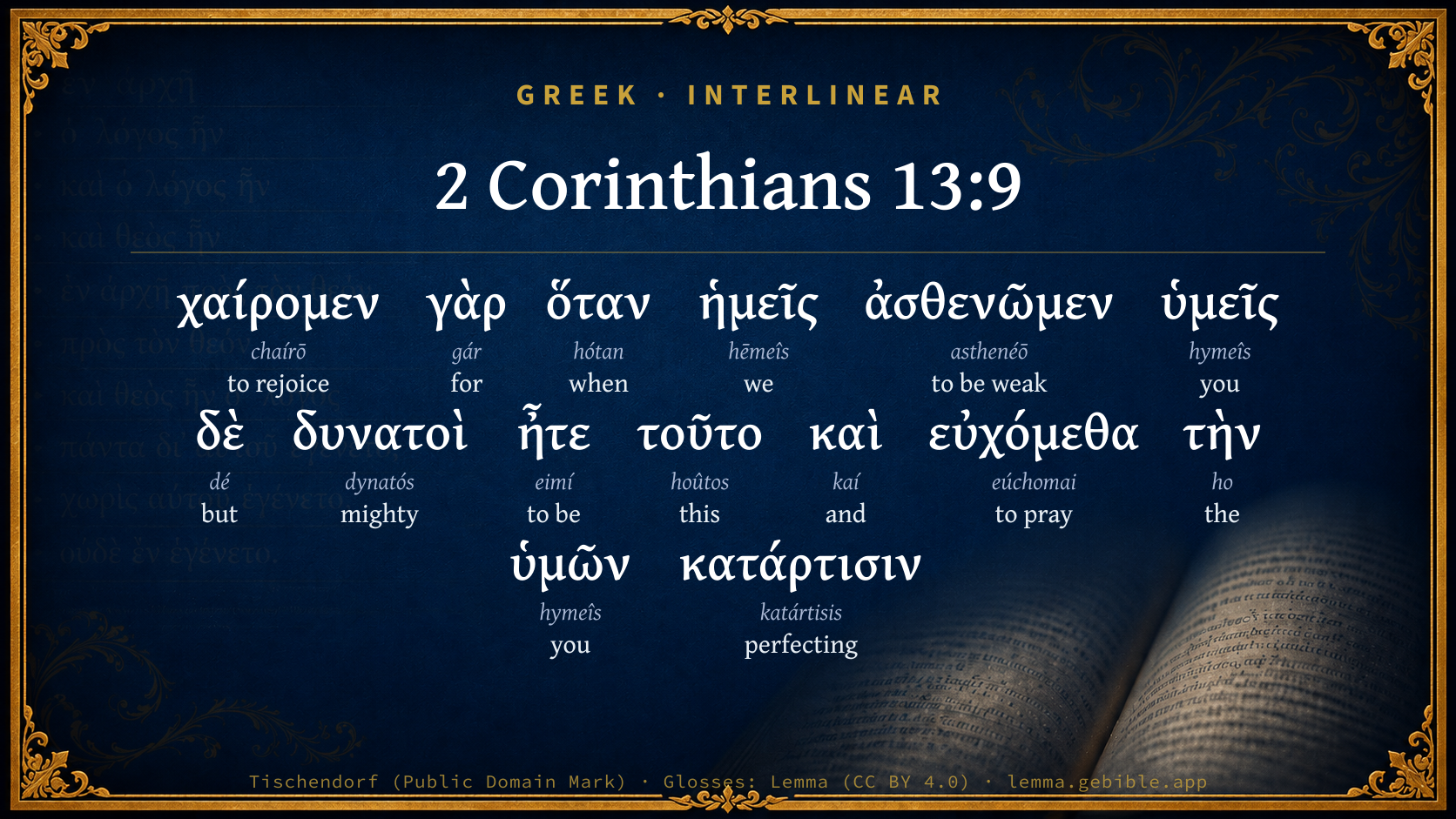
Greek (Tischendorf 8th ed.) 2 Corinthians 13:9 appears in the Greek New Testament. The text above is from the Tischendorf 8th edition. Each word links to its Strong’s number and a concise gloss. Click any word for its full Thayer’s Greek Lexicon entry.
Download image
Cite this verse

2 Corinthians 13:9 (World English Bible). Public Domain. Lemma interlinear Bible study tool, https://lemma.gebible.app/v/2-corinthians/13/9.

Show BibTeX & RIS
BibTeX
RIS
English Translation
For we rejoice when we are weak and you are strong. And this we also pray for, even your perfecting.
World English Bible · Public Domain
Highlights
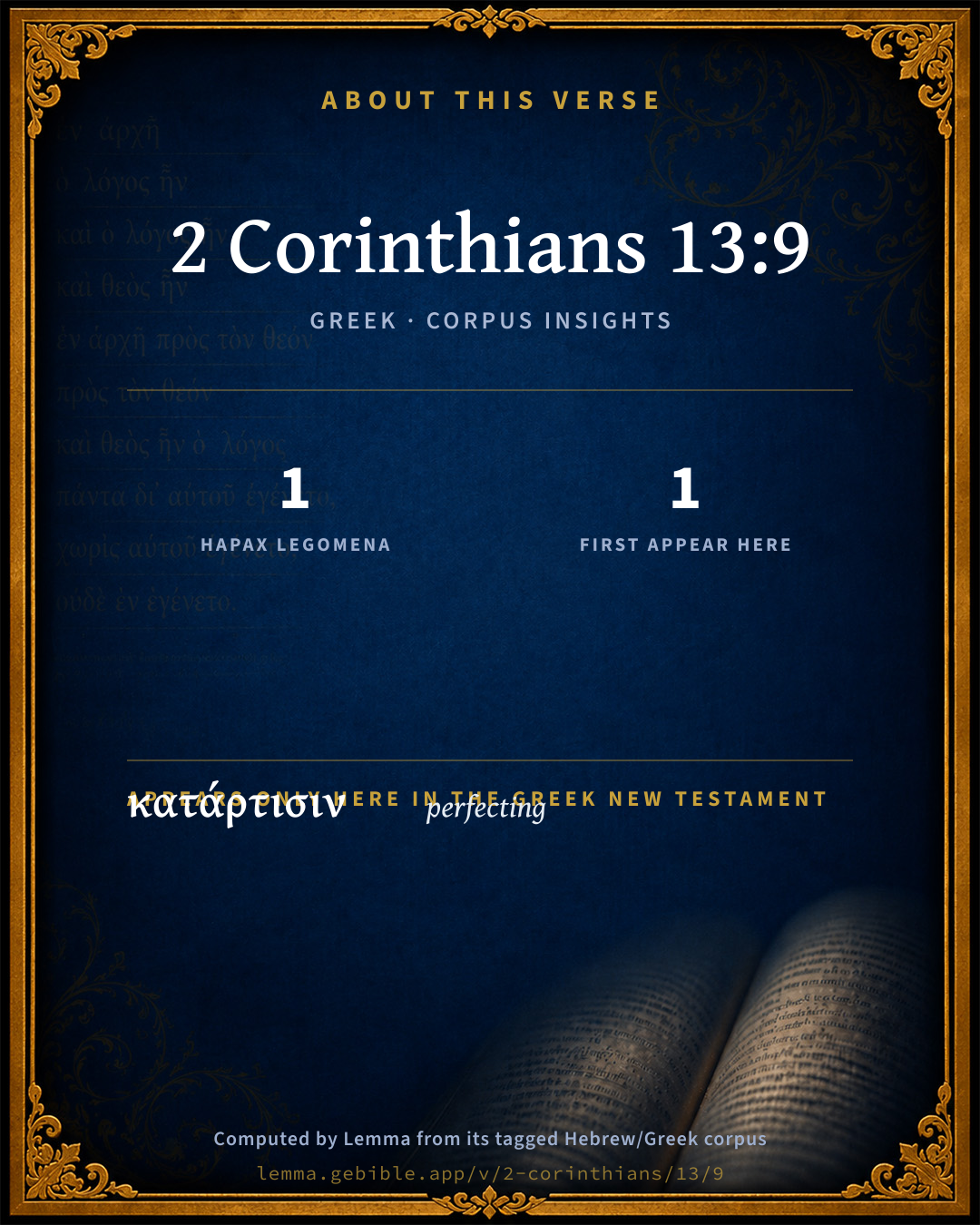
  • 1 hapax legomenon — only here in the Greek New Testament
  • 1 first appearance in the Greek New Testament
Full analysis ↓
Download a study sheet

One document with this verse’s original text, its word-by-word gloss line, the meaning frame, cross-references with their text, attributed commentary, and full source and license credits — printable, and it pastes into notes with its structure intact.

This verse Autodidact and up

Study sheet (.html) Plain text (.txt)

A passage Seminary Student

Up to 50 verses in one chapter. A passage sheet keeps up to 6 commentary sources and 12 cross-references per verse, in the order this page ranks them, and says so on the sheet whenever that leaves anything out. Ask for a single verse and you get the Autodidact verse sheet above.

Everything on this page stays free to read, with no account — the sheet is a download of what is already on screen, not access to it.

Want to remove ads? Support Godless Engineer
Compare translations 3

The same verse in 3 English versions, stacked beneath the original-language interlinear above. Click any original word for its lexicon entry.

Each is an independent rendering of the whole verse — the interlinear is not word-aligned to these translations.

Highlighted words mark where these versions differ — a whole-verse word diff, not a word-by-word alignment.

  • World English Bible Public Domain
    For we rejoice when we are weak and you are strong. And this we also pray for, even your perfecting.
  • King James Version Public Domain
    For we are glad, when we are weak, and ye are strong: and this also we wish, even your perfection.
  • unfoldingWord Literal Text CC BY-SA 4.0
    For we rejoice whenever we ourselves are weak but you yourselves are powerful. We also pray for this: for your restoration.

unfoldingWord Literal Text — © unfoldingWord, licensed CC BY-SA 4.0. Word-aligned USFM3 via Door43 (git.door43.org/unfoldingWord/en_ult).

Versions to compare (up to 4)

3 of 4 selected

Show all 19 translations

Every available English version of this verse, each an independent rendering of the whole verse.

  • World English Bible Public Domain
    For we rejoice when we are weak and you are strong. And this we also pray for, even your perfecting.
  • Berean Standard Bible Public Domain
    In fact, we rejoice when we are weak but you are strong, and our prayer is for your perfection.
  • Majority Standard Bible Public Domain
    In fact, we rejoice when we are weak but you are strong, and our prayer is for your perfection.
  • King James Version Public Domain
    For we are glad, when we are weak, and ye are strong: and this also we wish, even your perfection.
  • American Standard Version (1901) Public Domain
    For we rejoice, when we are weak, and ye are strong: this we also pray for, even your perfecting.
  • Revised Version (1885) Public Domain
    For we rejoice, when we are weak, and ye are strong: this we also pray for, even your perfecting.
  • Geneva Bible (1599) Public Domain
    For we are glad when wee are weake, and that ye are strong: this also we wish for, euen your perfection.
  • Douay-Rheims (1899) Public Domain
    For we rejoice that we are weak, and you are strong. This also we pray for, your perfection.
  • Young's Literal Translation Public Domain
    for we rejoice when we may be infirm, and ye may be powerful; and this also we pray for -- your perfection!
  • Literal Standard Version CC BY-SA 4.0
    for we rejoice when we may be weak, but you may be powerful; and we also pray for this—your perfection!
  • Unlocked Literal Bible CC BY-SA 4.0
    For we rejoice when we are weak and you are strong. We also pray that you may be made complete.
  • unfoldingWord Literal Text CC BY-SA 4.0
    For we rejoice whenever we ourselves are weak but you yourselves are powerful. We also pray for this: for your restoration.
  • Darby Bible Public Domain
    For we rejoice when *we* may be weak and *ye* may be powerful. But this also we pray for, your perfecting.
  • World Messianic Bible Public Domain
    For we rejoice when we are weak and you are strong. We also pray for this: your becoming perfect.
  • Webster's Bible Public Domain
    For we are glad, when we are weak, and ye are strong: and this also we wish, even your perfection.
  • Free Bible Version CC BY-SA 4.0
    We're happy when we are weak, and you are strong—we pray that you may continue to improve.
  • Bible in Basic English Public Domain
    For we are glad when we are feeble and you are strong: and this is our prayer, even that you may be made complete.
  • Text-Critical English NT CC BY 4.0
    We rejoice when we are weak and you are strong, and we pray for your restoration.
  • Tyndale New Testament (1534) Public Domain
    We are glad when we are weake and ye stronge. This also we wisshe for even that ye were perfect.

Literal Standard Version (2020), Covenant Press — licensed CC BY-SA 4.0. Text via the HelloAO Bible API (eBible.org). Unlocked Literal Bible (unfoldingWord) — licensed CC BY-SA 4.0. Text via the HelloAO Bible API (eBible.org). unfoldingWord Literal Text — © unfoldingWord, licensed CC BY-SA 4.0. Word-aligned USFM3 via Door43 (git.door43.org/unfoldingWord/en_ult). Free Bible Version, Dr. Jonathan Gallagher — licensed CC BY-SA 4.0. Text via the HelloAO Bible API (eBible.org).

Word by word

More ways to search: Search by grammar → Find every occurrence → Compare this word →

Practice this passage: Drill this verse → Learn its vocabulary →

κατάρτισιν
katártisis
G2676
“perfecting”
Noun, Accusative, Singular, Feminine
Part of Speech
Noun
Case
Accusative
Number
Singular
Gender
Feminine
Full Thayer's Definition

Origin: from G2675

TDNT: 08:55,8

1. a strengthening, perfecting of the soul a. a training, disciplining, instructing
  1. χαίρομεν chaírō G5463 “to rejoice” Verb, Present, Active, Indicative, 1st person, Plural
  2. γὰρ gár G1063 “for” Conjunction
  3. ὅταν hótan G3752 “when” Conjunction
  4. ἡμεῖς hēmeîs G2249 “we” Personal pronoun, 1st person, Nominative, Plural
  5. ἀσθενῶμεν asthenéō G770 “to be weak” Verb, Present, Active, Subjunctive, 1st person, Plural
  6. ὑμεῖς hymeîs G5210 “you” Personal pronoun, 2nd person, Nominative, Plural
  7. δὲ dé G1161 “but” Conjunction
  8. δυνατοὶ dynatós G1415 “mighty” Adjective, Nominative, Plural, Masculine
  9. ἦτε eimí G1510 “to be” Verb, Present, Active, Subjunctive, 2nd person, Plural
  10. τοῦτο hoûtos G3778 “this” Demonstrative pronoun, Accusative, Singular, Neuter
  11. καὶ kaí G2532 “and” Conjunction
  12. εὐχόμεθα eúchomai G2172 “to pray” Verb, Present, Middle or Passive deponent, Indicative, 1st person, Plural
  13. τὴν ho G3588 “the” Article, Accusative, Singular, Feminine
  14. ὑμῶν hymeîs G5210 “you” Personal pronoun, 2nd person, Genitive, Plural

About this verse

These counts appear in no published source. They are computed here, from the morphology-tagged text and Lemma’s own curated glosses. What Lemma adds →

15
words
14
distinct lemmas
Pauline Epistles
section

Notable vocabulary

1 hapax legomenon — a word that appears only here in the entire Greek New Testament:

  • κατάρτισιν perfecting G2676

First appearance in Scripture

This word makes its first canonical appearance in the Greek New Testament here:

  • κατάρτισιν perfecting G2676

Shared distinctive vocabulary

εὐχόμεθα to pray G2172 occurs in 7 verses of the Greek New Testament. Also found in:

Repetition

A word recurs within this verse:

  • ὑμεῖς you G5210 ×2

Cross-references

16

Topical passages linked to 2 Corinthians 13:9 in the Treasury of Scripture Knowledge — connected by theme and wording, ordered by reader-vote popularity; previews shown in the World English Bible.

  • 2 Corinthians 13:11 Finally, brothers, rejoice. Be perfected, be comforted, be of the same mind, live in peace, and the God of love and peace will be with you.
  • 1 Corinthians 4:10 We are fools for Christ's sake, but you are wise in Christ. We are weak, but you are strong. You have honor, but we have dishonor.
  • 1 Thessalonians 3:10 night and day praying exceedingly that we may see your face, and may perfect that which is lacking in your faith?
  • 1 Peter 5:10 But may the God of all grace, who called you to his eternal glory by Christ Jesus, after you have suffered a little while, perfect, establish, strengthen, and settle you.
  • 2 Corinthians 12:5–10 On behalf of such a one I will boast, but on my own behalf I will not boast, except in my weaknesses.
  • 2 Corinthians 7:1 Having therefore these promises, beloved, let us cleanse ourselves from all defilement of flesh and spirit, perfecting holiness in the fear of God.
  • 2 Corinthians 11:30 If I must boast, I will boast of the things that concern my weakness.
  • 2 Corinthians 13:7–8 Now I pray to God that you do no evil; not that we may appear approved, but that you may do that which is honorable, though we are as reprobate.
  • Ephesians 4:12–13 for the perfecting of the saints, to the work of serving, to the building up of the body of Christ;
  • Philippians 3:12–15 Not that I have already obtained, or am already made perfect; but I press on, if it is so that I may take hold of that for which also I was taken hold of by Christ Jesus.
  • Colossians 1:28 whom we proclaim, admonishing every man and teaching every man in all wisdom, that we may present every man perfect in Christ Jesus;
  • Colossians 4:12 Epaphras, who is one of you, a servant of Christ, salutes you, always striving for you in his prayers, that you may stand perfect and complete in all the will of God.
  • 2 Timothy 3:17 that the man of God may be complete, thoroughly equipped for every good work.
  • Hebrews 6:1 Therefore leaving the doctrine of the first principles of Christ, let us press on to perfection--not laying again a foundation of repentance from dead works, of faith toward God,
  • Hebrews 12:23 to the general assembly and assembly of the firstborn who are enrolled in heaven, to God the Judge of all, to the spirits of just men made perfect,
  • Hebrews 13:21 make you complete in every good work to do his will, working in you that which is well pleasing in his sight, through Jesus Christ, to whom be the glory forever and ever. Amen.

Cross-references courtesy of OpenBible.info (CC BY 4.0).

Commentary

Notes on 2 Corinthians 13:9 from classic Christian and Jewish commentators (each source and its license shown beneath its notes). The classic Christian expositions comment on the surrounding passage and are grouped to its opening verse, so a note may address several verses; the Jewish commentaries on the Tanakh (Rashi and others) are per-verse, so they appear only where the commentator wrote on this verse.

Lemma curates 59 commentaries, every one of them public domain or Creative Commons licensed, each selected and text-cleaned for this edition rather than reprinted as found. About our sources →

The Biblical Illustrator

Joseph S. Exell

2Co_13:9

For we are glad, when we are weak, and ye are strong:.

. even your perfection.

Christian perfection

I. The object desired. Perfection.

1. As individual believers. No such thing as aggregate holiness can exist, without the sanctification of its units. A church cannot be perfect except as its members are so, any more than the body can be healthy unless its organs are sound. In what he considered this to consist we may gather from his writings:--In understanding be men, literally perfect; that I might perfect that which is lacking in your faith; perfect and complete in all the will of God; that the man of God may be perfect, thoroughly furnished to every, good work; perfect in Christ Jesus. He would have Christians--

(1) Of vigorous understanding, not feeble minded, not intellectual dwarfs, not liable to be carried about with every wind of doctrine in consequence of their slight comprehension or grasp of the truth.

(2) Of strong faith, not sceptical, doubting, hesitating, but, like Abraham, strong in faith, giving glory to God; living by it, walking by it, taking it as their principle and guide; and by it giving the future ascendency over the present, the spiritual over the material.

(3) Perfect in all Gods will; not correct in creed and defective in practice; not strong in faith and deficient in love, but showing faith by works; being all that Christianity requires and Christ was.

(4) Careful to maintain good works; active, diligent, zealous, devout.

(5) And all this in Christ Jesus; not from a spirit of legality, self-righteousness, or self dependence, but by grace derived from Christ, by the indwelling spirit of Christ, actuated by the love of Christ, and doing all to His glory. This is an object at which we may all aim. The highest kind of excellence is presented to the view of each. You cannot perhaps be great, you may be good--wealth may be denied you, worth is not. And this is what we want. If each one will consecrate themselves by a more personal surrender to Christ, and will resolve in Gods strength to be more what the Word of God requires, a new era will dawn upon this fellowship.

2. As a Church.

(1) And here we are at once reminded that there is much which a Christian Church may possess which does not constitute Christian perfection. Like the capital to which the city gave its name and which is the composite of many other forms of beauty, the Corinthian Church had great excellence, but it was not perfect, It had wealth, gifts, numbers probably--yet it was not perfect. The perfection of a Christian Church does not consist in outward things. Not that they are to be despised. They may be valuable adjuncts. But we are in danger of putting, e.g., beautiful architecture in the place of a spiritual house; melodious music in the place of harmonious feeling; of mistaking eloquence for gracious words; of idolising intellect instead of yielding to truth; but in proportion as we do this we content ourselves with the shell instead of the kernel, we grasp a shadow, but we miss the substance. The kingdom of God is not in word but in power.

(2) In thinking of what constitutes Church perfection, I place too in a very subordinate position mere outward organisation. Not that I despise it; but I regard it as a means.

(3) If I am asked what then constitutes the perfection of a Church, I point you to the Pentecostal Church (Act_2:1-47.).

(4) As we would obtain this perfection, let us try and avoid whatever would impair or destroy it. In this letter the apostle had animadverted on many points of reprehension. There was party-spirit, forbearance of needful discipline, undue conformity to the world, defects in the mode of conducting worship and in dispensing ordinances, an undue regard to ostentatious display of gifts, a lack of such liberality as was exhibited by other and poorer churches, unkind depreciation of him as their teacher and apostle. These and similar evils led him to say (2Co_12:20), I fear, lest when I come I shall not find you such as I would, and no wonder that he so earnestly desired greater perfection.

II. The wish expressed. Here observe--

1. The lofty aim of the Christian ministry.

(1) Look at it in itself, and how spiritual, vast, important--the fullest development of individual and collective character. And then recollect this was desired in order to something beyond--the worlds salvation and the glory of God. The Christian ministry seeks the Churchs perfection, and this in order to higher aims still.

(2) I go a step farther: it not only seeks it but it is greatly instrumental in promoting it. God has many means by which He works, as He can dispense with all; but of all the means He has blessed to this end, none have been more hopeful than an earnest, evangelical ministry. This we wish as ministers--your perfection.

2. The deep emotions by which earnest minds are characterised. The term wish but faintly intimates the apostles obvious feeling. We might illustrate it by some other of his expressions:--My little children of whom I travail in birth again till Christ be formed within you. God is my record how greatly I long after you all in the bowels of Jesus Christ. I will very gladly spend and be spent for you. Be in earnest, and let the earnest emotion of others on your behalf urge you to concern for yourself.

3. The conscious dependence of the apostle upon an agency superior to his own to secure the object desired. We wish! but some one else must grant. Perfection will never be secured by mere wishing. This indeed will never secure anything.

(1) There must be effort. What a man sows that shall he also reap. If he sows only wishes, wishes light as thistle down will be his only harvest. If he sows real effort, diligent persevering exertion, a daily advance to perfection will be his glorious reward. Are we putting forth this? Say not it is discouraging to be constantly failing. Remember the effort braces the moral nature, and is thus its own reward. Let conscious failure only quicken to further exertion.

(2) Likewise pray--so did the apostle; well did he know that only the Perfect One could give perfection. (J. Vincy.)

Christian perfection

I. The nature of the apostles wish.

1. It was very serious and solemn, and of the nature of a fervent and affectionate prayer (Rom_10:1).

2. It was benevolent. The apostle had reason to be offended with the Corinthians, yet he manifested towards them the greatest kindness, and was at all times their advocate at the throne of grace.

3. It was seasonable and suitable. It implies that some things had taken place amongst the Corinthians which he lamented, and desired to see removed.

4. It was full and comprehensive, including both their present and eternal welfare. The greatest thing that is said of glorified saints above is, that they are made perfect. The greatest thing that can be said of God Himself is, that He is perfect.

5. It was highly apostolic, being in unison with his character and office.

II. Its object perfection. This is what he laboured himself to attain (Php_3:12). For the Corinthians he entertained the same holy desire (2Co_13:7). Corrupt principles and evil habits had crept in among them, and he wished to see these corrected and laid aside. Not content with negative purity he adds: This also we wish, even your perfection.

1. Christian perfection is--

(1) Legal. In the eye of the lawgiver, all the saints are complete in Christ, who is their head and representative (Col_2:10-11).

(2) Moral, which is either full, or partial. Man was originally free from moral defect, being created in righteousness and true holiness. Christ was also holy and sinless. Both were perfect, being in every respect what righteousness could require. The only perfection to be found amongst fallen creatures is partial; a perfection begun but not consummated; entire in all the integral parts, but not in degrees, as a child is perfect in possessing all that is requisite to constitute a complete and entire human being, though not grown up to the fulness of the stature of a man. So where patience has its perfect work, in connection with all the other graces, the believer is said to be perfect and entire, wanting nothing (Jam_1:4).

(3) Comparative (1Co_2:6).

(4) Synonymous with sincerity and uprightness (Gen_6:9; Gen_17:1; Job_1:8; Psa_37:37; Psa_101:2; Joh_1:47).

2. The perfection which Paul desired on behalf of the Corinthians would include

(1) A maturity of understanding in the great mysteries of the gospel. The entrance of Gods Word giveth light (Col_1:13); but all true religion is progressive.

(2) A pure heart and an unspotted conversation.

(3) A high degree of spirituality.

(4) Tenderness of conscience.

(5) An aptitude for spiritual and edifying conversation.

(6) Joining in Christian fellowship, and attending on gospel ordinances. Conclusion:

1. The sincere Christian, though he has not attained perfection, earnestly breathes after it, and cannot be satisfied without it.

2. What the apostle wished for others, let us anxiously seek for ourselves.

3. As the most eminent and perfect part of the Christian character consists in making Christ all and in all, so let this be the life and substance of our religion. (B. Beddome, M. A.)

Christian perfection

The objection to this is probably the loudest of all objections ever urged against Christianity. It is said to be clear fanaticism, false in fact, and ridiculous in appearance. And yet it is likely that a very slight examination will show that the common creed of all men has not a more clear or prominent feature or section in it than this very doctrine. And here we inquire, is it a new and strange doctrine peculiar to Christianity? Ask the orator how high he has fixed his standard of perfection in the powers of oratory, beyond which point he does not aim? His young manhood makes war upon all who have preceded him. His pride disdains the achievements of mortals; and he would, if he could, hold his audience nerveless and breathless--subject only to the flash of his eye and the move of his finger. His motto is perfection. Ask the painter--if he would not, were he able, make the canvas whisper! The sculptor, if he could, would chisel the marble, that you could see the very life blood coursing in its veins! To excel is the desire of every man who is not a drone or a sluggard. What means achievement? Is it a word without a meaning? Go on to perfection is the only motto worthy a God-created, heaven-aspiring mind. It is the first thing the child learns, and the last thing the sage grasps after. And would you deny this heavenly doctrine to the Christian? Must he, and he alone, be deprived of its cheering influence? May not his heart, too, be fired with its vital flames? Must he, and he alone, be fettered and chained down to the mere experience of the common herd? Or may he not rise above the earth likewise, and go on to perfection too? Let him go! Let him rise! Let him fix his aspiring gaze higher, yea upon the very spot where the Saviour sits at the right hand of God. (Homilist.)

The Biblical Illustrator, edited by Joseph S. Exell (c. 1880s–1900s) — public domain. Text from a community e-Sword module.

Tyndale Open Study Notes

Tyndale Open Resources

13:9 become mature: This Greek word sometimes carries the idea of repair or completion, of restoring something to its proper condition, as in a return to good health (a related word is used in 13:11, “grow to maturity”; Mark 1:19, “repairing”; 1 Thes 3:10, “fill”; Heb 13:21, “equip”; 1 Pet 5:10, “restore”).

Tyndale Open Study Notes — © Tyndale Open Resources, licensed CC BY-SA 4.0. Text via the HelloAO Bible API.

Bengel's Gnomon

Johann Albrecht Bengel

2Co 13:9. Ἀσθενῶμεν, we are weak) in body and with our authority unemployed.—δυνατοὶ, strong) in faith.—καὶ εὐχόμεθα, we also wish) Weakness is welcome, not wished for; κατάρτισις, is even (καὶ) wished for.—κατάρτισιν) perfect union, perfection, 2Co 13:11; 1Co 1:10 [“perfectly joined together”]: that there may be no need to use severity in cutting off[93] any one from the body.

[93] ἀποτόμως 2Co 13:10, Th. ἀποτέμνειν, to cut off.—ED.

Bengel's Gnomon of the New Testament — English translation (T&T Clark, Edinburgh, 1860) — public domain. Text from a community e-Sword module.

Meyer's Critical & Exegetical Commentary

Heinrich August Wilhelm Meyer

2Co_13:9. Not reason assigned for 2Co_13:7 (Hofmann), but confirmation of what is said in 2Co_13:8 from the subjective relation of the apostle to the readers, in which χαίρομεν has the emphasis. This joy is as the living seal of the heart to that axio.

ἀσθενῶμεν] according to the connection, quite the same as ἀδόκιμοι ὦμεν in 2Co_13:7, of the state in which the apostle is not in a position to exercise punitive authority on account of the Christian conduct of his readers. Comp. 2Co_13:4.

δυνατοί] correlative to the ἀσθενῶμεν, consequently: such as (on account of their Christian excellence) one can do nothing to with the power of punishment. The latter is powerless in presence of such a moral disposition. The context does not yield more than this contrast; even the thought, that the δυνατοί guard themselves against all that would call forth the punitive authority (Hofmann), is here foreign to i.

τοῦτο καὶ εὐχόμεθα] this, namely, that ye may be strong, we also pray; it is not merely the object of our joy, but also of our prayers. On the absolute εὔχεσθαι, used of praying (for after 2Co_13:7 it is not here merely wishing), comp. Jam_5:16; often in classic writers. There is no reason for taking the τοῦτο adverbially: thereupon, on that account (Ewald).

τὴν ὑμῶν κατάρτισιν] epexegesis of τοῦτο: namely, your full preparation, complete furnishing, perfection in Christian morality. Comp. καταρτισμός, Eph_4:12. Beza and Bengel think of the readjustment of the members of the body of the church that had been dislocated by the disputes (see on 1Co_1:10, and Kypke, II. p. 290)a special reference, which is not suggested in the context. See 2Co_13:7.

Meyer — Critical and Exegetical Commentary on the New Testament — English translation by Peter Christie, edited by Frederick Crombie (T&T Clark, 1880) — public domain. Text from a community e-Sword module.

Expositor's Greek Testament

ed. W. Robertson Nicoll

2Co 13:9 . χαίρομεν γὰρ κ . τ . λ .: for we rejoice when we are weak and ye are strong, i.e. , in Christian graces. The primary reference is to that weakness which the non-exercise of Apostolic authority would seem to suggest to them (2Co 13:4 , 2Co 11:21 ), and of which his opponents were very ready to accuse him (2Co 10:10 ); but in all weakness of his he repeatedly declares his contentment, if it minister in any way to their edification (see 2Co 4:12 , 2Co 12:10 , and cf. 1Co 4:10 ). τοῦτο δὲ καὶ κ . τ . λ .: this we also pray for (and not merely rejoice in), viz., your perfecting ( cf. 2Co 13:11 ).

The Expositor's Greek Testament, edited by W. Robertson Nicoll (1897–1910) — public domain. Text from a community e-Sword module.

Geneva Bible (1599)

Geneva Bible translators

That all things may be in good order amongst you, and the members of the Church restored into their place, which have been shaken and out of place.

Geneva Bible (1599) marginal notes — public domain. Text via Bolls.life.

Jamieson, Fausset & Brown

Robert Jamieson, A. R. Fausset & David Brown

are glad--Greek, "rejoice."

when we are weak--having no occasion for displaying our power; and so seeming "weak," as being compassed with "infirmities" (Co2 10:10; Co2 11:29-30).

ye . . . strong--"mighty" in faith and the fruits of the Spirit.

and--not in the oldest manuscripts.

we wish--Greek, "pray for."

your perfection--literally, "perfect restoration"; literally, that of a dislocated limb. Compare Co2 13:11, "Be perfect," the same Greek word; also in Co1 1:10, "perfectly joined together"; Eph 4:12, "the perfecting of the saints."

Jamieson, Fausset & Brown — Commentary Critical and Explanatory on the Whole Bible (1871) — public domain (CC PDM 1.0). Text via the HelloAO Bible API.

Adam Clarke's Commentary

Verse 9. For we are glad, when we are weak] It will give me indescribable pleasure that I should still appear to be poor, despicable, and destitute of this extraordinary power with which God has clothed me, so that you be strong in all the gifts and graces of the Holy Spirit.

And this also we wish, even your perfection.] We cannot be satisfied that persons, with such eminent endowments, and who have once received the truth as it is in Jesus, should be deficient in any of the graces that constitute the mind of Christ; such as brotherly love, charity, harmony, unity, and order. I have given the above paraphrase to this verse, because of the last term καταρτισιν, which we render perfection. καταρτισις, from κατα, intensive, and αρτιζω, to fit or adapt, signifies the reducing of a dislocated limb to its proper place; and hence, as Beza says on this passage: "The apostle's meaning is, that whereas the members of the Church were all, as it were, dislocated and out of joint, they should be joined together in love; and they should endeavour to make perfect what was amiss among them, either in faith or morals."

It is a metaphor, also, taken from a building; the several stones and timbers being all put in their proper places and situations, so that the whole building might be complete, and be a proper habitation for the owner. The same figure, though not in the same terms, the apostle uses, Eph 2:20-22.

The perfection or rejointing which the apostle wishes is that which refers to the state of the Church in its fellowship, unity, order, c. And perfection in the soul is the same, in reference to it, as perfection in the Church is to its order and unity. The perfection or rejointing of the soul implies its purification, and placing every faculty, passion, and appetite in its proper place so that the original order, harmony, unity, and purity of the soul may be restored; and the whole builded up to be a habitation of God through the Spirit, Eph 2:22.

Adam Clarke's Commentary on the Bible (1810–1826) — public domain. Text from a community e-Sword/MySword module.

John Calvin's Commentaries

9. For, we rejoice. Either the causal particle γὰρ, (for,) must be taken as meaning — therefore; or it is a second reason, why he does not refuse to be regarded as a reprobate — for their sake, and with a view to their advantage. Let the reader select whichever he may choose, for it is of no consequence. When he says, Provided you are strong, I shall willingly submit to be reckoned weak, there is an antithesis in the words — not in the meaning; for weakness means here, as formerly, (2 Corinthians 13:4,) contempt. On the other hand, he means that the Corinthians will be strong, if they are full of the power and grace of God.

And this also, He now again repeats, what he had already stated several times, that he was from necessity — not from his own inclination, more severe than they would have wished; and farther, that by this means, too, he spared them, that he might not be constrained to resort to severer measures, when he was present with them.

The perfection, of which he speaks, consists in a fit proportion, and sound condition, of all the members. Now he alludes to good physicians, who cure particular diseases in such a way as not in any part to mutilate the body; and, as he is concerned to secure a perfection of this nature, he says, that, for that reason, he provides against the necessity of having recourse to severer measures. For we see, that those, who at first shrink back from the slight pain, or uneasy feeling of a plaster, are at length constrained to endure the torture of burning, or amputating, and that, too, where the issue is extremely doubtful.

John Calvin's Commentaries (1540-1563) — public domain. Text from the Calvin Translation Society English edition (1840s-50s) via the Christian Classics Ethereal Library (ccel.org). Calvin's coverage is partial (roughly two-thirds of the Bible); uncommented books and verses are honest gaps, never fabricated. The 19th-century editor's footnotes and remarks are omitted so the notes are faithfully Calvin's own voice.

Ellicott's Commentary for English Readers

(9) For we are glad, when we are weak . . .—The last words cover many shades of meaning. We may think of the weakness of his bodily presence, of his physical infirmities, of the apparent failure of his supernatural powers because the condition of the Corinthian Church, as walking in faith and truth, presented no opening for their exercise. He can find cause for joy in all these, if only the disciples whom he loves are strong with the strength of God.

This also we wish, even your perfection.—Better, your restoration. This is the only passage in the New Testament in which the word occurs; but the corresponding verb is found in the “mending their nets” of Mat_4:21, Mar_1:19, and in the “restore” of Gal_6:1. Its proper meaning is to bring back to completeness. This, then, was what the Apostle had been aiming at all along. In his seeming harshness and self-assertion, as in his overflowing tenderness, he was looking forward to their restoration to their first love and their first purity. He would rather threaten than act, even at the cost of the threat appearing an empty vaunt, if only he might be spared the necessity for acting.

A Bible Commentary for English Readers, edited by Charles John Ellicott (1878–1897) — public domain. Text from a community e-Sword module.

The Cambridge Bible for Schools and Colleges

gen. ed. J. J. S. Perowne

9. For we are glad, when we are weak, and ye are strong] This passage is very similar to 1Co_4:8-10. At present none of the burdens, but many of the blessings of the Gospel, have fallen on the Corinthians. St Paul rejoices that their immature faith is not subjected to the severe strain of persecution and affliction, while as respects himself, he rejoices in sorrows (ch. 2Co_12:10), regarding them as proofs of the ascendency of the life of the Spirit over that of the flesh. Cf. ch. 2Co_4:10-16. The word translated am glad is somewhat stronger in the original—rejoice. And the word translated strong is cognate with that translated mighty in 2Co_13:3. See also ch. 2Co_10:4. It refers to the inner strength of spirit with which the believer in Christ is endued. It is also to be observed—and the Greek here displays it more clearly than the English—that St Paul does not say that the Corinthians are strong, but that he rejoices when they are so.

and this also we wish] More literally, pray. St Paul rejoices when the Corinthians are strong, but whether they are so or not, he does not cease to pray for their advancement in holiness.

perfection] The word is not that usually rendered perfection in our translation, i.e. the fulfilment by any creature of the end for which it was designed. It rather signifies the fitting together of a number of souls as the pieces in a mosaic. Cf. 1Co_1:10, where the cognate word (see 2Co_13:11) is used of unity of mind and judgment; Heb_10:5, where it is used of preparing a body for Christ; Mar_1:19, where it is used of mending nets; Gal_6:1, where it is used of restoring a sinner. The first and last of these meanings are probably combined here.

The Cambridge Bible for Schools and Colleges (gen. ed. J. J. S. Perowne; Cambridge University Press, 1878–1918) — public domain. Text from a community e-Sword module.

John Gill's Exposition

For we are glad when we are weak,.... Appear to be so, look like persons disarmed of all power and authority; the apostles rejoiced when they had no occasion of exerting themselves, and of exercising that high office, and extraordinary commission they had received of Christ Jesus:

and ye are strong; stand fast in the doctrine of faith, and are lively and active in the exercise of the grace of faith; are strong in Christ, and in his grace, and in the power of his might, to withstand every temptation of Satan, every corruption of their own hearts, and to perform every duty aright.

And this also we wish, even your perfection; or restoration, or jointing in again; a metaphor taken from the setting of bones that are dislocated and out of joint; for the church at Corinth was like a disjointed body, and the apostle's wish was, that their animosities might cease, their divisions be healed, their disorders rectified, and each member be in its proper place, behaving as became the Gospel of Christ; see Co1 1:10.

John Gill's Exposition of the Whole Bible (1746–1763) — public domain (CC PDM 1.0). Text via the HelloAO Bible API.

Trapp's Complete Commentary

John Trapp

9 For we are glad, when we are weak, and ye are strong: and this also we wish, even your perfection.

Ver. 9. Even your perfection] Or, your restoration, or joining again, καταρτισιν. His meaning is, saith Beza, that whereas the members of this Church were all, as it were, dislocated and out of joint, they should now again be joined together in love, and they should endearour to amend what was amiss among them, either in faith or manners.

John Trapp, A Commentary or Exposition upon All the Books of the Old and New Testament (1647–1656) — public domain. Text from a community e-Sword module.

Albert Barnes' Notes on the Bible

For we are glad when we are weak ... - We rejoice in your welfare, and are willing to submit to self-denial and to infirmity if it may promote your spiritual strength. In the connection in which this stands it seems to mean, “I am content to appear weak, provided you do no wrong; I am willing not to have occasion to exercise my power in punishing offenders, and had rather lie under the reproach of being actually weak, than to have occasion to exercise my power by punishing you for wrongdoing; and provided you are strong in the faith and in the hope of the gospel, I am very willing, nay, I rejoice that I am under this necessity of appearing weak.”

And this also we wish - I desire this in addition to your doing no evil.

Even your perfection - The word used here (κατάρτισις katartisis) occurs nowhere else in the New Testament, though the verb from which it is derived (καταρτίζω katartizō) occurs often; Mat 4:21; Mat 21:16; Mar 1:19; Luk 6:40; Rom 9:22; 1Co 1:10; 2Co 13:11; Gal 6:1; 1Th 3:10, et al.; see the note on 2Co 13:11. On the meaning of the word see Rom 9:22. The idea of restoring, putting in order, fitting, repairing, is involved in the word “always,” and hence, the idea of making perfect; that is, of completely restoring anything to its proper place. Here it evidently means that Paul wished their entire reformation - so that there should be no occasion for exercising discipline. Doddridge renders it, “perfect good order.” Macknight, “restoration.” For this restoration of good order Paul had diligently labored in these epistles; and this was an object near to his heart.

Albert Barnes' Notes on the Bible (1834–1885) — public domain. Text from a community e-Sword/MySword module.

Haydock's Catholic Bible Commentary

We rejoice that we have not made our power appear in punishing the wicked, and afflicting our enemies; we are glad that we appear to them to be weak; but we are particularly glad, when you live is such a manner as to give us no occasion of reprimanding you, or of exercising our power over you. (St. John Chrysostom)

George Leo Haydock (1774–1849), Haydock's Catholic Family Bible and Commentary, 1859 edition — public domain. Excludes Psalms (Douay-Rheims chapter numbering differs from Protestant) and Deuterocanonical books (Catholic canon only).

Matthew Poole's English Annotations

Some by weak here understand a moral impotency; as the apostle had said, he could not do any thing against the truth, that is, rightly and justly he could not: and by

strong here, a spiritual strength, a reformation, growth, and proficiency in grace. These make the sense to be this; I am so far from coming with a desire to show amongst you my apostolical power in punishing offenders, as that I should be glad to find you so strong in the exercise of grace, that I should find none to punish; that men be made weak (as to the putting forth that power) by your spiritual strength. I incline to a more general interpretation. The apostle by this purgeth himself from any thing of vain glory, or seeking himself; Though (saith he) I be weak, (as some amongst you report me), yet if you be truly strong, I shall heartily rejoice therein. For I wish nothing more than

your perfection; my reputation is nothing to me compared with that.

Matthew Poole's English Annotations on the Holy Bible (1683–1685) — public domain. Text from a community e-Sword/MySword module.

Whedon's Commentary on the Bible

Daniel D. Whedon

9. And he rejoices in his powerlessness save for the truth alone.

Glad… weak—He rejoices that his apostleship thus loses force by their being strong in Christian truth.

Perfection—Your completion as Christians. The image is drawn from a structure, where all the parts are exactly adjusted so as to make it complete and perfect in its kind. Be ye possessed of a complete symmetry of Christian character.

Daniel D. Whedon (gen. ed.), Commentary on the Old and New Testaments (1874–1909) — public domain. Text from a community e-Sword module.

The Pulpit Commentary

When we are weak, and ye are strong. (comp. 1Co_4:8-10) Strong; " powerful. (2Co_10:4) We wish; rather, we pray. Your perfection; rather, your perfect union; " the readjustment of your disordered elements." A similar word occurs in Eph_4:10, and the verb in ver. 11; (1Co_1:10; 1Th_3:10, etc. It is also used in the Gospels for "mending nets". Mar_1:19, etc.)

The Pulpit Commentary (1880–1919), ed. H.D.M. Spence-Jones & Joseph S. Exell — public domain. Text from a community e-Sword module.

John Wesley's Explanatory Notes

For we rejoice when we are weak - When we appear so, having no occasion to show our apostolic power. And this we wish, even your perfection - In the faith that worketh by love.

John Wesley, Explanatory Notes Upon the Whole Bible (1754–1765) — public domain. Text via the GEBible commentary corpus.

Scofield Reference Notes

C. I. Scofield

perfection

Perfecting. (See Scofield "Mat 5:48").

The Scofield Reference Bible (1917 edition), notes by C. I. Scofield — public domain. Text from a community e-Sword module.

Burkitt's Expository Notes on the New Testament

William Burkitt

The apostle may be understood two ways:

1. We are glad when we are weak; that is, when I have no occasion to manifest my apostolical power, in censuring any of you as offenders: But ye are strong; strong in faith, and fruitful in good works.

Or, 2. We are glad when we are weak, that is, when we are weakened by never so many sufferings and infirmities, provided you are made strong thereby:

For this is what we principally wish and endeavour, even your utmost perfection in knowledge, faith and holiness. Nothing is more desired by the zealous and faithful ministers of Jesus Christ, than to see their people strong in faith, fruitful in good works, persevering in well doing, yea, perfect in holiness and obedience: This we wish, nothing like it, even your perfection.

William Burkitt's Expository Notes on the New Testament (1700–1703) — public domain. Text from a community e-Sword module.

McGarvey & Pendleton's Commentaries

J. W. McGarvey

For we rejoice, when we are weak, and ye are strong: this we also pray for, even your perfecting .

J. W. McGarvey (with Philip Y. Pendleton), Commentaries on the New Testament (The Fourfold Gospel, 1914; Acts; and the epistles) — public domain. Text from a community e-Sword/MySword module.

unfoldingWord translationNotes

Door43 World Missions Community

may be made complete

"may become spiritually mature"

in the use of my authority

"when I use my authority"

so that I may build you up, and not tear you down

Paul speaks of helping the Corinthians to know Christ better as if he were constructing a building. See how you translated a similar phrase in 2 Corinthians 10:8. AT: "to help you become better followers of Christ and not to discourage you so you stop following him" (See: Metaphor)

translationWords

joy

pray

authority

lord

unfoldingWord translationNotes — © Distant Shores Media and the Door43 World Missions Community, licensed CC BY-SA 4.0. Source: git.door43.org/Door43/en_tn.

Cambridge Greek Testament for Schools and Colleges

9. τοῦτο καί (אABDFGP) rather than τοῦτο δὲ καί (א3D3KL). Chrys. inserts γάρ, 73 δή.

9. χαίρομεν γάρ. This is not a second justification of 2Co 13:7, but a justification of 2Co 13:8. ‘Why, so far from being able to violate the spirit of the Gospel by wishing you to transgress, in order that my authority may be proved, I rejoice when, through your good behaviour, I lose the opportunity of showing my authority.’

ὅταν ἡμεῖς ἀσθενῶμεν κ.τ.λ. Whenever we are weak, through being unable to prove our power, and ye are strong, through having nothing for which you can be punished. Comp. 2Co 12:10. It would have been like Jonah, lamenting that through the repentance of the Ninevites his prediction of their destruction had been falsified, to wish that through the unrepentance of the Corinthians the Apostle might be able to demonstrate that he possessed the power of Christ. The Clementine Vulgate reads gaudemus quoniam, which represents no Greek text; Cod. Am. has quando.

τοῦτο καὶ εὐχόμεθα. See critical note. This we also pray for, even your perfecting. This is a larger petition than the εὐχόμεθα in 2Co 13:7. In both places the verb must be rendered ‘pray.’ The καί means that this is a subject not only for joy (χαίρομεν) but for prayer. With κατάρτισιν comp. καταρτίζεσθε (2Co 13:11) and καταρτισμός (Eph 4:12). The verb is common, but neither substantive is found elsewhere in N.T. or LXX. All three have the idea of making fit (2Ti 3:17), equipping, remedying defects, rendering complete. ‘Perfecting’ (R.V.) rather than ‘perfection’ (A.V.), because it is the process, and not the result, that is contemplated.

For ὑμῶν between the article and the verb see last note on 2Co 12:19.

Cambridge Greek Testament for Schools and Colleges (Cambridge University Press, 1896; 21 vols, various authors incl. Carr, Maclear, Plummer, Farrar, Lumby, Moule, M. R. James, Simcox) — public domain. Text from a community e-Sword module.

Alford’s Greek Testament

Henry Alford

9.] For (confirmation of ver. 8 by the still stronger assertion, wherein his joy consists, and for what he prays) our joy is, when we are weak (have no opportunity for shewing our power in punishment) but ye are mighty (in Christian graces, and requiring no exercise of our authority): this (viz. that the state of the case may be as just mentioned) we also pray for, viz. your perfection (generally,—in all good things, see καταρτισμόν, Eph 4:12: not, as Bengel, ‘ne opus sit quenquam de corpore rescindere;’ the reference here being far more general).

Henry Alford, The Greek Testament (1849–1861) — public domain. Text from a community e-Sword module.

International Critical Commentary

9. χαίρομεν γὰρ ὅταν ἡμεῖς ἀσθενῶμεν. ‘For we are not merely content, we rejoice whenever we are weak, through not being able to manifest our power, and ye are strong, through doing nothing that requires punishment or censure.’ Jonah was angry because the repentance of the Ninevites caused his prediction of their overthrow to be unfulfilled; but the Apostle is delighted whenever his Corinthians repent, or prove themselves to be in no need of repentance, and thus cause his promised demonstration of Apostolic power (vv. 3, 4) to be unfulfilled. The γάρ indicates that this verse is a confirmation of v. 8.

τοῦτο καὶ εὐχόμεθα, τὴν ὑμῶν κατάρτισιν. ‘This is an additional thing that we pray for, even your perfecting.’ To pray that they may go on to perfection is a great deal more than merely praying that they may do nothing evil (v. 7). AV mars the effect by translating εὔχομαι first ‘pray’ and then ‘wish.’ RV. is more accurate in having ‘pray’ in both places, and also in rendering κατάρτισις ‘perfecting’ rather than ‘perfection’; it is the growth in holiness that is meant. Cf. καταρτισμός (Eph 4:12). Neither noun is found elsewhere in Bibl. Grk., but the verb καταρτίζω (v. 11) is common enough. The original idea is that of ‘fitting together,’ whether of setting bones or reconciling parties, and hence in N.T. the verb is often used of setting right what has previously gone wrong, rectifying and restoring, rather than merely bringing onwards to perfection. See Lightfoot on 1Th 3:10 and J. A. Robinson on Eph 4:12. Such a word is admirably suited to the context; it suggests, without necessarily implying, that at present things are wrong and that a process of rectification is needed. See on 1:6 for the Pauline usage of placing ὑμῶν between the art. and the substantive.

τοῦτο καί (א* A B D* P 17, Latt.) rather than τοῦτο δὲ καί א3 D3 E K L).

International Critical Commentary — older volumes (1896–1929), various authors — public domain. Text from a community e-Sword module.

Vincent's Word Studies in the New Testament

Marvin R. Vincent

We are weak. Practically the same as unapproved. When your good conduct deprives us of the power of administering discipline, we are weak. Perfection [καταρτισιν] . Only here in the New Testament See on be perfect, ver. 11. Rev., perfecting.

Marvin R. Vincent, Word Studies in the New Testament (1887–1900) — public domain. Text from a community e-Sword/MySword module.

Lesson kit

Teaching starters — assembled from the data on this page, not authored interpretation. Every prompt links to the verse data it draws on. Edit before teaching.

2 Corinthians, in the Pauline Epistles, opens this verse with 15 words (14 distinct Greek lemmas). Its most distinctive word is katártisis (“perfecting”). A historical commentator’s framing appears above. Read the whole chapter for the surrounding context.

Discussion questions

  1. The word katártisis carries the sense “perfecting.” How does it shape the verse?
  2. 1 word here appears nowhere else in the Greek New Testament. Why might the author reach for such rare wording?
  3. This is the first place “perfecting” appears in Scripture (first appears here). What does its debut here establish?
  4. How does Acts 26:29, which shares the word «to pray», read alongside this verse?
  5. What does the repetition of “you” (2× in this one verse) do in this verse?
  6. These translations render this verse differently; the difference is in the English rendering, not the original. What questions does that raise?
  7. Compare how The Biblical Illustrator and Tyndale Open Study Notes read this verse. Where do they agree or differ?

Things to notice

  • 1 word in this verse appears nowhere else in the Greek New Testament.
  • 1 word makes its first canonical appearance in Scripture here.
  • These translations choose different wording for 15 words in this verse.
  • “you” occurs 2× in this single verse.
  • 14 distinct Greek lemmas span 15 words in this verse.

Reading settings

Reading text

Shown beneath each verse's original-language words.

Old Testament
Old Testament edition

Read the OT as the Masoretic Hebrew (MT) or the Greek Septuagint (LXX).

English shown for the Greek Septuagint (in the Hebrew ↔ Greek comparison).

Comparing translations? Open the Compare panel on any verse page to stack up to four side by side.