Revelation 17:10

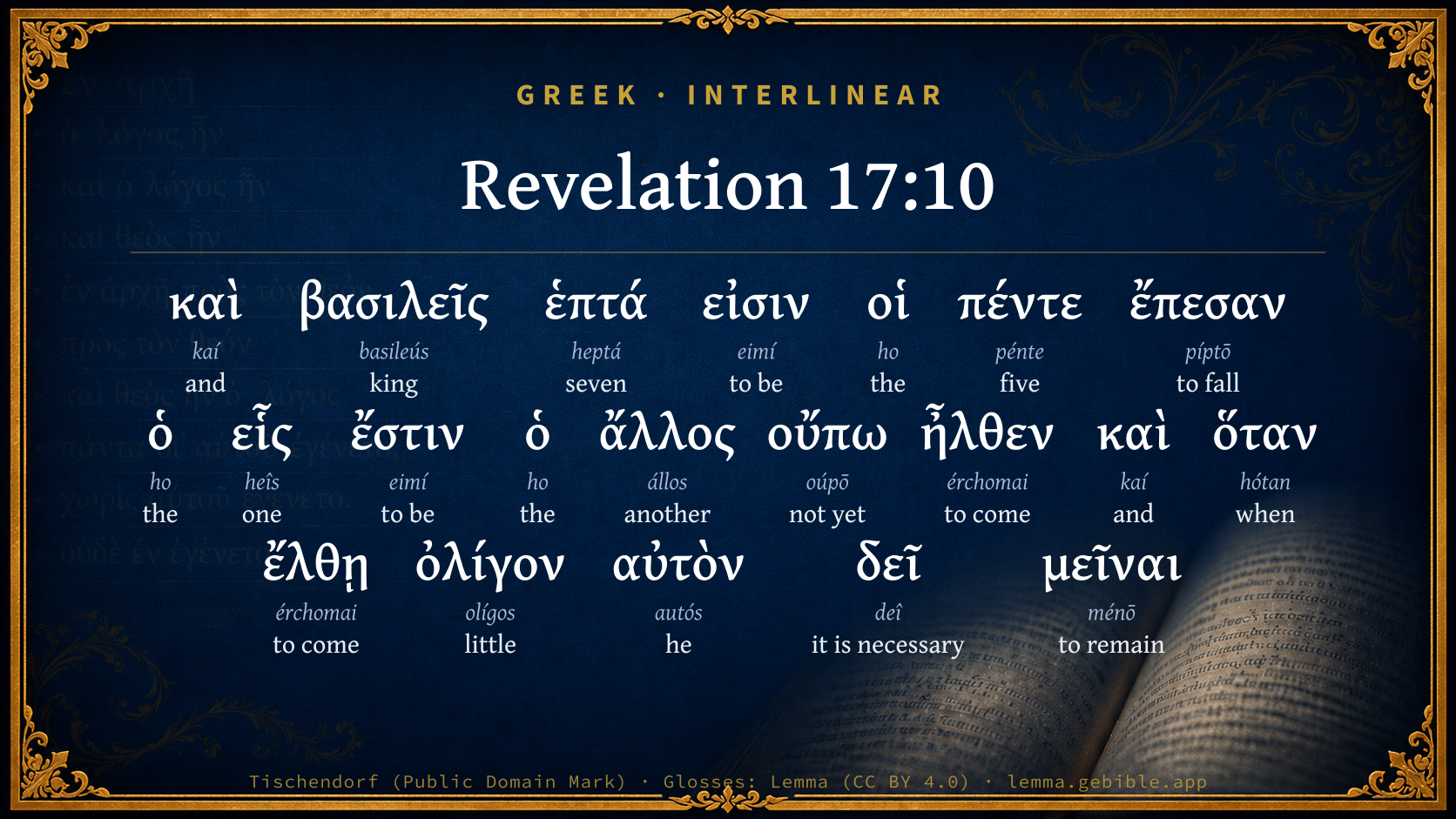
Greek (Tischendorf 8th ed.) Revelation 17:10 appears in the Greek New Testament. The text above is from the Tischendorf 8th edition. Each word links to its Strong’s number and a concise gloss. Click any word for its full Thayer’s Greek Lexicon entry.
Download image
Cite this verse

Revelation 17:10 (World English Bible). Public Domain. Lemma interlinear Bible study tool, https://lemma.gebible.app/v/revelation/17/10.

Show BibTeX & RIS
BibTeX
RIS
English Translation
They are seven kings. Five have fallen, the one is, the other has not yet come. When he comes, he must continue a little while.
World English Bible · Public Domain
Download a study sheet

One document with this verse’s original text, its word-by-word gloss line, the meaning frame, cross-references with their text, attributed commentary, and full source and license credits — printable, and it pastes into notes with its structure intact.

This verse Autodidact and up

Study sheet (.html) Plain text (.txt)

A passage Seminary Student

Up to 50 verses in one chapter. A passage sheet keeps up to 6 commentary sources and 12 cross-references per verse, in the order this page ranks them, and says so on the sheet whenever that leaves anything out. Ask for a single verse and you get the Autodidact verse sheet above.

Everything on this page stays free to read, with no account — the sheet is a download of what is already on screen, not access to it.

Want to remove ads? Support Godless Engineer
Compare translations 3

The same verse in 3 English versions, stacked beneath the original-language interlinear above. Click any original word for its lexicon entry.

Each is an independent rendering of the whole verse — the interlinear is not word-aligned to these translations.

Highlighted words mark where these versions differ — a whole-verse word diff, not a word-by-word alignment.

  • World English Bible Public Domain
    They are seven kings. Five have fallen, the one is, the other has not yet come. When he comes, he must continue a little while.
  • King James Version Public Domain
    And there are seven kings: five are fallen, and one is, and the other is not yet come; and when he cometh, he must continue a short space.
  • unfoldingWord Literal Text CC BY-SA 4.0
    the five have fallen, the one is, the other has not yet come, and when he comes, it is necessary for him to remain a little.

unfoldingWord Literal Text — © unfoldingWord, licensed CC BY-SA 4.0. Word-aligned USFM3 via Door43 (git.door43.org/unfoldingWord/en_ult).

Versions to compare (up to 4)

3 of 4 selected

Show all 19 translations

Every available English version of this verse, each an independent rendering of the whole verse.

  • World English Bible Public Domain
    They are seven kings. Five have fallen, the one is, the other has not yet come. When he comes, he must continue a little while.
  • Berean Standard Bible Public Domain
    There are also seven kings. Five have fallen, one is, and the other has not yet come; but when he does come, he must remain for only a little while.
  • Majority Standard Bible Public Domain
    There are also seven kings. Five have fallen, one is, and the other has not yet come. But when he does come, he must remain for only a little while.
  • King James Version Public Domain
    And there are seven kings: five are fallen, and one is, and the other is not yet come; and when he cometh, he must continue a short space.
  • American Standard Version (1901) Public Domain
    and they are seven kings; the five are fallen, the one is, the other is not yet come; and when he cometh, he must continue a little while.
  • Revised Version (1885) Public Domain
    and they are seven kings; the five are fallen, the one is, the other is not yet come; and when he cometh, he must continue a little while.
  • Geneva Bible (1599) Public Domain
    Fiue are fallen, and one is, and another is not yet come: and when he commeth, he must continue a short space.
  • Douay-Rheims (1899) Public Domain
    Five are fallen, one is, and the other is not yet come: and when he is come, he must remain a short time.
  • Young's Literal Translation Public Domain
    and there are seven kings, the five did fall, and the one is, the other did not yet come, and when he may come, it behoveth him to remain a little time;
  • Literal Standard Version CC BY-SA 4.0
    and there are seven kings, the five fell, and the one is, the other did not yet come, and when he may come, it is necessary for him to remain a short time;
  • Unlocked Literal Bible CC BY-SA 4.0
    They are also seven kings. Five kings have fallen, one exists, and the other has not yet come; when he comes, he can remain only for a little while.
  • unfoldingWord Literal Text CC BY-SA 4.0
    the five have fallen, the one is, the other has not yet come, and when he comes, it is necessary for him to remain a little.
  • Darby Bible Public Domain
    And there are seven kings: five have fallen, one is, the other has not yet come; and when he comes he must remain [only] a little while.
  • World Messianic Bible Public Domain
    They are seven kings. Five have fallen, the one is, and the other has not yet come. When he comes, he must continue a little while.
  • Webster's Bible Public Domain
    And there are seven kings: five are fallen, and one is, and the other is not yet come; and when he cometh, he must continue a short time.
  • Free Bible Version CC BY-SA 4.0
    they are seven kings. Five have already fallen, one is reigning now, and the last is still to come—and his reign will be short.
  • Bible in Basic English Public Domain
    And they are seven kings; the five have come to an end, the one is, the other has not come; and when he comes, he will have to go on for a little time.
  • Text-Critical English NT CC BY 4.0
    They are also seven kings. Five have fallen, one is, and another has not yet come; but when he does come, he must remain for only a little while.
  • Tyndale New Testament (1534) Public Domain
    they are also seven kynges. Fyve are fallen and on ys and onother is not yet come. When he cometh he muste contynew a space.

Literal Standard Version (2020), Covenant Press — licensed CC BY-SA 4.0. Text via the HelloAO Bible API (eBible.org). Unlocked Literal Bible (unfoldingWord) — licensed CC BY-SA 4.0. Text via the HelloAO Bible API (eBible.org). unfoldingWord Literal Text — © unfoldingWord, licensed CC BY-SA 4.0. Word-aligned USFM3 via Door43 (git.door43.org/unfoldingWord/en_ult). Free Bible Version, Dr. Jonathan Gallagher — licensed CC BY-SA 4.0. Text via the HelloAO Bible API (eBible.org).

Word by word

More ways to search: Search by grammar → Find every occurrence → Compare this word →

Practice this passage: Drill this verse → Learn its vocabulary →

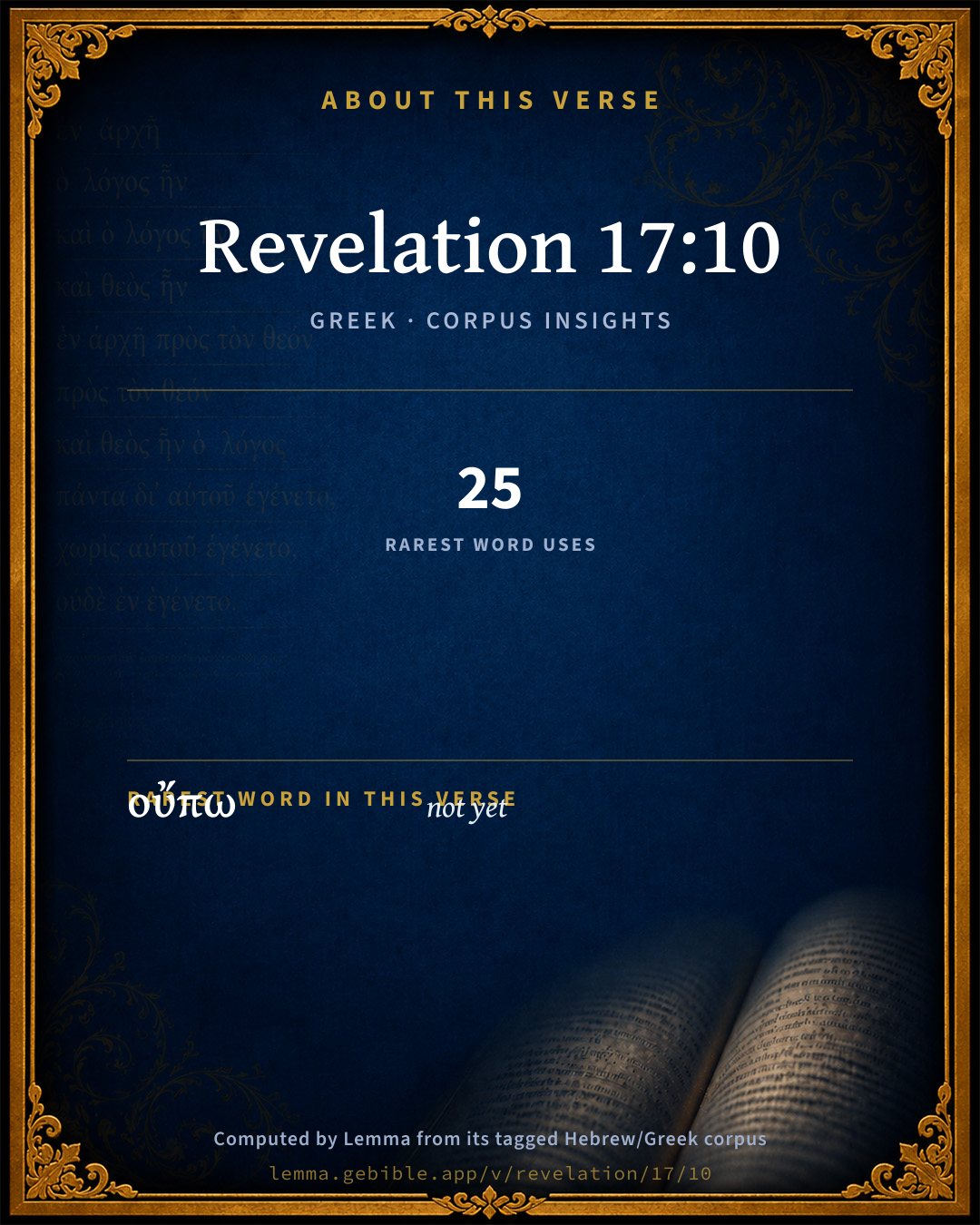
οὔπω
oúpō
G3768
“not yet”
Adverb, Negative
Part of Speech
Adverb
Degree
Negative
Full Thayer's Definition

Origin: from G3756 and G4452

TDNT: None

1. not yet
  1. καὶ kaí G2532 “and” Conjunction
  2. βασιλεῖς basileús G935 “king” Noun, Nominative, Plural, Masculine
  3. ἑπτά heptá G2033 “seven” Adjective, Numeral (indeclinable)
  4. εἰσιν eimí G1510 “to be” Verb, Present, Active, Indicative, 3rd person, Plural
  5. οἱ ho G3588 “the” Article, Nominative, Plural, Masculine
  6. πέντε pénte G4002 “five” Adjective, Numeral (indeclinable)
  7. ἔπεσαν píptō G4098 “to fall” Verb, Aorist, Active, Indicative, 3rd person, Plural
  8. ὁ ho G3588 “the” Article, Nominative, Singular, Masculine
  9. εἷς heîs G1520 “one” Adjective, Nominative, Singular, Masculine
  10. ἔστιν eimí G1510 “to be” Verb, Present, Active, Indicative, 3rd person, Singular
  11. ὁ ho G3588 “the” Article, Nominative, Singular, Masculine
  12. ἄλλος állos G243 “another” Adjective, Nominative, Singular, Masculine
  13. ἦλθεν érchomai G2064 “to come” Verb, Aorist, Active, Indicative, 3rd person, Singular
  14. καὶ kaí G2532 “and” Conjunction
  15. ὅταν hótan G3752 “when” Conjunction
  16. ἔλθῃ érchomai G2064 “to come” Verb, Aorist, Active, Subjunctive, 3rd person, Singular
  17. ὀλίγον olígos G3641 “little” Adjective, Accusative, Singular, Neuter
  18. αὐτὸν autós G846 “he” Personal pronoun, Accusative, Singular, Masculine
  19. δεῖ deî G1163 “it is necessary” Verb, Present, Active, Indicative, 3rd person, Singular
  20. μεῖναι ménō G3306 “to remain” Verb, Aorist, Active, Infinitive

About this verse

These counts appear in no published source. They are computed here, from the morphology-tagged text and Lemma’s own curated glosses. What Lemma adds →

21
words
16
distinct lemmas
Revelation
section

Notable vocabulary

The rarest word here is οὔπω not yet G3768 — appearing just 25 times in the whole Greek New Testament.

Shared distinctive vocabulary

οὔπω not yet G3768 occurs in 25 verses of the Greek New Testament. Also found in:

Repetition

Words recur within this verse:

  • εἰσιν to be G1510 ×2
  • ἦλθεν to come G2064 ×2
  • οἱ the G3588 ×3
  • καὶ and G2532 ×2

Commentary

Notes on Revelation 17:10 from classic Christian and Jewish commentators (each source and its license shown beneath its notes). The classic Christian expositions comment on the surrounding passage and are grouped to its opening verse, so a note may address several verses; the Jewish commentaries on the Tanakh (Rashi and others) are per-verse, so they appear only where the commentator wrote on this verse.

Lemma curates 59 commentaries, every one of them public domain or Creative Commons licensed, each selected and text-cleaned for this edition rather than reprinted as found. About our sources →

Tyndale Open Study Notes

Tyndale Open Resources

17:10-11 Five kings have already fallen: If these kings represent Roman emperors, and the starting point for numbering them is the switch from a republic to an empire with Augustus (29 BC–AD 14), then the fifth in line would be Nero (AD 54–68), the sixth would be Vespasian, and the seventh would be Titus. The eighth king would then be Domitian. • that was, but is no longer: Early commentators argued that Domitian was an embodiment of Nero’s spirit (see study note on 17:8). • like the other seven: This apparently invincible ruler was also headed for destruction.

Tyndale Open Study Notes — © Tyndale Open Resources, licensed CC BY-SA 4.0. Text via the HelloAO Bible API.

Bengel's Gnomon

Johann Albrecht Bengel

Rev 17:10. Οἱ πέντε, ὁ εἷς, ὁ ἄλλος) The Article has a force relative to those seven, who are distributed into five, and one, and the other.—ὀλίγον, a short space) This extends as far as the hour, in which not the other by himself, but the ten kings reign with the beast, Rev 17:12. The German Exegesis of the Apocalypse, and the Order of the times, contain a particular consideration of the times, but I wished to omit it in the Gnomon: and yet that theory so recurs that it even becomes wearisome. But if mathematicians, musicians, painters, and all artists, bestow pains upon the smallest subjects, and seek elegance in the smallest matters IN PARTICULAR, why should we not comply with prophecy showing itself most admirable in the smallest calculations? With respect to this also the works of THE LORD are exquisite [“sought out,” Engl. Vers.] דרושים, Psa 111:2. But no μικρολογία and curiosity of man can exceed or come up to their minute nicety. In Erkl. Offenb. p. 1072, we made a kind of experiment in attempting to arrange the times of the woman with wings and of the beast; and those times are now much more plainly consolidated, reference being repeatedly made to Daniel. Wherefore to those things which I have said in reply to D. Lange, on ch. Rev 13:1, Proposition 10, Observ. 29, I wish the following remarks to be added, without infringing that modesty and sobriety which I have often premised, until the event itself shall explain things which are still future.

Table:

The Termini.

A. Anno

1058. d. 2 Sept. fer. 4, The Woman obtains wings.

B.

1077. d. 1 Sept. fer. 6, The Beast out of the sea.

C.

1143. d. 25 Sept. fer. 7, Commencement of the xlii. months.

D.

1810. d. 21 Mai. (new style 1 Jun.) fer. 7, End of the xlii. months.

E.

1832. d. 14 Oct. fer. 2, Beast out of the bottomless pit; one hour.

F.

1832. d. 22 Oct. fer. 3, Beast increased with the kingdom of the ten horns.

G.

1836. d. 18 Jun. fer. 1, Beast vanquished.

Intervals.

The terminus, from which the particulars begin, being included and that which is subsequent being excluded:

Days

and

hours

or

weeks

and

days

A.

6938,

12.

991:

1½.

B.

24130,

31/7 8/7 9/7.

3447:

1 full.

C.

243495,

precisely.

34785:

0.

D.

8170,

22 2/7 1/7 8/7.

1167:

2.

E.

7,

22 3/7 7/7 0/7.

1:

1 nearly.

F.

1335.

190:

5.

There are, altogether, 284,077½ days: there are 40,582½ weeks: there are 5797½ square weeks: there are 777 7/9 years: there are precisely 686 monads of Daniel (of which we shall speak presently).

First we will explain the Intervals, in the abstract; and afterwards the Termini, in the concrete.

Explanation of the Intervals.

The Interval A

comprises 19

years, wanting 1 day.

B

66 66/999

years, precisely.

The Interval C

comprises 666 666/999

years, precisely.

D

22 123/333

years, fully.

E

22/999

of a year, as nearly as possible.

F

3 218/333

years, fully.

ADEF

conjointly 45 45/999

years, precisely.

ABDEF

111 1/9

precisely.

ABCDEF

777 7/9

precisely.

The seventy weeks of Daniel contain 490 monads, which conjointly are 555 5/9 years, as we have shown in the Order of the Times, ch. 10. The same Intervals are in a remarkable manner transfused into monads and weeks of the same kind.

The Interval C contains precisely 588 monads of the same kind, which are 12 square weeks.

B and D, conjointly, contain 78 monads, without the excess of a day.

BCD are 666 monads (or 275,795 5/14 days, which do not run out 17 hours beyond the appendices of the days of the interval BCD), by a wonderful harmony. For the number of the beast is said to be 666, in that mode of expression, by which that number is taken not in one way only. See Erkl. Offenb. p. 742. Thus the number 666 comprises the first and the second Portion of the duration of the beast.

AEF, conjointly, are 20 monads, without the defect of a day.

ABDEF are 98 monads, which are two square weeks.

ABCDEF, conjointly, are precisely 686 monads, or two CUBE WEEKS.

The numbers, and periods, which are equal under the enigma of different numbers, in Daniel and in the Apocalypse, are wonderfully ductile and versatile, so that they are interchanged with one another in the most connected and easy manner, which is a strong argument of the truth.

Explanation of the Termini.

A. The woman becomes possessed of wings: the beginning of the 3½ times. See Erkl. Offenb. p. 646.

B. Of the ascent of the beast out of the sea, and of the very day, Sept. 1, we have treated at ch. Rev 13:1, especially in Proposition 9. From that day is the previous flowing of the 666 2/3 years (see Erkl. Offenb. p. 1069), and that now hastening to its close. Before the completion of 5684 years from the creation of the world (see Ord. Temp. p. 300 [Ed. ii. p. 256]), or of 116 square weeks of years, there will be a possibility of estimating what must be expected before that close.

C. Of the power given to the beast for 42 months, and of the beginning of the months, we have treated at ch. Rev 13:18, § 12. The same is the number of the beast, 666.

D. When the 42 months have elapsed, it does not therefore immediately follow that the beast is not; for even before those months he was. But yet under the vial of the fifth angel the kingdom of the beast becomes so obscured, that it is in greater difficulty than it was before the beginning of the 42 months. Therefore we shall have to notice, at the proper time, whether at the close of the 42 months that angel is then at length about to pour forth his vial upon the throne of the beast, or whether the beast is even forthwith about to carry the whore, while he himself is not. This Interval, in which the beast is not, is properly added to the Half-time [Semitempusculum], of which the Ordo Temp, treats, p. 318. [Ed. ii. p. 271.]

E. The one hour, during which the ten horns receive the kingdom together with the beast, we interpret as a prophetical hour, for this reason, because it precedes the thousand years, so called in their ordinary signification; but it may also be taken to signify the ordinary, natural hour, because, although it falls as yet upon the gloomy times of the beast, yet it falls immediately after the number of the beast. The matter is for the most part in uncertainty. See Erkl. Offenb. Ed. ii. pp. 146, 147, 889.

F. The ten kings, and the beast, as soon as they shall have given the kingdom to him, shall harass the whore. Rome was founded Anno 3960 Per. Jul. d. 29 Oct. (as Des-Vignoles teaches in his Chronology at the close), feriâ 2. From that time to Ann. Dion. 1832, Per. Jul. 6545 d. 20 Oct. fer. 1, the excess of the Julian year being taken away, there are precisely 2585 years, or 134,878 weeks and about 6 days, from that feria 2 to this feria 1. Or, Anno 3960 Per. Jul. d. 29 Oct. is feria 2. From that time to A.D. 1834 P.I. 6547 d. 20 Oct. fer. 3, the excess of the Julian year being taken away, there are 2587 years precisely, or 134,981 weeks, 1 day, 8. 2′0. 2″4 from that feria 2 to the end of feria 3 (of March). Comp. Zeugniss der Wahrheit, p. 207, etc. What Rome is about to experience on her birth-day after 90 years, they who shall then be alive may notice.

These two intervals, E and F, are most closely connected. The saints shall be given into the hands of the single horn, or, as those of Zurich interpret it, the appointing of times and of laws (so parallel are the words of Psa 31:15) [shall be given into his hands], until A TIME AND TIMES AND A HALF-TIME [“the dividing of time”]: Dan 7:25. The other king, when he is come, must continue A SHORT SPACE (Rev 17:10). Concerning each passage we have conjectured many things in the treatise, Erkl. Offenb. p. 883. But a third passage assists us. The ten horns receive power as kings ONE HOUR with the beast, Rev 17:12. The short space is the interval EF conjointly; for it comprises the whole continuance of the other king, in the third Portion of the time of the beast: E is the one hour: F has the residue of the former intervals, that is, 1335 days, and those ordinary days. These are immediately followed by the 1335 prophetical days of Daniel (which the Ordo Temp. p. 379 [Ed. ii. pp. 326, 327], proves to be the thousand years which are promised, Dan 12:12); so that 1335 ordinary, wretched days, of waiting, i.e. of endurance, require to be understood; and 1335 prophetical, happy days, to be attained [ to be “come to,” Dan 12:12], are expressed. The words, who waiteth, and shall attain to, the thousand days, have great force from the accents. The time, and times, and half a time of Daniel, coincide with the interval F, if they do not complete it: and I assent to Lange, that they are 31/2 years, but amounting to 1278 days, in accordance with the natural truth, and not to 1260 days, as he takes them, and that they are not 1333 1/3 days, which might have come into the mind. Now, by what means also are the 1278 days and the 1335 reconciled? I will not say that either number of days is 3 years, with פלג part or half, and not four years; inasmuch as even the interval F, either apart from, or with the addition of the interval E, agrees with the ancient Tradition which represents Antichrist as about torage 31/2 years. But in Daniel the action of the beast out of the bottomless pit seems to be beheld in the land of Israel: in the Apocalypse the beast out of the bottomless pit has first something to occupy him out of that land also.

My Table may be considered doubtful in some particular article: but within its own limits it is throughout corroborated by strong exegetical and historical arguments. Those things contained in the period of the six intervals which are less clearly defined from the Apocalypse, are defined from Daniel, as the being of the beast before the 42 months, and the non-being of the same, and the short space of the other king; and the 3½ times, which in Daniel were plainly expressed, the Apocalypse shuts up into that short space; again, that which had been represented in Daniel by the enigma of 1335 days, the Apocalypse declares in the plain words of the expression, a thousand years. Are all these things by chance? We do not affirm all things with equal confidence: but still we put forward all things, that posterity may have something to notice, and, in accordance with the result, may partly correct, and partly approve of them.

Bengel's Gnomon of the New Testament — English translation (T&T Clark, Edinburgh, 1860) — public domain. Text from a community e-Sword module.

Geneva Bible (1599)

Geneva Bible translators

Nerua. The Empire being now translated from the family of Flavius. This man reigned only one year, four months, and nine days, as the history writers do tell.

Whose names are these: the first, Servius Sulpicius Galba, who was the seventh Emperor of the people of Rome, the second Marcus Salvius Otho, the third Aulus Vitellius, the fourth, Titus Flavius Vespasianus, the fifth, Titus Vespasianus his son of his own name.

Flavius Domitian son of the first Vespasian. For in the latter end of his days S. John wrote these things, as witnesseth Irenaus, Lib. 5 adversus hareses.

Geneva Bible (1599) marginal notes — public domain. Text via Bolls.life.

Jamieson, Fausset & Brown

Robert Jamieson, A. R. Fausset & David Brown

there are--Translate, "they (the seven heads) are seven kings."

five . . . one--Greek, "the five . . . the one"; the first five of the seven are fallen (a word applicable not to forms of government passing away, but to the fall of once powerful empires: Egypt, Eze. 29:1-30:26; Assyria and Nineveh, Nah. 3:1-19; Babylon, Rev 18:2; Jer. 50:1-51:64; Medo-Persia, Dan 8:3-7, Dan 8:20-22; Dan 10:13; Dan 11:2; Greece, Dan 11:4). Rome was "the one" existing in John's days. "Kings" is the Scripture phrase for kingdoms, because these kingdoms are generally represented in character by some one prominent head, as Babylon by Nebuchadnezzar, Medo-Persia by Cyrus, Greece by Alexander, &c.

the other is not yet come--not as ALFORD, inaccurately representing AUBERLEN, the Christian empire beginning with Constantine; but, the Germanic-Slavonic empire beginning and continuing in its beast-like, that is, HEATHEN Antichristian character for only "a short space." The time when it is said of it, "it is not" (Rev 17:11), is the time during which it is "wounded to death," and has the "deadly wound" (Rev 13:3). The external Christianization of the migrating hordes from the North which descended on Rome, is the wound to the beast answering to the earth swallowing up the flood (heathen tribes) sent by the dragon, Satan, to drown the woman, the Church. The emphasis palpably is on "a short space," which therefore comes first in the Greek, not on "he must continue," as if his continuance for some [considerable] time were implied, as ALFORD wrongly thinks. The time of external Christianization (while the beast's wound continues) has lasted for centuries, ever since Constantine. Rome and the Greek Church have partially healed the wound by image worship.

Jamieson, Fausset & Brown — Commentary Critical and Explanatory on the Whole Bible (1871) — public domain (CC PDM 1.0). Text via the HelloAO Bible API.

Adam Clarke's Commentary

Verse 10. And there are seven kings] καιβασιλειςεπταεισιν They are also seven kings. Before, it was said, they are seven mountains; here, they are also seven kings, which is a demonstration that kingdoms are not here meant by mountains: and this is a farther argument that the seven electorates are represented by seven mountains, for though the sovereigns of these states ranked with kings, they were not kings: that is to say, they were not absolute and sole lords of the territories they possessed, independently of the emperor, for their states formed a part of the Germanic body. But the seven heads of the beast are also seven kings, that is to say, the Latin empire has had seven supreme forms of government; for king is used in the prophetical writings for any supreme governor of a state or people, as is evident from De 33:5, where Moses is called a king. Of these seven kings, or supreme forms of Latin government, the angel informs St. John:-

Five are fallen, and one is] It is well known that the first form of Latin government was that of kings, which continued after the death of Latinus 428 years, till the building of Rome, B.C. 753. After Numitor's decease the Albans or Latins instituted the form of a republic, and were governed by dictators. We have only the names of two, viz., Cluilius and Metius Fufetius or Suffetius; but as the dictatorship continued at least eighty-eight years, there might have been others, though their names and actions are unknown. In the year before Christ 665 Alba, the metropolis of the Latin nation, was destroyed by Tullus Hostilius, the third king of the Romans, and the inhabitants carried to Rome. This put an end to the monarchical republic of the Latins; and the Latins elected two annual magistrates, whom Licinius calls dictators, but who are called praetors by other writers. This form of government continued till the time of P. Decius Mus, the Roman consul; for Festus, in his fourteenth book, informs us "that the Albans enjoyed prosperity till the time of King Tullus; but that, Alba being then destroyed, the consuls, till the time of P. Decius Mus, held a consultation with the Latins at the head of Ferentina, and the empire was governed by the council of both nations." The Latin nation was entirely subjugated by the Romans B.C. 336, which put an end to the government by praetors, after it had continued upwards of three hundred years. The Latins from this time ceased to be a nation, as it respects the name; therefore the three forms of government already mentioned were those which the Latins had during that period which the angel speaks of, when he says, The beast which thou sawest WAS. But as five heads, or forms of government, had fallen before St. John's time, it is evident that the two other forms of government which had fallen must be among those of the Romans; first, because though the Latin nation so called, was deprived of all authority by the Romans, yet the Latin power continued to exist, for the very conquerors of the Latin nation were Latins; and, consequently the Latins, though a conquered people, continued to have a LATIN government. Secondly, the angel expressly says, when speaking to St. John, that one is, that is, the sixth head, or Latin form of government, was then in existence; which could be no other than the imperial power, this being the only independent form of Latin government in the apostolic age. It therefore necessarily follows, that the Roman forms of government by which Latium was ruled must be the remaining heads of the beast. Before the subjugation of the Latins by the Romans four of the Roman or draconic forms of government had fallen, the regal power, the dictatorship, the decemvirate, and the consular power of the military tribunes, the last of which was abolished about 366 years before the commencement of the Christian era; none of these, therefore, ruled over the WHOLE Latin nation. But as the Latins were finally subdued about 336 B.C., the consular government of the Romans, which was then the supreme power in the state, must be the fourth head of the beast. This form of government continued, with very little interruption, till the rising up of the triumvirate, the fifth head of the beast, B.C. 43. The dictatorship of Sylla and Julius Caesar could not be considered a new head of the beast, as the Latins had already been ruled by it in the persons of Cluilius and Fufetius. The sixth head of the beast, or that which existed in the time of St. John, was consequently, as we have already proved, the imperial power of the heathen Caesars, or the seventh draconic form of government.

And the other is not yet come] Bishop Newton considers the Roman dutchy, under the eastern emperor's lieutenant, the exarch of Ravenna, the seventh head of the beast. But this cannot be the form of government signified by the seventh head, for a head of the beast as we have already shown, is a supreme, independent form of Latin government; consequently the Roman dutchy cannot be the seventh head, as it was dependent upon the exarchate of Ravenna; and the exarchate cannot be the head, as it was itself in subjection to the Greek empire. The Rev. G. Faber has ascertained the truth exactly in denominating the Carlovingian patriciate the seventh head of the beast. That this was a supreme, independent form of government, is evident from history. Gibbon, in speaking of the patriciate, observes that "the decrees of the senate and people successively invested Charles Martel and his posterity with the honours of patrician of Rome. The leaders of a powerful nation would have disdained a servile title and subordinate office; but the reign of the Greek emperors was suspended, and in the vacancy of the empire they derived a more glorious commission from the pope and the republic. The Roman ambassadors presented these patricians with the keys of the shrine of St. Peter as a pledge and symbol of sovereignty, and with a holy banner, which it was their right and duty to unfurl in defense of the Church and city. In the time of Charles Martel and of Pepin, the interposition of the Lombard kingdom covered the freedom, while it threatened the safety of Rome; and the patriciate represented only the title, the service, the alliance, of these distant protectors. The power and policy of Charlemagne annihilated an enemy, and imposed a master. In his first visit to the capital he was received with all the honours which had formerly been paid to the exarch, the representative of the emperor; and these honours obtained some new decorations from the joy and gratitude of Pope Adrian I. In the portico Adrian expected him at the head of his clergy; they embraced as friends and equals; but in their march to the altar, the king, or patrician, assumed the right hand of the pope. Nor was the Frank content with these vain and empty demonstrations of respect. In the twenty-six years that elapsed between the conquest of Lombardy and his imperial coronation, Rome, which had been delivered by the sword, was subject, as his own, to the sceptre of Charlemagne. The people swore allegiance to his person and family, in his name money was coined and justice was administered, and the election of the popes was examined and confirmed by his authority. Except an original and self-inherent claim of sovereignty, there was not any prerogative remaining which the title of emperor could add to the patrician of Rome." The seven heads of the beast are therefore the following: The regal power, the dictatorship, the power of the praetors, the consulate, the triumvirate, the imperial power, and the patriciate.

And when he cometh, he must continue a short space.] The seventh form of government was only to remain a short time, which was actually the case; for from its first rise to independent power to its utter extinction, there passed only about forty-five years, a short time in comparison to the duration of several of the preceding forms of government; for the primitive regal government continued at least four hundred and twenty-eight years, the dictatorship was in power about eighty-eight years, the power of the praetors was in being for upwards of three hundred years, the consulate lasted about two hundred and eighty years, and the imperial power continued upwards of five hundred years.

Adam Clarke's Commentary on the Bible (1810–1826) — public domain. Text from a community e-Sword/MySword module.

Ellicott's Commentary for English Readers

(10) And there are seven kings. . . .—Better. They are seven kings: five (not “are fallen,” but fell, the one is, the other is not yet come; and when he shall come, he must continue a short time. It has been debated whether these kings are individual sovereigns, or forms of government, or kingdoms The last view is the one adopted in this Commentary. The wild beast belongs to no one age, but is a power which has risen in every age; the seven heads represent the successive culminations of the world-power. Our space is insufficient to discuss here the whole question. But the language here used and the passages in the earlier prophets, which may be called the parent passages of the present vision, favour the interpretation that great world-kingdoms are intended. The language favours this view. It is said that the “kings fell.” The word is the one which has been used for political catastrophe: the cities of the nations fell (Rev_16:19); Babylon, it is cried, has fallen (Rev_14:8). It suits the overthrow of empires, and is so used in the LXX.; to apply it to individual kings is to ask that it shall be equivalent to “they died.” It is to be noticed that the four beasts of Daniel (Dan_7:3-8) are declared to be four kings (Rev_17:17), but these kings are not individual kings, but represent kingdoms. (See Dan_7:23). This brings us to the drift of the parent passage. Daniel saw four wild beasts rise from the sea; they represented the then great world-power Babylon, and its three successors, Persia, Greece, and Rome. This is a guide to us here, as most commentators admit; but two great world-powers had preceded Babylon, viz., Egypt and Assyria: these figure in the ancient prophecies as forces hostile to the righteous King. St. John, whose visions took the range of the world’s drama, could not see the representative of the ever rising spirit of worldly hostility to God’s chosen without seeing Egypt and Assyria included. The voices of Moses and Isaiah called to him across the centuries that in these the world principle of their day found its clearest and strongest manifestation. In various empires the world-power showed itself: in Egypt, the house of bondage (Exo_20:2); in Assyria, that exalted herself against God (Isa_37:23); in Babylon, the hammer of the whole earth (Jer_50:23); in Persia, and in Greece; and in succession these kingdoms fell, only to be succeeded by another—Rome. Five fell; the one is. But what is the seventh, the other who is not yet come? We must recall the appearance of the wild beast. It had seven heads and ten horns. Where were these ten horns? It seems generally admitted that they were all on the seventh head. The seventh head, which represents the seventh kingdom, or manifestation of the world principle which is described as not yet come, then, was different in appearance from the others. It was ten-horned. It had not the same unity of appearance as the others. Now the ten horns are explained as ten kings or minor powers (Rev_17:12). The conclusion, therefore, is that the seventh head must be rather an aggregation of monarchies than a single universal empire. This agrees with Daniel’s prophecy that out of the fourth kingdom, which corresponds, as we have seen, with the sixth head of the wild beast here, ten kings should arise (Dan_7:7; Dan_7:23-24).

The seventh kingdom (the ten-horned head) it is said will, when it arises, continue a “short time.” The short time is probably the same as the “one hour” in Rev_17:12, where the ten kingdoms, represented by the ten horns, receive power one hour with the wild beast.

A Bible Commentary for English Readers, edited by Charles John Ellicott (1878–1897) — public domain. Text from a community e-Sword module.

The Cambridge Bible for Schools and Colleges

gen. ed. J. J. S. Perowne

10. And there are seven kings] Rather, and they [the seven heads] are seven kings: they have a double significance—standing both for the seven mountains and the seven kings.

Who are these kings? According to the view mentioned on Rev_13:2, that the Beast is not the Roman Empire, but an embodiment of the worldly imperial spirit, it is plausibly held that the kings are kingdoms or empires (like the “kings of Persia and Grecia” in Daniel 8)—that they are the four kingdoms of Daniel 2, 7, together with Egypt and Assyria that came before Babylon, and the kingdoms of modern Europe that come after Rome. On this view, the ten horns are all on one head: it is this ten-horned head which receives the deadly wound of Rev_13:3 : i.e. the Beast is nearly slain (the Empire as an evil and persecuting power overthrown) by the conversion, first of the later emperors, and then of the sovereigns of Europe, to Christianity: but he revives—e.g. in Julian after Constantine, and again in the neo-paganism of the Renaissance and the persecutions of the Reformation.

With all the elements of truth that must be acknowledged in this view, it seems hardly possible to doubt that the Beast, so closely united with the City of the Seven Hills, represents the Roman Empire particularly. On this view, the “kings” have been taken to represent forms of government—Rome having been successively governed, it is said, by kings, consuls, dictators, decemvirs, military tribunes, emperors, and Christian emperors (the last being taken, as before, to be the wounded head: some however make the conversion of Constantine a wound to the sixth head, and count the Ostrogoth kings as the seventh). But considering that the dictatorship, the decemvirate, and even the tribunate, were transitory episodes in the Roman government—the first avowedly exceptional, the second both exceptional and ephemeral, and all three, as well as the primitive monarchy, probably unknown to St John’s original readers,—this view does not appear even plausible.

It remains then that the kings be taken as individual Emperors of Rome: (it must be remembered that though these were never called “kings” in Latin, the Greek equivalent title was constantly applied to the Emperors: see e.g. 1Pe_2:13; 1Pe_2:17.) Who then were the first seven Emperors? According to the common reckoning, Julius Caesar, Augustus, Tiberius, Gaius (often called by modern writers by his nickname Caligula, “Little Boots”), Claudius, Nero, and Galba. But Julius Caesar, though he received the title of Imperator as the later Emperors did, cannot be considered, and is not considered by careful historians, as the first of the “Emperors,” if the Empire be spoken of as a settled form of government. His authority in the state, so far as it was constitutional at all, lay in his Dictatorship: which office was legally abolished immediately after his death, and never revived. Augustus, and the later Emperors, ruled not as Dictator, but as Chief of the Senate with the power of Tribune.

five are fallen] Augustus, Tiberius, Gaius, Claudius, and Nero. (It is argued that the word “fallen” is not “appropriate to Augustus and Tiberius, who died in their beds:” but see Gen_25:8, mar.) Is then the “one who is” Galba? So he is generally understood by those who adopt this scheme of interpretation: and if so, the date of the vision (see Introduction) is fixed at a time between June a.d. 68, and the 15th of January 69, when Galba was murdered. He was succeeded by Otho, who certainly “continued a short space,” if he could be said to continue at all: he killed himself, on April 15th, when defeated by the army of Vitellius, who had revolted from Galba a few days before his murder by Otho.

But the rest of the prophecy, on this view, received nothing that can be reckoned as even a typical fulfilment. Vitellius, despite many contemptible vices, was a good-natured man, and not a bad ruler, so far as he had energy to rule at all. He could not be considered as an incarnation of the Antichristian power, nor even as a revival of Nero, though he, as well as Otho, treated Nero’s memory with respect. And considering that Galba had only reigned in Rome for a few weeks before his death (though he had been acknowledged longer), that Otho never had an uncontested title, and Vitellius only from about the end of April to July 1st, it seems likelier that these three are passed over, as claimants of empire (and they had not been the only ones: see on Rev_17:12) rather than actual emperors. Thus, the sixth king will be Vespasian, who was proclaimed emperor on July 1st, a.d. 69: his troops gained a decisive victory over those of Vitellius late in October, and Rome was taken, and Vitellius killed, on Dec. 21st.

Vespasian reigned well and peaceably, and was succeeded by his elder son Titus, in June 79: who “continued a short space,” till Sept. 13th, a.d. 81, when he died, aged 40;—murdered, as some said, by his brother Domitian, who succeeded him, and who was regarded, by pagans and Christians alike, as a revival of Nero (Juv. iv. 38; Tert. Apol. c. 7). Like Nero, he persecuted the Christians: like Nero, he indulged in the most hideous vices: though unlike Nero, he had a strong sense of decorum, and was fanatically attached to the Roman religion. Further than this, the vision does not follow the fortunes of the Empire in detail. At the point where the type of Antichrist comes into the history, the prophecy introduces Antichrist himself: cf. Daniel 11, as understood by most orthodox interpreters.

must continue a short space] Both “continue” and “short” seem to be emphatic—his reign is to be short, but not ephemeral. Thus the designation seems more appropriate to Titus than to Otho. St Victorinus (in the present text) applies it to Nerva, who like Titus reigned mildly for only two years. But his successor Trajan (though he to a certain extent sanctioned the persecution of Christianity, and is said himself to have condemned St Ignatius) was anything but an Antichrist. It seems as though St Victorinus (or his editor) were making a rather clumsy attempt to reconcile the interpretation here given, which he was acquainted with as a tradition, with the general belief that St John was writing under Domitian.

The Cambridge Bible for Schools and Colleges (gen. ed. J. J. S. Perowne; Cambridge University Press, 1878–1918) — public domain. Text from a community e-Sword module.

John Gill's Exposition

And there are seven kings,.... The Arabic version renders it, "who are seven kings"; and it should be rendered, as it is by the Vulgate Latin, Syriac and Ethiopic versions, "and they are seven kings"; that is, the seven heads signify seven kings also, for they have in them a double representation, first of seven mountains, and then of seven kings; by which are meant not seven ages of the world, as from Adam to Noah; from Noah to Abraham; from Abraham to David; from David to the Babylonish captivity; from the Babylonish captivity to Christ; from Christ to antichrist; and from antichrist to the end of the world; the five first of which were gone in John's time, the sixth was then in being, and when the seventh shall come it will continue for a short time: this is a foolish and absurd interpretation of the Papists, who make the beast to be the devil, and these his seven heads; whereas he rather is the head, or god of the world: nor are seven emperors of Rome intended, which are differently reckoned, according to the different times John is supposed to have had this revelation. Grotius, who is followed by Hammond, supposes this was written in the times of Vespasian, and reckons them thus; Clandius, Nero, Galba, Otho, Vitellius, Vespasian, and Titus; the first five of these were dead in John's time, one was then, the sixth, Vespasian, the then reigning emperor, and the other, Titus, was yet to come to the empire; and when he came to it, continued but a short time, two years and two mouths: others, who more rightly judge that John wrote in Domitian's time, reckon them after this manner; Galba, Otho, Vitellius, Vespasian, Titus, Domitian, and Nerva; the first five of these were dead; Domitian was then living, and Nerva, the other that was to come and succeed him, reigned but a little while, not quite two years; but to this sense must be objected, that there were other emperors before either Galba or Claudius; and before John's time there were more than five fallen or dead; according to the first account, there must be nine dead, and according to the latter eleven; for before Claudius there were Julius, Augustus, Tiberius, and Caius: besides, if these were the seven heads of the beast, the beast must have been long ago without any head, and consequently must have expired; whereas it is still in being, and will be under the fifth, sixth, and seventh vials, which are yet to come; it will be at the battle of Armageddon, and will be taken then, and cast alive into the lake of fire; to which may be added, that the beast, in the form in which John now saw it, was not yet risen in the times of these emperors; but by the seven heads are meant so many forms of government which took place successively in the Roman empire, and were all of them idolatrous heads, as kings, consuls, dictators, decemvirs, tribunes, emperors, and popes; it being usual for any sort of governors, or governments and monarchies, to be called kings, Deu 33:5.

Five are fallen; or ceased, are no longer in being as kings, consuls, dictators, decemvirs, and tribunes; at least, the supreme power was not lodged in any bearing either of these names in John's time:

and one is; the Pagan emperors; an Heathen emperor, Domitian, then reigning, when John had this vision; and these continued to the opening of the sixth seal, which put an end to that succession, as Pagan, and till the woman brought forth the man child, or till Constantine's time:

and the other is not yet come; which some understand of the Christian emperors, who immediately succeeded the Pagan ones, and were another, and different from them, as to religion, though the form of government was the same, and were not another head; for they were not an idolatrous head, on which were names of blasphemy, but another king; for from the following verse it appears, that there are eight kings, and but seven heads, and therefore one of them should seem not to be a head; and these, when they came, continued but a short time in comparison of the Heathen emperors that reigned before them, and of the hope, or antichrist, who was to reign after them 1260 years; for they reigned not, put them all together, more than 150 years; and especially at Rome their stay was short, for Constantine removed from thence to Constantinople, in the nineteenth year of his empire. But these emperors, though in religion they differed from the others, yet their form of government and title were the same, and therefore must be included in the sixth head: according to some, Theodoricus the Ostrogoth, and his successors, are meant, who continued about an hundred years; others have thought that the exarchs of Ravenna, who rose up upon the destruction of the western empire, are intended, and who continued but a short time; but then these had not their seat at Rome, which it seems necessary each head of this beast should have; it is better, therefore, to understand this of the popes of Rome, the seventh and last head of the Roman empire; these were not yet come, in John's time, to their supreme dignity and authority:

and when he cometh he must continue a short space; forty two months, or 1260 days; that is, so many years, which, though a long time in itself, and in the account of man, yet with God, with whom a thousand years is as one day, and in comparison of the everlasting kingdom of Christ, and his people, it is but a short space; and so the reign of the beast, and of the ten kings with him, is said to be one hour, Rev 17:12 and this is said for the comfort of the saints, and to keep up their faith and patience under their sufferings in antichristian states. Mr. Daubuz makes these seven heads, or kings, signified by seven mountains, seven capital cities, which by degrees came to belong to the Roman empire; as first Rome itself, the capital of Italy; next Carthage, the capital of Africa; then Aege, the capital of Macedonia; after that Antiochia, the capital of the east; then Augustodunum, the capital of the Gauls; and Alexandria, the capital of Egypt; five of these six, with the monarchies belonging to them, were fallen; one, or the first of them now, was the mistress of all; and the other seventh was to come, namely, Byzantium, or Contantinople, which continued not long. This passage is so interpreted, as also the seven heads, in Rev 13:1 by this writer.

John Gill's Exposition of the Whole Bible (1746–1763) — public domain (CC PDM 1.0). Text via the HelloAO Bible API.

Trapp's Complete Commentary

John Trapp

10 And there are seven kings: five are fallen, and one is, and the other is not yet come; and when he cometh, he must continue a short space.

Ver. 10. And there are seven kings] That is, kinds of government.

Five are fallen] Kings, consuls, dictators, decemvirs, tribunes.

One is] i.e. The heathen emperor.

And the other is not yet come] sc. The Christian emperors.

A short space] sc. At Rome; for Constantine soon translated the seat of the empire to Byzantium, calling it Constantinople, and left Rome to be the pope’s nest. (Zonaras.) The Emperor Constans, nephew to Heraclius, and after him, Otho, had some thoughts to set up again at Rome, but could not; that so the kingdom of the Church foretold by Daniel might there be seated, saith Genebrard: if he had said the kingdom of Antichrist foretold by John the divine, he had hit it.

John Trapp, A Commentary or Exposition upon All the Books of the Old and New Testament (1647–1656) — public domain. Text from a community e-Sword module.

Albert Barnes' Notes on the Bible

And there are seven kings - That is, seven in all, as they are enumerated in this verse and the next. An eighth is mentioned in Rev 17:11, but it is, at the same time, said that this one so pertains to the seven, or is so properly in one sense of the number seven, though, in another sense, to be regarded as an eighth, that it may be properly reckoned as the seventh. The word “kings” - βασιλεῖς basileis - may be understood, so far as the meaning of the word is concerned:

(a)Literally, as denoting a king, or one who exercises royal authority;

(b)In a more general sense, as denoting one of distinguished honor - a viceroy, prince, leader, chief, Mat 2:1, Mat 2:3,Mat 2:9; Luk 1:5; Act 12:1;

(c)In a still larger sense, as denoting a dynasty, a form of government, a mode of administration, as what, in fact, “rules.”

See the notes on Dan 7:24, where the word “king” undoubtedly denotes a “dynasty,” or “form of rule.” The notion of ruling, or of authority, is undoubtedly in the word, for the verb βασιλεύω basileuō means “to rule,” but the word may be applied to anything in which sovereignty resides. Thus it is applied to a king’s son, to a military commander, to the gods, to a Greek archon, etc. See Passow. It would be contrary to the whole spirit of this passage, and to what is demanded by the proper meaning of the word, to insist that the word should denote literally kings, and that it could not be applied to emperors, or to dictators, or to dynasties.

Five are fallen - Have passed away as if fallen; that is, they have disappeared. The language would be applicable to rulers who have died, or who had been dethroned; or to dynasties or forms of government that had ceased to be. In the fulfillment of this, it would be necessary to find five such successive kings or rulers who had died, and who pertained to one sovereignty or nation; or five such dynasties or forms of administrations that had successively existed, but which had ceased.

And one is - That is, there is one - a sixth - that now reigns. The proper interpretation of this would be, that this existed in the time of the writer; that is, according to the view taken of the time of the writing of the Apocalypse (see Intro., section 2), at the close of the first century.

And the other is not yet come - The sixth one is to be succeeded by another in the same line, or occupying the same dominion.

And when he cometh - When that form of dominion is set up. No intimation is yet given as to the time when this would occur.

He must continue a short space - ὀλίγον oligon. A short time; his dominion will be of short duration. It is observable that this characteristic is stated as applicable only to this one of the seven; and the fair meaning would seem to be, that the time would be short as compared with the six that preceded, and as compared with the one that followed - the eighth - into which it was to be merged, Rev 17:11.

Albert Barnes' Notes on the Bible (1834–1885) — public domain. Text from a community e-Sword/MySword module.

Haydock's Catholic Bible Commentary

Five are fallen, one is, and the other is not yet. The meaning of this is obscure. And perhaps it were better to own with St. Augustine that we do not know the meaning, than to advance suspicions and conjectures. But it is not improbable that by these seven kings may be understood the collection of kings, in what are called the seven ages of the world, from its creations to its consummation. The first age, is reckoned from Adam to Noe [Noah], and the deluge: the second age, from Noe to Abraham; the third, from Abraham to Moses; the fourth, from Moses to David; the fifth, from David to Christ. These five were past, and fallen, when St. John wrote. The sixth is, and is to last from Christ to antichrist. And another, the seventh, is not, being the time of antichrist, and only a short time. See Cornelius a Lapide on this verse. (Witham)

George Leo Haydock (1774–1849), Haydock's Catholic Family Bible and Commentary, 1859 edition — public domain. Excludes Psalms (Douay-Rheims chapter numbering differs from Protestant) and Deuterocanonical books (Catholic canon only).

Matthew Poole's English Annotations

And there are seven kings; the seven heads do not only signify seven hills or mountains, but also seven kings, that is, (according to the best interpretation I meet with), seven forms of government which ruled Rome; the term kings, it Scripture, signifying rulers, whether the government was in single persons, or more, as Deu 33:5. Rome was governed:

1. By kings.

2. By consuls.

3. Tribunes.

4. Decemvirs.

5. Dictators.

6. Emperors that were pagans.

7. Emperors that were Christians.

Five are fallen; five of these were fallen, extinguishied before John’s time, viz. the government by kings, consuls, tribunes, decemvirs, dictators.

And one is; the government by pagan emperors was at that time in being.

And the other is not yet come; the government by Christian emperors was not yet in being.

And when he cometh, he must continue a short space; and when it came, it held but a little time before the bishops of Rome wrested the government of Italy out of their hands. This to me seemeth the most probable interpretation of this difficult text.

Matthew Poole's English Annotations on the Holy Bible (1683–1685) — public domain. Text from a community e-Sword/MySword module.

Whedon's Commentary on the Bible

Daniel D. Whedon

10. Seven kings—The mountains have a double import; physical, representing the hills on which Rome is founded, and political, representing kings, or, as in the words of Daniel’s prophecy, on which this is based, kingdoms. “These great beasts, which are four, are four kings,” that is, as the context shows, kingdoms. In the despotic East the King was the State. And a beast is never a king except as one with his kingdom.

Five are fallen—To ascertain which these fallen kingdoms are, we note that the present beast, as stated in Rev_13:2, comprised in himself leopard, bear, and lion, which are the beasts of Daniel, (Dan_7:4-6,) traced in backward order. The present is, therefore, the “fourth beast, dreadful and terrible;” and Daniel’s four beasts, as explained in that chapter, given in his order, are Babylon, Persia, Greece, and Rome. And this is the order of the same kingdoms as presented in Nebuchadnezzar’s image, in Daniel 2. And, previous to these, there were but two antichristic monarchies—Egypt and Assyria.

One is—The five fallen being EGYPT, ASSYRIA, BABYLON, PERSIA, and GREECE; the one that now is, is imperial ROME.

Not yet come—Pontifical Rome. Hence, comparing ver.

8, the beast that was and is not, is imperial Rome, which expired with the last emperor, Augustulus, A.D. 475.

Is not yet come—To imperial Rome succeeds papal Rome. The universal emperor ceased, and revived in the universal bishop. When, in the fifth century, the Roman empire succumbed to the flood of the northern barbarians, and the emperor no longer existed, Rome was left with little or no civil government. Then was the period when the imperial beast was and is not. After this the pope came into supremacy, and in due time became the substitute for the imperial Cesar. And that stupendous spiritual Roman empire, in far greater extent than the first secular empire, stands to the present hour.

On the subject of the revival of the dead imperial in the pontifical head, Elliott quotes from Vitringa two pertinent statements from papal writers of the papal era. The first is from Augustin Steuchus, librarian to the pope, who says: “The empire having been overthrown, unless God had raised up the pontificate, Rome, resuscitated and restored by none, would have become uninhabitable, and have become a most foul habitation thenceforward of cattle. But in the pontificate it revived as with a second birth; its empire not, indeed, equal to the old empire, but its form not very dissimilar; because all nations, from east and from west, venerate the pope not otherwise than they before obeyed the emperors.”

The second statement is from Flavius Blondus, a celebrated papal antiquarian writer in the sixteenth century, who says: “The princes of the world now adore and worship as perpetual dictator the successor, not of Cesar, but of the fisherman, Peter: that is, the supreme pontiff, the substitute of the aforesaid emperor.”

And hereby was fulfilled the ancient prediction that the “man of sin,” the antichrist in the temple of God, would not be revealed until the Roman emperor disappeared. See note on 2Th_2:6.

The tiara, or triple crown worn by the pope, is a claim that he is emperor as well as pontiff. “It was,” says Baronius, “a mitre intertwined with a crown.” Pope Alexander III. first added the crown to the mitre; Boniface VIII. added a second crown in 1303; and Urban V. a third in 1362. Innocent III. wrote, in A.D. 1200, “In token of spiritual things is conferred upon me the mitre; in token of temporal things, the crown; the mitre for the priesthood, the crown for the royalty.” Again, “The mitre he uses always and every where; the crown not every where nor always, because The pontifical authority is both prior and worthier than the imperial.” This claim to the CESARSHIP exists and is asserted to the present day. To the Roman professors who refused to officiate under the king Victor Emmanuel, Pope Pius gave each a medal of himself, saying, “Receive in reward the image of that CESAR who stands before your eyes.”

Let it not be for one moment supposed that in these modern days, and in our own country, the popedom has in the least degree abated its claim to being God’s vicegerent on earth, entitled as such to the absolute obedience of every human being, and of all human governments, with the right of inflicting force and bodily punishment for disobedience. Though the name of God is less frequently applied to the pope, the attributes and authority of God were never more explicitly ascribed to him than at the present day. Whatever he judges, the Vatican decree declares, “It is not lawful for any one to judge concerning his judgment.” That decree declares that all are bound to obedience to him in all things, “not only that pertain to faith and morals, but in those things which pertain to the discipline and government of the Church diffused throughout the world.” Besides faith and morals, whatever the pope pleases to include under the head of church-government thereby becomes subjected to his absolute authority, the decisions of which, man must not question. Romish doctors may give opinions beforehand—they may ingeniously interpret away, and, as it called “minimize” these claims—but their statements are of no value, since it is the pope alone who has authority to pronounce upon their extent, and when he pronounces all doctors must be silent. And this authority rules men who are rulers, whether kings or presidents, even over their official action. If the pope make it the duty of the American president, as matter pertaining to “the government of the Church,” to execute all heretics, the president disobeys to the loss of his salvation, and under just law of being deposed from his office, and handed over to death.

Cardinal Manning expressly declared, in 1874, “The spiritual power knows, with divine certainty, the limits of its own jurisdiction, and it knows, therefore, the limits and the competence of the civil power. It is thereby, in matters of conscience and religion supreme.” “And power which is independent, and can alone fix the limits of its jurisdiction, and can thereby fix the limits of all other jurisdiction, is, ipso facto, supreme. But the Church of Christ, within the sphere of revelation, of faith and morals, is all this or is nothing, or worse than nothing—an imposture and a usurpation—that is, it is Christ or antichrist.” And as it is the pope that decides, above all questioning, what “faith,” “morals,” and “the government of the Church” include, so the pope is absolute over every thing over which he decides himself to be absolute. No allegiance to any sovereign can be more absolute; and when a Romanist in America swears, as he must in his oath of allegiance to our government, to renounce all foreign allegiance whatsoever, his oath is, by strictest logic, a perjury.

Hereby we see why it is that Rome determines to have absolute control of the education of the young wherever she can. It is to shape their minds to a complete subjection to the absolute authority of a foreign potentate, and render them ready executioners of the pope’s decisions. Such schools are therefore schools of treason. So far from making provision for their existence, they should be held as hostile to the existence of our free American government.

That in America the Romish doctrine is that the pope is entitled to control legislation, is declared in the Catholic World for July, 1870, a periodical published in New York, endorsed by the pope. “All legislation in harmony with the organic law is theocratic and divine. Since justice and our honour and dignity require that we should obey God and not man, we are compelled to ascertain his will. The finger of the pope, like the needle in the compass, invariably points to the pole of eternal truth, and the mind of the sovereign pontiff is as certain to reflect the mind and will of God as the mirror at one end of the submarine cable to indicate the electric signal made at the other.” That is, all legislation is to be subjected to the will of the pope as to the will of God.

And what Romanism includes under education is thus declared in the same article. “The supremacy asserted for the Church in matters of education implies the additional and cognate function of the censorship of ideas, and the right to examine and approve or disapprove all books, publications, writings, and utterances intended for public instruction, enlightenment, or entertainment, and the supervision of places of amusement. This is the principle upon which the Church has acted in handing over to the civil authority for punishment criminals IN THE ORDER OF IDEAS. It is the principle upon which every civilized government acts in emergencies, and it was asserted vigorously and unsparingly North and South during the recent revolution.” That is, the pope has the same, or even better, right to execute, or cause to be executed, a man for rebellion against himself, than the civil government for treason against itself. See Methodist Quarterly Review for 1870, p. 633.

He must continue a short space—Or, a little while. As Alford well observes, the emphasis must be read upon continue, and the meaning be that of permanence. The others will have past, but he will stay awhile. The space must be measured by the scale of national history. Rationalistic commentators find in these seven kings the first seven Roman emperors. But, 1. John, after Daniel’s model, uses the word kings for kingdoms. See our note on Rev_13:2 This beast expressly embodies the last three beasts of Daniel 7, and so the last three kingdoms of Daniel’s image. 2.

In order to explain the king that is, these commentators are obliged to falsify history, and make the Apocalypse be written in the reign of Nero. And this is followed by the further outrage of making John base his imageries on a whimsical superstition of the pagan populace. 3. Under this interpretation the Apocalypse no longer roundly and majestically closes the New Testament, as the standard prophecy, covering the new dispensation, it shrivels into insignificance, and is shaded with suspicions of imposture. It simply raises the old question of the reality of the supernatural.

Daniel D. Whedon (gen. ed.), Commentary on the Old and New Testaments (1874–1909) — public domain. Text from a community e-Sword module.

The Pulpit Commentary

And there are seven kings; and they are. Here we have the same idea (cf. ver 9), with a somewhat different aspect. The phrase in ver. 9, "seven mountains," regarded the world power as one universal indivisible whole, without respect to particular times or modes in which it might be exhibited. In this phrase, "seven kings," we have the same world power viewed in its successive exhibitions by different nations; though here again we must be on our guard not to interpret the number seven literally of seven nations. The kings represent Worldly states or kingdoms; seven, again, betokens universality. We are thus told that this world power on which the woman relies is exhibited in the manifestation of power by successive nations, e.g. Egyptian, Assyrian, Roman, etc., as many as have ever existed or shall exist; for this is the meaning of seven. Five are fallen, and one is, and the other is not yet come; the five; the one; the other. Omit "and." Here, again, not literally five. The seer divides the whole series of antitheistic world powers into three groups, and he would say, some, probably the majority, of these are passed away; the second group embraces the world power as it is exhibited now, whether Roman, Jewish, or any other; in the third group are included those yet to come. Thus those writers who enumerate Egypt, Nineveh, Babylon, Persia, Greece, Syria, etc., in the first group, are partially correct, and only wrong in so far as they attempt to limit and define the kingdoms; and similarly also those who in the third group place the Roman empire after the barbarian invasions, or imperial Germany, etc. And when he cometh, he must continue a short space; a little while (Revised Version). This "short space" describes the remainder of the time of the world"s existence. Such is its meaning in Rev_6:11 and Rev_12:12, and again in Rev_20:3. In a similar manner, also, "shortly come to pass," etc.. (Rev_1:1, 3 2:5, 16, etc.; cf. also Joh_16:17, Joh_16:28)

The Pulpit Commentary (1880–1919), ed. H.D.M. Spence-Jones & Joseph S. Exell — public domain. Text from a community e-Sword module.

John Wesley's Explanatory Notes

And they are seven kings - Anciently there were royal palaces on all the seven Roman bills. These were the Palatine, Capitoline, Coelian, Exquiline, Viminal, Quirinal, Aventine hills. But the prophecy respects the seven hills at the time of the beast, when the Palatine was deserted and the Vatican in use. Not that the seven heads mean hills distinct from kings; but they have a compound meaning, implying both together. Perhaps the first head of the beast is the Coelian hill, and on it the Lateran, with Gregory VII. and his successors; the second, the Vatican with the church of St. Peter, chosen by Boniface VIII. the third, the Quirinal, with the church of St. Mark, and the Quirinal palace built by Paul II. and the fourth, the Exquiline hill, with the temple of St. Maria Maggiore, where Paul V. reigned. The fifth will be added hereafter. Accordingly, in the papal register, four periods are observable since Gregory VII. In the first almost all the bulls made in the city are dated in the Lateran; in the second, at St. Peter's; in the third, at St. Mark's, or in the Quirinal; in the fourth, at St. Maria Maggiore. But no fifth, sixth, or seventh hill has yet been the residence of any Pope. Not that the hill was deserted, when another was made the papal residence; but a new one was added to the other sacred palaces. Perhaps the times hitherto mentioned might be fixed thus:- 1058. Wings are given to the woman. 1077. The beast ascends out of the sea. 1143. The forty-two months begin. 1810. The forty-two months end. 1832. The beast ascends out of the bottomless pit. 1836. The beast finally overthrown. The fall of those five kings seems to imply, not only the death of the Popes who reigned on those hills, but also such a disannulling of all they had done there, that it will be said, The beast is not; the royal power, which had so long been lodged in the Pope, being then transferred to the city. One is, the other is not yet come - These two are remarkably distinguished from the five preceding, whom they succeed in their turns. The former of them will continue not a short space, as may be gathered from what is said of the latter: the former is under the government of Babylon; the latter is with the beast. In this second period, one is, at the same time that the beast is not. Even then there will be a Pope, though not with the power which his predecessors had. And he will reside on one of the remaining hills, leaving the seventh for his successor.

John Wesley, Explanatory Notes Upon the Whole Bible (1754–1765) — public domain. Text via the GEBible commentary corpus.

The People's New Testament

B. W. Johnson

10. And there are seven kings. We have found that a mountain is a symbol of an exalted man, or power. In 13:1–8 I have explained the kingdoms or powers, symbolized by these heads.

B. W. Johnson's The People's New Testament with Notes (1889–1891) — public domain. Electronic text from the Christian Classics Ethereal Library (CCEL) ThML edition.

Cambridge Greek Testament for Schools and Colleges

10. καὶ βασιλεῖς ἑπτά εἰσιν. “And they [the seven heads] are seven kings”: they have a double significance—standing both for the seven mountains and the seven kings.

Who are these kings? According to the view mentioned on Rev 13:2, that the Beast is not the Roman Empire, but an embodiment of the worldly imperial spirit, it is plausibly held that the kings are kingdoms or empires (like the “kings of Persia and Grecia” in Daniel 8)—that they are the four kingdoms of Daniel 2, 7, together with Egypt and Assyria that came before Babylon, and the kingdoms of modern Europe that come after Rome. On this view, the ten horns are all on one head: it is this ten-horned head which receives the deadly wound of Rev 13:3: i.e. the Beast is nearly slain (the Empire as an evil and persecuting power overthrown) by the conversion, first of the later Emperors, and then of the sovereigns of Europe, to Christianity: but he revives—e.g. in Julian after Constantine, and again in the neo-paganism of the Renaissance and the persecutions of the Reformation.

With all the elements of truth that must be acknowledged in this view, it seems hardly possible to doubt that the Beast, so closely united with the City of the Seven Hills, represents the Roman Empire particularly. On this view, the “kings” have been taken to represent forms of government—Rome having been successively governed, it is said, by kings, consuls, dictators, decemvirs, military tribunes, emperors, and Christian emperors (the last being taken, as before, to be the wounded head: some however make the conversion of Constantine a wound to the sixth head, and count the Ostrogoth kings as the seventh). But considering that the dictatorship, the decemvirate, and even the tribunate, were transitory episodes in the Roman government—the first avowedly exceptional, the second both exceptional and ephemeral, and all three, as well as the primitive monarchy, probably unknown to St John’s original readers,—this view does not appear even plausible.

It remains then that the kings be taken as individual Emperors of Rome (it must be remembered that though these were never called “kings” in Latin, the Greek title βασιλεύς was constantly applied to the Emperors: see e.g. 1 St Peter Rev 2:13; Rev 2:17). Who then were the first seven Emperors? According to the common reckoning, Julius Caesar, Augustus, Tiberius, Gaius—(often called by modern writers by his nickname Caligula, “Little Boots”): of the twelve Caesars, Julius and Claudius were better known to history by their gentile names; Augustus by his title; Vespasian and Domitian, both younger sons, were known by cognomina formed from the name of their mothers; Titus was known by the praenomen he shared with his father and brother; Tiberius, Gaius and Nero were known by their praenomina, the latter having received a cognomen of Claudius as his praenomen, Galba and Otho by their cognomina (while the elder brother of the latter was commonly known as Titianus, which was a cognomen not inherited from his father),—Claudius, Nero, and Galba. But Julius Caesar, though he received the title of Imperator as the later Emperors did, cannot be considered, and is not by careful historians, as the first of the “Emperors,” if the Empire be spoken of as a settled form of government. His authority in the state, so far as it was constitutional at all, lay in his Dictatorship: which office was legally abolished immediately after his death, and never revived. He was however deified, which marks his recognition as, so to speak, the founder of the dynasty. Augustus, and the later Emperors, ruled not as Dictator, but as Chief of the Senate with the power of Tribune.

οἱ πέντε ἔπεσαν. Augustus, Tiberius, Gaius, Claudius, and Nero. Is then the “one who is” Galba? So he is generally understood by those who adopt this scheme of interpretation: and if so, the date of the vision (see Introduction) is fixed at a time between June A.D. 68, and the 15th of January A.D. 69, when Galba was murdered. He was succeeded by Otho, who certainly “continued a short space,” if he could be said to continue at all: he killed himself, on April 15th, when defeated by the army of Vitellius, who had revolted from Galba a few days before his murder by Otho.

But the rest of the prophecy, on this view, received nothing that can be reckoned as even a typical fulfilment. Vitellius, despite many contemptible vices, was a good-natured man, and not a bad ruler, so far as he had energy to rule at all. He could not be considered as an incarnation of the Antichristian power, nor even as a revival of Nero, though he, as well as Otho, treated Nero’s memory with respect. And considering that Galba had only reigned in Rome for a few weeks before his death (though he had been acknowledged longer), that Otho never had an uncontested title, and Vitellius only from about the end of April to July 1st, it seems likelier that these three are passed over, as claimants of empire (and they had not been the only ones: see on Rev 17:12) rather than actual emperors. Thus, the sixth king will be Vespasian, who was proclaimed emperor on July 1st, A.D. 69: his troops gained a decisive victory over those of Vitellius late in October, and Rome was taken, and Vitellius killed, on Dec. 21st.

Vespasian reigned well and peaceably, and was succeeded by his elder son Titus, in June A.D. 79: who “continued a short space,” till Sept. 12th, A.D. 81, when he died, aged 40;—murdered, as some said, by his brother Domitian, who succeeded him, and who was regarded, by pagans and Christians alike, as a revival of Nero (Juv. IV. 38; Tert[622] Apol. c. 7). Like Nero, he persecuted the Christians: like Nero, he indulged in the most hideous vices: though unlike Nero, he had a strong sense of decorum, and was fanatically attached to the Roman religion. Further than this, the vision does not follow the fortunes of the Empire in detail. At the point where the type of Antichrist comes into the history, the prophecy introduces Antichrist himself: cf. Daniel 11, as understood by most orthodox interpreters.

[622] Tertullian as quoted by Haussleiter.

ὀλίγον αὐτὸν δεῖ μεῖναι. Both “continue” and “short” seem to be emphatic—his reign is to be short, but not ephemeral. Thus the designation seems more appropriate to Titus than to Otho. St Victorinus (in the present text) applies it to Nerva, who like Titus reigned mildly for under two years. But his successor Trajan (though he to a certain extent sanctioned the persecution of Christianity, and is said himself to have condemned St Ignatius) was anything but an Antichrist. It may seem as though St Victorinus (or his editor) were making a rather clumsy attempt to reconcile the interpretation here given, which he was acquainted with as a tradition, with the general belief that St John was writing under Domitian.

Cambridge Greek Testament for Schools and Colleges (Cambridge University Press, 1896; 21 vols, various authors incl. Carr, Maclear, Plummer, Farrar, Lumby, Moule, M. R. James, Simcox) — public domain. Text from a community e-Sword module.

Vincent's Word Studies in the New Testament

Marvin R. Vincent

Are fallen [επεσαν] . Lit., fell. Constantly used in the Septuagint of the violent fall or overthrow of kings or kingdoms. See Eze 29:5; Eze 30:6; Isa 21:9; Jer 50:15; Jer 51:8.

Marvin R. Vincent, Word Studies in the New Testament (1887–1900) — public domain. Text from a community e-Sword/MySword module.

Lesson kit

Teaching starters — assembled from the data on this page, not authored interpretation. Every prompt links to the verse data it draws on. Edit before teaching.

Revelation, in the Revelation, opens this verse with 21 words (16 distinct Greek lemmas). Its most distinctive word is oúpō (“not yet”). A historical commentator’s framing appears above. Read the whole chapter for the surrounding context.

Discussion questions

  1. How does “not yet” (oúpō) shape what this verse is saying?
  2. Matthew 16:9 shares the word «not yet» with this verse. How do the two illuminate each other?
  3. “to be” occurs 2× in this one verse. What is the effect of the repetition?
  4. The translations on this page render this verse differently — a whole-verse word diff, not a word-by-word alignment. What might account for the different wordings?
  5. Reading how Tyndale Open Study Notes and Bengel's Gnomon read this verse, where do the two commentators agree and where do they part?

Things to notice

Reading settings

Reading text

Shown beneath each verse's original-language words.

Old Testament
Old Testament edition

Read the OT as the Masoretic Hebrew (MT) or the Greek Septuagint (LXX).

English shown for the Greek Septuagint (in the Hebrew ↔ Greek comparison).

Comparing translations? Open the Compare panel on any verse page to stack up to four side by side.