
Colossians 4:16

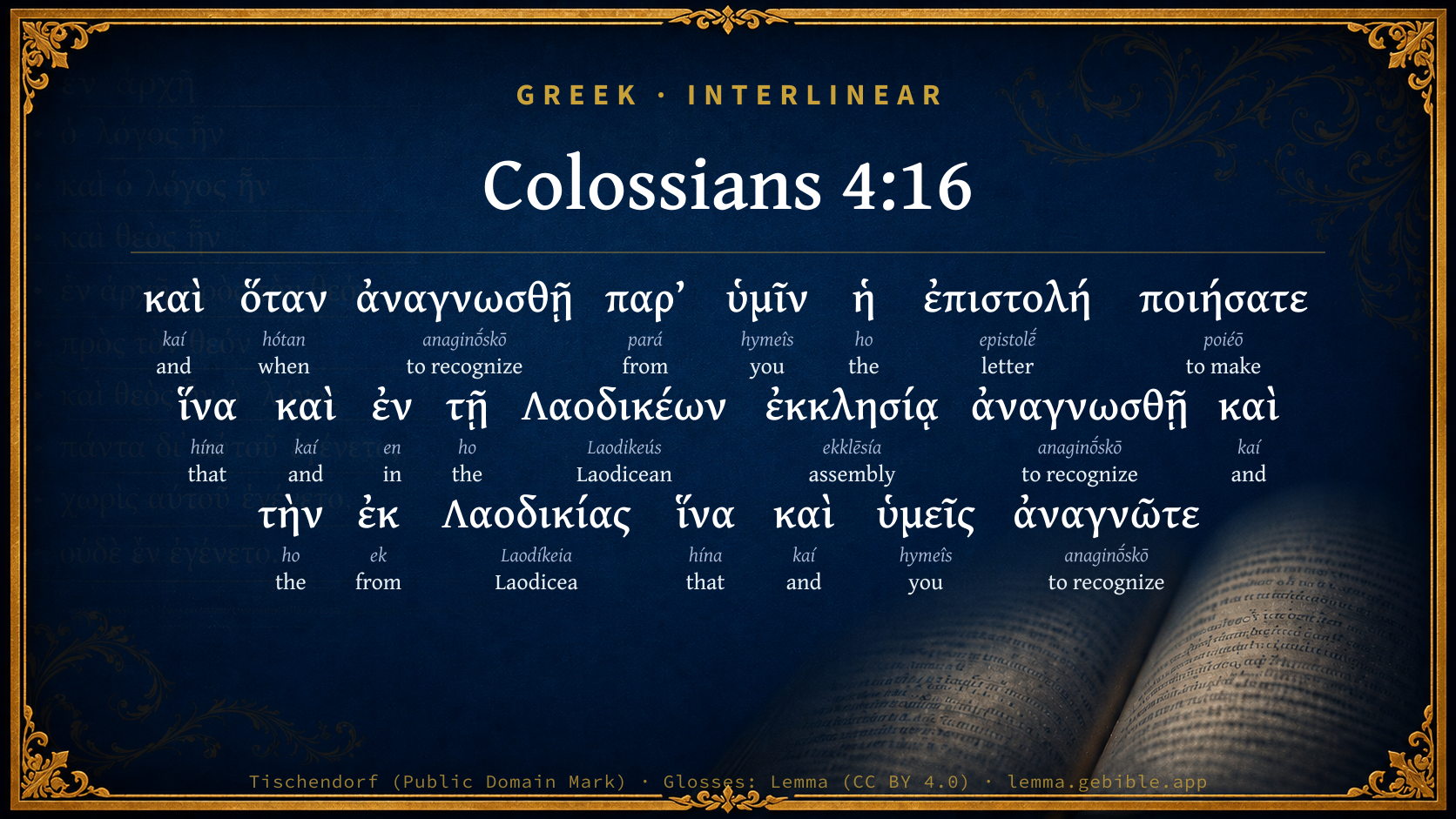
Greek (Tischendorf 8th ed.) Colossians 4:16 appears in the Greek New Testament. The text above is from the Tischendorf 8th edition. Each word links to its Strong’s number and a concise gloss. Click any word for its full Thayer’s Greek Lexicon entry.
Download image
Cite this verse

Colossians 4:16 (World English Bible). Public Domain. Lemma interlinear Bible study tool, https://lemma.gebible.app/v/colossians/4/16.

Show BibTeX & RIS
BibTeX
RIS
English Translation
When this letter has been read among you, cause it to be read also in the assembly of the Laodiceans; and that you also read the letter from Laodicea.
World English Bible · Public Domain
Highlights
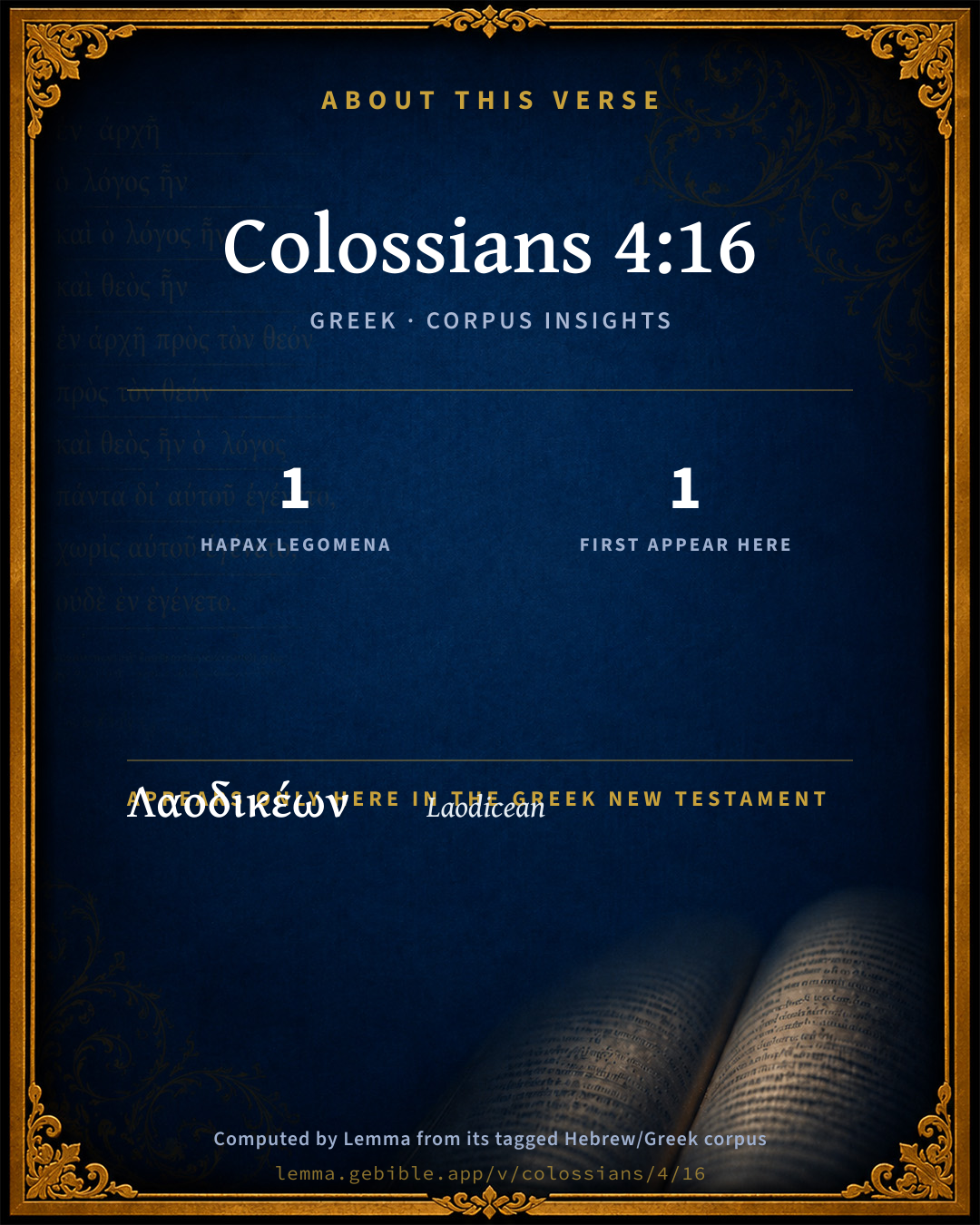
  • 1 hapax legomenon — only here in the Greek New Testament
  • 1 first appearance in the Greek New Testament
Full analysis ↓
Download a study sheet

One document with this verse’s original text, its word-by-word gloss line, the meaning frame, cross-references with their text, attributed commentary, and full source and license credits — printable, and it pastes into notes with its structure intact.

This verse Autodidact and up

Study sheet (.html) Plain text (.txt)

A passage Seminary Student

Up to 50 verses in one chapter. A passage sheet keeps up to 6 commentary sources and 12 cross-references per verse, in the order this page ranks them, and says so on the sheet whenever that leaves anything out. Ask for a single verse and you get the Autodidact verse sheet above.

Everything on this page stays free to read, with no account — the sheet is a download of what is already on screen, not access to it.

Want to remove ads? Support Godless Engineer
Compare translations 3

The same verse in 3 English versions, stacked beneath the original-language interlinear above. Click any original word for its lexicon entry.

Each is an independent rendering of the whole verse — the interlinear is not word-aligned to these translations.

Highlighted words mark where these versions differ — a whole-verse word diff, not a word-by-word alignment.

  • World English Bible Public Domain
    When this letter has been read among you, cause it to be read also in the assembly of the Laodiceans; and that you also read the letter from Laodicea.
  • King James Version Public Domain
    And when this epistle is read among you, cause that it be read also in the church of the Laodiceans; and that ye likewise read the epistle from Laodicea.
  • unfoldingWord Literal Text CC BY-SA 4.0
    And when this letter has been read among you, make sure that it would be read also in the church of Laodicea and that you also would read the one from Laodicea.

unfoldingWord Literal Text — © unfoldingWord, licensed CC BY-SA 4.0. Word-aligned USFM3 via Door43 (git.door43.org/unfoldingWord/en_ult).

Versions to compare (up to 4)

3 of 4 selected

Show all 19 translations

Every available English version of this verse, each an independent rendering of the whole verse.

  • World English Bible Public Domain
    When this letter has been read among you, cause it to be read also in the assembly of the Laodiceans; and that you also read the letter from Laodicea.
  • Berean Standard Bible Public Domain
    After this letter has been read among you, make sure that it is also read in the church of the Laodiceans, and that you in turn read the letter from Laodicea.
  • Majority Standard Bible Public Domain
    After this letter has been read among you, make sure that it is also read in the church of the Laodiceans, and that you in turn read the letter from Laodicea.
  • King James Version Public Domain
    And when this epistle is read among you, cause that it be read also in the church of the Laodiceans; and that ye likewise read the epistle from Laodicea.
  • American Standard Version (1901) Public Domain
    And when this epistle hath been read among you, cause that it be read also in the church of the Laodiceans; and that ye also read the epistle from Laodicea.
  • Revised Version (1885) Public Domain
    And when this epistle hath been read among you, cause that it be read also in the church of the Laodiceans; and that ye also read the epistle from Laodicea.
  • Geneva Bible (1599) Public Domain
    And when this Epistle is read of you, cause that it be read in the Church of the Laodiceans also, and that ye likewise reade the Epistle written from Laodicea.
  • Douay-Rheims (1899) Public Domain
    And when this epistle shall have been read with you, cause that it be read also in the church of the Laodiceans: and that you read that which is of the Laodiceans.
  • Young's Literal Translation Public Domain
    and when the epistle may be read with you, cause that also in the assembly of the Laodiceans it may be read, and the `epistle' from Laodicea that ye also may read;
  • Literal Standard Version CC BY-SA 4.0
    and when the letter may be read with you, cause that it may also be read in the assembly of the Laodiceans, and the [letter] from Laodicea that you also may read;
  • Unlocked Literal Bible CC BY-SA 4.0
    When this letter has been read among you, have it read also in the church of the Laodiceans, and see that you also read the letter from Laodicea.
  • unfoldingWord Literal Text CC BY-SA 4.0
    And when this letter has been read among you, make sure that it would be read also in the church of Laodicea and that you also would read the one from Laodicea.
  • Darby Bible Public Domain
    And when the letter has been read among you, cause that it be read also in the assembly of Laodiceans, and that *ye* also read that from Laodicea.
  • World Messianic Bible Public Domain
    When this letter has been read among you, cause it to be read also in the assembly of the Laodiceans, and that you also read the letter from Laodicea.
  • Webster's Bible Public Domain
    And when this epistle is read among you, cause that it be read also in the church of the Laodiceans; and that ye likewise read the epistle from Laodicea.
  • Free Bible Version CC BY-SA 4.0
    And when this letter has been read to you, make sure it's read to the church in Laodicea too, and that you also read the letter sent to Laodicea.
  • Bible in Basic English Public Domain
    And when this letter has been made public among you, let the same be done in the church of Laodicea; and see that you have the letter from Laodicea.
  • Text-Critical English NT CC BY 4.0
    After this letter has been read among you, have it read in the church of the Laodiceans as well, and make sure you also read the letter from Laodicea.
  • Tyndale New Testament (1534) Public Domain
    And when the pistle is reed of you make that it be reed in the congregacion of the Laodicians also: and that ye lyke wyse reade the epistle of Laodicia.

Literal Standard Version (2020), Covenant Press — licensed CC BY-SA 4.0. Text via the HelloAO Bible API (eBible.org). Unlocked Literal Bible (unfoldingWord) — licensed CC BY-SA 4.0. Text via the HelloAO Bible API (eBible.org). unfoldingWord Literal Text — © unfoldingWord, licensed CC BY-SA 4.0. Word-aligned USFM3 via Door43 (git.door43.org/unfoldingWord/en_ult). Free Bible Version, Dr. Jonathan Gallagher — licensed CC BY-SA 4.0. Text via the HelloAO Bible API (eBible.org).

Word by word

More ways to search: Search by grammar → Find every occurrence → Compare this word →

Practice this passage: Drill this verse → Learn its vocabulary →

Λαοδικέων
Laodikeús
G2994
“Laodicean”
Noun, Genitive, Plural, Masculine
Part of Speech
Noun
Case
Genitive
Number
Plural
Gender
Masculine
Full Thayer's Definition

Origin: from G2993

TDNT: None

1. a Laodicean, an inhabitant of Laodicea
  1. καὶ kaí G2532 “and” Conjunction
  2. ὅταν hótan G3752 “when” Conjunction
  3. ἀναγνωσθῇ anaginṓskō G314 “to recognize” Verb, Aorist, Passive, Subjunctive, 3rd person, Singular
  4. παρ’ pará G3844 “from” Preposition
  5. ὑμῖν hymeîs G5210 “you” Personal pronoun, 2nd person, Dative, Plural
  6. ἡ ho G3588 “the” Article, Nominative, Singular, Feminine
  7. ἐπιστολή epistolḗ G1992 “letter” Noun, Nominative, Singular, Feminine
  8. ποιήσατε poiéō G4160 “to make” Verb, Aorist, Active, Imperative, 2nd person, Plural
  9. ἵνα hína G2443 “that” Conjunction
  10. καὶ kaí G2532 “and” Conjunction
  11. ἐν en G1722 “in” Preposition
  12. τῇ ho G3588 “the” Article, Dative, Singular, Feminine
  13. ἐκκλησίᾳ ekklēsía G1577 “assembly” Noun, Dative, Singular, Feminine
  14. ἀναγνωσθῇ anaginṓskō G314 “to recognize” Verb, Aorist, Passive, Subjunctive, 3rd person, Singular
  15. καὶ kaí G2532 “and” Conjunction
  16. τὴν ho G3588 “the” Article, Accusative, Singular, Feminine
  17. ἐκ ek G1537 “from” Preposition
  18. Λαοδικίας Laodíkeia G2993 “Laodicea” Noun, Genitive, Singular, Feminine
  19. ἵνα hína G2443 “that” Conjunction
  20. καὶ kaí G2532 “and” Conjunction
  21. ὑμεῖς hymeîs G5210 “you” Personal pronoun, 2nd person, Nominative, Plural
  22. ἀναγνῶτε anaginṓskō G314 “to recognize” Verb, Aorist, Active, Subjunctive, 2nd person, Plural

About this verse

These counts appear in no published source. They are computed here, from the morphology-tagged text and Lemma’s own curated glosses. What Lemma adds →

23
words
14
distinct lemmas
Pauline Epistles
section

Notable vocabulary

1 hapax legomenon — a word that appears only here in the entire Greek New Testament:

  • Λαοδικέων Laodicean G2994

First appearance in Scripture

This word makes its first canonical appearance in the Greek New Testament here:

  • Λαοδικέων Laodicean G2994

Shared distinctive vocabulary

Λαοδικίας Laodicea G2993 occurs in 6 verses of the Greek New Testament. Also found in:
Repetition

Words recur within this verse:

  • ἀναγνωσθῇ to recognize G314 ×3
  • καὶ and G2532 ×4
  • ἡ the G3588 ×3
  • ὑμῖν you G5210 ×2
  • ἵνα that G2443 ×2

Cross-references

2

Topical passages linked to Colossians 4:16 in the Treasury of Scripture Knowledge — connected by theme and wording, ordered by reader-vote popularity; previews shown in the World English Bible.

  • 1 Thessalonians 5:27 I solemnly charge you by the Lord that this letter be read to all the holy brothers.
  • 2 Thessalonians 3:14 If any man doesn't obey our word in this letter, note that man, that you have no company with him, to the end that he may be ashamed.

Cross-references courtesy of OpenBible.info (CC BY 4.0).

Commentary

Notes on Colossians 4:16 from classic Christian and Jewish commentators (each source and its license shown beneath its notes). The classic Christian expositions comment on the surrounding passage and are grouped to its opening verse, so a note may address several verses; the Jewish commentaries on the Tanakh (Rashi and others) are per-verse, so they appear only where the commentator wrote on this verse.

Lemma curates 59 commentaries, every one of them public domain or Creative Commons licensed, each selected and text-cleaned for this edition rather than reprinted as found. About our sources →

The Biblical Illustrator

Joseph S. Exell

Col_4:16

When this Epistle is read among you, cause it to be read also in the Church of the Laodiceans.

I. The apostle wished his Epistle to be read in the whole Church. Hence observe--

1. That the sacred Scriptures were not written for the clergy, but for all Christian people, and that the ordinary reading of the Scriptures obtained in the primitive Church (1Th_5:27). And that this was in a language understood by the people is plain from Justin Martyr, Tertullian, and other fathers.

2. That they do err who deny that the reading of the Scriptures conduces to the edification of a Christian people unless there be an exposition by the preacher. This is not to detract from the utility or necessity of preaching. Nevertheless, we assert with the Psalmist (Psa_19:7).

II. He ordered them to communicate this Epistle to the Laodiceans.

1. Because the doctrine of the Epistle is general, and on that account was not to be reserved for the private use of the Church, but to be communicated to the whole Church of God, but first to their nearest neighbours, who, having read the autograph, could take copies of them and scatter them abroad.

2. Because Laodicea was infected with the same error as Colossae. Observe, then, that among all the Churches of God, and especially neighbouring ones, there Ought to be a communication of spiritual benefits, so that if one Church should have anything that might contribute to the edification of another, it should not grudge to impart it. (Bishop Davenant.)

The Epistles a common means of edification

The first Churches were edified by the mutual interchange of apostolical Epistles, and by the public reading of them. An Epistle sent to one Church became in reality the common property of all the Churches, and this fact led, at no very long period, to the formation of the canon of the New Testament. These Epistles were eagerly sought after, frequently copied, and devoutly cherished, so that complete collections of them were made. They were carefully distinguished from other writings, and, by the voice of the Churches, to them exclusively was accorded a place in the sacred canon. In this arrangement the wisdom of God was providentially manifested. By such use of the Holy Scripture the first Christians were nourished in their faith, and built up in the love and hope of the gospel. Healthful religion from that time to this, and, indeed, previously, under the Jewish economy, has been connected with a free, frequent, and devout use of Holy Scripture. This alone, by the blessing of God, can preserve the purity and living power of a Church. Shut out the Word of God, and superstition and spiritual death will creep in. It is by the use of the unadulterated milk of the Word that the disciples are to grow (1Pe_2:2)

. It is the engrafted Word which saves (Jam_1:21). It is through the comfort of the Scriptures that we have hope (Rom_15:4). And all Scripture is profitable (2Ti_3:16-17). (J. Spence, D. D.)

General reading of Scripture allowed

Nothing is more condemnatory of the practice of Rome than this plain unequivocal command. Yet Romanists prohibit the general perusal of the Scriptures, and read only small portions, and these in an unknown tongue, in public worship. St. Paul orders his entire Epistle to be read publicly. But if one Epistle, then all Epistles are equally required to be read. The Old Testament was, as we know, constantly recited in the Jewish synagogues, as is manifest by the case of our Lord at Nazareth and St. Paul at Antioch (Act_13:15)

; and in the face of the apostles command respecting his First Epistle to the Thessalonians, Romanism sets up its prohibitions. Can we wonder that all evils and superstitions should follow; that the invocation of saints, the worship of images, the adoration of the Virgin, and the veneration of altars, tombs, and relics should supersede the mediation of Christ; and that a multitude of uncommanded ceremonies and abstinences, and a whole torrent of will-worship, should follow in the train? (Bishop D. Wilson.)

The Epistle from Laodicea.

The connection forbids us to suppose that this means a letter by the Laodiceans. Both letters are plainly Pauline Epistles, and the latter is said to be from Laodicea, simply because the Colossians were to procure it from that place. The from does not imply authorship, but transmission. What, then, has become of that letter? Is it lost? So say some; but a more probable opinion is that it is the Epistle we know as that to the Ephesians. Very weighty authorities omit the words In Ephesus in verse 1 of that Epistle. The conjecture is a reasonable one that the letter was intended for a circle of Churches, and had originally no place named in the superscription, just as we might issue circulars To the Church in--leaving a blank to be filled in with different names. This conjecture is strengthened by the marked absence of personal references in the letter, which, in that respect, forms a striking contrast to Colossians, which it so strongly resembles in other particulars. Probably, therefore, Tychicus had both letters put into his hands for delivery. The circular would go first to Ephesus, as the most important Church in Asia, and thence would be carried by him to one community after another, till he reached Laodicea, from which he would come further up the valley to Colossae, bringing both letters with him. The Colossians are not told to get the letter from Laodicea, but to be sure they read it. Tychicus would see that it came to them; their business was to see that they marked, learned, and inwardly digested it. (A. Maclaren, D. D.)

The Biblical Illustrator, edited by Joseph S. Exell (c. 1880s–1900s) — public domain. Text from a community e-Sword module.

Joseph Benson's Commentary

Col 4:16. When this epistle is read among you — It appears by this, that the apostolic epistles were read publicly in the churches to which they were addressed; and probably not once, but often: copies of them were likewise taken, and translations of them made very early into different languages, and sent to different countries, where Christian churches were formed, that they might be read in them: a great proof this of the genuineness of these epistles: for they could not have been corrupted but the corruption must have been detected, by comparing different copies with each other. Cause that it be read also in the church of the Laodiceans — “The members of the church at Laodicea having, before their conversion, entertained the same principles, and followed the same practices with the Colossians, and the dangers to both churches, from the attempts of false teachers, being nearly the same, it was proper that the same spiritual remedies should be applied to both. And therefore the apostle ordered this letter, which was designed for the instruction of the Colossians, to be read in the church of the Laodiceans also: and no doubt it was read there, agreeably to the apostle’s injunction; by which means, in that church, as well as in the church at Colosse, the false teachers and their idolatrous practices were for a while repressed.” And that ye likewise read the epistle from Laodicea — Some think the letter here referred to was one which the apostle wrote to the Laodiceans, but which is now lost. But as the ancients mention no such letter, nor indeed any letter written by St. Paul which is not still remaining, others judge it more probable that the letter to the Ephesians is intended, and that the apostle directed the Ephesians, by Tychicus, who carried their letter to them, to send a copy of it to the Laodiceans, with an order to them to communicate it to the Colossians.

Joseph Benson's Commentary on the Old and New Testaments (1811–1818) — public domain. Text from a community e-Sword module.

Tyndale Open Study Notes

Tyndale Open Resources

4:16 you should read the letter I wrote to them: Various attempts have been made over the years to identify the letter to the Laodiceans with a New Testament letter or fragment, but it is most likely that Paul’s letter to the Laodicean church has been lost.

Tyndale Open Study Notes — © Tyndale Open Resources, licensed CC BY-SA 4.0. Text via the HelloAO Bible API.

Bengel's Gnomon

Johann Albrecht Bengel

Col 4:16. Ἀναγνωσθῇ, shall be read) publicly, in the church. Comp. 1Th 5:27; Rev 1:3; Deu 31:11.—ἡ ἐπιστολὴ, the epistle) this very one.—ποιήσατε, cause) So also 1 Thess. as above.—τὴν ἐκ Λαοδικείας, the one from Laodicea) Mill is of opinion that the Epistle to the Ephesians is intended, which was to be got from Laodicea, and to be brought to Colosse. It is certainly not without a reason that Paul mentions the town from which the epistle was to be procured, rather than those to whom he sent it.

Bengel's Gnomon of the New Testament — English translation (T&T Clark, Edinburgh, 1860) — public domain. Text from a community e-Sword module.

Meyer's Critical & Exegetical Commentary

Heinrich August Wilhelm Meyer

Col_4:16.[179] This message presupposes essentially similar circumstances in the two churches.

ἡ ἐπιστολή] is, as a matter of course, the present Epistle now before us; Winer, p. 102 [E. T. 133]. Comp. Rom_16:22; 1Th_5:27.

ποιήσατε, ἵνα] procure, that. The expression rests on the conception: to be active, in order that something may happen, Joh_11:37. Comp. Herod, i. 8: ποίει, ὅκως κ.τ.λ., i. 209; Xen. Cyrop. vi. 3. 18. The following καὶ τὴν ἐκ Λαοδ. κ.τ.λ. is, with emphatic prefixing of the object, likewise dependent on ποιήσατε, not co-ordinated with the latter as an independent imperative sentence like Eph_5:33a forced invention of Hofmann, which, besides, is quite inappropriate on account of the stern command which it would yield.[180]

τὴν ἐκ Λαοδικείας] not: that written to me from Laodicea. So τινές in Chrysostom, who himself gives no decisive voice, as also Syriac, Theodoret, Photius in Oecumenius, Erasmus, Beza, Vatablus, Calvin, Calovius, Wolf, Estius, Cornelius a Lapide, Storr, and others, as also again Baumgarten-Crusius. This is at variance with the context, according to which ΚΑῚ ὙΜΕῖς, pursuant to the parallel of the first clause of the verse, presupposes the Laodiceans, not as the senders of the letter, but as the receivers of the letter, by whom it was read. How unsuitable also would be the form of the message by ποιήσατε! Paul must, in fact, have sent to them the letter. Lastly, neither the object aimed at (Theophylact already aptly remarks: ἀλλʼ οὐκ οἶδα, τί ἂν ἐκείνηςnamely, that alleged letter of the Laodiceans

ἜΔΕΙ ΑὐΤΟῖς ΠΡῸς ΒΕΛΤΊΩΣΙΝ), nor even the propriety of the matter would be manifest. Purely fanciful is the opinion of Jablonsky, that Paul means a letter of the Laodiceans to the Colossian overseers, as well as that of Theophylact: ἡ πρὸς Τιμόθεον πρώτη· αὕτη γὰρ ἐκ Λαοδικείας ἐγράφη. So also a scholion in Matthaei In accordance with the contextalthough Lange, Apost. Zeitalt. I. p. 211 ff., denounces the idea as a fiction, and Hofmann declares it as excluded by the very salutations with which the Colossians are charged to the Laodiceanswe can only understand it to refer to a letter of Paul to the Laodiceans, which not merely these, to whom it was written, but also the Colossians (καὶ ὑμεῖς) were to read, just as the letter to the Colossians was to be read not merely by the latter, but also in the Laodicean church. The mode of expression, τὴν ἐκ Λαοδικείας, is the very usual form of attraction in the case of prepositions with the article (comp. Mat_24:17; Luk_11:13), so that the two elements are therein comprehended: the letter to be found in Laodicea, and to be claimed or fetched from Laodicea to Colossae. See generally, Kühner, II. 1, p. 473 f., and ad Xen. Mem. iii. 6. 11, ad Anab. i. 1. 5; Stallbaum, ad Plat. Apol. p. 32 B; Winer, p. 584 [E. T. 784]. This letter written to the Laodiceans has, like various other letters of the apostle, been lost.[181] In opposition to the old opinion held by Marcion, and in modern times still favoured especially by such as hold the Epistle to the Ephesians to be a circular letter (Böhmer, Böttger, Bähr, Steiger, Anger, Reuss, Lange, Bleek, Dalmer, Sabatier, Hofmann, Hitzig, and others), that the Epistle to the Ephesians is to be understood as that referred to, see Introd. to Eph. § 1; Wieseler, Chronol. d. apost. Zeitalt. p. 435 ff.; Sartori, l.c.; Reiche, Comm. crit. ad Eph_1:1; Laurent in the Jahrb. f. D. Theol. 1866, p. 131 ff. The hypothesis that the Epistle to Philemon is meant (so Wieseler, also Thiersch, Hist. Standp. p. 424; and some older expositors, see in Calovius and in Anger, p. 35) finds no confirmation either in the nature and contents of this private letter,[182] or in the expressions of our passage, which, according to the analogy of the context, presuppose a letter to the whole church and for it. Even the Epistle to the Hebrews (Schulthess, Stein, in his Comm. z. Luk., appendix) has been fallen upon in the vain search after the lost! According to Holtzmann, the words are intended to refer to the Epistle to the Ephesians, but καὶ τὴν ἐκ Λαοδικ. ἵνα κ. ὑμ. ἀναγν. is an insertion of the interpolator;[183] comp. Hitzig.

[179] See Anger, Beitr. zur histor. krit. Einl. in d. A. u. N. T. I.; über den Laodicenerbrief, Leip. 1843; Wieseler, de epistola Laodicena, Gott. 1844; and Chronol. d. apost. Zeit. p. 450 ff.; Sartori, Ueber d. Laodicenserbrief, Lüb. 1853.

[180] Hofmann needed, certainly, some such artificial expedient, wholly without warrant in the words of the text, to favour his presupposition that the Epistle to the Ephesians was meant, and that it was a circular letter. For a circular letter goes through the circuit destined for it of itself, and there is no occasion to ask or to send for it in order to procure, that (ποιήσατε, ἵνα) people may get it to read. But the effect of the forced separation of the second ἵνα from ποιήσατε is, that the words τὴν ἐκ Λαοδικείας are supposed only to affirm that the letter will come from Laodicea to Colossae, that it will reach them, and they ought to read it. In this way the text must be strained to suit what is à priori put into it. This applies also in opposition to Sahatier, lap. Paul, p. 201, who entirely ignores the connection with ποιήσατι (la lettre qui vous viendra de Laod.).

[181] The apocryphal letter to the Laodiceans, the Greek text of which, we may mention, originated with Elias Hutter (1599), who translated it from the Latin, may be seen in Fabricius, Codex apocr. p. 873 ff., Anger, p. 142 ff. The whole letter,highly esteemed, on the suggestion of Gregory I., during the Middle Ages in the West, although prohibited in the second Council of Nice, 787 (to be found also in pre-Lutheran German Bibles),which is doubtless a still later fabrication than that already rejected in the Canon Muratorianus, consists only of twenty verses, the author of which does not even play the part of a definite situation. Erasmus rightly characterizes it: quae nihil habeat Pauli praeter voculas aliquot ex ceteris ejus epistolis mendicatas.

[182] For, although it is in form addressed to several persons, and even to the church in the house (see on Phm_1:1-2), it is at any rate in substance clear, as Jerome already remarks: Paulum tantummodo ad Philemonem scribere, et unum cum suo sermocinari. Besides, it is to be inferred from the contents of the Colossian letter, that the Laodicean letter meant was also doctrinal in contents, and that the reciprocal use of the two letters had reference to this, in accordance with the essentially similar needs of the two neighbouring churches.

[183] Because, if we annex ἵνα to ποιήσατε, an awkward sense arises, seeing that the Colossians can only cause that they get the letter to read, but not that they read it. That is a subtlety, which does injustice to the popular style of the letter. But if we take ἵνα independently (as Hofmann does), then Holtzmann is further of opinion that the author of Eph_4:29; Eph_5:27; Eph_5:33, is immediately betrayedan unfounded inference (comp. Winer, p. 295 [E. T. 396]), in which, besides, only the comparison of Eph_5:33 would be relevant, and that would he balanced by 2Co_8:7.

REMARK.

It is to be assumed that the Epistle to the Laodiceans was composed at the same time with that to the Colossians, inasmuch as the injunction that they should be mutually read in the churches can only have been founded on the similarity of the circumstances of the two churches as they stood at the time. Comp. Col_2:1, where the καὶ τῶν ἐν Λαοδικείᾳ, specially added to περὶ ὑμῶν, expresses the similar and simultaneous character of the need, and, when compared with our passage, is to be referred to the consciousness that the apostle was writing to both churches. And the expression τὴν ἐκ Λαοδικείας produces the impression that, when the Colossians received their letter, the Laodiceans would already have theirs. At the same time the expression is such, that Paul does not expressly inform, the Colossians that he had written also to the Laodiceans, but speaks of this letter as of something known to the readers, evidently reckoning upon the oral communication of Tychicus. The result, accordingly, seems as follows: Tychicus was the bearer of both letters, and travelled by way of Laodicea to Colossae, so that the letter for that church was already in Laodicea when the Colossians got theirs from the hands of Tychicus, and they were now in a position, according to the directions given in our passage, to have the Laodicean letter forwarded to them, and to send their own (after it was publicly read in their own church) to Laodicea.

Meyer — Critical and Exegetical Commentary on the New Testament — English translation by Peter Christie, edited by Frederick Crombie (T&T Clark, 1880) — public domain. Text from a community e-Sword module.

Expositor's Greek Testament

ed. W. Robertson Nicoll

Col 4:16 . τὴν ἐκ Λαοδικίας : clearly a letter sent by Paul to Laodicea, which the Colossians are instructed to procure and read. It may be a lost letter, or it may be our so-called Epistle to the Ephesians, to which Marcion refers as the Epistle to the Laodiceans, and which was probably a circular letter. Weiss argues that it cannot be the Epistle to the Ephesians, for that was sent at the same time as this, and therefore Paul could not have sent salutations to Laodicea in this letter. But this is really natural, if Ephesians was a circular letter (and the absence of salutations is difficult to explain otherwise), and if this letter was to be passed on to Laodicea.

The Expositor's Greek Testament, edited by W. Robertson Nicoll (1897–1910) — public domain. Text from a community e-Sword module.

Jamieson, Fausset & Brown

Robert Jamieson, A. R. Fausset & David Brown

the epistle from Laodicea--namely, the Epistle which I wrote to the Laodiceans, and which you will get from them on applying to them. Not the Epistle to the Ephesians. See Introduction to Ephesians and Introduction to Colossians. The Epistles from the apostles were publicly read in the church assemblies. IGNATIUS [Epistle to the Ephesians, 12], POLYCARP [Epistle to the Philippians, 3.11,12], CLEMENT [Epistle to the Corinthians, 1. 47], Th1 5:27; Rev 1:3, "Blessed is he that readeth, and they that hear." Thus, they and the Gospels were put on a level with the Old Testament, which was similarly read (Deu 31:11). The Holy Spirit inspired Paul to write, besides those extant, other Epistles which He saw necessary for that day, and for particular churches; and which were not so for the Church of all ages and places. It is possible that as the Epistle to the Colossians was to be read for the edification of other churches besides that of Colosse; so the Epistle to the Ephesians was to be read in various churches besides Ephesus, and that Laodicea was the last of such churches before Colosse, whence he might designate the Epistle to the Ephesians here as "the Epistle from Laodicea." But it is equally possible that the Epistle meant was one to the Laodiceans themselves.

Jamieson, Fausset & Brown — Commentary Critical and Explanatory on the Whole Bible (1871) — public domain (CC PDM 1.0). Text via the HelloAO Bible API.

Adam Clarke's Commentary

Verse 16. Cause that it be read also in the Church of the Laodiceans] That is: Let a copy be taken, and sent to them, that it may be read there also. This appears to have been a regular custom in the apostolic Church.

That ye likewise read the epistle from Laodicea] Some suppose that this was an epistle sent from Laodicea to the apostle, which he now sent by Aristarchus to the Colossians, that they might peruse it; that thereby they might see the propriety of sending a copy of his epistle to them, to the Laodicean Church. Many eminent critics are of this opinion, which appears to me to be both forced and far fetched. Others think that the Epistle to the Ephesians is the epistle in question, and that it was originally directed to them, and not to the Ephesians. See Clarke on Eph 1:1, c. But others, equally learned, think that there was an epistle, different from that to the Ephesians, sent by St. Paul to the Laodiceans, which is now lost. There was an epistle under this direction in the times of Theodoret and Jerome, for both of them mention it but the latter mentions it as apocryphal, Legunt quidam et ad Laodicenses Epistolam, sed ab omnibus exploditur; "Some read an Epistle to the Laodiceans, but it is exploded by all." The seventh OEcumenic council, held in 787, states that the ancients allowed that there was an epistle with this direction, but that all the orthodox rejected it as supposititious.

An epistle ad Laodicenses is still extant in the Latin language, a very ancient copy of which is in the library Sancti Albani Andegavensis, St. Alban's of Anjou. Hutter has translated it into Greek, but his translation is of no authority. Calmet has published this epistle, with various readings from the above MS. I shall subjoin it at the end of this epistle, and give my opinion relative to its use and authenticity. A copy of this epistle stands in this place as a portion of Divine revelation in one of my own MSS. of the Vulgate.

Adam Clarke's Commentary on the Bible (1810–1826) — public domain. Text from a community e-Sword/MySword module.

John Calvin's Commentaries

16. Let it be read in the Church of the Laodiceans. Hence, though it was addressed to the Colossians, it was, nevertheless, necessary that it should be profitable to others. The same view must also be taken of all the Epistles. They were indeed, in the first instance, addressed to particular Churches, but, as they contain doctrine that is always in force, and is common to all ages, it is of no importance what title they bear, for the subject matter belongs to us. It has been groundlessly supposed that the other Epistle of which he makes mention was written by Paul, and those labor under a double mistake who think that it was written by Paul to the Laodiceans. I have no doubt that it was an Epistle that had been sent to Paul, the perusal of which might be profitable to the Colossians, as neighboring towns have usually many things in common. There was, however, an exceedingly gross imposture in the circumstance that some worthless person, I know not who, had the audacity to forge, under this pretext, an Epistle, that is so insipid, that nothing can be conceived to be more foreign to Paul’s spirit.

John Calvin's Commentaries (1540-1563) — public domain. Text from the Calvin Translation Society English edition (1840s-50s) via the Christian Classics Ethereal Library (ccel.org). Calvin's coverage is partial (roughly two-thirds of the Bible); uncommented books and verses are honest gaps, never fabricated. The 19th-century editor's footnotes and remarks are omitted so the notes are faithfully Calvin's own voice.

Ellicott's Commentary for English Readers

(16) When this epistle.—In the implied direction to read this Epistle in the Church—a direction expressly given under like circumstances to the Church at Thessalonica (1Th_5:27)—we discern the method of first publication of the Apostolic Epistles; in the direction to interchange Epistles with the Laodicean Church, we trace the way in which these Epistles became more widely diffused, and recognised as authoritative in the Church at large. Thus it was that they were “canonised,” i.e., accepted as a part of the “canon” or rule of divine truth. The likelihood, or unlikelihood, of this public reading has an important bearing on the question of the authenticity of some of the books, which were placed among the “doubtful” by Eusebius and other ancient authorities. The fact that other books (such as our so-called Apocryphal books) were also publicly read was the cause of their being wrongly confused with the books of Holy Scripture.

The epistle from Laodicea.—The question, What was this “Epistle from Laodicea”? has given birth to a crowd of conjectures, of which an admirable and exhaustive examination will be found in Dr. Lightfoot’s Excursus on this verse. But many of these may be at once dismissed. It seems perfectly clear, from the obvious parallelism of this Epistle from Laodicea with the Epistle to the Colossians itself, that it was a letter not from the Laodicean Church, not from any other Apostle, or Apostolic writer, but from St. Paul himself, either written at Laodicea, or (as is more likely) written to the Laodicean Church, and to be sent “from Laodicea” to Colossæ. Hence the question is narrowed to a single alternative—(1) Is it an Epistle which has been lost, or, at any rate, not found in the canon? This is, of course, possible; it cannot be necessary, as it is certainly difficult, to suppose that all St. Paul’s Epistles have been preserved to us in Holy Scripture. Now, there is extant an “Epistle to the Laodiceans,” circulated in the West, and known only in the Latin, although it has been thought to bear traces of translation from a Greek original. This letter (for which see Excursus B.) is obviously a forgery, probably not of early date, being little more than a tame compilation of phrases from St. Paul’s Epistles. Putting this unhesitatingly aside, we may suppose the letter to have been lost. But this is a supposition merely arbitrary, and not to be adopted, except in default of something which has a better claim to attention. (2) Is it some other of St. Paul’s known Epistles? The only letter which is noticed in our ordinary copies of the Greek Testament as written from Laodicea is the First Epistle to Timothy; but this is put out of the question, both in date and character; and, moreover, the very idea of a letter written from Laodicea at this time is negatived by St. Paul’s declaration (Col_2:1) that the Laodiceans had not seen his face in the flesh. A fourth century tradition declares our “Epistle to the Hebrews” to have been written to the Laodiceans; but (setting aside all question of the authorship) the whole character and argument of the Epistle make this extremely unlikely. Far the most probable supposition identifies it with our “Epistle to the Ephesians.” For the reasons for supposing this an encyclical letter, see Introduction to that Epistle. In particular it should not be forgotten that Marcion expressly calls it an “Epistle to the Laodiceans.” Laodicea lay lower down the valley, and was the larger town: an encyclical letter might well be left there to be sent on to Colossæ. The two Epistles, as we have seen, have both strong likeness and marked distinction. Nothing could be more natural than that they should be interchanged, according to the direction of the text.

A Bible Commentary for English Readers, edited by Charles John Ellicott (1878–1897) — public domain. Text from a community e-Sword module.

The Cambridge Bible for Schools and Colleges

gen. ed. J. J. S. Perowne

16. this epistle] Lit., the epistle; as Rom_16:22; 2Th_3:14. “The letter now before you.”

is read] I.e., shall have been read.

in the church of the Laodiceans] Hierapolis is not mentioned in this charge. Was Laodicea already beginning to grow “lukewarm” (Rev_3:15) as the sister-church was not?

“A similar [and still more solemn] charge is given in 1Th_5:27. The precaution here is probably suggested by the distastefulness of the Apostle’s warnings” (Lightfoot).

the epistle from Laodicea] I.e., which will reach you viâ Laodicea. On the question whether this was our “Epistle to the Ephesians” see Introd., ch. 5.

The Cambridge Bible for Schools and Colleges (gen. ed. J. J. S. Perowne; Cambridge University Press, 1878–1918) — public domain. Text from a community e-Sword module.

John Gill's Exposition

And when this epistle is read amongst you, Which the apostle was now writing, and sent unto them; and which was to be read publicly, before the whole church; being sent not to any particular person, or persons, but to the whole body, and for their general good and instruction:

cause that it be read also in the church of the Laodiceans; his will was, that after it had been read to the church at Colosse, it should be sent, or at least a copy of it, to the church of the Laodiceans, in order to be read there: his reason might be, not only because this church was near them, but because it was in much the same situation, being infested with the same sort of false teachers; and therefore what was said to the one, was pertinent to the other:

and that ye likewise read the epistle from Laodicea; which was not an epistle of the apostle to the Laodiceans, as some have thought, but one that was "written from" thence, as the Syriac version renders it. Marcion, the heretic, called the epistle to the Ephesians, the epistle to the Laodiceans, but without any reason; and others have forged an epistle which bears this name, and appears to be a collection out of others, and chiefly from the epistle to the Philippians; and which being short, and may gratify the curious who cannot otherwise come at it, I shall transcribe it, and is as follows (r).

"Paul an Apostle, not of men, neither by man, but by Jesus Christ; to the brethren which are of Laodicea, grace be unto you, and peace from God our Father and the Lord Jesus Christ. I give thanks to Christ in every prayer of mine, that ye continue and persevere in good works, expecting the promise in the day of judgment: neither let the vain speeches of some that pretend to truth disturb you, so as to turn you from the truth of the Gospel which is preached by me; and now the Lord cause that those who belong to me may be serviceable for the furtherance of the truth of the Gospel, and doing kind actions, which are of salvation unto eternal life: and now my bonds are manifest which I suffer in Christ, in which I am glad and rejoice; and this is to my perpetual salvation which is done by your prayers, the Holy Ghost supplying, whether by life or by death; for me to live is life in Christ, and to die is joy; and he will do his own mercy in you, that ye may have the same love, and be unanimous: therefore, most beloved, as ye have heard of the presence of the Lord, so think ye, and do in fear, and you shall have life for ever; for it is God that worketh in you; and whatsoever ye do, do without sin; and what is best, most beloved, rejoice in the Lord Jesus Christ, and take heed of all filth in all gain; let your petitions be openly with God, be ye steadfast in the sense of Christ: and whatsoever things are sound and true, and chaste and just, and lovely, do; and what ye have heard and received retain in the heart, and peace shall be with you. Salute all the brethren with an holy kiss; all the saints salute you; the grace of our Lord Jesus Christ be with your spirit. Amen. Cause this to be read to the Colossians, and that which is of the Colossians to you.''

Every one on reading it will easily see that it is a spurious piece, a collection out of other epistles, and very ill put together: however, the apostle here does not speak of any epistle written to the church of Laodicea, but of one that was written from thence; which some think was written by himself, and that he means his first epistle to Timothy, which is said to be written from Laodicea; and the rather, because in that the qualifications of the ministers of the Gospel are given; and also suitable instructions for the discharge of their work, and so very proper to be read in the presence of Archippus; who, from the following verse, seems to have been remiss and negligent, and needed stirring up to the performance of his office: but from Col 2:1 it appears, that the apostle had not been at Laodices when he wrote this, and had not so much as seen any of the faces of the brethren there in the flesh; it therefore seems rather to be an epistle which was sent from Laodicea to him, or to the Colossians; which having something in it very instructive and useful, the apostle desires it might be publicly read.

(r) Jachasin, fol. 87. 2. & 117. 1.

John Gill's Exposition of the Whole Bible (1746–1763) — public domain (CC PDM 1.0). Text via the HelloAO Bible API.

Trapp's Complete Commentary

John Trapp

16 And when this epistle is read among you, cause that it be read also in the church of the Laodiceans; and that ye likewise read the epistle from Laodicea.

Ver. 16. Read the Epistle from Laodicea] Other good books then must be read as well as the Scriptures; yet not idle pamphlets and love toys. These should be burnt, as those curious books were, Act 19:18-20

John Trapp, A Commentary or Exposition upon All the Books of the Old and New Testament (1647–1656) — public domain. Text from a community e-Sword module.

Albert Barnes' Notes on the Bible

And when this Epistle is read among you, cause that it be read also in the church of the Laodiceans - Laodicea was near to Colossae, and the church there was evidently exposed to the same dangers from philosophy and false teachers as the at Colossae. The counsels in this Epistle, therefore, would be equally applicable to both. In 1Th 5:27, the apostle also charges those to whom that Epistle was addressed to see that it be “read unto all the holy brethren.” It is evident that the apostles designed that the letters which they addressed to the churches should be read also by others, and should become the permanent source of instruction to the friends of Christ. Laodicea, here referred to, was the seat of one of the “Seven churches” of Asia Rev 3:14; was a city of Phrygia, and was its capital. It was situated on the river Lycus (hence, called Λαοδίκεία ἐπὶ Λύκῳ Laodikeia epi Lukō - Laodicea on the Lycus) and stood at the southwestern angle of Phrygia. Its early name appears to have been Dios polis, changed subsequently to Rhoas. The name Laodicea was given to it by Antiochus Theos, in honor of his wife Laodice. Under the Romans it became a very flourishing commercial city.

It was often damaged by earthquakes, but was restored by the Roman emperors. It is supposed to have been destroyed during the inroad of Timur Leng in 1402. The ruins are called by the Turks Eski Hissar. These ruins, and the ruins of Hierapolis, were visited by Mr. Riggs, an American Missionary, in 1842, who thus speaks of them: “These spots, so interesting to the Christian, are now utterly desolate. The threatening expressed in Rev 3:10, has been fulfilled, and Laodicea is but a name. In the midst of one of the finest plains of Asia Minor, it is entirely without inhabitant. Sardis, in like manner, whose church had a name to live, but was dead, is now an utter desolation. Its soil is turned up by the plow, or overgrown by rank weeds: while in Philadelphia, since the day when our Saviour commended those who had there “kept the word of his patience,” there has never ceased to be a nominally Christian church. The ruins of Laodicea and Hierapolis are very extensive. The stadium of the former city, and the gymnasia and theaters of both, are the most complete which I have anywhere seen. Hierapolis is remarkable also for the so-called frozen cascades, a natural curiosity, in its kind probably not surpassed for beauty and extent in the world. It consists of a deposit of carbonate of lime, white as the driven snow, assuming, when closely examined, various forms, and covering nearly the whole southern and western declivities of the elevation on which the city was built. It is visible for many miles, and has procured for the place the name by which alone Hierapolis is known among the Turks, of the Cotton Castle.”

And that ye likewise read the epistle from Laodicea - In regard to this Epistle, see Introduction, Section 6.

Albert Barnes' Notes on the Bible (1834–1885) — public domain. Text from a community e-Sword/MySword module.

Haydock's Catholic Bible Commentary

Read you that which is of the Laodiceans.[1] Some expound these words of an epistle which St. Paul wrote to the Laodiceans, which is lost, for that now extant is no more than a collection of sentences out of St. Paul. By the Greek text is rather signified a letter writ from Laodicea, and might be a letter sent from the Laodiceans to St. Paul, which he had a mind the Colossians should read. (Witham) --- This opinion does not, however, seem well founded. Hence it is more probable, that St. Paul wrote an epistle from Rome to the Laodiceans about the same time that he wrote to the Colossians, as he had them both equally at heart, and that he ordered that epistle to be read by the Colossians for their instruction; and, being neighbouring cities, they might communicate to each other what they had received from him: as one epistle might contain some matters not related in the other, and would be equally useful for their concern; and more particularly as they were equally disturbed by intruders and false teachers, against whom the apostle was anxious to warn them, lest they should be infected by their pernicious doctrine. (Challoner) --- It is the most common opinion, both amongst the ancients and moderns, that the epistle here alluded to was one written by the Laodiceans to St. Paul, which he sent to Colossus with this, and not one which he himself had written to the Laodiceans. It is however now lost. This exposition agrees best with the Greek. (Calmet)

===============================

[BIBLIOGRAPHY]

That of the Laodiceans. Eam quæ Laodicensium est, Greek: ten ek Laodikeias. See St. John Chrysostom (Greek: log. ib. p. 152.) and P. Mauduit dissert. on this place, who endeavours to prove that St. Paul wrote to the Laodiceans.

====================

George Leo Haydock (1774–1849), Haydock's Catholic Family Bible and Commentary, 1859 edition — public domain. Excludes Psalms (Douay-Rheims chapter numbering differs from Protestant) and Deuterocanonical books (Catholic canon only).

Matthew Poole's English Annotations

And when this epistle is read among you: the apostle takes it for granted, that, when this Epistle came to their hands, it would be publicly read in a solemn assembly of the church, or brethren, convened to that purpose, as elsewhere usual. For indeed he doth strictly enjoin and adjure the Thessalonians, under the penalty of the Lord’s displeasure, that the Epistle or letter which he wrote unto them should be read unto all the brethren, 1Th 5:27; it being an indispensable duty of Christ’s disciples, to search the Scriptures, Joh 5:39, and there solemnly to read them in the assembly for the edification of all ministers and people, old and young, Deu 17:19; Psa 1:2; 119:9; Mar 13:37; Act 13:15; 17:11,12; 18:26-28; Rom 15:4; 1Ti 4:13,15.

Cause that it be read also in the church of the Laodiceans: hence (as it follows) the apostle (who it is likely had not an opportunity at Rome to have a copy of it transcribed) chargeth them at Colosse, to see or take care after the reading of this same Epistle amongst themselves, that, a copy of it being prepared for that purpose, it might, as from him, be also solemnly read or rehearsed in a public assembly of the Christians at Laodicea.

And that ye likewise read the epistle from Laodicea; and he further chargeth those to whom he wrote at Colosse, that they should take care that the Epistle (as we rightly with the generality of ancients and moderns render it) from Laodicea, be read amongst them. The Ethiopic version (as we have it thence in the Latin) reads, send it to Laodicea, that the Laodiceans also may read it, in the house or congregation of Christians there. The Vulgar Latin, that ye likewise may read the Laodicean Epistle, or the Epistle of the Laodiceans. Whence some of old and of late would have it thought, that St. Paul wrote a distinct Epistle to the Laodiceans. In favour of this opinion, some bad man, out of this Epistle to the Colossians, and that to the Ephesians, patched up and forged a short, but gross and trifling, Epistle, and fathered it on the apostle, though very dissonant from his character and style; whereupon it hath been rejected as spurious and apocryphal by the learned fathers, and the second council of Nice; and since by the learned on all hands, except some few of the papists, and except quakers, who printed a translation of it, and plead for it. Some papists urge this, to argue that the church gives the Scripture authority amongst Christians. But though she is bound to preserve the books of Divine authority, it doth not belong to her to authenticate them, or prescribe them as the rule of faith; that were no less than to outrage the majesty of the Author. Others allege it, as being lost, and thereupon would infer the canon of Holy Scriptures to be defective. But supposing, yet not granting, that Paul had written an Epistle to the Laodiceans, which had not come down to us, it were altogether inconsequent that the canon of Scriptures we have doth not contain all things necessary to salvation. Some, still harping on the Vulgar translation of the Laodicean Epistle, (though that in common speech might argue they wrote it rather than received it), would fancy that it was the Epistle Paul wrote to the Ephesians; but Tertullian did brand the impostor Marctan for changing the title of Paul’s Epistle to the Ephesians. Others conceit it may be understood of Paul’s Epistle to Philemon, whom Paul calls his fellow labourer, likely exercising his ministry in the neighbour city of Laodicea, which was sent by Onesimus, and for the sake of Onesimus, who was a Colossian, was to be read at Colosse. Others, because Luke is mentioned, Col 4:14, that it was an Epistle of his to the Laodiceans; but of that there is no evidence. Neither is it probable that Paul would in this Epistle to the Colossians have saluted the Laodiceans, had he written a distinct Epistle to them. Wherefore it is most rational to understand it, not of an Epistle of Paul written to the Laodiceans, but as our Bibles, according to an authentic copy, have, with the Greek fathers, faithfully translated and represented it, written from Laodicea. Some conjecture it to be the First Epistle of John, which they conceive was written from the city of Laodicea. Others think it was the First Epistle to Timothy, from the inscription or subscription of a long time put at the end of it, as if written from Laodicea. But against that it may be excepted, there is no mention of Pacatiana, in the writers of the first age, but only in after-times, dividing the Roman empire into provinces; and some say this was first mentioned in the ecclesiastical records in the fifth synod at Constantinople. Further, there be several passages in the Epistle itself do intimate that it was written from some place in Macedonia, if we consult Col 1:3, with Col 3:14; 4:13, not from Laodicea. Some think it to be meant of the Epistle from Laodicea, wherein they would answer the Colossians; how probably I determine not. Wherefore it is most probable, that the Epistle was written from Laodicea, to Paul at Rome; either by the church there, or some of her officers, which (likely he in straits of time enclosed, and) he would have read, as helpful to the edification of the Colossians, for the better clearing of some passages in this Epistle to them, wherein he had obviated such errors as he might hear seducers were attempting to disseminate amongst them.

Matthew Poole's English Annotations on the Holy Bible (1683–1685) — public domain. Text from a community e-Sword/MySword module.

Whedon's Commentary on the Bible

Daniel D. Whedon

16. Cause that it be read—This public reading of an epistle is also enjoined in 1Th_5:27. The exchange of epistles, as in the present case, would require a copy to be made, and gives us a glimpse of the multiplication of copies of the gospels and epistles whereby they rapidly spread through the entire early Church. This epistle having been read to the brethren at Colosse, a copy was to be sent to Laodicea, but what was to be received in return is not so clear. It has been supposed to be, (1) An epistle written by the Laodiceans to St. Paul; (2) An epistle written at Laodicea by St. Paul, possibly the first to Timothy; (3) An epistle by Paul to the Laodiceans, as a circular letter, which we now have in our Epistle to the Ephesians; and (4) An epistle of Paul to the Laodiceans, which is now lost. The first and second suppositions need only be mentioned. The third, which originated with Grotius, and has a considerable basis of argument, is considered in the Introduction to Ephesians. We agree with those who hold that a letter is meant, no copy of which is now known to exist. It would be hazardous to say what treasures some future explorer, like Tischendorf, in Oriental monasteries may discover. There is extant in Latin an “Epistle of Paul the Apostle to the Laodiceans;” but it is a mere rhapsodical collection of passages from the apostle’s other epistles, and is on all hands admitted to be a clumsy forgery.

Daniel D. Whedon (gen. ed.), Commentary on the Old and New Testaments (1874–1909) — public domain. Text from a community e-Sword module.

The Pulpit Commentary

And when this letter has been read among you, see to it (literally, cause) that it be read also in the Church of (the) Laodiceans. (1Th_5:27) For these two Churches were closely allied in origin and condition, as well as by situation and acquaintanceship (Col_2:1-5 Col_4:13) The leaven of the Colossian error was doubtless beginning to work in Laodicea also. The words addressed to Laodicea in the Apocalypse (Rev_3:14-22) bear reference apparently to the language of this Epistle; (Col_1:15-18) see Lightfoot, pp. 41, etc. The phrase, "Church of Laodiceans," corresponds to that used in the salutation of 1 and 2 Thessalonians, but is not found elsewhere in St. Paul. And that ye also read the letter from Laodicea. What was this letter? Clearly a letter from St. Paul which would be received at Laodicea, and which the Colossians were to obtain from there. The connection of this sentence with the foregoing, and the absence of any other definition of the words, "the letter (from Laodicea)," make this evident. Nothing further can be affirmed with certainty. But several considerations point to the probability that this missing Epistle is none other than our (so-called) Epistle to the Ephesians. For:

(1) Both letters were sent at the same time, and by the same messenger (Eph_6:21; Col_4:7)

(2) The relation between the two is more intimate than exists between any other of St. Paul"s writings; they are twins, the birth of the same crisis in the condition of the Church and in the apostle"s own mind. Each serves as a commentary on the other. And there are several important topics, lightly touched upon in this letter, on which the writer dilates at length in the other. (comp. Col_1:9 b and Eph_1:17, Eph_1:18; Col_1:23 b -25 and Eph_3:1-13; Col_1:18 a, 24 b, 2:19 and Eph_4:4-16, Eph_5:23-32; Col_1:21, Col_1:27, Col_2:11-13, Col_3:11 and Eph 2; Col_1:18 ("Firstborn out of the dead") 2:12 b and Eph_1:19-23; Col_3:12 ("God"s elect") and Eph_1:3-14; Col_3:18, 19 and Eph_5:22-33) On the other hand, the main arguments of the Colossian letter are, as it seems, assumed and presupposed in the Ephesian. (Eph_1:10, 20 23, 2:20 b, 3:8 11, 19 b, 4:13 b with (Col_1:15-20, Col_2:9, Col_2:10; Eph_4:14 with Col_2:4, Col_2:8, Col_2:16-23)

1. The words ejn Efedw in Eph_1:1 are of doubtful authenticity; and there is much in the internal character of that Epistle to favour the hypothesis, proposed by Archbishop Usher, that it was a circular letter, destined for a number of Churches in Asia Minor, of which Ephesus may have been the first and Laodicea the last (compare the order. (Rev_2:3) In that case a copy of the Ephesian Epistle would

2. be left at Laodicea by Tychicus on his way to Colossae. (See Introduction, compare that to Ephesians.)

3. Marcion, in the middle of tile second century (see Tertullian, "Against Marcion," 5:11, 17), entitled the Epistle to the Ephesians, "To the Laodiceans." It does not appear that his heretical views could have been furthered by this change. Probably his statement contains a fragment of ancient tradition, identifying the Epistle in question with that referred to by St. Paul in this passage.

4. The expression, "the letter from Laodicea," would scarcely be used of a letter addressed simply to the Laodiceans and belonging properly to them; but would be quite appropriate to a more general Epistle transmitted from one place to another. There is extant in Latin a spurious epistle "Ad Laodicenses," which is traced back to the fourth century, and was widely accepted in the Middle Ages; but it is "a mere cento of Pauline phrases, strung together without any definite connection or any clear object" (Lightfoot). (On this curious forgery, and on the whole subject of "the Epistle from Laodicea," see Lightfoot"s masterly discussion, pp. 274 300; also p. 37.) Meyer, on the other hand, in his "Introduction to Ephesians," pronounces strongly against "the circular hypothesis.

A friendly exchange.

I SCRIPTURE IS INTENDED FOR GENERAL READING. The two Epistles are to be read in the Churches. They are not to be reserved for the bishops, the more initiated or the more advanced Christians. All members of the two Churches, young and old, slaves and freemen, illiterate and cultured, imperfect and spiritual minded, are to hear the two Epistles. Now, these Epistles contain about the most advanced doctrine of all writings of the Bible. They approach nearest to what is analogous to the inner Gnostic doctrines of all Scripture teaching. If, therefore, any portions of Revelation should be reserved for the few, it would be these. If these are for public perusal, surely the simpler Gospels and psalms must be also public property. The Bible is a book for the people. It is free to all. No man has a right to bar access to the tree of life on the plea that the ignorant do not know how to help themselves from it and must have its knits doled out by official guardians. The greatest philosopher may find unfathomable depths in Scripture; but a little child may also read clear truths therein. If it be said that the ignorant will misunderstand, the reply is They will gain more truth on the whole, in spite of misunderstanding, by free access to the Bible than when only led to it by others. God can take care of his own truth; the Bible was written for the people, and the people have a right to their own. No guardians of Scripture who are to measure it out to others at their discretion were ever appointed by Christ or by his apostles.

II THE SCRIPTURE THAT IS USEFUL TO ONE CHURCH WILL BE USEFUL TO ANOTHER. The two letters were written with special regard to the peculiar circumstances of the two Churches. Yet they were to be exchanged, Much more, then, should Christians who have not had any private Epistle of their own benefit by the public Scriptures. Special wants are not primary wants. The great need of revelation is common to all. The fundamental truths of the gospel are needed by and offered to all. The highest glories of revelation are for all.

III OUR READING OF SCRIPTURE SHOULD NOT BE CONFINED TO ISOLATED FRAGMENTS. A Church which had been honoured by receiving an apostolic Epistle written expressly for itself would be tempted to depreciate other apostolic writings, or at least to consider that for its own use its own Epistle was of paramount if not of exclusive importance. It would be in danger of making its one Epistle its own New Testament, to the disregard of all the rest. But the advice of St. Paul shows that such an action would be a mistake.

1. Our reading of Scripture should be wide and varied. We must beware of confining our attention to favourite portions. By doing so we get one-sided views of truth, and probably, even if unconsciously, select what seems to support our own notions to the neglect of what would modify them. We may most need to read those Scriptures in which we feel least interest.

2. Scripture balances and interprets Scripture. The doctrine of the Christ which is the leading theme of the Epistle to the Colossians is closely related to the doctrine of the Church which is the central subject of the so-called Epistle to the Ephesians (that, probably, referred to by St. Paul as the Epistle to the Laodiceans).

IV THERE SHOULD BE INTERCOMMUNION BETWEEN CHRISTIAN CONGREGATIONS. There is too much corporate selfishness in the Church. We should be the better for more ecclesiastical altruism, or rather communism.

1. This is most to be looked for between neighbours. Laodicea was near to Colossae.

2. And it should be cultivated between the prominent and the obscure. Laodicea was an important city, Colossae a small town. Yet the Churches in the two places were to show brotherly sympathy on equal terms and to

be mutually helpful to one another. While the strong should help the weak, the weak should beware of selfishness and do their best to serve the strong. W.F.A.

The Pulpit Commentary (1880–1919), ed. H.D.M. Spence-Jones & Joseph S. Exell — public domain. Text from a community e-Sword module.

John Wesley's Explanatory Notes

The epistle from Laodicea - Not to Laodicea. Perhaps some letter had been written to St. Paul from thence.

John Wesley, Explanatory Notes Upon the Whole Bible (1754–1765) — public domain. Text via the GEBible commentary corpus.

Kretzmann's Popular Commentary

Paul E. Kretzmann

The conclusion:

v. 16. And when this epistle is read among you, cause that it be read also in the church of the Laodiceans; and that ye likewise read the epistle from Laodicea.

v. 17. And say to Archippus, Take heed to the ministry which thou hast received in the Lord, that thou fulfill it.

v. 18. The salutation by the hand of me, Paul. Remember my bonds. Grace be with you! Amen.

Although this apostolic epistle was addressed to the Christians at Colossae, its doctrines and admonitions were not intended for the Colossians alone. Paul expressly tells them that, after they have finished reading the letter, they should cause it to be read also in the congregation at Laodicea, whose interest in their affairs might be expected to be greater than that of any other congregation. In turn, they should take steps to read the epistle from Laodicea. This was either the epistle to the Ephesians, which was forwarded to other congregations from Ephesus, or it is a letter which was lost, probably in the earthquake which destroyed many cities of that region the next year.

Paul includes a message to one Archippus, the man who probably had succeeded Epaphras as bishop, or pastor, of the Colossian congregation: Take heed to the ministry which thou hast received in the Lord, that thou fulfill it. To have charge of any Christian congregation involves great responsibility, and the work should therefore be done at all times with the full realization of this solemn dignity. It is an office which requires zealous, untiring fulfillment, for even today it is given into the hands of the pastor by the action of the congregation in calling him. Both congregations and pastors should at all times remain conscious of this fact.

In concluding, Paul adds his personal greeting with his own hand, as in other letters, 1Co 16:21; 2Th 3:17. Once more he reminds the Colossians to keep his bonds in mind, to remember him, the captive for the sake of the Gospel, in their prayers. As for him, all his love for them is expressed in the one sentence: Grace be with you! The grace of God, which the Savior has earned for all men, is the basis of the faith and the power of the life of the Christians. This grace is not ours by our own reason or strength, it is the free gift of God in Christ Jesus, our Lord. Amen.

Summary

The apostle urges his readers to be diligent in prayer and to make intercession for him; he includes a recommendation of Tychicus and Onesimus; he sends greetings from various companions in Rome; he closes with a charge to Archippus and a final salutation.

Paul E. Kretzmann, Popular Commentary of the Bible (1921–1924) — public domain. Text from a community e-Sword module.

Burkitt's Expository Notes on the New Testament

William Burkitt

Here St. Paul directs to the reading of this epistle themselves, which the Spirit of God had directed him to write unto them, Let this epistle be read amongst you. All holy scripture is to be read and perused by every private Christian; the same Spirit that did indite the scriptures, requires the reading and understanding of them.

And further, St. Paul desires this epistle, being read amongst the Colossians, should next be read in the church at Laodicea; who being their neighbours, received the same poison or errors from the false teachers, crept in amongst them, and consequently directed to some particular church or person, recorded in scripture, was of universal use to them, and may be now, to all particular persons and societies.

Much controversy has arisen in the church about this epistle from Laodicea; some have affirmed that it was written by St. Paul to the Laodiceans, but lost; from whence they would infer, that the canon of the scripture is not entire: But supposing it were so, yet it follows not but that we have all things necessary to salvation in the holy scriptures.

It is very probable that St. Paul himself, and several other apostles, wrote more epistles than are in the Bible: What then? We have what the wisdom of God thought fit to hand down to us, and what is sufficient to make the serious reader of it wise unto salvation. Surely Almighty God was not bound to bring down all that they wrote to us, but only what his own wisdom saw fit and necessary for us. Others understand it of an epistle from Laodicea to St. Paul, and that he answered it fully in this epistle to the Colossians, and sending it back, desired the Colossians might read it, for better clearing of some passages in this epistle to them.

Lastly, Some understand it of the epistle ot the Ephesians, Ephesus being the metropolis, or the chief city of Laodicea; and accordingly some called the epistle to the Ephesians, the epistle to the Laodiceans: The truth is, there is a very great affinity betwixt the epistle to the Ephesians, and this to the Colossians; the doctrines, exhortations, and many expressions are the very same; so that it is no wonder if he desired they should be both read at Colosse, to let them see that he wrote the same doctrine to other churches which he had done to them.

William Burkitt's Expository Notes on the New Testament (1700–1703) — public domain. Text from a community e-Sword module.

Godbey's Commentary on the New Testament

William B. Godbey

16. This verse enjoins the reading of this epistle in the Church of the Laodiceans, which was near; also that the Loadicean epistle should be read in the Church at Colosse. We are sorry the epistle of Paul to the Laodiceans was lost. It may yet be found, as the explorations in the Bible lands are this day moving vigorously. When I was at Jerusalem in 1895, Dr. Bliss was excavating in Mt. Zion without the walls, down toward the Valley of Hinnom. The great manuscript of Tischendorf, which I hold in my hand, containing the whole New Testament, flooding the world with light on the inspired text, lay hidden in the convent of St. Catharine, on Mt. Sinai, until 1859. So it is not too late for the Laodicean epistle yet to come to light.

William B. Godbey, Commentary on the New Testament (1896–1900) — public domain. Text from a community e-Sword module.

The People's New Testament

B. W. Johnson

16–18. Likewise read the Epistle from Laodicea. The Epistles addressed to these contiguous churches were for each other. Tychicus no doubt bore also a letter to the Laodiceans. Whether that letter was lost, whether it is the Epistle to the Ephesians, or whether the letter was a general letter to the churches of Asia, has been much discussed. My own opinion is that more than one copy of the Ephesian letter was made, one being delivered to the Ephesian church, and the other to the church at Laodicea. Space will not permit of a discussion upon this point.

B. W. Johnson's The People's New Testament with Notes (1889–1891) — public domain. Electronic text from the Christian Classics Ethereal Library (CCEL) ThML edition.

Cambridge Greek Testament for Schools and Colleges

16. τὴν ἐκ Λαοδικίας. τὴν ἐν Λαοδικείᾳ is read by G Syrpal.

16. A command to exchange St Paul’s letters between Laodicea and Colossae.

ὅταν ἀναγνωσθῇ παρʼ ὑμῖν. Probably at Divine Service, that being the readiest means of ensuring that it be heard by all, a point on which St Paul lays special stress in 1Th 5:27. Compare Act 15:30-31, where observe that in Act 15:32 Judas and Silas, being prophets, give (apparently public) exhortations. For the ἀνάγνωσις see also 1Ti 4:13, and cf. Swete on Rev 1:3.

ἡ ἐπιστολή, i.e. this letter. So 2Th 3:14; Rom 16:22.

ποιήσατε ἵνα, “cause that.” Cf. Blass, Gram. § 69. 4. See Joh 11:37. There is no need to suppose any other reason for the phrase than the trouble involved in getting the letter to Laodicea, and the Laodicean letter to Colossae (vide infra).

καὶ ἐν τῇ Λαοδικέων ἐκκλησίᾳ ἀναγνωσθῇ. Cf. 1Th 1:1 and 2Th 1:1. In these three passages only is the Ecclesia designated by “the adjectival local name of its members” (Hort, The Christian Ecclesia, p. 114). The absence of the second article before Λαοδ. is strange, but resembles the passages quoted from 1 and 2 Thes.

καὶ τὴν ἐκ Λαοδικίας. Lightfoot’s Additional Note on this phrase (pp. 340–366) is a typical example of his thoroughness and lucidity.

Out of the many interpretations tabulated by him two only are worth serious attention: (1) that St Paul means a lost letter of his to the Laodiceans, or (2) that he means the Circular letter known as the Epistle to the Ephesians, which Marcion actually includes in his canon under the title “To the Laodiceans.”

As to (1) there is of course no reason why a letter by St Paul should not have been lost (cf. 1Co 5:9), but as Abbott points out (a) St Paul himself seems to have attached some importance to this one; (b) the direction in this verse would have ensured it greater publicity; (c) if the Colossians preserved Phm. how much more would they have preserved this other [yet, after all, Phm. belonged to them in a way that this other did not]; (d) we know that St Paul sent three Epistles at this time, Eph., Col., Phm., and we can hardly assume a fourth, except on necessity; (e) St Paul’s description of it would more naturally have been τὴν πρὸς Λαοδικέας.

As to (2) assuming the circular character of Eph. (a question which cannot be discussed here) it would naturally be read at Laodicea before Colossae, because that city lay first on Tychicus’ route, and would have been addressed to Laodicea rather than Colossae as the more important city of the two; and again St Paul would hardly think it necessary to have a separate copy of it made for Colossae in view of the nearness of the two cities. Yet Eph. is sufficiently different from Col. to render it advisable that both Epistles should be read by the Christians at each place.

On the forged letter to Laodicea see Lightfoot, pp. 347 sqq.

Observe further (1) that in the phrase τὴν ἐκ Λαοδικίας the preposition is used proleptically, “that which comes to you” thence; cf. Mat 24:17. (2) The phrase is placed before ἵνα for emphasis; cf. Gal 2:10.

ἵνα καὶ ὑμεῖς ἀναγνῶτε. Perhaps dependent on the preceding ποιήσατε. An ellipse of βλέπετε (cf. 2Co 8:7) not only appears unnecessary in itself, but would impart a sternness into it for which there appears to be no need (cf. Meyer). But see on Col 4:17.

Cambridge Greek Testament for Schools and Colleges (Cambridge University Press, 1896; 21 vols, various authors incl. Carr, Maclear, Plummer, Farrar, Lumby, Moule, M. R. James, Simcox) — public domain. Text from a community e-Sword module.

Alford’s Greek Testament

Henry Alford

16.] ἡ ἐπιστ., the present letter, reff.

ποιήσ. ἵνα] as ποίει, ὅκως … Herod. i. 8. 209,—ὡς σαφέστατά γἂν εἰδείην … ἐποίουν, Xen. Cyr. vi. 3. 18.

τὴν ἐκ Λαοδ.] On this Epistle, see Prolegg. to Eph. § ii. 17, 19; and Philem. § iii. 2, 3 [and note on the subscription to 1 Tim.]. I will only indicate here the right rendering of the words. They cannot well be taken, as τινές in Chrys., to mean οὐχὶ τὴν Π. πρὸς αὐτοὺς ἀπεσταλμένην, ἀλλὰ τὴν παρʼ αὐτῶν Παύλῳ (so also Syr., Thdrt., Phot. in Œc., Erasm., Beza, Calv., Wolf, Est., Corn.-a-lap., al.), both on account of the awkwardness of the sense commanding them to read an Epistle sent from Laodicea, and not found there, and on account of the phrase τὴν ἐκ so commonly having the pregnant meaning of ‘which is there and must be sought from there;’ cf. Kühner, ii. § 623 α. Herod. iii. 6. Thucyd. ii. 34; iii. 22; vi. 32; vii. 70, and other examples there. We may safely say that a letter not from, but to the Laodiceans is meant. For the construction of this latter sentence, ποιήσατε again is of course to be supplied.

Henry Alford, The Greek Testament (1849–1861) — public domain. Text from a community e-Sword module.

Vincent's Word Studies in the New Testament

Marvin R. Vincent

The epistle from Laodicaea [την εκ λαοδικειας] . That is, the letter left at Laodicaea, and to be obtained by you from the church there. This letter cannot be positively identified. The composition known as the Epistle to the Laodicaeans is a late and clumsy forgery, existing only in Latin MSS., and made up chiefly of disconnected passages from Philippians, with a few from other epistles. 208

Marvin R. Vincent, Word Studies in the New Testament (1887–1900) — public domain. Text from a community e-Sword/MySword module.

Lightfoot's Colossians and Philemon

J. B. Lightfoot

16. ἡ ἐπιστολή] ‘the letter’, which has just been concluded, for these salutations have the character of a postscript; comp. Rom. xvi. 22 Τέρτιος ὁ γράψας τὴν ἐπιστολήν, 2 Thess. iii. 14 διὰ τῆς ἐπιστολῆς, Mart. Polyc. 20 τὴν ἐπιστολὴν διαπέμψασθε. Such examples however do not countenance the explanation which refers ἔγραψα ὑμῖν ἐν τῇ ἐπιστολῇ in 1 Cor. v. 9 to the First Epistle itself, occurring (as it does) in the middle of the letter (comp. 2 Cor. vii. 8).

ποιήσατε ἵνα] ‘cause that’; so John xi. 37, Apoc. xiii. 15. In such cases the ἵνα is passing away from its earlier sense of design to its later sense of result. A corresponding classical expression is ποιεῖν ὡς or ὅπως, e.g. Xen. Cyr. vi. 3. 18.

A similar charge is given in 1 Thess. v. 27. The precaution here is probably suggested by the distastefulness of the Apostle’s warnings, which might lead to the suppression of the letter.

J. B. Lightfoot, St Paul's Epistles to the Colossians and Philemon: a revised text with introductions, notes and dissertations (London: Macmillan, 1875) — public domain. Electronic text from Project Gutenberg (ebook #50857). Covers Colossians and Philemon only (the verse-by-verse notes; introductions and dissertations are omitted); Lightfoot's companion Galatians and Philippians volumes are not included, as the available public-domain scans carry garbled Greek that cannot be faithfully reproduced.

Lesson kit

Teaching starters — assembled from the data on this page, not authored interpretation. Every prompt links to the verse data it draws on. Edit before teaching.

Colossians, in the Pauline Epistles, opens this verse with 23 words (14 distinct Greek lemmas). Its most distinctive word is Laodikeús (“Laodicean”). A historical commentator’s framing appears above. Read the whole chapter for the surrounding context.

Discussion questions

  1. How does “Laodicean” (Laodikeús) shape what this verse is saying?
  2. 1 word here appears nowhere else in the Greek New Testament. Why might the author reach for such rare wording?
  3. This is the first place “Laodicean” appears in Scripture (first appears here). What does its debut here establish?
  4. How does Colossians 2:1, which shares the word «Laodicea», read alongside this verse?
  5. What does the repetition of “to recognize” (3× in this one verse) do in this verse?
  6. The translations on this page render this verse differently — a whole-verse word diff, not a word-by-word alignment. What might account for the different wordings?
  7. Compare how The Biblical Illustrator and Joseph Benson's Commentary read this verse. Where do they agree or differ?

Things to notice

  • 1 word in this verse appears nowhere else in the Greek New Testament.
  • 1 word makes its first canonical appearance in Scripture here.
  • These translations choose different wording for 13 words in this verse.
  • “to recognize” occurs 3× in this single verse.
  • 14 distinct Greek lemmas span 23 words in this verse.

Reading settings

Reading text

Shown beneath each verse's original-language words.

Old Testament
Old Testament edition

Read the OT as the Masoretic Hebrew (MT) or the Greek Septuagint (LXX).

English shown for the Greek Septuagint (in the Hebrew ↔ Greek comparison).

Comparing translations? Open the Compare panel on any verse page to stack up to four side by side.