
Numbers 21:9

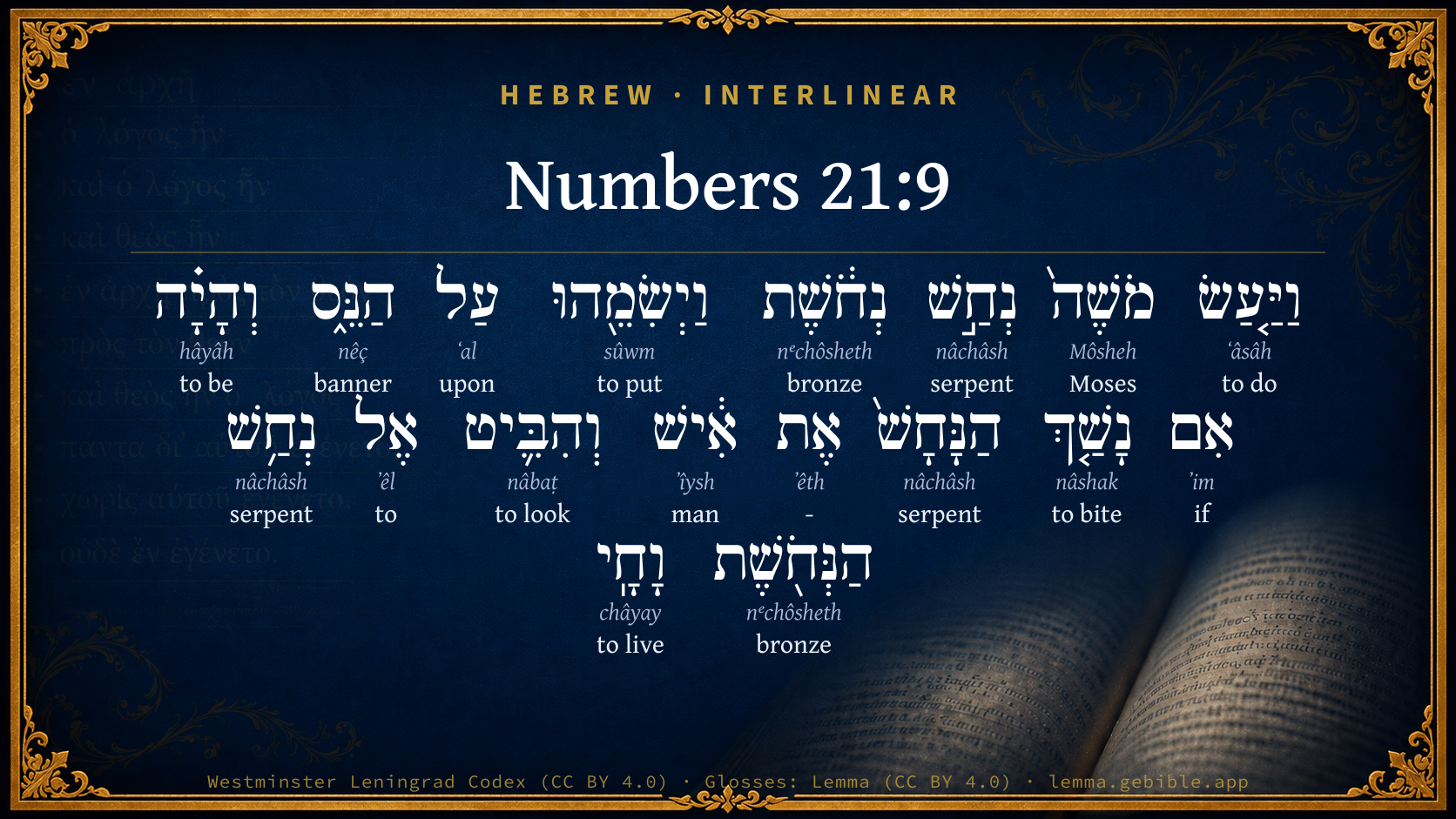
Hebrew (Westminster Leningrad Codex) Numbers 21:9 appears in the Hebrew Old Testament. The text above is from the Westminster Leningrad Codex. Each word links to its Strong’s number, a concise gloss, and parsing drawn from the Open Scriptures Hebrew Bible morphology. Click any word for its full Brown-Driver-Briggs (BDB) entry.
Download image
Cite this verse

Numbers 21:9 (World English Bible). Public Domain. Lemma interlinear Bible study tool, https://lemma.gebible.app/v/numbers/21/9.

Show BibTeX & RIS
BibTeX
RIS
English Translation
Moses made a serpent of brass, and set it on the standard: and it happened, that if a serpent had bitten any man, when he looked to the serpent of brass, he lived.
World English Bible · Public Domain
Download a study sheet

One document with this verse’s original text, its word-by-word gloss line, the meaning frame, cross-references with their text, attributed commentary, and full source and license credits — printable, and it pastes into notes with its structure intact.

This verse Autodidact and up

Study sheet (.html) Plain text (.txt)

A passage Seminary Student

Up to 50 verses in one chapter. A passage sheet keeps up to 6 commentary sources and 12 cross-references per verse, in the order this page ranks them, and says so on the sheet whenever that leaves anything out. Ask for a single verse and you get the Autodidact verse sheet above.

Everything on this page stays free to read, with no account — the sheet is a download of what is already on screen, not access to it.

Want to remove ads? Support Godless Engineer
Compare translations 3

The same verse in 3 English versions, stacked beneath the original-language interlinear above. Click any original word for its lexicon entry.

Each is an independent rendering of the whole verse — the interlinear is not word-aligned to these translations.

Highlighted words mark where these versions differ — a whole-verse word diff, not a word-by-word alignment.

  • World English Bible Public Domain
    Moses made a serpent of brass, and set it on the standard: and it happened, that if a serpent had bitten any man, when he looked to the serpent of brass, he lived.
  • King James Version Public Domain
    And Moses made a serpent of brass, and put it upon a pole, and it came to pass, that if a serpent had bitten any man, when he beheld the serpent of brass, he lived.
  • unfoldingWord Literal Text CC BY-SA 4.0
    And Moses made a serpent of bronze, and he set it on the banner. And it was if a serpent bit a man and he looked to the serpent of bronze, then he lived.

unfoldingWord Literal Text — © unfoldingWord, licensed CC BY-SA 4.0. Word-aligned USFM3 via Door43 (git.door43.org/unfoldingWord/en_ult).

Versions to compare (up to 4)

3 of 4 selected

Show all 18 translations

Every available English version of this verse, each an independent rendering of the whole verse.

  • World English Bible Public Domain
    Moses made a serpent of brass, and set it on the standard: and it happened, that if a serpent had bitten any man, when he looked to the serpent of brass, he lived.
  • Berean Standard Bible Public Domain
    So Moses made a bronze snake and mounted it on a pole. If anyone who was bitten looked at the bronze snake, he would live.
  • Majority Standard Bible Public Domain
    So Moses made a bronze snake and mounted it on a pole. If anyone who was bitten looked at the bronze snake, he would live.
  • King James Version Public Domain
    And Moses made a serpent of brass, and put it upon a pole, and it came to pass, that if a serpent had bitten any man, when he beheld the serpent of brass, he lived.
  • American Standard Version (1901) Public Domain
    And Moses made a serpent of brass, and set it upon the standard: and it came to pass, that if a serpent had bitten any man, when he looked unto the serpent of brass, he lived.
  • Revised Version (1885) Public Domain
    And Moses made a serpent of brass, and set it upon the standard: and it came to pass, that if a serpent had bitten any man, when he looked unto the serpent of brass, he lived.
  • Geneva Bible (1599) Public Domain
    So Moses made a serpent of brasse, and set it vp for a signe: and when a serpent had bitten a man, then he looked to the serpent of brasse, and liued.
  • Douay-Rheims (1899) Public Domain
    Moses therefore made a brazen serpent, and set it up for a sign: which when they that were bitten looked upon, they were healed.
  • Young's Literal Translation Public Domain
    And Moses maketh a serpent of brass, and setteth it on the ensign, and it hath been, if the serpent hath bitten any man, and he hath looked expectingly unto the serpent of brass -- he hath lived.
  • Literal Standard Version CC BY-SA 4.0
    And Moses makes a serpent of bronze, and sets it on the ensign, and it has been, if the serpent has bitten any man, and he has looked expectingly to the serpent of bronze—he has lived.
  • Unlocked Literal Bible CC BY-SA 4.0
    So Moses made a bronze snake and attached it to a pole. When a snake bit any person, if he looked at the bronze snake, he survived.
  • unfoldingWord Literal Text CC BY-SA 4.0
    And Moses made a serpent of bronze, and he set it on the banner. And it was if a serpent bit a man and he looked to the serpent of bronze, then he lived.
  • Darby Bible Public Domain
    And Moses made a serpent of brass, and put it upon a pole; and it came to pass, if a serpent had bitten any man, and he beheld the serpent of brass, he lived.
  • World Messianic Bible Public Domain
    Moses made a serpent of bronze, and set it on the pole. If a serpent had bitten any man, when he looked at the serpent of bronze, he lived.
  • Webster's Bible Public Domain
    And Moses made a serpent of brass, and put it upon a pole, and it came to pass, that if a serpent had bitten any man, when he beheld the serpent of brass, he lived.
  • Free Bible Version CC BY-SA 4.0
    Moses made a snake out of bronze and put it on a pole. Those who looked at it did live.
  • Bible in Basic English Public Domain
    So Moses made a snake of brass and put it on a rod; and anyone who had a snakebite, after looking on the snake of brass, was made well.
  • JPS Tanakh (1917) Public Domain
    And Moses made a serpent of brass, and set it upon the pole; and it came to pass, that if a serpent had bitten any man, when he looked unto the serpent of brass, he lived.

Literal Standard Version (2020), Covenant Press — licensed CC BY-SA 4.0. Text via the HelloAO Bible API (eBible.org). Unlocked Literal Bible (unfoldingWord) — licensed CC BY-SA 4.0. Text via the HelloAO Bible API (eBible.org). unfoldingWord Literal Text — © unfoldingWord, licensed CC BY-SA 4.0. Word-aligned USFM3 via Door43 (git.door43.org/unfoldingWord/en_ult). Free Bible Version, Dr. Jonathan Gallagher — licensed CC BY-SA 4.0. Text via the HelloAO Bible API (eBible.org).

Word by word

More ways to search: Search by grammar → Find every occurrence → Compare this word →

Practice this passage: Drill this verse → Learn its vocabulary →

נָשַׁ֤ךְ
nâshak
H5391
“to bite”
Verb, Qal, Perfect, 3rd Person, Masculine, Singular
Part of Speech
Verb
Stem
Qal
Form
Perfect
Person
3rd Person
Gender
Masculine
Number
Singular
Full BDB Definition

Origin: a primitive root

TWOT: 1430 , 1430b

to bite - (Qal) to bite - (Piel) to bite - to pay, give interest, lend for interest or usury - (Qal) to give interest - (Hiphil) to make to give interest
  1. וַיַּ֤עַשׂ ʻâsâh H6213 “and · to do” Conjunction + Verb, Qal, Sequential Imperfect, 3rd Person, Masculine, Singular
  2. מֹשֶׁה֙ Môsheh H4872 “Moses” Noun, Proper
  3. נְחַ֣שׁ nâchâsh H5175 “serpent of” Noun, Common, Masculine, Singular, Construct
  4. נְחֹ֔שֶׁת nᵉchôsheth H5178 “bronze” Noun, Common, Feminine, Singular, Absolute
  5. וַיְשִׂמֵ֖הוּ sûwm H7760 “and · to put · him” Conjunction + Verb, Qal, Sequential Imperfect, 3rd Person, Masculine, Singular + Suffix, Personal, 3rd Person, Masculine, Singular
  6. עַל ʻal H5921 “upon” Preposition
  7. הַנֵּ֑ס nêç H5251 “the · banner” Particle, Definite Article + Noun, Common, Masculine, Singular, Absolute
  8. וְהָיָ֗ה hâyâh H1961 “and · to be” Conjunction + Verb, Qal, Sequential Perfect, 3rd Person, Masculine, Singular
  9. אִם ʼim H518 “if” Conjunction
  10. הַנָּחָשׁ֙ nâchâsh H5175 “the · serpent” Particle, Definite Article + Noun, Common, Masculine, Singular, Absolute
  11. אֶת ʼêth H853 “-” Particle, Direct Object
  12. אִ֔ישׁ ʼîysh H376 “man” Noun, Common, Masculine, Singular, Absolute
  13. וְהִבִּ֛יט nâbaṭ H5027 “and · to look” Conjunction + Verb, Hiphil, Sequential Perfect, 3rd Person, Masculine, Singular
  14. אֶל ʼêl H413 “to” Preposition
  15. נְחַ֥שׁ nâchâsh H5175 “serpent of” Noun, Common, Masculine, Singular, Construct
  16. הַנְּחֹ֖שֶׁת nᵉchôsheth H5178 “the · bronze” Particle, Definite Article + Noun, Common, Feminine, Singular, Absolute
  17. וָחָֽי châyay H2425 “and · to live” Conjunction + Verb, Qal, Sequential Perfect, 3rd Person, Masculine, Singular

About this verse

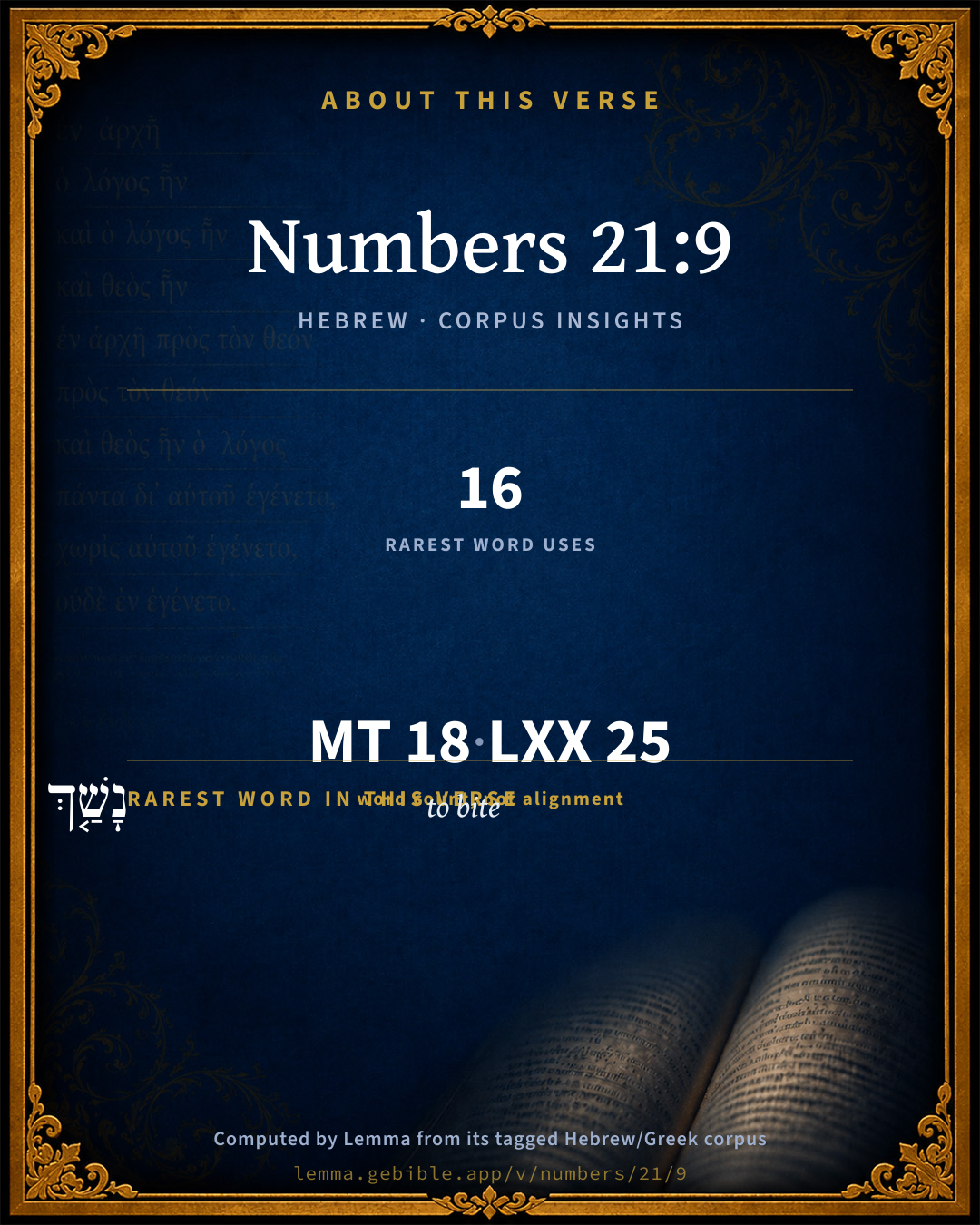
These counts appear in no published source. They are computed here, from the morphology-tagged text and Lemma’s own curated glosses. What Lemma adds →

18
words
15
distinct lemmas
Pentateuch
section

Notable vocabulary

The rarest word here is נָשַׁ֤ךְ to bite H5391 — appearing just 16 times in the whole Hebrew Bible.

Shared distinctive vocabulary

נָשַׁ֤ךְ to bite H5391 occurs in 14 verses of the Hebrew Bible. Also found in:

Grammatical profile

  • 6 verbs
  • 8 nouns
  • 2 prepositions
  • 1 conjunction
  • 1 particle

Verb forms

  • וַיַּ֤עַשׂ Qal · Sequential Imperfect
  • וַיְשִׂמֵ֖הוּ Qal · Sequential Imperfect
  • וְהָיָ֗ה Qal · Sequential Perfect
  • נָשַׁ֤ךְ Qal · Perfect
  • וְהִבִּ֛יט Hiphil · Sequential Perfect
  • וָחָֽי Qal · Sequential Perfect

Repetition

Words recur within this verse — often emphatic in Hebrew:

  • נְחַ֣שׁ serpent H5175 ×3
  • נְחֹ֔שֶׁת bronze H5178 ×2

Hebrew & Septuagint length

In English translation the verse runs 33 words from the Hebrew and 34 from the Septuagint (LXX English) — closely comparable.

A rough comparison of the two English renderings, which tokenize alike — not a word-level alignment.

Word counts can differ between the Hebrew and the Greek without any difference in meaning — e.g. the Hebrew direct-object marker אֵת has no separate Greek word, and Greek often adds the article ὁ.

In the original languages it is 18 Hebrew tokens and 25 Greek tokens — but the two are counted differently (Hebrew bundles its prefixes and suffixes into one token; the Greek is in lemma form), so that isn’t a like-for-like length.

Cross-references

13

Topical passages linked to Numbers 21:9 in the Treasury of Scripture Knowledge — connected by theme and wording, ordered by reader-vote popularity; previews shown in the World English Bible.

  • John 3:14–15 As Moses lifted up the serpent in the wilderness, even so must the Son of Man be lifted up,
  • John 6:40 This is the will of the one who sent me, that everyone who sees the Son, and believes in him, should have eternal life; and I will raise him up at the last day."
  • Hebrews 12:2 looking to Jesus, the author and perfecter of faith, who for the joy that was set before him endured the cross, despising shame, and has sat down at the right hand of the throne of God.
  • 2 Kings 18:4 He removed the high places, and broke the pillars, and cut down the Asherah: and he broke in pieces the brazen serpent that Moses had made; for to those days the children of Israel did burn incense to it; and he called it Nehushtan.
  • John 12:32 And I, if I am lifted up from the earth, will draw all people to myself."
  • Isaiah 45:22 Look to me, and be you saved, all the ends of the earth; for I am God, and there is none else.
  • Romans 8:3 For what the law couldn't do, in that it was weak through the flesh, God did, sending his own Son in the likeness of sinful flesh and for sin, he condemned sin in the flesh;
  • 2 Corinthians 5:21 For him who knew no sin he made to be sin on our behalf; so that in him we might become the righteousness of God.
  • Romans 1:17 For in it is revealed God's righteousness from faith to faith. As it is written, "But the righteous shall live by faith."
  • Romans 5:20–21 The law came in besides, that the trespass might abound; but where sin abounded, grace did abound more exceedingly;
  • Zechariah 12:10 I will pour on the house of David, and on the inhabitants of Jerusalem, the spirit of grace and of supplication; and they will look to me whom they have pierced; and they shall mourn for him, as one mourns for his only son, and will grieve bitterly for him, as one grieves for his firstborn.
  • 1 John 3:8 He who sins is of the devil, for the devil has been sinning from the beginning. To this end the Son of God was revealed, that he might destroy the works of the devil.
  • John 1:29 The next day, he saw Jesus coming to him, and said, "Behold, the Lamb of God, who takes away the sin of the world!

Cross-references courtesy of OpenBible.info (CC BY 4.0).

Hebrew and Greek witnesses Masoretic Hebrew ↔ Greek Septuagint

The same verse in the two great witnesses to the Old Testament, shown verse-for-verse.

These are two independent witnesses, not word-aligned to each other, and the Septuagint is shown in lemma (dictionary) form.

Hebrew Numbers 21:9 Masoretic · Westminster Leningrad Codex

וַיַּ֤עַשׂ מֹשֶׁה֙ נְחַ֣שׁ נְחֹ֔שֶׁת וַיְשִׂמֵ֖הוּ עַל הַנֵּ֑ס וְהָיָ֗ה אִם נָשַׁ֤ךְ הַנָּחָשׁ֙ אֶת אִ֔ישׁ וְהִבִּ֛יט אֶל נְחַ֥שׁ הַנְּחֹ֖שֶׁת וָחָֽי

Moses made a serpent of brass, and set it on the standard: and it happened, that if a serpent had bitten any man, when he looked to the serpent of brass, he lived.

World English Bible · Public Domain

Greek LXX Numbers 21:9 Septuagint · lemma form

καί ποιέω μωυσῆς ὄφις χαλκοῦς καί ἵστημι αὐτός ἐπί σημεῖον καί γίγνομαι ὅταν δάκνω ὄφις ἄνθρωπος καί ἐπιβλέπω ἐπί ὁ ὄφις ὁ χαλκοῦς καί ζάω

And Moses made a serpent of brass, and put it upon a signal-staff: and it came to pass that whenever a serpent bit a man, and he looked on the brazen serpent, he lived.

LXX2012 (modern English Septuagint) · Public Domain

Hebrew: Westminster Leningrad Codex (CC BY 4.0). Greek: Septuagint (public domain); English from LXX2012 (modern English Septuagint) (Public Domain). How the Septuagint differs from the Hebrew →

Targum (Aramaic paraphrase)

2

The Targum is the ancient Jewish Aramaic paraphrase of the Hebrew Scriptures — an interpretive translation, not the Hebrew text itself. Onkelos (literal) and Pseudo-Jonathan (expansive) render the Torah, and Jonathan the Prophets. Coverage is partial: where no permissively-licensed English translation exists for a verse, only the Aramaic is shown. This is verse-level text, not a word-by-word alignment to the Hebrew.

  1. Targum Onkelos Torah (Genesis–Deuteronomy)
    וַעֲבַד משֶׁה חִוְיָא דִנְחָשָׁא וְשַׁוְיֵהּ עַל אָת וַהֲוָה כַּד נְכֵית חִוְיָא יָת גַבְרָא וּמִסְתַּכֵּל לְחִוְיָא דִנְחָשָׁא וּמִתְקַיָם

    (no public-domain English translation for this verse)

    Targum Onkelos — Aramaic: “Onkelos Genesis” (public domain); “Onkelos Exodus” (public domain); “Onkelos Leviticus” (public domain); “Onkelos Numbers” (public domain); “Onkelos Deuteronomy” (public domain). English: “Sefaria Community Translation” (CC0 1.0 (public-domain dedication)); “J.W. Etheridge. The Targums of Onkelos and Jonathan Ben Uzziel on the Pentateuch. London: Longmans, Green, 1862” (public domain). Text via Sefaria.

  2. Targum Pseudo-Jonathan Torah (Genesis–Deuteronomy)
    וַעֲבַד משֶׁה חִיוְיָא דִנְחָשָׁא וְשַׁוִי יָתֵיהּ עַל אֲתַר תְּלֵי וַהֲוֵי כַּד נְכִית חִיוְיָא יַת גַבְרָא וַהֲוָה מִסְתַּכֵּל בְּחִיוְיָא דִנְחָשָׁא וּמְכַוֵין לִבֵּיהּ לְשׁוּם מֵימְרָא דַיְיָ וְחָאִי

    And Mosheh made a serpent of brass, and set it upon a place aloft; and it was, when a serpent had bitten a man, and the serpent of brass was gazed at, and his heart was intent upon the Name of the Word of the Lord, he lived.

    Targum Pseudo-Jonathan — Aramaic: “Targum Jonathan on Genesis” (public domain); “Targum Jonathan on Exodus” (public domain); “Targum Jonathan on Leviticus” (public domain); “Targum Jonathan on Numbers” (public domain); “Targum Jonathan on Deuteronomy” (public domain). English: “The Targum of Jonathan ben Uzziel, trans. J. W. Etheridge, London, 1862” (public domain). Text via Sefaria.

Commentary

Notes on Numbers 21:9 from classic Christian and Jewish commentators (each source and its license shown beneath its notes). The classic Christian expositions comment on the surrounding passage and are grouped to its opening verse, so a note may address several verses; the Jewish commentaries on the Tanakh (Rashi and others) are per-verse, so they appear only where the commentator wrote on this verse.

Lemma curates 59 commentaries, every one of them public domain or Creative Commons licensed, each selected and text-cleaned for this edition rather than reprinted as found. About our sources →

Geneva Bible (1599)

Geneva Bible translators

Or, recovered.

2 Kings 18:4; Job 3:14

Geneva Bible (1599) marginal notes — public domain. Text via Bolls.life.

Adam Clarke's Commentary

Verse 9. And Moses made a serpent of brass] נחש נחשת nechash nechosheth. Hence we find that the word for brass or copper comes from the same root with nachash, which here signifies a serpent, probably on account of the colour; as most serpents, especially those of the bright spotted kind, have a very glistening appearance, and those who have brown or yellow spots appear something like burnished brass: but the true meaning of the root cannot be easily ascertained.

On the subject of the cure of the serpent-bitten Israelites, by looking at the brazen serpent, there is a good comment in the book of Wisdom, Apoch. Wis 16:4-12, in which are these remarkable words: "They were admonished, having a sign of salvation, (i. e., the brazen serpent,) to put them in remembrance of the commandments of thy law. For he that turned himself towards It was not saved by the THING that he saw, but by THEE, that art the Saviour of all." To the circumstance of looking at the brazen serpent in order to be healed, our Lord refers, Joh 3:14-15: "As Moses lifted up the serpent in the wilderness, even so must the Son of man be lifted up, that whosoever believeth in him should not perish, but have eternal life." The brazen serpent was certainly no type of Jesus Christ; but from our Lord's words we may learn,

1. That as the serpent was lifted up on the pole or ensign, so Jesus Christ was lifted up on the cross.

2. That as the Israelites were to look at the brazen serpent, so sinners must look to Christ for salvation.

3. That as God provided no other remedy than this looking for the wounded Israelites, so he has provided no other way of salvation than faith in the blood of his Son.

4. That as he who looked at the brazen serpent was cured and did live, so he that believeth on the Lord Jesus Christ shall not perish, but have eternal life.

5. That as neither the serpent, nor looking at it, but the invisible power of GOD healed the people, so neither the cross of Christ, nor his merely being crucified, but the pardon he has bought by his blood, communicated by the powerful energy of his Spirit, saves the souls of men.

May not all these things be plainly seen in the circumstances of this transaction, without making the serpent a type of Jesus Christ, (the most exceptionable that could possibly be chosen,) and running the parallel, as some have done, through ten or a dozen particulars?

Adam Clarke's Commentary on the Bible (1810–1826) — public domain. Text from a community e-Sword/MySword module.

Ellicott's Commentary for English Readers

(9) And Moses made a serpent of brass.—The old serpent was the cause of death, temporal and spiritual. Christ Jesus, “in the likeness of sinful flesh” (Rom_8:3), was made sin for us (2Co_5:21), and thus fulfilled, as He Himself explained to Nicodemus, the type of the brazen serpent (Joh_3:14-15). The meaning of this type, or “sign of salvation,” is explained in the Book of Wisdom in these words, “He that turned himself toward it was not saved by the thing that he saw, but by Thee, that art the Saviour of all” (Num_16:7). This serpent was preserved by the Israelites, and taken into Canaan, and was ultimately destroyed by King Hezekiah, after it had become an object of idolatrous worship (2Ki_18:4).

A Bible Commentary for English Readers, edited by Charles John Ellicott (1878–1897) — public domain. Text from a community e-Sword module.

The Cambridge Bible for Schools and Colleges

gen. ed. J. J. S. Perowne

9. Moses made a serpent of bronze] The removing of a pest by means of a bronze image of it finds parallels in ancient Europe. See Gray, Numb. p. 276.

Num_21:10-11. P

Stages in the journey to the east of Moab

11. The site of Oboth is unknown; ‘somewhere on the flinty plateau to the east of Edom, the Ard Suwwan or Flint Ground, Arabia Petraea’ (G. A. Smith, H. G. [Note: . G. Historical Geography of the Holy Land.] 557). Iye-abarim (Heb. ‘Iyyê-hâ‘abhârîm, ‘the Ruins of the ‘Abharim’) is stated to lie ‘over against Moab, on the sunrise (i.e. the eastern) side.’ ‘The ‘Abharim’ means ‘the parts on the other side,’ a name which was given to the district on the east of the Dead Sea, looked at from the point of view of a dweller in Palestine: cf. Num_27:12, Num_33:47 f. The name distinguishes it from the Iyim of Jos_15:29, which was in Judah, close to the Edomite border.

Many writers assign Num_21:10-11 to P , since the names Oboth and Iye-abarim recur in the list in ch. 33, which is from the hand of a priestly writer, and are found nowhere else in the O.T. According to that list (41–44) the itinerary was as follows: Mt Hor, Zalmonah, Punon, Oboth, Iye-abarim. The sites of Zalmonah and Punon are quite unknown. But the writer of 33, who clearly intends to trace the journey as completely as possible, omits all reference to the detour by the way to the Red Sea. If, therefore, Mt Hor is the modern Jebel Madurah (see on Num_20:22) on the west of Edom, and Iye-abarim is somewhere on the eastern border of Moab, it seems probable that the priestly traditions represented Israel as marching straight through Edom. Whether the account of the hostility of the king of Edom was unknown to P , or whether it was, for some reason, intentionally omitted, we cannot say. But it is noteworthy that in Dt. also there is no mention of it.

The Cambridge Bible for Schools and Colleges (gen. ed. J. J. S. Perowne; Cambridge University Press, 1878–1918) — public domain. Text from a community e-Sword module.

John Gill's Exposition

And Moses made a serpent of brass,.... Which was the most proper metal to make it of, that it might resemble the fiery serpents, whether of a golden or scarlet colour: and Diodorus Siculus (d) speaks of some of the colour of brass, whose bite was immediately followed with death, and by which, if anyone was struck, he was seized with terrible pains, and a bloody sweat flowed all over him; and this was chosen also, because being burnished and bright, could be seen at a great distance, and with this metal Moses might be furnished from Punon, the next station to this, where they now were, Zalmonah, as appears from Num 33:42 a place famous for brass mines, and which Jerom (e) says, in his time, was a little village, from whence brass metal was dug, by such that were condemned to the mines:

and put it upon a pole; as he was directed:

and it came to pass, that if a serpent had bitten any man, when he beheld the serpent of brass, he lived: which was very marvellous, and the more so, if what physicians say is true, as Kimchi relates (f), that if a man bitten by a serpent looks upon a piece of brass he dies immediately: the lifting up of this serpent on a pole for such a purpose was a figure of the lifting up of Christ, either upon the cross, or in the ministry of the word, that whosoever looks unto him by faith may have healing; see Gill on Joh 3:14,where this type or figure is largely explained: the station the Israelites were now at, when this image was made, is called Zalmonah, which signifies an image, shadow, or resemblance, as the brazen serpent was; from Mount Hor, where they were last, to this place, according to Bunting (g), were twenty eight miles: this serpent did not remain in the place where it was set, but was taken with them, and continued until the days of Hezekiah, Kg2 18:4.

(d) Bibliothec. l. 17. p. 560. (e) De locis Heb. fol. 91. G. (f) Sepher Sherash. rad. (g) Travels of the Patriarchs, &c. 83.

John Gill's Exposition of the Whole Bible (1746–1763) — public domain (CC PDM 1.0). Text via the HelloAO Bible API.

Haydock's Catholic Bible Commentary

A brazen serpent. This was a figure of Christ crucified, and of the efficacy of a lively faith in him, against the bites of the hellish serpent, John iii. 14. (Challoner) (St. Ambrose; Apol. i. 3.) As the old serpent infected the whole human race, Jesus Christ gives life to those that look at him with entire confidence. (Theodoret, q. 38.) The brazen serpent was destitute of poison, though it resembled a most noxious animal; so Jesus Christ assumed our nature, yet without sin. (Calmet)

George Leo Haydock (1774–1849), Haydock's Catholic Family Bible and Commentary, 1859 edition — public domain. Excludes Psalms (Douay-Rheims chapter numbering differs from Protestant) and Deuterocanonical books (Catholic canon only).

Matthew Poole's English Annotations

He was delivered from death, and cured of his disease.

Matthew Poole's English Annotations on the Holy Bible (1683–1685) — public domain. Text from a community e-Sword/MySword module.

Whedon's Commentary on the Bible

Daniel D. Whedon

9. Serpent of brass — The material was not prescribed in the command. Brass was selected, doubtless, because its lustre would enable it to be seen at a great distance. Possibly the fiery serpents may have had a coppery hue, like the copperhead of America. The size of this piece of brass was probably many times that of the fiery serpent, in order to be seen from afar. That the Israelites had abundance of metals is seen from the amount contributed to the tabernacle.

If a serpent had bitten any man — This would imply that the antidote was only for those bitten previous to the lifting up of the brazen serpent; but a critical examination shows that the merciful Healer provides also for those who may be bitten subsequently. Nordh. (Gram., § 1090, 2) translates the passage thus: “And it came to pass when a serpent bit a man, and he looked at the serpent of brass, that he survived.” See Furst’s Lexicon. “It (אם) is but seldom a sign of the actual past.” This justifies the conclusion that the fiery serpents were not taken away, but that they continued to annoy the people and to kill such as despised the remedy, while the virus was harmless in the veins of him who immediately looked toward the antidote. How long the brazen serpent continued to be “lifted up” in the camp we know not; but it is probable that it continued during the remainder of the march to Canaan, and that it had a conspicuous position near the tabernacle after it was set up in the Land of Promise. We find it existing eight hundred and twenty-five years afterward (2Ki_18:4) as an object of idolatrous worship, when the reformer, Hezekiah, because of this, broke it in pieces. He stigmatized it as “Nehushtan,” a mere piece of brass. Rationalistic writers, both Jewish and Christian, have endeavoured to divest the cure by looking at the brazen serpent of its miraculous character by the theory that Moses, by his knowledge of astrology, devised this as a talisman or charm to operate on the imaginations of the people. The more pious Jews regard the cures as the result of a lively faith in Jehovah. See Targum of Onkelos. Evangelical writers ascribe the healing power of this serpent-form to its great Antitype, lifted up in crucifixion for the salvation of all believers.

Daniel D. Whedon (gen. ed.), Commentary on the Old and New Testaments (1874–1909) — public domain. Text from a community e-Sword module.

The Pulpit Commentary

When he beheld the serpent (vjg in all three places of this verse) of brass, he lived. The record is brief and simple in the extreme, and tells nothing but the bare facts. The author of the Book of Wisdom understood the true bearing of those facts when he called the brazen serpent a sumbolon swthrriav , (Num_16:6) and when he wrote oo epistrafei to yewroumenon (the thing he looked at) eswzeto alla dia se tontwn swthra . At an earlier day Hezekiah had estimated the sumbolon swthriav at its true value, as being in itself worthless, and under certain circumstances mischievous. (see on 2Ki_18:4)

The Pulpit Commentary (1880–1919), ed. H.D.M. Spence-Jones & Joseph S. Exell — public domain. Text from a community e-Sword module.

John Wesley's Explanatory Notes

He lived - He was delivered from death, and cured of his disease.

John Wesley, Explanatory Notes Upon the Whole Bible (1754–1765) — public domain. Text via the GEBible commentary corpus.

Scofield Reference Notes

C. I. Scofield

serpent

(See Scofield "Gen 3:14"). The serpent is a symbol of sin judged; brass speaks of the divine judgment, as in the brazen altar See Scofield "Exo 27:1", note (2) and self-judgment, as in the laver of brass. The brazen serpent is a type of Christ "made sin for us"; Joh 3:14; Joh 3:15; 2Co 5:21 in bearing our judgment. Historically, the moment is indicated in the cry: "My God, My God, why hast Thou forsaken Me?" Mat 27:46.

The Scofield Reference Bible (1917 edition), notes by C. I. Scofield — public domain. Text from a community e-Sword module.

Rashi

Rabbi Shlomo Yitzchaki (Rashi)

נחש נחשת A SERPENT OF COPPER — He had not been told to make it of copper, but Moses said, “The Holy One, blessed be He, terms it נחש; I will therefore make it of נחשת — one term fitting the other term” (Genesis Rabbah 31:8).

Rashi on the Tanakh — English translations: “The Judaica Press complete Tanach with Rashi, translated by A. J. Rosenberg” (CC BY 4.0); “Pentateuch with Rashi's commentary by M. Rosenbaum and A.M. Silbermann, 1929-1934” (public domain); “The Metsudah Tanach series, Lakewood, N.J” (CC BY 4.0); and “The Book of Joshua, Metsudah Publications, 1997” (CC BY 4.0). Text via Sefaria.

Ramban (Nachmanides)

Rabbi Moshe ben Nachman (Ramban / Nachmanides)

AND MOSES MADE ‘NECHASH NECHOSHETH’ (A SERPENT OF BRASS). “He was not told to make it of brass. But Moses said: ‘The Holy One, blessed be He, called it a nachash (serpent); therefore I will make it of nechosheth (brass)’ — since the one word resembles the other [in sound].” This is Rashi’s language, based upon the words of our Rabbis. But I do not understand this, for the Holy One, blessed be He, did not mention to Moses [the word] nachash, but said to him, Make thee ‘saraf’ (a fiery serpent)! But the intention of the Sages is that Moses was guided by the substantive name thereof [which is nachash; and saraf is merely a particular description of a certain kind of serpent — a “fiery” serpent — hence he made the saraf which G-d mentioned to him from nechosheth (brass), corresponding with its substantive name].It appears to me that the secret of this matter is that this is one of the ways of the Torah, every deed of which is a miracle within a miracle. Thus [the Torah] removes injury by means of the cause of the injury, and heals illness by means of the cause of the sickness, as the Rabbis have mentioned in connection with [the verse], and the Eternal showed him a tree, and as occurred with the salt that Elisha [cast] into the water. Now it is a well-known medical principle that all people bitten by poisonous creatures become dangerously ill when they see them, or [even] when they [only] see their likeness, so that if people who have been bitten by a mad dog or other mad animals look into water, they see there the image of the dog or the attacker, and [this] can [cause them to] die, as is written in medical books and mentioned in the Gemara of Tractate Yoma. Similarly doctors protect them from [people] mentioning in their presence the name of the animal that bit them, [and they forbid people] to mention it at all, because their minds cling to this thought and do not turn away from it altogether until it causes their death. [The doctors] have already mentioned that it is an empirical fact, amongst the wonders of reproduction, that if the urine of a person bitten by a mad dog is put in a glass receptacle after he has become rabidly sick, there will appear in that urine the likeness of the young of small dogs. And if you pass the liquid through a cloth and filter it, you will not find any trace of them at all; but if you return the liquid to the glass bottle, and it remains there for about an hour, you will again clearly see in it the small dogs. This is a true fact, and of the wonders of the powers of the soul. Now in view of all this, it would have been correct that the Israelites, who had been bitten by the fiery serpents, should not look upon a serpent, and should not mention it or bring it to mind at all. But the Holy One, blessed be He, commanded Moses to make for them the likeness of a fiery serpent, which was [the creature] that killed them. And it is well-known that these fiery serpents have red eyes and wide heads, and their bodies at their necks are like brass. Therefore Moses could not fulfill His command to make a fiery serpent except by making a serpent of brass, which appears similar to a fiery serpent. For had he made it of any other material, it would have had the likeness of a serpent, but not that of a saraf (a fiery serpent). And the Rabbis who said [that Moses was to make a brass serpent] because “one word corresponds [in sound] to the other,” [meant to imply] that the mere mention of the name [saraf, which is a particular form of nachash, as explained above] was harmful [for the people who had been bitten, and yet G-d wanted to heal them through it]. The general intention [of this section, then] is that G-d commanded that they should be healed by the harmful agent whose nature is to kill; therefore they made its likeness in form and name, and when a person concentrated his gaze upon the brass serpent which resembled totally the offending agent, he lived. This was to make them realize that it is G-d [alone] Who sendeth death and maketh alive.

Ramban (Nachmanides) on the Tanakh — English translation: “Commentary on the Torah by Ramban (Nachmanides). Translated and annotated by Charles B. Chavel. New York, Shilo Pub. House, 1971-1976” (CC BY 4.0). Text via Sefaria.

Lesson kit

Teaching starters — assembled from the data on this page, not authored interpretation. Every prompt links to the verse data it draws on. Edit before teaching.

Numbers, in the Pentateuch, opens this verse with 18 words (15 distinct Hebrew lemmas). Its most distinctive word is nâshak (“to bite”). A historical commentator’s framing appears above. Read the whole chapter for the surrounding context.

Discussion questions

  1. The word nâshak carries the sense “to bite.” How does it shape the verse?
  2. Genesis 49:17 shares the word «to bite» with this verse. How do the two illuminate each other?
  3. “serpent” occurs 3× in this one verse. What is the effect of the repetition?
  4. The translations on this page render this verse differently — a whole-verse word diff, not a word-by-word alignment. What might account for the different wordings?
  5. The verb «וַיַּ֤עַשׂ» is Qal Sequential Imperfect. How does its form color the action?
  6. Reading how Geneva Bible (1599) and Adam Clarke's Commentary read this verse, where do the two commentators agree and where do they part?

Things to notice

Reading settings

Reading text

Shown beneath each verse's original-language words.

Old Testament
Old Testament edition

Read the OT as the Masoretic Hebrew (MT) or the Greek Septuagint (LXX).

English shown for the Greek Septuagint (in the Hebrew ↔ Greek comparison).

Comparing translations? Open the Compare panel on any verse page to stack up to four side by side.