

1 Thessalonians 5:3
Greek (Tischendorf 8th ed.) 1 Thessalonians 5:3 appears in the Greek New Testament. The text above is from the Tischendorf 8th edition. Each word links to its Strong’s number and a concise gloss. Click any word for its full Thayer’s Greek Lexicon entry.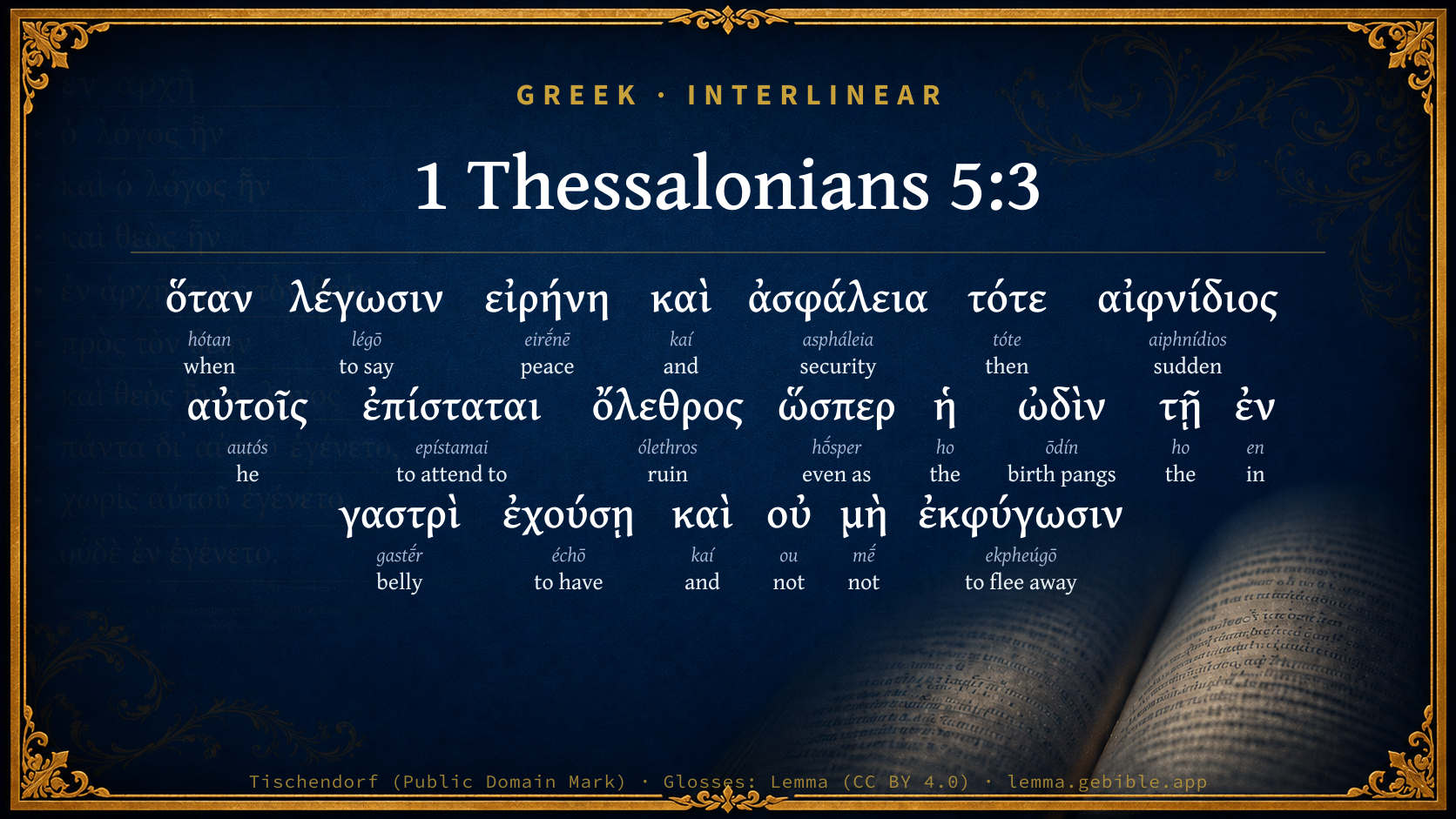
For when they are saying, "Peace and safety," then sudden destruction will come on them, like birth pains on a pregnant woman; and they will in no way escape.
Download a study sheet
One document with this verse’s original text, its word-by-word gloss line, the meaning frame, cross-references with their text, attributed commentary, and full source and license credits — printable, and it pastes into notes with its structure intact.
This verse Autodidact and up
A passage Seminary Student
Up to 50 verses in one chapter. A passage sheet keeps up to 6 commentary sources and 12 cross-references per verse, in the order this page ranks them, and says so on the sheet whenever that leaves anything out. Ask for a single verse and you get the Autodidact verse sheet above.
Everything on this page stays free to read, with no account — the sheet is a download of what is already on screen, not access to it.
Compare translations 3
The same verse in 3 English versions, stacked beneath the original-language interlinear above. Click any original word for its lexicon entry.
Each is an independent rendering of the whole verse — the interlinear is not word-aligned to these translations.
Highlighted words mark where these versions differ — a whole-verse word diff, not a word-by-word alignment.
-
World English Bible Public Domain
For when they are saying, "Peace and safety," then sudden destruction will come on them, like birth pains on a pregnant woman; and they will in no way escape.
-
King James Version Public Domain
For when they shall say, Peace and safety; then sudden destruction cometh upon them, as travail upon a woman with child; and they shall not escape.
-
unfoldingWord Literal Text CC BY-SA 4.0
Whenever they say, “Peace and safety,” then sudden destruction comes on them, just as the birth pain to the one having in the womb, and they will certainly not escape.
unfoldingWord Literal Text — © unfoldingWord, licensed CC BY-SA 4.0. Word-aligned USFM3 via Door43 (git.door43.org/unfoldingWord/en_ult).
Show all 19 translations
Every available English version of this verse, each an independent rendering of the whole verse.
-
World English Bible Public Domain
For when they are saying, "Peace and safety," then sudden destruction will come on them, like birth pains on a pregnant woman; and they will in no way escape.
-
Berean Standard Bible Public Domain
While people are saying, “Peace and security,” destruction will come upon them suddenly, like labor pains on a pregnant woman, and they will not escape.
-
Majority Standard Bible Public Domain
For while people are saying, “Peace and security,” destruction will come upon them suddenly, like labor pains on a pregnant woman, and they will not escape.
-
King James Version Public Domain
For when they shall say, Peace and safety; then sudden destruction cometh upon them, as travail upon a woman with child; and they shall not escape.
-
American Standard Version (1901) Public Domain
When they are saying, Peace and safety, then sudden destruction cometh upon them, as travail upon a woman with child; and they shall in no wise escape.
-
Revised Version (1885) Public Domain
When they are saying, Peace and safety, then sudden destruction cometh upon them, as travail upon a woman with child; and they shall in no wise escape.
-
Geneva Bible (1599) Public Domain
For when they shall say, Peace, and safetie, then shall come vpon them sudden destruction, as the trauaile vpon a woman with childe, and they shall not escape,
-
Douay-Rheims (1899) Public Domain
For when they shall say, peace and security; then shall sudden destruction come upon them, as the pains upon her that is with child, and they shall not escape.
-
Young's Literal Translation Public Domain
for when they may say, Peace and surety, then sudden destruction doth stand by them, as the travail `doth' her who is with child, and they shall not escape;
-
Literal Standard Version CC BY-SA 4.0
for when they may say, “Peace and security,” then sudden destruction comes [on] them, as the travail [on] her who is with child, and they will not escape;
-
Unlocked Literal Bible CC BY-SA 4.0
When they say, “Peace and safety,” then sudden destruction will come on them. It will be like birth pains in a pregnant woman. They will in no way escape.
-
unfoldingWord Literal Text CC BY-SA 4.0
Whenever they say, “Peace and safety,” then sudden destruction comes on them, just as the birth pain to the one having in the womb, and they will certainly not escape.
-
Darby Bible Public Domain
When they may say, Peace and safety, then sudden destruction comes upon them, as travail upon her that is with child; and they shall in no wise escape.
-
World Messianic Bible Public Domain
For when they are saying, “Peace and safety,” then sudden destruction will come on them, like birth pains on a pregnant woman. Then they will in no way escape.
-
Webster's Bible Public Domain
For when they shall say, Peace and safety; then sudden destruction cometh upon them, as travail upon a woman with child; and they shall not escape.
-
Free Bible Version CC BY-SA 4.0
When people talk about peace and security suddenly they will be completely ruined. It will be just like the sudden onset of childbirth, and they certainly won't escape.
-
Bible in Basic English Public Domain
When they say, There is peace and no danger, then sudden destruction will come on them, as birth-pains on a woman with child; and they will not be able to get away from it.
-
Text-Critical English NT CC BY 4.0
When people are saying, “Peace and safety,” destruction will come upon them suddenly, like labor pains upon a woman with child, and they will certainly not escape.
-
Tyndale New Testament (1534) Public Domain
When they shall saye peace and no daunger than commeth on the soden destruccion as the travalynge of a woman with childe and they shall not scape.
Literal Standard Version (2020), Covenant Press — licensed CC BY-SA 4.0. Text via the HelloAO Bible API (eBible.org). Unlocked Literal Bible (unfoldingWord) — licensed CC BY-SA 4.0. Text via the HelloAO Bible API (eBible.org). unfoldingWord Literal Text — © unfoldingWord, licensed CC BY-SA 4.0. Word-aligned USFM3 via Door43 (git.door43.org/unfoldingWord/en_ult). Free Bible Version, Dr. Jonathan Gallagher — licensed CC BY-SA 4.0. Text via the HelloAO Bible API (eBible.org).
Word by word
More ways to search: Search by grammar → Find every occurrence → Compare this word →
Practice this passage: Drill this verse → Learn its vocabulary →
- Appears 2× in the Greek New Testament
- First appears at Luke 21:34
- Part of Speech
- Adjective
- Case
- Nominative
- Number
- Singular
- Gender
- Masculine
Full Thayer's Definition
- ὅταν hótan G3752 “when” Conjunction
- λέγωσιν légō G3004 “to say” Verb, Present, Active, Subjunctive, 3rd person, Plural
- εἰρήνη eirḗnē G1515 “peace” Noun, Nominative, Singular, Feminine
- καὶ kaí G2532 “and” Conjunction
- ἀσφάλεια aspháleia G803 “security” Noun, Nominative, Singular, Feminine
- τότε tóte G5119 “then” Adverb
- αἰφνίδιος aiphnídios G160 “sudden” Adjective, Nominative, Singular, Masculine
- αὐτοῖς autós G846 “he” Personal pronoun, Dative, Plural, Masculine
- ἐπίσταται epístamai G1987 “to attend to” Verb, Present, Middle or Passive deponent, Indicative, 3rd person, Singular
- ὄλεθρος ólethros G3639 “ruin” Noun, Nominative, Singular, Masculine
- ὥσπερ hṓsper G5618 “even as” Adverb
- ἡ ho G3588 “the” Article, Nominative, Singular, Feminine
- ὠδὶν ōdín G5604 “birth pangs” Noun, Nominative, Singular, Feminine
- τῇ ho G3588 “the” Article, Dative, Singular, Feminine
- ἐν en G1722 “in” Preposition
- γαστρὶ gastḗr G1064 “belly” Noun, Dative, Singular, Feminine
- ἐχούσῃ échō G2192 “to have” Verb, Present, Active, Participle, Dative, Singular, Feminine
- καὶ kaí G2532 “and” Conjunction
- οὐ ou G3756 “not” Particle, Negative
- μὴ mḗ G3361 “not” Particle, Negative
- ἐκφύγωσιν ekpheúgō G1628 “to flee away” Verb, Aorist, Active, Subjunctive, 3rd person, Plural
About this verse
These counts appear in no published source. They are computed here, from the morphology-tagged text and Lemma’s own curated glosses. What Lemma adds →
- 21
- words
- 19
- distinct lemmas
- Pauline Epistles
- section
Cross-references
33Topical passages linked to 1 Thessalonians 5:3 in the Treasury of Scripture Knowledge — connected by theme and wording, ordered by reader-vote popularity; previews shown in the World English Bible.
- Luke 21:34–35 "So be careful, or your hearts will be loaded down with carousing, drunkenness, and cares of this life, and that day will come on you suddenly.
- Matthew 24:37–39 "As the days of Noah were, so will be the coming of the Son of Man.
- Luke 17:26–30 As it happened in the days of Noah, even so will it be also in the days of the Son of Man.
- Revelation 18:7–8 However much she glorified herself, and grew wanton, so much give her of torment and mourning. For she says in her heart, 'I sit a queen, and am no widow, and will in no way see mourning.'
- Psalms 73:18–20 Surely you set them in slippery places. You throw them down to destruction.
- 2 Thessalonians 1:9 who will pay the penalty: eternal destruction from the face of the Lord and from the glory of his might,
- Hebrews 2:3 how will we escape if we neglect so great a salvation-- which at the first having been spoken through the Lord, was confirmed to us by those who heard;
- Psalms 10:11–13 He says in his heart, "God has forgotten. He hides his face. He will never see it."
- Proverbs 29:1 He who is often rebuked and stiffens his neck Will be destroyed suddenly, with no remedy.
- Jeremiah 4:31 For I have heard a voice as of a woman in travail, the anguish as of her who brings forth her first child, the voice of the daughter of Zion, who gasps for breath, who spreads her hands, [saying], Woe is me now! for my soul faints before the murderers.
- Daniel 5:3–6 Then they brought the golden vessels that were taken out of the temple of the house of God which was at Jerusalem; and the king and his lords, his wives and his concubines, drank from them.
- 2 Peter 2:4 For if God didn't spare angels when they sinned, but cast them down to Tartarus, and committed them to pits of darkness, to be reserved to judgment;
- Isaiah 43:6–9 I will tell the north, Give up; and to the south, Don't keep back; bring my sons from far, and my daughters from the end of the earth;
- Isaiah 56:12 Come you, [say they], I will get wine, and we will fill ourselves with strong drink; and tomorrow shall be as this day, [a day] great beyond measure.
- Jeremiah 6:24 We have heard the report of it; our hands wax feeble: anguish has taken hold of us, [and] pangs as of a woman in travail.
- Jeremiah 22:23 Inhabitant of Lebanon, who makes your nest in the cedars, how greatly to be pitied shall you be when pangs come on you, the pain as of a woman in travail!
- Acts 13:41 'Behold, you scoffers, and wonder, and perish; For I work a work in your days, A work which you will in no way believe, if one declares it to you.'"
- Judges 18:27–28 They took that which Micah had made, and the priest whom he had, and came to Laish, to a people quiet and secure, and struck them with the edge of the sword; and they burnt the city with fire.
- Psalms 48:6 Trembling took hold of them there, Pain, as of a woman in travail.
- Isaiah 21:3–4 Therefore are my loins filled with anguish; pangs have taken hold on me, as the pangs of a woman in travail: I am pained so that I can't hear; I am dismayed so that I can't see.
- Nahum 1:10 For entangled like thorns, and drunken as with their drink, they are consumed utterly like dry stubble.
- Exodus 15:9–10 The enemy said, 'I will pursue, I will overtake, I will divide the spoil. My desire shall be satisfied on them. I will draw my sword, my hand shall destroy them.'
- Deuteronomy 29:19 and it happen, when he hears the words of this curse, that he bless himself in his heart, saying, I shall have peace, though I walk in the stubbornness of my heart, to destroy the moist with the dry.
- Joshua 8:20–22 When the men of Ai looked behind them, they saw, and, behold, the smoke of the city ascended up to heaven, and they had no power to flee this way or that way: and the people who fled to the wilderness turned back on the pursuers.
- Judges 20:41–42 The men of Israel turned, and the men of Benjamin were dismayed; for they saw that evil had come on them.
- 2 Chronicles 32:19–21 They spoke of the God of Jerusalem, as of the gods of the peoples of the earth, which are the work of men's hands.
- Isaiah 30:13 therefore this iniquity shall be to you as a breach ready to fall, swelling out in a high wall, whose breaking comes suddenly in an instant.
- Jeremiah 13:21 What will you say, when he shall set over you as head those whom you have yourself taught to be friends to you? shall not sorrows take hold of you, as of a woman in travail?
- Hosea 13:13 The sorrows of a travailing woman will come on him. He is an unwise son; For when it is time, he doesn't come to the opening of the womb.
- Micah 4:9–10 Now why do you cry out aloud? Is there no king in you? Has your counselor perished, That pains have taken hold of you as of a woman in travail?
- Hebrews 12:23 to the general assembly and assembly of the firstborn who are enrolled in heaven, to God the Judge of all, to the spirits of just men made perfect,
- Matthew 23:33 You serpents, you offspring of vipers, how will you escape the judgment of Gehenna?
- Acts 12:22–23 The people shouted, "The voice of a god, and not of a man!"
Cross-references courtesy of OpenBible.info (CC BY 4.0).
Lesson kit
Teaching starters — assembled from the data on this page, not authored interpretation. Every prompt links to the verse data it draws on. Edit before teaching.
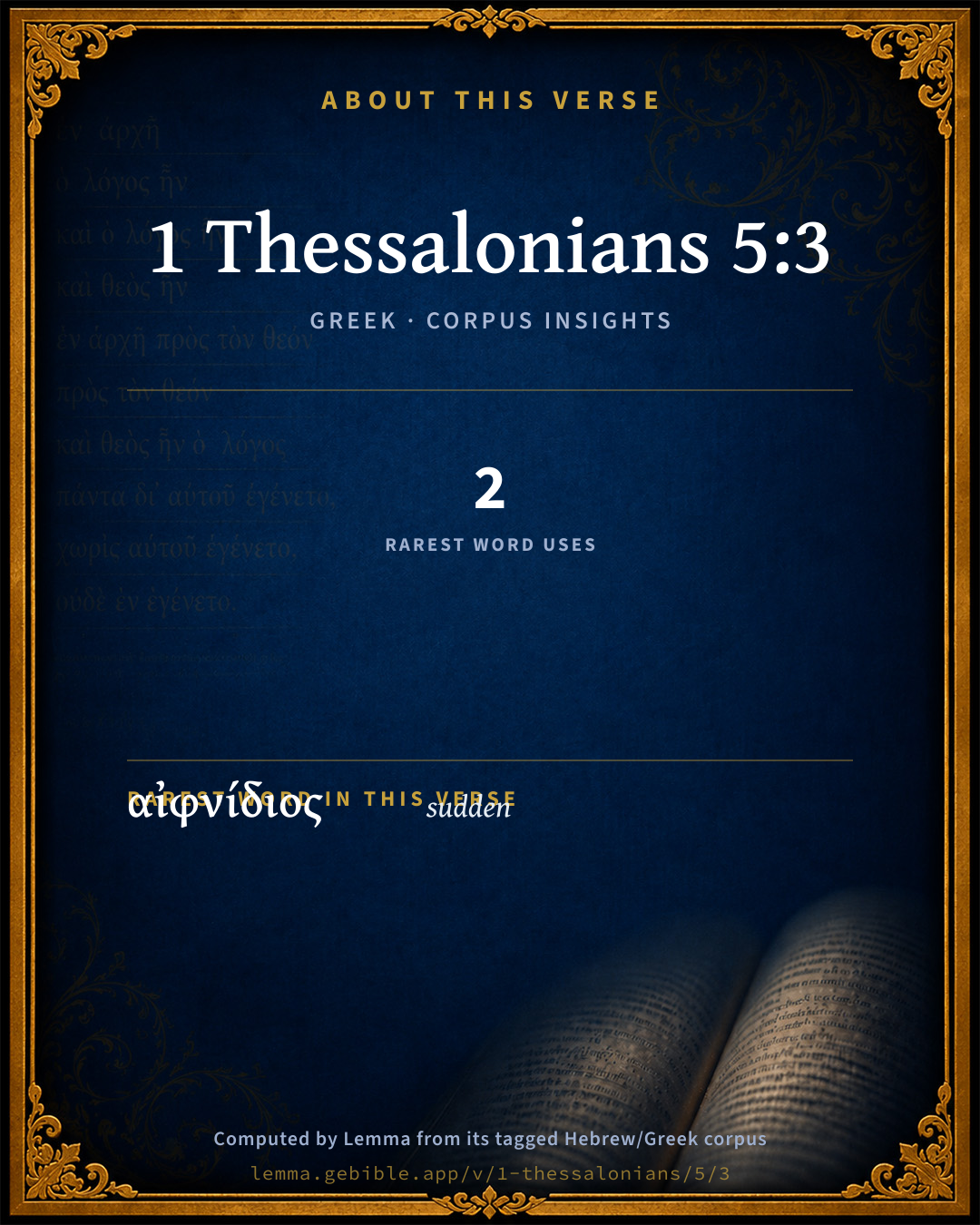
1 Thessalonians, in the Pauline Epistles, opens this verse with 21 words (19 distinct Greek lemmas). Its most distinctive word is aiphnídios (“sudden”). A historical commentator’s framing appears above. Read the whole chapter for the surrounding context.
Discussion questions
- The word aiphnídios carries the sense “sudden.” How does it shape the verse?
- How does Luke 21:34, which shares the word «sudden», read alongside this verse?
- What does the repetition of “and” (2× in this one verse) do in this verse?
- These translations render this verse differently; the difference is in the English rendering, not the original. What questions does that raise?
- Compare how The Biblical Illustrator and Tyndale Open Study Notes read this verse. Where do they agree or differ?
Things to notice
- These translations choose different wording for 24 words in this verse.
- “and” occurs 2× in this single verse.
- 19 distinct Greek lemmas span 21 words in this verse.
Commentary
Notes on 1 Thessalonians 5:3 from classic Christian and Jewish commentators (each source and its license shown beneath its notes). The classic Christian expositions comment on the surrounding passage and are grouped to its opening verse, so a note may address several verses; the Jewish commentaries on the Tanakh (Rashi and others) are per-verse, so they appear only where the commentator wrote on this verse.
Lemma curates 59 commentaries, every one of them public domain or Creative Commons licensed, each selected and text-cleaned for this edition rather than reprinted as found. About our sources →
The Biblical Illustrator
Joseph S. Exell
The Biblical Illustrator, edited by Joseph S. Exell (c. 1880s–1900s) — public domain. Text from a community e-Sword module.
Tyndale Open Study Notes
Tyndale Open Resources
Tyndale Open Study Notes — © Tyndale Open Resources, licensed CC BY-SA 4.0. Text via the HelloAO Bible API.
Bengel's Gnomon
Johann Albrecht Bengel
Bengel's Gnomon of the New Testament — English translation (T&T Clark, Edinburgh, 1860) — public domain. Text from a community e-Sword module.
Meyer's Critical & Exegetical Commentary
Heinrich August Wilhelm Meyer
Meyer — Critical and Exegetical Commentary on the New Testament — English translation by Peter Christie, edited by Frederick Crombie (T&T Clark, 1880) — public domain. Text from a community e-Sword module.
Expositor's Greek Testament
ed. W. Robertson Nicoll
The Expositor's Greek Testament, edited by W. Robertson Nicoll (1897–1910) — public domain. Text from a community e-Sword module.
Jamieson, Fausset & Brown
Robert Jamieson, A. R. Fausset & David Brown
Jamieson, Fausset & Brown — Commentary Critical and Explanatory on the Whole Bible (1871) — public domain (CC PDM 1.0). Text via the HelloAO Bible API.
Adam Clarke's Commentary
Adam Clarke's Commentary on the Bible (1810–1826) — public domain. Text from a community e-Sword/MySword module.
John Calvin's Commentaries
John Calvin's Commentaries (1540-1563) — public domain. Text from the Calvin Translation Society English edition (1840s-50s) via the Christian Classics Ethereal Library (ccel.org). Calvin's coverage is partial (roughly two-thirds of the Bible); uncommented books and verses are honest gaps, never fabricated. The 19th-century editor's footnotes and remarks are omitted so the notes are faithfully Calvin's own voice.
Ellicott's Commentary for English Readers
A Bible Commentary for English Readers, edited by Charles John Ellicott (1878–1897) — public domain. Text from a community e-Sword module.
The Cambridge Bible for Schools and Colleges
gen. ed. J. J. S. Perowne
The Cambridge Bible for Schools and Colleges (gen. ed. J. J. S. Perowne; Cambridge University Press, 1878–1918) — public domain. Text from a community e-Sword module.
John Gill's Exposition
John Gill's Exposition of the Whole Bible (1746–1763) — public domain (CC PDM 1.0). Text via the HelloAO Bible API.
Trapp's Complete Commentary
John Trapp
John Trapp, A Commentary or Exposition upon All the Books of the Old and New Testament (1647–1656) — public domain. Text from a community e-Sword module.
Albert Barnes' Notes on the Bible
Albert Barnes' Notes on the Bible (1834–1885) — public domain. Text from a community e-Sword/MySword module.
Matthew Poole's English Annotations
Matthew Poole's English Annotations on the Holy Bible (1683–1685) — public domain. Text from a community e-Sword/MySword module.
Whedon's Commentary on the Bible
Daniel D. Whedon
Daniel D. Whedon (gen. ed.), Commentary on the Old and New Testaments (1874–1909) — public domain. Text from a community e-Sword module.
The Pulpit Commentary
The Pulpit Commentary (1880–1919), ed. H.D.M. Spence-Jones & Joseph S. Exell — public domain. Text from a community e-Sword module.
John Wesley's Explanatory Notes
John Wesley, Explanatory Notes Upon the Whole Bible (1754–1765) — public domain. Text via the GEBible commentary corpus.
McGarvey & Pendleton's Commentaries
J. W. McGarvey
J. W. McGarvey (with Philip Y. Pendleton), Commentaries on the New Testament (The Fourfold Gospel, 1914; Acts; and the epistles) — public domain. Text from a community e-Sword/MySword module.
The People's New Testament
B. W. Johnson
B. W. Johnson's The People's New Testament with Notes (1889–1891) — public domain. Electronic text from the Christian Classics Ethereal Library (CCEL) ThML edition.
Cambridge Greek Testament for Schools and Colleges
Cambridge Greek Testament for Schools and Colleges (Cambridge University Press, 1896; 21 vols, various authors incl. Carr, Maclear, Plummer, Farrar, Lumby, Moule, M. R. James, Simcox) — public domain. Text from a community e-Sword module.
Alford’s Greek Testament
Henry Alford
Henry Alford, The Greek Testament (1849–1861) — public domain. Text from a community e-Sword module.
International Critical Commentary
International Critical Commentary — older volumes (1896–1929), various authors — public domain. Text from a community e-Sword module.
Vincent's Word Studies in the New Testament
Marvin R. Vincent
Marvin R. Vincent, Word Studies in the New Testament (1887–1900) — public domain. Text from a community e-Sword/MySword module.