
Revelation 9:5

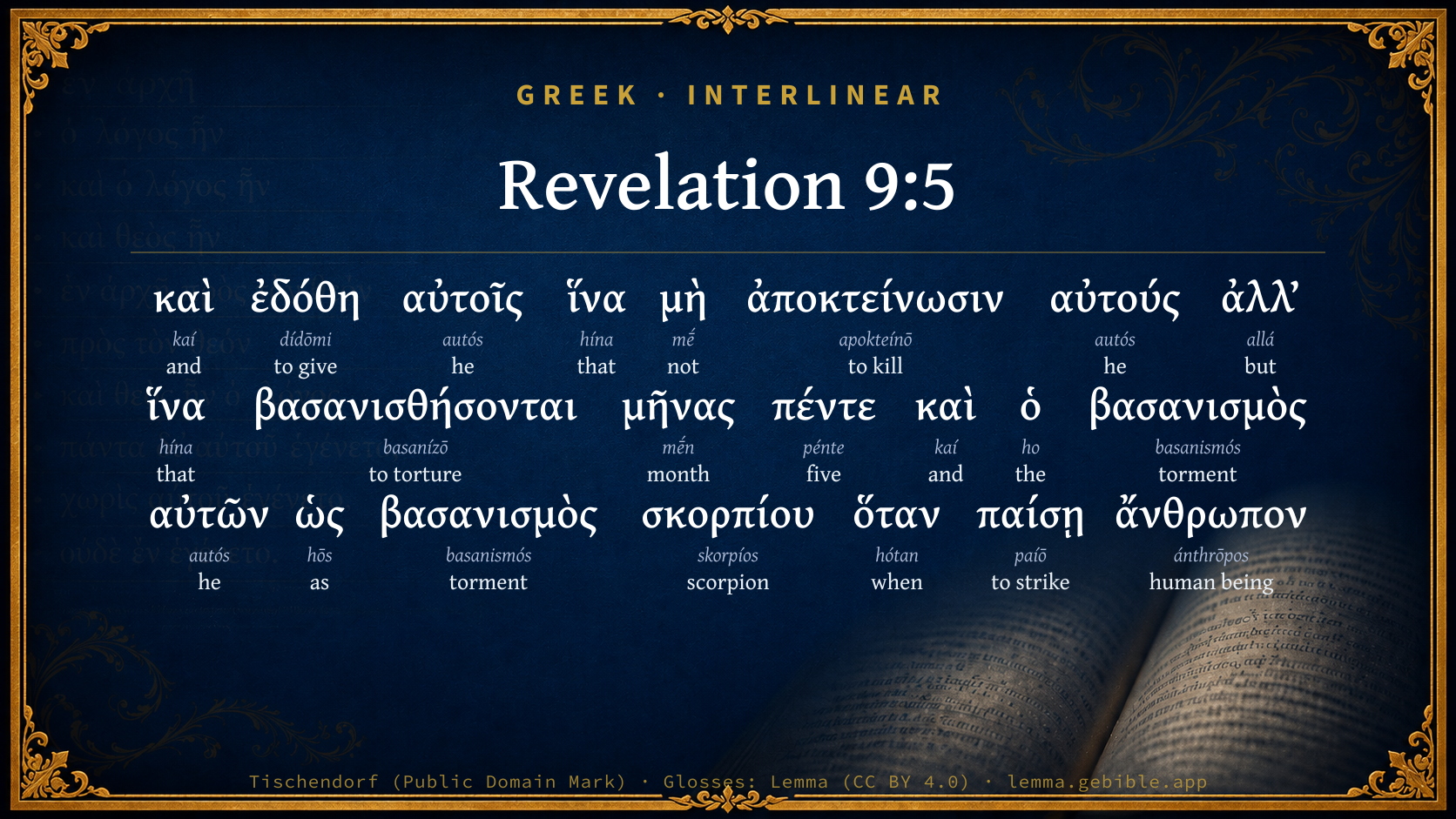
Greek (Tischendorf 8th ed.) Revelation 9:5 appears in the Greek New Testament. The text above is from the Tischendorf 8th edition. Each word links to its Strong’s number and a concise gloss. Click any word for its full Thayer’s Greek Lexicon entry.
Download image
Cite this verse

Revelation 9:5 (World English Bible). Public Domain. Lemma interlinear Bible study tool, https://lemma.gebible.app/v/revelation/9/5.

Show BibTeX & RIS
BibTeX
RIS
English Translation
They were given power not to kill them, but to torment them for five months. Their torment was like the torment of a scorpion, when it strikes a person.
World English Bible · Public Domain
Highlights
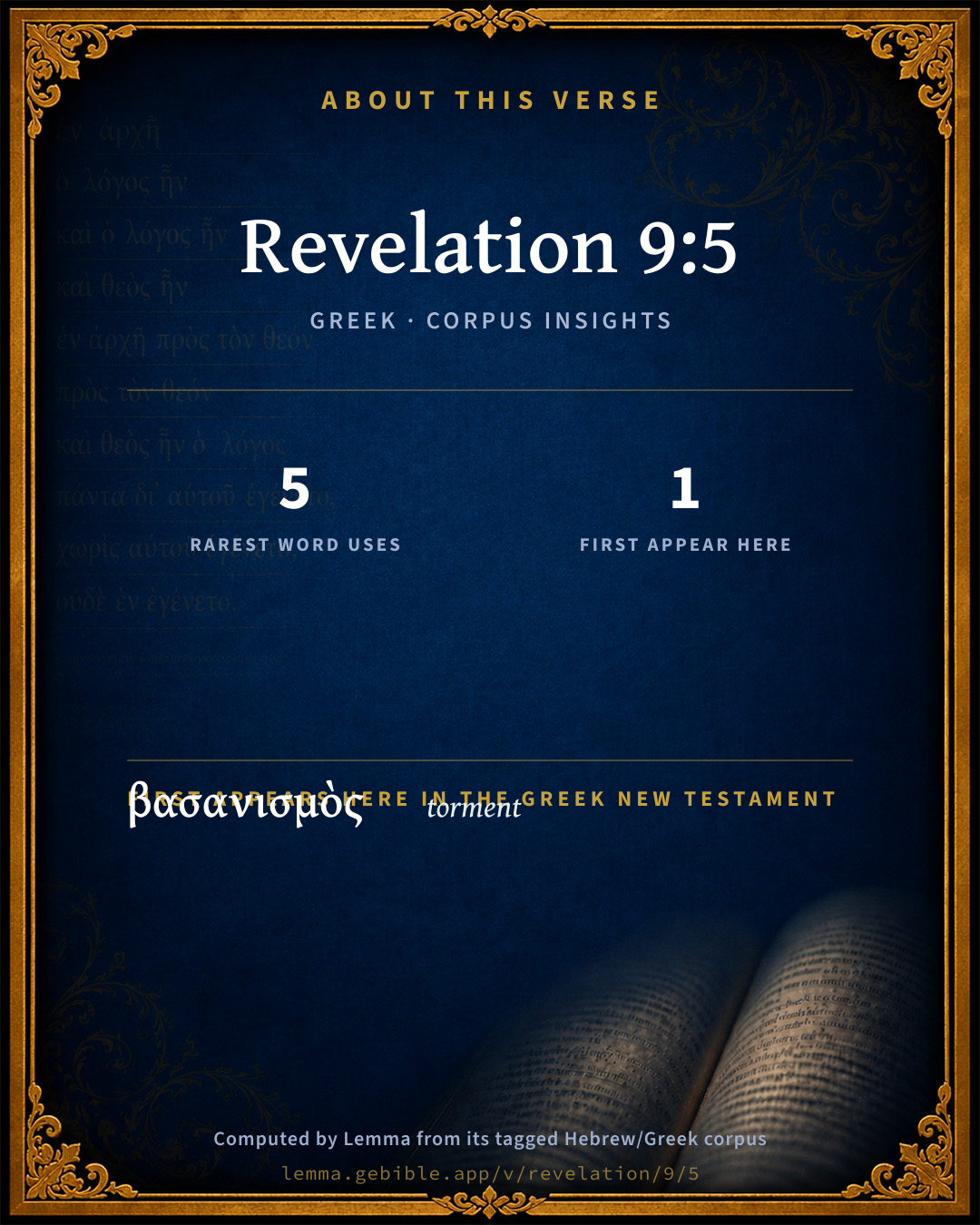
  • 1 first appearance in the Greek New Testament
Full analysis ↓
Download a study sheet

One document with this verse’s original text, its word-by-word gloss line, the meaning frame, cross-references with their text, attributed commentary, and full source and license credits — printable, and it pastes into notes with its structure intact.

This verse Autodidact and up

Study sheet (.html) Plain text (.txt)

A passage Seminary Student

Up to 50 verses in one chapter. A passage sheet keeps up to 6 commentary sources and 12 cross-references per verse, in the order this page ranks them, and says so on the sheet whenever that leaves anything out. Ask for a single verse and you get the Autodidact verse sheet above.

Everything on this page stays free to read, with no account — the sheet is a download of what is already on screen, not access to it.

Want to remove ads? Support Godless Engineer
Compare translations 3

The same verse in 3 English versions, stacked beneath the original-language interlinear above. Click any original word for its lexicon entry.

Each is an independent rendering of the whole verse — the interlinear is not word-aligned to these translations.

Highlighted words mark where these versions differ — a whole-verse word diff, not a word-by-word alignment.

  • World English Bible Public Domain
    They were given power not to kill them, but to torment them for five months. Their torment was like the torment of a scorpion, when it strikes a person.
  • King James Version Public Domain
    And to them it was given that they should not kill them, but that they should be tormented five months: and their torment was as the torment of a scorpion, when he striketh a man.
  • unfoldingWord Literal Text CC BY-SA 4.0
    And it was given to them that they should not kill them, but that they would be tormented for five months and their torment like the torment of a scorpion when it might strike a man.

unfoldingWord Literal Text — © unfoldingWord, licensed CC BY-SA 4.0. Word-aligned USFM3 via Door43 (git.door43.org/unfoldingWord/en_ult).

Versions to compare (up to 4)

3 of 4 selected

Show all 19 translations

Every available English version of this verse, each an independent rendering of the whole verse.

  • World English Bible Public Domain
    They were given power not to kill them, but to torment them for five months. Their torment was like the torment of a scorpion, when it strikes a person.
  • Berean Standard Bible Public Domain
    The locusts were not given power to kill them, but only to torment them for five months, and their torment was like the stinging of a scorpion.
  • Majority Standard Bible Public Domain
    The locusts were not given power to kill them, but only to torment them for five months, and their torment was like the stinging of a scorpion.
  • King James Version Public Domain
    And to them it was given that they should not kill them, but that they should be tormented five months: and their torment was as the torment of a scorpion, when he striketh a man.
  • American Standard Version (1901) Public Domain
    And it was given them that they should not kill them, but that they should be tormented five months: and their torment was as the torment of a scorpion, when it striketh a man.
  • Revised Version (1885) Public Domain
    And it was given them that they should not kill them, but that they should be tormented five months: and their torment was as the torment of a scorpion, when it striketh a man.
  • Geneva Bible (1599) Public Domain
    And to them was comanded that they should not kill them, but that they should be vexed fiue moneths, and that their paine should be as the paine that commeth of a scorpion, when he hath stung a man.
  • Douay-Rheims (1899) Public Domain
    And it was given unto them that they should not kill them; but that they should torment them five months: and their torment was as the torment of a scorpion when he striketh a man.
  • Young's Literal Translation Public Domain
    and it was given to them that they may not kill them, but that they may be tormented five months, and their torment `is' as the torment of a scorpion, when it may strike a man;
  • Literal Standard Version CC BY-SA 4.0
    and it was given to them that they may not kill them, but that they may be tormented five months, and their torment—as the torment of a scorpion—when it may strike a man;
  • Unlocked Literal Bible CC BY-SA 4.0
    They were not given permission to kill those people, but only to torture them for five months. Their agony would be like the sting of a scorpion when it strikes a person.
  • unfoldingWord Literal Text CC BY-SA 4.0
    And it was given to them that they should not kill them, but that they would be tormented for five months and their torment like the torment of a scorpion when it might strike a man.
  • Darby Bible Public Domain
    and it was given to them that they should not kill them, but that they should be tormented five months; and their torment [was] as [the] torment of a scorpion when it strikes a man.
  • World Messianic Bible Public Domain
    They were given power, not to kill them, but to torment them for five months. Their torment was like the torment of a scorpion when it strikes a person.
  • Webster's Bible Public Domain
    And to them it was given that they should not kill them, but that they should be tormented five months: and their torment was as the torment of a scorpion, when he striketh a man.
  • Free Bible Version CC BY-SA 4.0
    They were not allowed to kill, but they could torture these people for five months. The torture was like that of a scorpion when it stings someone.
  • Bible in Basic English Public Domain
    And orders were given them not to put them to death, but to give them great pain for five months: and their pain was as the pain from the wound of a scorpion.
  • Text-Critical English NT CC BY 4.0
    They were permitted to torment them for five months, but not to kill them, and their torment was like the torment of a scorpion when it stings someone.
  • Tyndale New Testament (1534) Public Domain
    and to the was commaunded that they shulde not kyll them but that they shulde be vexed v monethes and their payne was as the payne that cometh of a scorpion when he hath stoge a man.

Literal Standard Version (2020), Covenant Press — licensed CC BY-SA 4.0. Text via the HelloAO Bible API (eBible.org). Unlocked Literal Bible (unfoldingWord) — licensed CC BY-SA 4.0. Text via the HelloAO Bible API (eBible.org). unfoldingWord Literal Text — © unfoldingWord, licensed CC BY-SA 4.0. Word-aligned USFM3 via Door43 (git.door43.org/unfoldingWord/en_ult). Free Bible Version, Dr. Jonathan Gallagher — licensed CC BY-SA 4.0. Text via the HelloAO Bible API (eBible.org).

Word by word

More ways to search: Search by grammar → Find every occurrence → Compare this word →

Practice this passage: Drill this verse → Learn its vocabulary →

σκορπίου
skorpíos
G4651
“scorpion”
Noun, Genitive, Singular, Masculine
Part of Speech
Noun
Case
Genitive
Number
Singular
Gender
Masculine
Full Thayer's Definition

Origin: probably from an obsolete skerpo (perhaps strengthened from the base of G4649 and meaning to pierce)

TDNT: None

1. a scorpion, the name of a little animal, somewhat resembling a lobster, which in warm regions lurk, esp. in stone walls; it has a poisonous sting in its tail
  1. καὶ kaí G2532 “and” Conjunction
  2. ἐδόθη dídōmi G1325 “to give” Verb, Aorist, Passive, Indicative, 3rd person, Singular
  3. αὐτοῖς autós G846 “he” Personal pronoun, Dative, Plural, Masculine
  4. ἵνα hína G2443 “that” Conjunction
  5. μὴ mḗ G3361 “not” Particle, Negative
  6. ἀποκτείνωσιν apokteínō G615 “to kill” Verb, Aorist, Active, Subjunctive, 3rd person, Plural
  7. αὐτούς autós G846 “he” Personal pronoun, Accusative, Plural, Masculine
  8. ἀλλ’ allá G235 “but” Conjunction
  9. ἵνα hína G2443 “that” Conjunction
  10. βασανισθήσονται basanízō G928 “to torture” Verb, Future, Passive, Indicative, 3rd person, Plural
  11. μῆνας mḗn G3376 “month” Noun, Accusative, Plural, Masculine
  12. πέντε pénte G4002 “five” Adjective, Numeral (indeclinable)
  13. καὶ kaí G2532 “and” Conjunction
  14. ὁ ho G3588 “the” Article, Nominative, Singular, Masculine
  15. βασανισμὸς basanismós G929 “torment” Noun, Nominative, Singular, Masculine
  16. αὐτῶν autós G846 “he” Personal pronoun, Genitive, Plural, Feminine
  17. ὡς hōs G5613 “as” Adverb
  18. βασανισμὸς basanismós G929 “torment” Noun, Nominative, Singular, Masculine
  19. ὅταν hótan G3752 “when” Conjunction
  20. παίσῃ paíō G3817 “to strike” Verb, Aorist, Active, Subjunctive, 3rd person, Singular
  21. ἄνθρωπον ánthrōpos G444 “human being” Noun, Accusative, Singular, Masculine

About this verse

These counts appear in no published source. They are computed here, from the morphology-tagged text and Lemma’s own curated glosses. What Lemma adds →

22
words
17
distinct lemmas
Revelation
section

Notable vocabulary

The rarest word here is σκορπίου scorpion G4651 — appearing just 5 times in the whole Greek New Testament.

First appearance in Scripture

This word makes its first canonical appearance in the Greek New Testament here:

  • βασανισμὸς torment G929

Shared distinctive vocabulary

σκορπίου scorpion G4651 occurs in 5 verses of the Greek New Testament. Also found in:
Repetition

Words recur within this verse:

  • βασανισμὸς torment G929 ×2
  • αὐτοῖς he G846 ×3
  • καὶ and G2532 ×2
  • ἵνα that G2443 ×2

Cross-references

6

Topical passages linked to Revelation 9:5 in the Treasury of Scripture Knowledge — connected by theme and wording, ordered by reader-vote popularity; previews shown in the World English Bible.

  • Revelation 9:10 They have tails like those of scorpions, and stings. In their tails they have power to harm men for five months.
  • Job 2:6 Yahweh said to Satan, "Behold, he is in your hand. Only spare his life."
  • Revelation 9:3 Then out of the smoke came forth locusts on the earth, and power was given to them, as the scorpions of the earth have power.
  • Daniel 5:18–22 You king, the Most High God gave Nebuchadnezzar your father the kingdom, and greatness, and glory, and majesty:
  • Revelation 13:5 A mouth speaking great things and blasphemy was given to him. Authority to make war for forty-two months was given to him.
  • Revelation 13:7 It was given to him to make war with the saints, and to overcome them. Authority over every tribe, people, language, and nation was given to him.

Cross-references courtesy of OpenBible.info (CC BY 4.0).

Commentary

Notes on Revelation 9:5 from classic Christian and Jewish commentators (each source and its license shown beneath its notes). The classic Christian expositions comment on the surrounding passage and are grouped to its opening verse, so a note may address several verses; the Jewish commentaries on the Tanakh (Rashi and others) are per-verse, so they appear only where the commentator wrote on this verse.

Lemma curates 59 commentaries, every one of them public domain or Creative Commons licensed, each selected and text-cleaned for this edition rather than reprinted as found. About our sources →

Tyndale Open Study Notes

Tyndale Open Resources

9:5 torture them for five months: This time period is a symbolically complete number based on the fingers on a hand. It is also the normal life span of locusts, suggesting that their entire purpose was to torture people.

Tyndale Open Study Notes — © Tyndale Open Resources, licensed CC BY-SA 4.0. Text via the HelloAO Bible API.

Bengel's Gnomon

Johann Albrecht Bengel

Rev 9:5. Μῆνας πέντε) Some Lat. MSS. have six months. I was long ago, but easily added to V. The number five is repeated, Rev 9:10. Five months in prophecy are 79 complete ordinary years, from A. 510 to 589. The men who were tormented were Israelites, who had not received the Divine seal: the locusts were Persians, who dreadfully harassed them.

Rev 9:5; Rev 9:10. Βασανισθῶσι· ἀδικῆσαι) The one fact is expressed in a twofold manner, passively and actively. The locusts ἀδικοῦσι, hurt: men βασανίζονται, are tormented. So, to slay and to be slain, Rev 9:15; Rev 9:18; to have those who nourish, and to be nourished, ch. Rev 12:6; Rev 12:14.

Bengel's Gnomon of the New Testament — English translation (T&T Clark, Edinburgh, 1860) — public domain. Text from a community e-Sword module.

Expositor's Greek Testament

ed. W. Robertson Nicoll

Rev 9:5 . παίσῃ here, like ἐπάταξεν Jas 4:7 , represents LXX, tr. of נכה in sense of reptile’s bite; the scorpion with its long-fanged tail stings the prey which it has already gripped with its claws ( cf. Sen. Hercul. 1218). Scorpions were a natural symbol for vicious and dangerous opponents ( cf. Eze 2:6 , Luk 10:9 ), whose attacks were always painful and might be mortal. “The sting is not perilous.… The wounded part throbs with numbness and aching till the third day, there is not much swelling” (Doughty, Ar. Des. i. 328). But the effects were not always so mild (Arist. H. N. ix. 29).

The Expositor's Greek Testament, edited by W. Robertson Nicoll (1897–1910) — public domain. Text from a community e-Sword module.

Jamieson, Fausset & Brown

Robert Jamieson, A. R. Fausset & David Brown

they . . . they--The subject changes: the first "they" is the locusts; the second is the unsealed.

five months--the ordinary time in the year during which locusts continue their ravages.

their torment--the torment of the sufferers. This fifth verse and Rev 9:6 cannot refer to an invading army. For an army would kill, and not merely torment.

Jamieson, Fausset & Brown — Commentary Critical and Explanatory on the Whole Bible (1871) — public domain (CC PDM 1.0). Text via the HelloAO Bible API.

Adam Clarke's Commentary

Verse 5. To them it was given] That is, they were permitted.

That they should be tormented five months] Some take these months literally, and apply them to the conduct of the Zealots who, from May to September, in the year of the siege, produced dreadful contests among the people; or to the afflictions brought upon the Jews by Cestius Gallus, when he came against Jerusalem, before which he lay one whole summer, or nearly five months.-See Joseph., Bell. Jud., l. ii. c. 19.

Others consider the months as being prophetical months, each day being reckoned for a year; therefore this period must amount to one hundred and fifty years, counting thirty days to each month, as was the general custom of the Asiatics.

Their torment was as the torment of a scorpion] The phraseology here is peculiar, and probably refers to the warlike weapon called a scorpion, several of which, or men armed with them, Cestius Gallus brought with him in his army.

Isidore describes this scorpion thus: Scorpio est sagitta venenata arcu vel tormentis excussa, quea, dum ad hominem venerit, virus qua figit infundit; unde et scorpio nomen accepit. "The scorpion is a poisoned arrow shot from a bow or other instrument, which, when it wounds a man, deposits the poison with which it is covered in the wound; whence it has the name of scorpion." Seneca, in his Hercules OEtaeus, act iv., ver. 1218, describes the torment which is occasioned by this species of poisoned arrow: -

Heu qualis intus scorpius, quis fervida

Plaga revulsus cancer infixus meas

Urit medullas?

Adam Clarke's Commentary on the Bible (1810–1826) — public domain. Text from a community e-Sword/MySword module.

Ellicott's Commentary for English Readers

(5) And to them . . .—Better, And it was given to them that they should not kill them (i.e., those who had not the seal of God in their foreheads), but that they should be tortured five months. The general period of a locust plague is about five months: “as the natural locusts commit their ravages only for five months, so the ravages of these symbolical ones will be only for a short period” (Stuart). Their power is to inflict torment, and not death. The next verse tells us that men would consider death preferable to this torment; but the relief of the grave is denied them.

And their torment . . .—Literally, and the torture of them (i.e., the torture inflicted by them) is as the torture of a scorpion when it has stricken a man. The wound of a scorpion occasions intense suffering: we have in it the symbol of the malicious cruelty of the merciless. The emblem is used in Ezekiel: the rebellious and malicious opponents of the prophet being compared to scorpions (Eze_2:6). We may compare the similar imagery of the bee for the Assyrian power (Isa_7:18), and the Psalmist’s complaint that his enemies came about him like bees—a swarm, irritating him with wing and sting. The tenth verse tells us the way in which the injury was inflicted: there were stings in their tails.

A Bible Commentary for English Readers, edited by Charles John Ellicott (1878–1897) — public domain. Text from a community e-Sword module.

The Cambridge Bible for Schools and Colleges

gen. ed. J. J. S. Perowne

5. five months] It has been conjectured that this period is named, as being the time for which a plague of the literal locusts is liable to last. But more probably the period is to be reckoned on the same principle—whatever that be—as the other periods of time indicated in this book.

The Cambridge Bible for Schools and Colleges (gen. ed. J. J. S. Perowne; Cambridge University Press, 1878–1918) — public domain. Text from a community e-Sword module.

John Gill's Exposition

And to them it was given that they should not kill them,.... As the power of the locusts was limited with respect to the persons they should hurt, so with regard also to the mischief they should do; for even those whom they were suffered to annoy they might not kill, that is, utterly root out and destroy, so as that they were no more: and thus, though the Saracens killed great numbers in the eastern empire, by their frequent incursions and ravages, and made large conquests, yet they could never destroy the empire itself, or bring it in subjection to them; nor did they ever take Constantinople, the metropolis and seat of the empire, though they often besieged it. And as for the western locusts, the months, friars, &c. though they kill the souls, yet not the bodies of men that are under their power and influence:

but that they should be tormented five months; that is, not that the locusts should be tormented, but men by the locusts; and so the eastern empire was grievously teased and tormented by the Saracens, and many parts of it were conquered, plundered, and pillaged by them, though it was not killed and put an end to. In the year 628, Mahomet with his Saracens having obtained a place in Arabia Felix to dwell in, died in the year 631; from which time his successors, the Saracens, by little and little, subdued Palestine, Syria, and Egypt; and, in the year 640, took Persis, putting King Hormisda to flight; they laid siege to Constantinople seven years, but without success; in the year 698, Carthage was taken by them; and in following times many countries on the continent, and many of the islands, were grievously infested and distressed by them; though the empire itself did not fall into their hands; it was tormented by them, but not destroyed. And the western locusts have most dreadfully tormented men by their exorbitant dues demanded of them; and by obliging them to confessions, and to attend Mass; by enjoining them whippings, fastings, pilgrimages, and penances, and with the terrors of purgatory, and the like. The time that the locusts should torment men, which is "five months", seems not to design any determinate time; but only that seeing five months is the time that locusts live, and are in their strength and power, even the five, hottest months in the year, from April to September (h), this seems to denote, that as long as the locusts live, the Saracens in the east, and the monks and friars in the west, so long men should be tormented by them; for it is certain that these have had power to torment men longer time than barely five months; yea, even though these should be understood, according to the prophetic style used in this book, of five months of years, or an hundred and fifty years; and though this should be doubled, seeing they are repeated, Rev 9:10; and so make up in all three hundred ears; for both the Saracens and the Romish clergy have distressed men, either of them, longer time than this: indeed, the flourishing condition of the Saracens was but about three hundred years, or two five months; but their empire or dominion lasted longer, even from the year 622, which was the year of the "Hegira", or flight of Mahomet, to the year 1057 (i), when the Turkish empire succeeded it: though it is pretty remarkable, that from the year 612, in which Mahomet began to preach publicly, and so let out the smoke with the locusts, to the year 762, in which the city of Bagdad was built, when and where the Saracens settled, and made no more excursions of any consequence, were just an hundred and fifty years, or five months of years, as Mr. Daubuz observes; and I will not say that this is not intended by this prophecy. Noah's flood prevailed over the earth one hundred and fifty days, or five months, Gen 7:24.

And their torment was as the torment of a scorpion when he striketh a man; which gives great pain, is very distressing, and their stings are poisonous and mortal: it signifies how troublesome and afflictive those locusts were; to be among them was to live among scorpions, as in Eze 2:6. As these locusts are like scorpions, so scorpions have been seen sometimes with wings like locusts; such an one, Pausanias (k) relates, was brought into Ionia by a Phrygian.

(h) Plin. Nat. Hist. l. 11. c. 29. (i) Petav. Rationar. par. 1. l. 7. c. 13. & l. 8. c. 13. (k) Boeotica, sive l. 9. p. 573. Vid. Plin. Nat. Hist. l. 11. c. 25. & Aelian. Hist. Animal. l. 6. c. 20. & l. 16. c. 41, 42.

John Gill's Exposition of the Whole Bible (1746–1763) — public domain (CC PDM 1.0). Text via the HelloAO Bible API.

Trapp's Complete Commentary

John Trapp

5 And to them it was given that they should not kill them, but that they should be tormented five months: and their torment was as the torment of a scorpion, when he striketh a man.

Ver. 5. And to them it was given] This is often repeated in this book, to show that though Antichrist and his actuaries bandy and bend all their forces to destroy souls, yet they are bounded by God, and can do no more than is given them from above.

Five months] Locusts used to live no longer. See Pliny, lib. xi. cap. 29. There are those who interpret these five months of those 500 years, wherein the pope stood in his full pride and power. For, ab eo tempore quo per vos Papa Antichristus esse coepit (saith Bellarmine) non modo non crevit eius imperium, sed semper magis ac magis decrevit, Since you first began to call the pope Antichrist he hath lost a great part of his command and commodity. (De Pap. Rom., lib. iii. cap. 21.)

As the torment of a scorpion] Pliny testifieth that of all creeping things that are poisonous, the sting of a scorpion is most cruel and grievous.

John Trapp, A Commentary or Exposition upon All the Books of the Old and New Testament (1647–1656) — public domain. Text from a community e-Sword module.

Albert Barnes' Notes on the Bible

And to them it was given - There is here the same indefiniteness as in the former verse, the impersonal verb being here also used. The writer does not say by whom this power was given, whether by God, or by the leader of the host. It may be admitted, however, that the most natural interpretation is to suppose that it was given them by God, and that this was the execution of his purpose in this case. Still it is remarkable that this is not directly affirmed, and that the language is so general as to admit of the other application. The fact that they did not kill them, but tormented them - if such a fact should be found to exist - would be in every sense a fulfillment of what is here said.

That they should not kill them - This is in accordance with the nature of the symbol. The locusts do not themselves destroy any living creature; and the sting of the scorpion, though exceedingly painful, is not usually fatal. The proper fulfillment of this would be found in what would not be generally fatal, but which would diffuse misery and wretchedness. (Compare Rev 9:6.) Perhaps all that would be necessarily meant by this would be, not that individual people would not be killed, but that they would be sent to inflict plagues and torments rather than to take life, and that the characteristic effects of their appearing would be distress and suffering rather than death. There may be included in the fair interpretation of the words, “general distress” and “sorrow”; acts of oppression, cruelty, and violence; such a condition of public suffering that people would regard death as a relief if they could find it.

But that they should be tormented - That is, that they should be subjected to ills and troubles which might be properly compared with the sting of a scorpion.

Five months - So far as the words here are concerned this might be taken literally, denoting five months or one hundred and fifty days; or as a prophetic reckoning, where a day stands for a year. Compare the notes on Dan 9:24 ff. The latter is undoubtedly the correct interpretation here, for it is the character of the book thus to reckon time. See the notes on Rev 9:15. If this be the true method of reckoning here, then it will be necessary to find some events which will embrace about the period of one hundred and fifty years, during which this distress and sorrow would continue. The proper laws of interpretation demand that one or the other of these periods should be found - either that of five months literally, or that of 150 years. It may be true, as Prof. Stuart suggests (in loco), that “the usual time of locusts is from May to September inclusive - five months.” It may be true, also, that this symbol was chosen partly because that was the fact, and they would, from that fact, be well adapted to symbolize a period that could be spoken of as “five months”; but still the meaning must be more than simply it was “a short period,” as he supposes. The phrase a few months might designate such a period; but if that had been the writer’s intention, he would not have selected the definite number five.

And their torment was as the torment of a scorpion, ... - See the notes on Rev 9:3. That is, it would be painful, severe, dangerous.

Albert Barnes' Notes on the Bible (1834–1885) — public domain. Text from a community e-Sword/MySword module.

Matthew Poole's English Annotations

Supposing the Saracens and Turks here meant by the locusts, here arise two difficulties:

1. How it can be said of them, that they had no power to kill, but only torment men.

2. How their time is set for five months, whereas they have already tormented the world more than a thousand years; and how long they shall yet continue to do so, God only knows: they are both great difficulties.

Alsted tells us: That Mahomet began in the year 622, and the Saracens entered Spain 714, where they were called Moors, and kept possession of that kingdom eight hundred years, and that in the year 719, they besieged Constantinople with a navy of three thousand ships and three hundred thousand land soldiers; that before this time they had made themselves masters of Arabia, Palestina, Syria, Persia, Egypt, Africa, and Spain; and in the year 726, carried into France an army consisting of three hundred and seventy-five thousand, where they were beaten by Charles Martell, father to King Pepin. Mr, Mede telleth us, that the Saracens grievously vexed the countries subject to the Roman emperor, but could not take either Rome or Constantinople. The latter was taken by the Turks, in the year 1457, commanded by Sultan Mahomet. This is but a hard interpretation of those words,

that they should not kill them; which, it may be, hath made some other interpreters choose to interpret these locusts to signify the Roman clergy, who indeed did not kill men for religion, of many years. But both the one and the other tormented the world enough, and that like a scorpion, which pierceth a man with a venomous sting, and puts him to great pain. For the five months, we shall again meet with them, Rev 9:10.

Matthew Poole's English Annotations on the Holy Bible (1683–1685) — public domain. Text from a community e-Sword/MySword module.

Whedon's Commentary on the Bible

Daniel D. Whedon

5. Not kill—As the war-demons (Rev_9:18) would. These inflict agonies; agonies from which, indeed, natural death may naturally, in time, result: but it is not the work of these error-demons, as of the war-demons, to slaughter and slay.

Tormented—For misery is the outflow of error and sin.

Five months—A divine limitation again, based on the nature of the locust, whose ravages last usually about five months; that is, from May to September. And so temptation, error, and sin have not limitless control over all the life of humanity. Gospel truths take their turn of influence and offer. Even the smoke of the bottomless pit produces but twilight here, not total darkness.

Torment of a scorpion—The wounds of a scorpion are not usually fatal unless they are neglected; but the poison is so acrid that it occasions great agony. Like to this are the images of the hornet, the bee, and the wasp. See the Old Testament, for example Deu_7:20; Exo_23:28; Jos_24:12; Deu_1:44.

Torments— A frequent word in the Greek in the Apocalypse. Its noun-form, βασανος, signifies the Libyan touchstone, by which the purity of metals was claimed to be tested. Thence the verb signified any examination of a thing by criticism, or of a person by torture. Thence it signifies any torment or suffering. In the New Testament it never signifies infliction on an inanimate object but once, Mat_14:24, where it speaks of a ship as “tossed by the waves.” Our seer applies the term here to the sting of the locusts; to the torment of the people by the two witnesses, Rev_11:10; to the pains of child-birth, Rev_12:2; and to the fiery torment of the wicked, Rev_14:10; Rev_20:10.

Daniel D. Whedon (gen. ed.), Commentary on the Old and New Testaments (1874–1909) — public domain. Text from a community e-Sword module.

The Pulpit Commentary

And to them it was given that they should not kill them, but that they should be tormented five months; and it was given them i.e. the locusts that they the locusts should not kill them the unsealed, but that they the unsealed should be tormented five months. The devil and his agents have not unlimited power committed to them; they are restrained within limits by the will of God. The evils which follow in the train of heresy and infidelity are not as yet permitted to kill, (cf. Job_1:12) for this judgment extends only to the natural life of man. God reserves the final killing to himself at the great judgment day. This is shown in the limitation, "five months." This apparently meaningless period becomes explicable, when we remember that the usual duration of a locust plague is five months, viz. from April to September. The visitation is for the natural period of such occurrences; the torment is to extend to the natural period of man"s sojourn on the earth. It does not extend into the next life; other and special means are adopted for man"s punishment then, as set forth under the seventh trumpet. Various other explanations have been given of the five months.

(1) Five years of Gothic rule (Vitringa).

(2) Five months= 5 30 days; each day represents one year; therefore 150 years are signified, viz.

(a) of the Saracens, A.D. 830 A.D. 980 (Mede);

(b) Mohammed"s conquests, A.D. 612 A.D. 762 (Elliott).

(3) Hengstenberg believes 5 to signify a part of the complete number 10, and thus to symbolize an incomplete period, as compared with the period of the seventh trumpet.

(4) Bengel, following the principles assumed by him, makes the five months to equal 79 natural years, and assigns the period to A.D. 510 A.D. 589.

(5) Others take the expression to mean "a short time" merely.

(6) Wordsworth interprets it as meaning a limited time permitted by God, and thinks the Mohammedan period is signified, and their torment was as the torment of a scorpion, when he striketh a man. "Their torment," that is, the torment of the unsealed, according to Alford; the torment of the locusts (viz. that which they inflict), according to others. In either ease the meaning is the same. The last clause, "when he striketh a man," is perhaps added in contradistinction to the injury naturally inflicted by locusts, whose efforts are directed against the vegetation.

The Pulpit Commentary (1880–1919), ed. H.D.M. Spence-Jones & Joseph S. Exell — public domain. Text from a community e-Sword module.

John Wesley's Explanatory Notes

Not to kill them - Very few of them were killed: in general, they were imprisoned and variously tormented.

John Wesley, Explanatory Notes Upon the Whole Bible (1754–1765) — public domain. Text via the GEBible commentary corpus.

Kretzmann's Popular Commentary

Paul E. Kretzmann

The plague of the locusts:

v. 5. And to them it was given that they should not kill them, but that they should be tormented five months; and their torment was as the torment of a scorpion when he striketh a man.

v. 6. And in those days shall men seek death, and shall not find it; and shall desire to die, and death shall flee from them.

v. 7. And the shapes of the locusts were like unto horses prepared unto battle; and on their heads were as it were crowns like gold, and their faces were as the faces of men.

v. 8. And they had hair as the hair of women, and their teeth were as the teeth of lions.

v. 9. And they had breastplates, as it were breastplates of iron; and the sound of their wings was as the sound of chariots of many horses running to battle.

v. 10. And they had tails like unto scorpions, and there were stings in their tails; and their power was to hurt men five months.

v. 11. And they had a king over them, which is the angel of the bottomless pit, whose name in the Hebrew tongue is Abaddon, but in the Greek tongue hath his name Apollyon.

Here the devastating spirits are described in detail. It is said of them, first of all: And it was granted to them that they should not kill them, but should torture them five months; and their torture is as the torture of a scorpion when it strikes a man. The scorpion signified a vicious and dangerous opponent, whose attacks were always attended with excruciating pain, and might prove mortal. For a long time, for five months, but incidentally a definite time, fixed by the Lord, beyond which they did not dare to go, the evil hordes were to vex Christendom. The torture was almost unspeakably severe: And in those days men will seek death and will not find it, and they will desire to die, and death will flee from them. The very withholding of death, under this refinement of torture, would result in intensifying its power; the tortured people crave in vain for some surcease of the torment, desiring death itself in preference to this torture. But this boon would be denied them.

The impression of the destructive activity of the hordes is heightened by their appearance: And the appearance of the locusts was like horses prepared for battle, and on their heads what resembled crowns like gold, and their faces like faces of men, and they had hair like the hair of women, and their teeth were like those of lions; and they had scaly plates like iron coats of mail, and the sound of their wings was like the noise of many chariots rushing to battle; and they had tails and stings like scorpions, and in their tails was their power to injure men five months. This description is partly fanciful, partly realistic, the former being true of the crowns gleaming like gold and of the antennae waving like a girl’s long hair; the latter, of the shape of the head, of the segmented, scaly body, of their omnivorous appetite, and of the whirring noise made by them when in flight. The description is completed by the naming of their leader: They had over them as king the angel of the abyss, whose name is in Hebrew Abaddon, but in Greek he has as his name Apollyon. Surely a fitting name for the ruler and leader of the devastating hordes, for it means Destroyer.

The interpretation of this entire picture, vv. 1-11, in the absence of authentic explanation by the Lord Himself, presents the same difficulties as most of the other pictures in this book of vision and prophecy. So much seems to be certain that the fallen star is an exceptionally great teacher, but one that has fallen away from the pure truth. His doctrine is one that savors of hell and destruction, and the result of its promulgation is that the pure saving knowledge of God is darkened on the earth. Moreover, he will gain many adherents, whose heresy would act as a spiritual plague in the midst of Christendom. For where the precious Word of God is despised and not accepted in true faith, there God will finally take this Word away and permit false and soul-destroying doctrine to be taught. And finally, the fact that the leader of the false believers bore the name Destroyer and had the power to torture apostate Christendom for five months, indicates that he was a mighty ruler and great warrior, whose destructive activity would vex also the true children of God.

This description may be applied to at least two historical movements of great extent. Luther writes: "The first woe, the fifth angel, is the great heretic Arius and his companions, who tormented Christendom so terribly in all the world that the text well says the pious people would rather have died than to have witnessed all of it; and yet they had to see it all, and could not die. He even says that an angel out of hell, called the Destroyer, is their king.... For not only in a spiritual manner, but also bodily, with the sword, they persecuted the true Christians. " Arius was a presbyter of the congregation at Alexandria in Egypt at the beginning of the fourth century, who introduced the terrible doctrine that Christ was not true God with the Father, but a mere creature. In spite of all efforts of faithful teachers to have this doctrine put out of the Church, since it overthrows the very foundations of Christianity, Arianism persisted for several centuries, being spread very rapidly by various Germanic nations that had accepted it, during the so-called migration of nations. It was a truly terrible visitation upon such Christians as were members of the Church in name only, but proved a torture also for the faithful few that clung to the doctrine of Scriptures. Other commentators find in this fallen star and in the hordes that followed him, led by the angel from the abyss, the Pope and his entire hierarchy. And it is true that every detail of the picture as here drawn may well be applied to this anti-Christian system in all its ramifications, to this day the greatest enemy of the Church of Christ in the whole world. Would that all true Christians had their eyes opened to see and understand this fact and to comport themselves accordingly!

Paul E. Kretzmann, Popular Commentary of the Bible (1921–1924) — public domain. Text from a community e-Sword module.

Burkitt's Expository Notes on the New Testament

William Burkitt

That is, God would bring such dreadful judgments and calamities upon the wicked world, that men should be an affliction beyond all other afflictions, that they could not die: to flee death is a great misery, but to have death flee from us, or flee before us, and not be able to find it, is a far greater misery; God can so embitter life by afflictions and sufferings, that those who dread death may yet desire to die; not for any good that they see in death, but only to get rid of the troubles of this life: In those days men shall seek death, and shall not find it.

William Burkitt's Expository Notes on the New Testament (1700–1703) — public domain. Text from a community e-Sword module.

The People's New Testament

B. W. Johnson

5. They should not kill them. This either implies that the armies symbolized by the locusts should seek not to destroy the races they attacked, or that they should not destroy the empire assailed. Five months. Their torment should continue five months, or one hundred and fifty prophetic days. Since a day is a symbol of a year, this implies one hundred and fifty years. Their torment was as the torment of a scorpion. Their warfare and torment shall be almost intolerable.

B. W. Johnson's The People's New Testament with Notes (1889–1891) — public domain. Electronic text from the Christian Classics Ethereal Library (CCEL) ThML edition.

unfoldingWord translationNotes

Door43 World Missions Community

They were not given permission

"They" refers to the locusts. (Revelation 9:03)

those people

the people whom the locusts were stinging

but only to torture them

Here the words "given permission" are understood. AT: "but only given permission to torture them" (See: Ellipsis)

to torture them for five months

The locusts would be allowed to do this for five months.

to torture them

"to make them suffer terrible pain"

the sting of a scorpion

A scorpion is a small insect with a poisonous stinger at the end of its long tail. The sting can cause severe pain or even death.

people will seek death, but will not find it

This can be restated to remove the abstract noun "death." AT: "people will try to find a way to die, but will not find it" or "people will try to kill themselves, but will not find a way to die" (See: Abstract Nouns)

will greatly desire to die

"will want very much to die" or "will wish that they could die"

death will flee from them

John speaks of death as if it were a person or animal that could run away. AT: "they will not be able to die" or "they will not die" (See: Personification)

translationWords

die

unfoldingWord translationNotes — © Distant Shores Media and the Door43 World Missions Community, licensed CC BY-SA 4.0. Source: git.door43.org/Door43/en_tn.

Cambridge Greek Testament for Schools and Colleges

5. βασανισθήσονται; Erasmus altered this into βασανισθήσωνται; Text. Rec[319] reads βασανισθῶσι with B2.

[319] Rec. Textus Receptus as printed by Scrivener.

5. μῆνας πέντε. It has been conjectured that this period is named, as being the time for which a plague of the literal locusts is liable to last. But more probably the period is to be reckoned on the same principle—whatever that be—as the other periods of time indicated in this Book.

Cambridge Greek Testament for Schools and Colleges (Cambridge University Press, 1896; 21 vols, various authors incl. Carr, Maclear, Plummer, Farrar, Lumby, Moule, M. R. James, Simcox) — public domain. Text from a community e-Sword module.

Vincent's Word Studies in the New Testament

Marvin R. Vincent

They should be tormented (basanisqwsin). See on torments, Mt 4:24.

Striketh [παιση] . Dr. Thomson says that the scorpion cannot strike sideways. All accounts agree as to the fearful pain from its sting.

Marvin R. Vincent, Word Studies in the New Testament (1887–1900) — public domain. Text from a community e-Sword/MySword module.

Lesson kit

Teaching starters — assembled from the data on this page, not authored interpretation. Every prompt links to the verse data it draws on. Edit before teaching.

Revelation, in the Revelation, opens this verse with 22 words (17 distinct Greek lemmas). Its most distinctive word is skorpíos (“scorpion”). A historical commentator’s framing appears above. Read the whole chapter for the surrounding context.

Discussion questions

  1. The word skorpíos carries the sense “scorpion.” How does it shape the verse?
  2. This is the first place “torment” appears in Scripture (first appears here). What does its debut here establish?
  3. How does Luke 10:19, which shares the word «scorpion», read alongside this verse?
  4. What does the repetition of “torment” (2× in this one verse) do in this verse?
  5. The translations on this page render this verse differently — a whole-verse word diff, not a word-by-word alignment. What might account for the different wordings?
  6. Compare how Tyndale Open Study Notes and Bengel's Gnomon read this verse. Where do they agree or differ?

Things to notice

  • 1 word makes its first canonical appearance in Scripture here.
  • These translations choose different wording for 11 words in this verse.
  • “torment” occurs 2× in this single verse.
  • 17 distinct Greek lemmas span 22 words in this verse.

Reading settings

Reading text

Shown beneath each verse's original-language words.

Old Testament
Old Testament edition

Read the OT as the Masoretic Hebrew (MT) or the Greek Septuagint (LXX).

English shown for the Greek Septuagint (in the Hebrew ↔ Greek comparison).

Comparing translations? Open the Compare panel on any verse page to stack up to four side by side.