Revelation 4:9

Greek (Tischendorf 8th ed.) Revelation 4:9 appears in the Greek New Testament. The text above is from the Tischendorf 8th edition. Each word links to its Strong’s number and a concise gloss. Click any word for its full Thayer’s Greek Lexicon entry.
Download image
Cite this verse

Revelation 4:9 (World English Bible). Public Domain. Lemma interlinear Bible study tool, https://lemma.gebible.app/v/revelation/4/9.

Show BibTeX & RIS
BibTeX
RIS
English Translation
When the living creatures give glory, honor, and thanks to him who sits on the throne, to him who lives forever and ever,
World English Bible · Public Domain
Download a study sheet

One document with this verse’s original text, its word-by-word gloss line, the meaning frame, cross-references with their text, attributed commentary, and full source and license credits — printable, and it pastes into notes with its structure intact.

This verse Autodidact and up

Study sheet (.html) Plain text (.txt)

A passage Seminary Student

Up to 50 verses in one chapter. A passage sheet keeps up to 6 commentary sources and 12 cross-references per verse, in the order this page ranks them, and says so on the sheet whenever that leaves anything out. Ask for a single verse and you get the Autodidact verse sheet above.

Everything on this page stays free to read, with no account — the sheet is a download of what is already on screen, not access to it.

Want to remove ads? Support Godless Engineer
Compare translations 3

The same verse in 3 English versions, stacked beneath the original-language interlinear above. Click any original word for its lexicon entry.

Each is an independent rendering of the whole verse — the interlinear is not word-aligned to these translations.

Highlighted words mark where these versions differ — a whole-verse word diff, not a word-by-word alignment.

  • World English Bible Public Domain
    When the living creatures give glory, honor, and thanks to him who sits on the throne, to him who lives forever and ever,
  • King James Version Public Domain
    And when those beasts give glory and honour and thanks to him that sat on the throne, who liveth for ever and ever,
  • unfoldingWord Literal Text CC BY-SA 4.0
    And whenever the living creatures will give glory and honor and thanks to the one sitting on the throne, the one living to the ages of the ages,

unfoldingWord Literal Text — © unfoldingWord, licensed CC BY-SA 4.0. Word-aligned USFM3 via Door43 (git.door43.org/unfoldingWord/en_ult).

Versions to compare (up to 4)

3 of 4 selected

Show all 19 translations

Every available English version of this verse, each an independent rendering of the whole verse.

  • World English Bible Public Domain
    When the living creatures give glory, honor, and thanks to him who sits on the throne, to him who lives forever and ever,
  • Berean Standard Bible Public Domain
    And whenever the living creatures give glory, honor, and thanks to the One seated on the throne who lives forever and ever,
  • Majority Standard Bible Public Domain
    And whenever the living creatures give glory, honor, and thanks to the One seated on the throne, who lives forever and ever,
  • King James Version Public Domain
    And when those beasts give glory and honour and thanks to him that sat on the throne, who liveth for ever and ever,
  • American Standard Version (1901) Public Domain
    And when the living creatures shall give glory and honor and thanks to him that sitteth on the throne, to him that liveth for ever and ever,
  • Revised Version (1885) Public Domain
    And when the living creatures shall give glory and honour and thanks to him that sitteth on the throne, to him that liveth for ever and ever,
  • Geneva Bible (1599) Public Domain
    And when those beasts gaue glorie, and honour, and thanks to him that sate on the throne, which liueth for euer and euer,
  • Douay-Rheims (1899) Public Domain
    And when those living creatures gave glory, and honour, and benediction to him that sitteth on the throne, who liveth for ever and ever;
  • Young's Literal Translation Public Domain
    and when the living creatures do give glory, and honour, and thanks, to Him who is sitting upon the throne, who is living to the ages of the ages,
  • Literal Standard Version CC BY-SA 4.0
    and when the living creatures give glory, and honor, and thanksgiving, to the [One] sitting on the throne, the [One] living through the ages of the ages,
  • Unlocked Literal Bible CC BY-SA 4.0
    Whenever the living creatures give glory, honor, and thanks to the one who sits on the throne, the one who lives forever and ever,
  • unfoldingWord Literal Text CC BY-SA 4.0
    And whenever the living creatures will give glory and honor and thanks to the one sitting on the throne, the one living to the ages of the ages,
  • Darby Bible Public Domain
    And when the living creatures shall give glory and honour and thanksgiving to him that sits upon the throne, who lives to the ages of ages,
  • World Messianic Bible Public Domain
    When the living creatures give glory, honor, and thanks to him who sits on the throne, to him who lives forever and ever,
  • Webster's Bible Public Domain
    And when those living beings give glory, and honor, and thanks to him that sat on the throne, who liveth for ever and ever,
  • Free Bible Version CC BY-SA 4.0
    Whenever the living creatures glorify, honor, and thank the one that sits on the throne, who lives for ever and ever,
  • Bible in Basic English Public Domain
    And when the beasts give glory and honour to him who is seated on the high seat, to him who is living for ever and ever,
  • Text-Critical English NT CC BY 4.0
    And whenever the living creatures give glory, honor, and thanks to him who sits on the throne, who lives forever and ever,
  • Tyndale New Testament (1534) Public Domain
    And when those beestes gave glory and honour and thankes to him that sat on the seate which lyveth for ever and ever:

Literal Standard Version (2020), Covenant Press — licensed CC BY-SA 4.0. Text via the HelloAO Bible API (eBible.org). Unlocked Literal Bible (unfoldingWord) — licensed CC BY-SA 4.0. Text via the HelloAO Bible API (eBible.org). unfoldingWord Literal Text — © unfoldingWord, licensed CC BY-SA 4.0. Word-aligned USFM3 via Door43 (git.door43.org/unfoldingWord/en_ult). Free Bible Version, Dr. Jonathan Gallagher — licensed CC BY-SA 4.0. Text via the HelloAO Bible API (eBible.org).

Word by word

More ways to search: Search by grammar → Find every occurrence → Compare this word →

Practice this passage: Drill this verse → Learn its vocabulary →

εὐχαριστίαν
eucharistía
G2169
“thanksgiving”
Noun, Accusative, Singular, Feminine
Part of Speech
Noun
Case
Accusative
Number
Singular
Gender
Feminine
Full Thayer's Definition

Origin: from G2170

TDNT: 15:47,1

1. thankfulness 2. the giving of thanks
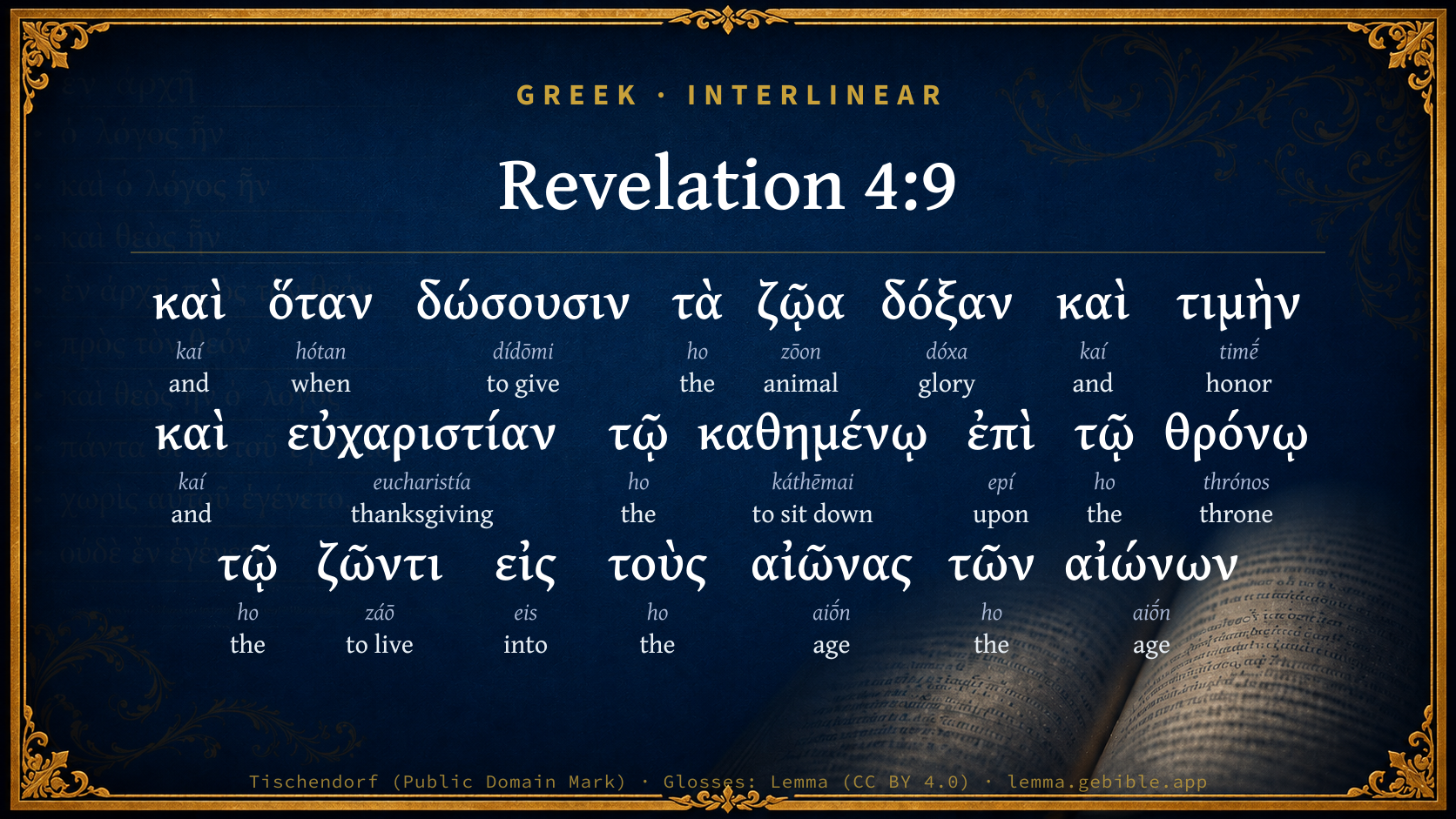
  1. καὶ kaí G2532 “and” Conjunction
  2. ὅταν hótan G3752 “when” Conjunction
  3. δώσουσιν dídōmi G1325 “to give” Verb, Future, Active, Indicative, 3rd person, Plural
  4. τὰ ho G3588 “the” Article, Nominative, Plural, Neuter
  5. ζῷα zōon G2226 “animal” Noun, Nominative, Plural, Neuter
  6. δόξαν dóxa G1391 “glory” Noun, Accusative, Singular, Feminine
  7. καὶ kaí G2532 “and” Conjunction
  8. τιμὴν timḗ G5092 “honor” Noun, Accusative, Singular, Feminine
  9. καὶ kaí G2532 “and” Conjunction
  10. τῷ ho G3588 “the” Article, Dative, Singular, Masculine
  11. καθημένῳ káthēmai G2521 “to sit down” Verb, Present, Middle or Passive deponent, Participle, Dative, Singular, Masculine
  12. ἐπὶ epí G1909 “upon” Preposition
  13. τῷ ho G3588 “the” Article, Dative, Singular, Masculine
  14. θρόνῳ thrónos G2362 “throne” Noun, Dative, Singular, Masculine
  15. τῷ ho G3588 “the” Article, Dative, Singular, Masculine
  16. ζῶντι záō G2198 “to live” Verb, Present, Active, Participle, Dative, Singular, Masculine
  17. εἰς eis G1519 “into” Preposition
  18. τοὺς ho G3588 “the” Article, Accusative, Plural, Masculine
  19. αἰῶνας aiṓn G165 “age” Noun, Accusative, Plural, Masculine
  20. τῶν ho G3588 “the” Article, Genitive, Plural, Masculine
  21. αἰώνων aiṓn G165 “age” Noun, Genitive, Plural, Masculine

About this verse

These counts appear in no published source. They are computed here, from the morphology-tagged text and Lemma’s own curated glosses. What Lemma adds →

22
words
14
distinct lemmas
Revelation
section

Notable vocabulary

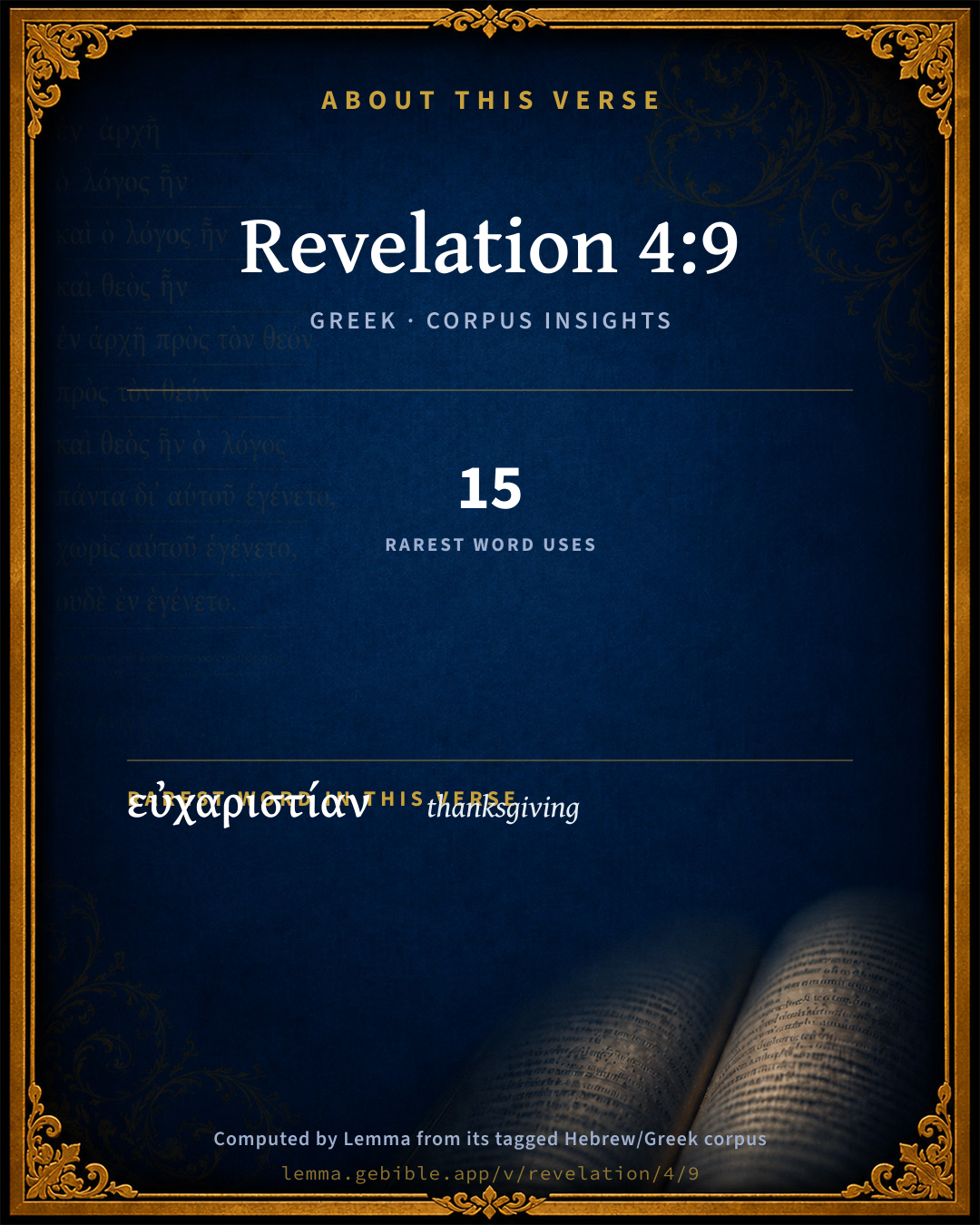
The rarest word here is εὐχαριστίαν thanksgiving G2169 — appearing just 15 times in the whole Greek New Testament.

Shared distinctive vocabulary

εὐχαριστίαν thanksgiving G2169 occurs in 15 verses of the Greek New Testament. Also found in:

Repetition

Words recur within this verse:

  • αἰῶνας age G165 ×2
  • τὰ the G3588 ×6
  • καὶ and G2532 ×3

Cross-references

12

Topical passages linked to Revelation 4:9 in the Treasury of Scripture Knowledge — connected by theme and wording, ordered by reader-vote popularity; previews shown in the World English Bible.

  • Revelation 5:13–14 I heard every created thing which is in heaven, on the earth, under the earth, on the sea, and everything in them, saying, "To him who sits on the throne, and to the Lamb be the blessing, the honor, the glory, and the dominion, forever and ever! Amen!"
  • Revelation 7:11–12 All the angels were standing around the throne, the elders, and the four living creatures; and they fell on their faces before his throne, and worshiped God,
  • Revelation 10:6 and swore by him who lives forever and ever, who created heaven and the things that are in it, the earth and the things that are in it, and the sea and the things that are in it, that there will no longer be delay,
  • Revelation 15:7 One of the four living creatures gave to the seven angels seven golden bowls full of the wrath of God, who lives forever and ever.
  • Psalms 47:8 God reigns over the nations. God sits on his holy throne.
  • Revelation 1:18 and the Living one. I was dead, and behold, I am alive forevermore. Amen. I have the keys of Death and of Hades.
  • Daniel 4:34 At the end of the days I, Nebuchadnezzar, lifted up my eyes to heaven, and my understanding returned to me, and I blessed the Most High, and I praised and honored him who lives forever; for his dominion is an everlasting dominion, and his kingdom from generation to generation.
  • Exodus 15:18 Yahweh shall reign forever and ever."
  • Psalms 48:14 For this God is our God forever and ever. He will be our guide even to death.
  • Daniel 12:7 I heard the man clothed in linen, who was above the waters of the river, when he held up his right hand and his left hand to heaven, and swore by him who lives forever that it shall be for a time, times, and a half; and when they have made an end of breaking in pieces the power of the holy people, all these things shall be finished.
  • Hebrews 7:8 Here people who die receive tithes, but there one receives tithes of whom it is testified that he lives.
  • Hebrews 7:25 Therefore he is also able to save to the uttermost those who draw near to God through him, seeing he ever lives to make intercession for them.

Cross-references courtesy of OpenBible.info (CC BY 4.0).

Commentary

Notes on Revelation 4:9 from classic Christian and Jewish commentators (each source and its license shown beneath its notes). The classic Christian expositions comment on the surrounding passage and are grouped to its opening verse, so a note may address several verses; the Jewish commentaries on the Tanakh (Rashi and others) are per-verse, so they appear only where the commentator wrote on this verse.

Lemma curates 59 commentaries, every one of them public domain or Creative Commons licensed, each selected and text-cleaned for this edition rather than reprinted as found. About our sources →

The Biblical Illustrator

Joseph S. Exell

Rev_4:9-11

The four and twenty elders fall down … and cast their crowns before the throne.

Royal homage

I. The saints in heaven are all crowned. How is this?

1. They are all kings, Dei gratia. There is not a king in heaven that has his crown on any other terms than this, by the sovereign grace of God.

2. But, though it may seem astonishing, they are all kings by hereditary descent. They have been born again, and it is in their new nature that they are before the throne of God.

3. They are also kings by marriage alliance. There is many a crowned head that would not have been so by descent, but has come to be so by being given in wedlock to a royal consort.

4. They are kings by right of conquest and of victory. A crown should signify, and did signify in the olden times, battling and contending. They are kings, then, because they have fought with sin and with temptation. Yea, the brightest of them have had to bear the brunt of fiercest persecutions.

5. Then the crowned heads in heaven have their crowns, and their crowns befit them well, because of the nobility of their character. They are sanctified, delivered from every taint of corruption, and now they are like their Lord Himself in holiness of character. Well should they be crowned whose character has thus been made glorious by the work of the Spirit of God within them!

6. And, once more, they have another right to their crowns, because those crowns represent real possessions. All things are theirs--the gift of God--and God is theirs and Christ is theirs. They are clothed with honour and majesty--not outwardly only but inwardly--and they have all the concomitants that should go with royal dignity.

II. They all cast their crowns before the throne.

1. Solemn reverence. They see more of God than we do, therefore are they more filled with awe and thrilled with admiration. Our reverence will always make us feel in the lowliest state of self-abasement at the foot of the throne!

2. Moreover, they are no doubt actuated by sincere humility. Reverence to God always brings a humble opinion of ones own self.

3. Doubtless, also, they do this for another reason, namely, because of their profound gratitude. They bless God that they are where they are, and what they are.

4. Above all, they are actuated by intense affection. They love their Lord, and loving their Lord they do anything to adore Him. They are glad to fling their richest goods, their choicest trophy, their most cherished treasure, at His feet: they love Him so.

III. Practical lessons.

1. By this text we can know whether we are on the way to heaven or not; because no man goes to heaven to learn for the first time heavenly things.

2. The next lesson is a lesson of unanimity. Our text says that all cast their crowns before the throne. There are no divided opinions in heaven, no sects and parties, no schisms there.

3. Once again, these redeemed ones in heaven teach us the true way of happiness. They set before us what perfect bliss is. There is no happiness beneath the clouds like the happiness of unselfishness. Strip yourself, and you clothe yourself. Throw, money away, and you grow rich--I mean in a spiritual sense. Happiness, again, consists in adoration, for these blessed spirits find it to be their happiness to adore God. The happiest days you ever spent are those in which you worshipped God most. But then they were not merely happy because they were self-denying and adoring, but because they were practical. They took off their crowns and laid them before the throne. And our joy on earth must lie in practically carrying out our principles. Cast your ability to do and to suffer, as well as the crown of your labour and patience, at the foot of your God; serve Him with all your heart and wisdom and strength, and thus, your self-denial and adoration being mixed therewith, you shall realise on earth as much as possible a foretaste of what the joy of heaven may be. (C. H. Spurgeon.)

The feelings of saints in heaven

I. The import of the action. It is necessary to recollect that all the rewards which await the righteous in heaven are often summed up in the comprehensive expression of a kingdom. Casting these crowns at the foot of the throne was, therefore, the same as casting their kingdom, with all its dignity, glory, and honour, at the feet of God and the Lamb.

1. It was an acknowledgment of what God is, and of what He deserves from His creatures.

2. It implied a more particular acknowledgment that to Him all the glory of their salvation belonged.

II. The feelings which prompted it, and of which it was an expression.

1. It was prompted by, it was an expression of, perfect humility.

2. It expressed, and was prompted by perfect love to God and the Redeemer.

3. It was prompted by, and expressed perfect gratitude.

4. It expresses the most profound reverence. (E. Payson, D. D.)

The crown

If we except the ever-blessed Cross, there is no such symbol as the crown. It speaks of honour and exaltation, and of the care which attends them. The crown denotes power, dominion, victory, and possession: it indicates, not less evidently, anxiety, responsibility, uneasiness, and toils of once. Beyond all these, It gives the idea of completeness; of such completeness as belongs to any creature, any estate, or any condition. That which perfects and finishes a joy or a sorrow is called its crown; the crown of happiness, the crown of misery, are set upon them by some event after which they cannot be enhanced. The Lord Protector Cromwell was wont to speak of a certain decisive battle as his crowning mercy; and the first of living poets says that a sorrows crown of sorrow is remembering happier things. So full of meaning is the word that there seems no end to what it can express. Those four-and-twenty are examples of such as enter into the rest of God; who have obtained the crown of righteousness, because they were counted worthy of it, and give proof of their merit in the perfection of their self-renunciation. What may be done by way of experiment to become true, sincere, and simple-hearted followers of the servants of God? Material for practice abounds. God hath made us kings and priests unto Himself: and even before this, in his natural estate, man is the head and lord of all the works of our Fathers hand. We wear as men the crown of dominion over inferior orders of animals; as redeemed men, we wear the crown of a royal estate of sons of God by adoption and inheritors of the kingdom of heaven. Here are the crown of nature and the crown of grace both associated with our life in this world. These, moreover, denote privilege, power, and duty; and first a man should ask himself whether he be doing his duty in that state unto which it has pleased Almighty God to call him: for if not, the sign of his native dignity and superadded honour, even already, ere life be spent, is tarnishing around his temples, and looking as though presently it might crack asunder and fall into the dust. But this is merely the beginning; these things are common to us all. Over and above what pertains to our state as men, and what is generally necessary to our salvation, comes that which stamps the individual as distinct from his fellows. There be as many crowns as heads to wear them. God, who sees all, sees something in each life which makes that lifes crown. It may be a crown of happiness, or a hard ring of sorrow; a crown of mercy and blessing in basket and store, in goods and lands, in home and household, or a crown of poverty, affliction, and grief. Whatsoever it be, each life has its crown, to distinguish it from all the rest. These we must wear, each in the order of his lot: and, knowing that ye all have them, let me ask you whether you are offering, each his own crown, of joy, or pain, or care, as the case may be, to God? Some of you have the lot of toil: your crown is an iron band clasped around the head by the fingers of necessity: are you, in spirit, casting that before the throne, and offering your work and daily tasks to God? Some of you have been born to wealth, or have acquired it: your crowns are precious, and worth much money; are you, in spirit, offering them to God, and saying as you do mercy and give aims, Thine, O Lord, are these, and of Thine own do we offer to Thee? Some of you are very happy, in domestic relations, in social position, as life runs on smoothly and successfully; your crowns are crowns of mercies; are you daily offering them at the foot of the throne, acknowledging their Author and pouring out the tribute of your thanks? (Morgan Dix, D. D.)

Rightful homage

England was perhaps never more humiliated than when John took off his crown and placed it in the hands of Pandulph, the Popes legate, and then received it from him as from the Pope. It was mean in John so to abase himself, especially after he had boasted that no Italian priest shall tithe or toll in our dominion. It would have been less disgraceful in him to have hurled his crown among the reeds beside the Thames, than to have put it in the hands of Pandulph. But the royal people in heaven are right in doing homage for their crowns before the throne of God. By that act they confess their indebtedness to God for their crowns. (J. Marrat.)

Man in heaven

I. Man in heaven has reached the highest dignity. He has crowns.

1. Have faith in the improvability of our nature.

2. Let us be consoled under the departure by death of the good.

3. Let us not judge of providence without taking into account the future as well as the present.

II. Man in heaven ascribes the dignity he has reached to Jesus Christ. They cast their crowns, etc.

1. A conviction that they owed all their honours to Christ.

2. A readiness to acknowledge their obligation. The greater our nature the more ready to acknowledge our obligation.

3. The surpassing glories of Christ,. He is in the midst of the throne, and all ascribe their all to Him. Napoleon the First, after he had conquered empires, and planted his foot upon the neck of kingdoms, determined to be crowned Emperor. To give pageantry and lustre to the occasion, he compelled the Pope of Rome to be present. In the act of coronation, the emperor refused to receive the crown from the Pope; his proud spirit told him he had won it himself: he placed it upon his own brow, thus declaring to the spectators and the civilised world the fact that he was indebted to himself only for imperial power. There is nothing of this spirit in heaven; they all cast their crowns at the feet of Christ, and say, Thine is the kingdom, the power and the glory. (Homilist.)

Glory to the glorious One

Jesus, Messiah, the Lamb that was slain, the King on the throne, Creator of the universe, Head of all things, is He who is worthy to receive the glory! And why?

I. Because of His person. As having in Himself all the perfections of the Creator and of the creature; as very God and very man; the Word made flesh--He is worthy to receive glory. Godhead and manhood, united in one wondrous person, make Him infinitely glorious.

II. Because of His work. The excellency of His propitiation is infinite. It is--

1. Excellent in itself.

2. In its revelation of Divine wisdom.

3. In its manifestation of Divine love.

4. In its reconciliation of grace with righteousness.

5. In its everlasting results. Because of such a work it is said, Thou art worthy to receive glory.

III. Because of His life on earth. His whole earthly life was marvellous. There has been nothing like it, neither shall be. It was absolute perfection in every part: the perfection of a human life.

IV. Because of the redemption of His church.

V. Because of what He is now in heaven. He has triumphed over His enemies; He has abolished death; He has emptied the grave; He has risen; He has ascended on high; He ever lives to intercede; He is the head of principalities and powers; He sits on the right hand of the throne of the Majesty in the heavens.

VI. Because of what He is to be and to do when He comes again.

1. Let us appreciate His excellency.

2. Let us thoroughly trust and love Him.

3. Let us make use of His fulness.

4. Let us bow before Him.

5. Let us sing the song of praise. (H. Bonar, D. D.)

God glorified in heaven for tits works of creation and providence

I. The heavenly Church acknowledge that God created all things.

II. That all things are and were created for Gods pleasure or will.

III. That all intelligent beings are bound to glorify God for His works of creation and providence.

1. These works should lead us to the knowledge and contemplation of their great and glorious Author.

2. We should glorify God in His works, by improving them to awaken in our souls pious affections to Him.

3. The works of God should invite us to Him in the humble exercises of devotion.

4. We are to glorify God for our own existence.

5. If creation deserves our praise, redemption deserves it still more, for this is our hope. (J. Lathrop, D. D.)

Give God the glory

After the battle of Agincourt it is said of Henry V. that, desiring to acknowledge the Divine interposition, he ordered the chaplain to read a Psalm of David, and, when he came to these words, Not unto us--not unto us, O Lord! but unto Thy name give glory and praise, the king dismounted, his officers dismounted--the cavalry all dismounted, great hosts of officers and men fell on their faces in reverence to their Great Deliverer. When we contemplate what great victories we have attained over sin, through Christ, how fitting to fall before God in thanksgiving and praise, crying, Not unto us, but unto Thy name be the praise. (A. J. Gordon, D. D.)

For Thy pleasure they are and were created.--

Creation the consequence of love

I. Remember what is involved in the notion of creation. It is not the bringing order out of disorder, beauty out of shapelessness and confusion. To create is to make out of nothing. But the truth that God created out of nothing, whilst it exalts immeasurably our conception of His Majesty, makes the question yet more urgent: Why did He create? We reply, that it seems to follow from the very nature of God, that He should create. God we believe to be all Good, the Fountain of Love, yea, Love itself. Must not a Being thus gracious, and thus in Himself an inexhaustible source of happiness, desire to communicate of His fulness unto others? Must not He, who is both wise and beneficent, desire to dispense wisdom? Must not He who has all power, if He be liberal, seek to give power? Throned in the light inaccessible, alone, and all-sufficient, He dwells in the plenitude of His own glory, lacking nothing, dependent upon none--a universe to Himself, to Himself all in all. Myriads of angels growing up around Him would add nought to His happiness. And not therefore for any selfish ends (as we term them) did God become a Creator. And yet was it for Himself? Yea, for Himself, we read throughout Scripture, God made the worlds. Of Him are all things, and for Him are all things, writes the apostle. Even so. Gods nature urged Him, nay, if we may dare so speak, compelled Him to create. Abounding in love, His love would not let Him dwell alone. The air and the water, the very dust of the ground teem, you know, with living things. Life meets us everywhere. We can detect no end answered by millions of creatures which swarm around us. It may be they do answer no end. But the love of God constrains Him to create, ay, if it be but to give to the tiny animalculae in the drop of water a moments taste of the pleasure of existence. And thus we seem to apprehend, in a measure at any rate, why God is to be rejoiced in as a Creator; ay, why the heavenly inhabitants should praise Him as having created all things for His pleasure. Creation is the most overwhelming demonstration that God is Love; creation is the Ocean of Divine love, overflowing its banks, and pouring itself forth beyond all bounds.

II. Has the act of creation been, on the whole, productive of more happiness or misery? What if, where Gods love is manifested, Gods justice must also be revealed; is this a reason why His love should be restrained? Nay; we still find in that love the cause of the authorship of our being; we recognise in that love the source of creation, though love could not have free course without giving scope for vengeance also; and we marvel not that the eternal dwellers should unweariedly say, Worthy art Thou to receive glory, etc. (Bp. Woodford.)

.

The Biblical Illustrator, edited by Joseph S. Exell (c. 1880s–1900s) — public domain. Text from a community e-Sword module.

Joseph Benson's Commentary

Rev 4:9-11. And when those living creatures give glory, &c., the elders fall down — That is, as often as the living creatures begin their song of adoration and praise, the elders immediately fall down. The expression implies that they did so at the same instant, and that they both did this frequently. The living creatures do not say directly, Holy, holy, holy art thou; but only bend a little, out of deep reverence, and say, Holy, holy, holy is the Lord. But the elders, when they are fallen down, say, Thou art worthy, O Lord, to receive glory — This he receives, not only when he is thus praised, but also when he destroys his enemies, and glorifies himself anew; glory, &c. — In the Greek, (which has the article with each noun,) it is, the glory, and the honour, and the power; answering the thrice holy of the living creatures, Rev 4:9. For thou hast created all things — By thine almighty energy. Creation is the ground of all the works of God. Therefore for this, as well as for all his other works, he must and will be praised to all eternity. And for thy pleasure — Δια το θελημα σου, on account of thy will; they are — They exist; and were at first created — Their first production and continued existence are owing to the riches of thy free goodness; and therefore they are all under the strongest obligations, according to their respective natures, to subserve the purposes of thy glory.

Joseph Benson's Commentary on the Old and New Testaments (1811–1818) — public domain. Text from a community e-Sword module.

Tyndale Open Study Notes

Tyndale Open Resources

4:9-11 The antiphonal chorus of twenty-four elders provides divine perspective on creation. • The one sitting on the throne is typical Jewish indirection to avoid speaking God’s name.

Tyndale Open Study Notes — © Tyndale Open Resources, licensed CC BY-SA 4.0. Text via the HelloAO Bible API.

Bengel's Gnomon

Johann Albrecht Bengel

Rev 4:9-10. Ὅταν δώσουσι—πεσοῦνται) Each future expresses a simultaneous act of giving of glory on the part of the beasts and on the part of the elders: and, at the same time, it has a frequentative force: As often as the beasts give glory, immediately the elders fall.

Bengel's Gnomon of the New Testament — English translation (T&T Clark, Edinburgh, 1860) — public domain. Text from a community e-Sword module.

Meyer's Critical & Exegetical Commentary

Heinrich August Wilhelm Meyer

Rev_4:9. ὅταν δώσουσι. The fut., instead of the regular sub.,[1825] does not present a conception that is strictly future,[1826] but has, like the Heb. imperfect, the force of a frequentative: when, as often as.[1827]

ΔΌΞΑΝ ΚΑῚ ΤΙΜῊΝ. Viz., the worshipful acknowledgment of the glory and honor[1828] belonging to the Lord;[1829] while by ΚΑῚ ΕὐΧΑΡΙΣΤΊΑΝ is designated immediately, and without metonymy, the thanksgiving[1830] rendered by the creature.

Τῶ ΚΑΘΗΜΈΝῼ

ΑἸΏΝΩΝ. So God calls the enthroned God very similarly as the four beasts praise him, and in the same respect. Hence, also on cemore in Rev_4:10, the same designation of God, comprising the reason for the praise, and the ground of all hope and prophecy.

On Rev_4:10, cf. Rev_5:8; Rev_19:4. The casting-down of the crowns is, together with the falling down and worshipping, the sign of humiliation before the King and Lord, in whose presence no creature whatever has any glory or honor of its own.[1831]

[1825] Winer, p. 289 sq.

[1826] From now, and to all the future. Cf. Rev_7:15 sq. It is not so earlier, because only since the work of redemption is in progress, and the victory of Christ in development, are the twenty-four elders in this position and occupation. De Wette; cf. Stern.

[1827] Vitr., Beng., Hengstenb., Ebrard, etc.

[1828] Cf. Psa_29:1; Psa_96:7. Hengstenb., etc.

[1829] Cf. Rev_1:6.

[1830] Hengstenb.

[1831] Cf. Tacit., Annal., xv. 29: To which (statue of Nero) Tiridates, having advanced, cast before the image the diadem removed from his head.

Rev_4:9-11. The ascription of praise to God by the representatives of the creation, viz., the four beasts, is joined by that of the twenty-four elders, the representatives of redeemed humanity;[1824] yet here the praise of the elders (Rev_4:11) refers not to redemption itself,which first occurs in Rev_5:9 sq.,but to the power and glory of God revealed in creation, so that the words of the elders stand in beautiful harmony with the praise of the four beings, as well as with the significance of the entire vision; of course not without the relation expressly indicated in Rev_4:8, and lying at the basis, that Almighty God, who has made the beginning of all things, will also bring them to a completion.

[1824] Cf. De Wette, Hengstenb., Ebrard.

Meyer — Critical and Exegetical Commentary on the New Testament — English translation by Peter Christie, edited by Frederick Crombie (T&T Clark, 1880) — public domain. Text from a community e-Sword module.

Expositor's Greek Testament

ed. W. Robertson Nicoll

Rev 4:9 . The frequentative meaning of δώσουσι comes from the sense rather than from the grammar of the passage. “Whenever,” etc. ( i.e. , throughout the course of this book, Rev 5:8 f., Rev 11:16 f., Rev 19:4 ) is “a sort of stage-direction” (Simcox). It would be harsh to take the words as a proleptic allusion to the single occurrence at Rev 11:15 f. (J. Weiss). To give or ascribe δόξα to God is reverently to acknowledge his supreme authority, either spontaneously and gladly (as here and Rev 19:7 , where “honour” becomes almost “praise”) or under stress of punishment (Rev 11:13 , Rev 14:7 , Rev 16:9 ) and fear of judgment. The addition of τιμή in doxologies amplifies the idea, by slightly emphasising the expression of that veneration and awe felt inwardly by those who recognise his δόξα . To fear God or to be his servants is thus equivalent upon the part of men to an attitude of pious submission and homage. To “give thanks” is hardly co-ordinate with δ . κ . τ ., but follows from it as a corollary ( cf. Psalms 96-98). Such worship is the due of the living God (Rev 7:2 , Rev 10:6 , Rev 15:7 ), whereas to eat “meat sacrificed to idols is to worship dead gods” (Did. vi. 3, cf. Rev 2:14 ; Rev 2:20 ). The Apocalypse, however, never dwells on the danger of idolatry within the Christian church; its attention is almost absorbed by the supreme idolatry of the Emperor, which is silently contrasted in this and in other passages with the genuine Imperial worship of the Christian church. “He who sits on the throne” (a title of Osiris in E. B. D. ) is the only true recipient of worship. Cf. the hymn to “Ra when he riseth”: “Those who are in thy following sing unto thee with joy and bow down their foreheads to the earth when they meet thee, thou lord of heaven and earth, thou king of Right and Truth, thou creator of eternity”.

The Expositor's Greek Testament, edited by W. Robertson Nicoll (1897–1910) — public domain. Text from a community e-Sword module.

Geneva Bible (1599)

Geneva Bible translators

God is said to have glory, honor, kingdom, and such like given unto him, when we godly and reverently set forth that which is properly and only his.

Geneva Bible (1599) marginal notes — public domain. Text via Bolls.life.

Jamieson, Fausset & Brown

Robert Jamieson, A. R. Fausset & David Brown

The ground of praise here is God's eternity, and God's power and glory manifested in the creation of all things for His pleasure. Creation is the foundation of all God's other acts of power, wisdom, and love, and therefore forms the first theme of His creatures' thanksgivings. The four living creatures take the lead of the twenty-four elders, both in this anthem, and in that new song which follows on the ground of their redemption (Rev 5:8-10).

when--that is, whensoever: as often as. A simultaneous giving of glory on the part of the beasts, and on the part of the elders.

give--"shall give" in one oldest manuscript.

for ever and ever--Greek, "unto the ages of the ages."

Jamieson, Fausset & Brown — Commentary Critical and Explanatory on the Whole Bible (1871) — public domain (CC PDM 1.0). Text via the HelloAO Bible API.

Ellicott's Commentary for English Readers

(9, 10) And when those beasts . . .—Better, And whensoever the living beings shall give (the future is used) glory and honour and thanks to Him who sitteth upon the throne, to Him who liveth to the ages of ages, the four-and-twenty elders shall (as is their wont) fall down before Him who sitteth on the throne, and worship Him that liveth unto the ages of ages, and shall (as is their wont) cast their crowns before the throne, saying ... It is not to Him who sat upon the throne, but to Him who sitteth there, as he liveth to the ages of ages, that this homage is paid. The future tense (shall give glory, &c.) implies the eternal repetition of the act. The connection between the praise given by creation, and the consequent homage of the twenty-four elders, expresses a truth. The Church of Christ does not always hear the voice of praise from created things. Often the creation groaneth” and travaileth; but her chorus of praise rises when she perceives that “every thing that hath breath praiseth the Lord.” The converse of this thought — the earth bringeth forth her fruit when the people praise God—is hinted in Psa_67:5-6, “the earth ceases her travail when the sons of God are made manifest (Rom_8:19-21).

Crowns.—The crowns are not royal crowns, but the crowns of conquerors. These are laid down before the throne by those who overcame, not in their own might, but through the blood of the Lamb (Rev_12:11; comp. Rev_7:14).

A Bible Commentary for English Readers, edited by Charles John Ellicott (1878–1897) — public domain. Text from a community e-Sword module.

The Cambridge Bible for Schools and Colleges

gen. ed. J. J. S. Perowne

9, 10. And when those beasts, &c.] Read And when the living creatures shall give glory and honour and thanks to Him that sitteth upon the Throne, to Him that liveth for ever and ever, the four and twenty elders shall fall down before Him that sitteth …, and shall worship Him …, and shall cast.…” The meaning of the futures is doubtful: some take it as “implying eternal repetition of the act.” Or the meaning may be (if one may say so reverently) a sort of stage direction: “during the future course of the vision, these (who never leave the scene) are to be understood to be thus employed.” But it is always a question in this Book whether the use of tenses be not accommodated to the rules of Hebrew rather than Greek grammar: the sense may after all be merely frequentative.

cast their crowns] Alford compares Tac. Ann. XV. xxix. 3, 6, where Tiridates lays down his crown before the image of Nero, as a token of homage for his kingdom.

The Cambridge Bible for Schools and Colleges (gen. ed. J. J. S. Perowne; Cambridge University Press, 1878–1918) — public domain. Text from a community e-Sword module.

John Gill's Exposition

And when these beasts give glory,.... When they give God the glory of all his perfections, covenant, and promises, and of all the gifts and grace bestowed on them, and of the success of their ministry; and in it glorify Father, Son, and Spirit, who bear their respective parts in the business of salvation; and ascribe to each their due glory in election, redemption, and sanctification:

and honour; in the several parts of religious worship performed by them; and not with their lips only, but with their hearts also:

and thanks; for all blessings, temporal and spiritual, bestowed on them, and on the saints: even

to him that sat on the throne; God the Father, Rev 4:3;

who liveth for ever and ever; he who is the living God, and will always continue so.

John Gill's Exposition of the Whole Bible (1746–1763) — public domain (CC PDM 1.0). Text via the HelloAO Bible API.

Trapp's Complete Commentary

John Trapp

9 And when those beasts give glory and honour and thanks to him that sat on the throne, who liveth for ever and ever,

Ver. 9. And when those beasts] When the preachers are performing their office, as heralds of God’s praises.

John Trapp, A Commentary or Exposition upon All the Books of the Old and New Testament (1647–1656) — public domain. Text from a community e-Sword module.

Albert Barnes' Notes on the Bible

And when those beasts give glory ... - As often as those living beings ascribe glory to God. They did this continually Rev 4:8; and, if the above explanation be correct, then the idea is that the ways and acts of God in his providential government are continually of such a nature as to honor him.

Albert Barnes' Notes on the Bible (1834–1885) — public domain. Text from a community e-Sword/MySword module.

Matthew Poole's English Annotations

And when those beasts, the living creatures before expressed, signifying the ministers of the gospel,

give glory, &c.; when they praise God who is eternal.

Matthew Poole's English Annotations on the Holy Bible (1683–1685) — public domain. Text from a community e-Sword/MySword module.

Whedon's Commentary on the Bible

Daniel D. Whedon

9. Glory and honour and thanks—A threefold divine ascription.

Daniel D. Whedon (gen. ed.), Commentary on the Old and New Testaments (1874–1909) — public domain. Text from a community e-Sword module.

The Pulpit Commentary

And when those beasts give; or, and as often as the living belongs shall give. The expression has a frequentative force, and also points to a continued repetition of the act in the future; perhaps a contrast to the past, since before the redemption the Church, as being of the whole world, could not join in the adoration. Glory and honour and thanks. The Eucharistic hymn recognizes the glory and honour which are the inseparable attributes of God, and renders the thanks due to him from his creation. To him that sat on the throne, who liveth forever and ever; or, to him sitting on the throne. The Triune God (see on ver. 2). "Who liveth forever and ever" declares that attribute which was ascribed to God, in the song of the living beings, by the words, "which was, and is, and is to come" (see on ver. 8).

Vers. 9-11. The Church"s song of praise.

The elders speak for all and appear for all. In them all are present. As is promised again and again, the Church surrounds the throne. It is the sign of the Church"s recognition and highest honour.

I THE SUBJECT OF THE SONG. That of "the living creatures" is "the Lord God," the Almighty, the Ever-living. The subject of the Church"s song is the creative power of God, in recognition of which "glory, honour, and power" are ascribed. It is the ground of hope for the final triumph of the Divine kingdom over the opposing kingdom of evil which is so soon to be brought into view.

II The song is offered by the Church"s representatives; it symbolizes THE ENTIRE CHURCH REJOICING IN THE UNIVERSAL SONG OF PRAISE. When the living creatures shall give glory." The Church"s song of praise for redemption wilt presently be heard; but it is preceded, as is most meet, by praise to God "for his excellent greatness and for his mighty acts.

III The song is presented by the Church IN LOWLY PROSTRATION. Never do the songs of praise from the earth rise higher than when presented in the lowliest humility. Not only do the elders "fall down before him that sitteth on the throne," but in recognition of his absolute supreme authority, they "cast their crowns before the throne." In presence of the one Lord, all authority, all honour, all might, must be ignored.

IV The matter of the song recognizes THE EXALTED WORTHINESS OF THE MOST HIGH, to whom pertains the highest "glory, honour, and power," illustrated in the creation of all things.

V The song terminates in AN ADORING ACKNOWLEDGMENT OF THE FINAL END OF CREATION. "Because of thy will." "He spake, and they were created: he commanded, and they stood fast." The "will" expresses the pleasure of God, and for his pleasure they are, and were created. The end of their being is not to be found in themselves, but in the Divine will. It is worthy. And as by the Divine will all things are, so all things will be made to serve that will, yea, even the rebellious elements in human life, for he will make the wrath of man to praise him. R.G.

The Pulpit Commentary (1880–1919), ed. H.D.M. Spence-Jones & Joseph S. Exell — public domain. Text from a community e-Sword module.

John Wesley's Explanatory Notes

And when the living creatures give glory-the elders fall down - That is, as often as the living creatures give glory, immediately the elders fall down. The expression implies, that they did so at the same instant, and that they both did this frequently. The living creatures do not say directly, "Holy, holy, holy art thou;" but only bend a little, out of deep reverence, and say, "Holy, holy, holy is the Lord." But the elders, when they are fallen down, may say, "Worthy art thou, O Lord our God."

John Wesley, Explanatory Notes Upon the Whole Bible (1754–1765) — public domain. Text via the GEBible commentary corpus.

Scofield Reference Notes

C. I. Scofield

beasts

living creatures. (See Scofield "Eze 1:5")

The Scofield Reference Bible (1917 edition), notes by C. I. Scofield — public domain. Text from a community e-Sword module.

Burkitt's Expository Notes on the New Testament

William Burkitt

Observe here, 1. How St. John saw both beasts and elders, representing ministers and people, unitedly joining together; and with one consent sounding forth the high praises of their God; intimating, how the whole body of sincere Christians ought heartily to join with their faithful ministers in that blessed work of praising and worshipping the eternal God.

Observe, 2. That as a farther act of homage and adoration, the four and twenty elders cast their crowns down to the ground; not in a way of contempt and disdain, as if they slighted the glory conferred upon them by God, but in a way of humble gratitude; attributing their victory and reward to God, and not to themselves of it, that they may put honour upon God; professing hereby, that all the goodness wrought in them, or done by them, does proceed from God’s free grace and mercy, and that the glory of it is entirely due to him.

Observe, 3. The hymn of thanksgiving itself, which was jointly sung among them. Worthy art thou O Lord, to receive glory, and honour, and power. As if they had said, That God thou art, unto whom all the homage and adoration of thy creatures are justly and peculiarly due; for thou hast created all things by thy omnipotent power, and for thy pleasure and the manifestation of thy glory, they are still preserved as they were at first created.

Where remark, That every moment’s preservation is virtually a new creation, and that the same omnipotent power is necessary every moment to preserve us, which was at first requisite to create us.

Therefore worthy art thou, O Lord, to receive glory, and honour, and everlasting praises, as thou art He who givest being to all creatures, and therefore givest it them, that they might love and laud, magnify and bless, glorify and serve, honour and obey, thee, their great creator and gracious preserver. Amen.

William Burkitt's Expository Notes on the New Testament (1700–1703) — public domain. Text from a community e-Sword module.

The People's New Testament

B. W. Johnson

9–11. And when the living creatures shall give glory and honor and thanks to him that sitteth on the throne. Shall utter such praises as are given in verse 8. Then the twenty-four elders also join in swelling the anthems. It will be noted that these two classes, whatever they signify, are both about the throne, and both engaged in harmonious praise of the Almighty.

B. W. Johnson's The People's New Testament with Notes (1889–1891) — public domain. Electronic text from the Christian Classics Ethereal Library (CCEL) ThML edition.

unfoldingWord translationNotes

Door43 World Missions Community

the one who sits on the throne, the one who lives forever and ever

This is one person. The one who sits on the throne lives forever and ever.

forever and ever

These two words mean about the same thing and are repeated for emphasis. AT: "for all eternity" (See: Doublet)

twenty-four elders

"24 elders." See how you translated this in Revelation 4:4. (See: Numbers)

fall down

They purposely lie down facing the ground to show that they are worshiping.

They lay their crowns before the throne

These crowns looked like wreaths of olive branches or laurel leaves, hammered out in gold. The elders were respectfully placing the crowns on the ground, showing that they were submitting to God's authority to rule. AT: "they lay their crowns before the throne to show that they were submitting to him" (See: Symbolic Action)

lay

Possible meanings are 1) to place or 2) to throw down forcibly, as of something worthless ("throw," Revelation 2:22). The reader should understand that the elders are acting respectfully.

our Lord and our God

"our Lord and God." This is one person, the one who was sitting on the throne.

to receive glory and honor and power

These are things that God always has. Being praised for having them is spoken of as receiving them. AT: "to be praised for your glory, honor, and power" or "for everyone to praise you because you are glorious, honorable, and powerful" (See: Metonymy)

translationWords

life

creature

glory

honor

throne

eternity

elder

bow

crown

worthy

lord

God

power

create

unfoldingWord translationNotes — © Distant Shores Media and the Door43 World Missions Community, licensed CC BY-SA 4.0. Source: git.door43.org/Door43/en_tn.

Cambridge Greek Testament for Schools and Colleges

9–11. THE HOMAGE OF THE ELDERS

9. δώσουσιν. Primas[170] reads dederant (=? ἔδωκαν); Vg[171] darent (=? δώσωσιν אB2 δωσιν Areth[172]). In Rev 4:10 Haussleiter edits cadebunt adorabunt.

[170] Primasius, edited by Haussleiter.

[171] Vulgate.

[172] Arethas, Archbishop of Caesarea.

9. καὶ ὅταν δώσουσιν τὰ ζῷα.… The meaning of the futures is doubtful: some take them as “implying eternal repetition of the act.” Or the meaning may be (if one may say so reverently) a sort of stage direction: “during the future course of the vision, these (who never leave the scene) are to be understood to be thus employed.” But it is always a question in this book whether the use of tenses be not accommodated to the rules of Hebrew rather than Greek grammar: the sense may after all be merely frequentative.

Cambridge Greek Testament for Schools and Colleges (Cambridge University Press, 1896; 21 vols, various authors incl. Carr, Maclear, Plummer, Farrar, Lumby, Moule, M. R. James, Simcox) — public domain. Text from a community e-Sword module.

Alford’s Greek Testament

Henry Alford

9-11.] The everlasting song of praise of creation, in which the church joins. It is well observed by Düsterd., that the ground of this ascription of praise is not redemption, which first comes in ch. 5:9 ff.,—but the power and glory of God as manifested in Creation; so that the words of the elders are in beautiful harmony with the praise of the four living-beings, and with the signification of the whole vision. And whensoever the living-beings shall give (the future δώσουσι must not be pressed quite so strongly as is done by De Wette (so also Stern), “from henceforth for all the time to come: see ch. 7:15 ff.: beforetime it was not so, seeing that the 24 elders have only assumed their place since Christ’s work of Redemption has been proceeding and His victory developing.” Still, it is more than a mere frequentative put for the regular subjunctive, as Düsterd., after Vitr., Beng., Hengstb., and Ebr. It has a distinct pointing onward towards the future, implying eternal repetition of the act, which the subjunctive would not carry) glory and honour (i. e., recognition of His glory and honour) and thanksgiving (i. e. actual giving of thanks: the 3 accusatives are not strictly co-ordinate in meaning) to Him that sitteth upon the throne, to Him that liveth to the ages of the ages, the twenty-four elders shall fall down before Him that sitteth upon the throne, and shall worship Him that liveth to the ages of the ages (cf. ch. 5:8, 19:4), and shall cast down their crowns (to disclaim all honour and dignity of their own, and acknowledge that all belongs to Him. See instances of casting down crowns cited in Wetstein. Cf. especially Tacit. Ann. xv. 29: “ad quam (effigiem Neronis) progressus Tiridates … sublatum capiti diadema imagini subjecit”) before the throne, saying, Thou art worthy, O Lord and our (Düsterd. remarks that the ἡμῶν has a force here peculiarly belonging to the 24 elders, as representing the redeemed, and thus standing in a covenant relation to God nearer than that of the 4 living-beings. But we must not forget, that Creation is only a part of Redemption, Col 1:20) God, to receive the glory (τὴν δ. &c., as alluding to the δόξα &c., ver. 9, ascribed by the living-beings. The articles are improperly omitted in E. V.) and the honour and the might (observe that τὴν δύναμιν in the mouth of the 24 elders represents εὐχαριστίαν in that of the 4 living-beings. The elders, though themselves belonging to creation, in this ascription of praise look on creation from without, and that thanksgiving, which creation renders for its being, becomes in their view a tribute to Him who called them into being, and thus a testimony to His creative power. And thus the reason follows): because Thou didst create all things (τὰ πάντα, “this universal whole,” the universe), and on account of Thy will (i. e. because Thou didst will it: “propter voluntatem tuam,” as Vulg.: not durch Deinen Willen, as Luther, which represents διὰ with a gen. “For thy pleasure,” of the E. V., introduces an element entirely strange to the context, and however true in fact, most inappropriate here, where the ὅτι renders a reason for the ἀξιότης of ἡ δόξα, ἡ τιμή, and ἡ δύναμις) they were (ἦσαν, not = ἐγενήθησαν, came into being, as De W., al.: for this it cannot signify: nor again, though thus the requirement of ἦσαν would be satisfied, as Lyra, “in dispositione tua ab æterno, antequam crearentur:” nor, as Grot., “erant jam homines quia tu volueras, et conditi sunt, id est, iterum conditi, per Christum:” nor again as Bengel, “all things were, from the creation down to the time of this ascription of praise and henceforward.” The best explanation is that of Düsterd., they existed, as in contrast to their previous non-existence: whereby not their coming into being, but the simple fact of their being, is asserted.

The remarkable reading οὐκ ἦσαν is worth notice: “by reason of Thy will they were not, and were created:” i. e. “they were created out of nothing.” But besides the preponderance of authority the other way, there is the double chance, that οὐκ may have arisen from the preceding ου, and that it may have been an escape from the difficulty of ἦσαν) and were created (they both had their being,—ἦσαν; and received it from Thee by a definite act of Thine,—ἐκτίσθησαν).

Henry Alford, The Greek Testament (1849–1861) — public domain. Text from a community e-Sword module.

Vincent's Word Studies in the New Testament

Marvin R. Vincent

When [οταν] . Whensoever, implying, with the future tense, the eternal repetition of the act of praise.

Give [δωσουσιν] . Lit., as Rev., shall give.

Marvin R. Vincent, Word Studies in the New Testament (1887–1900) — public domain. Text from a community e-Sword/MySword module.

Lesson kit

Teaching starters — assembled from the data on this page, not authored interpretation. Every prompt links to the verse data it draws on. Edit before teaching.

Revelation, in the Revelation, opens this verse with 22 words (14 distinct Greek lemmas). Its most distinctive word is eucharistía (“thanksgiving”). A historical commentator’s framing appears above. Read the whole chapter for the surrounding context.

Discussion questions

  1. The word eucharistía carries the sense “thanksgiving.” How does it shape the verse?
  2. Acts 24:3 shares the word «thanksgiving» with this verse. How do the two illuminate each other?
  3. “age” occurs 2× in this one verse. What is the effect of the repetition?
  4. The translations on this page render this verse differently — a whole-verse word diff, not a word-by-word alignment. What might account for the different wordings?
  5. Reading how The Biblical Illustrator and Joseph Benson's Commentary read this verse, where do the two commentators agree and where do they part?

Things to notice

Reading settings

Reading text

Shown beneath each verse's original-language words.

Old Testament
Old Testament edition

Read the OT as the Masoretic Hebrew (MT) or the Greek Septuagint (LXX).

English shown for the Greek Septuagint (in the Hebrew ↔ Greek comparison).

Comparing translations? Open the Compare panel on any verse page to stack up to four side by side.