Acts 13:12

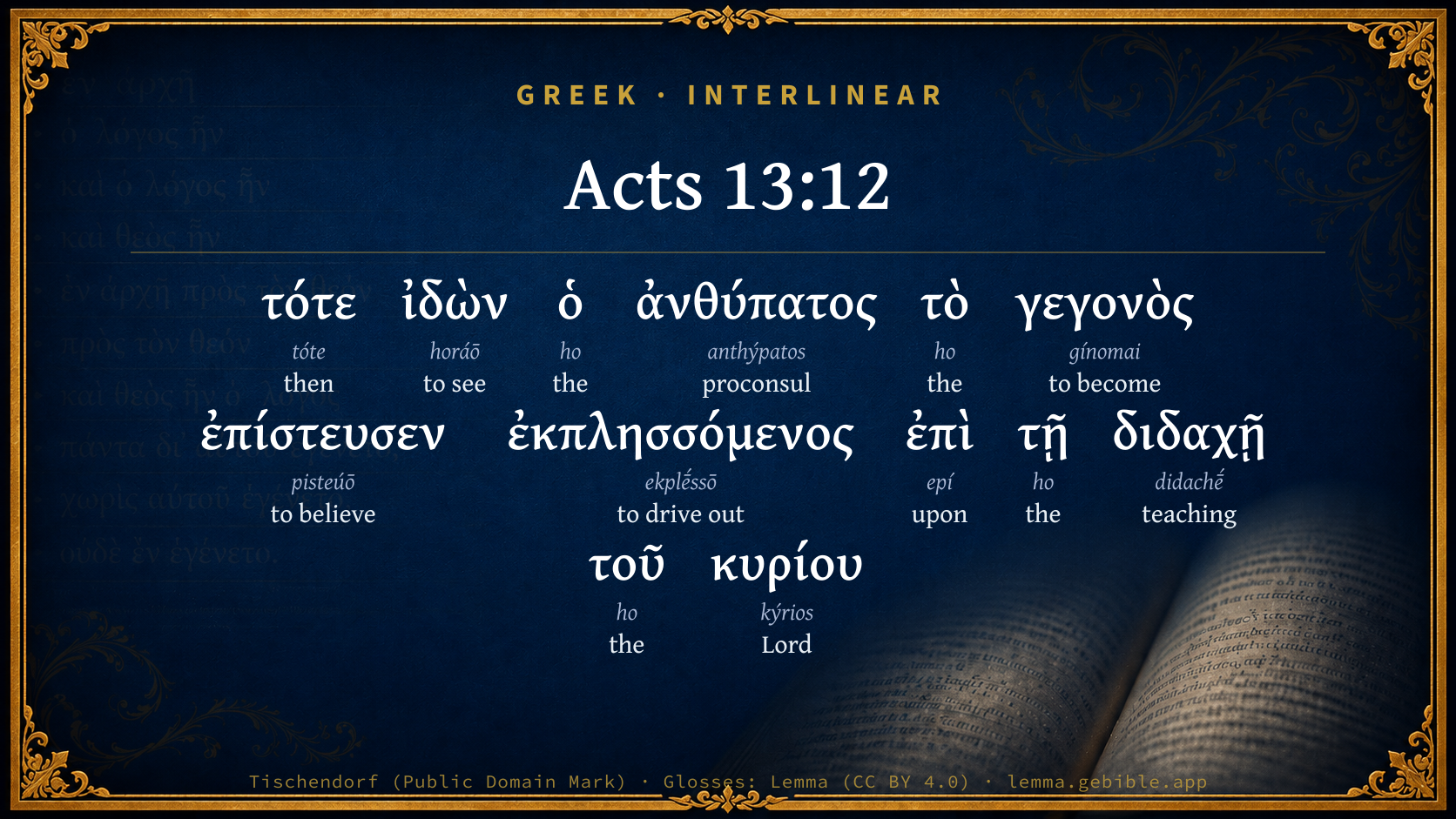
Greek (Tischendorf 8th ed.) Acts 13:12 appears in the Greek New Testament. The text above is from the Tischendorf 8th edition. Each word links to its Strong’s number and a concise gloss. Click any word for its full Thayer’s Greek Lexicon entry.
Download image
Cite this verse

Acts 13:12 (World English Bible). Public Domain. Lemma interlinear Bible study tool, https://lemma.gebible.app/v/acts/13/12.

Show BibTeX & RIS
BibTeX
RIS
English Translation
Then the proconsul, when he saw what was done, believed, being astonished at the teaching of the Lord.
World English Bible · Public Domain
Download a study sheet

One document with this verse’s original text, its word-by-word gloss line, the meaning frame, cross-references with their text, attributed commentary, and full source and license credits — printable, and it pastes into notes with its structure intact.

This verse Autodidact and up

Study sheet (.html) Plain text (.txt)

A passage Seminary Student

Up to 50 verses in one chapter. A passage sheet keeps up to 6 commentary sources and 12 cross-references per verse, in the order this page ranks them, and says so on the sheet whenever that leaves anything out. Ask for a single verse and you get the Autodidact verse sheet above.

Everything on this page stays free to read, with no account — the sheet is a download of what is already on screen, not access to it.

Want to remove ads? Support Godless Engineer
Compare translations 3

The same verse in 3 English versions, stacked beneath the original-language interlinear above. Click any original word for its lexicon entry.

Each is an independent rendering of the whole verse — the interlinear is not word-aligned to these translations.

Highlighted words mark where these versions differ — a whole-verse word diff, not a word-by-word alignment.

  • World English Bible Public Domain
    Then the proconsul, when he saw what was done, believed, being astonished at the teaching of the Lord.
  • King James Version Public Domain
    Then the deputy, when he saw what was done, believed, being astonished at the doctrine of the Lord.
  • unfoldingWord Literal Text CC BY-SA 4.0
    Then the proconsul, having seen the having happened, believed, being astonished at the teaching of the Lord.

unfoldingWord Literal Text — © unfoldingWord, licensed CC BY-SA 4.0. Word-aligned USFM3 via Door43 (git.door43.org/unfoldingWord/en_ult).

Versions to compare (up to 4)

3 of 4 selected

Show all 19 translations

Every available English version of this verse, each an independent rendering of the whole verse.

  • World English Bible Public Domain
    Then the proconsul, when he saw what was done, believed, being astonished at the teaching of the Lord.
  • Berean Standard Bible Public Domain
    When the proconsul saw what had happened, he believed, for he was astonished at the teaching about the Lord.
  • Majority Standard Bible Public Domain
    When the proconsul saw what had happened, he believed, for he was astonished at the teaching about the Lord.
  • King James Version Public Domain
    Then the deputy, when he saw what was done, believed, being astonished at the doctrine of the Lord.
  • American Standard Version (1901) Public Domain
    Then the proconsul, when he saw what was done, believed, being astonished at the teaching of the Lord.
  • Revised Version (1885) Public Domain
    Then the proconsul, when he saw what was done, believed, being astonished at the teaching of the Lord.
  • Geneva Bible (1599) Public Domain
    Then the Deputie when he sawe what was done, beleeued, and was astonied at the doctrine of the Lord.
  • Douay-Rheims (1899) Public Domain
    Then the proconsul, when he had seen what was done, believed, admiring at the doctrine of the Lord.
  • Young's Literal Translation Public Domain
    then the proconsul having seen what hath come to pass, did believe, being astonished at the teaching of the Lord.
  • Literal Standard Version CC BY-SA 4.0
    then the proconsul having seen what has come to pass, believed, being astonished at the teaching of the LORD.
  • Unlocked Literal Bible CC BY-SA 4.0
    After the proconsul saw what had happened, he believed, because he was astonished at the teaching about the Lord.
  • unfoldingWord Literal Text CC BY-SA 4.0
    Then the proconsul, having seen the having happened, believed, being astonished at the teaching of the Lord.
  • Darby Bible Public Domain
    Then the proconsul, seeing what had happened, believed, being amazed at the teaching of the Lord.
  • World Messianic Bible Public Domain
    Then the proconsul, when he saw what was done, believed, being astonished at the teaching of the Lord.
  • Webster's Bible Public Domain
    Then the deputy, when he saw what was done, believed, being astonished at the doctrine of the Lord.
  • Free Bible Version CC BY-SA 4.0
    When the governor saw what happened he trusted in God, amazed at the teaching about the Lord.
  • Bible in Basic English Public Domain
    Then the ruler, when he saw what was done, had faith, being full of wonder at the teaching of the Lord.
  • Text-Critical English NT CC BY 4.0
    When the proconsul saw what had happened, he believed, for he was astonished at the teaching of the Lord.
  • Tyndale New Testament (1534) Public Domain
    Then the rular when he sawe what had happened beleved and wodred at the doctryne of the Lorde.

Literal Standard Version (2020), Covenant Press — licensed CC BY-SA 4.0. Text via the HelloAO Bible API (eBible.org). Unlocked Literal Bible (unfoldingWord) — licensed CC BY-SA 4.0. Text via the HelloAO Bible API (eBible.org). unfoldingWord Literal Text — © unfoldingWord, licensed CC BY-SA 4.0. Word-aligned USFM3 via Door43 (git.door43.org/unfoldingWord/en_ult). Free Bible Version, Dr. Jonathan Gallagher — licensed CC BY-SA 4.0. Text via the HelloAO Bible API (eBible.org).

Word by word

More ways to search: Search by grammar → Find every occurrence → Compare this word →

Practice this passage: Drill this verse → Learn its vocabulary →

ἀνθύπατος
anthýpatos
G446
“proconsul”
Noun, Nominative, Singular, Masculine
Part of Speech
Noun
Case
Nominative
Number
Singular
Gender
Masculine
Full Thayer's Definition

Origin: from G473 and a superlative of G5228

TDNT: None

1. a proconsul a. the emperor Augustus divided the Roman provinces into senatorial and imperial. The former were governed by proconsuls; the later by legates of the emperor, sometimes called propraetors
  1. τότε tóte G5119 “then” Adverb
  2. ἰδὼν horáō G3708 “to see” Verb, Aorist, Active, Participle, Nominative, Singular, Masculine
  3. ὁ ho G3588 “the” Article, Nominative, Singular, Masculine
  4. τὸ ho G3588 “the” Article, Accusative, Singular, Neuter
  5. γεγονὸς gínomai G1096 “to become” Verb, Perfect, Active, Participle, Accusative, Singular, Neuter
  6. ἐπίστευσεν pisteúō G4100 “to believe” Verb, Aorist, Active, Indicative, 3rd person, Singular
  7. ἐκπλησσόμενος ekplḗssō G1605 “to drive out” Verb, Present, Passive, Participle, Nominative, Singular, Masculine
  8. ἐπὶ epí G1909 “upon” Preposition
  9. τῇ ho G3588 “the” Article, Dative, Singular, Feminine
  10. διδαχῇ didachḗ G1322 “teaching” Noun, Dative, Singular, Feminine
  11. τοῦ ho G3588 “the” Article, Genitive, Singular, Masculine
  12. κυρίου kýrios G2962 “Lord” Noun, Genitive, Singular, Masculine

About this verse

These counts appear in no published source. They are computed here, from the morphology-tagged text and Lemma’s own curated glosses. What Lemma adds →

13
words
10
distinct lemmas
Acts
section

Notable vocabulary

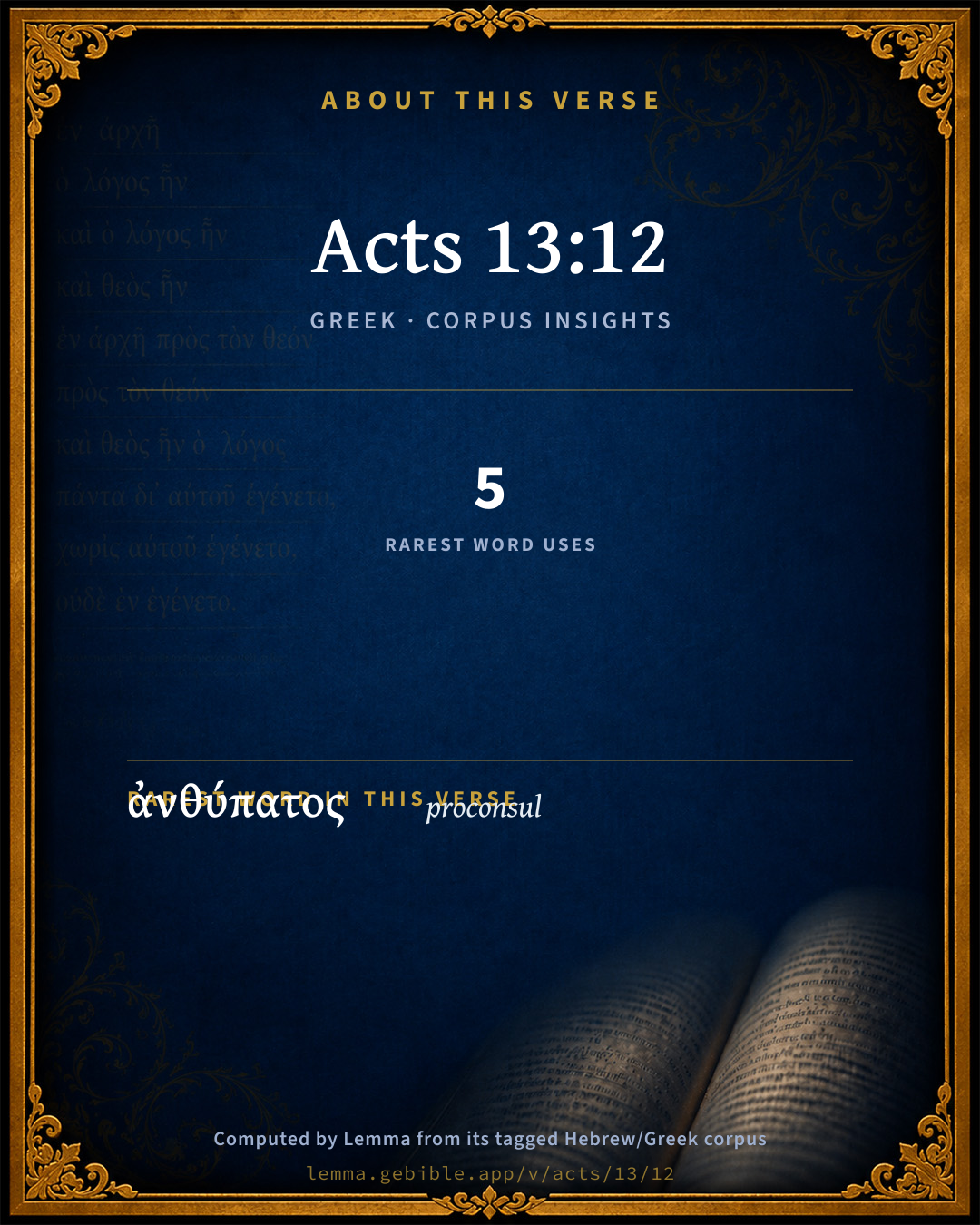
The rarest word here is ἀνθύπατος proconsul G446 — appearing just 5 times in the whole Greek New Testament.

Shared distinctive vocabulary

ἀνθύπατος proconsul G446 occurs in 5 verses of the Greek New Testament. Also found in:

Repetition

A word recurs within this verse:

Cross-references

12

Topical passages linked to Acts 13:12 in the Treasury of Scripture Knowledge — connected by theme and wording, ordered by reader-vote popularity; previews shown in the World English Bible.

  • 2 Corinthians 10:4–5 for the weapons of our warfare are not of the flesh, but mighty before God to the throwing down of strongholds,
  • Acts 13:7 who was with the proconsul, Sergius Paulus, a man of understanding. This man summoned Barnabas and Saul, and sought to hear the word of God.
  • Luke 4:22 All testified about him, and wondered at the gracious words which proceeded out of his mouth, and they said, "Isn't this Joseph's son?"
  • Matthew 7:28–29 It happened, when Jesus had finished saying these things, that the multitudes were astonished at his teaching,
  • Matthew 27:54 Now the centurion, and those who were with him watching Jesus, when they saw the earthquake, and the things that were done, feared exceedingly, saying, "Truly this was the Son of God."
  • Luke 7:16 Fear took hold of all, and they glorified God, saying, "A great prophet has arisen among us!" and, "God has visited his people!"
  • John 7:46 The officers answered, "No man ever spoke like this man!"
  • Acts 6:10 They weren't able to withstand the wisdom and the Spirit by which he spoke.
  • Acts 13:49 The Lord's word was spread abroad throughout all the region.
  • Acts 15:35 But Paul and Barnabas stayed in Antioch, teaching and preaching the word of the Lord, with many others also.
  • Acts 19:7 They were about twelve men in all.
  • Acts 28:7 Now in the neighborhood of that place were lands belonging to the chief man of the island, named Publius, who received us, and courteously entertained us for three days.

Cross-references courtesy of OpenBible.info (CC BY 4.0).

Commentary

Notes on Acts 13:12 from classic Christian and Jewish commentators (each source and its license shown beneath its notes). The classic Christian expositions comment on the surrounding passage and are grouped to its opening verse, so a note may address several verses; the Jewish commentaries on the Tanakh (Rashi and others) are per-verse, so they appear only where the commentator wrote on this verse.

Lemma curates 59 commentaries, every one of them public domain or Creative Commons licensed, each selected and text-cleaned for this edition rather than reprinted as found. About our sources →

The Biblical Illustrator

Joseph S. Exell

Act_13:12

Then the deputy, when he saw what was done, believed.

Two Pauls and a blinded sorcerer

Note--

I. Opposition to the faith.

1. Elymas withstood them, seeking to turn away the deputy from the faith. This is true the world over. The greater the opportunity the greater the opposition. The devil is ever on the lookout to defeat the servants of God and hinder the effect of truth.

2. But opposition is overruled for good. The intense opposition of Elymas only served to draw the attention of the deputy more intently to the doctrine of Gods Word. But more than this: when Saul pronounced upon him the solemn judgment of God, the proconsul saw that it was in very deed the Word of God. The blinded sorcerer, seeking someone to lead him by the hand, was a visible witness for the truth against which he had fought. So that the overthrow of the opposition made the victory of truth the more conspicuous. And this is always so.

II. Aids to faith. I have not called miracles causes of faith, for they do not cause it, although they may lead up to it. What Sergius Paulus saw did not make him believe, but it helped him to believe. What did he see, then?

1. The great courage of Paul. In another case boldness struck a blow at unbelief, for when the rulers saw the boldness of Peter and John, and perceived that they were unlearned and ignorant men, they marvelled. In this case the effect would be the same. Saul fixed his eyes on Elymas as though he were perfectly master of the situation--as indeed he was, and without hesitation or apology addressed him, O full of all subtlety, etc. Intense conviction in the mind of Paul led him to speak thus plainly and sternly, but it was not the heat of his own spirit, for he was filled with the Holy Ghost. Let every teacher of Christ be thus filled, and then let him speak boldly, as he ought to speak. Come not forward with your ifs and buts and peradventures to prove Gods Word. Tell out the message God hath told thee, as from Him, and not as thine own opinion!

2. Gods judgments. If Sergius Paul was deeply impressed with Pauls boldness, he was still more deeply moved when he saw Elymas stricken with blindness.

3. Gods wonders of mercy. Conversions are the standing miracles of the gospel, the best attesting seals the truth can have. I knew a man who was of a fierce temper, a troubler to his own household; I have seen that man since his conversion, and the lion has become a lamb. We have seen persons revelling in licentiousness, but they have heard the gospel and become chaste. What has wrought this? What teaching must that be which accomplishes such marvels?

III. The source of faith. It is doctrine, or faithful teaching, which brings men to Christ. Let those who despise doctrine beware, for the doctrine of the Cross is only foolishness to them who perish. Under the influence of the Holy Ghost the plain teaching of the Word of the Lord leads men to believe in Jesus. I do not think it is any great good for a preacher to cry, Believe, if he never tells you what is to be believed. There is plenty of this kind of preaching about, and the result is sadly transient and superficial. If we do not preach the great doctrine of the atoning sacrifice, we have not put before men the basis on which their faith is to be built. Justification by faith and regeneration by the Spirit must be taught continually. The proconsul was, no doubt, astonished to see Elymas blinded, but he was a great deal more astonished at the doctrine which Paul preached when he began to tell him that salvation was not by the works of the law, but by faith in Jesus Christ; that the way to be accepted of God was not by presenting to the Lord anything performed by us or felt within us, but by laying hold upon the righteousness which Jesus Christ has wrought out and brought in. When he heard this good news he might well be astonished, and yield his heart to Jesus. The most astonishing thing in the world is the gospel. Come, then, and candidly study what is to be believed. If you desire to know God you shall know Him. The great Father is not far from any one of you. There is the light! It is not dim, nor far away. The fault is in your eyes if you do not see. (C. H. Spurgeon.)

The conversion of Sergius Paulus

I. He saw. Probably no special stress is laid upon the seeing, yet the fact that opportunity was given him to see is worthy of emphasis. Had the Church of Antioch loved their own better than the things of Christ, the missionaries had been kept at home. If we turn over the opportunity of Sergius and examine its obverse side, we shall find written thereon a duty and a privilege. Paul, who felt it and obeyed it thus early in his career, later states it (Rom_10:13-15). The great salvation is provided for all; let it be carried to all. No violence is done human thought or the spirit of the gospel by discerning, in the proconsuls opportunity to see, the Churchs opportunity to send. Paul came and preached, therefore Paulus saw and heard.

II. He was astonished. The transition from sight to faith is explained in the astonishment produced by the matter and manner of the doctrine of the Lord. Two teachers, each professing to possess the oracles of the Highest, had confronted each other with contradictory doctrine. The mind of the heathen deputy, unrestful and discontented with the fables of Roman mythology, must have been perplexed with these rival claimants for his faith and devotion. But the purer doctrine had the prevailing power, and Paulus wondered at the doctrine of the Lord, and admired it. Then came the proof that the story of Divine love was no bright fiction nor sweet poem, but a genuine fact and power in the world among men by the method of the teaching--persuasively to him who was ready to hear--judicially to him who was determined to resist. It could sue or subdue.

III. He believed. The simplicity and freshness of youth adorned and invigorated the gospel of that early day. The deputys mind was not perplexed by half a dozen kinds of faith, each with a technical name requiring special instruction to understand. The story of the living, personal Christ, what He had said and done, and what He wanted and waited to do, was the simple and unformulated theology of that earliest day. Sergius Paulus, in believing, was conscious of no such abstract process as that of accepting a theory or adopting a system. This might come afterwards; but when he believed he simply trusted himself into the care of God, he took Him at His word. The Roman proconsul became the Christian disciple; faith gave him a higher rank and a sublimer title. He had before represented the emperor of the world. He then represented the One seated on the right hand of God. The name Roman proconsul pales before the title Heir of God. (J. R. Danforth.)

Pauls first convert from heathenism

When Napoleon landed on his return from Elba, and one man came and presented himself as willing to serve the Emperor, Here, said Napoleon, is one recruit at least. So may we say when we have converts, Here is one recruit, and thank God for one; for the same attractive influence which draws one will draw multitudes more. We have got the right medicine, we have got the right power, and therefore let us hope that there is a harvest to be reaped now. (C. H. Spurgeon.)

The conversion of one soul

The conversion of one soul by the gospel should be to you a hopeful sign that God intends to convert others. For see, the cholera is raging in certain towns, say, on the continent, and a physician has been studying the disease. He has administered a variety of drugs, but in every case without success. He has prescribed different methods of treatment, but in no case has he succeeded in effecting a cure. At last he has hit upon the right drug, and, administering it, he sees his patient rallying, strength evidently given by the medicine; the struggle ends favourably, and the patient rises to life and health. Now, says the physician, I know that I shall have a harvest of men who will be preserved from this disease, because the same medicine which heals one will heal two, will heal twenty, will heal a thousand, or even twenty thousand; it only has to be administered; that one person has been healed by this compound, and it is clear that as many more may be healed as are willing to receive it. Brethren, we do not lack this sign with regard to the gospel. (C. H. Spurgeon.)

Opposition helpful to the gospel

In all probability the opposition of Bar-Jesus may have called the attention of Sergius Paul more intently to the doctrine of the Word of God. When a certain doctrine is neglected and half forgotten by the Church of God there rises up a bold heretic who rails at the truth most bitterly, and then Christian people remember it, defend it, and propagate it. A Colenso attacks the story of the Exodus, and all eyes are fixed upon Moses and the tribes of Israel. Some critic or other attacks the Book of Deuteronomy, and straightway we get a host of books about Deuteronomy; all the scholars of the Christian Church begin to study it, and as a part of the Word it is valued exceedingly. This Elymas finds fault with the gospel, and Saul and Barnabas are thus called upon to clear up the points at issue, and by refuting the magicians malicious errors they make the truth the more apparent to the mind of the proconsul. So far so good. (C. H. Spurgeon.)

The Biblical Illustrator, edited by Joseph S. Exell (c. 1880s–1900s) — public domain. Text from a community e-Sword module.

Joseph Benson's Commentary

Act 13:12. Then the deputy — Or proconsul; when he saw what was done — What a wonderful miracle was performed, yielding to such convincing evidence; believed the gospel; being astonished — Εκπλησσομενος, being struck with astonishment; at the doctrine of the Lord — At the confirmation thus given to it, and probably also at the internal evidence which he soon discovered in it, and which broke in with increasing lustre on his mind. The reader will observe, that at this period of the history, Luke has changed Saul’s name, calling him Paul, without assigning any reason for so doing. Some learned men have supposed that this change was made by Saul himself, in honour of the proconsul, who they think was, perhaps, Saul’s first convert from among the idolatrous Gentiles, or the first person of high rank of that character who was converted. For it was customary among the Romans to assume the name of a benefactor whom they highly esteemed. Thus the Jewish historian, Josephus, took the name of Flavius, in compliment to Vespasian, with whom he was in high favour. But it is more probable, that, coming now among the Romans and Greeks, they adapted his name to their own language, and so called him Paul instead of Saul; as one whose Hebrew name was Jochanan, would be called by the Greeks and Latins, Johannes; by the French, Jean; by the Dutch, Hans; and by the English, John. Perhaps, however, the family of the proconsul might be the first who addressed, or spoke to him, by this name. But in whatever manner it happened, it is certain that ever after this he was known only by this name; and, being the apostle of the Gentiles, he himself used it as a name most familiar to them. From this time forth, likewise, Paul is generally mentioned by the historian before Barnabas: because, by his success in preaching at Paphos, and by the greatness of his miracles, he was now shown to be the principal person; although, formerly, he was mentioned after Barnabas, because he was a younger disciple, and because his apostolical authority was not fully understood.

Joseph Benson's Commentary on the Old and New Testaments (1811–1818) — public domain. Text from a community e-Sword module.

Tyndale Open Study Notes

Tyndale Open Resources

13:12 The teaching about the Lord included a miraculous demonstration of divine power (cp. Mark 1:21-27), for it was a teaching about the living God (see Acts 14:15).

Tyndale Open Study Notes — © Tyndale Open Resources, licensed CC BY-SA 4.0. Text via the HelloAO Bible API.

Bengel's Gnomon

Johann Albrecht Bengel

Act 13:12. Τὸ γεγονὸς, what had happened) Often the obstacles which have stood in the way of the truth, when overcome, are subservient to it.—διδαχῇ, the doctrine) By the miracle his attention was sharpened in relation to the doctrine.[71]

[71] Bengel, J. A. (1860). Vol. 2: Gnomon of the New Testament (M. E. Bengel & J. C. F. Steudel, Ed.) (A. R. Fausset, Trans.) (610–621). Edinburgh: T&T Clark.

Bengel's Gnomon of the New Testament — English translation (T&T Clark, Edinburgh, 1860) — public domain. Text from a community e-Sword module.

Meyer's Critical & Exegetical Commentary

Heinrich August Wilhelm Meyer

Act_13:12. Ἐπὶ τῇ διδαχῇ τ. Κυρίου] For he rightly saw, both in that announcement of punishment by Paul, and in the fate of his sorcerer, something which had a connection with the doctrine of the Lord (that is, with the doctrine which Christ caused to be proclaimed by His apostles; see on Act_8:25). Its announcer had shown such a marvellous familiarity with the counsel of God, and its opponent had suddenly experienced such a severe punishment, that he was astonished at the doctrine, with which so evident a divine judgment was connected. Comp. on the connection of the judgment concerning the doctrine with the miracle beheld, Mar_1:27. The ἐπίστευσεν obviously supposes the reception of baptism; comp. Act_4:4, Act_11:21, Act_19:18.

Whether the sorcerer afterwards became a believer the text does not, indeed, inform us; but the presumption of a future conversion is contained in ἄχρι καιροῦ, Act_13:11, and therefore the question is to be answered in the affirmative; for Paul spoke that ἄχρι καιροῦ: ὅριον τῇ γνώμῃ διδούς, Oecumenius. The Tübingen criticism has indeed condemned the miraculous element in this story, and the story itself as an invented and exaggerated counterpart of the encounter of Peter with Simon Magus, chap. 8a judgment in which the denial of miracles in general, and the assumption of dogmatic motives on the part of the author, are the controlling presuppositions (see Baur and Zeller; comp. also Schneckenburger, p. 53).

Meyer — Critical and Exegetical Commentary on the New Testament — English translation by Peter Christie, edited by Frederick Crombie (T&T Clark, 1880) — public domain. Text from a community e-Sword module.

Expositor's Greek Testament

ed. W. Robertson Nicoll

Act 13:12 . ἐπίστευσεν : “the blindness of Elymas opened the eyes of the proconsul” (Felten). If the verb is understood in its full sense, viz. , that Sergius Paulus became a convert to the faith, Act 13:48 , Act 2:44 , Act 4:4 , Act 11:21 , baptism would be implied, Act 8:12 . ἐκπλησσ ., Mat 7:28 , Mar 1:22 ; Mar 11:18 , Luk 4:32 ; Luk 9:43 , etc., so in classical Greek with ἐπί . The verb is also found in Ecc 7:17 (16), Wis 13:4 , 2Ma 7:12 , 4Ma 8:4 ; 4Ma 17:16 . Bengel’s comment is suggestive, “miraculo acuebatur attentio ad doctrinam”: the conversion is not represented as the result of the miracle alone. The conversion of a Roman proconsul is regarded as absolutely incredible by Renan (so more recent critics). But if the narrative had been a mere fiction to magnify Paul’s powers in converting such an important personage in his first encounter with the powers of heathenism, the forger would not have contented himself with the brief Σαῦλος ὁ καὶ Π . of Act 13:9 ; see Zöckler’s Apostelgeschichte , p. 245, second edition, on this and other objections against the narrative. See Introd. for the favourable light in which St. Luke describes the relations between the Roman government and Christianity.

The Expositor's Greek Testament, edited by W. Robertson Nicoll (1897–1910) — public domain. Text from a community e-Sword module.

Jamieson, Fausset & Brown

Robert Jamieson, A. R. Fausset & David Brown

Then the deputy, when he saw what was done, believed, being astonished at the doctrine of the Lord--so marvellously attested; compare Mar 1:27. What fruit, if any, followed this remarkable conversion, or how long after it the missionaries remained at Paphos, we know not.

Jamieson, Fausset & Brown — Commentary Critical and Explanatory on the Whole Bible (1871) — public domain (CC PDM 1.0). Text via the HelloAO Bible API.

Adam Clarke's Commentary

Verse 12. The deputy - believed] This was a proof that the doctrine was true; and that the power of God, from which nothing could be concealed, and which nothing could resist, was with these preachers.

Being astonished] εκπλησσομενος, Being struck with astonishment, as Elymas was struck with blindness. Thus the word of God is a two-edged sword: it smites the sinner with judgment or compunction; and the sincere inquirer after truth, with conviction of its own worth and excellence.

Adam Clarke's Commentary on the Bible (1810–1826) — public domain. Text from a community e-Sword/MySword module.

John Calvin's Commentaries

12. Then when the deputy saw This is that which I said, that the snares were broken wherein Elymas kept him entangled, for he was brought by the miracle unto faith, because the reverence of doctrine is the beginning of faith, and the preparation. Therefore, forasmuch as he saw an evident token of the power of God, he knew that Paul was sent of God, and so he began to reverence his doctrine, whereof he did doubt before. If God do now miraculously strengthen in the minds of many the faith of the gospel, which is shaken with so many and such strong engines; if he bring to pass, after an incredible manner, that the course of faith doth pass through a thousand lets, being content with this his grace, let us not murmur against him, or reason the matter with him, as if our condition were worse, if he do not daily show such miracles as we would desire.

John Calvin's Commentaries (1540-1563) — public domain. Text from the Calvin Translation Society English edition (1840s-50s) via the Christian Classics Ethereal Library (ccel.org). Calvin's coverage is partial (roughly two-thirds of the Bible); uncommented books and verses are honest gaps, never fabricated. The 19th-century editor's footnotes and remarks are omitted so the notes are faithfully Calvin's own voice.

Ellicott's Commentary for English Readers

(12) Being astonished at the doctrine of the Lord.—The genitive is, probably, that of the object, the teaching which had the Lord, i.e., the Lord Jesus, as its main theme.

A Bible Commentary for English Readers, edited by Charles John Ellicott (1878–1897) — public domain. Text from a community e-Sword module.

The Cambridge Bible for Schools and Colleges

gen. ed. J. J. S. Perowne

12. Then the deputy [proconsul], when he saw what was done, believed] He was convinced by the miracle and by the words with which it was accompanied, that the Apostles were teachers of the way of the Lord after which he had been seeking in vain from Elymas. We are not told that Sergius was baptized, but we have other instances of the like omission of notice (see Act_13:48), yet as baptism was the appointed door into Christ’s Church, such omission of the mention thereof should not be thought to warrant us in believing that the sacrament was neglected on any occasion.

The Cambridge Bible for Schools and Colleges (gen. ed. J. J. S. Perowne; Cambridge University Press, 1878–1918) — public domain. Text from a community e-Sword module.

John Gill's Exposition

Then the deputy, when he saw what was done,.... That Elymas was struck with blindness immediately, and that the hand of God was manifestly in it, and there was no juggle nor magic art in the case; it was a plain fact, which was certain and visible:

he believed; in the Lord Jesus Christ, whom the apostle preached:

being astonished at the doctrine of the Lord: both at what was contained in it: for there are many astonishing things in the doctrine of faith; as the birth of Christ of a virgin; the union of the two natures, divine and human, in his person; salvation through his crucifixion and death, and the resurrection of the dead, with others: and also at the miracles which attended this doctrine, and confirmed it; though the Alexandrian copy reads the words thus, "being astonished, he believed in the doctrine of the Lord"; which affords a very easy and natural sense, as that being filled with admiration at the striking of Elymas with blindness, he was induced to believe the doctrine of Christ, preached by Paul and Barnabas, and so the Ethiopic version renders it, "he wondered, and believed in our Lord": and Beza's ancient copy, and others read, "he wondered and believed in God". This deputy we hear no more of afterwards; there is no reason to believe that he quitted his government of this island; though some pretend to say that he did, and followed the Apostle Paul, and went with him into Spain; and that he was left by him at Narbonne in Languedoc in France, and became bishop of that place; which office he held till his death. And though we read of no more converted at this time in Paphos, yet it is highly probable there were others, and that a foundation of a Gospel church state was laid in this place, even though Heathenism still continued. The temple of Venus remained in this place in the "second" century; and in the "fourth" century Venus was worshipped here; yet in the beginning of the "fourth" century, in the council of Nice, Cyril, bishop of Paphos, was present; and in the "fifth" century, a bishop of this place was at the synod of Chalcedon: and in the "eighth" century, Michael, bishop of Taphos, was in the Nycene synod (w). Jerom (x) makes mention of Hilarion, an eminent servant of Christ, who was for some time at Paphos, in the fourth century, and of the many miraculous cures he wrought here; but of the church here, or of any number of believers in Christ, he takes no notice, only of one Hesychius, a disciple; though it is certain there must be a church at this time, as before observed.

(w) Magdeburg. Hist. Eccles. cent. 2. c. 15. p. 193. cent. 4. c. 2. p. 5. c. 15. p. 865. cent. 5. c. 2. p. 6. cent. 8. c. 2. p. 6. (x) Vita Hilarion. fol. 86. C.

John Gill's Exposition of the Whole Bible (1746–1763) — public domain (CC PDM 1.0). Text via the HelloAO Bible API.

Trapp's Complete Commentary

John Trapp

12 Then the deputy, when he saw what was done, believed, being astonished at the doctrine of the Lord.

Ver. 12. Being astonished, &c.] The word worketh not kindly till it be received with admiration.

John Trapp, A Commentary or Exposition upon All the Books of the Old and New Testament (1647–1656) — public domain. Text from a community e-Sword module.

Albert Barnes' Notes on the Bible

Then the deputy ...believed - Was convinced that Elymas was an impostor, and that the doctrine of Paul was true. There seems no reason to doubt that his faith was what is connected with eternal life; and if so, it is an evidence that the gospel was not always confined to the poor, and to those in obscure ranks of life.

At the doctrine of the Lord - The word “doctrine” here seems to denote, not the “teaching” or “instruction,” but the wonderful effects which were connected with the doctrine. It was particularly the miracle with which he was astonished; but he might have been also deeply impressed and amazed at the purity and sublimity of the truths which were now expanded to his view. We learn nothing further respecting him in the New Testament.

Albert Barnes' Notes on the Bible (1834–1885) — public domain. Text from a community e-Sword/MySword module.

Matthew Poole's English Annotations

The gospel which Paul preached; finding in it (though a wise man) depths beyond his fathoming; and all accompanied with such a power in doing of miracles, and changing of hearts and lives, as might well amaze so prudent and considering a man.

Matthew Poole's English Annotations on the Holy Bible (1683–1685) — public domain. Text from a community e-Sword/MySword module.

Whedon's Commentary on the Bible

Daniel D. Whedon

12. Done, believed—The penal miracle performed upon the magus overthrew the divinity of his claims; performed by the apostle, it established his. So the superiority of the miracles of Moses over and in penalty upon the sorcerers of Egypt, and of Paul over and upon those of Ephesus, are specimens of the divine method of defeating the preternaturalisms and demonisms of paganism by the supernaturalisms and miracles of Jehovah and Jesus.

Astonished—Thrilled, electrified. The miracle wrought belief; the doctrine wrought salvation.

Daniel D. Whedon (gen. ed.), Commentary on the Old and New Testaments (1874–1909) — public domain. Text from a community e-Sword module.

The Pulpit Commentary

The proconsul for the deputy, A.V.; teaching for doctrine, A.V. Believed. We cannot, perhaps, conclude positively from this that Sergius was baptized and became an avowed Christian, though the usual language of the Acts rather leads us to infer it. (see ver. 48; Act_2:44 Act_4:4 Act_8:12, 13 11:21 19:18) Farrar thinks that if so marked a person had become a lifelong convert, we should have heard of him as such in other writings, Renan says, "La conversion d"un Romain de cet ordre, a cette epoque est chose absolument inadmissible." Alford and Olshausen speak doubtfully. Lange and Howson and Meyer look upon him as a genuine convert. The "Speaker"s Commentary" speaks of him as "the first fruits of heathenism." Being astonished at the teaching. "For the connection of the judgment concerning the doctrine with the miracle seen," comp. Mar_1:27. (Meyer).

The Pulpit Commentary (1880–1919), ed. H.D.M. Spence-Jones & Joseph S. Exell — public domain. Text from a community e-Sword module.

John Wesley's Explanatory Notes

Being astonished at the doctrine of the Lord - Confirmed by such a miracle.

John Wesley, Explanatory Notes Upon the Whole Bible (1754–1765) — public domain. Text via the GEBible commentary corpus.

McGarvey & Pendleton's Commentaries

J. W. McGarvey

See notes one verse 8

J. W. McGarvey (with Philip Y. Pendleton), Commentaries on the New Testament (The Fourfold Gospel, 1914; Acts; and the epistles) — public domain. Text from a community e-Sword/MySword module.

Cambridge Greek Testament for Schools and Colleges

12. τότε ἰδὼν ὁ ἀνθύπατος κ.τ.λ., then the deputy, when he saw what was done, believed. He was convinced by the miracle and by the words with which it was accompanied that the Apostles were teachers of that way of the Lord after which he had been seeking in vain from Elymas. We are not told that Sergius was baptized, but we have other instances of the like omission of notice (see Act 13:48), yet as baptism was the appointed door into Christ’s Church, such omission of the mention thereof should not be thought to warrant us in believing that the sacrament was neglected on any occasion.

Cambridge Greek Testament for Schools and Colleges (Cambridge University Press, 1896; 21 vols, various authors incl. Carr, Maclear, Plummer, Farrar, Lumby, Moule, M. R. James, Simcox) — public domain. Text from a community e-Sword module.

Alford’s Greek Testament

Henry Alford

12. ἐπὶ τῇ διδ. τ. κυρ.] Hesitating as he had been before between the teaching of the sorcerer and that of the Apostle, he is amazed at the divine power accompanying the latter, and gives himself up to it. It is not said that he was baptized: but the supposition is not thereby excluded: see ver. 48; ch. 17:12, 34; 18:8, first part.

Henry Alford, The Greek Testament (1849–1861) — public domain. Text from a community e-Sword module.

Vincent's Word Studies in the New Testament

Marvin R. Vincent

Astonished [εκπλησσομενος] . See on Mt 7:28.

Marvin R. Vincent, Word Studies in the New Testament (1887–1900) — public domain. Text from a community e-Sword/MySword module.

Lesson kit

Teaching starters — assembled from the data on this page, not authored interpretation. Every prompt links to the verse data it draws on. Edit before teaching.

Acts, in the Acts, opens this verse with 13 words (10 distinct Greek lemmas). Its most distinctive word is anthýpatos (“proconsul”). A historical commentator’s framing appears above. Read the whole chapter for the surrounding context.

Discussion questions

  1. What does “proconsul” (anthýpatos) contribute to the verse as a whole?
  2. Acts 13:7 shares the word «proconsul» with this verse. How do the two illuminate each other?
  3. “the” occurs 4× in this one verse. What is the effect of the repetition?
  4. These translations render this verse differently. What is at stake in choosing one wording over another?
  5. Reading how The Biblical Illustrator and Joseph Benson's Commentary read this verse, where do the two commentators agree and where do they part?

Things to notice

Reading settings

Reading text

Shown beneath each verse's original-language words.

Old Testament
Old Testament edition

Read the OT as the Masoretic Hebrew (MT) or the Greek Septuagint (LXX).

English shown for the Greek Septuagint (in the Hebrew ↔ Greek comparison).

Comparing translations? Open the Compare panel on any verse page to stack up to four side by side.