

Acts 27:29
Greek (Tischendorf 8th ed.) Acts 27:29 appears in the Greek New Testament. The text above is from the Tischendorf 8th edition. Each word links to its Strong’s number and a concise gloss. Click any word for its full Thayer’s Greek Lexicon entry.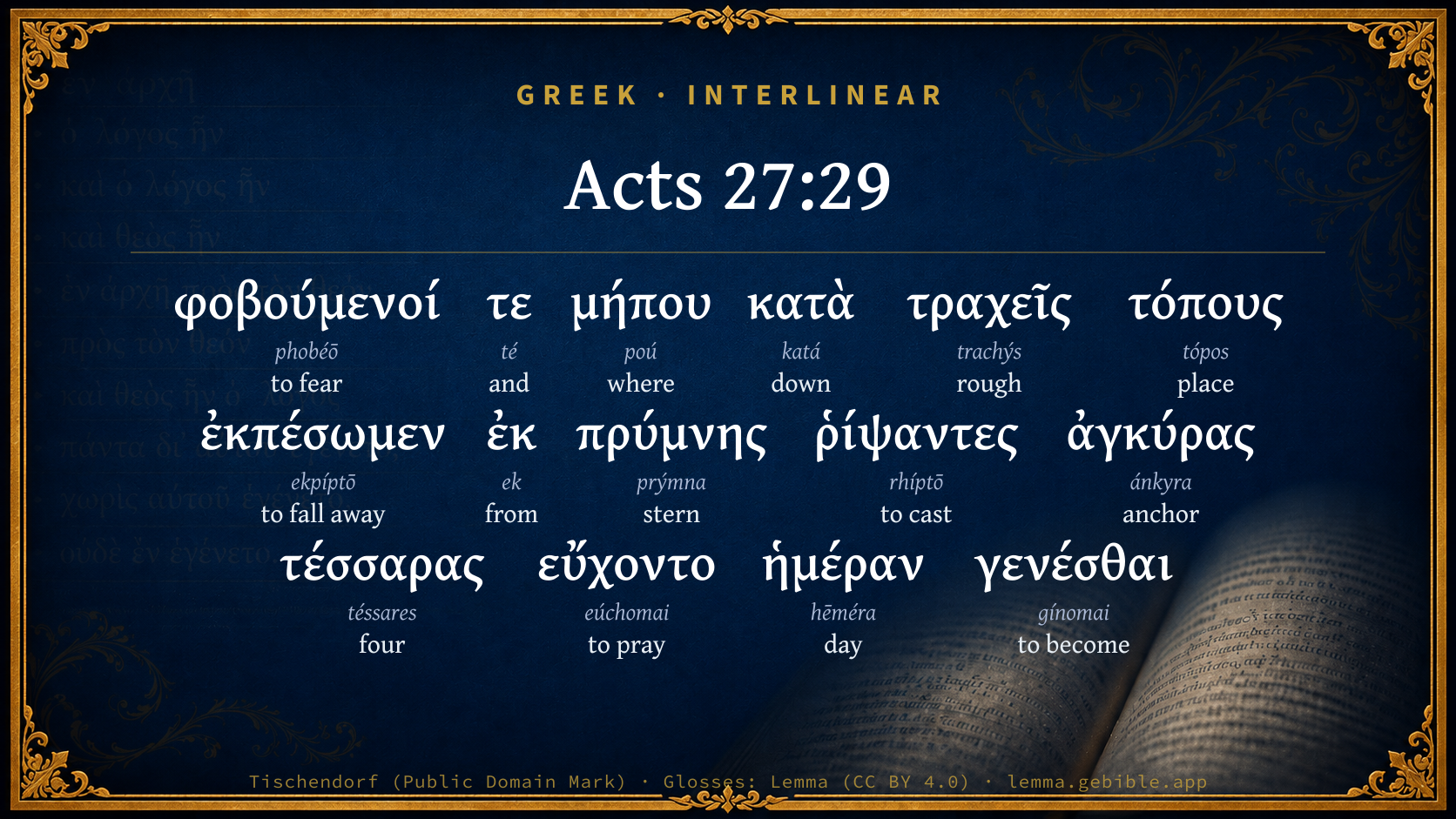
Fearing that we would run aground on rocky ground, they let go four anchors from the stern, and wished for daylight.
Download a study sheet
One document with this verse’s original text, its word-by-word gloss line, the meaning frame, cross-references with their text, attributed commentary, and full source and license credits — printable, and it pastes into notes with its structure intact.
This verse Autodidact and up
A passage Seminary Student
Up to 50 verses in one chapter. A passage sheet keeps up to 6 commentary sources and 12 cross-references per verse, in the order this page ranks them, and says so on the sheet whenever that leaves anything out. Ask for a single verse and you get the Autodidact verse sheet above.
Everything on this page stays free to read, with no account — the sheet is a download of what is already on screen, not access to it.
Compare translations 3
The same verse in 3 English versions, stacked beneath the original-language interlinear above. Click any original word for its lexicon entry.
Each is an independent rendering of the whole verse — the interlinear is not word-aligned to these translations.
Highlighted words mark where these versions differ — a whole-verse word diff, not a word-by-word alignment.
-
World English Bible Public Domain
Fearing that we would run aground on rocky ground, they let go four anchors from the stern, and wished for daylight.
-
King James Version Public Domain
Then fearing lest we should have fallen upon rocks, they cast four anchors out of the stern, and wished for the day.
-
unfoldingWord Literal Text CC BY-SA 4.0
And fearing lest we might fall upon a rugged place somewhere, having lowered four anchors from the stern, they were praying for day to come.
unfoldingWord Literal Text — © unfoldingWord, licensed CC BY-SA 4.0. Word-aligned USFM3 via Door43 (git.door43.org/unfoldingWord/en_ult).
Show all 19 translations
Every available English version of this verse, each an independent rendering of the whole verse.
-
World English Bible Public Domain
Fearing that we would run aground on rocky ground, they let go four anchors from the stern, and wished for daylight.
-
Berean Standard Bible Public Domain
Fearing that we would run aground on the rocks, they dropped four anchors from the stern and prayed for daybreak.
-
Majority Standard Bible Public Domain
Fearing that we would run aground on the rocks, they dropped four anchors from the stern and prayed for daybreak.
-
King James Version Public Domain
Then fearing lest we should have fallen upon rocks, they cast four anchors out of the stern, and wished for the day.
-
American Standard Version (1901) Public Domain
And fearing lest haply we should be cast ashore on rocky ground, they let go four anchors from the stern, and wished for the day.
-
Revised Version (1885) Public Domain
And fearing lest haply we should be cast ashore on rocky ground, they let go four anchors from the stern, and wished for the day.
-
Geneva Bible (1599) Public Domain
Then fearing least they should haue fallen into some rough places, they cast foure ancres out of the sterne, and wished that the day were come.
-
Douay-Rheims (1899) Public Domain
Then fearing lest we should fall upon rough places, they cast four anchors out of the stern, and wished for the day.
-
Young's Literal Translation Public Domain
and fearing lest on rough places we may fall, out of the stern having cast four anchors, they were wishing day to come.
-
Literal Standard Version CC BY-SA 4.0
and fearing lest we may fall on rough places, having cast four anchors out of the stern, they were wishing day to come.
-
Unlocked Literal Bible CC BY-SA 4.0
They were afraid that we might crash on the rocks, so they lowered four anchors from the stern and prayed that morning would come soon.
-
unfoldingWord Literal Text CC BY-SA 4.0
And fearing lest we might fall upon a rugged place somewhere, having lowered four anchors from the stern, they were praying for day to come.
-
Darby Bible Public Domain
and fearing lest we should be cast on rocky places, casting four anchors out of the stern, they wished that day were come.
-
World Messianic Bible Public Domain
Fearing that we would run aground on rocky ground, they let go four anchors from the stern, and wished for daylight.
-
Webster's Bible Public Domain
Then fearing lest we should fall upon rocks, they cast four anchors out of the stern, and wished for the day.
-
Free Bible Version CC BY-SA 4.0
They were concerned that we might be wrecked on rocks, so they dropped four anchors from the stern, and prayed for daylight to come.
-
Bible in Basic English Public Domain
Then, fearing that by chance we might come on to the rocks, they let down four hooks from the back of the ship, and made prayers for the coming of day.
-
Text-Critical English NT CC BY 4.0
Fearing that we might run aground on the rocks, they let down four anchors from the stern and prayed for daybreak to come.
-
Tyndale New Testament (1534) Public Domain
Then fearinge lest they shuld have fallen on some Rocke they cast.iiii. ancres out of the sterne and wysshed for the daye.
Literal Standard Version (2020), Covenant Press — licensed CC BY-SA 4.0. Text via the HelloAO Bible API (eBible.org). Unlocked Literal Bible (unfoldingWord) — licensed CC BY-SA 4.0. Text via the HelloAO Bible API (eBible.org). unfoldingWord Literal Text — © unfoldingWord, licensed CC BY-SA 4.0. Word-aligned USFM3 via Door43 (git.door43.org/unfoldingWord/en_ult). Free Bible Version, Dr. Jonathan Gallagher — licensed CC BY-SA 4.0. Text via the HelloAO Bible API (eBible.org).
Word by word
More ways to search: Search by grammar → Find every occurrence → Compare this word →
Practice this passage: Drill this verse → Learn its vocabulary →
- Appears 2× in the Greek New Testament
- First appears at Luke 3:5
- Part of Speech
- Adjective
- Case
- Accusative
- Number
- Plural
- Gender
- Masculine
Full Thayer's Definition
- φοβούμενοί phobéō G5399 “to fear” Verb, Present, Middle or Passive deponent, Participle, Nominative, Plural, Masculine
- τε té G5037 “and” Particle
- μήπου poú G4225 “where” Conjunction, Negative
- κατὰ katá G2596 “down” Preposition
- τραχεῖς trachýs G5138 “rough” Adjective, Accusative, Plural, Masculine
- τόπους tópos G5117 “place” Noun, Accusative, Plural, Masculine
- ἐκπέσωμεν ekpíptō G1601 “to fall away” Verb, Aorist, Active, Subjunctive, 1st person, Plural
- ἐκ ek G1537 “from” Preposition
- πρύμνης prýmna G4403 “stern” Noun, Genitive, Singular, Feminine
- ῥίψαντες rhíptō G4496 “to cast” Verb, Aorist, Active, Participle, Nominative, Plural, Masculine
- ἀγκύρας ánkyra G45 “anchor” Noun, Accusative, Plural, Feminine
- τέσσαρας téssares G5064 “four” Adjective, Accusative, Plural, Feminine
- εὔχοντο eúchomai G2172 “to pray” Verb, Imperfect, Middle or Passive deponent, Indicative, 3rd person, Plural
- ἡμέραν hēméra G2250 “day” Noun, Accusative, Singular, Feminine
- γενέσθαι gínomai G1096 “to become” Verb, Aorist, Middle deponent, Infinitive
About this verse
These counts appear in no published source. They are computed here, from the morphology-tagged text and Lemma’s own curated glosses. What Lemma adds →
- 15
- words
- 15
- distinct lemmas
- Acts
- section
Notable vocabulary
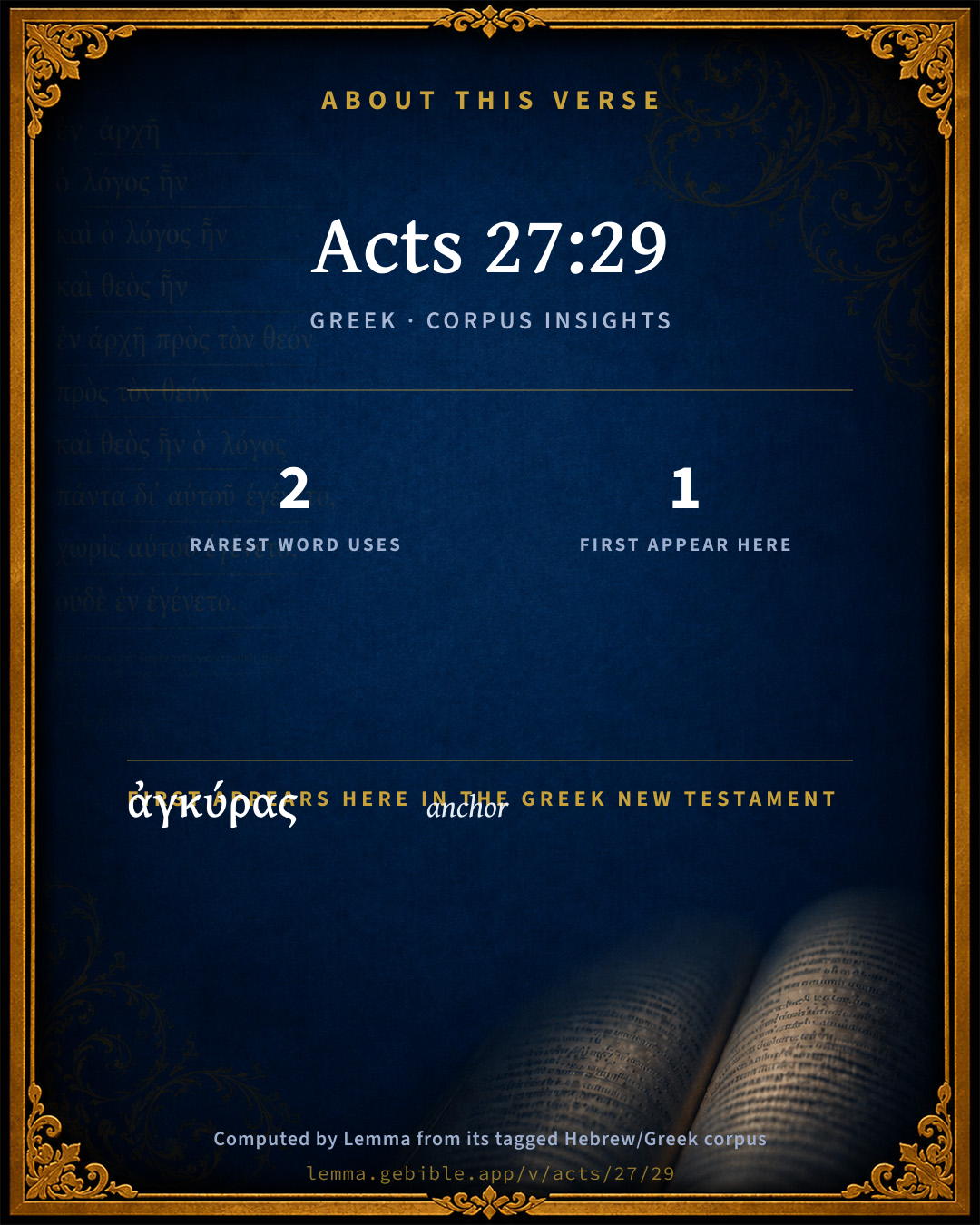
The rarest word here is τραχεῖς rough G5138 — appearing just 2 times in the whole Greek New Testament.
First appearance in Scripture
This word makes its first canonical appearance in the Greek New Testament here:
- ἀγκύρας anchor G45
Shared distinctive vocabulary
τραχεῖς rough G5138 occurs in 2 verses of the Greek New Testament. Also found in:
Cross-references
7Topical passages linked to Acts 27:29 in the Treasury of Scripture Knowledge — connected by theme and wording, ordered by reader-vote popularity; previews shown in the World English Bible.
- Acts 27:17 After they had hoisted it up, they used cables to help reinforce the ship. Fearing that they would run aground on the Syrtis sand bars, they lowered the sea anchor, and so were driven along.
- Hebrews 6:19 This hope we have as an anchor of the soul, a hope both sure and steadfast and entering into that which is within the veil;
- Deuteronomy 28:67 In the morning you shall say, Would it were even! and at even you shall say, Would it were morning! for the fear of your heart which you shall fear, and for the sight of your eyes which you shall see.
- Psalms 130:6 My soul longs for the Lord more than watchmen long for the morning; More than watchmen for the morning.
- Acts 27:26 But we must run aground on a certain island."
- Acts 27:30 As the sailors were trying to flee out of the ship, and had lowered the boat into the sea, pretending that they would lay out anchors from the bow,
- Acts 27:40–41 Casting off the anchors, they left them in the sea, at the same time untying the rudder ropes. Hoisting up the foresail to the wind, they made for the beach.
Cross-references courtesy of OpenBible.info (CC BY 4.0).
Where the printed editions differ
1 variantPlaces in this verse where the major printed Greek editions disagree on the wording in a way that affects the translation — a comparison of editions, not a manuscript-by-manuscript collation. The editions are the modern critical texts (Nestlé-Aland 28/27, SBL, Westcott-Hort, Tregelles, Tyndale House) and the traditional texts behind the KJV (the Textus Receptus and the Byzantine/Majority text). It is not a claim about which reading is original.
-
Different wording
ἐκπέσωμεν,
“we may fall,”
In NA28NA27TynSBLWHTregByzKJV Not in TRἐκπέσωσιν (ekpesōsin) 'they may fall' occurs in a few manuscripts (TR) instead of ἐκπέσωμεν, (ekpesōmen) 'we may fall,' in older manuscripts (NA28+NA27+Tyn+SBL+WH+Treg+Byz+KJV)
Textual data: Translators Amalgamated Greek New Testament (STEPBible TAGNT) · CC BY 4.0.
Lesson kit
Teaching starters — assembled from the data on this page, not authored interpretation. Every prompt links to the verse data it draws on. Edit before teaching.
Acts, in the Acts, opens this verse with 15 words (15 distinct Greek lemmas). Its most distinctive word is trachýs (“rough”). A historical commentator’s framing appears above. Read the whole chapter for the surrounding context.
Discussion questions
- The word trachýs carries the sense “rough.” How does it shape the verse?
- This is the first place “anchor” appears in Scripture (first appears here). What does its debut here establish?
- How does Luke 3:5, which shares the word «rough», read alongside this verse?
- These translations render this verse differently. What is at stake in choosing one wording over another?
- Compare how Expositor's Greek Testament and Jamieson, Fausset & Brown read this verse. Where do they agree or differ?
Things to notice
- 1 word makes its first canonical appearance in Scripture here.
- These translations choose different wording for 27 words in this verse.
- 15 distinct Greek lemmas span 15 words in this verse.
Commentary
Notes on Acts 27:29 from classic Christian and Jewish commentators (each source and its license shown beneath its notes). The classic Christian expositions comment on the surrounding passage and are grouped to its opening verse, so a note may address several verses; the Jewish commentaries on the Tanakh (Rashi and others) are per-verse, so they appear only where the commentator wrote on this verse.
Lemma curates 59 commentaries, every one of them public domain or Creative Commons licensed, each selected and text-cleaned for this edition rather than reprinted as found. About our sources →
Expositor's Greek Testament
ed. W. Robertson Nicoll
The Expositor's Greek Testament, edited by W. Robertson Nicoll (1897–1910) — public domain. Text from a community e-Sword module.
Jamieson, Fausset & Brown
Robert Jamieson, A. R. Fausset & David Brown
Jamieson, Fausset & Brown — Commentary Critical and Explanatory on the Whole Bible (1871) — public domain (CC PDM 1.0). Text via the HelloAO Bible API.
Adam Clarke's Commentary
Adam Clarke's Commentary on the Bible (1810–1826) — public domain. Text from a community e-Sword/MySword module.
Ellicott's Commentary for English Readers
A Bible Commentary for English Readers, edited by Charles John Ellicott (1878–1897) — public domain. Text from a community e-Sword module.
The Cambridge Bible for Schools and Colleges
gen. ed. J. J. S. Perowne
The Cambridge Bible for Schools and Colleges (gen. ed. J. J. S. Perowne; Cambridge University Press, 1878–1918) — public domain. Text from a community e-Sword module.
John Gill's Exposition
John Gill's Exposition of the Whole Bible (1746–1763) — public domain (CC PDM 1.0). Text via the HelloAO Bible API.
Trapp's Complete Commentary
John Trapp
John Trapp, A Commentary or Exposition upon All the Books of the Old and New Testament (1647–1656) — public domain. Text from a community e-Sword module.
Albert Barnes' Notes on the Bible
Albert Barnes' Notes on the Bible (1834–1885) — public domain. Text from a community e-Sword/MySword module.
Matthew Poole's English Annotations
Matthew Poole's English Annotations on the Holy Bible (1683–1685) — public domain. Text from a community e-Sword/MySword module.
Whedon's Commentary on the Bible
Daniel D. Whedon
Daniel D. Whedon (gen. ed.), Commentary on the Old and New Testaments (1874–1909) — public domain. Text from a community e-Sword module.
The Pulpit Commentary
The Pulpit Commentary (1880–1919), ed. H.D.M. Spence-Jones & Joseph S. Exell — public domain. Text from a community e-Sword module.
Godbey's Commentary on the New Testament
William B. Godbey
William B. Godbey, Commentary on the New Testament (1896–1900) — public domain. Text from a community e-Sword module.
McGarvey & Pendleton's Commentaries
J. W. McGarvey
J. W. McGarvey (with Philip Y. Pendleton), Commentaries on the New Testament (The Fourfold Gospel, 1914; Acts; and the epistles) — public domain. Text from a community e-Sword/MySword module.
Cambridge Greek Testament for Schools and Colleges
Cambridge Greek Testament for Schools and Colleges (Cambridge University Press, 1896; 21 vols, various authors incl. Carr, Maclear, Plummer, Farrar, Lumby, Moule, M. R. James, Simcox) — public domain. Text from a community e-Sword module.
Alford’s Greek Testament
Henry Alford
Henry Alford, The Greek Testament (1849–1861) — public domain. Text from a community e-Sword module.