
Acts 9:43

Greek (Tischendorf 8th ed.) Acts 9:43 appears in the Greek New Testament. The text above is from the Tischendorf 8th edition. Each word links to its Strong’s number and a concise gloss. Click any word for its full Thayer’s Greek Lexicon entry.
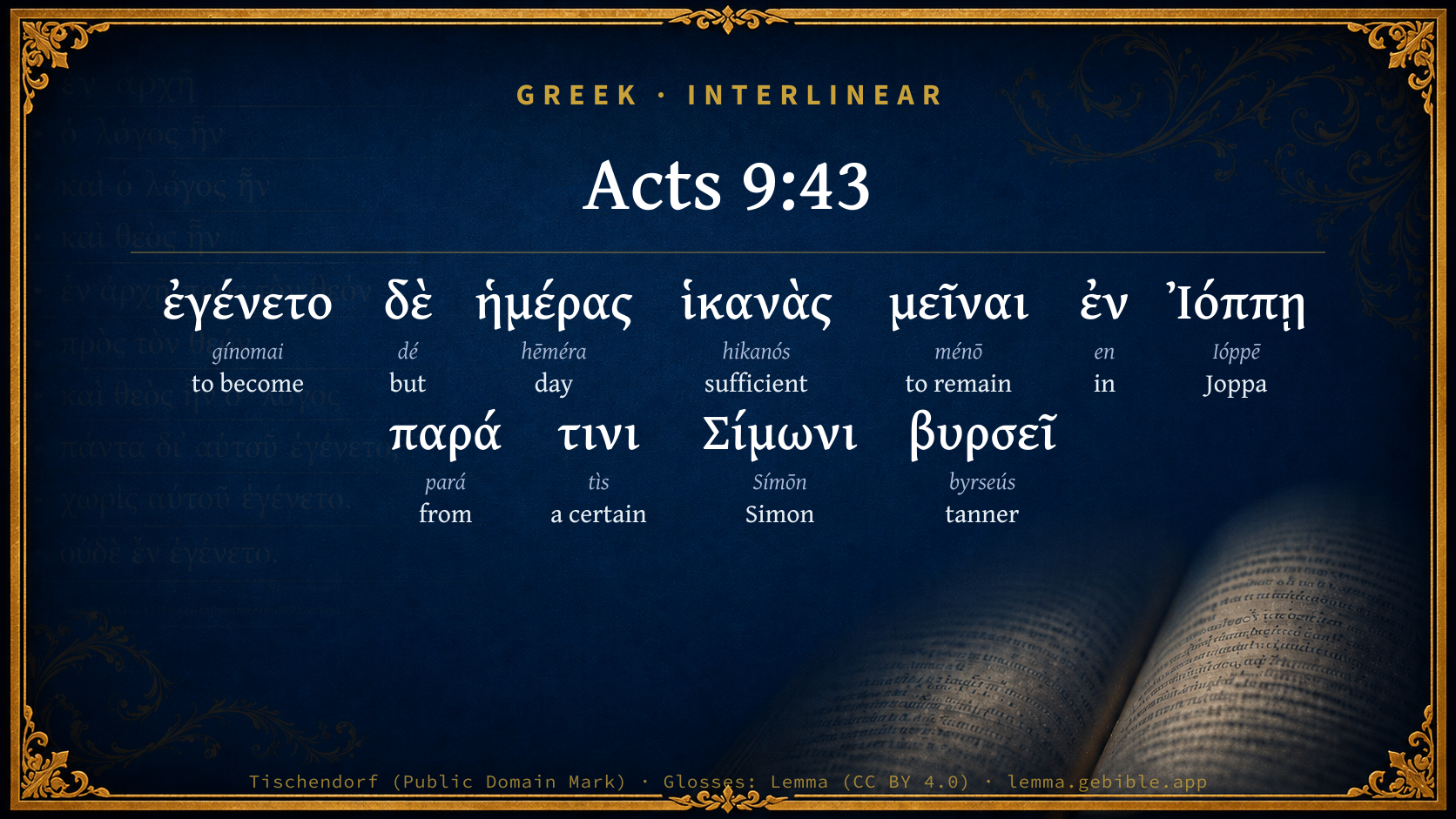
Download image
Cite this verse

Acts 9:43 (World English Bible). Public Domain. Lemma interlinear Bible study tool, https://lemma.gebible.app/v/acts/9/43.

Show BibTeX & RIS
BibTeX
RIS
English Translation
It happened, that he stayed many days in Joppa with one Simon, a tanner.
World English Bible · Public Domain
Highlights
  • 1 first appearance in the Greek New Testament
Full analysis ↓
Download a study sheet

One document with this verse’s original text, its word-by-word gloss line, the meaning frame, cross-references with their text, attributed commentary, and full source and license credits — printable, and it pastes into notes with its structure intact.

This verse Autodidact and up

Study sheet (.html) Plain text (.txt)

A passage Seminary Student

Up to 50 verses in one chapter. A passage sheet keeps up to 6 commentary sources and 12 cross-references per verse, in the order this page ranks them, and says so on the sheet whenever that leaves anything out. Ask for a single verse and you get the Autodidact verse sheet above.

Everything on this page stays free to read, with no account — the sheet is a download of what is already on screen, not access to it.

Want to remove ads? Support Godless Engineer
Compare translations 3

The same verse in 3 English versions, stacked beneath the original-language interlinear above. Click any original word for its lexicon entry.

Each is an independent rendering of the whole verse — the interlinear is not word-aligned to these translations.

Highlighted words mark where these versions differ — a whole-verse word diff, not a word-by-word alignment.

  • World English Bible Public Domain
    It happened, that he stayed many days in Joppa with one Simon, a tanner.
  • King James Version Public Domain
    And it came to pass, that he tarried many days in Joppa with one Simon a tanner.
  • unfoldingWord Literal Text CC BY-SA 4.0
    Now it happened that he stayed many days in Joppa with a certain Simon, a tanner.

unfoldingWord Literal Text — © unfoldingWord, licensed CC BY-SA 4.0. Word-aligned USFM3 via Door43 (git.door43.org/unfoldingWord/en_ult).

Versions to compare (up to 4)

3 of 4 selected

Show all 19 translations

Every available English version of this verse, each an independent rendering of the whole verse.

  • World English Bible Public Domain
    It happened, that he stayed many days in Joppa with one Simon, a tanner.
  • Berean Standard Bible Public Domain
    And Peter stayed for several days in Joppa with a tanner named Simon.
  • Majority Standard Bible Public Domain
    And Peter stayed for several days in Joppa with a tanner named Simon.
  • King James Version Public Domain
    And it came to pass, that he tarried many days in Joppa with one Simon a tanner.
  • American Standard Version (1901) Public Domain
    And it came to pass, that he abode many days in Joppa with one Simon a tanner.
  • Revised Version (1885) Public Domain
    And it came to pass, that he abode many days in Joppa with one Simon a tanner.
  • Geneva Bible (1599) Public Domain
    And it came to passe that he taried many dayes in Ioppa with one Simon a Tanner.
  • Douay-Rheims (1899) Public Domain
    And it came to pass, that he abode many days in Joppe, with one Simon a tanner.
  • Young's Literal Translation Public Domain
    and it came to pass, that he remained many days in Joppa, with a certain one, Simon a tanner.
  • Literal Standard Version CC BY-SA 4.0
    and it came to pass, that he remained many days in Joppa, with a certain one, Simon a tanner.
  • Unlocked Literal Bible CC BY-SA 4.0
    It happened that Peter stayed for many days in Joppa with a man named Simon, a tanner.
  • unfoldingWord Literal Text CC BY-SA 4.0
    Now it happened that he stayed many days in Joppa with a certain Simon, a tanner.
  • Darby Bible Public Domain
    And it came to pass that he remained many days in Joppa with a certain Simon, a tanner.
  • World Messianic Bible Public Domain
    He stayed many days in Joppa with a tanner named Simon.
  • Webster's Bible Public Domain
    And it came to pass, that he tarried many days in Joppa with one Simon a tanner.
  • Free Bible Version CC BY-SA 4.0
    Peter spent a long time in Joppa, staying at the house of Simon the tanner.
  • Bible in Basic English Public Domain
    And he was living in Joppa for some time with Simon, a leather-worker.
  • Text-Critical English NT CC BY 4.0
    And Peter remained in Joppa for many days with a tanner named Simon.
  • Tyndale New Testament (1534) Public Domain
    And it fortuned that he taryed many dayes in Ioppa with one Simon a tanner.

Literal Standard Version (2020), Covenant Press — licensed CC BY-SA 4.0. Text via the HelloAO Bible API (eBible.org). Unlocked Literal Bible (unfoldingWord) — licensed CC BY-SA 4.0. Text via the HelloAO Bible API (eBible.org). unfoldingWord Literal Text — © unfoldingWord, licensed CC BY-SA 4.0. Word-aligned USFM3 via Door43 (git.door43.org/unfoldingWord/en_ult). Free Bible Version, Dr. Jonathan Gallagher — licensed CC BY-SA 4.0. Text via the HelloAO Bible API (eBible.org).

Word by word

More ways to search: Search by grammar → Find every occurrence → Compare this word →

Practice this passage: Drill this verse → Learn its vocabulary →

About this verse

These counts appear in no published source. They are computed here, from the morphology-tagged text and Lemma’s own curated glosses. What Lemma adds →

11
words
11
distinct lemmas
Acts
section

Notable vocabulary

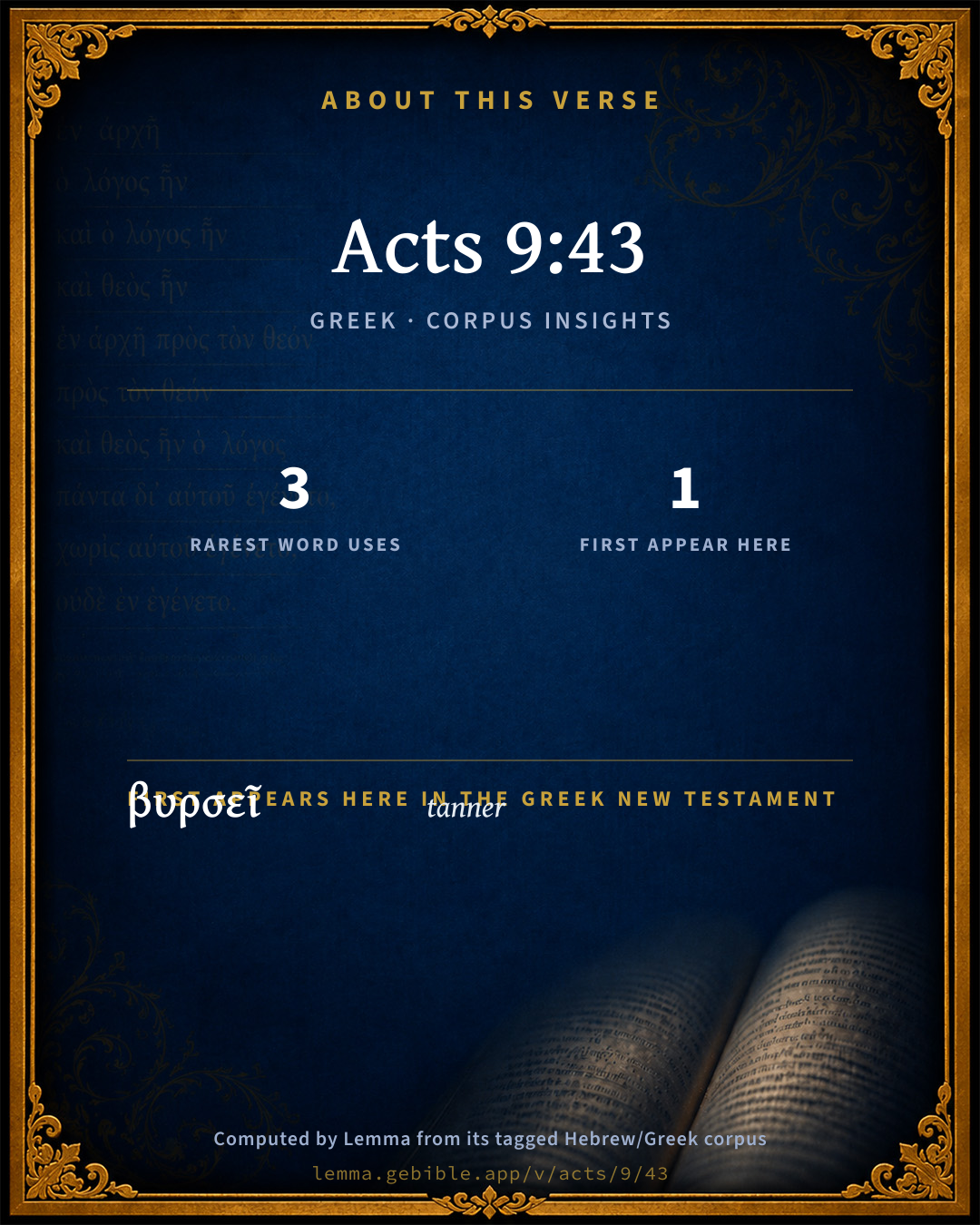
The rarest word here is βυρσεῖ tanner G1038 — appearing just 3 times in the whole Greek New Testament.

First appearance in Scripture

This word makes its first canonical appearance in the Greek New Testament here:

  • βυρσεῖ tanner G1038

Shared distinctive vocabulary

βυρσεῖ tanner G1038 occurs in 3 verses of the Greek New Testament. Also found in:
Cross-references

2

Topical passages linked to Acts 9:43 in the Treasury of Scripture Knowledge — connected by theme and wording, ordered by reader-vote popularity; previews shown in the World English Bible.

  • Acts 10:6 He lodges with one Simon, a tanner, whose house is by the seaside."
  • Acts 10:32 Send therefore to Joppa, and summon Simon, who is surnamed Peter. He lodges in the house of Simon a tanner, by the seaside. When he comes, he will speak to you.'

Cross-references courtesy of OpenBible.info (CC BY 4.0).

Commentary

Notes on Acts 9:43 from classic Christian and Jewish commentators (each source and its license shown beneath its notes). The classic Christian expositions comment on the surrounding passage and are grouped to its opening verse, so a note may address several verses; the Jewish commentaries on the Tanakh (Rashi and others) are per-verse, so they appear only where the commentator wrote on this verse.

Lemma curates 59 commentaries, every one of them public domain or Creative Commons licensed, each selected and text-cleaned for this edition rather than reprinted as found. About our sources →

Tyndale Open Study Notes

Tyndale Open Resources

9:43 living with Simon, a tanner of hides: Tanning was an unclean business in Jewish eyes, which might suggest that Peter was not scrupulous in observing Jewish traditions (cp. Gal 2:11-14).

Tyndale Open Study Notes — © Tyndale Open Resources, licensed CC BY-SA 4.0. Text via the HelloAO Bible API.

Bengel's Gnomon

Johann Albrecht Bengel

Act 9:43. Ἱκανὰς, a considerable number of days) He did more than they had asked, Act 9:38.—Σίμωνι, Simon) who lived perhaps near the place.—[βυρσεῖ, a tanner) What condescending familiarity with the people did the illustrious apostle in this instance exhibit in external things, after the great deed which he accomplished in this very town, Joppa, and before the grand business which he was about to undertake at Cæsarea!—V. g.]

Bengel's Gnomon of the New Testament — English translation (T&T Clark, Edinburgh, 1860) — public domain. Text from a community e-Sword module.

Expositor's Greek Testament

ed. W. Robertson Nicoll

Act 9:43 . ἐγένετο δὲ , see on Act 9:37 , Plummer, St. Luke , p. 45, on the use of ἐγένετο . The phrase also marks (as often in Luke) a transition to the following narrative (Nösgen). ἡμέρας ἱκανὰς , see on Act 8:11 , and Act 27:7 . Kennedy speaks of the adjective as used in the vernacular sense of “long,” “many,” Aristoph., Pax. , 354. βυρσεῖ , in classics βυρσοδέψης : it is difficult to suppose that the common estimate of the work of a tanner amongst the Jews as unclean, on account of their constant contact with dead animals, has here no significance. At least the mention of the trade seems to show that St. Peter was already in a state of mind which would fit him for the further revelation of the next chapter, and for the instructions to go and baptise the Gentile Cornelius. On the detestation in which this trade was held by the Jews, see Wetstein, in loco ; Edersheim, Jewish Social Life , p. 158; cf. Mishna, Khethuboth , vii., 10. It does not in any way militate against the historical character of the narrative, as Overbeck maintains, to admit that the description is meant to introduce the “universalism” of the following incident. Both Chrysostom and Theophylact (so too Erasmus) dwell upon this incident in St. Peter’s life as illustrating his unassuming conduct. Ἰόππῃ , see on Act 9:36 . Heb. יָפוֹ , “beauty,” Jaffa ; see for references Jos 19:46 , 2Ch 2:16 , Jon 1:3 , Ezr 3:7 ; the port of Jerusalem from the days of Solomon (from which it was distant some thirty-five miles), situated on a hill so high that people affirmed, as Strabo mentions, that the capital was visible from its summit. It was comparatively (Schürer) the best harbour on the coast of Palestine (although Josephus, B. J. , iii., 9, correctly describes it as dangerous), and in this lay its chief importance. The Maccabees were well aware of this, and it is of Simon that the historian writes: “With all his glory he took Joppa for an haven, and made an entrance to the isles of the sea” 1Ma 14:5 (about 144 B.C.). The Judaising of the city was the natural result of the Maccabean occupation, although the Syrians twice retook Joppa, and twice Hyrcanus regained it for the Jews. Taken by Pompey B.C. 63, restored to the Jews by Cæsar 47, Jos., Ant. , xiv., 4, 4; B. J. , i., 7, 7, and Ant. , xiv., 10, 6, and at length added to the kingdom of Herod the Great, Ant. , xv., 7, 3; B. J. , i., 20, 3, Joppa remained Jewish, imbued with all the fanatic patriotism of the mother-city, and in the fierce revolt of 66 A.D. Joppa still remained alone in her undivided allegiance to Judaism, and against Joppa the first assault of Cestius Gallus was directed. On the Joppa which St. Peter entered, Act 10 , and its contrast to the neighbouring Cæsarea, see Act 8:40 and G. A. Smith, Hist. Geog. , p. 136 ff.; see also Schürer, Jewish People , div. ii., vol. i., p. 79 ff. E.T.; Hamburger, Real-Encyclopädie des Judentums , i., 4, 601; B.D. 2 , “Joppa”.

The Expositor's Greek Testament, edited by W. Robertson Nicoll (1897–1910) — public domain. Text from a community e-Sword module.

Jamieson, Fausset & Brown

Robert Jamieson, A. R. Fausset & David Brown

with one Simon a tanner--a trade regarded by the Jews as half unclean, and consequently disreputable, from the contact with dead animals and blood which was connected with it. For this reason, even by other nations, it is usually carried on at some distance from towns; accordingly, Simon's house was "by the seaside" (Act 10:6). Peter's lodging there shows him already to some extent above Jewish prejudice.

Next: Acts Chapter 10

Jamieson, Fausset & Brown — Commentary Critical and Explanatory on the Whole Bible (1871) — public domain (CC PDM 1.0). Text via the HelloAO Bible API.

Adam Clarke's Commentary

Verse 43. He tarried many days in Joppa] Taking advantage of the good impression made on the people's minds by the miracle, he preached to them the great truths of Christianity, and thus established them in the faith.

Simon a tanner.] Whether the original word βυρσευς signifies a tanner or a currier, is of little consequence. The person who dealt in the hides, whether of clean or unclean animals, could not be in high repute among the Jews. Even in Joppa, the trade appears to have been reputed unclean; and therefore this Simon had his house by the sea side. See Ac 10:6. Of the trade itself the Talmudists speak with great contempt; they reckon it among blemishes. See proofs in Schoettgen.

1. THUS terminates what has not been improperly called the first period of the Christian Church, which began at the day of pentecost, Ac 2:1, and continued to the resurrection of Dorcas; a period of about eight years. During the whole of this time the Gospel was preached to the Jews only, no Gentile being called before Cornelius, the account of whose conversion, and the Divine vision that led to it, are detailed in the following chapter. Salvation was of the Jews: theirs were the fathers, the covenants, and the promises, and from them came Christ Jesus; and it was right that they should have the first offer of a salvation which, while it was a light to lighten the Gentiles, was to be the glory of the Israelitish people. When they utterly rejected it, then the apostles turned unto the Gentiles. Among them the Christian Church was founded, and thus the reprobates became the elect, and the elect became reprobates. Reader! behold the goodness and severity of God! Towards them that fell, severity; but towards thee, goodness, if thou continue in his goodness; otherwise thou also shalt be cut off, Ro 11:22. Thou canst only stand by faith; and be not high-minded, but fear. Nothing less than Christ dwelling in thy heart by faith can save thy soul unto eternal life.

2. The conversion of Saul of Tarsus is one of the most remarkable facts recorded in the history of the Christian Church. When we consider the man; the manner in which he was brought to the knowledge of the truth; the impression made on his own mind and heart by the vision he had on his way to Damascus, and the effect produced in all his subsequent life, we have a series of the most convincing evidences of the truth of the Christian religion. In this light he ever viewed the subject himself; the manner of his conversion he ever appealed to, as the most proper apology for his conduct; and, on several most important occasions, he not only refers to it, but enters into a detail of its circumstances, that his hearers might see that the excellency of the power was of GOD and not of man.

Saul of Tarsus was not a man of a light, fickle, and uncultivated mind. His natural powers were vast, his character the most decided, and his education, as we learn from his historian, and from his writings, was at once both liberal and profound. He was born and brought up in a city which enjoyed every privilege of which Rome itself could boast, and was a successful rival both of Rome and Athens in arts and science. Though a Jew, it is evident that his education was not confined to matters that concerned his own people and country alone. He had read the best Greek writers, as his style, allusions, and quotations sufficiently prove; and, an matters which concern his own religion, he was instructed by Gamaliel, one of the most celebrated doctors the synagogue had ever produced. He was evidently master of the three great languages which were spoken among the only people who deserved the name of nations-the Hebrew, and its prevailing dialect, the Chaldio-Syriac; the Greek, and the Latin; languages which, notwithstanding all the cultivation through which the earth has passed, maintain their rank, which is a most decisive superiority over all the languages of the universe. Was it likely that such a man, possessing such a mind, cultivated to such an extent, could have been imposed on or deceived? The circumstances of his conversion forbid the supposition: they do more; they render it impossible. One consideration on this subject will prove that imposture in this case was impossible: he had no communication with Christians; the then that accompanied him to Damascus were of his own mind-virulent, determined enemies to the very name of Christ; and his conversion took place in the open day, on the open road, in company only with such men as the persecuting high priest and Sanhedrin thought proper to be employed in the extermination of Christianity. In such circumstances, and in such company, no cheat could be practised. But was not he the deceiver? The supposition is absurd and monstrous, for this simple reason, that there was no motive that could prompt him to feign what he was not; and no end that could be answered by assuming the profession of Christianity. Christianity had in it such principles as must expose it to the hatred of Greece, Rome, and Judea. It exposed the absurdity and folly of Grecian and Roman superstition and idolatry, and asserted itself to be the completion, end, and perfection of the whole Mosaic economy. It was therefore hated by all those nations, and its followers despised, detested, and persecuted. From the profession of such a religion, so circumstanced, could any man, who possessed even the most moderate share of common sense, expect secular emolument or advantage? No! Had not this apostle of the Gentiles the fullest conviction of the truth of Christianity, the fullest proof of its heavenly influence on his own soul, the brightest prospect of the reality and blessedness of the spiritual world, he could not have taken one step in the path which the doctrine of Christ pointed out. Add to this, that he lived long after his conversion, saw Christianity and its influence in every point of view, and tried it in all circumstances. What was the result? The deepest conviction of its truth; so that he counted all things dross and dung in comparison of the excellency of its knowledge. Had he continued a Jew he would have infallibly risen to the first dignities and honours of his nation; but he willingly forfeited all his secular privileges and well grounded expectations of secular honour and emolument, and espoused a cause from which he could not only have no expectation of worldly advantage, but which, most evidently and necessarily, exposed him to all sorts of privations, sufferings, hardships, dangers, and death itself! These were not only the unavoidable consequences of the cause he espoused; but he had them fully in his apprehension and constantly in his eye. He predicted them, and knew that every step he took was a progressive advance in additional sufferings, and the issue of his journey must be a violent death!

The whole history of St. Paul proves him to be one of the greatest of men; and his conduct after he became a Christian, had it not sprung from a Divine motive, of the truth of which he had the fullest conviction, would have shown him to be one of the weakest of men. The conclusion therefore is self-evident, that in St. Paul's call there could be no imposture, that in his own mind there could be no deception, that his conversion was from heaven, and the religion he professed and taught, the infallible and eternal truth of Jehovah. In this full conviction he counted not his life dear unto him, but finished his rugged race with joy, cheerfully giving up his life for the testimony of Jesus; and thus his luminous sun set in blood, to rise again in glory. The conversion of St. Paul is the triumph of Christianity; his writings, the fullest exhibition and defence of its doctrines; and his life and death, a glorious illustration of its principles. Armed with this history of Paul's conversion and life, the feeblest believer needs not fear the most powerful infidel. The ninth chapter of the Acts of the Apostles will ever remain an inexpugnable fortress to defend Christianity and defeat its enemies. Reader, hath not God so done his marvellous works that they may be had in everlasting remembrance?

Adam Clarke's Commentary on the Bible (1810–1826) — public domain. Text from a community e-Sword/MySword module.

John Calvin's Commentaries

43. When as he saith that Peter dwelt with a tanner, we may hereby gather of what manner of men the church of Joppa did consist, for if the chieftains of the city had been converted to Christ, some one of them would have lodged Peter; for it had been too cruel a thing to suffer an apostle of Christ to be so despised. Therefore, the Lord did gather together there, as every where, a church of the common sort of men, that he might throw down the pride of the flesh; and also thereby appeareth Peter’s courtesy, in that he vouchsafeth to lodge with a man of that calling; although it seemeth that he was rather a merchant of some good estimation, than one of the basest sort of workmen. For Luke will say afterwards that there were there some which ministered unto Peter, whereby it appeareth that he was well and honestly used.

John Calvin's Commentaries (1540-1563) — public domain. Text from the Calvin Translation Society English edition (1840s-50s) via the Christian Classics Ethereal Library (ccel.org). Calvin's coverage is partial (roughly two-thirds of the Bible); uncommented books and verses are honest gaps, never fabricated. The 19th-century editor's footnotes and remarks are omitted so the notes are faithfully Calvin's own voice.

Ellicott's Commentary for English Readers

(43) Many days in Joppa with one Simon a tanner.—Either as bringing with it, through contact with the carcases and hides of dead beasts, the risks of ceremonial defilement, or being generally a repulsive and noisome business, the occupation was one from which the stricter Jews generally shrunk. The Rabbis held that if a tanner about to marry concealed his occupation from his intended wife, the concealment was of the nature of a fraud that invalidated the contract (Schöttgen, Hor. Heb., in loc.). In taking up his abode with one of this calling, Peter must accordingly have been taking one step in advance towards greater freedom. He had learnt, partially at least, the lesson which his Master had taught as to that which alone can bring with it real defilement (Mar_7:17-23), and was thus being trained for a fuller illumination. We have no data for determining the length of time implied in the “many days.” In Act_9:23, as we have seen, the words covered a period of nearly three years.

A Bible Commentary for English Readers, edited by Charles John Ellicott (1878–1897) — public domain. Text from a community e-Sword module.

The Cambridge Bible for Schools and Colleges

gen. ed. J. J. S. Perowne

43. he tarried many days] On the indefinite nature of the time indicated here see above, Act_9:23, note.

with one Simon a tanner] The trade of a tanner was held as abominable by the Jews. A wife, it is said, could claim a divorce from a husband who became a tanner (Mishna Khethuboth vii. 10, where is recorded the following story): “It happened at Sidon that a tanner died, and left a brother who was also a tanner. The sages held that his (childless) widow had a right to plead, Thy brother I could bear but I cannot bear thee,” and so in this case the woman might refuse to marry her husband’s brother.

It is a sign that in the mind of St Peter some usages and prejudices of the Jews were already becoming of small account, when he makes his abode at the house of Simon a tanner. Such a step prepares us for the history of the next chapter, where he is instructed to go and preach to and baptize the Gentile Cornelius.

The Cambridge Bible for Schools and Colleges (gen. ed. J. J. S. Perowne; Cambridge University Press, 1878–1918) — public domain. Text from a community e-Sword module.

Trapp's Complete Commentary

John Trapp

43 And it came to pass, that he tarried many days in Joppa with one Simon a tanner.

Ver. 43. With one Simon a tanner] Of mean rank and despicable, but religious and hospitable. Of such, and not of great ones, consisted this Church of Christ at Joppa. The poor are gospellized, ευαγγελιζονται, Mat 11:5. The lesser fishes bite soonest. Grandior solet esse Deus in parvulis, quam in magnis. {See Trapp on "Act 10:6"}

John Trapp, A Commentary or Exposition upon All the Books of the Old and New Testament (1647–1656) — public domain. Text from a community e-Sword module.

Haydock's Catholic Bible Commentary

In the Greek is added: instructing the new converts, and fortifying them in the faith they had just embraced.

George Leo Haydock (1774–1849), Haydock's Catholic Family Bible and Commentary, 1859 edition — public domain. Excludes Psalms (Douay-Rheims chapter numbering differs from Protestant) and Deuterocanonical books (Catholic canon only).

Matthew Poole's English Annotations

The miracle had only prepared them to receive his doctrine, which Peter tarried some time with them to instruct them in: the miracle had prepared the ground, and now he takes this season to sow the seed of the word into it.

Matthew Poole's English Annotations on the Holy Bible (1683–1685) — public domain. Text from a community e-Sword/MySword module.

Whedon's Commentary on the Bible

Daniel D. Whedon

43. With one Simon a tanner—Tanning was an unclean trade in a Jew’s estimation, spoken of with great contemn by the rabbies, and excluded from Jewish cities, and so Simon’s tannery was by the sea side, (Act_10:6.) Peter had, no doubt, so far relaxed his high Judaism as to slight this prejudice.

Daniel D. Whedon (gen. ed.), Commentary on the Old and New Testaments (1874–1909) — public domain. Text from a community e-Sword module.

The Pulpit Commentary

Abode for tarried, A.V. Many days (hJmerav iJkanav); the same phrase as ver. 23; spoken of a time of indeterminate length. Here probably it means some months, luring which Peter would be evangelizing the whole neighborhood. The Jews are said to have considered the trade of a tanner unclean; but if this were so, it would not be safe to infer that Peter was already indifferent to ceremonial uncleanness. We know he was not so, (Act_10:14) but probably in his line of life he could not act up to all the nicer distinctions of the strictest Pharisees.

The Pulpit Commentary (1880–1919), ed. H.D.M. Spence-Jones & Joseph S. Exell — public domain. Text from a community e-Sword module.

McGarvey & Pendleton's Commentaries

J. W. McGarvey

43. Peter was engaged, at this time, in general evangelizing among the Jews, adapting his stay at a given point, and his change of place, to the exigencies of the cause. The restoration of Dorcas, doubtless, opened a wide field for usefulness in the surrounding community, (43) " and he tarried many days in Joppa, with one Simon, a tanner. " Here the historian leaves him for awhile, and introduces us to the circumstances which removed him from this to another field of labor.

J. W. McGarvey (with Philip Y. Pendleton), Commentaries on the New Testament (The Fourfold Gospel, 1914; Acts; and the epistles) — public domain. Text from a community e-Sword/MySword module.

The People's New Testament

B. W. Johnson

43. Tarried many days. Perhaps a year. Joppa was a large city and a favorable field of work. Here Peter was found, at “the house of Simon the tanner,” when called to Cæsarea by the messengers of Cornelius. It was by the seaside (10:32), and a house is still pointed out, close to the sea-shore, as that of Simon, which Dean Stanley believes to be on the original site.

In the main I have followed that of Dean Howson. The dates for the period after Paul's labors began are reasonably certain, and most critics are substantially agreed. Those of the period from the Ascension to the time when Paul began his labors at Antioch are somewhat uncertain. The Ascension and the founding of the Church on Pentecost must, I think he placed as early as a.d. 30, and this gives a longer interval for the events recorded in the first eleven chapters of Acts. As modified the following are the outlines:

a.d. 30. The Resurrection, the Ascension, the Gospel first Preached on Pentecost, Holy Spirit Sent, the Church Founded, and the Events Embraced from Acts I. to Acts VI: 8.

a.d. 37. Conversion of Paul of Tarsus. Acts IX :1–19.

a.d. 38–40. Period of Paul's Retirement in Arabia.

a.d. 41–43. The Labors of Peter and the Conversion of the Gentiles Recorded in Chapter IX-XI.

a.d. 44. Martyrdom of James, and Death of Herod. Acts XII.

a.d. 45–47. Paul's First Missionary Journey. Acts XIII, XIV.

a.d. 49 or 50. Council at Jerusalem. Acts XV.

a.d. 51–53. Paul on His Second Missionary Journey. Acts XV-XVIII.

a.d. 54–56. Paul at Ephesus, nearly three Years. Acts XIX.

a.d. 57. Paul a Second Time at Corinth.

a.d. 58. Paul Goes to Jerusalem, is seized, Imprisoned. Acts XX-XXIII.

a.d. 59–60. Paul Imprisoned at Cæsarea. His Defence before Festus and Agrippa. Acts XXIII-XXVI.

a.d. 61. Paul sent to Rome. Shipwrecked. Acts XXVII-XXVIII.

a.d. 62. Imprisoned at Rome. The End of Acts.

To this I may add that there is reason to believe that Paul was acquitted and released in a.d. 63, preached in Spain, Greece and Asia, until a.d. 67 or 68, was again seized in Nicopolis in Epirus, taken to Rome a second time, and put to death in a.d. 68.

B. W. Johnson's The People's New Testament with Notes (1889–1891) — public domain. Electronic text from the Christian Classics Ethereal Library (CCEL) ThML edition.

Cambridge Greek Testament for Schools and Colleges

43. ἡμέρας ἱκανάς. On the indefinite nature of the length of time indicated here, see Act 9:23, note.

παρά τινι Σίμωνι βυρσεῖ, with one Simon a tanner. The trade of a tanner was held as abominable by the Jews. A wife, it is said, could claim a divorce from a husband who became a tanner. See Mishna Khethuboth VII. 10 where is recorded the following story: ‘It happened at Sidon that a tanner died, and left a brother who was also a tanner. The sages held that his (childless) widow had a right to plead, Thy brother I could bear but I cannot bear thee, and so in this case the woman might refuse to marry her husband’s brother.’

It is a sign that in the mind of St Peter some usages and prejudices of the Jews were already becoming of small account, when he makes his abode at the house of Simon a tanner. Such a step prepares us for the history of the next chapter, where he is instructed to go and preach to and baptize the Gentile Cornelius.

Cambridge Greek Testament for Schools and Colleges (Cambridge University Press, 1896; 21 vols, various authors incl. Carr, Maclear, Plummer, Farrar, Lumby, Moule, M. R. James, Simcox) — public domain. Text from a community e-Sword module.

Alford’s Greek Testament

Henry Alford

43. βυρσεῖ] From the extracts in Wetstein and Schöttgen, it appears that the Jews regarded the occupation of a tanner as a half-unclean one. In this case it would shew, as De W. observes, that the stricter Jewish practices were already disregarded by the Apostle. It also would shew, in how little honour he and his office were held by the Jews at Cæsarea.

Henry Alford, The Greek Testament (1849–1861) — public domain. Text from a community e-Sword module.

Lesson kit

Teaching starters — assembled from the data on this page, not authored interpretation. Every prompt links to the verse data it draws on. Edit before teaching.

Acts, in the Acts, opens this verse with 11 words (11 distinct Greek lemmas). Its most distinctive word is byrseús (“tanner”). A historical commentator’s framing appears above. Read the whole chapter for the surrounding context.

Discussion questions

  1. How does “tanner” (byrseús) shape what this verse is saying?
  2. This is the first place “tanner” appears in Scripture (first appears here). What does its debut here establish?
  3. How does Acts 10:6, which shares the word «tanner», read alongside this verse?
  4. These translations render this verse differently; the difference is in the English rendering, not the original. What questions does that raise?
  5. Compare how Tyndale Open Study Notes and Bengel's Gnomon read this verse. Where do they agree or differ?

Things to notice

  • 1 word makes its first canonical appearance in Scripture here.
  • These translations choose different wording for 8 words in this verse.
  • 11 distinct Greek lemmas span 11 words in this verse.

Reading settings

Reading text

Shown beneath each verse's original-language words.

Old Testament
Old Testament edition

Read the OT as the Masoretic Hebrew (MT) or the Greek Septuagint (LXX).

English shown for the Greek Septuagint (in the Hebrew ↔ Greek comparison).

Comparing translations? Open the Compare panel on any verse page to stack up to four side by side.