Acts 10:25

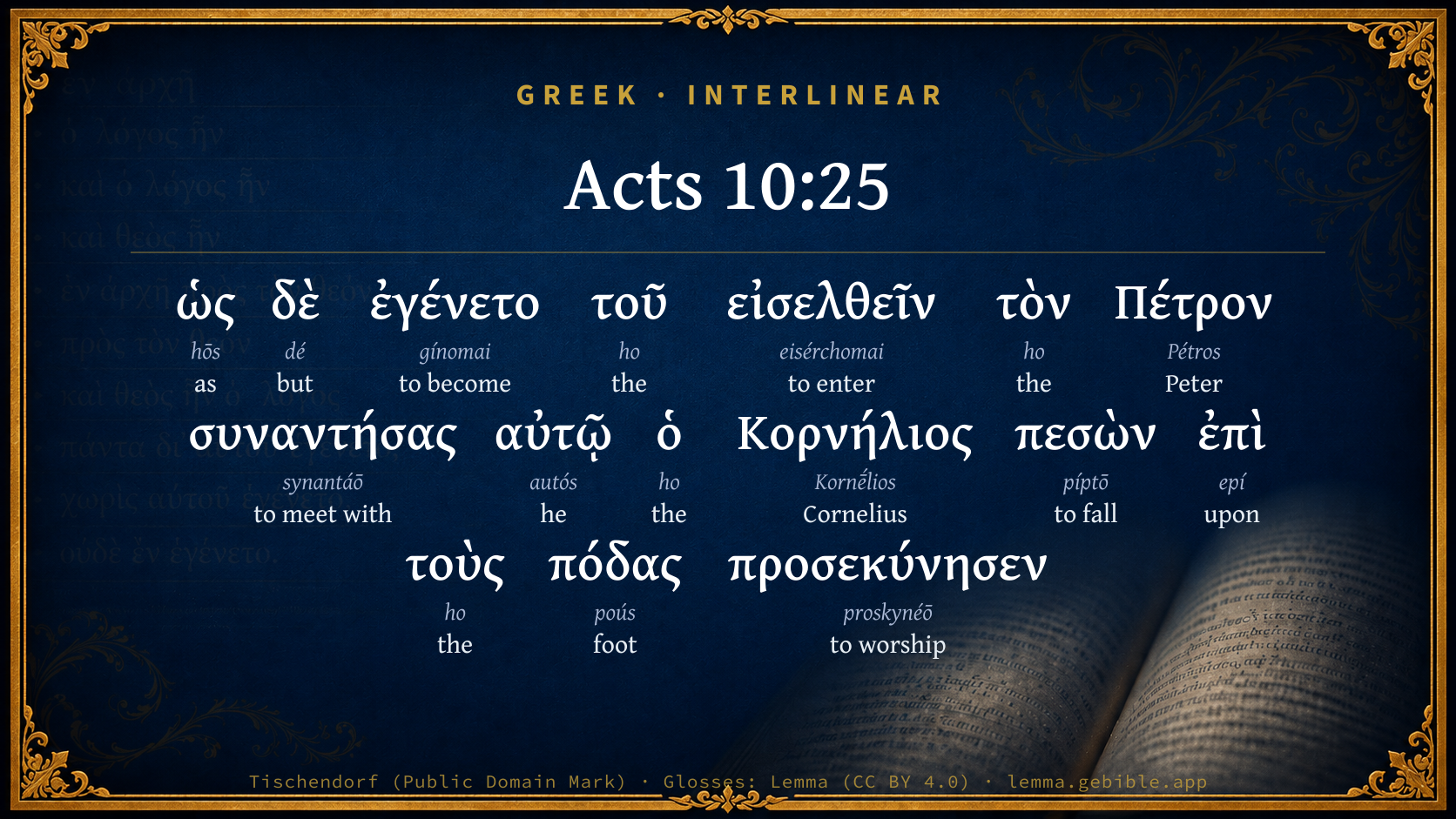
Greek (Tischendorf 8th ed.) Acts 10:25 appears in the Greek New Testament. The text above is from the Tischendorf 8th edition. Each word links to its Strong’s number and a concise gloss. Click any word for its full Thayer’s Greek Lexicon entry.
Download image
Cite this verse

Acts 10:25 (World English Bible). Public Domain. Lemma interlinear Bible study tool, https://lemma.gebible.app/v/acts/10/25.

Show BibTeX & RIS
BibTeX
RIS
English Translation
When it happened that Peter entered, Cornelius met him, fell down at his feet, and worshiped him.
World English Bible · Public Domain
Download a study sheet

One document with this verse’s original text, its word-by-word gloss line, the meaning frame, cross-references with their text, attributed commentary, and full source and license credits — printable, and it pastes into notes with its structure intact.

This verse Autodidact and up

Study sheet (.html) Plain text (.txt)

A passage Seminary Student

Up to 50 verses in one chapter. A passage sheet keeps up to 6 commentary sources and 12 cross-references per verse, in the order this page ranks them, and says so on the sheet whenever that leaves anything out. Ask for a single verse and you get the Autodidact verse sheet above.

Everything on this page stays free to read, with no account — the sheet is a download of what is already on screen, not access to it.

Want to remove ads? Support Godless Engineer
Compare translations 3

The same verse in 3 English versions, stacked beneath the original-language interlinear above. Click any original word for its lexicon entry.

Each is an independent rendering of the whole verse — the interlinear is not word-aligned to these translations.

Highlighted words mark where these versions differ — a whole-verse word diff, not a word-by-word alignment.

  • World English Bible Public Domain
    When it happened that Peter entered, Cornelius met him, fell down at his feet, and worshiped him.
  • King James Version Public Domain
    And as Peter was coming in, Cornelius met him, and fell down at his feet, and worshipped him.
  • unfoldingWord Literal Text CC BY-SA 4.0
    And it happened that as Peter entered, Cornelius, meeting him falling down at feet, worshiped him.

unfoldingWord Literal Text — © unfoldingWord, licensed CC BY-SA 4.0. Word-aligned USFM3 via Door43 (git.door43.org/unfoldingWord/en_ult).

Versions to compare (up to 4)

3 of 4 selected

Show all 19 translations

Every available English version of this verse, each an independent rendering of the whole verse.

  • World English Bible Public Domain
    When it happened that Peter entered, Cornelius met him, fell down at his feet, and worshiped him.
  • Berean Standard Bible Public Domain
    As Peter was about to enter, Cornelius met him and fell at his feet to worship him.
  • Majority Standard Bible Public Domain
    As Peter was about to enter, Cornelius met him and fell at his feet to worship him.
  • King James Version Public Domain
    And as Peter was coming in, Cornelius met him, and fell down at his feet, and worshipped him.
  • American Standard Version (1901) Public Domain
    And when it came to pass that Peter entered, Cornelius met him, and fell down at his feet, and worshipped him.
  • Revised Version (1885) Public Domain
    And when it came to pass that Peter entered, Cornelius met him, and fell down at his feet, and worshipped him.
  • Geneva Bible (1599) Public Domain
    And it came to passe as Peter came in, that Cornelius met him, and fell downe at his feete, and worshipped him.
  • Douay-Rheims (1899) Public Domain
    And it came to pass, that when Peter was come in, Cornelius came to meet him, Cornelius came to meet him, and falling at his feet adored.
  • Young's Literal Translation Public Domain
    and as it came that Peter entered in, Cornelius having met him, having fallen at `his' feet, did bow before `him';
  • Literal Standard Version CC BY-SA 4.0
    and as it came that Peter entered in, Cornelius having met him, having fallen at [his] feet, worshiped [him];
  • Unlocked Literal Bible CC BY-SA 4.0
    It came about that when Peter entered, Cornelius met him and fell down at his feet to worship him.
  • unfoldingWord Literal Text CC BY-SA 4.0
    And it happened that as Peter entered, Cornelius, meeting him falling down at feet, worshiped him.
  • Darby Bible Public Domain
    And when Peter was now coming in, Cornelius met him, and falling down did [him] homage.
  • World Messianic Bible Public Domain
    When Peter entered, Cornelius met him, fell down at his feet, and worshiped him.
  • Webster's Bible Public Domain
    And as Peter was coming in, Cornelius met him, and fell down at his feet, and worshiped him.
  • Free Bible Version CC BY-SA 4.0
    When Peter entered the house, Cornelius met him and fell down at his feet and worshiped him.
  • Bible in Basic English Public Domain
    And when Peter came in, Cornelius came to him and, falling down at his feet, gave him worship.
  • Text-Critical English NT CC BY 4.0
    When Peter entered the house, Cornelius met him, fell at his feet, and worshiped him.
  • Tyndale New Testament (1534) Public Domain
    And as it chaunsed Peter to come in Cornelius met hym and fell doune at his fete and worshipped hym.

Literal Standard Version (2020), Covenant Press — licensed CC BY-SA 4.0. Text via the HelloAO Bible API (eBible.org). Unlocked Literal Bible (unfoldingWord) — licensed CC BY-SA 4.0. Text via the HelloAO Bible API (eBible.org). unfoldingWord Literal Text — © unfoldingWord, licensed CC BY-SA 4.0. Word-aligned USFM3 via Door43 (git.door43.org/unfoldingWord/en_ult). Free Bible Version, Dr. Jonathan Gallagher — licensed CC BY-SA 4.0. Text via the HelloAO Bible API (eBible.org).

Word by word

More ways to search: Search by grammar → Find every occurrence → Compare this word →

Practice this passage: Drill this verse → Learn its vocabulary →

συναντήσας
synantáō
G4876
“to meet with”
Verb, Aorist, Active, Participle, Nominative, Singular, Masculine
Part of Speech
Verb
Tense
Aorist
Voice
Active
Mood
Participle
Case
Nominative
Number
Singular
Gender
Masculine
Full Thayer's Definition

Origin: from G4862 and a derived from G473

TDNT: None

1. to meet with a. of events: to happen or befall
  1. ὡς hōs G5613 “as” Adverb
  2. δὲ dé G1161 “but” Conjunction
  3. ἐγένετο gínomai G1096 “to become” Verb, Aorist, Middle deponent, Indicative, 3rd person, Singular
  4. τοῦ ho G3588 “the” Article, Genitive, Singular, Neuter
  5. εἰσελθεῖν eisérchomai G1525 “to enter” Verb, Aorist, Active, Infinitive
  6. τὸν ho G3588 “the” Article, Accusative, Singular, Masculine
  7. Πέτρον Pétros G4074 “Peter” Noun, Accusative, Singular, Masculine
  8. αὐτῷ autós G846 “he” Personal pronoun, Dative, Singular, Masculine
  9. ὁ ho G3588 “the” Article, Nominative, Singular, Masculine
  10. Κορνήλιος Kornḗlios G2883 “Cornelius” Noun, Nominative, Singular, Masculine
  11. πεσὼν píptō G4098 “to fall” Verb, Aorist, Active, Participle, Nominative, Singular, Masculine
  12. ἐπὶ epí G1909 “upon” Preposition
  13. τοὺς ho G3588 “the” Article, Accusative, Plural, Masculine
  14. πόδας poús G4228 “foot” Noun, Accusative, Plural, Masculine
  15. προσεκύνησεν proskynéō G4352 “to worship” Verb, Aorist, Active, Indicative, 3rd person, Singular

About this verse

These counts appear in no published source. They are computed here, from the morphology-tagged text and Lemma’s own curated glosses. What Lemma adds →

16
words
13
distinct lemmas
Acts
section

Notable vocabulary

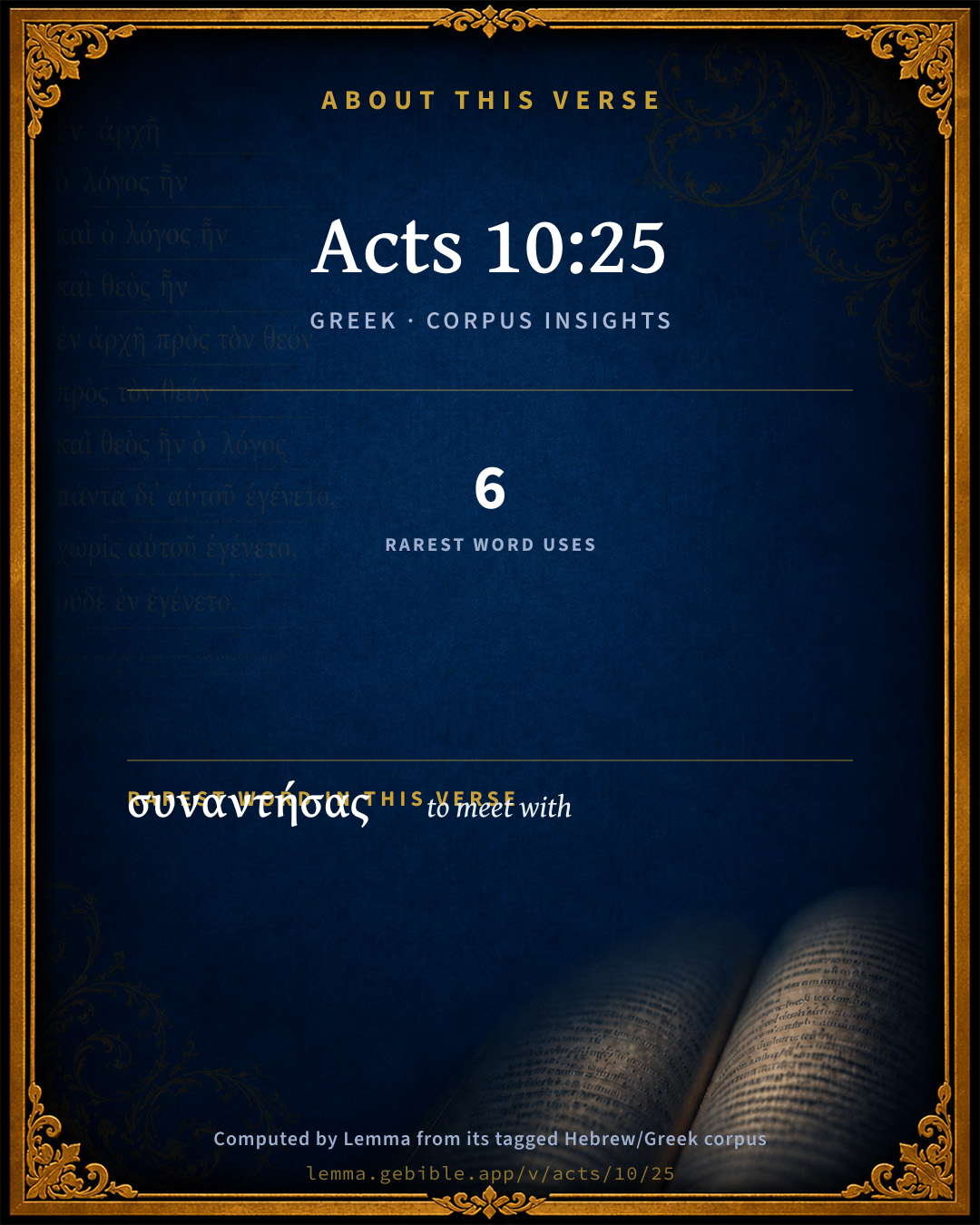
The rarest word here is συναντήσας to meet with G4876 — appearing just 6 times in the whole Greek New Testament.

Shared distinctive vocabulary

συναντήσας to meet with G4876 occurs in 6 verses of the Greek New Testament. Also found in:

Repetition

A word recurs within this verse:

Cross-references

7

Topical passages linked to Acts 10:25 in the Treasury of Scripture Knowledge — connected by theme and wording, ordered by reader-vote popularity; previews shown in the World English Bible.

  • Revelation 19:10 I fell down before his feet to worship him. He said to me, "Look! Don't do it! I am a fellow bondservant with you and with your brothers who hold the testimony of Jesus. Worship God, for the testimony of Jesus is the Spirit of Prophecy."
  • Revelation 22:8–9 Now I, John, am the one who heard and saw these things. When I heard and saw, I fell down to worship before the feet of the angel who had shown me these things.
  • Daniel 2:46 Then the king Nebuchadnezzar fell on his face, and worshiped Daniel, and commanded that they should offer an offering and sweet odors to him.
  • Matthew 8:2 Behold, a leper came to him and worshiped him, saying, "Lord, if you want to, you can make me clean."
  • Daniel 2:30 But as for me, this secret is not revealed to me for any wisdom that I have more than any living, but to the intent that the interpretation may be made known to the king, and that you may know the thoughts of your heart.
  • Acts 14:11–13 When the multitude saw what Paul had done, they lifted up their voice, saying in the language of Lycaonia, "The gods have come down to us in the likeness of men!"
  • Matthew 14:33 Those who were in the boat came and worshiped him, saying, "You are truly the Son of God!"

Cross-references courtesy of OpenBible.info (CC BY 4.0).

Commentary

Notes on Acts 10:25 from classic Christian and Jewish commentators (each source and its license shown beneath its notes). The classic Christian expositions comment on the surrounding passage and are grouped to its opening verse, so a note may address several verses; the Jewish commentaries on the Tanakh (Rashi and others) are per-verse, so they appear only where the commentator wrote on this verse.

Lemma curates 59 commentaries, every one of them public domain or Creative Commons licensed, each selected and text-cleaned for this edition rather than reprinted as found. About our sources →

Joseph Benson's Commentary

Act 10:25-27. As Peter was coming in — Cornelius, who had been expecting him, probably with some impatience, longing to know what that important doctrine was, which an angel had told him he should hear from him; met him, and fell down at his feet — Expressing thus his reverence for one, in so eminent a sense, the messenger of Heaven; and worshipped him — Not with divine, but mere civil worship: such as was usually paid to kings and princes, and others of high dignity, in the East. Having believed in the one living and true God, and forsaken the idolatry of the Gentiles, he certainly could not offer divine or religious worship to Peter: nor could he, as some have fancied, imagine Peter to be an angel, considering how the angel had spoken of him. But his reverence for him as a divine messenger, together with the custom which prevailed in those countries, of expressing the highest respect by prostration, might induce him to fall down at his feet, and offer a homage, which Peter wisely and religiously declined accepting. And as he talked with him, he went in — They went into the house talking together, probably of the goodness of God manifested in so happily bringing them together, for they could not but see and acknowledge God in it. And found many that were come together — More than Peter expected, which at once added solemnity to this service, and afforded a greater opportunity of doing good.

Joseph Benson's Commentary on the Old and New Testaments (1811–1818) — public domain. Text from a community e-Sword module.

Tyndale Open Study Notes

Tyndale Open Resources

10:25-26 Cornelius . . . worshiped him: This act must have been more than traditional obeisance to a high-ranking person. The Bible restricts worship to God alone (see 14:11-17; Exod 20:3; Deut 5:7; Matt 22:37-38; Mark 12:29-30; Luke 10:27; 1 Cor 10:14; Col 3:5; 1 Pet 4:3; 1 Jn 5:21; Rev 4:10; 9:20; 22:8-9). Peter was just a fellow human being whom Cornelius should not worship.

Tyndale Open Study Notes — © Tyndale Open Resources, licensed CC BY-SA 4.0. Text via the HelloAO Bible API.

Bengel's Gnomon

Johann Albrecht Bengel

Act 10:25. Εἰσελθεῖν, As it happened that Peter was entering) the house.—(συναντήσας, having met) with joy, and by way of compliment to him.—ἐπὶ τοὺς τόδας, at his feet) viz. those of Peter.—προσεκύνησεν, worshipped) Luke does not add him. A Euphemism [avoiding the expression of that which is idolatry].

Bengel's Gnomon of the New Testament — English translation (T&T Clark, Edinburgh, 1860) — public domain. Text from a community e-Sword module.

Expositor's Greek Testament

ed. W. Robertson Nicoll

Act 10:25 . ὡς δὲ ἐγέν . ( τοῦ ) εἰσ .: for τοῦ see critical notes; “and when it came to pass that Peter entered,” R.V., i.e. , into the house, see Burton, N. T. Moods and Tenses , p. 139. It may be regarded as an extension of τοῦ beyond its usual sphere, see Viteau, Le Grec du N. T. , for instances in LXX, pp. 166, 170 (1893). Simcox regards the sense as much the same as in the common (and specially Lucan), ἐγένετο τὸν Π . εἰσελθεῖν . προσεκύνησεν ( cf. Act 14:15 ): expressive of lowliest humiliation, but not of necessity involving divine worship, cf. LXX, Gen 23:7 ; Gen 23:12 , etc. Weiss thinks that as the verb is used here absolutely, as in Act 8:27 , the act was one of worship towards one regarded after the vision as a divine being; but on the other hand the language of the vision by no means involved such a belief on the part of Cornelius (see Act 10:5 ), and as a worshipper of the one true God he would not be likely to pay such divine worship.

The Expositor's Greek Testament, edited by W. Robertson Nicoll (1897–1910) — public domain. Text from a community e-Sword module.

Geneva Bible (1599)

Geneva Bible translators

Religious adoration or worship agreeth only to God: but civil worship is given to the Ministers of the word, although not without danger.

Geneva Bible (1599) marginal notes — public domain. Text via Bolls.life.

Jamieson, Fausset & Brown

Robert Jamieson, A. R. Fausset & David Brown

as Peter was coming in, Cornelius met him--a mark of the highest respect.

fell down at his feet, and worshipped him--In the East this way of showing respect was customary not only to kings, but to others occupying a superior station; but among the Greeks and Romans it was reserved for the gods. Peter, therefore, declines it as due to no mortal [GROTIUS]. "Those who claim to have succeeded Peter, have not imitated this part of his conduct" [ALFORD] (therein only verifying Th2 2:4, and compare Rev 19:10; Rev 22:9).

Jamieson, Fausset & Brown — Commentary Critical and Explanatory on the Whole Bible (1871) — public domain (CC PDM 1.0). Text via the HelloAO Bible API.

Adam Clarke's Commentary

Verse 25. Fell down at his feet, and worshipped him.] As Peter's coming was announced by an angel, Cornelius might have supposed that Peter himself was an angel, and of a superior order; seeing he came to announce what the first angel was not employed to declare: it was, probably, in consequence of this thought that he prostrated himself before Peter, offering him the highest act of civil respect; for there was nothing in the act, as performed by Cornelius, which belonged to the worship of the true God. Prostrations to superiors were common in all Asiatic countries. The Codex Bezae, and the later Syriac in the margin reads this verse differently from all other MSS. and versions; thus, But as Peter drew nigh to Caesarea, one of the servants ran before, and told that he was come: then Cornelius leaped up, and met him, and, falling at his feet, he worshipped him. This is a very remarkable addition, and relates circumstances that we may naturally suppose did actually take place.

Adam Clarke's Commentary on the Bible (1810–1826) — public domain. Text from a community e-Sword/MySword module.

John Calvin's Commentaries

25. Falling down at his feet, he worshipped. Here is the word προσεκυνησεν, which signifieth to testify honor or worship, either by bowing the knee or ducking down the head, or by any other gesture. Now, the question is, whether Peter refuteth this worship for modesty’s sake only, or he disalloweth it as a thing altogether unlawful? It appeareth that Cornelius’ fact displeased Peter, by the reason which is by and by added, Arise, for even I am a man. For we may gather that there was some divine thing in that worship, because he did ascribe unto mortal man the honor which is due to God alone. But we must not think that Cornelius did count Peter instead of God; for if he translated God’s honor unto mortal man, where is that godliness and religion, with the title whereof he was of late adorned? Therefore, I think that he meant nothing less than to spoil God of his lawful worship, that he might give it to man; but forasmuch as he meant to give singular honor unto the prophet and apostle of Christ, he fell into an immoderate token of reverence, and so he offended in excess.

For it can scarce be expressed in words how prone men are to fall to superstition, when as that honor is given to the ministers of Christ, which hath any small show of divine worship; for we fall easily unawares into that whereof we thought full little. There were less danger in a king or in the chief chieftains of this world; for he which falleth down before a king keepeth himself within the bounds of earthly and civil honor. But the case standeth otherwise in the ministers of Christ; for as their office is spiritual, so if any man fall down at their feet to worship them, this honor hath in it some spiritual thing. For we must put a difference between civil worship, which men use among themselves in respect of civil order, and that under which is contained religion, or which respecteth directly the honor of God; as also between laws which are made for temporal regimen, or which bind the conscience. For certain foolish men are deceived too far, who think that kneeling is in this place condemned simply and of itself. But this is that which I said, Cornelius doth not here salute his proconsul, or the emperor, after any civil sort; but being stricken with wondering when he saw Peter, he honoreth him as he would have honored God, if he had been present; so that he giveth man more than is meet, having, as it were, forgotten himself. He thought nothing less (as I have already said) than to rob God of any part of his honor, that he might give that to man which he took from him. But when as the worship which is given to man hath somewhat which is, as it were, linked with the honor of God, men fall into a fault contrary to their hope and opinion, so that they extol man above his degree, and give him the worship which is due to God.

The Papists, omitting that distinction, snatch only at one member for they handle religious worship only. To the end they may ascribe some part thereof, with some honest color, unto creatures, they cut [subdivide] it into latria, dulia, and hyperdulia. They give latria to God alone; as if they should say, that the adoration of worship is due to him alone. They make dulia common to the dead and their bones, to images and pictures. They assign their hyperdulia to the Virgin Mary, and to the cross whereon Christ hanged. That I may omit to say that they babble through childish ignorance, how many of them do understand that rotten distinction? Neither do I speak only of the common sort, but of the chieftains. Therefore, all their worshippings must needs be infected and corrupt with wicked superstition, seeing they unadvisedly match creatures with God. But Luke saith not in this place that Cornelius gave to Peter latria, (or the honor due to God;) he useth only the general word worshipped, and he addeth, notwithstanding, that he was reproved, because he did wickedly extol man higher than became him. Surely, if that new opinion concerning the adoration which is called dulia had any place, Peter ought to have admonished Cornelius that he should not go beyond dulia. But because no worship whereunto religion is annexed, and the respect of God’s honor, doth leave to God his honor untouched, what man soever it have; therefore, Peter is content with this one only reason that he is a man. Moreover, I would gladly know of the Papists, whether they think that John was so blockish, that he would take the honor due to God, which they call latria, and give it to the angel? Surely, there was nothing else that caused him to worship the angel, save only too much and preposterous reverence, and that in honor of God, whose glory shone in the angel; notwithstanding his fact is condemned. Therefore, to the end we may give God that which is his own, let the spiritual worship, under which is comprehended religion, remain whole and sound to him.

John Calvin's Commentaries (1540-1563) — public domain. Text from the Calvin Translation Society English edition (1840s-50s) via the Christian Classics Ethereal Library (ccel.org). Calvin's coverage is partial (roughly two-thirds of the Bible); uncommented books and verses are honest gaps, never fabricated. The 19th-century editor's footnotes and remarks are omitted so the notes are faithfully Calvin's own voice.

Ellicott's Commentary for English Readers

(25) Fell down at his feet, and worshipped him.—The attitude was the extremest form of Eastern homage. So Jairus had bowed down before Jesus (Mat_9:18), so St. John bowed before the angel (Rev_22:8). Peter’s answer, in strong contrast with the words and acts, the very ceremonial, of those who claim to be his successors, shows that he looked on it as expressing a homage such as God alone could rightly claim. For man to require or receive it from man was an inversion of the true order, The language of the angel in Rev_22:9—“See thou do it not: for I am thy fellow-servant . . . worship God”—implies the same truth. Both bear their witness, all the more important because not controversial, against any culius of saints or angels that tends to efface the distinction between man and God. We must not pass over the parallelism between St. Peter’s words and those of St. Paul at Lystra, “We also are men of like passions with yourselves” (Act_14:15).

A Bible Commentary for English Readers, edited by Charles John Ellicott (1878–1897) — public domain. Text from a community e-Sword module.

The Cambridge Bible for Schools and Colleges

gen. ed. J. J. S. Perowne

25–33. Arrival of Peter. Cornelius explains why he had sent for him

25. And as Peter was coming in] The Greek is literally, “And as it came to pass that Peter entered,” i.e. before he went in, for we read of his entrance in Act_10:27.

worshipped him] paying him the religious reverence which the supernatural direction of the angel concerning Peter would be likely to prompt. This act of obeisance in the Roman officer marks most strongly his sense that Peter was God’s messenger. Such acts were not usual among Roman soldiers.

The Cambridge Bible for Schools and Colleges (gen. ed. J. J. S. Perowne; Cambridge University Press, 1878–1918) — public domain. Text from a community e-Sword module.

John Gill's Exposition

And as Peter was coming in,.... Not into the city of Caesarea, for his entrance there is mentioned before, but into the house of Cornelius:

Cornelius met him, and fell down at his feet; to testify his great affection for him, and reverence of him:

and worshipped him; not with a religious adoration, or with worship due to God; for that would have been contrary to his character as a devout man, and one that feared God; but with civil worship and respect, in which he might exceed just bounds, and therefore is reproved by Peter: nor could he take him for an angel of God, or for one sent immediately from heaven to him; for he had been informed who he was, and what he was, and from whence he came, and what he was to do.

John Gill's Exposition of the Whole Bible (1746–1763) — public domain (CC PDM 1.0). Text via the HelloAO Bible API.

Trapp's Complete Commentary

John Trapp

25 And as Peter was coming in, Cornelius met him, and fell down at his feet, and worshipped him.

Ver. 25. Worshipped him] Not as God, with divine worship; yet with too much humility, which Peter correcteth. The word must be glorified, the ministers not overly admired.

John Trapp, A Commentary or Exposition upon All the Books of the Old and New Testament (1647–1656) — public domain. Text from a community e-Sword module.

Albert Barnes' Notes on the Bible

Fell down at his feet - This was an act of profound regard for him as an ambassador of God. In Oriential countries it was usual for persons to prostrate themselves at length on the ground before men of rank and honor. “Worshipped him” This does not mean religious homage, but civil respect - the homage, or profound regard which was due to one in honor. See the notes on Mat 2:2.

Albert Barnes' Notes on the Bible (1834–1885) — public domain. Text from a community e-Sword/MySword module.

Haydock's Catholic Bible Commentary

Cornelius ... worshipped.[2] Some think Cornelius might look upon St. Peter as more than a man, and offer to him divine worship: by prostrating, he might only intend to pay such honour to him, as is paid to persons eminent in dignity, especially according to the custom of the eastern people. (Witham)

===============================

[BIBLIOGRAPHY]

Procidens ad pedes ejus adoravit, Greek: peson epi tous podas prosekunesen. The same word, is often used for a civil worship.

George Leo Haydock (1774–1849), Haydock's Catholic Family Bible and Commentary, 1859 edition — public domain. Excludes Psalms (Douay-Rheims chapter numbering differs from Protestant) and Deuterocanonical books (Catholic canon only).

Matthew Poole's English Annotations

As Peter was coming in, Cornelius met him; into Cornelius’s house, for he hastened to meet with him.

Worshipped him; Cornelius worshipped with the most humble civil worship; but he could not think him to be God, and therefore he did give him no Divine worship, he having forsaken the idolatry of the Gentiles; but might perhaps think him to have been an angel, and intended to worship him accordingly, for which he is blamed in the following verse.

Matthew Poole's English Annotations on the Holy Bible (1683–1685) — public domain. Text from a community e-Sword/MySword module.

Whedon's Commentary on the Bible

Daniel D. Whedon

25. Worshipped him—Some trace of his pagan education Luke impartially notes here. Yet it is not clear nor probable that the centurion held Peter for a god or demigod, nor even an angel, as Grotius conceived. Limborch well replied that it is not likely that Cornelius believed that one angel told him to send for another angel, or that an angel by the name of Simon Peter was lodging with a tanner. Limborch rightly explains it that Cornelius paid a more prostrate reverence to Peter as an ambassador of God and a saint or sacred personage than true Christianity allows to be paid to any mere man. Hence Peter’s words. It is remarkably significant that Peter, the supposed first so-called Roman pope, should be the man to utter this marked caution against ever reverence of saints.

Daniel D. Whedon (gen. ed.), Commentary on the Old and New Testaments (1874–1909) — public domain. Text from a community e-Sword module.

The Pulpit Commentary

When it came to pass that Peter entered for as Peter was coming in, A.V. The commentators all notice the ungrammatical phrase, ejgeneto tou eijselqein, of the R.T. It seems to be a mixture of two constructions ejgeneto tou eijselqein totron and wJv detrov. But probably the T.R. is right. Worshipped him; not necessarily as a god, because proskunein (with a dative or an accusative, or, as here, without any case, Hebrew hwj) is constantly used to express that prostration which Orientals practiced before those whom they wished to honor; e.g. Gen_23:7, 12 33:3, 6, 7, etc. But Peter"s answer shows that he saw in it greater honor than ought to be paid by one man to another. (see Act_14:15)

The Pulpit Commentary (1880–1919), ed. H.D.M. Spence-Jones & Joseph S. Exell — public domain. Text from a community e-Sword module.

Godbey's Commentary on the New Testament

William B. Godbey

25. “And it came to pass when Peter was coming in, Cornelius meeting him, falling at his feet, worshipped.” E. V. erroneously says “worshipped him.” Cornelius was no idolater. He did not worship Peter, but God. When I arrive at my preaching place responsive to a brother’s call, I am always glad on meeting him to drop on my knees and unite with him at a throne of grace, thus invoking God to sanctify introduction and bless the work.

William B. Godbey, Commentary on the New Testament (1896–1900) — public domain. Text from a community e-Sword module.

McGarvey & Pendleton's Commentaries

J. W. McGarvey

25-27. (25) " Now as Peter was coming in, Cornelius met him, and fell down at his feet and worshipped. (26) But Peter raised him up, and said, Stand up. I myself also am a man. (27) And conversing with him, he came in and found many who had come together. " It is not in keeping with the character of Cornelius to suppose that he rendered to Peter such worship as is due to God. But prostration was the common attitude of approach to a superior, as it yet is in eastern countries, and Cornelius was but complying with this custom. To Peter, however, it appeared as if he intended something more, and hence the rebuke.

J. W. McGarvey (with Philip Y. Pendleton), Commentaries on the New Testament (The Fourfold Gospel, 1914; Acts; and the epistles) — public domain. Text from a community e-Sword/MySword module.

The People's New Testament

B. W. Johnson

25, 26. Cornelius met him, and fell down at his feet. Meeting him, as he entered, he cast himself at his feet as God's messenger. Observe Peter's conduct: Instead of receiving worship, as the popes who claim to be his successors, he forbade him, as he was “only a man.” Not even an angel ought to be worshiped (Rev. 22:9), only God.

B. W. Johnson's The People's New Testament with Notes (1889–1891) — public domain. Electronic text from the Christian Classics Ethereal Library (CCEL) ThML edition.

unfoldingWord translationNotes

Door43 World Missions Community

when Peter entered

"when Peter entered the house"

fell down at his feet to worship him

"he knelt down and put his face close to Peter's feet." He did this to honor Peter. (See: Symbolic Action)

fell down

He purposely lies down facing the ground to show that he is worshiping.

Stand up! I too am a man

This was a mild rebuke or correction to Cornelius not to worship Peter. AT: "Stop doing that! I am only a man, as you are"

translationWords

Peter

Cornelius

worship

unfoldingWord translationNotes — © Distant Shores Media and the Door43 World Missions Community, licensed CC BY-SA 4.0. Source: git.door43.org/Door43/en_tn.

Cambridge Greek Testament for Schools and Colleges

25–33. ARRIVAL OF PETER. CORNELIUS EXPLAINS WHY HE HAS SENT FOR HIM

25. ὡς δὲ ἐγένετο τοῦ εἰσελθεῖν τὸν Πέτρον, and as Peter was come in. This is a solitary case in the N.T. of the substantival infinitive in such a construction, and it is very difficult to see an explanation of it. That it could so stand is clear from a parallel sentence in Acta Barnab. Apocryp. 7 ὡς δὲ ἐγένετο τοῦ τελέσαι αὐτοὺς διδάσκοντας. It seems as if the genitive of the infinitive in both these instances were regarded as a genitive absolute would be. So that the sense = ‘when Peter went in’ ‘when they had finished teaching.’ What occurred in Cæsarea was prior to St Peter’s entry into the house. We read of that in Act 10:27.

προσεκύνησεν, worshipped, i.e. paid him the religious reverence which the supernatural direction of the angel concerning Peter would be likely to prompt. This act of obeisance in the Roman officer marks most strongly his sense that Peter was God’s messenger. Such acts were not usual among Roman soldiers.

Cambridge Greek Testament for Schools and Colleges (Cambridge University Press, 1896; 21 vols, various authors incl. Carr, Maclear, Plummer, Farrar, Lumby, Moule, M. R. James, Simcox) — public domain. Text from a community e-Sword module.

Alford’s Greek Testament

Henry Alford

25. τοῦ εἰσελθ.] This, the most difficult and best supported reading, is a harshness of construction hardly explicable (see Winer, edn. 6, § 44. 4) on any principles. It probably arose from taking the so frequent τοῦ with the infin. almost as one word, and equivalent to the infin. itself.

τοὺς πόδας] viz. those of Peter. Kuinoel’s rendering ‘in genua provolutus’ is clearly inadmissible.

προσεκύν.] “Adoravit; non addidit Lucas, ‘eum.’ Euphmia.” (Bengel.)

May not the same reason have occasioned the omission of αὐτοῦ after πόδας? the one αὐτ. would almost require the other. It was natural for Cornelius to think that one so pointed out by an angel must be deserving of the highest respect; and this respect he shewed in a way which proves him not to have altogether lost the heathen training of his childhood. He must have witnessed the rise of the custom of paying divine honours first to those who were clothed with the delegated power of the senate (Suet., Octav.52, mentions, “templa etiam proconsulibus decerni solere”), and then κατʼ ἐξοχήν to him in whom the imperial majesty centered.

Henry Alford, The Greek Testament (1849–1861) — public domain. Text from a community e-Sword module.

Vincent's Word Studies in the New Testament

Marvin R. Vincent

Worshipped [προσεκυνησεν] . An unfortunate translation, according to modern English usage, but justified by the usage of earlier English, according to which to worship meant simply to honor. Worship is worthship, or honor paid to dignity or worth. This usage survives in the expressions worshipful and your worship. In the marriage - service of the English Church occurs the phrase, "With my body I thee worship." So Wycliffe renders Mt 19:19, "Worship thy father and thy mother;" and Joh 12:26, "If any man serve me, my Father shall worship him." Here the meaning is that Cornelius paid reverence by prostrating himself after the usual oriental manner.

Marvin R. Vincent, Word Studies in the New Testament (1887–1900) — public domain. Text from a community e-Sword/MySword module.

Lesson kit

Teaching starters — assembled from the data on this page, not authored interpretation. Every prompt links to the verse data it draws on. Edit before teaching.

Acts, in the Acts, opens this verse with 16 words (13 distinct Greek lemmas). Its most distinctive word is synantáō (“to meet with”). A historical commentator’s framing appears above. Read the whole chapter for the surrounding context.

Discussion questions

  1. The word synantáō carries the sense “to meet with.” How does it shape the verse?
  2. How does Luke 9:37, which shares the word «to meet with», read alongside this verse?
  3. What does the repetition of “the” (4× in this one verse) do in this verse?
  4. The translations on this page render this verse differently — a whole-verse word diff, not a word-by-word alignment. What might account for the different wordings?
  5. Compare how Joseph Benson's Commentary and Tyndale Open Study Notes read this verse. Where do they agree or differ?

Things to notice

Reading settings

Reading text

Shown beneath each verse's original-language words.

Old Testament
Old Testament edition

Read the OT as the Masoretic Hebrew (MT) or the Greek Septuagint (LXX).

English shown for the Greek Septuagint (in the Hebrew ↔ Greek comparison).

Comparing translations? Open the Compare panel on any verse page to stack up to four side by side.