
Acts 20:3

Greek (Tischendorf 8th ed.) Acts 20:3 appears in the Greek New Testament. The text above is from the Tischendorf 8th edition. Each word links to its Strong’s number and a concise gloss. Click any word for its full Thayer’s Greek Lexicon entry.

Download image
Cite this verse

Acts 20:3 (World English Bible). Public Domain. Lemma interlinear Bible study tool, https://lemma.gebible.app/v/acts/20/3.

Show BibTeX & RIS
BibTeX
RIS
English Translation
When he had spent three months there, and a plot was made against him by Jews as he was about to set sail for Syria, he determined to return through Macedonia.
World English Bible · Public Domain
Highlights
  • 1 first appearance in the Greek New Testament
Full analysis ↓
Download a study sheet

One document with this verse’s original text, its word-by-word gloss line, the meaning frame, cross-references with their text, attributed commentary, and full source and license credits — printable, and it pastes into notes with its structure intact.

This verse Autodidact and up

Study sheet (.html) Plain text (.txt)

A passage Seminary Student

Up to 50 verses in one chapter. A passage sheet keeps up to 6 commentary sources and 12 cross-references per verse, in the order this page ranks them, and says so on the sheet whenever that leaves anything out. Ask for a single verse and you get the Autodidact verse sheet above.

Everything on this page stays free to read, with no account — the sheet is a download of what is already on screen, not access to it.

Want to remove ads? Support Godless Engineer
Compare translations 3

The same verse in 3 English versions, stacked beneath the original-language interlinear above. Click any original word for its lexicon entry.

Each is an independent rendering of the whole verse — the interlinear is not word-aligned to these translations.

Highlighted words mark where these versions differ — a whole-verse word diff, not a word-by-word alignment.

  • World English Bible Public Domain
    When he had spent three months there, and a plot was made against him by Jews as he was about to set sail for Syria, he determined to return through Macedonia.
  • King James Version Public Domain
    And there abode three months. And when the Jews laid wait for him, as he was about to sail into Syria, he purposed to return through Macedonia.
  • unfoldingWord Literal Text CC BY-SA 4.0
    And having stayed three months there, a plot by the Jews happening against him being about to sail to Syria, it happened that he returned of a resolution through Macedonia.

unfoldingWord Literal Text — © unfoldingWord, licensed CC BY-SA 4.0. Word-aligned USFM3 via Door43 (git.door43.org/unfoldingWord/en_ult).

Versions to compare (up to 4)

3 of 4 selected

Show all 19 translations

Every available English version of this verse, each an independent rendering of the whole verse.

  • World English Bible Public Domain
    When he had spent three months there, and a plot was made against him by Jews as he was about to set sail for Syria, he determined to return through Macedonia.
  • Berean Standard Bible Public Domain
    where he stayed three months. And when the Jews formed a plot against him as he was about to sail for Syria, he decided to go back through Macedonia.
  • Majority Standard Bible Public Domain
    where he stayed three months. And when the Jews formed a plot against him as he was about to sail for Syria, he decided to go back through Macedonia.
  • King James Version Public Domain
    And there abode three months. And when the Jews laid wait for him, as he was about to sail into Syria, he purposed to return through Macedonia.
  • American Standard Version (1901) Public Domain
    And when he had spent three months `there,' and a plot was laid against him by Jews as he was about to set sail for Syria, he determined to return through Macedonia.
  • Revised Version (1885) Public Domain
    And when he had spent three months there, and a plot was laid against him by the Jews, as he was about to set sail for Syria, he determined to return through Macedonia.
  • Geneva Bible (1599) Public Domain
    And hauing taried there three moneths, because the Iewes layde waite for him, as hee was about to saile into Syria, hee purposed to returne through Macedonia.
  • Douay-Rheims (1899) Public Domain
    Where, when he had spent three months, the Jews laid wait for him, as he was about to sail into Syria; so he took a resolution to return through Macedonia.
  • Young's Literal Translation Public Domain
    having made also three months' `stay' -- a counsel of the Jews having been against him -- being about to set forth to Syria, there came `to him' a resolution of returning through Macedonia.
  • Literal Standard Version CC BY-SA 4.0
    and having continued three months—a counsel of the Jews having been against him—being about to set forth to Syria, there came [to him] a resolution of returning through Macedonia.
  • Unlocked Literal Bible CC BY-SA 4.0
    After he had spent three months there, a plot was formed against him by the Jews as he was about to sail for Syria, so he decided to return through Macedonia.
  • unfoldingWord Literal Text CC BY-SA 4.0
    And having stayed three months there, a plot by the Jews happening against him being about to sail to Syria, it happened that he returned of a resolution through Macedonia.
  • Darby Bible Public Domain
    And having spent three months [there], a treacherous plot against him having been set on foot by the Jews, as he was going to sail to Syria, [the] resolution was adopted of returning through Macedonia.
  • World Messianic Bible Public Domain
    When he had spent three months there, and a plot was made against him by Jews as he was about to set sail for Syria, he determined to return through Macedonia.
  • Webster's Bible Public Domain
    And there abode three months. And when the Jews laid wait for him, as he was about to sail into Syria, he purposed to return through Macedonia.
  • Free Bible Version CC BY-SA 4.0
    After he had spent three months there and just as he was about to sail to Syria, it was discovered that the Jews were plotting against him. So he decided to return through Macedonia.
  • Bible in Basic English Public Domain
    And when he had been there three months, because the Jews had made a secret design against him when he was about to take ship for Syria, he made a decision to go back through Macedonia.
  • Text-Critical English NT CC BY 4.0
    where he stayed for three months. As he was about to set sail for Syria, a plot was made against him by the Jews, so the decision was made to return by way of Macedonia.
  • Tyndale New Testament (1534) Public Domain
    and there abode.iii. monethes. And when the Iewes layde wayte for him as he was about to sayle into Syria he purposed to returne thorowe Macedonia.

Literal Standard Version (2020), Covenant Press — licensed CC BY-SA 4.0. Text via the HelloAO Bible API (eBible.org). Unlocked Literal Bible (unfoldingWord) — licensed CC BY-SA 4.0. Text via the HelloAO Bible API (eBible.org). unfoldingWord Literal Text — © unfoldingWord, licensed CC BY-SA 4.0. Word-aligned USFM3 via Door43 (git.door43.org/unfoldingWord/en_ult). Free Bible Version, Dr. Jonathan Gallagher — licensed CC BY-SA 4.0. Text via the HelloAO Bible API (eBible.org).

Word by word

More ways to search: Search by grammar → Find every occurrence → Compare this word →

Practice this passage: Drill this verse → Learn its vocabulary →

ἐπιβουλῆς
epiboulḗ
G1917
“plot”
Noun, Genitive, Singular, Feminine
Part of Speech
Noun
Case
Genitive
Number
Singular
Gender
Feminine
Full Thayer's Definition

Origin: from a presumed compound of G1909 and G1014

TDNT: None

1. a plan formed against one, a plot
  1. ποιήσας poiéō G4160 “to make” Verb, Aorist, Active, Participle, Nominative, Singular, Masculine
  2. τε té G5037 “and” Particle
  3. μῆνας mḗn G3376 “month” Noun, Accusative, Plural, Masculine
  4. τρεῖς treîs G5140 “three” Adjective, Accusative, Plural, Masculine
  5. γενομένης gínomai G1096 “to become” Verb, Aorist, Middle deponent, Participle, Genitive, Singular, Feminine
  6. αὐτῷ autós G846 “he” Personal pronoun, Dative, Singular, Masculine
  7. ὑπὸ hypó G5259 “under” Preposition
  8. τῶν ho G3588 “the” Article, Genitive, Plural, Masculine
  9. Ἰουδαίων Ioudaîos G2453 “Jewish” Adjective, Genitive, Plural, Masculine
  10. μέλλοντι méllō G3195 “to be about” Verb, Present, Active, Participle, Dative, Singular, Masculine
  11. ἀνάγεσθαι anágō G321 “to lead up” Verb, Present, Passive, Infinitive
  12. εἰς eis G1519 “into” Preposition
  13. τὴν ho G3588 “the” Article, Accusative, Singular, Feminine
  14. Συρίαν Syría G4947 “Syria” Noun, Accusative, Singular, Feminine
  15. ἐγένετο gínomai G1096 “to become” Verb, Aorist, Middle deponent, Indicative, 3rd person, Singular
  16. γνώμης gnṓmē G1106 “mind” Noun, Genitive, Singular, Feminine
  17. τοῦ ho G3588 “the” Article, Genitive, Singular, Neuter
  18. ὑποστρέφειν hypostréphō G5290 “to turn back” Verb, Present, Active, Infinitive
  19. διὰ diá G1223 “through” Preposition
  20. Μακεδονίας Makedonía G3109 “Macedonia” Noun, Genitive, Singular, Feminine

About this verse

These counts appear in no published source. They are computed here, from the morphology-tagged text and Lemma’s own curated glosses. What Lemma adds →

21
words
18
distinct lemmas
Acts
section

Notable vocabulary

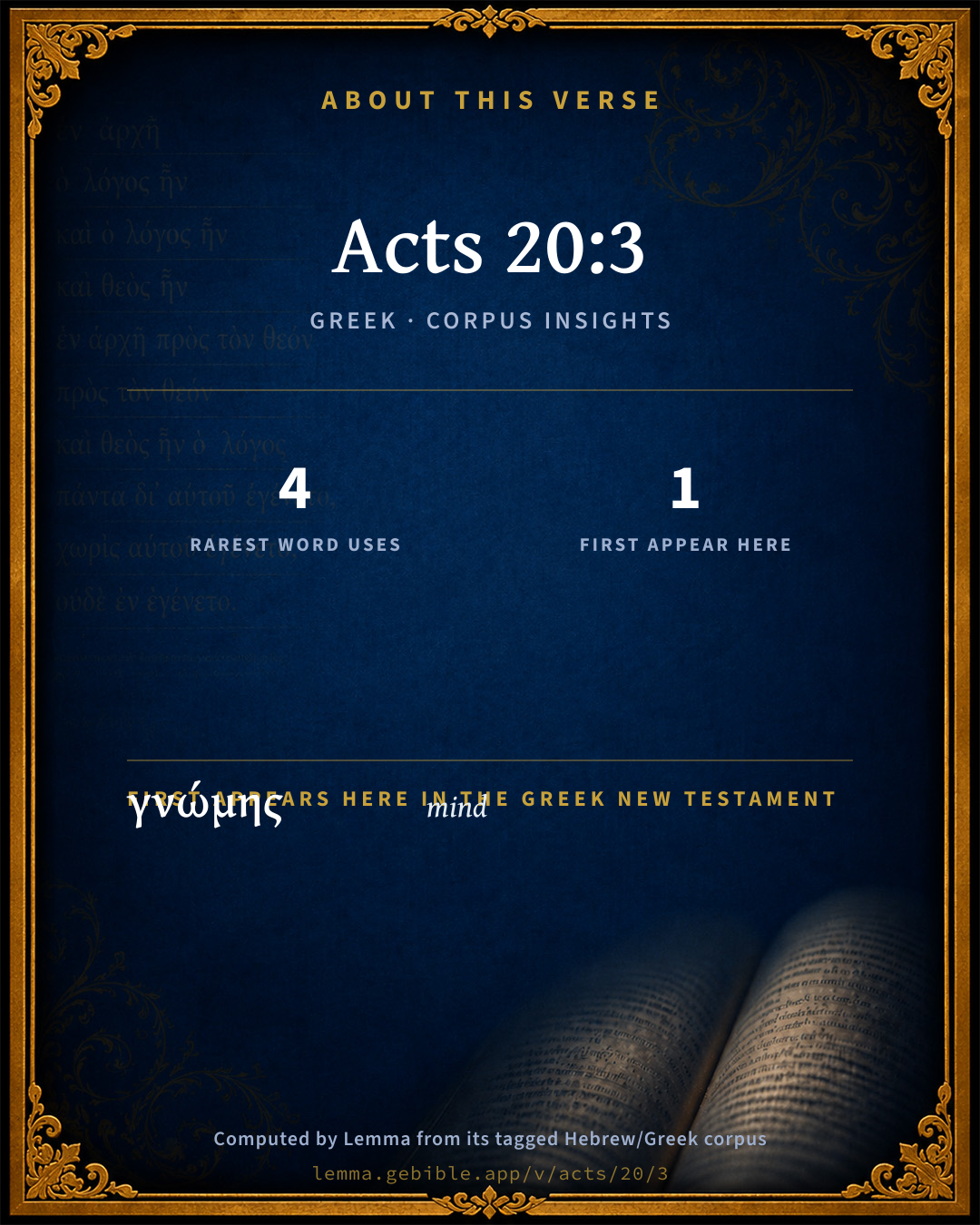
The rarest word here is ἐπιβουλῆς plot G1917 — appearing just 4 times in the whole Greek New Testament.

First appearance in Scripture

This word makes its first canonical appearance in the Greek New Testament here:

  • γνώμης mind G1106

Shared distinctive vocabulary

ἐπιβουλῆς plot G1917 occurs in 4 verses of the Greek New Testament. Also found in:
Repetition

Words recur within this verse:

  • γενομένης to become G1096 ×2
  • τῶν the G3588 ×3

Cross-references

15

Topical passages linked to Acts 20:3 in the Treasury of Scripture Knowledge — connected by theme and wording, ordered by reader-vote popularity; previews shown in the World English Bible.

  • Acts 20:19 serving the Lord with all humility, with many tears, and with trials which happened to me by the plots of the Jews;
  • 2 Corinthians 11:26 I have been in travels often, perils of rivers, perils of robbers, perils from my countrymen, perils from the Gentiles, perils in the city, perils in the wilderness, perils in the sea, perils among false brothers;
  • Acts 9:23–24 When many days were fulfilled, the Jews conspired together to kill him,
  • Acts 25:3 asking a favor against him, that he would summon him to Jerusalem; plotting to kill him on the way.
  • 2 Corinthians 7:5 For even when we had come into Macedonia, our flesh had no relief, but we were afflicted on every side. Fightings were outside. Fear was inside.
  • Ezra 8:31 Then we departed from the river Ahava on the twelfth [day] of the first month, to go to Jerusalem: and the hand of our God was on us, and he delivered us from the hand of the enemy and the bandit by the way.
  • Proverbs 1:11 If they say, "Come with us, Let's lay in wait for blood; Let's lurk secretly for the innocent without cause;
  • Jeremiah 5:26 For among my people are found wicked men: they watch, as fowlers lie in wait; they set a trap, they catch men.
  • Acts 16:9 A vision appeared to Paul in the night. There was a man of Macedonia standing, begging him, and saying, "Come over into Macedonia and help us."
  • Acts 18:18 Paul, having stayed after this many more days, took his leave of the brothers, and sailed from there for Syria, together with Priscilla and Aquila. He shaved his head in Cenchreae, for he had a vow.
  • Acts 19:21 Now after these things had ended, Paul determined in the spirit, when he had passed through Macedonia and Achaia, to go to Jerusalem, saying, "After I have been there, I must also see Rome."
  • Acts 21:3 When we had come in sight of Cyprus, leaving it on the left hand, we sailed to Syria, and landed at Tyre, for there the ship was to unload her cargo.
  • Acts 23:12–15 When it was day, some of the Jews banded together, and bound themselves under a curse, saying that they would neither eat nor drink until they had killed Paul.
  • 2 Corinthians 1:15 In this confidence, I was determined to come first to you, that you might have a second benefit;
  • Galatians 1:21 Then I came to the regions of Syria and Cilicia.

Cross-references courtesy of OpenBible.info (CC BY 4.0).

Commentary

Notes on Acts 20:3 from classic Christian and Jewish commentators (each source and its license shown beneath its notes). The classic Christian expositions comment on the surrounding passage and are grouped to its opening verse, so a note may address several verses; the Jewish commentaries on the Tanakh (Rashi and others) are per-verse, so they appear only where the commentator wrote on this verse.

Lemma curates 59 commentaries, every one of them public domain or Creative Commons licensed, each selected and text-cleaned for this edition rather than reprinted as found. About our sources →

The Biblical Illustrator

Joseph S. Exell

Act_20:3

And when the Jews laid wait for him as he was about to sail.

Pauls prudence

Why was it safer for Paul to travel by land through Macedonia than to go down to the seaport, Cenchrea, to take ship there? The reason is, that the Jews, with their keen trading instincts, had settled chiefly in the great seaports and emporia of trade throughout the civilised world. Paul thus, in entering a seaport, would find himself in the midst of a large body of Jews, who had both the ability and the will to execute any plot against him; while in the inland and provincial towns the Jews formed a comparatively insignificant portion of the population. (H. C. Trumbull, D. D.)

Pauls prudence rewarded

The hope of reaching Jerusalem by the Passover had, of course, to be abandoned: the only chance left was to get there by Pentecost. It was doubtless overruled for good that it should be so; for if Paul had been in the Holy City at the Passover, he would have been mixed up by his enemies with the riot and massacre which about that time marked the insane rising of the Egyptian impostor who called himself the Messiah. (Archdeacon Farrar.)

Pauls moral courage

It is a great thing to know when to run from evil, and when to stand and meet it. Often more courage is needed to run than fight. A bulldog knows just enough to be always ready for a fight. It takes more than a bulldogs character to decide when not to fight, and to stand by ones decision--even if one has to run in order to stand. In a community where duelling is still tolerated, it requires more the spirit of Paul, and less of the spirit of the bulldog, to decline a challenge. In a community where duelling is not tolerated, but where unnecessary and irritating discussion is, it is easier to conform to the bulldogs standard, than to Pauls, in times of temptation to such a discussion. It is not easy to say in advance just when a man should run rather than fight; but it is something for us all to bear in mind, that running often shows courage where fighting would show cowardice. (H. C. Trumbull, D. D.)

The Biblical Illustrator, edited by Joseph S. Exell (c. 1880s–1900s) — public domain. Text from a community e-Sword module.

Joseph Benson's Commentary

Act 20:3. And there — Namely, in Greece; he abode three months — Meeting, it seems, with business there as he often did in other places, which detained him longer than he expected. During this time, he received from the churches of Achaia the money which they had collected for the saints in Judea, agreeably to his direction to the Corinthians, 1Co 16:1-3. At this time also he wrote his epistle to the Romans, of whose affairs he had heard by Aquila and Priscilla. For, it plainly appears, that epistle was written before his imprisonment at Rome; and in it he speaks of a collection made by the churches of Macedonia and Achaia, with which he was hastening to Jerusalem, Rom 15:25-27; a circumstance which fixes it to this time. It appears, also, from Rom 16:21, that Timothy and Sosipater (or Sopater, one of the noble Bereans) were with him when that epistle was written, which agrees with verse four of this chapter, by which we find they both attended him into Asia. And when the Jews had laid wait for him, as he was about to sail into Syria, he — Upon this account; purposed — Εγενετο γνωμη, the thought, or design, occurred, or he conceived the intention; to return through Macedonia — The fact seems to be, that having finished all his matters in Greece, he had proposed to sail directly into Syria. But the Jews, who had heard of the money he was carrying to Jerusalem; and who, besides, hated him as an enemy to their religion, lying in wait for him in Cenchrea, the eastern port of Corinth, where he was to embark, he changed his resolution. So that avoiding that port, which was about nine miles from Corinth, he returned by land, through Macedonia, in such time that he left Philippi after the days of unleavened bread, and so began his voyage into Syria.

Joseph Benson's Commentary on the Old and New Testaments (1811–1818) — public domain. Text from a community e-Sword module.

Bengel's Gnomon

Johann Albrecht Bengel

Act 20:3. Ποιήσας) The nominative was employed by Luke before that the predicate (ἐγένετο γνώμη) occurred to him, which requires the oblique case (viz. αὐτῷ). Such constructions are found not only in Hebrew, but also in Greek and Latin writers.—μῆνας τρεῖς, three months) at which time also he seems to have seen the Corinthians, but only in passing: 1Co 16:7.—αὐτῷ—μέλλοντι ἀνάγεσθαι, for him, as he was about to sail) They were laying plots for Paul against this very journey to Syria.—εἰς τὴν Συρίαν, into Syria) ch. Act 21:3.—ἐγένετο γνώμη, he determined) Sometimes they relied on a, general, sometimes on a special call.—ὑποστρέφειν, to return) Even a holy purpose can sometimes be changed. Comp. ch. Act 19:21, where Paul is represented as having once wished to go through Macedonia. It appears that Paul had wished, after journeying through Macedonia and Achaia, to go forward to Jerusalem. But at that time, indeed, lie did not get to Jerusalem, but again returned through Macedonia. His journey to Jerusalem, and to Rome afterwards, proceeded (was accomplished) by another way: the order merely of his course being changed.

Bengel's Gnomon of the New Testament — English translation (T&T Clark, Edinburgh, 1860) — public domain. Text from a community e-Sword module.

Expositor's Greek Testament

ed. W. Robertson Nicoll

Act 20:3 . ποιήσας τε μῆνας τρεῖς , cf. Act 15:33 , Act 18:23 . ἐπιβουλῆς : only in Acts in N.T., see above on Act 9:24 ; the plot may have been formed in the anticipation that it would be easy to carry it through on a pilgrim ship crowded with Jews of Corinth and Asia, hostile to the Apostle; or it may have been the purpose of the conspirators to kill Paul in a crowded harbour like Cenchreæ before the ship actually started. μέλλ . ἀνάγ ., see on Act 13:13 . If we read ἐγέν . γνώμης (genitive) ( cf. 2Pe 1:20 ), nowhere else in N.T., cf. Thuc., i., 113, ὅσοι τῆς αὐτῆς γνώμης ἦσαν , see also Winer-Schmiedel, p. 269. τοῦ ὑποσ ., i.e. , the return journey to Jerusalem (Ramsay), but see also Wendt (1899), p. 323.

The Expositor's Greek Testament, edited by W. Robertson Nicoll (1897–1910) — public domain. Text from a community e-Sword module.

Geneva Bible (1599)

Geneva Bible translators

A froward zeal is the guider and instructor to murders: and we are not debarred by the wisdom of God to prevent the endeavors of wicked men.

Geneva Bible (1599) marginal notes — public domain. Text via Bolls.life.

Jamieson, Fausset & Brown

Robert Jamieson, A. R. Fausset & David Brown

And there abode three months--Though the province only is here mentioned, it is the city of CORINTH that is meant, as the province of "Macedonia" (Act 20:1) meant the city of Philippi. Some rough work he anticipated on his arrival at Corinth (Co2 10:1-8, Co2 10:11; Co2 13:1-10) though he had reason to expect satisfaction on the whole; and as we know there were other churches in Achaia besides that at Corinth (Co2 1:1; Co2 11:10), he would have time enough to pay them all a brief visit during the three months of his stay there. This period was rendered further memorable by the despatch of the EPISTLE TO THE ROMANS, written during his stay at Corinth and sent by "Phœbe, a servant [deaconess] of the Church at Cenchrea" (see on Act 18:3), a lady apparently of some standing and substance, who was going thither on private business. (See on Rom 16:1 and see Introduction to Romans).

And when the Jews laid wait for him, as he was about to sail into Syria--He had intended to embark, probably at Cenchrea, the eastern harbor of the city, for Palestine, on his route to Jerusalem, the third part of his plan (Act 19:21). But having detected some conspiracy against his life by his bitter Jewish enemies as at Damascus (Act 9:22-25) and Jerusalem (Act 9:29-30), he changed his plan and determined "to return" as he had come, "through Macedonia." As he was never more to return to Corinth, so this route would bring him, for the last time, face to face with the attached disciples of Berea, Thessalonica, and Philippi.

Jamieson, Fausset & Brown — Commentary Critical and Explanatory on the Whole Bible (1871) — public domain (CC PDM 1.0). Text via the HelloAO Bible API.

Adam Clarke's Commentary

Verse 3. Abode three months] Partly, as we may suppose, at Corinth, at Athens, and in Achaia; from which place he is supposed to have sent his epistle to the Romans, because he continued longer here than at any other place, and mentions several of the Corinthians in his salutations to the believers of Rome.

When the Jesus laid wait for him] Paul had determined to go by sea to Syria, and from thence to Jerusalem. This was the first object of his journey; and this was the readiest road he could take; but, hearing that the Jews had laid wait for him, probably to attack his ship on the voyage, seize his person, sell him for a slave, and take the money which he was carrying to the poor saints at Jerusalem, he resolved to go as much of the journey as he conveniently could, by land. Therefore, he returned through Macedonia, and from thence to Troas, where he embarked to sail for Syria, on his way to Jerusalem. The whole of his journey is detailed in this and the following chapter. See also the map.

Adam Clarke's Commentary on the Bible (1810–1826) — public domain. Text from a community e-Sword/MySword module.

John Calvin's Commentaries

3. Because the Jews laid wait for him. The Lord did exercise his servant so diversely and continually that he set before us in him an example of most excellent constancy. It is not sufficient for him to be wearied with the labor and trouble of a long and wearisome journey, unless he be also brought in danger of his life by those which lay in wait for him. Let all the servants of Christ set this mirror before their eyes, that they may never faint through the wearisomeness of straits. Notwithstanding, when Paul doth journey another way that he may avoid their laying in wait, he showeth that we must have regard of our life so far forth that we throw not ourselves headlong into the midst of dangers. And those who accompany him give no small testimony of their godliness; and we see how precious his life was to the faithful, when as a great many being chosen out of diverse countries to be his companions, do for his sake take a hard and sharp journey not without great charges. Luke saith that Paul tarried at Philippos so long as the days of unleavened bread did last, because he had at that time better opportunity offered to teach. And forasmuch as it was unknown as yet that the law was disannulled, it stood him upon to beware, lest by neglecting the feast-day he should be thought among the rude to be a contemner of God. Though, for mine own part, I think that he sought principally opportunity to teach, because the Jews were then more attentive to learn.

John Calvin's Commentaries (1540-1563) — public domain. Text from the Calvin Translation Society English edition (1840s-50s) via the Christian Classics Ethereal Library (ccel.org). Calvin's coverage is partial (roughly two-thirds of the Bible); uncommented books and verses are honest gaps, never fabricated. The 19th-century editor's footnotes and remarks are omitted so the notes are faithfully Calvin's own voice.

Ellicott's Commentary for English Readers

(3) When the Jews laid wait for him . . .—In sailing for Syria, Cenchreæ would naturally be the port of embarkation, and St. Paul’s presence there may reasonably be connected with the mention of Phœbe, the deaconess of that church, in Rom_16:1. His intention was, however, frustrated. The malignant Jews of Corinth watched their opportunity. At Cenchreæ, amid the stir and bustle of a port, they might do what they had failed to do before. Here there was no Gallio to curb their fury, and throw the ægis of his tolerant equity over their victim. Their plans were laid, and their victim was to be seized and made away with as he was on the point of embarking. On hearing of the plot, the Apostle had to change his plans, and started with his companions for Macedonia, either travelling by land or taking a ship bound for one of its ports, instead of the one bound for Cæsarea, or Tyre, or Joppa. It is clear that the latter course would have baffled his murderers quite as much as the former.

A Bible Commentary for English Readers, edited by Charles John Ellicott (1878–1897) — public domain. Text from a community e-Sword module.

The Cambridge Bible for Schools and Colleges

gen. ed. J. J. S. Perowne

3. and there abode three months] More literally, with Rev. Ver., “and when he had spent three months there,” connecting it, as the Greek does, with what follows.

and when the Jews laid wait for him] The English of the A.V. defines too precisely the form of the danger. Read “And when a plot was laid against him by the Jews.” The Jews, who had tried to engage Gallio in their matters on St Paul’s last visit to Corinth, now take a secret instead of a public means of wreaking their vengeance on him. And we may judge that St Paul anticipated some trouble from the Judaizing party at Corinth by the tone of the latter portion (after chap. 9) of his second Epistle written to them while he was on his way, but detained in Macedonia. There were persons in Corinth who spoke slightingly of the Apostle. His bodily presence was weak and his speech contemptible. And in opposition to the remarks of these opponents, the Epistle concludes with an assertion of St Paul’s equality to the chiefest Apostles, a recital more full than in any other place of his sufferings for the Gospel, and an account of revelations divinely made unto him. It is clear therefore that among those who would be counted as Christians St Paul was not everywhere accepted. The Jews under such circumstances would have some abettors in their animosity even among the Judæo-Christians, and seem to have planned some means whereby St Paul might be attacked on his sea-voyage to Syria. No doubt the intention was to kill him. The word in the original is that used (Act_9:24) when the Jews watched the gates of Damascus night and day to kill him.

as he was about to sail into Syria] The rendering of the Rev. Ver. gives the sense more vividly “as he was about to set sail for Syria.” He had apparently gone so far as to arrange for his passage and go on board, and was nearly departed, before he got the warning news. Perhaps some heart, among the people to whom the plot was known on shore, was moved to give a hint of the great peril at the last moment. This is the more probable if we suppose some previous communications between the Jews and the Judaizers among the Christians.

he purposed to return through Macedonia] Better, he determined, with Rev. Ver. As the scheme for killing him had been meant to be carried out at sea, the choice of an overland journey and a prompt departure made the forming of a new plan impossible to the conspirators.

The Cambridge Bible for Schools and Colleges (gen. ed. J. J. S. Perowne; Cambridge University Press, 1878–1918) — public domain. Text from a community e-Sword module.

John Gill's Exposition

And there abode three months,.... In Greece:

and when the Jews laid wait for him, as he was about to sail into Syria; from some part of Greece, in order to go to Jerusalem; which the Jews in the parts of Greece understanding, laid wait for him, either by sea or land, with an intention either to take the money from him, which he had collected in Macedonia, and in Greece, for the poor saints at Jerusalem, or to take away his life, or both; of which lying in wait for him, the apostle had some notice, either by divine revelation, or from somebody who was in the secret, or had got knowledge of it from such as were: upon which he

purposed to return through Macedonia; through which he came from Ephesus to Greece: this wicked design being made known to him, obliged him, in point of prudence, and both for his own safety, and the good of the churches, to alter his scheme, and steer his course another way, to the disappointment of his enemies; in which the wisdom of providence, the care of God over his ministers, and his concern for his churches manifestly appeared.

John Gill's Exposition of the Whole Bible (1746–1763) — public domain (CC PDM 1.0). Text via the HelloAO Bible API.

Trapp's Complete Commentary

John Trapp

3 And there abode three months. And when the Jews laid wait for him, as he was about to sail into Syria, he purposed to return through Macedonia.

Ver. 3. And there abode three] Gr. ποιησας, "Was doing there," he was in continual action. Life consists in action; so doth spiritual life, Isa 38:16. And by this reason one may live more in a month than another in many years. In this sense Seneca saith (Epist. lxvii.), Quamvis vitae paucos fecerimus dies. See the same word used thus, Mat 20:12.

John Trapp, A Commentary or Exposition upon All the Books of the Old and New Testament (1647–1656) — public domain. Text from a community e-Sword module.

Albert Barnes' Notes on the Bible

And there abode - Why he remained here is unknown. It is probable that while in Greece he wrote the Epistle to the Romans. Compare Rom 15:25-27.

And when the Jews laid wait for him - There was a design formed against him by the Jews, which they sought to execute. Why they formed this purpose the historian has not informed us.

As he was about to sail - It would seem from this, that the design of the Jews was to attack the ship in which he was about to sail, or to arrest him on shipboard. This fact determined him to take a much more circuitous route by land, so that the churches of Macedonia were favored with another visit from him.

Into Syria - On his way to Jerusalem.

He purposed ... - He resolved to avoid the snare which they had laid for him, and to return by the same way in which he had come into Greece.

Albert Barnes' Notes on the Bible (1834–1885) — public domain. Text from a community e-Sword/MySword module.

Matthew Poole's English Annotations

The Jews laid wait for him; some have thought that their laying in wait might be to rob him of the collections which he carried with him for the saints at Jerusalem; but most likely it was rather to take away his life, whom they hated for his zeal and diligence in the gospel.

He purposed to return; slunning their treachery and plotting against him. He would not tempt God by running into dangers, though his cause were never so good.

Through Macedonia; being the same way that he had come to Corinth.

Matthew Poole's English Annotations on the Holy Bible (1683–1685) — public domain. Text from a community e-Sword/MySword module.

Whedon's Commentary on the Bible

Daniel D. Whedon

3. Three months—During which his headquarters were at Corinth, his missions probably mostly in the rural regions of Achaia. From Corinth Paul, sorrowfully learning that the Church of Galatia was largely apostatizing to the Judaizers, wrote

His Fifth Letter—THE EPISTLE TO THE GALATIANS, in the winter of A.D. 57. From Corinth, too, about the same time, was sent

Paul’s Sixth Letter—THE EPISTLE TO THE ROMANS, in the spring of A.D. 58.

3. Jews laid wait—Probably at Cenchrea they plotted either to kidnap and slay him before he embarked, or, perhaps, embarking with him, to assassinate him at sea.

Daniel D. Whedon (gen. ed.), Commentary on the Old and New Testaments (1874–1909) — public domain. Text from a community e-Sword module.

The Pulpit Commentary

When he had spent...there for there abode, A.V.; a plot was laid against him by the Jews for when the Jews laid wait for him, A.V.; for for into, A.V.; determined for purposed, A.V. (ejgeneto gnwmhv, R.T.).

When he had spent three months. For this use of poiein, see 15:33; 18:33. See also 2Co_11:25, where the R.V. varies the rendering, and seems to take poiein as a verb neuter, as the A.V. does here, the accusative (mhnav treiv) being taken as that of time how long. And a plot, etc. There is no "and" in the Greek. It is better to take the T.R., and to consider poihsav as a nominative pendens as ejpignontev is, Act_19:34, according to the reading of Meyer, Alford, etc. A plot was laid against him by the Jews. It appears from this that Apollos had not succeeded in subduing the bigoted hatred of the Corinthian Jews. But probably the desperate measure of a plot against his life (ejpiboulh) as in Act_9:23, Act_9:24; ver. 19 of this chapter, and Act_23:30) is an indication that many of their number had joined the Church; and that the unbelieving remnant, being foiled in argument, had recourse to violence. He determined ; literally, according to the R.T., he was of opinion. But the T.R. has ejgeneto gnwmh, "his opinion was," the construction of the sentence being changed. The three months were probably chiefly spent at Corinth, according to the intention expressed in 1Co_16:6, though it would seem that he had stayed a longer time in Macedonia than he anticipated. It was during his sojourn at Corinth that the Epistle to the Romans was written.

The Pulpit Commentary (1880–1919), ed. H.D.M. Spence-Jones & Joseph S. Exell — public domain. Text from a community e-Sword module.

John Wesley's Explanatory Notes

An ambush being laid for him - In his way to the ship.

John Wesley, Explanatory Notes Upon the Whole Bible (1754–1765) — public domain. Text via the GEBible commentary corpus.

McGarvey & Pendleton's Commentaries

J. W. McGarvey

See notes on verse 2

J. W. McGarvey (with Philip Y. Pendleton), Commentaries on the New Testament (The Fourfold Gospel, 1914; Acts; and the epistles) — public domain. Text from a community e-Sword/MySword module.

Cambridge Greek Testament for Schools and Colleges

3. ἦλθεν εἰς τὴν Ἑλλάδα, he came into Greece. There is nothing said of the places which St Paul visited in this journey, but as he was always anxious to strengthen any work which he had before begun we may feel sure that Athens and Corinth, on this account, as well as for their importance as centres of intellectual and commercial life, were the places in which he spent the greater part of his three months’ stay. In the latter Church especially there were many things to be set in order. He had already written to the Corinthians his two Epistles. In the first, sent from Ephesus, he had found it necessary to rebuke them for the party-spirit in the Church, some calling themselves by the name of Peter, some of Apollos, and some of Paul himself, instead of finding true unity in Christ; he had also censured the disorders in the Eucharistic feast, had given his judgment on a notorious offender, and on many topics raised by the difficulties of a Christian Church growing up amid heathen surroundings. These matters, and the guidance into a right channel of the exercise of those special gifts of preaching and speaking with tongues with which God endowed the Church in Corinth, would give the Apostle little rest during his brief stay, even if he bestowed his whole time on Corinth alone.

ποιήσας τε μῆνας τρεῖς, and when he had spent three months. On ποιέω in this sense, cf. Act 15:33, Act 18:23. So also Acta Barnabæ Apocryph. 7, ἐλθεῖν ἐν Κύπρῳ καὶ ποιῆσαι τὸν χειμῶνα.

γενομένης ἐπιβουλῆς κ.τ.λ., and when a plot was laid against him by the Jews. The Jews, who had tried to engage Gallio in their matters on St Paul’s last visit to Corinth, now take a secret instead of a public means of wreaking their vengeance on him. And we may judge that St Paul anticipated some trouble from the Judaizing party at Corinth by the tone of the latter portion (after chap. 9) of his second Epistle written to them while he was on his way, but detained in Macedonia. There were persons in Corinth who spoke slightingly of the Apostle. His bodily presence was weak and his speech contemptible. And in opposition to the remarks of these opponents, the Epistle concludes with an assertion of St Paul’s equality to the chiefest Apostles, a recital more full than in any other place of his sufferings for the Gospel, and an account of revelations divinely made unto him. It is clear therefore that among those who would be counted as Christians St Paul was not everywhere accepted. The Jews under such circumstances would have some abettors in their animosity even among the Judæo-Christians, and seem to have planned some means whereby St Paul might be attacked on his sea voyage to Syria. No doubt the intention was to kill him. ἐπιβουλή is the word used (Act 9:24) when the Jews watched the gates of Damascus night and day to kill him.

μέλλοντι ἀνάγεσθαι εἰς τὴν Συρίαν, as he was about to set sail for Syria. He had apparently gone so far as to arrange for his passage and go on board, and was nearly departed, before he got the warning news. For ἀνάγεσθαι refers to the actual preparation for setting sail. Perhaps some heart, among the people to whom the plot was known on shore, was moved to give a hint of the great peril at the last moment. This is the more probable if we suppose some previous communications between the Jews and the Judaizers among the Christians.

ἐγένετο γνώμης κ.τ.λ., he determined to return through Macedonia. As the scheme for killing him had been meant to be carried out at sea, the choice of an overland journey and a prompt departure made the forming of a new plan impossible to the conspirators.

For the genitive after γίνομαι, cf. Apocal. Act 11:15, ἐγένοντο αἱ βασιλεῖαι τοῦ κυρίου ἡμῶν. Also ἐλπίδος γίνεσθαι, Plutarch, Phoc. 23.

The grammar of the whole verse is remarkable for its freedom from rule. Beginning with ποιήσας, we come next to μέλλοντι, and presently the construction is once more changed in ἐγένετο γνώμης.

Cambridge Greek Testament for Schools and Colleges (Cambridge University Press, 1896; 21 vols, various authors incl. Carr, Maclear, Plummer, Farrar, Lumby, Moule, M. R. James, Simcox) — public domain. Text from a community e-Sword module.

Alford’s Greek Testament

Henry Alford

3. ποιήσας] This stay was made at Corinth, most probably: see 1Co 16:6, 1Co 16:7: and was during the winter, see below on ver. 5. During it the Epistle to the Romans was written: see Prolegg. to Rom. § iv.

μέλλοντι ἀνάγεσθαι] This purpose, of going from Corinth to Palestine by sea, is implied ch. 19:21, and 1Co 16:3-7.

τοῦ ὑποστρ.] The genit. is not (as Meyer) governed directly by γνώμης, which would be more naturally followed by εἰς τὸ ὑπ.: but denotes the purpose, as in reff.

Henry Alford, The Greek Testament (1849–1861) — public domain. Text from a community e-Sword module.

Vincent's Word Studies in the New Testament

Marvin R. Vincent

Sail [αναγεσθαι] . Better, as Rev., set sail. See on Luk 8:22; and compare Luk 5:3.

Marvin R. Vincent, Word Studies in the New Testament (1887–1900) — public domain. Text from a community e-Sword/MySword module.

Lesson kit

Teaching starters — assembled from the data on this page, not authored interpretation. Every prompt links to the verse data it draws on. Edit before teaching.

Acts, in the Acts, opens this verse with 21 words (18 distinct Greek lemmas). Its most distinctive word is epiboulḗ (“plot”). A historical commentator’s framing appears above. Read the whole chapter for the surrounding context.

Discussion questions

  1. The word epiboulḗ carries the sense “plot.” How does it shape the verse?
  2. The word “mind” first appears here in Scripture. What is being introduced at this debut?
  3. Acts 9:24 shares the word «plot» with this verse. How do the two illuminate each other?
  4. “to become” occurs 2× in this one verse. What is the effect of the repetition?
  5. The translations on this page render this verse differently — a whole-verse word diff, not a word-by-word alignment. What might account for the different wordings?
  6. Reading how The Biblical Illustrator and Joseph Benson's Commentary read this verse, where do the two commentators agree and where do they part?

Things to notice

  • 1 word makes its first canonical appearance in Scripture here.
  • These translations choose different wording for 21 words in this verse.
  • “to become” occurs 2× in this single verse.
  • 18 distinct Greek lemmas span 21 words in this verse.

Reading settings

Reading text

Shown beneath each verse's original-language words.

Old Testament
Old Testament edition

Read the OT as the Masoretic Hebrew (MT) or the Greek Septuagint (LXX).

English shown for the Greek Septuagint (in the Hebrew ↔ Greek comparison).

Comparing translations? Open the Compare panel on any verse page to stack up to four side by side.