
Acts 13:32

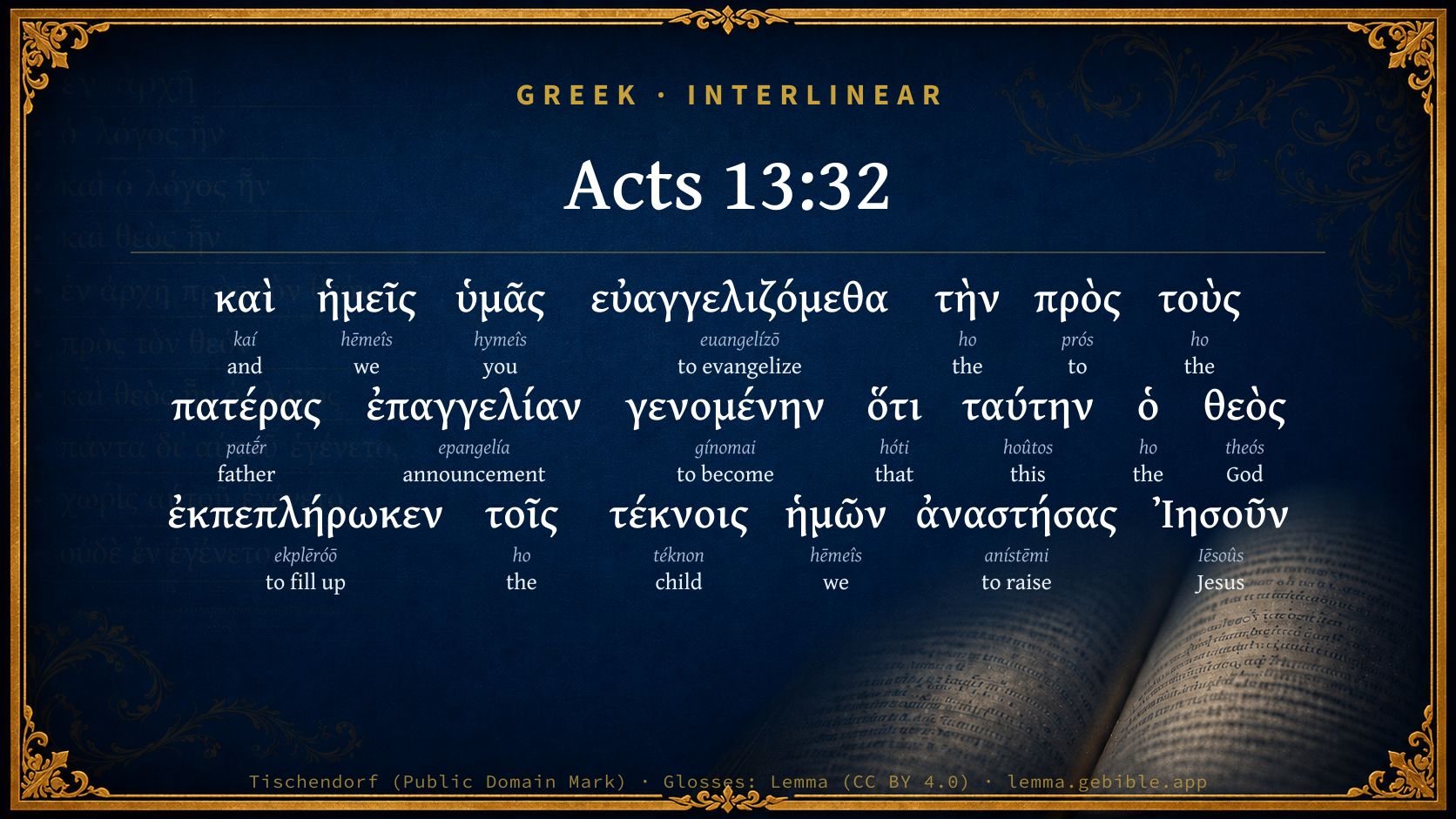
Greek (Tischendorf 8th ed.) Acts 13:32 appears in the Greek New Testament. The text above is from the Tischendorf 8th edition. Each word links to its Strong’s number and a concise gloss. Click any word for its full Thayer’s Greek Lexicon entry.
Download image
Cite this verse

Acts 13:32 (World English Bible). Public Domain. Lemma interlinear Bible study tool, https://lemma.gebible.app/v/acts/13/32.

Show BibTeX & RIS
BibTeX
RIS
English Translation
We bring you good news of the promise made to the fathers,
World English Bible · Public Domain
Highlights
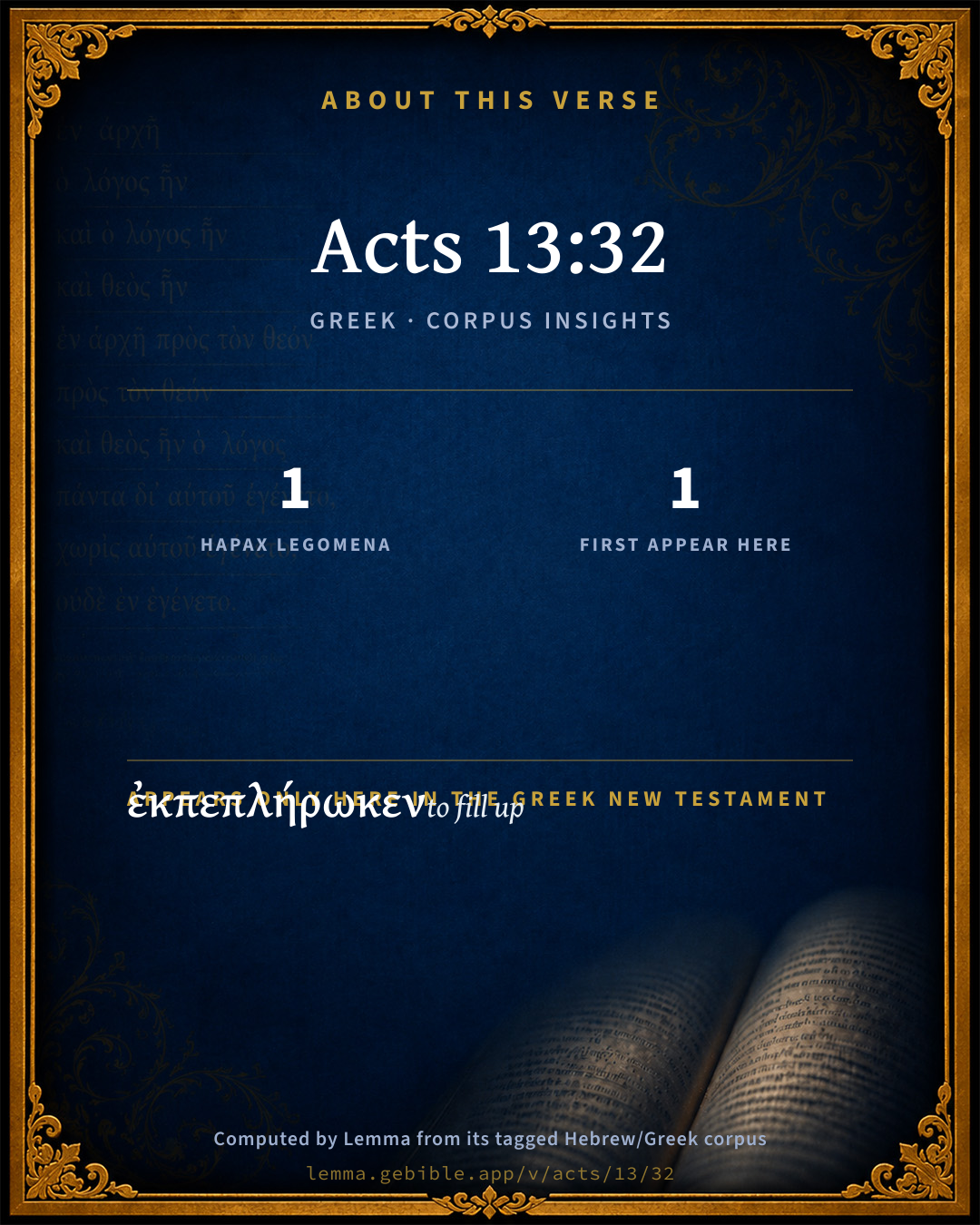
  • 1 hapax legomenon — only here in the Greek New Testament
  • 1 first appearance in the Greek New Testament
Full analysis ↓
Download a study sheet

One document with this verse’s original text, its word-by-word gloss line, the meaning frame, cross-references with their text, attributed commentary, and full source and license credits — printable, and it pastes into notes with its structure intact.

This verse Autodidact and up

Study sheet (.html) Plain text (.txt)

A passage Seminary Student

Up to 50 verses in one chapter. A passage sheet keeps up to 6 commentary sources and 12 cross-references per verse, in the order this page ranks them, and says so on the sheet whenever that leaves anything out. Ask for a single verse and you get the Autodidact verse sheet above.

Everything on this page stays free to read, with no account — the sheet is a download of what is already on screen, not access to it.

Want to remove ads? Support Godless Engineer
Compare translations 3

The same verse in 3 English versions, stacked beneath the original-language interlinear above. Click any original word for its lexicon entry.

Each is an independent rendering of the whole verse — the interlinear is not word-aligned to these translations.

Highlighted words mark where these versions differ — a whole-verse word diff, not a word-by-word alignment.

  • World English Bible Public Domain
    We bring you good news of the promise made to the fathers,
  • King James Version Public Domain
    And we declare unto you glad tidings, how that the promise which was made unto the fathers,
  • unfoldingWord Literal Text CC BY-SA 4.0
    And we are proclaiming to you the promise having been to fathers,

unfoldingWord Literal Text — © unfoldingWord, licensed CC BY-SA 4.0. Word-aligned USFM3 via Door43 (git.door43.org/unfoldingWord/en_ult).

Versions to compare (up to 4)

3 of 4 selected

Show all 19 translations

Every available English version of this verse, each an independent rendering of the whole verse.

  • World English Bible Public Domain
    We bring you good news of the promise made to the fathers,
  • Berean Standard Bible Public Domain
    And now we proclaim to you the good news: What God promised our fathers
  • Majority Standard Bible Public Domain
    And now we proclaim to you the good news: What God promised our fathers
  • King James Version Public Domain
    And we declare unto you glad tidings, how that the promise which was made unto the fathers,
  • American Standard Version (1901) Public Domain
    And we bring you good tidings of the promise made unto the fathers,
  • Revised Version (1885) Public Domain
    And we bring you good tidings of the promise made unto the fathers,
  • Geneva Bible (1599) Public Domain
    And we declare vnto you, that touching the promise made vnto the fathers,
  • Douay-Rheims (1899) Public Domain
    And we declare unto you, that the promise which was made to our fathers,
  • Young's Literal Translation Public Domain
    `And we to you do proclaim good news -- that the promise made unto the fathers,
  • Literal Standard Version CC BY-SA 4.0
    And we proclaim good news to you—that the promise made to the fathers,
  • Unlocked Literal Bible CC BY-SA 4.0
    So we are telling you the good news that what God promised to our fathers
  • unfoldingWord Literal Text CC BY-SA 4.0
    And we are proclaiming to you the promise having been to fathers,
  • Darby Bible Public Domain
    And *we* declare unto you the glad tidings of the promise made to the fathers,
  • World Messianic Bible Public Domain
    We bring you good news of the promise made to the fathers,
  • Webster's Bible Public Domain
    And we declare to you the glad tidings, that the promise which was made to the fathers,
  • Free Bible Version CC BY-SA 4.0
    We are here to bring to you the good news of the promise that God made to our forefathers,
  • Bible in Basic English Public Domain
    And we are giving you the good news of the undertaking made to the fathers,
  • Text-Critical English NT CC BY 4.0
    And we preach to you the good news that what God promised to our fathers, he has fulfilled to us, their children, by raising up Jesus,
  • Tyndale New Testament (1534) Public Domain
    And we declare vnto you how that the promes made vnto the fathers

Literal Standard Version (2020), Covenant Press — licensed CC BY-SA 4.0. Text via the HelloAO Bible API (eBible.org). Unlocked Literal Bible (unfoldingWord) — licensed CC BY-SA 4.0. Text via the HelloAO Bible API (eBible.org). unfoldingWord Literal Text — © unfoldingWord, licensed CC BY-SA 4.0. Word-aligned USFM3 via Door43 (git.door43.org/unfoldingWord/en_ult). Free Bible Version, Dr. Jonathan Gallagher — licensed CC BY-SA 4.0. Text via the HelloAO Bible API (eBible.org).

Word by word

More ways to search: Search by grammar → Find every occurrence → Compare this word →

Practice this passage: Drill this verse → Learn its vocabulary →

ἐκπεπλήρωκεν
ekplēróō
G1603
“to fill up”
Verb, Perfect, Active, Indicative, 3rd person, Singular
Part of Speech
Verb
Tense
Perfect
Voice
Active
Mood
Indicative
Person
3rd person
Number
Singular
Full Thayer's Definition

Origin: from G1537 and G4137

TDNT: 11:07,9

1. to fill full, to fill up completely 2. metaph. to fulfil, make good
  1. καὶ kaí G2532 “and” Conjunction
  2. ἡμεῖς hēmeîs G2249 “we” Personal pronoun, 1st person, Nominative, Plural
  3. ὑμᾶς hymeîs G5210 “you” Personal pronoun, 2nd person, Accusative, Plural
  4. εὐαγγελιζόμεθα euangelízō G2097 “to evangelize” Verb, Present, Middle, Indicative, 1st person, Plural
  5. τὴν ho G3588 “the” Article, Accusative, Singular, Feminine
  6. πρὸς prós G4314 “to” Preposition
  7. τοὺς ho G3588 “the” Article, Accusative, Plural, Masculine
  8. πατέρας patḗr G3962 “father” Noun, Accusative, Plural, Masculine
  9. ἐπαγγελίαν epangelía G1860 “announcement” Noun, Accusative, Singular, Feminine
  10. γενομένην gínomai G1096 “to become” Verb, Aorist, Middle deponent, Participle, Accusative, Singular, Feminine
  11. ὅτι hóti G3754 “that” Conjunction
  12. ταύτην hoûtos G3778 “this” Demonstrative pronoun, Accusative, Singular, Feminine
  13. ὁ ho G3588 “the” Article, Nominative, Singular, Masculine
  14. θεὸς theós G2316 “God” Noun, Nominative, Singular, Masculine
  15. τοῖς ho G3588 “the” Article, Dative, Plural, Neuter
  16. τέκνοις téknon G5043 “child” Noun, Dative, Plural, Neuter
  17. ἡμῶν hēmeîs G2249 “we” Personal pronoun, 1st person, Genitive, Plural
  18. ἀναστήσας anístēmi G450 “to raise” Verb, Aorist, Active, Participle, Nominative, Singular, Masculine
  19. Ἰησοῦν Iēsoûs G2424 “Jesus” Noun, Accusative, Singular, Masculine

About this verse

These counts appear in no published source. They are computed here, from the morphology-tagged text and Lemma’s own curated glosses. What Lemma adds →

20
words
16
distinct lemmas
Acts
section

Notable vocabulary

1 hapax legomenon — a word that appears only here in the entire Greek New Testament:

  • ἐκπεπλήρωκεν to fill up G1603

First appearance in Scripture

This word makes its first canonical appearance in the Greek New Testament here:

  • ἐκπεπλήρωκεν to fill up G1603

Shared distinctive vocabulary

ἐπαγγελίαν announcement G1860 occurs in 50 verses of the Greek New Testament. Also found in:
Repetition

Words recur within this verse:

Cross-references

36

Topical passages linked to Acts 13:32 in the Treasury of Scripture Knowledge — connected by theme and wording, ordered by reader-vote popularity; previews shown in the World English Bible.

  • Romans 4:13 For the promise to Abraham and to his seed that he should be heir of the world wasn't through the law, but through the righteousness of faith.
  • Acts 26:6 Now I stand here to be judged for the hope of the promise made by God to our fathers,
  • Ezekiel 34:23 I will set up one shepherd over them, and he shall feed them, even my servant David; he shall feed them, and he shall be their shepherd.
  • Jeremiah 23:5 Behold, the days come, says Yahweh, that I will raise to David a righteous Branch, and he shall reign as king and deal wisely, and shall execute justice and righteousness in the land.
  • Micah 5:2 But you, Bethlehem Ephrathah, Being small among the clans of Judah, Out of you one will come forth to me that is to be ruler in Israel; Whose goings forth are from of old, from everlasting.
  • Zechariah 6:12 and speak to him, saying, 'Thus says Yahweh of Hosts, "Behold, the man whose name is the Branch: and he shall grow up out of his place; and he shall build the temple of Yahweh;
  • Acts 13:38 Be it known to you therefore, brothers, that through this man is proclaimed to you remission of sins,
  • Romans 9:4 who are Israelites; whose is the adoption, the glory, the covenants, the giving of the law, the service, and the promises;
  • Galatians 3:16–18 Now the promises were spoken to Abraham and to his seed. He doesn't say, "To seeds," as of many, but as of one, "To your seed," which is Christ.
  • Genesis 3:15 I will put enmity between you and the woman, and between your offspring and her offspring. He will bruise your head, and you will bruise his heel."
  • Genesis 12:3 I will bless those who bless you, and I will curse him who curses you. In you will all of the families of the earth be blessed."
  • Genesis 22:18 In your seed will all the nations of the earth be blessed, because you have obeyed my voice."
  • Genesis 26:4 I will multiply your seed as the stars of the sky, and will give to your seed all these lands. In your seed will all the nations of the earth be blessed,
  • Genesis 49:10 The scepter will not depart from Judah, Nor the ruler's staff from between his feet, Until he comes to whom it belongs. To him will the obedience of the peoples be.
  • Deuteronomy 18:15 Yahweh your God will raise up to you a prophet from the midst of you, of your brothers, like me; to him you shall listen;
  • Isaiah 7:14 Therefore the Lord himself will give you a sign. Behold, the virgin will conceive, and bear a son, and shall call his name Immanuel.
  • Isaiah 9:6–7 For to us a child is born, to us a son is given; and the government shall be on his shoulder: and his name shall be called Wonderful, Counselor, Mighty God, Everlasting Father, Prince of Peace.
  • Isaiah 11:1 There shall come forth a shoot out of the stock of Jesse, and a branch out of his roots shall bear fruit.
  • Isaiah 40:9 You who tell good news to Zion, go up on a high mountain; you who tell good news to Jerusalem, lift up your voice with strength; lift it up, don't be afraid; say to the cities of Judah, Behold, your God!
  • Isaiah 41:27 [I am the] first [who says] to Zion, Behold, behold them; and I will give to Jerusalem one who brings good news.
  • Isaiah 52:7 How beautiful on the mountains are the feet of him who brings good news, who publishes peace, who brings good news of good, who publishes salvation, who says to Zion, Your God reigns!
  • Isaiah 61:1 The Spirit of the Lord Yahweh is on me; because Yahweh has anointed me to preach good news to the humble; he has sent me to bind up the broken-hearted, to proclaim liberty to the captives, and the opening [of the prison] to those who are bound;
  • Daniel 9:24–26 Seventy weeks are decreed on your people and on your holy city, to finish disobedience, and to make an end of sins, and to make reconciliation for iniquity, and to bring in everlasting righteousness, and to seal up vision and prophecy, and to anoint the most holy.
  • Haggai 2:7 and I will shake all nations. The precious things of all nations will come, and I will fill this house with glory, says Yahweh of Hosts.
  • Zechariah 9:9 Rejoice greatly, daughter of Zion! Shout, daughter of Jerusalem! Behold, your king comes to you! He is righteous, and having salvation; Lowly, and riding on a donkey, Even on a colt, the foal of a donkey.
  • Zechariah 13:1 "In that day there will be a spring opened to the house of David and to the inhabitants of Jerusalem, for sin and for uncleanness.
  • Zechariah 13:7 "Awake, sword, against my shepherd, And against the man who is close to me," says Yahweh of Hosts. Strike the shepherd, and the sheep will be scattered; And I will turn my hand against the little ones.
  • Malachi 3:1 "Behold, I send my messenger, and he will prepare the way before me; and the Lord, whom you seek, will suddenly come to his temple; and the messenger of the covenant, whom you desire, behold, he comes!" says Yahweh of hosts.
  • Malachi 4:2 But to you who fear my name shall the sun of righteousness arise with healing in its wings. You will go out, and leap like calves of the stall.
  • Luke 1:19 The angel answered him, "I am Gabriel, who stands in the presence of God. I was sent to speak to you, and to bring you this good news.
  • Luke 1:54–55 He has given help to Israel, his servant, that he might remember mercy,
  • Luke 1:68–73 "Blessed be the Lord, the God of Israel, For he has visited and worked redemption for his people;
  • Luke 2:10 The angel said to them, "Don't be afraid, for behold, I bring you good news of great joy which will be to all the people.
  • Acts 3:19 "Repent therefore, and turn again, that your sins may be blotted out, so that there may come times of refreshing from the presence of the Lord,
  • Acts 5:42 Every day, in the temple and at home, they never stopped teaching and preaching Jesus, the Christ.
  • Romans 10:15 And how will they preach unless they are sent? As it is written: "How beautiful are the feet of those who preach the Gospel of peace, Who bring glad tidings of good things!"

Cross-references courtesy of OpenBible.info (CC BY 4.0).

Commentary

Notes on Acts 13:32 from classic Christian and Jewish commentators (each source and its license shown beneath its notes). The classic Christian expositions comment on the surrounding passage and are grouped to its opening verse, so a note may address several verses; the Jewish commentaries on the Tanakh (Rashi and others) are per-verse, so they appear only where the commentator wrote on this verse.

Lemma curates 59 commentaries, every one of them public domain or Creative Commons licensed, each selected and text-cleaned for this edition rather than reprinted as found. About our sources →

The Biblical Illustrator

Joseph S. Exell

Act_13:32-34

And we declare unto you glad tidings, how that the promise … God hath fulfilled.

The glad tidings

I. What they are. The origin of the gospel conception is connected with Jewish history. The people were often assailed by enemies, and in Jerusalem they waited with anxiety to learn the issue. By agreement, a messenger was to be sent, and especially when God crowned them with victory. And as the watchman lifted up his eyes, and the people saw the sight, they cried, How beautiful upon the mountains, etc. Hence, when the angel spoke on the plains of Bethlehem, he used words with which the shepherds were familiar. So when our Lord rose, He gave the disciples commandment to proclaim these glad tidings, to which Paul was obedient here. What, then, is the gospel?

1. It is news. Man did not know it--could not find it, or invent it. Not the least proof that the gospel comes from heaven is that it is beyond the intellect and contrary to the temper of man.

2. It is good news. All the attributes of goodness are in it. Mercy and truth have met together, righteousness and peace have kissed each other.

3. It is good news about a Person, and that Person the Son of God--the adequate revelation of the Father--and Son of Man--the typical manifestation of humanity. The Person also the atonement for the worlds guilt, and its Deliverer from condemnation and death.

II. To whom they are sent. To you--i.e., everyone.

1. To the sad heart. They come to the wakened mind, to the alarmed conscience, to the despairing spirit. What glad tidings to know that the burden of guilt has been borne and the punishment of sin endured by Christ!

2. To a sad world, whose disappointment, sorrow, and tears makes it a very Marah, which nothing can sweeten but the Cross.

III. With what end. To produce joy--pure, deep, everlasting. (J. Aldis.)

Gods promises fulfilled

God is always true to what He promises to do. He will fulfil every word of what He has promised; yet how few take Him at His word! When I was a young man I was clerk in the establishment of a man in Chicago, whom I observed frequently occupied sorting and marking bills. He explained to me what he had been doing; on some notes he had marked B, on some D, and on others G; those marked B he told me were bad, those marked D meant they were doubtful, and those with G on them meant they were good. And, said he you must treat all of them accordingly. And thus people endorse Gods promises, by marking some as bad, and others as doubtful; whereas we ought to take all of them as good, for He has never once broken His word, and all that He says He will do will be done in the fulness of time. (D. L. Moody.)

The resurrection of Christ glad tidings

He speaks of Christs resurrection--

I. As an accomplishment of prophecy (cf. Psa_118:22, with Luk_20:17)

. We must not, however, suppose this to be an uninteresting fact; for the apostle further speaks of it--

II. As glad tidings to the soul. To the disconsolate disciples the tidings of Christs resurrection were doubtless exceeding joyful. But they ought to be no less so to us, since that event ascertains--

1. The virtue of His sacrifice. Had He not risen, His death had been in vain (1Co_15:14; 1Co_15:17-18). But His resurrection clearly proved that He had satisfied the demands of law and justice.

2. His sufficiency for our help. If He were still dead, it would be in vain to look to Him for help.

3. The certainty of our own resurrection. Because He liveth, we may be sure that we shall live also (Joh_14:19).

As a further improvement of this passage, permit me to observe--

1. How deeply are we interested in the writings of the Old Testament! In them are promises of which we receive the accomplishment.

2. What enemies are they to themselves who despise the ministry of the gospel!

3. What a near relation subsists between believers in all ages! (Theological Sketch book.)

The resurrection of Christ the great promise

I. God promised to the patriarchs and prophets that He would raise Christ from the dead.

1. To Adam, as we read in Gen_3:1-24. The whole four themes of revelation are contained in these words: the first coming of Christ in the flesh; her seed. His death; thou shalt bruise his heel. His resurrection, and the present state of the Church; I will put enmity between thee and the woman. His coming in glory, when He shall bruise the serpents head.

2. To Abraham (Gen_22:1-24; cf. Heb_11:17-19). Isaac was dead, in design; and on the third morning he was raised up. In this transaction Abraham saw the day of Christ, and rejoiced. This would also be a promise to Isaac.

3. To Moses also. Let us examine some types.

(1) The manna represented Christ coming down from heaven, that the Church might feed on Him and live. We learn that a portion of manna was to be brought into the holy place, and there set before the testimony of the Lord. Which teaches us that He who came down from heaven was also to go up thither again, to appear in the presence of God for us.

(2) In Lev_14:1-57, we read of the law of cleansing the leper. There was a bird killed, and a bird flying away. The living bird was to be sprinkled with the blood; the resurrection of Christ is available through the atonement, and the atonement through the resurrection.

(3) So in the history of the two goats. One was to be slain; over the other the priest was to confess all the sins and trespasses of the people, and to send him away into the wilderness. So it is not on Jesus crucified merely that our sins are laid, or they would be there still. But the glory of the gospel is this: He was delivered for our offences, and raised again for our justification.

(4) In Lev_23:1-44, we read of the waving of the sheaf. Christ is raised from the dead, and is become the first fruits of them that slept. And as the first fruits were to be waved the morning after the Sabbath, which was the first day of the week, on which day Christ also rose.

4. To David. The second Psalm is immediately connected with our text. On the morning of the resurrection, God owned His beloved Son: then He said, Thou art My Son; this day have I begotten Thee. Again, in Psa_16:1-11, I have set the Lord always before me, etc. Then, again, in Psa_118:1-29, The stone which the builders refused is become the head stone of the corner, etc. Which passage is also quoted by Peter, in Act_4:1-37, when questioned as to the miracle performed on the impotent man.

5. To the prophets. In the context there is one remarkable quotation, from Isa_55:3. In that Christ is raised, never to die again; therefore He says, I will make an everlasting covenant with you, even the sure mercies of David.

6. We are taught this promise also by the history of Jonah. As Jonah was three days and three nights in the whales belly, so shall the Son of Man be three days and three nights in the heart of the earth.

II. He performed this promise. He did what He said. The day after the crucifixion of Christ the priests and Pharisees, who were His enemies, came to Pilate and said, Sir, we remember that that deceiver said, while he was yet alive, After three days I will rise again, etc. On the day after the Sabbath there was a great earthquake; for the angel of the Lord came and rolled back the stone. What avails the vigilance of Roman soldiers against the angels of God! The Lord afterwards showed Himself alive, by many infallible proofs, to Mary, to two of His disciples on their way to Emmaus, to ten of His disciples when they were assembled with the door shut for fear of the Jews. To some of them at the sea of Tiberias, etc. But some will say, Were the disciples proper witnesses? In a court of justice, what are the requisites of a competent witness? He must have known the person of whom he speaks, so that he may know him again when he sees him. And also he must be trustworthy. Now the disciples were fully competent. They knew Christ. And that they knew themselves to be competent witnesses, and that they knew it was necessary that they should be so, is evident from the words of Peter (Act_1:21). And they were trustworthy also. We know the nature of man too well not to know that he will say anything to gain favour. But what did they gain? Scourging, bonds, imprisonments, death.

III. Therefore we declare unto you glad tidings. And how is the resurrection of Christ glad tidings? Because--

1. It has caused the gospel to be preached. It would not have been preached had it not been for this event.

2. It shows that the justice of God is fully satisfied, and sin fully expiated.

3. It directs our minds to our great Intercessor. It is Christ that died; yea, rather, that is risen again; who has also appeared in the presence of God for us.

4. It excites and maintains a lively hope. Blessed be the God and Father of our Lord Jesus Christ, etc.

5. Through this hope it draws up the affections of the soul, and mortifies the deeds of the body. The man who believes that Christ has died and rose again, and whose life is hid with Christ in God, turns away with disgust from that which satisfies others.

6. It is the ground of our expectation of His second coming. If He be not risen, He cannot come again; but He is risen, and He will come again. (H. McNeile, D. D.)

The sure mercies of David.

The words do not seem in themselves to have the nature of a Messianic prediction. To those, however, whose minds were full to overflowing with the writings of the prophets, they would be pregnant with meaning. What were the sure mercies of David (Isa_55:3) but the everlasting covenant of mercy which was to find its fulfilment in One who should be a leader and commander to the people? We may well believe that the few words quoted recalled to St. Paul and to his hearers the whole of that wonderful chapter which opens with He, everyone that thirsteth, come ye to the waters. The Greek word for mercies is the same adjective as that translated holy in the next verse, holiness being identified with mercy, and so forms a connecting link with the prophecy cited in the next verse. (Dean Plumptre.)

Sure mercies

Consider--

I. What these mercies are.

1. The knowledge of God in Christ. God, who commanded the light to shine out of darkness, hath shined in our hearts, etc. Great is this mercy. By this alone we are delivered from idolatry. No man can worship the true God, except in Jesus Christ. The poor ignorant heathen is not the only idolater. The Deist, Rationalist, the man that flatters himself that above all men he is the farthest removed from idolatry, is nevertheless worshipping an idol, which he himself creates--the imagination of his own heart.

2. Forgiveness of sin by Christ. The present completeness of this blessing is the distinguishing feature of true religion from all false religion whatever. And therefore the very outset, the very A B C of the gospel, is, By this Man is preached unto you the forgiveness of sins.

3. Renewal of heart in Christ. Unto the perfection of mans happiness, association is indispensable. Man cannot live alone; fellowship with God there cannot be without holiness of heart, leading to sincere obedience. Here, then, is a great mercy--that the man to whom God has given the knowledge of Himself, and to whom He has proclaimed forgiveness of sins, shall also experience in himself such a renewal of his affections, that, instead of shrinking from God, he shall now find a congeniality, a sympathy, an association, and begin to find a happiness of companionship, without which no man can really be happy. These are some of the mercies spoken of in this text. And they are at the same time, as you may observe in the margin of your Bibles, holy or just things. They are holy--

(1) Or God would never have done them.

(2) As the purchase of the holy One.

(3) As procured according to law.

(4) In their results.

II. How these mercies are obtained. In answer to this inquiry, consult the prophecy in Isa_55:1-13, the passage referred to by the apostle. Here is a threefold exhortation to hear: the first in connection with the satisfying of the soul--Hearken diligently, and eat what is good, and let your soul delight itself; the second in connection with coming to the Lord--Incline your ear and come unto Me; the third in connection with everlasting life thus given--Hear, and your soul shall live. Now, mark these: hearken--incline your ear--hear. They are all explained by that great truth which the apostle proclaims when he says, Faith cometh by hearing. We have all these mercies by faith, because we have Christ by faith, and in no other way. God has appointed this medium in order that the attainment might be manifestly of grace--not of study, not of time, not of hereditary descent, not of instruction by man. Now, see what is attained by the appointment of this medium. It is confidence. Faith is confidence; faith places God and man in their proper places--God in authority, man in dependence. Man fell through an attempt to be independent. Man is recovered through a willingness to be dependent. This is attained through the appointment of faith as the medium through which the blessings are conveyed; and faith comes by hearing--hearing the Word of God. Hence the importance of the ministry of the Word. You cannot have the Word proclaimed without a voice to proclaim it; you cannot have a voice without a man to raise it; you cannot have a man without sustenance and support.

III. The description here given of these mercies. Sure.

1. They are infallibly sure to rest on all for whom they were designed.

2. They are immutably sure to all on whom they rest. (H. McNeile, D. D.)

The Biblical Illustrator, edited by Joseph S. Exell (c. 1880s–1900s) — public domain. Text from a community e-Sword module.

Joseph Benson's Commentary

Act 13:32-37. And we declare unto you glad tidings — Tidings which should be in a particular manner acceptable to the Jews; that the promise which was made unto the fathers — And was the hope and joy of their posterity through so many succeeding ages; God hath fulfilled unto us their children — Most signally and manifestly; in that he hath raised up Jesus again — From the dead, and thereby hath declared, in the most convincing manner, that he is indeed his Son, the Messiah; as it is also written in the second Psalm — By this it appears that the Psalms were then placed in the same order as they are now; and it is observable that this is the only quotation of the Old Testament so circumstantially made in the New. Thou art my Son, this day, &c. — It is true, he was the Son of God before his incarnation, yea, from eternity. See notes on Joh 1:1-5; Heb 1:2-12; Heb 7:3. The meaning, therefore, here is, I have this day declared thee to be my Son, as (Rom 1:4) Paul says, he was declared to be the Son of God with power, by the resurrection from the dead. And it is with peculiar propriety and beauty that God is said to have begotten him when he raised him from the dead, as Jesus seemed then to be born out of the earth anew. And to show that he raised him up, no more to return to corruption — That is, to die no more; he said, I will give you the sure mercies of David — The blessings promised to David in Christ, which are sure, certain, and firm to every true believer in him. Or, “mercies by the resurrection of him whom I have now set upon the throne of David, are made sure to you, and shall prove eternal as his life and reign.” The resurrection of Christ, therefore, is implied in the words: for without it those blessings could not have been given. Wherefore he saith also, (namely, Psa 16:10,) Thou shalt not suffer thy Holy One to see corruption — Words which, it is evident, must refer, not to the inspired writer himself, but to some other person; for David — By whom this Psalm was written; after he had served his own generation, by the will of God — Or, as the words may be rendered, had served the will of God in his generation; fell asleep — That is, died; and saw corruption — In the same manner as other human bodies do, when the soul is separated from them. Observe, reader, the character here given of David; he served the will of God, or, served his generation according to the will of God. This was his business here on earth: he lived for this purpose. What is thy business? Why art thou here? Thou who art yet in the world? Is it not that thou also mayest serve the will of God? Art thou serving it now? Doing all his will? O remember, only he that doth the will of God shall enter the kingdom of heaven, Mat 7:21.

Joseph Benson's Commentary on the Old and New Testaments (1811–1818) — public domain. Text from a community e-Sword module.

Whedon's Commentary on the Bible

Daniel D. Whedon

4. Glad tidings! the promise fulfilled, Act_13:32-37.

32. Glad tidings—The news which Paul brings is not a message of terror or destruction, but glad tidings of salvation, promise, remission of sins.

Daniel D. Whedon (gen. ed.), Commentary on the Old and New Testaments (1874–1909) — public domain. Text from a community e-Sword module.

Bengel's Gnomon

Johann Albrecht Bengel

Act 13:32. Τὴν) The sense is, εὐαγγελιζόμεθα, ὄτι τὴν πρὸς τοὺς πατέρας ἐπαγγελίαν ὁ Θεὸς ἐκπεπλήρωκε. Comp. ὄτι, ch. Act 16:3, “They all knew his father, that (ὄτι) he was a Greek,” for, “they all knew that his father was a Greek.”—ἐκπεπλήρωκε) A rare verb, nowhere else employed either in the Old or New Testament of a promise having been fulfilled,—ἀναστήσας Ἰησοῦν) in that He hath raised up Jesus, and has exhibited Him present before us. From this “raising up,” used absolutely (as in ch. Act 3:22), we are to distinguish the “raising up from the dead,” Act 13:34.[77] Both raisings are confirmed by the Old Testament.—[ἠμῖν, to us) in order that we may be able to be the first in our age to enjoy the fulfilment: ch. Act 3:26, “Unto you first, God having raised up his Son Jesus, sent Him to bless you.”—V. g.]

[77] This signification of the word ἀναστήσας is confirmed also by Ernesti, Bibl. th. T. iv., p. 477.—E. B.

But Engl. Vers. here understands it, raised up again.—E. and T.

Bengel's Gnomon of the New Testament — English translation (T&T Clark, Edinburgh, 1860) — public domain. Text from a community e-Sword module.

Expositor's Greek Testament

ed. W. Robertson Nicoll

Act 13:32 . καὶ ἡμεῖς , cf. 1Co 15:11 , “whether it were I or they,” etc., “ut illi illis, sic nos vobis”. εὐαγγελ ., see above on p. 210, and Simcox, u. s. , pp. 78, 79. τὴν πρὸς τοὺς π . ἐπαγγελίαν γεν ., cf. Rom 15:8 , Act 26:6 .

The Expositor's Greek Testament, edited by W. Robertson Nicoll (1897–1910) — public domain. Text from a community e-Sword module.

Adam Clarke's Commentary

Verse 32. We declare unto you glad tidings] We proclaim that Gospel to you which is the fulfilment of the promise made unto the fathers.

Adam Clarke's Commentary on the Bible (1810–1826) — public domain. Text from a community e-Sword/MySword module.

John Calvin's Commentaries

32. We preach to you glad tidings. He doth now challenge to himself the office and honor of an apostle, that he may be heard as a lawful minister of God. And he saith the sum of the embassage enjoined him is, that that is revealed and given in their time which was promised in times past. And in few words doth he comprehend many and great matters. First, he giveth them to understand that he bringeth in nothing which is new, or contrary to the law and prophets, but that he did reveal the fulfilling of that doctrine which they themselves did confess, and were persuaded to have been delivered by God. Whereupon it followeth that they cannot refuse that which he offereth them, but they shall break the covenant made with the fathers by God, so much as in them shall lie; secondly, he commandeth the faithfulness of God, because it doth now in very deed appear that there was nothing promised in times past unadvisedly or in vain; but he doth chiefly extol the greatness of the grace given at length in Christ. For we must note the comparison between them and the fathers, when he saith, that they had gotten that which was promised to the fathers. For the more liberally the grace of God is poured out upon them, the more filthy shall their unthankfulness be, if they shall despise or loathe that inestimable good thing. For what else were this, but to cast down at their feet a treasure even reached out to them, that they might take hold thereof, and so consequently laid in their lap, the hope whereof was reverently embraced by the fathers, when it was showed them afar off, and which they did foster during their whole life.

But some man may ask this question concerning those who lived under the law, whether even they were not made partakers of the promises? I answer, that there is such a society of the same grace among us which doth not hinder the long distance. But this was Paul’s meaning, that their faith stood, as it were, in doubt until Christ appeared, in whom all the promises of God are yea and amen; as he teacheth, (2 Corinthians 1:19, 20.) Therefore we be the heirs of the same kingdom of heaven, and partakers of the same spiritual good things, which God bestoweth upon his children; also, God gave to them some taste of his love in this life, as we taste him now. But Christ, who is the substance of all good things and of eternal life, was only promised to them, but he is given to us; and they desired him, as being far off; we enjoy him, being present.

John Calvin's Commentaries (1540-1563) — public domain. Text from the Calvin Translation Society English edition (1840s-50s) via the Christian Classics Ethereal Library (ccel.org). Calvin's coverage is partial (roughly two-thirds of the Bible); uncommented books and verses are honest gaps, never fabricated. The 19th-century editor's footnotes and remarks are omitted so the notes are faithfully Calvin's own voice.

The Cambridge Bible for Schools and Colleges

gen. ed. J. J. S. Perowne

32. And we declare unto you glad tidings] While the first companions of Jesus are His witnesses, we are His Evangelists, the bringers of good news.

how that the promise, &c.] Better, “of the promise,” making this the direct object of the preceding verb.

The Cambridge Bible for Schools and Colleges (gen. ed. J. J. S. Perowne; Cambridge University Press, 1878–1918) — public domain. Text from a community e-Sword module.

John Gill's Exposition

Wherefore he saith also in another psalm,.... Psa 16:10 or "in another place", as the Syriac version supplies; or "in another section", as the Arabic version; or "elsewhere", as Beza's most ancient copy, the Vulgate Latin and Ethiopic versions, read:

thou shalt not suffer thine Holy One to see corruption; which cannot be understood of David: the term "Holy One", is not so applicable to him, who was a man subject to infirmities; at least not in such sense as to Christ, who was holy in his nature, and without sin in his life and conversation; besides, David was laid in his grave, and saw corruption, as the apostle afterwards proves: the former part of this passage is not cited, "thou wilt not leave my soul in hell"; which was not absolutely necessary to be mentioned, it being clearly implied in what is produced; for if he should not be suffered to see corruption, then he could not be left in the grave: moreover, the apostle cites that which he intended to reason upon, as he afterwards does, and by it makes it manifestly appear that the words do not belong to David, but the Messiah, and are a clear and pertinent proof of his resurrection from the dead. The Jew (p) objects to the apostle's version of these words, rendering by "corruption", whereas he says it signifies a "pit"; but it ought to be observed, that the word in its first proper, and literal sense, signifies "corruption"; and a pit or grave is only called by this name, because dead bodies, or carcasses, are therein corrupted; and instances may be given, wherein the word cannot be understood in another sense than in that of corruption, as in Lev 22:25. See Gill on Act 2:27.

(p) R. Isaac, Chizzuk Emuna, par. 2. c. 69. p. 456.

John Gill's Exposition of the Whole Bible (1746–1763) — public domain (CC PDM 1.0). Text via the HelloAO Bible API.

Trapp's Complete Commentary

John Trapp

32 And we declare unto you glad tidings, how that the promise which was made unto the fathers,

Ver. 32. And we declare unto you glad tidings] Even the sum of all the good news in the world, and that which should swallow up all discontents. The old Church had επαγγελιαν, the promise only; but we now have ευαγγελιαν, the joyful tidings, good news from heaven.

John Trapp, A Commentary or Exposition upon All the Books of the Old and New Testament (1647–1656) — public domain. Text from a community e-Sword module.

Albert Barnes' Notes on the Bible

And we - We who are here present. Paul and Barnabas.

Declare unto you glad tidings - We preach the gospel the good news. To a Jew, nothing could be more grateful intelligence than that the Messiah had come; to a sinner convinced of his sins nothing can be more cheering than to hear of a Saviour.

The promise ... - The promise here refers to all that had been spoken in the Old Testament respecting the advent, sufferings, death, and resurrection of Christ.

Albert Barnes' Notes on the Bible (1834–1885) — public domain. Text from a community e-Sword/MySword module.

Matthew Poole's English Annotations

Glad tidings; or the gospel, which is nothing else but the glad tidings of our salvation from sin and hell.

The promise which was made unto the fathers; this promise was frequently made and renewed to their ancestors, and typified by many deliverances, especially from Egypt and Babylon.

Matthew Poole's English Annotations on the Holy Bible (1683–1685) — public domain. Text from a community e-Sword/MySword module.

The Pulpit Commentary

Bring you good tidings of the promise made for declare unto you glad tidings how that the promise which was made, A.V.

The Pulpit Commentary (1880–1919), ed. H.D.M. Spence-Jones & Joseph S. Exell — public domain. Text from a community e-Sword module.

McGarvey & Pendleton's Commentaries

J. W. McGarvey

See notes one verse 30

J. W. McGarvey (with Philip Y. Pendleton), Commentaries on the New Testament (The Fourfold Gospel, 1914; Acts; and the epistles) — public domain. Text from a community e-Sword/MySword module.

unfoldingWord translationNotes

Door43 World Missions Community

General Information:

The second quotation here is from the prophet Isaiah.

So

This word marks an event that happened because of previous event. In this case, the previous event is God's raising Jesus from the dead.

our fathers

"our ancestors." Paul is still speaking to the Jews and Gentile converts in the synagogue at Antioch of Pisidia. These were the physical ancestors of the Jews, and the spiritual ancestors of the converts.

what God promised to our fathers he has fulfilled for us, their children

"God has fulfilled for us these promises that he made to our ancestors"

for us, their children

"for us, who are the children of our ancestors." Paul is still speaking to the Jews and Gentile converts in the synagogue at Antioch of Pisidia. These were the physical ancestors of the Jews, and the spiritual ancestors of the converts.

by raising up Jesus

Here to raise up is an idiom for causing someone who has died to become alive again. AT: "by making Jesus alive again" (See: Idiom)

As it is written in the second Psalm

"This is what was written in the second Psalm"

the second Psalm

"Psalm 2"

Son ... Father

These are important titles that describe the relationship between Jesus and God. (See: Translating Son and Father)

The fact that he raised him up from the dead so that his body would never decay, God has spoken in this way

"God spoke these words about his making Jesus alive again so that he would never die again"

from the dead

From among all those who have died. This expression describes all dead people together in the underworld. To come back from among them speaks of becoming alive again.

sure blessings

"certain blessings"

translationWords

good news

promise

ancestor

psalm

Son of God

holy

bless

David

unfoldingWord translationNotes — © Distant Shores Media and the Door43 World Missions Community, licensed CC BY-SA 4.0. Source: git.door43.org/Door43/en_tn.

Cambridge Greek Testament for Schools and Colleges

32. καὶ ἡμεῖς ὑμᾶς εὐαγγελιζόμεθα, and we declare unto you glad tidings. While the companions of Jesus are to be His witnesses, we are His Evangelists, the bringers of the good news of His salvation.

τὴν … ἐπαγγελίαν …, of the promise which was made unto the fathers. Thus ἐπαγγελίαν becomes the direct object of the verb εὐαγγελιζόμεθα.

Cambridge Greek Testament for Schools and Colleges (Cambridge University Press, 1896; 21 vols, various authors incl. Carr, Maclear, Plummer, Farrar, Lumby, Moule, M. R. James, Simcox) — public domain. Text from a community e-Sword module.

Alford’s Greek Testament

Henry Alford

32. ἡμεῖς ὑμᾶς] He and Barnabas were not of the number of the συναναβάντες, ver. 31, nor was their mission to the Jewish people. ‘They are at this moment witnessing to the people, we, preaching to you.’ Stier observes (Red. d. Apost. p. 367) how entirely Paul sinks himself, his history and commission from Christ, in the great object of his preaching.

ἀναστήσας] The meaning having raised Him from the dead is absolutely required by the context: both because the word is repeated with ἐκ νεκρῶν (ver. 34), and because the Apostle’s emphasis throughout the passage is on the Resurrection (ver. 30) as the final fulfilment (ἐκπεπλήρωκεν) of God’s promises regarding Jesus. This is maintained by Luther, Hammond, Le Clerc, Meyer, &c.: the other meaning, ‘having raised up,’ as in ch. 7:37, προφήτην ὑμῖν ἀναστήσει ὁ κύριος,—by Calvin, Beza, Calov., Wolf, Michaelis, Rosenm., Heinrichs, Kuinoel, Olsh., and by Mr. Humphry. Meyer well remarks, that this meaning would hardly in our passage have been thought of or defended, had it not been that the subjoined citation from Psa_2 has been thought necessarily to apply to our Lord’s mission upon earth.

Henry Alford, The Greek Testament (1849–1861) — public domain. Text from a community e-Sword module.

Lesson kit

Teaching starters — assembled from the data on this page, not authored interpretation. Every prompt links to the verse data it draws on. Edit before teaching.

Acts, in the Acts, opens this verse with 20 words (16 distinct Greek lemmas). Its most distinctive word is ekplēróō (“to fill up”). A historical commentator’s framing appears above. Read the whole chapter for the surrounding context.

Discussion questions

  1. How does “to fill up” (ekplēróō) shape what this verse is saying?
  2. This verse holds 1 word here found nowhere else in the Greek New Testament. What might the rare word draw attention to?
  3. The word “to fill up” first appears here in Scripture. What is being introduced at this debut?
  4. Luke 24:49 shares the word «announcement» with this verse. How do the two illuminate each other?
  5. “the” occurs 4× in this one verse. What is the effect of the repetition?
  6. These translations render this verse differently. What is at stake in choosing one wording over another?
  7. Reading how The Biblical Illustrator and Joseph Benson's Commentary read this verse, where do the two commentators agree and where do they part?

Things to notice

  • 1 word in this verse appears nowhere else in the Greek New Testament.
  • 1 word makes its first canonical appearance in Scripture here.
  • These translations choose different wording for 12 words in this verse.
  • “the” occurs 4× in this single verse.
  • 16 distinct Greek lemmas span 20 words in this verse.

Reading settings

Reading text

Shown beneath each verse's original-language words.

Old Testament
Old Testament edition

Read the OT as the Masoretic Hebrew (MT) or the Greek Septuagint (LXX).

English shown for the Greek Septuagint (in the Hebrew ↔ Greek comparison).

Comparing translations? Open the Compare panel on any verse page to stack up to four side by side.