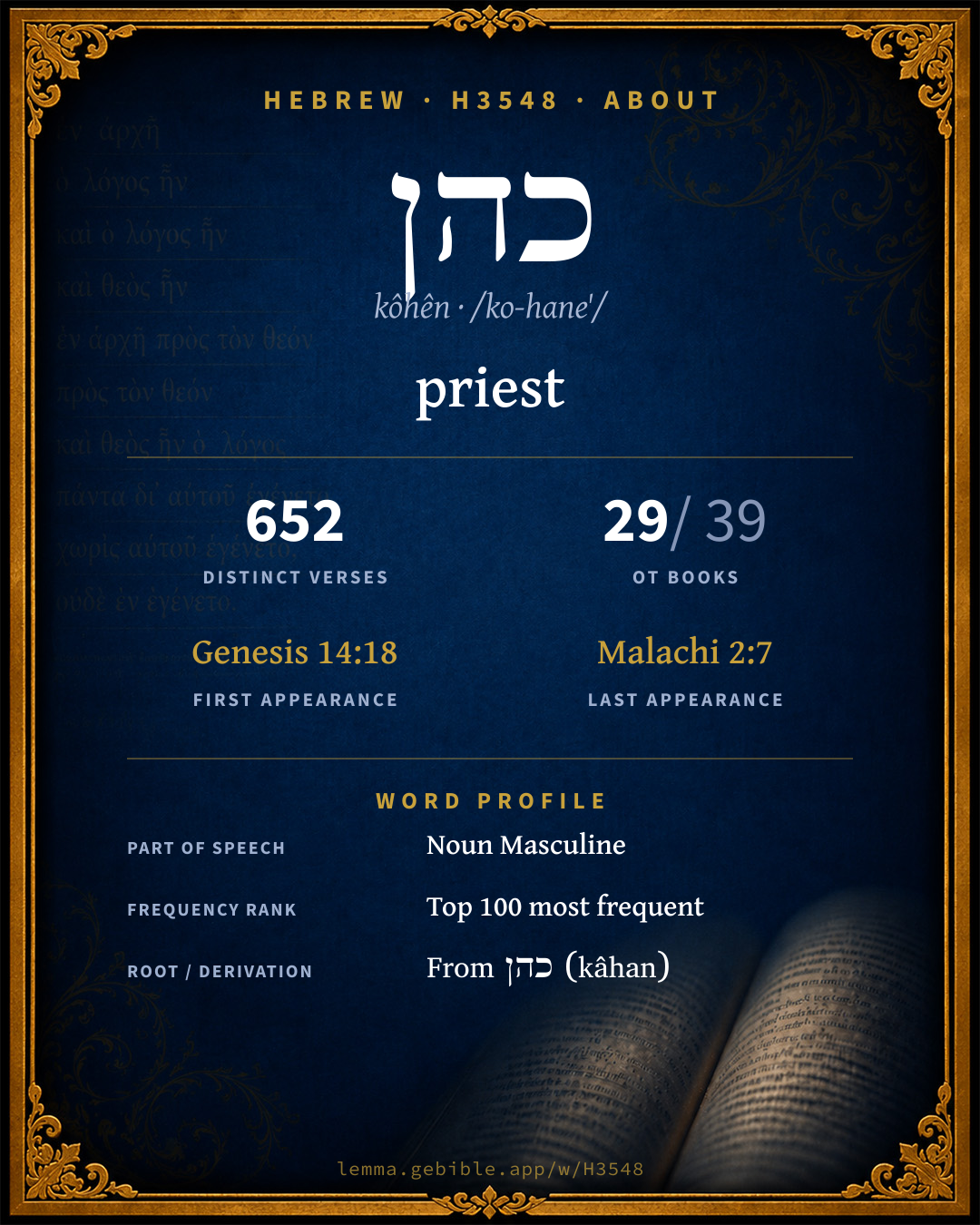
כֹּהֵן
priest
‘priest’ is one of 8 main senses fuller range ↓
Full lexicon entry — Brown-Driver-Briggs (BDB)
From Brown-Driver-Briggs (BDB)
Where this word appears
Grammar key — what these labels mean
Part of speech
- Noun
- A naming word — a person, place, thing, or idea.
Noun type
- Common
- A common noun — a general class of person, place, or thing (“king,” “city,” “water”), not a specific name.
State
- Absolute
- The independent form of a noun, not bound to a following word.
- Construct
- A noun bound to a following noun in a possessive / “of” relationship (the construct chain).
Gender
- Masculine
- Grammatically masculine.
Number
- Singular
- One.
- Plural
- More than one (in Hebrew, generally three or more).
Every verse where H3548 appears in the Book of Numbers — 62 distinct verses. Click any verse to open its interlinear word-by-word view. Verse text shown in the World English Bible for context — . Each verse’s Hebrew form is shown with its reference; the English is not keyword-highlighted, since the data carries no word-level English alignment. Use “Compare translations” on any verse to read it across multiple English versions. This concordance covers the Hebrew Bible; Septuagint (Greek Old Testament) occurrences are not indexed here.
Numbers
- Numbers 3:3 הַ/כֹּהֲנִ֖ים ptcl def.art + n c mp These are the names of the sons of Aaron, the priests who were anointed, whom he consecrated to minister in the priest's office.
- Numbers 3:6 הַ/כֹּהֵ֑ן ptcl def.art + n c ms "Bring the tribe of Levi near, and set them before Aaron the priest, that they may minister to him.
- Numbers 3:32 הַ/כֹּהֵ֑ן ptcl def.art + n c ms Eleazar the son of Aaron the priest shall be prince of the princes of the Levites, with the oversight of those who keep the charge of the sanctuary.
- Numbers 4:16 הַ/כֹּהֵ֗ן ptcl def.art + n c ms "The charge of Eleazar the son of Aaron the priest shall be the oil for the light, the sweet incense, the continual meal offering, and the anointing oil, the charge of all the tabernacle, and of all that is in it, the sanctuary, and its furnishings."
- Numbers 4:28 הַ/כֹּהֵֽן ptcl def.art + n c ms This is the service of the families of the sons of the Gershonites in the Tent of Meeting: and their charge shall be under the hand of Ithamar the son of Aaron the priest.
- Numbers 4:33 הַ/כֹּהֵֽן ptcl def.art + n c ms This is the service of the families of the sons of Merari, according to all their service, in the Tent of Meeting, under the hand of Ithamar the son of Aaron the priest."
- Numbers 5:8 לַ/כֹּהֵ֑ן prep det + n c ms But if the man has no kinsman to whom restitution may be made for the guilt, the restitution for guilt which is made to Yahweh shall be the priest's; besides the ram of the atonement, by which atonement shall be made for him.
- Numbers 5:9 לַ/כֹּהֵ֖ן prep det + n c ms Every heave offering of all the holy things of the children of Israel, which they present to the priest, shall be his.
- Numbers 5:10 לַ/כֹּהֵ֖ן prep det + n c ms Every man's holy things shall be his: whatever any man gives the priest, it shall be his."
- Numbers 5:15 הַ/כֹּהֵן֒ ptcl def.art + n c ms then the man shall bring his wife to the priest, and shall bring her offering for her: the tenth part of an ephah of barley meal. He shall pour no oil on it, nor put frankincense on it, for it is a meal offering of jealousy, a meal offering of memorial, bringing iniquity to memory.
- Numbers 5:16 הַ/כֹּהֵ֑ן ptcl def.art + n c ms The priest shall bring her near, and set her before Yahweh;
- Numbers 5:17 הַ/כֹּהֵ֛ן הַ/כֹּהֵ֖ן ptcl def.art + n c ms ptcl def.art + n c ms and the priest shall take holy water in an earthen vessel; and of the dust that is on the floor of the tabernacle the priest shall take, and put it into the water.
- Numbers 5:18 הַ/כֹּהֵ֥ן הַ/כֹּהֵן֙ ptcl def.art + n c ms ptcl def.art + n c ms The priest shall set the woman before Yahweh, and let the hair of the woman's head go loose, and put the meal offering of memorial in her hands, which is the meal offering of jealousy. The priest shall have in his hand the water of bitterness that brings a curse.
- Numbers 5:19 הַ/כֹּהֵ֗ן ptcl def.art + n c ms The priest shall cause her to swear, and shall tell the woman, 'If no man has lain with you, and if you haven't gone aside to uncleanness, being under your husband, be free from this water of bitterness that brings a curse.
- Numbers 5:21 הַ/כֹּהֵ֥ן הַ/כֹּהֵן֙ ptcl def.art + n c ms ptcl def.art + n c ms then the priest shall cause the woman to swear with the oath of cursing, and the priest shall tell the woman, 'Yahweh make you a curse and an oath among your people, when Yahweh allows your thigh to fall away, and your body to swell;
- Numbers 5:23 הַ/כֹּהֵ֖ן ptcl def.art + n c ms "The priest shall write these curses in a book, and he shall blot them out into the water of bitterness.
- Numbers 5:25 הַ/כֹּהֵן֙ ptcl def.art + n c ms The priest shall take the meal offering of jealousy out of the woman's hand, and shall wave the meal offering before Yahweh, and bring it to the altar.
- Numbers 5:26 הַ/כֹּהֵ֤ן ptcl def.art + n c ms The priest shall take a handful of the meal offering, as the memorial of it, and burn it on the altar, and afterward shall make the woman drink the water.
- Numbers 5:30 הַ/כֹּהֵ֔ן ptcl def.art + n c ms or when the spirit of jealousy comes on a man, and he is jealous of his wife; then he shall set the woman before Yahweh, and the priest shall execute on her all this law.
- Numbers 6:10 הַ/כֹּהֵ֔ן ptcl def.art + n c ms On the eighth day he shall bring two turtledoves or two young pigeons to the priest, to the door of the Tent of Meeting.
- Numbers 6:11 הַ/כֹּהֵ֗ן ptcl def.art + n c ms The priest shall offer one for a sin offering, and the other for a burnt offering, and make atonement for him, because he sinned by reason of the dead, and shall make his head holy that same day.
- Numbers 6:16 הַ/כֹּהֵ֖ן ptcl def.art + n c ms The priest shall present them before Yahweh, and shall offer his sin offering, and his burnt offering.
- Numbers 6:17 הַ/כֹּהֵ֔ן ptcl def.art + n c ms He shall offer the ram for a sacrifice of peace offerings to Yahweh, with the basket of unleavened bread. The priest shall offer also its meal offering, and its drink offering.
- Numbers 6:19 הַ/כֹּהֵ֜ן ptcl def.art + n c ms The priest shall take the boiled shoulder of the ram, and one unleavened cake out of the basket, and one unleavened wafer, and shall put them on the hands of the Nazirite, after he has shaved the head of his separation;
- Numbers 6:20 הַ/כֹּהֵ֥ן לַ/כֹּהֵ֔ן ptcl def.art + n c ms prep det + n c ms and the priest shall wave them for a wave offering before Yahweh. This is holy for the priest, together with the breast that is waved and the thigh that is offered. After that the Nazirite may drink wine.
- Numbers 7:8 הַ/כֹּהֵֽן ptcl def.art + n c ms and he gave four wagons and eight oxen to the sons of Merari, according to their service, under the direction of Ithamar the son of Aaron the priest.
- Numbers 10:8 הַ/כֹּ֣הֲנִ֔ים ptcl def.art + n c mp The sons of Aaron, the priests, shall blow the trumpets; and they shall be to you for a statute forever throughout your generations.
- Numbers 15:25 הַ/כֹּהֵ֗ן ptcl def.art + n c ms The priest shall make atonement for all the congregation of the children of Israel, and they shall be forgiven; for it was an error, and they have brought their offering, an offering made by fire to Yahweh, and their sin-offering before Yahweh, for their error:
- Numbers 15:28 הַ/כֹּהֵ֗ן ptcl def.art + n c ms The priest shall make atonement for the soul who errs, when he sins unwittingly, before Yahweh, to make atonement for him; and he shall be forgiven.
- Numbers 16:37 הַ/כֹּהֵ֗ן ptcl def.art + n c ms Speak to Eleazar the son of Aaron the priest, that he take up the censers out of the burning, and scatter you the fire yonder; for they are holy,
- Numbers 16:39 הַ/כֹּהֵ֗ן ptcl def.art + n c ms Eleazar the priest took the brazen censers, which those who were burnt had offered; and they beat them out for a covering of the altar,
- Numbers 18:28 הַ/כֹּהֵֽן ptcl def.art + n c ms Thus you also shall offer a heave-offering to Yahweh of all your tithes, which you receive of the children of Israel; and of it you shall give Yahweh's heave-offering to Aaron the priest.
- Numbers 19:3 הַ/כֹּהֵ֑ן ptcl def.art + n c ms You shall give her to Eleazar the priest, and he shall bring her forth outside of the camp, and one shall kill her before his face:
- Numbers 19:4 הַ/כֹּהֵ֛ן ptcl def.art + n c ms and Eleazar the priest shall take of her blood with his finger, and sprinkle her blood toward the front of the tent of meeting seven times.
- Numbers 19:6 הַ/כֹּהֵ֗ן ptcl def.art + n c ms and the priest shall take cedar-wood, and hyssop, and scarlet, and cast it into the midst of the burning of the heifer.
- Numbers 19:7 הַ/כֹּהֵ֗ן הַ/כֹּהֵ֖ן ptcl def.art + n c ms ptcl def.art + n c ms Then the priest shall wash his clothes, and he shall bathe his flesh in water, and afterward he shall come into the camp, and the priest shall be unclean until the even.
- Numbers 25:7 הַ/כֹּהֵ֑ן ptcl def.art + n c ms When Phinehas, the son of Eleazar, the son of Aaron the priest, saw it, he rose up from the midst of the congregation, and took a spear in his hand;
- Numbers 25:11 הַ/כֹּהֵ֗ן ptcl def.art + n c ms Phinehas, the son of Eleazar, the son of Aaron the priest, has turned my wrath away from the children of Israel, in that he was jealous with my jealousy among them, so that I didn't consume the children of Israel in my jealousy.
- Numbers 26:3 הַ/כֹּהֵ֛ן ptcl def.art + n c ms Moses and Eleazar the priest spoke with them in the plains of Moab by the Jordan at Jericho, saying,
- Numbers 26:63 הַ/כֹּהֵ֑ן ptcl def.art + n c ms These are those who were numbered by Moses and Eleazar the priest, who numbered the children of Israel in the plains of Moab by the Jordan at Jericho.
- Numbers 26:64 הַ/כֹּהֵ֑ן ptcl def.art + n c ms But among these there was not a man of them who were numbered by Moses and Aaron the priest, who numbered the children of Israel in the wilderness of Sinai.
- Numbers 27:2 הַ/כֹּהֵ֔ן ptcl def.art + n c ms They stood before Moses, and before Eleazar the priest, and before the princes and all the congregation, at the door of the tent of meeting, saying,
- Numbers 27:19 הַ/כֹּהֵ֔ן ptcl def.art + n c ms and set him before Eleazar the priest, and before all the congregation; and give him a charge in their sight.
- Numbers 27:21 הַ/כֹּהֵן֙ ptcl def.art + n c ms He shall stand before Eleazar the priest, who shall inquire for him by the judgment of the Urim before Yahweh: at his word shall they go out, and at his word they shall come in, both he, and all the children of Israel with him, even all the congregation.
- Numbers 27:22 הַ/כֹּהֵ֔ן ptcl def.art + n c ms Moses did as Yahweh commanded him; and he took Joshua, and set him before Eleazar the priest, and before all the congregation:
- Numbers 31:6 הַ/כֹּהֵן֙ ptcl def.art + n c ms Moses sent them, one thousand of every tribe, to the war, them and Phinehas the son of Eleazar the priest, to the war, with the vessels of the sanctuary and the trumpets for the alarm in his hand.
- Numbers 31:12 הַ/כֹּהֵ֜ן ptcl def.art + n c ms They brought the captives, and the prey, and the spoil, to Moses, and to Eleazar the priest, and to the congregation of the children of Israel, to the camp at the plains of Moab, which are by the Jordan at Jericho.
- Numbers 31:13 הַ/כֹּהֵ֛ן ptcl def.art + n c ms Moses, and Eleazar the priest, and all the princes of the congregation, went forth to meet them outside of the camp.
- Numbers 31:21 הַ/כֹּהֵן֙ ptcl def.art + n c ms Eleazar the priest said to the men of war who went to the battle, This is the statute of the law which Yahweh has commanded Moses:
- Numbers 31:26 הַ/כֹּהֵ֔ן ptcl def.art + n c ms Take the sum of the prey that was taken, both of man and of animal, you, and Eleazar the priest, and the heads of the fathers' [houses] of the congregation;
- Numbers 31:29 הַ/כֹּהֵ֖ן ptcl def.art + n c ms take it of their half, and give it to Eleazar the priest, for Yahweh's heave-offering.
- Numbers 31:31 הַ/כֹּהֵ֑ן ptcl def.art + n c ms Moses and Eleazar the priest did as Yahweh commanded Moses.
- Numbers 31:41 הַ/כֹּהֵ֑ן ptcl def.art + n c ms Moses gave the tribute, which was Yahweh's heave-offering, to Eleazar the priest, as Yahweh commanded Moses.
- Numbers 31:51 הַ/כֹּהֵ֛ן ptcl def.art + n c ms Moses and Eleazar the priest took the gold of them, even all worked jewels.
- Numbers 31:54 הַ/כֹּהֵן֙ ptcl def.art + n c ms Moses and Eleazar the priest took the gold of the captains of thousands and of hundreds, and brought it into the tent of meeting, for a memorial for the children of Israel before Yahweh.
- Numbers 32:2 הַ/כֹּהֵ֔ן ptcl def.art + n c ms the children of Gad and the children of Reuben came and spoke to Moses, and to Eleazar the priest, and to the princes of the congregation, saying,
- Numbers 32:28 הַ/כֹּהֵ֔ן ptcl def.art + n c ms So Moses gave charge concerning them to Eleazar the priest, and to Joshua the son of Nun, and to the heads of the fathers' [houses] of the tribes of the children of Israel.
- Numbers 33:38 הַ/כֹּהֵ֜ן ptcl def.art + n c ms Aaron the priest went up into Mount Hor at the commandment of Yahweh, and died there, in the fortieth year after the children of Israel were come out of the land of Egypt, in the fifth month, on the first day of the month.
- Numbers 34:17 הַ/כֹּהֵ֔ן ptcl def.art + n c ms These are the names of the men who shall divide the land to you for inheritance: Eleazar the priest, and Joshua the son of Nun.
- Numbers 35:25 הַ/כֹּהֵ֣ן ptcl def.art + n c ms and the congregation shall deliver the manslayer out of the hand of the avenger of blood, and the congregation shall restore him to his city of refuge, where he was fled: and he shall dwell therein until the death of the high priest, who was anointed with the holy oil.
- Numbers 35:28 הַ/כֹּהֵ֣ן הַ/כֹּהֵ֣ן ptcl def.art + n c ms ptcl def.art + n c ms because he should have remained in his city of refuge until the death of the high priest: but after the death of the high priest the manslayer shall return into the land of his possession.
- Numbers 35:32 הַ/כֹּהֵֽן ptcl def.art + n c ms You shall take no ransom for him who is fled to his city of refuge, that he may come again to dwell in the land, until the death of the priest.
About this entry
At a glance — auto-summarized from this page’s data, not written by a person. Every figure links to its source below. This summary describes the numbers; it doesn’t interpret them.
כהן — transliterated kôhên — is a Hebrew noun carrying the sense “priest.” The lexicon spreads it across several senses; see its full sense range. Spanning 652 verses in 29 books, it ranks among the most common words of the Hebrew Bible. Its earliest occurrence is Genesis 14:18. Sharing its root, it stands alongside כהן, כהנה and כהן. See the sense tree, 652-verse concordance, and the renderings breakdown below.
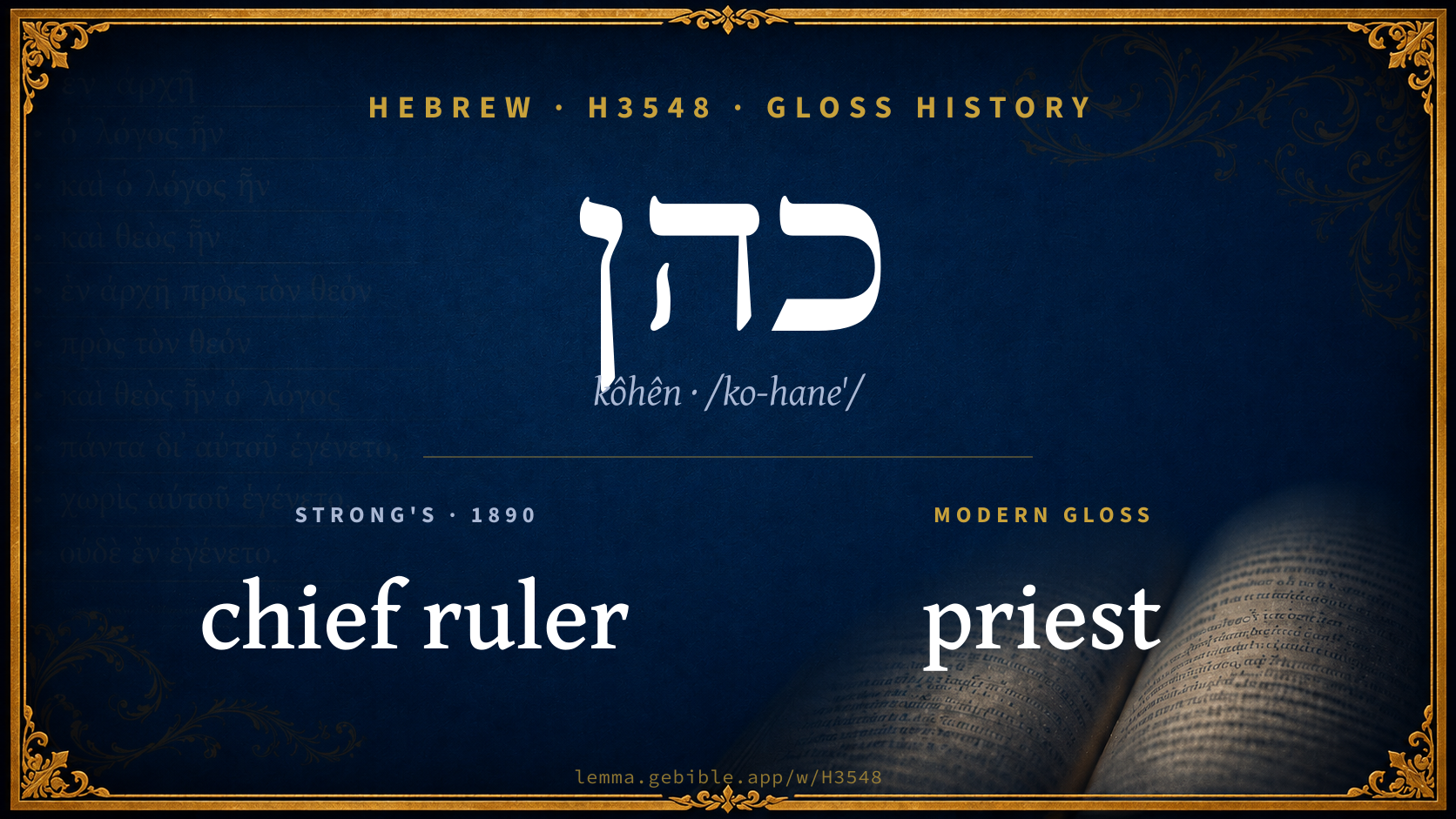
Gloss history
Strong's 1890 vs modern scholarship
About this word
Strong's H3548 catalogs a Hebrew word from the Hebrew Old Testament.
These counts are not copied from any lexicon or concordance. They are computed here, from the morphology-tagged Hebrew Old Testament. What Lemma adds →
- 652
- distinct verses
- The word appears in 652 distinct verses.
- 29 / 39
- OT books
- The word appears in 29 of 39 Old Testament books.
- #67
- by frequency
- Top 100 most frequent Hebrew words (rank 67 of 8,640 Hebrew words by occurrence).
View all 652 occurrences in the concordance →
Most concentrated in
- Leviticus 153 verses 23%
- 2 Chronicles 72 verses 11%
- Numbers 62 verses 10%
By section of the Old Testament
By traditional corpus
Conventional, traditional groupings — biblical authorship is debated, so this is a traditional corpus grouping, not an authorship claim. Each share is this word’s portion of its verses in that division of the Hebrew canon. Each figure is a share of the word’s 652 distinct verses.
- Torah (Pentateuch) 245 verses · 38%
- Prophets (Nevi'im) 239 verses · 37%
- Writings (Ketuvim) 168 verses · 26%
How translations render this word
Counts come from each version’s own published word-to-Strong’s tagging or interlinear alignment — an approximate guide to how each version renders this word, not a word-level alignment the data otherwise carries. Because each total is that version’s own tagged count, the per-version totals vary from one another and need not match the appearance or distinct-verse counts above. These counts may also differ from a printed concordance because Lemma counts each distinctly tagged rendering and does not collapse phrase taggings into a single head-word total. This is a fixed set of word-tagged versions (KJV, ASV, BSB, ULT) and does not change with the reading translation you choose elsewhere. Each version’s license is shown beside its name below (and on Sources).
- King James Version: Priest 392×, Priests 243×, Priest's 7×
- American Standard Version: Priest 383×, Priests 232×, Were priests 6×
- Berean Standard Bible: Priest 380×, Priests 255×, Way the priest 8×
- unfoldingWord Literal Text: Priest 410×, Priests 271×, The 30×
King James Version Public Domain
Renders H3548 across 750 tagged occurrences — most commonly:
Plus other, less common renderings. Plus 58 renderings that appear only once — usually multi-word phrases or single function words the recovered tagging swept in, not distinct renderings.
American Standard Version Public Domain
Renders H3548 across 750 tagged occurrences — most commonly:
Plus other, less common renderings. Plus 83 renderings that appear only once — usually multi-word phrases or single function words the recovered tagging swept in, not distinct renderings.
Berean Standard Bible Public Domain
Renders H3548 across 725 tagged occurrences — most commonly:
Plus other, less common renderings. Plus 37 renderings that appear only once — usually multi-word phrases or single function words the recovered tagging swept in, not distinct renderings. Not rendered by a distinct English word in 25 further occurrences.
unfoldingWord Literal Text CC BY-SA 4.0
Renders H3548 across 768 tagged occurrences — most commonly:
Plus 17 renderings that appear only once — usually multi-word phrases or single function words the recovered tagging swept in, not distinct renderings.
11 senses and sub-senses in the full BDB
What do BDB’s symbols mean?
BDB uses these scholarly abbreviations:
| Symbol | Meaning |
|---|---|
| 𝔊 | the Septuagint (the ancient Greek translation, LXX) |
| 𝔙 | the Vulgate (the Latin translation) |
| 𝔖 | the Syriac version (the Peshitta) |
| 𝔗 | the Targum (the Aramaic translation) |
| ψ | the Psalms |
| √ | root (the underlying root or stem) |
| ‖ | parallel passage (a synonymous or contrasted parallel) |
| † | the dagger: every passage where the word occurs is cited |
The 11 senses and sub-senses the full Brown-Driver-Briggs lexicon distinguishes for this word, in lexicon order (not ranked by frequency), with BDB’s own verbatim wording and sub-sense lettering. Shown in Hebrew script with BDB’s own scholarly abbreviations. The condensed entry is in the Lexicon Entry tab. See also the Forms in the corpus table below.
- 1. priest-king: e.g. Melchizedek Gn 14:18 (E?), cf. ψ 110:4 (the Messianic priest-King like Melchizedek); Zc 6:13 (Messianic priest and king); Israel מַמְלֶכֶת כֹּהֲנִים Ex 19:6 (E) a kingdom of priests (priests and kings at once in their relation to the nations); cf. Is 61:6 (of Israel ministering as a priest); or a chieftain (exercising priestly functions) כֹּהֵן מִדְיָן Ex 2:16; 3:1; 18:1 (all JE); so also probably the sons of David 2 S 8:18, his grandson 1 K 4:5; and Ira the Jairite 2 S 20:26, who as princes performed priestly functions. With these we may class the כהנים Ex 19:22, 24 (J). e.g. Genesis 14:18
- 2. priests of other religions than י׳’s: Potiphera כ׳ אֹן Gn 41:45, 50 (E), 46:20 (P); Egyptian כהנים Gn 47:22(×2), 26 (J); כ׳ דָגוֹן 1 S 5:5; Philistine כהנים וקסמים 1 S 6:2; כֹּהֲנָיו his priests: e.g. of Baal 2 K 10:19 = of Ahab 2 K 10:11; of Chemosh Je 48:7; of Malcam Je 49:3; Mattan was כ׳ הבעל 2 K 11:18 = 2 Ch 23:17; הכמרים עם הכהנים Zp 1:4; Josiah burned the bones of the priests of the Baalim and Asherim 2 Ch 34:5. e.g. Genesis 41:45
- 3. priests of special orders in Israel:
- a. Micah in the hill-country of Ephraim consecrated his own son וַיְהִי־לוֹ לְכֹהֵן Ju 17:5; but so soon as he could secure Jonathan ben Gershom, a descendant of Moses (see VB Ju 18:30), he consecrated him, היה ל׳ לכהן Ju 17:10, 12, 13; 18:4, 19; הַכֹּהֵן v 6, 17, 18, 20, 24, 27. He was captured by the Danites, and he and his line became priests at Dan until the Exile, v 19(×2), 30. e.g. Judges 17:5
- b. Jeroboam עשׂה כהנים 1 K 12:31 of those not מבני לוי, as כ׳ (הַ)בָּמוֹת priests of (the) high places 1 K 12:32; 13:2, 33(×2) = כ׳ לבמות 2 Ch 11:15; Amaziah (of this class) was כ׳ בית־אל Am 7:10; v. also 2 Ch 13:9; called by Chr כ׳ לְלֹא אלהים v 9; yet Hosea rebukes them as priests of י׳ Ho 4:4, 9; 5:1; 6:9; at the Exile they were deported by the Assyrians 2 K 17:27, 28. e.g. 1 Kings 12:31
- c. the people imported into Samaria made some of themselves כ׳ במות to worship י׳ the God of the land 2 K 17:32. e.g. 2 Kings 17:32
- 4. priests in Israel הכהנים who bore the ark and the trumpets Jos 3:13, 14, 15, 17; 4:3, 9, 10, 17, 18(×2); 6:4(×2), 6(×2), 8, 9, 12, 13, 16 (all JE), 1 K 8:3, 6, 10, 11; Eli was הכהן 1 S 1:9; 2:11; כ׳ יהוה 14:3; and his sons כ׳ ליהוה 1 S 1:3; a מִשְׁפַּט הַכֹּהֲנִים 1 S 2:13 mentions the ministering priest הכהן and the נַעַר הַכּ׳ 1 S 2:13, 14, 15(×2), Ahijah was הַכּ׳ in time of Saul 1 S 14:19(×2); 36; Abimelech הַכּ׳ at Nob, a priestly centre, 1 S 21:2, 3, 5, 6, 7, 10; 22:11; where were many כֹּהֲנֵי י׳ 1 S 22:17(×2), 21, all slain by Saul except Abiathar son of Ahimelech 1 S 22:11, 18(×2), 19, who became הַכּ׳ 1 S 23:9; 30:7 1 K 1:7, 19, 25, 42; 2:22, 26; Zadok later was הַכּ׳ 2 S 15:27 1 K 1:8, 26, 32, 34, 38, 39, 44, 45; 2:35; 3:2 1 Ch 16:39; 24:6: so that the two were (ה)כהנים 2 S 8:17 = 1 Ch 18:16 (read וְאֶבְיָתָר בֶּן־אח׳ 2 S 8:17 𝔖 We Dr, and correct 1 Ch 18:16 accordingly) 2 S 15:35(×2); 17:15; 19:12; 20:25 1 K 4:4; Sol. removed Abiathar 1 K 2:27 and Zadok was anointed לְכֹהֵן according to 1 Ch 29:22; cf. prediction of rejection of house of Eli and selection of כ׳ נֶאֱמָן 1 S 2:28, 35; Jehoiada הַכּ׳ led the revolution against Athaliah 2 K 11:9(×2), 10, 15(×2), 18; 12:3, 8, 10 = 2 Ch 22:11; 23:8(×2), 9, 14(×2); 24:2, 20, 25, perhaps also Je 29:26; הנהנים sustaining him in his reforms 2 K 12:5, 6, 7, 8, 9, 10, 17; Uriah was הַכּ׳ in the reign of Ahaz 2 K 16:10, 11(×2), 15, 16 Is 8:2; Hilkiah of Josiah 2 K 22:10, 12, 14; 23:24 2 Ch 34:14, 18. Other individual priests are named, e.g.: Pashhur of Jehoiachin Je 20:1; Zephaniah of Zedekiah Je 21:1; 29:25, 26, 29; 37:3; הַכּ׳ is Ezekiel’s title Ez 1:3. Priests are classed with officials of state: prophets and priests 2 K 23:2 Is 28:7 Je 5:31; 6:13; 8:10; 14:18; 23:11, 33, 34; 26:7, 8, 11, 16; 29:1; La 2:20; 4:13; priests and elders La 1:19; 4:16; king and priest La 2:6; kings, priests, and prophets Je 13:13; kings, princes, and priests Je 1:18; princes, eunuchs, and priests Je 34:19; priest, sage, and prophet Je 18:18; chiefs, priests, and prophets Mi 3:11; prophets, priests, and elders Ez 7:26; kings, princes, priests, and prophets Je 2:26; 4:9; 8:1; 32:32; princes, judges, prophets, and priests Zp 3:4; seeming to exclude any other officials. Apparently in the same generic sense הכהנים Je 1:1; 2:8; 27:16; 28:1, 5; 29:25; 31:14; כַּכֹּהֵן Is 24:2; כהנים Jb 12:19; כהניה La 1:4 Ez 22:26; כהניו ψ 78:64. Moses and Aaron among his priests ψ 99:6 includes Moses (against P). Zion’s priests clothed with righteousness and salvation ψ 132:9, 16 = 2 Ch 6:41, prob. here also. e.g. Joshua 3:13
- 5. Levitical priests הַכֹּהֲנִים הַלְוִיִּם Dt 17:9, 18; 18:1; 24:8; 27:9; Jos 3:3; 8:33 (all D), Je 33:18 (inverted), v 21 (neither in 𝔊), 2 Ch 5:5 (= הַכּ׳ וְהַלּ׳ 1 K 8:4: Chronicler retains original Deuteronomic reading), Ez 43:19; 44:15 (cf. 6); הַכּ׳ בְנֵי לֵוִי Dt 21:5; 31:9; לקח לכ׳ לל׳ Is 66:21 take for priests, for Levites (of the nations in Messianic age). Doubtless of same class are: הַכֹּהֲנִים Dt 18:3; 19:17; Jos 3:6, 8; 4:11 (D); and הַכֹּהֵן, the priest officiating on a partic. occasion Dt 18:3; 20:2; or holding a partic. dignity 17:12; 26:3, 4. The כהנים of the other cities of Judah, כ׳ הבמות, who were not allowed to minister in Jerusalem 2 K 23:8(×2), 9, 20, may be an attempt to enforce an exclusion from the priesthood of all but Levitical priests. e.g. Deuteronomy 17:9
- 6. Zadokite priests: Ezekiel distinguishes among הכהנים הלוים those of the seed of Zadok, בְּנֵי צָדוֹק; all but the latter excluded by him from priesthood 40:46; 43:19; 44:15; 48:11; the priests of his code being all Zadokites 40:45, 46; 42:13, 14; 43:24, 27; 44:21, 22, 30(×2), 31; 45:4, 19; 46:2, 19, 20; 48:10, 13. e.g. Ezekiel 40:46
- 7. Aaronic priests. In H. it is taken for granted that a priest is of the seed of Aaron; the pl. is never used; כֹּהֵן is used for any priest Lv 21:9; 22:10, 11, 12, 13; הַכֹּהֵן for Aaron Lv 21:21, and for the official priest (acting for the priesthood, almost collective) Lv 17:5, 6; 22:14; 23:10, 11, 20(×2); 27:8(×3), 11, 12(×2), 14(×2), 18, 21, 23. The priests of P are בְּנֵי אַהֲרֹן Lv 1:5, 8, 11; 2:2; 3:2; 21:1 Nu 3:3; 10:8 Jos 21:19; so in Chronicles 2 Ch 13:9, 10; 26:18; 29:21; 31:19; 35:14(×2); הַכֹּהֵן is used of Aaron 22 times, Eleazar 29 times, Phinehas Jos 22:30 and elsewhere; 180 times of ministering priests, or generic of the priests; הכהנים Lv 6:22; 7:6; 13:2; 16:33 Jos 4:16; כהן Lv 6:16. Chronicles distinguishes הַכֹּהֲנִים וְהַלְוִיִּם 1 Ch 13:2; 15:11, 14; 23:2; 24:6, 31; 28:13, 21 2 Ch 8:15; 11:13; 13:9, 10; 23:4; 24:5; 29:4; 30:15, 25; 31:2(×2), 4, 9; 34:30; 35:8, 18 (the variants without וְ 2 Ch 23:18; 30:27 are due to copyists’ errors). Ezr 1:5; 2:70; 3:8, 12; 6:20; 7:7; 8:29, 30; 9:1 Ne 7:72; 8:13; 11:3; 12:1, 30, 44(×2); 13:30; הלוים והכהנים 2 Ch 19:8; 30:21; priests, Levites, and others 1 Ch 9:2 Ezr 10:5 Ne 10:1, 29, 35; 11:20; בְּנֵי לֵוִי antith. to הַכּ׳ Ezr 8:15; הכהן בן אהרן עם הלוים Ne 10:39; (ה)כהנים in Chr 67 times has the same reference, as also כֹּהֲנֵינוּ Ezr 9:7 Ne 9:32, 34; כֹּהֵן Ezr 2:63 = Ne 7:65; כ׳ ליהוה 2 Ch 26:17; כהניו His (God’s) priests 2 Ch 13:12; כ׳ מוֹרֶה teaching priest 2 Ch 15:3; הַכֹּהֵן is used of Jehoiada in time of David 1 Ch 27:5, and Azariah in the reign of Uzziah 2 Ch 26:17. In the literature of the restoration הַכֹּהֵן is used of Ezra, Ezr 7:11; 10:10, 16 Ne 8:2, 9; 12:26; Uriah Ezr 8:33; Eliashib Ne 13:4; Shelemiah Ne 13:13; הכהנים Jo 1:9, 13; 2:17 Hg 2:11, 12, 13 Zc 7:5 Mal 1:6; 2:1; priests and prophets Zc 7:3; כהן Mal 2:7. e.g. Leviticus 21:9
- 8. the high priest: הַכֹּהֵן is frequently used (see 4) to designate the priest who was at the head of priestly affairs. The adj. הַגָּדוֹל first appears of Jehoiada 2 K 12:11, then of Hilkiah 2 K 22:4, 8; 23:4; 2 Ch 34:9; after the exile, of Joshua Hg 1:1, 12, 14; 2:2, 4 Zc 3:1, 8; 6:11, and Eliashib Ne 3:1, 20; 13:28. But P uses it of Aaron and his eldest descendants who are anointed with holy oil Lv 21:10 (H; הכ׳ הַגָּדוֹל מֶאֶהָיו), Nu 35:25, 28(×2) Jos 20:6, and so הַכּ׳ הַמָּשִׁיהַ Lv 4:3, 5, 16; 6:15, cf. 16:32. כ׳ הָרֹאשׁ is used of Seraiah 2 K 25:18 = Je 52:24; and, in Chronicler, of Amariah 2 Ch 19:11, Jehoiada 2 Ch 24:11, Azariah, 2 Ch 26:20; 31:10; of Aaron Ezr 7:5. (We also supposes הרואה in 2 S 15:27 to be a corruption of הראשׁ, which he regards as postexilic insertion. The text is corrupt [see DrSm. l.c.]; but this correction is improbable. Lists of high priests occur 1 Ch 5:30–41; 6:35–38.) A priest of second rank (כֹּהֵן (ה)מִשְׁנֶה) appears in 2 K 23:4 (cstr. pl. incorrect), 25:18 = Je 52:24; זִקְנֵי הַכּ׳ 2 K 19:2 = Is 37:2, Je 19:1; שָׂרֵי הַכּ׳ 2 Ch 36:14 Ezr 8:24, 29; 10:5; רָאשֵׁי הַכּ׳ Ne 12:7. e.g. 2 Kings 12:11
Senses from the full Brown-Driver-Briggs lexicon (Brown, Driver, Briggs; Oxford 1906 — public domain), digitized via Sefaria, supplemented by the OpenScriptures HebrewLexicon (CC BY 4.0). Full attribution on Sources.
Word origin
n.m. priest (NH כֹּהֵן; Aramaic כָּהֵין, כַּהֲנָא ܟܳܗܶܢ, ܟܳܗܢܳܐ; Ethiopic ካህን, all id.; on Ph. and Arabic v. supr.);—כ׳ Gn 14:18 + 439 times; pl. כֹּהֲנִים Ex 19:6 + 272 times; cstr. כֹּהֲנֵי 1 S 5:5 + 13 times; sf. כֹּהֲנַי La 1:19 + 22 times; sfs.—
— Brown-Driver-Briggs (Oxford 1906, public domain), digitized via Sefaria, supplemented by the OpenScriptures HebrewLexicon (CC BY 4.0). See Sources.
Derived from כהן (kâhan) (H3547) — to serve as priest.
Jastrow Dictionary
A second Hebrew/Aramaic lexicon for comparison, covering Aramaic and post-biblical (Talmudic, Targumic, Midrashic) usage that the biblical-Hebrew BDB does not. Matched by lemma rather than by Strong’s number, so a lemma may carry more than one Jastrow headword (shown separately below), and the entries cover usage well beyond the Bible.
כֹּהֵן
- , v. כּוּן; cmp. b. h. כַּן) [standing, stationed,] officer, esp. priest. Yoma 6ᵃ, a. fr. כ׳ גדול (abbr. כ"ג) high priest, כ׳ הדיוט ordinary priest. Meg. I, 9 כ׳ משוח an anointed high priest, contrad. to מרובה בגדים a high priest distinguished only by his robes (but not anointed, as in the days of the Second Temple). Ib. כ׳ משמש officiating highpriest, כ׳ שעבר a substitute of the high priest no longer required, ex-substitute. Hor. III, 8 ממזר … קודם לכ"ג ע"ה a bastard who is a scholar has the precedence of an ignorant high priest; a. v. fr.—Pl. כֹּהֲנִים. Yeb. 86ᵇ, a. e. בכ"ד מקומות נקראו הכ׳ וכ in twenty four Biblical passages the priests are designated as Levites; a. v. fr.—תּוֹרַת כֹּהֲנִים (abbr. ת"כ) Torath Kohănim, a) name of the third book of Moses, Leviticus. Kidd. 33ᵃ. Lev. R. s. 7 מפני מה … בת"כ why do we, in teaching children, commence with Leviticus? a. e.—b) name of an halachic commentary to Leviticus, also named Sifra. Yeb. 72ᵇ; a. fr.—Fem. כֹּהֶנֶת, כּוֹהֶ׳ a priest’s daughter or wife. Ḥull. 131ᵇ, sq.—Keth. IV, 8 ובכ׳ and in the case of a priest’s wife. Ib. VII, 1, sq. (70ᵃ) ובכ׳ Mish. a. Y. ed. (Bab. ed. ובכהן). Ib. 71ᵃ; a. fr.—Pl. כֹּהֲנוֹת, כּוֹהֲ׳. Ber. 44ᵃ. Yeb. III, 10 אם היו כ׳ (Y. ed. כוה׳) if they are daughters of priests; a. e.
כָּהַן
- , (b. h.), Nithpa. נִתְכַּהֵן (denom. of כֹּהֵן) to be appointed priest, to act as priest. Zeb. 101ᵇ לא נ׳ פנחס וכ׳ Phineas was not appointed high priest until &c. Ib. 102ᵃ לא נ׳ משה וכ׳ Moses acted as priest only during &c.
כָּהֵן
- Targ. Jer. XIV, 18. Targ. Mal. II, 7. Targ. Lev. I, 7; a. v. fr.—Snh. 110ᵃ, a. fr. כ׳ רבא high priest. Ḥull. 49ᵃ ישמעאל כ׳ מסייע כהני Ishmael, being a priest, favors the priests. Gitt. 59ᵇ קרי בכ׳ read from the Torah in the priest’s place, i.e. was called up the first; Meg. 22ᵃ Ms. O. (ed. בכהני pl.); a. fr.—Pl. כַּהֲנִין, כַּהֲנַיָּא, כַּהֲנֵי. Targ. Ex. XIX, 6. Targ. O. Lev. I, 5; a. fr.—Gitt. l. c. כ׳ חשיבי דא"י highly esteemed Palestinean priests; a. fr.—Fem. (כֹּהֶנֶת) כַּהַנְתָּא. Ḥull. 131ᵇ … יהיב לכ׳ gave priestly gifts to a priest’s daughter (married to an Israelite). Pes. 49ᵃ נסיב כ׳ married a priest’s daughter.—Pl. כַּהֲנָתָא. Ber. 44ᵃ
כָּהֵן ²
- (or כֹּהֵן), כַּהֲנָא II pr. n. m. Kahen, Kahăna, name of several Amoraim. Y. Ber. III, 6ᵃ, a. fr. ר׳ כהן.—B. Kam. 117ᵃ. Y. R. Hash. IV, beg. 59ᵇ; a. fr.—Erub. 8ᵇ רב כ׳ רביה דרב (v., however, Ms. M. a. Rabb. D. S. a. l. notes); a. fr.—v. Fr. M’bo, p. 109ᵇ, sq.
A Dictionary of the Targumim, the Talmud Babli and Yerushalmi, and the Midrashic Literature (Marcus Jastrow; London, Luzac, 1903) — Public Domain. Digitized via Sefaria. Digitized via Sefaria. Full attribution on Sources.
Forms in the corpus
The 161 distinct written forms H3548 takes in the Hebrew Bible, most frequent first — each parse links to that state’s occurrences in the concordance. Hebrew forms include their vowel points and cantillation, so a single lemma takes many written forms.
The 60 most common forms are shown; 101 rarer forms follow in the full concordance.
Same root — word family
Other BDB entries built from the same root as H3548, grouped by Strong’s listed origin. These share a root / origin per the lexicon — not necessarily a shared meaning. Each links to that word’s own entry.
Derives from
Shares the same root
Derived from this word
Compare all same-root words → They share a root, not necessarily a meaning.
Septuagint verse parallels
This word appears in 595 verses that also exist in the Greek Old Testament (Septuagint), out of the 652 Hebrew verses it occurs in. You can read those verses in Greek by switching the Old Testament edition to the Septuagint.
Read these verses in the Septuagint
- Genesis 14:18
- Exodus 2:16
- Leviticus 1:5
- Numbers 3:3
- Deuteronomy 17:9
- Joshua 3:3
- Judges 17:5
- 1 Samuel 1:3
- 2 Samuel 8:17
- 1 Kings 1:7
- 2 Kings 10:11
- 1 Chronicles 9:2
This is a verse-level parallel only — the same verses exist in both the Hebrew and Greek Old Testaments. No word-level Hebrew↔Greek correspondence is claimed: the data carries no such alignment, so no Greek word is shown as this Hebrew word’s translation. Coverage is not total — the Septuagint omits the deuterocanon and renumbers the Psalms, so some Hebrew verses have no direct Greek parallel.