
Jeremiah 14:18

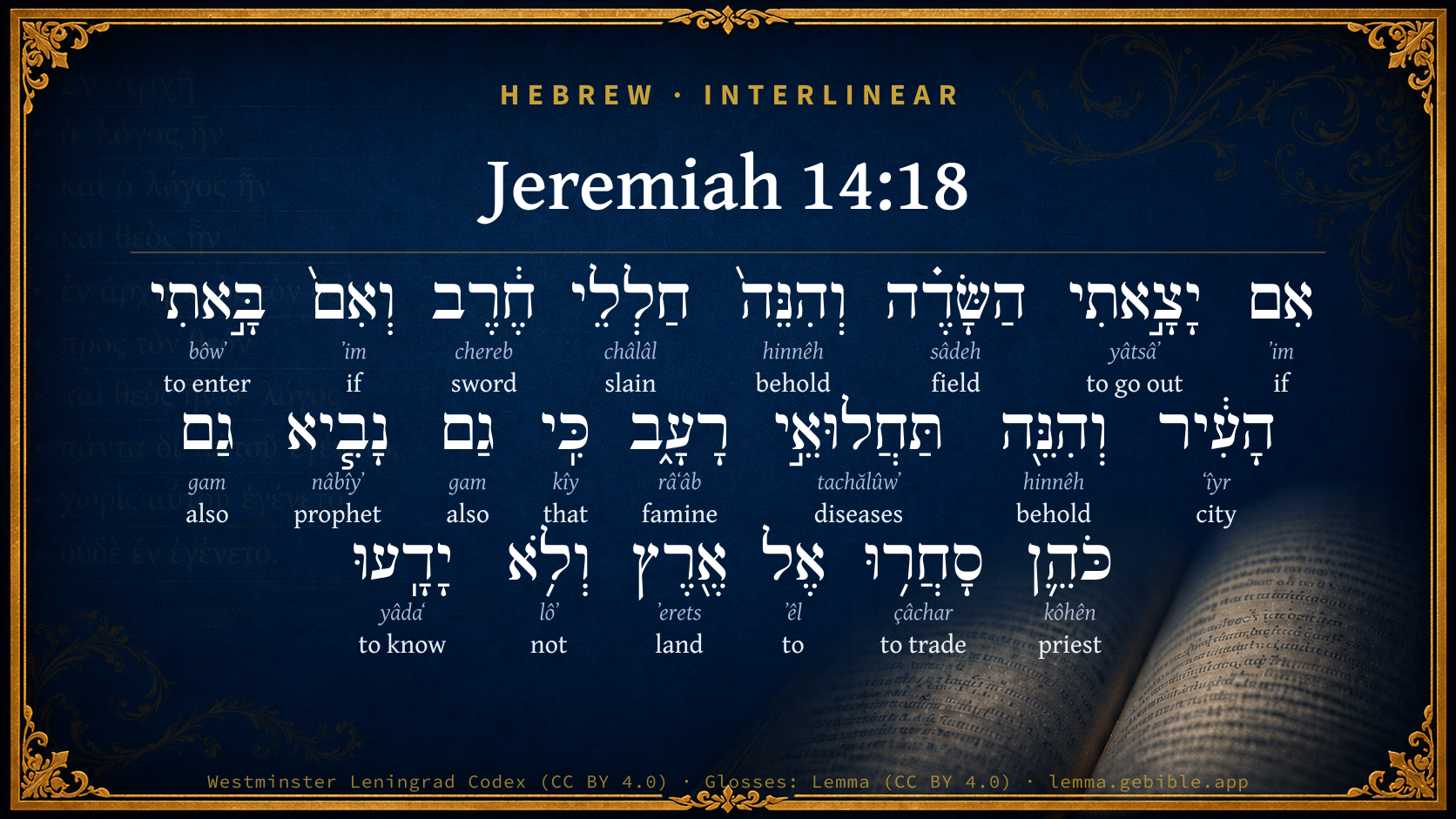
Hebrew (Westminster Leningrad Codex) Jeremiah 14:18 appears in the Hebrew Old Testament. The text above is from the Westminster Leningrad Codex. Each word links to its Strong’s number, a concise gloss, and parsing drawn from the Open Scriptures Hebrew Bible morphology. Click any word for its full Brown-Driver-Briggs (BDB) entry.
Download image
Cite this verse

Jeremiah 14:18 (World English Bible). Public Domain. Lemma interlinear Bible study tool, https://lemma.gebible.app/v/jeremiah/14/18.

Show BibTeX & RIS
BibTeX
RIS
English Translation
If I go forth into the field, then, behold, the slain with the sword! and if I enter into the city, then, behold, those who are sick with famine! for both the prophet and the priest go about in the land, and have no knowledge.
World English Bible · Public Domain
Download a study sheet

One document with this verse’s original text, its word-by-word gloss line, the meaning frame, cross-references with their text, attributed commentary, and full source and license credits — printable, and it pastes into notes with its structure intact.

This verse Autodidact and up

Study sheet (.html) Plain text (.txt)

A passage Seminary Student

Up to 50 verses in one chapter. A passage sheet keeps up to 6 commentary sources and 12 cross-references per verse, in the order this page ranks them, and says so on the sheet whenever that leaves anything out. Ask for a single verse and you get the Autodidact verse sheet above.

Everything on this page stays free to read, with no account — the sheet is a download of what is already on screen, not access to it.

Want to remove ads? Support Godless Engineer
Compare translations 3

The same verse in 3 English versions, stacked beneath the original-language interlinear above. Click any original word for its lexicon entry.

Each is an independent rendering of the whole verse — the interlinear is not word-aligned to these translations.

Highlighted words mark where these versions differ — a whole-verse word diff, not a word-by-word alignment.

  • World English Bible Public Domain
    If I go forth into the field, then, behold, the slain with the sword! and if I enter into the city, then, behold, those who are sick with famine! for both the prophet and the priest go about in the land, and have no knowledge.
  • King James Version Public Domain
    If I go forth into the field, then behold the slain with the sword! and if I enter into the city, then behold them that are sick with famine! yea, both the prophet and the priest go about into a land that they know not.
  • unfoldingWord Literal Text CC BY-SA 4.0
    If I go out to the field, then behold, pierced ones of the sword, and if I enter the city, then behold the diseases of famine, yes, both prophet and priest go about in a land, and they know not.’”

unfoldingWord Literal Text — © unfoldingWord, licensed CC BY-SA 4.0. Word-aligned USFM3 via Door43 (git.door43.org/unfoldingWord/en_ult).

Versions to compare (up to 4)

3 of 4 selected

Show all 18 translations

Every available English version of this verse, each an independent rendering of the whole verse.

  • World English Bible Public Domain
    If I go forth into the field, then, behold, the slain with the sword! and if I enter into the city, then, behold, those who are sick with famine! for both the prophet and the priest go about in the land, and have no knowledge.
  • Berean Standard Bible Public Domain
    If I go out to the country, I see those slain by the sword; if I enter the city, I see those ravaged by famine! For both prophet and priest travel to a land they do not know.’”
  • Majority Standard Bible Public Domain
    If I go out to the country, I see those slain by the sword; if I enter the city, I see those ravaged by famine! For both prophet and priest travel to a land they do not know.’”
  • King James Version Public Domain
    If I go forth into the field, then behold the slain with the sword! and if I enter into the city, then behold them that are sick with famine! yea, both the prophet and the priest go about into a land that they know not.
  • American Standard Version (1901) Public Domain
    If I go forth into the field, then, behold, the slain with the sword! and if I enter into the city, then, behold, they that are sick with famine! for both the prophet and the priest go about in the land, and have no knowledge.
  • Revised Version (1885) Public Domain
    If I go forth into the field, then behold the slain with the sword! and if I enter into the city, then behold them that are sick with famine! for both the prophet and the priest go about in the land and have no knowledge.
  • Geneva Bible (1599) Public Domain
    For if I go into the field, behold the slaine with the sworde: and if I enter into the citie, behold them that are sicke for hunger also: moreouer the Prophet also and the Priest go a wandring into a land that they know not.
  • Douay-Rheims (1899) Public Domain
    If I go forth into the fields, behold the slain with the sword: and if I enter into the city, behold them that are consumed with famine. The prophet also and the priest are gone into a land which they knew not.
  • Young's Literal Translation Public Domain
    If I have gone forth to the field, Then, lo, the pierced of the sword! And if I have entered the city, Then, lo, the diseased of famine! For both prophet and priest have gone up and down Unto a land that they knew not.
  • Literal Standard Version CC BY-SA 4.0
    If I have gone forth to the field, || Then, behold, the pierced of the sword! And if I have entered the city, || Then, behold, the diseased of famine! For both prophet and priest have gone up and down || To a land that they did not know.”
  • Unlocked Literal Bible CC BY-SA 4.0
    If I go out to the field, there are the ones who were killed by the sword! If I come to the city, there are the diseases that are caused by famine. Both the prophet and the priest wander about the land, and they do not know.'”
  • unfoldingWord Literal Text CC BY-SA 4.0
    If I go out to the field, then behold, pierced ones of the sword, and if I enter the city, then behold the diseases of famine, yes, both prophet and priest go about in a land, and they know not.’”
  • Darby Bible Public Domain
    If I go forth into the field, behold the slain with the sword! and if I enter into the city, behold them that pine away with famine! For both prophet and priest shall go about into a land that they know not.
  • World Messianic Bible Public Domain
    If I go out into the field, then behold, the slain with the sword! If I enter into the city, then behold, those who are sick with famine! For both the prophet and the priest go about in the land, and have no knowledge.’”
  • Webster's Bible Public Domain
    If I go forth into the field, then behold the slain with the sword! and if I enter into the city, then behold them that are sick with famine! yes, both the prophet and the priest go about into a land that they know not.
  • Free Bible Version CC BY-SA 4.0
    If I go out to the countryside, I see those killed by the sword; if I go into the city, I see those dying by famine. Both prophets and priests wander around the country—they don't know what they're doing.
  • Bible in Basic English Public Domain
    If I go out into the open country, there are those put to death by the sword! and if I go into the town, there are those who are diseased from need of food! for the prophet and the priest go about in the land and have no knowledge.
  • JPS Tanakh (1917) Public Domain
    If I go forth into the field, then behold the slain with the sword! And if I enter into the city, then behold them that are sick with famine! For both the prophet and the priest are gone about to a land, and knew it not.

Literal Standard Version (2020), Covenant Press — licensed CC BY-SA 4.0. Text via the HelloAO Bible API (eBible.org). Unlocked Literal Bible (unfoldingWord) — licensed CC BY-SA 4.0. Text via the HelloAO Bible API (eBible.org). unfoldingWord Literal Text — © unfoldingWord, licensed CC BY-SA 4.0. Word-aligned USFM3 via Door43 (git.door43.org/unfoldingWord/en_ult). Free Bible Version, Dr. Jonathan Gallagher — licensed CC BY-SA 4.0. Text via the HelloAO Bible API (eBible.org).

Word by word

More ways to search: Search by grammar → Find every occurrence → Compare this word →

Practice this passage: Drill this verse → Learn its vocabulary →

תַּחֲלוּאֵ֣י
tachălûwʼ
H8463
“diseases of”
Noun, Common, Masculine, Plural, Construct
Part of Speech
Noun
Type
Common
Gender
Masculine
Number
Plural
State
Construct
Full BDB Definition

Origin: from H2456

TWOT: 648a

diseases
  1. אִם ʼim H518 “if” Conjunction
  2. יָצָ֣אתִי yâtsâʼ H3318 “to go out” Verb, Qal, Perfect, 1st Person, Common, Singular
  3. הַשָּׂדֶ֗ה sâdeh H7704 “the · field” Particle, Definite Article + Noun, Common, Masculine, Singular, Absolute
  4. וְהִנֵּה֙ hinnêh H2009 “and · behold” Conjunction + Particle, Demonstrative
  5. חַלְלֵי châlâl H2491 “slain of” Adjective, Adjective, Masculine, Plural, Construct
  6. חֶ֔רֶב chereb H2719 “sword” Noun, Common, Feminine, Singular, Absolute
  7. וְאִם֙ ʼim H518 “and · if” Conjunction + Conjunction
  8. בָּ֣אתִי bôwʼ H935 “to enter” Verb, Qal, Perfect, 1st Person, Common, Singular
  9. הָעִ֔יר ʻîyr H5892 “the · city” Particle, Definite Article + Noun, Common, Feminine, Singular, Absolute
  10. וְהִנֵּ֖ה hinnêh H2009 “and · behold” Conjunction + Particle, Demonstrative
  11. רָעָ֑ב râʻâb H7458 “famine” Noun, Common, Masculine, Singular, Absolute
  12. כִּֽי kîy H3588 “that” Conjunction
  13. גַם gam H1571 “also” Adverb
  14. נָבִ֧יא nâbîyʼ H5030 “prophet” Noun, Common, Masculine, Singular, Absolute
  15. גַם gam H1571 “also” Adverb
  16. כֹּהֵ֛ן kôhên H3548 “priest” Noun, Common, Masculine, Singular, Absolute
  17. סָחֲר֥וּ çâchar H5503 “to trade” Verb, Qal, Perfect, 3rd Person, Common, Plural
  18. אֶל ʼêl H413 “to” Preposition
  19. אֶ֖רֶץ ʼerets H776 “land” Noun, Common, Both, Singular, Absolute
  20. וְלֹ֥א lôʼ H3808 “and · not” Conjunction + Particle, Negative
  21. יָדָֽעוּ yâdaʻ H3045 “to know” Verb, Qal, Perfect, 3rd Person, Common, Plural

About this verse

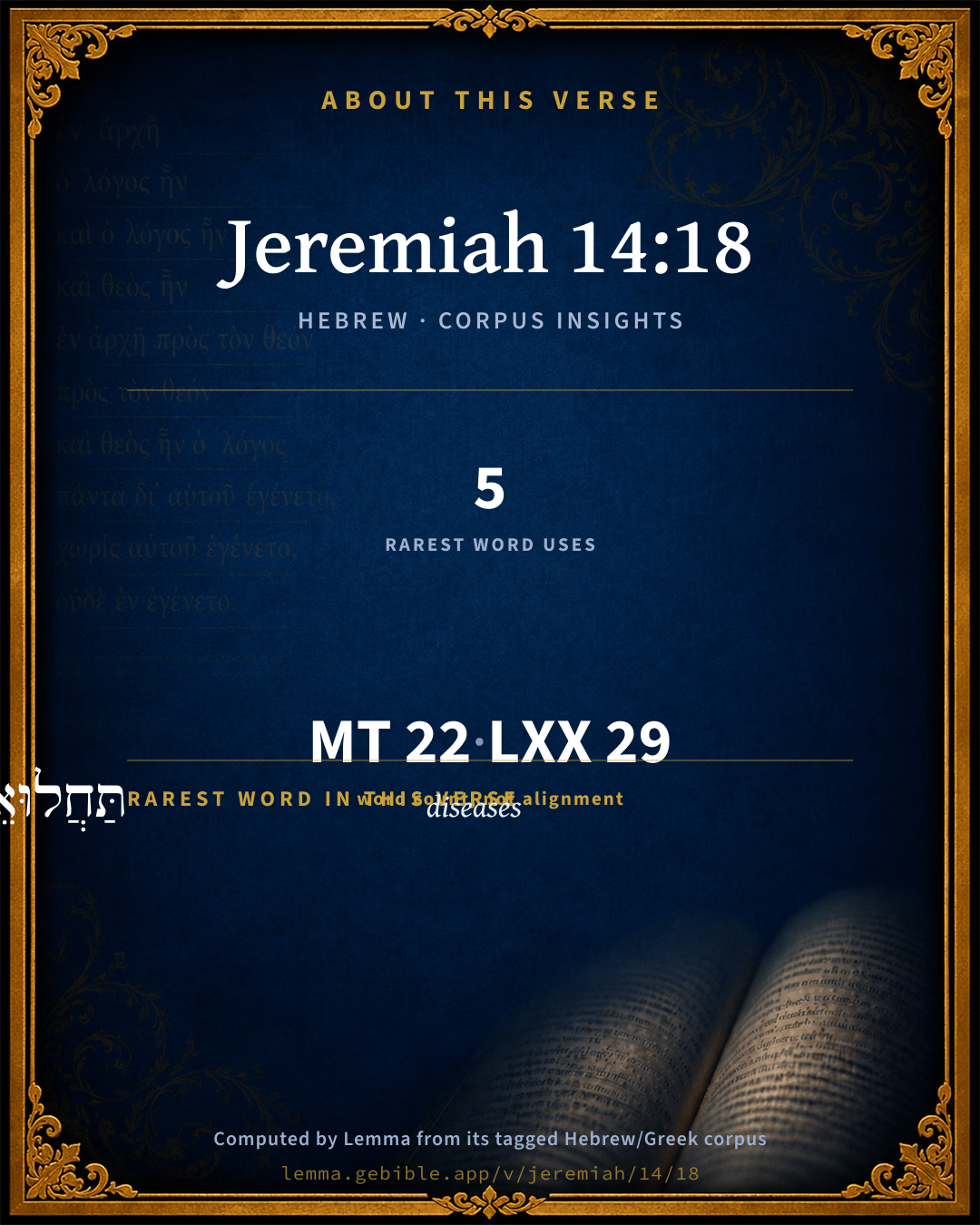
These counts appear in no published source. They are computed here, from the morphology-tagged text and Lemma’s own curated glosses. What Lemma adds →

22
words
19
distinct lemmas
Prophets
section

Notable vocabulary

The rarest word here is תַּחֲלוּאֵ֣י diseases H8463 — appearing just 5 times in the whole Hebrew Bible.

Shared distinctive vocabulary

תַּחֲלוּאֵ֣י diseases H8463 occurs in 5 verses of the Hebrew Bible. Also found in:

Grammatical profile

  • 4 verbs
  • 8 nouns
  • 1 adjective
  • 1 preposition
  • 3 conjunctions
  • 2 adverbs
  • 3 particles

Verb forms

  • יָצָ֣אתִי Qal · Perfect
  • בָּ֣אתִי Qal · Perfect
  • סָחֲר֥וּ Qal · Perfect
  • יָדָֽעוּ Qal · Perfect

Repetition

Words recur within this verse — often emphatic in Hebrew:

  • וְהִנֵּה֙ behold H2009 ×2
  • גַם also H1571 ×2
  • אִם if H518 ×2

Hebrew & Septuagint length

In the original languages it is 22 Hebrew tokens and 29 Greek tokens — but the two are counted differently (Hebrew bundles its prefixes and suffixes into one token; the Greek is in lemma form), so that isn’t a like-for-like length.

Cross-references

15

Topical passages linked to Jeremiah 14:18 in the Treasury of Scripture Knowledge — connected by theme and wording, ordered by reader-vote popularity; previews shown in the World English Bible.

  • Ezekiel 7:15 The sword is outside, and the pestilence and the famine within: he who is in the field shall die with the sword: and he who is in the city, famine and pestilence shall devour him.
  • Lamentations 1:20 See, Yahweh; for I am in distress; my heart is troubled; My heart is turned within me; for I have grievously rebelled: Abroad the sword bereaves, at home there is as death.
  • Jeremiah 8:10 Therefore will I give their wives to others, and their fields to those who shall possess them: for everyone from the least even to the greatest is given to covetousness; from the prophet even to the priest every one deals falsely.
  • Deuteronomy 28:36 Yahweh will bring you, and your king whom you shall set over you, to a nation that you have not known, you nor your fathers; and there shall you serve other gods, wood and stone.
  • Jeremiah 5:31 the prophets prophesy falsely, and the priests bear rule by their means; and my people love to have it so: and what will you do in the end of it?
  • Jeremiah 6:13 For from the least of them even to the greatest of them everyone is given to covetousness; and from the prophet even to the priest everyone deals falsely.
  • Jeremiah 52:6–7 In the fourth month, in the ninth day of the month, the famine was sore in the city, so that there was no bread for the people of the land.
  • Deuteronomy 28:64 Yahweh will scatter you among all peoples, from the one end of the earth even to the other end of the earth; and there you shall serve other gods, which you have not known, you nor your fathers, even wood and stone.
  • Isaiah 28:7 Even these reel with wine, and stagger with strong drink; the priest and the prophet reel with strong drink, they are swallowed up of wine, they stagger with strong drink; they err in vision, they stumble in judgment.
  • Jeremiah 2:8 The priests didn't say, Where is Yahweh? and those who handle the law didn't know me: the rulers also transgressed against me, and the prophets prophesied by Baal, and walked after things that do not profit.
  • Jeremiah 23:21 I sent not these prophets, yet they ran: I didn't speak to them, yet they prophesied.
  • Lamentations 4:9 Those who are killed with the sword are better than those who are killed with hunger; For these pine away, stricken through, for want of the fruits of the field.
  • Lamentations 4:13–16 [It is] because of the sins of her prophets, [and] the iniquities of her priests, That have shed the blood of the just in the midst of her.
  • Micah 3:11 Her leaders judge for bribes, And her priests teach for a price, And her prophets of it tell forturnes for money: Yet they lean on Yahweh, and say, Isn't Yahweh in the midst of us? No disaster will come on us.
  • 2 Peter 2:3 In covetousness they will exploit you with deceptive words: whose sentence now from of old doesn't linger, and their destruction will not slumber.

Cross-references courtesy of OpenBible.info (CC BY 4.0).

Hebrew and Greek witnesses Masoretic Hebrew ↔ Greek Septuagint

The same verse in the two great witnesses to the Old Testament, shown verse-for-verse.

These are two independent witnesses, not word-aligned to each other, and the Septuagint is shown in lemma (dictionary) form.

Hebrew Jeremiah 14:18 Masoretic · Westminster Leningrad Codex

אִם יָצָ֣אתִי הַשָּׂדֶ֗ה וְהִנֵּה֙ חַלְלֵי חֶ֔רֶב וְאִם֙ בָּ֣אתִי הָעִ֔יר וְהִנֵּ֖ה תַּחֲלוּאֵ֣י רָעָ֑ב כִּֽי גַם נָבִ֧יא גַם כֹּהֵ֛ן סָחֲר֥וּ אֶל אֶ֖רֶץ וְלֹ֥א יָדָֽעוּ

If I go forth into the field, then, behold, the slain with the sword! and if I enter into the city, then, behold, those who are sick with famine! for both the prophet and the priest go about in the land, and have no knowledge.

World English Bible · Public Domain

Greek LXX Structure differs

In the Septuagint, Jeremiah is about an eighth shorter than the Hebrew and arranges its material differently — the Oracles Against the Nations (Hebrew chapters 46–51) appear in the middle of the Greek book, after 25:13. Because the chapter and verse boundaries do not line up, a verse-for-verse comparison with the Hebrew is not shown.

A verse-for-verse comparison isn’t shown here because the chapters and verses don’t line up. Switch to the LXX edition with the MT / LXX toggle above to read the Greek directly.

Hebrew: Westminster Leningrad Codex (CC BY 4.0). Greek: Septuagint (public domain); English from a public-domain English Septuagint. How the Septuagint differs from the Hebrew →

Targum (Aramaic paraphrase)

1

The Targum is the ancient Jewish Aramaic paraphrase of the Hebrew Scriptures — an interpretive translation, not the Hebrew text itself. Onkelos (literal) and Pseudo-Jonathan (expansive) render the Torah, and Jonathan the Prophets. Coverage is partial: where no permissively-licensed English translation exists for a verse, only the Aramaic is shown. This is verse-level text, not a word-by-word alignment to the Hebrew.

  1. Targum Jonathan Prophets (Joshua–Malachi)
    אִם נְפָקֵית לְחַקְלָא וְהָא קְטִילֵי חַרְבָּא וְאִם עֲלֵית לְקַרְתָּא וְהָא מְמַרְעֵי כַפְנָא אֲרֵי אַף סָפַר אַף כָּהֵן אִתְפְּנִיאוּ לִסְחוֹרְתְּהוֹן עַל דִי מַה בְּאַרְעָא וְלָא בַקָרוּ:

    (no public-domain English translation for this verse)

    Targum Jonathan — Aramaic: “Mikraot Gedolot” (public domain). English: “Sefaria Community Translation” (CC0 1.0 (public-domain dedication)); “London "Chaldee Paraphrase," 1871” (public domain). Text via Sefaria.

Commentary

Notes on Jeremiah 14:18 from classic Christian and Jewish commentators (each source and its license shown beneath its notes). The classic Christian expositions comment on the surrounding passage and are grouped to its opening verse, so a note may address several verses; the Jewish commentaries on the Tanakh (Rashi and others) are per-verse, so they appear only where the commentator wrote on this verse.

Lemma curates 59 commentaries, every one of them public domain or Creative Commons licensed, each selected and text-cleaned for this edition rather than reprinted as found. About our sources →

Trapp's Complete Commentary

John Trapp

Jer 14:18 If I go forth into the field, then behold the slain with the sword! and if I enter into the city, then behold them that are sick with famine! yea, both the prophet and the priest go about into a land that they know not.

Ver. 18. If I go forth into the field.] The prophet here sets forth the siege as present, though it was many years after, the more to affect the people.

Yea, both the prophet and the priest go about into a land that they know not.] Or, Go about the land - sc., begging their bread, or fleeing their miseries - and men know them not, though men of such rank and quality.

John Trapp, A Commentary or Exposition upon All the Books of the Old and New Testament (1647–1656) — public domain. Text from a community e-Sword module.

Geneva Bible (1599)

Geneva Bible translators

Both high and low shall be led captives into Babylon.

Geneva Bible (1599) marginal notes — public domain. Text via Bolls.life.

Jamieson, Fausset & Brown

Robert Jamieson, A. R. Fausset & David Brown

go about--that is, shall have to migrate into a land of exile. HORSLEY translates, "go trafficking about the land (see Jer 5:31, Margin; Co2 4:2; Pe2 2:3), and take no knowledge" (that is, pay no regard to the miseries before their eyes) (Isa 1:3; Isa 58:3). If the sense of the Hebrew verb be retained, I would with English Version understand the words as referring to the exile to Babylon; thus, "the prophet and the priest shall have to go to a strange land to practise their religious traffic (Isa 56:11; Eze 34:2-3; Mic 3:11).

Jamieson, Fausset & Brown — Commentary Critical and Explanatory on the Whole Bible (1871) — public domain (CC PDM 1.0). Text via the HelloAO Bible API.

Adam Clarke's Commentary

Verse 18. If I go forth into the field, then behold the slain with the sword] Every place presents frightful spectacles; the wounded, the dying, the starving, and the slain; none to bury the dead, none to commiserate the dying, none to bring either relief or consolation. Even the prophets and the priests are obliged to leave the cities, and wander about in unfrequented and unknown places, seeking for the necessaries of life. Dr. Blayney thinks that the going about of the prophets and priests of the land, is to be understood thus: - "They went trafficking about with their false doctrines and lying predictions, as pedlars do with their wares, seeking their own gain." I think the other sense preferable.

Adam Clarke's Commentary on the Bible (1810–1826) — public domain. Text from a community e-Sword/MySword module.

John Calvin's Commentaries

He confirms the same thing in other words, not on account of the obscurity of what he had said, but because he knew that he was speaking to the deaf, or that such was their sloth, that they needed many goads. He says, in short, that there would be in the city no defense for the people to shield them from the punishment that was at hand, and that if they went into the fields the whole land would be covered with enemies, who would destroy them. This is the sum of the whole.

But he speaks as though he saw the event with his eyes, If I go out into the field, he says, their carcases meet me; for the enemy destroys with his drawn sword all who venture to go forth. Then he says, If I go into the city, there famine kins those whom the enemy has not reached. As he had said before, “Behold, all were east forth in the streets of Jerusalem because of the famine and the sword.” But what he had said of the streets of Jerusalem he extends now to the fields; as though he had said, that there would be no place of rest to the Jews; for if they attempted to flee away, they met with the swords of enemies, and if they sought hiding — places, the famine would meet them, so that they would perish without being destroyed by any enemy.

The prophet, he says, as well as the priest shall wander, shall go round to the land and know not Some explain the last part of the verse as though the Prophet had said, When both the prophets and the priests shall be driven into exile, after many wanderings, they shall not understand that exile is a punishment due to their sins. They therefore take the words, ולא ידעו vela idou, and they shall not know, in a general sense, as though the Prophet here condemned that brutal blindness which possessed the minds of the people, nay, even of the priests, who did not consider that God punished them for their sins. Others explain the words more simply, — that they would go round to the land, that is, that they would come to Chaldea by various windings and by long circuits, and would come to a land they knew not, that is, which was before unknown to them. But I know not whether this was the meaning of the Prophet. Certainly a third view seems more suitable to me, though it has none in its favor, that is, that the priests and prophets would go round to seek subterfuges, as they would be destitute of all means of escape, not knowing what to do; and they shall not know, that is, they shall find that a sound mind is by God taken from them, because they had demented others. Hence I doubt not but that the Prophet had especially denounced this punishment on the wicked priests and the false prophets, because they thought that they would have some way of escape; but they would be mistaken; for their own conceit would at length disappoint them; and when they thought of this and of that, God would bring to nothing their crafty ways. And they were worthy of such a punishment, because they had fascinated the wretched people with their lies; and we also know that they were proud of their own crafts and wiles. The Prophet therefore derides this false confidence and says, They shall go round through the land and shall not understand, that is, all their counsels and plans shall be, without any fruit or benefit, though they may be long in forming them. It follows —

John Calvin's Commentaries (1540-1563) — public domain. Text from the Calvin Translation Society English edition (1840s-50s) via the Christian Classics Ethereal Library (ccel.org). Calvin's coverage is partial (roughly two-thirds of the Bible); uncommented books and verses are honest gaps, never fabricated. The 19th-century editor's footnotes and remarks are omitted so the notes are faithfully Calvin's own voice.

Ellicott's Commentary for English Readers

(18) Them that are sick with famine.—Literally, with even a more awful force, as summing all individual sufferings in one collective unity, the sickness of famine—the pestilence that follows on starvation.

Go about into a land that they know not.—Literally, go about (as in Gen_34:10, where the Authorised version has “trade”) in a land and know not, i.e., whither they go—are in a land of exile, and know not where to find a home, or where they may be dragged next, or, perhaps, with some commentators. learn no wisdom from their bitter experience. There is no adequate ground for the rendering in the margin, which, besides, gives no satisfactory meaning.

A Bible Commentary for English Readers, edited by Charles John Ellicott (1878–1897) — public domain. Text from a community e-Sword module.

The Cambridge Bible for Schools and Colleges

gen. ed. J. J. S. Perowne

18. them that are sick with famine] lit. as mg. the sicknesses of famine.

go about] mg. traffick. Such is the sense of the Heb. verb elsewhere, e.g. Gen_34:10; Gen_34:21, but the corresponding consonants in Syriac are found, though rarely, with the meaning, to go as a beggar. In either case, a fall in rank is indicated. Gi. proposes to substitute one of the two Heb. letters represented by s for the other, thus obtaining the sense of sinking to the earth in mourning garb. Cp. for this thought Jer_13:18. So Co.

in the land and have no knowledge] mg. into a land that they know not. But the last four words are obscure, and, as Peake suggests, may be the commencement of a new sentence of which the remainder has been lost.

19–15:1. See introd. summary to section. Co. somewhat drastically considers that the expression “the throne of thy glory” (Jer_14:21), i.e. Jerusalem, must belong to a later date than Jeremiah’s, and that this excludes from genuineness Jer_14:19-22. He also, however, points to metrical difficulties, which Gi. (Metrik) gets over by a considerable amount of omissions. The latter part of Jer_14:19 has already occurred in Jer_8:15, but one passage (we can hardly say which) is probably quoted from the other.

The Cambridge Bible for Schools and Colleges (gen. ed. J. J. S. Perowne; Cambridge University Press, 1878–1918) — public domain. Text from a community e-Sword module.

John Gill's Exposition

If I go forth into the field,.... Without the city, where was the camp of the enemy besieging it

then behold the slain with the sword! the sword of the enemy; who by sallying out of the city upon them, or by endeavouring to make their escape into the country, fell into their hands, and were slain by them.

And if I enter into the city; the city of Jerusalem:

then behold them that are sick with the famine! just ready to die, being starved for want of provisions; and multitudes dead, and their carcasses lying in the streets unburied; the prophet does not make mention of the dead indeed, only of the sick with famine; the reason of which, Kimchi says, is because the sick were more than the dead.

Yea, both the prophet and the priest go about into a land that they knew not; into the land of Chaldea, a strange and foreign country, whither they were carried captive, both in the times of Jehoiakim and of Zedekiah, and whither they might go in ways far about: and this seems to be understood of false prophets and wicked priests, that had led the people about, and had caused them to wander from the ways of God and his worship; and therefore, in righteous retaliation, they are led in round about ways to a land unknown to them: though some think that the true prophets and priests of the Lord may be meant, as Ezekiel and Daniel, who were carried captive into Babylon: others interpret them of such going about in the land of Judea seeking for bread and water, or food in the time of the famine;

but they know not (q), as the last clause may be literally rendered, that is, men know them not, take no notice of them, show no regard to them, and give them no relief; the famine being so sore, that everyone was for himself, and could afford no help to others, even to the prophets and priests. Some render the words, "yea, the priest and the prophet make merchandise against the land"; or, "through the lands" (r); by deceiving the people with their false prophecies: or rather, go about the land making merchandise (s); of the souls of men; see Pe2 2:3, making a gain of their visions and prophecies:

and they know not; the people are not aware of their deception and falsehood. The Targum is,

"for even the scribe and the priest are turned to their own negotiations or merchandises, to that which is in the land, neither do they inquire;''

they minded their own affairs, and inquired not for, nor sought after, the people's good.

(q) "et non agnoverunt, Supple, ulli eos", De Dieu. (r) "nundinantur contra terram", Junius & Tremellius, Piscator; "mercaturam exercuerunt per terram", Cocceius. (s) "est circuire terram negotiandi causa", Grotius.

John Gill's Exposition of the Whole Bible (1746–1763) — public domain (CC PDM 1.0). Text via the HelloAO Bible API.

Haydock's Catholic Bible Commentary

Famine. Under Jechonias many were slain, and the chiefs carried into captivity, 4 Kings xxiv. 12. --- Into. Hebrew, "through the land, and are ignorant." Chaldean, "they apply to their business, to earthly concerns, and care not," chap. v. 31.

George Leo Haydock (1774–1849), Haydock's Catholic Family Bible and Commentary, 1859 edition — public domain. Excludes Psalms (Douay-Rheims chapter numbering differs from Protestant) and Deuterocanonical books (Catholic canon only).

Matthew Poole's English Annotations

The prophet is by God directed to speak still of the calamities of this people as a thing past, though yet to come, according to the usual style of prophetical writings; and to tell them, that whatsoever their false prophets told them, yet he so certainly knew the contrary, that he could even wish himself melted into tears for them, and had even already before his eyes the doleful spectacle of their miseries; some in the field slain by the enemy’s sword, others within the walls almost starved to death.

Both the prophet and the priest go about into a land that they know not: the word in the Hebrew סחרו which we translate go about, signifies so primarily, and in a second sense to merchandise, because merchants go about countries to trade. This hath made that variety of sense which the margins of our Bible have; but our translation is true enough, and the sense seems to be, that priests and prophets (though accounted sacred persons) should be made captives also, and wander in a land wherein they were foreigners. This is thought to relate to the first captivity in the time of Jehoiakim, when the people of the best fashion were carried into captivity.

Matthew Poole's English Annotations on the Holy Bible (1683–1685) — public domain. Text from a community e-Sword/MySword module.

Whedon's Commentary on the Bible

Daniel D. Whedon

18. Prophet and the priest — These stays of the people’s faith, the fountains of influence and objects of trust, will themselves go into exile.

Daniel D. Whedon (gen. ed.), Commentary on the Old and New Testaments (1874–1909) — public domain. Text from a community e-Sword module.

The Pulpit Commentary

A picture of the state of things after the capture of Jerusalem: the slain without, the famine-stricken within. The latter are described allusively as "sicknesses of famine" (so literally). As a peculiarly striking evidence of the downfall of greatness, it is added that even prophet and priest have to go about into a land that they know not. The verb used here can obviously not have its ordinary sense of going about for purposes of traffic. Aramaic usage suggests, however, a suitable meaning; what the prophet sketches before us is a company of these ex-grandees "begging their way" into an unknown land.

The Pulpit Commentary (1880–1919), ed. H.D.M. Spence-Jones & Joseph S. Exell — public domain. Text from a community e-Sword module.

Rashi

Rabbi Shlomo Yitzchaki (Rashi)

have gone around They have gone around to seek rescue.

to a land [which] they had not known To another land about which they did not know until then.

Rashi on the Tanakh — English translations: “The Judaica Press complete Tanach with Rashi, translated by A. J. Rosenberg” (CC BY 4.0); “Pentateuch with Rashi's commentary by M. Rosenbaum and A.M. Silbermann, 1929-1934” (public domain); “The Metsudah Tanach series, Lakewood, N.J” (CC BY 4.0); and “The Book of Joshua, Metsudah Publications, 1997” (CC BY 4.0). Text via Sefaria.

Lesson kit

Teaching starters — assembled from the data on this page, not authored interpretation. Every prompt links to the verse data it draws on. Edit before teaching.

Jeremiah, in the Prophets, opens this verse with 22 words (19 distinct Hebrew lemmas). Its most distinctive word is tachălûwʼ (“diseases”). A historical commentator’s framing appears above. Read the whole chapter for the surrounding context.

Discussion questions

  1. How does “diseases” (tachălûwʼ) shape what this verse is saying?
  2. How does Deuteronomy 29:22, which shares the word «diseases», read alongside this verse?
  3. What does the repetition of “behold” (2× in this one verse) do in this verse?
  4. The translations on this page render this verse differently — a whole-verse word diff, not a word-by-word alignment. What might account for the different wordings?
  5. «יָצָ֣אתִי» is a Qal Perfect verb. How does that grammatical form shape the action described?
  6. Compare how Trapp's Complete Commentary and Geneva Bible (1599) read this verse. Where do they agree or differ?

Things to notice

Reading settings

Reading text

Shown beneath each verse's original-language words.

Old Testament
Old Testament edition

Read the OT as the Masoretic Hebrew (MT) or the Greek Septuagint (LXX).

English shown for the Greek Septuagint (in the Hebrew ↔ Greek comparison).

Comparing translations? Open the Compare panel on any verse page to stack up to four side by side.