2 Chronicles 13:14

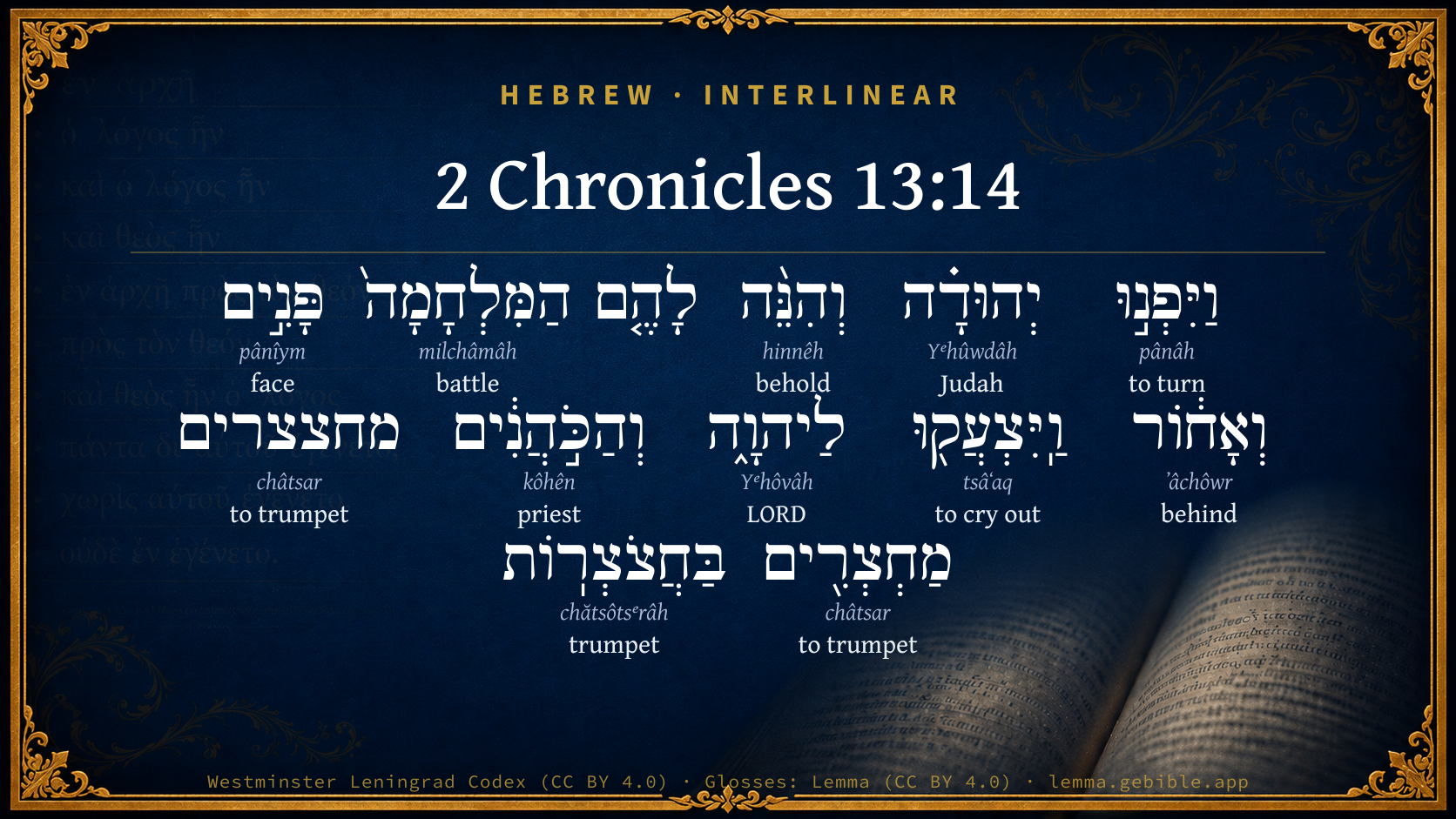
Hebrew (Westminster Leningrad Codex) 2 Chronicles 13:14 appears in the Hebrew Old Testament. The text above is from the Westminster Leningrad Codex. Each word links to its Strong’s number, a concise gloss, and parsing drawn from the Open Scriptures Hebrew Bible morphology. Click any word for its full Brown-Driver-Briggs (BDB) entry.
Download image
Cite this verse

2 Chronicles 13:14 (World English Bible). Public Domain. Lemma interlinear Bible study tool, https://lemma.gebible.app/v/2-chronicles/13/14.

Show BibTeX & RIS
BibTeX
RIS
English Translation
When Judah looked back, behold, the battle was before and behind them; and they cried to Yahweh, and the priests sounded with the trumpets.
World English Bible · Public Domain
Download a study sheet

One document with this verse’s original text, its word-by-word gloss line, the meaning frame, cross-references with their text, attributed commentary, and full source and license credits — printable, and it pastes into notes with its structure intact.

This verse Autodidact and up

Study sheet (.html) Plain text (.txt)

A passage Seminary Student

Up to 50 verses in one chapter. A passage sheet keeps up to 6 commentary sources and 12 cross-references per verse, in the order this page ranks them, and says so on the sheet whenever that leaves anything out. Ask for a single verse and you get the Autodidact verse sheet above.

Everything on this page stays free to read, with no account — the sheet is a download of what is already on screen, not access to it.

Want to remove ads? Support Godless Engineer
Compare translations 3

The same verse in 3 English versions, stacked beneath the original-language interlinear above. Click any original word for its lexicon entry.

Each is an independent rendering of the whole verse — the interlinear is not word-aligned to these translations.

Highlighted words mark where these versions differ — a whole-verse word diff, not a word-by-word alignment.

  • World English Bible Public Domain
    When Judah looked back, behold, the battle was before and behind them; and they cried to Yahweh, and the priests sounded with the trumpets.
  • King James Version Public Domain
    And when Judah looked back, behold, the battle was before and behind: and they cried unto the LORD, and the priests sounded with the trumpets.
  • unfoldingWord Literal Text CC BY-SA 4.0
    And Judah turned, and behold, to them was the battle before them and behind. And they cried out to Yahweh, and the priests were blowing trumpets.

unfoldingWord Literal Text — © unfoldingWord, licensed CC BY-SA 4.0. Word-aligned USFM3 via Door43 (git.door43.org/unfoldingWord/en_ult).

Versions to compare (up to 4)

3 of 4 selected

Show all 18 translations

Every available English version of this verse, each an independent rendering of the whole verse.

  • World English Bible Public Domain
    When Judah looked back, behold, the battle was before and behind them; and they cried to Yahweh, and the priests sounded with the trumpets.
  • Berean Standard Bible Public Domain
    When Judah turned and discovered that the battle was both before and behind them, they cried out to the LORD. Then the priests blew the trumpets,
  • Majority Standard Bible Public Domain
    When Judah turned and discovered that the battle was both before and behind them, they cried out to the LORD. Then the priests blew the trumpets,
  • King James Version Public Domain
    And when Judah looked back, behold, the battle was before and behind: and they cried unto the LORD, and the priests sounded with the trumpets.
  • American Standard Version (1901) Public Domain
    And when Judah looked back, behold, the battle was before and behind them; and they cried unto Jehovah, and the priests sounded with the trumpets.
  • Revised Version (1885) Public Domain
    And when Judah looked back, behold, the battle was before and behind them: and they cried unto the LORD, and the priests sounded with the trumpets.
  • Geneva Bible (1599) Public Domain
    Then Iudah looked, and beholde, the battel was before and behinde them, and they cried vnto the Lord, and the Priests blewe with the trumpets,
  • Douay-Rheims (1899) Public Domain
    And when Juda looked back, they saw the battle coming upon them both before and behind, and they cried to the Lord: and the priests began to sound with the trumpets.
  • Young's Literal Translation Public Domain
    And Judah turneth, and lo, against them `is' the battle, before and behind, and they cry to Jehovah, and the priests are blowing with trumpets,
  • Literal Standard Version CC BY-SA 4.0
    And Judah turns, and behold, the battle [is] against them, before and behind, and they cry to YHWH, and the priests are blowing with trumpets,
  • Unlocked Literal Bible CC BY-SA 4.0
    When Judah looked back, behold, the fighting was both in front of them and behind them. They cried out to Yahweh, and the priests blew the trumpets.
  • unfoldingWord Literal Text CC BY-SA 4.0
    And Judah turned, and behold, to them was the battle before them and behind. And they cried out to Yahweh, and the priests were blowing trumpets.
  • Darby Bible Public Domain
    And Judah looked back, and behold, they had the battle in front and behind; and they cried to Jehovah, and the priests sounded with the trumpets.
  • World Messianic Bible Public Domain
    When Judah looked back, behold, the battle was before and behind them; and they cried to the LORD, and the priests sounded with the shofars.
  • Webster's Bible Public Domain
    And when Judah looked back, behold, the battle was before and behind: and they cried to the LORD, and the priests sounded with the trumpets.
  • Free Bible Version CC BY-SA 4.0
    Judah turned around and realized that they were having to fight front and rear. They cried out to the Lord for help. Then the priests blew their trumpets,
  • Bible in Basic English Public Domain
    And Judah, turning their faces, saw that they were being attacked in front and at the back; and they gave a cry for help to the Lord, while the priests were sounding their horns.
  • JPS Tanakh (1917) Public Domain
    And when Judah looked back, behold, the battle was before and behind them; and they cried unto the LORD, and the priests sounded with the trumpets.

Literal Standard Version (2020), Covenant Press — licensed CC BY-SA 4.0. Text via the HelloAO Bible API (eBible.org). Unlocked Literal Bible (unfoldingWord) — licensed CC BY-SA 4.0. Text via the HelloAO Bible API (eBible.org). unfoldingWord Literal Text — © unfoldingWord, licensed CC BY-SA 4.0. Word-aligned USFM3 via Door43 (git.door43.org/unfoldingWord/en_ult). Free Bible Version, Dr. Jonathan Gallagher — licensed CC BY-SA 4.0. Text via the HelloAO Bible API (eBible.org).

Word by word

More ways to search: Search by grammar → Find every occurrence → Compare this word →

Practice this passage: Drill this verse → Learn its vocabulary →

מחצצרים
châtsar
H2690
“trumpeting”
Verb, Hiphil, Participle Active, Masculine, Plural, Absolute
Part of Speech
Verb
Stem
Hiphil
Form
Participle Active
Gender
Masculine
Number
Plural
State
Absolute
Full BDB Definition

Origin: a primitive root

TWOT: 726b

to sound a trumpet - (Piel) players on clarions (participle) - (Hiphil) sound with clarions (participle)
  1. וַיִּפְנ֣וּ pânâh H6437 “and · to turn” Conjunction + Verb, Qal, Sequential Imperfect, 3rd Person, Masculine, Plural
  2. יְהוּדָ֗ה Yᵉhûwdâh H3063 “Judah” Noun, Proper
  3. וְהִנֵּ֨ה hinnêh H2009 “and · behold” Conjunction + Particle, Demonstrative
  4. הַמִּלְחָמָה֙ milchâmâh H4421 “the · battle” Particle, Definite Article + Noun, Common, Feminine, Singular, Absolute
  5. פָּנִ֣ים pânîym H6440 “face(s)” Noun, Common, Both, Plural, Absolute
  6. וְאָח֔וֹר ʼâchôwr H268 “and · behind” Conjunction + Noun, Common, Masculine, Singular, Absolute
  7. וַֽיִּצְעֲק֖וּ tsâʻaq H6817 “and · to cry out” Conjunction + Verb, Qal, Sequential Imperfect, 3rd Person, Masculine, Plural
  8. לַיהוָ֑ה Yᵉhôvâh H3068 “to/for · LORD” Preposition + Noun, Proper
  9. וְהַכֹּ֣הֲנִ֔ים kôhên H3548 “and · the · priests” Conjunction + Particle, Definite Article + Noun, Common, Masculine, Plural, Absolute
  10. מַחְצְרִ֖ים châtsar H2690 “trumpeting” Verb, Hiphil, Participle Active, Masculine, Plural, Absolute
  11. בַּחֲצֹצְרֽוֹת chătsôtsᵉrâh H2689 “in/at · trumpets” Preposition + Noun, Common, Feminine, Plural, Absolute

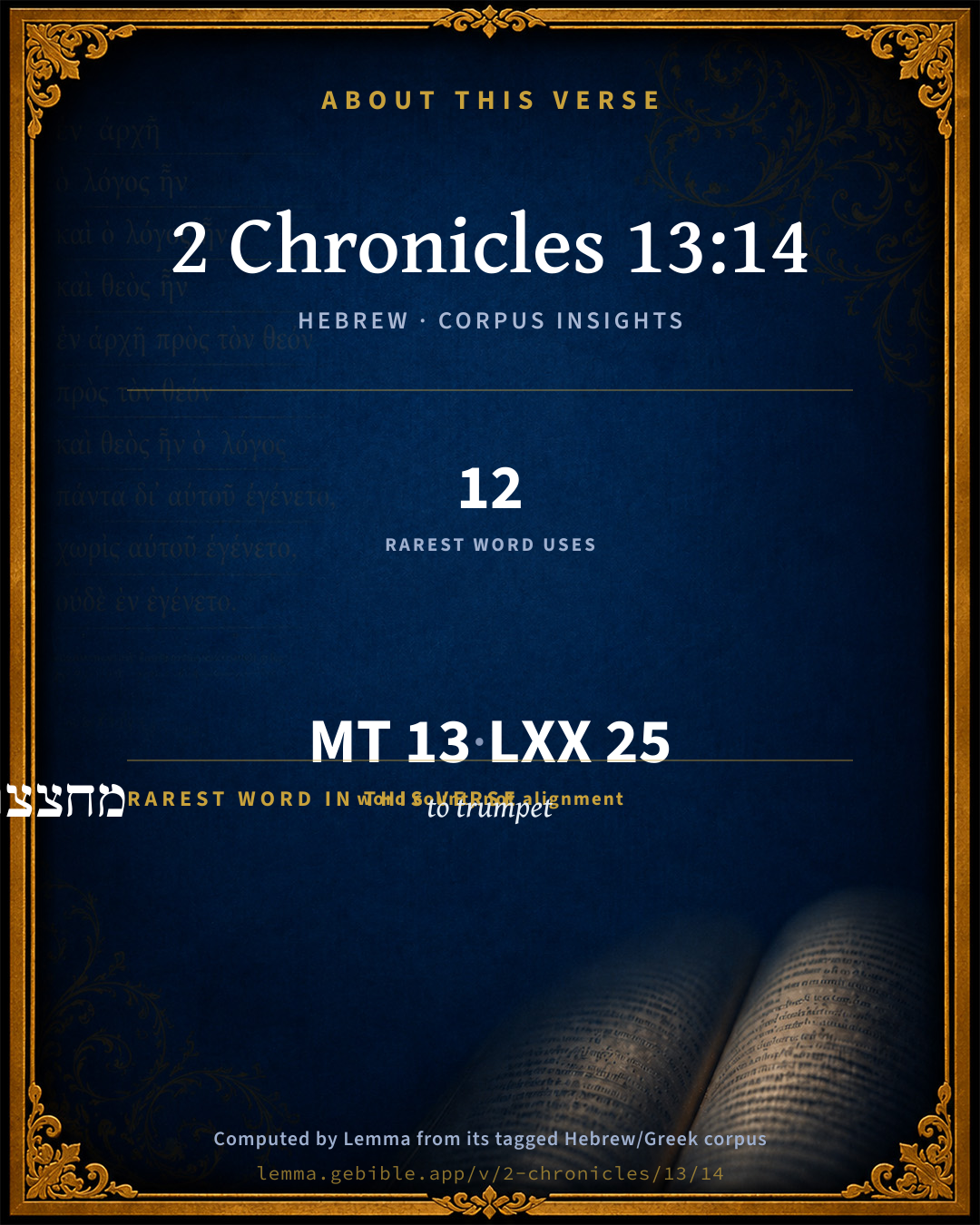
About this verse

These counts appear in no published source. They are computed here, from the morphology-tagged text and Lemma’s own curated glosses. What Lemma adds →

13
words
11
distinct lemmas
Historical
section

Notable vocabulary

The rarest word here is מחצצרים to trumpet H2690 — appearing just 12 times in the whole Hebrew Bible.

Shared distinctive vocabulary

מחצצרים to trumpet H2690 occurs in 6 verses of the Hebrew Bible. Also found in:

Grammatical profile

  • 4 verbs
  • 7 nouns
  • 1 preposition
  • 1 particle

Verb forms

  • וַיִּפְנ֣וּ Qal · Sequential Imperfect
  • וַֽיִּצְעֲק֖וּ Qal · Sequential Imperfect
  • מחצצרים Hiphil · Participle Active
  • מַחְצְרִ֖ים Hiphil · Participle Active

Repetition

A word recurs within this verse — often emphatic in Hebrew:

  • מחצצרים to trumpet H2690 ×2

Hebrew & Septuagint length

In English translation the verse runs 24 words from the Hebrew and 27 from the Septuagint (LXX English) — closely comparable.

A rough comparison of the two English renderings, which tokenize alike — not a word-level alignment.

Word counts can differ between the Hebrew and the Greek without any difference in meaning — e.g. the Hebrew direct-object marker אֵת has no separate Greek word, and Greek often adds the article ὁ.

In the original languages it is 13 Hebrew tokens and 25 Greek tokens — but the two are counted differently (Hebrew bundles its prefixes and suffixes into one token; the Greek is in lemma form), so that isn’t a like-for-like length.

Cross-references

8

Topical passages linked to 2 Chronicles 13:14 in the Treasury of Scripture Knowledge — connected by theme and wording, ordered by reader-vote popularity; previews shown in the World English Bible.

  • 2 Chronicles 14:11 Asa cried to Yahweh his God, and said, Yahweh, there is none besides you to help, between the mighty and him who has no strength: help us, Yahweh our God; for we rely on you, and in your name are we come against this multitude. Yahweh, you are our God; don't let man prevail against you.
  • Exodus 14:10 When Pharaoh drew near, the children of Israel lifted up their eyes, and behold, the Egyptians were marching after them; and they were very afraid. The children of Israel cried out to Yahweh.
  • Joshua 8:20 When the men of Ai looked behind them, they saw, and, behold, the smoke of the city ascended up to heaven, and they had no power to flee this way or that way: and the people who fled to the wilderness turned back on the pursuers.
  • Judges 20:33–43 All the men of Israel rose up out of their place, and set themselves in array at Baal Tamar: and the liers-in-wait of Israel broke forth out of their place, even out of Maareh Geba.
  • 2 Samuel 10:8–14 The children of Ammon came out, and put the battle in array at the entrance of the gate: and the Syrians of Zobah and of Rehob, and the men of Tob and Maacah, were by themselves in the field.
  • Psalms 50:15 Call on me in the day of trouble. I will deliver you, and you will honor me."
  • Psalms 91:5 You shall not be afraid of the terror by night, Nor of the arrow that flies by day;
  • 2 Chronicles 18:31 It happened, when the captains of the chariots saw Jehoshaphat, that they said, It is the king of Israel. Therefore they turned about to fight against him: but Jehoshaphat cried out, and Yahweh helped him; and God moved them [to depart] from him.

Cross-references courtesy of OpenBible.info (CC BY 4.0).

Hebrew and Greek witnesses Masoretic Hebrew ↔ Greek Septuagint

The same verse in the two great witnesses to the Old Testament, shown verse-for-verse.

These are two independent witnesses, not word-aligned to each other, and the Septuagint is shown in lemma (dictionary) form.

Hebrew 2 Chronicles 13:14 Masoretic · Westminster Leningrad Codex

וַיִּפְנ֣וּ יְהוּדָ֗ה וְהִנֵּ֨ה לָהֶ֤ם הַמִּלְחָמָה֙ פָּנִ֣ים וְאָח֔וֹר וַֽיִּצְעֲק֖וּ לַיהוָ֑ה וְהַכֹּ֣הֲנִ֔ים מחצצרים מַחְצְרִ֖ים בַּחֲצֹצְרֽוֹת

When Judah looked back, behold, the battle was before and behind them; and they cried to Yahweh, and the priests sounded with the trumpets.

World English Bible · Public Domain

Greek LXX 2 Chronicles 13:14 Septuagint · lemma form

καί ἀποστρέφω ἰούδας καί ἰδού αὐτός ὁ πόλεμος ἐκ ὁ ἔμπροσθεν καί ἐκ ὁ ὄπισθε καί βοάω πρός κύριος καί ὁ ἱερεύς σαλπίζω ὁ σάλπιγξ

And Juda looked back, and, behold, the battle was against them before and behind: and they cried to the Lord, and the priests sounded with the trumpets.

LXX2012 (modern English Septuagint) · Public Domain

Hebrew: Westminster Leningrad Codex (CC BY 4.0). Greek: Septuagint (public domain); English from LXX2012 (modern English Septuagint) (Public Domain). How the Septuagint differs from the Hebrew →

Commentary

Notes on 2 Chronicles 13:14 from classic Christian and Jewish commentators (each source and its license shown beneath its notes). The classic Christian expositions comment on the surrounding passage and are grouped to its opening verse, so a note may address several verses; the Jewish commentaries on the Tanakh (Rashi and others) are per-verse, so they appear only where the commentator wrote on this verse.

Lemma curates 59 commentaries, every one of them public domain or Creative Commons licensed, each selected and text-cleaned for this edition rather than reprinted as found. About our sources →

Trapp's Complete Commentary

John Trapp

2Ch 13:14 And when Judah looked back, behold, the battle [was] before and behind: and they cried unto the LORD, and the priests sounded with the trumpets.

Ver. 14. And when Judah looked back.] For till then, they suspected not any such treachery.

And they cried unto the Lord.] Inter arma silent leges: preces non sileant. Prayers are the soldier’s surest great ordnance.

John Trapp, A Commentary or Exposition upon All the Books of the Old and New Testament (1647–1656) — public domain. Text from a community e-Sword module.

Joseph Benson's Commentary

2Ch 13:14. Behold, the battle was before and behind — Thus Judah was unexpectedly brought into a great strait, and put into great fear. A good cause, and one which is designed to be victorious, may be involved in difficulty and distress. And they cried unto the Lord — For when danger was on every side, which way should they look but upward for deliverance? It is an unspeakable comfort, that no enemy, not the most powerful or politic, and no stratagem or ambushment, can cut off our communication with heaven. Our way thitherward is always open. We may hope they cried unto the Lord before they engaged in this war; but the distress they were in made them renew their prayers, and quickened them to be more importunate. God brings his people into straits, that he may teach them to cry unto him.

Joseph Benson's Commentary on the Old and New Testaments (1811–1818) — public domain. Text from a community e-Sword module.

Ellicott's Commentary for English Readers

(14) And when Judah looked back, behold the battle was before and behind.—Comp. the account of the ambuscade by which Ai was taken (Joshua , 8); and Gibeah (Judges 20),

Judah looked back.—Not prepared (Bertheau) (See Jos_8:20).

Sounded.—Were sounding. Literally, trumpeting.

A Bible Commentary for English Readers, edited by Charles John Ellicott (1878–1897) — public domain. Text from a community e-Sword module.

John Gill's Exposition

Then the men of Judah gave a shout,.... Taking heart at the sound of the trumpets, and in order to encourage one another, and intimidate the enemy; See Gill on Sa1 17:20,

and as the men of Judah shouted, it came to pass, that God smote Jeroboam and all Israel before Abijah and Judah; possessed them with a panic, so that they fled at once, as follows.

John Gill's Exposition of the Whole Bible (1746–1763) — public domain (CC PDM 1.0). Text via the HelloAO Bible API.

Haydock's Catholic Bible Commentary

Trumpets, to invoke God’s aid, Numbers x. 9. (Menochius)

George Leo Haydock (1774–1849), Haydock's Catholic Family Bible and Commentary, 1859 edition — public domain. Excludes Psalms (Douay-Rheims chapter numbering differs from Protestant) and Deuterocanonical books (Catholic canon only).

Lesson kit

Teaching starters — assembled from the data on this page, not authored interpretation. Every prompt links to the verse data it draws on. Edit before teaching.

2 Chronicles, in the Historical, opens this verse with 13 words (11 distinct Hebrew lemmas). Its most distinctive word is châtsar (“to trumpet”). A historical commentator’s framing appears above. Read the whole chapter for the surrounding context.

Discussion questions

  1. How does “to trumpet” (châtsar) shape what this verse is saying?
  2. How does 1 Chronicles 15:24, which shares the word «to trumpet», read alongside this verse?
  3. What does the repetition of “to trumpet” (2× in this one verse) do in this verse?
  4. The translations on this page render this verse differently — a whole-verse word diff, not a word-by-word alignment. What might account for the different wordings?
  5. «וַיִּפְנ֣וּ» is a Qal Sequential Imperfect verb. How does that grammatical form shape the action described?
  6. Compare how Trapp's Complete Commentary and Joseph Benson's Commentary read this verse. Where do they agree or differ?

Things to notice

Reading settings

Reading text

Shown beneath each verse's original-language words.

Old Testament
Old Testament edition

Read the OT as the Masoretic Hebrew (MT) or the Greek Septuagint (LXX).

English shown for the Greek Septuagint (in the Hebrew ↔ Greek comparison).

Comparing translations? Open the Compare panel on any verse page to stack up to four side by side.