
Numbers 26:64

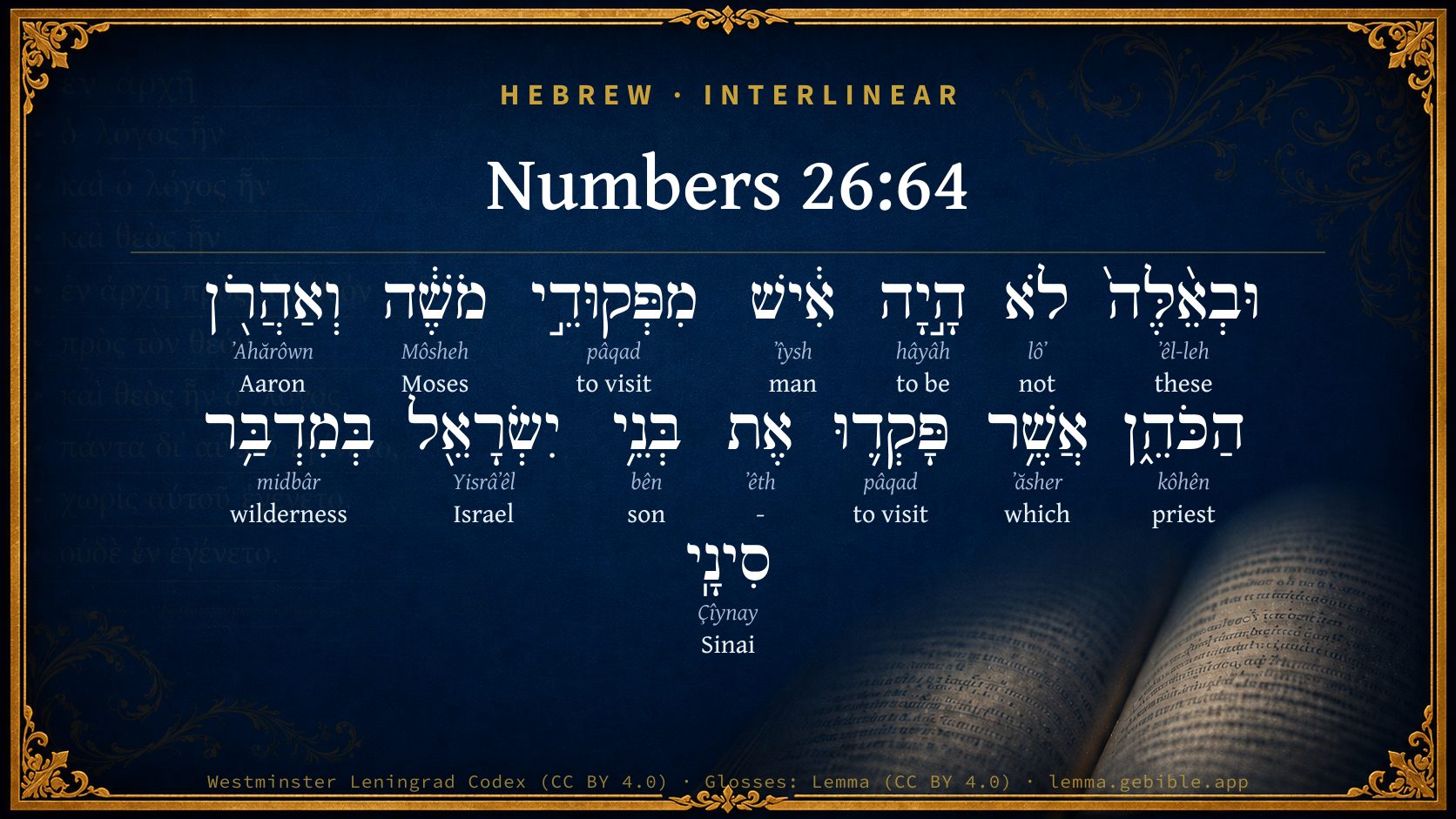
Hebrew (Westminster Leningrad Codex) Numbers 26:64 appears in the Hebrew Old Testament. The text above is from the Westminster Leningrad Codex. Each word links to its Strong’s number, a concise gloss, and parsing drawn from the Open Scriptures Hebrew Bible morphology. Click any word for its full Brown-Driver-Briggs (BDB) entry.
Download image
Cite this verse

Numbers 26:64 (World English Bible). Public Domain. Lemma interlinear Bible study tool, https://lemma.gebible.app/v/numbers/26/64.

Show BibTeX & RIS
BibTeX
RIS
English Translation
But among these there was not a man of them who were numbered by Moses and Aaron the priest, who numbered the children of Israel in the wilderness of Sinai.
World English Bible · Public Domain
Download a study sheet

One document with this verse’s original text, its word-by-word gloss line, the meaning frame, cross-references with their text, attributed commentary, and full source and license credits — printable, and it pastes into notes with its structure intact.

This verse Autodidact and up

Study sheet (.html) Plain text (.txt)

A passage Seminary Student

Up to 50 verses in one chapter. A passage sheet keeps up to 6 commentary sources and 12 cross-references per verse, in the order this page ranks them, and says so on the sheet whenever that leaves anything out. Ask for a single verse and you get the Autodidact verse sheet above.

Everything on this page stays free to read, with no account — the sheet is a download of what is already on screen, not access to it.

Want to remove ads? Support Godless Engineer
Compare translations 3

The same verse in 3 English versions, stacked beneath the original-language interlinear above. Click any original word for its lexicon entry.

Each is an independent rendering of the whole verse — the interlinear is not word-aligned to these translations.

Highlighted words mark where these versions differ — a whole-verse word diff, not a word-by-word alignment.

  • World English Bible Public Domain
    But among these there was not a man of them who were numbered by Moses and Aaron the priest, who numbered the children of Israel in the wilderness of Sinai.
  • King James Version Public Domain
    But among these there was not a man of them whom Moses and Aaron the priest numbered, when they numbered the children of Israel in the wilderness of Sinai.
  • unfoldingWord Literal Text CC BY-SA 4.0
    And among these there was not a man from the counted ones of Moses and Aaron the priest when they counted the sons of Israel in the wilderness of Sinai.

unfoldingWord Literal Text — © unfoldingWord, licensed CC BY-SA 4.0. Word-aligned USFM3 via Door43 (git.door43.org/unfoldingWord/en_ult).

Versions to compare (up to 4)

3 of 4 selected

Show all 18 translations

Every available English version of this verse, each an independent rendering of the whole verse.

  • World English Bible Public Domain
    But among these there was not a man of them who were numbered by Moses and Aaron the priest, who numbered the children of Israel in the wilderness of Sinai.
  • Berean Standard Bible Public Domain
    Among all these, however, there was not one who had been numbered by Moses and Aaron the priest when they counted the Israelites in the Wilderness of Sinai.
  • Majority Standard Bible Public Domain
    Among all these, however, there was not one who had been numbered by Moses and Aaron the priest when they counted the Israelites in the Wilderness of Sinai.
  • King James Version Public Domain
    But among these there was not a man of them whom Moses and Aaron the priest numbered, when they numbered the children of Israel in the wilderness of Sinai.
  • American Standard Version (1901) Public Domain
    But among these there was not a man of them that were numbered by Moses and Aaron the priest, who numbered the children of Israel in the wilderness of Sinai.
  • Revised Version (1885) Public Domain
    But among these there was not a man of them that were numbered by Moses and Aaron the priest; who numbered the children of Israel in the wilderness of Sinai.
  • Geneva Bible (1599) Public Domain
    And among these there was not a man of them, whome Moses and Aaron the Priest nobred, when they tolde the children of Israel in the wildernes of Sinai.
  • Douay-Rheims (1899) Public Domain
    Among whom there was not one of them that were numbered before by Moses and Aaron in the desert of Sinai.
  • Young's Literal Translation Public Domain
    and among these there hath not been a man of those numbered by Moses, and Aaron the priest, who numbered the sons of Israel in the wilderness of Sinai,
  • Literal Standard Version CC BY-SA 4.0
    and among these there has not been a man of those numbered by Moses and Aaron the priest, who numbered the sons of Israel in the wilderness of Sinai,
  • Unlocked Literal Bible CC BY-SA 4.0
    But among these there was no man who had been counted by Moses and Aaron the priest when the descendants of Israel were counted in the wilderness of Sinai.
  • unfoldingWord Literal Text CC BY-SA 4.0
    And among these there was not a man from the counted ones of Moses and Aaron the priest when they counted the sons of Israel in the wilderness of Sinai.
  • Darby Bible Public Domain
    But among these there was not a man numbered by Moses and Aaron the priest, who numbered the children of Israel in the wilderness of Sinai.
  • World Messianic Bible Public Domain
    But among these there was not a man of them who were counted by Moses and Aaron the priest, who counted the children of Israel in the wilderness of Sinai.
  • Webster's Bible Public Domain
    But among these there was not a man of them whom Moses and Aaron the priest numbered, when they numbered the children of Israel in the wilderness of Sinai.
  • Free Bible Version CC BY-SA 4.0
    However, they did not include a single one who had previously been censused by Moses and Aaron the priest when they counted the Israelites in the Sinai Desert,
  • Bible in Basic English Public Domain
    But among all these was not one of those numbered by Moses and Aaron the priest when the children of Israel were numbered in the waste land of Sinai.
  • JPS Tanakh (1917) Public Domain
    But among these there was not a man of them that were numbered by Moses and Aaron the priest, who numbered the children of Israel in the wilderness of Sinai.

Literal Standard Version (2020), Covenant Press — licensed CC BY-SA 4.0. Text via the HelloAO Bible API (eBible.org). Unlocked Literal Bible (unfoldingWord) — licensed CC BY-SA 4.0. Text via the HelloAO Bible API (eBible.org). unfoldingWord Literal Text — © unfoldingWord, licensed CC BY-SA 4.0. Word-aligned USFM3 via Door43 (git.door43.org/unfoldingWord/en_ult). Free Bible Version, Dr. Jonathan Gallagher — licensed CC BY-SA 4.0. Text via the HelloAO Bible API (eBible.org).

Word by word

More ways to search: Search by grammar → Find every occurrence → Compare this word →

Practice this passage: Drill this verse → Learn its vocabulary →

סִינָֽי
Çîynay
H5514
“Sinai”
Noun, Proper
Part of Speech
Noun
Type
Proper
Full BDB Definition

Origin: of uncertain derivation

TWOT: 1488

Sinai = "thorny" - the mountain where Moses received the Law from Jehovah; located at the southern end of the Sinai peninsula between the horns of the Red Sea; exact site unknown
  1. וּבְאֵ֨לֶּה֙ ʼêl-leh H428 “and · in/at · these” Conjunction + Preposition + Pronoun, Demonstrative, Common, Plural
  2. לֹא lôʼ H3808 “not” Particle, Negative
  3. הָ֣יָה hâyâh H1961 “to be” Verb, Qal, Perfect, 3rd Person, Masculine, Singular
  4. אִ֔ישׁ ʼîysh H376 “man” Noun, Common, Masculine, Singular, Absolute
  5. מִפְּקוּדֵ֣י pâqad H6485 “from · visited” Preposition + Verb, Qal, Participle Passive, Masculine, Plural, Construct
  6. מֹשֶׁ֔ה Môsheh H4872 “Moses” Noun, Proper
  7. וְאַהֲרֹ֖ן ʼAhărôwn H175 “and · Aaron” Conjunction + Noun, Proper
  8. הַכֹּהֵ֑ן kôhên H3548 “the · priest” Particle, Definite Article + Noun, Common, Masculine, Singular, Absolute
  9. אֲשֶׁ֥ר ʼăsher H834 “which” Particle, Relative
  10. פָּקְד֛וּ pâqad H6485 “to visit” Verb, Qal, Perfect, 3rd Person, Common, Plural
  11. אֶת ʼêth H853 “-” Particle, Direct Object
  12. בְּנֵ֥י bên H1121 “sons of” Noun, Common, Masculine, Plural, Construct
  13. יִשְׂרָאֵ֖ל Yisrâʼêl H3478 “Israel” Noun, Proper
  14. בְּמִדְבַּ֥ר midbâr H4057 “in/at · wilderness of” Preposition + Noun, Common, Masculine, Singular, Construct

About this verse

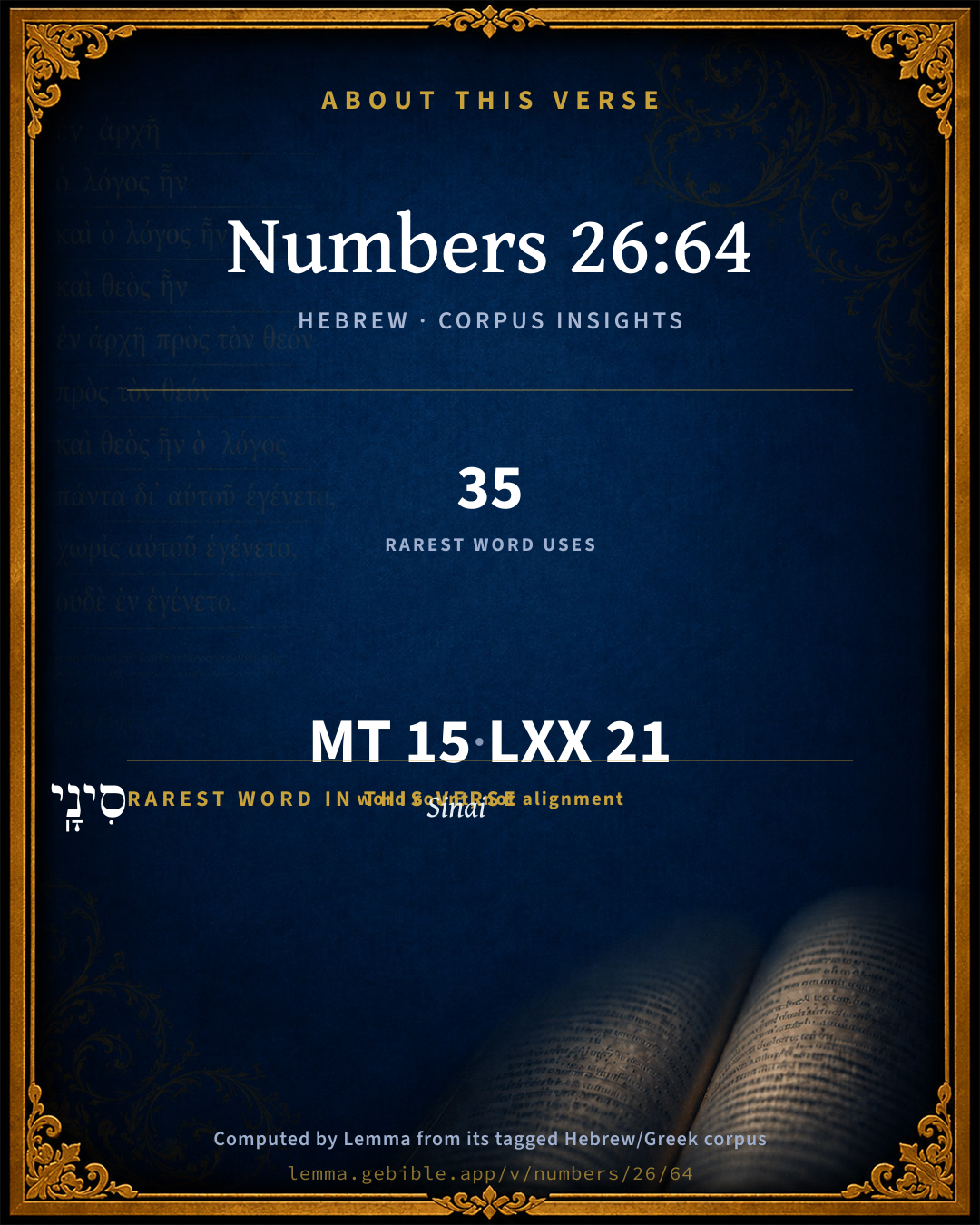
These counts appear in no published source. They are computed here, from the morphology-tagged text and Lemma’s own curated glosses. What Lemma adds →

15
words
14
distinct lemmas
Pentateuch
section

Shared distinctive vocabulary

סִינָֽי Sinai H5514 occurs in 34 verses of the Hebrew Bible. Also found in:

Grammatical profile

  • 3 verbs
  • 8 nouns
  • 1 pronoun
  • 3 particles

Verb forms

  • הָ֣יָה Qal · Perfect
  • מִפְּקוּדֵ֣י Qal · Participle Passive
  • פָּקְד֛וּ Qal · Perfect

Repetition

A word recurs within this verse — often emphatic in Hebrew:

  • מִפְּקוּדֵ֣י to visit H6485 ×2

Hebrew & Septuagint length

In English translation the verse runs 30 words from the Hebrew and 26 from the Septuagint (LXX English) — closely comparable.

A rough comparison of the two English renderings, which tokenize alike — not a word-level alignment.

Word counts can differ between the Hebrew and the Greek without any difference in meaning — e.g. the Hebrew direct-object marker אֵת has no separate Greek word, and Greek often adds the article ὁ.

In the original languages it is 15 Hebrew tokens and 21 Greek tokens — but the two are counted differently (Hebrew bundles its prefixes and suffixes into one token; the Greek is in lemma form), so that isn’t a like-for-like length.

Cross-references

6

Topical passages linked to Numbers 26:64 in the Treasury of Scripture Knowledge — connected by theme and wording, ordered by reader-vote popularity; previews shown in the World English Bible.

  • Deuteronomy 2:14–15 The days in which we came from Kadesh-barnea, until we were come over the brook Zered, were thirty-eight years; until all the generation of the men of war were consumed from the midst of the camp, as Yahweh swore to them.
  • Numbers 1:1–2 Yahweh spoke to Moses in the wilderness of Sinai, in the Tent of Meeting, on the first day of the second month, in the second year after they had come out of the land of Egypt, saying,
  • Numbers 14:29 your dead bodies shall fall in this wilderness; and all who were numbered of you, according to your whole number, from twenty years old and upward, who have murmured against me,
  • Deuteronomy 4:3–4 Your eyes have seen what Yahweh did because of Baal Peor; for all the men who followed Baal Peor, Yahweh your God has destroyed them from the midst of you.
  • 1 Corinthians 10:5 However with most of them, God was not well pleased, for they were overthrown in the wilderness.
  • Hebrews 3:17 With whom was he displeased forty years? Wasn't it with those who sinned, whose bodies fell in the wilderness?

Cross-references courtesy of OpenBible.info (CC BY 4.0).

Hebrew and Greek witnesses Masoretic Hebrew ↔ Greek Septuagint

The same verse in the two great witnesses to the Old Testament, shown verse-for-verse.

These are two independent witnesses, not word-aligned to each other, and the Septuagint is shown in lemma (dictionary) form.

Hebrew Numbers 26:64 Masoretic · Westminster Leningrad Codex

וּבְאֵ֨לֶּה֙ לֹא הָ֣יָה אִ֔ישׁ מִפְּקוּדֵ֣י מֹשֶׁ֔ה וְאַהֲרֹ֖ן הַכֹּהֵ֑ן אֲשֶׁ֥ר פָּקְד֛וּ אֶת בְּנֵ֥י יִשְׂרָאֵ֖ל בְּמִדְבַּ֥ר סִינָֽי

But among these there was not a man of them who were numbered by Moses and Aaron the priest, who numbered the children of Israel in the wilderness of Sinai.

World English Bible · Public Domain

Greek LXX Numbers 26:64 Septuagint · lemma form

καί ἐν οὗτος οὐ εἰμί ἄνθρωπος ὁ ἐπισκέπτω ὑπό μωυσῆς καί ἀαρών ὅς ἐπισκέπτω ὁ υἱός ἰσραήλ ἐν ὁ ἔρημος σινα

And among these there was not a man numbered by Moses and Aaron, whom, even the children of Israel, they numbered in the wilderness of Sinai.

LXX2012 (modern English Septuagint) · Public Domain

Hebrew: Westminster Leningrad Codex (CC BY 4.0). Greek: Septuagint (public domain); English from LXX2012 (modern English Septuagint) (Public Domain). How the Septuagint differs from the Hebrew →

Targum (Aramaic paraphrase)

2

The Targum is the ancient Jewish Aramaic paraphrase of the Hebrew Scriptures — an interpretive translation, not the Hebrew text itself. Onkelos (literal) and Pseudo-Jonathan (expansive) render the Torah, and Jonathan the Prophets. Coverage is partial: where no permissively-licensed English translation exists for a verse, only the Aramaic is shown. This is verse-level text, not a word-by-word alignment to the Hebrew.

  1. Targum Onkelos Torah (Genesis–Deuteronomy)
    וּבְאִלֵין לָא הֲוָה גְבַר מִמִנְיָנֵי משֶׁה וְאַהֲרֹן כַּהֲנָא דִי מְנוֹ יָת בְּנֵי יִשְׂרָאֵל בְּמַדְבְּרָא דְסִינָי

    (no public-domain English translation for this verse)

    Targum Onkelos — Aramaic: “Onkelos Genesis” (public domain); “Onkelos Exodus” (public domain); “Onkelos Leviticus” (public domain); “Onkelos Numbers” (public domain); “Onkelos Deuteronomy” (public domain). English: “Sefaria Community Translation” (CC0 1.0 (public-domain dedication)); “J.W. Etheridge. The Targums of Onkelos and Jonathan Ben Uzziel on the Pentateuch. London: Longmans, Green, 1862” (public domain). Text via Sefaria.

  2. Targum Pseudo-Jonathan Torah (Genesis–Deuteronomy)
    וּבָאִלֵין לָא הֲוָה גְבַר מִן סְכוּמֵי משֶׁה וְאַהֲרן כַּהֲנָא דִי סְכָמוּן יַת בְּנֵי יִשְרָאֵל בְּמַדְבְּרָא דְסִינָי

    And among them was not a man of the numbers when Mosheh and Aharon the priest took the sum of the children of Israel in the wilderness of Sinai,

    Targum Pseudo-Jonathan — Aramaic: “Targum Jonathan on Genesis” (public domain); “Targum Jonathan on Exodus” (public domain); “Targum Jonathan on Leviticus” (public domain); “Targum Jonathan on Numbers” (public domain); “Targum Jonathan on Deuteronomy” (public domain). English: “The Targum of Jonathan ben Uzziel, trans. J. W. Etheridge, London, 1862” (public domain). Text via Sefaria.

Commentary

Notes on Numbers 26:64 from classic Christian and Jewish commentators (each source and its license shown beneath its notes). The classic Christian expositions comment on the surrounding passage and are grouped to its opening verse, so a note may address several verses; the Jewish commentaries on the Tanakh (Rashi and others) are per-verse, so they appear only where the commentator wrote on this verse.

Lemma curates 59 commentaries, every one of them public domain or Creative Commons licensed, each selected and text-cleaned for this edition rather than reprinted as found. About our sources →

Geneva Bible (1599)

Geneva Bible translators

Wherein appeareth the great power of God, that so wonderfully increased his people.

Geneva Bible (1599) marginal notes — public domain. Text via Bolls.life.

Jamieson, Fausset & Brown

Robert Jamieson, A. R. Fausset & David Brown

among these there was not a man . . . numbered . . . in the wilderness of Sinai--The statement in this verse must not be considered absolute. For, besides Caleb and Joshua, there were alive at this time Eleazar and Ithamar, and in all probability a considerable number of Levites, who had no participation in the popular defections in the wilderness. The tribe of Levi, having neither sent a spy into Canaan, nor being included in the enumeration at Sinai, must be regarded as not coming within the range of the fatal sentence; and therefore it would exhibit a spectacle not to be witnessed in the other tribes of many in their ranks above sixty years of age.

Tribes Chap. 1 Chap. 26 Increase Decrease

Reuben 46,500 43,730 -- 2,770

Simeon 59,300 22,200 -- 37,100

Gad 45,650 40,500 -- 5,150

Judah 74,600 76,500 1,900 --

Issachar 54,400 64,300 9,900 --

Zebulun 57,400 60,500 3,100 --

Ephraim 40,500 32,500 -- 8,000

Manasseh 32,200 52,700 20,500 --

Benjamin 35,400 45,600 10,200 --

Dan 62,700 64,400 1,700 --

Asher 41,500 53,400 11,900 --

Naphtali 53,400 45,400 -- 8,000

Total 603,550 601,730 59,200 61,020

Total decrease 1,820

Next: Numbers Chapter 27

Jamieson, Fausset & Brown — Commentary Critical and Explanatory on the Whole Bible (1871) — public domain (CC PDM 1.0). Text via the HelloAO Bible API.

Ellicott's Commentary for English Readers

(64) But among these . . . —Thus the prediction contained in Num_14:29-32 was fulfilled. The fact that the fulfilment of this prediction is stated after Num_26:62, which contains the result of the census as regards the Levites, viewed in connection with the statement contained in Num_26:65, might seem to favour the inference that the sentence of exclusion was applicable to the tribe of Levi as well as to the other tribes. On the other hand, the second clause of Num_26:62 may be alleged in support of the opposite view. (See Num_14:29, and Note.)

When they numbered . . . —Or, who numbered, as in Num_26:63.

A Bible Commentary for English Readers, edited by Charles John Ellicott (1878–1897) — public domain. Text from a community e-Sword module.

Albert Barnes' Notes on the Bible

It appears from Deu 2:14-15 that the generation numbered at the former census had perished before the host crossed the brook Zered.

Albert Barnes' Notes on the Bible (1834–1885) — public domain. Text from a community e-Sword/MySword module.

Haydock's Catholic Bible Commentary

Sinai, if we except the Levites. (Menochius) See chap. xiv. 23. --- Origen (hom. 21.) makes a very good remark on this subject. This circumcised, but rebellious people, conducted by Moses into the desert, clearly points out the Hebrews, who come to the frontiers of the promised land, but are not suffered to cross the Jordan. The uncircumcised are introduced into the land flowing with milk and honey, not by Moses, but by Josue, the figure of our Saviour, who opens heaven to true believers. "The first people is rejected, which had received circumcision, and the second is introduced, which is gathered from the Gentiles; and it is the people which obtains its father’s inheritance....If Moses give any inheritance, it is not within the Jordan....it is a land fit for cattle....he does not distribute it by lot....nor can he know the merits of each. This is done by Jesus only, to whom his Father has given all judgment." (Haydock)

George Leo Haydock (1774–1849), Haydock's Catholic Family Bible and Commentary, 1859 edition — public domain. Excludes Psalms (Douay-Rheims chapter numbering differs from Protestant) and Deuterocanonical books (Catholic canon only).

The Pulpit Commentary

Vers. 64, 65. A generation gone.

Certain things strike us in examining this second census and comparing it with the former one at Sinai: e.g., the difference as to numbers; the fluctuations of the tribes, some increasing, others decreasing; in particular, the extraordinary decrease in Simeon arrests attention. But all these are passed over as not needing notice. There is one thing, however, to which attention is specially called, and indeed it must have been kept in view all the census through, namely, that not one of those numbered in the previous census was now alive. Those counted now had not been counted before.

I ATTENTION IS CALLED TO A FULFILLED PREDICTION. It deserves special attention as a very remarkable, exact, and early fulfillment of prediction. Most of God"s predictions for Israel worked on to their fulfillment slowly and imperceptibly through many generations; some in the highest sense of them are still incomplete; but here was a prediction concerning the present, moving to its fulfillment under the very eyes of many whom in their turn it would also include. Surely it must often have been talked of in the tents of Israel. And here was another purpose that the census served to show clearly and impressively that the prediction had been fulfilled. The fulfillment had its dark side and its bright one. It was an impressive proof that what penalties God attaches to sin he can accomplish to their full extent. All had perished save Caleb and Joshua. Things had happened exactly as God said they would, the people themselves being witnesses. "If any one numbered in the previous census is still alive, save Caleb and Joshua, let him step forward," Moses and Eleazar might have said. But they were all silent in the mystery of a peculiar death. Rightly looked at, it was very comforting and inspiring for Israel to go into Canaan with such a wonderful proof of God"s power in their minds. He who had so manifestly fulfilled such a peculiar prediction might be confidently expected to keep his word in all others.

II THE COMPLETENESS OF THE DIVINE CONTROL OVER THE TERM OF HUMAN LIFE. What God did in the particular instance of this generation he can do in any and every generation, with any and every one of the children of men. We talk very grandly sometimes of the value of a sound constitution, the prudence of attending to the laws of health, and taking such means as may preserve life to a ripe old age. But while these considerations are indeed not to be neglected, God"s will also must be taken, into account, as at least a possible regulating force in the term of every human life. He may have some weighty reason of his own for shortening or lengthening, which will nullify alike the prudence of some and the recklessness of others. It is not competent for us to say that he does actually interfere in every instance, as he so plainly did with the men of this doomed generation; it is enough for us to feel that he has power to do it. We have here but one out of many evidences to be found in the Scriptures that God has death completely under restraint. He can keep us back from its grasp as long as may seem good to him. He can also allow us to fall into its grasp, if thereby his own purposes will be better served. They are much more important than the devices and desires which arise out of our selfish, ignorant, and unexperienced hearts.

III THE SPECIAL INTERVENTION IN THIS INSTANCE SUGGESTS THAT, AS A GENERAL RULE, NATURE IS LEFT TO ITS OWN COURSE. Every one entering this world is left to the play of what, for want of a better term, may be called the forces of nature. So much of natural vitality and energy, so much power of assimilation and growth, so much, sometimes good and sometimes bad, by Way of inheritance from parents, and, over and above what may be peculiar, the taint of that depravity which is the common calamity of the children of men these are the elements with which we have to do our best. And might we not hope, if only the obstacles were taken away which arise from ignorance, error, prejudice, sensuality, and slavery to base appetites of every sort, that the term of human life would be extended far beyond what it is in the great majority of instances? Should it not be reckoned the normal state of things, the state of things according to God"s own wish, for those who come into the world as infants to go out of it as old men? The reason why so many do not should be made a matter of urgent, light-seeking, personal inquiry. It is a very misleading thing to speak, and without any real authority to do so, of God calling people away; particularly infants and children, who furnish such a large and melancholy proportion of the world"s mortality. We foreclose many questions of the greatest moment by a traditional, thought-benumbing fatalist, a seemingly pious, yet really impious, profession of submission to the will of God. The will of God would sooner be complied with in this ignorant, purblind world if Christians, who pray that God"s will may be done on earth as in heaven, would only set themselves to discover what the will of God really is. Surely it is a strange and horrible thing that, without some plain reason such as we find in 2Sa_12:14, many infants should breathe their little lives so quickly away; and it is all the more horrible when they thus die in spite of the solicitude and patient care of a loving mother. Where love abounds, wisdom may yet be lacking. A world wiser to consider the laws of nature and self-denyingly to obey them would be a less anguished and sorrowing world. Mothers would not so often be sharing Rachel"s bitter lot, weeping for her children and refusing to be comforted.

IV THE EXTENSION OF GOD"S WRATH OVER THIS LONG PERIOD ESPECIALLY MARKS IT OUT AS WRATH AGAINST UNRIGHTEOUSNESS. (Rom_1:18) God is not a man, that he should be carried away in sudden bursts of passion, and need the exhortation, "Let not the sun go down upon your wrath." For forty years he went patiently through the vineyard, cutting down the cumberers of the ground. Sudden as were the flamings out of the Divine wrath on Israel, it was because Israel was as dry, susceptible fuel to the flame. Wherever there is unrighteousness of men there must be wrath of God. In the deliberate, steady fulfilling of God"s wrath on the doomed generation we see a most sublime contrast with the caprice, uncertainty, and partiality of human passion.

V THERE IS A VERY EMPHATIC ASSURANCE OF GOD"S INTEREST IN ISRAEL INDIVIDUALLY. Each man who thus died had the eye of the Lord on him as an individual. And though he suffered temporal death as a necessary consequence of belonging to the doomed generation, yet the very same watchful care of God which acted with severity in one way was equally available to act with mercy in another. The doom which fell upon the Israelite as Israelite was quite compatible with mercy to the Israelite as a man. Let us in the midst of our need, in the midst of our difficulties in finding a way to God, lay hold of every assurance we can get, and especially in the Scriptures, as to the reality of God"s dealings with individuals. There is special record in the Scriptures of his dealings with some, but of many there is of necessity no such record. Here there is clear evidence of God"s dealings, individually, with more than 600, 000 men in forty years. That period was given for every.one of them to pass from the earth, so that at the end of it there was not a survivor to enter the promised land, save the two men who had been singled out for preservation. And God is dealing with every individual now, and by his goodness would lead him to repentance. What is wanted in return is that every individual thus appealed to, when he meets the angel of repentance in the way, should have dealings with God such as may end in the full reception of eternal life and increased glory to the fullness of the Divine Trinity. Y.

The Pulpit Commentary (1880–1919), ed. H.D.M. Spence-Jones & Joseph S. Exell — public domain. Text from a community e-Sword module.

Rashi

Rabbi Shlomo Yitzchaki (Rashi)

ובאלה לא היה איש וגו׳ BUT AMONG THESE THERE WAS NO MAN [OF THEM WHOM MOSES AND AARON NUMBERED] — no man; but the decree consequent upon the incident of the spies had not been enacted upon the women, because they held the Promised Land dear. The men had said, (Numbers 14:4) “Let us appoint a chief and return to Egypt”, while the women said, (Numbers 27:4) “Give us a possession in the Land”. On this account, too, the chapter regarding the daughters of Zelophehad follows immediately here (Sifrei Bamidbar 133:1).

Rashi on the Tanakh — English translations: “The Judaica Press complete Tanach with Rashi, translated by A. J. Rosenberg” (CC BY 4.0); “Pentateuch with Rashi's commentary by M. Rosenbaum and A.M. Silbermann, 1929-1934” (public domain); “The Metsudah Tanach series, Lakewood, N.J” (CC BY 4.0); and “The Book of Joshua, Metsudah Publications, 1997” (CC BY 4.0). Text via Sefaria.

Ramban (Nachmanides)

Rabbi Moshe ben Nachman (Ramban / Nachmanides)

BUT AMONG THESE THERE WAS NOT A MAN OF THEM THAT WERE NUMBERED BY MOSES AND AARON THE PRIEST. For Joshua and Caleb [who were amongst those who were numbered at the first census] were not [included] now in this census, because they were over sixty years old, and the census was only of [people] aged between twenty and sixty, which [years] are the principal ones of a man’s life, similar to that which is stated in [the law of] Valuations, and it is then [in those years] that he goes forth to war in Israel, and not after the age of sixty, as our Rabbis have said. But when Scripture says [in the following verse], And there was not left a man ‘of them,’ save Caleb the son of Jephunneh, and Joshua the son of Nun [the words “of them” do not refer to those who were numbered now in the wilderness of Sinai, but to] them that were numbered at the first [census] and did not die [in the wilderness, since Caleb and Joshua, being over sixty years old, were not numbered now in this second census].

Ramban (Nachmanides) on the Tanakh — English translation: “Commentary on the Torah by Ramban (Nachmanides). Translated and annotated by Charles B. Chavel. New York, Shilo Pub. House, 1971-1976” (CC BY 4.0). Text via Sefaria.

Lesson kit

Teaching starters — assembled from the data on this page, not authored interpretation. Every prompt links to the verse data it draws on. Edit before teaching.

Numbers, in the Pentateuch, opens this verse with 15 words (14 distinct Hebrew lemmas). Its most distinctive word is Çîynay (“Sinai”). A historical commentator’s framing appears above. Read the whole chapter for the surrounding context.

Discussion questions

  1. What does “Sinai” (Çîynay) contribute to the verse as a whole?
  2. Exodus 16:1 shares the word «Sinai» with this verse. How do the two illuminate each other?
  3. “to visit” occurs 2× in this one verse. What is the effect of the repetition?
  4. These translations render this verse differently. What is at stake in choosing one wording over another?
  5. The verb «הָ֣יָה» is Qal Perfect. How does its form color the action?
  6. Reading how Geneva Bible (1599) and Jamieson, Fausset & Brown read this verse, where do the two commentators agree and where do they part?

Things to notice

Reading settings

Reading text

Shown beneath each verse's original-language words.

Old Testament
Old Testament edition

Read the OT as the Masoretic Hebrew (MT) or the Greek Septuagint (LXX).

English shown for the Greek Septuagint (in the Hebrew ↔ Greek comparison).

Comparing translations? Open the Compare panel on any verse page to stack up to four side by side.