Judges 17:5

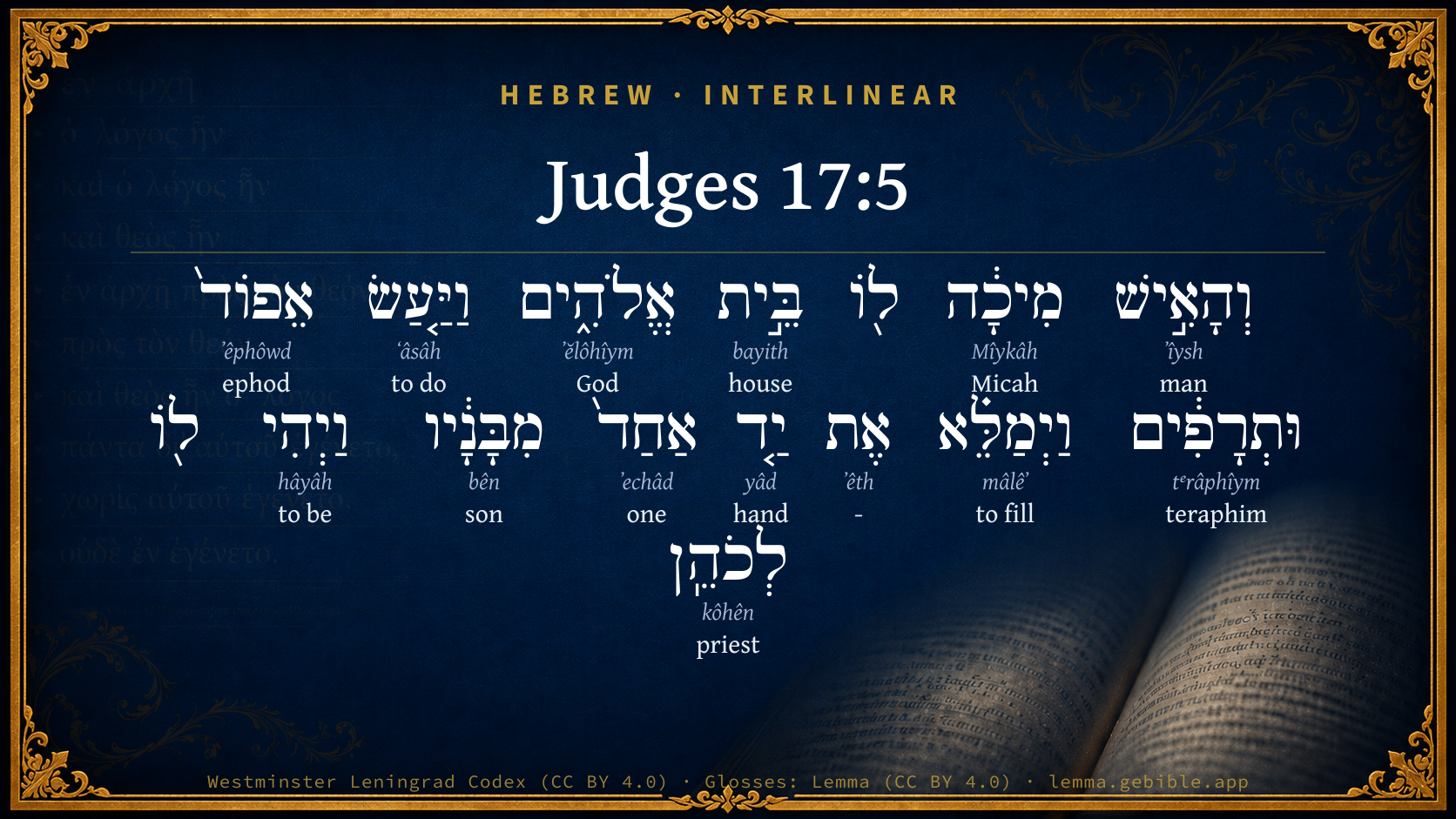
Hebrew (Westminster Leningrad Codex) Judges 17:5 appears in the Hebrew Old Testament. The text above is from the Westminster Leningrad Codex. Each word links to its Strong’s number, a concise gloss, and parsing drawn from the Open Scriptures Hebrew Bible morphology. Click any word for its full Brown-Driver-Briggs (BDB) entry.
Download image
Cite this verse

Judges 17:5 (World English Bible). Public Domain. Lemma interlinear Bible study tool, https://lemma.gebible.app/v/judges/17/5.

Show BibTeX & RIS
BibTeX
RIS
English Translation
The man Micah had a house of gods, and he made an ephod, and teraphim, and consecrated one of his sons, who became his priest.
World English Bible · Public Domain
Highlights
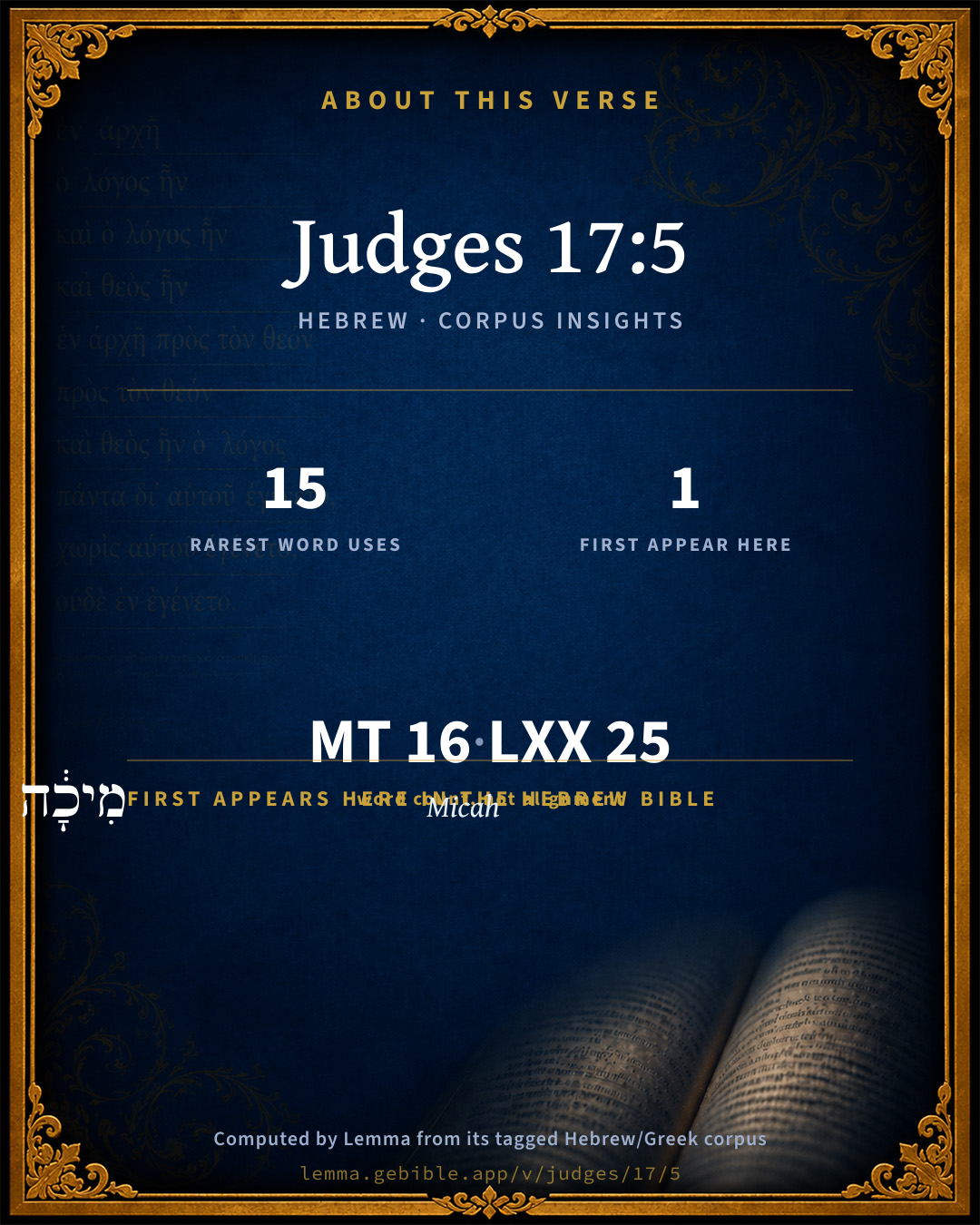
  • 1 first appearance in the Hebrew Bible
Full analysis ↓
Download a study sheet

One document with this verse’s original text, its word-by-word gloss line, the meaning frame, cross-references with their text, attributed commentary, and full source and license credits — printable, and it pastes into notes with its structure intact.

This verse Autodidact and up

Study sheet (.html) Plain text (.txt)

A passage Seminary Student

Up to 50 verses in one chapter. A passage sheet keeps up to 6 commentary sources and 12 cross-references per verse, in the order this page ranks them, and says so on the sheet whenever that leaves anything out. Ask for a single verse and you get the Autodidact verse sheet above.

Everything on this page stays free to read, with no account — the sheet is a download of what is already on screen, not access to it.

Want to remove ads? Support Godless Engineer
Compare translations 3

The same verse in 3 English versions, stacked beneath the original-language interlinear above. Click any original word for its lexicon entry.

Each is an independent rendering of the whole verse — the interlinear is not word-aligned to these translations.

Highlighted words mark where these versions differ — a whole-verse word diff, not a word-by-word alignment.

  • World English Bible Public Domain
    The man Micah had a house of gods, and he made an ephod, and teraphim, and consecrated one of his sons, who became his priest.
  • King James Version Public Domain
    And the man Micah had an house of gods, and made an ephod, and teraphim, and consecrated one of his sons, who became his priest.
  • unfoldingWord Literal Text CC BY-SA 4.0
    And the man Micah, to him a house of gods. And he made an ephod and teraphim, and he filled the hand of one of his sons, and he was to him for a priest.

unfoldingWord Literal Text — © unfoldingWord, licensed CC BY-SA 4.0. Word-aligned USFM3 via Door43 (git.door43.org/unfoldingWord/en_ult).

Versions to compare (up to 4)

3 of 4 selected

Show all 18 translations

Every available English version of this verse, each an independent rendering of the whole verse.

  • World English Bible Public Domain
    The man Micah had a house of gods, and he made an ephod, and teraphim, and consecrated one of his sons, who became his priest.
  • Berean Standard Bible Public Domain
    Now this man Micah had a shrine, and he made an ephod and some household idols, and ordained one of his sons as his priest.
  • Majority Standard Bible Public Domain
    Now this man Micah had a shrine, and he made an ephod and some household idols, and ordained one of his sons as his priest.
  • King James Version Public Domain
    And the man Micah had an house of gods, and made an ephod, and teraphim, and consecrated one of his sons, who became his priest.
  • American Standard Version (1901) Public Domain
    And the man Micah had a house of gods, and he made an ephod, and teraphim, and consecrated one of his sons, who became his priest.
  • Revised Version (1885) Public Domain
    And the man Micah had an house of gods, and he made an ephod, and teraphim, and consecrated one of his sons, who became his priest.
  • Geneva Bible (1599) Public Domain
    And this man Michah had an house of gods, and made an Ephod, and Teraphim, and cosecrated one of his sonnes, who was his Priest.
  • Douay-Rheims (1899) Public Domain
    And he separated also therein a little temple for the god, and made an ephod, and theraphim, that is to say, a priestly garment, and idols: and he filled the hand of one of his sons, and he became his priest.
  • Young's Literal Translation Public Domain
    As to the man Micah, he hath a house of gods, and he maketh an ephod, and teraphim, and consecrateth the hand of one of his sons, and he is to him for a priest;
  • Literal Standard Version CC BY-SA 4.0
    As for the man Micah, he has a house of gods, and he makes an ephod, and teraphim, and consecrates the hand of one of his sons, and he is for a priest to him;
  • Unlocked Literal Bible CC BY-SA 4.0
    The man Micah had a house of idols and he made an ephod and household gods, and he hired one of his sons to become his priest.
  • unfoldingWord Literal Text CC BY-SA 4.0
    And the man Micah, to him a house of gods. And he made an ephod and teraphim, and he filled the hand of one of his sons, and he was to him for a priest.
  • Darby Bible Public Domain
    And the man Micah had a shrine, and he made an ephod and teraphim, and installed one of his sons, who became his priest.
  • World Messianic Bible Public Domain
    The man Micah had a house of gods, and he made an ephod, and teraphim, and consecrated one of his sons, who became his priest.
  • Webster's Bible Public Domain
    And the man Micah had a house of gods, and made an ephod, and teraphim, and consecrated one of his sons, who became his priest.
  • Free Bible Version CC BY-SA 4.0
    Micah had built a shrine for the idol. He also made an ephod and some household gods, and ordained one of his sons as his priest.
  • Bible in Basic English Public Domain
    And the man Micah had a house of gods; and he made an ephod and family gods and put one of his sons in the position of priest.
  • JPS Tanakh (1917) Public Domain
    And the man Micah had a house of God, and he made an ephod, and teraphim, and consecrated one of his sons, who became his priest.

Literal Standard Version (2020), Covenant Press — licensed CC BY-SA 4.0. Text via the HelloAO Bible API (eBible.org). Unlocked Literal Bible (unfoldingWord) — licensed CC BY-SA 4.0. Text via the HelloAO Bible API (eBible.org). unfoldingWord Literal Text — © unfoldingWord, licensed CC BY-SA 4.0. Word-aligned USFM3 via Door43 (git.door43.org/unfoldingWord/en_ult). Free Bible Version, Dr. Jonathan Gallagher — licensed CC BY-SA 4.0. Text via the HelloAO Bible API (eBible.org).

Word by word

More ways to search: Search by grammar → Find every occurrence → Compare this word →

Practice this passage: Drill this verse → Learn its vocabulary →

וּתְרָפִ֔ים
tᵉrâphîym
H8655
“and · teraphim”
Conjunction + Noun, Common, Masculine, Plural, Absolute
Part of Speech
Conjunction + Noun
Type
Common
Gender
Masculine
Number
Plural
State
Absolute
Full BDB Definition

Origin: pl. from H7495

TWOT: 2545

idolatry, idols, image(s), teraphim, family idol - a kind of idol used in household shrine or worship
  1. וְהָאִ֣ישׁ ʼîysh H376 “and · the · man” Conjunction + Particle, Definite Article + Noun, Common, Masculine, Singular, Absolute
  2. מִיכָ֔ה Mîykâh H4318 “Micah” Noun, Proper
  3. בֵּ֣ית bayith H1004 “house of” Noun, Common, Masculine, Singular, Construct
  4. אֱלֹהִ֑ים ʼĕlôhîym H430 “God(s)” Noun, Common, Masculine, Plural, Absolute
  5. וַיַּ֤עַשׂ ʻâsâh H6213 “and · to do” Conjunction + Verb, Qal, Sequential Imperfect, 3rd Person, Masculine, Singular
  6. אֵפוֹד֙ ʼêphôwd H646 “ephod” Noun, Common, Masculine, Singular, Absolute
  7. וַיְמַלֵּ֗א mâlêʼ H4390 “and · to fill” Conjunction + Verb, Piel, Sequential Imperfect, 3rd Person, Masculine, Singular
  8. אֶת ʼêth H853 “-” Particle, Direct Object
  9. יַ֤ד yâd H3027 “hand of” Noun, Common, Both, Singular, Construct
  10. אַחַד֙ ʼechâd H259 “one” Adjective, Cardinal number, Masculine, Singular, Absolute
  11. מִבָּנָ֔יו bên H1121 “from · sons · his” Preposition + Noun, Common, Masculine, Plural, Construct + Suffix, Personal, 3rd Person, Masculine, Singular
  12. וַיְהִי hâyâh H1961 “and · to be” Conjunction + Verb, Qal, Sequential Imperfect, 3rd Person, Masculine, Singular
  13. לְכֹהֵֽן kôhên H3548 “to/for · priest” Preposition + Noun, Common, Masculine, Singular, Absolute

About this verse

These counts appear in no published source. They are computed here, from the morphology-tagged text and Lemma’s own curated glosses. What Lemma adds →

16
words
14
distinct lemmas
Historical
section

Notable vocabulary

The rarest word here is וּתְרָפִ֔ים teraphim H8655 — appearing just 15 times in the whole Hebrew Bible.

First appearance in Scripture

This word makes its first canonical appearance in the Hebrew Bible here:

  • מִיכָ֔ה Micah H4318

Shared distinctive vocabulary

וּתְרָפִ֔ים teraphim H8655 occurs in 15 verses of the Hebrew Bible. Also found in:

Grammatical profile

  • 3 verbs
  • 9 nouns
  • 1 adjective
  • 2 prepositions
  • 1 particle

Verb forms

  • וַיַּ֤עַשׂ Qal · Sequential Imperfect
  • וַיְמַלֵּ֗א Piel · Sequential Imperfect
  • וַיְהִי Qal · Sequential Imperfect

Hebrew & Septuagint length

In English translation the verse runs 25 words from the Hebrew and 33 from the Septuagint (LXX English) — closely comparable.

A rough comparison of the two English renderings, which tokenize alike — not a word-level alignment.

Word counts can differ between the Hebrew and the Greek without any difference in meaning — e.g. the Hebrew direct-object marker אֵת has no separate Greek word, and Greek often adds the article ὁ.

In the original languages it is 16 Hebrew tokens and 25 Greek tokens — but the two are counted differently (Hebrew bundles its prefixes and suffixes into one token; the Greek is in lemma form), so that isn’t a like-for-like length.

Cross-references

16

Topical passages linked to Judges 17:5 in the Treasury of Scripture Knowledge — connected by theme and wording, ordered by reader-vote popularity; previews shown in the World English Bible.

  • Genesis 31:19 Now Laban had gone to shear his sheep: and Rachel stole the teraphim that were her father's.
  • Genesis 31:30 Now, you want to be gone, because you sore longed after your father's house, but why have you stolen my gods?"
  • Judges 8:27 Gideon made an ephod of it, and put it in his city, even in Ophrah: and all Israel played the prostitute after it there; and it became a snare to Gideon, and to his house.
  • Judges 18:14 Then the five men who went to spy out the country of Laish answered, and said to their brothers, Do you know that there is in these houses an ephod, and teraphim, and an engraved image, and a molten image? now therefore consider what you have to do.
  • Judges 18:24 He said, you have taken away my gods which I made, and the priest, and are gone away, and what have I more? and how then say you to me, What ails you?
  • Hosea 3:4 For the children of Israel shall abide many days without king, and without prince, and without sacrifice, and without sacred stone, and without ephod or idols.
  • Exodus 28:15 "You shall make a breastplate of judgment, the work of the skillful workman; like the work of the ephod you shall make it; of gold, of blue, and purple, and scarlet, and fine twined linen, shall you make it.
  • Exodus 29:9 You shall dress them with belts, Aaron and his sons, and bind headbands on them: and they shall have the priesthood by a perpetual statute: and you shall consecrate Aaron and his sons.
  • Hebrews 5:4 Nobody takes this honor on himself, but he is called by God, just like Aaron was.
  • Exodus 24:5 He sent young men of the children of Israel, who offered burnt offerings and sacrificed peace-offerings of oxen to Yahweh.
  • Exodus 28:4 These are the garments which they shall make: a breastplate, and an ephod, and a robe, and a coat of checker work, a turban, and a sash: and they shall make holy garments for Aaron your brother, and his sons, that he may minister to me in the priest's office.
  • 1 Samuel 23:6 It happened, when Abiathar the son of Ahimelech fled to David to Keilah, that he came down with an ephod in his hand.
  • 1 Kings 12:31 He made houses of high places, and made priests from among all the people, who were not of the sons of Levi.
  • 1 Kings 13:33–34 After this thing Jeroboam didn't return from his evil way, but made again from among all the people priests of the high places: whoever would, he consecrated him, that there might be priests of the high places.
  • Ezra 1:7 Also Cyrus the king brought forth the vessels of the house of Yahweh, which Nebuchadnezzar had brought forth out of Jerusalem, and had put in the house of his gods;
  • Hosea 8:14 For Israel has forgotten his Maker and built palaces; And Judah has multiplied fortified cities; But I will send a fire on his cities, And it will devour its fortresses."

Cross-references courtesy of OpenBible.info (CC BY 4.0).

Hebrew and Greek witnesses Masoretic Hebrew ↔ Greek Septuagint

The same verse in the two great witnesses to the Old Testament, shown verse-for-verse.

These are two independent witnesses, not word-aligned to each other, and the Septuagint is shown in lemma (dictionary) form.

Hebrew Judges 17:5 Masoretic · Westminster Leningrad Codex

וְהָאִ֣ישׁ מִיכָ֔ה ל֖וֹ בֵּ֣ית אֱלֹהִ֑ים וַיַּ֤עַשׂ אֵפוֹד֙ וּתְרָפִ֔ים וַיְמַלֵּ֗א אֶת יַ֤ד אַחַד֙ מִבָּנָ֔יו וַיְהִי ל֖וֹ לְכֹהֵֽן

The man Micah had a house of gods, and he made an ephod, and teraphim, and consecrated one of his sons, who became his priest.

World English Bible · Public Domain

Greek LXX Judges 17:5 Septuagint · lemma form

καί ὁ οἶκος μιχαιας αὐτός οἶκος θεός καί ποιέω εφωδ καί θαραφιν καί πληρόω ὁ χείρ ἀπό εἷς υἱός αὐτός καί γίγνομαι αὐτός εἰς ἱερεύς

And the house of Michaias was to him the house of God, and he made an ephod and theraphin, and he consecrated one of his sons, and he became to him a priest.

LXX2012 (modern English Septuagint) · Public Domain

On this verse, Ellicott's Commentary for English Readers discusses the Septuagint’s reading. Read the note in Commentary ↓

Hebrew: Westminster Leningrad Codex (CC BY 4.0). Greek: Septuagint (public domain); English from LXX2012 (modern English Septuagint) (Public Domain). How the Septuagint differs from the Hebrew →

Targum (Aramaic paraphrase)

1

The Targum is the ancient Jewish Aramaic paraphrase of the Hebrew Scriptures — an interpretive translation, not the Hebrew text itself. Onkelos (literal) and Pseudo-Jonathan (expansive) render the Torah, and Jonathan the Prophets. Coverage is partial: where no permissively-licensed English translation exists for a verse, only the Aramaic is shown. This is verse-level text, not a word-by-word alignment to the Hebrew.

  1. Targum Jonathan Prophets (Joshua–Malachi)
    וְגַבְרָא מִיכָה לֵיהּ בֵּית טַעֲוָתָא וַעֲבַד אֵפוֹד וּדְמָאִין וּקְרֵיב יַת קוּרְבַּן חָד מִבְּנוֹהִי וַהֲוָא לֵיהּ לְכוּמָרָא:

    (no public-domain English translation for this verse)

    Targum Jonathan — Aramaic: “Mikraot Gedolot” (public domain). English: “Sefaria Community Translation” (CC0 1.0 (public-domain dedication)); “London "Chaldee Paraphrase," 1871” (public domain). Text via Sefaria.

Commentary

Notes on Judges 17:5 from classic Christian and Jewish commentators (each source and its license shown beneath its notes). The classic Christian expositions comment on the surrounding passage and are grouped to its opening verse, so a note may address several verses; the Jewish commentaries on the Tanakh (Rashi and others) are per-verse, so they appear only where the commentator wrote on this verse.

Lemma curates 59 commentaries, every one of them public domain or Creative Commons licensed, each selected and text-cleaned for this edition rather than reprinted as found. About our sources →

Ellicott's Commentary for English Readers

(5) Had an house of gods.—The Hebrew is Beth Elohim, which may mean equally well “a house of God” (Vulg., œdiculam Deo, and so too the LXX.). It is quite clear that Micah did not abandon the worship of God under the names of Jehovah and Elohim, by which He was known to the Israelites. How he coordinated this worship with his grossly idolatrous symbols, or whom those symbols were intended to represent, it is impossible to say. The fact remains that in the Beth-Micah we find “a house of gods”—“whole chapel of idols”—consecrated to Jehovah as a pious act (Jdg_17:2; Jdg_17:5; Jdg_17:13; Jdg_18:6).

An ephod.—No doubt the ephod was nothing more than a gorgeous priestly garment, though possibly it may have been used for oracular purposes. (See Jdg_8:27.)

And teraphim.—These were Syrian images (Gen_31:19), the use of which among the Israelites seems to have lasted for a long period, until it was put down by King Josiah in his great reformation (2Ki_23:34; Eze_21:26; Hos_3:4; Zec_10:2). I have entered upon the interesting question of the use of Teraphim in an article on the subject in Kitto’s Cyclopœdia. (See Excursus II: Teraphim.)

Consecrated.—The curious Hebrew phrase is “filled the hand” (see Exo_28:41; Exo_29:24; Lev_7:37), i.e., gave him the office by putting certain offerings in his hands. It is rather installed than “consecrated.”

EXCURSUS II.—ON Jdg_17:5. (TERAPHIM.)

THE Hebrew word Teraphim is always simply transliterated as in our version, or rendered by “images,” with “teraphim” in the margin, except in 1Sa_15:23, Zec_10:2, where it is represented by “idolatry,” “idols.” The singular of the word, “a teraph,” does not occur in Scripture, although it is clear that only one can have been put into David’s bed (1Sa_19:13-16). The LXX. adopt many different renderings, as does the Vulg., but they all point to idolatrous images or the implements of necromancy, as do the two renderings of the Targums, images and (Hos_3:4) “announcers.”

1. Teraphim are first mentioned in Gen_31:19, where Rachel steals her father’s “images,” and successfully hides them from his search under the hiran on which she was sitting—the coarse carpet used to cover the wicker-work pack-saddle of her camel. Josephus supposes that she was actuated by idolatrous reverence; Iben Ezra that she expected oracular guidance from them; others that she stole them because of their intrinsic value. She probably shared the superstitions of her father, and regarded them as sacred (Gen_30:14; Gen_31:30), as being the figures of ancestral divinities (Gen_31:53). It is not impossible that they were among the “strange gods” which Jacob ordered his family to bury under “the sorcerer’s oak”—Allon Meonenim (Jdg_9:37). But that Jacob’s right feeling in the matter was not permanent is proved only too clearly by the conduct of Micah (Jdg_17:5) and the Danites (Jdg_18:3), although, unlike Jeroboam, they could not even plead the poor palliation of political motives.

2. The next definite notice of teraphim occurs in 1Sa_19:13-16, where Michal, in the dark eastern chamber, conceals her husband’s absence by putting the teraphim in his bed, with a bolster of goat’s hair for a pillow. The use of the article shows that even in David’s family the use of the “teraphim” was perfectly well known. Nor can we rely on the vague conjecture of Thenius, that barren women (Rachel and Michal) were especially addicted to their worship, or on that of Michaelis, that Michal may have possessed them unknown to David. The passage seems to show that they had at least some rude resemblance to the human shape, whence Aquila renders the word by protomai (“busts”), which is used of figures like the ancient Hermae. This is not the place to enter into the curious reading of the LXX. on this verse, by which they seem to connect the worship of teraphim with what the ancients called extispicium—i.e., divination by means of the liver of sacrifices, as in Eze_21:21. Josephus follows the same reading, and dishonestly suppresses all mention of the teraphim.

3. The next important passage is Hos_3:4, where the primâ facie view of every unbiassed reader would be that the “image” (matsêbah) and the teraphim are mentioned without blame as ordinary adjuncts to religious worship. Hence, perhaps, arose the notion that the teraphim were in some way connected with the Urim and Thummim, which led to the rendering of the word in this passage by δήλοι (LXX., “bright gems”), and by φωτισμούς (“enlightenments,” Aquila), and by “implements of priestly dress” (St. Jerome). This is the theory maintained most unconvincingly, though with great learning, by Spencer in his De Legibus Hebrœ-orum, lib. 3, pp. 920-1038.

But if these passages show that even in religious families teraphim were sometimes tolerated as material adjuncts to an Elohistic worship, on the other hand we find them unequivocally condemned by Samuel (1Sa_15:23), by Josiah (2Ki_23:24), and by the prophet Zechariah (Zec_10:2 ); and in Eze_21:21 the use of them, is attributed to the heathen Nebuchadnezzar.

The general inference seems to be that the use of the teraphim involved a violation of the second commandment, but that this use of symbols, this monotheistic idolatry, which is very different from polytheism, arises from a tendency very deeply ingrained in human nature, and which it took many years to eradicate. If centuries elapsed before the Jews were cured of their propensity to worship “other gods,”we can feel no surprise that “image worship” continued to linger among them, in spite of the condemnation of it by the stricter prophets. The calf-worship, the toleration of teraphim and consecrated stones (baetylia) and high places, the offering of incense to the brazen serpent, the glimpses of grave irregularities even in the worship of the sanctuary, show that it was only by centuries of misfortune and a succession of prophets that Israel was at last educated into the spiritual worship of the true God.

The reader will find further remarks on this subject in the article on “Teraphim,” by the present writer, in Kitto’s Biblical Cyclopœdia.

A Bible Commentary for English Readers, edited by Charles John Ellicott (1878–1897) — public domain. Text from a community e-Sword module.

Trapp's Complete Commentary

John Trapp

Jdg 17:5 And the man Micah had an house of gods, and made an ephod, and teraphim, and consecrated one of his sons, who became his priest.

Ver. 5. And the man Micah had an house of gods.] Aediculam sacram. The devil is ειδωλοχαρης, saith Synesius, a great promoter of idolatry. His champion Julian was by the Christians merrily called Idolian.

And teraphim,] i.e., Seraphims and cherubims, saith Hugo: but it seemeth rather to signifiy certain statues, whereby the devil gave answers or oracles. {Eze 21:21 Zec 10:2}

John Trapp, A Commentary or Exposition upon All the Books of the Old and New Testament (1647–1656) — public domain. Text from a community e-Sword module.

Joseph Benson's Commentary

Jdg 17:5. The man Micah had a house of gods — The Hebrew בית אלהים, Beth Elohim, may more properly be translated a house of God; that is, he had made, or at least intended to make, in his own dwelling, an imitation of the house of God in Shiloh. And teraphim — A sort of images so called. And consecrated one of his sons — Because the Levites, in that corrupt state of the church, neglected the exercise of their office, and therefore they were neglected by the people, and others put into their employments.

Joseph Benson's Commentary on the Old and New Testaments (1811–1818) — public domain. Text from a community e-Sword module.

Geneva Bible (1599)

Geneva Bible translators

Gen. 31:19; Hos. 3:4

He would serve both God and Idols.

By Teraphim some understand certain idols, having the likeness of a man, but others understand thereby all manner of things and instruments belonging unto those, who sought for any answer at God’s hands, as Judg. 18:5,6.

Hebrew, filled the hand of one.

Geneva Bible (1599) marginal notes — public domain. Text via Bolls.life.

Jamieson, Fausset & Brown

Robert Jamieson, A. R. Fausset & David Brown

the man Micah had an house of gods--Hebrew, "a house of God"--a domestic chapel, a private religious establishment of his own.

an ephod--(see on Exo 28:6).

teraphim--tutelary gods of the household (see Gen 31:19 and see on Gen 31:26).

consecrated one of his sons who became his priest--The assumption of the priestly office by any one out of the family of Aaron was a direct violation of the divine law (Num 3:10; Num 16:17; Deu 21:5; Heb 5:4).

Jamieson, Fausset & Brown — Commentary Critical and Explanatory on the Whole Bible (1871) — public domain (CC PDM 1.0). Text via the HelloAO Bible API.

Adam Clarke's Commentary

Verse 5. The man Micah had a house of gods] בית אלהים beith Elohim should, I think, be translated house or temple of God; for it is very likely that both the mother and the son intended no more than a private or domestic chapel, in which they proposed to set up the worship of the true God.

Made an ephod] Perhaps the whole of this case may be stated thus: Micah built a house of God - a chapel in imitation of the sanctuary; he made a graven image representing the ark, a molten image to represent the mercy-seat, teraphim to represent the cherubim above the mercy-seat, and an ephod in imitation of the sacerdotal garments; and he consecrated one of his sons to be priest. Thus gross idolatry was not the crime of Micah; he only set up in his own house an epitome of the Divine worship as performed at Shiloh. What the teraphim were, See Clarke on Ge 31:19; for the ephod, See Clarke on Ex 25:7; and for the sacerdotal vestments in general, See Clarke on Ex 28:4, c.

Who became his priest.] כהן cohen, which the Targum translates chumera. The word כהן cohen is the common name in Hebrew for a priest of the true God but sometimes it is applied to idolatrous priests. When it is to be understood in the former sense, the Targum renders it cahen; when in the latter, it uses the word כומרא chumera, by which it always understands an idolatrous priest. But that this was not a case of idolatry, and that the true God was worshipped here, is evident from the word Jehovah being used, Jdg 17:4, and oracular answers being given at this house, as we see from Jdg 18:6 &c.

Adam Clarke's Commentary on the Bible (1810–1826) — public domain. Text from a community e-Sword/MySword module.

The Cambridge Bible for Schools and Colleges

gen. ed. J. J. S. Perowne

5. had an house of gods] But according to his lights Micah was a zealous worshipper of Jehovah; so follow Marg. had an house of God, i.e. a private shrine. The narrative hardly permits the identification of Micah’s beth-elohim with Beth-el, as has been proposed; nor does it intend to brand his shrine, and the sanctuary at Dan, as idolatrous foundations.

an ephod and teraphim] Instruments for consulting the divine oracle; 1Sa_23:9-12, Zec_10:2. In Hos_3:4 they are mentioned, together with sacrifice and pillar, in a way which suggests that they were to be found in public sanctuaries. Such was the case with the ephod, Jdg_8:27 note; but the terâphim as a rule seem to have been household sacra, perhaps images shaped in human form (Gen_31:19; Gen_31:34 f.; 1Sa_19:13; 1Sa_19:16), associated with superstitious practices such as divination and witchcraft, and therefore discountenanced by the higher religion; Gen_35:2; Gen_35:4 E; 1Sa_15:23; 2Ki_23:24; Eze_21:21[60]. The archaic miniature idols, generally figures of Ashtoreth, which have been unearthed at Taanach and Gezer, are supposed to have been terâphim, but without much probability. See the illustrations in Vincent, Canaan, pp. 153 ff.; Driver,

[60] The Jerusalem Targum on Gen_31:19 thus explains what the terâphim were: ‘they kill a first-born male and cut off his head, and salt it in salt and spices, and write spells on a leaf of gold which they place under the tongue, and set it up on the wall, and it speaks with them.’ This barbarous magic must actually have existed in popular practice.

Schweich Lectures, p. 57. Gressmann, Eschatologie, p. 345 n., accepts the view that if the ephod was the mantle, the terâphim were the masks of the sacred image; the priest put them on to deliver an oracle, and was then supposed to be invested with the power of the Deity. But this does not seem to explain the private, domestic use of the terâphim. The etymology and meaning of the word are unknown; it occurs only in the plural, even when referring to a single object (e.g. 1Sa_19:13; 1Sa_19:16); see Gesenius-Kautzsch, Hebr. Gram.28, §124 h, Meyer, Die Israeliten, p. 212.

and consecrated one of his sons] Jdg_17:12, installed lit. filled the hand of. The idiom probably originated from the custom of filling the hands of a candidate for the priestly office with choice portions of the sacrifice, if we may suppose that the ceremonial enjoined in P was based upon traditional usage; Exo_29:22-25, Lev_8:25-28; cf. 2Ch_13:9, 1Ki_13:33. In Eze_43:26 the phrase has become entirely conventionalized, and is applied to the altar (lit. fill ye its hand). An exact equivalent was used in Assyrian for conferring a dignity on a person, e.g. the god Ashur ‘filled his hand with a matchless kingdom,’ KB. i. p. 191.

The verse throws a valuable light on the religious practice of the period. The head of a family could install a son as priest to his household (cf. 1Sa_7:1, 2Sa_8:18), and the priestly office was not confined to Levites (cf. 1Sa_2:18; 1Sa_3:1; 1Sa_7:9 f. etc., 2Sa_20:26), though a Levite was considered to possess superior skill and fitness for it, Jdg_17:13. Of course this was entirely at variance with later theory and custom. In Deuteronomy (viith century) the only priests we hear of are the Levites, and according to the compiler of the Book of Kings none but Levites had the right to exercise priestly functions (1Ki_12:31; 1Ki_13:33); all Levites might be priests (Deu_10:8 f., Jdg_18:1-8). In the following age Ezekiel draws a distinction between Levites, and confines the priesthood to the descendants of Zadok, degrading the rest to the rank of priests’ servants (Eze_44:10-16); while finally, according to the Priestly Code, only the descendants of Aaron can be priests (Exodus 28, Num_3:10, etc.). A later scribe, familiar with what had become the established rule in his day, draws attention to the irregularity in the present case, and puts it down to the general lack of order in the days before the monarchy; cf. Jdg_18:1, Jdg_19:1, Jdg_21:25. The remark implies that the scribe who added it was writing? time when there were kings in Israel.

The Cambridge Bible for Schools and Colleges (gen. ed. J. J. S. Perowne; Cambridge University Press, 1878–1918) — public domain. Text from a community e-Sword module.

John Gill's Exposition

And the man Micah had an house of gods,.... Having two images in it, besides teraphim, which were a sort of idols; and the Targum is, an house of images, or idols; though it may be rendered "an house of God"; a temple, a place for religious worship:

and made an ephod; a priestly garment, a linen one very probably, not so rich an one with a breastplate to it as the high priest had, which was very costly. Ben Melech interprets it a girdle, and there was a curious girdle of the ephod, with which it was girt; this may be here put for the rest of the priestly garments which Micah provided:

and teraphim; which were a sort of household gods, like the Lares and Penates of the Romans, and by which consultations were made; See Gill on Hos 3:3, Hos 3:4, Zac 10:2 Micah proposed to have an oracle in his house, whereby he might consult the Lord about future things, and not be at the trouble of going to the tabernacle, and consult there by Urim and Thummim; and the same some take the teraphim to be:

and consecrated one of his sons, who became his priest; or, "filled the hand" (k) of one of them; that is, with offerings, as Ben Melech interprets it; in which way priests were initiated, and consecrated to their office; see Exo 28:41 or, as Kimchi expresses it, he offered his offerings by the hand of one of his sons, and appointed him to be a priest, very probably his eldest son.

(k) "et implevit manum", Montanus, V. L.

John Gill's Exposition of the Whole Bible (1746–1763) — public domain (CC PDM 1.0). Text via the HelloAO Bible API.

Haydock's Catholic Bible Commentary

That....idols is added by the Vulgate. St. Jerome supposes that the ephod denotes all the sacerdotal vestments, and the theraphim whatever else was requisite for priestly functions, ep. ad Marcel. Grotius is of opinion that these theraphim, or cherubim, are styled elohim, gods, (ver. 5) and that the altar, candlesticks, &c., are designated above by whatever was to be graven or molten. Michas had a mind to represent the tabernacle, with its ornaments, in miniature. By the theraphim he might imitate the urim, &c., at the expense of 200 sicles, while 900 might be set apart for the other ornaments. (Calmet) --- Many think that he wished to have domestic gods, like the Lares or Penates. --- Hand. That is, appointed and consecrated him to the priestly office. (Challoner) --- He put in his hand the offerings which he had to make, as was customary, Exodus xxviii. 41. (Calmet) --- Priest, contrary to all order. (Menochius) (Numbers iii. 10., and Hebrews v. 4.) (Calmet) --- The anointing of his hands with oil, prescribed, (Leviticus viii.) could give him no authority. (Worthington)

George Leo Haydock (1774–1849), Haydock's Catholic Family Bible and Commentary, 1859 edition — public domain. Excludes Psalms (Douay-Rheims chapter numbering differs from Protestant) and Deuterocanonical books (Catholic canon only).

Matthew Poole's English Annotations

An house of gods, i.e. an house or place consecrated for the service of God in this manner.

An ephod; an eminent part of the priestly garments, Exo 28:4, which, some think, is here put for all of them.

Teraphim; some sort of images so called, of which see Gen 31:19; Hos 3:4.

Who became his priest; because the Levites in that corrupt estate of the church neglected the exercise of their office, and therefore were neglected by the people, and others put into their employment. But this kind of priesthood was condemned, Num 16:40; 18:2,7.

Matthew Poole's English Annotations on the Holy Bible (1683–1685) — public domain. Text from a community e-Sword/MySword module.

Whedon's Commentary on the Bible

Daniel D. Whedon

5. House of gods — Or, a house of God, a sanctuary after the model of that at Shiloh. He would have a tabernacle of his own.

An ephod — Probably after the fashion of Gideon’s. See on Jdg_8:27.

Teraphim — Idolatrous images among the Syrians, but in Israel connected rather with corrupt notions of religion than with open idolatry. It does not appear that they were ever worshipped. But see on Gen_31:19, and Jos_24:14.

Consecrated — Literally, filled the hand, in allusion to the sacred and solemn duties which filled the hands — required all the care — of those who occupied the priest’s office.

One of his sons — This fact affords further evidence of the looseness of that age, and shows how completely some of the most solemn enactments of the law had become a dead letter. But Micah did not feel fully satisfied with this priest of his own household, and hence his subsequent consecration of the wandering Levite.

Daniel D. Whedon (gen. ed.), Commentary on the Old and New Testaments (1874–1909) — public domain. Text from a community e-Sword module.

The Pulpit Commentary

And the man Micah, etc. It is impossible to say for certain whether the state of things here described in respect of Micah preceded the events narrated in the preceding verses, or was consequent upon them. If it preceded, then we have the reason of his mother"s vow: she wished to make her son"s "house of God" complete by the addition of a graven and molten image. If it was consequent upon his mother"s vow, then we have in the opening verses of this chapter a history of the circumstances of the foundation of Micah"s "house of God," which was to play an important part in the colony of Danites, whose proceedings arc related in the following chapter, and for the sake of which this domestic history of Micah is introduced. House of gods. Rather, of God (Elohim); for the worship was of Jehovah, only with a corrupt and semi-idolatrous ceremonial. An ephod. See Jud_1:8:26, 27, note. Teraphim. See Gen_31:19 (images, A.V; teraphim, Hebrews); 1Sa_15:23 (idolatry, A.V; teraphim, Hebrews); 1Sa_19:13 (an image, A.V; teraphim, Hebrews); Hos_3:4, to etc. They seem to have been a kind of Penates, or household gods, and were used for divination. (Eze_21:21 Zec_10:2) Became his priest. One function of the priest, and for which it is likely he was much resorted to, was to inquire of God by the Jud_1:18:5, 6. What his other duties might be does notappear.

The Pulpit Commentary (1880–1919), ed. H.D.M. Spence-Jones & Joseph S. Exell — public domain. Text from a community e-Sword module.

John Wesley's Explanatory Notes

Of gods - That is, an house consecrated for the service of God in this manner. Teraphim - A sort of images so called. One of his sons - Because the Levites in that corrupt estate of the church, neglected the exercise of their office, and therefore they were neglected by the people, and others put into their employment.

John Wesley, Explanatory Notes Upon the Whole Bible (1754–1765) — public domain. Text via the GEBible commentary corpus.

unfoldingWord translationNotes

Door43 World Missions Community

a house of idols

This refers to a house used specifically for worshiping idols. This can be stated clearly. AT: "a house for worshiping idols" (See: Assumed Knowledge and Implicit Information)

everyone did what was right in his own eyes

The eyes represent seeing, and seeing represents thoughts or judgment. AT: "each person did what he decided was right" or "each person did what he judged to be right" (See: Metaphor)

translationWords

house

false god

ephod

household

false god

son

priest

Israel

unfoldingWord translationNotes — © Distant Shores Media and the Door43 World Missions Community, licensed CC BY-SA 4.0. Source: git.door43.org/Door43/en_tn.

Rashi

Rabbi Shlomo Yitzchaki (Rashi)

An idolatrous temple [lit. "temple of Elohim"]. A temple of idol worship. Similarly, "god" throughout this chapter is profane, except for the following: "Throughout the time that the Sanctuary of God was at Shiloh."

And inducted [lit. "filled the hands of"] one. He inducted him into the service of the image, to serve as its priest. Any induction process which a person enters for the purpose of achieving a position of prominence is described as "filling the hands," "revetir" in old French. When a person is charged with a position, it is described as "reveture" in old French.

Rashi on the Tanakh — English translations: “The Judaica Press complete Tanach with Rashi, translated by A. J. Rosenberg” (CC BY 4.0); “Pentateuch with Rashi's commentary by M. Rosenbaum and A.M. Silbermann, 1929-1934” (public domain); “The Metsudah Tanach series, Lakewood, N.J” (CC BY 4.0); and “The Book of Joshua, Metsudah Publications, 1997” (CC BY 4.0). Text via Sefaria.

Lesson kit

Teaching starters — assembled from the data on this page, not authored interpretation. Every prompt links to the verse data it draws on. Edit before teaching.

Judges, in the Historical, opens this verse with 16 words (14 distinct Hebrew lemmas). Its most distinctive word is tᵉrâphîym (“teraphim”). A historical commentator’s framing appears above. Read the whole chapter for the surrounding context.

Discussion questions

  1. The word tᵉrâphîym carries the sense “teraphim.” How does it shape the verse?
  2. This is the first place “Micah” appears in Scripture (first appears here). What does its debut here establish?
  3. How does Genesis 31:19, which shares the word «teraphim», read alongside this verse?
  4. These translations render this verse differently; the difference is in the English rendering, not the original. What questions does that raise?
  5. «וַיַּ֤עַשׂ» is a Qal Sequential Imperfect verb. How does that grammatical form shape the action described?
  6. Compare how Ellicott's Commentary for English Readers and Trapp's Complete Commentary read this verse. Where do they agree or differ?

Things to notice

Reading settings

Reading text

Shown beneath each verse's original-language words.

Old Testament
Old Testament edition

Read the OT as the Masoretic Hebrew (MT) or the Greek Septuagint (LXX).

English shown for the Greek Septuagint (in the Hebrew ↔ Greek comparison).

Comparing translations? Open the Compare panel on any verse page to stack up to four side by side.