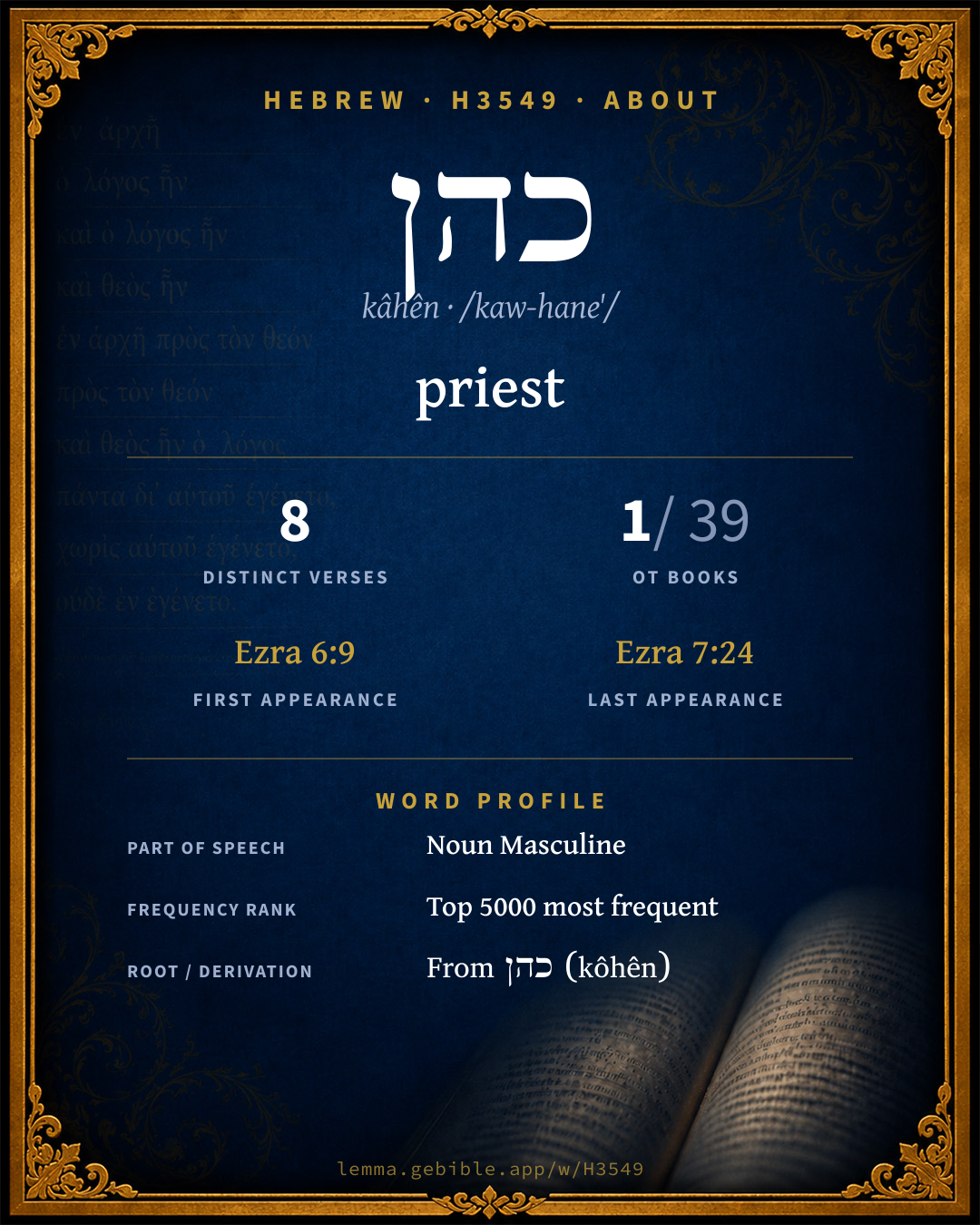
כָּהֵן
priest
Full lexicon entry — Brown-Driver-Briggs (BDB)
From Brown-Driver-Briggs (BDB)
Where this word appears
Grammar key — what these labels mean
Noun type
- Common
- A common noun — a general class of person, place, or thing (“king,” “city,” “water”), not a specific name.
State
- Construct
- A noun bound to a following noun in a possessive / “of” relationship (the construct chain).
Gender
- Masculine
- Grammatically masculine.
Number
- Plural
- More than one (in Hebrew, generally three or more).
Grammatical forms
- Particle, Definite Article 7 times (88%)
- Noun, Common, Masculine, Plural, Construct 1 time (13%)
Parsed forms decoded from the imported morphology (morphhb / Westminster Leningrad Codex — WLC text public domain, morphhb tagging CC BY 4.0), counted across 8 parsed occurrences — not distinct verses.
Every verse where H3549 appears — 8 distinct verses across 1 book. Click any verse to open its interlinear word-by-word view. Verse text shown in the World English Bible for context — . Each verse’s Hebrew form is shown with its reference; the English is not keyword-highlighted, since the data carries no word-level English alignment. Use “Compare translations” on any verse to read it across multiple English versions. This concordance covers the Hebrew Bible; Septuagint (Greek Old Testament) occurrences are not indexed here.
Ezra 8 verses
- Ezra 6:9 כָּהֲנַיָּ֤/א n c mp det + ptcl def.art That which they have need of, both young bulls, and rams, and lambs, for burnt offerings to the God of heaven; [also] wheat, salt, wine, and oil, according to the word of the priests who are at Jerusalem, let it be given them day by day without fail;
- Ezra 6:16 כָּהֲנַיָּ֨/א n c mp det + ptcl def.art The children of Israel, the priests, and the Levites, and the rest of the children of the captivity, kept the dedication of this house of God with joy.
- Ezra 6:18 כָהֲנַיָּ֜/א n c mp det + ptcl def.art They set the priests in their divisions, and the Levites in their courses, for the service of God, which is at Jerusalem; as it is written in the book of Moses.
- Ezra 7:12 כָ֠הֲנָ/א n c ms det + ptcl def.art Artaxerxes, king of kings, to Ezra the priest, the scribe of the law of the God of heaven, perfect and so forth.
- Ezra 7:13 וְ/כָהֲנ֣וֹ/הִי conj + n c mp cs + sfx pers 3ms I make a decree, that all those of the people of Israel, and their priests and the Levites, in my realm, who are minded of their own free will to go to Jerusalem, go with you.
- Ezra 7:16 וְ/כָֽהֲנַיָּ/א֙ conj + n c mp det + ptcl def.art and all the silver and gold that you shall find in all the province of Babylon, with the freewill-offering of the people, and of the priests, offering willingly for the house of their God which is in Jerusalem;
- Ezra 7:21 כָהֲנָ֜/ה n c ms det + ptcl def.art I, even I Artaxerxes the king, do make a decree to all the treasurers who are beyond the River, that whatever Ezra the priest, the scribe of the law of the God of heaven, shall require of you, it be done with all diligence,
- Ezra 7:24 כָּהֲנַיָּ֣/א n c mp det + ptcl def.art Also we inform you, that touching any of the priests and Levites, the singers, porters, Nethinim, or servants of this house of God, it shall not be lawful to impose tribute, custom, or toll, on them.
About this entry
At a glance — auto-summarized from this page’s data, not written by a person. Every figure links to its source below. This summary describes the numbers; it doesn’t interpret them.
“priest” is the headline sense of the Hebrew noun כהן (kâhên). More than three-quarters of its appearances fall in Ezra. The Hebrew Bible uses it across 8 verses — uncommon. Its earliest occurrence is Ezra 6:9. See the sense tree, 8-verse concordance, and the renderings breakdown below.
Gloss history
Strong's 1890 vs modern scholarship
About this word
Strong's H3549 catalogs a Hebrew word from the Hebrew Old Testament.
These counts are not copied from any lexicon or concordance. They are computed here, from the morphology-tagged Hebrew Old Testament. What Lemma adds →
- 8
- distinct verses
- The word appears in 8 distinct verses.
- 1 / 39
- OT books
- The word appears in 1 of 39 Old Testament books.
- #2,625
- by frequency
- Top 5000 most frequent Hebrew words (rank 2,625 of 8,640 Hebrew words by occurrence).
View all 8 occurrences in the concordance →
Most concentrated in
- Ezra 8 verses 100%
By section of the Old Testament
By traditional corpus
Conventional, traditional groupings — biblical authorship is debated, so this is a traditional corpus grouping, not an authorship claim. Each share is this word’s portion of its verses in that division of the Hebrew canon. Each figure is a share of the word’s 8 distinct verses.
- Writings (Ketuvim) 8 verses · 100%
How translations render this word
Counts come from each version’s own published word-to-Strong’s tagging or interlinear alignment — an approximate guide to how each version renders this word, not a word-level alignment the data otherwise carries. Because each total is that version’s own tagged count, the per-version totals vary from one another and need not match the appearance or distinct-verse counts above. These counts may also differ from a printed concordance because Lemma counts each distinctly tagged rendering and does not collapse phrase taggings into a single head-word total. This is a fixed set of word-tagged versions (KJV, ASV, BSB, ULT) and does not change with the reading translation you choose elsewhere. Each version’s license is shown beside its name below (and on Sources).
- King James Version: Priests 6×, Priest 2×
- American Standard Version: Priests 4×, Priest 2×
- Berean Standard Bible: Priests 5×, Priest 2×
- unfoldingWord Literal Text: Priests 6×, Priest 2×
King James Version Public Domain
Renders H3549 across 8 tagged occurrences — most commonly:
American Standard Version Public Domain
Renders H3549 across 8 tagged occurrences — most commonly:
Plus 2 renderings that appear only once — usually multi-word phrases or single function words the recovered tagging swept in, not distinct renderings.
Berean Standard Bible Public Domain
Renders H3549 across 8 tagged occurrences — most commonly:
Plus 1 rendering that appears only once — usually multi-word phrases or single function words the recovered tagging swept in, not distinct renderings.
unfoldingWord Literal Text CC BY-SA 4.0
Renders H3549 across 8 tagged occurrences — most commonly:
Senses in BDB
The 1 sense BDB distinguishes for this word, in lexicon order (not ranked by frequency or importance). The full entry — with sub-senses — is in the Lexicon Entry tab.
- priest
Word origin
Derived from כהן (kôhên) (H3548) — priest.
Jastrow Dictionary
A second Hebrew/Aramaic lexicon for comparison, covering Aramaic and post-biblical (Talmudic, Targumic, Midrashic) usage that the biblical-Hebrew BDB does not. Matched by lemma rather than by Strong’s number, so a lemma may carry more than one Jastrow headword (shown separately below), and the entries cover usage well beyond the Bible.
כֹּהֵן
- , v. כּוּן; cmp. b. h. כַּן) [standing, stationed,] officer, esp. priest. Yoma 6ᵃ, a. fr. כ׳ גדול (abbr. כ"ג) high priest, כ׳ הדיוט ordinary priest. Meg. I, 9 כ׳ משוח an anointed high priest, contrad. to מרובה בגדים a high priest distinguished only by his robes (but not anointed, as in the days of the Second Temple). Ib. כ׳ משמש officiating highpriest, כ׳ שעבר a substitute of the high priest no longer required, ex-substitute. Hor. III, 8 ממזר … קודם לכ"ג ע"ה a bastard who is a scholar has the precedence of an ignorant high priest; a. v. fr.—Pl. כֹּהֲנִים. Yeb. 86ᵇ, a. e. בכ"ד מקומות נקראו הכ׳ וכ in twenty four Biblical passages the priests are designated as Levites; a. v. fr.—תּוֹרַת כֹּהֲנִים (abbr. ת"כ) Torath Kohănim, a) name of the third book of Moses, Leviticus. Kidd. 33ᵃ. Lev. R. s. 7 מפני מה … בת"כ why do we, in teaching children, commence with Leviticus? a. e.—b) name of an halachic commentary to Leviticus, also named Sifra. Yeb. 72ᵇ; a. fr.—Fem. כֹּהֶנֶת, כּוֹהֶ׳ a priest’s daughter or wife. Ḥull. 131ᵇ, sq.—Keth. IV, 8 ובכ׳ and in the case of a priest’s wife. Ib. VII, 1, sq. (70ᵃ) ובכ׳ Mish. a. Y. ed. (Bab. ed. ובכהן). Ib. 71ᵃ; a. fr.—Pl. כֹּהֲנוֹת, כּוֹהֲ׳. Ber. 44ᵃ. Yeb. III, 10 אם היו כ׳ (Y. ed. כוה׳) if they are daughters of priests; a. e.
כָּהַן
- , (b. h.), Nithpa. נִתְכַּהֵן (denom. of כֹּהֵן) to be appointed priest, to act as priest. Zeb. 101ᵇ לא נ׳ פנחס וכ׳ Phineas was not appointed high priest until &c. Ib. 102ᵃ לא נ׳ משה וכ׳ Moses acted as priest only during &c.
כָּהֵן
- Targ. Jer. XIV, 18. Targ. Mal. II, 7. Targ. Lev. I, 7; a. v. fr.—Snh. 110ᵃ, a. fr. כ׳ רבא high priest. Ḥull. 49ᵃ ישמעאל כ׳ מסייע כהני Ishmael, being a priest, favors the priests. Gitt. 59ᵇ קרי בכ׳ read from the Torah in the priest’s place, i.e. was called up the first; Meg. 22ᵃ Ms. O. (ed. בכהני pl.); a. fr.—Pl. כַּהֲנִין, כַּהֲנַיָּא, כַּהֲנֵי. Targ. Ex. XIX, 6. Targ. O. Lev. I, 5; a. fr.—Gitt. l. c. כ׳ חשיבי דא"י highly esteemed Palestinean priests; a. fr.—Fem. (כֹּהֶנֶת) כַּהַנְתָּא. Ḥull. 131ᵇ … יהיב לכ׳ gave priestly gifts to a priest’s daughter (married to an Israelite). Pes. 49ᵃ נסיב כ׳ married a priest’s daughter.—Pl. כַּהֲנָתָא. Ber. 44ᵃ
כָּהֵן ²
- (or כֹּהֵן), כַּהֲנָא II pr. n. m. Kahen, Kahăna, name of several Amoraim. Y. Ber. III, 6ᵃ, a. fr. ר׳ כהן.—B. Kam. 117ᵃ. Y. R. Hash. IV, beg. 59ᵇ; a. fr.—Erub. 8ᵇ רב כ׳ רביה דרב (v., however, Ms. M. a. Rabb. D. S. a. l. notes); a. fr.—v. Fr. M’bo, p. 109ᵇ, sq.
A Dictionary of the Targumim, the Talmud Babli and Yerushalmi, and the Midrashic Literature (Marcus Jastrow; London, Luzac, 1903) — Public Domain. Digitized via Sefaria. Digitized via Sefaria. Full attribution on Sources.
Forms in the corpus
The 8 distinct written forms H3549 takes in the Hebrew Bible, most frequent first — each parse links to that state’s occurrences in the concordance. Hebrew forms include their vowel points and cantillation, so a single lemma takes many written forms.
| Form | Parsing | Example | Uses |
|---|---|---|---|
| וְ/כָֽהֲנַיָּ/א֙ | Particle, Definite Article | Ezra 7:16 | 1 |
| וְ/כָהֲנ֣וֹ/הִי | Noun, Common, Masculine, Plural, Construct | Ezra 7:13 | 1 |
| כָ֠הֲנָ/א | Particle, Definite Article | Ezra 7:12 | 1 |
| כָהֲנַיָּ֜/א | Particle, Definite Article | Ezra 6:18 | 1 |
| כָהֲנָ֜/ה | Particle, Definite Article | Ezra 7:21 | 1 |
| כָּהֲנַיָּ֣/א | Particle, Definite Article | Ezra 7:24 | 1 |
| כָּהֲנַיָּ֤/א | Particle, Definite Article | Ezra 6:9 | 1 |
| כָּהֲנַיָּ֨/א | Particle, Definite Article | Ezra 6:16 | 1 |
Septuagint verse parallels
This word appears in 8 verses that also exist in the Greek Old Testament (Septuagint), out of the 8 Hebrew verses it occurs in. You can read those verses in Greek by switching the Old Testament edition to the Septuagint.
Read these verses in the Septuagint
This is a verse-level parallel only — the same verses exist in both the Hebrew and Greek Old Testaments. No word-level Hebrew↔Greek correspondence is claimed: the data carries no such alignment, so no Greek word is shown as this Hebrew word’s translation. Coverage is not total — the Septuagint omits the deuterocanon and renumbers the Psalms, so some Hebrew verses have no direct Greek parallel.