Numbers 31:26

Hebrew (Westminster Leningrad Codex) Numbers 31:26 appears in the Hebrew Old Testament. The text above is from the Westminster Leningrad Codex. Each word links to its Strong’s number, a concise gloss, and parsing drawn from the Open Scriptures Hebrew Bible morphology. Click any word for its full Brown-Driver-Briggs (BDB) entry.
Download image
Cite this verse

Numbers 31:26 (World English Bible). Public Domain. Lemma interlinear Bible study tool, https://lemma.gebible.app/v/numbers/31/26.

Show BibTeX & RIS
BibTeX
RIS
English Translation
Take the sum of the prey that was taken, both of man and of animal, you, and Eleazar the priest, and the heads of the fathers' [houses] of the congregation;
World English Bible · Public Domain
Download a study sheet

One document with this verse’s original text, its word-by-word gloss line, the meaning frame, cross-references with their text, attributed commentary, and full source and license credits — printable, and it pastes into notes with its structure intact.

This verse Autodidact and up

Study sheet (.html) Plain text (.txt)

A passage Seminary Student

Up to 50 verses in one chapter. A passage sheet keeps up to 6 commentary sources and 12 cross-references per verse, in the order this page ranks them, and says so on the sheet whenever that leaves anything out. Ask for a single verse and you get the Autodidact verse sheet above.

Everything on this page stays free to read, with no account — the sheet is a download of what is already on screen, not access to it.

Want to remove ads? Support Godless Engineer
Compare translations 3

The same verse in 3 English versions, stacked beneath the original-language interlinear above. Click any original word for its lexicon entry.

Each is an independent rendering of the whole verse — the interlinear is not word-aligned to these translations.

Highlighted words mark where these versions differ — a whole-verse word diff, not a word-by-word alignment.

  • World English Bible Public Domain
    Take the sum of the prey that was taken, both of man and of animal, you, and Eleazar the priest, and the heads of the fathers' [houses] of the congregation;
  • King James Version Public Domain
    Take the sum of the prey that was taken, both of man and of beast, thou, and Eleazar the priest, and the chief fathers of the congregation:
  • unfoldingWord Literal Text CC BY-SA 4.0
    “Lift up the head of the booty of the captives, of human and of animal, you and Eleazar the priest and the heads of the fathers of the congregation.

unfoldingWord Literal Text — © unfoldingWord, licensed CC BY-SA 4.0. Word-aligned USFM3 via Door43 (git.door43.org/unfoldingWord/en_ult).

Versions to compare (up to 4)

3 of 4 selected

Show all 18 translations

Every available English version of this verse, each an independent rendering of the whole verse.

  • World English Bible Public Domain
    Take the sum of the prey that was taken, both of man and of animal, you, and Eleazar the priest, and the heads of the fathers' [houses] of the congregation;
  • Berean Standard Bible Public Domain
    “You and Eleazar the priest and the family heads of the congregation are to take a count of what was captured, both of man and beast.
  • Majority Standard Bible Public Domain
    “You and Eleazar the priest and the family heads of the congregation are to take a count of what was captured, both of man and beast.
  • King James Version Public Domain
    Take the sum of the prey that was taken, both of man and of beast, thou, and Eleazar the priest, and the chief fathers of the congregation:
  • American Standard Version (1901) Public Domain
    Take the sum of the prey that was taken, both of man and of beast, thou, and Eleazar the priest, and the heads of the fathers' `houses' of the congregation;
  • Revised Version (1885) Public Domain
    Take the sum of the prey that was taken, both of man and of beast, thou, and Eleazar the priest, and the heads of the fathers’ houses of the congregation:
  • Geneva Bible (1599) Public Domain
    Take the summe of the praie that was taken, both of persons and of cattell, thou and Eleazar the Priest, and the chiefe fathers of the Congregation.
  • Douay-Rheims (1899) Public Domain
    Take the sum of the things that were taken both of man and beast, thou and Eleazar the priest and the princes of the multitude:
  • Young's Literal Translation Public Domain
    `Take up the sum of the prey of the captives, among man and among beast, thou, and Eleazar the priest, and the heads of the fathers of the company;
  • Literal Standard Version CC BY-SA 4.0
    “Take up the sum of the prey of the captives, among man and among beast, you, and Eleazar the priest, and the heads of the fathers of the congregation;
  • Unlocked Literal Bible CC BY-SA 4.0
    “Count all the plundered things that were taken, both people and animals. You, Eleazar the priest, and the leaders of the community's ancestor's clans
  • unfoldingWord Literal Text CC BY-SA 4.0
    “Lift up the head of the booty of the captives, of human and of animal, you and Eleazar the priest and the heads of the fathers of the congregation.
  • Darby Bible Public Domain
    Take the sum of the prey that was taken, of man and of cattle, thou, and Eleazar the priest, and the chief fathers of the assembly;
  • World Messianic Bible Public Domain
    “Count the plunder that was taken, both of man and of animal, you, and Eleazar the priest, and the heads of the fathers’ households of the congregation;
  • Webster's Bible Public Domain
    Take the sum of the prey that was taken, both of man and of beast, thou, and Eleazar the priest, and the chief fathers of the congregation:
  • Free Bible Version CC BY-SA 4.0
    “You, Eleazar the priest, and the Israelite family leaders are to take a record of the people and animals that were captured.
  • Bible in Basic English Public Domain
    Get an account of everything which was taken in the war, of man and of beast, you and Eleazar the priest and the heads of families of the people:
  • JPS Tanakh (1917) Public Domain
    'Take the sum of the prey that was taken, both of man and of beast, thou, and Eleazar the priest, and the heads of the fathers' houses of the congregation;

Literal Standard Version (2020), Covenant Press — licensed CC BY-SA 4.0. Text via the HelloAO Bible API (eBible.org). Unlocked Literal Bible (unfoldingWord) — licensed CC BY-SA 4.0. Text via the HelloAO Bible API (eBible.org). unfoldingWord Literal Text — © unfoldingWord, licensed CC BY-SA 4.0. Word-aligned USFM3 via Door43 (git.door43.org/unfoldingWord/en_ult). Free Bible Version, Dr. Jonathan Gallagher — licensed CC BY-SA 4.0. Text via the HelloAO Bible API (eBible.org).

Word by word

More ways to search: Search by grammar → Find every occurrence → Compare this word →

Practice this passage: Drill this verse → Learn its vocabulary →

מַלְק֨וֹחַ֙
malqôwach
H4455
“prey of”
Noun, Common, Masculine, Singular, Construct
Part of Speech
Noun
Type
Common
Gender
Masculine
Number
Singular
State
Construct
Full BDB Definition

Origin: from H3947

TWOT: 1124b , 1124c

booty, prey - jaw
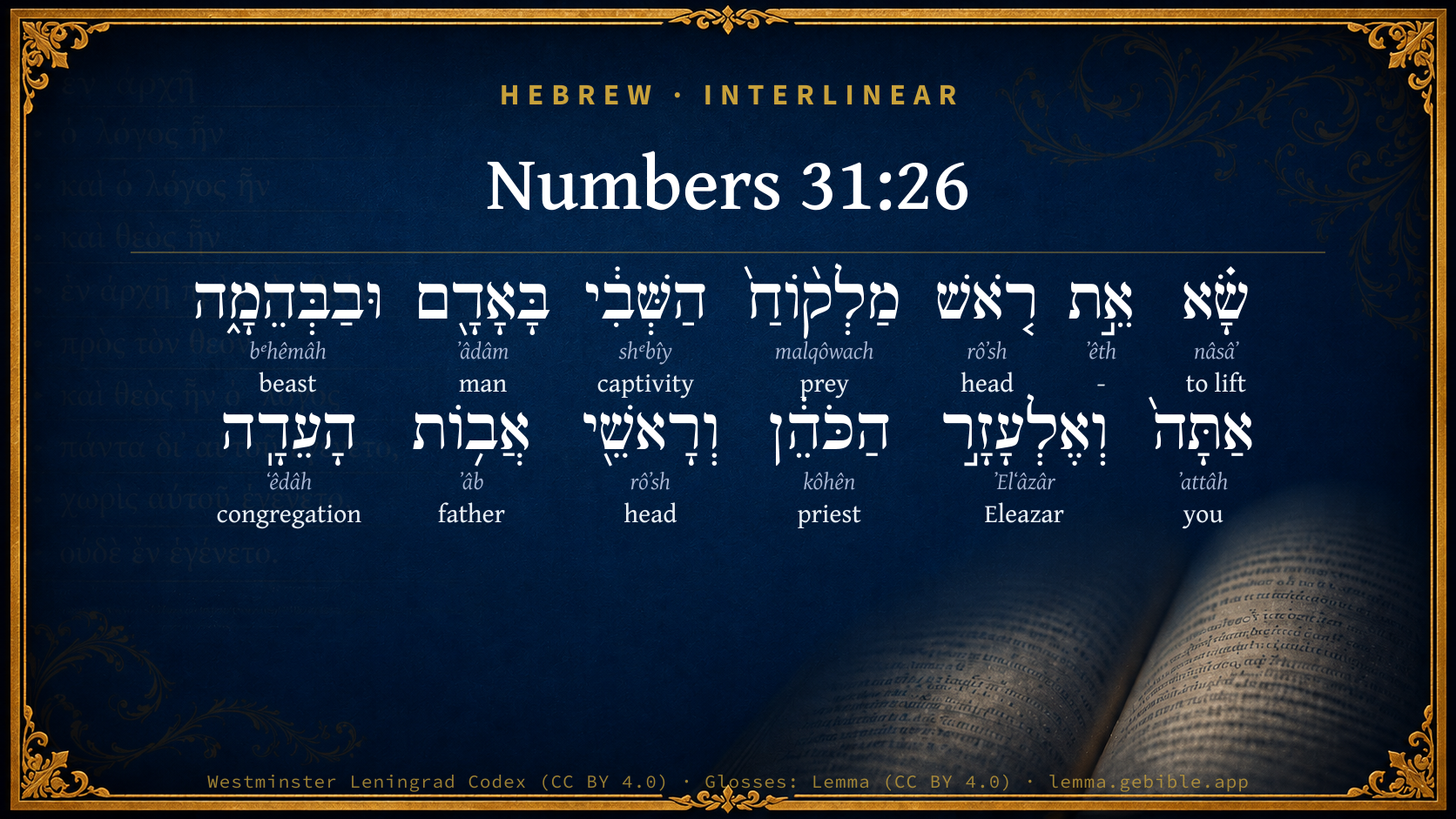
  1. שָׂ֗א nâsâʼ H5375 “lift” Verb, Qal, Imperative, 2nd Person, Masculine, Singular
  2. אֵ֣ת ʼêth H853 “-” Particle, Direct Object
  3. רֹ֤אשׁ rôʼsh H7218 “head of” Noun, Common, Masculine, Singular, Construct
  4. הַשְּׁבִ֔י shᵉbîy H7628 “the · captivity” Particle, Definite Article + Noun, Common, Both, Singular, Absolute
  5. בָּאָדָ֖ם ʼâdâm H120 “in/at the · man” Preposition, Determined + Noun, Common, Masculine, Singular, Absolute
  6. וּבַבְּהֵמָ֑ה bᵉhêmâh H929 “and · in/at the · beast” Conjunction + Preposition, Determined + Noun, Common, Feminine, Singular, Absolute
  7. אַתָּה֙ ʼattâh H859 “you” Pronoun, Personal, 2nd Person, Masculine, Singular
  8. וְאֶלְעָזָ֣ר ʼElʻâzâr H499 “and · Eleazar” Conjunction + Noun, Proper
  9. הַכֹּהֵ֔ן kôhên H3548 “the · priest” Particle, Definite Article + Noun, Common, Masculine, Singular, Absolute
  10. וְרָאשֵׁ֖י rôʼsh H7218 “and · heads of” Conjunction + Noun, Common, Masculine, Plural, Construct
  11. אֲב֥וֹת ʼâb H1 “fathers of” Noun, Common, Masculine, Plural, Construct
  12. הָעֵדָֽה ʻêdâh H5712 “the · congregation” Particle, Definite Article + Noun, Common, Feminine, Singular, Absolute

About this verse

These counts appear in no published source. They are computed here, from the morphology-tagged text and Lemma’s own curated glosses. What Lemma adds →

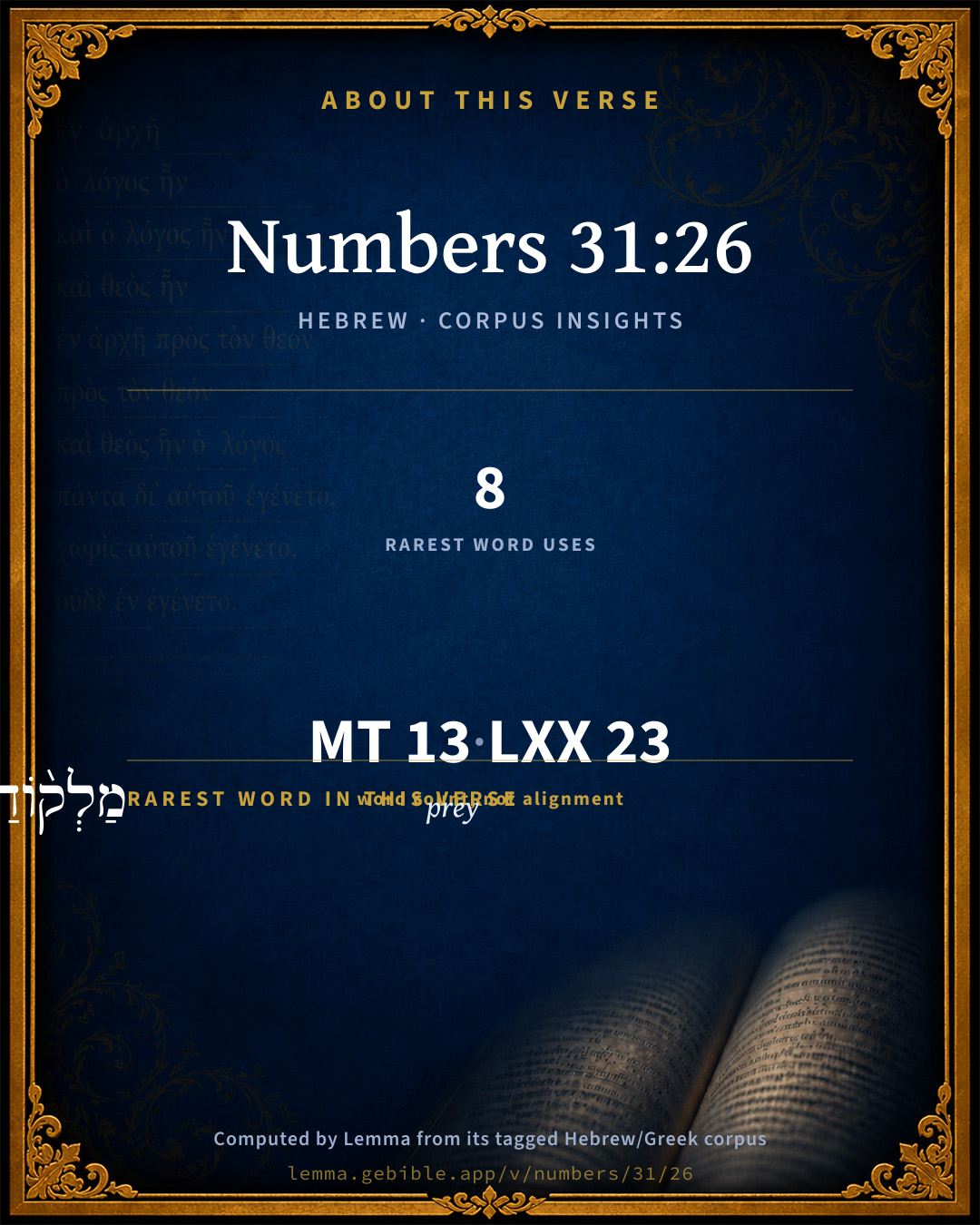
13
words
12
distinct lemmas
Pentateuch
section

Notable vocabulary

The rarest word here is מַלְק֨וֹחַ֙ prey H4455 — appearing just 8 times in the whole Hebrew Bible.

Shared distinctive vocabulary

מַלְק֨וֹחַ֙ prey H4455 occurs in 8 verses of the Hebrew Bible. Also found in:

Grammatical profile

  • 1 verb
  • 10 nouns
  • 1 pronoun
  • 1 particle

Verb forms

  • שָׂ֗א Qal · Imperative

Repetition

A word recurs within this verse — often emphatic in Hebrew:

  • רֹ֤אשׁ head H7218 ×2

Hebrew & Septuagint length

In English translation the verse runs 30 words from the Hebrew and 28 from the Septuagint (LXX English) — closely comparable.

A rough comparison of the two English renderings, which tokenize alike — not a word-level alignment.

Word counts can differ between the Hebrew and the Greek without any difference in meaning — e.g. the Hebrew direct-object marker אֵת has no separate Greek word, and Greek often adds the article ὁ.

In the original languages it is 13 Hebrew tokens and 23 Greek tokens — but the two are counted differently (Hebrew bundles its prefixes and suffixes into one token; the Greek is in lemma form), so that isn’t a like-for-like length.

Hebrew and Greek witnesses Masoretic Hebrew ↔ Greek Septuagint

The same verse in the two great witnesses to the Old Testament, shown verse-for-verse.

These are two independent witnesses, not word-aligned to each other, and the Septuagint is shown in lemma (dictionary) form.

Hebrew Numbers 31:26 Masoretic · Westminster Leningrad Codex

שָׂ֗א אֵ֣ת רֹ֤אשׁ מַלְק֨וֹחַ֙ הַשְּׁבִ֔י בָּאָדָ֖ם וּבַבְּהֵמָ֑ה אַתָּה֙ וְאֶלְעָזָ֣ר הַכֹּהֵ֔ן וְרָאשֵׁ֖י אֲב֥וֹת הָעֵדָֽה

Take the sum of the prey that was taken, both of man and of animal, you, and Eleazar the priest, and the heads of the fathers' [houses] of the congregation;

World English Bible · Public Domain

Greek LXX Numbers 31:26 Septuagint · lemma form

λαμβάνω ὁ κεφάλαιον ὁ σκῦλον ὁ αἰχμαλωσία ἀπό ἄνθρωπος ἕως κτῆνος σύ καί ελεαζαρ ὁ ἱερεύς καί ὁ ἄρχων ὁ πατριά ὁ συναγωγή

Take the sum of the spoils of the captivity both of man and beast, you and Eleazar the priest, and the heads of the families of the congregation.

LXX2012 (modern English Septuagint) · Public Domain

On this verse, The Pulpit Commentary discusses the Septuagint’s reading. Read the note in Commentary ↓

Hebrew: Westminster Leningrad Codex (CC BY 4.0). Greek: Septuagint (public domain); English from LXX2012 (modern English Septuagint) (Public Domain). How the Septuagint differs from the Hebrew →

Targum (Aramaic paraphrase)

2

The Targum is the ancient Jewish Aramaic paraphrase of the Hebrew Scriptures — an interpretive translation, not the Hebrew text itself. Onkelos (literal) and Pseudo-Jonathan (expansive) render the Torah, and Jonathan the Prophets. Coverage is partial: where no permissively-licensed English translation exists for a verse, only the Aramaic is shown. This is verse-level text, not a word-by-word alignment to the Hebrew.

  1. Targum Onkelos Torah (Genesis–Deuteronomy)
    קַבֵּל יָת חוּשְׁבַּן דַבְרַת שִׁבְיָא בֶּאֱנָשָׁא וּבִבְעִירָא אַתְּ וְאֶלְעָזָר כַּהֲנָא וְרֵישֵׁי אֲבָהַת כְּנִשְׁתָּא

    (no public-domain English translation for this verse)

    Targum Onkelos — Aramaic: “Onkelos Genesis” (public domain); “Onkelos Exodus” (public domain); “Onkelos Leviticus” (public domain); “Onkelos Numbers” (public domain); “Onkelos Deuteronomy” (public domain). English: “Sefaria Community Translation” (CC0 1.0 (public-domain dedication)); “J.W. Etheridge. The Targums of Onkelos and Jonathan Ben Uzziel on the Pentateuch. London: Longmans, Green, 1862” (public domain). Text via Sefaria.

  2. Targum Pseudo-Jonathan Torah (Genesis–Deuteronomy)
    סַב יַת שֵׁירוּי בִּיזַת שִׁבְיָיתָא בְּאֵינָשָׁא וּבִבְעִירָא וּתְקַבֵּיל חוּשְׁבָּנָא אַנְתְּ וְאֶלְעָזָר כַּהֲנָא וְרֵישֵׁי אַבְהַת כְּנִישְׁתָּא

    Take the sum of the prey of the captives, both of man and beast, and take their amount, thou and Elazar the priest, and the chiefs of the fathers of the congregation;

    Targum Pseudo-Jonathan — Aramaic: “Targum Jonathan on Genesis” (public domain); “Targum Jonathan on Exodus” (public domain); “Targum Jonathan on Leviticus” (public domain); “Targum Jonathan on Numbers” (public domain); “Targum Jonathan on Deuteronomy” (public domain). English: “The Targum of Jonathan ben Uzziel, trans. J. W. Etheridge, London, 1862” (public domain). Text via Sefaria.

Commentary

Notes on Numbers 31:26 from classic Christian and Jewish commentators (each source and its license shown beneath its notes). The classic Christian expositions comment on the surrounding passage and are grouped to its opening verse, so a note may address several verses; the Jewish commentaries on the Tanakh (Rashi and others) are per-verse, so they appear only where the commentator wrote on this verse.

Lemma curates 59 commentaries, every one of them public domain or Creative Commons licensed, each selected and text-cleaned for this edition rather than reprinted as found. About our sources →

John Gill's Exposition

And take it of their half,.... Of the half part of the prey divided to the soldiers:

and give it unto Eleazar the priest for an heave offering of the Lord; by way of thanksgiving for the success and victory, God had given them, by means of which so much booty had fallen into their hands.

John Gill's Exposition of the Whole Bible (1746–1763) — public domain (CC PDM 1.0). Text via the HelloAO Bible API.

Whedon's Commentary on the Bible

Daniel D. Whedon

THE ALLOTMENT OF THE SPOILS, Num_31:25-47.

26. Chief fathers — This means heads of the fathers’ houses. See full form, Exo_6:14.

Daniel D. Whedon (gen. ed.), Commentary on the Old and New Testaments (1874–1909) — public domain. Text from a community e-Sword module.

The Pulpit Commentary

Take the sum of the prey. No notice is taken here of the spoil (see on verse 11), but only of the captured children and cattle. And the chief fathers. Perhaps twOba (fathers) stands here for twObaAtyBe (fathers" houses). So the Septuagint, oi arcontev twn patriwn .

The Pulpit Commentary (1880–1919), ed. H.D.M. Spence-Jones & Joseph S. Exell — public domain. Text from a community e-Sword module.

Rashi

Rabbi Shlomo Yitzchaki (Rashi)

שאו את ראש means, TAKE THE CENSUS.

Rashi on the Tanakh — English translations: “The Judaica Press complete Tanach with Rashi, translated by A. J. Rosenberg” (CC BY 4.0); “Pentateuch with Rashi's commentary by M. Rosenbaum and A.M. Silbermann, 1929-1934” (public domain); “The Metsudah Tanach series, Lakewood, N.J” (CC BY 4.0); and “The Book of Joshua, Metsudah Publications, 1997” (CC BY 4.0). Text via Sefaria.

Ibn Ezra

Rabbi Abraham ibn Ezra

Booty seized. Livestock.

Captured. Human beings. It is missing the connecting word “and,” as in (Chabakuk 3:11): “שמש ירח (sun and moon).”

And the leaders of the community. These are the nesi’im.

Ibn Ezra on the Tanakh — English translations: “Sefaria Community Translation” (CC0 1.0 (public-domain dedication)); “Yalkut, Sifsei Chachomim Chumash, Metsudah Publications, 2009” (CC BY 4.0); and “Commentary of Ibn Ezra on Isaiah - trans. by M. Friedlander, 1873” (public domain). Text via Sefaria.

Lesson kit

Teaching starters — assembled from the data on this page, not authored interpretation. Every prompt links to the verse data it draws on. Edit before teaching.

Numbers, in the Pentateuch, opens this verse with 13 words (12 distinct Hebrew lemmas). Its most distinctive word is malqôwach (“prey”). A historical commentator’s framing appears above. Read the whole chapter for the surrounding context.

Discussion questions

  1. The word malqôwach carries the sense “prey.” How does it shape the verse?
  2. Numbers 31:11 shares the word «prey» with this verse. How do the two illuminate each other?
  3. “head” occurs 2× in this one verse. What is the effect of the repetition?
  4. These translations render this verse differently; the difference is in the English rendering, not the original. What questions does that raise?
  5. The verb «שָׂ֗א» is Qal Imperative. How does its form color the action?
  6. Reading how John Gill's Exposition and Whedon's Commentary on the Bible read this verse, where do the two commentators agree and where do they part?

Things to notice

Reading settings

Reading text

Shown beneath each verse's original-language words.

Old Testament
Old Testament edition

Read the OT as the Masoretic Hebrew (MT) or the Greek Septuagint (LXX).

English shown for the Greek Septuagint (in the Hebrew ↔ Greek comparison).

Comparing translations? Open the Compare panel on any verse page to stack up to four side by side.