1 Chronicles 9:2

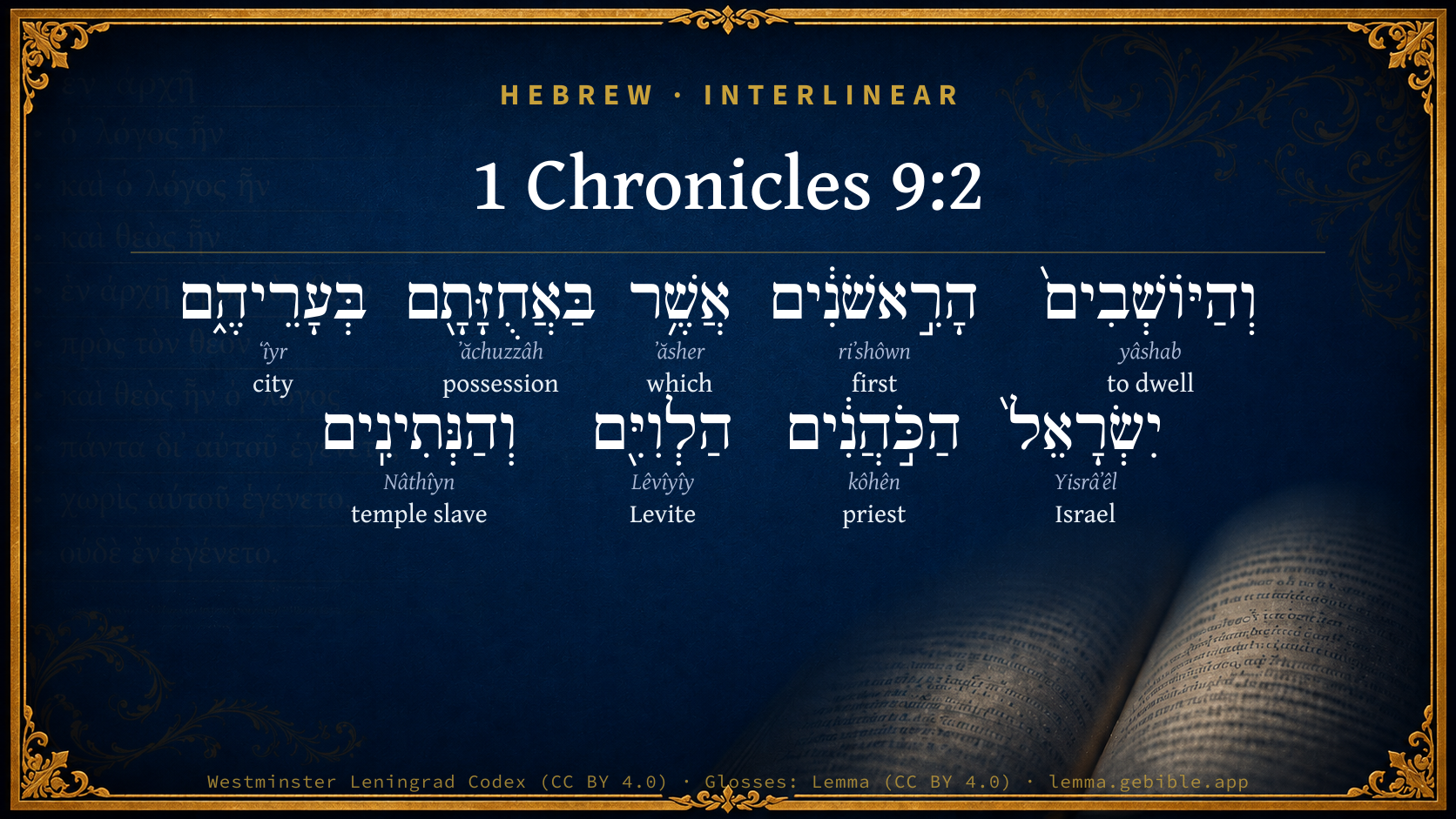
Hebrew (Westminster Leningrad Codex) 1 Chronicles 9:2 appears in the Hebrew Old Testament. The text above is from the Westminster Leningrad Codex. Each word links to its Strong’s number, a concise gloss, and parsing drawn from the Open Scriptures Hebrew Bible morphology. Click any word for its full Brown-Driver-Briggs (BDB) entry.
Download image
Cite this verse

1 Chronicles 9:2 (World English Bible). Public Domain. Lemma interlinear Bible study tool, https://lemma.gebible.app/v/1-chronicles/9/2.

Show BibTeX & RIS
BibTeX
RIS
English Translation
Now the first inhabitants who lived in their possessions in their cities were Israel, the priests, the Levites, and the Nethinim.
World English Bible · Public Domain
Highlights
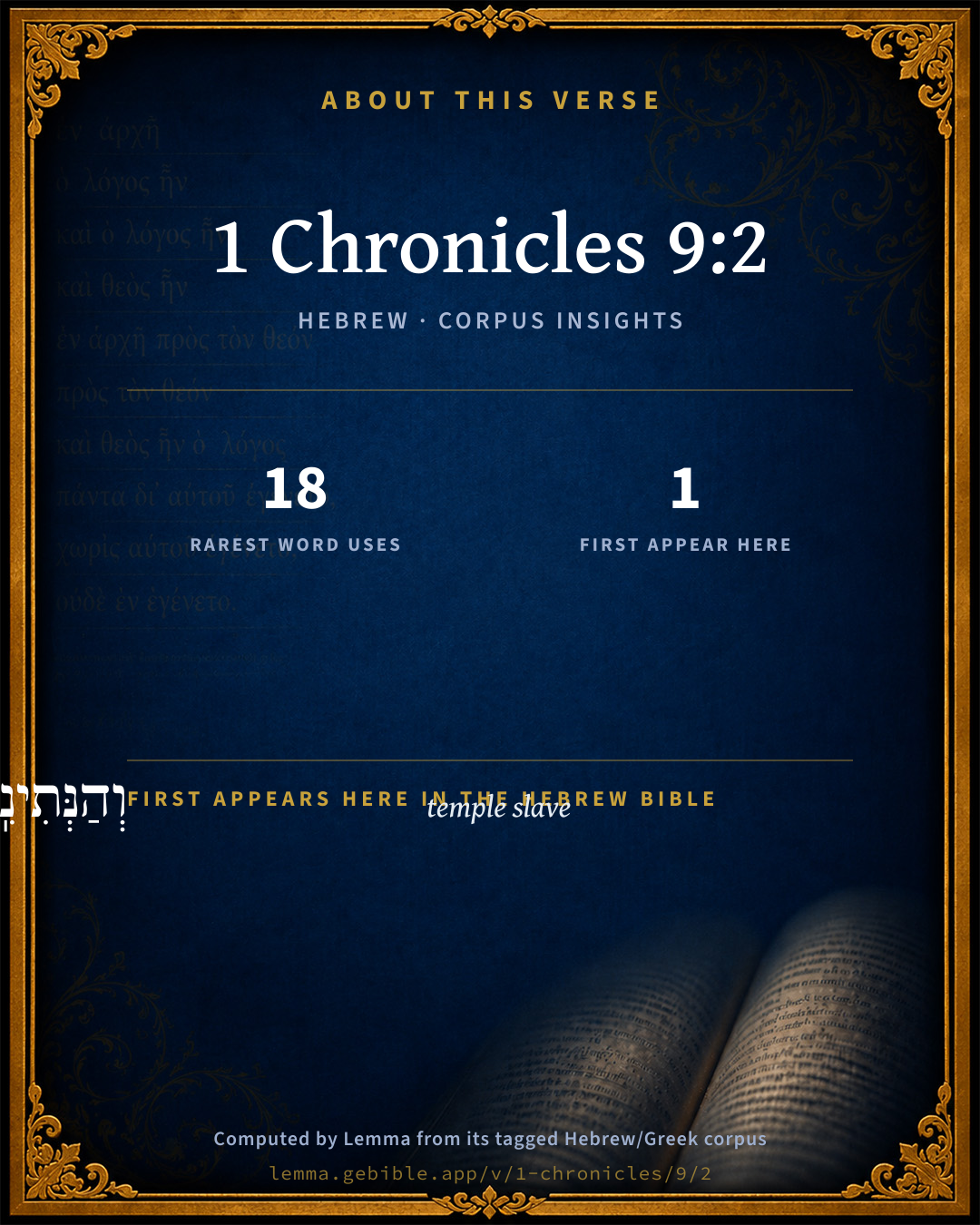
  • 1 first appearance in the Hebrew Bible
Full analysis ↓
Download a study sheet

One document with this verse’s original text, its word-by-word gloss line, the meaning frame, cross-references with their text, attributed commentary, and full source and license credits — printable, and it pastes into notes with its structure intact.

This verse Autodidact and up

Study sheet (.html) Plain text (.txt)

A passage Seminary Student

Up to 50 verses in one chapter. A passage sheet keeps up to 6 commentary sources and 12 cross-references per verse, in the order this page ranks them, and says so on the sheet whenever that leaves anything out. Ask for a single verse and you get the Autodidact verse sheet above.

Everything on this page stays free to read, with no account — the sheet is a download of what is already on screen, not access to it.

Want to remove ads? Support Godless Engineer
Compare translations 3

The same verse in 3 English versions, stacked beneath the original-language interlinear above. Click any original word for its lexicon entry.

Each is an independent rendering of the whole verse — the interlinear is not word-aligned to these translations.

Highlighted words mark where these versions differ — a whole-verse word diff, not a word-by-word alignment.

  • World English Bible Public Domain
    Now the first inhabitants who lived in their possessions in their cities were Israel, the priests, the Levites, and the Nethinim.
  • King James Version Public Domain
    Now the first inhabitants that dwelt in their possessions in their cities were, the Israelites, the priests, Levites, and the Nethinims.
  • unfoldingWord Literal Text CC BY-SA 4.0
    And the first dwellers who in their holding in their cities Israel, priests, Levites, and temple servants.

unfoldingWord Literal Text — © unfoldingWord, licensed CC BY-SA 4.0. Word-aligned USFM3 via Door43 (git.door43.org/unfoldingWord/en_ult).

Versions to compare (up to 4)

3 of 4 selected

Show all 18 translations

Every available English version of this verse, each an independent rendering of the whole verse.

  • World English Bible Public Domain
    Now the first inhabitants who lived in their possessions in their cities were Israel, the priests, the Levites, and the Nethinim.
  • Berean Standard Bible Public Domain
    Now the first to resettle their own property in their cities were Israelites, priests, Levites, and temple servants.
  • Majority Standard Bible Public Domain
    Now the first to resettle their own property in their cities were Israelites, priests, Levites, and temple servants.
  • King James Version Public Domain
    Now the first inhabitants that dwelt in their possessions in their cities were, the Israelites, the priests, Levites, and the Nethinims.
  • American Standard Version (1901) Public Domain
    Now the first inhabitants that dwelt in their possessions in their cities were Israel, the priests, the Levites, and the Nethinim.
  • Revised Version (1885) Public Domain
    Now the first inhabitants that dwelt in their possessions in their cities were, Israel, the priests, the Levites, and the Nethinim.
  • Geneva Bible (1599) Public Domain
    And the chiefe inhabitants that dwelt in their owne possessions, and in their owne cities, euen Israel the Priestes, the Leuites, and the Nethinims.
  • Douay-Rheims (1899) Public Domain
    Now the first that dwelt in their possessions, and in their cities, were the Israelites, and the priests, and the Levites, and the Nathineans.
  • Young's Literal Translation Public Domain
    And the first inhabitants, who `are' in their possession, in their cities, of Israel, `are' the priests, the Levites, and the Nethinim.
  • Literal Standard Version CC BY-SA 4.0
    And the first inhabitants, who [are] in their possession, in their cities, of Israel, [are] the priests, the Levites, and the Nethinim.
  • Unlocked Literal Bible CC BY-SA 4.0
    The first to resettle in their cities were some Israelites, priests, Levites, and temple servants.
  • unfoldingWord Literal Text CC BY-SA 4.0
    And the first dwellers who in their holding in their cities Israel, priests, Levites, and temple servants.
  • Darby Bible Public Domain
    And the inhabitants that were first in their possessions in their cities were the Israelites, the priests, the Levites, and the Nethinim.
  • World Messianic Bible Public Domain
    Now the first inhabitants who lived in their possessions in their cities were Israel, the priests, the Levites, and the temple servants.
  • Webster's Bible Public Domain
    Now the first inhabitants that dwelt in their possessions in their cities were, the Israelites, the priests, Levites, and the Nethinims.
  • Free Bible Version CC BY-SA 4.0
    The first to return and reclaim their property and live in their towns were some Israelites, priests, Levites, and Temple servants.
  • Bible in Basic English Public Domain
    Now the first to take up their heritage in their towns were: Israel, the priests, the Levites, and the Nethinim.
  • JPS Tanakh (1917) Public Domain
    Now the first inhabitants that dwelt in their possessions in their cities were, Israelites, the priests, the Levites, and the Nethinim.

Literal Standard Version (2020), Covenant Press — licensed CC BY-SA 4.0. Text via the HelloAO Bible API (eBible.org). Unlocked Literal Bible (unfoldingWord) — licensed CC BY-SA 4.0. Text via the HelloAO Bible API (eBible.org). unfoldingWord Literal Text — © unfoldingWord, licensed CC BY-SA 4.0. Word-aligned USFM3 via Door43 (git.door43.org/unfoldingWord/en_ult). Free Bible Version, Dr. Jonathan Gallagher — licensed CC BY-SA 4.0. Text via the HelloAO Bible API (eBible.org).

Word by word

More ways to search: Search by grammar → Find every occurrence → Compare this word →

Practice this passage: Drill this verse → Learn its vocabulary →

וְהַנְּתִינִֽים
Nâthîyn
H5411
“and · the · temple slaves”
Conjunction + Particle, Definite Article + Noun, Common, Masculine, Plural, Absolute
Part of Speech
Conjunction + Particle + Noun
Type
Common
Gender
Masculine
Number
Plural
State
Absolute
Full BDB Definition

Origin: from H5414

TWOT: 1443a

Nethinims - temple slaves assigned to the Levites and priests for service in the sanctuary
  1. וְהַיּוֹשְׁבִים֙ yâshab H3427 “and · the · dwelling” Conjunction + Particle, Definite Article + Verb, Qal, Participle Active, Masculine, Plural, Absolute
  2. הָרִ֣אשֹׁנִ֔ים riʼshôwn H7223 “the · first” Particle, Definite Article + Adjective, Adjective, Masculine, Plural, Absolute
  3. אֲשֶׁ֥ר ʼăsher H834 “which” Particle, Relative
  4. בַּאֲחֻזָּתָ֖ם ʼăchuzzâh H272 “in/at · possession · their” Preposition + Noun, Common, Feminine, Singular, Construct + Suffix, Personal, 3rd Person, Masculine, Plural
  5. בְּעָרֵיהֶ֑ם ʻîyr H5892 “in/at · cities · their” Preposition + Noun, Common, Feminine, Plural, Construct + Suffix, Personal, 3rd Person, Masculine, Plural
  6. יִשְׂרָאֵל֙ Yisrâʼêl H3478 “Israel” Noun, Proper
  7. הַכֹּ֣הֲנִ֔ים kôhên H3548 “the · priests” Particle, Definite Article + Noun, Common, Masculine, Plural, Absolute
  8. הַלְוִיִּ֖ם Lêvîyîy H3881 “the · Levites” Particle, Definite Article + Noun, Gentilic, Masculine, Plural, Absolute

About this verse

These counts appear in no published source. They are computed here, from the morphology-tagged text and Lemma’s own curated glosses. What Lemma adds →

9
words
9
distinct lemmas
Historical
section

Notable vocabulary

The rarest word here is וְהַנְּתִינִֽים temple slave H5411 — appearing just 18 times in the whole Hebrew Bible.

First appearance in Scripture

This word makes its first canonical appearance in the Hebrew Bible here:

  • וְהַנְּתִינִֽים temple slave H5411

Shared distinctive vocabulary

וְהַנְּתִינִֽים temple slave H5411 occurs in 15 verses of the Hebrew Bible. Also found in:

Grammatical profile

  • 1 verb
  • 6 nouns
  • 1 adjective
  • 1 particle

Verb forms

  • וְהַיּוֹשְׁבִים֙ Qal · Participle Active

Hebrew & Septuagint length

In English translation the verse runs 21 words from the Hebrew and 21 from the Septuagint (LXX English) — the same length.

A rough comparison of the two English renderings, which tokenize alike — not a word-level alignment.

Word counts can differ between the Hebrew and the Greek without any difference in meaning — e.g. the Hebrew direct-object marker אֵת has no separate Greek word, and Greek often adds the article ὁ.

Cross-references

8

Topical passages linked to 1 Chronicles 9:2 in the Treasury of Scripture Knowledge — connected by theme and wording, ordered by reader-vote popularity; previews shown in the World English Bible.

  • Nehemiah 7:73 So the priests, and the Levites, and the porters, and the singers, and some of the people, and the Nethinim, and all Israel, lived in their cities. When the seventh month was come, the children of Israel were in their cities.
  • Ezra 2:58 All the Nethinim, and the children of Solomon's servants, were three hundred ninety-two.
  • Ezra 2:70 So the priests, and the Levites, and some of the people, and the singers, and the porters, and the Nethinim, lived in their cities, and all Israel in their cities.
  • Ezra 8:20 and of the Nethinim, whom David and the princes had given for the service of the Levites, two hundred and twenty Nethinim: all of them were mentioned by name.
  • Ezra 2:43 The Nethinim: the children of Ziha, the children of Hasupha, the children of Tabbaoth,
  • Nehemiah 7:60 All the Nethinim, and the children of Solomon's servants, were three hundred ninety-two.
  • Joshua 9:21–27 The princes said to them, Let them live: so they became wood cutters and drawers of water to all the congregation, as the princes had spoken to them.
  • Nehemiah 11:3–22 Now these are the chiefs of the province who lived in Jerusalem: but in the cities of Judah lived everyone in his possession in their cities, [to wit], Israel, the priests, and the Levites, and the Nethinim, and the children of Solomon's servants.

Cross-references courtesy of OpenBible.info (CC BY 4.0).

Hebrew and Greek witnesses Masoretic Hebrew ↔ Greek Septuagint

The same verse in the two great witnesses to the Old Testament, shown verse-for-verse.

These are two independent witnesses, not word-aligned to each other, and the Septuagint is shown in lemma (dictionary) form.

Hebrew 1 Chronicles 9:2 Masoretic · Westminster Leningrad Codex

וְהַיּוֹשְׁבִים֙ הָרִ֣אשֹׁנִ֔ים אֲשֶׁ֥ר בַּאֲחֻזָּתָ֖ם בְּעָרֵיהֶ֑ם יִשְׂרָאֵל֙ הַכֹּ֣הֲנִ֔ים הַלְוִיִּ֖ם וְהַנְּתִינִֽים

Now the first inhabitants who lived in their possessions in their cities were Israel, the priests, the Levites, and the Nethinim.

World English Bible · Public Domain

Greek LXX 1 Chronicles 9:2 Septuagint · lemma form

καί ὁ καταοἰκέω πρότερον ἐν ὁ κατάσχεσις αὐτός ἐν ὁ πόλις ἰσραήλ ὁ ἱερεύς ὁ λευίτης καί ὁ δίδωμι

And they that lived before in their possessions in the cities of Israel, the priests, the Levites, and the appointed ones.

LXX2012 (modern English Septuagint) · Public Domain

On this verse, Joseph Benson's Commentary discusses the Septuagint’s reading. Read the note in Commentary ↓

Hebrew: Westminster Leningrad Codex (CC BY 4.0). Greek: Septuagint (public domain); English from LXX2012 (modern English Septuagint) (Public Domain). How the Septuagint differs from the Hebrew →

Commentary

Notes on 1 Chronicles 9:2 from classic Christian and Jewish commentators (each source and its license shown beneath its notes). The classic Christian expositions comment on the surrounding passage and are grouped to its opening verse, so a note may address several verses; the Jewish commentaries on the Tanakh (Rashi and others) are per-verse, so they appear only where the commentator wrote on this verse.

Lemma curates 59 commentaries, every one of them public domain or Creative Commons licensed, each selected and text-cleaned for this edition rather than reprinted as found. About our sources →

Trapp's Complete Commentary

John Trapp

1Ch 9:2 Now the first inhabitants that [dwelt] in their possessions in their cities [were], the Israelites, the priests, Levites, and the Nethinims.

Ver. 2. Now the first inhabitants,] sc., After the return from captivity. {Ezr 1:1-11; Ezr 2:1-60}

That dwelt in their possessions.] The same they had before the captivity. A wonderful providence of God it was, that as the land kept her Sabbaths for those seventy years, so the country should be all that while kept empty, till the return of the natives: for we read not that any colonies were sent thither, nor any displaced to make room for these at their return.

And the Nethinims.] Dedititii; these were the posterity of those old Gibeonites. {Jos 9:3-17} {See Trapp on "Ezr 2:58"} Vocati ad vilia officia Deum respiciant, &c. {a}

{a} Lavat.

John Trapp, A Commentary or Exposition upon All the Books of the Old and New Testament (1647–1656) — public domain. Text from a community e-Sword module.

Joseph Benson's Commentary

1Ch 9:2. The first — After the return from Babylon. That dwelt in their possessions — That took possession of their own lands and cities, which had been formerly allotted them, but of late years had been taken from them for their sins, and possessed by other people. Israelites — The common people of Judah and Israel, called here by the general name of Israelites, which was given them before that unhappy division of the kingdoms; and now is restored to them, when the Israelites are united with the Jews in one and the same commonwealth, that so all the names and signs of their former division might be blotted out. And though the generality of the ten tribes were yet in captivity, yet divers of them, upon Cyrus’s general proclamation, associated themselves, and returned with those of Judah and Benjamin. Levites — These took possession of the cities belonging to them, as they had need and opportunity. Nethinims — A certain order of men, either Gibeonites, or others joined with them, who were נתינים, nethinim, given to the priests and Levites for performing the servile offices of the tabernacle or temple: accordingly the LXX. in this place render the word by δεδομενοι, persons given. Thus Joshua gave the Gibeonites to be hewers of wood, &c., Jos 9:21; Jos 9:27. That they might attend upon their work without distraction, they had certain places and possessions given to them, which they are now said to repossess.

Joseph Benson's Commentary on the Old and New Testaments (1811–1818) — public domain. Text from a community e-Sword module.

Geneva Bible (1599)

Geneva Bible translators

Meaning, the Gibeonites, which served in the Temple, read Josh. 9:13.

Geneva Bible (1599) marginal notes — public domain. Text via Bolls.life.

Jamieson, Fausset & Brown

Robert Jamieson, A. R. Fausset & David Brown

the first inhabitants that dwelt in their possessions--This chapter relates wholly to the first returned exiles. Almost all the names recur in Nehemiah (Neh. 11:1-36), although there are differences which will be explained there. The same division of the people into four classes was continued after, as before the captivity; namely, the priests, Levites, natives, who now were called by the common name of Israelites, and the Nethinims (Jos 9:27; Ezr 2:43; Ezr 8:20). When the historian speaks of "the first inhabitants that dwelt in their possessions," he implies that there were others who afterwards returned and settled in possessions not occupied by the first. Accordingly, we read of a great number returning successively under Ezra, Nehemiah, and at a later period. And some of those who returned to the ancient inheritance of their fathers, had lived before the time of the captivity (Ezr 3:12; Hag 2:4, Hag 2:10).

Jamieson, Fausset & Brown — Commentary Critical and Explanatory on the Whole Bible (1871) — public domain (CC PDM 1.0). Text via the HelloAO Bible API.

Adam Clarke's Commentary

Verse 2. Now the first inhabitants] This is spoken of those who returned from the Babylonish captivity, and of the time in which they returned; for it is insinuated here that other persons afterwards settled at Jerusalem, though these mentioned here were the first on the return from the captivity. Properly speaking, the divisions mentioned in this verse constituted the whole of the Israelitish people, who were, ever since the days of Joshua, divided into the four following classes:

1. The priests.

2. The Levites.

3. The common people, or simple Israelites.

4. The Nethinim, or slaves of the temple, the remains of the Gibeonites, who, having deceived Joshua, were condemned to this service Jos 9:21, &c. In David's time it is probable that other conquered people were added, as the successors of the Gibeonites were not sufficient to perform all the drudgery of the temple service.

Adam Clarke's Commentary on the Bible (1810–1826) — public domain. Text from a community e-Sword/MySword module.

The Cambridge Bible for Schools and Colleges

gen. ed. J. J. S. Perowne

2. The text of this verse seems to be faulty, but the meaning is probably the same as in Ezr_2:70 (cp. ibid. Ezr_2:1). Now those who first returned from Babylon to dwell in Judaea, again, dwelt (not in Jerusalem, but) in their own cities; this did they all whether they were laymen, priests, Levites; or Nethinim.

the first inhabitants] The word “first” here corresponds with the phrase “the chiefs of the province” in Neh_11:3 (R.V.), and may be interpreted by it, for “first” gives no satisfactory sense if understood in reference to time. The list which follows (1Ch_9:4 ff.) is a list of chief men.

were] They belonged to the following four classes:

the Israelites] R.V. Israel, i.e. laymen as distinguished from men of Levitical descent. According to 1Ch_9:3 Israel included at least Judah, Benjamin, Ephraim, and Manasseh (cp. Psa_80:2, where Judah—the speaker—associates Ephraim, Benjamin, and Manasseh with herself in her appeal to the God of Israel). This is a totally different usage from that of earlier times, when Israel meant the Northern kingdom, and Judah the Southern.

Levites] R.V. the Levites.

Nethinims] R.V. Nethinim. These were a class of Temple servants reckoned as inferior to the Levites. Perhaps they were of foreign extraction and included the Gibeonites (cp. Jos_9:23). They are mentioned nowhere else in the Old Testament except in the books of Ezra and Nehemiah, See Ryle’s note on Ezr_2:43.

The Cambridge Bible for Schools and Colleges (gen. ed. J. J. S. Perowne; Cambridge University Press, 1878–1918) — public domain. Text from a community e-Sword module.

John Gill's Exposition

Now the first inhabitants that dwelt in their possessions in their cities,.... Who first returned from Babylon upon the proclamation of Cyrus, and enjoyed their former possessions, and dwelt in the cities they had before, or in such as were allotted them, or they chose:

were, the Israelites, the priests, Levites, and the Nethinims; the whole body that returned were divided into four classes, as they had been before the captivity; the Israelites were the common people in general, the body politic; the priests, the ecclesiastics, who officiated in sacred things; the Levites, who ministered to them; and the Nethinims were such persons as were "given", as the word signifies, to do servile work for the sanctuary, as, to be hewers of wood and drawers of water; such were the Gibeonites, Jos 9:27, and such as were appointed by David for such work, see Ezr 8:20.

John Gill's Exposition of the Whole Bible (1746–1763) — public domain (CC PDM 1.0). Text via the HelloAO Bible API.

Albert Barnes' Notes on the Bible

The first inhabitants - i. e. the first inhabitants of the holy land after the return from the captivity. They are enumerated under four heads:

(1) Israelites, i. e. the mass of the laity, whether belonging to the ten tribes or the two;

(2) priests;

(3) Levites; and

(4) the lowest order of the ministry, the Nethinims.

These last, whose name is derived from a root “to give,” were a sort of sacred slaves - persons “given” to the Levites to perform the more laborious duties of the sanctuary. Some had been “given” as early as the time of Moses Num 31:47; and the number afterward increased Jos 9:23; Ezr 8:20. At the time of the return from the captivity, owing to the small number of Levites who came back Ezr 2:40-42, the services of the Nethinims became very important. They are mentioned under the name of Nethinims only in Chronicles, Ezra, and Nehemiah.

Albert Barnes' Notes on the Bible (1834–1885) — public domain. Text from a community e-Sword/MySword module.

Haydock's Catholic Bible Commentary

First. He only treats of those who returned first, (Tirinus) under Esdras. (Haydock) --- Nehemias brought back others, and more returned afterwards. Many also retook possession of their lands, which they had enjoyed before the captivity, 1 Esdras iii. 12. --- Nathineans. These were the posterity of the Gabaonites, whose office was to bring wood, water, &c., for the service of the temple. (Challoner) (Josue ix. 27.) --- David and Solomon consigned others of the Chanaanites, whose lives they spared, to perform the same office. They were like public slaves. The number of those who returned was so small, that days were appointed for all the people to help to carry wood for the temple. At Jerusalem the Nathineans, "or people given," resided on the east side of the city; (2 Esdras ii. 26.) and other towns were assigned them, 1 Esdras ii. 70. (Calmet) --- The people continued to be divided into four classes, as they had been before the captivity. (Malvenda)

George Leo Haydock (1774–1849), Haydock's Catholic Family Bible and Commentary, 1859 edition — public domain. Excludes Psalms (Douay-Rheims chapter numbering differs from Protestant) and Deuterocanonical books (Catholic canon only).

Matthew Poole's English Annotations

The first inhabitants; the first after the return from Babylon.

That dwelt in their possessions in their cities, i.e. that took possession of their own lands and cities, which had been formerly allotted to them; but of late years had been taken from them for their sins, and possessed by other people.

The Israelites, i.e. the common people of Judah and Israel, called here by the general name of Israelites, which was given to them before that unhappy division of the two kingdoms, and now is restored to them when the Israelites are united with the Jews in one and the same commonwealth, that so all the names and signs of their former division might be blotted out. And although the generality of the ten tribes were yet in captivity, yet divers of them were now returned; either such as had long before the captivity fled to Jerusalem to worship God, and joined themselves with Judah, as those 2Ch 11:16, and others; or such as, upon Cyrus’s general proclamation, associated themselves, and returned with those of Judah and Benjamin.

The priests, Levites; these took possession of the cities or places belonging to them, as they had need and opportunity. The

Nethinims; a certain order of men, either Gibeonites, or others joined with them, devoted to the service of God, and of his house, and of the priests and Levites; who, that they might attend upon their work without distraction, had certain places and possessions given to them; which they are now said to repossess.

Matthew Poole's English Annotations on the Holy Bible (1683–1685) — public domain. Text from a community e-Sword/MySword module.

Whedon's Commentary on the Bible

Daniel D. Whedon

2. Israelites… priests… Levites… Nethinim — Four classes of inhabitants. The Israelites here denote the mass of the people, the laity, as distinguished from the three classes next named.

The Nethinim — The given ones. Hebrew, נתינים; Septuagint οι δεδομενοι. Here this name first occurs as an appellative, though the participle Nethunim, (נתונם,) from the same root, is applied to the Levites of the time of Moses.

Num_3:9; Num_8:19. The Levites were given to Aaron and his sons to do service in the tabernacle. At a later time a number of captive Midianites were given to the Levites to assist them in the charge of the tabernacle, (Num_31:47;) and still later the Gibeonites were also given to be “hewers of wood and drawers of water for the congregation, and for the altar of the Lord.” Jos_9:27. Jewish tradition regards the Nethinim as descendants of those ancient Gibeonitish sanctuary slaves, so that they seem ever to have borne the stigma of a Canaanitish origin. Their work was to perform the menial and laborious service connected with the sanctuary, such as carrying wood and water, and any similar labour which the Levites might require of them. “The only period at which they rise into any thing like prominence, is that of the return from the captivity. In that return the priests were conspicuous and numerous; but the Levites, for some reason unknown to us, hung back. Under Zerubbabel there were but three hundred and forty-one Levites to four thousand two hundred and eighty-nine priests. Ezr_2:36-42. Under Ezra none came up till after a special call. Ezr_8:15. The services of the Nethinim were consequently of more importance, but in their case, also, the small number of those that joined indicates that many preferred remaining in the land of their exile to returning to their old service. Those that did come were consequently thought worthy of special mention. The names of their families were registered with as much care as those of the priests. Ezr_2:43-58. They were admitted, in strict conformity to the letter of the rule of Deu_29:11, to join in the great covenant with which the restored people inaugurated its new life. Neh_10:28. They, like the priests and Levites, were exempted from taxation by the Persian satraps. Ezr_7:24. They were also under the control of a chief of their own body. Ezr_2:43; Neh_7:46. They took an active part in the work of rebuilding the city, (Neh_3:26,) and the tower of Ophel was assigned to some of them as a residence, (Neh_11:21,) while others dwelt with the Levites in their cities. Ezr_2:70. They took their place in the chronicles of the time as next in order to the Levites.” — SMITH’S Bib. Dict.

Daniel D. Whedon (gen. ed.), Commentary on the Old and New Testaments (1874–1909) — public domain. Text from a community e-Sword module.

The Pulpit Commentary

Now the first inhabitants that dwelt in their possessions, in their cities. Authorities are very divided as to whether this expression describes inhabitants of the land before the Captivity or subsequent to it. Almost all the older authorities, and Keil amongst those of more modern date, take the former position; Movers, Bertheau, and others take the latter, as also Canon Rawlinson ("Speaker"s Commentary," 3:157, 211). It must be admitted that there is some obscurity, and which accounts for the contrariety of opinion. But obscurity and contrariety notwithstanding, a comparison of vers. 2 and 3 with Neh_11:1-4: produces two impressions almost irresistible, viz. that the difficulty is occasioned by some comparatively slight corruption or mutilation in our ver. 2; and that, whatever the reference is in, Neh_11:1-4 (and there is no ambiguity there) that it is in the present passage. The fourfold classification intends the Israel people (Isa_24:2; Hos_4:9) the priests, the Levites, the Nethinims, i.e. those given as helpers of the priests, bond-men of the temple (Num_8:18, 19 31:47; Ezr_2:40-48 Ezr_8:17, Ezr_8:20) Not before the time of the return does the name Nethinim seem to have crystallized upon this class of helpers, the explanation of which may possibly be that their numbers and their services then became so much more necessary. To this classification is added in Neh_11:3, "And the children of Solomon"s servants". (Ezr_2:55)

HOMILIES BY R. TUCK Ver. 2.

Returned captives.

The allusion made here to those who were the first to reoccupy their ancestral possessions in the Holy Land, may serve to introduce the subject of the returned captives, and may set us upon learning the permanent lessons of their restoration. Some account may be given of the moral and religious condition of the Jewish people while in Babylon; of the literary, national, and religious influences exerted upon them by the associations of their captivity; of their measure of fitness for restoration when the providential time came; and of the historical circumstances which led up to their release. For these topics valuable help may be gained from Stanley"s "Jewish Church," vol. 3. We only note one or two points which might be missed or under-estimated.

1. The work of the prophets of the Captivity, in distinctly connectingnational sufferings with national sins, and so producing a national repentance and a heart-return to Jehovah.

1. The influence exerted by the association of Babylonian idolatry withBabylonian tyranny; a similar influence to that exerted by the Egyptian experiences on the first fathers of their race.. They were made to feel that

2. idolatry could never assure national liberty; it is never anything but an engine of human tyranny man"s way of mastering and managing the bodies and minds of his fellow-men. The Jews have been, ever since the Captivity, the most strictly monotheistic race on the face of the earth.

3. The sympathy with the Jewish people which Cyrus, as a monotheist, was likely to feel.

4. And the limited and almost disappointing character of the first party toreturn. It was but a company representative of a national return. The majority of the Jews, having become settled and prosperous in the land of their exile, preferred to remain behind; only 42, 360, attended by 7337 servants, were found willing to return to their native land. That company started under the leadership of Zerubbabel, the head of the house of Judah, and grandson of King Jehoiachin. The chief effects of the Captivity upon the Jews have been thus summarized.

(1) The old tendency to idolatry had been eradicated;

(2) there had sprung up a deep reverence for the letter of the Law, and for their great lawgiver, Moses;

(3) the love of agriculture had declined, and had given place to a taste for commerce and trade;

(4) the vernacular language had undergone a change, the old Hebrew giving place to the Chaldee. Fixing our attention on the first returning company, we note

I THEY HAD RETURNED TO LOYALTY. That is, to their full allegiance to Jehovah, their one, immediate, invisible, spiritual King. This heart-return and national return was the essential preparation for their restoration; as we know that repentance, confession, conversion, and heart-return to God must ever precede the assurance of Divine forgiveness and acceptance. The sanctified influences of the Captivity bore directly upon bowing the people down in penitence and winning them to full allegiance to their God. So it may be impressively urged that Divine blessings are always held back until we are ready to receive them, and the great readiness is full openness to God, hearty loyalty to him.

II THEY NOW RETURNED TO PRIVILEGE. Explain their sentiment about their beloved land, as showing what a privilege they esteemed it to be only to go and dwell in it. They also had the privilege of comparative national liberty and independence. They might enjoy their family possessions. They might renew the Jehovah-worship. God would do great things for his loyal people whereof they might be glad.

III THEY FOUND THAT RETURN TO PRIVILEGE MEANT RETURN TO DUTY. A connection that is universally preserved and constantly repeated. Privilege never stands alone. No man can ever get it as an isolated and distinct thing. Responsibility and duty are always linked with it; and whoever will have privilege must have these things with it. The "returned captives" found that they were called to rebuild their city, retill their lands, restore their ceremonial worship, reorganize their governmental and social systems, secure their defence from external foes, raise again their demolished walls, and erect a new temple upon the ruins of the old. And, beyond such material things, they were bound to "occupy for God," they were to present such a model "state" as would effectively witness to all surrounding nations, and to all succeeding generations, of God"s high claims, God"s infinite justice, God"s triumphing mercy, and God"s sure faithfulness alike to his threatenings and to his promises. The forms in which, for us, duty follows privilege may be illustrated. Position brings influence, wealth brings power, learning brings claims, gifts bring spheres, piety brings the call to witness, etc.

Application may be made to God"s restorations from the sicknesses and calamities of life. When God brings us up again out of any "depths," we should feel as did David, "Before I was afflicted I went astray: but now have I kept thy Word." If we thought aright we should daily regard ourselves as urged to all holy endeavour by the pressure of the feeling that we are God"s "restored ones. R.T.

The Pulpit Commentary (1880–1919), ed. H.D.M. Spence-Jones & Joseph S. Exell — public domain. Text from a community e-Sword module.

John Wesley's Explanatory Notes

The first - After the return from Babylon. Dwelt - That took possession of their own lands and cities, which had been formerly allotted them; but of late years had been taken from them for their sins, and possessed by other people. Israelites - The common people of Judah and Israel, called here by the general name of Israelites, which was given them before that unhappy division of the kingdoms, and now is restored to them when the Israelites are united with the Jews in one and the same commonwealth, that so all the names and signs of their former division might be blotted out. And though the generality of the ten tribes were yet in captivity, yet divers of them upon Cyrus's general proclamation, associated themselves, and returned with those of Judah and Benjamin. Levites - These took possession of the cities belonging to them, as they had need and opportunity. Nethinims - A certain order of men, either Gibeonites or others joined with them, devoted to the service of God, and of his house, and of the priests and Levites; who, that they might attend upon their work without distraction, had certain places and possessions given to them; which they are now said to repossess.

John Wesley, Explanatory Notes Upon the Whole Bible (1754–1765) — public domain. Text via the GEBible commentary corpus.

Keil & Delitzsch

C. F. Keil & F. Delitzsch

Now the first inhabitants that dwelt in their possessions in their cities,.... Who first returned from Babylon upon the proclamation of Cyrus, and enjoyed their former possessions, and dwelt in the cities they had before, or in such as were allotted them, or they chose:

were, the Israelites, the priests, Levites, and the Nethinims; the whole body that returned were divided into four classes, as they had been before the captivity; the Israelites were the common people in general, the body politic; the priests, the ecclesiastics, who officiated in sacred things; the Levites, who ministered to them; and the Nethinims were such persons as were "given", as the word signifies, to do servile work for the sanctuary, as, to be hewers of wood and drawers of water; such were the Gibeonites, Jos 9:27, and such as were appointed by David for such work, see Ezr 8:20.

Keil & Delitzsch — Biblical Commentary on the Old Testament (1861–1891) — public domain (CC PDM 1.0). Text via the HelloAO Bible API. (Old Testament only.)

Lesson kit

Teaching starters — assembled from the data on this page, not authored interpretation. Every prompt links to the verse data it draws on. Edit before teaching.

1 Chronicles, in the Historical, opens this verse with 9 words (9 distinct Hebrew lemmas). Its most distinctive word is Nâthîyn (“temple slave”). A historical commentator’s framing appears above. Read the whole chapter for the surrounding context.

Discussion questions

  1. What does “temple slave” (Nâthîyn) contribute to the verse as a whole?
  2. The word “temple slave” first appears here in Scripture. What is being introduced at this debut?
  3. Ezra 2:43 shares the word «temple slave» with this verse. How do the two illuminate each other?
  4. The translations on this page render this verse differently — a whole-verse word diff, not a word-by-word alignment. What might account for the different wordings?
  5. The verb «וְהַיּוֹשְׁבִים֙» is Qal Participle Active. How does its form color the action?
  6. Reading how Trapp's Complete Commentary and Joseph Benson's Commentary read this verse, where do the two commentators agree and where do they part?

Things to notice

Reading settings

Reading text

Shown beneath each verse's original-language words.

Old Testament
Old Testament edition

Read the OT as the Masoretic Hebrew (MT) or the Greek Septuagint (LXX).

English shown for the Greek Septuagint (in the Hebrew ↔ Greek comparison).

Comparing translations? Open the Compare panel on any verse page to stack up to four side by side.