Numbers 32:2

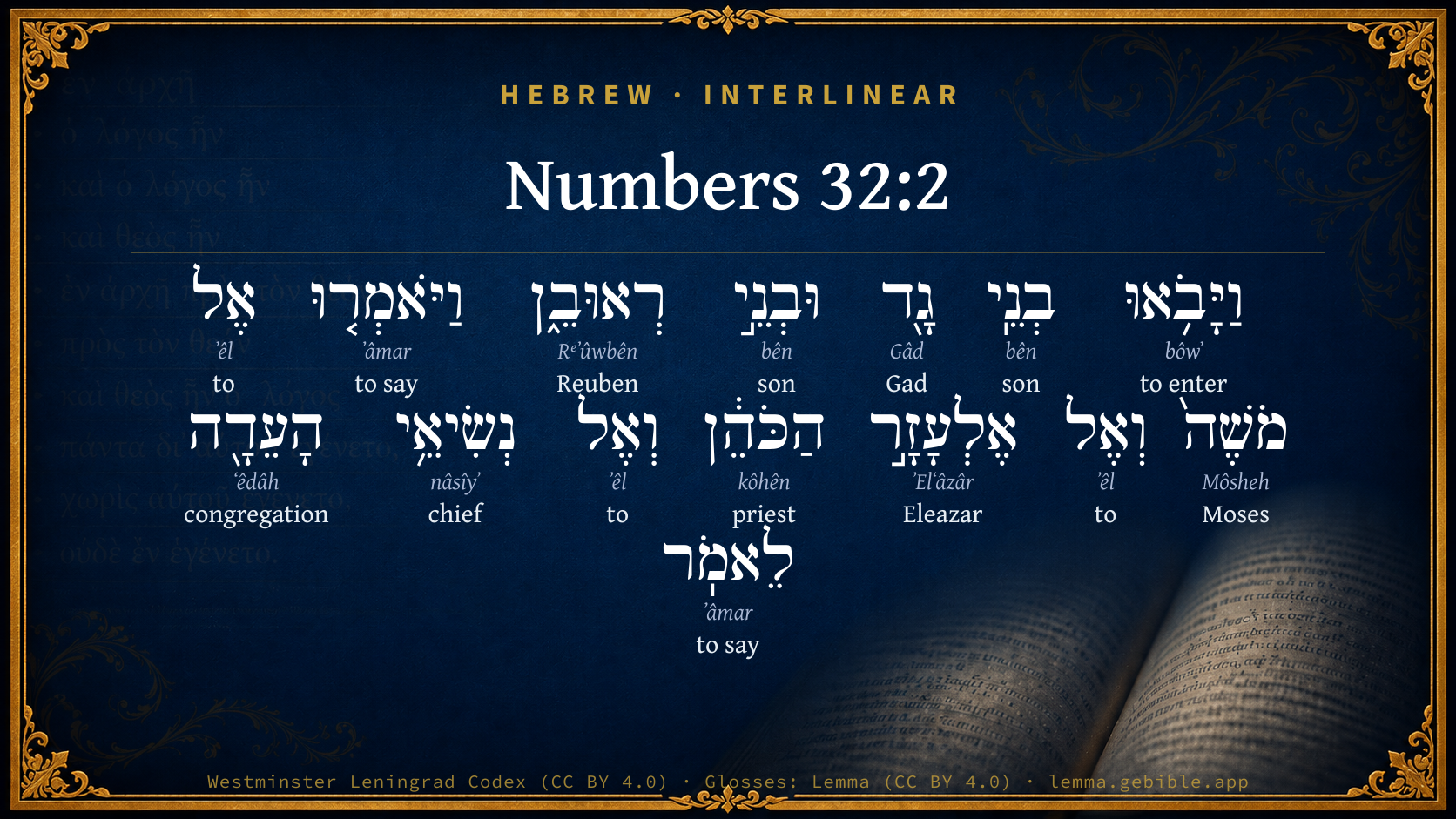
Hebrew (Westminster Leningrad Codex) Numbers 32:2 appears in the Hebrew Old Testament. The text above is from the Westminster Leningrad Codex. Each word links to its Strong’s number, a concise gloss, and parsing drawn from the Open Scriptures Hebrew Bible morphology. Click any word for its full Brown-Driver-Briggs (BDB) entry.
Download image
Cite this verse

Numbers 32:2 (World English Bible). Public Domain. Lemma interlinear Bible study tool, https://lemma.gebible.app/v/numbers/32/2.

Show BibTeX & RIS
BibTeX
RIS
English Translation
the children of Gad and the children of Reuben came and spoke to Moses, and to Eleazar the priest, and to the princes of the congregation, saying,
World English Bible · Public Domain
Download a study sheet

One document with this verse’s original text, its word-by-word gloss line, the meaning frame, cross-references with their text, attributed commentary, and full source and license credits — printable, and it pastes into notes with its structure intact.

This verse Autodidact and up

Study sheet (.html) Plain text (.txt)

A passage Seminary Student

Up to 50 verses in one chapter. A passage sheet keeps up to 6 commentary sources and 12 cross-references per verse, in the order this page ranks them, and says so on the sheet whenever that leaves anything out. Ask for a single verse and you get the Autodidact verse sheet above.

Everything on this page stays free to read, with no account — the sheet is a download of what is already on screen, not access to it.

Want to remove ads? Support Godless Engineer
Compare translations 3

The same verse in 3 English versions, stacked beneath the original-language interlinear above. Click any original word for its lexicon entry.

Each is an independent rendering of the whole verse — the interlinear is not word-aligned to these translations.

Highlighted words mark where these versions differ — a whole-verse word diff, not a word-by-word alignment.

  • World English Bible Public Domain
    the children of Gad and the children of Reuben came and spoke to Moses, and to Eleazar the priest, and to the princes of the congregation, saying,
  • King James Version Public Domain
    The children of Gad and the children of Reuben came and spake unto Moses, and to Eleazar the priest, and unto the princes of the congregation, saying,
  • unfoldingWord Literal Text CC BY-SA 4.0
    And the sons of Gad and the sons of Reuben came and said to Moses and to Eleazar the priest and to the leaders of the congregation, saying,

unfoldingWord Literal Text — © unfoldingWord, licensed CC BY-SA 4.0. Word-aligned USFM3 via Door43 (git.door43.org/unfoldingWord/en_ult).

Versions to compare (up to 4)

3 of 4 selected

Show all 18 translations

Every available English version of this verse, each an independent rendering of the whole verse.

  • World English Bible Public Domain
    the children of Gad and the children of Reuben came and spoke to Moses, and to Eleazar the priest, and to the princes of the congregation, saying,
  • Berean Standard Bible Public Domain
    So the Gadites and Reubenites came to Moses, Eleazar the priest, and the leaders of the congregation, and said,
  • Majority Standard Bible Public Domain
    So the Gadites and Reubenites came to Moses, Eleazar the priest, and the leaders of the congregation, and said,
  • King James Version Public Domain
    The children of Gad and the children of Reuben came and spake unto Moses, and to Eleazar the priest, and unto the princes of the congregation, saying,
  • American Standard Version (1901) Public Domain
    the children of Gad and the children of Reuben came and spake unto Moses, and to Eleazar the priest, and unto the princes of the congregation, saying,
  • Revised Version (1885) Public Domain
    the children of Gad and the children of Reuben came and spake unto Moses, and to Eleazar the priest, and unto the princes of the congregation, saying,
  • Geneva Bible (1599) Public Domain
    Then the children of Gad, and the childre of Reuben came, and spake vnto Moses and to Eleazar the Priest, and vnto the princes of the Congregation, saying,
  • Douay-Rheims (1899) Public Domain
    They came to Moses and Eleazar the priest, and the princes of the multitude, and said:
  • Young's Literal Translation Public Domain
    and the sons of Gad, and the sons of Reuben, come in and speak unto Moses, and unto Eleazar the priest, and unto the princes of the company, saying:
  • Literal Standard Version CC BY-SA 4.0
    and the sons of Gad and the sons of Reuben come in and speak to Moses, and to Eleazar the priest, and to the princes of the congregation, saying,
  • Unlocked Literal Bible CC BY-SA 4.0
    So the descendants of Gad and Reuben came and spoke to Moses, to Eleazar the priest, and to the leaders of the community. They said,
  • unfoldingWord Literal Text CC BY-SA 4.0
    And the sons of Gad and the sons of Reuben came and said to Moses and to Eleazar the priest and to the leaders of the congregation, saying,
  • Darby Bible Public Domain
    And the children of Gad and the children of Reuben came and spoke to Moses, and to Eleazar the priest, and to the princes of the assembly, saying,
  • World Messianic Bible Public Domain
    Then the children of Gad and the children of Reuben came and spoke to Moses, and to Eleazar the priest, and to the princes of the congregation, saying,
  • Webster's Bible Public Domain
    The children of Gad and the children of Reuben came and spoke to Moses, and to Eleazar the priest, and to the princes of the congregation, saying,
  • Free Bible Version CC BY-SA 4.0
    So they came to Moses, Eleazar the priest, and the Israelite leaders and said,
  • Bible in Basic English Public Domain
    The children of Gad and the children of Reuben came and said to Moses and to Eleazar the priest and to the chiefs of the meeting,
  • JPS Tanakh (1917) Public Domain
    the children of Gad and the children of Reuben came and spoke unto Moses, and to Eleazar the priest, and unto the princes of the congregation, saying:

Literal Standard Version (2020), Covenant Press — licensed CC BY-SA 4.0. Text via the HelloAO Bible API (eBible.org). Unlocked Literal Bible (unfoldingWord) — licensed CC BY-SA 4.0. Text via the HelloAO Bible API (eBible.org). unfoldingWord Literal Text — © unfoldingWord, licensed CC BY-SA 4.0. Word-aligned USFM3 via Door43 (git.door43.org/unfoldingWord/en_ult). Free Bible Version, Dr. Jonathan Gallagher — licensed CC BY-SA 4.0. Text via the HelloAO Bible API (eBible.org).

Word by word

More ways to search: Search by grammar → Find every occurrence → Compare this word →

Practice this passage: Drill this verse → Learn its vocabulary →

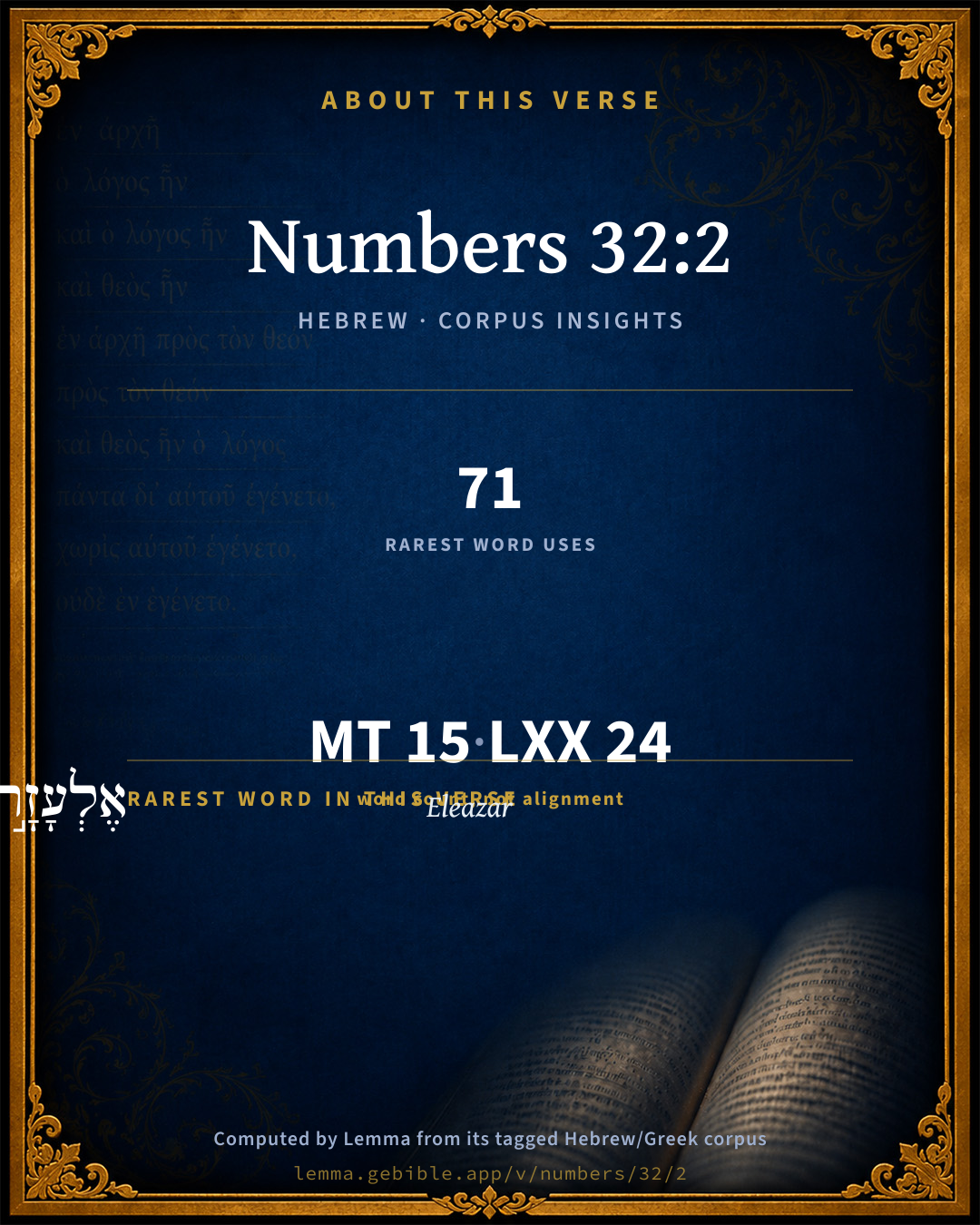
אֶלְעָזָ֣ר
ʼElʻâzâr
H499
“Eleazar”
Noun, Proper
Part of Speech
Noun
Type
Proper
Full BDB Definition

Origin: from H410 and H5826

TWOT: None

Eleazar = "God has helped" - the high priest son of Aaron - Abinadab's son who cared for the ark - the priest who rebuilt and dedicated the restored walls of Jerusalem in time of Ezra - one of David's mighty warriors - a Levite - one of the line of Parosh
  1. וַיָּבֹ֥אוּ bôwʼ H935 “and · to enter” Conjunction + Verb, Qal, Sequential Imperfect, 3rd Person, Masculine, Plural
  2. בְנֵֽי bên H1121 “sons of” Noun, Common, Masculine, Plural, Construct
  3. גָ֖ד Gâd H1410 “Gad” Noun, Proper
  4. וּבְנֵ֣י bên H1121 “and · sons of” Conjunction + Noun, Common, Masculine, Plural, Construct
  5. רְאוּבֵ֑ן Rᵉʼûwbên H7205 “Reuben” Noun, Proper
  6. וַיֹּאמְר֤וּ ʼâmar H559 “and · to say” Conjunction + Verb, Qal, Sequential Imperfect, 3rd Person, Masculine, Plural
  7. אֶל ʼêl H413 “to” Preposition
  8. מֹשֶׁה֙ Môsheh H4872 “Moses” Noun, Proper
  9. וְאֶל ʼêl H413 “and · to” Conjunction + Preposition
  10. הַכֹּהֵ֔ן kôhên H3548 “the · priest” Particle, Definite Article + Noun, Common, Masculine, Singular, Absolute
  11. וְאֶל ʼêl H413 “and · to” Conjunction + Preposition
  12. נְשִׂיאֵ֥י nâsîyʼ H5387 “chiefs of” Noun, Common, Masculine, Plural, Construct
  13. הָעֵדָ֖ה ʻêdâh H5712 “the · congregation” Particle, Definite Article + Noun, Common, Feminine, Singular, Absolute
  14. לֵאמֹֽר ʼâmar H559 “to say” Preposition + Verb, Qal, Infinitive Construct

About this verse

These counts appear in no published source. They are computed here, from the morphology-tagged text and Lemma’s own curated glosses. What Lemma adds →

15
words
11
distinct lemmas
Pentateuch
section

Grammatical profile

  • 3 verbs
  • 9 nouns
  • 3 prepositions

Verb forms

  • וַיָּבֹ֥אוּ Qal · Sequential Imperfect
  • וַיֹּאמְר֤וּ Qal · Sequential Imperfect
  • לֵאמֹֽר Qal · Infinitive Construct

Repetition

Words recur within this verse — often emphatic in Hebrew:

  • בְנֵֽי son H1121 ×2
  • וַיֹּאמְר֤וּ to say H559 ×2
  • אֶל to H413 ×3

Hebrew & Septuagint length

In English translation the verse runs 27 words from the Hebrew and 28 from the Septuagint (LXX English) — closely comparable.

A rough comparison of the two English renderings, which tokenize alike — not a word-level alignment.

Word counts can differ between the Hebrew and the Greek without any difference in meaning — e.g. the Hebrew direct-object marker אֵת has no separate Greek word, and Greek often adds the article ὁ.

In the original languages it is 15 Hebrew tokens and 24 Greek tokens — but the two are counted differently (Hebrew bundles its prefixes and suffixes into one token; the Greek is in lemma form), so that isn’t a like-for-like length.

Hebrew and Greek witnesses Masoretic Hebrew ↔ Greek Septuagint

The same verse in the two great witnesses to the Old Testament, shown verse-for-verse.

These are two independent witnesses, not word-aligned to each other, and the Septuagint is shown in lemma (dictionary) form.

Hebrew Numbers 32:2 Masoretic · Westminster Leningrad Codex

וַיָּבֹ֥אוּ בְנֵֽי גָ֖ד וּבְנֵ֣י רְאוּבֵ֑ן וַיֹּאמְר֤וּ אֶל מֹשֶׁה֙ וְאֶל אֶלְעָזָ֣ר הַכֹּהֵ֔ן וְאֶל נְשִׂיאֵ֥י הָעֵדָ֖ה לֵאמֹֽר

the children of Gad and the children of Reuben came and spoke to Moses, and to Eleazar the priest, and to the princes of the congregation, saying,

World English Bible · Public Domain

Greek LXX Numbers 32:2 Septuagint · lemma form

καί προςἔρχομαι ὁ υἱός ρουβην καί ὁ υἱός γαδ εἶπον πρός μωυσῆς καί πρός ελεαζαρ ὁ ἱερεύς καί πρός ὁ ἄρχων ὁ συναγωγή λέγω

and the children of Ruben and the children of Gad came, and spoke to Moses, and to Eleazar the priest, and to the princes of the congregation, saying,

LXX2012 (modern English Septuagint) · Public Domain

Hebrew: Westminster Leningrad Codex (CC BY 4.0). Greek: Septuagint (public domain); English from LXX2012 (modern English Septuagint) (Public Domain). How the Septuagint differs from the Hebrew →

Targum (Aramaic paraphrase)

2

The Targum is the ancient Jewish Aramaic paraphrase of the Hebrew Scriptures — an interpretive translation, not the Hebrew text itself. Onkelos (literal) and Pseudo-Jonathan (expansive) render the Torah, and Jonathan the Prophets. Coverage is partial: where no permissively-licensed English translation exists for a verse, only the Aramaic is shown. This is verse-level text, not a word-by-word alignment to the Hebrew.

  1. Targum Onkelos Torah (Genesis–Deuteronomy)
    וַאֲתוֹ בְנֵי גָד וּבְנֵי רְאוּבֵן וַאֲמָרוּ לְמשֶׁה וּלְאֶלְעָזָר כַּהֲנָא וּלְרַבְרְבֵי כְּנִשְׁתָּא לְמֵימָר

    (no public-domain English translation for this verse)

    Targum Onkelos — Aramaic: “Onkelos Genesis” (public domain); “Onkelos Exodus” (public domain); “Onkelos Leviticus” (public domain); “Onkelos Numbers” (public domain); “Onkelos Deuteronomy” (public domain). English: “Sefaria Community Translation” (CC0 1.0 (public-domain dedication)); “J.W. Etheridge. The Targums of Onkelos and Jonathan Ben Uzziel on the Pentateuch. London: Longmans, Green, 1862” (public domain). Text via Sefaria.

  2. Targum Pseudo-Jonathan Torah (Genesis–Deuteronomy)
    וַאֲתוֹ בְנֵי גָד וּבְנֵי רְאוּבֵן וַאֲמָרוּ לְמשֶׁה וּלְאֶלְעָזָר כַּהֲנָא וּלְרַבְרְבֵי כְּנִישְׁתָּא לְמֵימָר

    And the sons of Gad and Reuben came and spoke to Mosheh, Elazar, and the princes of the congregation, saying:

    Targum Pseudo-Jonathan — Aramaic: “Targum Jonathan on Genesis” (public domain); “Targum Jonathan on Exodus” (public domain); “Targum Jonathan on Leviticus” (public domain); “Targum Jonathan on Numbers” (public domain); “Targum Jonathan on Deuteronomy” (public domain). English: “The Targum of Jonathan ben Uzziel, trans. J. W. Etheridge, London, 1862” (public domain). Text via Sefaria.

Commentary

Notes on Numbers 32:2 from classic Christian and Jewish commentators (each source and its license shown beneath its notes). The classic Christian expositions comment on the surrounding passage and are grouped to its opening verse, so a note may address several verses; the Jewish commentaries on the Tanakh (Rashi and others) are per-verse, so they appear only where the commentator wrote on this verse.

Lemma curates 59 commentaries, every one of them public domain or Creative Commons licensed, each selected and text-cleaned for this edition rather than reprinted as found. About our sources →

John Gill's Exposition

Ataroth, Dibon, and Jazer,.... These were places which belonged to the Amorites, and were taken from Sihon, their king: of Ataroth we read nowhere else but in this chapter; of Dibon see Isa 15:2, Jazer was a city, from whence the land about it had its name; it is the same with Jaazer, Num 21:32 and stood about fifteen miles from Heshbon (k), the capital city of the kingdom of Sihon:

and Nimrah, and Heshbon, and Elealeh, and Shebam, and Nebo, and Beon; these were all places in the same country; of Heshbon see Num 21:25, Nimrah is the same with Bethnimrah, Num 32:36 and sometimes called Nimrim, famous for its water, Isa 15:6. Jerom says (l) the name of it in his time was Benamerium, and lay to the north of Zoar; Elealeh, according to the same writer (m) was but a mile from Heshbon, of which see Isa 15:4. Shebam is the same with Shibmah, Num 32:36, and seems to be a place famous for vines, Isa 16:8; it is thought to be the same with the Seba of Ptolemy (n), and according to Jerom (o), there were scarce five hundred paces between this place and Heshbon; Nebo, the Targums of Onkelos and Jonathan call the grave of Moses, because on a mountain of this name Moses died, and where it is supposed he was buried; but it is certain he was buried not on a mountain, but in a valley, Deu 34:6, this perhaps had its name from the mountain near which it was, and of which see Isa 15:2. Beon is the same that is called Baalmeon, Num 32:38 and Bethbaalmeon, Jos 13:17, where was very probably a temple of Baal; it was about nine miles from Heshbon (p).

(k) Jerom. de loc. Heb. fol. 92. G. (l) lbid. K. (m) Ibid. fol. 91. A. (n) Geograph. l. 5. c. 19. (o) Comment. in Esaiam, c. 16. 8. (p) Eusebius apud Reland: Palest. Illustr. par. 2. l. 3. p. 611.

John Gill's Exposition of the Whole Bible (1746–1763) — public domain (CC PDM 1.0). Text via the HelloAO Bible API.

Ramban (Nachmanides)

Rabbi Moshe ben Nachman (Ramban / Nachmanides)

AND THE CHILDREN OF GAD AND THE CHILDREN OF REUBEN CAME AND SPOKE UNTO MOSES. In the preceding verse Scripture mentioned the children of Reuben first, [saying], Now the children of Reuben and the children of Gad had a very great multitude of cattle, as is the correct way [of referring to them], for he [Reuben] was the firstborn and he was the son of the principal wife [of Jacob, i.e., Leah, whereas Gad was the son of Leah’s handmaid, Zilpah]. Similarly also when Scripture tells of [the occurrence of] this event it says, And unto the Reubenites and unto the Gadites I gave etc. However, in the whole of this section He mentions the children of Gad first, because it was they who suggested this idea, and it was they who first spoke to Moses about this inheritance; and they were also stronger than the children of Reuben, as it is said [of the Gadites], and he teareth the arm, yea, the crown of the head, 33:20. and therefore they were not afraid of living alone amongst the inhabitants of that land. Now Moses suspected that they were only suggesting this [plan of settling on the east side of the Jordan] because they were afraid of the people in the land of Canaan, concerning whom the spies had said, We are not able to go up against the people; for they are stronger than we — therefore he told them that they did not trust in G-d, just like their fathers [who did not trust in Him] and therefore He would again punish them like their fathers, by leaving them in the wilderness. Therefore they answered him: “Far be it from us to fear them! For we shall pass over [the Jordan] armed for battle, and we shall be the most eager and the first amongst the people to fight against the enemies of the Eternal, for they are bread for us.”

Ramban (Nachmanides) on the Tanakh — English translation: “Commentary on the Torah by Ramban (Nachmanides). Translated and annotated by Charles B. Chavel. New York, Shilo Pub. House, 1971-1976” (CC BY 4.0). Text via Sefaria.

Lesson kit

Teaching starters — assembled from the data on this page, not authored interpretation. Every prompt links to the verse data it draws on. Edit before teaching.

Numbers, in the Pentateuch, opens this verse with 15 words (11 distinct Hebrew lemmas). Its most distinctive word is ʼElʻâzâr (“Eleazar”). A historical commentator’s framing appears above. Read the whole chapter for the surrounding context.

Discussion questions

  1. What does “Eleazar” (ʼElʻâzâr) contribute to the verse as a whole?
  2. What does the repetition of “son” (2× in this one verse) do in this verse?
  3. The translations on this page render this verse differently — a whole-verse word diff, not a word-by-word alignment. What might account for the different wordings?
  4. «וַיָּבֹ֥אוּ» is a Qal Sequential Imperfect verb. How does that grammatical form shape the action described?
  5. Compare how John Gill's Exposition and Ramban (Nachmanides) read this verse. Where do they agree or differ?

Things to notice

Reading settings

Reading text

Shown beneath each verse's original-language words.

Old Testament
Old Testament edition

Read the OT as the Masoretic Hebrew (MT) or the Greek Septuagint (LXX).

English shown for the Greek Septuagint (in the Hebrew ↔ Greek comparison).

Comparing translations? Open the Compare panel on any verse page to stack up to four side by side.