Numbers 10:8

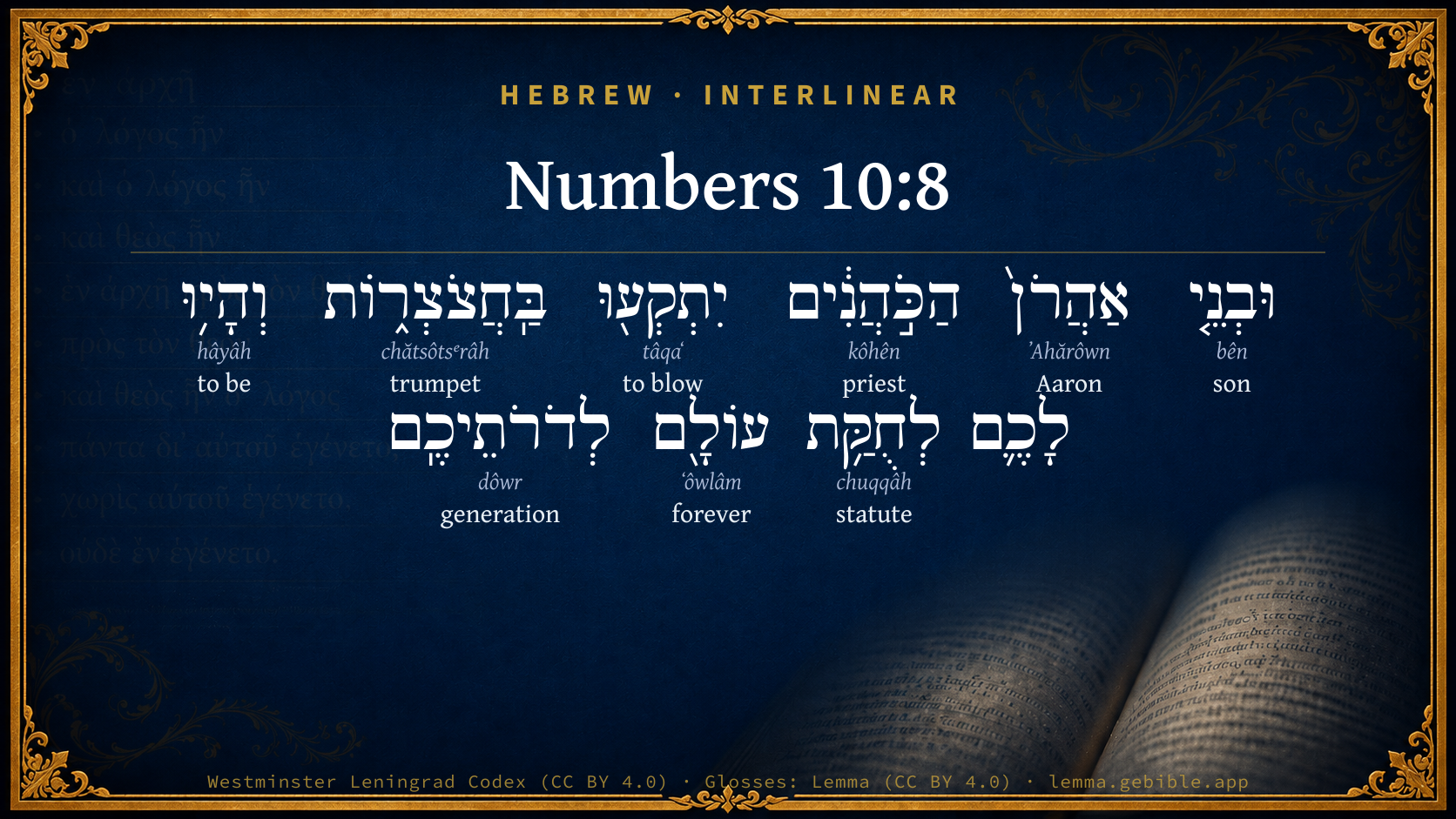
Hebrew (Westminster Leningrad Codex) Numbers 10:8 appears in the Hebrew Old Testament. The text above is from the Westminster Leningrad Codex. Each word links to its Strong’s number, a concise gloss, and parsing drawn from the Open Scriptures Hebrew Bible morphology. Click any word for its full Brown-Driver-Briggs (BDB) entry.
Download image
Cite this verse

Numbers 10:8 (World English Bible). Public Domain. Lemma interlinear Bible study tool, https://lemma.gebible.app/v/numbers/10/8.

Show BibTeX & RIS
BibTeX
RIS
English Translation
The sons of Aaron, the priests, shall blow the trumpets; and they shall be to you for a statute forever throughout your generations.
World English Bible · Public Domain
Download a study sheet

One document with this verse’s original text, its word-by-word gloss line, the meaning frame, cross-references with their text, attributed commentary, and full source and license credits — printable, and it pastes into notes with its structure intact.

This verse Autodidact and up

Study sheet (.html) Plain text (.txt)

A passage Seminary Student

Up to 50 verses in one chapter. A passage sheet keeps up to 6 commentary sources and 12 cross-references per verse, in the order this page ranks them, and says so on the sheet whenever that leaves anything out. Ask for a single verse and you get the Autodidact verse sheet above.

Everything on this page stays free to read, with no account — the sheet is a download of what is already on screen, not access to it.

Want to remove ads? Support Godless Engineer
Compare translations 3

The same verse in 3 English versions, stacked beneath the original-language interlinear above. Click any original word for its lexicon entry.

Each is an independent rendering of the whole verse — the interlinear is not word-aligned to these translations.

Highlighted words mark where these versions differ — a whole-verse word diff, not a word-by-word alignment.

  • World English Bible Public Domain
    The sons of Aaron, the priests, shall blow the trumpets; and they shall be to you for a statute forever throughout your generations.
  • King James Version Public Domain
    And the sons of Aaron, the priests, shall blow with the trumpets; and they shall be to you for an ordinance for ever throughout your generations.
  • unfoldingWord Literal Text CC BY-SA 4.0
    And the sons of Aaron, the priests, shall blow the trumpets, and they shall be for you for a statute of eternity, for your generations.

unfoldingWord Literal Text — © unfoldingWord, licensed CC BY-SA 4.0. Word-aligned USFM3 via Door43 (git.door43.org/unfoldingWord/en_ult).

Versions to compare (up to 4)

3 of 4 selected

Show all 18 translations

Every available English version of this verse, each an independent rendering of the whole verse.

  • World English Bible Public Domain
    The sons of Aaron, the priests, shall blow the trumpets; and they shall be to you for a statute forever throughout your generations.
  • Berean Standard Bible Public Domain
    The sons of Aaron, the priests, are to sound the trumpets. This shall be a permanent statute for you and the generations to come.
  • Majority Standard Bible Public Domain
    The sons of Aaron, the priests, are to sound the trumpets. This shall be a permanent statute for you and the generations to come.
  • King James Version Public Domain
    And the sons of Aaron, the priests, shall blow with the trumpets; and they shall be to you for an ordinance for ever throughout your generations.
  • American Standard Version (1901) Public Domain
    And the sons of Aaron, the priests, shall blow the trumpets; and they shall be to you for a statute for ever throughout your generations.
  • Revised Version (1885) Public Domain
    And the sons of Aaron, the priests, shall blow with the trumpets; and they shall be to you for a statute for ever throughout your generations.
  • Geneva Bible (1599) Public Domain
    And the sonnes of Aaron the Priest shall blowe the trumpets, and ye shall haue them as a lawe for euer in your generations.
  • Douay-Rheims (1899) Public Domain
    And the sons of Aaron the priest shall sound the trumpets: and this shall be an ordinance for ever in your generations.
  • Young's Literal Translation Public Domain
    and sons of Aaron, the priests, blow with the trumpets; and they have been to you for a statute age-during to your generations.
  • Literal Standard Version CC BY-SA 4.0
    and sons of Aaron, the priests, blow with the trumpets; and they have been for a continuous statute to you throughout your generations.
  • Unlocked Literal Bible CC BY-SA 4.0
    The sons of Aaron, the priests, must blow the trumpets. This will always be a regulation for you throughout your people's generations.
  • unfoldingWord Literal Text CC BY-SA 4.0
    And the sons of Aaron, the priests, shall blow the trumpets, and they shall be for you for a statute of eternity, for your generations.
  • Darby Bible Public Domain
    the sons of Aaron, the priests, shall blow with the trumpets; and they shall be to you for an everlasting statute throughout your generations.
  • World Messianic Bible Public Domain
    “The sons of Aaron, the priests, shall blow the shofars. This shall be to you for a statute forever throughout your generations.
  • Webster's Bible Public Domain
    And the sons of Aaron, the priests, shall blow with the trumpets; and they shall be to you for an ordinance for ever throughout your generations.
  • Free Bible Version CC BY-SA 4.0
    Aaron's descendants are to blow the trumpets. This regulation is for all time and for all future generations.
  • Bible in Basic English Public Domain
    The horns are to be sounded by the sons of Aaron, the priests; this is to be a law for you for ever, from generation to generation.
  • JPS Tanakh (1917) Public Domain
    And the sons of Aaron, the priests, shall blow with the trumpets; and they shall be to you for a statute for ever throughout your generations.

Literal Standard Version (2020), Covenant Press — licensed CC BY-SA 4.0. Text via the HelloAO Bible API (eBible.org). Unlocked Literal Bible (unfoldingWord) — licensed CC BY-SA 4.0. Text via the HelloAO Bible API (eBible.org). unfoldingWord Literal Text — © unfoldingWord, licensed CC BY-SA 4.0. Word-aligned USFM3 via Door43 (git.door43.org/unfoldingWord/en_ult). Free Bible Version, Dr. Jonathan Gallagher — licensed CC BY-SA 4.0. Text via the HelloAO Bible API (eBible.org).

Word by word

More ways to search: Search by grammar → Find every occurrence → Compare this word →

Practice this passage: Drill this verse → Learn its vocabulary →

בַּֽחֲצֹצְר֑וֹת
chătsôtsᵉrâh
H2689
“in/at · trumpets”
Preposition + Noun, Common, Feminine, Plural, Absolute
Part of Speech
Preposition + Noun
Type
Common
Gender
Feminine
Number
Plural
State
Absolute
Full BDB Definition

Origin: by reduplication from H2690

TWOT: 726a

trumpet, clarion
  1. וּבְנֵ֤י bên H1121 “and · sons of” Conjunction + Noun, Common, Masculine, Plural, Construct
  2. אַהֲרֹן֙ ʼAhărôwn H175 “Aaron” Noun, Proper
  3. הַכֹּ֣הֲנִ֔ים kôhên H3548 “the · priests” Particle, Definite Article + Noun, Common, Masculine, Plural, Absolute
  4. יִתְקְע֖וּ tâqaʻ H8628 “to blow” Verb, Qal, Imperfect, 3rd Person, Masculine, Plural
  5. וְהָי֥וּ hâyâh H1961 “and · to be” Conjunction + Verb, Qal, Sequential Perfect, 3rd Person, Common, Plural
  6. לְחֻקַּ֥ת chuqqâh H2708 “to/for · statute of” Preposition + Noun, Common, Both, Singular, Construct
  7. עוֹלָ֖ם ʻôwlâm H5769 “forever” Noun, Common, Masculine, Singular, Absolute
  8. לְדֹרֹתֵיכֶֽם dôwr H1755 “to/for · generations · your” Preposition + Noun, Common, Masculine, Plural, Construct + Suffix, Personal, 2nd Person, Masculine, Plural

About this verse

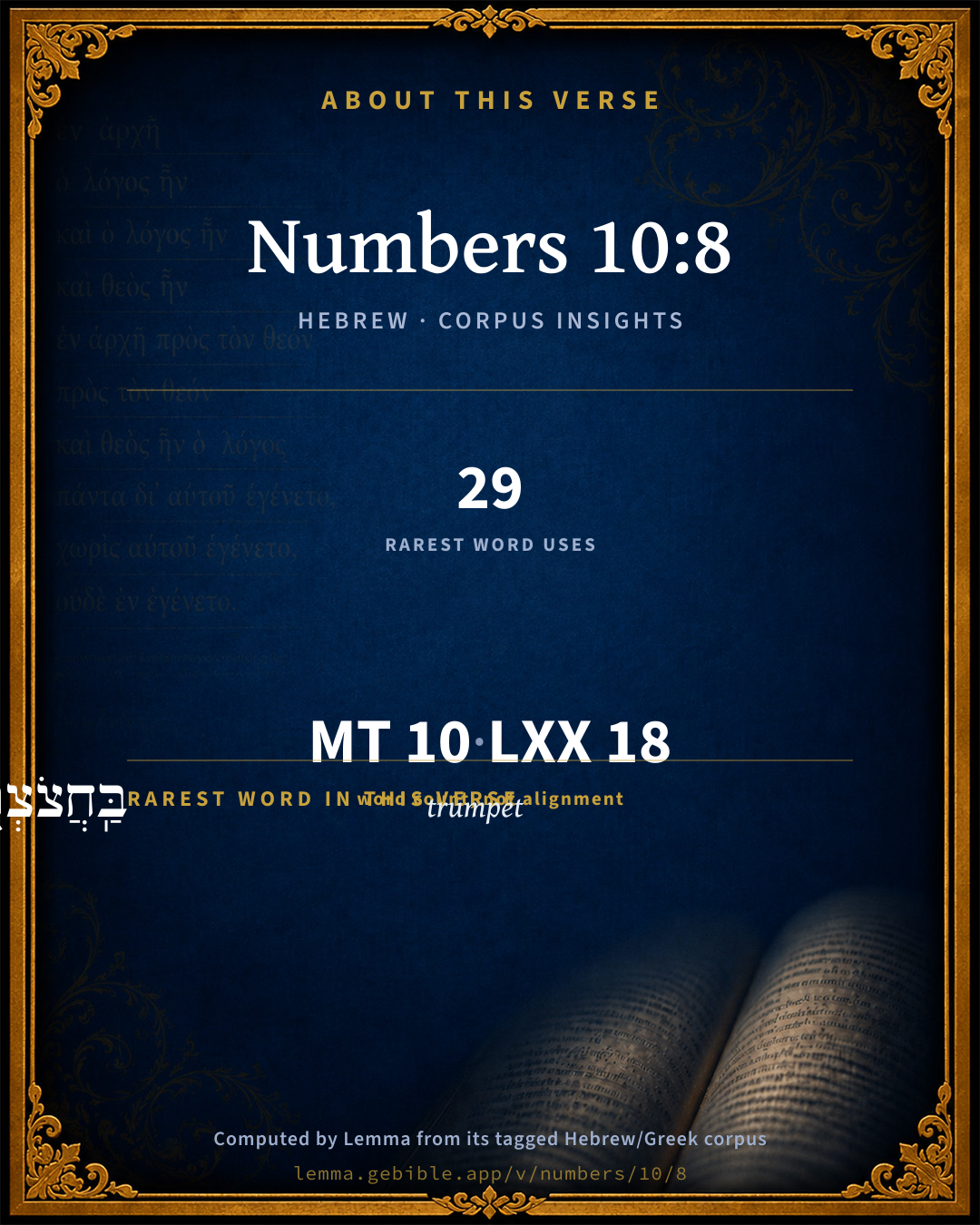
These counts appear in no published source. They are computed here, from the morphology-tagged text and Lemma’s own curated glosses. What Lemma adds →

10
words
9
distinct lemmas
Pentateuch
section

Shared distinctive vocabulary

בַּֽחֲצֹצְר֑וֹת trumpet H2689 occurs in 27 verses of the Hebrew Bible. Also found in:

Grammatical profile

  • 2 verbs
  • 7 nouns
  • 1 preposition

Verb forms

  • יִתְקְע֖וּ Qal · Imperfect
  • וְהָי֥וּ Qal · Sequential Perfect

Hebrew & Septuagint length

In English translation the verse runs 23 words from the Hebrew and 24 from the Septuagint (LXX English) — closely comparable.

A rough comparison of the two English renderings, which tokenize alike — not a word-level alignment.

Word counts can differ between the Hebrew and the Greek without any difference in meaning — e.g. the Hebrew direct-object marker אֵת has no separate Greek word, and Greek often adds the article ὁ.

In the original languages it is 10 Hebrew tokens and 18 Greek tokens — but the two are counted differently (Hebrew bundles its prefixes and suffixes into one token; the Greek is in lemma form), so that isn’t a like-for-like length.

Cross-references

5

Topical passages linked to Numbers 10:8 in the Treasury of Scripture Knowledge — connected by theme and wording, ordered by reader-vote popularity; previews shown in the World English Bible.

  • Numbers 31:6 Moses sent them, one thousand of every tribe, to the war, them and Phinehas the son of Eleazar the priest, to the war, with the vessels of the sanctuary and the trumpets for the alarm in his hand.
  • Joshua 6:4–16 Seven priests shall bear seven trumpets of rams' horns before the ark: and the seventh day you shall compass the city seven times, and the priests shall blow the trumpets.
  • 1 Chronicles 15:24 Shebaniah, and Joshaphat, and Nethanel, and Amasai, and Zechariah, and Benaiah, and Eliezer, the priests, did blow the trumpets before the ark of God: and Obed-edom and Jehiah were doorkeepers for the ark.
  • 1 Chronicles 16:6 and Benaiah and Jahaziel the priests with trumpets continually, before the ark of the covenant of God.
  • 2 Chronicles 13:12–15 Behold, God is with us at our head, and his priests with the trumpets of alarm to sound an alarm against you. Children of Israel, don't you fight against Yahweh, the God of your fathers; for you shall not prosper.

Cross-references courtesy of OpenBible.info (CC BY 4.0).

Hebrew and Greek witnesses Masoretic Hebrew ↔ Greek Septuagint

The same verse in the two great witnesses to the Old Testament, shown verse-for-verse.

These are two independent witnesses, not word-aligned to each other, and the Septuagint is shown in lemma (dictionary) form.

Hebrew Numbers 10:8 Masoretic · Westminster Leningrad Codex

וּבְנֵ֤י אַהֲרֹן֙ הַכֹּ֣הֲנִ֔ים יִתְקְע֖וּ בַּֽחֲצֹצְר֑וֹת וְהָי֥וּ לָכֶ֛ם לְחֻקַּ֥ת עוֹלָ֖ם לְדֹרֹתֵיכֶֽם

The sons of Aaron, the priests, shall blow the trumpets; and they shall be to you for a statute forever throughout your generations.

World English Bible · Public Domain

Greek LXX Numbers 10:8 Septuagint · lemma form

καί ὁ υἱός ἀαρών ὁ ἱερεύς σαλπίζω ὁ σάλπιγξ καί εἰμί σύ νόμιμος αἰώνιος εἰς ὁ γενεά σύ

And the priests the sons of Aaron shall sound with the trumpets; and it shall be a perpetual ordinance for you throughout your generations.

LXX2012 (modern English Septuagint) · Public Domain

Hebrew: Westminster Leningrad Codex (CC BY 4.0). Greek: Septuagint (public domain); English from LXX2012 (modern English Septuagint) (Public Domain). How the Septuagint differs from the Hebrew →

Targum (Aramaic paraphrase)

2

The Targum is the ancient Jewish Aramaic paraphrase of the Hebrew Scriptures — an interpretive translation, not the Hebrew text itself. Onkelos (literal) and Pseudo-Jonathan (expansive) render the Torah, and Jonathan the Prophets. Coverage is partial: where no permissively-licensed English translation exists for a verse, only the Aramaic is shown. This is verse-level text, not a word-by-word alignment to the Hebrew.

  1. Targum Onkelos Torah (Genesis–Deuteronomy)
    וּבְנֵי אַהֲרֹן כַּהֲנַיָא יִתְקְעוּן בַּחֲצוֹצְרָתָא וִיהֶוְיָן לְכוֹן לִקְיַם עֲלָם לְדָרֵיכוֹן

    (no public-domain English translation for this verse)

    Targum Onkelos — Aramaic: “Onkelos Genesis” (public domain); “Onkelos Exodus” (public domain); “Onkelos Leviticus” (public domain); “Onkelos Numbers” (public domain); “Onkelos Deuteronomy” (public domain). English: “Sefaria Community Translation” (CC0 1.0 (public-domain dedication)); “J.W. Etheridge. The Targums of Onkelos and Jonathan Ben Uzziel on the Pentateuch. London: Longmans, Green, 1862” (public domain). Text via Sefaria.

  2. Targum Pseudo-Jonathan Torah (Genesis–Deuteronomy)
    וּבְנֵי אַהֲרן כַּהֲנַיָא שְׁלֵימַיָא יִתְקְעוּן בַּחֲצוֹצְרָתָא וִיהוֹן לְכוֹן לִקְיַם עֲלָם לְדָרֵיכוֹן

    The sons of Aharon, the priests only, shall blow with the trumpets, which shall be to you, for a perpetual statute for your generations.

    Targum Pseudo-Jonathan — Aramaic: “Targum Jonathan on Genesis” (public domain); “Targum Jonathan on Exodus” (public domain); “Targum Jonathan on Leviticus” (public domain); “Targum Jonathan on Numbers” (public domain); “Targum Jonathan on Deuteronomy” (public domain). English: “The Targum of Jonathan ben Uzziel, trans. J. W. Etheridge, London, 1862” (public domain). Text via Sefaria.

Commentary

Notes on Numbers 10:8 from classic Christian and Jewish commentators (each source and its license shown beneath its notes). The classic Christian expositions comment on the surrounding passage and are grouped to its opening verse, so a note may address several verses; the Jewish commentaries on the Tanakh (Rashi and others) are per-verse, so they appear only where the commentator wrote on this verse.

Lemma curates 59 commentaries, every one of them public domain or Creative Commons licensed, each selected and text-cleaned for this edition rather than reprinted as found. About our sources →

Trapp's Complete Commentary

John Trapp

Num 10:8 And the sons of Aaron, the priests, shall blow with the trumpets; and they shall be to you for an ordinance for ever throughout your generations.

Ver. 8. Shall blow with the trumpets.] A trumpeter, as one observeth, winds his trumpet with his mouth, and holds it up with his hand: so should a minister both preach and practise; vivere concionibus, concionari moribus.

John Trapp, A Commentary or Exposition upon All the Books of the Old and New Testament (1647–1656) — public domain. Text from a community e-Sword module.

Tyndale Open Study Notes

Tyndale Open Resources

10:8 Only the priests . . . are allowed to blow the trumpets: All uses of these trumpets were related to God and his government of Israel, both of which the priests served.

Tyndale Open Study Notes — © Tyndale Open Resources, licensed CC BY-SA 4.0. Text via the HelloAO Bible API.

Geneva Bible (1599)

Geneva Bible translators

So that only the Priests must blow the trumpets, so long as the Priesthood lasted.

Geneva Bible (1599) marginal notes — public domain. Text via Bolls.life.

Jamieson, Fausset & Brown

Robert Jamieson, A. R. Fausset & David Brown

the sons of Aaron the priests shall blow with the trumpets, &c.--Neither the Levites nor any in the common ranks of the people could be employed in this office of signal giving. In order to attract greater attention and more faithful observance, it was reserved to the priests alone, as the Lord's ministers; and as anciently in Persia and other Eastern countries the alarm trumpets were sounded from the tent of the sovereign, so were they blown from the tabernacle, the visible residence of Israel's King.

Jamieson, Fausset & Brown — Commentary Critical and Explanatory on the Whole Bible (1871) — public domain (CC PDM 1.0). Text via the HelloAO Bible API.

Ellicott's Commentary for English Readers

(8) And the sons of Aaron, the priests, shall blow with the trumpets.—As Aaron had only two sons at this time, there was need only of two trumpets. In most of the places in which the word hazozerah (trumpet) occurs (as, e.g., Num_31:6; 1Ch_15:24), this instrument appears to have been used by the priests. There are cases, however, in the later history (as 2Ki_11:14; 1Ch_16:42), in which the trumpets appear to have been used by the Levites, and perhaps by those who were neither priests nor Levites. The number of these trumpets was increased in the time of David and Solomon. We read in 1Ch_15:24 of seven priests blowing with them before the ark of God, and in 2Ch_5:12 of one hundred and twenty priests blowing with them. Josephus says that Solomon made 200,000 trumpets, according to the command of Moses (Antiq., Book 8, chap. 3).

A Bible Commentary for English Readers, edited by Charles John Ellicott (1878–1897) — public domain. Text from a community e-Sword module.

John Gill's Exposition

And the sons of Aaron the priests shall blow with the trumpets,.... Eleazar and Ithamar, the one with the one and the other with the other, there being at first but two, as there were but two priests; but in Solomon's time there were an hundred twenty priests, and as many trumpets, Ch2 5:12; hence Maimonides says (l), there were never fewer than two trumpets, nor more than an hundred twenty:

and they shall be to you for an ordinance for ever throughout your generations: for they were not only for present use, for the journeying of the camps in the wilderness, but for calling together the assembly in later times, as well as for other uses next mentioned; which would obtain in future ages till the coming of Christ, and even under the Gospel dispensation the mystical use of them continues, the preaching of the everlasting Gospel.

(l) Hilchot Cele Hamikdash, c. 3. sect. 4.

John Gill's Exposition of the Whole Bible (1746–1763) — public domain (CC PDM 1.0). Text via the HelloAO Bible API.

Albert Barnes' Notes on the Bible

The sons of Aaron - As the trumpets were emblematic of the voice of God, the priests only were to use them. At this time there were only two “sons of Aaron;” but in later times, when the number of priests was greater, more trumpets were used; we read of seven in the times of Joshua and David (see the marginal references.); and of a hundred and twenty in that of Solomon 2Ch 5:12.

Albert Barnes' Notes on the Bible (1834–1885) — public domain. Text from a community e-Sword/MySword module.

Haydock's Catholic Bible Commentary

Priests. God’s officers and heralds. Curtius (3) observes, that among the Persians at day-break, the signal was given from the king’s tent by sound of trumpet.

George Leo Haydock (1774–1849), Haydock's Catholic Family Bible and Commentary, 1859 edition — public domain. Excludes Psalms (Douay-Rheims chapter numbering differs from Protestant) and Deuterocanonical books (Catholic canon only).

Matthew Poole's English Annotations

The sons of Aaron shall blow, to oblige them to the greater regard and observance, as if God himself had called them.

Matthew Poole's English Annotations on the Holy Bible (1683–1685) — public domain. Text from a community e-Sword/MySword module.

Whedon's Commentary on the Bible

Daniel D. Whedon

8. The priests, shall blow — And they alone, in the giving of the signals in this statute, and they were to preserve these trumpets and use them in all future generations in the manner described by this law.

Daniel D. Whedon (gen. ed.), Commentary on the Old and New Testaments (1874–1909) — public domain. Text from a community e-Sword module.

The Pulpit Commentary

The sons of Aaron, the priests, shall blow. It was natural that they should be made responsible for the custody and use of these trumpets, not because their sound represented the voice of God, but because they were used for religious purposes, and could only be safely kept in the sanctuary. An ordinance forever. The accustomed formula for some sacred institution which was to have a permanent character and an eternal meaning. (cf. Exo_12:24) The truth of these words cannot be exhausted by an actual use of 1500 years, followed by complete disuse for 1800 years. The "ordinance" of the silver trumpets must be perpetuated "forever" in the gospel, or else the Divine word has failed.

The Pulpit Commentary (1880–1919), ed. H.D.M. Spence-Jones & Joseph S. Exell — public domain. Text from a community e-Sword module.

Keil & Delitzsch

C. F. Keil & F. Delitzsch

These trumpets were to be used for the holy purposes of the congregation generally, and therefore not only the making, but the manner of using them was prescribed by God Himself. They were to be blown by the priests alone, and "to be for an eternal ordinance to the families of Israel," i.e., to be preserved and used by them in all future times, according to the appointment of God. The blast of these trumpets was to call Israel to remembrance before Jehovah in time of war and on their feast-days.

Num 10:9

"If ye go to war in your land against the enemy who oppresses you, and ye blow the trumpets, ye shall bring yourselves to remembrance before Jehovah, and shall be saved (by Him) from your enemies." מלחמה בּוא, to come into war, or go to war, is to be distinguished from למּלחמה בּוא, to make ready for war, go out to battle (Num 31:21; Num 32:6).

Num 10:10

"And on your joyous day, and your feasts and new moons, he shall blow the trumpets over your burnt-offerings and peace-offerings, that they may be to you for a memorial (remembrance) before your God." - השּׂמחה יום is any day on which a practical expression was given to their joy, in the form of a sacrifice. The השּׂמחה are the feasts enumerated in chs. 28 and 29 and Lev 23. The "beginnings of the months," or new-moon days, were not, strictly speaking, feast-days, with the exception of the seventh new moon of the year (see at Num 28:11). On the object, viz., "for a memorial," see Exo 28:29, and the explanation, p. 450. In accordance with this divine appointment, so full of promise, we find that in after times the trumpets were blown by the priests in war (Num 31:6; Ch2 13:12, Ch2 13:14; Ch2 20:21-22, Ch2 20:28) as well as on joyful occasions, such as at the removal of the ark (Ch1 15:24; Ch1 16:6), at the consecration of Solomon's temple (Ch2 5:12; Ch2 7:6), the laying of the foundation of the second temple (Ezr 3:10), the consecration of the walls of Jerusalem (Neh 12:35, Neh 12:41), and other festivities (Ch2 29:27).

Keil & Delitzsch — Biblical Commentary on the Old Testament (1861–1891) — public domain (CC PDM 1.0). Text via the HelloAO Bible API. (Old Testament only.)

Rashi

Rabbi Shlomo Yitzchaki (Rashi)

ובני אהרן... יתקעו AND THE SONS OF AARON … SHALL BLOW [WITH THE TRUMPETS] at the occasions of these (above-mentioned) assemblings and journeyings.

Rashi on the Tanakh — English translations: “The Judaica Press complete Tanach with Rashi, translated by A. J. Rosenberg” (CC BY 4.0); “Pentateuch with Rashi's commentary by M. Rosenbaum and A.M. Silbermann, 1929-1934” (public domain); “The Metsudah Tanach series, Lakewood, N.J” (CC BY 4.0); and “The Book of Joshua, Metsudah Publications, 1997” (CC BY 4.0). Text via Sefaria.

Lesson kit

Teaching starters — assembled from the data on this page, not authored interpretation. Every prompt links to the verse data it draws on. Edit before teaching.

Numbers, in the Pentateuch, opens this verse with 10 words (9 distinct Hebrew lemmas). Its most distinctive word is chătsôtsᵉrâh (“trumpet”). A historical commentator’s framing appears above. Read the whole chapter for the surrounding context.

Discussion questions

  1. The word chătsôtsᵉrâh carries the sense “trumpet.” How does it shape the verse?
  2. How does Numbers 10:2, which shares the word «trumpet», read alongside this verse?
  3. The translations on this page render this verse differently — a whole-verse word diff, not a word-by-word alignment. What might account for the different wordings?
  4. «יִתְקְע֖וּ» is a Qal Imperfect verb. How does that grammatical form shape the action described?
  5. Compare how Trapp's Complete Commentary and Tyndale Open Study Notes read this verse. Where do they agree or differ?

Things to notice

Reading settings

Reading text

Shown beneath each verse's original-language words.

Old Testament
Old Testament edition

Read the OT as the Masoretic Hebrew (MT) or the Greek Septuagint (LXX).

English shown for the Greek Septuagint (in the Hebrew ↔ Greek comparison).

Comparing translations? Open the Compare panel on any verse page to stack up to four side by side.