Jeremiah 6:13

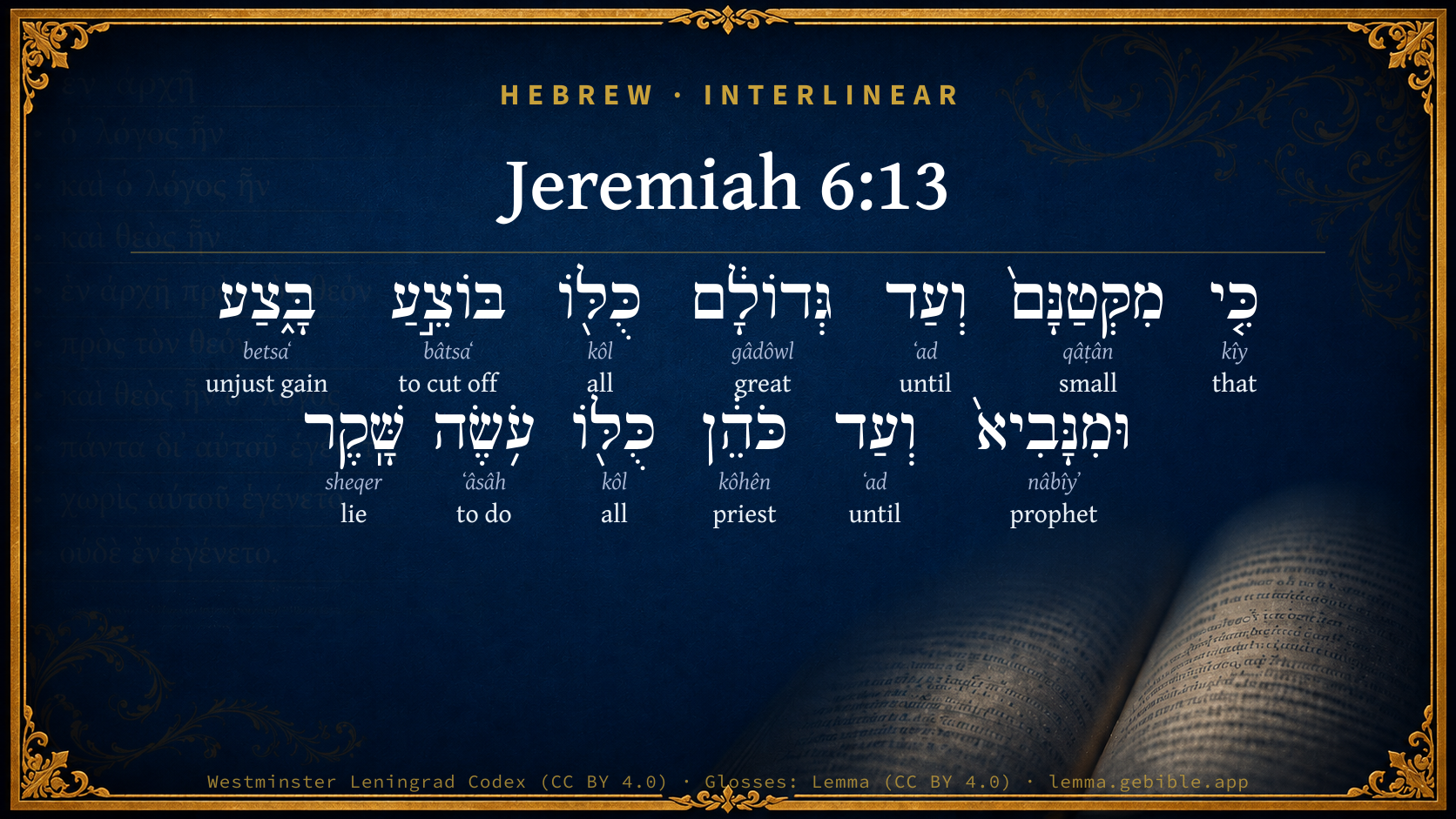
Hebrew (Westminster Leningrad Codex) Jeremiah 6:13 appears in the Hebrew Old Testament. The text above is from the Westminster Leningrad Codex. Each word links to its Strong’s number, a concise gloss, and parsing drawn from the Open Scriptures Hebrew Bible morphology. Click any word for its full Brown-Driver-Briggs (BDB) entry.
Download image
Cite this verse

Jeremiah 6:13 (World English Bible). Public Domain. Lemma interlinear Bible study tool, https://lemma.gebible.app/v/jeremiah/6/13.

Show BibTeX & RIS
BibTeX
RIS
English Translation
For from the least of them even to the greatest of them everyone is given to covetousness; and from the prophet even to the priest everyone deals falsely.
World English Bible · Public Domain
Download a study sheet

One document with this verse’s original text, its word-by-word gloss line, the meaning frame, cross-references with their text, attributed commentary, and full source and license credits — printable, and it pastes into notes with its structure intact.

This verse Autodidact and up

Study sheet (.html) Plain text (.txt)

A passage Seminary Student

Up to 50 verses in one chapter. A passage sheet keeps up to 6 commentary sources and 12 cross-references per verse, in the order this page ranks them, and says so on the sheet whenever that leaves anything out. Ask for a single verse and you get the Autodidact verse sheet above.

Everything on this page stays free to read, with no account — the sheet is a download of what is already on screen, not access to it.

Want to remove ads? Support Godless Engineer
Compare translations 3

The same verse in 3 English versions, stacked beneath the original-language interlinear above. Click any original word for its lexicon entry.

Each is an independent rendering of the whole verse — the interlinear is not word-aligned to these translations.

Highlighted words mark where these versions differ — a whole-verse word diff, not a word-by-word alignment.

  • World English Bible Public Domain
    For from the least of them even to the greatest of them everyone is given to covetousness; and from the prophet even to the priest everyone deals falsely.
  • King James Version Public Domain
    For from the least of them even unto the greatest of them every one is given to covetousness; and from the prophet even unto the priest every one dealeth falsely.
  • unfoldingWord Literal Text CC BY-SA 4.0
    For from the smallest and to the greatest, all of them are greedy dishonest gain. And from prophet and to priest, each deals deceitfully.

unfoldingWord Literal Text — © unfoldingWord, licensed CC BY-SA 4.0. Word-aligned USFM3 via Door43 (git.door43.org/unfoldingWord/en_ult).

Versions to compare (up to 4)

3 of 4 selected

Show all 18 translations

Every available English version of this verse, each an independent rendering of the whole verse.

  • World English Bible Public Domain
    For from the least of them even to the greatest of them everyone is given to covetousness; and from the prophet even to the priest everyone deals falsely.
  • Berean Standard Bible Public Domain
    “For from the least of them to the greatest, all are greedy for gain; from prophet to priest, all practice deceit.
  • Majority Standard Bible Public Domain
    “For from the least of them to the greatest, all are greedy for gain; from prophet to priest, all practice deceit.
  • King James Version Public Domain
    For from the least of them even unto the greatest of them every one is given to covetousness; and from the prophet even unto the priest every one dealeth falsely.
  • American Standard Version (1901) Public Domain
    For from the least of them even unto the greatest of them every one is given to covetousness; and from the prophet even unto the priest every one dealeth falsely.
  • Revised Version (1885) Public Domain
    For from the least of them even unto the greatest of them every one is given to covetousness; and from the prophet even unto the priest every one dealeth falsely.
  • Geneva Bible (1599) Public Domain
    For from the least of them, euen vnto the greatest of them, euery one is giuen vnto couetousnesse, and from the Prophet euen vnto the Priest, they all deale falsely.
  • Douay-Rheims (1899) Public Domain
    For from the least of them even to the greatest, all are given to covetousness: and from the prophet even to the priest, all are guilty of deceit.
  • Young's Literal Translation Public Domain
    For from their least unto their greatest, Every one is gaining dishonest gain, And from prophet even unto priest, Every one is dealing falsely,
  • Literal Standard Version CC BY-SA 4.0
    “For from their least to their greatest, || Everyone is gaining dishonest gain, || And from prophet even to priest, || Everyone is dealing falsely,
  • Unlocked Literal Bible CC BY-SA 4.0
    Yahweh declares that from the least to the greatest, all of them are greedy for dishonest gain. From the prophet to the priest, all of them practice deceit.
  • unfoldingWord Literal Text CC BY-SA 4.0
    For from the smallest and to the greatest, all of them are greedy dishonest gain. And from prophet and to priest, each deals deceitfully.
  • Darby Bible Public Domain
    For from the least of them even unto the greatest of them, every one is given to covetousness; and from the prophet even unto the priest, every one dealeth falsely.
  • World Messianic Bible Public Domain
    “For from their least even to their greatest, everyone is given to covetousness. From the prophet even to the priest, everyone deals falsely.
  • Webster's Bible Public Domain
    For from the least of them even to the greatest of them every one is given to covetousness; and from the prophet even to the priest every one dealeth falsely.
  • Free Bible Version CC BY-SA 4.0
    Everyone cheats because they're greedy, poor and rich alike. Even prophets and priests—they are all dishonest liars!
  • Bible in Basic English Public Domain
    For from the least of them even to the greatest, everyone is given up to getting money; from the prophet even to the priest, everyone is working deceit.
  • JPS Tanakh (1917) Public Domain
    For from the least of them even unto the greatest of them every one is greedy for gain; and from the prophet even unto the priest every one dealeth falsely.

Literal Standard Version (2020), Covenant Press — licensed CC BY-SA 4.0. Text via the HelloAO Bible API (eBible.org). Unlocked Literal Bible (unfoldingWord) — licensed CC BY-SA 4.0. Text via the HelloAO Bible API (eBible.org). unfoldingWord Literal Text — © unfoldingWord, licensed CC BY-SA 4.0. Word-aligned USFM3 via Door43 (git.door43.org/unfoldingWord/en_ult). Free Bible Version, Dr. Jonathan Gallagher — licensed CC BY-SA 4.0. Text via the HelloAO Bible API (eBible.org).

Word by word

More ways to search: Search by grammar → Find every occurrence → Compare this word →

Practice this passage: Drill this verse → Learn its vocabulary →

בּוֹצֵ֣עַ
bâtsaʻ
H1214
“cutting off”
Verb, Qal, Participle Active, Masculine, Singular, Absolute
Part of Speech
Verb
Stem
Qal
Form
Participle Active
Gender
Masculine
Number
Singular
State
Absolute
Full BDB Definition

Origin: a primitive root

TWOT: 267

to cut off, break off, gain by unrighteous violence, get, finish, be covetous, be greedy - (Qal) - to cut off - to stop - to gain wrongfully or by violence - (Piel) - to cut off, sever - to finish, complete, accomplish - to violently make gain of
  1. כִּ֤י kîy H3588 “that” Conjunction
  2. מִקְּטַנָּם֙ qâṭân H6996 “from · small · their” Preposition + Adjective, Adjective, Masculine, Singular, Construct + Suffix, Personal, 3rd Person, Masculine, Plural
  3. וְעַד ʻad H5704 “and · until” Conjunction + Preposition
  4. גְּדוֹלָ֔ם gâdôwl H1419 “great · their” Adjective, Adjective, Masculine, Singular, Construct + Suffix, Personal, 3rd Person, Masculine, Plural
  5. כֻּלּ֖וֹ kôl H3605 “all · his” Noun, Common, Masculine, Singular, Construct + Suffix, Personal, 3rd Person, Masculine, Singular
  6. בָּ֑צַע betsaʻ H1215 “unjust gain” Noun, Common, Masculine, Singular, Absolute
  7. וּמִנָּבִיא֙ nâbîyʼ H5030 “and · from · prophet” Conjunction + Preposition + Noun, Common, Masculine, Singular, Absolute
  8. וְעַד ʻad H5704 “and · until” Conjunction + Preposition
  9. כֹּהֵ֔ן kôhên H3548 “priest” Noun, Common, Masculine, Singular, Absolute
  10. כֻּלּ֖וֹ kôl H3605 “all · his” Noun, Common, Masculine, Singular, Construct + Suffix, Personal, 3rd Person, Masculine, Singular
  11. עֹ֥שֶׂה ʻâsâh H6213 “doing” Verb, Qal, Participle Active, Masculine, Singular, Absolute
  12. שָּֽׁקֶר sheqer H8267 “lie” Noun, Common, Masculine, Singular, Absolute

About this verse

These counts appear in no published source. They are computed here, from the morphology-tagged text and Lemma’s own curated glosses. What Lemma adds →

13
words
11
distinct lemmas
Prophets
section

Notable vocabulary

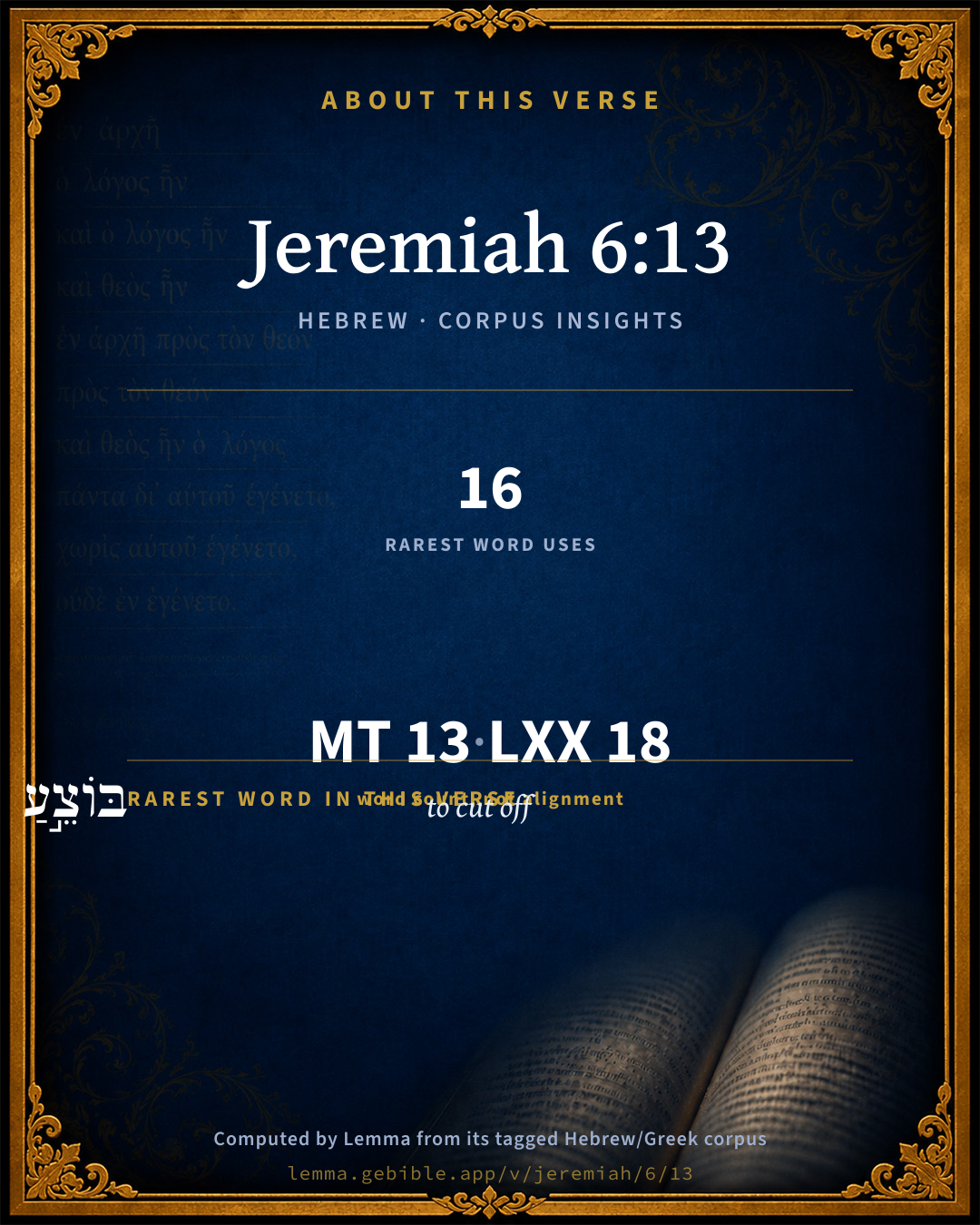
The rarest word here is בּוֹצֵ֣עַ to cut off H1214 — appearing just 16 times in the whole Hebrew Bible.

Shared distinctive vocabulary

בּוֹצֵ֣עַ to cut off H1214 occurs in 16 verses of the Hebrew Bible. Also found in:

Grammatical profile

  • 2 verbs
  • 6 nouns
  • 2 adjectives
  • 2 prepositions
  • 1 conjunction

Verb forms

  • בּוֹצֵ֣עַ Qal · Participle Active
  • עֹ֥שֶׂה Qal · Participle Active

Repetition

Words recur within this verse — often emphatic in Hebrew:

  • וְעַד until H5704 ×2
  • כֻּלּ֖וֹ all H3605 ×2

Hebrew & Septuagint length

In the original languages it is 13 Hebrew tokens and 18 Greek tokens — but the two are counted differently (Hebrew bundles its prefixes and suffixes into one token; the Greek is in lemma form), so that isn’t a like-for-like length.

Cross-references

26

Topical passages linked to Jeremiah 6:13 in the Treasury of Scripture Knowledge — connected by theme and wording, ordered by reader-vote popularity; previews shown in the World English Bible.

  • Jeremiah 23:11 for both prophet and priest are profane; yes, in my house have I found their wickedness, says Yahweh.
  • Jeremiah 8:10 Therefore will I give their wives to others, and their fields to those who shall possess them: for everyone from the least even to the greatest is given to covetousness; from the prophet even to the priest every one deals falsely.
  • Micah 3:11 Her leaders judge for bribes, And her priests teach for a price, And her prophets of it tell forturnes for money: Yet they lean on Yahweh, and say, Isn't Yahweh in the midst of us? No disaster will come on us.
  • Jeremiah 22:17 But your eyes and your heart are not but for your covetousness, and for shedding innocent blood, and for oppression, and for violence, to do it.
  • Micah 3:2–3 You who hate the good, And love the evil; Who tear off their skin, And their flesh from off their bones;
  • Isaiah 57:17 For the iniquity of his covetousness was I angry, and struck him; I hid [my face] and was angry; and he went on backsliding in the way of his heart.
  • Jeremiah 5:31 the prophets prophesy falsely, and the priests bear rule by their means; and my people love to have it so: and what will you do in the end of it?
  • Jeremiah 14:18 If I go forth into the field, then, behold, the slain with the sword! and if I enter into the city, then, behold, those who are sick with famine! for both the prophet and the priest go about in the land, and have no knowledge.
  • Ezekiel 22:25–28 There is a conspiracy of her prophets in the midst of it, like a roaring lion ravening the prey: they have devoured souls; they take treasure and precious things; they have made her widows many in the midst of it.
  • Micah 3:5 Thus says Yahweh concerning the prophets who lead my people astray; for those who feed their teeth, they proclaim, "Peace!" and whoever doesn't provide for their mouths, they prepare war against him:
  • Zephaniah 3:3–4 Her princes in the midst of her are roaring lions. Her judges are evening wolves. They leave nothing until the next day.
  • Isaiah 28:7 Even these reel with wine, and stagger with strong drink; the priest and the prophet reel with strong drink, they are swallowed up of wine, they stagger with strong drink; they err in vision, they stumble in judgment.
  • Isaiah 56:9–12 All you animals of the field, come to devour, [yes], all you animals in the forest.
  • Jeremiah 2:8 The priests didn't say, Where is Yahweh? and those who handle the law didn't know me: the rulers also transgressed against me, and the prophets prophesied by Baal, and walked after things that do not profit.
  • Jeremiah 2:26 As the thief is ashamed when he is found, so is the house of Israel ashamed; they, their kings, their princes, and their priests, and their prophets;
  • Jeremiah 23:14–15 In the prophets of Jerusalem also I have seen a horrible thing: they commit adultery, and walk in lies; and they strengthen the hands of evil-doers, so that none does return from his wickedness: they are all of them become to me as Sodom, and the inhabitants of it as Gomorrah.
  • Jeremiah 26:7–8 The priests and the prophets and all the people heard Jeremiah speaking these words in the house of Yahweh.
  • Jeremiah 32:32 because of all the evil of the children of Israel and of the children of Judah, which they have done to provoke me to anger, they, their kings, their princes, their priests, and their prophets, and the men of Judah, and the inhabitants of Jerusalem.
  • Lamentations 4:13 [It is] because of the sins of her prophets, [and] the iniquities of her priests, That have shed the blood of the just in the midst of her.
  • Ezekiel 22:12 In you have they taken bribes to shed blood; you have taken interest and increase, and you have greedily gained of your neighbors by oppression, and have forgotten me, says the Lord Yahweh.
  • Ezekiel 33:31 They come to you as the people comes, and they sit before you as my people, and they hear your words, but don't do them; for with their mouth they show much love, but their heart goes after their gain.
  • Micah 2:1–2 Woe to those who devise iniquity And work evil on their beds! When the morning is light, they practice it, Because it is in the power of their hand.
  • Luke 16:14 The Pharisees, who were lovers of money, also heard all these things, and they scoffed at him.
  • 1 Timothy 3:3 not a drinker, not violent, not greedy for money, but gentle, not quarrelsome, not covetous;
  • 2 Peter 2:3 In covetousness they will exploit you with deceptive words: whose sentence now from of old doesn't linger, and their destruction will not slumber.
  • 2 Peter 2:14–15 having eyes full of adultery, and who can't cease from sin; enticing unsettled souls; having a heart trained in greed; children of cursing;

Cross-references courtesy of OpenBible.info (CC BY 4.0).

Hebrew and Greek witnesses Masoretic Hebrew ↔ Greek Septuagint

The same verse in the two great witnesses to the Old Testament, shown verse-for-verse.

These are two independent witnesses, not word-aligned to each other, and the Septuagint is shown in lemma (dictionary) form.

Hebrew Jeremiah 6:13 Masoretic · Westminster Leningrad Codex

כִּ֤י מִקְּטַנָּם֙ וְעַד גְּדוֹלָ֔ם כֻּלּ֖וֹ בּוֹצֵ֣עַ בָּ֑צַע וּמִנָּבִיא֙ וְעַד כֹּהֵ֔ן כֻּלּ֖וֹ עֹ֥שֶׂה שָּֽׁקֶר

For from the least of them even to the greatest of them everyone is given to covetousness; and from the prophet even to the priest everyone deals falsely.

World English Bible · Public Domain

Greek LXX Structure differs

In the Septuagint, Jeremiah is about an eighth shorter than the Hebrew and arranges its material differently — the Oracles Against the Nations (Hebrew chapters 46–51) appear in the middle of the Greek book, after 25:13. Because the chapter and verse boundaries do not line up, a verse-for-verse comparison with the Hebrew is not shown.

A verse-for-verse comparison isn’t shown here because the chapters and verses don’t line up. Switch to the LXX edition with the MT / LXX toggle above to read the Greek directly.

On this verse, John Gill's Exposition discusses the Septuagint’s reading. Read the note in Commentary ↓

Hebrew: Westminster Leningrad Codex (CC BY 4.0). Greek: Septuagint (public domain); English from a public-domain English Septuagint. How the Septuagint differs from the Hebrew →

Targum (Aramaic paraphrase)

1

The Targum is the ancient Jewish Aramaic paraphrase of the Hebrew Scriptures — an interpretive translation, not the Hebrew text itself. Onkelos (literal) and Pseudo-Jonathan (expansive) render the Torah, and Jonathan the Prophets. Coverage is partial: where no permissively-licensed English translation exists for a verse, only the Aramaic is shown. This is verse-level text, not a word-by-word alignment to the Hebrew.

  1. Targum Jonathan Prophets (Joshua–Malachi)
    אֲרֵי מִזְעֵירְהוֹן וְעַד רַבְּהוֹן כּוּלְהוֹן אַנְסֵי מָמוֹן וּמִסָפַר וְעַד כָּהֵין כּוּלְהוֹן עָבְדֵי שְׁקָר:

    (no public-domain English translation for this verse)

    Targum Jonathan — Aramaic: “Mikraot Gedolot” (public domain). English: “Sefaria Community Translation” (CC0 1.0 (public-domain dedication)); “London "Chaldee Paraphrase," 1871” (public domain). Text via Sefaria.

Commentary

Notes on Jeremiah 6:13 from classic Christian and Jewish commentators (each source and its license shown beneath its notes). The classic Christian expositions comment on the surrounding passage and are grouped to its opening verse, so a note may address several verses; the Jewish commentaries on the Tanakh (Rashi and others) are per-verse, so they appear only where the commentator wrote on this verse.

Lemma curates 59 commentaries, every one of them public domain or Creative Commons licensed, each selected and text-cleaned for this edition rather than reprinted as found. About our sources →

Trapp's Complete Commentary

John Trapp

Jer 6:13 For from the least of them even unto the greatest of them every one [is] given to covetousness; and from the prophet even unto the priest every one dealeth falsely.

Ver. 13. Every one is given to covetousness.] Avet avaritia, eager for greed, is coveting covetise or excessively; crieth still, Give, give, with the horse leech; of which creature Pliny {a} observeth, and experience showeth, that it hath no through passage, but taketh much in, and letting nothing out, breaks and kills itself with sucking. So doth the covetous man.

Every one dealeth falsely.] Heb., Each one is doing falsehood, as if that were their common trade.

{a} Lib. xi. cap. 34.

John Trapp, A Commentary or Exposition upon All the Books of the Old and New Testament (1647–1656) — public domain. Text from a community e-Sword module.

Joseph Benson's Commentary

Jer 6:13-15. For, from the least of them, &c. — Old and young, rich and poor, high and low, those of all ranks, professions, and employments; every one is given to covetousness — Greedy of filthy lucre; and this made them oppressive, for of that evil, as well as others, the love of money is the bitter root. Nay, and this hardened their hearts against the word of God and his prophets: they were the covetous Pharisees that derided Christ. From the prophet to the priest, every one dealeth falsely — Not only in speaking false things, but, as the Hebrew, עשׁה שׁקר, signifies, doing falsehood; acting a lie; that is, playing the hypocrite; keeping up an outward form, or appearance, of piety, and desiring to be accounted righteous, when, before God, they were abominably wicked. They have healed also the hurt, &c., slightly — Skinning over the wound, and never searching it to the bottom; applying lenitives, soothing speeches, when there was need of corrosives, or sharp reproofs, which might have brought them to a true sense of the danger of their condition: encouraging them in their sins, and carnal security, by promising them peace and safety when they were on the brink of ruin and destruction. So that the ministry of these priests and prophets, instead of proving a blessing, became a real curse to them. Were they ashamed, &c. — Nothing is a greater sign of an incorrigible temper than being past shame. Such the prophet tells us was the character of the generality of the Jews at this time: their hearts were so hardened that they were not at all ashamed, neither could they blush. Nay, it seems they even gloried in their wickedness, and openly confronted the convictions that should have humbled and brought them to repentance. This is thought by some to refer especially to the priests and prophets, who had soothed the people in their sins, with false hopes of peace, and yet were not ashamed of their deceit and treachery; no, not when the event disproved and gave the lie to their promises. Therefore shall they fall among them that fall —

They shall have their portion with those whom they have deceived and destroyed.

Joseph Benson's Commentary on the Old and New Testaments (1811–1818) — public domain. Text from a community e-Sword module.

Tyndale Open Study Notes

Tyndale Open Resources

6:13 The people were so ruled by greed that they sought gain even by violent methods (cp. Prov 1:11-19; see also Isa 56:11; Mic 3:5, 11). The religious leaders were frauds; they did not function as their titles indicated they should.

Tyndale Open Study Notes — © Tyndale Open Resources, licensed CC BY-SA 4.0. Text via the HelloAO Bible API.

Jamieson, Fausset & Brown

Robert Jamieson, A. R. Fausset & David Brown

(Jer 8:10; Isa 56:11; Mic 3:11).

Jamieson, Fausset & Brown — Commentary Critical and Explanatory on the Whole Bible (1871) — public domain (CC PDM 1.0). Text via the HelloAO Bible API.

John Calvin's Commentaries

The Prophet now again declares, that it was nothing strange that God resolved to deal with so much severity with that people, and to execute on them extreme vengeance; for no part was whole and sound, but impiety had pervaded all ranks. It might, indeed, be ascribed to the young, as well as to the old, for he says, From the small to the great; but I prefer to understand the first clause of the poor and the lower orders, and the second of the higher ranks, who excelled in power and wealth among the people. He says, then, that contempt of God and every kind of wickedness prevailed, not only in one part but in the whole community, so that there was no soundness from the head to the soles of the feet. We now, then, perceive what the Prophet means by saying, From the small to the great

And this appears still clearer from the end of the verse, where he says, From the prophet to the priest He amplifies here what he had said of the small and the great. Hence we see, that by the great he understands not those of mature or advanced age, but such as were in dignity and honor, who were in esteem on account of their wealth or of other endowments. So also, on the other hand, he does not call those small who were young, but such as were despised, who were of the lowest order, and formed as it were the dregs of society: for as I have said, he amplifies what he had said, by adducing the prophets and the priests. Even though the king and his court were extremely wicked, yet some care for religion ought to have prevailed among the prophets and the priests; there ought at least to have been among them some decency; for they were appointed for the purpose of carrying light for others. As, then, even these were apostates, and had degenerated from the true worship of God, what could have been found among the rest of the people?

We now, then, see that the mouth of the ungodly was here closed, so that they could not expostulate with God or blame his severity, for they had all arrived at the highest pitch of impiety, inasmuch as the prophets and the priests were no less corrupt than the common people.

By saying that all coveted covetousness, he refers to frauds and base gain; in that he includes every kind of avariciousness. By saying that the priests and the prophets wrought falsehood, or acted fraudulently, he means the same thing, but in other words, even that there was no integrity in those teachers who ought to have been leaders to the blind: for God had ordained them that they might, as I have said, carry light to all others and shew them the way of salvation. It follows —

John Calvin's Commentaries (1540-1563) — public domain. Text from the Calvin Translation Society English edition (1840s-50s) via the Christian Classics Ethereal Library (ccel.org). Calvin's coverage is partial (roughly two-thirds of the Bible); uncommented books and verses are honest gaps, never fabricated. The 19th-century editor's footnotes and remarks are omitted so the notes are faithfully Calvin's own voice.

Ellicott's Commentary for English Readers

(13) Is given to covetousness.—Literally, gained gain. The Hebrew word (as in Gen_37:26; Job_22:2) does not necessarily involve the idea of dishonest gain, though this (as in Pro_1:19; Hab_2:9) is often implied. What the prophet condemns is the universal desire of gain (rem . . . rem . . . quocunque modo rem), sure to lead, as in the second clause, to a gratification of it by fair means or foul.

From the prophet even unto the priest . . .—The two orders that ought to have checked the evil are noted as having been foremost in promoting it. (Comp. Note on Jer_5:31.)

Dealeth falsely.—Literally, worketh a lie, in the sense of “dishonesty.”

A Bible Commentary for English Readers, edited by Charles John Ellicott (1878–1897) — public domain. Text from a community e-Sword module.

The Cambridge Bible for Schools and Colleges

gen. ed. J. J. S. Perowne

13. from the least of them even unto the greatest] Cp. Jer_5:5.

The Cambridge Bible for Schools and Colleges (gen. ed. J. J. S. Perowne; Cambridge University Press, 1878–1918) — public domain. Text from a community e-Sword module.

John Gill's Exposition

For from the least of them even unto the greatest of them,.... From the least in age to the oldest among them; or rather, from persons of the lowest class of life, and in the meanest circumstances, to those that are in the highest places of trust and honour, and are in the greatest affluence of riches and wealth; so that as men of every age and station had sinned, old and young, high and low, rich and poor, it was but just and right that they should all share in the common calamity:

everyone is given to covetousness; which is mentioned particularly, and instead of other sins, it being the root of evil, and was the prevailing sin among them:

from the prophet even unto the priest everyone dealeth falsely; the false prophet, as Kimchi interprets it, and so the Septuagint and other versions; and the priest of Baal, as the same interpreter; both acted deceitfully; the one in prophesying lies to the people, the other in drawing them off from the pure worship of God. The Targum is,

"from the scribe to the priest;''

from the lowest order of teachers to the highest in ecclesiastical office. The whole shows a most general and dreadful corruption.

John Gill's Exposition of the Whole Bible (1746–1763) — public domain (CC PDM 1.0). Text via the HelloAO Bible API.

Albert Barnes' Notes on the Bible

Given to covetousness - literally, everyone has gained gains. The temper of mind which gains the world is not that which gains heaven.

Falsely - Rather, “fraudulently.”

Albert Barnes' Notes on the Bible (1834–1885) — public domain. Text from a community e-Sword/MySword module.

Haydock's Catholic Bible Commentary

Prophet. Septuagint, "false prophet," chap. iv. 31. (Haydock)

George Leo Haydock (1774–1849), Haydock's Catholic Family Bible and Commentary, 1859 edition — public domain. Excludes Psalms (Douay-Rheims chapter numbering differs from Protestant) and Deuterocanonical books (Catholic canon only).

Matthew Poole's English Annotations

From the least of them; not respecting so much their age as degree and quality, poor and rich; the prophet notes the generality of their corruption as the reason of God’s severity against them, as Jer 6:6; observing also that it was even among the greatest, who ought to have given better examples, no soundness from head to foot.

Covetousness; in which possibly all their wickednesses, as cruelty, oppression, injustice, &c., may be comprised, it being the root of all evil, 1Ti 6:10, and may also speak the justice of God, in the Chaldeans taking them and all their substance away, that had by violence and fraud wrested it from others, Mic 2:2.

Dealeth falsely, Heb. doing falsehood; as if that were their whole work, the proper and peculiar sin of the priests and prophets, to deceive the people, and to flatter them by false visions, as in the next verse; not that they were not also guilty of the other sins, Isa 56:11, and the princes and people of this, Mic 3:9; Jer 5:31, for they were all involved in the same wickedness; but the prophet mentions those sins that were most peculiar to each party. See the same Jer 8:10.

Matthew Poole's English Annotations on the Holy Bible (1683–1685) — public domain. Text from a community e-Sword/MySword module.

The Pulpit Commentary

Given to covetousness; literally, gaineth gain; but the word here rendered "gain" implies that it is unrighteous gain (the root means "to tear"), Unjust gain and murder are repeatedly singled out in the Old Testament as representative sins. (comp. Eze_33:31 Psa_119:36 Isa_1:15 Jer_2:34; and see my note on Isa_57:17) There is a special reason for the selection of "covetousness" here. Land was the object of a high-born Jew"s ambition, and expulsion from his land was his appropriate punishment. (comp. Isa_5:8, Isa_5:9)

The ministry of deceit.

The extent to which corruption prevailed is suggested when even the prophets and priests share the general apostasy: Every one dealeth falsely.

I THE DUTY IT HAD TO FULFIL. The priest dealt with ritual, the prophet with moral and doctrinal questions in religion. They had to act as the spiritual guides and overseers of the people of God. Here they are represented as behaving like quack doctors in cases of grave injury or disease. They were appointed for the spiritual health and well-being of men. Circumstances in the condition of their flocks would determine the manner in which they should exercise their functions, and the special direction in which their attention should be directed. Israel had fallen into serious wickedness. It was no isolated acts of transgression of which she was guilty; her whole spiritual state was one of alienation from God. In such a case the utmost faithfulness and severity were required; as the surgeon has to probe the wound, and use sharp instruments for excising the part that is diseased; or the physician has to make a thorough diagnosis of a patient, and in desperate sickness to use desperate remedies. Here an opposite course had been pursued. The gravity of the "hurt" was overlooked or ignored, and merely outward signs of amendment were regarded as complete reconciliation with God.

1. That which separates men from God is no slight matter. It is a deadly thing. If it continues, it must inevitably destroy. The observances of religion will be nullified until it is put fight. Men must be told of their sin, not merely in a round and general manner, but judiciously, and according to the specialties of individual or class peculiarities. The unbelief of the natural man is the parent of his misdeeds and sin, and keeps him from any real communion with God.

2. The minister of religion is bound to be discerning and faithful.

3. It is only through a real and spiritual repentance that reconciliation can be effected. At such a juncture spiritual religion ought to have been insisted on, and the enormity of the offence exposed. Preliminary acts of contrition; experiences and discoveries of the heart such as conviction of sin, etc.; the necessity of love, obedience, and faith ought not to be slurred over.

II FAILURE IN THIS DUTY AND ITS CAUSES. The root-cause is undoubtedly the share which the religious teachers had in the general depravity. There was also a consequent lack of spiritual discernment. The greatness of the fall from the former position occupied by Israel was not appreciated, and the nature of true religion was not understood. A ministry under court patronage and a merely popular ministry are alike subject to the temptations to please rather than to deal honestly with the evils of individuals, society, and the state, and to rectify them. "They who live to please must please to live." There is such a thing always as a making of religion too easy either in its moral conditions or its doctrinal realizations. It is fearfully wrong to say a man is a Christian when he is not a Christian; or so to deal with him in pastoral relations that he fancies himself in possession of salvation and spiritually secure when he is in heart and life far from God. Flattery has a thousand forms, and there is no falsehood to which it contributes that is more insidious or wide-reaching than this.

III THE RESULTS. These are terrible in the extreme. From the authority of office they are credited in their declarations, and national and individual offences are condoned and perpetuated. Possible for a man to be deceived on this most vital question; to think himself a child of God when he is in reality a child of Satan. Death-bed repentances.

1. The divorce of morality from religion.

2. The intensified wrath of God at hypocrisy and sham religion.

3. Eternal death and irretrievable loss. M.

Covetousness a universal sin.

It is not so much of covetousness in itself that the prophet is here speaking, as of the universality of it. From the least even to the greatest the spirit of the spoiler is in the hearts of the people. The words, of course, are not to be taken literally as to individuals; but there is this universality about them, that they apply to every class. That a man is rich, and increased with goods, and that he has, indeed, a great deal more than he can ever enjoy in his own person, is far from being a general ground for supposing that he will be contented with his possessions. The more he has and the higher he stands, the more he may want to have and the higher he may want to get. And so all the way up the ladder from the lowest round, men are continually struggling with one another. It is a ladder, the lowest round of which will hold a great multitude, but it ever narrows as it ascends; and the covetous who happen to be also strong and consequently victorious over their feebler competitors, go clambering on as long as one"s eye rests upon them. No one ever seems to reach the top of the ladder; and it may be said moreover that, though there seem many who are free from the spoiling spirit, it simply arises from this, that there has been nothing to bring the dormant germ into life and activity. No one can tell what possibilities of evil lie within him. And may not the essential element in covetousness be a strong motive force even when it is hidden away under the appearance of something else? One thing is very certain, that covetousness prevailed from the least even to the greatest in Jerusalem; it will also do so in every other human society. It is in human nature to have strong desires of the heart, strong and imperative even as hunger and thirst; and these desires will go out after things that can be seen and felt, enjoyed with the senses. To whom these things may of right belong is, alas! a secondary consideration with many men. They simply do not reflect upon it at all. Life resolves itself into a struggle between him who wants and him who has, and, if the truth must be spoken, the victor in such a struggle is practically a robber. There may be no physical violence, no shedding of blood; but if there is the enriching of one"s self at the expense of another, then the essential wrong is present. Let us allow the covetous man whatever credit there may be in this, that he does not form his covetous designs for any pleasure that he has in rapacity, but rather that he is rapacious in order to carry out his covetous designs. He wants to be rich and strong, and the only way he can do it is by crushing others into poverty. Hence this is reckoned an unavoidable accompaniment. It never strikes men of this sort that there is a more excellent way to satisfy and exhilarate the heart. Gods eye is upon this universal desire for large possessions, and he can make a Divine and truly wise use of the desire. He turns our thoughts to the heavenly, the unseen, the eternal. Man does well in having the largest views as to possessions; he does well in looking to an immense increase of goods. It is a grand thing when he can pull down his barns and build greater, if it is only spiritual wealth that he is heaping up. In this gathering of goods there is no spoiling of the brethren, leaving them hungry, naked, and unsheltered. The spiritual wealth of the godly man makes poverty to none. Nay, rather beautiful contrast-the richer he becomes, the richer he makes all with whom he comes in living contact. Y.

The Pulpit Commentary (1880–1919), ed. H.D.M. Spence-Jones & Joseph S. Exell — public domain. Text from a community e-Sword module.

John Wesley's Explanatory Notes

Falsely - Hebrew. doing falsehood, as if that were their whole work, the proper sin of the priests and prophets, to deceive the people, and to flatter them by false visions.

John Wesley, Explanatory Notes Upon the Whole Bible (1754–1765) — public domain. Text via the GEBible commentary corpus.

unfoldingWord translationNotes

Door43 World Missions Community

that from the least to the greatest, all of them are greedy

The phrase "from the least to the greatest" shows that all the people of Israel are included in the phrase "all of them," regardless of how important they are. AT: "all of them, including the least powerful, the most powerful, and every one else, are greedy" (See: Merism)

the least

This refers to the least powerful and least important people. AT: "the least powerful people" (See: Nominal Adjectives)

the greatest

This refers to the most powerful and most important people. AT: "the greatest people" or "the most powerful people" (See: Nominal Adjectives)

all of them

"all of the people of Israel"

are greedy for dishonest gain

The abstract noun "gain" can be expressed with the phrases "get more money" or "get more things." AT: "want to get more money by lying to people" or "strongly desire to get more things and will even trick people in order to get them" (See: Abstract Nouns)

all of them practice deceit

"all of them deceive people" or "all of them are liars"

They have healed the wounds of my people lightly

Possible meanings are 1) the wounds represent the problems the people have as a result of their sin. AT: "They act as though my people's problems are not serious, like small wounds" or 2) the wounds represent the people's sin. AT: "They acts as though my people's sins are not serious, like small wounds" (See: Metaphor)

They have healed the wounds ... lightly

Here "lightly" represents treating the wounds as if they were not serious, as if they were not difficult. (See: Metaphor)

'Peace, Peace,' when there is no peace

"'All is well, All is well,' but it is not well"

Were they ashamed when they practiced abominations?

God uses this question to show his anger that the people were not ashamed of their sins. AT: "They committed terrible sins, and they were not ashamed" (See: Rhetorical Question)

they did not know how to blush

When a person is ashamed, his face normally turns red. AT: "their faces did not even turn red"

they will fall among the fallen

Here "fall" represents being killed. AT: "they will be killed along with the others who are killed" (See: Metaphor)

they will be brought down when they are punished

Here "will be brought down" represents being destroyed. This can be stated in active form. AT: "I will destroy them when I punish them" (See: Metaphor and Active or Passive)

translationWords

prophet

priest

deceive

cure

people of God

peace

shame

abomination

humble

punish

unfoldingWord translationNotes — © Distant Shores Media and the Door43 World Missions Community, licensed CC BY-SA 4.0. Source: git.door43.org/Door43/en_tn.

Rashi

Rabbi Shlomo Yitzchaki (Rashi)

commit robbery rob money.

Rashi on the Tanakh — English translations: “The Judaica Press complete Tanach with Rashi, translated by A. J. Rosenberg” (CC BY 4.0); “Pentateuch with Rashi's commentary by M. Rosenbaum and A.M. Silbermann, 1929-1934” (public domain); “The Metsudah Tanach series, Lakewood, N.J” (CC BY 4.0); and “The Book of Joshua, Metsudah Publications, 1997” (CC BY 4.0). Text via Sefaria.

Lesson kit

Teaching starters — assembled from the data on this page, not authored interpretation. Every prompt links to the verse data it draws on. Edit before teaching.

Jeremiah, in the Prophets, opens this verse with 13 words (11 distinct Hebrew lemmas). Its most distinctive word is bâtsaʻ (“to cut off”). A historical commentator’s framing appears above. Read the whole chapter for the surrounding context.

Discussion questions

  1. The word bâtsaʻ carries the sense “to cut off.” How does it shape the verse?
  2. How does Job 6:9, which shares the word «to cut off», read alongside this verse?
  3. What does the repetition of “until” (2× in this one verse) do in this verse?
  4. These translations render this verse differently. What is at stake in choosing one wording over another?
  5. «בּוֹצֵ֣עַ» is a Qal Participle Active verb. How does that grammatical form shape the action described?
  6. Compare how Trapp's Complete Commentary and Joseph Benson's Commentary read this verse. Where do they agree or differ?

Things to notice

Reading settings

Reading text

Shown beneath each verse's original-language words.

Old Testament
Old Testament edition

Read the OT as the Masoretic Hebrew (MT) or the Greek Septuagint (LXX).

English shown for the Greek Septuagint (in the Hebrew ↔ Greek comparison).

Comparing translations? Open the Compare panel on any verse page to stack up to four side by side.