
Exodus 38:21

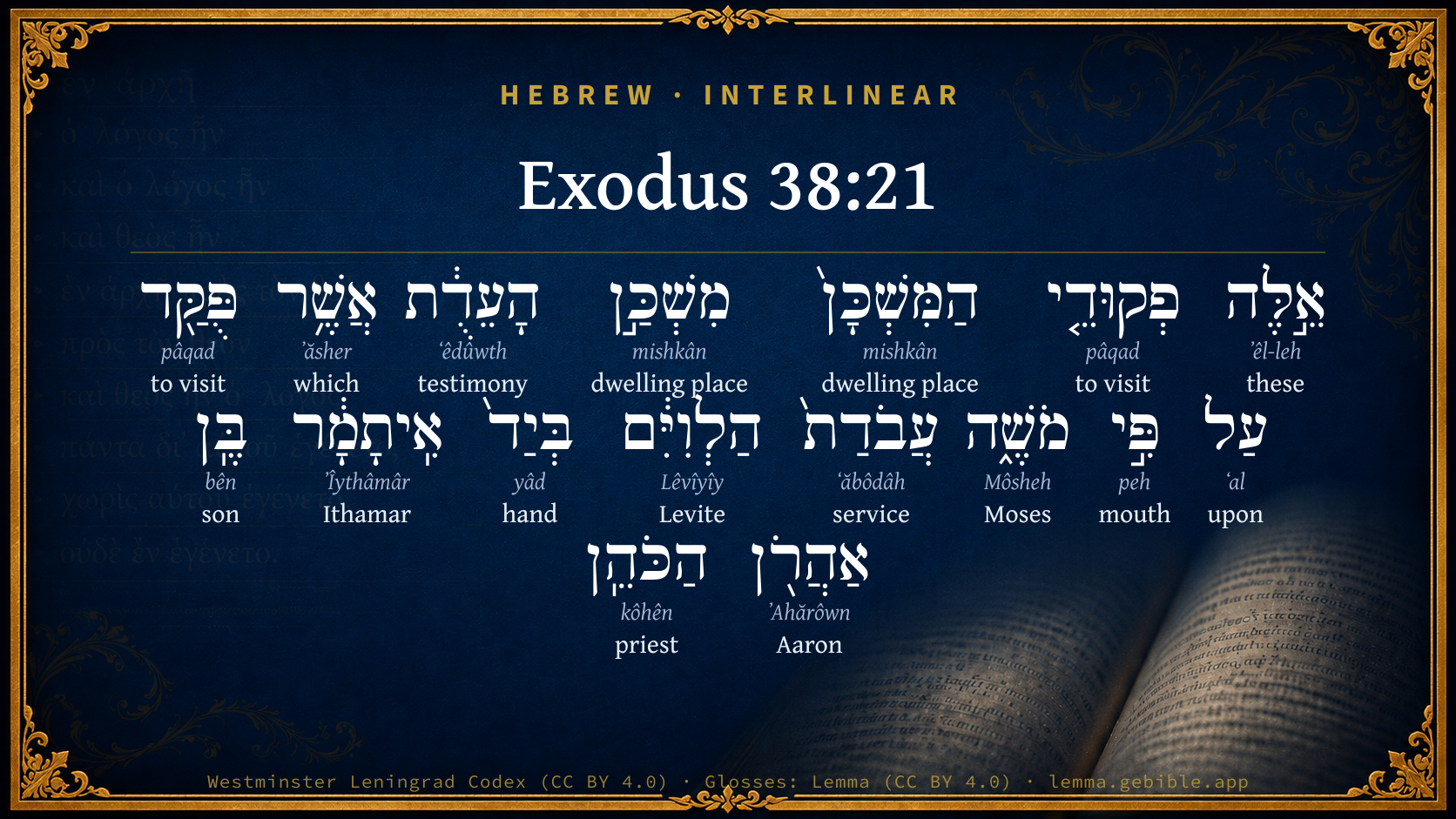
Hebrew (Westminster Leningrad Codex) Exodus 38:21 appears in the Hebrew Old Testament. The text above is from the Westminster Leningrad Codex. Each word links to its Strong’s number, a concise gloss, and parsing drawn from the Open Scriptures Hebrew Bible morphology. Click any word for its full Brown-Driver-Briggs (BDB) entry.
Download image
Cite this verse

Exodus 38:21 (World English Bible). Public Domain. Lemma interlinear Bible study tool, https://lemma.gebible.app/v/exodus/38/21.

Show BibTeX & RIS
BibTeX
RIS
English Translation
This is the amount of material used for the tent, even the Tent of the Testimony, as they were counted, according to the commandment of Moses, for the service of the Levites, by the hand of Ithamar, the son of Aaron the priest.
World English Bible · Public Domain
Download a study sheet

One document with this verse’s original text, its word-by-word gloss line, the meaning frame, cross-references with their text, attributed commentary, and full source and license credits — printable, and it pastes into notes with its structure intact.

This verse Autodidact and up

Study sheet (.html) Plain text (.txt)

A passage Seminary Student

Up to 50 verses in one chapter. A passage sheet keeps up to 6 commentary sources and 12 cross-references per verse, in the order this page ranks them, and says so on the sheet whenever that leaves anything out. Ask for a single verse and you get the Autodidact verse sheet above.

Everything on this page stays free to read, with no account — the sheet is a download of what is already on screen, not access to it.

Want to remove ads? Support Godless Engineer
Compare translations 3

The same verse in 3 English versions, stacked beneath the original-language interlinear above. Click any original word for its lexicon entry.

Each is an independent rendering of the whole verse — the interlinear is not word-aligned to these translations.

Highlighted words mark where these versions differ — a whole-verse word diff, not a word-by-word alignment.

  • World English Bible Public Domain
    This is the amount of material used for the tent, even the Tent of the Testimony, as they were counted, according to the commandment of Moses, for the service of the Levites, by the hand of Ithamar, the son of Aaron the priest.
  • King James Version Public Domain
    This is the sum of the tabernacle, even of the tabernacle of testimony, as it was counted, according to the commandment of Moses, for the service of the Levites, by the hand of Ithamar, son to Aaron the priest.
  • unfoldingWord Literal Text CC BY-SA 4.0
    These the records of the Dwelling, the Dwelling of the Testimony which was recorded according to the mouth of Moses, the work of the Levites by the hand of Ithamar the son of Aaron the priest.

unfoldingWord Literal Text — © unfoldingWord, licensed CC BY-SA 4.0. Word-aligned USFM3 via Door43 (git.door43.org/unfoldingWord/en_ult).

Versions to compare (up to 4)

3 of 4 selected

Show all 18 translations

Every available English version of this verse, each an independent rendering of the whole verse.

  • World English Bible Public Domain
    This is the amount of material used for the tent, even the Tent of the Testimony, as they were counted, according to the commandment of Moses, for the service of the Levites, by the hand of Ithamar, the son of Aaron the priest.
  • Berean Standard Bible Public Domain
    This is the inventory for the tabernacle, the tabernacle of the Testimony, as recorded at Moses’ command by the Levites under the direction of Ithamar son of Aaron the priest.
  • Majority Standard Bible Public Domain
    This is the inventory for the tabernacle, the tabernacle of the Testimony, as recorded at Moses’ command by the Levites under the direction of Ithamar son of Aaron the priest.
  • King James Version Public Domain
    This is the sum of the tabernacle, even of the tabernacle of testimony, as it was counted, according to the commandment of Moses, for the service of the Levites, by the hand of Ithamar, son to Aaron the priest.
  • American Standard Version (1901) Public Domain
    This is the sum of `the things for' the tabernacle, even the tabernacle of the testimony, as they were counted, according to the commandment of Moses, for the service of the Levites, by the hand of Ithamar, the son of Aaron the priest.
  • Revised Version (1885) Public Domain
    This is the sum of the things for the tabernacle, even the tabernacle of the testimony, as they were counted, according to the commandment of Moses, for the service of the Levites, by the hand of Ithamar, the son of Aaron the priest.
  • Geneva Bible (1599) Public Domain
    These are the parts of the Tabernacle, I meane, of the Tabernacle of the Testimonie, which was appovnted by the commandement of Moses for the office of the Leuites by the hande of Ithamar sonne to Aaron the Priest.
  • Douay-Rheims (1899) Public Domain
    These are the instruments of the tabernacle of the testimony, which were counted according to the commandment of Moses, in the ceremonies of the Levites, by the hand of Ithamar son of Aaron the priest:
  • Young's Literal Translation Public Domain
    These are the numberings of the tabernacle (the tabernacle of testimony), which hath been numbered by the command of Moses, the service of the Levites, by the hand of Ithamar son of Aaron the priest.
  • Literal Standard Version CC BY-SA 4.0
    These are the numberings of the Dwelling Place (the Dwelling Place of Testimony), which has been numbered by the command of Moses, the service of the Levites, by the hand of Ithamar son of Aaron the priest.
  • Unlocked Literal Bible CC BY-SA 4.0
    This is the inventory of the tabernacle, the tabernacle of the covenant decrees, as it was taken following Moses' instructions. It was the work of the Levites under the direction of Ithamar son of Aaron the priest.
  • unfoldingWord Literal Text CC BY-SA 4.0
    These the records of the Dwelling, the Dwelling of the Testimony which was recorded according to the mouth of Moses, the work of the Levites by the hand of Ithamar the son of Aaron the priest.
  • Darby Bible Public Domain
    These are the things numbered of the tabernacle, the tabernacle of the testimony, which were counted, according to the commandment of Moses, by the service of the Levites, under the hand of Ithamar, son of Aaron the priest.
  • World Messianic Bible Public Domain
    These are the amounts of materials used for the tabernacle, even the Tabernacle of the Testimony, as they were counted, according to the commandment of Moses, for the service of the Levites, by the hand of Ithamar, the son of Aaron the priest.
  • Webster's Bible Public Domain
    This is the sum of the tabernacle, even of the tabernacle of testimony, as it was counted, according to the commandment of Moses, for the service of the Levites, by the hand of Ithamar, son to Aaron the priest.
  • Free Bible Version CC BY-SA 4.0
    The following is what was used for the Tabernacle, the Tabernacle of the Testimony, recorded at Moses' direction by the Levites under the supervision of Ithamar, son of Aaron the priest.
  • Bible in Basic English Public Domain
    This is the price of the making of the House, even the House of witness, as it was valued by the word of Moses, for the work of the Levites under the direction of Ithamar, the son of Aaron the priest.
  • JPS Tanakh (1917) Public Domain
    These are the accounts of the tabernacle, even the tabernacle of the testimony, as they were rendered according to the commandment of Moses, through the service of the Levites, by the hand of Ithamar, the son of Aaron the priest. —

Literal Standard Version (2020), Covenant Press — licensed CC BY-SA 4.0. Text via the HelloAO Bible API (eBible.org). Unlocked Literal Bible (unfoldingWord) — licensed CC BY-SA 4.0. Text via the HelloAO Bible API (eBible.org). unfoldingWord Literal Text — © unfoldingWord, licensed CC BY-SA 4.0. Word-aligned USFM3 via Door43 (git.door43.org/unfoldingWord/en_ult). Free Bible Version, Dr. Jonathan Gallagher — licensed CC BY-SA 4.0. Text via the HelloAO Bible API (eBible.org).

Word by word

More ways to search: Search by grammar → Find every occurrence → Compare this word →

Practice this passage: Drill this verse → Learn its vocabulary →

אִֽיתָמָ֔ר
ʼÎythâmâr
H385
“Ithamar”
Noun, Proper
Part of Speech
Noun
Type
Proper
Full BDB Definition

Origin: from H339 and H8558

TWOT: None

Ithamar = "coast of palms" - fourth and youngest son of Aaron
  1. אֵ֣לֶּה ʼêl-leh H428 “these” Pronoun, Demonstrative, Common, Plural
  2. פְקוּדֵ֤י pâqad H6485 “visited” Verb, Qal, Participle Passive, Masculine, Plural, Construct
  3. הַמִּשְׁכָּן֙ mishkân H4908 “the · dwelling place” Particle, Definite Article + Noun, Common, Masculine, Singular, Absolute
  4. מִשְׁכַּ֣ן mishkân H4908 “dwelling place of” Noun, Common, Masculine, Singular, Construct
  5. הָעֵדֻ֔ת ʻêdûwth H5715 “the · testimony” Particle, Definite Article + Noun, Common, Feminine, Singular, Absolute
  6. אֲשֶׁ֥ר ʼăsher H834 “which” Particle, Relative
  7. פֻּקַּ֖ד pâqad H6485 “to visit” Verb, Pual, Perfect, 3rd Person, Masculine, Singular
  8. עַל ʻal H5921 “upon” Preposition
  9. פִּ֣י peh H6310 “mouth of” Noun, Common, Masculine, Singular, Construct
  10. מֹשֶׁ֑ה Môsheh H4872 “Moses” Noun, Proper
  11. עֲבֹדַת֙ ʻăbôdâh H5656 “service of” Noun, Common, Feminine, Singular, Construct
  12. הַלְוִיִּ֔ם Lêvîyîy H3881 “the · Levites” Particle, Definite Article + Noun, Gentilic, Masculine, Plural, Absolute
  13. בְּיַד֙ yâd H3027 “in/at · hand of” Preposition + Noun, Common, Both, Singular, Construct
  14. בֶּֽן bên H1121 “son of” Noun, Common, Masculine, Singular, Construct
  15. אַהֲרֹ֖ן ʼAhărôwn H175 “Aaron” Noun, Proper
  16. הַכֹּהֵֽן kôhên H3548 “the · priest” Particle, Definite Article + Noun, Common, Masculine, Singular, Absolute

About this verse

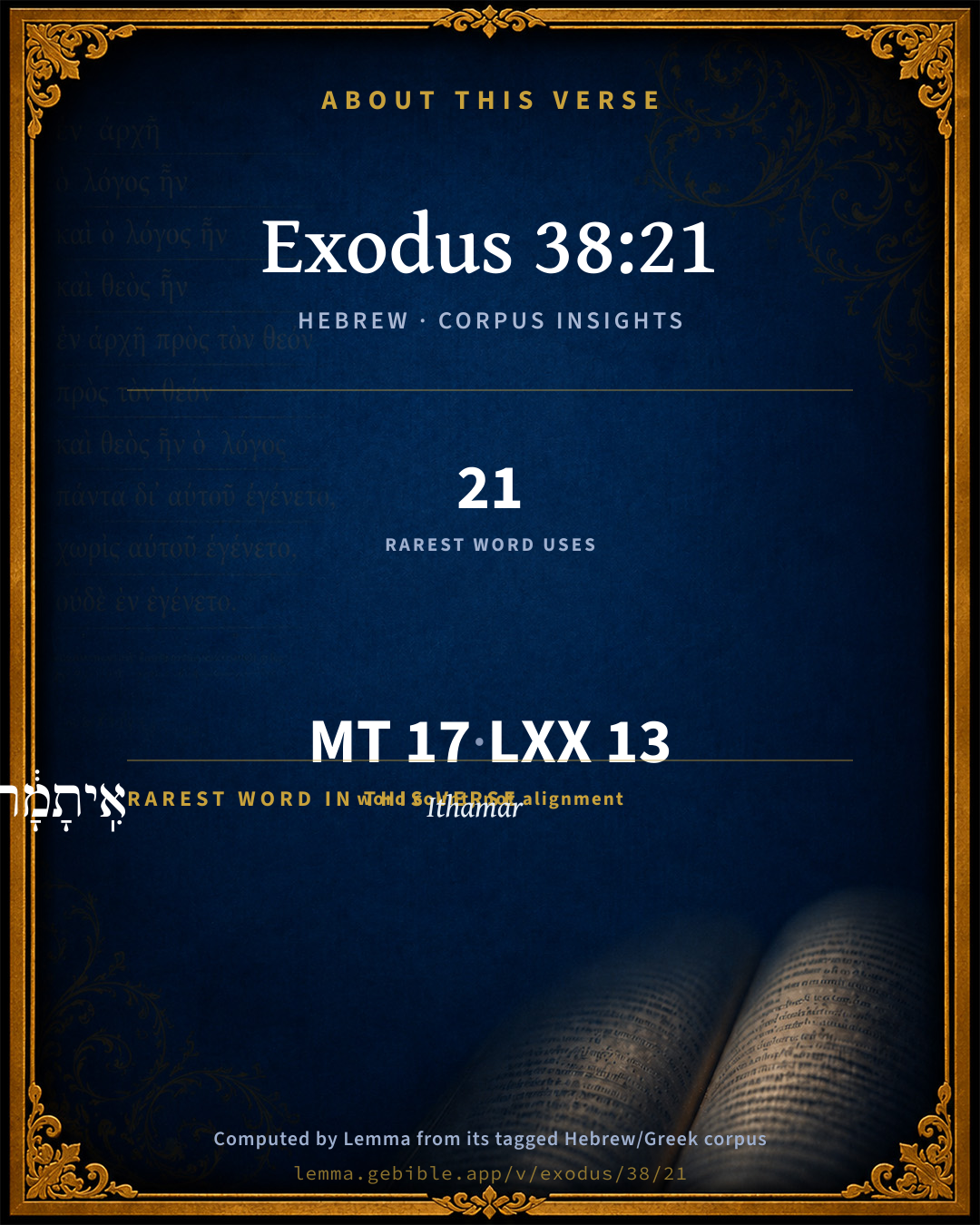
These counts appear in no published source. They are computed here, from the morphology-tagged text and Lemma’s own curated glosses. What Lemma adds →

17
words
15
distinct lemmas
Pentateuch
section

Notable vocabulary

The rarest word here is אִֽיתָמָ֔ר Ithamar H385 — appearing just 21 times in the whole Hebrew Bible.

Shared distinctive vocabulary

אִֽיתָמָ֔ר Ithamar H385 occurs in 20 verses of the Hebrew Bible. Also found in:

Grammatical profile

  • 2 verbs
  • 12 nouns
  • 1 pronoun
  • 1 preposition
  • 1 particle

Verb forms

  • פְקוּדֵ֤י Qal · Participle Passive
  • פֻּקַּ֖ד Pual · Perfect

Repetition

Words recur within this verse — often emphatic in Hebrew:

  • פְקוּדֵ֤י to visit H6485 ×2
  • הַמִּשְׁכָּן֙ dwelling place H4908 ×2

Hebrew & Septuagint length

In English translation the verse runs 43 words from the Hebrew and 15 from the Septuagint (LXX English) — the Septuagint runs noticeably shorter here. See the side-by-side →

A rough comparison of the two English renderings, which tokenize alike — not a word-level alignment.

Word counts can differ between the Hebrew and the Greek without any difference in meaning — e.g. the Hebrew direct-object marker אֵת has no separate Greek word, and Greek often adds the article ὁ.

In the original languages it is 17 Hebrew tokens and 13 Greek tokens — but the two are counted differently (Hebrew bundles its prefixes and suffixes into one token; the Greek is in lemma form), so that isn’t a like-for-like length.

Cross-references

28

Topical passages linked to Exodus 38:21 in the Treasury of Scripture Knowledge — connected by theme and wording, ordered by reader-vote popularity; previews shown in the World English Bible.

  • Acts 7:44 "Our fathers had the tent of the testimony in the wilderness, even as he who spoke to Moses commanded him to make it according to the pattern that he had seen;
  • Numbers 1:50 but appoint the Levites over the Tabernacle of the Testimony, and over all its furnishings, and over all that belongs to it. They shall carry the tabernacle, and all its furnishings; and they shall take care of it, and shall encamp around it.
  • Numbers 1:53 But the Levites shall encamp around the Tabernacle of the Testimony, that there may be no wrath on the congregation of the children of Israel: and the Levites shall be responsible for the Tabernacle of the Testimony."
  • Numbers 9:15 On the day that the tabernacle was raised up, the cloud covered the tabernacle, even the Tent of the Testimony: and at evening it was over the tabernacle as it were the appearance of fire, until morning.
  • Numbers 10:11 It happened in the second year, in the second month, on the twentieth day of the month, that the cloud was taken up from over the tent of the testimony.
  • 2 Chronicles 24:6 The king called for Jehoiada the chief, and said to him, Why haven't you required of the Levites to bring in out of Judah and out of Jerusalem the tax of Moses the servant of Yahweh, and of the assembly of Israel, for the tent of the testimony?
  • Exodus 6:23 Aaron took Elisheba, the daughter of Amminadab, the sister of Nahshon, as his wife; and she bore him Nadab and Abihu, Eleazar and Ithamar.
  • Numbers 17:7–8 Moses laid up the rods before Yahweh in the tent of the testimony.
  • Numbers 18:2 Your brothers also, the tribe of Levi, the tribe of your father, bring you near with you, that they may be joined to you, and minister to you: but you and your sons with you shall be before the tent of the testimony.
  • Exodus 25:16 You shall put the testimony which I shall give you into the ark.
  • Exodus 26:33 You shall hang up the veil under the clasps, and shall bring the ark of the testimony in there within the veil: and the veil shall separate the holy place from the most holy for you.
  • Exodus 40:3 You shall put the ark of the testimony in it, and you shall screen the ark with the veil.
  • Numbers 4:28–33 This is the service of the families of the sons of the Gershonites in the Tent of Meeting: and their charge shall be under the hand of Ithamar the son of Aaron the priest.
  • Numbers 24:5 How goodly are your tents, Jacob, Your tents, Israel!
  • 1 Chronicles 6:3 The children of Amram: Aaron, and Moses, and Miriam. The sons of Aaron: Nadab, and Abihu, Eleazar, and Ithamar.
  • Ezra 8:26–30 I weighed into their hand six hundred fifty talents of silver, and silver vessels one hundred talents; of gold one hundred talents;
  • Job 11:4 For you say, 'My doctrine is pure, I am clean in your eyes.'
  • Job 22:23 If you return to the Almighty, you shall be built up, If you put away unrighteousness far from your tents.
  • Job 26:1 Then Job answered,
  • Psalms 15:1 Yahweh, who shall dwell in your sanctuary? Who shall live on your holy hill?
  • Matthew 17:4 Peter answered, and said to Jesus, "Lord, it is good for us to be here. If you want, let's make three tents here: one for you, one for Moses, and one for Elijah."
  • 2 Corinthians 5:1 For we know that if the earthly house of our tent is dissolved, we have a building from God, a house not made with hands, eternal, in the heavens.
  • Hebrews 8:2 a minister of the sanctuary, and of the true tabernacle, which the Lord pitched, not man.
  • Hebrews 9:2–3 For there was a tabernacle prepared. In the first part were the lampstand, the table, and the show bread; which is called the Holy Place.
  • Hebrews 9:11 But Christ having come as a high priest of the coming good things, through the greater and more perfect tabernacle, not made with hands, that is to say, not of this creation,
  • 2 Peter 1:13 I think it right, as long as I am in this tent, to stir you up by reminding you;
  • Revelation 11:19 God's temple that is in heaven was opened, and the ark of the Lord's covenant was seen in his temple. Lightnings, sounds, thunders, an earthquake, and great hail followed.
  • Revelation 21:3 I heard a loud voice out of heaven saying, "Behold, God's dwelling is with people, and he will dwell with them, and they will be his people, and God himself will be with them as their God.

Cross-references courtesy of OpenBible.info (CC BY 4.0).

Hebrew and Greek witnesses Masoretic Hebrew ↔ Greek Septuagint

The same verse in the two great witnesses to the Old Testament, shown verse-for-verse.

Here the Septuagint runs noticeably shorter than the Hebrew — LXX2012 (modern English Septuagint) 15 words vs World English Bible 43. A rough length comparison of the two English translations, not a word-level alignment — read both below.

These are two independent witnesses, not word-aligned to each other, and the Septuagint is shown in lemma (dictionary) form.

Hebrew Exodus 38:21 Masoretic · Westminster Leningrad Codex

אֵ֣לֶּה פְקוּדֵ֤י הַמִּשְׁכָּן֙ מִשְׁכַּ֣ן הָעֵדֻ֔ת אֲשֶׁ֥ר פֻּקַּ֖ד עַל פִּ֣י מֹשֶׁ֑ה עֲבֹדַת֙ הַלְוִיִּ֔ם בְּיַד֙ אִֽיתָמָ֔ר בֶּֽן אַהֲרֹ֖ן הַכֹּהֵֽן

This is the amount of material used for the tent, even the Tent of the Testimony, as they were counted, according to the commandment of Moses, for the service of the Levites, by the hand of Ithamar, the son of Aaron the priest.

World English Bible · Public Domain

Greek LXX Exodus 38:21 Septuagint · lemma form

οὗτος ποιέω καί ὁ πάσσαλος ὁ σκηνή καί ὁ πάσσαλος ὁ αὐλή χαλκοῦς

He made the pins of the tabernacle and the pins of the court of brass.

LXX2012 (modern English Septuagint) · Public Domain

Hebrew: Westminster Leningrad Codex (CC BY 4.0). Greek: Septuagint (public domain); English from LXX2012 (modern English Septuagint) (Public Domain). How the Septuagint differs from the Hebrew →

Targum (Aramaic paraphrase)

2

The Targum is the ancient Jewish Aramaic paraphrase of the Hebrew Scriptures — an interpretive translation, not the Hebrew text itself. Onkelos (literal) and Pseudo-Jonathan (expansive) render the Torah, and Jonathan the Prophets. Coverage is partial: where no permissively-licensed English translation exists for a verse, only the Aramaic is shown. This is verse-level text, not a word-by-word alignment to the Hebrew.

  1. Targum Onkelos Torah (Genesis–Deuteronomy)
    אִלֵין מִנְיָנֵי מַשְׁכְּנָא מַשְׁכְּנָא דְסַהֲדוּתָא דִי אִתְמְנֵי עַל מֵימְרָא דְמשֶׁה פָּלְחַן לֵיוָאֵי בִּידָא דְאִיתָמָר בַּר אַהֲרֹן כַּהֲנָא:

    (no public-domain English translation for this verse)

    Targum Onkelos — Aramaic: “Onkelos Genesis” (public domain); “Onkelos Exodus” (public domain); “Onkelos Leviticus” (public domain); “Onkelos Numbers” (public domain); “Onkelos Deuteronomy” (public domain). English: “Sefaria Community Translation” (CC0 1.0 (public-domain dedication)); “J.W. Etheridge. The Targums of Onkelos and Jonathan Ben Uzziel on the Pentateuch. London: Longmans, Green, 1862” (public domain). Text via Sefaria.

  2. Targum Pseudo-Jonathan Torah (Genesis–Deuteronomy)
    אלה אִלֵין מִנְיָנֵי מַתְקַלְוָן וּסְכוּמְהוֹן דְּמַשְׁכְּנָא דְסַהֲדוּתָא דְאִתְמְנִיוּ עַל פּוּם מֵימְרָא דְמשֶׁה בְּרַם פּוּלְחַן לֵיוָאֵי הֲוַת בִּידָא דְאִיתָמָר בַּר אַהֲרן כַּהֲנָא

    These are the sums, weights, and numbers of the Tabernacle of the Testimony, which were counted by the word of the mouth of Mosheh. But the service of the Levites was by the hand of Ithamar bar Aharon the priest.

    Targum Pseudo-Jonathan — Aramaic: “Targum Jonathan on Genesis” (public domain); “Targum Jonathan on Exodus” (public domain); “Targum Jonathan on Leviticus” (public domain); “Targum Jonathan on Numbers” (public domain); “Targum Jonathan on Deuteronomy” (public domain). English: “The Targum of Jonathan ben Uzziel, trans. J. W. Etheridge, London, 1862” (public domain). Text via Sefaria.

Commentary

Notes on Exodus 38:21 from classic Christian and Jewish commentators (each source and its license shown beneath its notes). The classic Christian expositions comment on the surrounding passage and are grouped to its opening verse, so a note may address several verses; the Jewish commentaries on the Tanakh (Rashi and others) are per-verse, so they appear only where the commentator wrote on this verse.

Lemma curates 59 commentaries, every one of them public domain or Creative Commons licensed, each selected and text-cleaned for this edition rather than reprinted as found. About our sources →

Matthew Henry's Commentary

Here we have a breviat of the account which, by Moses's appointment, the Levites took and kept of the gold, silver, and brass, that was brought in for the tabernacle's use, and how it was employed. Ithamar the son of Aaron was appointed to draw up this account, and was thus by less services trained up and fitted for greater, Exo 38:21. Bezaleel and Aholiab must bring in the account (Exo 38:22, Exo 38:23), and Ithamar must audit it, and give it in to Moses. And it was thus: - 1. All the gold was a free-will offering; every man brought as he could and would, and it amounted to twenty-nine talents, and 730 shekels over, which some compute to be about 150,000l. worth of gold, according to the present value of it. Of this were made all the golden furniture and vessels. 2. The silver was levied by way of tax; every man was assessed half a shekel, a kind of poll-money, which amounted in the whole to 100 talents, and 1775 shekels over, Exo 38:25, Exo 38:26. Of this they made the sockets into which the boards of the tabernacle were let, and on which they rested; so that they were as the foundation of the tabernacle, Exo 38:27. The silver amounted to about 34,000l. of our money. The raising of the gold by voluntary contribution, and of the silver by way of tribute, shows that either way may be taken for the defraying of public expenses, provided that nothing be done with partiality. 3. The brass, though less valuable, was of use not only for the brazen altar, but for the sockets of the court, which probably in other tents were of wood: but it is promised (Isa 60:17), For wood I will bring brass. See how liberal the people were and how faithful the workmen were, in both which respects their good example ought to be followed.

Matthew Henry's Commentary on the Whole Bible (1708–1710) — public domain (CC PDM 1.0). Text via the HelloAO Bible API.

Joseph Benson's Commentary

Exo 38:21. This is the sum of the tabernacle — That is, this is the charge of the foregoing work of the tabernacle, under the direction of the two chief workmen. For the service of the Levites, by the hand of Ithamar — The particle for is not in the original, and therefore it may be better rendered, By the ministry of the Levites, under the conduct of Ithamar. By Moses’s appointment the Levites took and kept an account of the gold, silver, and brass, that was brought in for the use of the tabernacle, and how it was employed. Ithamar, the son of Aaron, was appointed to draw up this account. The gold amounted to twenty-nine talents, and seven hundred and thirty shekels, which sum of gold, at the rate of f5,250 to a talent, and f1.

15s. to a shekel of gold, will be found to have amounted to upward of f150,000 English. As to the silver, there being six hundred and three thousand five hundred and fifty, who offered each of them half a shekel, as Exo 38:26 informs us, three hundred and one thousand seven hundred and seventy-five shekels were thus raised, which sum amounts to thirty-five thousand two hundred and seven pounds, English. The raising of the gold by voluntary contribution, and silver by way of tribute, shows that either way may be taken for the defraying of public expenses, provided that nothing be done by partiality.

Joseph Benson's Commentary on the Old and New Testaments (1811–1818) — public domain. Text from a community e-Sword module.

Tyndale Open Study Notes

Tyndale Open Resources

38:21-29 The immense amount of metal reported in this inventory of materials (more than a ton of gold, almost four tons of silver, and two and a half tons of bronze) reflects the Egyptians’ eagerness to get the Israelites out of Egypt, giving the Israelites anything they asked for in order to hurry them on their way (see 12:35-36).

38:21 Since the Tabernacle contained the Ark of the Covenant, it is called the Tabernacle of the Covenant.

Tyndale Open Study Notes — © Tyndale Open Resources, licensed CC BY-SA 4.0. Text via the HelloAO Bible API.

Geneva Bible (1599)

Geneva Bible translators

That the Levites might have the charge thereof, and minister in the same, as did Eleazar and Ithamar, Num. 3:4.

Geneva Bible (1599) marginal notes — public domain. Text via Bolls.life.

Jamieson, Fausset & Brown

Robert Jamieson, A. R. Fausset & David Brown

This is the sum of the tabernacle--Having completed his description of the component parts of the tabernacle, the inspired historian digresses into a statement respecting the gold and silver employed in it, the computation being made according to an order of Moses--by the Levites, under the direction of Ithamar, Aaron's youngest son.

Jamieson, Fausset & Brown — Commentary Critical and Explanatory on the Whole Bible (1871) — public domain (CC PDM 1.0). Text via the HelloAO Bible API.

Adam Clarke's Commentary

Verse 21. This is the sum of the tabernacle.] That is, The foregoing account contains a detail of all the articles which Bezaleel and Aholiab were commanded to make; and which were reckoned up by the Levites, over whom Ithamar, the son of Aaron, presided.

Adam Clarke's Commentary on the Bible (1810–1826) — public domain. Text from a community e-Sword/MySword module.

Ellicott's Commentary for English Readers

THE SUM OF THE GOLD, SILVER, AND BRONZE EMPLOYED IN THE TABERNACLE.

(21) This is the sum.—Kalisch translates, “These are the accounts”; Canon Cook, “This is the reckoning.” The expression recurs in Num_26:63.

The tabernacle of testimony—i.e., the dwelling which was to contain God’s “testimony” against sin—the Ten Commandments.

For the service of the Levites.—Rather, a service of the Levites: i.e., a service which they rendered “by the hand,” or through the instrumentality of Ithamar. Ithamar was the youngest of the sons of Aaron (Exo_6:23).

A Bible Commentary for English Readers, edited by Charles John Ellicott (1878–1897) — public domain. Text from a community e-Sword module.

The Cambridge Bible for Schools and Colleges

gen. ed. J. J. S. Perowne

21. Superscription. These are the reckonings of (the metals employed for) the Dwelling, (even) the Dwelling of the testimony (so Num_1:50; Num_1:53; Num_10:11; cf. on Exo_25:16), which were reckoned according to the commandment of Moses; (being) the work of the Levites, under the hand, &c. ‘For the service’ is wrong grammatically (for the constr. see G.-K. § 118m); the meaning is not that the reckonings were made for the Levites, but that they were the work of the Levites, done by them under the direction of Ithamar (cf. Num_4:28; Num_4:33; Num_7:8, where the same prep. is rendered under). For Ithamar see on Exo_6:23. ‘Reckoning’ is derived from the verb explained on Exo_30:12, and is cognate with ‘counted’ just below and ‘numbered’ in v. 25.

21–31. Account of the amount of metal employed in the construction of the Tent of Meeting. A ‘very late addition’ to the narrative (Di., in agreement with We. and others): notice (1) in v. 25 f. the census of Numbers 1 (v. 46) is presupposed, although according to P (Num_1:1 compared with Exo_40:17) this did not take place till a whole month after the Tabernacle was completed and erected; (2) the Levites, who are first appointed to their official duties in Numbers 3, are already (cf. Num_4:33) represented as acting under Ithamar’s superintendence; (3) ‘wave-offering’ (vv. 24, 29) appears in the same weakened sense as in Exo_35:22; (4) the writer, while passing over altogether the silver offered voluntarily (Exo_25:3, Exo_35:5 f., 24), to all appearance (comp. v. 26 with Exo_31:13-14) misunderstands Exo_30:11-16, treating the poll-tax there imposed, at the time of a census, in order to form a fund for the maintenance of daily worship, as if it were a contribution of silver in kind, for the construction of the sanctuary.

The Cambridge Bible for Schools and Colleges (gen. ed. J. J. S. Perowne; Cambridge University Press, 1878–1918) — public domain. Text from a community e-Sword module.

John Gill's Exposition

And with him was Aholiab, son of Ahisamach, of the tribe of Dan,.... Of him see Exo 31:6.

an engraver; of precious stones, as those in the ephod and breastplate:

and a cunning workman; in devising and working curious figured works, either in weaving or with the needle:

and an embroiderer in blue, and purple, and in scarlet, and in fine linen; which were used in the curtains and hangings of the tabernacle, and in the priests' garments.

John Gill's Exposition of the Whole Bible (1746–1763) — public domain (CC PDM 1.0). Text via the HelloAO Bible API.

Albert Barnes' Notes on the Bible

This is the sum ... - “This is the reckoning of the tabernacle, the tabernacle of the Testimony as it was reckoned up according to the commandment of Moses, by the service of the Levites, by the hand of Ithamar,” etc. The weight of the metals was taken by the Levites, under the direction of Ithamar. The tabernacle is called the tabernacle of the testimony, or the depository of the testimony, i. e. the tables of the law Exo 25:16.

Albert Barnes' Notes on the Bible (1834–1885) — public domain. Text from a community e-Sword/MySword module.

Haydock's Catholic Bible Commentary

Ithamar, some time after this, (Numbers i. 50,) was appointed to deliver the necessary vessels to the Levites; part of whose duty it was to take down the tabernacle and set it up again, and to keep an account of all things. (Menochius)

George Leo Haydock (1774–1849), Haydock's Catholic Family Bible and Commentary, 1859 edition — public domain. Excludes Psalms (Douay-Rheims chapter numbering differs from Protestant) and Deuterocanonical books (Catholic canon only).

Matthew Poole's English Annotations

This doth not belong to the following account of gold and silver, but to the foregoing particulars of holy things relating to the tabernacle, for these only were committed to the care of the Levites, as it here follows, but this gold and silver was put into other hands.

For the service of the Levites, i.e. for those holy uses and services which the Levites administered.

Matthew Poole's English Annotations on the Holy Bible (1683–1685) — public domain. Text from a community e-Sword/MySword module.

The Pulpit Commentary

Vers. 21-31. THE SUM OF THE TABERNACLE, OR WEIGHT OF THE METALS EMPLOYED IN IT. Before dismissing the subject of the construction of the tabernacle, Moses places on record the sum of the gold, silver and bronze contributed and consumed in the work. At the same time he informs us who was the accountant by whom the sum was made up (ver. 21), and what were the portions of the work formed of each metal (vers. 24, 27, 28, 30, 31). Incidentally he mentions the number of the congregation at this period (ver. 26), and the weight of the "sockets" or "bases" (ver. 27).

This is the sum. Or "numbering". (as in Num_26:63) The tabernacle of testimony. The tabernacle, i.e. , of which the great glory was that it contained "the testimony" or "Two Tables." Compare Exo_25:16. For the service of the Levites. Literally "a service of the Levites by the hand of Ithamar," etc. i.e. "a service which was performed by the Levites at the command of Ithamar." It is somewhat remarkable that the direction of the Levites should be assigned to Ithamar, rather than to Nadab or Abihu.

HOMILIES BY J. ORR Vers. 21-31. The enumeration of the metals used.

This served a useful purpose

1. As an account rendered to the people of what had been done with theirgifts.

2. As gratifying a very laudable wish of the contributors to know howmuch the sum-total of their contributions amounted to.

3. As giving a just idea of the splendour and costliness of the building.

4. As a testimony to the liberality, willingness, and unstinting self-sacrificeof all classes in the congregation.

5. As specially indicating the destination of the atonement-money themaking of the "sockets" on which the tabernacle was reared (ver. 27).

6. As a lesson of exactitude in church finance. A church is not at liberty todeal in a slovenly manner with its receipts and disbursements. Careful accounts should be kept and published. This

1. Gives confidence in the management;

2. is an encouragement to giving;

3. prevents charges of maladministration;

4. is a prevention against waste. J.O.

The Pulpit Commentary (1880–1919), ed. H.D.M. Spence-Jones & Joseph S. Exell — public domain. Text from a community e-Sword module.

John Wesley's Explanatory Notes

By the hand of Ithamar - Here we have a breviate of the account which by Moses's appointment the Levites took and kept of the gold, silver, and brass, that was brought in for the tabernacle's use, and how it was employed. Ithamar the son of Aaron was appointed to draw up this account. All the gold amounted to twenty nine talents, and seven hundred and thirty shekels over; Which some compute to be about one hundred and fifty thousand pounds worth of gold, according to the present value of it. The silver amounted to about thirty-four thousand pounds of our money. The raising of the gold by voluntary contribution, and of the silver by way of tribute, shews that either way may be taken for the defraying of public expences, provided that nothing be done with partiality.

John Wesley, Explanatory Notes Upon the Whole Bible (1754–1765) — public domain. Text via the GEBible commentary corpus.

Kretzmann's Popular Commentary

Paul E. Kretzmann

The Summary of Gold, Silver, and Brass

v. 21. This is the sum of the Tabernacle, even of the Tabernacle of Testimony, as it was counted, the enumeration, the summary of the mustered things, the appointments of the Sanctuary, according to the commandment of Moses, for the service of the Levites, by the hand of Ithamar, son to Aaron, the priest. The duty of counting the amount of metal used was committed to the Levites under the direction of Ithamar.

v. 22. And Bezaleel, as the master artisan, the son of Uri, the son of Hur, of the tribe of Judah, made all that the Lord commanded Moses.

v. 23. And with him was Aholiab, son of Ahisamach, of the tribe of Dan, an engraver, and a cunning (skilful) workman, and an embroiderer in blue, and in purple, and in scarlet, and fine linen, an artist in all the various crafts that came into consideration.

v. 24. All the gold that was occupied (employed, made use of) for the work in all the work of the Holy Place, even the gold of the offering, the gifts which the people brought voluntarily, was twenty and nine talents, and seven hundred and thirty shekels, after the shekel of the Sanctuary, that is, standard weight. This was 87,730 shekels in gold, or more than $600,000, accepting the lowest estimate, according to which a gold shekel was worth $7. 20. If its value is taken at 9. 60, as some scholars do, the value of the gold used in preparing the Tabernacle was almost $850,000.

v. 25. And the silver of them that were numbered of the congregation was an hundred talents and a thousand seven hundred and threescore and fifteen shekels, after the shekel of the Sanctuary;

v. 26. a bekah for every man, that is, half a shekel, after the shekel of the Sanctuary, for everyone that went to be numbered, from twenty years old and upward, for six hundred thousand and three thousand and five hundred and fifty men. So the standard which was afterward fixed served as a guide in estimating the value of the voluntary contributions, the total amount being 301,775 shekels of silver, or almost $200,000.

v. 27. And of the hundred talents of silver were cast the sockets of the Sanctuary and the sockets of the veil and hundred sockets of the hundred talents, a talent for a socket, that is, almost 118 pounds Troy.

v. 28. And of the thousand seven hundred seventy and five shekels he made hooks for the pillars, and overlaid their chapiters, and filleted them.

v. 29. And the brass of the offering was seventy talents and two thousand and four hundred shekels.

v. 30. And therewith he made, that is, he made out of the copper which was offered or out of its alloy, bronze, the sockets to the door of the Tabernacle of the Congregation, the pillars of the entrance to the Holy Place having bronze bases, and the brazen altar, and the brazen grate for it, and all the vessels of the altar,

v. 31. and the sockets of the court round about, and the sockets of the court gate, and all the pins of the Tabernacle, and all the pins of the court round about. The example of the children of Israel in sacrificing for their Sanctuary may well inspire enthusiasm of the right kind in the hearts of the believers of the New Testament, making them willing to contribute for the building and the spreading of the Kingdom.

Paul E. Kretzmann, Popular Commentary of the Bible (1921–1924) — public domain. Text from a community e-Sword module.

unfoldingWord translationNotes

Door43 World Missions Community

Connecting Statement:

Bezalel's work crew continues to build the tabernacle and furniture.

General Information:

(See: How to Translate Names)

as it was taken

This can be stated in active form. AT: "which Moses instructed the Levites to write down" (See: Active or Passive)

Ithamar

This is the name of a man. See how you translated this name in Exodus 6:23. (See: How to Translate Names)

Bezalel son of Uri son of Hur

"Bezalel" and "uri" are the name of men. See how you translated this in Exodus 31:1-2. (See: How to Translate Names)

Yahweh had commanded Moses

"everything that Yahweh told Moses to do"

Oholiab son of Ahisamak

"Oholiab" and "Ahisamak" are names of men. See how you translated this in Exodus 31:6. (See: How to Translate Names)

an engraver, as a skillful workman, and as an embroiderer

"as a skilled engraver and embroiderer"

translationWords

tabernacle

covenant

decree

Moses

works

Levi

Aaron

priest

tribe

Judah

Yahweh

command

Dan

unfoldingWord translationNotes — © Distant Shores Media and the Door43 World Missions Community, licensed CC BY-SA 4.0. Source: git.door43.org/Door43/en_tn.

Rashi

Rabbi Shlomo Yitzchaki (Rashi)

אלה פקודי THESE ARE THE SUMS [OF THE TABERNCLE] — In this section are enumerated all the weights of the metals given as a contribution for the Tabernacle, of silver, gold and copper, and also there are enumerated the vessels used for every kind of service in it.

המשכן משכן OF THE TABERNACLE, EVEN OF THE TABERNACLE — The word משכן is mentioned here twice in allusion to the Temple that was taken in pledge (משכן) — as it were — (as a security for Israel’s repentance) by being twice destroyed for Israel’s iniquities (Midrash Tanchuma, Pekudei 5).

משכן העדת THE TABERNACLE OF THE TESTIMONY — The Tabernacle was a testimony to Israel that God had shown Himself indulgent to them in respect to the incident of the golden calf, for through the Temple He made His Shechinah dwell amongst them (Midrash Tanchuma, Pekudei 6).

עבדת הלוים THE SERVICE OF THE LEVITES — The things in the Tabernacle which were counted and its vessels constituted the service entrusted to the Levites in the wilderness — to carry them, to take them down and to set them up, each man according to the burden which was assigned to him, as is set forth in the section נשא (Numbers 4).

ביד איתמר BY THE HAND OF ITHAMAR — He was the officer appointed over them (the Levites) with the duty to hand over to each “house of the father” (בית אב) the service that devolved upon it.

Rashi on the Tanakh — English translations: “The Judaica Press complete Tanach with Rashi, translated by A. J. Rosenberg” (CC BY 4.0); “Pentateuch with Rashi's commentary by M. Rosenbaum and A.M. Silbermann, 1929-1934” (public domain); “The Metsudah Tanach series, Lakewood, N.J” (CC BY 4.0); and “The Book of Joshua, Metsudah Publications, 1997” (CC BY 4.0). Text via Sefaria.

Ramban (Nachmanides)

Rabbi Moshe ben Nachman (Ramban / Nachmanides)

THESE ARE THE ACCOUNTS OF THE TABERNACLE, THE TABERNACLE OF THE TESTIMONY. Scripture uses this expression because the term “Tabernacle” means the curtains of fine-twined linen, which are so called both when the command was given (above, 26:1). and at the construction of the Tabernacle, (ibid., 36:8). See also Ramban further on, 39:33. while “the Tabernacle of the Testimony” includes the entire building, which is the Tabernacle made to house the Tablets of the Testimony.In the opinion of many scholars the phrase these are the accounts of the Tabernacle refers back to all the things mentioned above, the verse stating that the Tabernacle and its vessels, namely, the house and the court and all that was made for them, constituted the service entrusted to the Levites at the command of Moses by the hand of Ithamar [whose duty it was to hand over to each family the service that devolved upon it]. But the holy vessels — the ark, the table, the candelabrum, and the altars — are not included in the term “Tabernacle,” for they were in the hands of Eleazar. But this is not my opinion, for why should Scripture mention the entrusting of those things given to Ithamar, and not mention that of Eleazar, which was the more honored one? Rather, these are the accounts of hints at those things that Scripture mentions in the section further on, thus stating that the silver of them that were numbered of the congregation was a hundred talents etc., — from which were made the sockets, the hooks for the pillars, the overlaying of their capitals and their fillets., Verses 27-28. And the brass of the wave-offering, which was seventy talents, from which were made the brazen altar and its grating and all its vessels, and the sockets of the court and the pins, Verses 29-31. — all these Moses gave over by number and weight through the hand of Ithamar. Now the section does not say what was done with the gold, for that was partly in the charge of Ithamar, namely, that used for covering the boards and the bars, and part of it was in the charge of Eleazar — the ark and the cover, the candelabrum, the table, and the golden altar. Now since one cannot know exactly how much gold went into the covering of each of these vessels, Scripture did not say that Moses gave it over to them by number and weight. It is for this reason that Scripture did not mention here the entrusting of the things given to Eleazar, for its intention here is only to speak of the work of the Tabernacle, not of that involved in the journeyings. Do not object [to this explanation] because Scripture mentions here the brazen altar, Verse 30. which was in the charge of Eleazar, for Scripture had to state that they made it out of the brass of the wave-offering, therefore it was not particular to exclude this one item from the general list of objects of which it said that they were by the hand of Ithamar, this being the way of Scripture in many places.Scripture does not mention in this section the laver and its base [which were also made of brass, and were under the charge of Ithamar], because it was not made according to a specified weight; instead, he put into it all the mirrors that the women brought together and thus Moses did not know its weight. It is possible that these were not under the charge of Ithamar [and therefore they are not mentioned], but they come into the category of that which Scripture says [of the children of Kohath, whose work was under the charge of Eleazar], and their charge was the ark, and the table, and the candelabrum, and the altars, and the vessels of the Sanctuary wherewith the priests minister, for through the laver and its base the priests were enabled to minister at the altar. Thus they do not come into the listing given in this section.

Ramban (Nachmanides) on the Tanakh — English translation: “Commentary on the Torah by Ramban (Nachmanides). Translated and annotated by Charles B. Chavel. New York, Shilo Pub. House, 1971-1976” (CC BY 4.0). Text via Sefaria.

Sforno

Rabbi Ovadia Sforno

The mishkon of Testimony. The Torah enumerates here the distinctions that made the Tabernacle worthy of Hashem’s special protection: 1) It housed the Tablets of Testimony; 2) it was made at Moshe’s order; 3) it was in the charge of the Levites, headed by Isamar; and 4) it was fashioned by a team of artisans headed by Betzalel and Oholiav, the tzaddikim of the generation. For all these reasons it was a worthy dwelling place for the Shechinah and never fell into enemy hands. The First Holy Temple, by contrast, was made at King Shelomo’s order and still housed the Tablets, but it was built with the help of non-Israelites from Tyre. Therefore even though the Shechinah dwelt there, it was in need of constant upkeep and was ultimately destroyed. Afterwards the Second Holy Temple was built at the order of the Persian Emperor and did not contain the Tablets. Moreover, it was not even in the charge of the Levites (see Ezra 8:15). Consequently the Shechinah never settled upon it and it, too, was destroyed in the end.

Sforno on the Tanakh — English translation: “Yalkut, Sifsei Chachomim Chumash, Metsudah Publications, 2009” (CC BY 4.0). Text via Sefaria.

Lesson kit

Teaching starters — assembled from the data on this page, not authored interpretation. Every prompt links to the verse data it draws on. Edit before teaching.

Exodus, in the Pentateuch, opens this verse with 17 words (15 distinct Hebrew lemmas). Its most distinctive word is ʼÎythâmâr (“Ithamar”). The Greek Septuagint runs shorter here. A historical commentator’s framing appears above. Read the whole chapter for the surrounding context.

Discussion questions

  1. What does “Ithamar” (ʼÎythâmâr) contribute to the verse as a whole?
  2. Exodus 6:23 shares the word «Ithamar» with this verse. How do the two illuminate each other?
  3. “to visit” occurs 2× in this one verse. What is the effect of the repetition?
  4. Compared with the Hebrew, the Septuagint runs shorter here. What questions does that raise?
  5. These translations render this verse differently; the difference is in the English rendering, not the original. What questions does that raise?
  6. The verb «פְקוּדֵ֤י» is Qal Participle Passive. How does its form color the action?
  7. Reading how Matthew Henry's Commentary and Joseph Benson's Commentary read this verse, where do the two commentators agree and where do they part?

Things to notice

Reading settings

Reading text

Shown beneath each verse's original-language words.

Old Testament
Old Testament edition

Read the OT as the Masoretic Hebrew (MT) or the Greek Septuagint (LXX).

English shown for the Greek Septuagint (in the Hebrew ↔ Greek comparison).

Comparing translations? Open the Compare panel on any verse page to stack up to four side by side.