Hosea 6:9

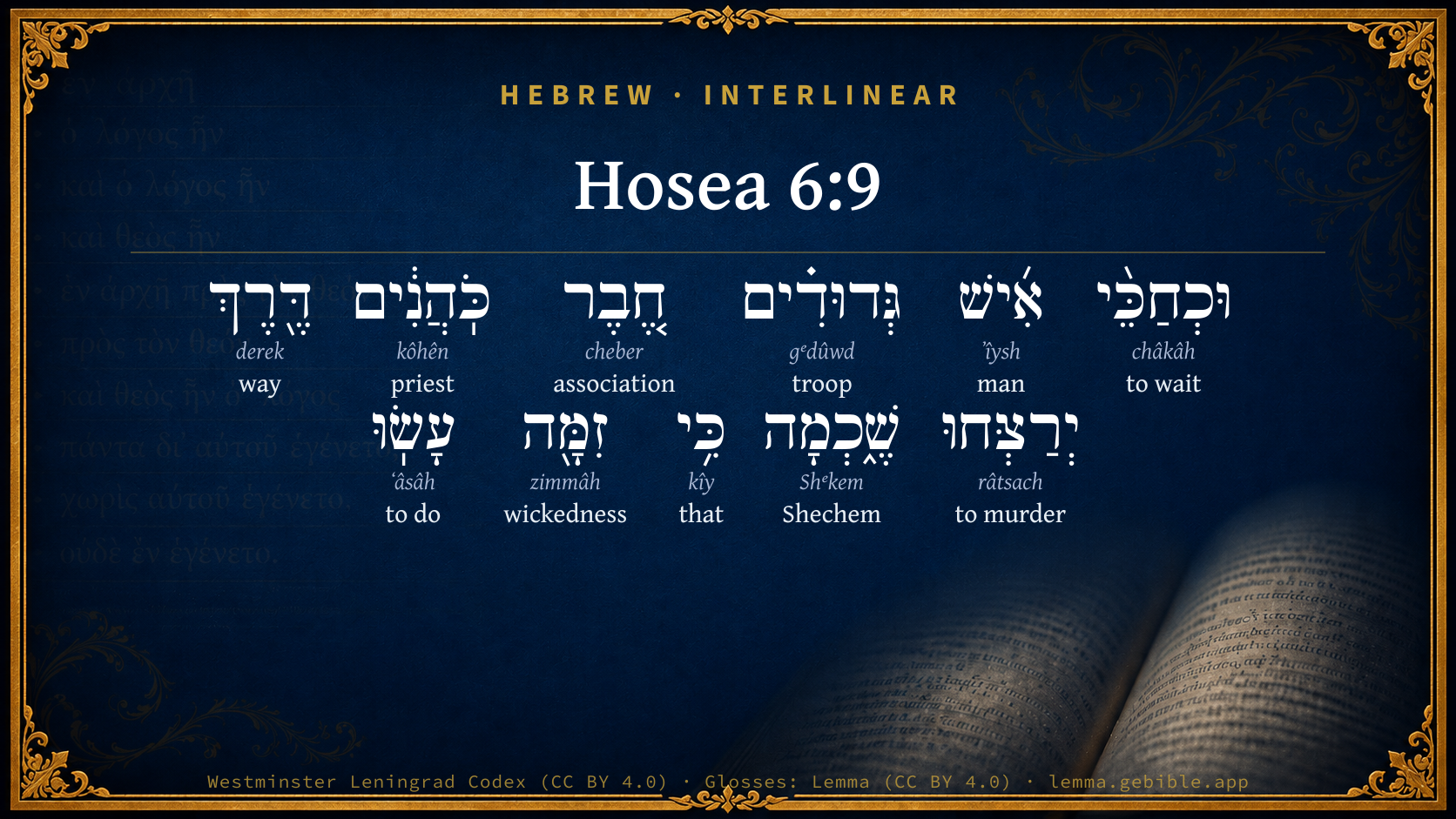
Hebrew (Westminster Leningrad Codex) Hosea 6:9 appears in the Hebrew Old Testament. The text above is from the Westminster Leningrad Codex. Each word links to its Strong’s number, a concise gloss, and parsing drawn from the Open Scriptures Hebrew Bible morphology. Click any word for its full Brown-Driver-Briggs (BDB) entry.
Download image
Cite this verse

Hosea 6:9 (World English Bible). Public Domain. Lemma interlinear Bible study tool, https://lemma.gebible.app/v/hosea/6/9.

Show BibTeX & RIS
BibTeX
RIS
English Translation
As gangs of robbers wait to ambush a man, So the company of priests murder in the way toward Shechem, Committing shameful crimes.
World English Bible · Public Domain
Download a study sheet

One document with this verse’s original text, its word-by-word gloss line, the meaning frame, cross-references with their text, attributed commentary, and full source and license credits — printable, and it pastes into notes with its structure intact.

This verse Autodidact and up

Study sheet (.html) Plain text (.txt)

A passage Seminary Student

Up to 50 verses in one chapter. A passage sheet keeps up to 6 commentary sources and 12 cross-references per verse, in the order this page ranks them, and says so on the sheet whenever that leaves anything out. Ask for a single verse and you get the Autodidact verse sheet above.

Everything on this page stays free to read, with no account — the sheet is a download of what is already on screen, not access to it.

Want to remove ads? Support Godless Engineer
Compare translations 3

The same verse in 3 English versions, stacked beneath the original-language interlinear above. Click any original word for its lexicon entry.

Each is an independent rendering of the whole verse — the interlinear is not word-aligned to these translations.

Highlighted words mark where these versions differ — a whole-verse word diff, not a word-by-word alignment.

  • World English Bible Public Domain
    As gangs of robbers wait to ambush a man, So the company of priests murder in the way toward Shechem, Committing shameful crimes.
  • King James Version Public Domain
    And as troops of robbers wait for a man, so the company of priests murder in the way by consent: for they commit lewdness.
  • unfoldingWord Literal Text CC BY-SA 4.0
    And, as lying in wait for a man, bands; a company of priests murder the way toward Shechem, for they have done villainy.

unfoldingWord Literal Text — © unfoldingWord, licensed CC BY-SA 4.0. Word-aligned USFM3 via Door43 (git.door43.org/unfoldingWord/en_ult).

Versions to compare (up to 4)

3 of 4 selected

Show all 18 translations

Every available English version of this verse, each an independent rendering of the whole verse.

  • World English Bible Public Domain
    As gangs of robbers wait to ambush a man, So the company of priests murder in the way toward Shechem, Committing shameful crimes.
  • Berean Standard Bible Public Domain
    Like raiders who lie in ambush, so does a band of priests; they murder on the way to Shechem; surely they have committed atrocities.
  • Majority Standard Bible Public Domain
    Like raiders who lie in ambush, so does a band of priests; they murder on the way to Shechem; surely they have committed atrocities.
  • King James Version Public Domain
    And as troops of robbers wait for a man, so the company of priests murder in the way by consent: for they commit lewdness.
  • American Standard Version (1901) Public Domain
    And as troops of robbers wait for a man, so the company of priests murder in the way toward Shechem; yea, they have committed lewdness.
  • Revised Version (1885) Public Domain
    And as troops of robbers wait for a man, so the company of priests murder in the way toward Shechem; yea, they have committed lewdness.
  • Geneva Bible (1599) Public Domain
    And as the eues waite for a man, so the companie of Priestes murder in the way by consent: for they worke mischiefe.
  • Douay-Rheims (1899) Public Domain
    And like the jaws of highway robbers, they conspire with the priests who murder in the way those that pass out Sichem: for they have wrought wickedness.
  • Young's Literal Translation Public Domain
    And as bands do wait for a man, A company of priests do murder -- the way to Shechem, For wickedness they have done.
  • Literal Standard Version CC BY-SA 4.0
    And as bands wait for a man, || A company of priests murder—the way to Shechem, || For they have done wickedness.
  • Unlocked Literal Bible CC BY-SA 4.0
    As gangs of robbers wait for someone, so the priests band together to commit murder on the way to Shechem; they have committed shameful crimes.
  • unfoldingWord Literal Text CC BY-SA 4.0
    And, as lying in wait for a man, bands; a company of priests murder the way toward Shechem, for they have done villainy.
  • Darby Bible Public Domain
    And as troops of robbers lie in wait for a man, so the company of priests murder in the way of Shechem; yea, they commit lewdness.
  • World Messianic Bible Public Domain
    As gangs of robbers wait to ambush a man, so the company of priests murder on the path toward Shechem, committing shameful crimes.
  • Webster's Bible Public Domain
    And as troops of robbers wait for a man, so the company of priests murder in the way by consent: for they commit lewdness.
  • Free Bible Version CC BY-SA 4.0
    Priests are like a gang of bandits, lying in wait to ambush travelers on the road. They commit murder in Shechem, carrying out wicked crimes.
  • Bible in Basic English Public Domain
    And like a band of thieves waiting for a man, so are the priests watching secretly the way of those going quickly to Shechem, for they are working with an evil design.
  • JPS Tanakh (1917) Public Domain
    And as troops of robbers wait for a man, so doth the company of priests; they murder in the way toward Shechem; yea, they commit enormity.

Literal Standard Version (2020), Covenant Press — licensed CC BY-SA 4.0. Text via the HelloAO Bible API (eBible.org). Unlocked Literal Bible (unfoldingWord) — licensed CC BY-SA 4.0. Text via the HelloAO Bible API (eBible.org). unfoldingWord Literal Text — © unfoldingWord, licensed CC BY-SA 4.0. Word-aligned USFM3 via Door43 (git.door43.org/unfoldingWord/en_ult). Free Bible Version, Dr. Jonathan Gallagher — licensed CC BY-SA 4.0. Text via the HelloAO Bible API (eBible.org).

Word by word

More ways to search: Search by grammar → Find every occurrence → Compare this word →

Practice this passage: Drill this verse → Learn its vocabulary →

חֶ֚בֶר
cheber
H2267
“association of”
Noun, Common, Masculine, Singular, Construct
Part of Speech
Noun
Type
Common
Gender
Masculine
Number
Singular
State
Construct
Full BDB Definition

Origin: from H2266

TWOT: 598a

association, company, band - shared, association, society - a magician, charmer, spell
  1. וּכְחַכֵּ֨י châkâh H2442 “and · like/as · to wait” Conjunction + Preposition + Verb, Piel, Infinitive Construct
  2. אִ֜ישׁ ʼîysh H376 “man” Noun, Common, Masculine, Singular, Absolute
  3. גְּדוּדִ֗ים gᵉdûwd H1416 “troops” Noun, Common, Masculine, Plural, Absolute
  4. כֹּֽהֲנִ֔ים kôhên H3548 “priests” Noun, Common, Masculine, Plural, Absolute
  5. דֶּ֖רֶךְ derek H1870 “way” Noun, Common, Both, Singular, Absolute
  6. יְרַצְּחוּ râtsach H7523 “to murder” Verb, Piel, Imperfect, 3rd Person, Masculine, Plural
  7. שֶׁ֑כְמָה Shᵉkem H7927 “Shechem · toward” Noun, Proper + Suffix, Demonstrative
  8. כִּ֥י kîy H3588 “that” Conjunction
  9. זִמָּ֖ה zimmâh H2154 “wickedness” Noun, Common, Feminine, Singular, Absolute
  10. עָשֽׂוּ ʻâsâh H6213 “to do” Verb, Qal, Perfect, 3rd Person, Common, Plural

About this verse

These counts appear in no published source. They are computed here, from the morphology-tagged text and Lemma’s own curated glosses. What Lemma adds →

11
words
11
distinct lemmas
Prophets
section

Notable vocabulary

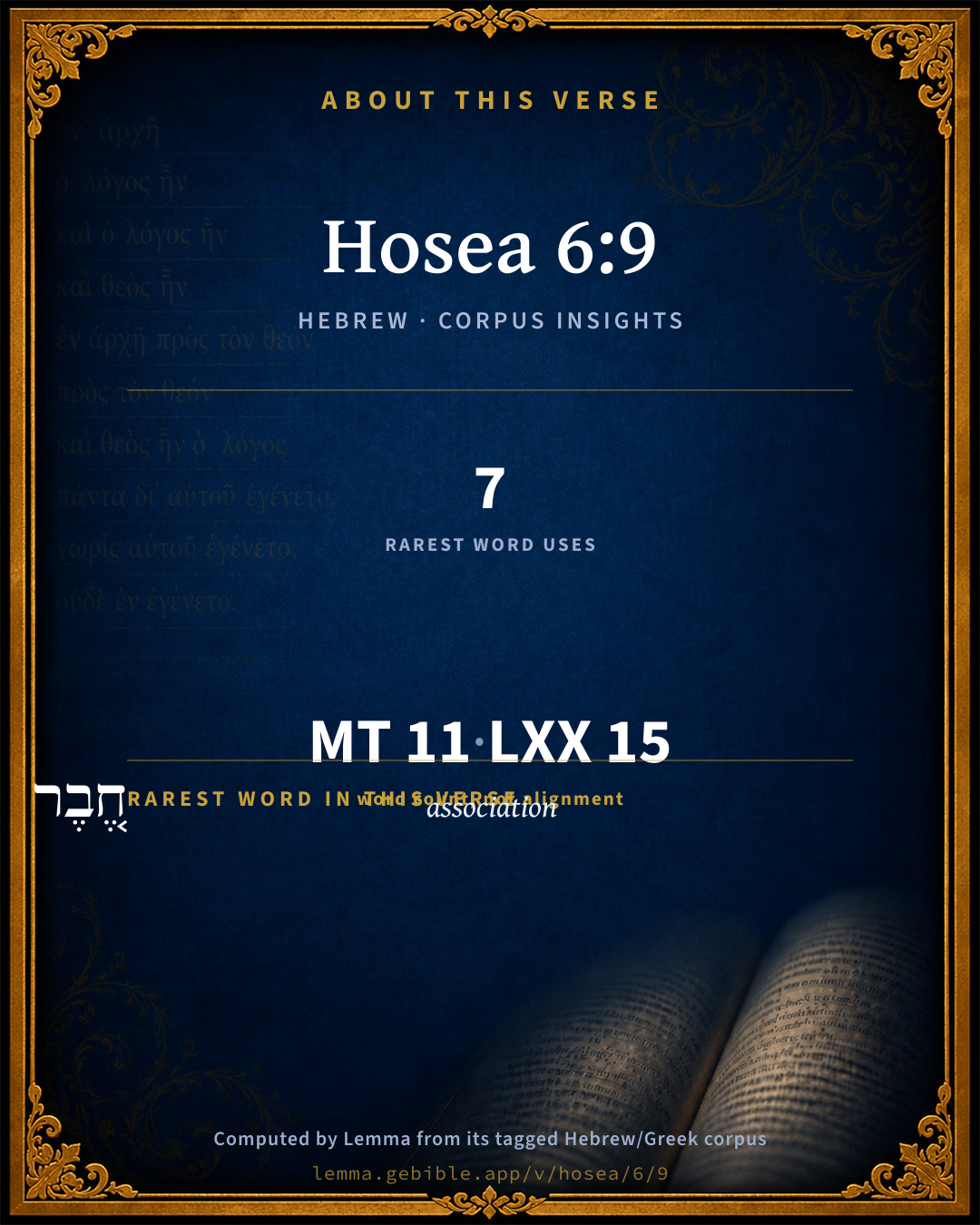
The rarest word here is חֶ֚בֶר association H2267 — appearing just 7 times in the whole Hebrew Bible.

Shared distinctive vocabulary

חֶ֚בֶר association H2267 occurs in 7 verses of the Hebrew Bible. Also found in:

Grammatical profile

  • 3 verbs
  • 7 nouns
  • 1 conjunction

Verb forms

  • וּכְחַכֵּ֨י Piel · Infinitive Construct
  • יְרַצְּחוּ Piel · Imperfect
  • עָשֽׂוּ Qal · Perfect

Hebrew & Septuagint length

In English translation the verse runs 23 words from the Hebrew and 10 from the Septuagint (LXX English) — the Septuagint runs noticeably shorter here. See the side-by-side →

A rough comparison of the two English renderings, which tokenize alike — not a word-level alignment.

Word counts can differ between the Hebrew and the Greek without any difference in meaning — e.g. the Hebrew direct-object marker אֵת has no separate Greek word, and Greek often adds the article ὁ.

In the original languages it is 11 Hebrew tokens and 15 Greek tokens — but the two are counted differently (Hebrew bundles its prefixes and suffixes into one token; the Greek is in lemma form), so that isn’t a like-for-like length.

Cross-references

15

Topical passages linked to Hosea 6:9 in the Treasury of Scripture Knowledge — connected by theme and wording, ordered by reader-vote popularity; previews shown in the World English Bible.

  • Proverbs 1:11–19 If they say, "Come with us, Let's lay in wait for blood; Let's lurk secretly for the innocent without cause;
  • Hosea 5:1 "Listen to this, you priests! Listen, house of Israel, And give ear, house of the king! For the judgment is against you; For you have been a snare at Mizpah, And a net spread on Tabor.
  • Hosea 7:1 When I would heal Israel, Then the iniquity of Ephraim is uncovered, Also the wickedness of Samaria; For they commit falsehood, And the thief enters in, And the gang of robbers ravages outside.
  • Zephaniah 3:3 Her princes in the midst of her are roaring lions. Her judges are evening wolves. They leave nothing until the next day.
  • Luke 22:2–6 The chief priests and the scribes sought how they might put him to death, for they feared the people.
  • Ezra 8:31 Then we departed from the river Ahava on the twelfth [day] of the first month, to go to Jerusalem: and the hand of our God was on us, and he delivered us from the hand of the enemy and the bandit by the way.
  • Job 1:15–17 and the Sabeans attacked, and took them away. Yes, they have killed the servants with the edge of the sword, and I alone have escaped to tell you."
  • Jeremiah 7:9–10 Will you steal, murder, and commit adultery, and swear falsely, and burn incense to Baal, and walk after other gods that you have not known,
  • Jeremiah 11:9 Yahweh said to me, A conspiracy is found among the men of Judah, and among the inhabitants of Jerusalem.
  • Ezekiel 22:9 Slanderous men have been in you to shed blood; and in you they have eaten on the mountains: in the midst of you they have committed lewdness.
  • Ezekiel 22:27 Her princes in the midst of it are like wolves ravening the prey, to shed blood, [and] to destroy souls, that they may get dishonest gain.
  • Micah 3:9 Please listen to this, you heads of the house of Jacob, And rulers of the house of Israel, Who abhor justice, And pervert all equity.
  • Mark 14:1 It was now two days before the feast of the Passover and the unleavened bread, and the chief priests and the scribes sought how they might sieze him by deception, and kill him.
  • John 11:47 The chief priests therefore and the Pharisees gathered a council, and said, "What are we doing? For this man does many signs.
  • 1 Kings 12:25 Then Jeroboam built Shechem in the hill-country of Ephraim, and lived therein; and he went out from there, and built Penuel.

Cross-references courtesy of OpenBible.info (CC BY 4.0).

Hebrew and Greek witnesses Masoretic Hebrew ↔ Greek Septuagint

The same verse in the two great witnesses to the Old Testament, shown verse-for-verse.

Here the Septuagint runs noticeably shorter than the Hebrew — LXX2012 (modern English Septuagint) 10 words vs World English Bible 23. A rough length comparison of the two English translations, not a word-level alignment — read both below.

These are two independent witnesses, not word-aligned to each other, and the Septuagint is shown in lemma (dictionary) form.

Hebrew Hosea 6:9 Masoretic · Westminster Leningrad Codex

וּכְחַכֵּ֨י אִ֜ישׁ גְּדוּדִ֗ים חֶ֚בֶר כֹּֽהֲנִ֔ים דֶּ֖רֶךְ יְרַצְּחוּ שֶׁ֑כְמָה כִּ֥י זִמָּ֖ה עָשֽׂוּ

As gangs of robbers wait to ambush a man, So the company of priests murder in the way toward Shechem, Committing shameful crimes.

World English Bible · Public Domain

Greek LXX Hosea 6:9 Septuagint · lemma form

καί ὁ ἰσχύς σύ ἀνήρ πειρατής κρύπτω ἱερεύς ὁδός κύριος φονεύω σικιμα ὅτι ἀνομία ποιέω

there the city Galaad despised me, working vanity, troubling water.

LXX2012 (modern English Septuagint) · Public Domain

On this verse, Keil & Delitzsch discusses the Septuagint’s reading. Read the note in Commentary ↓

Hebrew: Westminster Leningrad Codex (CC BY 4.0). Greek: Septuagint (public domain); English from LXX2012 (modern English Septuagint) (Public Domain). How the Septuagint differs from the Hebrew →

Targum (Aramaic paraphrase)

1

The Targum is the ancient Jewish Aramaic paraphrase of the Hebrew Scriptures — an interpretive translation, not the Hebrew text itself. Onkelos (literal) and Pseudo-Jonathan (expansive) render the Torah, and Jonathan the Prophets. Coverage is partial: where no permissively-licensed English translation exists for a verse, only the Aramaic is shown. This is verse-level text, not a word-by-word alignment to the Hebrew.

  1. Targum Jonathan Prophets (Joshua–Malachi)
    וּכְמָא מְסַבַּר אֱנַשׁ לְמַשִׁרְיָן אִתְחַבָּרוּ אִינוּן וְכַהֲנֵיהוֹן בְּאוֹרְחָא חֲדָא קַטְלִין נַפְשָׁן כְּתַף חַד אֲרֵי עֵיצַת חֶטְאִין עֲבָדוּ:

    (no public-domain English translation for this verse)

    Targum Jonathan — Aramaic: “Mikraot Gedolot” (public domain). English: “Sefaria Community Translation” (CC0 1.0 (public-domain dedication)); “London "Chaldee Paraphrase," 1871” (public domain). Text via Sefaria.

Commentary

Notes on Hosea 6:9 from classic Christian and Jewish commentators (each source and its license shown beneath its notes). The classic Christian expositions comment on the surrounding passage and are grouped to its opening verse, so a note may address several verses; the Jewish commentaries on the Tanakh (Rashi and others) are per-verse, so they appear only where the commentator wrote on this verse.

Lemma curates 59 commentaries, every one of them public domain or Creative Commons licensed, each selected and text-cleaned for this edition rather than reprinted as found. About our sources →

Trapp's Complete Commentary

John Trapp

Hos 6:9 And as troops of robbers wait for a man, [so] the company of priests murder in the way by consent: for they commit lewdness.

Ver. 9. And as troops of robbers wait for a man] This verse hath much of the former in it, saith an interpreter. The sum of it is, saith Wigandus, to show, that all the forementioned wickednesses were committed, instinctu doctorum, by the instinct of their priests, who were now turned tories or moss troopers. Jerome asked his Jewish doctor the meaning of this text, and received this answer: that at the time of the Passover and the Pentecost the people used to come to Jerusalem; and as they were going in their journey, these priests would stand in the way and slay them. Others think that these corrupt priests took into their city of refuge divers thieves and murderers; who not having whereupon otherwise to subsist, turned highwaymen (as they call them), and returning again into the city, divided the spoil with the priests, who had their share: and are therefore called companions of robbers, and are said to murder in the way by consent, or with one shoulder, or as Simeon and Levi did at Shechem, q.d. Sichemice, craftily and cruelly (for so many ways these words are rendered), and all this they did with malice forethought, of prepensed mischief ( ex destinata malitia et inito consilio), called here committing lewdness. Even as they thought in their hearts so they acted, saith King David. They executed the counsel of the wicked, saith the Chaldee paraphrast. They machinated mischief, and then practised what they had plotted with a deliberate will, and as it were with a high hand. Look now upon the Popish monks, saith Tarnovius, and compare them with these priests whom Hosea reproveth, non tam ovum ovo simile. And Luther saith, that they had a proverb in Germany, that there was nothing so bad which the monks could think of but they would dare to do it. Faciunt quicquid cogitant. 079 &&& Ministers-Immoral

“ Non audet Stygius Pluto tentare quod audet

Effrenis Monachus, ” -

John Trapp, A Commentary or Exposition upon All the Books of the Old and New Testament (1647–1656) — public domain. Text from a community e-Sword module.

Tyndale Open Study Notes

Tyndale Open Resources

6:9 Priests form bands of robbers: Hosea again condemns the religious leaders for their crimes (see 4:4-8).

Tyndale Open Study Notes — © Tyndale Open Resources, licensed CC BY-SA 4.0. Text via the HelloAO Bible API.

Jamieson, Fausset & Brown

Robert Jamieson, A. R. Fausset & David Brown

company--"association" or guild of priests.

murder by consent--literally, "with one shoulder" (compare Zep 3:9, Margin). The image is from oxen putting their shoulders together to pull the same yoke [RIVETUS]. MAURER translates, "in the way towards Shechem." It was a city of refuge between Ebal and Gerizim; on Mount Ephraim (Jos 20:7; Jos 21:21), long the civil capital of Ephraim, as Shiloh was the religious capital; now called Naploos; for a time the residence of Jeroboam (Kg1 12:25). The priests there became so corrupted that they waylaid and murdered persons fleeing to the asylum for refuge [HENDERSON]; the sanctity of the place enhanced the guilt of the priests who abused their priestly privileges, and the right of asylum to perpetrate murders themselves, or to screen those committed by others [MAURER].

commit lewdness--deliberate crime, presumptuous wickedness, from an Arabic root, "to form a deliberate purpose."

Jamieson, Fausset & Brown — Commentary Critical and Explanatory on the Whole Bible (1871) — public domain (CC PDM 1.0). Text via the HelloAO Bible API.

Adam Clarke's Commentary

Verse 9. As troops of robbers] What a sad picture is this of the state of the priesthood! The country of Gilead was infamous for its robberies and murders. The idolatrous priests there formed themselves into companies, and kept possession of the roads and passes; and if they found any person going to Jerusalem to worship the true God, they put him to death. The reason is given:-

For they commit lewdness.] They are gross idolaters.

Adam Clarke's Commentary on the Bible (1810–1826) — public domain. Text from a community e-Sword/MySword module.

John Calvin's Commentaries

The Prophet pursues more at large what he had briefly touched; for he does, not now confine himself to the common people, but directs his accusation against the sacerdotal order. “See,” he says, “the priests conspire among themselves like robbers, that they may slay wretched men, who may meet them in the way.” It is indeed certain that the Prophet speaks not here of open murders; for it is not credible that the priests had proceeded into so great a licentiousness, that Gilead had become a slaughter-house. But the Prophets, we know, are thus wont to speak, whenever they upbraid men with being sanguinary and cruel; they compare them to robbers, and that justly. Hence he says, The faction of the priests kill men in the way, as if they were robbers conspiring together. And then he shows that the priests were so void of every thing like the fear of God, that they perpetrated every kind of cruelty as if they were wholly given to robberies. This is the meaning.

The word שכמה, shicame, is no doubt taken by the Prophet for “consent.” What is meant by שכם, shicam, is properly the “shoulder;” but it is metaphorically changed into the sense which I have mentioned; as it is in the Zephaniah 3 ‘They shall serve the Lord שכם אחד, shicam ached, with one shoulder;’ that is, “with one consent.” So also in this place, the priests conspire together שכמה, shicame, with consent.” For they who think that the name of a place is intended are much mistaken.

Now in the last clause of the verse it is made evident why the Prophet had said that the priests were like robbers, ‘because,’ he says, ‘they do the thought,’ or ‘wickedness.’ The verb to זמם, zamem signifies “to think,” as it has been already said: hence זמה, zame is “thought” in general; but is often taken by the Hebrews in a bad sense, for a “bad design,” or “wicked trick:” They do then their conceived wickedness We hence learn that they were not open robbers, and publicly infamous in the sight of men, but that they were robbers before God, because the city was full of wicked devices, which were there concocted; and since they executed their schemes, it is justly said of them by the Prophet, that they imitated the licentiousness of robbers. Let us now go on —

John Calvin's Commentaries (1540-1563) — public domain. Text from the Calvin Translation Society English edition (1840s-50s) via the Christian Classics Ethereal Library (ccel.org). Calvin's coverage is partial (roughly two-thirds of the Bible); uncommented books and verses are honest gaps, never fabricated. The 19th-century editor's footnotes and remarks are omitted so the notes are faithfully Calvin's own voice.

Ellicott's Commentary for English Readers

(9) Should be rendered, As a robber lies in wait, so the company of priests murder on the road to Shechem; yea, they execute the plot. Shechem, charged with historic interest (Genesis to Judges), is also a city of refuge, a Levitical city, on the road to Bethel, where the priests of the calves resided. (Comp. Hos_5:1.)

A Bible Commentary for English Readers, edited by Charles John Ellicott (1878–1897) — public domain. Text from a community e-Sword module.

The Cambridge Bible for Schools and Colleges

gen. ed. J. J. S. Perowne

9. And as troops …] Rather, And as bandits lying in wait, (so doth) the company of priests; they murder on the road towards Shechem; yea, they commit outrages. The reference in the figure is either to the doings of native banditti (comp. Hos_7:1), or to those of the guerilla-bands of Arameans, Moabites, &c., which were constantly invading Israel and Judah (2Ki_5:2; 2Ki_13:20), whenever the central power was weak. The word for ‘company’ (khébher) implies an organized guild (such as the Pharisees afterwards), so that there was no public opinion to check the offenders. Shechem had long ago been notorious for the highway robberies committed by its inhabitants, and was therefore destroyed by Abimelech (Jdg_9:25; Jdg_9:45). It lay on the road, which was doubtless much frequented, from Samaria and the north to Bethel, now the chief sanctuary of the so-called Ten Tribes. Gilead and Shechem together represent the eastern and western divisions of the kingdom.

The Cambridge Bible for Schools and Colleges (gen. ed. J. J. S. Perowne; Cambridge University Press, 1878–1918) — public domain. Text from a community e-Sword module.

John Gill's Exposition

And as troops of robbers wait for a man,.... As a gang of highwaymen or footpads lie in wait in a ditch, or under a hedge, or in a cave of a rock or mountain, for a man they know will come by that way, who is full of money, in order to rob him; or, as Saadiah interprets it, as fishermen stand upon the banks of a river, and cast in their hooks to draw out the fish; and to the same purpose is Jarchi's note from R. Meir:

so the company of priests murder in the way by consent; not only encourage murderers, and commit murders within the city, but go out in a body together upon the highway, and there commit murders and robberies, and divide the spoil among them; all which they did unanimously, and were well agreed, being brethren in iniquity, as well as in office: or, "in the way of Shechem" (e); as good people passed by Gilead to Shechem, and so to Jerusalem, to worship there at the solemn feasts, they lay in wait for them, and murdered them; because they did not give into the idolatrous worship of the calves at Dan and Bethel: or, "in the manner of Shechem" (f); that is, they murdered men in a deceitful treacherous manner, as the Shechemites were murdered by Simeon and Levi: Joseph Kimchi interprets this of the princes and great men, so the word "cohanim" is sometimes used; but the context seems to carry it to the priests:

for they commit lewdness; or "enormity"; the most enormous crimes, and that purposely, with deliberation devising and contriving them.

(e) "Sichemam versus", Gussetius, Schmidt; approved by Reinbeck. De Accent. Heb. p. 442. "qua itur Sichem", Tigurine version; "qua via ad Shechemum factum occidunt", Junius & Tremellius; "quae ducit ad Sichermum", Piscator. So Abendana. (f) "Sicemice", so some in Drusius.

John Gill's Exposition of the Whole Bible (1746–1763) — public domain (CC PDM 1.0). Text via the HelloAO Bible API.

Albert Barnes' Notes on the Bible

And as troops of robbers wait for a man, so the company of priests murder in the way by consent - Or (more probably) “in the way to Shechem.” Shechem too was a “city of refuge” Joh 20:7, and so also a city of Levites and priests Joh 21:21. It was an important city. For there Joshua assembled all Israel for his last address to them, and made a covenant with them John 24:1, 25. There, Rehoboam came to be accepted by Israel as their king 1Ki 12:1, and was rejected by them. There Jeroboam after the schism, for a time, made his residence 1Ki 12:25. The priests were banded together; their counsel was one; they formed one company; but they were bound together as a band of robbers, not to save people’s lives but to destroy them. Whereas the way to the cities of refuge was, by God’s law, to be “prepared” Deu 19:3, clear, open, without let or hindrance to the guiltless fugitive, to save his life, the priests, the guardians of God’s law, obstructed the way, to roll and destroy. They, whom God appointed to teach the truth that people might live, were banded together against His law.

Shechem, besides that it was a city of refuge, was also hallowed by the memory of histories of the patriarchs who walked with God. There, was Jacob’s well Joh 4:5-6; there Joseph’s bones were buried Jos 24:32; and the memory of the patriarch Jacob was cherished there, even to the time of our Lord Joh 4:5-6. Lying in a narrow valley between Mount Ebal and Gerizim, it was a witness, as it were, of the blessing and curse pronounced from them, and had, in the times of Joshua, an ancient sanctuary of God Jos 24:26. It was a halting-place for the pilgrims of the northern tribes, in their way to the feasts at Jerusalem; so that these murders by the priests coincide with the tradition of the Jews, that they who would go up to Jerusalem were murdered in the way.

For they commit lewdness - Literally, “For they have done deliberate sin” . The word literally means “a thing thought of,” especially an evil, and so, deliberate, contrived, bethought-of, wickedness. They did deliberate wickedness, gave themselves to do it, and did nothing else.

Albert Barnes' Notes on the Bible (1834–1885) — public domain. Text from a community e-Sword/MySword module.

Haydock's Catholic Bible Commentary

Robbers. Jephte had infested those parts, and the country was noted for murders; whence more cities of refuge were appointed in it, Judges xi., and Josue xx. 8. The prophet alludes to what had been said to Gad, Genesis xlix. 19. --- Out of, or to Sichem. They were jealous of people going thither, (Calmet) wishing to receive their offerings themselves. (Haydock)

George Leo Haydock (1774–1849), Haydock's Catholic Family Bible and Commentary, 1859 edition — public domain. Excludes Psalms (Douay-Rheims chapter numbering differs from Protestant) and Deuterocanonical books (Catholic canon only).

Matthew Poole's English Annotations

What is here charged upon these priests, they turned highway-men and murderers, some understand of their killing and spoiling those that were going up to Jerusalem to worship God there; but more likely it is, that in this Gilead were many murderers, who durst not go out, nor could get their livelihood within the city, but, reduced to straits, took this wicked course for a livelihood, robbed and murdered on the highway, and then divided the prey with the priests, whose consent to the thing made them deeply guilty. And thus in this manner they act most lewd things; or these things are done and encouraged by the priests, because they make it their business, it is their trade now to contrive and act wickedness, highest wickednesses. Or, if you rather like it in the brief, the priests by companies lay wait, and rob, and murder, like as do the troops which rob towards Shethem.

Matthew Poole's English Annotations on the Holy Bible (1683–1685) — public domain. Text from a community e-Sword/MySword module.

John Wesley's Explanatory Notes

The company of priests - The priests by companies lay wait, and rob, and murder.

John Wesley, Explanatory Notes Upon the Whole Bible (1754–1765) — public domain. Text via the GEBible commentary corpus.

Keil & Delitzsch

C. F. Keil & F. Delitzsch

In these crimes the priests take the lead. Like highway robbers, they form themselves into gangs for the purpose of robbing travellers and putting them to death. חכּי, so written instead of חכּה (Ewald, 16, b), is an irregularly formed infinitive for חכּות (Ewald, 238, e). 'Ish gedūdı̄m, a man of fighting-bands, i.e., in actual fact a highway robber, who lies in wait for travellers.

(Note: The first hemistich has been entirely misunderstood by the lxx, who have confounded כּחכּי with כּחך, and rendered the clause καὶ ἡ Ἰσχύς ἀνδρὸς πειρατοῦ· ἔκρυψαν (חבו or חבאו instead of חבר) ἱερεῖς ὁδόν. Jerome has also rendered כחכי strangely, et quasi fauces (כּחכּי) virorum latronum particeps sacerdotum. Luther, on the other hand, has caught the sense quite correctly on the whole, and simply rendered it rather freely: "And the priests with their mobs are like footpads, who lie in wait for people.")

The company (chebher, gang) of the priests resembled such a man. They murder on the way (derekh, an adverbial accusative) to Sichem. Sichem, a place on Mount Ephraim, between Ebal and Gerizim, the present Nablus (see at Jos 17:7), was set apart as a city of refuge and a Levitical city (Jos 20:7; Jos 21:21); from which the more recent commentators have inferred that priests from Sichem, using the privileges of their city to cover crimes of their own, committed acts of murder, either upon fugitives who were hurrying thither, and whom they put to death at the command of the leading men who were ill-disposed towards them (Ewald), or upon other travellers, either from avarice or simple cruelty. But, apart from the fact that the Levitical cities are here confounded with the priests' cities (for Sichem was only a Levitical city, and not a priests' city at all), this conclusion is founded upon the erroneous assumption, that the priests who were taken by Jeroboam from the people generally, had special places of abode assigned them, such as the law had assigned for the Levitical priests. The way to Sichem is mentioned as a place of murders and bloody deeds, because the road from Samaria the capital, and in fact from the northern part of the kingdom generally, to Bethel the principal place of worship belonging to the kingdom of the ten tribes, lay through this city. Pilgrims to the feasts for the most part took this road; and the priests, who were taken from the dregs of the people, appear to have lain in wait for them, either to rob, or, in case of resistance, to murder. The following כּי carries it still higher, and adds another crime to the murderous deeds. Zimmâh most probably refers to an unnatural crime, as in Lev 18:17; Lev 19:29.

Thus does Israel heap up abomination upon abomination. Hos 6:10. "In the house of Israel I saw a horrible thing: there Ephraim practises whoredom: Israel has defiled itself." The house of Israel is the kingdom of the ten tribes. שׁערוּריה, a horrible thing, signifies abominations and crimes of every kind. In the second hemistich, zenūth, i.e., spiritual and literal whoredom, is singled out as the principal sin. Ephraim is not the name of a tribe here, as Simson supposes, but is synonymous with the parallel Israel.

Keil & Delitzsch — Biblical Commentary on the Old Testament (1861–1891) — public domain (CC PDM 1.0). Text via the HelloAO Bible API. (Old Testament only.)

Rashi

Rabbi Shlomo Yitzchaki (Rashi)

And as a man gathers fish, so do bands Heb. וּכְחַכֵּי. And as a fisherman gathers fish, who gathers them with a fishhook together, so do bands gather. Companies of their priests, who gather to go on the road, will all murder there in one group.

for they devised a plot For this is a plot which they plotted prior to their gathering, to which place they would go to murder and to loot. וּכְחַכֵּי means ajjmedours in O.F, fishermen. And also in mishnaic Hebrew, חַכֵּי is an expression of joining. The Gemara states (Baba Kamma 119b): “And he shall not put into it more than three חַכִּין.” Those are the stitches with which the comber joins together both ends of the garment when he beats it with sticks. This [following] interpretation is mine, and it seems appropriate, and this is the explanation: And when there is a group of five men gathering together, it is a company of priests to murder. The first one is that of Rabbi Meir Sheliach Zibbur o.b.m.

in one group Heb. שֶׁכְמָה, an expression of one group.

Rashi on the Tanakh — English translations: “The Judaica Press complete Tanach with Rashi, translated by A. J. Rosenberg” (CC BY 4.0); “Pentateuch with Rashi's commentary by M. Rosenbaum and A.M. Silbermann, 1929-1934” (public domain); “The Metsudah Tanach series, Lakewood, N.J” (CC BY 4.0); and “The Book of Joshua, Metsudah Publications, 1997” (CC BY 4.0). Text via Sefaria.

Lesson kit

Teaching starters — assembled from the data on this page, not authored interpretation. Every prompt links to the verse data it draws on. Edit before teaching.

Hosea, in the Prophets, opens this verse with 11 words (11 distinct Hebrew lemmas). Its most distinctive word is cheber (“association”). The Greek Septuagint runs shorter here. A historical commentator’s framing appears above. Read the whole chapter for the surrounding context.

Discussion questions

  1. The word cheber carries the sense “association.” How does it shape the verse?
  2. How does Deuteronomy 18:11, which shares the word «association», read alongside this verse?
  3. The Septuagint runs shorter here than the Hebrew. What might account for the difference?
  4. The translations on this page render this verse differently — a whole-verse word diff, not a word-by-word alignment. What might account for the different wordings?
  5. «וּכְחַכֵּ֨י» is a Piel Infinitive Construct verb. How does that grammatical form shape the action described?
  6. Compare how Trapp's Complete Commentary and Tyndale Open Study Notes read this verse. Where do they agree or differ?

Things to notice

Reading settings

Reading text

Shown beneath each verse's original-language words.

Old Testament
Old Testament edition

Read the OT as the Masoretic Hebrew (MT) or the Greek Septuagint (LXX).

English shown for the Greek Septuagint (in the Hebrew ↔ Greek comparison).

Comparing translations? Open the Compare panel on any verse page to stack up to four side by side.