
Exodus 19:22

Hebrew (Westminster Leningrad Codex) Exodus 19:22 appears in the Hebrew Old Testament. The text above is from the Westminster Leningrad Codex. Each word links to its Strong’s number, a concise gloss, and parsing drawn from the Open Scriptures Hebrew Bible morphology. Click any word for its full Brown-Driver-Briggs (BDB) entry.
Download image
Cite this verse

Exodus 19:22 (World English Bible). Public Domain. Lemma interlinear Bible study tool, https://lemma.gebible.app/v/exodus/19/22.

Show BibTeX & RIS
BibTeX
RIS
English Translation
Let the priests also, who come near to Yahweh, sanctify themselves, lest Yahweh break forth on them."
World English Bible · Public Domain
Download a study sheet

One document with this verse’s original text, its word-by-word gloss line, the meaning frame, cross-references with their text, attributed commentary, and full source and license credits — printable, and it pastes into notes with its structure intact.

This verse Autodidact and up

Study sheet (.html) Plain text (.txt)

A passage Seminary Student

Up to 50 verses in one chapter. A passage sheet keeps up to 6 commentary sources and 12 cross-references per verse, in the order this page ranks them, and says so on the sheet whenever that leaves anything out. Ask for a single verse and you get the Autodidact verse sheet above.

Everything on this page stays free to read, with no account — the sheet is a download of what is already on screen, not access to it.

Want to remove ads? Support Godless Engineer
Compare translations 3

The same verse in 3 English versions, stacked beneath the original-language interlinear above. Click any original word for its lexicon entry.

Each is an independent rendering of the whole verse — the interlinear is not word-aligned to these translations.

Highlighted words mark where these versions differ — a whole-verse word diff, not a word-by-word alignment.

  • World English Bible Public Domain
    Let the priests also, who come near to Yahweh, sanctify themselves, lest Yahweh break forth on them."
  • King James Version Public Domain
    And let the priests also, which come near to the LORD, sanctify themselves, lest the LORD break forth upon them.
  • unfoldingWord Literal Text CC BY-SA 4.0
    And furthermore, the priests, the ones who come near to Yahweh, they shall make themselves holy lest Yahweh bursts out against them.”

unfoldingWord Literal Text — © unfoldingWord, licensed CC BY-SA 4.0. Word-aligned USFM3 via Door43 (git.door43.org/unfoldingWord/en_ult).

Versions to compare (up to 4)

3 of 4 selected

Show all 18 translations

Every available English version of this verse, each an independent rendering of the whole verse.

  • World English Bible Public Domain
    Let the priests also, who come near to Yahweh, sanctify themselves, lest Yahweh break forth on them."
  • Berean Standard Bible Public Domain
    Even the priests who approach the LORD must consecrate themselves, or the LORD will break out against them.”
  • Majority Standard Bible Public Domain
    Even the priests who approach the LORD must consecrate themselves, or the LORD will break out against them.”
  • King James Version Public Domain
    And let the priests also, which come near to the LORD, sanctify themselves, lest the LORD break forth upon them.
  • American Standard Version (1901) Public Domain
    And let the priests also, that come near to Jehovah, sanctify themselves, lest Jehovah break forth upon them.
  • Revised Version (1885) Public Domain
    And let the priests also, which come near to the LORD, sanctify themselves, lest the LORD break forth upon them.
  • Geneva Bible (1599) Public Domain
    And let the Priestes also which come to the Lord be sanctified, least the Lord destroy them.
  • Douay-Rheims (1899) Public Domain
    The priests also that come to the Lord, let them be sanctified, lest he strike them.
  • Young's Literal Translation Public Domain
    and also the priests who are coming nigh unto Jehovah do sanctify themselves, lest Jehovah break forth on them.'
  • Literal Standard Version CC BY-SA 4.0
    and also the priests who are coming near to YHWH sanctify themselves, lest YHWH break forth on them.”
  • Unlocked Literal Bible CC BY-SA 4.0
    Let the priests also who come near to me set themselves apart—prepare themselves for my coming—so that I do not attack them.”
  • unfoldingWord Literal Text CC BY-SA 4.0
    And furthermore, the priests, the ones who come near to Yahweh, they shall make themselves holy lest Yahweh bursts out against them.”
  • Darby Bible Public Domain
    And the priests also, who come near to Jehovah, shall hallow themselves, lest Jehovah break forth on them.
  • World Messianic Bible Public Domain
    Let the priests also, who come near to the LORD, sanctify themselves, lest the LORD break out on them.”
  • Webster's Bible Public Domain
    And let the priests also who come near to the LORD, sanctify themselves, lest the LORD break forth upon them.
  • Free Bible Version CC BY-SA 4.0
    Even the priests, who come before the Lord, must prepare themselves spiritually, so that the Lord does not punish them.”
  • Bible in Basic English Public Domain
    And let the priests who come near to the Lord make themselves holy, for fear that the Lord may come on them suddenly.
  • JPS Tanakh (1917) Public Domain
    And let the priests also, that come near to the LORD, sanctify themselves, lest the LORD break forth upon them.'

Literal Standard Version (2020), Covenant Press — licensed CC BY-SA 4.0. Text via the HelloAO Bible API (eBible.org). Unlocked Literal Bible (unfoldingWord) — licensed CC BY-SA 4.0. Text via the HelloAO Bible API (eBible.org). unfoldingWord Literal Text — © unfoldingWord, licensed CC BY-SA 4.0. Word-aligned USFM3 via Door43 (git.door43.org/unfoldingWord/en_ult). Free Bible Version, Dr. Jonathan Gallagher — licensed CC BY-SA 4.0. Text via the HelloAO Bible API (eBible.org).

Word by word

More ways to search: Search by grammar → Find every occurrence → Compare this word →

Practice this passage: Drill this verse → Learn its vocabulary →

יִפְרֹ֥ץ
pârats
H6555
“to break through”
Verb, Qal, Imperfect, 3rd Person, Masculine, Singular
Part of Speech
Verb
Stem
Qal
Form
Imperfect
Person
3rd Person
Gender
Masculine
Number
Singular
Full BDB Definition

Origin: a primitive root

TWOT: 1826

to break through or down or over, burst, breach - (Qal) - to break or burst out (from womb or enclosure) - to break through or down, make a breach in - to break into - to break open - to break up, break in pieces - to break out (violently) upon - to break over (limits), increase - to use violence - to burst open - to spread, distribute - (Niphal) to be broken through - (Pual) to be broken down - (Hithpael) to break away
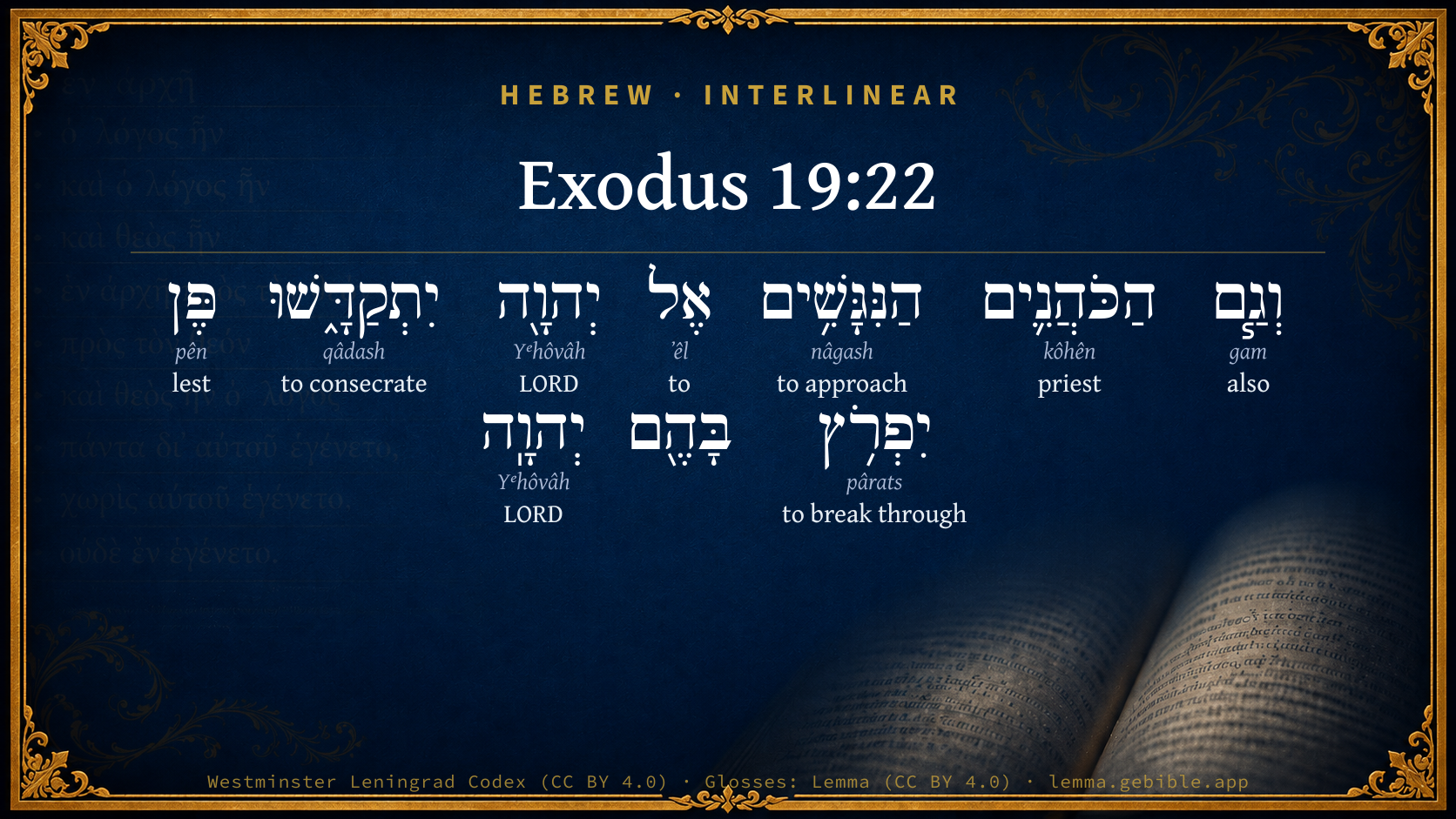
  1. וְגַ֧ם gam H1571 “and · also” Conjunction + Particle, Accusative
  2. הַכֹּהֲנִ֛ים kôhên H3548 “the · priests” Particle, Definite Article + Noun, Common, Masculine, Plural, Absolute
  3. הַנִּגָּשִׁ֥ים nâgash H5066 “the · approaching” Particle, Definite Article + Verb, Niphal, Participle Active, Masculine, Plural, Absolute
  4. אֶל ʼêl H413 “to” Preposition
  5. יְהוָ֖ה Yᵉhôvâh H3068 “LORD” Noun, Proper
  6. יִתְקַדָּ֑שׁוּ qâdash H6942 “to consecrate” Verb, Hithpael, Imperfect, 3rd Person, Masculine, Plural
  7. פֶּן pên H6435 “lest” Conjunction
  8. יְהוָֽה Yᵉhôvâh H3068 “LORD” Noun, Proper

About this verse

These counts appear in no published source. They are computed here, from the morphology-tagged text and Lemma’s own curated glosses. What Lemma adds →

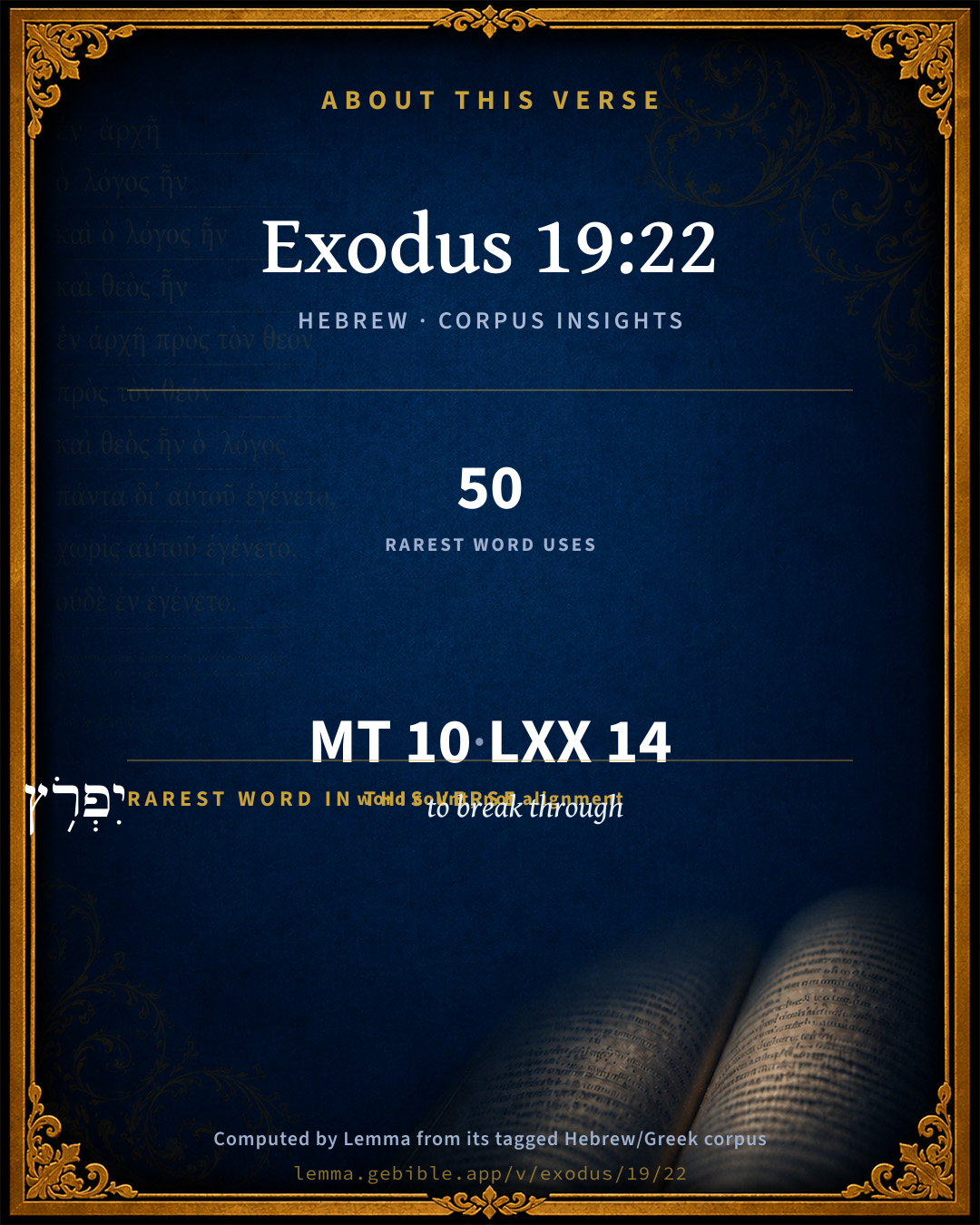
10
words
8
distinct lemmas
Pentateuch
section

Shared distinctive vocabulary

יִפְרֹ֥ץ to break through H6555 occurs in 48 verses of the Hebrew Bible. Also found in:

Grammatical profile

  • 3 verbs
  • 3 nouns
  • 2 prepositions
  • 1 conjunction
  • 1 particle

Verb forms

  • הַנִּגָּשִׁ֥ים Niphal · Participle Active
  • יִתְקַדָּ֑שׁוּ Hithpael · Imperfect
  • יִפְרֹ֥ץ Qal · Imperfect

Repetition

A word recurs within this verse — often emphatic in Hebrew:

  • יְהוָ֖ה LORD H3068 ×2

Hebrew & Septuagint length

In English translation the verse runs 17 words from the Hebrew and 17 from the Septuagint (LXX English) — the same length.

A rough comparison of the two English renderings, which tokenize alike — not a word-level alignment.

Word counts can differ between the Hebrew and the Greek without any difference in meaning — e.g. the Hebrew direct-object marker אֵת has no separate Greek word, and Greek often adds the article ὁ.

In the original languages it is 10 Hebrew tokens and 14 Greek tokens — but the two are counted differently (Hebrew bundles its prefixes and suffixes into one token; the Greek is in lemma form), so that isn’t a like-for-like length.

Cross-references

14

Topical passages linked to Exodus 19:22 in the Treasury of Scripture Knowledge — connected by theme and wording, ordered by reader-vote popularity; previews shown in the World English Bible.

  • Exodus 24:5 He sent young men of the children of Israel, who offered burnt offerings and sacrificed peace-offerings of oxen to Yahweh.
  • Exodus 19:5 Now therefore, if you will indeed obey my voice, and keep my covenant, then you shall be my own possession from among all peoples; for all the earth is mine;
  • Exodus 19:14–15 Moses went down from the mountain to the people, and sanctified the people; and they washed their clothes.
  • Leviticus 10:1–3 Nadab and Abihu, the sons of Aaron, each took his censer, and put fire in it, and laid incense on it, and offered strange fire before Yahweh, which he had not commanded them.
  • 2 Samuel 6:6–8 When they came to the threshing floor of Nacon, Uzzah put forth [his hand] to the ark of God, and took hold of it; for the oxen stumbled.
  • 1 Chronicles 13:9–11 When they came to the threshing floor of Chidon, Uzza put forth his hand to hold the ark; for the oxen stumbled.
  • 1 Chronicles 15:13 For because you didn't carry it at the first, Yahweh our God made a breach on us, because we didn't seek him according to the ordinance.
  • 2 Chronicles 30:3 For they could not keep it at that time, because the priests had not sanctified themselves in sufficient number, neither had the people gathered themselves together to Jerusalem.
  • 2 Chronicles 30:15 Then they killed the Passover on the fourteenth [day] of the second month: and the priests and the Levites were ashamed, and sanctified themselves, and brought burnt offerings into the house of Yahweh.
  • 2 Chronicles 30:18–19 For a multitude of the people, even many of Ephraim and Manasseh, Issachar and Zebulun, had not cleansed themselves, yet did they eat the Passover otherwise than it is written. For Hezekiah had prayed for them, saying, The good Yahweh pardon everyone
  • Isaiah 52:11 Depart you, depart you, go you out from there, touch no unclean thing; go you out of the midst of her; cleanse yourselves, you who bear the vessels of Yahweh.
  • Acts 5:5 Ananias, hearing these words, fell down and died. Great fear came on all who heard these things.
  • Acts 5:10 She fell down immediately at his feet, and died. The young men came in and found her dead, and they carried her out and buried her by her husband.
  • 1 Corinthians 11:30–32 For this cause many among you are weak and sickly, and not a few sleep.

Cross-references courtesy of OpenBible.info (CC BY 4.0).

Hebrew and Greek witnesses Masoretic Hebrew ↔ Greek Septuagint

The same verse in the two great witnesses to the Old Testament, shown verse-for-verse.

These are two independent witnesses, not word-aligned to each other, and the Septuagint is shown in lemma (dictionary) form.

Hebrew Exodus 19:22 Masoretic · Westminster Leningrad Codex

וְגַ֧ם הַכֹּהֲנִ֛ים הַנִּגָּשִׁ֥ים אֶל יְהוָ֖ה יִתְקַדָּ֑שׁוּ פֶּן יִפְרֹ֥ץ בָּהֶ֖ם יְהוָֽה

Let the priests also, who come near to Yahweh, sanctify themselves, lest Yahweh break forth on them."

World English Bible · Public Domain

Greek LXX Exodus 19:22 Septuagint · lemma form

καί ὁ ἱερεύς ὁ ἐγγίζω κύριος ὁ θεός ἁγιάζω μήποτε ἀποἀλλάσσω ἀπό αὐτός κύριος

And let the priests that draw near to the Lord God sanctify themselves, destroy some of them.

LXX2012 (modern English Septuagint) · Public Domain

Hebrew: Westminster Leningrad Codex (CC BY 4.0). Greek: Septuagint (public domain); English from LXX2012 (modern English Septuagint) (Public Domain). How the Septuagint differs from the Hebrew →

Targum (Aramaic paraphrase)

2

The Targum is the ancient Jewish Aramaic paraphrase of the Hebrew Scriptures — an interpretive translation, not the Hebrew text itself. Onkelos (literal) and Pseudo-Jonathan (expansive) render the Torah, and Jonathan the Prophets. Coverage is partial: where no permissively-licensed English translation exists for a verse, only the Aramaic is shown. This is verse-level text, not a word-by-word alignment to the Hebrew.

  1. Targum Onkelos Torah (Genesis–Deuteronomy)
    וְאַף כָּהֲנַיָא דִקְרִיבִין לְשַׁמָשָׁא קֳדָם יְיָ יִתְקַדְשׁוּן דִילְמָא יִקְטוֹל בְּהוֹן יְיָ:

    (no public-domain English translation for this verse)

    Targum Onkelos — Aramaic: “Onkelos Genesis” (public domain); “Onkelos Exodus” (public domain); “Onkelos Leviticus” (public domain); “Onkelos Numbers” (public domain); “Onkelos Deuteronomy” (public domain). English: “Sefaria Community Translation” (CC0 1.0 (public-domain dedication)); “J.W. Etheridge. The Targums of Onkelos and Jonathan Ben Uzziel on the Pentateuch. London: Longmans, Green, 1862” (public domain). Text via Sefaria.

  2. Targum Pseudo-Jonathan Torah (Genesis–Deuteronomy)
    וְאוּף כַּהֲנַיָא דִּקְרִיבִין לְשַׁמְשָׁא קֳדָם יְיָ יִתְקַדְּשׁוּן דִּלְמָא יִקְטוֹל בְּהוֹן יְיָ

    The priests, also, who approach to minister before the Lord, must be sanctified, lest the Lord destroy them.

    Targum Pseudo-Jonathan — Aramaic: “Targum Jonathan on Genesis” (public domain); “Targum Jonathan on Exodus” (public domain); “Targum Jonathan on Leviticus” (public domain); “Targum Jonathan on Numbers” (public domain); “Targum Jonathan on Deuteronomy” (public domain). English: “The Targum of Jonathan ben Uzziel, trans. J. W. Etheridge, London, 1862” (public domain). Text via Sefaria.

Commentary

Notes on Exodus 19:22 from classic Christian and Jewish commentators (each source and its license shown beneath its notes). The classic Christian expositions comment on the surrounding passage and are grouped to its opening verse, so a note may address several verses; the Jewish commentaries on the Tanakh (Rashi and others) are per-verse, so they appear only where the commentator wrote on this verse.

Lemma curates 59 commentaries, every one of them public domain or Creative Commons licensed, each selected and text-cleaned for this edition rather than reprinted as found. About our sources →

Trapp's Complete Commentary

John Trapp

Exo 19:22 And let the priests also, which come near to the LORD, sanctify themselves, lest the LORD break forth upon them.

Ver. 22. And let the priests.] The firstborn of the family, which before the Levitical law had the priesthood.

Sanctify themselves.] With a singular care, above that of the rest of the people. Much is required of ministers.

John Trapp, A Commentary or Exposition upon All the Books of the Old and New Testament (1647–1656) — public domain. Text from a community e-Sword module.

The Pulpit Commentary

Let the priests also. It has been objected, that no priests had been as yet appointed, and that we have here therefore an anachronism. But every nation in ancient times had priests, appointed on one principle or another: and the Levitical priesthood must be regarded as having superseded one previously existent, not as the first priesthood known to Israel. We have a second mention of priests, previous to the appointment of Aaron"s sons to the office (in Exo_24:5) which confirms the present passage. Sanctify themselves. The verb used is identical with that which occurs in ver. 10; and there is no reason to believe that any different sanctification was intended. The natural inference is that the priests had neglected to sanctify themselves. (See the introductory paragraph.) Lest the Lord break forth. Compare 2Sa_6:8, where we have an instance of such a "breaking forth" upon Uzzah.

Vers. 22-24. The priestly office does not dispense a man from personal purity, but obliges him the more to it.

Holiness of office, of profession, of function is too often regarded as if it secured, by some occult power, the personal holiness of the individual, or even of the class, exercising it. The priest castes of Egypt, India, and other countries, assumed to stand on a completely different footing from the rest of the community in respect of nearness, and acceptability to God. And both under the Jewish and the Christian dispensation, there has been in different times and countries a vast amount of sacerdotal pretension, a wide-spread disposition to assume that official covers and includes personal holiness. But Holy Scripture abounds in warnings against any such assumption. "Let the priests sanctify themselves." Nadab and Abihu, the sons of Aaron, were chosen among the first of the Levitical priests; (Exo_28:1) yet their priestly office did not prevent them from sinning grievously by offering "strange fire before the Lord," and perishing for their impiety. (Num_10:1, Num_10:2) Eli"s sons were "sons of Belial", (1Sa_2:12) whose "sin was very great before the Lord" (ib, verse 17). Even among the apostles there was a "son of perdition." Priests have to remember

I THAT THE PRIESTLY OFFICE DOES NOT SECURE THEM AGAINST BEING TEMPTED. Even Christ, our great High Priest the only true priest that the world has ever seen, was "in all points tempted like as we are". (Heb_4:15) Eli"s sons were tempted by greed and fleshly lusts; (1Sa_2:16, 1Sa_2:22) Nadab and Abihu by pride; Judas by covetousness. All men have the same nature, like passions, similar appetites. The priest, after all, is a man. Satan watches for him no less or rather much more than for others. It is a greater triumph for him to lead astray the shepherd than the sheep. And the relations of a priest towards his flock are of such a nature so close, so private sometimes as to lay him open to special temptations.

II THAT THE PRIESTLY OFFICE DOES NOT SECURE THEM AGAINST YIELDING TO TEMPTATION. Jesus alone was "in all points tempted, yet without sin". (Heb_4:15) "ALL we the rest, although baptised and born again in Christ, yet offend in many things," yield to the temptations which surround us, transgress the Divine law. Nadab, Abihu, Eli"s sons, Judas, were not only tempted, but fell. The priests of Judah, towards the close of the independent kingdom, were among those who provoked God the most. (Jer_32:32; Zep_3:4) Christian ministers, even at the present day, too often disgrace their profession, bring shame upon their church, and even upon religion itself, by acts of sin or sometimes by scandalous lives, no better than those of the sons of Eli. These terrible examples should be a warning to all of their danger, and should render the minister distrustful of himself, circumspect, vigilant, and above all prayerful. Only by God"s help can he hope to stand upright.

III THAT SIN IS WORSE IN THE PRIEST THAN IN OTHERS, AND WILL ENTAIL A SORER PUNISHMENT. Ministers of Christ pledge themselves by special vows, over and above their baptismal vows, to lead godly lives. They are bound to be examples to the flock. They have greater opportunities of grace than others. Their offences cause greater scandal than the offences of others, and do greater damage to the cause of religion. There is something shocking, even to the worldly man, in the immorality of one whose business in life is to minister in holy things. The impure minister is a hypocrite; and hypocrisy is hateful to God, and even in the sight of man contemptible.

IV THAT THE PRIESTLY PROFESSION BINDS TO HOLINESS. Priests are they whose office it is to "come near the Lord" (Exo_19:22) to draw closer to him than others to lead others on to him, by exhortation, by example, by intercessory prayer. Without holiness they are impotent to perform their work they are of no service either to God or man they do but help forward the work of the devil. Ministering in a holy place, in holy things, with holy words continually in their mouths, if they have not holiness in their hearts, their lives must be a perpetual contradiction, a continual profanity. Again, as already observed, they take special vows: they profess before God and the congregation to have an inward call; they spontaneously promise to live as examples to others; they enter on their position in life on these conditions: they bind themselves. Not to live holy lives is to fly in the face of these obligations to break the promises made to man and the vows offered to God to violate faith to destroy, so far as lies in their power, the great bond of humansociety. And what must not the offence be to God which they commit, by continually drawing near to him with their lips, when their hearts are far from him? He is "of purer eyes than to behold iniquity." "Without holiness no one shall see him." Let the priests sanctify themselves."

The Pulpit Commentary (1880–1919), ed. H.D.M. Spence-Jones & Joseph S. Exell — public domain. Text from a community e-Sword module.

Geneva Bible (1599)

Geneva Bible translators

Or, break out upon them.

Or, rulers.

Geneva Bible (1599) marginal notes — public domain. Text via Bolls.life.

Adam Clarke's Commentary

Verse 22. Let the priests also - sanctify themselves] That there were priests among the Hebrews before the consecration of Aaron and his sons, cannot be doubted; though their functions might be in a considerable measure suspended while under persecution in Egypt, yet the persons existed whose right and duty it was to offer sacrifices to God. Moses requested liberty from Pharaoh to go into the wilderness to sacrifice; and had there not been among the people both sacrifices and priests, the request itself must have appeared nugatory and absurd. Sacrifices from the beginning had constituted an essential part of the worship of God, and there certainly were priests whose business it was to offer them to God before the giving of the law; though this, for especial reasons, was restricted to Aaron and his sons after the law had been given. As sacrifices had not been offered for a considerable time, the priests themselves were considered in a state of impurity; and therefore God requires that they also should be purified for the purpose of approaching the mountain, and hearing their Maker promulgate his laws. See Clarke on Ex 28:1.

Adam Clarke's Commentary on the Bible (1810–1826) — public domain. Text from a community e-Sword/MySword module.

Ellicott's Commentary for English Readers

(22) The priests.—This has been called an anachronism, since the Levitical priesthood was not as yet instituted. But the Israelites, like all other ancient tribes or races, must have had priests long ere this, appointed upon one principle or another. It is a reasonable conjecture that hitherto the heads of families had exercised sacerdotal functions.

Break forth—i.e., punish in some open and manifest way. Compare the “breach” upon Uzzah (2Sa_6:8).

A Bible Commentary for English Readers, edited by Charles John Ellicott (1878–1897) — public domain. Text from a community e-Sword module.

The Cambridge Bible for Schools and Colleges

gen. ed. J. J. S. Perowne

22. Even the priests, whose duty it is to come near (Lev_21:21) to Jehovah, must sanctify themselves like the rest (vv. 10, 14), lest He make a breach in them (2Sa_6:8 AV., 1Ch_15:13), i.e. work destruction among them. The word is quite distinct from that rendered ‘break through’ in v. 21.

It appears from this passage that J recognizes priests before the legislation of Sinai—just as he recognizes similarly sacrifices and altars (e.g. Gen_12:7; Gen_13:18; Gen_26:25 : in P priests appear first in Leviticus 8); but the representation is hardly consistent with Exo_32:29.

23, 24 Moses reminds Jehovah that the barriers (v. 12) will effectually prevent the people from trespassing: but he is nevertheless commanded to repeat the warning.

The Cambridge Bible for Schools and Colleges (gen. ed. J. J. S. Perowne; Cambridge University Press, 1878–1918) — public domain. Text from a community e-Sword module.

John Gill's Exposition

And let the priests also, which come near unto the Lord,.... Either the firstborn, as the Jews generally interpret it, so Jarchi and Aben Ezra; who were sanctified to the Lord, and in whose stead afterwards the Levites were taken; or the sons of Aaron, who should be, and were potentially, though not actually priests, as Ben Gersom expresses it, from an ancient book of theirs called Mechilta; or rather some principal persons, as heads of families and the like, who, before the priesthood was settled in the family of Aaron, officiated as priests, and drew nigh to God, and offered up sacrifices for themselves and others, and were distinguished from others by this character, and therefore do not intend princes, as some interpret the word; for the description of them will not agree to them, but plainly points to a sort of men, to whom it was peculiar to perform that office. These Moses is bid to charge that they

sanctify themselves; in the same manner as the people in general were before ordered, and keep themselves within the same bounds; not daring to transgress them, because they were persons that used to draw nigh to God in the performance of religious actions:

lest the Lord break forth upon them; and smite them, that they die, in like manner as he made a breach on Uzzah afterwards for touching the ark of the Lord, Sa2 6:6.

John Gill's Exposition of the Whole Bible (1746–1763) — public domain (CC PDM 1.0). Text via the HelloAO Bible API.

Albert Barnes' Notes on the Bible

The priests also - Sacrifices had hitherto been offered by firstborn, or the heads of families. See Gen 14:18 note.

Albert Barnes' Notes on the Bible (1834–1885) — public domain. Text from a community e-Sword/MySword module.

Haydock's Catholic Bible Commentary

Sanctified, in an extraordinary manner, above the rest. These priests, according to St. Augustine, are the children of Aaron, and the whole race of Levi, who would shortly be selected by God. But others think, they are those who, by the law of nature, were accustomed to officiate. Or, as God had declared that they were all a priestly kingdom, some of the most comely and irreproachable youths of each family, had been chosen to present victims, when the covenant with God was to be ratified, chap. xxiv. 15. (Calmet)

George Leo Haydock (1774–1849), Haydock's Catholic Family Bible and Commentary, 1859 edition — public domain. Excludes Psalms (Douay-Rheims chapter numbering differs from Protestant) and Deuterocanonical books (Catholic canon only).

Matthew Poole's English Annotations

For though the Aaronical priesthood was not yet appointed, it is certain, that as there were sacrifices before, so there were priests to offer them, which were either the first-born, who were consecrated to God, and did execute the office of priests, as may be gathered from Exo 13:2; 24:5; Num 3:12; 8:26, or some other persons appointed by God for doing that work till the office was settled in Aaron’s family.

Which come near to the Lord; not at this time, for both priests and people are now kept at equal distance, Exo 19:24; but usually: q.d. Whose duty and privilege it is to approach unto God, and to present the people’s prayers and sacrifices to him, and therefore are here particularly admonished, because they above all others are obliged to this care, and because they might seem to claim this privilege by their function.

Matthew Poole's English Annotations on the Holy Bible (1683–1685) — public domain. Text from a community e-Sword/MySword module.

Whedon's Commentary on the Bible

Daniel D. Whedon

22. The priests also — Here we trace the existence of priests before the institution of the Levitical priesthood. This is no more strange than that there were ceremonial ablutions and purifications (compare Exo_19:10) before those which were instituted at Sinai. Probably the firstborn of each family held this honour. Comp. Exo_13:2. There was danger that those honoured members of families who were wont to act as priests might presume to pass the bounds set about the mount, and go up to the Lord in the mountain. Exo_19:24. And so every precaution was taken to impress upon all classes a deep sense of the unapproachable sanctity of Jehovah.

Daniel D. Whedon (gen. ed.), Commentary on the Old and New Testaments (1874–1909) — public domain. Text from a community e-Sword module.

Rashi

Rabbi Shlomo Yitzchaki (Rashi)

וגם הכהנים AND THE PRIESTS ALSO — the first born sons also, through whom the sacrificial service was carried out (Zevachim 115b),

‘הנגשים אל ה WHO MAY DRAW NIGH UNTO THE LORD to offer sacrifices — let them also not rely upon their rank and ascend the mountain, but

יתקדשו LET THEM BE PREPARED to remain at their post,

פן יפרץ LEST [THE LORD] BURST FORTH — The word פרץ is of the same root and meaning as פרצה “a breach”; the sense is: He may slay some of them and thus cause a breach in their ranks.

Rashi on the Tanakh — English translations: “The Judaica Press complete Tanach with Rashi, translated by A. J. Rosenberg” (CC BY 4.0); “Pentateuch with Rashi's commentary by M. Rosenbaum and A.M. Silbermann, 1929-1934” (public domain); “The Metsudah Tanach series, Lakewood, N.J” (CC BY 4.0); and “The Book of Joshua, Metsudah Publications, 1997” (CC BY 4.0). Text via Sefaria.

Ramban (Nachmanides)

Rabbi Moshe ben Nachman (Ramban / Nachmanides)

AND THE PRIESTS ALSO, THAT COME NEAR TO THE ETERNAL. I.e., who offer the sacrifices to the Glorious Name and who come near to Him with them. [They also must sanctify themselves and not go outside of their designated place.]

Ramban (Nachmanides) on the Tanakh — English translation: “Commentary on the Torah by Ramban (Nachmanides). Translated and annotated by Charles B. Chavel. New York, Shilo Pub. House, 1971-1976” (CC BY 4.0). Text via Sefaria.

Lesson kit

Teaching starters — assembled from the data on this page, not authored interpretation. Every prompt links to the verse data it draws on. Edit before teaching.

Exodus, in the Pentateuch, opens this verse with 10 words (8 distinct Hebrew lemmas). Its most distinctive word is pârats (“to break through”). A historical commentator’s framing appears above. Read the whole chapter for the surrounding context.

Discussion questions

  1. The word pârats carries the sense “to break through.” How does it shape the verse?
  2. Genesis 28:14 shares the word «to break through» with this verse. How do the two illuminate each other?
  3. “LORD” occurs 2× in this one verse. What is the effect of the repetition?
  4. These translations render this verse differently; the difference is in the English rendering, not the original. What questions does that raise?
  5. The verb «הַנִּגָּשִׁ֥ים» is Niphal Participle Active. How does its form color the action?
  6. Reading how Trapp's Complete Commentary and The Pulpit Commentary read this verse, where do the two commentators agree and where do they part?

Things to notice

Reading settings

Reading text

Shown beneath each verse's original-language words.

Old Testament
Old Testament edition

Read the OT as the Masoretic Hebrew (MT) or the Greek Septuagint (LXX).

English shown for the Greek Septuagint (in the Hebrew ↔ Greek comparison).

Comparing translations? Open the Compare panel on any verse page to stack up to four side by side.