
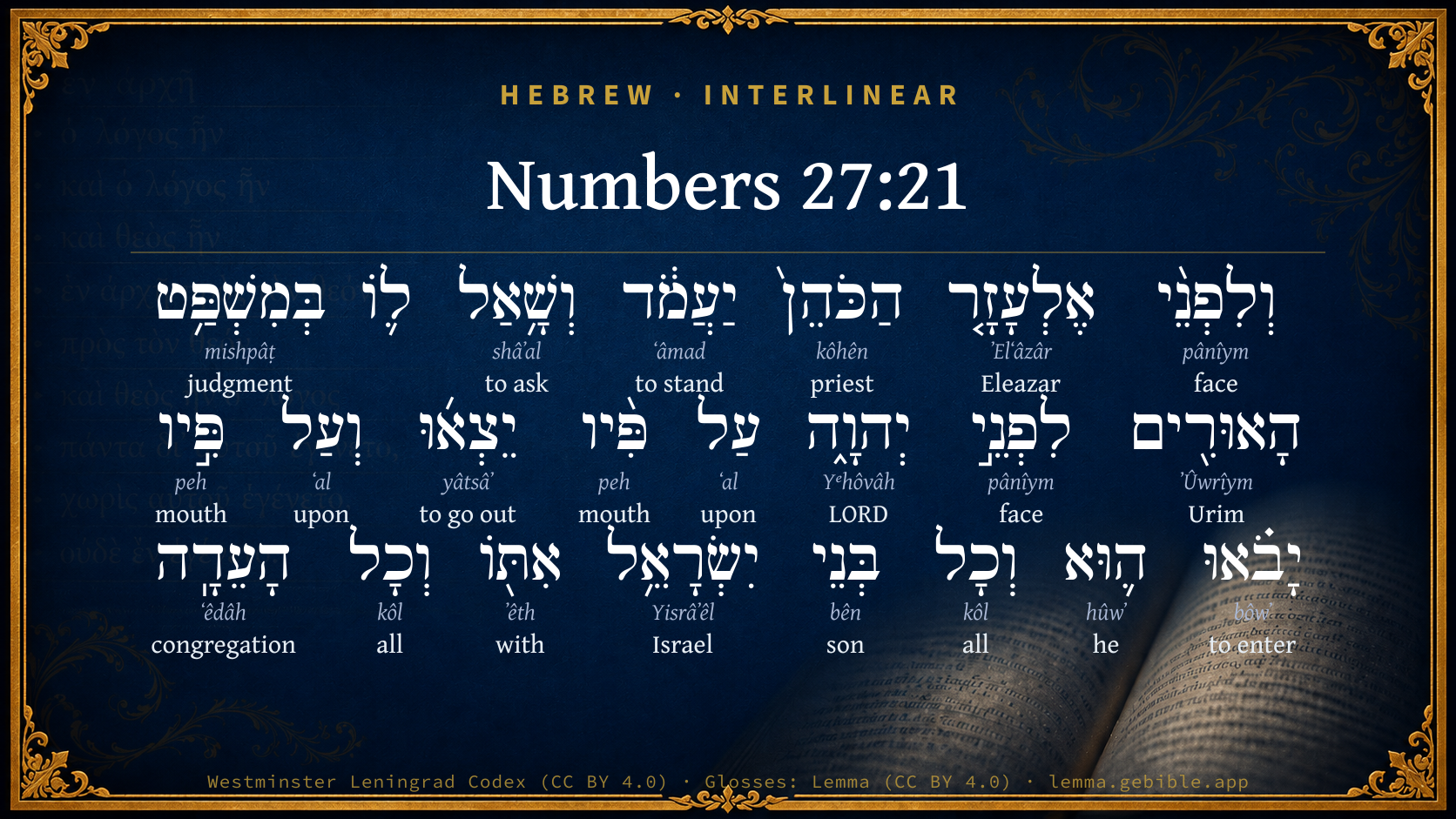
Numbers 27:21

Hebrew (Westminster Leningrad Codex) Numbers 27:21 appears in the Hebrew Old Testament. The text above is from the Westminster Leningrad Codex. Each word links to its Strong’s number, a concise gloss, and parsing drawn from the Open Scriptures Hebrew Bible morphology. Click any word for its full Brown-Driver-Briggs (BDB) entry.
Download image
Cite this verse

Numbers 27:21 (World English Bible). Public Domain. Lemma interlinear Bible study tool, https://lemma.gebible.app/v/numbers/27/21.

Show BibTeX & RIS
BibTeX
RIS
English Translation
He shall stand before Eleazar the priest, who shall inquire for him by the judgment of the Urim before Yahweh: at his word shall they go out, and at his word they shall come in, both he, and all the children of Israel with him, even all the congregation.
World English Bible · Public Domain
Download a study sheet

One document with this verse’s original text, its word-by-word gloss line, the meaning frame, cross-references with their text, attributed commentary, and full source and license credits — printable, and it pastes into notes with its structure intact.

This verse Autodidact and up

Study sheet (.html) Plain text (.txt)

A passage Seminary Student

Up to 50 verses in one chapter. A passage sheet keeps up to 6 commentary sources and 12 cross-references per verse, in the order this page ranks them, and says so on the sheet whenever that leaves anything out. Ask for a single verse and you get the Autodidact verse sheet above.

Everything on this page stays free to read, with no account — the sheet is a download of what is already on screen, not access to it.

Want to remove ads? Support Godless Engineer
Compare translations 3

The same verse in 3 English versions, stacked beneath the original-language interlinear above. Click any original word for its lexicon entry.

Each is an independent rendering of the whole verse — the interlinear is not word-aligned to these translations.

Highlighted words mark where these versions differ — a whole-verse word diff, not a word-by-word alignment.

  • World English Bible Public Domain
    He shall stand before Eleazar the priest, who shall inquire for him by the judgment of the Urim before Yahweh: at his word shall they go out, and at his word they shall come in, both he, and all the children of Israel with him, even all the congregation.
  • King James Version Public Domain
    And he shall stand before Eleazar the priest, who shall ask counsel for him after the judgment of Urim before the LORD: at his word shall they go out, and at his word they shall come in, both he, and all the children of Israel with him, even all the congregation.
  • unfoldingWord Literal Text CC BY-SA 4.0
    And he shall stand before the face of Eleazar the priest, and he shall ask for him by the judgment of the Urim before the face of Yahweh. In accordance with his mouth he shall go out and in accordance with his mouth he shall come in, he and all the sons of Israel with him and all the congregation.”

unfoldingWord Literal Text — © unfoldingWord, licensed CC BY-SA 4.0. Word-aligned USFM3 via Door43 (git.door43.org/unfoldingWord/en_ult).

Versions to compare (up to 4)

3 of 4 selected

Show all 18 translations

Every available English version of this verse, each an independent rendering of the whole verse.

  • World English Bible Public Domain
    He shall stand before Eleazar the priest, who shall inquire for him by the judgment of the Urim before Yahweh: at his word shall they go out, and at his word they shall come in, both he, and all the children of Israel with him, even all the congregation.
  • Berean Standard Bible Public Domain
    He shall stand before Eleazar the priest, who will seek counsel for him before the LORD by the judgment of the Urim. At his command, he and all the Israelites with him—the entire congregation—will go out and come in.”
  • Majority Standard Bible Public Domain
    He shall stand before Eleazar the priest, who will seek counsel for him before the LORD by the judgment of the Urim. At his command, he and all the Israelites with him—the entire congregation—will go out and come in.”
  • King James Version Public Domain
    And he shall stand before Eleazar the priest, who shall ask counsel for him after the judgment of Urim before the LORD: at his word shall they go out, and at his word they shall come in, both he, and all the children of Israel with him, even all the congregation.
  • American Standard Version (1901) Public Domain
    And he shall stand before Eleazar the priest, who shall inquire for him by the judgment of the Urim before Jehovah: at his word shall they go out, and at his word they shall come in, both he, and all the children of Israel with him, even all the congregation.
  • Revised Version (1885) Public Domain
    And he shall stand before Eleazar the priest, who shall inquire for him by the judgment of the Urim before the LORD: at his word shall they go out, and at his word they shall come in, both he, and all the children of Israel with him, even all the congregation.
  • Geneva Bible (1599) Public Domain
    And he shall stande before Eleazar the Priest, who shall aske counsell for him by the iudgement of Vrim before the Lord: at his worde they shall goe out, and at his worde they shall come in, both he, and all the children of Israel with him and all the Congregation.
  • Douay-Rheims (1899) Public Domain
    If any thing be to be done, Eleazar the priest shall consult the Lord for him. He and all the children of Israel with him, and the rest of the multitude shall go out and go in at his word.
  • Young's Literal Translation Public Domain
    `And before Eleazar the priest he standeth, and he hath asked for him by the judgment of the Lights before Jehovah; at His word they go out, and at His word they come in; he, and all the sons of Israel with him, even all the company.'
  • Literal Standard Version CC BY-SA 4.0
    And he stands before Eleazar the priest, and he has inquired before YHWH for him by the judgment of the Lights; at his word they go out, and at his word they come in, he and all the sons of Israel with him—even all the congregation.”
  • Unlocked Literal Bible CC BY-SA 4.0
    He will go before Eleazar the priest to seek my will for him by the decisions of the Urim. It will be at his command that the people will go out and come in, both he and all the people of Israel with him, the whole community.”
  • unfoldingWord Literal Text CC BY-SA 4.0
    And he shall stand before the face of Eleazar the priest, and he shall ask for him by the judgment of the Urim before the face of Yahweh. In accordance with his mouth he shall go out and in accordance with his mouth he shall come in, he and all the sons of Israel with him and all the congregation.”
  • Darby Bible Public Domain
    And he shall stand before Eleazar the priest, who shall inquire for him, by the judgment of the Urim before Jehovah: at his word shall they go out, and at his word they shall come in, he, and all the children of Israel with him, even the whole assembly.
  • World Messianic Bible Public Domain
    He shall stand before Eleazar the priest, who shall inquire for him by the judgment of the Urim before the LORD. At his word they shall go out, and at his word they shall come in, both he and all the children of Israel with him, even all the congregation.”
  • Webster's Bible Public Domain
    And he shall stand before Eleazar the priest, who shall ask counsel for him after the judgment of Urim before the LORD: at his word shall they go out, and at his word they shall come in, both he, and all the children of Israel with him, even all the congregation.
  • Free Bible Version CC BY-SA 4.0
    When he needs instructions, he is to go before Eleazar the priest who will ask the Lord on his behalf and find out the decision using the Urim. Joshua will give orders to all the Israelites concerning everything they are to do.”
  • Bible in Basic English Public Domain
    He will take his place before Eleazar the priest, so that he may get directions from the Lord for him, with the Urim: at his word they will go out, and at his word they will come in, he and all the children of Israel.
  • JPS Tanakh (1917) Public Domain
    And he shall stand before Eleazar the priest, who shall inquire for him by the judgment of the Urim before the LORD; at his word shall they go out, and at his word they shall come in, both he, and all the children of Israel with him, even all the congregation.'

Literal Standard Version (2020), Covenant Press — licensed CC BY-SA 4.0. Text via the HelloAO Bible API (eBible.org). Unlocked Literal Bible (unfoldingWord) — licensed CC BY-SA 4.0. Text via the HelloAO Bible API (eBible.org). unfoldingWord Literal Text — © unfoldingWord, licensed CC BY-SA 4.0. Word-aligned USFM3 via Door43 (git.door43.org/unfoldingWord/en_ult). Free Bible Version, Dr. Jonathan Gallagher — licensed CC BY-SA 4.0. Text via the HelloAO Bible API (eBible.org).

Word by word

More ways to search: Search by grammar → Find every occurrence → Compare this word →

Practice this passage: Drill this verse → Learn its vocabulary →

הָאוּרִ֖ים
ʼÛwrîym
H224
“the · Urim”
Particle, Definite Article + Noun, Common, Masculine, Plural, Absolute
Part of Speech
Particle + Noun
Type
Common
Gender
Masculine
Number
Plural
State
Absolute
Full BDB Definition

Origin: plural of H217

TWOT: None

Urim = "lights" - stones kept in a pouch on the high-priest's breastplate, used in determining God's decision in certain questions and issues
  1. וְלִפְנֵ֨י pânîym H6440 “and · to/for · face(s) of” Conjunction + Preposition + Noun, Common, Both, Plural, Construct
  2. אֶלְעָזָ֤ר ʼElʻâzâr H499 “Eleazar” Noun, Proper
  3. הַכֹּהֵן֙ kôhên H3548 “the · priest” Particle, Definite Article + Noun, Common, Masculine, Singular, Absolute
  4. יַעֲמֹ֔ד ʻâmad H5975 “to stand” Verb, Qal, Imperfect, 3rd Person, Masculine, Singular
  5. וְשָׁ֥אַל shâʼal H7592 “and · to ask” Conjunction + Verb, Qal, Sequential Perfect, 3rd Person, Masculine, Singular
  6. בְּמִשְׁפַּ֥ט mishpâṭ H4941 “in/at · judgment of” Preposition + Noun, Common, Masculine, Singular, Construct
  7. לִפְנֵ֣י pânîym H6440 “to/for · face(s) of” Preposition + Noun, Common, Both, Plural, Construct
  8. יְהוָ֑ה Yᵉhôvâh H3068 “LORD” Noun, Proper
  9. עַל ʻal H5921 “upon” Preposition
  10. פִּ֨יו peh H6310 “mouth · his” Noun, Common, Masculine, Singular, Construct + Suffix, Personal, 3rd Person, Masculine, Singular
  11. יֵצְא֜וּ yâtsâʼ H3318 “to go out” Verb, Qal, Imperfect, 3rd Person, Masculine, Plural
  12. וְעַל ʻal H5921 “and · upon” Conjunction + Preposition
  13. פִּ֣יו peh H6310 “mouth · his” Noun, Common, Masculine, Singular, Construct + Suffix, Personal, 3rd Person, Masculine, Singular
  14. יָבֹ֗אוּ bôwʼ H935 “to enter” Verb, Qal, Imperfect, 3rd Person, Masculine, Plural
  15. ה֛וּא hûwʼ H1931 “he” Pronoun, Personal, 3rd Person, Masculine, Singular
  16. וְכָל kôl H3605 “and · all of” Conjunction + Noun, Common, Masculine, Singular, Construct
  17. בְּנֵי bên H1121 “sons of” Noun, Common, Masculine, Plural, Construct
  18. יִשְׂרָאֵ֥ל Yisrâʼêl H3478 “Israel” Noun, Proper
  19. אִתּ֖וֹ ʼêth H854 “with · him” Preposition + Suffix, Personal, 3rd Person, Masculine, Singular
  20. וְכָל kôl H3605 “and · all of” Conjunction + Noun, Common, Masculine, Singular, Construct
  21. הָעֵדָֽה ʻêdâh H5712 “the · congregation” Particle, Definite Article + Noun, Common, Feminine, Singular, Absolute

About this verse

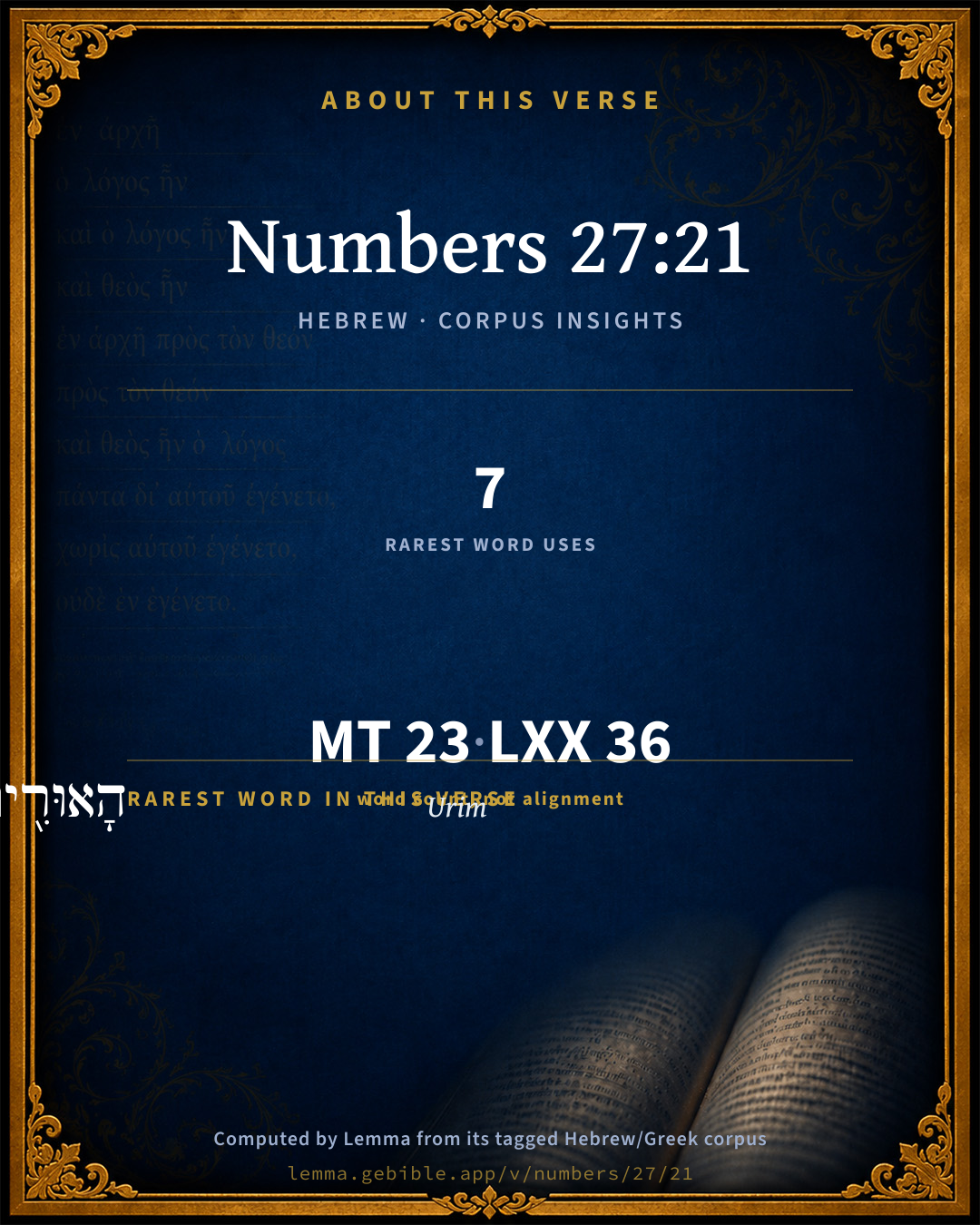
These counts appear in no published source. They are computed here, from the morphology-tagged text and Lemma’s own curated glosses. What Lemma adds →

23
words
18
distinct lemmas
Pentateuch
section

Notable vocabulary

The rarest word here is הָאוּרִ֖ים Urim H224 — appearing just 7 times in the whole Hebrew Bible.

Shared distinctive vocabulary

הָאוּרִ֖ים Urim H224 occurs in 7 verses of the Hebrew Bible. Also found in:

Grammatical profile

  • 4 verbs
  • 14 nouns
  • 1 pronoun
  • 4 prepositions

Verb forms

  • יַעֲמֹ֔ד Qal · Imperfect
  • וְשָׁ֥אַל Qal · Sequential Perfect
  • יֵצְא֜וּ Qal · Imperfect
  • יָבֹ֗אוּ Qal · Imperfect

Repetition

Words recur within this verse — often emphatic in Hebrew:

  • וְלִפְנֵ֨י face H6440 ×2
  • עַל upon H5921 ×2
  • פִּ֨יו mouth H6310 ×2
  • וְכָל all H3605 ×2

Hebrew & Septuagint length

In English translation the verse runs 49 words from the Hebrew and 50 from the Septuagint (LXX English) — closely comparable.

A rough comparison of the two English renderings, which tokenize alike — not a word-level alignment.

Word counts can differ between the Hebrew and the Greek without any difference in meaning — e.g. the Hebrew direct-object marker אֵת has no separate Greek word, and Greek often adds the article ὁ.

In the original languages it is 23 Hebrew tokens and 36 Greek tokens — but the two are counted differently (Hebrew bundles its prefixes and suffixes into one token; the Greek is in lemma form), so that isn’t a like-for-like length.

Cross-references

15

Topical passages linked to Numbers 27:21 in the Treasury of Scripture Knowledge — connected by theme and wording, ordered by reader-vote popularity; previews shown in the World English Bible.

  • Exodus 28:30 You shall put in the breastplate of judgment the Urim and the Thummim; and they shall be on Aaron's heart, when he goes in before Yahweh: and Aaron shall bear the judgment of the children of Israel on his heart before Yahweh continually.
  • Joshua 9:14 The men took of their provision, and didn't ask counsel at the mouth of Yahweh.
  • 1 Samuel 28:6 When Saul inquired of Yahweh, Yahweh didn't answer him, neither by dreams, nor by Urim, nor by prophets.
  • Leviticus 8:8 He placed the breastplate on him; and in the breastplate he put the Urim and the Thummim.
  • Numbers 27:17 who may go out before them, and who may come in before them, and who may lead them out, and who may bring them in; that the congregation of Yahweh not be as sheep which have no shepherd.
  • Deuteronomy 33:8 Of Levi he said, Your Thummim and your Urim are with your godly one, Whom you did prove at Massah, With whom you did strive at the waters of Meribah;
  • Judges 1:1 It happened after the death of Joshua, the children of Israel asked of Yahweh, saying, Who shall go up for us first against the Canaanites, to fight against them?
  • Judges 20:18 The children of Israel arose, and went up to Bethel, and asked counsel of God; and they said, Who shall go up for us first to battle against the children of Benjamin? Yahweh said, Judah [shall go up] first.
  • Judges 20:23 The children of Israel went up and wept before Yahweh until even; and they asked of Yahweh, saying, Shall I again draw near to battle against the children of Benjamin my brother? Yahweh said, Go up against him.
  • Judges 20:26–28 Then all the children of Israel, and all the people, went up, and came to Bethel, and wept, and sat there before Yahweh, and fasted that day until even; and they offered burnt-offerings and peace-offerings before Yahweh.
  • 1 Samuel 22:10–15 He inquired of Yahweh for him, and gave him food, and gave him the sword of Goliath the Philistine.
  • 1 Samuel 23:9 David knew that Saul was devising mischief against him; and he said to Abiathar the priest, Bring here the ephod.
  • 1 Samuel 30:7 David said to Abiathar the priest, the son of Ahimelech, Please bring me here the ephod. Abiathar brought there the ephod to David.
  • Ezra 2:63 The governor said to them, that they should not eat of the most holy things, until there stood up a priest with Urim and with Thummim.
  • Nehemiah 7:65 The governor said to them, that they should not eat of the most holy things, until there stood up a priest with Urim and Thummim.

Cross-references courtesy of OpenBible.info (CC BY 4.0).

Hebrew and Greek witnesses Masoretic Hebrew ↔ Greek Septuagint

The same verse in the two great witnesses to the Old Testament, shown verse-for-verse.

These are two independent witnesses, not word-aligned to each other, and the Septuagint is shown in lemma (dictionary) form.

Hebrew Numbers 27:21 Masoretic · Westminster Leningrad Codex

וְלִפְנֵ֨י אֶלְעָזָ֤ר הַכֹּהֵן֙ יַעֲמֹ֔ד וְשָׁ֥אַל ל֛וֹ בְּמִשְׁפַּ֥ט הָאוּרִ֖ים לִפְנֵ֣י יְהוָ֑ה עַל פִּ֨יו יֵצְא֜וּ וְעַל פִּ֣יו יָבֹ֗אוּ ה֛וּא וְכָל בְּנֵי יִשְׂרָאֵ֥ל אִתּ֖וֹ וְכָל הָעֵדָֽה

He shall stand before Eleazar the priest, who shall inquire for him by the judgment of the Urim before Yahweh: at his word shall they go out, and at his word they shall come in, both he, and all the children of Israel with him, even all the congregation.

World English Bible · Public Domain

Greek LXX Numbers 27:21 Septuagint · lemma form

καί ἔναντι ελεαζαρ ὁ ἱερεύς ἵστημι καί ἐπιἐρωτάω αὐτός ὁ κρίσις ὁ δῆλος ἔναντι κύριος ἐπί ὁ στόμα αὐτός ἐκἔρχομαι καί ἐπί ὁ στόμα αὐτός εἰςἔρχομαι αὐτός καί ὁ υἱός ἰσραήλ ὁμοθυμαδόν καί πᾶς ὁ συναγωγή

And he shall stand before Eleazar the priest, and they shall ask of him before the Lord the judgment of the Urim: they shall go forth at his word, and at his word they shall come in, he and the children of Israel with one accord, and all the congregation.

LXX2012 (modern English Septuagint) · Public Domain

On this verse, The Pulpit Commentary discusses the Septuagint’s reading. Read the note in Commentary ↓

Hebrew: Westminster Leningrad Codex (CC BY 4.0). Greek: Septuagint (public domain); English from LXX2012 (modern English Septuagint) (Public Domain). How the Septuagint differs from the Hebrew →

Targum (Aramaic paraphrase)

2

The Targum is the ancient Jewish Aramaic paraphrase of the Hebrew Scriptures — an interpretive translation, not the Hebrew text itself. Onkelos (literal) and Pseudo-Jonathan (expansive) render the Torah, and Jonathan the Prophets. Coverage is partial: where no permissively-licensed English translation exists for a verse, only the Aramaic is shown. This is verse-level text, not a word-by-word alignment to the Hebrew.

  1. Targum Onkelos Torah (Genesis–Deuteronomy)
    וְלִקֳדָם אֶלְעָזָר כַּהֲנָא יְקוּם וְיִשְׁאַל לֵיהּ בְּדִין אוּרַיָא קֳדָם יְיָ עַל מֵימְרֵיהּ יְהוֹן נַפְקִין וְעַל מֵימְרֵא יְהוֹן עָאלִין הוּא וְכָל בְּנֵי יִשְׂרָאֵל עִמֵיהּ וְכָל כְּנִשְׁתָּא

    (no public-domain English translation for this verse)

    Targum Onkelos — Aramaic: “Onkelos Genesis” (public domain); “Onkelos Exodus” (public domain); “Onkelos Leviticus” (public domain); “Onkelos Numbers” (public domain); “Onkelos Deuteronomy” (public domain). English: “Sefaria Community Translation” (CC0 1.0 (public-domain dedication)); “J.W. Etheridge. The Targums of Onkelos and Jonathan Ben Uzziel on the Pentateuch. London: Longmans, Green, 1862” (public domain). Text via Sefaria.

  2. Targum Pseudo-Jonathan Torah (Genesis–Deuteronomy)
    וּקְדָם אֶלְעָזָר כַּהֲנָא יְשַׁמֵישׁ וִיהֵי כַּד יִתְכַּסֵי מִנֵיהּ פִּתְגַם וְיַשְׁאִיל לֵיהּ בְּדִין אוּרַיָא קֳדָם יְיָ עַל מֵימְרָא דְאֶלְעָזָר כַּהֲנָא יְהוֹן נַפְקִין לְסִדְרֵי קְרָבָא וְעַל מֵימְרֵיהּ יְהוֹן עָלִין לְמֵידוֹן דִינָא הוּא וְכָל בְּנֵי יִשְרָאֵל עִמֵיהּ וְכָל כְּנִשְׁתָּא

    And he shall minister before Elazar the priest; and when any matter is hidden from him, he shall inquire for him before the Lord by Uraia. According to the word of Elazar the priest they shall go forth to battle, and come in to do judgment be and all the sons of Israel with him, even all the congregation.

    Targum Pseudo-Jonathan — Aramaic: “Targum Jonathan on Genesis” (public domain); “Targum Jonathan on Exodus” (public domain); “Targum Jonathan on Leviticus” (public domain); “Targum Jonathan on Numbers” (public domain); “Targum Jonathan on Deuteronomy” (public domain). English: “The Targum of Jonathan ben Uzziel, trans. J. W. Etheridge, London, 1862” (public domain). Text via Sefaria.

Commentary

Notes on Numbers 27:21 from classic Christian and Jewish commentators (each source and its license shown beneath its notes). The classic Christian expositions comment on the surrounding passage and are grouped to its opening verse, so a note may address several verses; the Jewish commentaries on the Tanakh (Rashi and others) are per-verse, so they appear only where the commentator wrote on this verse.

Lemma curates 59 commentaries, every one of them public domain or Creative Commons licensed, each selected and text-cleaned for this edition rather than reprinted as found. About our sources →

Joseph Benson's Commentary

Num 27:21. Who shall ask counsel for him — When he requires him so to do, and in important and difficult matters. From this and similar passages, it appears that the authority of the judge, or chief magistrate in Israel, however great, was not arbitrary, since in great emergencies he was obliged to have recourse to the high-priest, who was to ask counsel for him at the oracle. And some weighty matters were proposed to the congregation and princes, or senate of Israel, for their consent or decision. After the judgment of Urim — It appears from several passages, particularly 1Sa 14:18; 1Sa 23:2; 1Sa 28:6; 1Sa 30:7; 2Sa 5:19, that the high-priest, in consulting the oracle, was clothed with the ephod, or the sacerdotal vestment, to which belonged the breast- plate, and the Urim and Thummim. Thus, when David wanted to consult the oracle, he said to the priest, Bring hither the ephod: see 1Sa 30:7. In this and other places God is said to have answered him, but in what manner we are not told, only it appears to have been by a voice, 1Sa 30:3. But who uttered that voice, is a question. Spencer is of opinion that it was God himself, or an angel acting by commission from God. Le Clerc again contends that it was the high-priest himself that pronounced the words, but that he spake by divine inspiration: see on Exo 28:30. At his word shall they go out, &c. — That is, at the word of the Lord, delivered by the mouth of the priest. This shows the nature of the Jewish government, and that it is not without reason called a theocracy, or divine government; since no enterprise of moment was to be undertaken without first consulting the oracle of God by the priest. However, this is to be understood principally of their going out, or not going out, to war; upon which occasion chiefly the oracle was consulted, especially to know the event of it: see Jdg 1:1; Jdg 20:18; 1Sa 14:18; 1Sa 28:6. We may observe, that though Joshua was greatly inferior to Moses in this respect, he generally consulted God by the high- priest; whereas Moses had immediate access to God himself, and spake with him face to face; (Deu 34:10;) yet God sometimes vouchsafed the same honour to Joshua, and spake to him without the mediation of the priest: see Jos 3:7; Jos 4:1; Jos 4:15; Jos 5:13.

Joseph Benson's Commentary on the Old and New Testaments (1811–1818) — public domain. Text from a community e-Sword module.

Geneva Bible (1599)

Geneva Bible translators

According to his office: signifying that the civil magistrate could execute nothing but that which he knew to be the will of God.

Geneva Bible (1599) marginal notes — public domain. Text via Bolls.life.

Adam Clarke's Commentary

Verse 21. Eleazar the priest - shall ask counsel for him] Here was a remarkable difference between him and Moses. God talked with Moses face to face; but to Joshua only through the medium of the high priest.

Adam Clarke's Commentary on the Bible (1810–1826) — public domain. Text from a community e-Sword/MySword module.

Ellicott's Commentary for English Readers

(21) After the judgment of Urim . . . —See Exo_28:30, and Note.

At his word . . . —i.e., Joshua and the children of Israel were to abide by the decision of the high priest, which was obtained by means of Urim and Thummim.

A Bible Commentary for English Readers, edited by Charles John Ellicott (1878–1897) — public domain. Text from a community e-Sword module.

The Cambridge Bible for Schools and Colleges

gen. ed. J. J. S. Perowne

21. the Urim] The sacred lot by which the priests ascertained the will of God.

On the Urim and Tummim see the writer’s note on Exo_28:30.

This verse exemplifies the thought that Joshua’s dignity was to be less than that of Moses. Joshua must enquire of God’s will through the priest, whereas Moses always received commands straight from God Himself.

The Cambridge Bible for Schools and Colleges (gen. ed. J. J. S. Perowne; Cambridge University Press, 1878–1918) — public domain. Text from a community e-Sword module.

John Gill's Exposition

And Moses did as the Lord commanded him,.... Being faithful and obedient to him in all things, though ever so contrary to his own private interest and to that of his family:

and he took Joshua and set him before Eleazar the priest, and before all the congregation; as his successor, whom God had named and appointed as such.

John Gill's Exposition of the Whole Bible (1746–1763) — public domain (CC PDM 1.0). Text via the HelloAO Bible API.

Albert Barnes' Notes on the Bible

And he shall stand before Eleazar the priest ... - Joshua was thus to be inferior to what Moses had been. For Moses had enjoyed the privilege of unrestricted direct contact with God: Joshua, like all future rulers of Israel, was to ask counsel mediately, through the High Priest and those means of inquiring of God wherewith the high priest was entrusted. Such counsel Joshua seems to have omitted to seek when he concluded his hasty treaty with the Gibeonites (Jos 9:3 ff).

Judgment of Urim - See Exo 28:30 note.

Albert Barnes' Notes on the Bible (1834–1885) — public domain. Text from a community e-Sword/MySword module.

Haydock's Catholic Bible Commentary

For him. Hebrew adds, "according to the judgment of Urim." See Exodus xxviii. 30. Nothing better shews the theocracy of the Hebrews, as Josephus styles it, (contra Apion, 2,) than this order for the chief magistrate in civil affairs, to consult and be guided by God’s minister, and by the sentence which he should pronounce in his name. Till the reign of David, at least, we find few wars undertaken, without consulting God: (Calmet) and the Rabbins assert, that the kings could not declare any war of their own accord, without the consent of the high priest and Sanhedrim. (Selden, Syned. iii. 12.) Saul lost his crown and life for not complying with the injunctions of God, which were communicated to him by the prophet Samuel. (Haydock)

George Leo Haydock (1774–1849), Haydock's Catholic Family Bible and Commentary, 1859 edition — public domain. Excludes Psalms (Douay-Rheims chapter numbering differs from Protestant) and Deuterocanonical books (Catholic canon only).

Matthew Poole's English Annotations

Who shall ask counsel for him, when he requires him to do so, and in important and difficult matters. See Jos 9:14; Jdg 1:1; 20:18; 1Sa 23:9.

After the judgment, or, by or from the judgment, i.e. by seeking and receiving and communicating to him the judgment or sentence thereby given: or, by the judgment is here put defectively for by the breastplate of judgment, as it is called Exo 28:30, as the testimony is oft put for the ark of the testimony. Or, concerning the judgment; or sentence, i.e. what the mind and will of God is in the matter. Or, after the manner or rite, for so the Hebrew word mishpat here used oft signifies.

Urim, understand, and of Thummim, for these two generally go together; only here, as also 1Sa 28:6, Urim is synecdochically, put for both Urim and Thummim. For the manner of this inquiry and answer, see on Exo 28:30.

Before the Lord; ordinarily in the tabernacle near the second veil, setting his face to the ark, or otherwise presenting himself as in God’s presence, as Abiathar did by David’s direction, 1Sa 23:9, when they were both banished from the ark.

At his word, i.e. the word of the Lord, last mentioned, delivered to him by the high priest.

Matthew Poole's English Annotations on the Holy Bible (1683–1685) — public domain. Text from a community e-Sword/MySword module.

The Pulpit Commentary

He shall stand before Eleazar the priest. This points to the essential difference between Moses and Joshua, and all who came after until the "Prophet like unto" Moses was raised up. Moses was as much above the priests as he was above the tribe princes; but Joshua was only the civil and military head of the nation, and was as much subordinate to the high priest in one way as the high priest was subordinate to him in another. In after times no doubt the political headship quite overpowered and overshadowed the ecclesiastical, but this does not seem to have been so intended, or to have been the case in Eleazar"s lifetime. Who shall ask counsel for him after the judgment of Urim before the Lord. Rather, "who shall inquire for him in the judgment of Urim." fpvmiB.

Septuagint, thsin twn dhlwn . The Urim of this passage and of 1Sa_28:6 seems identical with the Urim and Thummim of Exo_28:30 Lev_8:8. What it actually was, and how it was used in con-suiting God, is not told us in Scripture, and has left no reliable trace in the tradition of the Jews; it must, therefore, remain for ever an insoluble mystery. It does not appear that Moses ever sought the judgment of Urim, for he possessed more direct means of ascertaining the will of God; nor does it seem ever to have been resorted to after the time of David, for the "more sure word of prophecy" superseded it. Its real use, therefore, belonged to the dark ages of Israel, after the light of Moses had set, and before the light of the prophets had arisen. At his word. Literally, after his mouth, i.e., according to the decision of Eleazar, given after consulting God by means of the Urim. (cf. Jos_9:14 Jud_1:1)

The Pulpit Commentary (1880–1919), ed. H.D.M. Spence-Jones & Joseph S. Exell — public domain. Text from a community e-Sword module.

John Wesley's Explanatory Notes

Who shall ask counsel for him - When he requires him to do so, and in important and difficult matters. Of Urim - Urim is put for both Urim and Thummim. Before the Lord - Ordinarily in the tabernacle near the second veil setting his face to the ark. At his word - The word of the Lord, delivered to him by the high priest.

John Wesley, Explanatory Notes Upon the Whole Bible (1754–1765) — public domain. Text via the GEBible commentary corpus.

Scofield Reference Notes

C. I. Scofield

after the

(See Scofield "Exo 28:30").

The Scofield Reference Bible (1917 edition), notes by C. I. Scofield — public domain. Text from a community e-Sword module.

Rashi

Rabbi Shlomo Yitzchaki (Rashi)

ולפני אלעזר הכהן יעמד AND HE SHALL STAND BEFORE ELEAZAR THE PRIEST — Here you have the request that you have made: that this honour should not depart from your father’s house, for Joshua, too, will need Eleazar (Midrash Tanchuma, Pinchas 11).

ושאל לו AND HE SHALL ASK OF HIM, whenever he finds it necessary to go forth to war (cf. Targum Jonathan on).

על פיו AT HIS WORD [SHALL THEY GO FORTH] — at Eleazar’s.

וכל העדה AND ALL THE CONGREGATION — the Sanhedrin (Sanhedrin 16a).

Rashi on the Tanakh — English translations: “The Judaica Press complete Tanach with Rashi, translated by A. J. Rosenberg” (CC BY 4.0); “Pentateuch with Rashi's commentary by M. Rosenbaum and A.M. Silbermann, 1929-1934” (public domain); “The Metsudah Tanach series, Lakewood, N.J” (CC BY 4.0); and “The Book of Joshua, Metsudah Publications, 1997” (CC BY 4.0). Text via Sefaria.

Lesson kit

Teaching starters — assembled from the data on this page, not authored interpretation. Every prompt links to the verse data it draws on. Edit before teaching.

Numbers, in the Pentateuch, opens this verse with 23 words (18 distinct Hebrew lemmas). Its most distinctive word is ʼÛwrîym (“Urim”). A historical commentator’s framing appears above. Read the whole chapter for the surrounding context.

Discussion questions

  1. The word ʼÛwrîym carries the sense “Urim.” How does it shape the verse?
  2. Exodus 28:30 shares the word «Urim» with this verse. How do the two illuminate each other?
  3. “face” occurs 2× in this one verse. What is the effect of the repetition?
  4. These translations render this verse differently; the difference is in the English rendering, not the original. What questions does that raise?
  5. The verb «יַעֲמֹ֔ד» is Qal Imperfect. How does its form color the action?
  6. Reading how Joseph Benson's Commentary and Geneva Bible (1599) read this verse, where do the two commentators agree and where do they part?

Things to notice

Reading settings

Reading text

Shown beneath each verse's original-language words.

Old Testament
Old Testament edition

Read the OT as the Masoretic Hebrew (MT) or the Greek Septuagint (LXX).

English shown for the Greek Septuagint (in the Hebrew ↔ Greek comparison).

Comparing translations? Open the Compare panel on any verse page to stack up to four side by side.