
Numbers 35:28

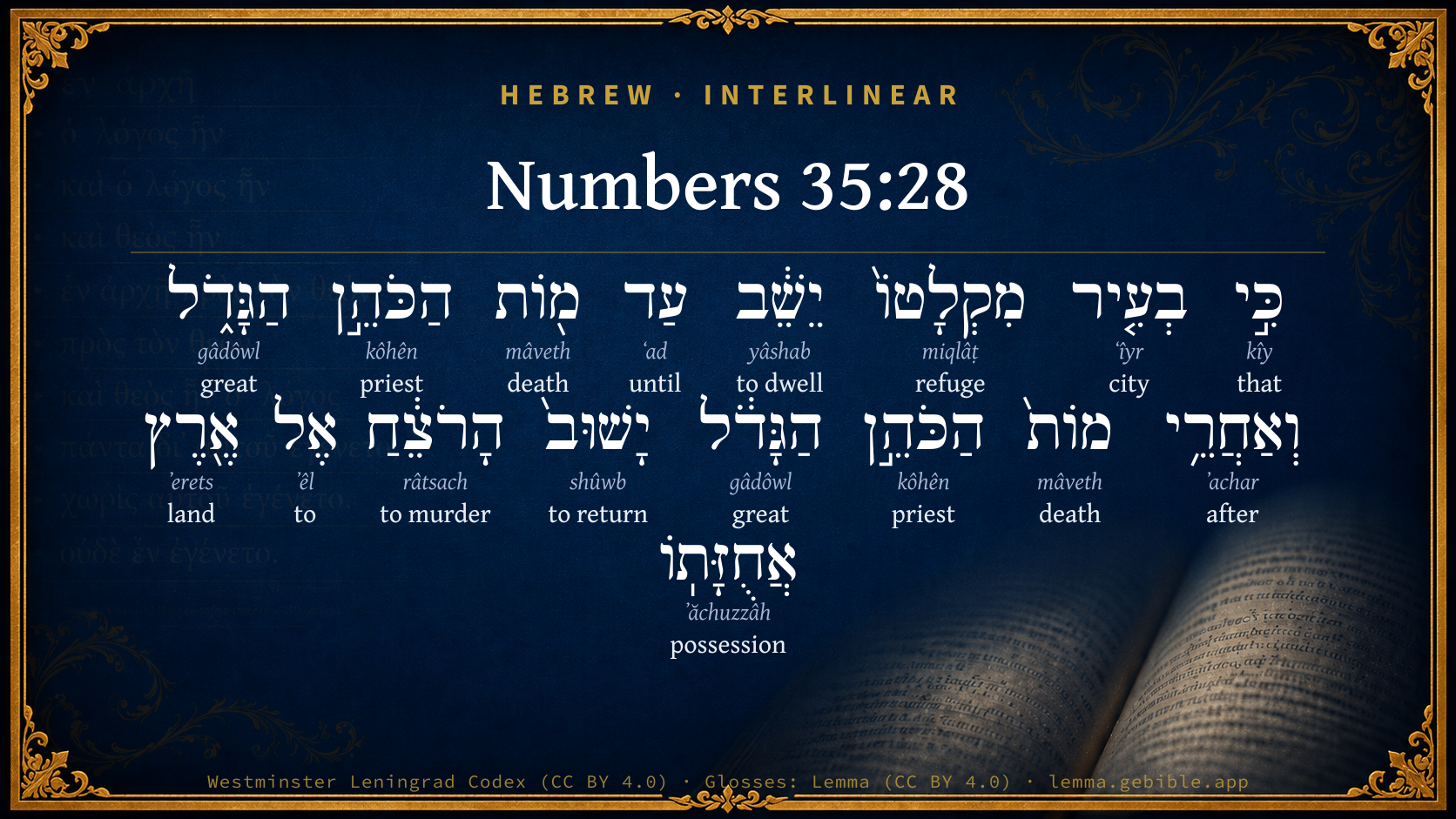
Hebrew (Westminster Leningrad Codex) Numbers 35:28 appears in the Hebrew Old Testament. The text above is from the Westminster Leningrad Codex. Each word links to its Strong’s number, a concise gloss, and parsing drawn from the Open Scriptures Hebrew Bible morphology. Click any word for its full Brown-Driver-Briggs (BDB) entry.
Download image
Cite this verse

Numbers 35:28 (World English Bible). Public Domain. Lemma interlinear Bible study tool, https://lemma.gebible.app/v/numbers/35/28.

Show BibTeX & RIS
BibTeX
RIS
English Translation
because he should have remained in his city of refuge until the death of the high priest: but after the death of the high priest the manslayer shall return into the land of his possession.
World English Bible · Public Domain
Download a study sheet

One document with this verse’s original text, its word-by-word gloss line, the meaning frame, cross-references with their text, attributed commentary, and full source and license credits — printable, and it pastes into notes with its structure intact.

This verse Autodidact and up

Study sheet (.html) Plain text (.txt)

A passage Seminary Student

Up to 50 verses in one chapter. A passage sheet keeps up to 6 commentary sources and 12 cross-references per verse, in the order this page ranks them, and says so on the sheet whenever that leaves anything out. Ask for a single verse and you get the Autodidact verse sheet above.

Everything on this page stays free to read, with no account — the sheet is a download of what is already on screen, not access to it.

Want to remove ads? Support Godless Engineer
Compare translations 3

The same verse in 3 English versions, stacked beneath the original-language interlinear above. Click any original word for its lexicon entry.

Each is an independent rendering of the whole verse — the interlinear is not word-aligned to these translations.

Highlighted words mark where these versions differ — a whole-verse word diff, not a word-by-word alignment.

  • World English Bible Public Domain
    because he should have remained in his city of refuge until the death of the high priest: but after the death of the high priest the manslayer shall return into the land of his possession.
  • King James Version Public Domain
    Because he should have remained in the city of his refuge until the death of the high priest: but after the death of the high priest the slayer shall return into the land of his possession.
  • unfoldingWord Literal Text CC BY-SA 4.0
    For in the city of his refuge he shall dwell until the death of the great priest, and after the death of the great priest the one who kills may return to the land of his possession.

unfoldingWord Literal Text — © unfoldingWord, licensed CC BY-SA 4.0. Word-aligned USFM3 via Door43 (git.door43.org/unfoldingWord/en_ult).

Versions to compare (up to 4)

3 of 4 selected

Show all 18 translations

Every available English version of this verse, each an independent rendering of the whole verse.

  • World English Bible Public Domain
    because he should have remained in his city of refuge until the death of the high priest: but after the death of the high priest the manslayer shall return into the land of his possession.
  • Berean Standard Bible Public Domain
    because the manslayer must remain in his city of refuge until the death of the high priest. Only after the death of the high priest may he return to the land he owns.
  • Majority Standard Bible Public Domain
    because the manslayer must remain in his city of refuge until the death of the high priest. Only after the death of the high priest may he return to the land he owns.
  • King James Version Public Domain
    Because he should have remained in the city of his refuge until the death of the high priest: but after the death of the high priest the slayer shall return into the land of his possession.
  • American Standard Version (1901) Public Domain
    because he should have remained in his city of refuge until the death of the high priest: but after the death of the high priest the manslayer shall return into the land of his possession.
  • Revised Version (1885) Public Domain
    because he should have remained in his city of refuge until the death of the high priest: but after the death of the high priest the manslayer shall return into the land of his possession.
  • Geneva Bible (1599) Public Domain
    Because he should haue remained in the citie of his refuge, vntill the death of the hie Priest: and after the death of the hie Priest, the slayer shall returne vnto the land of his possession.
  • Douay-Rheims (1899) Public Domain
    For the fugitive ought to have stayed in the city until the death of the high priest: and after he is dead, then shall the manslayer return to his own country.
  • Young's Literal Translation Public Domain
    for in the city of his refuge he doth dwell till the death of the chief priest; and after the death of the chief priest doth the man-slayer turn back unto the city of his possession.
  • Literal Standard Version CC BY-SA 4.0
    for he dwells in the city of his refuge until the death of the chief priest; and after the death of the chief priest the manslayer turns back to the city of his possession.
  • Unlocked Literal Bible CC BY-SA 4.0
    This is because the accused man should have remained in his city of refuge until the death of the high priest. After the death of the high priest, the accused may return to the land where he has his own property.
  • unfoldingWord Literal Text CC BY-SA 4.0
    For in the city of his refuge he shall dwell until the death of the great priest, and after the death of the great priest the one who kills may return to the land of his possession.
  • Darby Bible Public Domain
    for the manslayer should have remained in the city of his refuge until the death of the high-priest; but after the death of the high-priest he may return into the land of his possession.
  • World Messianic Bible Public Domain
    because he should have remained in his city of refuge until the death of the high priest. But after the death of the high priest, the man slayer shall return into the land of his possession.
  • Webster's Bible Public Domain
    Because he should have remained in the city of his refuge until the death of the high priest: but after the death of the high priest the slayer shall return into the land of his possession.
  • Free Bible Version CC BY-SA 4.0
    because the killer has to stay in his sanctuary town until the death of the high priest. Only after the death of the high priest is he allowed to return to the land he owns.
  • Bible in Basic English Public Domain
    Because he had been ordered to keep inside the safe town till the death of the high priest: but after the death of the high priest the taker of life may come back to the place of his heritage.
  • JPS Tanakh (1917) Public Domain
    because he must remain in his city of refuge until the death of the high priest; but after the death of the high priest the manslayer may return into the land of his possession.

Literal Standard Version (2020), Covenant Press — licensed CC BY-SA 4.0. Text via the HelloAO Bible API (eBible.org). Unlocked Literal Bible (unfoldingWord) — licensed CC BY-SA 4.0. Text via the HelloAO Bible API (eBible.org). unfoldingWord Literal Text — © unfoldingWord, licensed CC BY-SA 4.0. Word-aligned USFM3 via Door43 (git.door43.org/unfoldingWord/en_ult). Free Bible Version, Dr. Jonathan Gallagher — licensed CC BY-SA 4.0. Text via the HelloAO Bible API (eBible.org).

Word by word

More ways to search: Search by grammar → Find every occurrence → Compare this word →

Practice this passage: Drill this verse → Learn its vocabulary →

מִקְלָטוֹ֙
miqlâṭ
H4733
“refuge · his”
Noun, Common, Masculine, Singular, Construct + Suffix, Personal, 3rd Person, Masculine, Singular
Part of Speech
Noun
Type
Common
Gender
Masculine
Number
Singular
State
Construct
Full BDB Definition

Origin: from H7038 in the sense of taking in

TWOT: 2026a

refuge, asylum
  1. כִּ֣י kîy H3588 “that” Conjunction
  2. בְעִ֤יר ʻîyr H5892 “in/at · city of” Preposition + Noun, Common, Feminine, Singular, Construct
  3. יֵשֵׁ֔ב yâshab H3427 “to dwell” Verb, Qal, Imperfect, 3rd Person, Masculine, Singular
  4. עַד ʻad H5704 “until” Preposition
  5. מ֖וֹת mâveth H4194 “death of” Noun, Common, Masculine, Singular, Construct
  6. הַכֹּהֵ֣ן kôhên H3548 “the · priest” Particle, Definite Article + Noun, Common, Masculine, Singular, Absolute
  7. הַגָּדֹ֑ל gâdôwl H1419 “the · great” Particle, Definite Article + Adjective, Adjective, Masculine, Singular, Absolute
  8. וְאַחֲרֵ֥י ʼachar H310 “and · after” Conjunction + Preposition
  9. מוֹת֙ mâveth H4194 “death of” Noun, Common, Masculine, Singular, Construct
  10. הַכֹּהֵ֣ן kôhên H3548 “the · priest” Particle, Definite Article + Noun, Common, Masculine, Singular, Absolute
  11. הַגָּדֹ֔ל gâdôwl H1419 “the · great” Particle, Definite Article + Adjective, Adjective, Masculine, Singular, Absolute
  12. יָשׁוּב֙ shûwb H7725 “to return” Verb, Qal, Imperfect, 3rd Person, Masculine, Singular
  13. הָרֹצֵ֔חַ râtsach H7523 “the · murdering” Particle, Definite Article + Verb, Qal, Participle Active, Masculine, Singular, Absolute
  14. אֶל ʼêl H413 “to” Preposition
  15. אֶ֖רֶץ ʼerets H776 “land of” Noun, Common, Both, Singular, Construct
  16. אֲחֻזָּתֽוֹ ʼăchuzzâh H272 “possession · his” Noun, Common, Feminine, Singular, Construct + Suffix, Personal, 3rd Person, Masculine, Singular

About this verse

These counts appear in no published source. They are computed here, from the morphology-tagged text and Lemma’s own curated glosses. What Lemma adds →

17
words
14
distinct lemmas
Pentateuch
section

Notable vocabulary

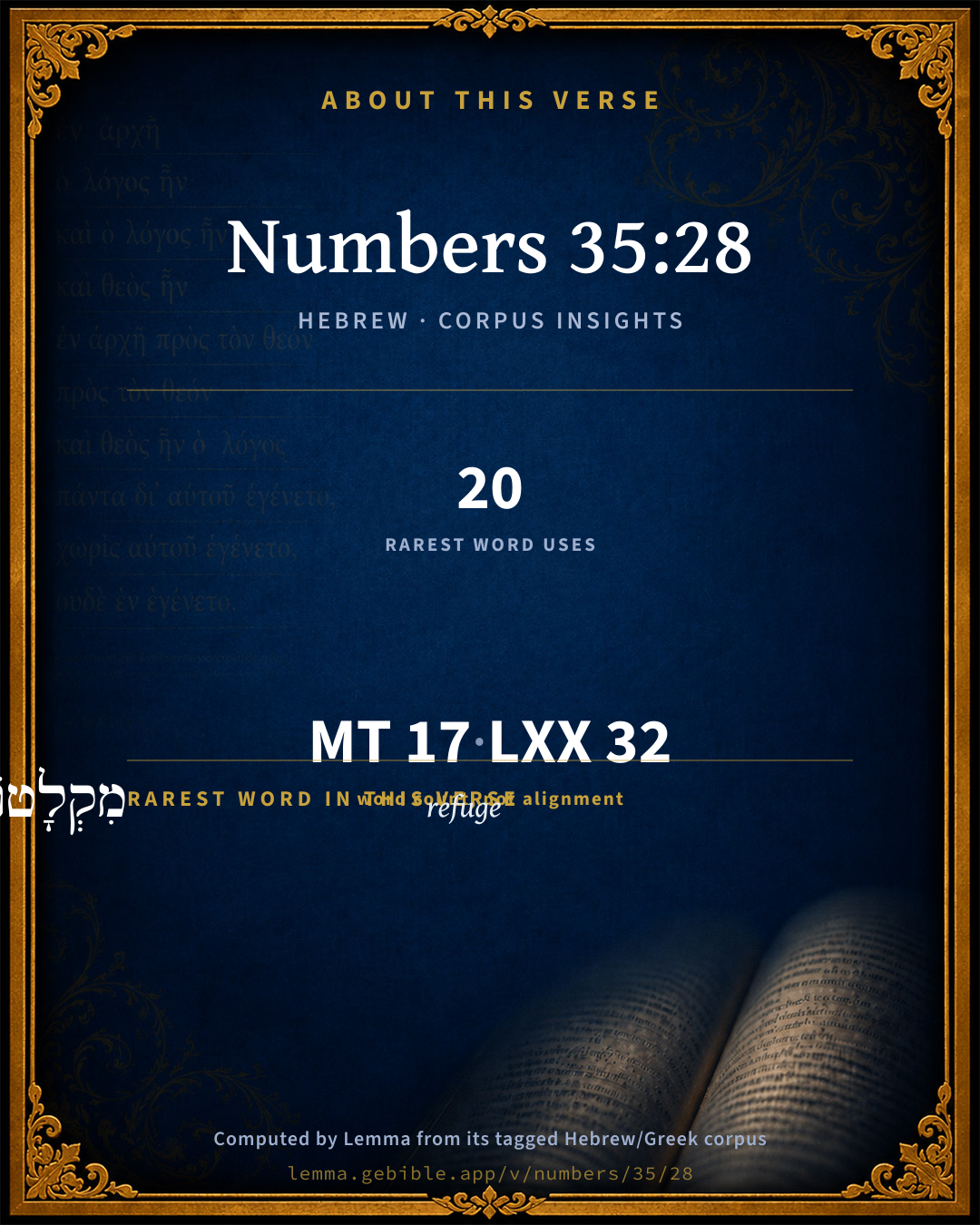
The rarest word here is מִקְלָטוֹ֙ refuge H4733 — appearing just 20 times in the whole Hebrew Bible.

Shared distinctive vocabulary

מִקְלָטוֹ֙ refuge H4733 occurs in 20 verses of the Hebrew Bible. Also found in:

Grammatical profile

  • 3 verbs
  • 8 nouns
  • 2 adjectives
  • 3 prepositions
  • 1 conjunction

Verb forms

  • יֵשֵׁ֔ב Qal · Imperfect
  • יָשׁוּב֙ Qal · Imperfect
  • הָרֹצֵ֔חַ Qal · Participle Active

Repetition

Words recur within this verse — often emphatic in Hebrew:

  • מ֖וֹת death H4194 ×2
  • הַכֹּהֵ֣ן priest H3548 ×2
  • הַגָּדֹ֑ל great H1419 ×2

Hebrew & Septuagint length

In English translation the verse runs 35 words from the Hebrew and 32 from the Septuagint (LXX English) — closely comparable.

A rough comparison of the two English renderings, which tokenize alike — not a word-level alignment.

Word counts can differ between the Hebrew and the Greek without any difference in meaning — e.g. the Hebrew direct-object marker אֵת has no separate Greek word, and Greek often adds the article ὁ.

In the original languages it is 17 Hebrew tokens and 32 Greek tokens — but the two are counted differently (Hebrew bundles its prefixes and suffixes into one token; the Greek is in lemma form), so that isn’t a like-for-like length.

Cross-references

9

Topical passages linked to Numbers 35:28 in the Treasury of Scripture Knowledge — connected by theme and wording, ordered by reader-vote popularity; previews shown in the World English Bible.

  • John 15:4–6 Remain in me, and I in you. As the branch can't bear fruit by itself, unless it remains in the vine, so neither can you, unless you remain in me.
  • Acts 11:23 who, when he had come, and had seen the grace of God, was glad. He exhorted them all, that with purpose of heart they should remain near to the Lord.
  • Acts 27:31 Paul said to the centurion and to the soldiers, "Unless these stay in the ship, you can't be saved."
  • Hebrews 3:14 For we have become partakers of Christ, if we hold fast the beginning of our confidence firm to the end:
  • Hebrews 6:4–8 For concerning those who were once enlightened and tasted of the heavenly gift, and were made partakers of the Holy Spirit,
  • Hebrews 9:11–12 But Christ having come as a high priest of the coming good things, through the greater and more perfect tabernacle, not made with hands, that is to say, not of this creation,
  • Hebrews 9:15–17 For this reason he is the mediator of a new covenant, since a death has occurred for the redemption of the transgressions that were under the first covenant, that those who have been called may receive the promise of the eternal inheritance.
  • Hebrews 10:26–30 For if we sin willfully after we have received the knowledge of the truth, there remains no more a sacrifice for sins,
  • Hebrews 10:39 But we are not of those who shrink back to destruction, but of those who have faith to the saving of the soul.

Cross-references courtesy of OpenBible.info (CC BY 4.0).

Hebrew and Greek witnesses Masoretic Hebrew ↔ Greek Septuagint

The same verse in the two great witnesses to the Old Testament, shown verse-for-verse.

These are two independent witnesses, not word-aligned to each other, and the Septuagint is shown in lemma (dictionary) form.

Hebrew Numbers 35:28 Masoretic · Westminster Leningrad Codex

כִּ֣י בְעִ֤יר מִקְלָטוֹ֙ יֵשֵׁ֔ב עַד מ֖וֹת הַכֹּהֵ֣ן הַגָּדֹ֑ל וְאַחֲרֵ֥י מוֹת֙ הַכֹּהֵ֣ן הַגָּדֹ֔ל יָשׁוּב֙ הָרֹצֵ֔חַ אֶל אֶ֖רֶץ אֲחֻזָּתֽוֹ

because he should have remained in his city of refuge until the death of the high priest: but after the death of the high priest the manslayer shall return into the land of his possession.

World English Bible · Public Domain

Greek LXX Numbers 35:28 Septuagint · lemma form

ἐν γάρ ὁ πόλις ὁ καταφυγή καταοἰκέω ἕως ἄν ἀποθνήσκω ὁ ἱερεύς ὁ μέγας καί μετά ὁ ἀποθνήσκω ὁ ἱερεύς ὁ μέγας ἐπι ἀναστρέφω ὁ φονεύω εἰς ὁ γῆ ὁ κατάσχεσις αὐτός

For he ought to have remained in the city of refuge till the high-priest died; and after the death of the high-priest the slayer shall return to the land of his possession.

LXX2012 (modern English Septuagint) · Public Domain

Hebrew: Westminster Leningrad Codex (CC BY 4.0). Greek: Septuagint (public domain); English from LXX2012 (modern English Septuagint) (Public Domain). How the Septuagint differs from the Hebrew →

Targum (Aramaic paraphrase)

2

The Targum is the ancient Jewish Aramaic paraphrase of the Hebrew Scriptures — an interpretive translation, not the Hebrew text itself. Onkelos (literal) and Pseudo-Jonathan (expansive) render the Torah, and Jonathan the Prophets. Coverage is partial: where no permissively-licensed English translation exists for a verse, only the Aramaic is shown. This is verse-level text, not a word-by-word alignment to the Hebrew.

  1. Targum Onkelos Torah (Genesis–Deuteronomy)
    אֲרֵי בְקִרְיַת שֵׁזָבוּתֵהּ יִתֵּב עַד דִימוּת כַּהֲנָא רַבָּא וּבָתַר דִימוּת כַּהֲנָא רַבָּא יְתוּב קָטּוֹלָא לְאֲרַע אַחֲסַנְתֵּה

    (no public-domain English translation for this verse)

    Targum Onkelos — Aramaic: “Onkelos Genesis” (public domain); “Onkelos Exodus” (public domain); “Onkelos Leviticus” (public domain); “Onkelos Numbers” (public domain); “Onkelos Deuteronomy” (public domain). English: “Sefaria Community Translation” (CC0 1.0 (public-domain dedication)); “J.W. Etheridge. The Targums of Onkelos and Jonathan Ben Uzziel on the Pentateuch. London: Longmans, Green, 1862” (public domain). Text via Sefaria.

  2. Targum Pseudo-Jonathan Torah (Genesis–Deuteronomy)
    אֲרוּם בְּקוּרְיְיתָא דְקַלְטֵיהּ יְתֵיב עַד דִימוּת כַּהֲנָא רַבָּא וּמִן בָּתַר דִימוּת כַּהֲנָא רַבָּא יְתוּב קָטוֹלָא לְאַרַע אַחֲסַנְתֵּיהּ

    for he should have abode in his city of refuge until the death of the high priest; but after the high priest is dead he may return to the land of his inheritance.

    Targum Pseudo-Jonathan — Aramaic: “Targum Jonathan on Genesis” (public domain); “Targum Jonathan on Exodus” (public domain); “Targum Jonathan on Leviticus” (public domain); “Targum Jonathan on Numbers” (public domain); “Targum Jonathan on Deuteronomy” (public domain). English: “The Targum of Jonathan ben Uzziel, trans. J. W. Etheridge, London, 1862” (public domain). Text via Sefaria.

Commentary

Notes on Numbers 35:28 from classic Christian and Jewish commentators (each source and its license shown beneath its notes). The classic Christian expositions comment on the surrounding passage and are grouped to its opening verse, so a note may address several verses; the Jewish commentaries on the Tanakh (Rashi and others) are per-verse, so they appear only where the commentator wrote on this verse.

Lemma curates 59 commentaries, every one of them public domain or Creative Commons licensed, each selected and text-cleaned for this edition rather than reprinted as found. About our sources →

John Gill's Exposition

Because he should have remained in the city of his refuge until the death of the high priest,.... Nothing could give him his liberty but his death; so that though this was a merciful provision made in such cases for such persons, and was a considerable benefit and privilege, yet it carried in it some appearance of a punishment; since such a person was confined within the boundaries of one of the cities of refuge as long as the high priest lived; and this was done to make persons cautious how they were any way accessory to the death of another, though without design:

but after the death of the high priest the slayer shall return into the land of his possession; to that part of the land, and to that tribe to which he belonged, to his house and family, and to his possessions and inheritances, whatever he had, and to all the honours and privileges he before enjoyed, and under no danger from the avenger of blood henceforward: a custom somewhat like this has prevailed in some parts of Africa, as Leo Africanus (y) relates, that if a man happened to kill another, all the friends of the deceased conspired to kill him, but if they could not effect it, then the guilty person was proclaimed an exile from the city, for the whole space of seven years; and at the expiration of the whole seven years, when he returned from his exile, the chief men of the city invited him to a feast, and so he was restored to his liberty: temples, groves, altars, and statues, were common among other nations for asylums or refuges, but whole cities very rarely with the ancients; it seems there were some (z).

(y) Descriptio Africae, l. 2. p. 135, 136. (z) Vid. Marmor. Oxon. & Not. in ib. p. 25. & Rittershusium de Jure Asylorum, c. 2.

John Gill's Exposition of the Whole Bible (1746–1763) — public domain (CC PDM 1.0). Text via the HelloAO Bible API.

Lesson kit

Teaching starters — assembled from the data on this page, not authored interpretation. Every prompt links to the verse data it draws on. Edit before teaching.

Numbers, in the Pentateuch, opens this verse with 17 words (14 distinct Hebrew lemmas). Its most distinctive word is miqlâṭ (“refuge”). A historical commentator’s framing appears above. Read the whole chapter for the surrounding context.

Discussion questions

  1. How does “refuge” (miqlâṭ) shape what this verse is saying?
  2. Numbers 35:6 shares the word «refuge» with this verse. How do the two illuminate each other?
  3. “death” occurs 2× in this one verse. What is the effect of the repetition?
  4. The translations on this page render this verse differently — a whole-verse word diff, not a word-by-word alignment. What might account for the different wordings?
  5. The verb «יֵשֵׁ֔ב» is Qal Imperfect. How does its form color the action?

Things to notice

Reading settings

Reading text

Shown beneath each verse's original-language words.

Old Testament
Old Testament edition

Read the OT as the Masoretic Hebrew (MT) or the Greek Septuagint (LXX).

English shown for the Greek Septuagint (in the Hebrew ↔ Greek comparison).

Comparing translations? Open the Compare panel on any verse page to stack up to four side by side.